Search Results: "agi"

29 April 2022

Russ Allbery: Review: Interesting Times

Review: Interesting Times, by Terry Pratchett
Series: Discworld #17
Publisher: Harper
Copyright: 1994
Printing: February 2014
ISBN: 0-06-227629-8
Format: Mass market
Pages: 399
Interesting Times is the seventeenth Discworld novel and certainly not the place to start. At the least, you will probably want to read The Colour of Magic and The Light Fantastic before this book, since it's a sequel to those (although Rincewind has had some intervening adventures). Lord Vetinari has received a message from the Counterweight Continent, the first in ten years, cryptically demanding the Great Wizzard be sent immediately. The Agatean Empire is one of the most powerful states on the Disc. Thankfully for everyone else, it normally suits its rulers to believe that the lands outside their walls are inhabited only by ghosts. No one is inclined to try to change their minds or otherwise draw their attention. Accordingly, the Great Wizard must be sent, a task that Vetinari efficiently delegates to the Archchancellor. There is only the small matter of determining who the Great Wizzard is, and why it was spelled with two z's. Discworld readers with a better memory than I will recall Rincewind's hat. Why the Counterweight Continent would demanding a wizard notorious for his near-total inability to perform magic is a puzzle for other people. Rincewind is promptly located by a magical computer, and nearly as promptly transported across the Disc, swapping him for an unnecessarily exciting object of roughly equivalent mass and hurling him into an unexpected rescue of Cohen the Barbarian. Rincewind predictably reacts by running away, although not fast or far enough to keep him from being entangled in a glorious popular uprising. Or, well, something that has aspirations of being glorious, and popular, and an uprising. I hate to say this, because Pratchett is an ethically thoughtful writer to whom I am willing to give the benefit of many doubts, but this book was kind of racist. The Agatean Empire is modeled after China, and the Rincewind books tend to be the broadest and most obvious parodies, so that was already a recipe for some trouble. Some of the social parody is not too objectionable, albeit not my thing. I find ethnic stereotypes and making fun of funny-sounding names in other languages (like a city named Hunghung) to be in poor taste, but Pratchett makes fun of everyone's names and cultures rather equally. (Also, I admit that some of the water buffalo jokes, despite the stereotypes, were pretty good.) If it had stopped there, it would have prompted some eye-rolling but not much comment. Unfortunately, a significant portion of the plot depends on the idea that the population of the Agatean Empire has been so brainwashed into obedience that they have a hard time even imagining resistance, and even their revolutionaries are so polite that the best they can manage for slogans are things like "Timely Demise to All Enemies!" What they need are a bunch of outsiders, such as Rincewind or Cohen and his gang. More details would be spoilers, but there are several deliberate uses of Ankh-Morpork as a revolutionary inspiration and a great deal of narrative hand-wringing over how awful it is to so completely convince people they are slaves that you don't need chains. There is a depressingly tedious tendency of western writers, even otherwise thoughtful and well-meaning ones like Pratchett, to adopt a simplistic ranking of political systems on a crude measure of freedom. That analysis immediately encounters the problem that lots of people who live within systems that rate poorly on this one-dimensional scale seem inadequately upset about circumstances that are "obviously" horrific oppression. This should raise questions about the validity of the assumptions, but those assumptions are so unquestionable that the writer instead decides the people who are insufficiently upset about their lack of freedom must be defective. The more racist writers attribute that defectiveness to racial characteristics. The less racist writers, like Pratchett, attribute that defectiveness to brainwashing and systemic evil, which is not quite as bad as overt racism but still rests on a foundation of smug cultural superiority. Krister Stendahl, a bishop of the Church of Sweden, coined three famous rules for understanding other religions:
  1. When you are trying to understand another religion, you should ask the adherents of that religion and not its enemies.
  2. Don't compare your best to their worst.
  3. Leave room for "holy envy."
This is excellent advice that should also be applied to politics. Most systems exist for some reason. The differences from your preferred system are easy to see, particularly those that strike you as horrible. But often there are countervailing advantages that are less obvious, and those are more psychologically difficult to understand and objectively analyze. You might find they have something that you wish your system had, which causes discomfort if you're convinced you have the best political system in the world, or are making yourself feel better about the abuses of your local politics by assuring yourself that at least you're better than those people. I was particularly irritated to see this sort of simplistic stereotyping in Discworld given that Ankh-Morpork, the setting of most of the Discworld novels, is an authoritarian dictatorship. Vetinari quite capably maintains his hold on power, and yet this is not taken as a sign that the city's inhabitants have been brainwashed into considering themselves slaves. Instead, he's shown as adept at maintaining the stability of a precarious system with a lot of competing forces and a high potential for destructive chaos. Vetinari is an awful person, but he may be better than anyone who would replace him. Hmm. This sort of complexity is permitted in the "local" city, but as soon as we end up in an analog of China, the rulers are evil, the system lacks any justification, and the peasants only don't revolt because they've been trained to believe they can't. Gah. I was muttering about this all the way through Interesting Times, which is a shame because, outside of the ham-handed political plot, it has some great Pratchett moments. Rincewind's approach to any and all danger is a running (sorry) gag that keeps working, and Cohen and his gang of absurdly competent decrepit barbarians are both funnier here than they have been in any previous book and the rare highly-positive portrayal of old people in fantasy adventures who are not wizards or crones. Pretty Butterfly is a great character who deserved to be in a better plot. And I loved the trouble that Rincewind had with the Agatean tonal language, which is an excuse for Pratchett to write dialog full of frustrated non-sequiturs when Rincewind mispronounces a word. I do have to grumble about the Luggage, though. From a world-building perspective its subplot makes sense, but the Luggage was always the best character in the Rincewind stories, and the way it lost all of its specialness here was oddly sad and depressing. Pratchett also failed to convince me of the drastic retcon of The Colour of Magic and The Light Fantastic that he does here (and which I can't talk about in detail due to spoilers), in part because it's entangled in the orientalism of the plot. I'm not sure Pratchett could write a bad book, and I still enjoyed reading Interesting Times, but I don't think he gave the politics his normal care, attention, and thoughtful humanism. I hope later books in this part of the Disc add more nuance, and are less confident and judgmental. I can't really recommend this one, even though it has some merits. Also, just for the record, "may you live in interesting times" is not a Chinese curse. It's an English saying that likely was attributed to China to make it sound exotic, which is the sort of landmine that good-natured parody of other people's cultures needs to be wary of. Followed in publication order by Maskerade, and in Rincewind's personal timeline by The Last Continent. Rating: 6 out of 10

28 April 2022

Jonathan McDowell: Resizing consoles automatically

I have 2 very useful shell scripts related to resizing consoles. The first is imaginatively called resize and just configures the terminal to be the requested size, neatly resizing an xterm or gnome-terminal:

#!/bin/sh
# resize <rows> <columns>
/bin/echo -e '\033[8;'$1';'$2't'
The other is a bit more complicated and useful when connecting to a host via a serial console, or when driving a qemu VM with -display none -nographic and all output coming over a serial console on stdio. It figures out the size of the terminal it s running in and correctly sets the local settings to match so you can take full advantage of a larger terminal than the default 80x24:
#!/bin/bash
echo -ne '\e[s\e[5000;5000H'
IFS='[;' read -p $'\e[6n' -d R -a pos -rs
echo -ne '\e[u'
# cols / rows
echo "Size: $ pos[2]  x $ pos[1] "
stty cols "$ pos[2] " rows "$ pos[1] "
export TERM=xterm-256color
Generally I source this with . fix-term or the TERM export doesn t get applied. Both of these exist in various places around the net (and there s a resize binary shipped along with xterm) but I always forget the exact terms to find it again when I need it. So this post is mostly intended to serve as future reference next time I don t have them handy.

27 April 2022

Antoine Beaupr : Using LSP in Emacs and Debian

The Language Server Protocol (LSP) is a neat mechanism that provides a common interface to what used to be language-specific lookup mechanisms (like, say, running a Python interpreter in the background to find function definitions). There is also ctags shipped with UNIX since forever, but that doesn't support looking backwards ("who uses this function"), linting, or refactoring. In short, LSP rocks, and how do I use it right now in my editor of choice (Emacs, in my case) and OS (Debian) please?

Editor (emacs) setup First, you need to setup your editor. The Emacs LSP mode has pretty good installation instructions which, for me, currently mean:
apt install elpa-lsp-mode
and this .emacs snippet:
(use-package lsp-mode
  :commands (lsp lsp-deferred)
  :hook ((python-mode go-mode) . lsp-deferred)
  :demand t
  :init
  (setq lsp-keymap-prefix "C-c l")
  ;; TODO: https://emacs-lsp.github.io/lsp-mode/page/performance/
  ;; also note re "native compilation": <+varemara> it's the
  ;; difference between lsp-mode being usable or not, for me
  :config
  (setq lsp-auto-configure t))
(use-package lsp-ui
  :config
  (setq lsp-ui-flycheck-enable t)
  (add-to-list 'lsp-ui-doc-frame-parameters '(no-accept-focus . t))
  (define-key lsp-ui-mode-map [remap xref-find-definitions] #'lsp-ui-peek-find-definitions)
  (define-key lsp-ui-mode-map [remap xref-find-references] #'lsp-ui-peek-find-references))
Note: this configuration might have changed since I wrote this, see my init.el configuration for the most recent config. The main reason for choosing lsp-mode over eglot is that it's in Debian (and eglot is not). (Apparently, eglot has more chance of being upstreamed, "when it's done", but I guess I'll cross that bridge when I get there.) I already had lsp-mode partially setup in Emacs so I only had to do this small tweak to switch and change the prefix key (because s-l or mod is used by my window manager). I also had to pin LSP packages to bookworm here so that it properly detects pylsp (the older version in Debian bullseye only supports pyls, not packaged in Debian). This won't do anything by itself: Emacs will need something to talk with to provide the magic. Those are called "servers" and are basically different programs, for each programming language, that provide the magic.

Servers setup The Emacs package provides a way (M-x lsp-install-server) to install some of them, but I prefer to manage those tools through Debian packages if possible, just like lsp-mode itself. Those are the servers I currently know of in Debian:
package languages
ccls C, C++, ObjectiveC
clangd C, C++, ObjectiveC
elpa-lsp-haskell Haskell
fortran-language-server Fortran
gopls Golang
python3-pyls Python
There might be more such packages, but those are surprisingly hard to find. I found a few with apt search "Language Server Protocol", but that didn't find ccls, for example, because that just said "Language Server" in the description (which also found a few more pyls plugins, e.g. black support). Note that the Python packages, in particular, need to be upgraded to their bookworm releases to work properly (here). It seems like there's some interoperability problems there that I haven't quite figured out yet. See also my Puppet configuration for LSP. Finally, note that I have now completely switched away from Elpy to pyls, and I'm quite happy with the results. lsp-mode feels slower than elpy but I haven't done any of the performance tuning and this will improve even more with native compilation. And lsp-mode is much more powerful. I particularly like the "rename symbol" functionality, which ... mostly works.

Remaining work

Puppet and Ruby I still have to figure how to actually use this: I mostly spend my time in Puppet these days, there is no server listed in the Emacs lsp-mode language list, but there is one listed over at the upstream language list, the puppet-editor-services server. But it's not packaged in Debian, and seems somewhat... involved. It could still be a good productivity boost. The Voxpupuli team have vim install instructions which also suggest installing solargraph, the Ruby language server, also not packaged in Debian.

Bash I guess I do a bit of shell scripting from time to time nowadays, even though I don't like it. So the bash-language-server may prove useful as well.

Other languages Here are more language servers available:

Antoine Beaupr : building Debian packages under qemu with sbuild

I've been using sbuild for a while to build my Debian packages, mainly because it's what is used by the Debian autobuilders, but also because it's pretty powerful and efficient. Configuring it just right, however, can be a challenge. In my quick Debian development guide, I had a few pointers on how to configure sbuild with the normal schroot setup, but today I finished a qemu based configuration.

Why I want to use qemu mainly because it provides better isolation than a chroot. I sponsor packages sometimes and while I typically audit the source code before building, it still feels like the extra protection shouldn't hurt. I also like the idea of unifying my existing virtual machine setup with my build setup. My current VM is kind of all over the place: libvirt, vagrant, GNOME Boxes, etc?). I've been slowly converging over libvirt however, and most solutions I use right now rely on qemu under the hood, certainly not chroots... I could also have decided to go with containers like LXC, LXD, Docker (with conbuilder, whalebuilder, docker-buildpackage), systemd-nspawn (with debspawn), unshare (with schroot --chroot-mode=unshare), or whatever: I didn't feel those offer the level of isolation that is provided by qemu. The main downside of this approach is that it is (obviously) slower than native builds. But on modern hardware, that cost should be minimal.

How Basically, you need this:
sudo mkdir -p /srv/sbuild/qemu/
sudo apt install sbuild-qemu
sudo sbuild-qemu-create -o /srv/sbuild/qemu/unstable.img unstable https://deb.debian.org/debian
Then to make this used by default, add this to ~/.sbuildrc:
# run autopkgtest inside the schroot
$run_autopkgtest = 1;
# tell sbuild to use autopkgtest as a chroot
$chroot_mode = 'autopkgtest';
# tell autopkgtest to use qemu
$autopkgtest_virt_server = 'qemu';
# tell autopkgtest-virt-qemu the path to the image
# use --debug there to show what autopkgtest is doing
$autopkgtest_virt_server_options = [ '--', '/srv/sbuild/qemu/%r-%a.img' ];
# tell plain autopkgtest to use qemu, and the right image
$autopkgtest_opts = [ '--', 'qemu', '/srv/sbuild/qemu/%r-%a.img' ];
# no need to cleanup the chroot after build, we run in a completely clean VM
$purge_build_deps = 'never';
# no need for sudo
$autopkgtest_root_args = '';
Note that the above will use the default autopkgtest (1GB, one core) and qemu (128MB, one core) configuration, which might be a little low on resources. You probably want to be explicit about this, with something like this:
# extra parameters to pass to qemu
# --enable-kvm is not necessary, detected on the fly by autopkgtest
my @_qemu_options = ['--ram-size=4096', '--cpus=2'];
# tell autopkgtest-virt-qemu the path to the image
# use --debug there to show what autopkgtest is doing
$autopkgtest_virt_server_options = [ @_qemu_options, '--', '/srv/sbuild/qemu/%r-%a.img' ];
$autopkgtest_opts = [ '--', 'qemu', @qemu_options, '/srv/sbuild/qemu/%r-%a.img'];
This configuration will:
  1. create a virtual machine image in /srv/sbuild/qemu for unstable
  2. tell sbuild to use that image to create a temporary VM to build the packages
  3. tell sbuild to run autopkgtest (which should really be default)
  4. tell autopkgtest to use qemu for builds and for tests
Note that the VM created by sbuild-qemu-create have an unlocked root account with an empty password.

Other useful tasks
  • enter the VM to make test, changes will be discarded (thanks Nick Brown for the sbuild-qemu-boot tip!):
     sbuild-qemu-boot /srv/sbuild/qemu/unstable-amd64.img
    
    That program is shipped only with bookworm and later, an equivalent command is:
     qemu-system-x86_64 -snapshot -enable-kvm -object rng-random,filename=/dev/urandom,id=rng0 -device virtio-rng-pci,rng=rng0,id=rng-device0 -m 2048 -nographic /srv/sbuild/qemu/unstable-amd64.img
    
    The key argument here is -snapshot.
  • enter the VM to make permanent changes, which will not be discarded:
     sudo sbuild-qemu-boot --readwrite /srv/sbuild/qemu/unstable-amd64.img
    
    Equivalent command:
     sudo qemu-system-x86_64 -enable-kvm -object rng-random,filename=/dev/urandom,id=rng0 -device virtio-rng-pci,rng=rng0,id=rng-device0 -m 2048 -nographic /srv/sbuild/qemu/unstable-amd64.img
    
  • update the VM (thanks lavamind):
     sudo sbuild-qemu-update /srv/sbuild/qemu/unstable-amd64.img
    
  • build in a specific VM regardless of the suite specified in the changelog (e.g. UNRELEASED, bookworm-backports, bookworm-security, etc):
     sbuild --autopkgtest-virt-server-opts="-- qemu /var/lib/sbuild/qemu/bookworm-amd64.img"
    
    Note that you'd also need to pass --autopkgtest-opts if you want autopkgtest to run in the correct VM as well:
     sbuild --autopkgtest-opts="-- qemu /var/lib/sbuild/qemu/unstable.img" --autopkgtest-virt-server-opts="-- qemu /var/lib/sbuild/qemu/bookworm-amd64.img"
    
    You might also need parameters like --ram-size if you customized it above.
And yes, this is all quite complicated and could be streamlined a little, but that's what you get when you have years of legacy and just want to get stuff done. It seems to me autopkgtest-virt-qemu should have a magic flag starts a shell for you, but it doesn't look like that's a thing. When that program starts, it just says ok and sits there. Maybe because the authors consider the above to be simple enough (see also bug #911977 for a discussion of this problem).

Live access to a running test When autopkgtest starts a VM, it uses this funky qemu commandline:
qemu-system-x86_64 -m 4096 -smp 2 -nographic -net nic,model=virtio -net user,hostfwd=tcp:127.0.0.1:10022-:22 -object rng-random,filename=/dev/urandom,id=rng0 -device virtio-rng-pci,rng=rng0,id=rng-device0 -monitor unix:/tmp/autopkgtest-qemu.w1mlh54b/monitor,server,nowait -serial unix:/tmp/autopkgtest-qemu.w1mlh54b/ttyS0,server,nowait -serial unix:/tmp/autopkgtest-qemu.w1mlh54b/ttyS1,server,nowait -virtfs local,id=autopkgtest,path=/tmp/autopkgtest-qemu.w1mlh54b/shared,security_model=none,mount_tag=autopkgtest -drive index=0,file=/tmp/autopkgtest-qemu.w1mlh54b/overlay.img,cache=unsafe,if=virtio,discard=unmap,format=qcow2 -enable-kvm -cpu kvm64,+vmx,+lahf_lm
... which is a typical qemu commandline, I'm sorry to say. That gives us a VM with those settings (paths are relative to a temporary directory, /tmp/autopkgtest-qemu.w1mlh54b/ in the above example):
  • the shared/ directory is, well, shared with the VM
  • port 10022 is forward to the VM's port 22, presumably for SSH, but not SSH server is started by default
  • the ttyS1 and ttyS2 UNIX sockets are mapped to the first two serial ports (use nc -U to talk with those)
  • the monitor UNIX socket is a qemu control socket (see the QEMU monitor documentation, also nc -U)
In other words, it's possible to access the VM with:
nc -U /tmp/autopkgtest-qemu.w1mlh54b/ttyS2
The nc socket interface is ... not great, but it works well enough. And you can probably fire up an SSHd to get a better shell if you feel like it.

Nitty-gritty details no one cares about

Fixing hang in sbuild cleanup I'm having a hard time making heads or tails of this, but please bear with me. In sbuild + schroot, there's this notion that we don't really need to cleanup after ourselves inside the schroot, as the schroot will just be delted anyways. This behavior seems to be handled by the internal "Session Purged" parameter. At least in lib/Sbuild/Build.pm, we can see this:
my $is_cloned_session = (defined ($session->get('Session Purged')) &&
             $session->get('Session Purged') == 1) ? 1 : 0;
[...]
if ($is_cloned_session)  
$self->log("Not cleaning session: cloned chroot in use\n");
  else  
if ($purge_build_deps)  
    # Removing dependencies
    $resolver->uninstall_deps();
  else  
    $self->log("Not removing build depends: as requested\n");
 
 
The schroot builder defines that parameter as:
    $self->set('Session Purged', $info-> 'Session Purged' );
... which is ... a little confusing to me. $info is:
my $info = $self->get('Chroots')->get_info($schroot_session);
... so I presume that depends on whether the schroot was correctly cleaned up? I stopped digging there... ChrootUnshare.pm is way more explicit:
$self->set('Session Purged', 1);
I wonder if we should do something like this with the autopkgtest backend. I guess people might technically use it with something else than qemu, but qemu is the typical use case of the autopkgtest backend, in my experience. Or at least certainly with things that cleanup after themselves. Right? For some reason, before I added this line to my configuration:
$purge_build_deps = 'never';
... the "Cleanup" step would just completely hang. It was quite bizarre.

Disgression on the diversity of VM-like things There are a lot of different virtualization solutions one can use (e.g. Xen, KVM, Docker or Virtualbox). I have also found libguestfs to be useful to operate on virtual images in various ways. Libvirt and Vagrant are also useful wrappers on top of the above systems. There are particularly a lot of different tools which use Docker, Virtual machines or some sort of isolation stronger than chroot to build packages. Here are some of the alternatives I am aware of: Take, for example, Whalebuilder, which uses Docker to build packages instead of pbuilder or sbuild. Docker provides more isolation than a simple chroot: in whalebuilder, packages are built without network access and inside a virtualized environment. Keep in mind there are limitations to Docker's security and that pbuilder and sbuild do build under a different user which will limit the security issues with building untrusted packages. On the upside, some of things are being fixed: whalebuilder is now an official Debian package (whalebuilder) and has added the feature of passing custom arguments to dpkg-buildpackage. None of those solutions (except the autopkgtest/qemu backend) are implemented as a sbuild plugin, which would greatly reduce their complexity. I was previously using Qemu directly to run virtual machines, and had to create VMs by hand with various tools. This didn't work so well so I switched to using Vagrant as a de-facto standard to build development environment machines, but I'm returning to Qemu because it uses a similar backend as KVM and can be used to host longer-running virtual machines through libvirt. The great thing now is that autopkgtest has good support for qemu and sbuild has bridged the gap and can use it as a build backend. I originally had found those bugs in that setup, but all of them are now fixed:
  • #911977: sbuild: how do we correctly guess the VM name in autopkgtest?
  • #911979: sbuild: fails on chown in autopkgtest-qemu backend
  • #911963: autopkgtest qemu build fails with proxy_cmd: parameter not set
  • #911981: autopkgtest: qemu server warns about missing CPU features
So we have unification! It's possible to run your virtual machines and Debian builds using a single VM image backend storage, which is no small feat, in my humble opinion. See the sbuild-qemu blog post for the annoucement Now I just need to figure out how to merge Vagrant, GNOME Boxes, and libvirt together, which should be a matter of placing images in the right place... right? See also hosting.

pbuilder vs sbuild I was previously using pbuilder and switched in 2017 to sbuild. AskUbuntu.com has a good comparative between pbuilder and sbuild that shows they are pretty similar. The big advantage of sbuild is that it is the tool in use on the buildds and it's written in Perl instead of shell. My concerns about switching were POLA (I'm used to pbuilder), the fact that pbuilder runs as a separate user (works with sbuild as well now, if the _apt user is present), and setting up COW semantics in sbuild (can't just plug cowbuilder there, need to configure overlayfs or aufs, which was non-trivial in Debian jessie). Ubuntu folks, again, have more documentation there. Debian also has extensive documentation, especially about how to configure overlays. I was ultimately convinced by stapelberg's post on the topic which shows how much simpler sbuild really is...

Who Thanks lavamind for the introduction to the sbuild-qemu package.

Russ Allbery: Review: Sorceress of Darshiva

Review: Sorceress of Darshiva, by David Eddings
Series: The Malloreon #4
Publisher: Del Rey
Copyright: December 1989
Printing: November 1990
ISBN: 0-345-36935-1
Format: Mass market
Pages: 371
This is the fourth book of the Malloreon, the sequel series to the Belgariad. Eddings as usual helpfully summarizes the plot of previous books (the one thing about his writing that I wish more authors would copy), this time by having various important people around the world briefed on current events. That said, you don't want to start reading here (although you might wish you could). This is such a weird book. One could argue that not much happens in the Belgariad other than map exploration and collecting a party, but the party collection involves meddling in local problems to extract each new party member. It's a bit of a random sequence of events, but things clearly happen. The Malloreon starts off with a similar structure, including an explicit task to create a new party of adventurers to save the world, but most of the party is already gathered at the start of the series since they carry over from the previous series. There is a ton of map exploration, but it's within the territory of the bad guys from the previous series. Rather than local meddling and acquiring new characters, the story is therefore chasing Zandramas (the big bad of the series) and books of prophecy. This could still be an effective plot trigger but for another decision of Eddings that becomes obvious in Demon Lord of Karanda (the third book): the second continent of this world, unlike the Kingdoms of Hats world-building of the Belgariad, is mostly uniform. There are large cities, tons of commercial activity, and a fairly effective and well-run empire, with only a little local variation. In some ways it's a welcome break from Eddings's previous characterization by stereotype, but there isn't much in the way of local happenings for the characters to get entangled in. Even more oddly, this continental empire, which the previous series set up as the mysterious and evil adversaries of the west akin to Sauron's domain in Lord of the Rings, is not mysterious to some of the party at all. Silk, the Drasnian spy who is a major character in both series, has apparently been running a vast trading empire in Mallorea. Not only has he been there before, he has houses and factors and local employees in every major city and keeps being distracted from the plot by his cutthroat capitalist business shenanigans. It's as if the characters ventured into the heart of the evil empire and found themselves in the entirely normal city next door, complete with restaurant recommendations from one of their traveling companions. I think this is an intentional subversion of the normal fantasy plot by Eddings, and I kind of like it. We have met the evil empire, and they're more normal than most of the good guys, and both unaware and entirely uninterested in being the evil empire. But in terms of dramatic plot structure, it is such an odd choice. Combined with the heroes being so absurdly powerful that they have no reason to take most dangers seriously (and indeed do not), it makes this book remarkably anticlimactic and weirdly lacking in drama. And yet I kind of enjoyed reading it? It's oddly quiet and comfortable reading. Nothing bad happens, nor seems very likely to happen. The primary plot tension is Belgarath trying to figure out the plot of the series by tracking down prophecies in which the plot is written down with all of the dramatic tension of an irritated rare book collector. In the middle of the plot, the characters take a detour to investigate an alchemist who is apparently immortal, featuring a university on Melcena that could have come straight out of a Discworld novel, because investigating people who spontaneously discover magic is of arguably equal importance to saving the world. Given how much the plot is both on rails and clearly willing to wait for the protagonists to catch up, it's hard to argue with them. It felt like a side quest in a video game. I continue to find the way that Eddings uses prophecy in this series to be highly amusing, although there aren't nearly enough moments of the prophecy giving Garion stage direction. The basic concept of two competing prophecies that are active characters in the world attempting to create their own sequence of events is one that would support a better series than this one. It's a shame that Zandramas, the main villain, is rather uninteresting despite being female in a highly sexist society, highly competent, a different type of shapeshifter (I won't say more to avoid spoilers for earlier books), and the anchor of the other prophecy. It's good material, but Eddings uses it very poorly, on top of making the weird decision to have her talk like an extra in a Shakespeare play. This book was astonishingly pointless. I think the only significant plot advancement besides map movement is picking up a new party member (who was rather predictable), and the plot is so completely on rails that the characters are commenting about the brand of railroad ties that Eddings used. Ce'Nedra continues to be spectacularly irritating. It's not, by any stretch of the imagination, a good book, and yet for some reason I enjoyed it more than the other books of the series so far. Chalk one up for brain candy when one is in the right mood, I guess. Followed by The Seeress of Kell, the epic (?) conclusion. Rating: 6 out of 10

26 April 2022

Reproducible Builds: Supporter spotlight: Google Open Source Security Team (GOSST)

The Reproducible Builds project relies on several projects, supporters and sponsors for financial support, but they are also valued as ambassadors who spread the word about our project and the work that we do. This is the fourth instalment in a series featuring the projects, companies and individuals who support the Reproducible Builds project. If you are a supporter of the Reproducible Builds project (of whatever size) and would like to be featured here, please let get in touch with us at contact@reproducible-builds.org. We started this series by featuring the Civil Infrastructure Platform project and followed this up with a post about the Ford Foundation as well as a recent one about ARDC. However, today, we ll be talking with Meder Kydyraliev of the Google Open Source Security Team (GOSST).
Chris Lamb: Hi Meder, thanks for taking the time to talk to us today. So, for someone who has not heard of the Google Open Source Security Team (GOSST) before, could you tell us what your team is about? Meder: Of course. The Google Open Source Security Team (or GOSST ) was created in 2020 to work with the open source community at large, with the goal of making the open source software that everyone relies on more secure.
Chris: What kinds of activities is the GOSST involved in? Meder: The range of initiatives that the team is involved in recognizes the diversity of the ecosystem and unique challenges that projects face on their security journey. For example, our sponsorship of sos.dev ensures that developers are rewarded for security improvements to open source projects, whilst the long term work on improving Linux kernel security tackles specific kernel-related vulnerability classes. Many of the projects GOSST is involved with aim to make it easier for developers to improve security through automated assessment (Scorecards and Allstar) and vulnerability discovery tools (OSS-Fuzz, ClusterFuzzLite, FuzzIntrospector), in addition to contributing to infrastructure to make adopting certain best practices easier. Two great examples of best practice efforts are Sigstore for artifact signing and OSV for automated vulnerability management.
Chris: The usage of open source software has exploded in the last decade, but supply-chain hygiene and best practices has seemingly not kept up. How does GOSST see this issue and what approaches is it taking to ensure that past and future systems are resilient? Meder: Every open source ecosystem is a complex environment and that awareness informs our approaches in this space. There are, of course, no silver bullets , and long-lasting and material supply-chain improvements requires infrastructure and tools that will make lives of open source developers easier, all whilst improving the state of the wider software supply chain. As part of a broader effort, we created the Supply-chain Levels for Software Artifacts framework that has been used internally at Google to protect production workloads. This framework describes the best practices for source code and binary artifact integrity, and we are engaging with the community on its refinement and adoption. Here, package managers (such as PyPI, Maven Central, Debian, etc.) are an essential link in the software supply chain due to their near-universal adoption; users do not download and compile their own software anymore. GOSST is starting to work with package managers to explore ways to collaborate together on improving the state of the supply chain and helping package maintainers and application developers do better all with the understanding that many open source projects are developed in spare time as a hobby! Solutions like this, which are the result of collaboration between GOSST and GitHub, are very encouraging as they demonstrate a way to materially strengthen software supply chain security with readily available tools, while also improving development workflows. For GOSST, the problem of supply chain security also covers vulnerability management and solutions to make it easier for everyone to discover known vulnerabilities in open source packages in a scalable and automated way. This has been difficult in the past due to lack of consistently high-quality data in an easily-consumable format. To address this, we re working on infrastructure (OSV.dev) to make vulnerability data more easily accessible as well as a widely adopted and automation friendly data format.
Chris: How does the Reproducible Builds effort help GOSST achieve its goals? Meder: Build reproducibility has a lot of attributes that are attractive as part of generally good build hygiene . As an example, hermeticity, one of requirements to meet SLSA level 4, makes it much easier to reason about the dependencies of a piece of software. This is an enormous benefit during vulnerability or supply chain incident response. On a higher level, however, we always think about reproducibility from the viewpoint of a user and the threats that reproducibility protects them from. Here, a lot of progress has been made, of course, but a lot of work remains to make reproducibility part of everyone s software consumption practices.
Chris: So if someone wanted to know more about GOSST or follow the team s work, where might they go to look? Meder: We post regular updates on Google s Security Blog and on the Linux hardening mailing list. We also welcome community participation in the projects we work on! See any of the projects linked above or OpenSSF s GitHub projects page for a list of efforts you can contribute to directly if you want to get involved in strengthening the open source ecosystem.
Chris: Thanks for taking the time to talk to us today. Meder: No problem. :)


For more information about the Reproducible Builds project, please see our website at reproducible-builds.org. If you are interested in ensuring the ongoing security of the software that underpins our civilisation and wish to sponsor the Reproducible Builds project, please reach out to the project by emailing contact@reproducible-builds.org.

22 April 2022

Russell Coker: Joplin Notes

In response to my post about Android phones without Google Play [1] I received an email recommending Joplin for notes on Android [2]. Joplin supports storing notes on a number of protocols including Nextcloud and WebDAV. I setup WebDAV because it s easiest, here is Digital Ocean instructions for WebDAV on Apache [3]. That basically works. One problem for my use case is that the Joplin client doesn t support accounts on multiple servers and the only released way of sharing notes between accounts is using the paid Joplin Cloud service. There is a Joplin Server in beta which allows sharing notes but that is designed to run in Docker and is written in TypeScript so it was too much pain to setup. One mitigating factor is that there are Notebooks which are collections of notes. So if multiple people who trust each other share an account they can have Notebooks for personal notes and a Notebook for shared notes. There is also a Snap install of the client for Debian [4]. Snap isn t my favourite way of doing things but packaging JavaScript programs will probably be painful so I ll do it if I continue using Joplin.

13 April 2022

Jonathan Dowland: Another Green World

Brian Eno's classic 1975 album Another Green World, with the iconic cover crop from Tom Philip's After Raphael. This is a recent pressing. I try to avoid buying new vinyl, and I think I got this as part of a trade-in swap two years ago when I went to get one of my first Covid vaccinations in Newcastle. It was the first time I'd been anywhere near a record shop (which was adjacent to the temporary vaccine centre) in a year or more, and I took the opportunity to bring in some records to sell. I definitely left with fewer records than I went in with, at least

Another Green World on the turntable
What to say about this album? It's a classic, it's weirdly compelling, it dances over the line between engaging your attention and something you can have on in the background. Many of the tracks are quite short relative to the ideas they express: I imagine some remixer could have a lot of fun with it. The Big Ship is perhaps the standout, but I really like the title track, and opener Sky Saw too. It's probably the first album written using using the oblique strategies card system.
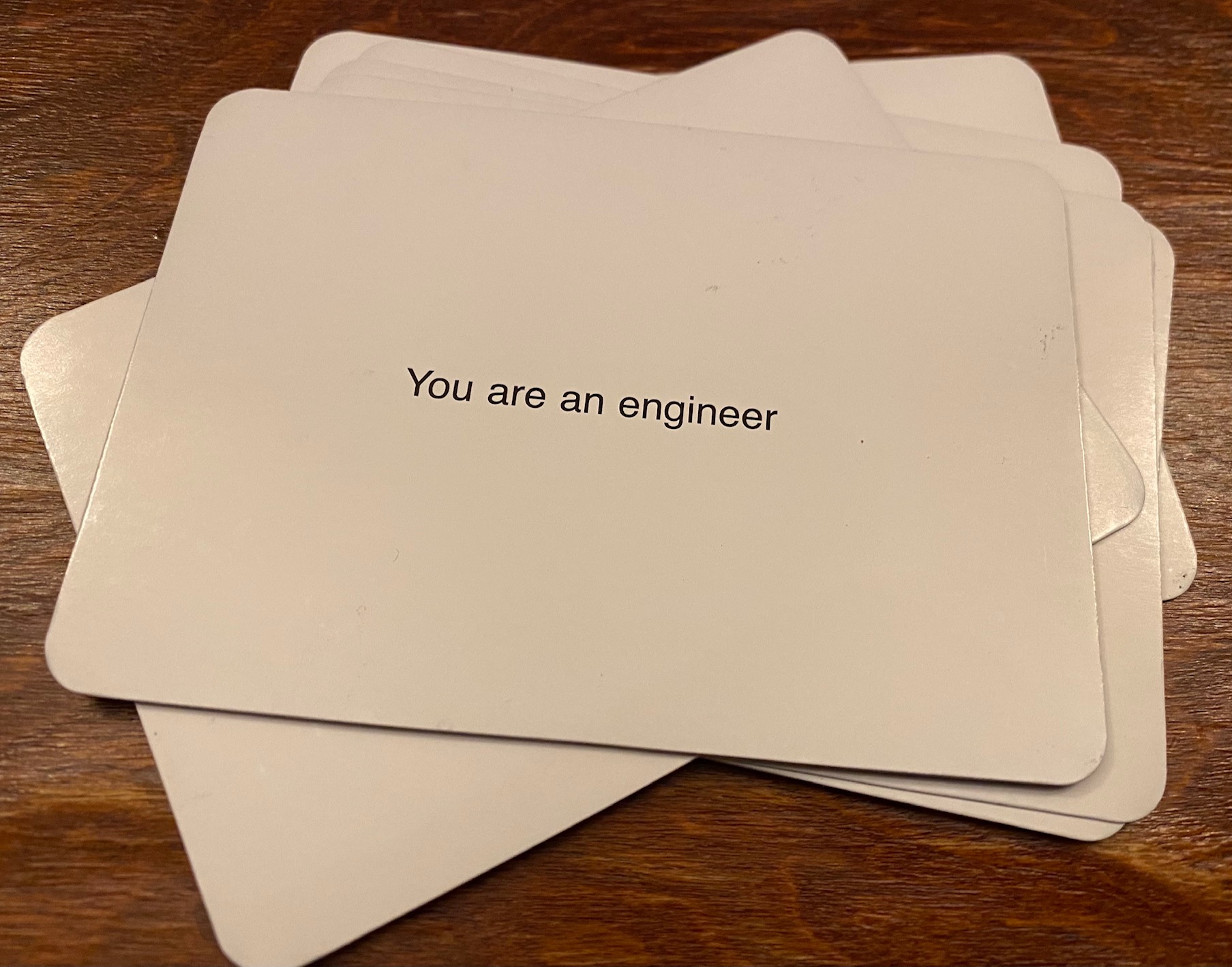
Card reading 'You are an Engineer'

11 April 2022

Jonathan Dowland: With Teeth

Sometimes people ask me which is the best entry point for Nine Inch Nails, and I have trouble answering. I've eventually decided that it's 2005's With Teeth.
Picture of 'With Teeth' playing on my turntable
I've pulled this from my pile of records to sell. Most Nine Inch Nails stuff seems to increase in value over time, and it's got to the stage that some of the ones in my collection are now valuable enough that I'm nervous to play them, which makes them a little pointless. A couple of years ago, a handful of the albums were re-issued (including With Teeth, here, and The Fragile, which hadn't been repressed since 1999). I had a vague plan to sell off my original pressings to someone who would appreciate them more and use the takings to buy the re-issues, but I didn't move fast enough, and now the re-issues are (for the most part) also sought-after.

7 April 2022

Gunnar Wolf: How is the free firmware for the Raspberry progressing?

Raspberry Pi computers require a piece of non-free software to boot the infamous raspi-firmware package. But for almost as long as there has been a Raspberry Pi to talk of (this year it turns 10 years old!), there have been efforts to get it to boot using only free software. How is it progressing? Michael Bishop (IRC user clever) explained today in the #debian-raspberrypi channel in OFTC that it advances far better than what I expected: It is even possible to boot a usable system under the RPi2 family! Just There is somewhat incomplete hardware support: For his testing, he has managed to use a xfce environment but over the composite (NTSC) video output, as HDMI initialization support is not there. However, he shared with me several interesting links and videos, and I told him I d share them there are still many issues; I do not believe it is currently worth it to make Debian images with this firmware. Before anything else: Go visit the librerpi/lk-overlay repository. Its README outlines hardware support for each of the RPi families; there is a binary build available with nixos if you want to try it out, and instructions to build it. But what clever showed me that made me write this post Is the amount of stuff you can do with the RPi s VPU (why Vision Vector Processing Unit and not the more familiar GPU, Graphical Processing Unit? I don t really know But I trust clever s definitions beyond how I trust my own ) before it loads an opearting system: There s not too much I can add to this. I was just Truly amazed. And I hope to see the remaining hurdles for regular Linux booting on this range of machines with purely free software quickly go away! Packaging this for Debian? Well, not yet not so fast I first told clever we could push this firmware to experimental instead of unstable, as it is not yet ready for most production systems. However, pabs made some spot-on further questions. And yes, it requires installing three(!) different cross-compilers, one of which vc4-toolchain, for the VPU is free software, but not yet upstreamed, and hence is not available for Debian. Anyway, the talk continued long after I had to go. I have gone a bit over the backlog, but I have to leave now so that will be it as for this blog post

6 April 2022

Thorsten Alteholz: My Debian Activities in March 2022

FTP master This month I accepted 332 and rejected 15 packages. This ratio gives a reason to hope. The overall number of packages that got accepted was 342. Debian LTS This was my ninety-third month that I did some work for the Debian LTS initiative, started by Raphael Hertzog at Freexian. This month my all in all workload has been 40h. During that time I did LTS and normal security uploads of: All my PU bugs for Buster and Bullseye, that accumulated over the last months, were part of the latest point release. So new ones have to be created now :-). I also continued to work on security support for golang packages. As a result #1008577 and #1008578 were the first real tests with a simple package. Debian ELTS This month was the forty-fifth ELTS month. During my allocated time I uploaded: Unfortunately uploads have to be done for younger releases first, so I had to withhold some uploads for ELTS. Hopefully they can be done in April. Probably this policy needs to be reconsidered. Last but not least I did some days of frontdesk duties. Debian Printing This month I uploaded new upstream versions or improved packaging of: In order to make the Debian Edu team happy, I uploaded a new version of cups-filters with an adapted Apparmor-file to Unstable and Bullseye. Debian Astro This month I uploaded new upstream versions or improved packaging of: Other stuff This month I uploaded new upstream versions or improved packaging of: In order to avoid an AUTORM of some Osmocom packages, I also had to NMU:

5 April 2022

Matthew Garrett: Bearer tokens are just awful

As I mentioned last time, bearer tokens are not super compatible with a model in which every access is verified to ensure it's coming from a trusted device. Let's talk about that in a bit more detail.

First off, what is a bearer token? In its simplest form, it's simply an opaque blob that you give to a user after an authentication or authorisation challenge, and then they show it to you to prove that they should be allowed access to a resource. In theory you could just hand someone a randomly generated blob, but then you'd need to keep track of which blobs you've issued and when they should be expired and who they correspond to, so frequently this is actually done using JWTs which contain some base64 encoded JSON that describes the user and group membership and so on and then have a signature associated with them so whenever the user presents one you can just validate the signature and then assume that the contents of the JSON are trustworthy.

One thing to note here is that the crypto is purely between whoever issued the token and whoever validates the token - as far as the server is concerned, any client who can just show it the token is just fine as long as the signature is verified. There's no way to verify the client's state, so one of the core ideas of Zero Trust (that we verify that the client is in a trustworthy state on every access) is already violated.

Can we make things not terrible? Sure! We may not be able to validate the client state on every access, but we can validate the client state when we issue the token in the first place. When the user hits a login page, we do state validation according to whatever policy we want to enforce, and if the client violates that policy we refuse to issue a token to it. If the token has a sufficiently short lifetime then an attacker is only going to have a short period of time to use that token before it expires and then (with luck) they won't be able to get a new one because the state validation will fail.

Except! This is fine for cases where we control the issuance flow. What if we have a scenario where a third party authenticates the client (by verifying that they have a valid token issued by their ID provider) and then uses that to issue their own token that's much longer lived? Well, now the client has a long-lived token sitting on it. And if anyone copies that token to another device, they can now pretend to be that client.

This is, sadly, depressingly common. A lot of services will verify the user, and then issue an oauth token that'll expire some time around the heat death of the universe. If a client system is compromised and an attacker just copies that token to another system, they can continue to pretend to be the legitimate user until someone notices (which, depending on whether or not the service in question has any sort of audit logs, and whether you're paying any attention to them, may be once screenshots of your data show up on Twitter).

This is a problem! There's no way to fit a hosted service that behaves this way into a Zero Trust model - the best you can say is that a token was issued to a device that was, around that time, apparently trustworthy, and now it's some time later and you have literally no idea whether the device is still trustworthy or if the token is still even on that device.

But wait, there's more! Even if you're nowhere near doing any sort of Zero Trust stuff, imagine the case of a user having a bunch of tokens from multiple services on their laptop, and then they leave their laptop unlocked in a cafe while they head to the toilet and whoops it's not there any more, better assume that someone has access to all the data on there. How many services has our opportunistic new laptop owner gained access to as a result? How do we revoke all of the tokens that are sitting there on the local disk? Do you even have a policy for dealing with that?

There isn't a simple answer to all of these problems. Replacing bearer tokens with some sort of asymmetric cryptographic challenge to the client would at least let us tie the tokens to a TPM or other secure enclave, and then we wouldn't have to worry about them being copied elsewhere. But that wouldn't help us if the client is compromised and the attacker simply keeps using the compromised client. The entire model of simply proving knowledge of a secret being sufficient to gain access to a resource is inherently incompatible with a desire for fine-grained trust verification on every access, but I don't see anything changing until we have a standard for third party services to be able to perform that trust verification against a customer's policy.

Still, at least this means I can just run weird Android IoT apps through mitmproxy, pull the bearer token out of the request headers and then start poking the remote API with curl. It may all be broken, but it's also got me a bunch of bug bounty credit, so, it;s impossible to say if its bad or not,

(Addendum: this suggestion that we solve the hardware binding problem by simply passing all the network traffic through some sort of local enclave that could see tokens being set and would then sequester them and reinject them into later requests is OBVIOUSLY HORRIFYING and is also probably going to be at least three startup pitches by the end of next week)

comment count unavailable comments

1 April 2022

Russ Allbery: Review: Princess Floralinda and the Forty-Flight Tower

Review: Princess Floralinda and the Forty-Flight Tower, by Tamsyn Muir
Publisher: Subterranean Press
Copyright: 2020
ISBN: 1-59606-992-9
Format: Kindle
Pages: 111
A witch put Princess Floralinda at the top of a forty-flight tower, but it wasn't personal. This is just what witches do, particularly with princesses with butter-coloured curls and sapphire-blue eyes. Princes would come from miles around to battle up the floors of the tower and rescue the princess. The witch even helpfully provided a golden sword, in case a prince didn't care that much about princesses. Floralinda was provided with water and milk, two loaves of bread, and an orange, all of them magically renewing, to sustain her while she waited. In retrospect, the dragon with diamond-encrusted scales on the first floor may have been a mistake. None of the princely endeavors ever saw the second floor. The diary that Floralinda found in her room indicated that she may not be the first princess to have failed to be rescued from this tower. Floralinda finally reaches the rather astonishing conclusion that she might have to venture down the tower herself, despite the goblins she was warned were on the 39th floor (not to mention all the other monsters). The result of that short adventure, after some fast thinking, a great deal of luck, and an unforeseen assist from her magical food, is a surprising number of dead goblins. Also seriously infected hand wounds, because it wouldn't be a Tamsyn Muir story without wasting illness and body horror. That probably would have been the end of Floralinda, except a storm blew a bottom-of-the-garden fairy in through the window, sufficiently injured that she and Floralinda were stuck with each other, at least temporarily. Cobweb, the fairy, is neither kind nor inclined to help Floralinda (particularly given that Floralinda is not a child whose mother is currently in hospital), but it is an amateur chemist and finds both Floralinda's tears and magical food intriguing. Cobweb's magic is also based on wishes, and after a few failed attempts, Floralinda manages to make a wish that takes hold. Whether she'll regret the results is another question. This is a fairly short novella by the same author as Gideon the Ninth, but it's in a different universe and quite different in tone. This summary doesn't capture the writing style, which is a hard-to-describe mix of fairy tale, children's story, and slightly archaic and long-winded sentence construction. This is probably easier to show with a quote:
"You are displaying a very small-minded attitude," said the fairy, who seemed genuinely grieved by this. "Consider the orange-peel, which by itself has many very nice properties. Now, if you had a more educated brain (I cannot consider myself educated; I have only attempted to better my situation) you would have immediately said, 'Why, if I had some liquor, or even very hot water, I could extract some oil from this orange-peel, which as everyone knows is antibacterial; that may well do my hands some good,' and you wouldn't be in such a stupid predicament."
On balance, I think this style worked. It occasionally annoyed me, but it has some charm. About halfway through, I was finding the story lightly entertaining, although I would have preferred a bit less grime, illness, and physical injury. Unfortunately, the rest of the story didn't work for me. The dynamic between Floralinda and Cobweb turns into a sort of D&D progression through monster fights, and while there are some creative twists to those fights, they become all of a sameness. And while I won't spoil the ending, it didn't work for me. I think I see what Muir was trying to do, and I have some intellectual appreciation for the idea, but it wasn't emotionally satisfying. I think my root problem with this story is that Muir sets up a rather interesting world, one in which witches artistically imprison princesses, and particularly bright princesses (with the help of amateur chemist fairies) can use the trappings of a magical tower in ways the witch never intended. I liked that; it has a lot of potential. But I didn't feel like that potential went anywhere satisfying. There is some relationship and characterization work, and it reached some resolution, but it didn't go as far as I wanted. And, most significantly, I found the end point the characters reached in relation to the world to be deeply unsatisfying and vaguely irritating. I wanted to like this more than I did. I think there's a story idea in here that I would have enjoyed more. Unfortunately, it's not the one that Muir wrote, and since so much of my problem is with the ending, I can't provide much guidance on whether someone else would like this story better (and why). But if the idea of taking apart a fairy-tale tower and repurposing the pieces sounds appealing, and if you get along better with Muir's illness motif than I do, you may enjoy this more than I did. Rating: 5 out of 10

Antoine Beaupr : Salvaged my first Debian package

I finally salvaged my first Debian package, python-invoke. As part of ITS 964718, I moved the package from the Openstack Team to the Python team. The Python team might not be super happy with it, because it's breaking some of its rules, but at least someone (ie. me) is actively working (and using) the package.

Wait what People not familiar with Debian will not understand anything in that first paragraph, so let me expand. Know-it-all Debian developers (you know who you are) can skip to the next section. Traditionally, the Debian project (my Linux-based operating system of choice) has prided itself on the self-managed, anarchistic organisation of its packaging. Each package maintainer is the lord of their little kingdom. Some maintainers like to accumulate lots of kingdoms to rule over. (Yes, it really doesn't sound like anarchism when you put it like that. Yes, it's complicated: there's a constitution and voting involved. And yes, we're old.) Therefore, it's really hard to make package maintainers do something they don't want. Typically, when things go south, someone makes a complaint to the Debian Technical Committee (CTTE) which is established by the Debian constitution to resolve such conflicts. The committee is appointed by the Debian Project leader, elected each year (and there's an election coming up if you haven't heard). Typically, the CTTE will then vote and formulate a decision. But here's the trick: maintainers are still free to do whatever they want after that, in a sense. It's not like the CTTE can just break down doors and force maintainers to type code. (I won't go into the details of the why of that, but it involves legal issues and, I think, something about the Turing halting problem. Or something like that.) Anyways. The point is all that is super heavy and no one wants to go there... (Know-it-all Debian developers, I know you are still reading this anyways and disagree with that statement, but please, please, make it true.) ... but sometimes, packages just get lost. Maintainers get distracted, or busy with something else. It's not that they want to abandon their packages. They love their little fiefdoms. It's just there was a famine or a war or something and everyone died, and they have better things to do than put up fences or whatever. So clever people in Debian found a better way of handling such problems than waging war in the poor old CTTE's backyard. It's called the Package Salvaging process. Through that process, a maintainer can propose to take over an existing package from another maintainer, if a certain set of condition are met and a specific process is followed. Normally, taking over another maintainer's package is basically a war declaration, rarely seen in the history of Debian (yes, I do think it happened!), as rowdy as ours is. But through this process, it seems we have found a fair way of going forward. The process is basically like this:
  1. file a bug proposing the change
  2. wait three weeks
  3. upload a package making the change, with another week delay
  4. you now have one more package to worry about
Easy right? It actually is! Process! It's magic! It will cure your babies and resurrect your cat!

So how did that go? It went well! The old maintainer was actually fine with the change because his team wasn't using the package anymore anyways. He asked to be kept as an uploader, which I was glad to oblige. (He replied a few months after the deadline, but I wasn't in a rush anyways, so that doesn't matter. It was polite for him to answer, even if, technically, I was already allowed to take it over.) What happened next is less shiny for me though. I totally forgot about the ITS, even after the maintainer reminded me of its existence. See, the thing is the ITS doesn't show up on my dashboard at all. So I totally forgot about it (yes, twice). In fact, the only reason I remembered it was that got into the process of formulating another ITS (1008753, trocla) and I was trying to figure out how to write the email. Then I remembered: "hey wait, I think I did this before!" followed by "oops, yes, I totally did this before and forgot for 9 months". So, not great. Also, the package is still not in a perfect shape. I was able to upload the upstream version that was pending 1.5.0 to clear out the ITS, basically. And then there's already two new upstream releases to upload, so I pushed 1.7.0 to experimental as well, for good measure. Unfortunately, I still can't enable tests because everything is on fire, as usual. But at least my kingdom is growing.

Appendix Just in case someone didn't notice the hyperbole, I'm not a monarchist promoting feudalism as a practice to manage a community. I do not intend to really "grow my kingdom" and I think the culture around "property" of "packages" is kind of absurd in Debian. I kind of wish it would go away. (Update: It has also been pointed out that I might have made Debian seem more confrontational than it actually is. And it's kind of true: most work and interactions in Debian actually go fine, it's only a minority of issues that degenerate into conflicts. It's just that they tend to take up a lot of space in the community, and I find that particularly draining. And I think think our "package ownership" culture is part of at least some of those problems.) Team maintenance, the LowNMU process, and low threshold adoption processes are all steps in the good direction, but they are all opt in. At least the package salvaging process is someone a little more ... uh... coercive? Or at least it allows the community to step in and do the right thing, in a sense. We'll see what happens with the coming wars around the recent tech committee decision, which are bound to touch on that topic. (Hint: our next drama is called "usrmerge".) Hopefully, LWN will make a brilliant article to sum it up for us so that I don't have to go through the inevitable debian-devel flamewar to figure it out. I already wrecked havoc on the #debian-devel IRC channel asking newbie questions so I won't stir that mud any further for now. (Update: LWN, of course, did make an article about usrmerge in Debian. I will read it soon and can then tell you know if it's brilliant, but they are typically spot on.)

30 March 2022

Ulrike Uhlig: How do kids conceive the internet?

I wanted to understand how kids between 10 and 18 conceive the internet. Surely, we have seen a generation that we call digital natives grow up with the internet. Now, there is a younger generation who grows up with pervasive technology, such as smartphones, smart watches, virtual assistants and so on. And only a few of them have parents who work in IT or engineering
Pervasive technology contributes to the idea that the internet is immaterial With their search engine website design, Google has put in place an extremely simple and straightforward user interface. Since then, designers and psychologists have worked on making user interfaces more and more intuitive to use. The buzzwords are usability and user experience design . Besides this optimization of visual interfaces, haptic interfaces have evolved as well, specifically on smartphones and tablets where hand gestures have replaced more clumsy external haptic interfaces such as a mouse. And beyond interfaces, the devices themselves have become smaller and slicker. While in our generation many people have experienced opening a computer tower or a laptop to replace parts, with the side effect of seeing the parts the device is physically composed of, the new generation of end user devices makes this close to impossible, essentially transforming these devices into black boxes, and further contributing to the idea that the internet they are being used to access with would be something entirely intangible.

What do kids in 2022 really know about the internet? So, what do kids of that generation really know about the internet, beyond purely using services they do not control? In order to find out, I decided to interview children between 10 and 18. I conducted 5 interviews with kids aged 9, 10, 12, 15 and 17, two boys and three girls. Two live in rural Germany, one in a German urban area, and two live in the French capital. I wrote the questions in a way to stimulate the interviewees to tell me a story each time. I also told them that the interview is not a test and that there are no wrong answers. Except for the 9 year old, all interviewees possessed both, their own smartphone and their own laptop. All of them used the internet mostly for chatting, entertainment (video and music streaming, online games), social media (TikTok, Instagram, Youtube), and instant messaging. Let me introduce you to their concepts of the internet. That was my first story telling question to them:

If aliens had landed on Earth and would ask you what the internet is, what would you explain to them? The majority of respondents agreed in their replies that the internet is intangible while still being a place where one can do anything and everything . Before I tell you more about their detailed answers to the above question, let me show you how they visualize their internet.

If you had to make a drawing to explain to a person what the internet is, how would this drawing look like? Each interviewee had some minutes to come up with a drawing. As you will see, that drawing corresponds to what the kids would want an alien to know about the internet and how they are using the internet themselves.

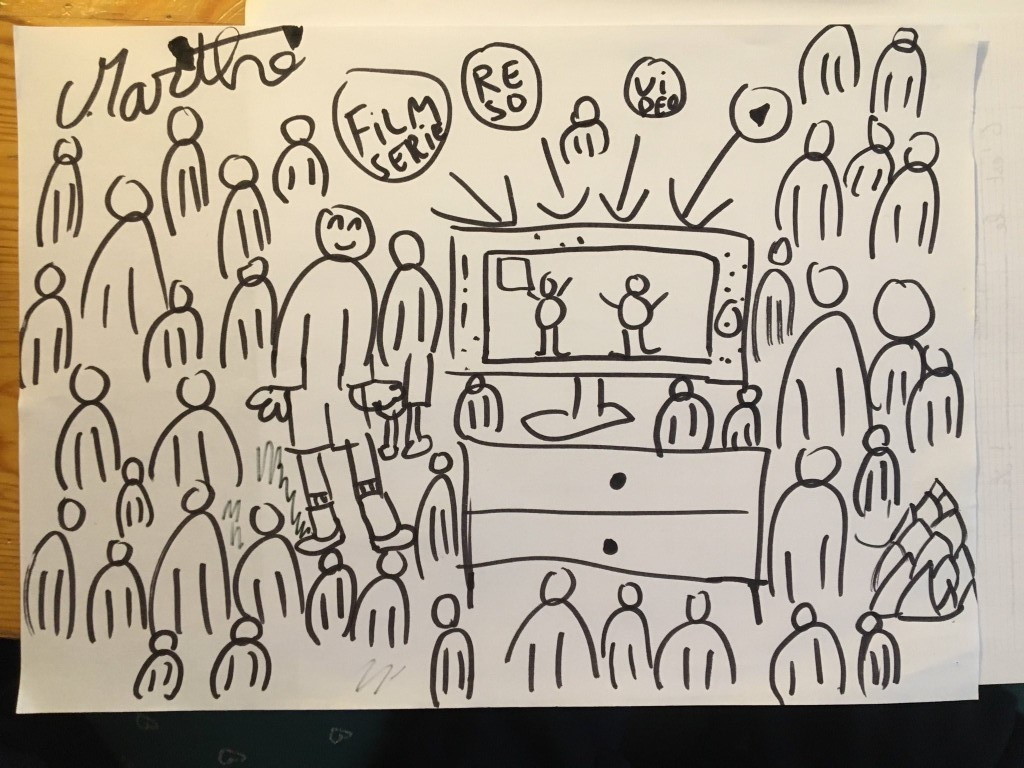
Movies, series, videos A child's drawing. In the middle, there is a screen, on the screen a movie is running. Around the screen there are many people, at least two dozens. The words 'film', 'series', 'network', 'video' are written and arrows point from these words to the screen. There's also a play icon. The youngest respondent, a 9 year old girl, drew a screen with lots of people around it and the words film, series, network, video , as well as a play icon. She said that she mostly uses the internet to watch movies. She was the only one who used a shared tablet and smartphone that belonged to her family, not to herself. And she would explain the net like this to an alien:

"Internet is a er one cannot touch it it s an, er [I propose the word idea ], yes it s an idea. Many people use it not necessarily to watch things, but also to read things or do other stuff."

User interface elements There is a magnifying glass icon, a play icon and speech bubbles drawn with a pencil. A 10 year old boy represented the internet by recalling user interface elements he sees every day in his drawing: a magnifying glass (search engine), a play icon (video streaming), speech bubbles (instant messaging). He would explain the internet like this to an alien:
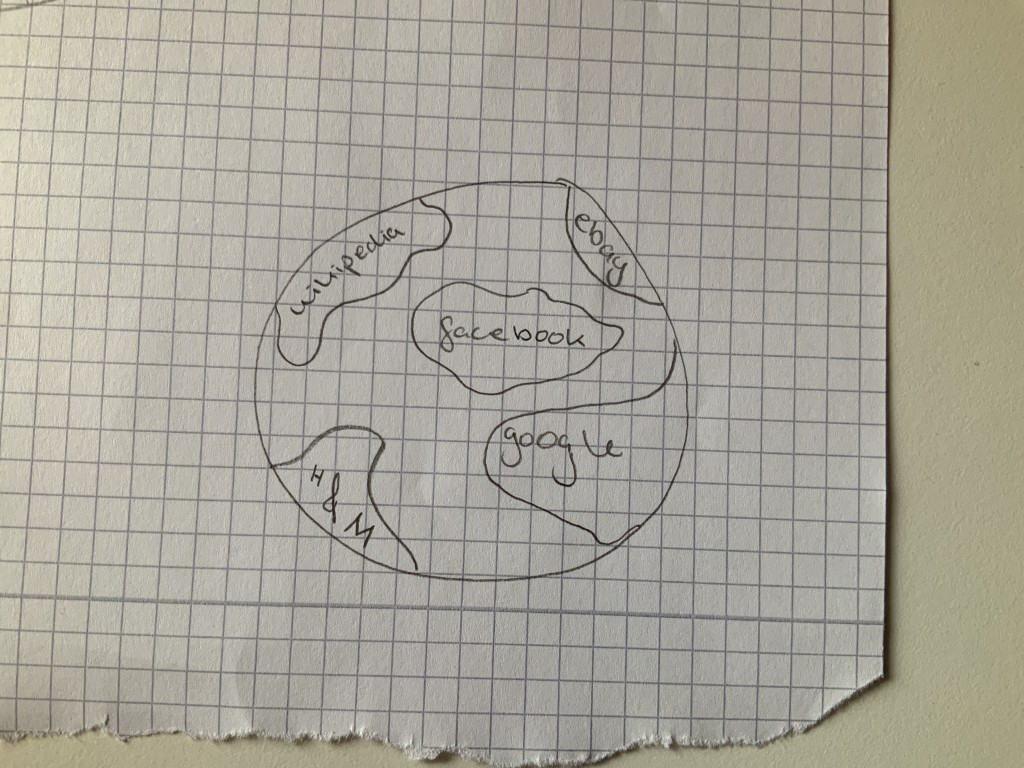
"You can use the internet to learn things or get information, listen to music, watch movies, and chat with friends. You can do nearly anything with it."

Another planet Pencil drawing that shows a planet with continents. The continents are named: H&M, Ebay, Google, Wikipedia, Facebook. A 12 year old girl imagines the internet like a second, intangible, planet where Google, Wikipedia, Facebook, Ebay, or H&M are continents that one enters into.
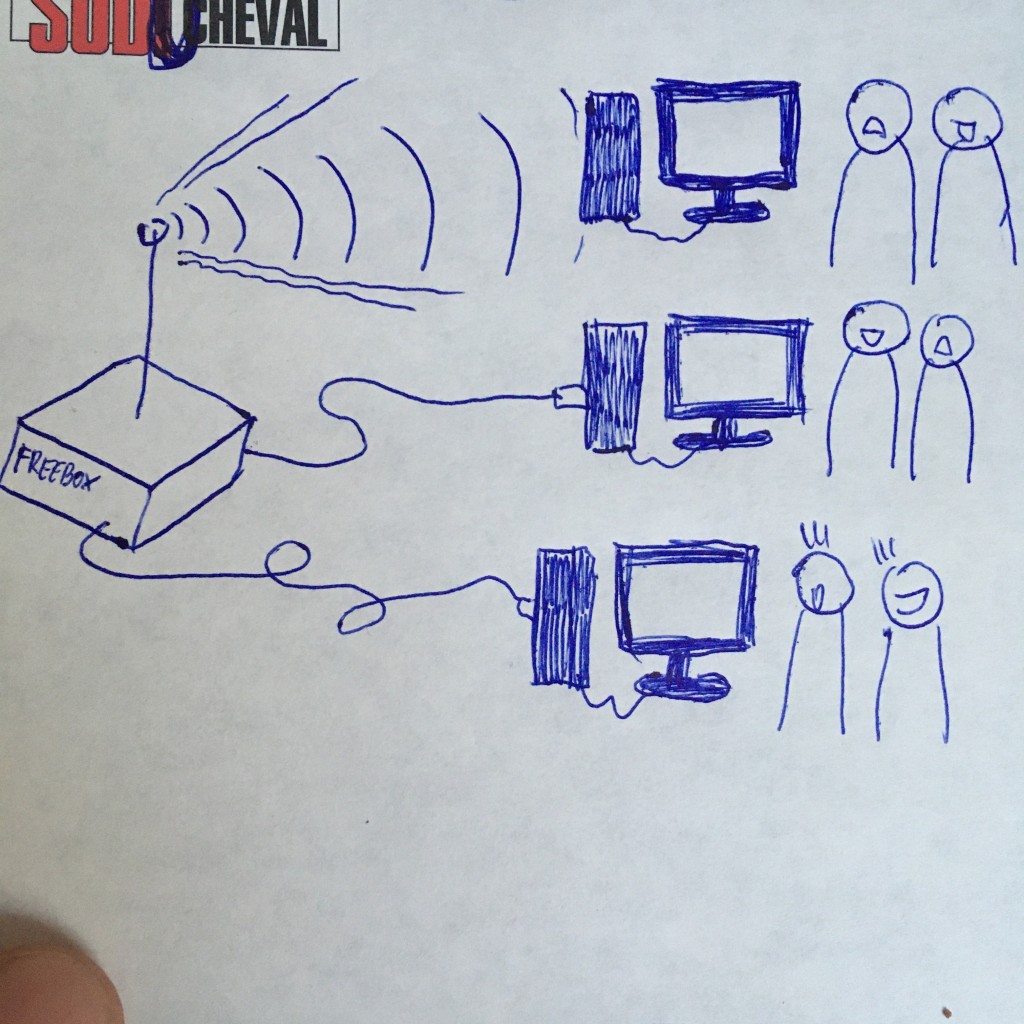
"And on [the] Ebay [continent] there s a country for clothes, and ,trousers , for example, would be a federal state in that country."
Something that was unique about this interview was that she told me she had an email address but she never writes emails. She only has an email account to receive confirmation emails, for example when doing online shopping, or when registering to a service and needing to confirm one s address. This is interesting because it s an anti-spam measure that might become outdated with a generation that uses email less or not at all.

Home network Kid's drawing: there are three computer towers and next to each there are two people. The first couple is sad, the seconf couple is smiling, the last one is suprised. Each computer is connected to a router, two of them by cable, one by wifi. A 15 year old boy knew that his family s devices are connected to a home router (Freebox is a router from the French ISP Free) but lacked an imagination of the rest of the internet s functioning. When I asked him about what would be behind the router, on the other side, he said what s behind is like a black hole to him. However, he was the only interviewee who did actually draw cables, wifi waves, a router, and the local network. His drawing is even extremely precise, it just lacks the cable connecting the router to the rest of the internet.
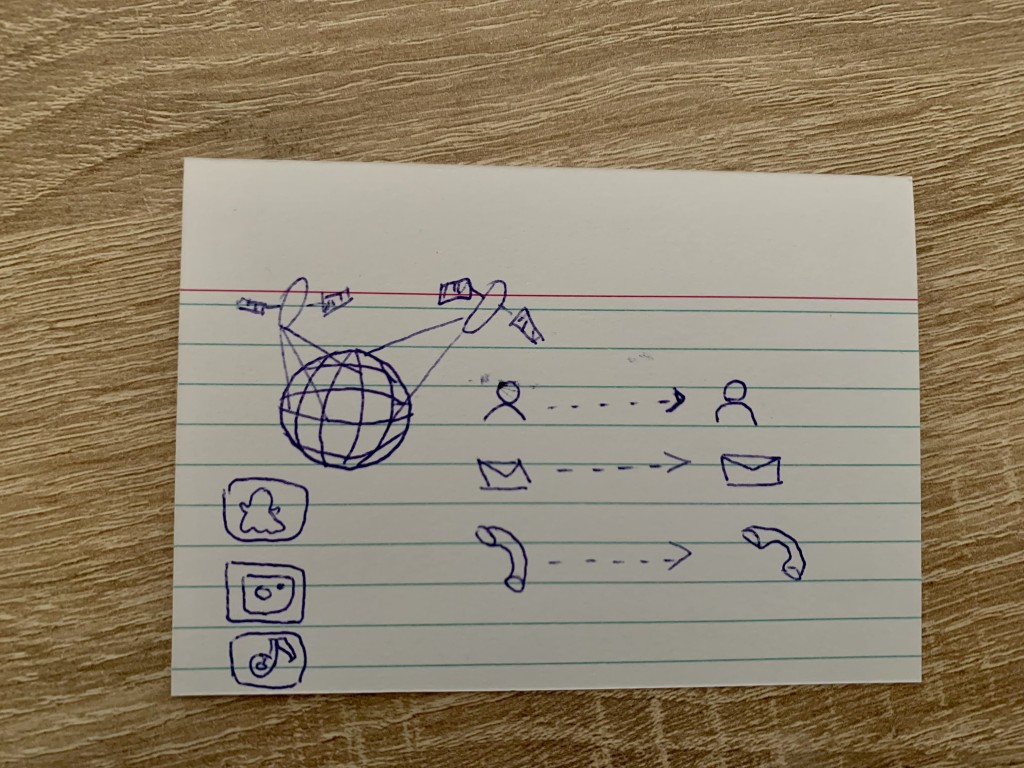
Satellite internet This is another very simple drawing: On top left, there's planet Earth an there are lines indicating that earth is a sphere. Around Earth there are two big satellites reaching most of Earth. on the left, below, there are three icons representing social media services on the internet: Snapchat, Instagram, TikTok. On the right, there are simplified drawings of possibilities which the internet offers: person to person connection, email (represented by envelopes), calls (represented by an old-style telephone set). A 17 year old girl would explain the internet to an alien as follows:
"The internet goes around the entire globe. One is networked with everyone else on Earth. One can find everything. But one cannot touch the internet. It s like a parallel world. With a device one can look into the internet. With search engines, one can find anything in the world, one can phone around the world, and write messages. [The internet] is a gigantic thing."
This interviewee stated as the only one that the internet is huge. And while she also is the only one who drew the internet as actually having some kind of physical extension beyond her own home, she seems to believe that internet connectivity is based on satellite technology and wireless communication.

Imagine that a wise and friendly dragon could teach you one thing about the internet that you ve always wanted to know. What would you ask the dragon to teach you about? A 10 year old boy said he d like to know how big are the servers behind all of this . That s the only interview in which the word server came up. A 12 year old girl said I would ask how to earn money with the internet. I always wanted to know how this works, and where the money comes from. I love the last part of her question! The 15 year old boy for whom everything behind the home router is out of his event horizon would ask How is it possible to be connected like we are? How does the internet work scientifically? A 17 year old girl said she d like to learn how the darknet works, what hidden things are there? Is it possible to get spied on via the internet? Would it be technically possible to influence devices in a way that one can listen to secret or telecommanded devices? Lastly, I wanted to learn about what they find annoying, or problematic about the internet.

Imagine you could make the internet better for everyone. What would you do first? Asked what she would change if she could, the 9 year old girl advocated for a global usage limit of the internet in order to protect the human brain. Also, she said, her parents spend way too much time on their phones and people should rather spend more time with their children. Three of the interviewees agreed that they see way too many advertisements and two of them would like ads to disappear entirely from the web. The other one said that she doesn t want to see ads, but that ads are fine if she can at least click them away. The 15 year old boy had different ambitions. He told me he would change:
"the age of access to the internet. More and more younger people access the internet ; especially with TikTok there is a recommendation algorithm that can influcence young people a lot. And influencing young people should be avoided but the internet does it too much. And that can be negative. If you don t yet have a critical spirit, and you watch certain videos you cannot yet moderate your stance. It can influence you a lot. There are so many things that have become indispensable and that happen on the internet and we have become dependent. What happens if one day it doesn t work anymore? If we connect more and more things to the net, that s not a good thing."

The internet - Oh, that s what you mean! On a sidenote, my first interview tentative was with an 8 year old girl from my family. I asked her if she uses the internet and she denied, so I abandoned interviewing her. Some days later, while talking to her, she proposed to look something up on Google, using her smartphone. I said: Oh, so you are using the internet! She replied: Oh, that s what you re talking about? I think she knows the word Google and she knows that she can search for information with this Google thing. But it appeared that she doesn t know that the Google search engine is located somewhere else on internet and not on her smartphone. I concluded that for her, using the services on the smartphone is as natural as switching on a light in the house: we also don t think about where the electricity comes from when we do that.

What can we learn from these few interviews? Unsurprisingly, social media, streaming, entertainment, and instant messaging are the main activities kids undertake on the internet. They are completely at the mercy of advertisements in apps and on websites, not knowing how to get rid of them. They interact on a daily basis with algorithms that are unregulated and known to perpetuate discrimination and to create filter bubbles, without necessarily being aware of it. The kids I interviewed act as mere service users and seem to be mostly confined to specific apps or websites. All of them perceived the internet as being something intangible. Only the older interviewees perceived that there must be some kind of physical expansion to it: the 17 year old girl by drawing a network of satellites around the globe, the 15 year old boy by drawing the local network in his home. To be continued

21 March 2022

Antoine Beaupr : 20+ years of Emacs

I enjoyed reading this article named "22 years of Emacs" recently. It's kind of fascinating, because I realised I don't exactly know for how long I've been using Emacs. It's lost in the mists of history. If I would have to venture a guess, it was back in the "early days", which in that history is mapped around 1996-1997, when I installed my very own "PC" with FreeBSD 2.2.x and painstakingly managed to make XFree86 run on it. Modelines. Those were the days... But I digress.

I am old... The only formal timestamp I can put is that my rebuilt .emacs.d git repository has its first commit in 2002. Some people reading this may be born after that time. This means I'm at least significantly older than those people, to put things gently. Clever history nerds will notice that the commit is obviously fake: Git itself did not exist until 2005. But ah-ah! I was already managing my home directory with CVS in 2001! I converted that repository into git some time in 2009, and therefore you can see all my embarrassing history, including changes from two decades ago. That includes my first known .emacs file which is just bizarre to read right now: 200 lines, most of which are "customize" stuff. Compare with the current, 1000+ lines init.el which is also still kind of a mess, but actually shares very little with the original, thankfully. All this to say that in those years (decades, really) of using Emacs, I have had a very different experience than credmp who wrote packages, sent patches, and got name dropping from other developers. My experience is just struggling to keep up with everything, in general, but also in Emacs.

... and Emacs is too fast for me It might sound odd to say, but Emacs is actually moving pretty fast right now. A lot of new packages are coming out, and I can hardly keep up.
  • I am not using org mode, but did use it for time (and task) tracking for a while (and for invoicing too, funky stuff).
  • I am not using mu4e, but maybe I'm using something better (notmuch) and yes, I am reading my mail in Emacs, which I find questionable from a security perspective. (Sandboxing untrusted inputs? Anyone?)
  • I am using magit, but only when coding, so I do end up using git on the command line quite a bit anyways.
  • I do have which-key enabled, and reading about it reminded me I wanted to turn it off because it's kind of noisy and I never remember I can actually use it for anything. Or, in other words, I don't even remember the prefix key or, when I do, there's too many possible commands after for it to be useful.
  • I haven't setup lsp-mode, let alone Eglot, which I just learned about reading the article. I thought I would be super shiny and cool by setting up LSP instead of the (dying?) elpy package, but I never got around to it. And now it seems lsp-mode is uncool and I should really do eglot instead, and that doesn't help. UPDATE: I finally got tired and switched to lsp-mode. The main reason for choosing it over eglot is that it's in Debian (and eglot is not). (Apparently, eglot has more chance of being upstreamed, "when it's done", but I guess I'll cross that bridge when I get there.) lsp-mode feels slower than elpy but I haven't done any of the performance tuning and this will improve even more with native compilation (see below). I already had lsp-mode partially setup in Emacs so I only had to do this small tweak to switch and change the prefix key (because s-l or mod is used by my window manager). I also had to pin LSP packages to bookworm here and here.
  • I am not using projectile. It's on some of my numerous todo lists somewhere, surely. I suspect it's important to getting my projects organised, but I still live halfway between the terminal and Emacs, so it's not quite clear what I would gain.
  • I had to ask what native compilation was or why it mattered the first time I heard of it. And when I saw it again in the article, I had to click through to remember.
Overall, I feel there's a lot of cool stuff in Emacs out there. But I can't quite tell what's the best of which. I can barely remember which completion mechanism I use (company, maybe?) or what makes my mini-buffer completion work the way it does. Everything is lost in piles of customize and .emacs hacks that is constantly changing. Because a lot is in third-party packages, there are often many different options and it's hard to tell which one we should be using.

... or at least fast enough And really, Emacs feels fast enough for me. When I started, I was running Emacs on a Pentium I, 166MHz, with 8MB of RAM (eventually upgraded to 32MB, whoohoo!). Back in those days, the joke was that EMACS was an acronym for "Eight Megs, Always Scratching" and now that I write this down, I realize it's actually "Eight Megs, and Constantly Swapping", which doesn't sound as nice because you could actually hear Emacs running on those old hard drives back in the days. It would make a "scratching" noise as the hard drive heads would scramble maniacally to swap pages in and out of swap to make room for the memory-hungry editor. Now Emacs is pretty far down the list of processes in top(1) regardless of how you look at it. It's using 97MB of resident memory and close to 400MB of virtual memory, which does sound like an awful lot compared to my first computer... But it's absolutely nothing compared to things like Signal-desktop, which somehow manages to map a whopping 20.5GB virtual memory. (That's twenty Gigabytes of memory for old timers or time travelers from the past, and yes, that is now a thing.) I'm not exactly sure how much resident memory it uses (because it forks multiple processes), probably somewhere around 300MB of resident memory. Firefox also uses gigabytes of that good stuff, also spread around the multiple processes, per tab. Emacs "feels" super fast. Typing latency is noticeably better in Emacs than my web browser, and even beats most terminal emulators. It gets a little worse when font-locking is enabled, unfortunately, but it's still feels much better. And all my old stuff still works in Emacs, amazingly. (Good luck with your old Netscape or ICQ configuration from 2000.) I feel like an oldie, using Emacs, but I'm really happy to see younger people using it, and learning it, and especially improving it. If anything, one direction I would like to see it go is closer to what web browsers are doing (yes, I know how bad that sounds) and get better isolation between tasks. An attack on my email client shouldn't be able to edit my Puppet code, and/or all files on my system, for example. And I know, fundamentally, that's a really hard challenge in Emacs. But if you're going to treat your editor as your operating system (or vice versa, I lost track of where we are now that there's an Emacs Window Manager, which I do not use), at least we should get that kind of security. Otherwise I'll have to find a new mail client, and that's really something I try to limit to once a decade or so.

18 March 2022

Bits from Debian: DebConf22 registration and call for proposals are open!

DebConf22 banner open registration Registration for DebConf22 is now open. The the 23rd edition of DebConf will take place from July 17th to 24th, 2022 at the Innovation and Training Park (ITP) in Prizren, Kosovo, and will be preceded by DebCamp, from July 10th to 16th. Along with the registration, the DebConf content team announced the call for proposals. Deadline to submit a proposal to be considered in the main schedule is April 15th, 2022 23:59:59 UTC (Friday). DebConf is an event open to everyone, no matter how you identify yourself or how others perceive you. We want to increase visibility of our diversity and work towards inclusion at Debian Project, drawing our attendees from people just starting their Debian journey, to seasoned Debian Developers or active contributors in different areas like packaging, translation, documentation, artwork, testing, specialized derivatives, user support and many other. In other words, all are welcome. To register for the event, log into the registration system and fill out the form. You will be able to edit and update your registration at any point. However, in order to help the organizers have a better estimate of how many people will attend the event, we would appreciate if you could access the system and confirm (or cancel) your participation in the conference as soon as you know if you will be able to come. The last day to confirm or cancel is July 1st, 2022 23:59:59 UTC. If you don't confirm or you register after this date, you can come to the DebConf22 but we cannot guarantee availability of accommodation, food and swag (t-shirt, bag, and so on). For more information about registration, please visit registration information. Submitting an event You can now submit an event proposal. Events are not limited to traditional presentations or informal sessions (BoFs): we welcome submissions of tutorials, performances, art installations, debates, or any other format of event that you think would be of interest to the Debian community. Regular sessions may either be 20 or 45 minutes long (including time for questions), other kinds of sessions (workshops, demos, lightning talks, and so on) could have different durations. Please choose the most suitable duration for your event and explain any special requests. In order to submit a talk, you will need to create an account on the website. We suggest that Debian Salsa account holders (including DDs and DMs) use their Salsa login when creating an account. However, this isn't required, as you can sign up with an e-mail address and password. Bursary for travel, accommodation and meals In an effort to widen the diversity of DebConf attendees, the Debian Project allocates a part of the financial resources obtained through sponsorships to pay for bursaries (travel, accommodation, and/or meals) for participants who request this support when they register. As resources are limited, we will examine the requests and decide who will receive the bursaries. They will be destined: Giving a talk, organizing an event or helping during DebConf22 is taken intoa account when deciding upon your bursary, so please mention them in your bursary application. For more information about bursaries, please visit applying for a bursary to DebConf. Attention: the registration for DebConf22 will be open until the conference starts, but the deadline to apply for bursaries using the registration form before May 1st, 2022 23:59:59 UTC. This deadline is necessary in order to the organizers use time to analyze the requests, and for successful applicants to prepare for the conference. DebConf would not be possible without the generous support of all our sponsors, especially our Platinum Sponsors Lenovo and Infomaniak. DebConf22 is accepting sponsors; if you are interested, or think you know of others who would be willing to help, please get in touch!

17 March 2022

Dirk Eddelbuettel: Rcpp 1.0.8.3: Hotfixing Hotfix

rcpp logo An even newer hot-fix release 1.0.8.3 of Rcpp follows the 1.0.8.2 release of a few days ago and got to CRAN this morning. A Debian upload will follow shortly, and Windows and macOS binaries will appear at CRAN in the next few days. This release again breaks with the six-months cycle started with release 1.0.5 in July 2020. When we addressed the CRAN request in 1.0.8.2 we forgot to dial testing down to their desired level (as three-part release numbers do automagically for us, whereas four-part do not). This is now taken care of, along with the hot-fix that was in 1.0.8.2 already. Rcpp has become the most popular way of enhancing R with C or C++ code. Right now, around 2522 packages on CRAN depend on Rcpp for making analytical code go faster and further, along with 239 in BioConductor. The full list of details for these two interim releases (and hence all changes accumulated since the last regular release, 1.0.8 in January) follows.

Changes in Rcpp hotfix release version 1.0.8.3 (2022-03-14)
  • Changes in Rcpp API:
    • Accomodate C++98 compilation by adjusting attributes.cpp (Dirk in #1193 fixing #1192)
    • Accomodate newest compilers replacing deprecated std::unary_function and std::binary_function with std::function (Dirk in #1202 fixing #1201 and CRAN request)
  • Changes in Rcpp Documentation:
    • Adjust one overflowing column (Bill Denney in #1196 fixing #1195)
  • Changes in Rcpp Deployment:
    • Accomodate four digit version numbers in unit test (Dirk)
    • Do not run complete test suite to limit test time to CRAN preference (Dirk)

Thanks to my CRANberries, you can also look at a diff to the previous release. Questions, comments etc should go to the rcpp-devel mailing list off the R-Forge page. Bugs reports are welcome at the GitHub issue tracker as well (where one can also search among open or closed issues); questions are also welcome under rcpp tag at StackOverflow which also allows searching among the (currently) 2843 previous questions. If you like this or other open-source work I do, you can sponsor me at GitHub.

This post by Dirk Eddelbuettel originated on his Thinking inside the box blog. Please report excessive re-aggregation in third-party for-profit settings.

10 March 2022

Michael Ablassmeier: fscom switch shell

fs.com s5850 and s8050 series type switches have a secret mode which lets you enter a regular shell from the switch cli, like so:
hostname # start shell
Password:
The command and password are not documented by the manufacturer, i wondered wether if its possible to extract that password from the firmware. After all: its my device, and i want to have access to all the features! Download the latest firmware image for those switch types and let binwalk do its magic:
$ wget https://img-en.fs.com/file/user_manual/s5850-and-s8050-series-switches-fsos-v7-2-5r-software.zip
binwalk FSOS-S5850-v7.2.5.r.bin  -e
This will extract an regular cpio archive, including the switch root FS:
$ file 2344D4 
2344D4: ASCII cpio archive (SVR4 with no CRC)
$ cpio --no-absolute-filenames -idv < 2344D4
The extracted files include the passwd file with hashes:
cat etc/passwd
root:$1$ZrdxfwMZ$1xAj.S6emtA7gWD7iwmmm/:0:0:root:/root:/bin/sh
nms:$1$nUbsGtA7$5omXOHPNK.ZzNd5KeekUq/:0:0:root:/ftp:/bin/sh
Let john do its job:
$ wget https://github.com/brannondorsey/naive-hashcat/releases/download/data/rockyou.txt
$ sudo john etc/passwd  --wordlist=rockyou.txt
<the_password>   (nms)
<the_password>   (root)
2g 0:00:04:03 100% 0.008220g/s 58931p/s 58935c/s 58935C/s nancy..!*!hahaha!*!
Thats it (wont reveal the password here, but well: its an easy one ;)) Now have fun poking around on your switches firmware:
hostname # start shell
Password: <the_password>
[root@hostname /mnt/flash]$ ps axw
  PID TTY      STAT   TIME COMMAND
    1 ?        Ss     0:29 init
    2 ?        S      0:06 [kthreadd]
 [..]
[root@hostname /mnt/flash]$ uname -a
Linux hostname 2.6.35-svn37723 #1 Thu Aug 22 20:43:19 CST 2019 ppc unknow
even tho the good things wont work, but i guess its time to update the firmware anyways:
[root@hostname /mnt/flash]$ tcpdump -pni vlan250
tcpdump: can't get TPACKET_V3 header len on packet socket: Invalid argument

9 March 2022

Dirk Eddelbuettel: RcppRedis 0.2.0: Major Updates

A new major release of RcppRedis arrived on CRAN today. RcppRedis is one of several packages connecting R to the fabulous Redis in-memory datastructure store (and much more). RcppRedis does not pretend to be feature complete, but it may do some things faster than the other interfaces, and also offers an optional coupling with MessagePack binary (de)serialization via RcppMsgPack. The package has carried production loads for several years now. This release integrates support for pub/sub, a popular messaging pattern in which one or more clients can subscribe to one or more channels . Whenever a client instances publishes, the Redis server immediately updates all clients listening on the given channel. This pattern is fairly common to transmit data to listeners. A there is a bit more to explain about this, I also added a brand-new vignette describing pub/sub with RcppRedis, along with another introductory vignette about Redis itself. We blogged about this exciting new feature and its particular use for market monitoring in R4 #36 recently too. The pub/sub feature was available in package rredis by Bryan Lewis and has now been ported over by Bryan in a truly elegant yet compact implementation. We placed the code for the pub/sub examples, both for a single symbol (SP 500) as well as for a set of (futures) symbols, into a new examples/ subdirectory. Other changes in this release are the removal of the build-dependency on Boost (or, rather, my BH package), an update to the included hiredis library (used if no system-wide version is found), and an updated to the UCRT build for R. That last one is a bit of a sore spot and nobody at CRAN deemed it necessary to tell me they were waiting for me to make this change; communication with the CRAN team can still be challenging (and I am being generous here). Anyway, the package is now on CRAN so all is well now, at long last. The detailed changes list follows.

Changes in version 0.2.0 (2022-03-08)
  • Two simple C++11 features remove needs for BH and lexical_cast() (Dirk in #45 addressing #44).
  • Redis pub/sub is now supported (Dirk in #43, Bryan in #46).
  • Bryan Lewis is now a coauthor.
  • Added pub/sub examples for single and multiple Globex symbols.
  • The included hiredis sources have been updated to release 1.0.2.
  • Two vignettes have been added to introduce Redis and to described a live market-monitoring application included in directory pubsub/.
  • The UCRT build was updated per a suggestion by Tomas.

Courtesy of CRANberries, there is also a diffstat report for this release. More information is on the RcppRedis page. If you like this or other open-source work I do, you can now sponsor me at GitHub.

This post by Dirk Eddelbuettel originated on his Thinking inside the box blog. Please report excessive re-aggregation in third-party for-profit settings.

Next.

Previous.