Search Results: "ads"

11 February 2025

Freexian Collaborators: Debian Contributions: Python 3.13 as the default Python 3 version, Fixing qtpaths6 for cross compilation, sbuild support for Salsa CI, Rails 7 transition, DebConf preparations and more! (by Anupa Ann Joseph)

Debian Contributions: 2025-01 Contributing to Debian is part of Freexian s mission. This article covers the latest achievements of Freexian and their collaborators. All of this is made possible by organizations subscribing to our Long Term Support contracts and consulting services.

Python 3.13 is now the default Python 3 version in Debian, by Stefano Rivera and Colin Watson The Python 3.13 as default transition has now completed. The next step is to remove Python 3.12 from the archive, which should be very straightforward, it just requires rebuilding C extension packages in no particular order. Stefano fixed some miscellaneous bugs blocking the completion of the 3.13 as default transition.

Fixing qtpaths6 for cross compilation, by Helmut Grohne While Qt5 used to use qmake to query installation properties, Qt6 is moving more and more to CMake and to ease that transition it relies on more qtpaths. Since this tool is not naturally aware of the architecture it is called for, it tends to produce results for the build architecture. Therefore, more than 100 packages were picking up a multiarch directory for the build architecture during cross builds. In collaboration with the Qt/KDE team and Sandro Knau in particular (none affiliated with Freexian), we added an architecture-specific wrapper script in the same way qmake has one for Qt5 and Qt6 already. The relevant CMake module has been updated to prefer the triplet-prefixed wrapper. As a result, most of the KDE packages now cross build on unstable ready in time for the trixie release.

/usr-move, by Helmut Grohne In December, Emil S dergren reported that a live-build was not working for him and in January, Colin Watson reported that the proposed mitigation for debian-installer-utils would practically fail. Both failures were to be attributed to a wrong understanding of implementation-defined behavior in dpkg-divert. As a result, all M18 mitigations had to be reviewed and many of them replaced. Many have been uploaded already and all instances have received updated patches. Even though dumat has been in operation for more than a year, it gained recent changes. For one thing, analysis of architectures other than amd64 was requested. Chris Hofstaedler (not affiliated with Freexian) kindly provided computing resources for repeatedly running it on the larger set. Doing so revealed various cross-architecture undeclared file conflicts in gcc, glibc, and binutils-z80, but it also revealed a previously unknown /usr-move issue in rpi.rpi-common. On top of that, dumat produced false positive diagnostics and wrongly associated Debian bugs in some cases, both of which have now been fixed. As a result, a supposedly fixed python3-sepolicy issue had to be reopened.

rebootstrap, by Helmut Grohne As much as we think of our base system as stable, it is changing a lot and the architecture cross bootstrap tooling is very sensitive to such changes requiring permanent maintenance. A problem that recently surfaced was that building a binutils cross toolchain would result in a binutils-for-host package that would not be practically installable as it would depend on a binutils-common package that was not built. This turned into an examination of binutils-common and noticing that it actually differed across architectures even though it should not. Johannes Schauer Marin Rodrigues (not affiliated with Freexian) and Colin Watson kindly helped brainstorm possible solutions. Eventually, Helmut provided a patch to move gprofng bits out of binutils-common. Independently, Matthias Klose (not affiliated with Freexian) split out binutils-gold into a separate source package. As a result, binutils-common is now equal across architectures and can be marked Multi-Arch: foreign resolving the initial problem.

Salsa CI, by Santiago Ruano Rinc n Santiago continued the work about the sbuild support for Salsa CI, that was mentioned in the previous month report. The !568 merge request that created the new build image was merged, making it easier to test !569 with external projects. Santiago used a fork of the debusine repo to try the draft !569, and some issues were spotted, and part of them fixed. This is the last debusine pipeline run with the current !569: https://salsa.debian.org/santiago/debusine/-/pipelines/794233. One of the last improvements relates to how to enable projects to customize the pipeline, in an equivalent way than they currently do in the extract-source and build jobs. While this is work-in-progress, the results are rather promising. Next steps include deciding on introducing schroot support for bookworm, bookworm-security, and older releases, as they are done in the official debian buildd.

DebConf preparations, by Stefano Rivera and Santiago Ruano Rinc n DebConf will be happening in Brest, France, in July. Santiago continued the DebConf 25 organization work, looking for catering providers. Both Stefano and Santiago have been reaching out to some potential sponsors. DebConf depends on sponsors to cover the organization cost, if your company depends on Debian, please consider sponsoring DebConf. Stefano has been winding up some of the finances from previous DebConfs. Finalizing reimbursements to team members from DebConf 23, and handling some outstanding issues from DebConf 24. Stefano and the rest of the DebConf committee have been reviewing bids for DebConf 26, to select the next venue.

Ruby 3.3 is now the default Ruby interpreter, by Lucas Kanashiro Ruby 3.3 is about to become the default Ruby interpreter for Trixie. Many bugs were fixed by Lucas and the Debian Ruby team during the sprint hold in Paris during Jan 27-31. The next step is to remove support of Ruby 3.1, which is the alternative Ruby interpreter for now. Thanks to the Debian Release team for all the support, especially Emilio Pozuelo Monfort.

Rails 7 transition, by Lucas Kanashiro Rails 6 has been shipped by Debian since Bullseye, and as a WEB framework, many issues (especially security related issues) have been encountered and the maintainability of it becomes harder and harder. With that in mind, during the Debian Ruby team sprint last month, the transition to Rack 3 (an important dependency of rails containing many breaking changes) was started in Debian unstable, it is ongoing. Once it is done, the Rails 7 transition will take place, and Rails 7 should be shipped in Debian Trixie.

Miscellaneous contributions
  • Stefano improved a poor ImportError for users of the turtle module on Python 3, who haven t installed the python3-tk package.
  • Stefano updated several packages to new upstream releases.
  • Stefano added the Python extension to the re2 package, allowing for the use of the Google RE2 regular expression library as a direct replacement for the standard library re module.
  • Stefano started provisioning a new physical server for the debian.social infrastructure.
  • Carles improved simplemonitor (documentation on systemd integration, worked with upstream for fixing a bug).
  • Carles upgraded packages to new upstream versions: python-ring-doorbell and python-asyncclick.
  • Carles did po-debconf translations to Catalan: reviewed 44 packages and submitted translations to 90 packages (via salsa merge requests or bugtracker bugs).
  • Carles maintained po-debconf-manager with small fixes.
  • Rapha l worked on some outstanding DEP-14 merge request and participated in the associated discussion. The discussions have been more contentious than anticipated, somewhat exacerbated by Otto s desire to conclude fast while the required tool support is not yet there.
  • Rapha l, with the help of Philipp Kern from the DSA team, upgraded tracker.debian.org to use Django 4.2 (from bookworm-backports) which in turn enabled him to configure authentication via salsa.debian.org. It s now possible to login to tracker.debian.org with your salsa credentials!
  • Rapha l updated zim a nice desktop wiki that is very handy to organize your day-to-day digital life to the latest upstream version (0.76).
  • Helmut sent patches for 10 cross build failures.
  • Helmut continued working on a tool for memory-based concurrency limit of builds.
  • Helmut NMUed libtool, opensysusers and virtualbox.
  • Enrico tried to support Helmut in working out tricky usrmerge situations
  • Thorsten Alteholz uploaded a new upstream version of brlaser.
  • Colin Watson upgraded 33 Python packages to new upstream versions, including fixes for CVE-2024-42353, CVE-2024-47532, and CVE-2025-22153.
  • Emilio Pozuelo managed various transitions, and fixed various RC bugs (telepathy-glib, xorg, xserver-xorg-video-vesa, apitrace, mesa).
  • Anupa attended the monthly team meeting for Debian publicity team and shared the social media stats.
  • Anupa assisted Jean-Pierre Giraud in the point release announcement for Debian 12.9 and published the Micronews.
  • Anupa took part in multiple Debian publicity team discussions regarding our presence in social media platforms.

9 February 2025

Philipp Kern: 20 years

20 years ago, I got my Debian Developer account. I was 18 at the time, it was Shrove Tuesday and - as is customary - I was drunk when I got the email. There was so much that I did not know - which is also why the process took 1.5 years from the time I applied. I mostly only maintained a package or two. I'm still amazed that Christian Perrier and Joerg Jaspert put sufficient trust in me at that time. Nevertheless now feels like a good time for a personal reflection of my involvement in Debian.

During my studies I took on more things. In January 2008 I joined the Release Team as an assistant, which taught me a lot of code review. I have been an Application Manager on the side.
Going to my first Debconf was really a turning point. My first one was Mar del Plata in Argentina in August 2008, when I was 21. That was quite an excitement, traveling that far from Germany for the first time. The personal connections I made there made quite the difference. It was also a big boost for motivation. I attended 8 (Argentina), 9 (Spain), 10 (New York), 11 (Bosnia and Herzegovina), 12 (Nicaragua), 13 (Switzerland), 14 (Portland), 15 (Germany), 16 (South Africa), and hopefully I'll make it to this year's in Brest. At all of them I did not see much of the countries as I prioritized all of my time focused on Debian, even skipping some of the day trips in favor of team meetings. Yet I am very grateful to the project (and to my employer) for shipping me there.I ended up as Stable Release Manager for a while, from August 2008 - when Martin Zobel-Helas moved into DSA - until I got dropped in March 2020. I think my biggest achievements were pushing for the creation of -updates in favor of a separate volatile archive and a change of the update policy to allow for more common sense updates in the main archive vs. the very strict "breakage or security" policy we had previously. I definitely need to call out Adam D. Barratt for being the partner in crime, holding up the fort for even longer.In 2009 I got too annoyed at the existing wanna-build team not being responsive anymore and pushed for the system to be given to a new team. I did not build it and significant contributions were done by other people (like Andreas Barth and Joachim Breitner, and later Aurelien Jarno). I mostly reworked the way the system was triggered, investigated when it broke and was around when people wanted things merged.
In the meantime I worked sys/netadmin jobs while at university, both paid and as a volunteer with the students' council. For a year or two I was the administrator of a System z mainframe IBM donated to my university. We had a mainframe course and I attended two related conferences. That's where my s390(x) interest came from, although credit for the port needs to go to Aurelien Jarno.
Since completing university in 2013 I have been working for a company for almost 12 years. Debian experience was very relevant to the job and I went on maintaining a Linux distro or two at work - before venturing off into security hardening. People in megacorps - in my humble opinion - disappear from the volunteer projects because a) they might previously have been studying and thus had a lot more time on their hands and b) the job is too similar to the volunteer work and thus the same brain cells used for work are exhausted and can't be easily reused for volunteer work. I kept maintaining a couple of things (buildds, some packages) - mostly because of a sense of commitment and responsibility, but otherwise kind of scaled down my involvement. I also felt less connected as I dropped off IRC.Last year I finally made it to Debian events again: MiniDebconf in Berlin, where we discussed the aftermath of the xz incident, and the Debian BSP in Salzburg. I rejoined IRC using the Matrix bridge. That also rekindled my involvement, with me guiding a new DD through NM and ending up in DSA. To be honest, only in the last two or three years I felt like a (more) mature old-timer.
I have a new gig at work lined up to start soon and next to that I have sysadmining for Debian. It is pretty motivating to me that I can just get things done - something that is much harder to achieve at work due to organizational complexities. It balances out some frustration I'd otherwise have. The work is different enough to be enjoyable and the people I work with are great.

The future
I still think the work we do in Debian is important, as much as I see a lack of appreciation in a world full of containers. We are reaping most of the benefits of standing on the shoulders of giants and of great decisions made in the past (e.g. the excellent Debian policy, but also the organizational model) that made Debian what it is today.Given the increase in size and complexity of what Debian ships - and the somewhat dwindling resource of developer time, it would benefit us to have better processes for large-scale changes across all packages. I greatly respect the horizontal effects that are currently being driven and that suck up a lot of energy.A lot of our infrastructure is also aging and not super well maintained. Many take it for granted that the services we have keep existing, but most are only maintained by a person or two, if even. Software stacks are aging and it is even a struggle to have all necessary packages in the next release.Hopefully I can contribute a bit or two to these efforts in the future.

Antoine Beaupr : A slow blogging year

Well, 2024 will be remembered, won't it? I guess 2025 already wants to make its mark too, but let's not worry about that right now, and instead let's talk about me. A little over a year ago, I was gloating over how I had such a great blogging year in 2022, and was considering 2023 to be average, then went on to gather more stats and traffic analysis... Then I said, and I quote:
I hope to write more next year. I've been thinking about a few posts I could write for work, about how things work behind the scenes at Tor, that could be informative for many people. We run a rather old setup, but things hold up pretty well for what we throw at it, and it's worth sharing that with the world...
What a load of bollocks.

A bad year for this blog 2024 was the second worst year ever in my blogging history, tied with 2009 at a measly 6 posts for the year:
anarcat@angela:anarc.at$ curl -sSL https://anarc.at/blog/   grep 'href="\./'   grep -o 20[0-9][0-9]   sort   uniq -c   sort -nr   grep -v 2025   tail -3
      6 2024
      6 2009
      3 2014
I did write about my work though, detailing the migration from Gitolite to GitLab we completed that year. But after August, total radio silence until now.

Loads of drafts It's not that I have nothing to say: I have no less than five drafts in my working tree here, not counting three actual drafts recorded in the Git repository here:
anarcat@angela:anarc.at$ git s blog
## main...origin/main
?? blog/bell-bot.md
?? blog/fish.md
?? blog/kensington.md
?? blog/nixos.md
?? blog/tmux.md
anarcat@angela:anarc.at$ git grep -l '\!tag draft'
blog/mobile-massive-gallery.md
blog/on-dying.mdwn
blog/secrets-recovery.md
I just don't have time to wrap those things up. I think part of me is disgusted by seeing my work stolen by large corporations to build proprietary large language models while my idols have been pushed to suicide for trying to share science with the world. Another part of me wants to make those things just right. The "tagged drafts" above are nothing more than a huge pile of chaotic links, far from being useful for anyone else than me, and even then. The on-dying article, in particular, is becoming my nemesis. I've been wanting to write that article for over 6 years now, I think. It's just too hard.

Writing elsewhere There's also the fact that I write for work already. A lot. Here are the top-10 contributors to our team's wiki:
anarcat@angela:help.torproject.org$ git shortlog --numbered --summary --group="format:%al"   head -10
  4272  anarcat
   423  jerome
   117  zen
   116  lelutin
   104  peter
    58  kez
    45  irl
    43  hiro
    18  gaba
    17  groente
... but that's a bit unfair, since I've been there half a decade. Here's the last year:
anarcat@angela:help.torproject.org$ git shortlog --since=2024-01-01 --numbered --summary --group="format:%al"   head -10
   827  anarcat
   117  zen
   116  lelutin
    91  jerome
    17  groente
    10  gaba
     8  micah
     7  kez
     5  jnewsome
     4  stephen.swift
So I still write the most commits! But to truly get a sense of the amount I wrote in there, we should count actual changes. Here it is by number of lines (from commandlinefu.com):
anarcat@angela:help.torproject.org$ git ls-files   xargs -n1 git blame --line-porcelain   sed -n 's/^author //p'   sort -f   uniq -ic   sort -nr   head -10
  99046 Antoine Beaupr 
   6900 Zen Fu
   4784 J r me Charaoui
   1446 Gabriel Filion
   1146 Jerome Charaoui
    837 groente
    705 kez
    569 Gaba
    381 Matt Traudt
    237 Stephen Swift
That, of course, is the entire history of the git repo, again. We should take only the last year into account, and probably ignore the tails directory, as sneaky Zen Fu imported the entire docs from another wiki there...
anarcat@angela:help.torproject.org$ find [d-s]* -type f -mtime -365   xargs -n1 git blame --line-porcelain 2>/dev/null   sed -n 's/^author //p'   sort -f   uniq -ic   sort -nr   head -10
  75037 Antoine Beaupr 
   2932 J r me Charaoui
   1442 Gabriel Filion
   1400 Zen Fu
    929 Jerome Charaoui
    837 groente
    702 kez
    569 Gaba
    381 Matt Traudt
    237 Stephen Swift
Pretty good! 75k lines. But those are the files that were modified in the last year. If we go a little more nuts, we find that:
anarcat@angela:help.torproject.org$ $ git-count-words-range.py    sort -k6 -nr   head -10
parsing commits for words changes from command: git log '--since=1 year ago' '--format=%H %al'
anarcat 126116 - 36932 = 89184
zen 31774 - 5749 = 26025
groente 9732 - 607 = 9125
lelutin 10768 - 2578 = 8190
jerome 6236 - 2586 = 3650
gaba 3164 - 491 = 2673
stephen.swift 2443 - 673 = 1770
kez 1034 - 74 = 960
micah 772 - 250 = 522
weasel 410 - 0 = 410
I wrote 126,116 words in that wiki, only in the last year. I also deleted 37k words, so the final total is more like 89k words, but still: that's about forty (40!) articles of the average size (~2k) I wrote in 2022. (And yes, I did go nuts and write a new log parser, essentially from scratch, to figure out those word diffs. I did get the courage only after asking GPT-4o for an example first, I must admit.) Let's celebrate that again: I wrote 90 thousand words in that wiki in 2024. According to Wikipedia, a "novella" is 17,500 to 40,000 words, which would mean I wrote about a novella and a novel, in the past year. But interestingly, if I look at the repository analytics. I certainly didn't write that much more in the past year. So that alone cannot explain the lull in my production here.

Arguments Another part of me is just tired of the bickering and arguing on the internet. I have at least two articles in there that I suspect is going to get me a lot of push-back (NixOS and Fish). I know how to deal with this: you need to write well, consider the controversy, spell it out, and defuse things before they happen. But that's hard work and, frankly, I don't really care that much about what people think anymore. I'm not writing here to convince people. I have stop evangelizing a long time ago. Now, I'm more into documenting, and teaching. And, while teaching, there's a two-way interaction: when you give out a speech or workshop, people can ask questions, or respond, and you all learn something. When you document, you quickly get told "where is this? I couldn't find it" or "I don't understand this" or "I tried that and it didn't work" or "wait, really? shouldn't we do X instead", and you learn. Here, it's static. It's my little soapbox where I scream in the void. The only thing people can do is scream back.

Collaboration So. Let's see if we can work together here. If you don't like something I say, disagree, or find something wrong or to be improved, instead of screaming on social media or ignoring me, try contributing back. This site here is backed by a git repository and I promise to read everything you send there, whether it is an issue or a merge request. I will, of course, still read comments sent by email or IRC or social media, but please, be kind. You can also, of course, follow the latest changes on the TPA wiki. If you want to catch up with the last year, some of the "novellas" I wrote include: (Well, no, you can't actually follow changes on a GitLab wiki. But we have a wiki-replica git repository where you can see the latest commits, and subscribe to the RSS feed.) See you there!

Antoine Beaupr : Qalculate hacks

This is going to be a controversial statement because some people are absolute nerds about this, but, I need to say it. Qalculate is the best calculator that has ever been made. I am not going to try to convince you of this, I just wanted to put out my bias out there before writing down those notes. I am a total fan. This page will collect my notes of cool hacks I do with Qalculate. Most examples are copy-pasted from the command-line interface (qalc(1)), but I typically use the graphical interface as it's slightly better at displaying complex formulas. Discoverability is obviously also better for the cornucopia of features this fantastic application ships.

Qalc commandline primer On Debian, Qalculate's CLI interface can be installed with:
apt install qalc
Then you start it with the qalc command, and end up on a prompt:
anarcat@angela:~$ qalc
> 
Then it's a normal calculator:
anarcat@angela:~$ qalc
> 1+1
  1 + 1 = 2
> 1/7
  1 / 7   0.1429
> pi
  pi   3.142
> 
There's a bunch of variables to control display, approximation, and so on:
> set precision 6
> 1/7
  1 / 7   0.142857
> set precision 20
> pi
  pi   3.1415926535897932385
When I need more, I typically browse around the menus. One big issue I have with Qalculate is there are a lot of menus and features. I had to fiddle quite a bit to figure out that set precision command above. I might add more examples here as I find them.

Bandwidth estimates I often use the data units to estimate bandwidths. For example, here's what 1 megabit per second is over a month ("about 300 GiB"):
> 1 megabit/s * 30 day to gibibyte 
  (1 megabit/second)   (30 days)   301.7 GiB
Or, "how long will it take to download X", in this case, 1GiB over a 100 mbps link:
> 1GiB/(100 megabit/s)
  (1 gibibyte) / (100 megabits/second)   1 min + 25.90 s

Password entropy To calculate how much entropy (in bits) a given password structure, you count the number of possibilities in each entry (say, [a-z] is 26 possibilities, "one word in a 8k dictionary" is 8000), extract the base-2 logarithm, multiplied by the number of entries. For example, an alphabetic 14-character password is:
> log2(26*2)*14
  log (26   2)   14   79.81
... 80 bits of entropy. To get the equivalent in a Diceware password with a 8000 word dictionary, you would need:
> log2(8k)*x = 80
  (log (8   000)   x) = 80  
  x   6.170
... about 6 words, which gives you:
> log2(8k)*6
  log (8   1000)   6   77.79
78 bits of entropy.

Exchange rates You can convert between currencies!
> 1 EUR to USD
  1 EUR   1.038 USD
Even fake ones!
> 1 BTC to USD
  1 BTC   96712 USD
This relies on a database pulled form the internet (typically the central european bank rates, see the source). It will prompt you if it's too old:
It has been 256 days since the exchange rates last were updated.
Do you wish to update the exchange rates now? y
As a reader pointed out, you can set the refresh rate for currencies, as some countries will require way more frequent exchange rates. The graphical version has a little graphical indicator that, when you mouse over, tells you where the rate comes from.

Other conversions Here are other neat conversions extracted from my history
> teaspoon to ml
  teaspoon = 5 mL
> tablespoon to ml
  tablespoon = 15 mL
> 1 cup to ml 
  1 cup   236.6 mL
> 6 L/100km to mpg
  (6 liters) / (100 kilometers)   39.20 mpg
> 100 kph to mph
  100 kph   62.14 mph
> (108km - 72km) / 110km/h
  ((108 kilometers)   (72 kilometers)) / (110 kilometers/hour)  
  19 min + 38.18 s

Completion time estimates This is a more involved example I often do.

Background Say you have started a long running copy job and you don't have the luxury of having a pipe you can insert pv(1) into to get a nice progress bar. For example, rsync or cp -R can have that problem (but not tar!). (Yes, you can use --info=progress2 in rsync, but that estimate is incremental and therefore inaccurate unless you disable the incremental mode with --no-inc-recursive, but then you pay a huge up-front wait cost while the entire directory gets crawled.)

Extracting a process start time First step is to gather data. Find the process start time. If you were unfortunate enough to forget to run date --iso-8601=seconds before starting, you can get a similar timestamp with stat(1) on the process tree in /proc with:
$ stat /proc/11232
  File: /proc/11232
  Size: 0               Blocks: 0          IO Block: 1024   directory
Device: 0,21    Inode: 57021       Links: 9
Access: (0555/dr-xr-xr-x)  Uid: (    0/    root)   Gid: (    0/    root)
Access: 2025-02-07 15:50:25.287220819 -0500
Modify: 2025-02-07 15:50:25.287220819 -0500
Change: 2025-02-07 15:50:25.287220819 -0500
 Birth: -
So our start time is 2025-02-07 15:50:25, we shave off the nanoseconds there, they're below our precision noise floor. If you're not dealing with an actual UNIX process, you need to figure out a start time: this can be a SQL query, a network request, whatever, exercise for the reader.

Saving a variable This is optional, but for the sake of demonstration, let's save this as a variable:
> start="2025-02-07 15:50:25"
  save("2025-02-07T15:50:25"; start; Temporary; ; 1) =
  "2025-02-07T15:50:25"

Estimating data size Next, estimate your data size. That will vary wildly with the job you're running: this can be anything: number of files, documents being processed, rows to be destroyed in a database, whatever. In this case, rsync tells me how many bytes it has transferred so far:
# rsync -ASHaXx --info=progress2 /srv/ /srv-zfs/
2.968.252.503.968  94%    7,63MB/s    6:04:58  xfr#464440, ir-chk=1000/982266) 
Strip off the weird dots in there, because that will confuse qalculate, which will count this as:
  2.968252503968 bytes   2.968 B
Or, essentially, three bytes. We actually transferred almost 3TB here:
  2968252503968 bytes   2.968 TB
So let's use that. If you had the misfortune of making rsync silent, but were lucky enough to transfer entire partitions, you can use df (without -h! we want to be more precise here), in my case:
Filesystem              1K-blocks       Used  Available Use% Mounted on
/dev/mapper/vg_hdd-srv 7512681384 7258298036  179205040  98% /srv
tank/srv               7667173248 2870444032 4796729216  38% /srv-zfs
(Otherwise, of course, you use du -sh $DIRECTORY.)

Digression over bytes Those are 1 K bytes which is actually (and rather unfortunately) Ki, or "kibibytes" (1024 bytes), not "kilobytes" (1000 bytes). Ugh.
> 2870444032 KiB
  2870444032 kibibytes   2.939 TB
> 2870444032 kB
  2870444032 kilobytes   2.870 TB
At this scale, those details matter quite a bit, we're talking about a 69GB (64GiB) difference here:
> 2870444032 KiB - 2870444032 kB
  (2870444032 kibibytes)   (2870444032 kilobytes)   68.89 GB
Anyways. Let's take 2968252503968 bytes as our current progress. Our entire dataset is 7258298064 KiB, as seen above.

Solving a cross-multiplication We have 3 out of four variables for our equation here, so we can already solve:
> (now-start)/x = (2996538438607 bytes)/(7258298064 KiB) to h
  ((actual   start) / x) = ((2996538438607 bytes) / (7258298064
  kibibytes))
  x   59.24 h
The entire transfer will take about 60 hours to complete! Note that's not the time left, that is the total time. To break this down step by step, we could calculate how long it has taken so far:
> now-start
  now   start   23 h + 53 min + 6.762 s
> now-start to s
  now   start   85987 s
... and do the cross-multiplication manually, it's basically:
x/(now-start) = (total/current)
so:
x = (total/current) * (now-start)
or, in Qalc:
> ((7258298064  kibibytes) / ( 2996538438607 bytes) ) *  85987 s
  ((7258298064 kibibytes) / (2996538438607 bytes))   (85987 secondes)  
  2 d + 11 h + 14 min + 38.81 s
It's interesting it gives us different units here! Not sure why.

Now and built-in variables The now here is actually a built-in variable:
> now
  now   "2025-02-08T22:25:25"
There is a bewildering list of such variables, for example:
> uptime
  uptime = 5 d + 6 h + 34 min + 12.11 s
> golden
  golden   1.618
> exact
  golden = ( (5) + 1) / 2

Computing dates In any case, yay! We know the transfer is going to take roughly 60 hours total, and we've already spent around 24h of that, so, we have 36h left. But I did that all in my head, we can ask more of Qalc yet! Let's make another variable, for that total estimated time:
> total=(now-start)/x = (2996538438607 bytes)/(7258298064 KiB)
  save(((now   start) / x) = ((2996538438607 bytes) / (7258298064
  kibibytes)); total; Temporary; ; 1)  
  2 d + 11 h + 14 min + 38.22 s
And we can plug that into another formula with our start time to figure out when we'll be done!
> start+total
  start + total   "2025-02-10T03:28:52"
> start+total-now
  start + total   now   1 d + 11 h + 34 min + 48.52 s
> start+total-now to h
  start + total   now   35 h + 34 min + 32.01 s
That transfer has ~1d left, or 35h24m32s, and should complete around 4 in the morning on February 10th. But that's icing on top. I typically only do the cross-multiplication and calculate the remaining time in my head. I mostly did the last bit to show Qalculate could compute dates and time differences, as long as you use ISO timestamps. Although it can also convert to and from UNIX timestamps, it cannot parse arbitrary date strings (yet?).

Other functionality Qalculate can:
  • Plot graphs;
  • Use RPN input;
  • Do all sorts of algebraic, calculus, matrix, statistics, trigonometry functions (and more!);
  • ... and so much more!
I have a hard time finding things it cannot do. When I get there, I typically need to resort to programming code in Python, use a spreadsheet, and others will turn to more complete engines like Maple, Mathematica or R. But for daily use, Qalculate is just fantastic. And it's pink! Use it!

Further reading and installation This is just scratching the surface, the fine manual has more information, including more examples. There is also of course a qalc(1) manual page which also ships an excellent EXAMPLES section. Qalculate is packaged for over 30 Linux distributions, but also ships packages for Windows and MacOS. There are third-party derivatives as well including a web version and an Android app.

Updates Colin Watson liked this blog post and was inspired to write his own hacks, similar to what's here, but with extras, check it out!

8 February 2025

Erich Schubert: Azul s State-of-Java report is nonsense

Azul s State-of-Java report is full of nonsense, and no worth looking at. The report claims various stuff about the adoption of AI in the Java ecosystem. But its results do not make any sense when looked at in detail. For example (in the AI section): I can only guess that people picked some random plausible answer, but were not actually using any of that. Probably because of bad incentives:
Participants were offered token compensation for their participation.
Seems like Dimensional Research, the company who did that survey, screwed up badly.

7 February 2025

Emmanuel Kasper: Wireless headset dongle not detected by PulseAudio

For whatever reason, when I plug and unplug my Wireless Headset dongle over USB, it is not always detected by the PulseAudio/Pipewire stack which is running our desktop sound Linux those days. But we can fix that with a restart of the handling daemon, see below.
In PulseAudio terminology an input device (microphone) is called a source, and an output device a sink. When the headset dongle is plugged in, we can see it on the USB bus:
$ lsusb   grep Headset 
Bus 001 Device 094: ID 046d:0af7 Logitech, Inc. Logitech G PRO X 2 Gaming Headset
The device is detected correctly as a Human Interface Device (HID) device
$ dmesg
...
[310230.507591] input: Logitech Logitech G PRO X 2 Gaming Headset as /devices/pci0000:00/0000:00:14.0/usb1/1-1/1-1.1/1-1.1.4/1-1.1.4:1.3/0003:046D:0AF7.0060/input/input163
[310230.507762] hid-generic 0003:046D:0AF7.0060: input,hiddev2,hidraw11: USB HID v1.10 Device [Logitech Logitech G PRO X 2 Gaming Headset] on usb-0000:00:14.0-1.1.4/input
However it is not seen in the list of sources / sinks of PulseAudio:
$ pactl list short sinks
58      alsa_output.usb-Lenovo_ThinkPad_Thunderbolt_3_Dock_USB_Audio_000000000000-00.analog-stereo      PipeWire        s16le 2ch 48000Hz       IDLE
62      alsa_output.pci-0000_00_1f.3.analog-stereo      PipeWire        s32le 2ch 48000Hz       SUSPENDED
95      bluez_output.F4_4E_FD_D2_97_1F.1        PipeWire        s16le 2ch 48000Hz       IDLE
This unfriendly list shows my docking station, which as a small jack connector for a wired cable, the built in speaker of my laptop, and a blutooth headset. If I restart Pipewire,
$ systemctl --user restart pipewire
then the headset appears as possible audio output.
$ pactl list short sinks
54      alsa_output.usb-Lenovo_ThinkPad_Thunderbolt_3_Dock_USB_Audio_000000000000-00.analog-stereo      PipeWire        s16le 2ch 48000Hz       SUSPENDED
56      alsa_output.usb-Logitech_Logitech_G_PRO_X_2_Gaming_Headset_0000000000000000-00.analog-stereo    PipeWire        s16le 2ch 48000Hz       SUSPENDED
58      alsa_output.pci-0000_00_1f.3.analog-stereo      PipeWire        s32le 2ch 48000Hz       SUSPENDED
77      bluez_output.F4_4E_FD_D2_97_1F.1        PipeWire        s16le 2ch 48000Hz       SUSPENDED
Once you have set the default input / output device, for me in Gnome, you can check it with:
$ pactl info   egrep '(Sink Source)'
Default Sink: alsa_output.usb-Logitech_Logitech_G_PRO_X_2_Gaming_Headset_0000000000000000-00.analog-stereo
Default Source: alsa_input.usb-Logitech_Logitech_G_PRO_X_2_Gaming_Headset_0000000000000000-00.mono-fallback
Finally let us play some test sounds:
$ speaker-test --test wav --nloops 1 --channels 2
And test some recording, you will hear the output around one second after the speaking (yes that is recorded audio sent over a Unix pipe for playing !):
# don't do this when the output is a speaker, this will create audio feedback (larsen effect)
$ arecord -f cd -   aplay

Dirk Eddelbuettel: zigg 0.0.2 on CRAN: Micromaintenance

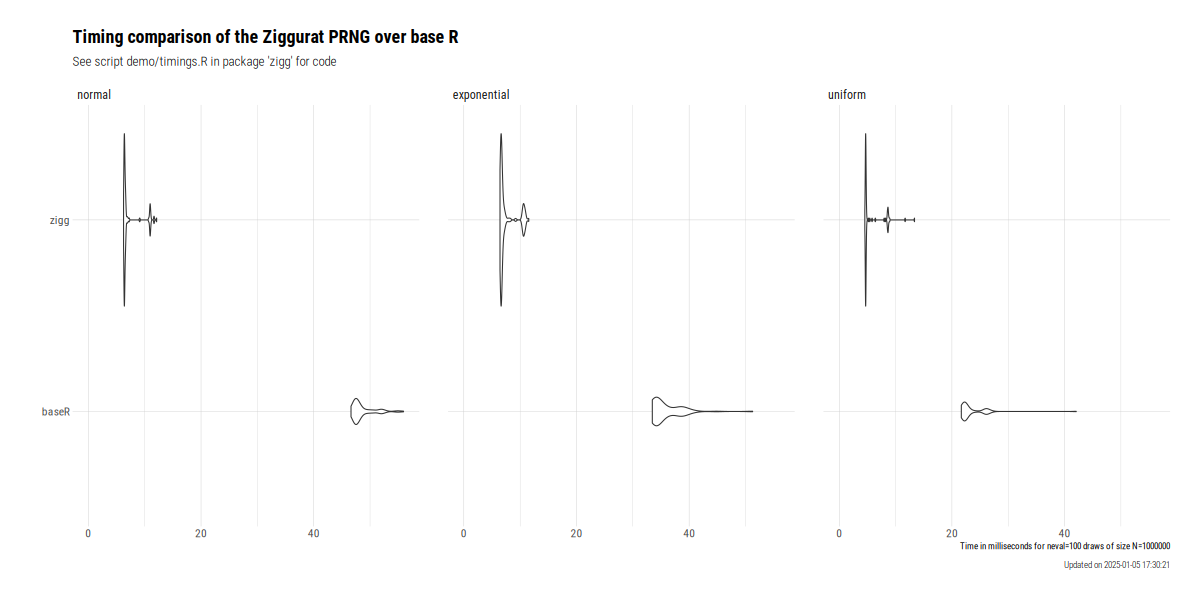
benchmark chart The still very new package zigg which arrived on CRAN a week ago just received a micro-update at CRAN. zigg provides the Ziggurat pseudo-random number generator (PRNG) for Normal, Exponential and Uniform draws proposed by Marsaglia and Tsang (JSS, 2000), and extended by Leong et al. (JSS, 2005). This PRNG is lightweight and very fast: on my machine speedups for the Normal, Exponential, and Uniform are on the order of 7.4, 5.2 and 4.7 times faster than the default generators in R as illustrated in the benchmark chart borrowed from the git repo. As wrote last week in the initial announcement, I had picked up their work in package RcppZiggurat and updated its code for the 64-buit world we now live in. That package alredy provided the Normal generator along with several competing implementations which it compared rigorously and timed them. As one of the generators was based on the GNU GSL via the implementation of Voss, we always ended up with a run-time dependency on the GSL too. No more: this new package is zero-depedency, zero-suggsts and hence very easy to deploy. Moreover, we also include a demonstration of four distinct ways of accessing the compiled code from another R package: pure and straight-up C, similarly pure C++, inclusion of the header in C++ as well as via Rcpp. The other advance is the resurrection of the second generator for the Exponential distribution. And following Burkardt we expose the Uniform too. The main upside of these generators is their excellent speed as can be seen in the comparison the default R generators generated by the example script timings.R: Needless to say, speed is not everything. This PRNG comes the time of 32-bit computing so the generator period is likely to be shorter than that of newer high-quality generators. If in doubt, forgo speed and stick with the high-quality default generators. This release essentially just completes the DESCRIPTION file and README.md now that this is a CRAN package. The short NEWS entry follows.

Changes in version 0.0.2 (2025-02-07)
  • Complete DESCRIPTION and README.md following initial CRAN upload

Courtesy of my CRANberries, there is a diffstat report relative to previous release. For more information, see the package page or the git repo.

This post by Dirk Eddelbuettel originated on his Thinking inside the box blog. If you like this or other open-source work I do, you can sponsor me at GitHub.

6 February 2025

Dirk Eddelbuettel: RcppArmadillo 14.2.3-1 on CRAN: Small Upstream Fix

armadillo image Armadillo is a powerful and expressive C++ template library for linear algebra and scientific computing. It aims towards a good balance between speed and ease of use, has a syntax deliberately close to Matlab, and is useful for algorithm development directly in C++, or quick conversion of research code into production environments. RcppArmadillo integrates this library with the R environment and language and is widely used by (currently) 1215 other packages on CRAN, downloaded 38.2 million times (per the partial logs from the cloud mirrors of CRAN), and the CSDA paper (preprint / vignette) by Conrad and myself has been cited 612 times according to Google Scholar. Conrad released a minor version 14.2.3 yesterday. As it has been two months since the last minor release, we prepared a new version for CRAN too which arrived there early this morning. The changes since the last CRAN release are summarised below.

Changes in RcppArmadillo version 14.2.3-1 (2025-02-05)
  • Upgraded to Armadillo release 14.2.3 (Smooth Caffeine)
    • Minor fix for declaration of xSYCON and xHECON functions in LAPACK
    • Fix for rare corner-case in reshape()

Courtesy of my CRANberries, there is a diffstat report relative to previous release. More detailed information is on the RcppArmadillo page. Questions, comments etc should go to the rcpp-devel mailing list off the Rcpp R-Forge page.

This post by Dirk Eddelbuettel originated on his Thinking inside the box blog. If you like this or other open-source work I do, you can sponsor me at GitHub.

Bits from Debian: Proxmox Platinum Sponsor of DebConf25

proxmox-logo We are pleased to announce that Proxmox has committed to sponsor DebConf25 as a Platinum Sponsor. Proxmox develops powerful, yet easy-to-use Open Source server software. The product portfolio from Proxmox, including server virtualization, backup, and email security, helps companies of any size, sector, or industry to simplify their IT infrastructures. The Proxmox solutions are based on the great Debian platform, and we are happy that we can give back to the community by sponsoring DebConf25. With this commitment as Platinum Sponsor, Proxmox is contributing to the Debian annual Developers' conference, directly supporting the progress of Debian and Free Software. Proxmox contributes to strengthen the community that collaborates on Debian projects from all around the world throughout all of the year. Thank you very much, Proxmox, for your support of DebConf25! Become a sponsor too! DebConf25 will take place from 14 to 20 July 2025 in Brest, France, and will be preceded by DebCamp, from 7 to 13 July 2025. DebConf25 is accepting sponsors! Interested companies and organizations may contact the DebConf team through sponsors@debconf.org, and visit the DebConf25 website at https://debconf25.debconf.org/sponsors /become-a-sponsor/.

5 February 2025

Reproducible Builds: Reproducible Builds in January 2025

Welcome to the first report in 2025 from the Reproducible Builds project! Our monthly reports outline what we ve been up to over the past month and highlight items of news from elsewhere in the world of software supply-chain security when relevant. As usual, though, if you are interested in contributing to the Reproducible Builds project, please visit our Contribute page on our website. Table of contents:
  1. reproduce.debian.net
  2. Two new academic papers
  3. Distribution work
  4. On our mailing list
  5. Upstream patches
  6. diffoscope
  7. Website updates
  8. Reproducibility testing framework

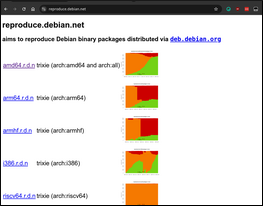
reproduce.debian.net The last few months saw the introduction of reproduce.debian.net. Announced at the recent Debian MiniDebConf in Toulouse, reproduce.debian.net is an instance of rebuilderd operated by the Reproducible Builds project. Powering that is rebuilderd, our server designed monitor the official package repositories of Linux distributions and attempt to reproduce the observed results there. This month, however, we are pleased to announce that in addition to the existing amd64.reproduce.debian.net and i386.reproduce.debian.net architecture-specific pages, we now build for a three more architectures (for a total of five) arm64 armhf and riscv64.

Two new academic papers Giacomo Benedetti, Oreofe Solarin, Courtney Miller, Greg Tystahl, William Enck, Christian K stner, Alexandros Kapravelos, Alessio Merlo and Luca Verderame published an interesting article recently. Titled An Empirical Study on Reproducible Packaging in Open-Source Ecosystem, the abstract outlines its optimistic findings:
[We] identified that with relatively straightforward infrastructure configuration and patching of build tools, we can achieve very high rates of reproducible builds in all studied ecosystems. We conclude that if the ecosystems adopt our suggestions, the build process of published packages can be independently confirmed for nearly all packages without individual developer actions, and doing so will prevent significant future software supply chain attacks.
The entire PDF is available online to view.
In addition, Julien Malka, Stefano Zacchiroli and Th o Zimmermann of T l com Paris in-house research laboratory, the Information Processing and Communications Laboratory (LTCI) published an article asking the question: Does Functional Package Management Enable Reproducible Builds at Scale?. Answering strongly in the affirmative, the article s abstract reads as follows:
In this work, we perform the first large-scale study of bitwise reproducibility, in the context of the Nix functional package manager, rebuilding 709,816 packages from historical snapshots of the nixpkgs repository[. We] obtain very high bitwise reproducibility rates, between 69 and 91% with an upward trend, and even higher rebuildability rates, over 99%. We investigate unreproducibility causes, showing that about 15% of failures are due to embedded build dates. We release a novel dataset with all build statuses, logs, as well as full diffoscopes: recursive diffs of where unreproducible build artifacts differ.
As above, the entire PDF of the article is available to view online.

Distribution work There as been the usual work in various distributions this month, such as:
  • 10+ reviews of Debian packages were added, 11 were updated and 10 were removed this month adding to our knowledge about identified issues. A number of issue types were updated also.
  • The FreeBSD Foundation announced that a planned project to deliver zero-trust builds has begun in January 2025 . Supported by the Sovereign Tech Agency, this project is centered on the various build processes, and that the primary goal of this work is to enable the entire release process to run without requiring root access, and that build artifacts build reproducibly that is, that a third party can build bit-for-bit identical artifacts. The full announcement can be found online, which includes an estimated schedule and other details.

On our mailing list On our mailing list this month:
  • Following-up to a substantial amount of previous work pertaining the Sphinx documentation generator, James Addison asked a question pertaining to the relationship between SOURCE_DATE_EPOCH environment variable and testing that generated a number of replies.
  • Adithya Balakumar of Toshiba asked a question about whether it is possible to make ext4 filesystem images reproducible. Adithya s issue is that even the smallest amount of post-processing of the filesystem results in the modification of the Last mount and Last write timestamps.
  • James Addison also investigated an interesting issue surrounding our disorderfs filesystem. In particular:
    FUSE (Filesystem in USErspace) filesystems such as disorderfs do not delete files from the underlying filesystem when they are deleted from the overlay. This can cause seemingly straightforward tests for example, cases that expect directory contents to be empty after deletion is requested for all files listed within them to fail.

Upstream patches The Reproducible Builds project detects, dissects and attempts to fix as many currently-unreproducible packages as possible. We endeavour to send all of our patches upstream where appropriate. This month, we wrote a large number of such patches, including:

diffoscope diffoscope is our in-depth and content-aware diff utility that can locate and diagnose reproducibility issues. This month, Chris Lamb made the following changes, including preparing and uploading versions 285, 286 and 287 to Debian:
  • Security fixes:
    • Validate the --css command-line argument to prevent a potential Cross-site scripting (XSS) attack. Thanks to Daniel Schmidt from SRLabs for the report. [ ]
    • Prevent XML entity expansion attacks. Thanks to Florian Wilkens from SRLabs for the report.. [ ][ ]
    • Print a warning if we have disabled XML comparisons due to a potentially vulnerable version of pyexpat. [ ]
  • Bug fixes:
    • Correctly identify changes to only the line-endings of files; don t mark them as Ordering differences only. [ ]
    • When passing files on the command line, don t call specialize( ) before we ve checked that the files are identical or not. [ ]
    • Do not exit with a traceback if paths are inaccessible, either directly, via symbolic links or within a directory. [ ]
    • Don t cause a traceback if cbfstool extraction failed.. [ ]
    • Use the surrogateescape mechanism to avoid a UnicodeDecodeError and crash when any decoding zipinfo output that is not UTF-8 compliant. [ ]
  • Testsuite improvements:
    • Don t mangle newlines when opening test fixtures; we want them untouched. [ ]
    • Move to assert_diff in test_text.py. [ ]
  • Misc improvements:
    • Drop unused subprocess imports. [ ][ ]
    • Drop an unused function in iso9600.py. [ ]
    • Inline a call and check of Config().force_details; no need for an additional variable in this particular method. [ ]
    • Remove an unnecessary return value from the Difference.check_for_ordering_differences method. [ ]
    • Remove unused logging facility from a few comparators. [ ]
    • Update copyright years. [ ][ ]
In addition, fridtjof added support for the ASAR .tar-like archive format. [ ][ ][ ][ ] and lastly, Vagrant Cascadian updated diffoscope in GNU Guix to version 285 [ ][ ] and 286 [ ][ ].
strip-nondeterminism is our sister tool to remove specific non-deterministic results from a completed build. This month version 1.14.1-1 was uploaded to Debian unstable by Chris Lamb, making the following the changes:
  • Clarify the --verbose and non --verbose output of bin/strip-nondeterminism so we don t imply we are normalizing files that we are not. [ ]
  • Bump Standards-Version to 4.7.0. [ ]

Website updates There were a large number of improvements made to our website this month, including:

Reproducibility testing framework The Reproducible Builds project operates a comprehensive testing framework running primarily at tests.reproducible-builds.org in order to check packages and other artifacts for reproducibility. In January, a number of changes were made by Holger Levsen, including:
  • reproduce.debian.net-related:
    • Add support for rebuilding the armhf architecture. [ ][ ]
    • Add support for rebuilding the arm64 architecture. [ ][ ][ ][ ]
    • Add support for rebuilding the riscv64 architecture. [ ][ ]
    • Move the i386 builder to the osuosl5 node. [ ][ ][ ][ ]
    • Don t run our rebuilders on a public port. [ ][ ]
    • Add database backups on all builders and add links. [ ][ ]
    • Rework and dramatically improve the statistics collection and generation. [ ][ ][ ][ ][ ][ ]
    • Add contact info to the main page [ ], thumbnails [ ] as well as the new, missing architectures. [ ]
    • Move the amd64 worker to the osuosl4 and node. [ ]
    • Run the underlying debrebuild script under nice. [ ]
    • Try to use TMPDIR when calling debrebuild. [ ][ ]
  • buildinfos.debian.net-related:
    • Stop creating buildinfo-pool_$ suite _$ arch .list files. [ ]
    • Temporarily disable automatic updates of pool links. [ ]
  • FreeBSD-related:
    • Fix the sudoers to actually permit builds. [ ]
    • Disable debug output for FreeBSD rebuilding jobs. [ ]
    • Upgrade to FreeBSD 14.2 [ ] and document that bmake was installed on the underlying FreeBSD virtual machine image [ ].
  • Misc:
    • Update the real year to 2025. [ ]
    • Don t try to install a Debian bookworm kernel from backports on the infom08 node which is running Debian trixie. [ ]
    • Don t warn about system updates for systems running Debian testing. [ ]
    • Fix a typo in the ZOMBIES definition. [ ][ ]
In addition:
  • Ed Maste modified the FreeBSD build system to the clean the object directory before commencing a build. [ ]
  • Gioele Barabucci updated the rebuilder stats to first add a category for network errors [ ] as well as to categorise failures without a diffoscope log [ ].
  • Jessica Clarke also made some FreeBSD-related changes, including:
    • Ensuring we clean up the object directory for second build as well. [ ][ ]
    • Updating the sudoers for the relevant rm -rf command. [ ]
    • Update the cleanup_tmpdirs method to to match other removals. [ ]
  • Jochen Sprickerhof:
  • Roland Clobus:
    • Update the reproducible_debstrap job to call Debian s debootstrap with the full path [ ] and to use eatmydata as well [ ][ ].
    • Make some changes to deduce the CPU load in the debian_live_build job. [ ]
Lastly, both Holger Levsen [ ] and Vagrant Cascadian [ ] performed some node maintenance.
If you are interested in contributing to the Reproducible Builds project, please visit our Contribute page on our website. However, you can get in touch with us via:

4 February 2025

Valhalla's Things: Conference Talk Timeout Ring, Part One

Posted on February 4, 2025
Tags: madeof:atoms, madeof:bits
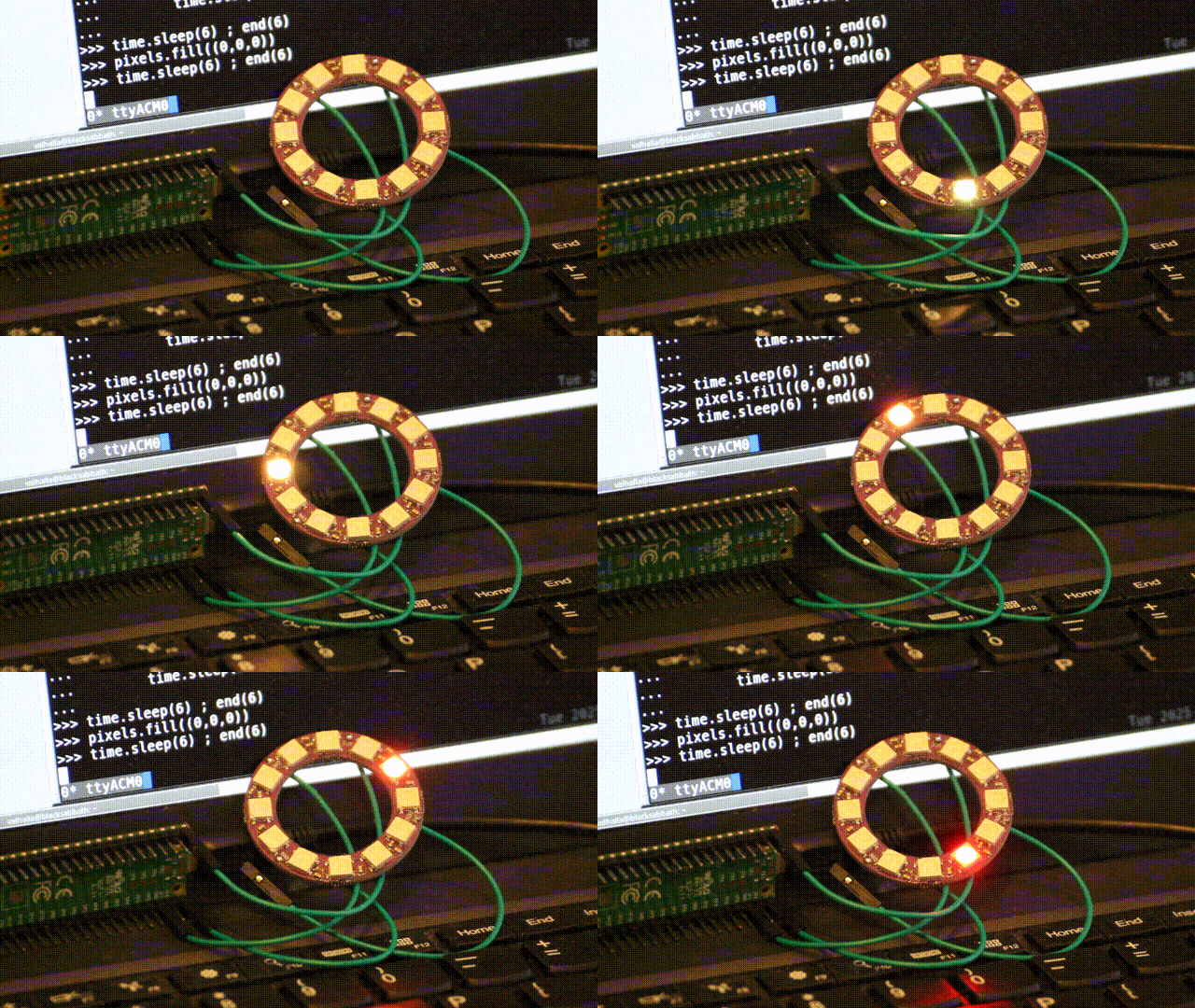
low quality video of a ring of rgb LED in front of a computer: the LED light up one at a time in colours that go from yellow to red. A few ago I may have accidentally bought a ring of 12 RGB LEDs; I soldered temporary leads on it, connected it to a CircuitPython supported board and played around for a while. They we had a couple of friends come over to remote FOSDEM together, and I had talked with one of them about WS2812 / NeoPixels, so I brought them to the living room, in case there was a chance to show them in sort-of-use. Then I was dealing with playing the various streams as we moved from one room to the next, which lead to me being called video team , which lead to me wearing a video team shirt (from an old DebConf, not FOSDEM, but still video team), which lead to somebody asking me whether I also had the sheet with the countdown to the end of the talk, and the answer was sort-of-yes (I should have the ones we used to use for our Linux Day), but not handy. But I had a thing with twelve things in a clock-like circle. A bit of fiddling on the CircuitPython REPL resulted, if I remember correctly, in something like:
import board
import neopixel
import time
num_pixels = 12
pixels = neopixel.NeoPixel(board.GP0, num_pixels)
pixels.brightness = 0.1
def end(min):
    pixels.fill((0, 0, 0))
    for i in range(12):
        pixels[i] = (127 + 10 * i, 8 * (12 - i), 0)
        pixels[i-1] = (0, 0, 0)
        time.sleep(min * 5)  # min * 60 / 12
Now, I wasn t very consistent in running end, especially since I wasn t sure whether I wanted to run it at the beginning of the talk with the full duration or just in the last 5 - 10 minutes depending of the length of the slot, but I ve had at least one person agree that the general idea has potential, so I m taking these notes to be able to work on it in the future. One thing that needs to be fixed is the fact that with the ring just attached with temporary wires and left on the table it isn t clear which LED is number 0, so it will need a bit of a case or something, but that s something that can be dealt with before the next fosdem. And I should probably add some input interface, so that it is self-contained and not tethered to a computer and run from the REPL. (And then I may also have a vague idea for putting that ring into some wearable thing: good thing that I actually bought two :D )

2 February 2025

Bits from Debian: Bits from the DPL

Dear Debian community, this is bits from DPL for January. Sovereign Tech Agency I was recently pointed to Technologies and Projects supported by the Sovereign Tech Agency which is financed by the German Federal Ministry for Economic Affairs and Climate Action. It is a subsidiary of the Federal Agency for Disruptive Innovation, SPRIND GmbH. It is worth sending applications there for distinct projects as that is their preferred method of funding. Distinguished developers can also apply for a fellowship position that pays up to 40hrs / week (32hrs when freelancing) for a year. This is esp. open to maintainers of larger numbers of packages in Debian (or any other Linux distribution). There might be a chance that some of the Debian-related projects submitted to the Google Summer of Code that did not get funded could be retried with those foundations. As per the FAQ of the project: "The Sovereign Tech Agency focuses on securing and strengthening open and foundational digital technologies. These communities working on these are distributed all around the world, so we work with people, companies, and FOSS communities everywhere." Similar funding organizations include the Open Technology Fund and FLOSS/fund. If you have a Debian-related project that fits these funding programs, they might be interesting options. This list is by no means exhaustive just some hints I ve received and wanted to share. More suggestions for such opportunities are welcome. Year of code reviews On the debian-devel mailing list, there was a long thread titled "Let's make 2025 a year when code reviews became common in Debian". It initially suggested something along the lines of: "Let's review MRs in Salsa." The discussion quickly expanded to include patches that have been sitting in the BTS for years, which deserve at least the same attention. One idea I'd like to emphasize is that associating BTS bugs with MRs could be very convenient. It s not only helpful for documentation but also the easiest way to apply patches. I d like to emphasize that no matter what workflow we use BTS, MRs, or a mix it is crucial to uphold Debian s reputation for high quality. However, this reputation is at risk as more and more old issues accumulate. While Debian is known for its technical excellence, long-standing bugs and orphaned packages remain a challenge. If we don t address these, we risk weakening the high standards that Debian is valued for. Revisiting old issues and ensuring that unmaintained packages receive attention is especially important as we prepare for the Trixie release. Debian Publicity Team will no longer post on X/Twitter The Press Team has my full support in its decision to stop posting on X. As per the Publicity delegation: the team once decided to join Twitter, but circumstances have since changed. The current Press delegates have the institutional authority to leave X, just as their predecessors had the authority to join. I appreciate that the team carefully considered the matter, reinforced by the arguments developed on the debian-publicity list, and communicated its reasoning openly. Kind regards, Andreas.

Dirk Eddelbuettel: RcppUUID 1.1.2 on CRAN: Newly Adopted Package

The RcppUUID package on CRAN has been providing UUIDs (based on the underlying Boost library) for several years. Written by Artem Klemsov and maintained in this gitlab repo, the package is a very nice example of clean and straightforward library binding. When we did our annual BH upgrade to 1.87.0 and check reverse dependencies, we noticed the RcppUUID needed a small and rather minor update which we showed as a short diff in an issue filed. Neither I nor CRAN heard from Artem, so the packaged ended up being archived last week. Which in turn lead me to make this minimal update to 1.1.2 to resurrect it, which CRAN processed more or less like a regular update given this explanation and so it arrived last Friday. Courtesy of my CRANberries, there is also a a new package note (no diffstat report yet). More detailed information is on the RcppUUID page, or the github repo.

This post by Dirk Eddelbuettel originated on his Thinking inside the box blog. If you like this or other open-source work I do, you can sponsor me at GitHub.

Colin Watson: Free software activity in January 2025

Most of my Debian contributions this month were sponsored by Freexian. If you appreciate this sort of work and are at a company that uses Debian, have a look to see whether you can pay for any of Freexian s services; as well as the direct benefits, that revenue stream helps to keep Debian development sustainable for me and several other lovely people. You can also support my work directly via Liberapay. Python team We finally made Python 3.13 the default version in testing! I fixed various bugs that got in the way of this: As with last month, I fixed a few more build regressions due to the removal of a deprecated intersphinx_mapping syntax in Sphinx 8.0: I ported a few packages to Django 5.1: I ported python-pypump to IPython 8.0. I fixed python-datamodel-code-generator to handle isort 6, and contributed that upstream. I fixed some packages to tolerate future versions of dh-python that will drop their dependency on python3-setuptools: I removed the old python-celery-common transitional package from celery, since nothing in Debian needs it any more. I fixed or helped to fix various other build/test failures: I upgraded these packages to new upstream versions: Rust team I fixed rust-pyo3-ffi to avoid explicit Python version dependencies that were getting in the way of making Python 3.13 the default version. Security tools packaging team I uploaded libevt to fix a build failure on i386 and to tolerate future versions of dh-python that will drop their dependency on python3-setuptools. Installer team I helped with some testing of a debian-installer-utils patch as part of the /usr move. I need to get around to uploading this, since it looks OK now. Other small things Helmut Grohne reached out for help debugging a multi-arch coinstallability problem (you know it s going to be complicated when even Helmut can t figure it out on his own ) in binutils, and we had a call about that. I reviewed and applied a new Romanian translation of debconf s manual pages. I did my twice-yearly refresh of debmirror s mirror_size documentation, and applied a contribution to improve the example debmirror.conf. I fixed an arguable preprocessor string handling bug in man-db, and applied a fix for out-of-tree builds.

Joachim Breitner: Coding on my eInk Tablet

For many years I wished I had a setup that would allow me to work (that is, code) productively outside in the bright sun. It s winter right now, but when its summer again it s always a bit. this weekend I got closer to that goal. TL;DR: Using code-server on a beefy machine seems to be quite neat.
Passively lit coding Passively lit coding

Personal history Looking back at my own old blog entries I find one from 10 years ago describing how I bought a Kobo eBook reader with the intent of using it as an external monitor for my laptop. It seems that I got a proof-of-concept setup working, using VNC, but it was tedious to set up, and I never actually used that. I subsequently noticed that the eBook reader is rather useful to read eBooks, and it has been in heavy use for that every since. Four years ago I gave this old idea another shot and bought an Onyx BOOX Max Lumi. This is an A4-sized tablet running Android and had the very promising feature of an HDMI input. So hopefully I d attach it to my laptop and it just works . Turns out that this never worked as well as I hoped: Even if I set the resolution to exactly the tablet s screen s resolution I got blurry output, and it also drained the battery a lot, so I gave up on this. I subsequently noticed that the tablet is rather useful to take notes, and it has been in sporadic use for that. Going off on this tangent: I later learned that the HDMI input of this device appears to the system like a camera input, and I don t have to use Boox s monitor app but could other apps like FreeDCam as well. This somehow managed to fix the resolution issues, but the setup still wasn t as convenient to be used regularly. I also played around with pure terminal approaches, e.g. SSH ing into a system, but since my usual workflow was never purely text-based (I was at least used to using a window manager instead of a terminal multiplexer like screen or tmux) that never led anywhere either.

VSCode, working remotely Since these attempts I have started a new job working on the Lean theorem prover, and working on or with Lean basically means using VSCode. (There is a very good neovim plugin as well, but I m using VSCode nevertheless, if only to make sure I am dogfooding our default user experience). My colleagues have said good things about using VSCode with the remote SSH extension to work on a beefy machine, so I gave this a try now as well, and while it s not a complete game changer for me, it does make certain tasks (rebuilding everything after a switching branches, running the test suite) very convenient. And it s a bit spooky to run these work loads without the laptop s fan spinning up. In this setup, the workspace is remote, but VSCode still runs locally. But it made me wonder about my old goal of being able to work reasonably efficient on my eInk tablet. Can I replicate this setup there? VSCode itself doesn t run on Android directly. There are project that run a Linux chroot or in termux on the Android system, and then you can VNC to connect to it (e.g. on Andronix) but that did not seem promising. It seemed fiddly, and I probably should take it easy on the tablet s system.

code-server, running remotely A more promising option is code-server. This is a fork of VSCode (actually of VSCodium) that runs completely on the remote machine, and the client machine just needs a browser. I set that up this weekend and found that I was able to do a little bit of work reasonably.

Access With code-server one has to decide how to expose it safely enough. I decided against the tunnel-over-SSH option, as I expected that to be somewhat tedious to set up (both initially and for each session) on the android system, and I liked the idea of being able to use any device to work in my environment. I also decided against the more involved reverse proxy behind proper hostname with SSL setups, because they involve a few extra steps, and some of them I cannot do as I do not have root access on the shared beefy machine I wanted to use. That left me with the option of using a code-server s built-in support for self-signed certificates and a password:
$ cat .config/code-server/config.yaml
bind-addr: 1.2.3.4:8080
auth: password
password: xxxxxxxxxxxxxxxxxxxxxxxx
cert: true
With trust-on-first-use this seems reasonably secure. Update: I noticed that the browsers would forget that I trust this self-signed cert after restarting the browser, and also that I cannot install the page (as a Progressive Web App) unless it has a valid certificate. But since I don t have superuser access to that machine, I can t just follow the official recommendation of using a reverse proxy on port 80 or 431 with automatic certificates. Instead, I pointed a hostname that I control to that machine, obtained a certificate manually on my laptop (using acme.sh) and copied the files over, so the configuration now reads as follows:
bind-addr: 1.2.3.4:3933
auth: password
password: xxxxxxxxxxxxxxxxxxxxxxxx
cert: .acme.sh/foobar.nomeata.de_ecc/foobar.nomeata.de.cer
cert-key: .acme.sh/foobar.nomeata.de_ecc/foobar.nomeata.de.key
(This is getting very specific to my particular needs and constraints, so I ll spare you the details.)

Service To keep code-server running I created a systemd service that s managed by my user s systemd instance:
~ $ cat ~/.config/systemd/user/code-server.service
[Unit]
Description=code-server
After=network-online.target
[Service]
Environment=PATH=/home/joachim/.nix-profile/bin:/nix/var/nix/profiles/default/bin:/usr/local/bin:/usr/bin:/bin:/usr/local/games:/usr/games
ExecStart=/nix/var/nix/profiles/default/bin/nix run nixpkgs#code-server
[Install]
WantedBy=default.target
(I am using nix as a package manager on a Debian system there, hence the additional PATH and complex ExecStart. If you have a more conventional setup then you do not have to worry about Environment and can likely use ExecStart=code-server. For this to survive me logging out I had to ask the system administrator to run loginctl enable-linger joachim, so that systemd allows my jobs to linger.

Git credentials The next issue to be solved was how to access the git repositories. The work is all on public repositories, but I still need a way to push my work. With the classic VSCode-SSH-remote setup from my laptop, this is no problem: My local SSH key is forwarded using the SSH agent, so I can seamlessly use that on the other side. But with code-server there is no SSH key involved. I could create a new SSH key and store it on the server. That did not seem appealing, though, because SSH keys on Github always have full access. It wouldn t be horrible, but I still wondered if I can do better. I thought of creating fine-grained personal access tokens that only me to push code to specific repositories, and nothing else, and just store them permanently on the remote server. Still a neat and convenient option, but creating PATs for our org requires approval and I didn t want to bother anyone on the weekend. So I am experimenting with Github s git-credential-manager now. I have configured it to use git s credential cache with an elevated timeout, so that once I log in, I don t have to again for one workday.
$ nix-env -iA nixpkgs.git-credential-manager
$ git-credential-manager configure
$ git config --global credential.credentialStore cache
$ git config --global credential.cacheOptions "--timeout 36000"
To login, I have to https://github.com/login/device on an authenticated device (e.g. my phone) and enter a 8-character code. Not too shabby in terms of security. I only wish that webpage would not require me to press Tab after each character This still grants rather broad permissions to the code-server, but at least only temporarily

Android setup On the client side I could now open https://host.example.com:8080 in Firefox on my eInk Android tablet, click through the warning about self-signed certificates, log in with the fixed password mentioned above, and start working! I switched to a theme that supposedly is eInk-optimized (eInk by Mufanza). It s not perfect (e.g. git diffs are unhelpful because it is not possible to distinguish deleted from added lines), but it s a start. There are more eInk themes on the official Visual Studio Marketplace, but because code-server is a fork it cannot use that marketplace, and for example this theme isn t on Open-VSX. For some reason the F11 key doesn t work, but going fullscreen is crucial, because screen estate is scarce in this setup. I can go fullscreen using VSCode s command palette (Ctrl-P) and invoking the command there, but Firefox often jumps out of the fullscreen mode, which is annoying. I still have to pay attention to when that s happening; maybe its the Esc key, which I am of course using a lot due to me using vim bindings. A more annoying problem was that on my Boox tablet, sometimes the on-screen keyboard would pop up, which is seriously annoying! It took me a while to track this down: The Boox has two virtual keyboards installed: The usual Google ASOP keyboard, and the Onyx Keyboard. The former is clever enough to stay hidden when there is a physical keyboard attached, but the latter isn t. Moreover, pressing Shift-Ctrl on the physical keyboard rotates through the virtual keyboards. Now, VSCode has many keyboard shortcuts that require Shift-Ctrl (especially on an eInk device, where you really want to avoid using the mouse). And the limited settings exposed by the Boox Android system do not allow you configure that or disable the Onyx keyboard! To solve this, I had to install the KISS Launcher, which would allow me to see more Android settings, and in particular allow me to disable the Onyx keyboard. So this is fixed. I was hoping to improve the experience even more by opening the web page as a Progressive Web App (PWA), as described in the code-server FAQ. Unfortunately, that did not work. Firefox on Android did not recognize the site as a PWA (even though it recognizes a PWA test page). And I couldn t use Chrome either because (unlike Firefox) it would not consider a site with a self-signed certificate as a secure context, and then code-server does not work fully. Maybe this is just some bug that gets fixed in later versions. Now that I use a proper certificate, I can use it as a Progressive Web App, and with Firefox on Android this starts the app in full-screen mode (no system bars, no location bar). The F11 key still does t work, and using the command palette to enter fullscreen does nothing visible, but then Esc leaves that fullscreen mode and I suddenly have the system bars again. But maybe if I just don t do that I get the full screen experience. We ll see. I did not work enough with this yet to assess how much the smaller screen estate, the lack of colors and the slower refresh rate will bother me. I probably need to hide Lean s InfoView more often, and maybe use the Error Lens extension, to avoid having to split my screen vertically. I also cannot easily work on a park bench this way, with a tablet and a separate external keyboard. I d need at least a table, or some additional piece of hardware that turns tablet + keyboard into some laptop-like structure that I can put on my, well, lap. There are cases for Onyx products that include a keyboard, and maybe they work on the lap, but they don t have the Trackpoint that I have on my ThinkPad TrackPoint Keyboard II, and how can you live without that?

Conclusion After this initial setup chances are good that entering and using this environment is convenient enough for me to actually use it; we will see when it gets warmer. A few bits could be better. In particular logging in and authenticating GitHub access could be both more convenient and more safe I could imagine that when I open the page I confirm that on my phone (maybe with a fingerprint), and that temporarily grants access to the code-server and to specific GitHub repositories only. Is that easily possible?

Junichi Uekawa: February.

February. This is entrance exam season for Tokyo Junior High Schools. Good luck to those who are going through it now.

Dirk Eddelbuettel: RcppSpdlog 0.0.20 on CRAN: New Upstream, New Features

Version 0.0.20 of RcppSpdlog arrived on CRAN early this morning and has been uploaded to Debian. RcppSpdlog bundles spdlog, a wonderful header-only C++ logging library with all the bells and whistles you would want that was written by Gabi Melman, and also includes fmt by Victor Zverovich. You can learn more at the nice package documention site. This release updates the code to the version 1.15.1 of spdlog which was released this morning as well. It also contains a contributed PR which illustrates logging in a multithreaded context. The NEWS entry for this release follows.

Changes in RcppSpdlog version 0.0.20 (2025-02-01)
  • New multi-threaded logging example (Young Geun Kim and Dirk via #22)
  • Upgraded to upstream release spdlog 1.15.1

Courtesy of my CRANberries, there is also a diffstat report. More detailed information is on the RcppSpdlog page, or the package documention site.

This post by Dirk Eddelbuettel originated on his Thinking inside the box blog. If you like this or other open-source work I do, you can sponsor me at GitHub.

1 February 2025

Guido G nther: Free Software Activities January 2025

Another short status update of what happened on my side last month. Mostly focused on quality of life improvements in phosh and cleaning up and improving phoc this time around (including catching up with wlroots git) but some improvements for other things like phosh-osk-stub happened on the side line too. phosh phoc phosh-osk-stub xdg-desktop-portal-phosh phosh-recipes libcmatrix phrog Debian git-buildpackage livi feedbackd Wayland protocols Wlroots Bug reports Reviews This is not code by me but reviews on other peoples code. The list is incomplete, but I hope to improve on this in the upcoming months. Thanks for the contributions! Help Development If you want to support my work see donations. Comments? Join the Fediverse thread

31 January 2025

Gunnar Wolf: ChatGPT is bullshit

This post is an unpublished review for ChatGPT is bullshit
As people around the world understand how LLMs behave, more and more people wonder as to why these models hallucinate, and what can be done about to reduce it. This provocatively named article by Michael Townsen Hicks, James Humphries and Joe Slater bring is an excellent primer to better understanding how LLMs work and what to expect from them. As humans carrying out our relations using our language as the main tool, we are easily at awe with the apparent ease with which ChatGPT (the first widely available, and to this day probably the best known, LLM-based automated chatbot) simulates human-like understanding and how it helps us to easily carry out even daunting data aggregation tasks. It is common that people ask ChatGPT for an answer and, if it gets part of the answer wrong, they justify it by stating that it s just a hallucination. Townsen et al. invite us to switch from that characterization to a more correct one: LLMs are bullshitting. This term is formally presented by Frankfurt [1]. To Bullshit is not the same as to lie, because lying requires to know (and want to cover) the truth. A bullshitter not necessarily knows the truth, they just have to provide a compelling description, regardless of what is really aligned with truth. After introducing Frankfurt s ideas, the authors explain the fundamental ideas behind LLM-based chatbots such as ChatGPT; a Generative Pre-trained Transformer (GPT) s have as their only goal to produce human-like text, and it is carried out mainly by presenting output that matches the input s high-dimensional abstract vector representation, and probabilistically outputs the next token (word) iteratively with the text produced so far. Clearly, a GPT s ask is not to seek truth or to convey useful information they are built to provide a normal-seeming response to the prompts provided by their user. Core data are not queried to find optimal solutions for the user s requests, but are generated on the requested topic, attempting to mimic the style of document set it was trained with. Erroneous data emitted by a LLM is, thus, not equiparable with what a person could hallucinate with, but appears because the model has no understanding of truth; in a way, this is very fitting with the current state of the world, a time often termed as the age of post-truth [2]. Requesting an LLM to provide truth in its answers is basically impossible, given the difference between intelligence and consciousness: Following Harari s definitions [3], LLM systems, or any AI-based system, can be seen as intelligent, as they have the ability to attain goals in various, flexible ways, but they cannot be seen as conscious, as they have no ability to experience subjectivity. This is, the LLM is, by definition, bullshitting its way towards an answer: their goal is to provide an answer, not to interpret the world in a trustworthy way. The authors close their article with a plea for literature on the topic to adopt the more correct bullshit term instead of the vacuous, anthropomorphizing hallucination . Of course, being the word already loaded with a negative meaning, it is an unlikely request. This is a great article that mixes together Computer Science and Philosophy, and can shed some light on a topic that is hard to grasp for many users. [1] Frankfurt, Harry (2005). On Bullshit. Princeton University Press. [2] Zoglauer, Thomas (2023). Constructed truths: truth and knowledge in a post-truth world. Springer. [3] Harari, Yuval Noah (2023. Nexus: A Brief History of Information Networks From the Stone Age to AI. Random House.

Dirk Eddelbuettel: zigg 0.0.1 on CRAN: New Package!

Thrilled to announce a new package: zigg. It arrived on CRAN today after a few days of review in the newbies queue. zigg provides the Ziggurat pseudo-random number generator for Normal, Exponential and Uniform draws proposed by Marsaglia and Tsang (JSS, 2000), and extended by Leong et al. (JSS, 2005). I had picked up their work in package RcppZiggurat and updated its code for the 64-buit world we now live in. That package alredy provided the Normal generator along with several competing implementations which it compared rigorously and timed them. As one of the generators was based on the GNU GSL via the implementation of Voss, we always ended up with a run-time dependency on the GSL too. No more: this new package is zero-depedency, zero-suggsts and hence very easy to deploy. Moreover, we also include a demonstration of four distinct ways of accessing the compiled code from another R package: pure and straight-up C, similarly pure C++, inclusion of the header in C++ as well as via Rcpp. The other advance is the resurrection of the second generator for the Exponential distribution. And following Burkardt we expose the Uniform too. The main upside of these generators is their excellent speed as can be seen in the comparison the default R generators generated by the example script timings.R: Needless to say, speed is not everything. This PRNG comes the time of 32-bit computing so the generator period is likely to be shorter than that of newer high-quality generators. If in doubt, forgo speed and stick with the high-quality default generators. The short NEWS entry follows.

Changes in version 0.0.1 (2021-01-30)
  • Initial version and CRAN upload

For more, see the package page or the git repo.

This post by Dirk Eddelbuettel originated on his Thinking inside the box blog. If you like this or other open-source work I do, you can sponsor me at GitHub.

Next.

Previous.