Search Results: "Martin"

19 September 2007

Martin F. Krafft: It's all text, and bug-free!

Yesterday, I started porting some of my research notes to the Debian wiki. I wanted to use vim for the editing, and since the "Editus Externus" extension basically died, I went out on a quest and found It's all text, which does the job quite nicely. And it's bug-free, at least when you configure it that way in the addon's preferences dialog:
Checked item 'remove all bugs'
NP: The Flower Kings: Paradox Hotel

11 September 2007

Martin Zobel-Helas: Debian Sarge 3.1r7 frozen

After tonights dinstall run, we will freeze 3.1r7 for sourcefull uploads, unless someone has a very good reason for another package inclusion for oldstable. Adventureous admins (who have also a backup of their systems) might want to try to add olstable-proposed-updates to their /etc/apt/sources.list and try to upgrade. Please report any problems to the debian-release@lists.debian.org mailing list.

4 September 2007

Romain Francoise: Shared links for 2007-09-04

2 September 2007

Christian Perrier: My country is even more complicated

Well, checking ISO-3166-2 data for my country, I found out that France officially listed the following subdivisions in ISO-3166-2: Thankfully, they didn't list the hundreds of "cantons" and "arrondissements", nor the 36,000 municipalities. Ah, and France is also one of the very few countries that have *more than one* ISO-3166 code as, besides the logical FR, we have GP for Guadeloupe, GF for Guyane, MQ for Martinique, RE for R union, YT for Mayotte, PM for Saint-Pierre-et-Miquelon, NC for New Caledonia, PF for French Polynesia, TF for the Southern French Territories and WF for Wallis et Futuna. Dammit..:-) Even our British friends didn't steal codes for Scotland or Wales...

1 September 2007

Michael Prokop: Froscon 2007 - lessons learnt

28 August 2007

Martin F. Krafft: Netconf status update

If you care about netconf and wonder what's the current status, you might want to ingest the status update I sent to the netconf-devel mailing list. The most important point probably is: if you want to work on netconf, I'll be readily available for questions on the mailing list, even though I cannot expend much time to hack myself over the next four months. But I will consider coaching anyone who would like to contribute and wants to be coached in doing so. So don't hesitate and let me know, and consider telling me a bit about what kind of projects you have worked on in the past. NP: Mono: Under the Pipal Tree

25 August 2007

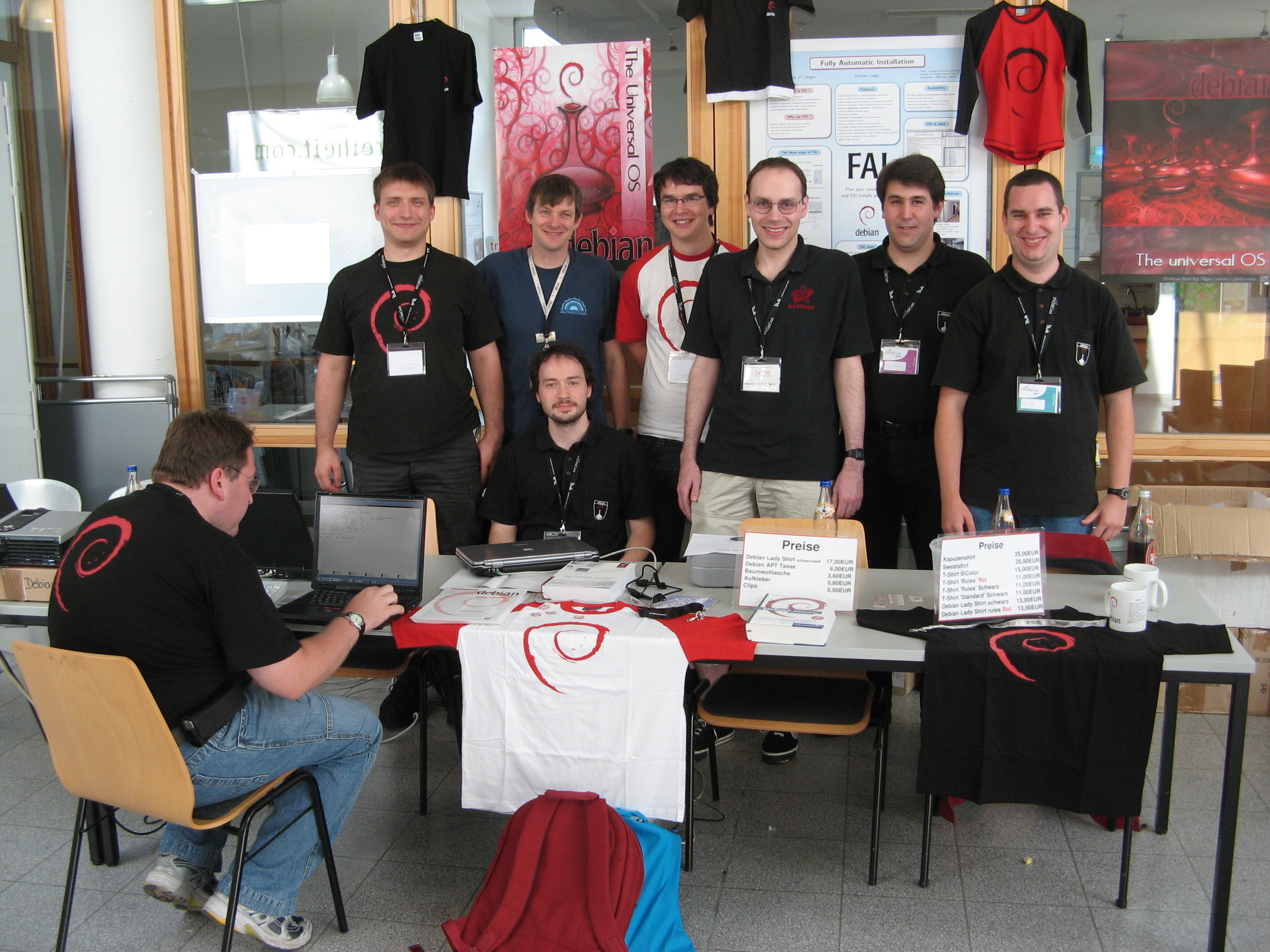
Michael Prokop: Debian @ Froscon 2007

The Debian-Team at the Debian-booth of Froscon 2007: Debian-Team at Froscon 2007, picture Standing (from left): Bernd Zeimetz, Thomas ‘MrFai’ Lange, Sebastian Harl, Elmar Hoffmann, Martin Zobel-Helas, Luk Claes;
Sitting in the middle: Christoph ‘myon’ Berg

21 August 2007

Martin F. Krafft: If you procmail, read this

I just had a hard time finding this excellent procmail resource on the web. I am thus blogging it for posterity, in case anyone is looking for procmail documentation, tips, tricks, a how-to, or anything else related to procmail. And if you procmail and have not read the document, I suggest you do. It's truly outstanding. NP: A Silver Mt. Zion: He Has Left us Alone, but Shafts of Light Sometimes Grace the Corner of our Rooms

20 August 2007

Martin F. Krafft: Pay three times as much and get zero brain power

If you walk up to the Swiss railways customer service desk and tell them that you're a group of six looking to travel from Zurich to Munich and would thus like to make a reservation, they'll charge you 15 CHF (~ 9.50 ) for a little piece of paper which documents that the guy behind the desk put his brain to use and reserved six contiguous seats to keep the group together. Well, he actually asked me whether that's what I wanted. If you walk up to the German railways customer service desk and tell them that you're a group of (now) eight looking to travel from Munich to Zurich and would thus like to make a reservation, they'll charge you 28 for a little piece of paper which documents that the guy behind the desk does not have a brain or didn't bother to switch it on: instead of two adjacent groups of four seats, we got four pairs of aisle seats. Given that we mainly reserved to minimise the annoyance for the other travellers while we kept up a conversation for the five hours of the journey, it did piss me off quite a bit to have paid three times as much in Germany as the reservation cost in Switzerland and not be able to talk among each other without annoying the others. This reservation was made two days in advance. You may, of course, think that the train was already full and no space to sit eight was left; however, I did not have to go further than two wagons to find copious amounts of unreserved spaces for eight, which were then, unfortunately, already occupied (of course). It shames me to expose my peers (I made the travel arrangements) to the crap and blather one has to put up in German railways: the quality of the speaker system is crap, everything is repeated in English by non-English-speaking conductors, and after every stop, we're yet again alerted to the fact that we could be relaxing to high-quality cuisine in the board restaurant, or should watch out for the little trolley passing by and happy to collect our money. Oh, and of course the brainless and often unfriendly service employees. And all that for a price more than it would have cost the lot of us to rent a van and drive back and forth. Going by train is my most preferable means of transport, not only, but in large part due to environmental issues. I don't understand why the German government puts this important bit of infrastructure in the hands of imbeciles and lets them overcharge for their low-quality service and their delays. NP: Mono: Under the Pipal Tree Update: A guy from Berlin wrote:
The seats you found in the other wagons may as well have been reserved, too. The electronic reservation signs will extinguish about 15 minutes after the train departs from the station. Or, there was too little time between reservation and departure, so you could only get one of the few express-reservation seats.
I am aware of this. However, the train between Zurich and Munich is ancient (part of the way it still has to run on Diesel) and the reservation signs were paper slips. The seats of eight I found were definitely unreserved, especially because I checked immediately after departure.

16 August 2007

Martin F. Krafft: Happy Birthday, Debian

You're 14 today. In Canada you have just reached age of consent and your tarot card would be Temperance. Yeah! (I could hardly wait) NP: The Penguin Cafe Orchestra: A History

Martin Zobel-Helas: 4.0r2 now open

Thanks James. No Tags

14 August 2007

Martin F. Krafft: Happy Birthday, Debian

You're 14 today. In Canada you have just reached age of consent and your tarot card would be Temperance. Yeah! NP: The Penguin Cafe Orchestra: A History

Martin-Éric Racine: Sound editors that work with Gstreamer or PulseAudio?

Today, I wanted to edit a few MP3 files into suitable ring tones for my phone. The idea seemed simple at first: load up a song, chop off a few bars and loop that as a ring tone. Nice in theory, except that sound editing software on a free desktop is challenging, at best: most of it was designed back in the days of OSS and GTK 1.2, some wants to use JACK for playback, while the most recent crop indeed supports ALSA but insists upon having exclusive access to the ALSA device. Dammit! My understanding was that, with Gstreamer and PulseAudio, the free desktop had finally acquired a comprehensive, standardized sound framework, but not many applications seem to support it or is there something I have missed?

12 August 2007

Martin-Éric Racine: Fresh out of NEW university: mkelfimage

I maintain the Debian package of mkelfimage, a tool to produce Etherboot images for use with thin client environments such as LTSP, which recently entered the Debian archive. The key difference between mkelfimage and the aging mknbi is that mkelfimage does not reply upon any traditional BIOS call to produce the bootable code in the ELF image, which makes it possible to boot thin clients with LinuxBIOS as their firmware, such as the Linuterm and several other products designed by Artec. mkelfimage accomplishes its BIOS-less operation using a simplified kexec implementation. However, this also means that explicit support for each architecture must be implemented with Assembler code. As it currently stands, the upstream tarball only includes support for i386 and ia64. Since amd64 boots in 32-bit mode, it should also work there, but this is untested. This leaves support for several architectures completely uncovered for. LinuxBIOS developers have taken over the upstream code and they welcome patches towards improving support for other architectures and towards cleaning up the autoconf implementation currently in use.

Martin-Éric Racine: GR: Debian Maintainer

Rumor has it that the General Resolution on acknowledging the concept of Debian Maintainers (mere participant who are granted limited upload rights, just enough to freely work on their own packages) has passed. I'm wondering what sort of timeframe we're looking at for deploying the infrastructure needed to manage this and then start accepting requests to be added to the separate GPG keyring. Would anyone know?

Martin-Éric Racine: Telling Network Manager to prefer home AP?

I'm running Network Manager on my Ubuntu laptop. It's a really neat tool when it comes to selecting an open wireless network when traveling, but it has one major flaw: you cannot tell it to prefer some "homebase" among a swarm of available Access Points; it insists upon using the first AP it finds, regardless. Has anyone figured out a solution to this common situation? Meanwhile, the OpenVPN front-end that Network Manager offers only covers a fraction of available parameters, which means that I cannot use it to connect to my dayjob's LAN from outside the company, because the few Windows clients we have connecting to it expect a VPN to work in a specific way and cannot adapt to non-Microsoft approaches to VPN concept, which means that we Ubuntu users are the ones who have to adapt. Thus, the OpenVPN front-end would need to be able to configure MTU, MSS and other arbitrary parameters supported by OpenVPN. Looking at various BTS, I notice that I'm not the only one who needs this. Are Network Manager developers listening? :-)

7 August 2007

Neil McGovern: And the winner is...

MJ Ray posted a couple of short summaries as to how the election would have turned out if alternate voting systems had been used. A couple of people asked about others, so here's a nice long list:

Borda,
Borda Elimination,
Minmax,
Nanson,
Ranked Pairs,
Condorcet (SPI),
Condorcet (Debian):
Bucklin:
IRV,
Pluralty:
Most of these seem to come out in favour of the result we achieved with Condorcet. Plurality (aka: First past the post) and IRV put heavy emphisis on the voters first choice. It doesn't really make sense to compare results from a condorcet ballot with either of these methods. Bucklin is rather meaningless in a multi-winner election.

In answer to "is this type of Condorcet ever likely to elect someone who polarises views", it's possible, but unlikely. IRV and Pluralty are the ones to go for if you want the majority of people unhappy, unlike the others, which produce the majority of people happy.

MJ Ray: SPI Election Results

I wasn't elected to SPI's board. I didn't think I would be once I saw all the other candidates (I nominated before all declared), but it looks like I would have been elected with those votes under some other common systems. I think both first-past-the-post and alternative vote (also known as instant run-off voting, reportedly recommended by Robert's Rules for election-by-mail) would have resulted in this same board:
  1. Bdale Garbee
  2. David Graham
  3. Joshua D. Drake
  4. Martin 'Joey' Schulze
  5. Luk Claes
  6. MJ Ray
Instead, the results were:
  1. Bdale Garbee
  2. David Graham
  3. Luk Claes
  4. Joshua D. Drake
  5. Joerg Jaspert
  6. Martin Zobel-Helas
Nevertheless, well done to the new members. On one hand, I'm happier, because there's still two of my top four there and now I've less required work. On the other hand, I would have liked a crack at it myself and both boards are disappointing because there's no Ian Jackson. An interesting thing is how many times I appear in each position in voting lists: (5, 1, 2, 1, 9, 6, 6, 3, 3, 4, 2, 9, 37), or as a bar chart:
  1. st
  2. nd
  3. rd
  4. th
  5. th
  6. th
  7. th
  8. th
  9. th
  10. th
  11. th
  12. th
  13. th
A fairly acceptable middle-of-road candidate for most of it, but then a huge spike at the low end. Note that a majority of voters put me in positions 11-13. There wasn't much warning of that one coming during hustings. WTF? There seem to be some 30 or 40 voters who really dislike me, but didn't tell me that straight, preferring to be silent then vote me down. Are you cowards, or what? More generally, is this type of Condorcet ever likely to elect someone who polarises views, or who many inexplicably dislike? What does this say for any plan to use a Condorcet for debian's social committee? Could majorities always prevent minority reps? Update: Neil McGovern posted a few comparisons of more complex systems (I only did the easy ones) and AJ posted STV results which completes the main systems, I think. It seems Condorcet-SPI wasn't as unusual as I first thought. Finally, as I understand it, turn-out was 25% of voting members (not the 25% of SPI members that some press reported). Why was turn-out so low? (2007-08-08: 1 pingback, 3 comments)

6 August 2007

Martin F. Krafft: Sending email via IMAP (or not?)

I am playing with the thought of using IMAP to send email from my mobile clients. The way this works is that mail is actually placed into a Maildir locally and synchronised with the IMAP server using a tool such as offlineimap. The Courier IMAP server supports such an outbox feature, for other servers you can use inotify or a cron job (I am planning to publish a writeup about my new mail setup sometime soon, so no scripts linked here yet). Anyway, it's trivial to get it working, and Dann Frazier has written it all up. The question is more whether I want to, or not. I am soliciting feedback. The advantages of using an IMAP-synchronised outbox are: Any solution with advantages comes with disadvantages, and these are: Can you think of any other advantages or disadvantages? Do you use an IMAP-synchronised outbox and would like to share your experiences with me? Or do you have yet another solution? Write to me! NP: OSI: Free

28 July 2007

Martin-Éric Racine: Dear lazy Fluendo

Surely there must be a way of using gstreamer0.10-fluendo-mp3 to produce MP3 files using Sound-Juicer, so that I can listen to my favorite albums on my Sony-Ericsson phone while commuting to work via the Helsinki-Tallinn ferry, but how?

Next.

Previous.