Search Results: "will"

26 February 2011

Sylvain Le Gall: OCaml Debian News

... or don't shoot yourself in the foot. This is not a big secret, Debian Squeeze has been released. Right after this event, the OCaml Debian Task force was back in action -- with Stephane in the leading role. He has planned the transition to OCaml 3.12.0. We will proceed in two steps: a small transition of a reduced set of packages that can be transitioned before 3.12 and then the big transition. The reason for the small transition, is to avoid having to dep-wait (waiting for dependencies) of package upload by human. In -- a not so far -- past, the OCaml Debian Task force members were uploading packages by hand and waited for a full rebuild to go to the next step. This was long and cumbersome. We use now binNMU: it is binary only uploads -- with no source changes -- processed automatically by the release team and its infrastructure. This is far more effective and helps us to reduce the delay of the transition... The small transition is happening now!!! Don't update/upgrade your critical Debian installations with OCaml packages, you'll get a lot of removal if you do so. N.B. these removal are part of the famous Enforcing type-safe linking using package dependencies paper. As a side note, I am happy to announce that a full round of new OCaml packages has landed in Debian unstable: People aware of my current work, should notice that all the dependencies of OASIS are now in Debian unstable: ocaml-data-notation, ocamlify, ocaml-expect. This is a hint about the next OCaml Debian package, I will upload. You can also have a look at OASIS enabled packages (all the OASIS dependencies, ocaml-sqlexpr and ocaml-extunix). These packages have been generated using oasis2debian a tool to convert _oasis into debian/ packaging files. After these transition we will continue proceeding with standard upgrade work (e.g. camomile to 0.8.1). Sylvain Le Gall is an OCaml consultant working for OCamlCore SARL

Joey Hess: infrastructure update

I'm surprised to be on the porch hearing rushing water. I tend to think of up here as high and mostly dry, but not this time of year. Yesterday was such a soaking rain, very annoying at the time as I did chores and drove out from town. Now there are two little creeks here. That's a sound I've missed.. Pity that all the water is going to waste. I discovered the reason the large cistern is not filling up is simply because the pipe into it is not connected to the feeder pipe in the spring. It seems like a complete shambles really, with layer upon layer of pipes, all broken. I will have to wait until the water is down to dig and find out what's going on, and fix it. In the last of the evening light today I got the house's two battery banks finally combined into one bank. I had planned this out long ago, and bought one long cable I'd need, so was surprised to find I needed two long cables. Had to slide batteries around like a big sokoban puzzle, and swap several cables to make it work. While I was away I'd charged up the bank that had gone unused most of the winter. So they were near equalized and the combination seems to have gone ok. I got through the lean part of the year with only half the batteries; there never seemed to be a good time to combine them. It remains to be seen if the solar panels can keep my increased capacity filled. I hope this was only an early taste of spring. Would be nice to have some more icy weather so I can put off dealing with refrigeration a little while longer. I have my eye on a 12v/propane fridge.

25 February 2011

Evgeni Golov: Desktop in a shell: mutt

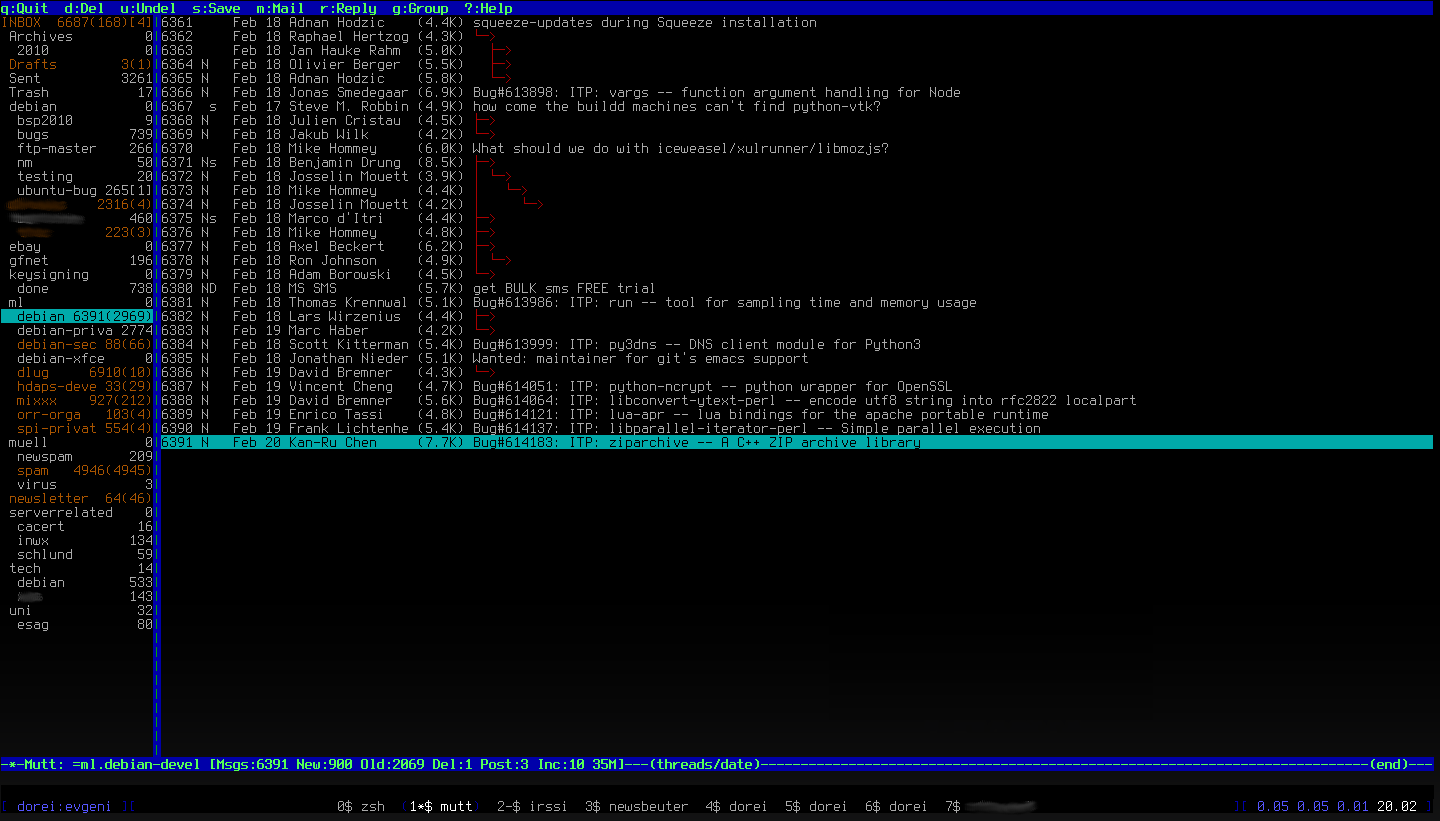
Continuing my series about a desktop in a shell, today I will present you my mutt setup. I use mutt because it has no bugs and is a really good MUA for people loving consoles ;)First of all you have to know, that all my mail is forwarded to my server and sorted into Maildirs via maildrop, so I do not care about sorting on my desktop , which just fetches the mail via IMAP from the server ;)I m running mutt-patched from Debian Squeeze, so not all options may be available for you if you do not have the same patchset as I do.First, tell mutt to fetch mail from imap.die-welt.net via IMAP:
set imap_user=username
set imap_pass=password
set folder="imaps://imap.die-welt.net/INBOX"
set spoolfile="imaps://imap.die-welt.net/INBOX"
Now, enable IMAP-IDLE, list subscribed folders, reconnect to the server if needed and mark mail as read when you open it:
set imap_idle
set imap_check_subscribed
unset imap_passive
unset imap_peek
Let mutt save sent mail to the Sent directory on the IMAP server, and postponed mail to Drafts:
set record=+Sent
set postponed=+Drafts
Read mail should stay where it is:
set mbox="!"
We use IMAP-IDLE, thus check for new mail manually only every 90 seconds:
set mail_check=90
Instead timeout after 15 seconds if no user input is given:
set timeout=15
Set default mail from address to my default mail address:
set from=evgeni@golov.de
And send mail via mstmp (see below for mstmp configuration):
set sendmail="/usr/bin/msmtp"
Tell mutt which addresses I recieve mail to (danger, ugly regex!):
alternates (evgeni@(debian.org golov.(de eu)) sargentd@(die-welt sargentd).net evgeni.golov@uni-duesseldorf.de)
As mutt knows where I receive mail, let it set From accordingly:
set reverse_name
Let mutt cache some stuff and find its certificates:
set header_cache="~/.mutt/cache/headers"
set message_cachedir="~/.mutt/cache/bodies"
set certificate_file=~/.mutt/certificates
set ssl_ca_certificates_file=/etc/ssl/certs/ca-certificates.crt
Show only interesting headers in an useful order:
ignore headers *
unignore headers from to subject date cc
hdr_order from to cc subject date
Fix stupid MUAs behaviour (e.g. filenames like =?iso-8859-1?Q?file=5F=E4=5F991116=2Ezip?=):
set rfc2047_parameters
Beep on new mail, will generate a ! in the window name in screen:
set beep_new
mutt-patched has the great sidebar patch, assign ctrl-n, ctrl-p to select next, prev folder, ctrl-o to open selected folder:
bind index \Cp sidebar-prev
bind index \Cn sidebar-next
bind index \Co sidebar-open
And toggle sidebar visibility with ctrl-b:
macro index \Cb '<enter-command>toggle sidebar_visible<enter><refresh>'
macro pager \Cb '<enter-command>toggle sidebar_visible<enter><redraw-screen>'
Since 1.5.20-2, mutt patched contains my sidebar-dotted and sidebar-sorted patches.
Let mutt shorten the displayed path (e.g. debian-devel instead of INBOX.ml.debian-devel) and sort the folders (the are returned in random order when using imap_check_subscribed):
set sidebar_shortpath
set sidebar_sort
Now let s set some colors (that match the rest of my desktop ):
color sidebar_new yellow default
color normal white default
color hdrdefault brightcyan default
color signature green default
color attachment brightyellow default
color quoted green default
color quoted1 white default
color tilde blue default
And add some useful macros for marking new and old messages as read:
macro index .n "<tag-pattern>~N<enter><tag-prefix><clear-flag>N<clear-flag>*" "Catchup all new messages"
macro index .o "<tag-pattern>~O<enter><tag-prefix><clear-flag>O<clear-flag>*" "Catchup all old messages"
When forwarding mail, I like it to be forwarded as an attachment (YMMV):
set mime_forward=yes
I m using goobook in mutt to fetch my addressbook from Google. As there is no Debian package for goobook (yet), you have to install it yourself (via easy_install):
apt-get install python-argparse python-gdata python-simplejson python-keyring python-nose
easy_install goobook
Configuration is easy via ~/.goobookrc:
[DEFAULT]
# If not given here, email and password is taken from .netrc using
# machine google.com
email: me@gmail.com
password: password
And then add the following to your .muttrc:
set query_command="goobook query '%s'"
bind editor  complete-query
macro index,pager a "<pipe-message>goobook add<return>" "add the sender address to Google contacts"
That s all for mutt, but We are running mutt in a screen, so let s add the following to .screenrc to fix transparency and cut&paste (see http://wiki.mutt.org/?MuttFaq/Appearance):
 defbce on
 term screen-bce
And as mutt uses mstmp (yes, I know, mutt can handle SMTP itself ), this is my .msmtprc:
defaults
domain dorei.kerker.die-welt.net
tls on
account die-welt.net
host smtp.die-welt.net
from sargentd@die-welt.net
auth on
user username
password password
tls_starttls on
tls_certcheck off
# Set a default account
account default : die-welt.net
C est tout! That is my personal mutt configuration, you can download it as one file here: my .muttrc. And as everyone loves screenshots, here is one:the default view of my muttOh, the next chapter will be about irssi, but not before next Sunday (March 6th) as I ll be offline for a week, skiing in Austria :)

Patrick Schoenfeld: Let me introduce DPKG::Log and dpkg-report

We have customers, which require a report about what we've done during maintenance windows. Usually this includes a report about upgrades, newly installed packages etc. and obviously everything we've done apart from that.
Till now we've prepared them manually. For a greater bunch of systems this is a big PITA, because to be somehow useful you have to collect the data for all systems and after that, prepare a report where you have:

Its also error-prone because humans make mistakes.

Perl to the rescue!
At least the part about generating a report about installed/upgraded/removed packages could be automated, because dpkg writes a well-formed logfile in /var/log/dpkg.log. But I noticed that there appearently is no library specialised at parsing that file. Its not a big deal, because the format of that file is really simple, but a proper library would be nice anyway.
And so I wrote such a library.
It basically takes a logfile, reads it line by line and stores each line parameterized into a generic object.

Its features include:

Based on that, I wrote another library DPKG::Log::Analyse, which takes a log, parses it with DPKG::Log and then extracts the more relevant information such as installed packages, upgraded packages, removed packages etc.

This, in turn, features:
- Info about newly installed packages
- Info about removed packages
- Info about upgraded packages
- Info about packages which got installed and removed again
- Info about packages which stayed halfinstalled or halfconfigured at the end of the logfile (or defined reporting period)


These libraries are already uploaded to CPAN and packaged for Debian.
They passed the NEW queue very quickly and are therefore available for Sid:

http://packages.debian.org/sid/libdpkg-log-perl

As an example use (and for my own use case, as stated above), I wrote dpkg-report, which uses the module and a Template::Toolkit based template to generate a report about what happened in the given logfile.
It currently misses some documentation, but it works somehow like this:

Report for a single host over the full log:
dpkg-report

Report for a single host for the last two days:
dpkg-report --last-two-days

Report for multiple hosts (and logfiles):
The script expects that each log file has the name <systemname>.dpkg.log so that it can guess the hostname from the system and can grab all such log files from a directory if a directory is specified as log-file arguments:</systemname>

dpkg-report --log-file /path/to/logs

This will generate a report about all systems without any merging.

Report for multiple hosts with merging:
dpkg-report --log-file /path/to/logs --merge

This will do the following:
A (fictive) report could look some what like this:

dpkg-Report for all:
------------------------
Newly Installed:
abc
Removed:
foo
Upgraded:
bar (0.99-12 - 1.00-1)

dpkg-Report for test*:
------------------------
Newly Installed:
blub

dpkg-Report for test1:
------------------------
Upgraded:
baz (1.0.0-1 -> 1.0.0-2)

dpkg-Report for test2:
------------------------
Upgraded:
zab (0.9.7 -> 0.9.8)

Currently this report generator is only included in the source package or in the git(hub) repository of the library. I wonder if it makes sense to let the source package build another binary package for it.
But its only a 238 lines perl script with a dependency on the perl library so I'm unsure if it warrants a new binary package. What do others think?

24 February 2011

Dirk Eddelbuettel: Rcpp 0.9.2

The 0.9.2 release of Rcpp is now on CRAN and Debian. This version contains a build fix for the older 10.5.* version of OS X and its g++ 4.2.1 compiler; we now skip one test that upset it. CRAN builds for OS X should resume. We also added simple configuration support for the Intel Compiler; feedback would be welcome on the list. Lastly, documentation in the vignettes was expanded a little. The NEWS entry is below; more detail is in the ChangeLog file in the package and on the Rcpp Changelog page.
0.9.2   2011-02-23
    o   The unitTest runit.Module.client.package.R is now skipped on older OS
        X releases as it triggers a bug with g++ 4.2.1 or older; OS X 10.6 is
        fine but as it no longer support ppc we try to accomodate 10.5 too
        Thanks to Simon Urbanek for pinning this down and Baptiste Auguie
        and Ken Williams for additonal testing 
    o   RcppCommon.h now recognises the Intel Compiler thanks to a short
        patch by Alexey Stukalov; this turns off Cxx0x and TR1 features too
    o   Three more setup questions were added to the Rcpp-FAQ vignette
    o   One question about RcppArmadillo was added to the Rcpp-FAQ vignette
Thanks to CRANberries, there is also a diff to the previous release 0.9.1. As always, even fuller details are on the Rcpp Changelog page and the Rcpp page which also leads to the downloads, the browseable doxygen docs and zip files of doxygen output for the standard formats. A local directory has source and documentation too. Questions, comments etc should go to the rcpp-devel mailing list off the R-Forge page

Sean Finney: git merge -s theirs

...For the cases where, yes, you actually do want it. For the impatient assuming you're in a clean checkout on the tip of your current branch:

git merge -s ours ref-to-be-merged
git diff ref-to-be-merged   git apply -R --index
git commit -F .git/COMMIT_EDITMSG --amend
you can then double check that everything is as you expect with git diff ref-to-be-merged, which should be empty. The longer story It's noted from time to time that git does not have a -s theirs option to complement the -s ours strategy when merging (or, it did, but it was removed long ago, see below). For those not savvy the idea with git merge -s ours is to pretend as though a merge from some other branch has occurred, though the result remains the current branch's contents, unchanged. This is a neat trick that can be used to show that all changes in some branch have been superceded by the current branch, which can help ease merges further down the line as parallel devlopment continues. However, there is no corresponding -s theirs option, which would conversely say that "everything developed up to here is superceded by this other branch". This feature was discussed and discarded by one of the git authors, who instead advised a developer to throw away the previous work and start on a fresh branch:
One big problem "-s theirs" has, compared to the above "reset to origin, discarding or setting aside the failed history" is that your 'master' history that your further development is based on will keep your failed crap in it forever if you did "-s theirs". Hopefully you will become a better programmer over time, and you may eventually have something worth sharing with the world near the tip of your master branch. When that happens, however, you cannot offer your master branch to be pulled by the upstream, as the wider world will not be interested in your earlier mistakes at all.
In what would probably qualify as "most cases", he's right, but sometimes you do want to do this, and not because you have "crap" in your history, but perhaps because you want to change the baseline for development in a public repository where rebasing should be avoided. In debian, for example, it's pretty common for maintainers who use git-buildpackage to build debian packages from git to have two branches: an "upstream" branch and a "debianized" branch. The upstream branch will follow the changes from the upstream project (either by importing tarballs, or by pulling directly from the project's git repo if they also use git), while the debianized branch contains all the packaging related changes as well as any debian-specific changes to the code. In this context, if the upstream project uses git and rebases their history (out of your control), or if they shift development to a different branch, you might want to have a way to merge with their latest changes without rebasing/abandoning your current debian branch. Hence, a "theirs" merge. The author is totally right that the upstream project may be less interested in pulling from such a repository (since they would drag in the entire previous history), and if that's a problem you might need to splinter off the old branch and start a fresh branch instead. But at least for the projects with which I work, I find that it's more likely that pulling is pretty much one way upstream to debian, and that the patches flow back to the upstream project by way of bug trackers, git format-patch sendmail, or quilt patches sitting in the patch-tracker. And if it becomes a problem later you're no worse off, you can still split off a new branch or take some other action. So anyway, I asked Teh Internetz and found a few hits in the right direction, such as this guy at stack overflow, or this guy here. But from an aesthetic point of view I thought their solutions still left some room for improvement--they were both more complicated, involved setting up temporary branches, and I don't know, just weren't pretty on the eyes. So, ending where I started, this is the relatively clean and easy to follow 3 lines I conjured up, which I will give to teh internetz for posterity.
git merge -s ours ref-to-be-merged
git diff ref-to-be-merged   git apply -R --index
git commit -F .git/COMMIT_EDITMSG --amend
Alternatively, if you want to keep the local upstream branches fast-forwardable, a potential compromise is to work with the understanding that for sid/unstable, the upstream branch can from time to time be reset/rebased (based on events that are ultimately out of your control on the upstream project's side). This isn't a big deal and working with that assumption means that it's easy to keep the local upstream branch in a state where it only takes fast-forward updates. However, on the debian branch your less interested in the clean upstream development, and instead want to keep a sane history of the debianization work, so on this branch you still do something like a merge -s theirs (though in this case, you probably want to amend the previous version's ./debian dir back in post-merge). So applying the same approach as above with the slight modification, in practice (assuming you're on the clean tip of the debian unstable branch, that'd be):
git branch -m upstream-unstable upstream-unstable-save
git branch upstream-unstable upstream-remote/master
git merge -s ours upstream-unstable
git diff ref-to-be-merged   git apply -R --index --exclude="debian/*"
git commit -F .git/COMMIT_EDITMSG --amend
PS In spirit, this is a similar approach to what's done by the XSF team, though I would argue that with what I'm describing both the approach and the resulting history are a bit cleaner and easier to follow. Also, thanks to ron, mrvn, jcristau, and nthykier on #debian-devel for some quick reviewing of this.

Steve Kemp: I like languages

One of the reasons I like Scotland is the fun that Scottish people have with language. I'm going to use two examples to illustrate my point: The last one is particularly fun when you use questions such as "How no?" - meaning roughly "Why not?". Languages, and idioms, vary wildly in different parts of the world, even when you restrict yourself to English-speaking languages. I'll not even get started on Accents. The UK is tiny compared to many other countries, yet we have a wide array of accents - Australia, by contrast is huge, but I can think of only two accents across the country. (Rationally I expect that there are many accents in different parts of Australia, and I'm merely ignorant.) In conclusion languages are fun, and some places this is more evident than in others. I will most likely contintue to say "The shop is open from 9 while 4" rather than the more typical "From 9 til 4" - I'm allowed to do that, having grown up in Yorkshire!
(PS. PHP still sucks - Even if you post it upon a PHP-powered blog. ;)
ObQuote: "People take you for granted, you know. We gotta make people miss you." - Hancock

23 February 2011

Gunnar Wolf: Finally presented that long-overdue exam!

Finally presented that long-overdue exam!
What Yes, I have not used this kind of outfit for over 20 years. And I hope it will be 20 more years before I do it again. But today, I was seen like this in public. Why? Well, I won't explain the whole background yet again I did it a bit over a month ago in this same space. Much much in short, I never attended university, so after many years of working without any formal validation for my knowledge I followed the CENEVAL Acuerdo 286 procedure to get a "Software Engineering" title and the corresponding c dula profesional. Today I did the last portion of this procedure: Presenting an oral exam, defending the work I developed. Not precisely a thesis, but you can see it as an equivalent. One of the requisites was to go on formal attire Of course, I have some beautiful shirts I am very fond of, but I didn't want to risk it to such a detail, so I asked my friend and almost-neighbour Miguel Barajas to lend me the needed bits of clothing, and presented the exam. Was it easy? No, not by a long shot. Did I pass? Yes! Now, back to work!

Julien Danjou: Handling my music collection with git-annex

git-annex is a recent tool allowing to manage files with git without having theirs contents checked into git. I've been looking at it with some interest in the past few weeks in order to use it to handle my music collection on the various computers I use. My laptop just got a new SSD drive which is quite small and cannot handle the whole collection. By using git-annex, I'm now able to only check out part of my music collection and keeping it synchronized with all my others computers. Using git-annex is pretty trivial once you understand the concepts. I've set up a a git repository in my Music directory, like that:
% git init
Initialized empty Git repository in /home/jd/Music
Then I initialized git annex:
% git annex init "Music on keller"
So now I'm able to import all my date into git annex. git-annex offers several backends to store data. WORM is the default, but is not a good choice for file that could be modified, and music files can be, at least when editing the metadata. Therefore, I chose the slow but more reliable SHA1 backend.
% git annex add --backend=SHA1 .
That can be long, so you should be patient. Then you should commit the fact you annexed files:
% git commit -a -m "Imported my music collection"
[master 82d060f] Imported my music collection
Now, it's done. You can go on another computer and clone the repo:
% git clone ssh://keller/~/Music
% cd Music
% git annex get "Incubus - Light Grenades"
And then let the magic happens. It will retrieve the whole directory for you. Do not forgot to commit the fact that you got those album on that machine! The concept used by git-annex is quite simple. All files are replaced by symlinks pointing to .git-annex/SHA1:filechecksum.log. This file contains lines, whose format is:
retrieval-timestamp is-file-present uuid-of-the-repository
Indicating if the file is present in a repository. This logs file are commited into the repository, whereas the real content is stored in the .git/annex directory and therefore not commited. I recommend to take a look to the walkthrough page to get more idea and what you can and cannot do with git-annex. Flattr this

Pietro Abate: More on Xen 4.0 setup on squeeze

After the upgrade of last week, I didn't have any major problems : xen 4 seems pretty stable and does its job well. One problem I encountered the other day was about the dom0 balloning. By default, xen sets dom0_min_mem to 196Mb and balloning set to true. This is all and good untill you try to use too much memory for your VMs, squeezing dom0 to its minimum amount of memory and causing all sort of problems. On the xen wiki, they reccomend as best practice to reserve a minimum of 512Mb to dom0 for its operations. This is done but setting dom0_mem=512M on the grub command line and the adjusting enable-dom0-ballooning to no and dom0-min-mem accordingly to the amount of memory you choose. On debian, you can set the grub command line once for all just by adding in /etc/default/group the conf variable
GRUB_CMDLINE_XEN="dom0_mem=512M"
Another small problem is related to the reboot sequence. Since I'm using lvm on aoe, the default shutdown sequence (network down first, lvm later) is not going to work for me. As I've few lvm volumes on aoe and others on the physical disk, the proper solution to this problem is to write a custom shutdown script for the aoe lvm volumes and make it run before deconfiguring the network interfaces. In the mean time, to avoid the kernel hanging there forever, I've added these lines to in /etc/syscntl.d/panic.conf
# Reboot 5 seconds after panic
kernel.panic = 5

# Panic if a hung task was found
kernel.hung_task_panic = 1

# Setup timeout for hung task to 300 seconds
kernel.hung_task_timeout_secs = 120
This will instruct the kernel to panic and then reboot if there a task will not respond for more then 120 seconds.

Neil Williams: cross-building, multiarch and binutils

At the Emdebian ARM sprint, cross-building experiments on a Multi-Arch base are going fairly well. It is looking like the hacks in dpkg-cross may finally be avoidable, possibly before Wheezy gets released. Elsewhere, debhelper has been updated to allow dh_strip and other tools to work directly with the binutils package from the cross-building toolchain and not to need binutils-multiarch any more. dpkg-cross has been updated to only Suggest binutils-multiarch, which makes room for more architectures to be covered by binutils-multiarch (which, therefore, will be getting quite a lot bigger quite soon).

Cross-building in Debian is therefore entering a period of transition and the old ways of dpkg-cross - and the tools it has spawned like apt-cross, xapt, pdebuild-cross and others - will be gradually side-lined and finally rendered obsolete. Like all transitions, there will be breakage, there will be pain, there will be things which don't cross-build now and which have no prospect of being fixed until the transition is deeply entrenched. There are packages which used to cross-build and which will stop cross-building and, again, won't be fixable for months. Sadly, Squeeze released with cross-building breakage too, due to changes within apt during the release freeze. A Lenny chroot is possibly the best place to do cross-building for now.

This is a major transition. It WILL break things. Badly and often.
What's more, just because we decide to implement stuff using one method now does not mean that the same method will even exist in a month or two.

In other words, if you've got a working cross-build chroot or installation currently and you absolutely need it to continue working leave it alone.

Don't go changing real packages to use the changes we're trying out!

If you enjoy fixing stuff, don't mind pain and fancy risking your system as I've been doing (unlinking /etc/, deleting /lib64 on amd64 or forcing package installation such that no shared libraries are accessible any longer) then you are:
  1. insane
  2. welcome to join the work

Check out the current state of things via the #emdebian channel on oftc.net and the very risky Emdebian multiarch SVN experiments along with the even more risky Emdebian Multiarch Mirror, courtesy of Steve McIntyre and Phil Hands.

The README in SVN is very clear - DON'T INSTALL THESE OUTSIDE A CHROOT and even if you do, don't come crying to me when it breaks your entire system (even when used inside a chroot).

No warranty, no guarantees, no promises, none of this is fit for any purpose whatsoever and we'll say when we finally have something which might actually be useful.

Andrew McMillan: Status: Busy

I've been very quiet on here for a few months, and the reason is (of course) because I've been doing other things. No surprise there, I guess! What I've been doing, first of all, is writing aCal, an Android CalDAV client with a lot of help from Chris Noldus. It's probably fair to say that Chris did most of the heavy lifting while I learned Java, did most of the UI & graphic design, and the low-level CalDAV synchronisation and geeky calendaring code. This is now available in the Android market for NZD$2.00 to help us fund further development and in a few days (or a couple of weeks) I'll get the source code up somewhere public (probably Gitorious) and it will be licensed GPLv3... When I get a moment - although refer to title :-) Of course on top of that I'd already committed to a second year of handling the sponsorship job for Linux.Conf.AU, so a fair amount of January was taken up with preparing for, and attending LCA in Brisbane where I took a lot of photos. LCA was, as always, a blast, and all credit to the fantastic team over in Brisbane who really came together when it seemed it was all going to fall apart after the flooding. This seems to be six long months of disasters around this part of the world, although until Tuesday I guess we thought we'd escaped the worst of it in New Zealand. After LCA I snuck home for a few days before flying off in the other direction, to UC Berkeley, for CalConnect XX where I managed to get in some great testing of the new Android CalDAV client, some excellent standards discussions, more photos and (even) a few days sightseeing. I've been home for a week from that now - just barely long enough to hug the kids, really - and today I am in the air once more, off to CeBIT in Hannover where I have been lucky to be sponsored a free booth in the Open Source Lounge by Linux New Media AG. My original travel sponsor slipped through the cracks, but I was fortunate that InternetNZ agreed to help fund me instead. If you're coming to CeBIT please do stop by the Morphoss table in the Open Source Lounge (Hall 2, F40) for a chat about DAViCal and Android - and anything else you want to talk about! I'll be there all week :-) And if I have some quiet time in that week (yeah, right!) I'll be trying to push out a new DAViCal release, which is overdue really, since the last one was two months ago.

Gintautas Miliauskas: Off to San Francisco!

The interview at Munich seemed to go well. Well, at least, I had fun. We'll see how that turns out.


For now, I'm off again for another job interview, this time to Palo Alto. This will be my first time to the West Coast, so I have postponed the return flight for two weeks to familiarize myself with the proverbial area. If anyone's from around the San Francisco Bay Area, I would be very happy to meet over lunch/dinner/beer!

Chris Taylor: SCALE9X

I will be at the Southern California Linux Expo 9X this weekend from Friday-Sunday. I will be at the Debian booth for a large portion of the event most likely, so feel free to stop by for Keysigning/BSing.

22 February 2011

Erich Schubert: Taking Google Calendar to the limits

The Global Lindy Hop Map I've built as a toy project is actually a calendar with geo annotated events. It currently is backed by a custom database using Xapian for the search functionality to improve performance.
The data comes from around 150 Google calendars from various dancing communities. I'm preprocessing the data to have reliable geo information as well as doing some filtering and HTML formatting.
Instead of putting everything into my own database - which doesn't know about recurrence rules, but relies on materialized recurrences - I've also tried to sync all 150 calendars into one huge "master" calendar.
However, using the Google Gdata APIs to access this calendar takes way too long for the website to be usable. This is not too surprising, there are like 3500 instances in the calendar and some of this will require the computation of recurrence rules. And I cannot do the synchronization without a local ID mapping cache anyway (I can recover a lost cache from additional information I put into the calendar though). There are around 60 event instances per day, since most come from weekly repetitions.
The HTML embed rendering can take quite a while to load (albeit the results apparently are cached somewhere) - looking at december either hits some processing limit or times out after around 40 seconds.
Looks like I'm going beyond the scope Google Calendar was designed for. :-)

21 February 2011

Michal &#268;iha&#345;: German-Czech dictionary for Debian

Okay, I finally decided it's about time to make Debian package out of German-Czech dictionary for which I'm providing builds for StarDict. Daily snapshots are (as usual) available in my Debian repository and the monthly builds will be uploaded to Debian (once it passes NEW queue). The dictionary currently lists only few words, but I hope it will improve in near future.

Filed under: Debian English Stardict 0 comments Flattr this!

Stefano Zacchiroli: Squeeze, Debian, and the FSF

Short version: Dear FSF, thanks for your appreciation of Debian Squeeze achievements in getting rid of non-free firmware blobs. We still disagree on the overall freeness assessment of Debian, but I'm positive that steps like this one can further future collaboration, in the interest of both projects. Long version follows.
Historically, the relationships among Debian and the FSF have gone through mixed fortune (and that's quite an euphemism). On the one hand, Debian is committed to 100% Free Software, is an open project explicitly inspired by "the spirit of GNU", has been sponsored by FSF in its infancy, and properly calls itself "GNU/Linux" (or even "GNU/kFreeBSD"). On the other hand, Debian is the project who considers the GNU FDL license to be only conditionally free and which is not considered to be an entirely Free system according to FSF.
So much for the history corner. As a long time member of the Debian Project, as well as an FSF(E) fellow, I've always felt a bit sad about this state of affairs. Not because the two projects should have aligned goals; they clearly focus on different aspects of the quest for a Free (Software) world. Not even because they should agree on how to build a Free distribution: history has shown that FSF technical positions do not always get along with Debian's more "pragmatic" style, as embodied by point 5 of the Social Contract. Rather, my sadness is rooted in the belief that not getting along have encouraged duplication of efforts which could have been easily avoided (e.g. multiple distributions concurrently freeing up kernels). Furthermore, I'm more and more convinced that Debian nowadays enjoys a rather privileged position among Free Software vendors. Indeed, even though GNU/Linux distributions have reached a popularity we didn't dare to imagine 15 years ago or so, most distributions are under the direct or indirect control of commercial vendors. Those commercial vendors play a very important role in the promotion of Free Software. For instance, they are structured in ways that enable them to seal OEM deals with hardware manufacturers to sell computers with GNU/Linux pre-installed. Commercial vendors, by their own nature, are also in general better at marketing than non-commercial vendors. On the flip side however, commercial vendors are not yet relevant enough to drive proprietary drivers out of the market and, as a consequence, cannot yet afford not to support hardware which need such proprietary bits to work. Among mainstream GNU/Linux distributions[1] Debian is one of the very few vendors if not the only one that is both very relevant and, thanks to its independence, can afford taking Free Software's side: no commercial urgency can force Debian to negotiate on that. That is quite an asset to be used in the promotion of Free Software, especially to a public that is interested in and willing to understand what Free Software really is about. Such an "aware" public is on the rise as of lately, together with the general awareness increase of risks entailed by living a digital life, when that life is not under our control (think, as an example, at how often the "Facebook privacy debate" has hit mainstream medias in the last year). The "aware" public is the natural target of both Debian and the FSF. Dividing it would not serve well the cause of Free Software. With all that in mind, last August I took the chance of being on the "right" side of the Atlantic Ocean for DebConf10, to discuss possible venues of collaboration among Debian and the FSF. I sat down and discussed at length with John Sullivan, who I happen to know for his Debian involvement, in his capacities of FSF representative and operations manager. We discussed various topics, with the intention of bringing them up to the respective communities[2]. Then, inevitably, we ended up talking about the overall freeness of Debian and his exclusion from FSF listing of Free systems. (FSF is of course entitled to such judgements, pretty much as Debian is entitled to its own judgements on FSF licenses. Nevertheless those judgements contribute to dividing our public and might lead to wasteful duplication of efforts, where Free Software could better be served by collaboration.) The main ground for exclusion from that list used to be the compromises Debian has made in the past about non-free firmware blobs. But, as I pointed out back in August, those compromises would have been gone starting with Squeeze, making that argument moot. Today 6 months later I'm delighted to cheer at FSF's decision to publicly recognize the achievements Debian has delivered with Squeeze.
Thanks! It's a nice gesture that I've very much appreciated. I'm confident steps like this one will help future collaboration if, on both sides, we will be able to spot actual venues for collaboration. Needlessly to say, I still disagree with the overall FSF assessment of Debian non-freeness. Apparently, it still stands on the basis that Debian also provides a repository of nonfree software [ ] [which] is not part of the Debian system. [ ] but users would be hard-pressed to make a distinction and that people can readily learn about software available through it by browsing Debian's online package database. I respect the principle of non advertising non-free software and I even agree that it is a good principle. But unfortunately it's also a very blurry principle on which, in my opinion, Debian actually scores very well. No non-free software is offered to users by Debian; it's just for users that really want to have non-free software (or need to, in order to run a Free OS on their computers), that Debian tries to stay out of their way. For the "aware" public discussed above, I think it's much better to draw the line where software freedom ends and use that line to explain what does crossing it entails, than locking them up pretending non-free software do not exist. But fair enough: for the time being, I guess, we will need to agree to disagree on this one. Getting a little bit closer in the occasion of the Squeeze release is still an important step forward. It's up to each of us now to seek out initiatives which attract the interest of both projects and that can benefit from synergies.
[1] Sorry, I've no decent definition of "mainstream distribution" to offer, besides folklore and well-established distribution review sites. (Heck, I don't even have a decent definition of "well-established distribution review site" to offer!).
[2] which hasn't happened yet, due to the proverbial amount of available spare time.

Lucas Nussbaum: Debian Spring Cleanup

We have many orphaned packages in Debian. Those are packages that no longer have a maintainer willing to care for them. They are a problem for several reasons. Often, there have better alternatives (that s often why the maintainer gave up maintenance), but users keep installing them because they show up in apt-cache search. Or, they might be broken, without anybody noticing because they only have a few users. Also, developers need to take them into account. They might slow down transitions, have RC bugs that need fixing, etc. So, there are good reasons to remove some of the orphaned packages from the Debian archive. Not all of them. But those that have been orphaned for a long time without anybody stepping up to take over the maintenance, have very few users according to popcon, etc. Removing some of them also makes it easier to expose the ones that should really find an adopter. Also, that removal is not final. The good reason to do this now is that we are at the beginning of a release cycle, and that it will be easy to reintroduce packages that are really needed during the next two years. Also, packages (both source and binaries) are still available on snapshot.debian.org, so users can still install them from there, and re-uploading them to Debian is very easy if someone wants to adopt them. So, how do I proceed? I use bapase, and go through specific sets of packages (using a custom version of bapase to restrict the list to those packages). For example, orphaned packages that have a popcon lower than 50, have been orphaned for more than 500 days, and whose orphaning bugs have not been modified in the last 100 days. Then, I read the bug log, and decide if there s a reason to keep the package. If there s not, I request the removal. As of today, there are 471 orphaned packages in Debian. The goal is not to get down to zero, but it s certainly possible to get down to 200 or 250. How can you help? Start from the list, and find some easy targets. You can take a look at bug #483252 if you want to re-use my template. Also, one thing that is currently missing in the process is that orphaned packages that have reverse-dependencies should not be removed without removing their dependencies (if appropriate). An easy and efficient way to know if a given package has reverse (build-)?dependencies would be great, so I could integrate this info into bapase and exclude those packages from the list, or mark them somehow.

Sean Finney: Recent debian updates

Packaging updates Help wanted: cacti I've also filed an RFA bug for cacti (and spine), as i'm not really using cacti any more in my day to day work. The packages are in pretty good shape, but it would really be for the best if someone who actually used cacti were able to more thoroughly test new versions before they were uploaded. I'm also open to co-maintaining the package and/or sponsoring uploads; so if you're already using cacti and looking to get involved in debian development, this could be a fun place to start :) Debian patch tracker Finally got around to fixing a couple post-release (and older) issues in the patch-tracker. Hopefully it should be back to updating and following the latest stuff in the archive. Next up I'll see if I can find someone from DSA to upgrade the hosting machine to squeeze and install a few extra dependencies for the next feature update, which contains a pretty substantial rewrite of the guts from some home-rolled wsgi+cheetah goo to a more established and maintainable django-based system. In the meantime, please let me know if you see any problems (via maintenance cat or otherwise), and I will take a look.

Steve Langasek: How you can help with multiarch today

Paul Wise called attention recently to the fact that there's renewed activity around multiarch in the face of the squeeze release. Although I fervently wish we could have gotten multiarch support into squeeze, it's better late than never; and real progress is being made now, thanks mostly to the efforts of wonderful package management experts like Raphael Hertzog, Guillem Jover, and David Kalnischkies. Don't believe it's finally coming? Here's some output from my amd64 multiarch chroot:
$ dpkg -l '*:i386'
Desired=Unknown/Install/Remove/Purge/Hold
  Status=Not/Inst/Conf-files/Unpacked/halF-conf/Half-inst/trig-aWait/Trig-pend
 / Err?=(none)/Reinst-required (Status,Err: uppercase=bad)
 / Name           Version        Description
+++-==============-==============-============================================
ii  gcc-4.5-base   4.5.2-3ubuntu2 The GNU Compiler Collection (base package)
ii  libc6          2.13-0ubuntu1+ Embedded GNU C Library: Shared libraries
ii  libdb4.8       4.8.30-5multia Berkeley v4.8 Database Libraries [runtime]
ii  libgcc1        1:4.5.2-3ubunt GCC support library
in  libpam-modules <none>         (no description available)
ii  libpam0g       1.1.2-2ubuntu1 Pluggable Authentication Modules library
ii  libselinux1    2.0.96-1multia SELinux runtime shared libraries
ii  libstdc++6     4.5.2-3ubuntu2 The GNU Standard C++ Library v3
iU  libuuid1       2.17.2-9.1ubun Universally Unique ID library
ii  selinux-utils  2.0.96-1multia SELinux utility programs
ii  zlib1g         1:1.2.3.4.dfsg compression library - runtime
If you're as excited about this making its way into Debian as I am, you might be wondering what you can do to help. That's great, because I'd love to tell you! Perhaps you happen to maintain a package that provides executables; and perhaps other packages depend on your package exclusively to use those executables; and perhaps some of those packages depending on your package are shared libraries. If all of the above is true, please consider declaring this package to be Multi-Arch: foreign as defined here. Note: it is very important that you not use this on any package that will provide architecture-dependent interfaces to its reverse-dependencies. So if you're shipping both shared libraries and executables in the same binary package, don't do this. But if your package does fit this description, this is one part of multiarch that you can safely start implementing today. This will go a long way towards getting the system ready to handle multiarch libraries when they land. My own efforts to help with getting Multi-Arch: foreign packages documented in the archive are trackable here.

Next.

Previous.