Clint Adams: Forward the foundation
 I don't know how I feel about this.

 Maximilian, along with the other members of the Debian kernel team, has the overwhelming job of maintaining the Linux kernel in Debian. It s one of the largest package and certainly one where dealing with bug reports is really difficult as most of them are hardware-specific, and thus difficult to reproduce.
He s very enthusiastic and energetic, and does not fear criticizing when something doesn t please him. You ll see.
My questions are in bold, the rest is by Maximilian.
Who are you?
My name is Maximilian
Attems. I am a theoretical physicist in my last year of PhD at the
Technical University of Vienna. My main research area is the early phase of a
Quark-Gluon Plasma as produced in heavy ion collisions at the LHC at CERN. I am
developing simulations that take weeks on the
Vienna
Scientific Cluster (in the TOP 500 list). The rest of the lab is much less fancy and boils down
to straight intel boxes without any binary blobs or external drivers (although
lately we add radeon graphics for decent free 3D). Mathematica and Maple are
the rare exceptions to the many dev tools of Debian (LaTeX, editors, git,
IDE s, Open MPI, ..) found at the institute, as those are unfortunately yet
unmatched in Free Software for symbolic computations. The lab mostly runs a
combination of Debian stable (testing starting from freeze) for desktops and
oldstable/stable for servers. Debian is in use for more than 10 years. So
people in the institute know some ups and downs of the project. Newcomers like
my room neighbors are always surprised how functional a free Debian Desktop
is.
 What s your biggest achievement within Debian?
Building lots and lots of kernels together with an growing uptake of the officially released linux images.
I joined the Debian kernel team shortly after Herbert Xu departed. I had been
upstream Maintainer of the linux-2.6 janitor project for almost a year brewing
hundreds of small cleanups with quilt in a tree named
kjt for
early
linux-2.6. In Debian we had lots
of fun in sorting out the troubles that the long 2.5 freeze had imposed:
Meaning we were sitting on a huge diverging monolithic semi-good patchset.
It was great fun to prepare 2.6.8 for Sarge with a huge team enthusiastic in
shipping something real close to mainline (You have to imagine that back then
you had no stable or longterm release nor any useful free tools like git. This
involved passing patches around, hand editing them and seeing what the result
does.)
From the Sarge install reports a common pattern emerged that the current Debian
early userspace was causing lots of boot failures. This motivated
me to develop an alternative using the new upstream initramfs features. So I got
involved in early userspace. Thanks to large and active development team
initramfs-tools got a nice ecosystem. It still tries to be as generic and
flexible as possible and thus gains many nice features. Also H. Peter Anvin
(hpa) gave me the official
co-maintenance of klibc. klibc saw uptake and good patches from Google
in the last 2 years. I am proud that the early userspace is working out
fairly well these days, meaning you can shuffle discs around and see your box
boot.
Later on we focused on 2.6.18 for Etch, which turned out to a be good release
and picked up by several other distributions. Only very much later
we would see such a sync again. With 2.6.26 for Lenny we got somehow
unlucky as we just missed the new longterm release by one release.
We also pushed for another update very late (during freeze) in the release
cycle, which turned out to semi-work as too much things depend on linux-2.6.
For Squeeze 2.6.32 got picked thanks to discussions at Portland Linux Plumbers
and it turned out to be a good release picked up by many distributions and
external patchsets. The long-term support is going very well. Greg KH is doing
a great job in collecting various needed fixes for it. Somehow we had hoped
that the Squeeze freeze would start sooner and that the freeze duration would be
shorter, since we were ready for a release starting from the actual freeze on.
The only real big bastard on the cool 2.6.32 sync is Red Hat. Red Hat
Enterprise 6.0 is shipping the linux-2.6 2.6.32 in obfuscated form. They
released their linux-2.6 as one big tarball clashing with the spirit of the
GPL. One can only mildly guess from the changelog which patches get applied.
This is in sharp contrast to any previous Red Hat release and has not yet
generated the sharp and snide comments in press it deserves. Red Hat should
really step back and not make such stupid management moves. Next to them
even the semi-maintained Oracle Unbreakable 2.6.32 branch looks better:
It is git fetchable.
What are your plans and those of the kernel team for Debian Wheezy?
Since 2.6.32 many of the used patches landed upstream or are on the way
(speakup, Kbuild Debian specific targets, ..). The proper vfs based unionfs is
something we d be looking forward. We haven t yet picked the next upstream
release we will base Wheezy on, so currently we can happily jump to the most
recent ones. There are plans for better interaction with Debian Installer
thanks to generating our udebs properly in linux-2.6 source itself. Also we
are looking forward to using git as tool of maintenance. We d hope that this will
also allow for even better cross distribution collaboration.
Concerning early userspace I plan to release an initramfs-tools with
more generic userspace for the default case and finally also a klibc
only for embedded or tuning cases.
What do you like most in Debian?
For one thing I do like the 2 year release cycle. It is not too long to have
completely outdated software and on the other hand it gives enough time to
really see huge progress from release to release. Also at my institute the
software is is recent enough without too much admin overhead. For servers the
three years support are a bit short, but on the manageable side.
I do enjoy a lot the testing distribution. For my personal use it is very stable
and thus I mainly run testing on my desktop and work boxes. (Occasionally
mixing in things from sid for unbreaking transition or newer security fixes).
Debian is independent and not a commercial entity. I think this is its main
force and even more important these days. I enjoy using the Debian platform a
lot at work thus in return this motivates me to contribute to Debian itself. I also like the
fact that we strive for technical correctness.
Is there some recurrent problem that hinders the progress of Debian?
The New Maintainer process is a strange way to discourage people to
contribute to Debian. It is particularly bureaucratic and a huge waste of time
both for the applicant and his manager. It should be completely thrown
overboard.
One needs a more scalable approach for trust and credibility that also enhances
the technical knowledge for coding and packaging of the applicant.
NM is currently set in stone as any outside critics is automatically rejected.
Young and energetic people are crucial for Debian and the long-term viability of
the project, this is the reason why I d consider the New Maintainer process
as Debian s biggest problem.
Note from Rapha l Hertzog: I must say I do not share this point of view on the New Maintainer process, I have witnessed lots of improvements lately thanks to the addition of the Debian Maintainer status, and to the fact that a good history of contribution can easily subsume the annoying Tasks & Skills questionnaire.
Another thing I miss is professional graphics input both for the desktop
theme and the website. I know that effort has been done there lately and
it is good to see movement there, but the end result is still lacking.
Another trouble of Debian is its marketing capabilities. It should learn to better sell itself. It is the distribution users want to run and use not the rebranded copies of itself with lock-in sugar . Debian is about choice and it offers plenty of it: it is a great default Desktop.
Linus Torvalds doesn t find Debian (and/or Ubuntu) a good platform to hack
on the kernel. Do you know why and what can we do about this?
The Fedora linux-2.6 receives contributions from several Red Hat employed
upstream sub-Maintainers. Thus it typically carries huge patches which are not
yet upstream. As a consequence eventual userland troubles get revealed quite
quickly and are often seen there first. The cutting edge nature of Fedora
rawhide is appealing for many developers.
The usual Debian package division of library development files and the library
itself is traditionally an entry barrier for dev on Debian. Debian got pretty
easily usable these days, although we could and should again improve a lot
more in this sector. Personally I think that Linus hasn t tried Debian
for years.
I have the feeling that the implication of the Debian Kernel team in LKML
has been on the rise. Is that true and how do you explain this?
Ben Hutchings is the Nr.1 contributor for
2.6.33.
He also is top listed as author of patches on stable
2.6.32.
Debian is not listed as organization as many send their linux-2.6 patches from
their corporate or personal email address and thus it won t be attributed to
Debian.
There is currently no means to see how many patches get forwarded for
the stable tree, but I certainly forwarded more then fifty patches.
I was very happy when Greg KH personally thanked me in the
2.6.32.12 release.
In the Squeeze kernel, the firmwares have been stripped and moved into
separate packages in the non-free section. What should a user do to ensure
his system keeps working?
There is a debconf warning on linux-2.6 installation. It is quite clear
that the free linux-2.6 can t depend on the firmware of the non-free
archive (also there is no strict dependency there technically).
On the terminal you d also see warnings by update-initramfs on the
initramfs generation for drivers included in the initramfs.
The debconf warning lists the filename(s) of the missing firmware(s). One can then apt-cache search for the firmware package name and install it via the non-free repository. The check runs against the current loaded modules. The match is not 100% accurate for special cases as the one where the device might be handled well by this driver without firmware, but is accurate enough to warrant the warning.
The set of virtualization technologies that the official Debian kernel
supports seems to change regularly. Which of the currently available
options would you recommend to users who want to build on something
that will last?
KVM has been a smooth ride from day zero. It almost got included instantly
upstream. The uptake it has is great as it sees both dev from Intel and AMD.
Together with libvirt it s management is easy. Also the performance of virtio is
very good.
The linux containers are the thing we are looking forward for enhanced chroots
in the Wheezy schedule. They are also manageable by libvirt.
Xen being the bad outside boy has an incredible shrinking patchset,
thus is fair to expect to see it for Wheezy and beyond. For many it may
come a bit late, but for old hardware without relevant CPU it is there.
Many tend to overstate the importance of the virtualization tech. I d be much
more looking forward to the better Desktop support in newer linux-2.6. The
Desktop is important for linux and something that is in heavy use. The much
better graphics support of the radeon and nouveau drivers:
One comment Liked this article? Click here. My blog is Flattr-enabled.
 Using a virtual IP managed by heartbeat is a nice way to work around the slow
fallback behavior with multiple nameservers in /etc/hosts. But unlike ntpd,
bind9 doesn't automatically listen on new IPs on the system.
Here's a cute hack to fix that:
# cat /etc/ha.d/haresources
server01 bind9release IPaddr::10.0.0.3 bind9takeover
# cat /etc/ha.d/resource.d/bind9release
#!/bin/sh
# when giving up resources, reload bind9
case $1 in
        stop) /etc/init.d/bind9 reload ;;
esac
exit 0
# cat /etc/ha.d/resource.d/bind9takeover
#!/bin/sh
# on takeover, reload bind9
case $1 in
        start) /etc/init.d/bind9 reload ;;
esac
exit 0
 Time for a fifth Debian XSF News issue!
unstable. Plenty of bug
reports came along accordingly.unstable (merging
stuff prepared in experimental over the last weeks/months, and
some new upstream versions): twm, x11-apps,
x11-session-utils, x11-utils, x11-xfs-utils, x11-xkb-utils,
x11-xserver-utils, xterm, xft, xbacklight.xorg-server 1.10 for experimental, with
Christopher James Halse Rogers. That meant updating randr and
xext proto packages. We re currently waiting for 1.10rc2 before
uploading to experimental, probably with a restricted set of
drivers.mesa builds on hurd-i386 again. xorg-server is no
longer BD-Uninstallable accordingly. Ditto for kfreebsd-i386,
the server was built right after mesa, and all driver packages
were built after that.glxinfo if
available, and the xserver-xorg-core bug script as well. That,
together with a report-with: xserver-xorg xserver-xorg-core in
the bug control file for each binary package should spare a few
mails asking submitters for more info.libdrm-intel1 (squeeze s/2.4.21), I bumped
symbols/shlibs to make sure packages building against it pick a
higher version.unstable with the following changes:
unstable, there was no need to keep the
virtual packages with both major andminor versions. Those were
meant to ease the transition from experimental to unstable,
making it possible to install experimental s drivers with
unstable s server./etc/modprobe.d/$driver-kms.conf) and their contents. The lspci
call was also updated. Finally, libGL-related diversions are now
reported as well.debian-squeeze branch, which should be finalized next week. This
branch also features a bug fix for
RandR on nvidia. One of the common complains about Debian packaging is that it s hard to learn because, while there is quite a lot of high-quality documentation, it is often written more as a reference manual than as a tutorial: it s great if you already know everything and want to check some detail, but not so great if you want to learn everything from scratch.
I have been volunteered (i.e, someone decided I volunteered) for a Debian packaging tutorial at work, so I decided to give a try at tackling this issue. I also volunteered (voluntarily this time) for a similar talk at RMLL 2011 to make sure I would be forced to do the work and prepare the actual tutorial. I m also considering teaching this next year in Licence Pro ASRALL, but I haven t made up my mind about it yet.
The result is a work in progress (hey, I still have a lot of time), but in the release-early-release-often tradition, I m making it public now in the hope that someone will pick up the idea and do all the work for me (you never know).
I ve decided to create a set of slides using Latex Beamer. The current version can be found here. The sources are available in a git repository, and all contributions are welcomed (including plain comments or suggestions). The last slide is the current TODO list.
 Rather than waiting for a few months, as I typically do, I decided to be brave and upgrade my main virtual machine from Lenny to Squeeze. That host runs QPSMTPD, Apache, thttpd, and my blogspam server; nothing too complex or atypical.
The upgrade was mostly painless; I was interrupted several times by debconf asking me if I wished to replace configuration files I'd modified, but otherwise there were only two significant messages in the process:
 As I have complained quite loudly in this blog, I think it's fair to post a status update again.
Yesterday the emails started suddenly to work. So the major reason for my complains is gone.
What I still don't like that this issue was not at all communicated to project admins. It stopped to work, what was sort of announced in blog post. It started to work again without any announcement and last status update in blog still claims they do not work.
At least for direct question, we've received reply that they have intentionally re-enabled this service.
Filed under: English Phpmyadmin 0 comments Flattr this!
 As you know, I very often advocate using the bycicle as the main means of transportation in Mexico City. The city is very apt for biking through it, and contrary to the fears of mostly everybody, the city is neither aggressive nor as dangerous as people say.
However, I have seen cyclists which seem to be looking for the best ways to be hit by a car, or to hit a pedestrian.
Yesterday, I read this note in La Jornada: The local Environment Secretary calls cyclists to respect vial regulations.
Many cyclists assume they are a special case of pedestrians, and zig-zag as they please between the road and the walkway, or just stay in the walkway. That is dangerous, both to pedestrians and to themselves. You might find children, elderly or motion-challenged people on your way. Also, not only will pedestrians only expect other people in the walkway, moving at their pace or slightly more, but cars will also not expect somebody moving at 10-20Km/h. A car driver pulling out of his garage, or crossing a street, will not have enough warning when he sees you, and you are very likely to end up in an accident.
Since ~5 years ago, Mexico City is growing a grid of Metrob s and confined troleb s cero emisiones (trolleybus) lanes. Many cyclists use those lanes That is VERY dangerous. Public transport vehicles are large, have a lot of inertia, and will take longer to react to finding you ahead of them. Besides, they can go way faster than a regular bike (~60Km/h for metrob s, ~40Km/h for troleb s), and have to stop every couple of blocks. So, you will be uncomfortable if trailing them, and you will be a liability to ~100 people if you go ahead of them. Besides, it is illegal to drive in the confined lanes if you are not a public, semimassive transport vehicle!
Surprisingly many people have argued they prefer riding their bicycles against the traffic I think they prefer staring at Death into its blue, glowing eyes (or into its long, thin whiskers)... By far, most cars that hit a bicycle do so from the side, when crossing a road. And if you arrive at a crossing from the wrong way, the way a driver does not expect you, don't expect the driver to be aware of you. Also, in the much less likely event of a car running into you, would it be better to be hit at 80Km/h (60Km/h of the car plus 20Km/h of your own speed on a full frontal crash), or at 40Km/h (substracting instead of adding)? Yes, some people say that looking at the car will allow you to maneuver How far in advance would you know a car coming from the front will hit you? One second? That's 22 meters at 80Km/h (again, if you realize the 60Km/h car is heading straight to you, at 20Km/h). Too short notice for you to do anything Any maneuver will most likely end in an accident. And the driver would not be so much to blame, as he would not be anticipating you riding against the traffic.
Make sure you get seen. By night, always use proper lights (red on the back, white on the front, and reflective material to the sides). Day or night, wear bright, reflective clothes (or over-clothes material). Act in a predictable fashion. Remember you are riding a vehicle and are subject to the same rules any driver is A cyclist is not exempt from driving correctly! Do not jump red lights. Never ride on the walkway. Do your best to enjoy the ride.
And ride. Yes, ride, take the streets, enjoy the streets. But don't attempt to drive the traffic out of it The streets belong to us all, and we can all share them.
PS I also saw this note in the same paper: Sunday Rides in "Campo Militar N mero Uno". The main military field was open as a park this weekend! I have to make sure it is regularly open I am definitively going there!
It seems that Matthew Palmer misread my blog post as a complaint against developers asking for patches in exchange of pet feature requests. He really should pay more attention, since I gave pet feature requests as an example of case where it would be appropriate to ask for a patch:
Of course, there are cases where it s perfectly reasonable to ask for a patch: when the task is expected to take hours, or when the result is of limited interest to everybody except the demander.But even then, it s not clear. This morning I got an email from a someone involved in PHP packages maintenance, who said that Bugs Search @ UDD was a great tool, but that he would love to have a way to list all bugs affecting packages with the implemented-in::php debtag.
 I just released laptop-mode-tools version 1.56.
This release adds many goodies. We now have a better calling application to rely upon, udev. The linux kernel generates many events based on conditions. udev is a framework that acts on those events and can call-in applications based on conditions. This is something I wanted to do for laptop-mode-tools.
Power State
read more
 I guess it won't be very many people reading this blog to know the name, even though he was without any doubt one of the biggest entertainers. Lots of movies, his own TV show, and an enormous amount of albums made him well known far outside the borders of Austria, his home country. Last saturday he died in the age of 84, yesterday was his funeral. This is a special dedication to him. Peter, you will be missed.
Servus.
The xen debian wiki is full of invaluable information. Kudos to the xen team for their hard work. To get you started on squeeze you need to install the xen hypervisor. Everything is provided by one package:
/etc/xen/vm.cfg).
One fantastic news is that xen 4 now uses pyGrub. It is not mandatory (so if you want, you can stick with the old configuration file). But if you use pygrub, on the domU you can install whatever kernel you want. Finally, your users will have complete freedom to pick and choose their kernels !
There was a small detail I didn't notice on the debian wiki, that is, if you try to use grub2 in squeeze, it will fail when probing the device#601974 . The workaround described in the wiki is to use xvd a,b,c,... as device names (and not xvd 1,2,3,... ) to make grub happy. Once you have changed then naming schema, grub will be able to see the disks and install the bootloader. Another solution is to install the os-prober from unstable / experimental. It seems a patch is on the works.
On newly created images, you can also pass the --scsi parameter to xen-create-image to ignore this problem altogeher... I'm not sure if this will have other implications... The console name is also changes from tty to xhv0 . To get back the console you should add this line in the inittab of all you VMs.
Hrmh... I am listening to a local news radio station. Of course, what I am about to write lacks information and insight but it follows a conversation I have had with several groups of friends.
Our de-facto president has decreed that the tuition for private schools will be deducted from the Impuesto sobre la renta (revenue/profit tax) up to a given tuition level (IIRC up to MX$2000 a month per child per school). The interviewed subsecretary said they expect this deduction will reach MX$13,000 million, around US$1,000 million. This is, about a third of what is assigned to the National University (UNAM).
At a first sight, this sounds good. However, I just thought about a discussion I have had with many friends. This money the government will hand back to the taxpayers has to be cut from somewhere (after all, we are not in a country with huge superavit or anything like that).
Why does this sound unfair ot me? Because it benefits the few in perjudice of the many. I did a quick search, and found this work based on numbers published by INEGI ten years ago: According to the last table, the money spent on private education was between 5% and 10% of that spent on public education Of course, it is almost impossible to infer the number of students from this alone. I know I could find authoritative data on this regard by searching a bit more, but after all I don't want to spend all (work!) evening on a blog post unless it creates some discussion. Lets say, just for the sake of the exercise, that this means that ~3% of the country's students learn in a private school.
In Mexico, the quality of the basic public education (primary/secondary, ages 6 to 18) has fallen hugely in the last decades. Even when I was to school (but not when my parents), the first subjective sign that a family had broken the low-income barrier is that they were finally able to send their children to private schools. Because, no matter how bad they are, public schools are perceived to be worse. Of course, I was among the "lucky" ones to be in a private school. Higher education (universitary level) is still way better ranged.
Anyway... I want to get this post over with. Why do I oppose this subsidies/tax devolution? Because it will lead to widen the difference between private and public education. And because it will be benefical only for medium-high and high classes People who are formaly employed (as I am) do not present a tax declaration, so we won't get any deductions. Between and of the country's economically active population work informally (from selling in the street to covering up huge transactions in large locals). Most of the population don't (directly) pay "impuesto sobre la renta", and will not get the benefit of this subsidy.
This money has to be taken from other sources in order to be given to private education. If the government wants to improve the education for everybody, why not assign it to the public sector? To specific areas in the public sector, if they don't want to hand it over to the (yes, very, incredibly) corrupt SNTE (National Union of Education Workers)?
adb root
adb remount
Then copy the BCM4329 driver over (the path to the driver here is running from the root of the kernel tree:
adb push drivers/net/wireless/bcm4329/bcm4329.ko /system/modulesFinally, reboot into the bootloader and flash the actual kernel:
adb reboot bootloader
fastboot flash zimage arch/arm/boot/zImage
fastboot reboot
Note that some of these commands may return before the operation they ve started has completed so you may need to wait for the phone at various points. As with updating the main system firmware the above requires an unlocked device which voids your warranty.
 Last week, we learned how to get rid of obsolete packages. This time, we re going to learn how to bring back your computer to a state close to a pure Ubuntu/Debian installation.
Thanks to the power of APT, it s easy to add new external repositories and install supplementary software. Unfortunately some of those are not very well maintained. They might contain crappy packages or they might simply not be updated. An external package which was initially working well, can become a burden on system maintenance because it will be interfering with regular updates (for example by requiring a package that should be removed in newer versions of the system).
So my goal for today is to teach you how to identify the packages on your system that are not coming from Debian or Ubuntu. So that you can go through them from time to time and keep only those that you really need. Obsolete packages are a subset of those, but I ll leave them alone. We took care of them last week.
Each (well-formed) APT repository comes with a Release file describing it (example). They provide some values that can be used by APT to identify packages contained in the repository. All official Debian repositories are documented with Origin=Debian (and Origin=Ubuntu for Ubuntu). You can verify the origin value associated to each repository (if any) in the output of apt-cache policy:
[...]
 500 http://ftp.debian.org/debian/ lenny/main i386 Packages
     release v=5.0.8,o=Debian,a=stable,n=lenny,l=Debian,c=main
     origin ftp.debian.org
[...]
From there on, we can simply ask aptitude to compute a list of packages which are both installed and not available in an official Debian repository:
$ aptitude search '?narrow(?installed, !?origin(Debian))!?obsolete'
or
$ aptitude search '~S ~i !~ODebian !~o'
You can replace search with purge or remove if you want to get rid of all the packages listed. But you re more likely to want to remove only a subset of carefully chosen packages you re probably still using some of the software that you installed from external repositories. With synaptic, you can also browse the content of each repository. Click on the Origin button and you have a list of repositories. You can go through the non-Debian repositories and look which packages are installed and up-to-date. But you can do better, you can create a custom view. Click on the menu entry Settings > Filter . Click on New to create a new filter and name it External packages . Unselect everything in the Status tab and keep only Installed .
 Go in the Properties tab and here add a new entry Origin Excludes ftp.debian.org . In fact you must replace ftp.debian.org with the hostname of your Debian/Ubuntu mirror. The one that appears on the origin line in the output of apt-cache policy (see the excerpt quoted above in this article).
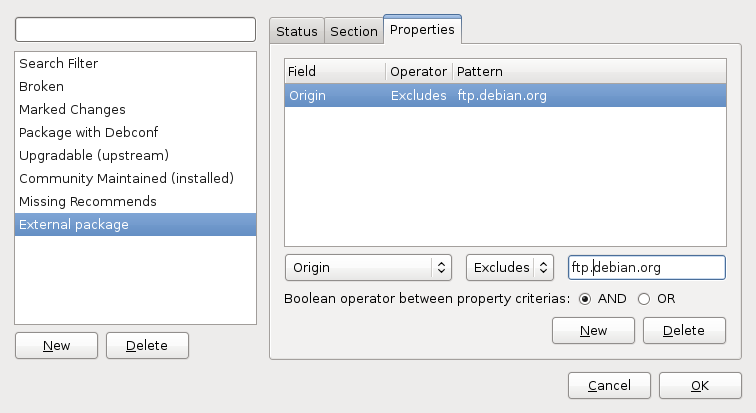 Note that the term Origin is used to refer to two different things, a field in the release file but also the name of the host for an APT repository. It s a bit confusing if you don t pay attention.
Close the filters window with OK. You now have a new listing of External packages under the Custom Filters screen. You can see which packages are installed and up-to-date and decide whether you really want to keep it. If the package is also provided by Debian/Ubuntu and you want to go back to the version provided by your distribution, you can use the Package > Force version menu entry.
Click here to subscribe to my free newsletter and get my monthly analysis on what s going on in Debian and Ubuntu. Or just follow along via the RSS feed, Identi.ca, Twitter or Facebook.
8 comments Liked this article? Click here. My blog is Flattr-enabled.
Next.

