Search Results: "sto"

24 April 2009

Jon Dowland: my first attempt at hacking on Linux: a story

I have a little job that runs on my web server and tells me what URIs people have tried to fetch over the last 24 hours which were not successful. One of these URIs was for a page that used to contain my first ever Linux device driver. That device driver is now obsolete and so there was little point in tracking down the code and putting it back in place, but I did think there was a story to tell, so today I wrote down what happened with this driver at the URI. Thanks to the magic of ikiwiki's "inline" directive, here it is in the log: This is a story about my first real attempt to contribute to the Linux kernel. The Davicom DM9601 is a cheap USB NIC that I picked up on ebay at some point in late 2006. Suprisingly, at the time, there was no driver for it in the Linux kernel. I'd had some experience hacking on the kernel whilst working for IBM and I've always wanted to get more involved, so I thought this would be a good opportunity. I searched around and managed to find a vendor-written driver for the 2.4.x kernel series, but nothing newer. I felt that the best approach would be to start porting this driver to 2.6, improving it along the way. I got to work, and after several hours I had something that would compile against 2.6 series headers, at least, so I put my progress online and wrote a short log post about it (dm9601). A really invaluable resource whilst doing this was LWN.net's "Porting device drivers to the 2.6 kernel". Once I had the code up there, kernel hacker Arnd Bergmann got in touch with me. He said, quite frankly, that my driver had a long way to go, but that he would be willing to help mentor me and guide me in improving it so that it would make it into mainline. This was fantastic news: this is exactly what people need when trying to get up to speed with the customs of something as complex as the kernel development community. Arnd sent me a long list of things I needed to fix. Whilst I had my code online I had several other people get in touch with me and provide things like device IDs for their NICs that they needed to add in order to get it to work for their hardware. Several weeks later, after implementing a good chunk of Arnd's suggestions, I had a driver that worked, at least a little bit, with 2.6, so I got back in touch with Arnd. Bad news, for me at least: Peter Korsgaard, another kernel hacker, had implemented a dm9601 driver from scratch over a weekend. Apparently he was at a friend's house, his friend had this device, he noticed there wasn't a driver in the kernel already and sat down to write it as a fun project. From scratch. In one weekend. This was a bit of a blow. I couldn't imagine having the skill and knowledge required to be able to pump out a driver like that, but I knew the first step on the road was what I was doing, and that road was now closed. I couldn't really blame Peter, I could only really feel quite jealous at his prowess, so that was the end of that. His driver was much leaner, much tidier, fitted the kernel programming style properly, and was thus accepted. However, for my hardware at least, it didn't actually work, and he didn't have access to the device after that one weekend, so he wasn't in a position to fix it. This situation lasted about 4 months from 2007-02-23, when Peter's driver was accepted, until about 2007-06-27 with this patch. From this whole experience, I did manage to get one small patch into the kernel: one which added the device IDs for my NIC and those of the people who had got in touch with me.

Stefano Zacchiroli: howto: uploading to people.d.o using dput

dput + mini-dinstall to ease people.d.o uploads As DDs we often want to offer unofficial packages, but still preserving a bit of "authoritativeness". A widespread solution is to upload somewhere under http://people.debian.org/~LOGIN as an APT repository. I've been using that solution too since ... ever, but I've never been happy about how to advertise the packages, probably just because I've never liked dpkg-scan packages,sources and hackish scripts built on top of them. My goal, as simple as it can be, is to work as I do to prepare "real" packages to be uploaded to the Debian archive, and just upload to people.d.o as the final step. Thanks to DSA which satisfied a request of mine by installing a while ago mini-dinstall on ravel, today I've finally set up a work-flow that enabled me to reach my goal. This post is a quick howto to implement that setup. If you have suggestions about where (wiki.d.o? devref?) to paste these info so that other DDs can more easily find them in the future, please let me know, via comments or mailing me. Step 1: configure mini-dinstall on people.debian.org On people.debian.org, create a ~/.mini-dinstall.conf file containing something like the following:
    [DEFAULT]
    mail_to = zack
    incoming_permissions = 0750
    architectures = all, i386, amd64
    archive_style = flat
    dynamic_reindex = 1
    archivedir = /home/zack/public_html/debian/
    generate_release = 1
    release_origin = Zack
    release_label = Zack
    release_description = Unofficial Debian packages maintained by Stefano Zacchiroli
    [zack-unstable]
    release_suite = zack-unstable

Highlights of that conf: The resulting repository will be accessible using the following /etc/apt/sources.list lines:
    deb http://people.debian.org/~zack/debian zack-unstable/
    deb-src http://people.debian.org/~zack/debian zack-unstable/

Step 2: configure dput The default incoming dir of mini-dinstall, relative to the configured archivedir, is mini-dinstall/incoming. The following entry for your ~/.dput.cf (on the machine you upload from) will therefore setup your dput for uploads:
    [people.debian.org]
    fqdn = people.debian.org
    method = scp
    login = *
    incoming = /home/zack/public_html/debian/mini-dinstall/incoming
    post_upload_command = ssh people.debian.org mini-dinstall -b

The only interesting detail here is the post upload command, which will run a "pulse" of mini-dinstall on people.d.o just after the upload, to process the uploaded file. Alternatively, you can leave mini-dinstall running on people.d.o, but I consider it unnecessary (because usually you are the only one able to upload to your home dir), unelegant, and complicated (because you then need to verify mini-dinstall is running). Step 3: enjoy (i.e., upload) Now you can prepare your packages as you always do (which means using cowbuilder!) and, when you are done with your foo_1.0-1_amd64.changes, upload it doing:
    $ dput people.debian.org foo_1.0-1_amd64.changes

Signing the Release file The above setup does not sign Release files, which means your APT users will receive complaints from the secure APT machinery. To fix that you must sign the Release file with some key and distribute the key to your users to be processed by apt-key add. You have a couple of ways to sign the release file automatically:
  1. (/me doesn't like this) use a GPG key created for the occasion, store that key (including the private part) on people.d.o, and use the mini-dinstall contrib script sign-release.sh by adding something like the following to your mini-dinstall.conf:
      release_signscript = ~/bin/sign-release.sh
    
    
  2. (/me likes this) use some script to sign the Release file remotely and send the resulting deatched signature back to people.d.o just after the mini-dinstall pulse; that way you can sign with your own private key, which will be reasonably felt as more trustworthy, being part of the Debian keyring. To achieve that, the most elegant way would be to fix debsign wishlist #465240 (volunteers? :-) ). As I'm lazy, I'm using my own sign-remote script, which is a bit more generic. Remote signing should be attached to dput upload hook as well. All in all, here is my actual ~/.dput.cf stanza:
      [people.debian.org]
      fqdn = people.debian.org
      method = scp
      login = *
      incoming = /home/zack/public_html/debian/mini-dinstall/incoming
      post_upload_command = ssh people.debian.org "mini-dinstall --batch" && sign-remote people.debian.org:~/public_html/debian/zack-unstable/Release
    
    
Enjoy! Update: do both mini-dinstall run and signing in post_upload_command, following gregoa's suggestion via comment

Jeff Bailey: Language lessons

Through a program at work, I just got access to Rosetta Stone. I've been a bit worried that with a primarily English-speaking workplace and an English-speaking home that my French would stagnate. It turns out that my account has access to all the languages, not just French.

So which other language should I learn? For fun, I did the first lesson of Latin (got 81%) and Japanese (83%).

And now I'll have dreams of this voice going "Hoooah toe teh mah jusa".

Mmmm. and now I want juice.

Zzzzz...

Dirk Eddelbuettel: Real nice Boston Marathon writeup

This article from the Boston Globe gives an excellent description of what running Boston last Monday was like, and why we keep coming back, almost regardless. The writer, for whom it was the fifth Boston and ninth total, expresses the range of emotions, expectations, frustrations, excitements, ups, downs, ... all of which form the challenge of racing a marathon in general, and on this course on a windy day in particular. And just like she concludes that the finish of one marathon leads to planning the next, I registered last night for the Chicago Marathon on October 11, apparently around twelve hours before it sold out. And so it is with regrets that I have to decline Christian's invitation to run Cologne with him on October 4. Another time, hopefully.

23 April 2009

Matthew Palmer: Insane/Brilliant Idea of the Day

I've been talking serial consoles with a couple of the other guys at work: how nice they are to have for machines in the datacenter, how annoying it is that vPro serial-over-LAN doesn't seem to be robust (yet?), and how serial access concentrators are lung-and-kidney expensive (especially when you've got 50-some racks to outfit). This discussion, combined with my ongoing embedded-hardware-fascination lust for a SheevaPlug appears to have spurred my brain into coming up with a Brilliant Idea: tie a SheevaPlug to a pile of USB to serial adapters and use that as your per-rack serial concentrator. Imagine: faffenheimer, a dedicated server you manage for a customer, and located in rack 27 of your DC, has just crashed, and you'd like to know WTF has happened rather than just blindly reboot, but you're in the office 15 minutes away from the DC floor, and the customer's going to want that machine back up and running pretty quickly.
workstation:~/porn$ ssh rack27.serial
rack27:~$ sconsole faffenheimer
[screen session attached]
[minicom running, shows the horror of a kernel crash dump]
[oh look at that, kernel bug]
^A ESC
[pgup pgup]
[enter]
[pgdn pgdn]
[enter]
^A >/tmp/faffenheimer-crash-dump
^A d
rack27:~$ exit
workstation:~/porn$ scp rack27.serial:/tmp/faffenheimer-crash-dump ~
workstation:~/porn$ powercycle rack27 faffenheimer
Shiny! We got a crash dump in a minute or so (rather than having to take phonecam photos of KVM screens in the DC), never had to leave our comfy seat, and the machine's on it's way back up. We're now free to pursue diagnostic activities on that crash dump at our leisure. 10 minutes later, the downtime for faffenheimer that was automatically set when we ran powercycle runs out and Nagios sends us threatening messages. Hmm, something's gone wrong here. Back into the console...
workstation:~/porn$ ssh rack27.serial
rack27:~$ sconsole faffenheimer
[screen session attached]
[Boot is hung waiting for root password after initrd has bombed]
[Type root password]
[Oh look, the root MD appears to have come asunder]
[clickety-click... fixee fixee]
[reboot]
The more I think about this, the more I reckon I'm onto a bona fide winner. The sheevaplug is a powerful ARM-based system with USB/ethernet/SD ports that is packaged literally in it's own power supply wall wart -- it's a plastic box with power plug prongs poking out the side. That's all there is to it. The USB to serial adapter things are likely to be a bit more of a pain, but I've played with enough of them by now to not be too scared. So, you plug the Sheeva into a power socket, plug an Ethernet cable and USB hub into the Sheeva, configure things a bit so that the system knows which serial adapter maps to which machine, and you're away. Oh, and the best bit: the Sheeva apparently draws as little as 2W when idle. A whole datacentre's worth of serial goodness for about a server's worth of power. The cost per rack should be somewhere below AU$250, especially in bulk. Let's see if I can convince work to spring for a Sheeva, a USB hub, and a half dozen or so USB to serial adapters to test this whole thing out. Given that the whole thing looks like it'd cost less than AU$250 (plus my R&D time), I can't imagine it'll be too hard a sell to at least give it a go. Watch this space...

Sean Finney: embedding youtube videos in ikiwiki

so i had a couple videos to mention and i figured i'd use the chance to write an ikiwiki template to do so. it's not the most flexible, but it works! current template code, put into templates/youtube.mdwn:
<div class="youtube">
 <object width="445" height="364" 
     data="http://www.youtube-nocookie.com/v/<TMPL_VAR raw_v>&fs=1&border=1" >
  <param name="allowFullScreen" value="true" />
  <param name="allowscriptaccess" value="always" />
  <param name="movie" 
     value="http://www.youtube-nocookie.com/v/<TMPL_VAR raw_v>&fs=1&border=1" />
 </object>
</div>

using it:
[[!template  id=youtube v="sPq3c5D65hE"]]

gets you:
(not sure if that will show up on a syndicated site) it's also xhtml compliant, unalike the default "share this" text and what's produced by the deprecated embed plugin. it also uses the "no automatic cookies" option provided by youtube. i might try and break out a few more options into parameters the next time i post videos. on a related note, does anyone know a good way to include/display the code of a template on a page? this stuff here is just cut/pasted but it would be nicer to be able to not have to do that to keep it up to date.

Petr Rockai: darcs sprint 2009-04

As you might know, as part of the Haskell Hackathon 5 in Utrecht, the second darcs hacking sprint took place. Thanks to generous donations to the Darcs project, I have been able to attend. I took the overnight train from Prague on Thursday evening interestingly, we managed to accumulate about 90 minute delay in Germany, but by skipping some detours (throwing passangers out at more convenient ones) we managed to get to Utrecht on time. (Wow.) After a while of confusion, we managed to get our strippencards and find the right bus and get to the UU campus (at that time, we have already met with Thorkil, whose train was combined with mine in the middle of the night somewhere in Germany). The first thing there was to get our name tags and a round of introductions followed I was fairly surprising by (large) number of darcs hackers among the general Haskell population present at the Hackathon. Overall during the sprint, various topics have been discussed ranging from theory issues to actual implementation bits in current darcs. Some roadmapping has taken place. It was great to see all those darcs people together. More interestingly, it sort of convinced me that actually something is going on with darcs. Although most people seem to be pretty short on time, at least I got the impression that people have actual intent to keep advancing darcs, in one form or other. Also, there s been some preliminary plotting on what is the life expectancy of darcs 2, roughly. My current plan is to use darcs 2 as an implementation vehicle, because people use it in real life, for carrying out the actual work on hashed-storage. That way, we should be able to de-couple low-level repository and file access code from darcs itself, also meaning it should be reasonably easy to plug it into camp later (or maybe it turns out we instead want to remodel darcs so that we can plug camp-core in time should tell). We have done some bits of work on darcsit (gitit) migration of wiki.darcs.net, although it hasn t been so much of a smooth sailing. I have even tried to set up gitit on one of my machines, but cabal-installed happstack went eventually crashing and burning instead of doing anything useful. I m stuck on that front, hoping that Eric and Gwern can get test.darcs.net running within reasonable resource usage. I have thrown a chat with various people about hashed storage and I have explained various problems of the current darcs hashed repositories and how hashed storage addresses those. Also, I have talked with Benedikt about his filecache and we entertained some initial thoughts on how those two play together. We have also spent a while at a whiteboard with Eric discussing what needs to be fixed in sources handling: the file that lives under _darcs/prefs/sources and that keeps track of related branches of a given repository. The catch is, that when inappropriate entries get into that file, bad things can happen: darcs repeatedly waiting for a nonexistent remote machine to answer, or triggering automount a few thousand times by probing just the wrong directory. These need to be remedied and we came up with a reasonable action plan. Hope to have this in 2.3, as it should be moderately hard to fix and it has potential to sweep a fair amount of silly and obscure performance bugs. All in all, it seems to me that the important part of the sprint this time was talking to people and thinking about things. Still, I did manage to get some hashed-storage coding done (but mostly cleaning up and documenting work) during the sprint. I expect the fruit of the sprint discussions to take shape in form of code improvements in following months.

Joey Hess: AT blogs

Finding power and internet to post to a blog while hiking for half a year up the Appalachian Trail doesn't seem like a very likely combination, but nowadays some people manage it in various ways. I've read and enjoyed three or four books about AT thru-hikes, but blogs are a more immediate, interactive medium. I've been following with interest a group who came down with food poisoning as they hiked along the Holston Mtn. ridge in my "backyard" and look forward to reading about others as they pass by. So, I'm aggregating all such blogs I can find for the 2009 season on a page I call Planet A.T.. It's a nice way to read these contrasting accounts juxtaposed together in real time. One includes cell phone photos and fairly frequent updates of a hiker who's already reached Damascus; another is frequently updated by Blackberry by a guy I could well have crossed paths with on Roan this week; another has more infrequent, interesting long essays by a hiker who has just reached Tennesee; another is a teacher sending educational videos home to his school. There's even an 86 year old who I understand is the oldest person to hike the whole trail -- and is doing it again. I thought I'd only find a few blogs, but I've now added over a hundred! So maybe one in ten of all thru-hikers this year have a blog. And the number of bloggers will presumably dwindle toward twenty-five before they reach the end in Maine.

Christian Perrier: Registered for Cologne

Now, I'm registered for Cologne Marathon. So is No l and probably Ralf Treinen. Any other DD or Debian contributors wanting to join in? I know that Dirk Eddelbuettel will probably not (btw, nice run at Boston, Dirk)....but others certainly can...and should ! October 4th, 2009 is still far enough for you guys to plan this..:-)

Romain Beauxis: Lastfm no longer free as in free beer (and some bits about xml in OCaml)

Lastfm no longer free as in free beer As I was trying move the code of ocaml-lastfm [1] from the unmaintained xml-light [2] to xmlm [3], I discovered that it now fails to request track in anonymous mode. Then, I went on the lastfm [4] site, and discovered that now I cannot find any full content available for anonymous users. Some more researches and I found this [5]:
Today we are making the changes to the radio that were previously announced here. This means that from today, listeners to Last.fm Radio outside of the USA, UK and Germany will be asked to subscribe for 3.00 per month, after a 30 track free trial period. In the USA, UK and Germany, where it's feasible to run an ad-supported radio service, there won't be any changes. Everything else on Last.fm (scrobbling, recommendations, charts, biographies, events, videos etc.) will remain free in all countries, like it is now.
JPEG - 42.5 kb
Alcool ! Voil l'ennemi.
Poster by French painter and missionary Fr d ric Christol (1850-1933) warning of the dangers of absinthe and other alcoholic drinks.
Although I will not comment this with the same violence as in the comments of the above message, this is not a good news at all. I totally understand how it can be difficult to find financial resources for this kind of business, and how complicated it can be after few years to maintain an activity that initially was breaking new and attracting investors. However, given the current global [6] propaganda [7] campaign [8] that is organized [9] by the major music companies, I do not believe this decision has only to do with lastfm's financial resources. In particular, also the legality of Deezer [10] was challenged by universal [11] such that they had to require registration [12] and also limit drastically the available titles. The current situation is now really becoming worse and worse. Not only the music companies are trying to push for dangerous laws for the civil rights while pretending to fight against illegal music sharing, but also they are trying to shutdown all the new competitors that were successful in doing exactly what they refused to do during the same time. All of this is just simply pathetic, and I strongly hope there will soon be an end to this, which will surely mean for these companies adapt or perish.. Or perhaps they plan to impose their restricting and dangerous laws in any country in the world ? Another remark about all this is that it clearly demonstrate the importance of having the right to copy and store for your own usage any copyrighted material. Indeed, these are not only products but also artistic productions, and for this reason it is important to be able to save them in some place in order to not loose track of it if the streaming company was to be shutdown, as it seems to be the trend now.
JPEG - 71 kb
Viktor Oliva: The Absinthe Drinker.
The original painting can be found in the Caf Slavia in Prague.

Moving from xml-light to Xmlm The other part of this post is about moving from xml-light to xmlm. This is in fact very easy, and should only be a matter of adding a piece of code like this:
type xml =
Element of (string * (string * string) list * xml list)
PCData of string

let parse_string s =
let source = String (0,s) in
let input = Xmlm.make_input source in
(* Map a tag representation in xmlm to
* (name, attributes list) where attribute = string*string. *)
let make_tag (x,l) =
(* Forget about the uri attribute *)
let l =
List.map (fun ((_,y),z) -> (y,z)) l
in
snd x,l
in
let rec get_elems l =
if Xmlm.eoi input then
l
else
match Xmlm.input input with
El_start tag ->
let elem = get_elems [] in
let (name,attributes) = make_tag tag in
get_elems ((Element (name, attributes, List.rev elem)) :: l)
El_end -> l
Data s ->
get_elems ((PCData s) :: l)
Dtd _ -> get_elems l
in
let elems = get_elems [] in
Element ("", [], List.rev elems)
This is a very simple code that surely needs more fixes, but starting from that, you can parse a string into an equivalent representation of the xml data, and then use it as before in your code..


[1] Ocaml-lastfm: http://www.rastageeks.org/lastfm.html [2] Xml-light: http://tech.motion-twin.com/xmlligh... [3] Xmlm: http://erratique.ch/software/xmlm [4] Lastfm: http://www.last.fm/ [5] "Radio Subscriptions": http://blog.last.fm/2009/04/22/radi... [6] "New Zealand: safe from Big Music. Or is it?": http://www.p2pnet.net/story/19074 [7] " La Quadrature du Net discr dit e aupr s des d put s anti-Hadopi": http://www.numerama.com/magazine/12.... Link is in french. It explains how, after filling a so-called petition with hundreds of signatures from employees presented as artists, or artists abused by the presentation of the content, these companies complain about the "totalitarian methods" used to verify the validity of the signature, which were simply based on the public available information on these names on the web, while they propose a system that would automatically cut the internet access to probably 1.000 people a day in France... [8] "Faux proc s : Les pirates paient": http://www.ecrans.fr/Faux-proces-Le.... again, in french, the article reports a Danish study that prove once again that people who tend to download a lot of music are also much more likely to spend their money in the music business, being concert, records or else.. [9] ""Three strikes" for Ireland - Eircom, music industry settle filtering case": http://tjmcintyre.com/2009/01/three... [10] Deezer: http://www.deezer.com/ [11] "Universal Music challenges the legality of Deezer, a free streaming website": http://french-law.net/universal-mus... [12] "Now Deezer Required Registration": http://forums.techarena.in/technolo...

Manoj Srivastava: Manoj: Ontologies: Towards a generic, distribution agnostic tool for building packages from a VCS

This is a continuation from before. I am digressing a little in this post. One of the things I want to get out of this exercise is to learn more about Ontologies and Ontology editors, and on the principle that you can never learn something unless you build something with it (aka bone knowledge), so this is gathering my thoughts to get started on creating an Ontology for package building. Perhaps this has been done before, and better, but I ll probably learn more trying to create my own. Also, I am playing around with code, an odd melange of my package building porcelain, and gitpkg, and other ideas bruited on IRC, and I don t want to blog about something that would be embarrassing in the long run if some of the concepts I have milling around turn out to not meet the challenge of first contact with reality. I want to create a ontology related to packaging software. It should be general enough to cater to the needs any packaging effort in a distribution agnostic and version control agnostic manner. It should enable us to talk about packaging schemes and mechanisms, compare different methods, and perhaps to work towards a common interchange mechanism good enough for people to share the efforts spent in packaging software. The ontology should be able to describe common practices in packaging, concepts of upstream sources, versioning, commits, package versions, and other meta-data related to packages. vcs-pkg concept diagram I am doing this ontology primarily for myself, but I hope this might be useful for other folks involved in packaging software. So, here follow a set of concepts related to packaging software, people who like pretty pictures can click on the thumbnail on the right:

Y Giridhar Appaji Nag: Today's vote

Dear Friends,

When you go out to vote today, please remember that it is most likely not local issues that should dominate your choice. The fact that there is a perpetual ditch on your way to work, no bus shelter at the bus stop that you use, or a poor neighbourhood road that disappears each monsoon should not determine the choice of candidate. Your MP doesn't have much to do in these areas, at-best they can spend the Rs. 2 crore under the MPLAD scheme to try and keep you happy. Local issues should be your primary concern in the municipality elections or perhaps in the legislative assembly elections, not in the general elections.

The members of parliament decide policy, laws and future of the country at a national level. You should be worried about their participation in the law and policy making process (what issues did they bring up in the parliament, which laws do they support, what questions do they ask in the sessions etc.). Please do keep that in mind. Some of the candidates may even take up issues that are clearly not important for the city in which you live, that is OK (like I said before, these are not your local elections).

Also, don't hesitate to vote for an independent candidate or a candidate from a small party just because they don't belong to a popular national level or state level party. While you may feel that your vote isn't being "used" well, you would want to encourage good people to contest elections. Having them lose their deposit each time they get into the fray is not the way to do that.

Thank you.

22 April 2009

Gunnar Wolf: Rodrigo denying evasions and religion

Umh, is today the quote your neighbour day? No? Thought so... Still, for the second time in a couple of minutes, I'm quoting/translating here. This time, I'm quoting a short text posted by fellow Mexican Debian guy Rodrigo Gallardo: Deceptions (hmm... Not in the let you down sense, but in the deceiving sense. Sometimes it is hard to translate a single word without twisting it around). My translation is far from perfect - Read it in Spanish, you will enjoy it more. Rodrigo says:
Things and actions are what they are, and the consequences of them will be what they will be; why then should we desire to be deceived? Joseph Butler
I was in Colima, sitting on a slide in a city park, that day I understood why somebody might want to be drunk. Several years later, this time in Tlalpan, I understood why somebody would want to believe in a god. And sometimes I am truly sorry not to be able to embrace neither of both longings. The idea of letting go the facts, to believe they have an inner order, although covered in mistery, or they are just far away, blurry. But where others see destiny, I see things falling naturally in their place. Where others see beauty in the mistery, I see a challenge. And even more beauty in an elegant explanation, in understanding. Motivation, not in the promise of future welfare but in the certainty of this limited but tangible present welfare. Freedom in the absence of a purpose, and inmortality in the little pebble I am in the great human building. I suppose that if Revernd Butler knew his phrase inspired this divagation, it would not make him precisely happy. But, things are what they are, and his argument says what it says.

Alastair McKinstry: pkg-config, -as-needed and multiple compilers

At work I've been promoting the use of pkg-config and modules to solve the problems of avoiding hard-coded paths and an environment where we've multiple compilers. In summary, "module load intel-cc" to load the intel compiler, "module load netcdf-intel" to, which among other things appends /ichec/packages/netcdf/4.0-intel/pkgconfig to $PKG_CONFIG_PATH, and then:
NCDF_INCS :=  pkg-config netcdf --cflags 
NCDF_LIBS :=  pkg-config netcdf --libs 
in the application code. Replace "intel-cc" and "netcdf-intel" with "gcc" and "netcdf-gcc", and it builds with gcc. This would work better if upstream supplied .pc files, which means the next stage in world domination is to send patches to do just that. But it's not that easy, apparently. netcdf (for example) supplies two libraries, libnetcdf.so and libnetcff.so, with the second including code only needed for Fortran. So, for gcc I have the following netcdf file:
prefix=/ichec/packages/netcdf/4.0-gcc
exec_prefix=$ prefix 
libdir=$ prefix /lib
includedir=$ prefix /include
Name: netcdf
Description: netCDF libraries, include files and development tools (gcc version)
Version: 4.0
Libs: -L$ libdir  -Wl,--as-needed -lnetcdf   -lnetcdff 
Cflags: -I$ includedir 
While for Intel I have:
prefix=/ichec/packages/netcdf/4.0-intel
# Add fortran libs 
forlibs=/ichec/packages/intel/fce/11.0.081/lib/intel64
exec_prefix=$ prefix 
libdir=$ prefix /lib
includedir=$ prefix /include
Name: netcdf
Description: netCDF libraries, include files and development tools
Version: 4.0
Libs: -L$ libdir  -lnetcdf -L$ forlibs   -lnetcdff -lifcore
Cflags: -I$ includedir 
The main problem is that --as-needed is not understood by non GNU-ld linkers, and must be conditionally removed somehow. Any ideas ? (There is a second wrinkle of needing to add additional libraries for Intel Fortran here, but I'm sure I can remove that with the addition of more .pc files.). A second issue is that --as-needed can break otherwise working pkg-config usages. Thanks to galtgendo at PhP Bugs for this example:
alastair@ailm:~$ cc -o testx  -Wl,--as-needed  pkg-config glib-2.0 --cflags  test.c  pkg-config glib-2.0 --libs 
works, but:
alastair@ailm:~$ cc -o testx  -Wl,--as-needed  pkg-config glib-2.0 --cflags    pkg-config glib-2.0 --libs  test.c
/tmp/ccsUEwtk.o: In function  main':
test.c:(.text+0x20): undefined reference to  g_print'
collect2: ld returned 1 exit status
The problem being that --as-needed removes libraries as unnecessary before the linker sees the test.o code. Tags , , , , ,

Dirk Eddelbuettel: Boston Marathon 2009

Monday was the 113th Boston Marathon. Just like in 2007 (and having skipped last year as I ran London the week before), I went as part of a group of local running friends. We once again had a blast---Boston on Marathon weekend is a real spectacle. Lots of people, lots of excitement, and this time even great weather. The race itself was challenging. Having done it once before, and having come off a really decent last marathon, I may have underestimated the impact of the famous hills. This really is a wonderful but challenging course. Combined with the poor training conditions during this last Chicago winter which forced us indoors for quite a few long runs, as well as a somewhat upset stomach which forced a two-minute break, I came up short and posted an underwhelming second half. The head wind was also a factor that was mentioned in a few reports on the comparatively slow times of the elite runners. So when all was said and done, I ended up with a time of 3:30:13 and 8:01 min/miles which is a little slower than last time. All in all a really great marathon weekend. As my time from Berlin qualifies me for Boston 2010, I may well be back next year.

Biella Coleman: They keep on coming

There are two topics that seem to receive a steady stream of comments on this blog. My entry on Edmonton garners a smattering of comments every few months, usually giving E-town a huge thumbs down. The other entry concerns my tribulations with BCBS and here I receive a steady stream of sad stories all of which point to the horrors caused by some branch of BCBS such as my least favorite one Horizon Blue Cross Blue Shield of NJ. Along with the comment posted above, I got this one asking me to reveal the email address of the PR director of BCBS NJ. In the past I advised folks to google it to find it. But I just tried and it is actually a bit harder to find and I wonder if I should post to one of the many press releases that exist on the web with this information? I hope thats some with some sort of time and lots of anger (toward BCBS) to start a website specifically geared toward and against BCBS. Call it Blue Cross No Shield (I think I actually own that and am pretty proud of the name) or something of that nature and throw up some blog and post horror stories in the style of the consumerist. There will be no shortage of them, especially if the blog is national in scope. Get a mailing list going and start a fax campaign among many others. Share contact information about public relations directors and Other People in Power, tips and advice on fighting them, and perhaps even move to the next level of organizing. I am not sure writing this here will do anything to inspire other and I would love to do this sort of rabble rousing as I get immense pleasure from doing so. But I simply am in the red when it comes to time. But I hope that some of the folks that have posted comments on this blog take the initiative to start a larger campaign (or someone can point me to an exisitng one). update: Now that I think of it, The Consumerist should really take up this cause and devote a section JUST to health insurance. They are already a brand name of sorts with lots of eyeballs on the site, everyday.

21 April 2009

Russell Coker: Mo Rewards

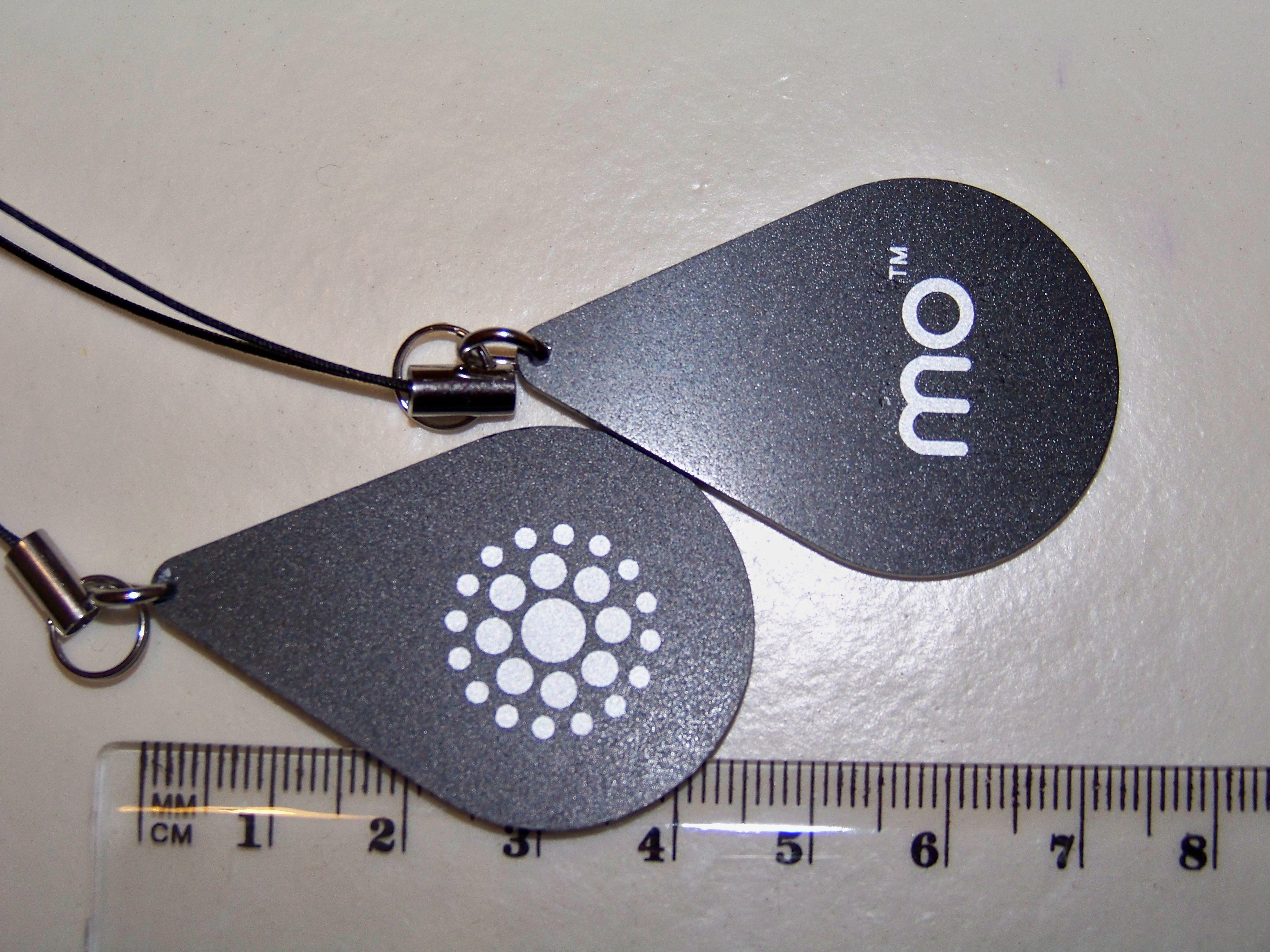
While shopping at Highpoint [1] today I noticed that they had a new loyalty system. It s called Mo Rewards [2] (for which the real web site is at MoCoMedia.net [3] which has no link from the main site because they didn t care enough about their web presence). The way that Mo works is that everyone gets a free RFID token similar to the two in the above photograph. The token comes with a pseudo-random seven letter code that you have to SMS to register it to your phone. You SMS the code and then receive a confirmation SMS. After that you can wave your token near a detector any time you visit the shopping center and you will receive three SMS messages with discount offers. You can send an SMS with your gender and birth-year to receive more targeted offers. To redeem offers you have to wave your token near a detector at the store so they know who is using the offers. Then of course once the database knows that you are a regular customer at a certain shop they can send you targeted advertising to entice you to buy from that shop on every visit. I presume that they have some sort of bidding system for adverts from the shops of a similar nature to the Google advertising. It s an interesting system and a lot better than most loyalty programs. One interesting thing about this is that high quality RFID devices are being given out for free. The tokens are quite solidly constructed and could be used for a variety of other purposes. I couldn t find anyone offering RFID tags at a reasonable price with a quick Google search (the cheapest was $75 for 100 tags - and they were the fragile ones used for marking stock in shops). So a hobbyist who wanted to do some RFID stuff could buy a cheap reader under one of the demo offers (where you get a reader and a small quantity of keys for a reasonable price) and then collect free RFID tokens from shopping centers. I expect that the number of people who would do such things is small enough to not be statistically significant and therefore not affect the business model. The tags are given out freely with no requirement that you must use them for the expected purpose (Mo Rewards) instead of using them for your own RFID work.

Romain Beauxis: Liquidsoap now supports AAC+ encoding.

The plot Following many user requests , we were considering adding this format to the list of supported encoders. As for mp3 encoding, this support was subject to some legal issues. These issues were indeed the initial motivation for implementing icecast2 using the patent-free ogg codecs and container for streaming data. However, it seems that many users and net-radios are still asking for these formats. There can be several motivations for that, among which I can list the following major ones:
  • These formats are supported by more players and, in particular, embedded devices, which are the main target for net-radios
  • For the case of AAC+, the codec supports a very good audio quality for low bandwidths, such as 64 and 32kb/s.

The philosophy There is a constant complain from the open source communities about the use of patent-encumbered formats. In particular, those formats are not allowed in the Wikimedia commons and the corresponding encoders, in particular mp3 encoders, are not supported by for instance the Debian distribution. In a similar intent to push for a wider usage of patent-free codecs, the icecast project reimplemented its streaming server in order to use the ogg container and codecs. All these actions are very important. In particular, the support for ogg/theora video files in firefox, and hopefully the major HTML 5 browser is mainly the result of wikipedia refusing other video formats. Indeed, wikipedia is now a major website, and it would be insane to not support the videos there. However, I for myself do not like when these actions become too restrictive to the user. For this matter, I personally prefer freedom of choice among other considerations. Also, as a matter of fact, when trying to change the situation about these issues, one has to take into account the relative importance of each actor. It is because wikipedia is already huge that it has managed to change the things. Hence, in the case of net-radios, a majority of potential users are asking for AAC+ and other patent-encumbered formats. Although this is not the ideal situation we would like to see, there comes a point were either the free-software projects have something to propose, or the users will just go for a proprietary software, which is even worse to the situation. For this purpose, I believed it was important to add such support into our software. However, as you will see later, we do not implement ourself the encoding algorithm, but only added support for external encoders. That way, we simply let the user choose what he wants to use, but remain a patent-free and open-source software.

The implementation Since mp3 was, and still is, the major target for net-radios, icecast2 still has the possibility to stream this format. In fact, this format, as well as AAC+, does not have headers, such that it is possible to decode a stream at any point in it. Hence, in this case, icecast only acts as a proxy, and the only constraint is to send it the encoded data at real rate. Hence, the main library for streaming to icecast, libshout, parses the audio data that it receives, and schedules the streaming according to real rate. Additionally, it also supports a raw mechanism, for which there would be not such mangling. In the case of liquidsoap, we did not need this feature of the libshout since the software is already working in real time. Furthermore, the source connection protocol provides a content-type header field, which allows icecast to display the correct mime for the data format that is streamed. All in all, in order to send AAC+ data to icecast, one needs to send the correct mime-type in the source connection headers, and then send audio data at the correct rate. However, the libshout did not allow to set an arbitrary content-type header. Hence, I proposed a patch. It was proposed for an inclusion into main code, since I believe it is interesting not only for our specific need, but also for any other generic data format support. Although the patch was accepted, it was never committed. So, we decided to go on: since liquidsoap need not the real rate mangling feature of the libhsout, and since the source protocol is mainly a basic HTTP, we decided it was worth a custom implementation. This implementation was quite easy, thanks to the powerful capabilities of the OCaml language, and resulted in a custom implementation, ocaml-cry, that does the same as libshout, except that it does not control the rate of the data flow sent to the icecast server. Then, we also needed to support encoding data to the AAC format. After looking at the only available open-source encoder, aacplusenc, I tried to propose some changes in order to export a library and be able to use it in liquidsoap. However, these propositions did not make it into upstream's code, so I decided to also move on and use directly the encoder binary. Hence, using only the good old unix standard input/output mechanism, it is possible to start an encoder as a child process, send it the raw PCM data to its standard input and read the encoded data from its standard output. This lead to the development of the external output operators, which include output.icecast.external. Although this implementation was not easy, it now appears to work quite well in the current SVN version. In particular, the encoder process exits correctly for the FLAC encoder, which is needed in order to stream correctly, since the ogg container needs a restart for every track. Hence, we also gained support for encoding to the FLAC audio format, which was not binded for OCaml (yet ?) because its callback-driven API makes it tricky to do. Additionally, the support for external processes as encoders allows to use the lame binary for encoding mp3 data. Hence, liquidsoap can now encode mp3 data without the need of a built-in support for it. And, as always, the idea of using external processes spread over several other operators, including the support for external file and stream decoders, enabling support for many audio format (in fact almost all supported in linux, using mplayer). In conclusion, liquidsoap now has a fairly good support for AAC+ audio streaming, as well as a many new formats for decoding files and streams. It also support arbitrary formats and encoders using a custom variant of the output.icecast.external. Hence, provided your format can be decoded from any point in the stream, you should be able to use liquidsoap to stream data to icecast as soon as you have a binary which is able to receive RAW or WAV PCM data to its standard input and send encoded data to its standard output. As an illustration, here is an implementation of the output.icecast.aacplusenc:
def output.icecast.aacplusenc(
~id="output.icecast.aacplusenc",
~start=true,
~restart=true,
~restart_delay=3,
~host="localhost",
~port=8000,
~user="source",
~password="hackme",
~genre="Misc",
~url="http://savonet.sf.net/",
~description="OCaml Radio!",
~public=true,
~dumpfile="",
~mount="Use [name]",
~name="Use [mount]",
~protocol="http",
~aacplusenc="aacplusenc",
~bitrate=64,
~restart_on_crash=false,
~restart_on_new_track=false,
~restart_encoder_delay=3600,
~headers=[],
s)
# Metadata update is set by ICY with icecast
def aacplusenc_p(m)
"# aacplusenc - - # bitrate "
end
output.icecast.external(id=id,
process=aacplusenc_p,
bitrate=bitrate,
start=start,
restart=restart,
restart_delay=restart_delay,
host=host,
port=port,
user=user,
password=password,
genre=genre,
url=url,
description=description,
public=public,
dumpfile=dumpfile,
name=name,
mount=mount,
protocol=protocol,
header=true,
restart_on_crash=restart_on_crash,
restart_on_new_track=restart_on_new_track,
headers=headers,
restart_encoder_delay=restart_encoder_delay,
format="audio/aacp",
s)
end

Nico Golde: newsbeuter 2.0 released

Yay, newsbeuter 2.0 was just released! I am way too lazy to summarize all the new features and bugfixes, It's just to many of them. Here is the changelog:
Added more flexible dialog handling
Improved position handling in article list (fixes #112; thanks to Isaac Good)
Fixed a lot of bugs (#102, #111, #117, #130, #131).
Added ability to specify a list of OPML URLs when using OPML as URL source.
Added config option "keep-articles-days" to optionally keep articles only for a limited number of days.
Added config option "bookmark-interactive" to indicate that the configured bookmarking command is interactive.
Don't display authentication information in URLs (fixes #121).
Replaced mrss with new RSS/Atom parser.
Added ability to search for text from the article view.
Added basic support for Yahoo Media RSS.
Made article view pager configurable.
Improved HTML rendering of links and underlined and bold text.
Added ":source" commandline command to (re)load configuration files.
Implemented "pipe-to" key to pipe articles to external commands.
Implemented backtick evaluation for configuration files.
Extended filter language with "between" operator.
Added "age" attribute for articles to filter them for relative age (in days).
Extended "set" commandline command to toggle boolean variables and reset configuration variables of all types to their default.
Added ability to configure local files as feeds.
Added a "random-unread" key to go to a random unread article.
When opening articles from a search result dialog, make search phrase stand out in article view.
Persist commandline and search history.
Implemented commandline completion.
Improved help dialog so that it now shows unbound functions.
Added ability to sort feed list and article list by interactively choosing the sort method.
Improved and extended conditional HTTP download handling.

The full release annoucement by ak is available on: http://newsbeuter.wordpress.com/2009/04/21/newsbeuter-20-released/

Also just uploaded the package to Debian unstable.

Russell Coker: Amusing Thanks.txt Entry

My SE Linux Play Machine [1] has a file named thanks.txt for users to send messages to me [2]. On a number of occasions people have offered to give me things in exchange for the password for the bofh account (the one with sysadm_r privileges). I ve been offered stolen credit cards, a ponzi scheme of root access to servers on the net, and various other stuff. Today I received an amusing joke entry: Hello Kind Sir, I am Dr. Adamu Salaam, the the bank manager of bank of africa (BOA) Burkina Faso West I am sending you this message about the $3.14159 million dollars in bank account number 2718281828450945. I will give you this money in exchange for the password to the bofh account. The amount of money is based on the value of Pi. The account number is based on the mathematical constant e [3]. It s a pity that the author of that one didn t sign their real name. Whoever created that should have claimed credit for their work.

Next.

Previous.