Search Results: "ema"

3 August 2006

DebianTimes: Debian GNU/Linux adopted in the Extremadura

The councillor for Infrastructure and Technological Development, Luis Mill n V zquez de Miguel, announced that within one year all the computers of the Junta of Extremadura (government of the autonomous region of Extremadura, Spain) will run Free Software office tools and gnuLinEx, the local flavour of Debian GNU/Linux 3.1, as mandatory operating system. It will be gradually introduced to all administrative organisations of the Junta of Extremadura. From now on, all workers of the public administration will also use Open Document Formats (ISO/IEC DIS 26300) for their office applications as well as PDF/A (Portable Document Format, ISO 19005-1:2005) for document exchange, when guaranteed unalterable visualisation is required. V zquez de Miguel explained that at the end of the period all additional software must be distributed under a free license. "This is an important initiative that the Junta of Extremadura has been working on for a long time, accumulating experience and analysing the impact on our organisation so as to guarantee its success", the councillor declared. According to V zquez de Miguel, Free Software also improves security, autonomy and rationalises public spending. Using Open Document Formats will guarantee the conservation of all the administrative documents for longer periods of time. It will also improve the relationship with the general public since it's not obliged to acquire proprietary software to access official documents. About Extremadura Extremadura is an autonomous region in the West of Spain, with a population of about 1 million. It is well known due to its innovative efforts to bring the information society to all citizens, recognised with distinctions such as the 2004 European prize for regional innovation, granted by the European Commission. About gnuLinEx gnuLinEx is based on Debian GNU/Linux 3.1, with GNOME as the default desktop. In 2004, it was already deployed in all public schools in Extremadura, and was in use in other environments, such as community centres. gnuLinEx closely follows the development of Debian, with a special focus on translation into Spanish, and easy of use and maintenance. About Debian Debian GNU/Linux is a free operating system, developed by more than a thousand volunteers from all over the world who collaborate via the Internet. Debian's dedication to Free Software, its non-profit nature, and its open development model make it unique among GNU/Linux distributions. The Debian project's key strengths are its volunteer base, its dedication to the Debian Social Contract, and its commitment to provide the best operating system possible.

Biella Coleman: Photos from South Africa

I have put a few photos of South Africa up. Some of my favorites are: joburg sunset Bill Gates in Tighty Whitey’s painting of Nelson Mandela with friends at the NSA in Cape Town with Anne-Maria amazing table mountain

David Nusinow: Back In The Saddle

After a three week forced hiatus due to hardware failure, I'm finally back to Debian work. I've read pretty much all the email backlog that counts, and I'm getting the necessary chroots and so forth ready to push ahead. I now have an actual desktop system for use, rather than my laptop, so I'll probably be buying various video cards over time to help support Debian a little better, and maybe learn something in the process. The primary chip for this machine is an Intel i915, so that's probably where I'll focus my attentions for the most part. Now it's time to get the updates and RC fixes done so I'm not holding back etch's release.

2 August 2006

Roland Mas: Gforge in Debian, June 2006

...or, "Bits from a Gforge maintainer", if you'd like. After being neglected for way too long, the Gforge packages have finally started moving again. Packages for the most recent upstream release (4.5.14) are available in experimental, with quite a few improvements over the version currently in unstable: From a Debian maintainer's point of view, my Gforge-related TODO list now mainly sports three items. I suppose I could also try and migrate to the webapps-common framework, but I'll keep that for later. Of course, any help is welcome. Remember: the sooner I get the Gforge packages into a reasonable shape, the sooner they'll go to unstable, then testing, and the sooner I'll be backporting them to sarge, which means Alioth can be upgraded. But since I've heard a few complaints about Alioth being too damn slow or broken or whatever, I expect I'll get lots of patches (in bug reports, please) from disgruntled users eager to help.

Evan Prodromou: 15 Thermidor CCXIV

I'm at the Wikimania hacking days today. We drove down from wt:Montreal through wt:Vermont and wt:New Hampshire on Monday, stopping overnight in the beautiful town of wt:Lincoln (New Hampshire) in the White Mountains. Amita June had a crappy ride on Monday -- she was unhappy and uncomfortable and let us know it at every possible opportunity. We stopped in wt:Saint Johnsbury, VT for dinner, and she got some time to walk around and play, but beside that she was crabby. Tuesday morning was much better -- she had a big bagel from the Comfort Inn's breakfast buffet, and her Sleepy Bear teddy bear, and she was happy. Sleepy Bear is winning the war for hearts and minds in our house -- it's the bear that she's starting to sleep with more and more, and she makes a happy squeal when she sees it. This could be good or bad news. Anyways, we made it down to wt:Cambridge (Massachusetts) aaaalmost in time for the beginning of Hacking Days. HD is the technical pre-conference for the more sociological and content-oriented Wikimania. I thought it was going to be mostly MW committers and Wikimedia sysadmins, but it's turned out to be huge. I think there are about 40-50 people here -- a just gigantic group. Anyways, I was sitting in the One Laptop Per Child office meeting room with about 30 hackers yesterday morning. I was about 20 minutes late, but I managed to find a seat anyways. Everyone was giving introductions, and up stand David Recordon, Jonathan Daugherty, and David Strauss, all of whom say they're there to help me with the OpenID MediaWiki extension. As everyone's talking, I realize wp:Ward Cunningham is sitting right in front of me. The guy sitting next to me stands up to introduce himself, and says, "I'm Dan Bricklin, who many of you may know as the inventor of the spreadsheet..." Jeez. Anyways, the talk has been fast and furious. Yesterday was a long discussion about the state of Wikimedia servers, the upshot of which, for me, was: Holy Shit, Wikimedia is a big project. I managed to talk to a ton of people, including Travis Derouin of wikiHow, Jason from Wikia, all the OpenID folks, etc. etc. Jonathan Daugherty and I actually got some hacking done, which was great. tags:

The future of MediaWiki This morning Brion Vibber and Tim Starling gave a discussion about the future of MediaWiki. The story? More cool features, I think. The OpenID will be part of it; incorporating a WYSIWYG editor like WikiWyg or FCKEditor into the software. Also, more [[wp:AJAX]-y features, which are coming up through the codebase right now. I think in a large way MW's future is going to be outside of Wikipedia proper. Some of the cooler developments using the MW as a platform include WiktionaryZ and Semantic MediaWiki, both of which provide a structured data substrate to wiki pages. They're not compatible, which I think is something that needs to happen at some point in the future, but they're very promising for future projects. Another big class of projects is bots -- like PyWikipediabot or some of the "vandal fighting" bots and interfaces, e.g. Tawkerbot. I think that MediaWiki is drifting from being a monolithic browser app more into a Web-based service, which will be really productive from a content-production and -maintenance point of view, but which is extremely challenging from the social point of view. Finally, I think the great explosion in the world of customized MW extensions and skins is meaning a real marketplace for expanding the software is happening. I think this is pretty fabu, also. Some people have been discussing formalizing this ecology into a CPAN or JabberStudio-style site for hosting and organizing MW extensions. We'll see what happens with that, but if it comes around, I hope that it's named $wgForge. Maj and Amita June are running around Boston today... very slowly and carefully. They've got a brutal heat wave on here, and people are fainting and collapsing like wilting flowers. I think they're going to go places that have air conditioning, like museums and so forth. tags:

Wouter Verhelst: Interesting things to do with an electronic ID card and a cardreader

So, now that I finally feel that belpic in Debian is in working order (in unstable), let's talk about the interesting things one can do with it. You have an eID, run Debian, just bought yourself a cardreader, and feel "now what"? This is the blog post for you ;-) Note that there are still some rough edges; but I still have time to fix those before etch releases, so that's not much of an issue. First, you need some support packages. If you bought a cardreader from Zetes or got one from the Government somehow, then you have an ACR38 reader and you need a hardware support package to be able to use it; the package in question is called libacr38u. Obviously you will also need the belpic packages. For now, just install all of them—there still appears to be a dependency issue which I will need to fix; I'll announce on this blog when that has been done. Just run
aptitude install $(apt-cache showsrc belpic sed -e '/^Binary/!d;s/^Binary: //;s/,//g')
and you will install them. I uploaded these packages to backports.org, too, where they'll hopefully show up some time soon (the current packages are still at 2.3.13 for some weird reason). This will give you:
beidgui
a graphical application that will allow you to view the data on the card, and to change your PIN code (as long as you still know your current PIN code and don't need to unblock it with the PUK; for the latter, you need to go to your local town or city or district hall).
beid-pkcs11-tool
a command-line tool that will allow you to change your pin and do some other interesting things. Note that while this is a command-line tool, you still need a GUI environment to be able to run it; there are cases where the libbeidlibopensc2 library will open a dialog window to ask you for your pin, without going through the application.
beid-tool
a command-line tool with not much options; it doesn't allow for much more than to test whether your installation works.
beidcrld
a daemon that will update the CRLs (Certificate Revocation Lists) when there is a network connection, so that you can verify the validity of the card in your reader. If you have a permanent Internet connection, there is also OCSP (Online Certificate something Protocol) which will verify the validity of your certificates against an online server, and which the preferred way to do this. Future versions of the belpic packages will have a /etc/default/beid which will allow you to disable beidcrld.
beidpcscd
a daemon that is used if you need libpcsclite to talk to your cardreader. If you have an ACR38 cardreader, you need this. I personally have a different one, which uses openct, so I don't...
a whole bunch of libraries
However, only three are really interesting: libbeidlibopensc2, for low-level operations on the card (such as "read a file", "sign some data"; libbeid2, for high-level operations on the card (such as "read identity data", "read a picture"), and libbeidlibjni (JNI library, if you want to use the eID from Java). Libbeidlibopensc2 and libbeid2 are packaged separately; libbeidlibjni is packaged together with libbeid2 (though that might change in the future, not sure).
Some files to support mozilla, firefox, and other browsers.
The most interesting ones from a user point of view are /usr/share/beid/beid-pkcs11-register.html and /usr/share/beid/beid-pkcs11-unregister.html. Note that registering the module isn't enough to be able to use it; you will have to perform some additional steps which are outlined on eid.belgium.be, the government website about the eID.
Additionally, there is also OpenSC which you may want to install. The point there is that things like OpenSC's pkcs15-tool and pkcs15-crypt do not have a counterpart in the eID toolkit, so if you want that, you need to install it. So, that's the software in the eID toolkit. But what can you do with it? There are a number of things. For starters, of course, there's the beidgui, which allows you to view, save, print out, and do other interesting things with data on a card. If you work on a place where you regularly need to work with eID data, this may just be the appliation for you. If you have set up your browser to support the eID, you may want to go to mijndossier.rrn.fgov.be, a website set up so that everyone can view their own information in the Rijksregister. I'm sure there is a French version of that URL, but don't ask me—I don't know it. You probably already know about tax-on-web, where you can do your tax application online. It is possible to install a signing module into Mozilla Thunderbird, and to sign your emails using S/MIME and the eID card. This will give you a signed email which is legally binding; might be interesting for those of you out there interested in not having to use as much paper signatures. Details, again, on eid.belgium.be. The same is true for signing documents in OpenOffice.org. I haven't tried doing any of this myself yet, though. Of course, you can sign any text file as well, using pkcs15-crypt from OpenSC, or extract the certificates on the card using pkcs15-tool. Just run them with the --help parameter to find out about their options. And that's about it, I guess. More interesting links can be found on a a portal maintained by Danny 'godot' Decock on the eID.

John Goerzen: Fire updates

Whew. Lots has been going on the past couple of days.

First, many thanks to all that sent us e-mails, comments, and notes. We appreciate it! It's nice to have people the care.

Next, in addition to the first set of fire photos I posted, I have now added more photos: a second set of fire photos. Note that there are two pages to that as well.

I've also added some photos to the Grandpa's Farm set -- this shows what things looked like back in April, before the fire. The buildings that burned are the barn, calf barn, and chicken house.

On to the updates...

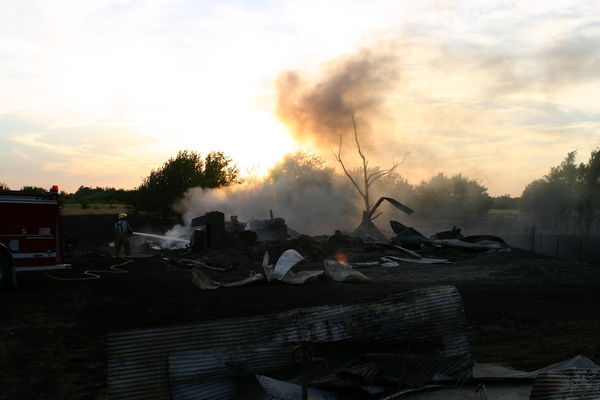
Monday I went out to the farm first thing in the morning. Some areas were still smoldering -- basically wherever there was hay. It was a bit concerning. I went up to the 2nd floor in the house and took some photos of the yard.

I headed on in to work. Later in the evening, I went back out to check on things. Two fire fighters were back out there with a fire truck dousing the remaining smoldering areas. Apparently the fire fighters had been checking on the place intermittently all day and had been out there with water earlier as well.

The Goessel Fire Dept. is an all-volunteer department. These people aren't getting paid for this, and they do an EXCELLENT job. Someone was out at 1AM Monday, again at 10AM Monday, then twice more with the truck. They did all this on their own -- I hadn't asked them to. It is amazing how much these people care about the community and taking care of fires.

I also never knew how long bales of hay burn.

Here's one of the new photos:

1 August 2006

John Goerzen: Asterisk: The Software Phone Company

Issue 13 of Free Software Magazine is out, and it includes my article Asterisk: The Software Phone Company. If you're interested in running your own PBX in software, check it out.

Gunnar Wolf: Israeli mistakes

Reading Jordi's blog, I cannot but agree with him (in most points): I plainly cannot understand Israel's actions in the last weeks. I can sadly understand how some people defend them, specially people not living in Israel - I was talking with a friend today, a friend who does not share a single political viewpoint with me, but still... The world seems to be completely polarized. Some have the impression that Israelis live under constant shelling, that life is unsustainable in that poor country, the last corner of civilization in that mess called the Middle East, and that the Arab countries (which are huge and petroleum-rich) just want to throw Jews to the sea or worse. The rest of the world think that Israelis are mass-murderers who decided to take a heavily populated bit of land and martyrize its originary population by any possible means, establishing an Apartheid.
Both views are false. But of course, both views hold their bits of truth.
I cannot claim to be neutral on this: Although I lived there in total for ~18 months, I am an Israeli by choice (I adopted the Israeli nationality in 1996 and wanted to live my life there - I came back to Mexico for personal reasons, and I later decided to stay here). I have not been to Israel since then - But I try to keep myself informed. And, living in a Jewish family, it's hard not to be somewhat informed - and of course, shocked at your relatives' opinions. Jews outside Israel tend to be right-wingers. I lived in a kibbutz, and I still sympathyze with Meretz, the most leftwing Zionist party.
I won't restate what Jordi eloquently said. I know not everybody who reads my blog reads Jordi's as well - Please do. If you missed it some lines above, here is the link. I insist: I agree with most of what he wrote. What could Israel do to protect itself from its enemies? The answer is simple: Don't give them a reason to hate you.
One year ago, I was optimistic because Israel was heading the right way. Of all people, Ariel Sharon (one of Israel's most hawkish, right-wing strongmen of all times) decided to withdraw from Gaza, and hinted that areas in the West Bank would follow. No, not the best way possible, not as his predecessor Menahem Begin did with Egypt leading to a strong and long lasting peace, and certainly not in the very notable way Itzhak Rabin did with Jordan, getting peace and even friendship. But at least, Sharon accepted the reality, and seemed he meant to let Palestinians build their state. When he organized a new party which reduced Likud to a shadow of its past, one of Israel's most prominent figures for the peace camp, Shimon Peres, joined. Amazing.
But still, there is too much hatred. Of course, life in Gaza is plainly not sustainable. You can walk the Gaza strip side to side in less than one hour, and North to South it's less than 50 Km long. Still, over 400,000 people live in there. The area is simply unsustainable.
Gaza depends for everything from Israel. Of course, according to the never-stable security status, the border between Gaza and Israel opens or closes every day. When I lived in Zikim, mostly every day there were five or six Arabs working with us... Except for the days when they weren't there. And, of course, Israel also depends on the Arabs for much of its hard labor jobs (as it's always the case when two economically disparate populations live together).
Anyway, back on track: Besides giving the Arabs their slice of land (which in a squeezed area as Israel is always hard; people have fought for such small spaces it's hard to believe), the only thing Israel can do is help them. It has worked before: Israeli Arabs (the Arabs living inside the internationally recognized borders of Israel) are full citizens. Yes, there is racism in the country towards them, and yes, they are not really equal with Jewish Israelis - But they have voting rights, they have the right to be elected, they can optionally join the army (it's not compulsory as it is with the Jewish population), and they get government aid. Arab towns are poorer than Jewish towns, yes, but they have their dignity.
The problem in Gaza and South Lebanon (somewhat less so in the West Bank, but also) is that it's plainly all made up of refugee camps. Refugees that were born there, and whose parents were born there as well. And, let me emphasize this, they are not Israel's fault. The refugees fled the newborn Israel because the Arab states said (in May 1948) they would enter Palestine and butcher everybody, inviting Arab civilians to flee and then get back home - of course, 700,000 (out of 1,300,000 who lived in Palestine by then) Arabs did so. And when the Arabs lost the war, the Palestinians were denied citizenship by all the Arab countries except for Jordan (not surprisingly, the most stable of them all, and with which Israel has the closest relation). They were given refugee camps to live, one over the other. When Egypt signed the peace with Israel, it demanded back every inch of the Sinai - But not an inch of Gaza. And not a single Palestinian refugee.
I agree here with Jordi as well: There is a huge military operation in Gaza, but it's more spectacular in Lebanon today. The media talks about Lebanon, but not about Gaza. And the crisis in Gaza is not easier. But how can it be solved in a permanent way? Israel does neither have land to spare to give to the Palestinians - and even if it did, most of Gaza is surrounded by the Negev, a desert where it would not be easy for them to get anything better than what they have inside Gaza. As desirable as it would be to have a completely independent Palestinian state, Gaza would just remain a concentration camp. There is too much hatred, and neither Arabs nor Israelis want to keep working together, not trusting each other. The only solution I can find to this is to have an agreement with Egypt, where Egypt opens its border with Gaza, gives either nationality or work permits to Gazan Palestinians, and Israel injects capital to develop Northern Sinai, to give some hope of survival to the almost half million people.
The same in Lebanon: Israel was widely applauded to withdraw from South Lebanon in 2000. The area is mostly peaceful - For $ DEITY 's sake, what is the kidnapping of two soldiers in a six year period compared to soldiers being killed in the occupation army every week or two? Israel did well to leave Lebanon. Lebanon was starting an incredible national rebuilding process, as Robert Fisk tells us (Spanish only. I could find only the first paragraphs of the original English version, which appears to require subscription) of the wonders of the rebuilding process, reduced to rubble again. Of course, Israeli and Syrian armies left Lebanon. The Lebanese government and army are plainly too weak to care for the country. Hezbollah (which, indoubtely, is a terrorist entity, no matter how many benefical aspects it does have) have poured tremendous amounts of money to rebuild its area of influence, South Lebanon. Of course, they rebuilt, healed and educated with a strong ideological inclination, and that's not good for Israel. What can Israel do to leasen the Islamist influence? Simple: Send aid. Don't just leave. Don't leave a void, don't invite bad people to loot, don't invite extremist people to recruite future bombers. Turn occupation into aid. Build hospitals. Build houses. Give money, give infrastructure. Do it behind your back, as you gave money to the South Lebanon Army for almost 20 years. But make the people see you don't want to kill and rob them - Make the Lebanese Arabs feel their neighbour as a friend, although different. Bring back the good border. What's that? That's the nickname for the Lebanese border between +- 1950 and 1970 - The only border that was stable, that was not filled with hatred, where Israeli doctors treated Lebanese patients across the fence. And still today, the border is just a simple fence.
How can you convince a people of not killing themselves to kill the invasor? Don't act as an invasor. Act in all your best self-interest - Save them from poverty and from indignity.
31 July 2006

Pierre Habouzit: Python transition

You thought that buglist was soon over ? sadly for you, I've tracked (using the Contents.gz of the archive) all the packages that seemed to have private python modules. I've found many that were even not compliant with the previous python policy (and that shiped public extensions btw), and a big lot that need update. I'm way to tired to launch the big mass bug now, because I've worked more than 2 hours straight on that, looking at almost a hundred of packages list files in the eyes, to know if there was a tiiiiiiny python module hidden in there. Still expect it soon Sadly, it does not looks so good: my first list was 265 packages long, I suppose there is a whole bunch of false-positives, but I fear there will remain in the 200 bugs. Though, this is the final step. If you do maintain a package that depends upon python, please help ! Migrating your package to the new policy is often easy if you use debhelper/cdbs/ and other high-level packaging tools.

Erich Schubert: Microsoft PhotoSynth - Vapourware?

Some might have seen the videos of Microsoft PhotoSynth. That of course makes many people go all "ooooh, must, have!". Actually, the videos from University of Washingtons PhotoTour are much more impressive. And it actually tells you how it works. Read the PDF of the paper published at this years SigGRAPH, also linked from that site, for more details. The Microsoft video only shows the UI; while the Washington video gives a bit more information, but still doesn't really talk about the "backend requirements". You can get some facts from the published paper, though. Basically it's a smart combination of existing technologies, together with some good optimization (I guess). It uses SIFT feature extraction and matching (use also by panotools: autopano-sift, but unfortunately this is patent encumbered in the US; I doubt it's patentable in Germany because of it's very mathematic nature) and basically does the same as panorama tools, except in 3D - using "Structure from Motion" approaches. So you might wonder why I still call this vapourware, when there is a sigGRAPH paper backing it, and an interesting demo? Well, in the paper they mentioned their test machine to be a 3.4 GHz computer. And that the Notre Dame photoset took two week to process, and that 597 of the 2635 images were actually placed; the others maybe had too much other stuff on them, or didn't match properly. This yields the impression that for this to work you need
  1. lots of CPU time
  2. lots of well-suited images (clean projection, not too many moving people on it etc.)
  3. no gaps inbetween pictures, but a complete covering
I don't want to talk down the scientific work done here, but the Microsoft annoucement makes it sound (well, just look at who they imply in the video that their users are) like it would be a product for everyone to use within a year. It won't. Thats why I call it vapourware. It's good research, but not a realistic product. It will be very interesting for professionals, however. They can set their camera to a well-behaved angle (no fisheye; I don't expect the software to like fisheye artifacts much) and take tons of photos, trying to cover all of a building. The software will then eventually allow them to construct and texture a 3D model, with some weeks of computation. The viewer is still interesting, for data sets computed by someone with access to excess CPU power. E.g. for a company to offer virtual sightseeing.

Aigars Mahinovs: Spot focus

For a long time I have considered F-Spot to be a nice concept application, but not really fit to be the center of Linux digital photography experience due to general bloat and (most importantly) due to the lack of many important features that would compensate the interface lock in that this application demands. In this post I will try to list all the deficiencies and lacking features of F-Spot that I have found while using it to manage my photo flow.
First let’s talk about the bloat. I will compare F-Spot to GThumb. There are few points of comparison: first start up, viewing a bunch of photos and importing a bunch of photos. When starting up GThumb uses 17 Mb RSS memory (10 of them shared with all other Gnome programs) while F-Spot uses 33 Mb RSS memory (17 of them shared with other Mono programs, of which I do not have any). When viewing a folder with couple hundred photos GThumb uses 25 Mb RSS memory while F-Spot grows to 55 Mb RSS. On import GThumb calls gphoto that adds 3-5 Mb RSS to the memory usage, while F-Spot seems to implement some/most of the photo protocol internally and can easily grow in memory up to the size of the photos being imported (which is kind of problematic while importing a gigabyte of photos), but usually the memory usage on import hangs around 250-300 Mb and hovers around that level for some time after the import is complete. For me personally it does not make much a difference (I have 2 Gb RAM now), but conservative memory usage is still critical for a good Linux application because people expect Linux to be faster and high memory usage can slow down anything. In my opinion no photo management operation should take more then 50 Mb of private RSS memory (even importing several gigs of RAW files from the camera).
Now let me try to describe the optimal work process of a (semi)professional photographer, so that we can see what is missing in F-Spot to accommodate such work-flow and what is done right.
  1. The photographer takes one (or several) cameras, lenses, flashes, memory cars, spare batteries and tripods and goes to an event/photoshoot/modelling session/walk in the park/wedding/…
  2. He takes 3-5 Gb of pictures from lots of different angles with different cameras, different lenses on different memory cards with different settings. Most of them will be the highest quality available on the camera, usually those will be RAW images.
  3. Upon getting back to his computer, the photographer wants to drop all the data to a staging place dedicated to this event. He wants to do it fast and simple without sorting trough the photos at the moment, but at the same time he might want to split the staging areas (multiple models within one session) or join them (one model from different cameras). Sometimes he might not even have time for that and would just want to dump the data now and run to another event.
  4. After several shooting events the photographer finally has reserved the time to sift trough some of the photos from the staging area (modelling jobs first, then the friends wedding and the walk in the park as last)
  5. First the photographer decides to check if the times on the photographs are correct and discovers that at some shooting sessions one of the cameras was set to another timezone. He select all shots from that camera across several (but not all) staging areas and adjusts the time.
  6. Now he rechecks the logical groups of photos (which photos should be in which staging area) by dragging the photos around, splitting and joining the staging areas
  7. When the overall structure is clear, the photographer selects one (most important) staging area and starts working with images in that staging area not caring about any other images
  8. First he browses in full screen trough all the photos rating them in quality scores form 1 to 9 by pressing corresponding number keys. Rating a picture automatically advances to the next picture, which happens very fast because the software precaches several photos ahead for speed and displays without any flicker. Speeds in the order of 2 photos per second are expected on good enough hardware. One key operations for “view 100% zoom”, “rotate”, “view exif” and “quick note” are available. RAW images are automatically translated for preview with default settings.
  9. With couple clicks bad photos (with score of 4 or under) are selected and erased
  10. Now the photographer starts working with individual photos
  11. First step is the RAW->Jpeg conversion. An appropriate tool is brought up with default setting already applied and a preview of the photo showing up (like in dcraw). The photographer adjusts the conversion parameters (including and option to make a HDR-like effect by compressing the dynamic range of high bitness pictures). The converted Jpeg is saved as a version of the original photo and becomes the default for operations that do not understand RAW.
  12. A separate plugin is used to reduce digital photo noise from the pictures (new version)
  13. Photographer makes adjustments to the image inside F-Spot. Each modification makes a new version.
  14. Still not satisfied, the photographer starts Gimp from inside F-Spot and make further edits. Each time Gimp saves the file, F-Spot makes another version.
  15. The photographer erases some versions of the picture and also joins multiple near-duplicate shots into one picture as versions of that picture. One version is always marked as the top version and the photographer can easily change it.
  16. The good photos are tagged and imported to the main collection
  17. A subset of the photos is exported to: Flickr, personal Gallery installation, plain html photo album, a zip file with small (1024x…) versions of the photos, … Only the top versions of photos are exported. If unconverted RAWs are top versions, then they are converted to Jpeg with default settings. In most cases photos are also downsized before export according to the preferences. Highest quality downsizing is used (anti-aliasing) and also additionally small unsharp mask is run on each photo
  18. The photographer does advanced searches and advanced tag selections to select and display or export subsets of his main collection
  19. The photographer has three instances of F-Spot: his laptop, his main work PC and a backup hard drive that can be attached to either of them. He needs to keep his F-Spot photographs synchronised between the three locations for backups and for distributed work. Also after some point the main photo archive becomes too big to store it (with all versions) on the laptop or even on the main PC, so the photographer selects a set of older photos and selects an option to archive them. The next time a connection is established with the backup drive, all versions of archived photos are copied to the backup harddrive and the laptop and the main PC only keep 90% quality Jpeg format picture of the top version of each photo downsized to exactly fit the display resolution of the device. If even that takes too much space then “Archive Only” option is selected which insures that the backup harddrive has the copy of the photo and then erases it from primary data stores completely.
  20. When the backup harddrive is connected it is also very simple to make DVD/HDDVD/Blueray backup copies of subsets of photos from the archive with all the metadata and versions in such a way that other software (and even dedicated media devices) could easily browse the top versions of photos directly from the backup media. Of course, restoring from such backups also must be tested.
So, to summarise, the changes needed for F-Spot are: As you can see, many of those issues are already reported to F-Spot bugzilla, but have recieved little attention. So what shall we do about it?

Erich Schubert: Most of web 2.0 is not web 2.0

Have you noticed, that most of the web 2.0 "sites" aren't really worth being called "web 2.0"? Take for example friendster. Many people say that friendster is a web 2.0 thing. Sure, it's using Ajax. But apart from that? Where's the open API? Where is remixing? What is it really different from, lets say, geocities with the addition of some easier linking and search functionality (read: "social networking") And seriously, the profile pages there suck just as bad as the homepages people made with geocities. Especially social networking pages tend to sit on their data and keep it closed. No FOAF files available. That's so web 1.0ish... the web 2.0 is a lot about APIs and open data access. Can you imagine a blogging service not offering syndication (e.g. RSS)? So why a social networking without FOAF? One of the few "true web 2.0 services" remains Google Maps. Even though it doesn't have tag clouds or social networking. ;-) But Mashups adding all that. We should rename the term to "Web 2.0 beta" anyway. It's not released yet. Or use the proper term for it: "DotCom 2.0" Or we should just stop using it, because it's all marketing buzz. Talk about open APIs, remixing, mashups, semantic web, syndication, tagging instead. [Update: web 2.0 is officially just "beta" - see for yourself. It ain't a true web2.0 logo if it doesn't contain "beta"... - also check out this huge list of web 2.0 logo mockups for known brands, including FedExr, McDndld's and of course S.NY beta...]

Biella Coleman: South African Plug Adapters

I am in the airport in Amsterdam on my way home to the US after a pretty decent nights sleep on the KLM from South Africa. This trip has been simply amazing, probably because I was taken around by locals, most of them who are U of C anthro students or graduate, all of them from South Africa. I have already started to write a few entries but will finish them when I get back. In the meantime, since I started the trip with an entry about an adapter, here is some more information on them. When I was researching the type of adapter needed for South Africa, much of the information on the web indicated that while South Africa took the M plug, one could get by with the British adapter as that is quite common here. I have to say that I never saw that type of plug at all… There seems to be one and only one type of plug so if you do come here, do purchase the South Africa-specific adapter.

Andrew Pollock: [life] Lady in the Water

Tonight Sarah and I went to see Lady in the Water with Sean and Louise. Best. M. Night Syhamalan movie. Ever. Sarah and I (and I think Sean and Louise) are big fans of Night's work. This movie made a much more pointed excursion into the fantastic, but remained (for me) absolutely rivetting, right through to the end. Shyamalan makes much less of a cameo appearance, and is more of a supporting actor in this one, and there are his usual plot subtleties littered throughout. I also want to see 5 out of 6 of the trailers that preceded: If you're looking for me in November/December, I'll be at the movies.

John Goerzen: Fire

I never thought I'd be writing a post like this today.

As Terah mentioned already, there was a fire out at our farm today. We lost both barns and the chicken house. Several acres of mostly grass burned in all.

It's hard to see those buildings gone. There was so much history and so many memories in them. And that loss isn't just ours; so many people have fond memories from out there.

Before I go on, I've posted a few very preliminary photos. I haven't even downloaded all of them from the camera yet. Here's how our yard looks:


We're sad about this, but there's a lot to be thankful for. There are so many ways that this could have been worse. If the firefighters had been a few minutes later to the scene, we probably would have lost the only remaining buildings -- house, wash house, and elevator -- as well. The fire was starting to burn a hedge row from two sides. It got within a few feet of the house.

Somebody driving through the country noticed the fire and called it in. That in itself is fortunate, because people don't just drive through this part of the country all that often.

We're very fortunate to have such a wonderful and loving family. The people from the Goessel Volunteer Fire Department spent 7 hours of their evening out there, part of it in 100-degree heat. (The Walton Fire Dept. also responded -- I don't know how long they were there). Even our insurance agent (one of the barns was insured) came out -- and he didn't have to.

We hope that we'll get enough insurance money to let us rebuild something in the same style as the original barn.

And, most importantly, nobody got hurt.

But somehow, despite all these things, it still feels like we lost a little bit of Grandpa today.

Ian Murdock: Two-way email synchronization without Blackberry Enterprise Server?

I’ve been thinking a lot about software above the level of a single device lately, so I set out this weekend to finally get two-way email synchronization working on my Blackberry. My main goal is to have a single inbox I can access from multiple devices without having to ever deal with the same message twice (i.e., if the message is read/filed/deleted/etc. on one client, it’s marked read/filed/deleted/etc. on all clients), with full support for disconnected operation. (I care much less about the oft ballyhooed push email feature—I’m perfectly content to wait 15-20 minutes for email to be delivered.) Since what I want more or less perfectly describes IMAP, I figured Blackberry Internet Service, which uses standard Internet protocols for mail delivery and supports IMAP, would be sufficient, and that I wouldn’t need Blackberry Enterprise Server, which hooks into Exchange and other “enterprise” messaging systems. Unfortunately, I appear to have been wrong. While messages read and deleted on the Blackberry are reflected on the IMAP server, the reverse is, surprisingly, not true (surprisingly because, unlike POP, which behaves similarly in BIS, IMAP is a bidirectional protocol). In other words, when messages are read or deleted on another client (e.g., the Thunderbird running on my laptop), those changes aren’t reflected on the Blackberry; so, as a result, the Blackberry accumulates every message I receive when it’s not in use, making a periodic “Delete Prior” necessary to get rid of all the accumulated junk (which obviously deletes the useful messages too, like, ahem, the ones with my flight information in it). Worst of all, after several days of trying to figure out why IMAP wasn’t working the way I was expecting it to, I discovered this is the expected behavior (see note 5—”Messages deleted from the source mailbox are not automatically deleted from the device”), rather than a bug. What to do? I could obviously break down and upgrade to Blackberry Enterprise Server. I’m not too keen on setting up an Exchange server just for this (which would cost hundreds of dollars, particularly after the cascading upgrades typical of Microsoft products, e.g., I’d need to get Windows Server too). As an alternative, there appear to be a number of companies that offer a BES hosting service. However, the costs add up pretty quickly—another $10/mo. to T-Mobile to allow BES traffic through (the “business tax”), $10/mo. for BES hosting, and $10-15/mo. for Exchange hosting on top of that (BES hosting is an add-on to Exchange hosting in every plan I’ve seen). That’s a grand total of $35/mo. just to get email marked read or deleted on my Blackberry when I read or delete it in Thunderbird. Hrmmph. Another idea is to find a Blackberry IMAP client, but there seem to be a dearth of these. The main one that comes up both in web searches and that’s described in Blackberry Hacks is from a company called Reqwireless which, tantalizingly, was acquired by Google last year but whose products, frustratingly, are no longer available. In any event, I want something that integrates with the Blackberry’s excellent inbox, which aggregates email, SMS, missed calls, Google Talk messages, etc. in a single stream, and I’m not sure if a separate IMAP client will be able to do that. Other observations: This page says that “two-way [Blackberry] sync is coming soon” to Yahoo Mail. However, “coming soon” doesn’t really help me. Funambol looks very promising, but it’s going to take me a little while to wrap my head around what exactly I need to do to deploy it. Not exactly point and click. Scalix offers Scalix Wireless Solution that works with Blackberry and is integrated with the Enterprise and Small Business Editions. At $60/user with no minimum number of users and a free trial, this looks promising too. Zimbra offers Zimbra Mobile, which “includes the ability to leverage Zimbra’s third party mobile partners that offer two-way sync to Blackberry and other devices” (whatever that means). However, I’m assuming this comes bundled with the Network Edition, which is sold with a minimum of 25 users, and that probably makes it unaffordable to an individual user like me. Any other suggestions?

30 July 2006

Daniel Burrows: People suck, news at 11

Continuing the saga of the lost wallet, it turns out that my uneasy premonitions about "Sidney"'s phone message were entirely correct.

He called me up at work, gave me a long spiel about how I should be glad he came from such a "respectful" family, mentioned that "someone" had gone through the wallet and taken the cash, and then asked again if there was a reward. Rude, I thought, but hey, rewards for wallets aren't unheard-of and he is doing me a favor...so I said, sure, I'll give you $20. There was a long pause, and then he said "that's really insulting, you know?" Taken aback, I asked what he was thinking of, and he said that he was thinking of more like a few hundred dollars.

A FEW F**ING HUNDRED DOLLARS?

That isn't quite what I said, I just said "No" and "I don't know what makes you think that's a reasonable amount." At this point he started asking again about "don't you want your wallet back?" and making vague threats about what would happen if it got into the "wrong" hands. I made one mistake, raising my bid to $40 (I shoulda just cut him off there), but finally told him I had to get off and get to work. He wouldn't give me a number to contact him at but said he'd call me later.

So, at this point it was obvious that a pretty nasty character had my wallet, so I double-checked that all my important cards were cancelled and started ordering duplicates of the remaining ones. I called my apartment manager (since my provisional license had my home address on it) and warned them to keep an eye out for suspicious people hanging around my apartment, just in case.

I did try calling the police; however, they were just as useless as you'd expect (considering I didn't know how to get in touch with the wannabe extortionist). The only thing they could suggest was that I try making arrangements to collect the wallet, then arrange to have a police officer arrest the guy when he showed up. Given the fact that I have no actual evidence of the extortion, though, I figured the main result would be to leave someone that I already know is a bad character, and who has my personal information and address, a grudge to hold against me. Not a good long-term move.

What depresses me most about all this is that "Sidney" is far more representative of the average person than I am, or (I assume) most readers of my blog; and he may very well be better adapted to the world than I am. People suck, life sucks, and the world sucks; I should be grown-up enough at age 25 to not care by now, but I still do. :-(

28 July 2006

Erich Schubert: On Amazon book scanning

Today was the first time I clicked on these buttons in Amazon that allow you to look at a few pages of a book. That is some Ajax application (which of course warned me first with some fancy schmancy Ajax popup, fading the window etc. that they only support Firefox, IE etc., ignoring the fact that Epiphanys rendering engine is, well, the same as Firefoxs'. I actually clicked the Ok button twice before it finally closed...) Anyway, what I want to share with you is a screenshot of some malfunction: Amazon look-inside disfunction So apparently they scanned the page word-by-word; often clipping the lower part (notice the missing parts of the p, g, y letters in most words). Some words have gone missing altogether (before "life"). However, the page appears to be a Jpeg image; you can see some compression artifacts around the words that are not my fault (you might need to zoom the image). So it seems like they disassemble the pages when scanning, then reassemble them to present them to the user. Sometimes messing up the background color, like in this example... interesting. Is there much data storage to be saved by merging word images and storing them only once? Are they reassembled on-demand?

Evan Prodromou: 10 Thermidor CCXIV

I've really enjoyed reading the recent writings of Joseph Reagle on Wikipedia and online communities. Somebody sent me his Notions of Openness essay. I think it's an excellent complement to Jonathan Nolen's Open Company Test for those of us who are working in the Open Source/Open Content/Open Communities nexus. Anyways, Joseph Reagle's blog is a good read if you're interested in the WP and sociology of wiki and Open Content. I note that he quotes and references Biella Coleman's great work on Debian; I think it's pretty cool that this field of study is expanding. Joseph will be giving a talk titled Is Wikipedia Neutral?'' at Wikimania; I'm looking forward to it. tags:

Next.

Previous.