Search Results: "cas"

1 January 2007

David Welton: One Year of Rails, on_idle plugin

I've been using Rails for about a year, and I am, in general, quite satisfied. It really is a big step forward in terms of web programming, and I've found the whole experience very enjoyable. In a year I've managed to crank out a number of sites in my spare time (in between various other activities such as the occasional bike ride and Hecl hacking): As promised, one of my goals is to shift a bit towards producing open source software as a side effect of revenue generating work. The first small result of that is the on_idle plugin I packaged up for Rails. It's the code that Stuff To Do uses to tell whether people are active or not. Installing it should be as simple as:
./script/plugin install http://svn.dedasys.com/public/on_idle
It's just a few lines of Javascript code that are wrapped up in a way that makes it trivial to use from Rails views:
def on_idle(timeout, options, wakeoptions)
<%= on_idle(600,  :url =>   :action => 'notify_idle'  ,
                  :url =>   :action => 'notify_wake'  ) %>
Let me know if there is anything I should fix/change/improve. If this plugin works out, I will post, in short order, a plugin that improves the default Rails drag and drop functionality.

Russell Coker: free software liason?

In my previous work as a sys-admin I have worked for a number of companies that depend heavily on free software. If you use a commercially supported distribution such as Red Hat Enterprise Linux then you get high quality technical support (much higher than you expect from closed-source companies), but this still doesn't provide as much as you might desire as it is reactive support (once you notice a problem you report it). Red Hat has a Technical Account Manager offering that provides a higher level of support and there is also a Professional Services organization that can provide customised versions of the software. But the TAM and GPS offerings are mostly aimed at the larger customers (they are quite expensive).

It seems to me that a viable option for companies with smaller budgets is to have an employee dedicated to enhancing free software and getting changes accepted upstream. For a company that has a team of 5+ sys-admins the cost of a developer dedicated to such software development tasks should be saved many times over by the greater productivity of the sys-admins and the greater reliability of the servers.

This is not to criticise commercial offerings such as Red Hat's TAM and GPS services, a dedicated free software developer could work with the Red Hat TAM and GPS people thus allowing the company to get the most value for money from the Red Hat consultants.

If using a free distribution such as Debian the case for a dedicated liason with the free software community is even stronger, as there is no formal support organization that compares to the Red Hat support (there are a variety of small companies that provide commercial support, but I am not aware of a 24*7 help desk or anything similar). If you have someone employed full-time as a free software developer then they can provide most of your support. It would probably make sense for a company that has mission critical servers running Debian to employ a Debian developer, a large number of Debian developers already work as sys-admins and finding one who is looking for a new job should not be difficult. There are more companies that would benefit from having DDs as employees than there are DDs, this isn't an obstacle to hiring them as most hiring managers don't realise the technical issues involved.

This is not to say that a company which can't hire a DD should use a different distribution, merely that their operations will not be as efficient as they might be.

Clint Adams: Do you realize that happiness makes you cry?

I left a good part of my childhood in a hotel room with a pretty girl in the bed. I left the place of hug fantasies and skated past whiteness, where snow became indistinguishable from clouds. A religious experience is coursing through my veins, seeded amongst overpriced cashews and condiments with special names, but blossoming hours into the future, for I am in the future now. Oddly, I've got a Heart song stuck in my head.

30 December 2006

David Nusinow: Communities

I spent some time playing with haskell over the past month or so. One of the most incredible things about it is the wonderful community that has sprung up around the language. The haskell homepage is a treasure trove of information, excited users throw all sorts of new articles at reddit every day, and the #haskell channel is exactly what you want out of an irc channel. A nice bonus for Debian types is the incredibly close ties the haskell community has with our distro.

Comparing this to Debian is instructive. The haskell community seems to be having a ton of fun using their language. The sense in #debian, or from whatever Debian tutorials I read, is that people aren't using their system to have fun any more. The air of joy and occasional whimsy that traces its way through #haskell (and also very strongly through the ruby community) seems to be somewhat surpressed in Debian, as though we're so big and cool and technically competent that we don't have time for frivolity. It's hard to have fun and create a warm and inviting community with this kind of attitude. Turf wars, protocol, and politics only compound the problem.

Doing something fun for its own sake should be a part of the Debian experience the same way that it's inherently part of the free software experience. It's way too easy to lose that in the mountain of packages, emails, and bug reports. Using Debian makes me happy, and I want to try and let that spirit out to play a little more.

Wouter Verhelst: f-spot vs digiKam

Since I have been having a digital camera since a few weeks now, I've had a need for an application to manage my pictures. The two applications that people have pointed me to are f-spot and digiKam, which also seem to be the most popular applications in this category for Linux. Since I use neither KDE nor GNOME as my user interface, it doesn't matter much to me which I install; so I've tried them both. Their feature set is quite different; unfortunately, though, they both have some features which the other doesn't, which makes choosing for one or the other rather hard. Since their on-disk format is rather different, it's impossible to use them both at the same time—at least not if I don't want to enter commentary and tags each and every time; so I'll have to choose one or the other based on their features. Since that requires me to actually compare them, I thought I might as well make a blog post out of that. Note, though, that this comparison is in no way intended to be complete; it only compares those features which I really care about. Features digiKam F-spot My opinion After having used f-spot for a few weeks before I tried digiKam, I have to be honest and say that I don't like the concept of albums. They do not add value; everything they allow you to express can equally well be expressed with tags. Additionally, one can categorize a picture in only one album, whereas it's possible to categorize pictures in as many tags as you would want. Just creating one album which contains all my pictures, with tagging used for categorizing, doesn't help either; that way, digiKam would store all my pictures in a single flat directory, which would become problematic when the number in the picture filenames wraps around. I do love the scoring thing in digiKam. A favourites tag just doesn't cut it; and creating five tags for scoring would make things like find all pictures that have a score of three or above rather cumbersome, and sort by score outright impossible. However, the fact that it's not possible to filter by score makes it all rather useless. The export to gallery function in digiKam is horrible. I have to select my pictures blindly; none of the metadata which I tack on them can be used to help select which pictures I want. Workaround: use whatever filtering is available to select the right pictures and add them to a temporary album from which I then upload all pictures, but that's silly (and requires disk space for no good reason). Additionally, there seems to be a bug in the interface, which means that I have to babysit an upload (with no workaround). And I can't even view my pictures to spend the time waiting. Bah. F-spot isn't without problems of its own. Due to a bug in mono, it crashes rather often on my PowerPC laptop. When that happens, it can't be restarted until the X server is restarted. Workaround: use Xnest, but that makes it impossible to view pictures in full-screen mode. Also, since f-spot is a GNOME application, its options dialog is as helpful as a pair of soccer shoes when you're out swimming. No surprises there. Conclusion Which one do I prefer? I'm not sure. The digiKam upload interface is positively annoying, especially the bug which requires me to click continue after every picture. For that alone, I might ditch it. On the other hand, it has a slew of interesting features (the scoring, to name one) that f-spot lacks, and that pull me more towards digiKam. I guess I'll have to give it a few days of thought. But hey, at least I know where I stand now.
David Welton: Stuff To Do

Regarding my previous posting, the first thing that I wanted to release is called "Stuff To Do", and is a simple, elegant priority queue for getting things done. It lets you reprioritize, track time spent on tasks, generate reports on time spent, and most importantly, share with other users. You can create groups of people who can view one another's tasks, and give tasks to other users, all via a very intuitive interface (javascript is, however, required). It's all meant to stay out of your way as much as possible, even the time tracking requires only that you visit the browser window every so often to let it know you're there, rather than fiddling with (and sooner or later forgetting about) start and stop buttons. Perhaps it's not accurate down to the second, but the idea is to give you a general idea of what you've been up to, rather than something you have to slavishly click on all the time. The group interface is also meant to be easy to use to get a quick idea of what other people are working on, or share tasks with other people. For instance, if you're a project manager, you could create a bunch of tasks, and then just drag and drop them to other people in the system. You can't change other people's priorities (yet), because I think it's better if you simply ask them yourself - technology isn't a substitute for communication! While I work on the paypal interface (I looked into Google Checkout, but it's still got some limitations), I'm going to let people sign up for the group-enabled version with six months for free. It won't cost too much per user when I roll it out in any case, probably somewhere south of $20. The basic version is likely to remain free as long as I can cover hosting costs. I've been using it myself at work and home for the past month or so, along with a few of my colleagues, and it seems to fill a nice niche in between more heavyweight issue tracking tools like JIRA, and the index cards/bulletin board we'd been using. Check it out - I hope you like it! In any case, let me know what you think.

29 December 2006

Evan Prodromou: 8 Niv se CCXV

We had a great day on the coast yesterday, just the three of us -- Maj, me, and Amita June. We drove over Highway 92 from my parents' place in Los Altos Hills, a pretty steep and winding highway, down to Half Moon Bay on the peninsula's coastline. We were going to head up to Montara Beach, one of my favorite places in the Bay Area, but it's a bit of a drive and we had plans to be back in Mountain View for dinner. So instead we turned off at the nearest coastal access -- Venice Beach, right in HMB -- and parked for a little beach time. Unfortunately, the strong winds and storms that we've had in the Bay Area this week have also caused higher-than-normal surf. We couldn't actually get to the beach from our parking lot -- Frenchman's Creek was blocking the staircase down to the sand. We think it might have been diverted by the high surf and winds. Anyways, we had to walk about 20 minutes out of the way to actually get down to the beach. Which was, of course, fantastic. I don't think there's anything quite like a Costanoan beach on a December day. The Bay Area's Pacific coast is quite unfairly ignored by most visitors, but a drive down scenic Highway 1 from SF to Santa Cruz can give a really good idea of what most of coastal Northern California is like -- from Santa Barbara up to Eureka. Venice Beach has nice yellow sand, Amita June loved running through the sand in bare feet. We chased seagulls (Amita tried to talk chicken-language to them: "bok bok bok!") and kicked around a soccer ball we'd brought. The surf has been exceptionally high, and it was probably pretty reckless to do, but the tide was going out, so we took off our shoes and dipped our feet in at the top of the sand. Amita loved seeing the waves come in, and running away when they got close. After a lot of playing and a little bit of a tantrum when we decided to leave, we all headed to lunch at the Distillery in Moss Beach. The Distillery is a California historical site -- an old speakeasy, built on the peninsula's coast in the 1920s when Canadian rum-runners would drop off their wares under these remote cliffs. It's kind of hard to find -- down some teensy residential streets on the ocean cliffs -- but it's a local landmark. The view was excellent and the food was great -- I had a big tub of steamers, and Maj had a really good plate of seaweed-wrapped prawns. The only problem was the wait -- we got there just as the lunch rush was starting, and didn't leave until after 3PM. That would have been nice for a romantic lunch for two, but with a one-year-old you're on a pretty tight schedule. Back over the Coast Range and down again to the introspective Bay, we took long naps then headed over to brother Andy's house for turkey soup and some family time. I dunno if there's any kind of tired like sun-and-wind tired from the beach. tags:

Ian Murdock

Phil Wainewright: “The idea, by the way, that users are going to keep their own private backup somewhere else, as Google’s PR rep suggested in an email to TechCrunch, is patently absurd. The whole point of storing email in the cloud, surely, is to avoid having to download hundreds of megabytes to your hard disk every night just in case the service falls over.”

Adrian von Bidder: Email disclaimers

Russel pointed me to Andre Pang's blog entry.  Yep, I share this annoyance.  Especially because I recently received an email with a 3 or 4 line disclaimer at the top of the email, and an additional, longer one at the bottom.  Occasionally, I use that one:
The content of this message may or may not reflect the opinion of me, my
employer, my girlfriend, my cat or anybody else, regardless of the fact
whether such an employer, girlfriend, cat, or anybody else exists.  I
(or my employer, girlfriend, cat or whoever) disclaim any legal
obligations resulting from the above message.  You, as the reader of
this message, may or may not have the permission to redistribute this
message as a whole or in parts, verbatim or in modified form, or to
distribute any message at all.
(Daniel Baumann: Please note the spaces I've added in this post, extra for you!)

Jonathan McDowell: Ubuntu on the Advent 8111

Katherine's father bought her mother a laptop for Christmas. I am ashamed to admit that although I was responsible for the specification it was purchased from PC World. There is a lack of shops in Northern Ireland where you can walk in and purchase a reasonably cheap laptop unfortunately. The model we ended up with was an Advent 8111 (Dixons link as it's saner than the PC World one). It's not actually a bad spec; Core Duo 1.6GHz, 1GB RAM, 80GB HD, wireless/ethernet/modem, 15.4" 1280x800 widescreen TFT. I think it claims up to 3 hours battery life and I certainly had 2+ out of it though not under heavy use. I decided that it was getting Linux; Katherine's mum isn't used to any form of computer so there are no preconceptions about Windows to get over. While I'm a Debian person myself I felt it was time to give Ubuntu a chance; mjg59 (and others I'm sure) has spent a lot of time trying to get it happy on laptops and make sure things Just Work. I didn't have a lot of time to sit fiddling with the setup, so a shiny out-of-the-box distro seemed ideal. I downloaded ubuntu-6.10-desktop-i386.iso and burnt myself a CD. Dropped it in the drive and it booted into the live CD installer fine. The install process was simple and it managed to resize the Windows partition without problems (I would have deleted it but I couldn't convince the Windows rescue CD creator to work and I don't want to burn my bridges until I'm sure Linux works out ok for the owner). Rebooting into the freshly installed system I was surprised at the time the boot process took. It certainly felt a lot longer than it takes my (lower speced) laptop to boot to a GDM prompt under Debian. Also the display looked a bit fuzzy. Further investigation led to the discovery that although X correctly detected a panel size of 1280x800 it was only using 1024x768. Much searching found me i915resolution which did some magic that made things work. However this doesn't appear to be part of Ubuntu proper so I'm not sure if was the correct solution or if I should have done something else? Getting to the point where I could download i915resolution was interesting too. My parents have a WEP encrypted wireless network (to prevent casual use rather than because it's secure). I was expecting Ubuntu (which detected the Intel wireless card fine) to pop up some sort of dialog saying it had found a network and would I like to connect (if I provided the key). Something network-managery. But no. Even when I went to the network control panel and added all the details the connection didn't seem to come up. I gave up and did it manually with iwconfig and dhclient (I needed it to work quickly and at present it won't need wireless usually). Once I had the display working happily my other task was to tame the modem. It's an Intel HDA thing and I'd hoped sl-modem-daemon would drive it. Of course it didn't. Although it's an Intel chipset it has a bloody Conexant codec on it. Which of course there are no free or Free drivers for. I ended up trying the trial Linuxant driver, which did work fine at 14.4k, but that's really painful so I gave up and paid for the full version. I'd really rather have voted with my feet and ended up with some proper modem hardware, but it would have been an extra set of wires and cost more. I hate Conexant. Anyway, the drivers work (though seem to break sound; I haven't had enough time to prod this and the modem is much more important to have working). Hopefully in time I'll convince them they really want ADSL, but at present I think it would be quite hard as they don't have a high expected use. Once the modem was working I needed an easy way to dial up. I started playing with modem monitor, which had been installed by default. However I just couldn't figure out how to get it to allow me to dialup and dial down - the activate/disable options stayed greyed out. So I installed GNOME PPP which seems to work fine and be easy enough to drive - put a nice link to it on the desktop and stored all the details so it's a double click to launch and then a click of the "Connect" button. My final issue was that once I actually took the laptop to Katherine's house to show her mum how to use it it started hanging on boot. Booting into recovery mode showed a soft lockup error message around the point where it was setting up the network interfaces. I think this might have had something to do with me hitting the wireless kill switch (no point having it on when there's no wireless in the house), as disabling the device in the BIOS made the problem go away. I didn't have enough time to do a fully exhaustive check, but will look at it in the future. I wait with interest to see how use of the laptop goes. Expected usage to being with is mainly web and email (provided by the Ubuntu defaults of Firefox and Evolution) so hopefully it shouldn't be too problematic now I've fought the install process. I was really quite surprised at the problems I encountered (well, aside from the modem drivers); I'd expected a much smoother install that would leave me with everything working fine out of the box. I haven't yet filed any bugs or done more investigation - I only had about a day to setup the machine so couldn't prod it more just yet. I will of course try to do so when I get a free moment, but if I missed some obvious stuff please do point it out to me! (As if you wouldn't...) Oh, and here's some lspci output for anyone interested in some more details about the laptop:
00:00.0 Host bridge: Intel Corporation Mobile 945GM/PM/GMS/940GML and 945GT Express Memory Controller Hub (rev 03)
00:02.0 VGA compatible controller: Intel Corporation Mobile 945GM/GMS/940GML Express Integrated Graphics Controller (rev 03) (prog-if 00 [VGA])
00:02.1 Display controller: Intel Corporation Mobile 945GM/GMS/940GML Express Integrated Graphics Controller (rev 03)
00:1b.0 Audio device: Intel Corporation 82801G (ICH7 Family) High Definition Audio Controller (rev 02)
00:1c.0 PCI bridge: Intel Corporation 82801G (ICH7 Family) PCI Express Port 1 (rev 02) (prog-if 00 [Normal decode])
00:1c.1 PCI bridge: Intel Corporation 82801G (ICH7 Family) PCI Express Port 2 (rev 02) (prog-if 00 [Normal decode])
00:1c.2 PCI bridge: Intel Corporation 82801G (ICH7 Family) PCI Express Port 3 (rev 02) (prog-if 00 [Normal decode])
00:1d.0 USB Controller: Intel Corporation 82801G (ICH7 Family) USB UHCI #1 (rev 02) (prog-if 00 [UHCI])
00:1d.1 USB Controller: Intel Corporation 82801G (ICH7 Family) USB UHCI #2 (rev 02) (prog-if 00 [UHCI])
00:1d.2 USB Controller: Intel Corporation 82801G (ICH7 Family) USB UHCI #3 (rev 02) (prog-if 00 [UHCI])
00:1d.3 USB Controller: Intel Corporation 82801G (ICH7 Family) USB UHCI #4 (rev 02) (prog-if 00 [UHCI])
00:1d.7 USB Controller: Intel Corporation 82801G (ICH7 Family) USB2 EHCI Controller (rev 02) (prog-if 20 [EHCI])
00:1e.0 PCI bridge: Intel Corporation 82801 Mobile PCI Bridge (rev e2) (prog-if 01 [Subtractive decode])
00:1f.0 ISA bridge: Intel Corporation 82801GBM (ICH7-M) LPC Interface Bridge (rev 02)
00:1f.2 IDE interface: Intel Corporation 82801GBM/GHM (ICH7 Family) Serial ATA Storage Controller IDE (rev 02) (prog-if 80 [Master])
00:1f.3 SMBus: Intel Corporation 82801G (ICH7 Family) SMBus Controller (rev 02)
02:00.0 Network controller: Intel Corporation PRO/Wireless 3945ABG Network Connection (rev 02)
04:00.0 Ethernet controller: Marvell Technology Group Ltd. 88E8055 PCI-E Gigabit Ethernet Controller (rev 10)
05:01.0 CardBus bridge: Texas Instruments Unknown device 8039
05:01.1 FireWire (IEEE 1394): Texas Instruments Unknown device 803a (prog-if 10 [OHCI])
05:01.2 Mass storage controller: Texas Instruments Unknown device 803b
05:01.3 Class 0805: Texas Instruments Unknown device 803c (prog-if 01)

Russell Coker: source dump blog

Inspired by Julien Goodwin's post I created a new blog for myself named Source Dump. Source is different to other blog content in that updates to fix bugs may be required (generally I believe that ideally blog posts should not be edited once published and in the rare cases of editing being necessary all such edits should be appended to the end), and in that it may be longer than is suitable for a Planet feed. Finally Planet and other aggregators may mess up source code. If the source is only visible through my blog then I can be reasonably sure that it is usable by everyone who sees it.

So when I have source code to publish that is related to blog postings or mailing list postings I now have a place for it (I haven't yet made a posting).

I will not be submitting my Source Dump blog for syndication anywhere, but if anyone wants to syndicate it they are welcome to do so. I don't desire that it not be syndicated, I merely recommend that it not be syndicated for the convenience of readers due to the potential large size of postings and the potential for postings to be broken by aggregation.

Russell Coker: music for children

Adam Rosi-Kessel made an interesting post about They Might Be Giants producing children's music because their original fan base are now old enough to have children.

From casual inspection of the crowds at events such as Linux Conf AU it seems to me that many serious Linux people are also at the right age to have young children, and several blogs that are syndicated on Linux Planets provide evidence of this. Therefore it seems that there is a market for Linux related children's music.

Many aspiring artists complain about the difficulty of establishing a reputation. I think that if someone was to release OGG and FLAC recordings of a children's version of the Free Software Song under a Creative Commons license then they would get some immediate publicity through the blog space and Linux conferences which could then be used to drive commercial sales of children's music.

While on the topic, it would be good to have a set of children's songs and nursery rhymes to teach children from a young age about the community standards that we share in the Free Software community. There is no shortage of propaganda that opposes our community standards, the idea that sharing all music and software is a crime is being widely promoted to children.

28 December 2006

David Welton: OFBiz officially joins the ASF

As of this writing, the DNS/infrastructure hasn't quite caught up, but ofbiz.apache.org ought to be live soon. "Apache Open For Business", aka OFBiz, has been promoted out of the incubator (the term the ASF uses for projects hoping to become full-fledged ASF projects) to its own top level project. As J Aaron Farr mentions, they managed most everything on their own, and were a project that wouldn't have looked out of place as part of the ASF even from the beginning of the incubation period, which made my job as a "mentor" pretty easy. What will be interesting is to track the project going forward. It has tremendous potential, because it focuses very much on providing not only the low level tools (which is still where most open source is), but also on creating good business models and processes, which is relatively newer terrain in the open source world. I think they face a couple of important challenges. First and foremost, a way to lower the barrier to entry. OFBiz is a big collection of code that in some ways tends to stand alone compared to the "mainstream" in that it uses its own tools in terms of the framework. Also, since it encompasses so much, it's a lot to come to terms with when you get started. This means that the initial step of the "learning curve" is pretty high, and I imagine that a lot of people stumble. Clearly, it's not a simple application, but I think efforts to make it more approachable will pay off in terms of attracting more users (and eventually, developers). The broader challenge is simply the fact that in some ways, this is uncharted territory for free software, so it remains to be seen what sort of "ecosystem" (if you'll pardon the buzzword) grows up around it. For instance, at this point in time, no one, least of all the core developers, sees it as a program that you simply download and run, but rather as a place to start from for integrators and developers who mould the code to fit the needs of the particular firm adopting it. That's working right now, but perhaps at some point it will be more of an out of the box system. Or maybe not - attempting to make it work well for a vague 'everyone' might just be chasing taillights and prove ultimately fruitless. Unfortunately, I still haven't had the opportunity to use it "in anger", as they say, so I don't have much to say about it technically, but from a business point of view, I really like their data model, and the system of processes they've put together, which allows you to capture a great deal of use cases in a very flexible way, which is no mean feat. In any case, a big round of congratulations to the core developers, and best wishes for the future!

Uwe Hermann: 23C3 - Day 1

Some observations while on an 8 hour (night) train ride to the 23rd Chaos Communication Congress (23C3) in Berlin: There's a lot of press coverage about the congress already, so I won't repeat all of that here. Just let me tell you that there's a tremendous amount of great lectures, many of which I have attended (and they're also streamed on the web, as well as broadcast via DVB-T locally here in Berlin, which is great!).

27 December 2006

Jordi Mallach: At the crossroad

Two Fridays ago, on the 15th of December, I finished my support contract with Canonical. Last Wednesday, or just 5 days after leaving Canonical, was my last day working for LliureX, the Valencian Debian-based educational distro which is being developed by the Conselleria de Cultura, Educaci i Esport. Definitely an intense week... In both cases, terminating the contract was my decision. I was working for Canonical for a small amount of hours per month, and I enjoyed doing it as it allowed me to work along with the great people who are developing Launchpad in a unique company like Canonical, but at some point my stress started to pile up and freeing time for myself seemed a good thing to do. I also had been working at LliureX for 2.5 years and I was starting to feel I had to move on, as the project has changed a bit since I joined it and because I think I need to see new things and explore new challenges. And the challenge is called ITI, a CS research institute in the Universitat Polit cnica de Val ncia, where I'll start working in a pair of weeks thanks to ex-lliurex co-worker Sergio. My main task will be sysadmin work, but the ITI gets many interesting contracts every few months, and I suspect I'll be working with Debian and Ubuntu at work very soon. The new job is pretty close to my house and the idea is that being in the University campus and having some more free time will allow me to retake a few activities like completing my studies, resuming some of my triathlon training (you've gotta see the awesome athletics ring and olympic swimming pool just 100 metres away from the institute!) and other stuff I have been neglecting for way too long. I leave behind quite a few friends and many good people, and getting used to the idea of not speaking or chatting to them on a daily basis isn't that easy. To compensate, I'm sure I'll meet lots of cool people next year. Bones festes!

Lars Wirzenius: Random hacks: Notetak

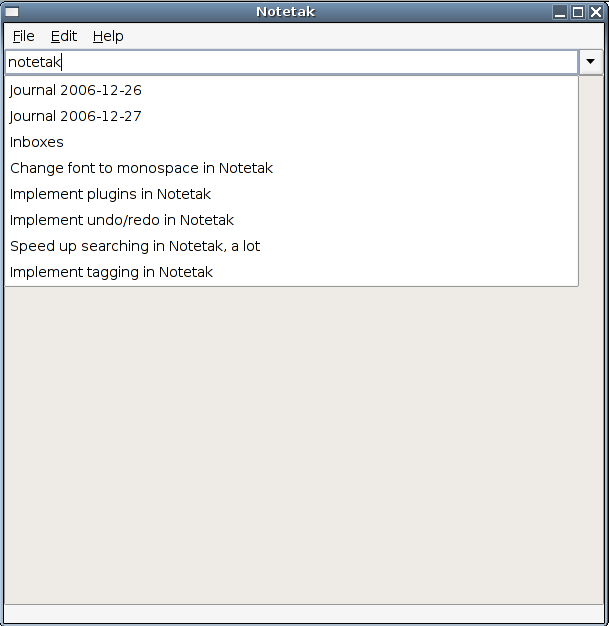
I always spend my Christmas with my parents, and for the past few years, I've always started some new little hobby hacking project or another. Three years ago I started writing a new text editor, sex.py. I still use it, although I haven't had much time to improve it further. This year, I wanted to see if I could come up with a little something to jot down random little notes easier, to keep track of said notes, and to help me manage a GTD workflow better. Last summer, I started dabbling with the "Getting Things Done" method by David Allen. It's basically a way of keeping track of things that you need to do. A bit more sophisticated than a simple todo list, without getting seriously bureaucratic or tedious. So far, whenever I follow the method, it seems to be working, although I'm not sure if it is because of using this particular method, or because I'm a method at all. GTD requires keeping a few lists of things: todo items that can be done now (assuming suitable context, but with no unfilled dependencies), todo items that might be done some day, etc. The tool I chose for this last summer is Gjots2. It's a GUI outliner tool that works adequately, but is not smooth enough to prevent me from looking at better tools. One of the things missing from Gjots2 is a good search facility. You can't do things like "show me all items containing the words 'Debian' and 'upload'", for example. Some time ago, while browsing 43Folders, I learned about a small application for MacOS X, called Notational Velocity. I don't have a Mac, so I can't try it out myself, but it works by keeping track of small text-only notes, each with a title, and has a user interface geared at searching. Instead of having a tree or a list of notes, it has a title bar where you enter some words, and it shows you a list of the notes that match those words. You can then either select something from the list, or press Enter to create a new note, with the text you entered as a title. This sounded intriguiging to me, and I thought it might be interesting to experiment with it for my note taking and GTD needs. So I spent one night at my parent's writing a first approximation of a prototype. I'm calling it Notetak.
Notetak screen shot Notetak, first prototype. The drop-down menu shows the notes that contain the word "notetak", in upper or lower case.
I've today switched from Gjots2 to Notetak, and it's already clear that it's a completely different approach to things. So far I like it, but I'll have to experiment with this for a few days or weeks to see if it really works. I'm pretty sure the basic approach would benefit from having additional tags for notes, or possibly having stored searches. I keep finding myself searching for, say, "@next" a lot to get a list of GTD next actions. The source (and a preliminary .deb) is on my home page, in case you're interested. Please note (ahem) that this is highly experimental and may eat your data. I may abandon it at any moment, if I decide that it's not worth it, but if not, it might also change frequently. If you do use it, I'd be happy to receive any bug reports, suggestions for improvements, and patches you may come up with.

Evan Prodromou: 5 Niv se CCXV

Nice Christmas for us at the Prodromou homestead in Los Altos Hills. My brothers Nate and Ted spent Christmas Eve with us at the big house, and we hung out till late at night watching Leeroy Jenkins videos on YouTube. The next morning, Amita June woke up early, oblivious to the importance of the day. My nieces Elena and Tessa had their initial gift opening at their house in Mountain View then came over to my Mom and Dad's around noon. So the rest of us played and chatted and had a nice brunch. We had a good time opening presents, and Amita got her main wished-for gifts: lots of musical instruments, like drums, maracas, and a recorder. She also got some nice clothes, both from my folks and her maternal grandparents. Altogether a good holiday, and as usual a watershed of stress. We don't have too much to do between now and the end of the year, so it's a good time to get caught up on some projects that need some attention. And, y'know, just rest. tags:

Basecamp crazy So, I really like the Basecamp project management service. It's a really intuitive system, simple to use, without a lot of project-management mumbo-jumbo that makes tracking your time and planning work too hard to do. It's nicely implemented, has a great UI, and does lots of neato Ajax stuff, so it's easy to use. I crossed the rubicon from the gratis version to the low-volume personal version last year, making myself a whole-hearted participant in the freemium business model. A couple of days ago, I crossed another milestone: I had more than 3 concurrent projects going, so I had to upgrade to the Business version. Normally I'd be pretty P.O.'d to pay for a Web service, but for one that has shown me a lot of value, and that I've moved into incrementally as I've become dependent on it, I'm more willing to pay. I'm not sure what that says about my values, about this particular business model, or just about the quality of the Basecamp service. tags:

One-time passwords So, I'll admit it: I think one-time passwords are pretty hard to understand. But Nick Moffitt gives a very good description of OPIE (One-time Passwords in Everything) in his blog this week. And, before you ask: yes, I am down with OTP. You know me. tags:

26 December 2006

Steve Kemp: Lets go dancing on the backs of the bruised

My Christmas day was primarily spent at home watching Red Dwarf. Apart from that I made new releases of xen-shell and xen-tools. I was suprised to recieve a sudden flurry of bug reports. No less than ten bugs reported by two users in one day! Still I fixed most of them and made a new release. It was nice to notice Isaac Clerencia writing about using xen-tools for automated testing. The idea has occurred to me before: Create a fresh Xen installation of Debian then run a test suite and trash the system afterwards. I even setup a test Yawns builder for a while. Are people finding interesting users for xen-tools? I’d love to have some use-cases, and more user-feedback is always appreciated. Feel free to get in touch or comment here. Personally I use a few Xen guests on my home LAN and I regularly create new Sarge images for building backported Xen packages. Only recently did I move my home cfengine setup onto a domU. In other news I recently received a copy of Programming Ruby from my Amazon wishlist, I’m learning a lot about Ruby and I think I’m in love. The only downside is the mental confusion I experience when I see “@variable” and “$variable” used. I am too wedded to Perl to stop thinking “array” and “string” respectively. I should find a toy project to write in Ruby to get used to it. Right now nothing occurs, but I’m sure it is just a matter of time.

25 December 2006

Gustavo Franco: For those who care about surprises

I'm not surprised with the positive Etch reviews after testing freeze, people here on planet.d.o definitely shouldn't. There are corner cases, but new installs (debian desktop anyone?) and a lot of upgrades scenarios (sarge->etch) are already ok. If you're surprised, you've wasted too much time around tanks in the last months, sorry.

Why? Debian is about us. The result of our work and feedback from our users, that are potential contributors in a much more powerful manner than alternative solutions. We've problems, tons of problems, but if you feel and wants to be part of our community stay tuned about the result of your work and the work of others members of the community during each development cycle. There's a lot under the hood, just ask.

For those who care about surprises, ignore this message and keep following just the politics. That's your choice, not mine.

24 December 2006

Brett Parker: OK - now *that* rocked...

Just finally got round to watching cars (bought it earlier in the week, just watched it, damned glad I bought it). I'm a pixar film fan, so when cars was announced as the last film last year before moving to another distributor I was a little pessamistic as to what the quality of the film was going to be, I must say, I'm still very happy with pixar - now, let's see what happens now that they're owned by the evil giant that is Disney - hopefully they'll still leave the pixar team as is and we'll get lots more quality films with lots of imagination behind them. (Yes, OK - I'm a big kid, and I also like most of the stuff that comes out of dreamworks studios, though they tend to have less story line - shrek is rather good though). So, yeah - just thought I'd post to say... If you haven't seen Cars, go get a copy, watch it, it's fun :) In case I totally avoid mentioning it tomorrow (quite likely), Merry Christmas peeps. Have a good one, don't drink too much :)

Next.

Previous.