Search Results: "sto"

4 May 2009

Matthew Garrett: Thinkpad mixers

Older (up to the *60 series) Thinkpads have a slightly odd mixer setup. There's a mixer stage that sits between the software controllable mixer and the speakers. This is controlled by the firmware in response to the volume keys being hit and can't be prevented by the OS. This is unfortunate, since users are quite enthusiastic about seeing an on-screen display when they hit various keys and if we do the obvious thing and map the volume keys to KEY_VOLUMEUP and KEY_VOLUMEDOWN then they get the OSD but also get their software-controlled mixer changed at the same time as their firmware-controlled mixer. This causes boundless confusion.

Lorne Applebaum recently sent a patch that added an ALSA control to represent the Thinkpad mixer. This means that we can now read and control the Thinkpad-specific hardware without userspace needing any special knowledge. I've gone a little further and sent a followup patch that sends ALSA notifications on button presses. Lennart suggested that it would also be helpful to export dB values and wrote a nice app that measures them - that means that Pulseaudio will be able to set the mixer volume correctly by default.

The only missing part of the puzzle now is getting the OSD back. We still can't map the keys to KEY_VOLUMEUP and KEY_VOLUMEDOWN because that'll still result in two mixers being changed at once. We can't add new keys to indicate that it's a notification event rather than a command, since X can't deal with keycodes greater than 255 (actually 243, since it adds 8 to every kernel keycode for historical hilarity) and we've run out of space. We can't hook off the ALSA notifications because that'll result in the OSD popping up in response to someone dragging a slider in a volume control application. The easiest thing might be to add another ALSA notification that's only triggered if the notification was generated in the kernel and then have userspace listen for that.

Newer Thinkpads appear to have done away with this mixer setup entirely and just send standard volume events. This is a Good Thing.

In other news, I'm off on holiday to Australia for a couple of weeks so may be a bit slow in replying to things.

3 May 2009

Gregory Colpart: Migration from GNU Arch to Git for Horde packages

All Horde packages (horde3, imp4, kronolith2 ) were in GNU Arch repository. After Lenny release, we decided to migrate to Git. Git has a lot cool features, and I was convinced by Pierre Habouzit talk about Packaging with Git. Technically, I used git-archimport to keep all history of packaging. Each package has a Git repository with some branches: upstream, upstream+patches, upstream+repack (if needed), pristine-tar, debian-sid (imported from GNU Arch) and debian-<release>. The hardest step was to set up a common ancestor for debian-sid and upstream branches: I found git-merge-unrelated-branch script to do it automagically. I write guidelines for packaging Horde with Git on Debian Wiki with some notes about migration from GNU Arch to Git. Comments welcome!

2 May 2009

Russell Coker: CPL

I ve just bught an NVidia video card from Computers and Parts Land (CPL) [1]. I asked for a PCIe*8 card but was assured that a PCIe*16 card would work. However when I got it home I discovered that it would not fit, the size difference was obvious enough that I didn t even need to unwrap the new card. According to the Wikipedia page for PCIe (PCI Express) [2] it is quite legal to have a motherboard implement a slower version of PCIe but have the full slot width, so a motherboard could have PCIe*1 implemented but have a socket that will fit a PCIe*16 card. The motherboard and the card will negotiate the capabilities that they both support. But there is no requirement to have a larger socket than required to use the capabilities of the motherboard. The CPL salesman assured me that any PCIe*16 card will fit into any PCIe*8 socket. I presume that he is used to white-box gear manufactured by companies that can save a few cents on the sockets if they make them all the same size. The Dell PowerEdge T105 that I own has PCIe*8 sockets that do not fit PCIe*16 cards. So now I have to return the card, and the CPL web site doesn t even give the hours that the store is open, so I have to call them. Sigh. Update: I returned the video card, first I had a debate with the CPL guy who had sold it to me regarding whether such PCIe sockets exist. He suggested that I had mistaken a PCI slot for a PCIe slot and was not convinced until I showed him a picture I had on my phone. He then claimed that Dell made sub-standard machines for not using a PCIe*16 socket for PCIe*8 connectors - so it was Dell s fault not his fault for delivering me a PCIe*16 board when I asked for a PCIe*8. He told me that no-one had ever made a PCIe*8 video card. Then he told me that I was lucky to not have a re-stocking fee (they sold me a device that was not what I asked for, I returned it in perfect condition on the same day and I was lucky to not pay them for the privilege). They gave me a credit note for the value of it (not a refund). I recommend never doing business with CPL if you can avoid it. I will make exactly one more purchase from them, that will be to use the credit note.

1 May 2009

Chris Lamb: April 2009 in UK civil liberties

Wednesday 1st
At the G20 protests, Londoner Ian Tomlinson collapses and is attended to by the emergency services; Metropolitan Police claim "during this time a number of missiles - believed to be bottles - were being thrown at them". Tomlinson dies that evening.
Thursday 2nd
The Evening Standard reports that "police were bombarded with bricks, bottles and planks of wood" as they helped Tomlinson.
Saturday 4th
Postmortem of Tomlinson finds he died of a heart attack.
Monday 6th
The EC Data Retention Regulations 2009 comes into force requiring internet service providers to retain details of emails, internet phone calls and other web traffic.
Tuesday 7th
The Guardian publishes a video of a police officer assualting Tomlinson on 1st April.
Wednesday 8th
Twelve Pakistani students are arrested on suspicion of planning terror attacks over the Easter holiday weekend.
Thursday 9th
The Guardian publishes a second video of Tomlinson's assualt, contributing that no missiles were thrown.
Monday 13th
Police arrest 114 climate protestors on conspiracy to cause criminal damage at Nottingham power plant. [ref]
Tuesday 14th
A video of a seperate assualt at the G20 protests is published.
Thursday 16th
Police claim tourist's photography of transport-related buildings is "strictly forbidden" and demand the photos are deleted. [ref]
Friday 17th
A second postmortem of Iam Tomlinson finds the cause of death to be an abdominal haemorrhage. A policeman is interviewed under caution on suspicion of manslaughter. [ref]
Saturday 18th
The Times reveals MP Damian Green private emails were searched by the police using the keywords "Shami Chakrabarti" (director of Liberty) after his arrest last year.
Monday 20th
The Guardian reveals police intelligence was given to E.On before the Nottingham climate demonstration, including movements of protesters and their meetings.
Tuesday 21st
Another video of the Tomlinson assault is revealed showing his head hitting the pavement. The Independent Police Complaints Commission fails to obtain an injunction to prevent broadcast.
Wednesday 22nd
Nine Pakistani students arrested during anti-terror raids are released after 13 days without charge and are passed to UK Border Agency custody for deportation. [ref]
Monday 27th
Home Secretary Jacqui Smith announces that ISPs and telecoms companies will be asked to record usage "to track murderers and paedophiles" without a warrant. [ref]
Tuesday 28th
Emails are revealed of the Home Office asking Phorm, the behavioural targeted advertising service, whether they are falling outside the law. Home Office claim Phorm would be legal if consent is obtained and that "providers of goods and services need only ensure they are compliant with relevant legislation". [ref]
Wednesday 29th
The Guardian documents the friends of the 7/7 bombers were denied bail on secret evidence - "the appellant asked the judge the question: why are you sending me to prison? To which the judge replied: 'I cannot tell you that.'"

Simon McVittie: Implementing D-Bus clients with telepathy-glib (and telepathy-qt4)

(The much-delayed part 2 in an ongoing series: shiny things in telepathy-glib) Over a year ago I explained my first major round of work on telepathy-glib, with which it could be used to implement D-Bus services. I started to write this post shortly after, but then got distracted by a bee or something; recent discussion about having a D-Bus binding in GLib has finally prompted me to finish it. The second major round of work on telepathy-glib dealt with implementing client code, and went sufficiently well that telepathy-qt4 (currently under development) uses essentially the same model. Again, while telepathy-glib is intended for Telepathy implementors, I think TpProxy's ideas are generically useful, particularly for "large" D-Bus APIs.

Some background: dbus-glib and libtelepathy
GObject-CRITICAL: Assertion failed: proxy->convenient
The life-cycle of a DBusGProxy (PD clipart credit: karderio and Andy)
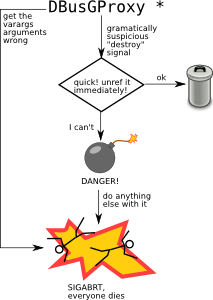
The API provided by dbus-glib for client code is, er, rather less than ideal. The basic object is DBusGProxy, which has a few problems. There's one per interface, rather than one per object; this leads to a maze of twisty GObjects, all suspiciously similar. Our old client library, libtelepathy, got round this by subclassing DBusGProxy to make helper objects called TpChan, TpConn etc., which were simultaneously the proxy for the "main" interface (Channel, Connection etc.), and a factory for proxies for the other interfaces (like Channel.Type.Text and Channel.Interface.Password). This still wasn't ideal, but it was a start. If you use a DBusGProxy in any way after it has emitted the destroy signal, this is considered to be invalid use of the API, and dbus-glib asserts all over the place. We'd rather it didn't do that - remote objects becoming invalid is a fact of life, and if you don't immediately discard all your references to those objects, remote operations on them should just give you a runtime error. You have to be prepared to handle such runtime errors already, because any IPC call can fail at any time. The main API for calling methods uses varargs and is rather subtle. Notably, the calling convention for variant parameters (of D-Bus signature 'v') is not consistent with the calling convention for any other container. For any other container, for instance a GPtrArray *, you pass in a GPtrArray ** pointing to a GPtrArray * variable containing NULL; on success, a pointer to a new GPtrArray is written into that variable. For variant parameters, though, you must pass in a GValue * pointing to a zero-filled GValue, and the result will be written into that GValue. dbus-binding-tool generates thin wrappers around this method-calling API which provide type-safety, although they can't directly specify a non-default timeout. As for signals, before binding to a signal, you have to tell dbus-glib about its signature. This tells dbus-glib how it should push the signal arguments onto the C stack (in GObject terminology: how it should marshal them), to match the signature of the signal-handler function. The documentation claims that this isn't necessary for objects supporting the Introspect method, but that's untrue - on the other hand, if the documented behaviour actually happened, I would consider this to be a critical bug in dbus-glib, since it would enable remote objects to crash dbus-glib clients (by causing signal arguments to be pushed onto the stack in a way that does not match the signature of the signal handler). Of course, the signal-adding function takes varargs, and has to be called exactly once per signal per object. If you don't, dbus-glib asserts when you connect to the signal; if you call it twice, dbus-glib asserts anyway.

TpProxy TpProxy is a GObject subclass vaguely inspired by Python's dbus.proxy.ProxyObject. It isn't a subclass of DBusGProxy, which lets us encapsulate dbus-glib almost completely - in fact, all the references to DBusGProxy are in a separate header, proxy-subclass.h, only used by subclasses of TpProxy (as opposed to normal library API users). TpProxy instances are per-remote-object (per-object-path) like in dbus-python, rather than per-interface like in dbus-glib or QtDBus. As explained below, I believe that this is the most natural object mapping for D-Bus interfaces; in practice it tends to lead to clearer code for us, since one remote object often maps nicely to one UI element (of course, if your objects only have one interface, this approach is no better or worse than dbus-glib's). TpProxy provides support for the following common D-Bus things:
  • Calling methods
  • Connecting to signals
  • Objects becoming invalid
  • Objects with optional interfaces
  • Extensibility
It doesn't currently provide any particular help with Properties - the Properties interface is just another interface as far as we're concerned. We find that, in practice, that's not a problem (even though we use D-Bus properties extensively). In telepathy-qt4 we basically reinvented TpProxy in C++, as Tp::DBusProxy. I've put in some comments below illustrating how the general ideas we used in TpProxy translate into a different object mapping.

Calling methods Method calls on TpProxy are done through auto-generated wrapper functions, much like DBusGProxy. These look something like this:
typedef void (*tp_cli_channel_callback_for_close) (TpChannel *proxy,
    /* any 'out' arguments would go here - Close() doesn't have any */
    const GError *error, gpointer user_data,
    GObject *weak_object);
TpProxyPendingCall *tp_cli_channel_call_close (TpChannel *proxy,
    gint timeout_ms,
    /* any 'in' arguments would go here - Close() doesn't have any */
    tp_cli_channel_callback_for_close callback,
    gpointer user_data,
    GDestroyNotify destroy,
    GObject *weak_object);
Methods for some interfaces, like DBus.Properties, are available on TpProxy itself; others, like Telepathy's Channel.anything, are only available on a particular subclass, like TpChannel. Things to note here:
  • It's an asynchronous call with a callback. General design principle: "this is IPC, get over it". We don't try to hide the fact that IPC is taking place by doing pseudo-blocking calls.
  • The timeout is explicit (although you can always pass -1 to let libdbus pick a "reasonable" default for you). This is because the remote service might not respond, and API users should be at least vaguely aware of this: "this is IPC, get over it".
  • The callback isn't a GCallback; it has an explicit signature, for some semblance of type-safety (it's not much, but it's better than nothing).
  • The callback takes a GError, because any IPC call can fail for any reason.
  • A TpProxyPendingCall * is returned. This is a pointer to an object that only exists until just after the callback is called (so you can ignore it if you don't want it), with a method you can call to cancel the method call (with hindsight this is not ideal, and if I was writing this API now, I'd use gio's GCancellable). "Cancel" is perhaps slightly misleading: the method call still takes place (it was already in libdbus's outgoing queue) but the result gets ignored and the callback isn't called. This is mostly so you an object can forget all the calls it was busy making at the time that the results become irrelevant (e.g. the object is destroyed).
  • There is an extra weak_object argument, which is weakly referenced and is passed to the callback: in practice, most users of telepathy-glib use this as well as or instead of user_data. If the weak_object runs out of references, the callback is automatically cancelled, which means that in practice, explicit cancellation is almost never needed.
  • The generated code has as its first argument a suitable subclass of TpProxy, in this case TpChannel (we tell the code generator about subclasses).
  • You can't see it in the API, but the TpProxy gains an extra ref while a method call is in progress, so you never have to worry about what happens if the proxy gets unreffed during a method call.
  • There's an explicit destructor for the user_data, which is called even if you "cancel" the method call.
In telepathy-qt4, these methods are on small generated helper classes similar to dbus-python's dbus.Interface, one per interface (we provide accessors for them on the non-generated DBusProxy subclass). Instead of using callbacks, we return a temporary QObject per call, which emits a Qt signal on success or failure (that's how all async calls in QtDBus work).

Connecting to signals Similarly, signals have some generated functions:
typedef void (*tp_cli_channel_signal_callback_closed) (TpChannel *proxy,
    /* any arguments would go here - Closed doesn't have any */
    gpointer user_data, GObject *weak_object);
TpProxySignalConnection *tp_cli_channel_connect_to_closed (TpChannel *proxy,
    tp_cli_channel_signal_callback_closed callback,
    gpointer user_data,
    GDestroyNotify destroy,
    GObject *weak_object,
    GError **error);
API notes for these:
  • The callback doesn't take a GError any more, because signals can't fail; the weak_object and the user_data are the same as for method calls
  • This isn't actually a GObject signal at all: those aren't particularly typesafe, and lack namespacing. This might not be very binding-friendly, we haven't tried doing that yet... it might be worth introducing a signal with details, like in dbus-glib, for which these functions are "C bindings".
  • The returned TpProxySignalConnection lets you disconnect from the signal, just like the TpProxyPendingCall above; it can safely be ignored
  • Similarly, if the weak_object dies, then the signal automatically disconnects
  • It is possible for connecting to a signal to fail: this happens if the proxy doesn't actually have the requested interface. If this happens, it's graceful, not a crash. In practice, the flow of code is almost always such that error can safely be NULL because the interfaces are already known.
In telepathy-qt4 the per-interface generated helper classes emit Qt signals. In many cases, we end up proxying these signals by responding to them in the hand-written Tp::DBusProxy subclass by emitting a different signal, in order to give them a nicer representation.

Becoming invalid This is IPC, and any error can happen to you at any time. We found that it was useful to have a general concept of "this object is no longer useful", so we introduced the concept of an object becoming invalidated. The invalidation reason is stored on the object as a GError. If this GError is NULL (as it is initially), then the object is still expected to be valid; if it's non-NULL, the remote object has vanished and the local proxy no longer works. There are several ways a TpProxy can become invalid:
  • its bus name falls off the bus (the process exited or crashed)
  • application-specific reasons (usually triggered by a D-Bus signal in a subclass, like the Telepathy Channel's Closed signal)
  • the GObject gets disposed
Method calls on an invalidated object always fail, with the invalidation reason as the error. This means that calling a method on a TpProxy should never crash your process. The method's callback has to be prepared to handle an error in any case, because this is Sparta^WIPC, so there's no loss in giving it another error. Connecting to signals on an invalidated object always fails, and any existing signal connections are disconnected when it becomes invalidated. This means that if a new remote object appears, and it happens to have the same object path, bus name etc. as the old one, you won't get its signals. A TpProxy can either be bound to a unique bus name or a well-known bus name. In the equivalent code in telepathy-qt4, we call this "stateful" or "stateless" - these names don't capture the intention perfectly, but they're the best we could come up with. A proxy for a stateful API like Telepathy's Channel should always bind to a unique name - when the unique name falls off the bus, the TpProxy becomes invalidated automatically, representing the fact that the Channel you had no longer exists, and nothing can be a perfect replacement for it (the VoIP call has already been terminated, you've already left the chatroom, or whatever - if you make another Channel, that's e.g. a distinct VoIP call). A proxy for a stateless API like Telepathy's ConnectionManager, where an exiting process can disappear, be service-activated again, and still have exactly the same API, should bind to the well-known name. Proxies for well-known names aren't invalidated when the process exits. Qt doesn't have a natural equivalent for GError, so the invalidation reasons in telepathy-qt4 are just a pair of strings, the namespaced name and the message - basically a libdbus DBusError. The principle is the same, though.

Optional interfaces As mentioned above, TpProxy instances are per-remote-object (per-object-path) like in dbus-python, rather than per-interface like in dbus-glib or QtDBus. I believe that this is the most natural object mapping for the D-Bus object model, because the D-Bus interfaces on a remote object can behave like any of these:
  • classes and subclasses (Telepathy.Channel.Type.Text is a Telepathy.Channel)
  • shared interfaces (some Telepathy.Channel objects, of many Types, implement Telepathy.Channel.Interface.Group; any D-Bus object can implement DBus.Properties)
  • optional features (some Telepathy.Channel.Type.Text objects implement Telepathy.Channel.Interface.ChatStates, some do not)
  • discoverable extensions (some Telepathy.Channel.Type.Text objects implement Telepathy.Channel.Interface.Messages, which is more or less Text 2.0)
The way in which interfaces are discovered is also variable. The "classic" D-Bus way to discover interfaces would be to call Introspect. Telepathy services still support that style of introspection, but we don't use it for anything beyond d-feet:
  • Introspect returns a blob of XML, which you have to parse into something useful; if it was in a D-Bus data structure, you'd already have some sensible data structure.
  • Finding out more information about the supported interfaces than their names isn't very useful: in a static language like C you already need to know the methods, signals, properties and their signatures in order to write and compile your code, and in a dynamic language like Python consumers of Introspect end up being remotely crashable by services with unexpected method signatures (this is one of dbus-python's big mistakes in my opinion).
  • If a method that you want to call turns out to be missing, the worst that can happen (in a competently written service) is that it fails with a D-Bus error - and you have to handle D-Bus errors anyway, because this is IPC and anything could fail.
  • Static bindings like dbus-glib have poor support for removing interfaces for which C code exists at runtime, whereas Telepathy needs features like an IM connection that might or might not support avatars (we don't get to find out until we've successfully connected to the server).
Instead, our older interfaces have a method on the "base class" (Channel, Connection etc.) called GetInterfaces, which just returns an array of strings. Newer interfaces (like Account), and older interfaces that have been ported (like Channel), have a property called Interfaces which is, again, an array of strings - this lets us combine the download of the interfaces list with downloading other basic information in a GetAll call. To cater for all these ways to use interfaces, the TpProxy base class has very basic support for interface discovery - you can ask it whether it supports an interface, and you can tell it that it does, in fact, support an interface. Asking which interfaces are supported is directly useful for library users; it's also used as a check by the generated method-call and signal-connection stubs, which return a canned error (Telepathy.Error.NotImplemented in Telepathy's case) if the object isn't known to have the interface. Telling TpProxy that it does support an interface is intended for use by subclasses, and might have been protected if we were writing C++: what happens in practice is that a concrete subclass like TpChannel knows how to discover the fully supported interfaces for this particular object, does so, and calls methods on the TpProxy to tell it which interfaces can work.

Extensibility The API stubs used by TpProxy to call methods and bind to signals are generated from XML documents containing an augmented form of D-Bus introspection data. These XML documents contain various Telepathy-specific extensions, but none of the extensions are language-specific - telepathy-glib, telepathy-python and telepathy-qt4 all operate from exactly the same XML specification. telepathy-qt4's different object-mapping did require us to tighten up some rules that were previously only conventions, but even so, the format is the same. I think this is vitally important - it just doesn't scale to have one set of language-specific annotations in a D-Bus API for each language that will have bindings. One thing that we make heavy use of is what I call "Ugly_Case", which is camel-case with underscores at word boundaries. This gives us a simple, unambiguous and foolproof rule to use in code generators whenever we generate any of the popular conventions for identifiers:
  • CamelCase: delete underscores
  • javaCamelCase: force everything before the first underscore to lower case, then delete underscores
  • lower_case: force everything to lower case, retain underscores
  • UPPER_CASE: force everything to upper case, retain underscores
dbus-glib, by contrast, applies a complex and subtly buggy algorithm to the CamelCase D-Bus names, which results in our SendDTMF method being mapped into GLib as send_dt_mf, and requires that telepathy-glib's Python reimplementation of dbus-binding-tool uses a bug-for-bug compatible implementation (we ended up reimplementing dbus-binding-tool in order to generate the TpProxy-based bindings). Our code generation tools are still rather ad-hoc, because so is our spec format, but for draft interfaces it's possible to copy them into individual projects and use them to generate additional methods for TpProxy or any subclass. This is how we implement unfinished APIs like geolocation in Empathy, for instance. The Interfaces or GetInterfaces hook described above is entirely usable for these extension interfaces, and in fact that's how they're set up. In telepathy-qt4, the generated method stubs are genuine C++ methods, so we can't just append methods to an existing class: this is why we have one helper class per interface, so individual clients can generate a helper class for their particular version of an unfinished API, and instantiate an object of this class attached to a particular Tp::DBusProxy. When an interface becomes stable, it can be added to the set of interfaces for which code is generated in telepathy-glib or telepathy-qt4, at which point any client or service that was already using the final draft of that interface can easily be ported to the library version using sed (the API remains the same).

Becoming ready The concept of being "ready" does not directly exist in TpProxy, but is implemented in TpChannel, TpConnection and TpConnectionManager. The idea is that a freshly created proxy object isn't really fully usable yet - you have to connect to basic signals and recover the initial state of the remote object, as well as checking which extension interfaces are supported. In many well-designed D-Bus APIs you can do this initial setup with a few signal connections and a DBus.Properties.GetAll call. After doing that initial setup (which has to be done asynchronously, because it's IPC), the TpProxy subclass has a local cache of the remote object's state (not necessarily in the same format as the representation on the bus), which can be accessed synchronously at any time, and will be updated in response to change-notification signals. TpChannel and subclasses like it have explicit support for checking for readiness, and having a callback called when the object is ready or invalidated (whichever happens first). The "ready" property also supports the GObject notify signal. telepathy-qt4 took this concept and ran with it - there is library support for objects that can become ready, including a mixin. If I had as much time to work on telepathy-glib as I wish I had, this would be one of the first telepathy-qt4 features to be added to telepathy-glib.

Features becoming ready Going beyond that, in an extensible framework like Telepathy it's probable that not every client understands (or wants to understand) every feature of every object, so it's highly inefficient for every proxy object to subscribe to all the change notification signals and cache all the remote state on the off-chance that the library user wants them. In the API for TpContact (which is not actually a TpProxy for various reasons) we introduced the concept of optional features; telepathy-qt4 extended this idea throughout the library. The idea is that each library user knows which of the optional features are "interesting" to it, and makes a single asynchronous call (which expands into a series of D-Bus calls inside the library) to download the state for core functionality plus all of the selected features, and subscribe to change notification for all of those. This is another telepathy-qt4 thing that telepathy-glib still needs to catch up with; until someone works out how to make the clone() syscall apply to programmers, I fear all libraries are doomed to lag behind how their designers want them to look :-) (license: CC-BY-3.0 / LGPL-2.1+)

Biella Coleman: RIP: A Remix Manifesto

This Sunday in the Burg, NYC.

Dirk Eddelbuettel: GSoC 2009 Chicago area meeting

Thanks to the effort of the tireless Borja Sotomayor for the local ACM chpater as well as the good folks at Google in Chicago, we had a local kickoff meeting for this year's Google Summer of Code at Google's Chicago office. A few accepted GSoC students, mentors, and a few Google engineers gave short presentations to a bunch of ACM-affiliated students from U of C, Northwestern, DePaul, IIT, UIC, ... I gave my first ever 'lightning talk' --- on R and the GSoC --- and after chatting a bit more rushed home to catch the end of the amazing triple-overtime win of the Bulls over the Celtics. Go Bulls for the improbable game seven in Boston!

30 April 2009

Pablo Lorenzzoni: EeePC: Surviving liquid spills

Last few months since I got my EeePC have been a lot of fun. Playing and tweaking the little bastard is a joy in the end of a busy day. Besides, since I loaded it with the most useful SysAdmin tools, it became a powerful device in my tool belt . Unfortunately, I ve been stupid enough to drink a glass of orange juice while messing with it. I know, I know! Silly thing to do. I should know better! But life is like that I spilled a few drops over it. Of course, the web is pouring off information on what to do in cases like this, so I ll just summarize what I did:
  1. Imediatelly, without thinking or questioning, I turned it upside down and removed the battery. It was a clumsy thing to do I ended up spilling the rest of my orange juice on the floor while worrying about the EeePC. Concearns about filesystem corruption (or whatever) crossed my mind, but I can always deal with that later First things first!
  2. I went online in another computer and found out how to disassemble it. For me it was easy, since I got other two computers at home but if I needed to leave it there while looking for information, I would! If it s upside down and has no power whatsoever (the battery was removed), it s safe, I think. The information was easily found. I decided I didn t need to disassemble all of it, but having those information at hand was pretty useful.
  3. I began by removing the keyboard. It s tricky but not difficult. The secret relies on the spring-mounted tabs near the screen. I checked for spills under it and cleaned with a cotton swab.
  4. I was not very confortable to open the case, but I decided that turning it back on without checking the electronic parts first was too risky. So I said goodbye to my warranty and unscrewed the 6 screws from the bottom and the 9 from the silver casing under the keyboard.
  5. There I found some little drops! Good decision to open it up! I dried it using cotton swabs again.
  6. Before putting it all together, I decided to leave it open until the next day. I was pretty sure everything was dry again, but better safe than sorry . The next day I successfully assembled it and turned it on. Great! Everything worked fine.
Now that was just what worked for me. My EeePC is back, fully restored but, of course, the warranty is void :-( So I cannot recommend you to do the same. Best advice I can tell you: Keep liquids away your EeePC!

Martin F. Krafft: The need for a GPG revocation certificate

Do you use GPG or PGP to sign or encrypt your emails and/or files? This is a reminder to those who answered yes: make sure you have a revocation certificate, as well as backups of your private/public key pair, ideally in multiple safe locations. It s always a good idea to keep backups. But what is more important with GPG is the revocation certificate. That s your emergency brake. If someone ever gains control over your key, this is the only way for you to minimise (further) abuse of your key and your identity. However, even a revocation certificate won t be able to prevent all abuse, by nature of the design of the GPG Web of Trust. You also need to exercise utmost care in protecting your key and making sure third parties cannot gain control over it. Do not keep it on machines you don t trust, and make sure to use a safe, non-guessable passphrase! With GnuPG, generating a revocation certificate is as easy as this; replace $KEYID with your 8 or 16 digit hexadecimal key ID:
gpg --gen-revoke $KEYID > $KEYID.revoke.asc

and store it away. Do not import it until you need to revoke your key! In my case, the process was this; lines requiring my input are prefixed with an arrow ( ):
  sec  1024D/330C4A75 2001-06-20 Martin F. Krafft <mail@martin-krafft.net>
  Create a revocation certificate for this key? (y/N) y
  Please select the reason for the revocation:
    0 = No reason specified
    1 = Key has been compromised
    2 = Key is superseded
    3 = Key is no longer used
    Q = Cancel
  (Probably you want to select 1 here)
  Your decision? 1
  Enter an optional description; end it with an empty line:
  > 
  Reason for revocation: Key has been compromised
  (No description given)
  Is this okay? (y/N) y
  You need a passphrase to unlock the secret key for
  user: "Martin F. Krafft <mail@martin-krafft.net>"
  1024-bit DSA key, ID 330C4A75, created 2001-06-20
  ASCII armored output forced.
  Revocation certificate created.
  Please move it to a medium which you can hide away; if Mallory gets
  access to this certificate he can use it to make your key unusable.
  It is smart to print this certificate and store it away, just in case
  your media become unreadable.  But have some caution:  The print system of
  your machine might store the data and make it available to others!

I then printed the file, put it in the safe, stored it on a removable disk and hid it away. Even though I exercise great care over my key material, I can now sleep better at night, knowing that I can at least minimise any damage done by an attacker who compromises my key. Also, that way I can make sure to declare unused keys as such, since there is no other way to revoke a published key for which you ve lost the private key or forgotten its passphrase. I ve left such traces in my past and wish I had known what I was doing at the time: A8FA196E, C22D1C01, 1EF0975C. This is your chance to do it right. Make yourself a revocation certificate now (along with backups)! And always exercise care and keep your key secure. NP: Mono: One More Step and You Die

29 April 2009

Florian Ragwitz: Running tests that require an X server

Lots of CPAN distributions require some kind of graphical environment. Some of them even pop up windows, which not only very annoying, but also sometimes fails if you're using a tiled window manager. To test such distributions on a machine where no graphical environment is available or on your desktop while you're working and don't want to get annoyed to death you can use a fake X server, like Xvfb. The easiest way to do that is to run
$ xvfb-run -a make test
instead of a plain make test. That'll automatically create a fake xserver, set up DISPLAY and run make test in that environment. That works well for manually installing modules. When installing using CPAN.pm you can make things easier by writing a distropref. First, tell cpan where your distroprefs are. I use ~/.cpan/prefs:
$ cpan
cpan[1]> o conf init prefs_dir
[...]
<prefs_dir>
Directory where to store default options/environment/dialogs for
building modules that need some customization? [] /home/rafl/.cpan/prefs
cpan[3]> o conf commit
commit: wrote '/home/rafl/.cpan/CPAN/MyConfig.pm'
Now write a distropref for the modules that need an X server and put it into your prefs dir as X11.yml
---
match:
  distribution:  
    /(?x:Wx
       Gtk2
       Gnome2
       ... other modules requiring an X server
    )-\d 
test:
  commandline: "xvfb-run -a make test"
Now the tests for Wx, Gtk2, Gnome2 and all other distributions you list in that regex will be executed with a fake X server. I have yet to figure out how to write a distropref that just prepends to the test commandline instead of replacing it so I won't need to have another pref for all modules using Module::Build.

MJ Ray: Bristol Social Enterprise Summit Consultation

Last Thursday, I went to the Social Enterprise summit regional workshop that I mentioned. Apparently, SEC are hoping that ministers Mandelson, Purnell, Byrne and Blears will be at the summit, along with people from various famous co-ops. I took along some email feedback I received on supporting new blood in social enterprise about needing help to bridge the gaps (financial, social, training) between taking on new members and them being productive enough to break even . Happily, that was echoed and reinforced by other delegates - I shared a table with people from Trinity Community Arts, AvonCDA, Sofa Project, Somerset Co-operative Services and Community Action. Emboldened by that, I ranted about the Business Support Simplification Programme (which seems to mean that only BusinessLinkSW has any gov.uk money in our region and they re being really poor at co-op support) and I threw a couple of ideological-explosives into the consultation, suggesting that franchising has failed as a way of spreading social enterprise and we need to start offering General Public Licensing of our business models, because we re not franchising businesses and most of us don t want to be. I wonder if that idea will detonate somewhere helpful. The Social Enterprise Coalition officers had some details of the support programmes that are already announced. One of them is a golden hello where the enterprise gets money when a new person joins. It s run by jobcentreplus. So yesterday, when I was at a Business Link Real help for business event, I asked the jobcentreplus officers there about it: apparently it s useless to TTLLP because all our workers are partners and not employees. I was expecting more support for co-ops from a Labour+Co-op government, but it shouldn t've been a surprise after the budget. After that, I don t think it s worth posting details of the other SE assistance programmes mentioned: they ll probably turn out to be equally useless for co-ops and I don t want to waste your time. I ll rant about that and the BusinessLinkSW event another day or in another place. Ask me if you want details and I ll put them in a comment or email them. And in that spirit, it s back to programming for me!

Julien Danjou: awesome is bloated

That's just something I hear from time to time, and I love it so much. Fluxbox: 65010 SLOC Metacity: 62923 SLOC Openbox: 36336 SLOC awesome: 19207 SLOC

Dirk Eddelbuettel: Google Summer of Code 2009: R / Quantlib

With everything that has been going on of late, I have yet to mention that Khanh Nguyen, a Ph.D. student in Computer Science at U Mass / Boston, will be working with me on RQuantLib as part of the Google Summer of Code program this year. We had twenty-two applications to review for the R project, including three for the RQuantLib topic I had proposed. Khanh's application was clearly among the best, and I look forward to helping him do cool stuff over the summer. He already posted two short emails on the r-sig-finance and the quantlib-user lists soliciting suggestions and comments. So if you have comments regarding R and QuantLib, please get in touch with him or me!

28 April 2009

Florian Ragwitz: Implementing Typed Lexical Variables

For quite some time perl provided a form of my declarations that includes a type name, like this:
my Str $x = 'foo';
However, that didn't do anything useful, until Vincent Pit came along and wrote the excellent Lexical::Types module, which allows you to extend the semantics of typed lexicals and actually make them do something useful. For that, it simply invokes a callback for every my declaration with a type in the scopes it is loaded. Within that callback you get the variable that is being declared as well as the name of the type used in the declaration. We also have Moose type constraints and the great MooseX::Types module, that allows us to define our own type libraries and import the type constraints into other modules. Let's glue those modules together. Consider this code:
use MooseX::Types::Moose qw/Int/;
use Lexical::Types;
my Int $x = 42;
The first problem is that the perl compiler expects a package with the name of the type used in my to exist. If there's no such package compilation will fail. Creating top-level namespaces for all the types we want to use would obviously suck. Luckily the compiler will also try to look for a function with the name of the type in the current scope. If that exists and is inlineable, it will call that function and use the return value as a package name. In the above code snippet an Int function already exists. We imported that from MooseX::Types::Moose. Unfortunately it isn't inlineable. Even if it were, compilation would still fail, because it would return a Moose::Meta::TypeConstraint instead of a valid package name. To fix that, let's rewrite the code to this:
use MooseX::Types::Moose qw/Int/;
use MooseX::Lexical::Types qw/Int/;
my Int $x = 42;
Let's also write a MooseX::Lexical::Types module that replaces existing imported type exports with something that can be inlined and returns an existing package name based on the type constraint's name.
package MooseX::Lexical::Types;
use Class::MOP;
use MooseX::Types::Util qw/has_available_type_export/;
use namespace::autoclean;
sub import  
    my ($class, @args) = @_;
    my $caller = caller();
    my $meta = Class::MOP::class_of($caller)   Class::MOP::Class->initialize($caller);
    for my $type_name (@args)  
        # get the type constraint by introspecting the caller
        my $type_constraint = has_available_type_export($caller, $type_name);
        my $package = 'MooseX::Lexical::Types::TYPE::' . $type_constraint->name;
        Class::MOP::Class->create($package);
        $meta->add_package_symbol('&'.$type_name => sub ()   $package  );
     
    Lexical::Types->import; # enable Lexical::Types for the caller
 
1;
With that the example code now compiles. Unfortunately it breaks every other usecase of MooseX::Types. The export will still need to return a Moose::Meta::TypeConstraint at run time so this will continue to work:
has some_attribute => (is => 'ro', isa => Int);
So instead of returning a plain package name from our exported function we will return an object that delegates all method calls to the actual type constraint, but evaluates to our special package name when used as a string:
my $decorator = MooseX::Lexical::Types::TypeDecorator->new($type_constraint);
$meta->add_package_symbol('&'.$type_name => sub ()   $decorator  );
and:
package MooseX::Lexical::Types::TypeDecorator;
use Moose;
use namespace::autoclean;
# MooseX::Types happens to already have a class that doesn't do much
# more than delegating to a real type constraint!
extends 'MooseX::Types::TypeDecorator';
use overload '""' => sub  
    'MooseX::Lexical::Types::TYPE::' . $_[0]->__type_constraint->name
 ;
1;
Now we're able to use Int as usual and have Lexical::Types invoke its callback on MooseX::Lexical::Types::TYPE::Int. Within that callback we will need the real type constraint again, but as it is invoked as a class method with no good way to pass in additional arguments, we will need to store the type constraint somewhere. I choose to simply add a method to the type class we create when constructing our export. After that, all we need is to implement our Lexical::Types callback. We will put that in a class all our type classes will inherit from:
Class::MOP::Class->create(
    $package => (
        superclasses => ['MooseX::Lexical::Types::TypedScalar'],
        methods      =>  
            get_type_constraint => sub   $type_constraint  ,
         ,
    ),
);
The Lexical::Types callback will now need to tie things together by modifying the declared variable so it will automatically validate values against the type constraint when being assigned to. There are several ways of doing this. Using tie on the declared variable would probable be the easiest thing to do. However, I decided to use Variable::Magic (also written by Vincent Pit - did I mention he's awesome?), because it's mostly invisible at the perl level and also performs rather well (not that it'd matter, given that validation itself is relatively slow):
package MooseX::Lexical::Types::TypedScalar;
use Carp qw/confess/;
use Variable::Magic qw/wizard cast/;
use namespace::autoclean;
my $wiz = wizard
    # store the type constraint in the data attached to the magic
    data => sub   $_[1]->get_type_constraint  ,
    # when assigning to the variable, fail if we can't validate the
    # new value ($_[0]) against the type constraint ($_[1])
    set  => sub  
        if (defined (my $msg = $_[1]->validate($  $_[0]  )))  
            confess $msg;
         
        ();
     ;
sub TYPEDSCALAR  
    # cast $wiz on the variable in $_[1]. pass the type package name
    # in $_[0] to the wizard's data construction callback.
    cast $_[1], $wiz, $_[0];
    ();
 
1;
With this, our example code now works. If someone wants to assign, say, 'foo' to the variable declared as my Int $x our magic callback will be invoked, try to validate the value against the type constraint and fail loudly. WIN! The code for all this is available github and should also be on CPAN shortly. You might notice warnings about mismatching prototypes. Those are caused by Class::MOP and fixed in the git version of it, so they'll go away with the next release. There's still a couple of caveats, but please see the documentation for that.

Muammar El Khatib: Open Chrome = Wireless problem in HP 2133?

I had almost two weeks without Wireless connection in my HP 2133. Due of the fact of being busy doing other stuff, it was today until I had time to try something. So, I proceeded to google it and I found a bug in Launchpad about it. There was said that the problem was caused by Open Chrome driver. I have to accept that when I read it I was kind of skeptic. I thought: What has to do a Video Driver with a Wi Fi microcode not responding? (real translation: WTF is this?)

So, I open a terminal. I went to /etc/X11/xorg.conf and I change the only line in xorg.conf (new version of XORG was able to recognize the Video Card and it was working right without using the bunch of options and sections as you can see in http://wiki.debian.org/InstallingDebianOn/HP/HP2133 , except the fact that Wi Fi stopped working) to this:


Section "Device"
Identifier "VESA"
Driver "vesa"
BusID "PCI:1:0:0"
Screen 0
Option "ActiveDevice" "LCD,CRT"
Option "ForceLCD"
Option "SWCursor" "True"
EndSection


I restarted the machine, because I had fucked off Wicd trying to get connected to the Wireless Router and there wasn't any way to get it work again, and when I entered my XFCE4 session and tried the Wireless it just worked again... shit.. I can't understand. That was weird. So for the record. If you are getting this problem to get connected with your HP 2133 using either Debian or Ubuntu, given that you got it working before, so change the driver in the Device section from Open Chrome to VESA and you should get the problem solved. I tested it in Debian Unstable.

27 April 2009

Russell Coker: Email Passwords

I was doing some routing sysadmin work for a client when I had to read mail in the system administration mailbox. This mailbox is used for cron job email, communication with ISPs that run servers for the company, and other important things. I noticed that the account was subscribed to some mailing lists related to system administration, the following is from one of the monthly messages from a list server: Passwords for sysadmin@example.com: List Password // URL
-
whatever-users@example.org victoria3 That doesn t seem terribly exciting, unless you know that the password used for the list server happens to be the same as the one used for POP and IMAP access to the account in question, and that it is available as webmail Of course I didn t put the real password in my blog post, I replaced it with something conceptually similar and equally difficult to guess (naturally I ve changed the password). The fact that the password wasn t a string of 8 semi-random letters and digits is not a good thing, but not really bad on it s own. It s only when the password gets used for 3rd party servers that you have a real problem. I wonder how many list servers are run by unethical people who use the passwords to gain access to email accounts, and how many hostile parties use such lists of email addresses and passwords when they compromise servers that run mailing lists. Now there would be an obvious security benefit to not having the list server store the password in clear-text or at least not send it out every month. Of course the down-side to doing that is that it doesn t give someone like me the opportunity to discover the problem and change the password.

John Goerzen: We Are Plains People, And Our Music Has Tornadoes

There s little that scares Kansans more than a good tornado. And, truth be told, there s little that excites us more than a good tornado, either. After all, we know it s going to be good for a story. Here on the plains, it is easy to remember how powerful nature really is. Weather sweeps in from all directions with little to hinder it, and tonight was a night few will forget. The 300-member Kansas Mennonite Men s Chorus, of which I m a member, had a concert tonight at 7, and we had a practice starting at 3. We sang in the beautiful old Memorial Hall on the campus of Bethel College. I need to describe the building a bit for you. It was built in 1938, in the day before auditorium designers decided you need to remove the outdoors. Three sides are full of windows, and it s just a few feet from the front doors into the auditorium itself. There is no air conditioning, so in a very humid day like today, every possible door and window is open. To stand on the stage and look out over the audience, you see light coming in from every direction, extremely bright light when there s lightning. It s been storming all afternoon. Our rehearsal featured thunderclaps, driving rain that was very audible inside, flickering lights. It was, in all honesty, a bit exciting. At about 6:35, word came that a tornado warning had been issued for the county. A few minutes later, about 20 minutes before start time, sirens were activated and the decision was made to evacuate to safety in the building s basement and an adjoining building. I, and a number of college students singing with the choir, wound up as a sort of impromptu ushers, directing people to the best place for safety and helping to get people into space efficiently. It was rather stuffy in those basement hallways, but it was also quite loud due to all the excited visiting going on. The KMMC concerts aren t usually like this. A few minutes later, word came that the tornado warning was canceled. I went down the steps, yelled out the news, and got a big cheer. People poured back upstairs. We got started a few minutes late, but nobody quite cared. A group of brass players was going to provide the prelude, but their first trumpet player had to leave at the last minute because his tool shed had blown over. They covered for him well in the concert though. When I got home later, Terah saw me and said, I thought they d cancel the concert because of the tornado. I just had to laugh, and pointed out, This is Kansas. After a tornado evacuation, it just got everybody more excited for the program! (Of course, had there been a strike, it would have been a different story.) And it was a great program. There was excitement in the air. And it was incredibly hot and stuffy on the stage with 300 men. I had sweat running down my face. The rain and the thunder continued, sometimes improving the program. About halfway through, we sang Prayer of the Children, written by Kurt Bestor, someone that was terribly saddened by the destruction during the civil war in the Balkans. The lyrics go, in part:
Can you hear the prayer of the children
on bended knee, in the shadow of an unknown room? Empty eyes with no more tears to cry,
turning heavenward to the light. Cryin Jesus, help me
to see the morning light of one more day. . . Can you hear the voice of the children
softly pleading for silence in their shattered world?. . . Angry guns preach a gospel full of hate
blood of the innocent on their hands. For when darkness clears, I know you re near,
brining peace again. Can you hear
the prayer of the children?
And when we get to the last phrase, there s a long rest after Can you hear . We sang it the phrase, and with perfect timing as we paused for the rest, was a loud clap of thunder. And after the last word of the song, total silence. Nobody moved for a few seconds, and then applause rang out. A couple of years ago, I was in the audience at a concert in the same building. Ominous weather lurked that day too. Before the concert started, the director said something like this, before giving information about evacuation procedures, should they be needed: We are plains people. We are privileged to see the awesome power and beauty of the weather and nature up close every day. If we should be a little too privileged today, here s what we ll do

26 April 2009

Sean Finney: new git hook for debian packaging: pre-recieve fileset fascism

previously i threw together a small hook to make it a bit easier to avoid duplicate work while maintaining packages, as well as easily keep the BTS up to date with relevant information. now i've commonized the code just a bit and have a second hook which can be used to maintain certian (what i believe to be) good practices for keeping packages in git. admittedly, it's a bit more "stick" than "carrot" with respect to streamlining workflows, but i feel the justifications and the resulting benefits are worth it. so the hook does basically two things, either of which can be customized and/or disabled. prevent "non-debian" changes on a "debian" branch assuming that there are seperate branches for "debian" packaging and for "upstream" development, this hook prevents upstream-style changes on the debian branches. that is to say changes to files outside ./debian are not permitted on a "debian" branch, unless of course you're merging from an upstream branch. instead, changes to the source in a debian branch should be managed by quilt-style "feature patches", or a more advanced branch topology using some kind of feature branches (topgit or similar). prevent changelog modifications from being mixed in with other commits this one might be a bit more controversial for some. basically, the idea is that: therefore, this hook "declines" commits which modify debian/changelog, unless it is the only file being changed. using this new hook note this is the same repo as the other hook, so if you already have that set up you can skip the clone and instead just pull in the changes. to set it up:
REPO_PATH=/path/to/your/repo.git
HOOK_REPO_PATH=/somewhere/you/want/to/put/it
git clone git://git.debian.org/users/seanius/vcs-hooks/git-hooks.git $HOOK_REPO_PATH
ln -sf $HOOK_REPO_PATH/debian/git-hooks/pre-receive-fileset-fascism.py $REPO_PATH/hooks/pre-receive

the config options for controlling this hook (these are git config options just like the other hook):
# hooks.debianbranches (default: 'debian-.*')
#    a regular expression which indicates which branches are "debian" branches.
#    in the context of this hook such branches are not allowed to have changes
#    in files outside of the ./debian directory.
# hooks.sacredchangelog (default: True)
#    if set to True, debian/changelog can not be changed in a commit that
#    also modifies other files.  this helps ensure changes that are easily
#    merged/cherry-picked/reverted.

examples of the hook in action rejecting a commit that has an entangled changelog:
rangda[~/debian/php] git push                                  :)
Counting objects: 9, done.
Delta compression using 2 threads.
Compressing objects: 100% (5/5), done.
Writing objects: 100% (5/5), 442 bytes, done.
Total 5 (delta 4), reused 0 (delta 0)
fileset-fascism rejecting commit 2fab3269b3d9daedd7013a576483a11ccb4cb86a
    debian/changelog must be changed seperately from other files.
    changed files in this commit:
        debian/changelog
        debian/control
error: hooks/pre-receive exited with error code 1
To ssh://git.debian.org/git/pkg-php/php.git
 ! [remote rejected] debian-sid -> debian-sid (pre-receive hook declined)
error: failed to push some refs to 'ssh://git.debian.org/git/pkg-php/php.git'

rejecting a commit that has non ./debian changes:
rangda[~/debian/php] git push                                  :)
Counting objects: 5, done.
Delta compression using 2 threads.
Compressing objects: 100% (3/3), done.
Writing objects: 100% (3/3), 309 bytes, done.
Total 3 (delta 2), reused 0 (delta 0)
fileset-fascism rejecting commit d96669c0780e33b250af81404e263fc181fe0547
    non ./debian changes on a debian branch in this commit.
error: hooks/pre-receive exited with error code 1
To ssh://git.debian.org/git/pkg-php/php.git
 ! [remote rejected] debian-sid -> debian-sid (pre-receive hook declined)
error: failed to push some refs to 'ssh://git.debian.org/git/pkg-php/php.git'

as always, comments/feedback/suggestions/etc welcome :)

25 April 2009

Daniel Kahn Gillmor: multiple USB serial adapters on a SheevaPlug

I just noticed Matthew Palmer's Insane/Brilliant idea of the day: he proposes to use large sets of USB serial adapters with a sheevaplug as a cheap serial console server. As part of upstream on cereal, i feel obliged to mention that package as a tool for managing serial console farms like this. It's designed to run in a small footprint, stores timestamped logs for the consoles, supports concurrent remote access, and uses standard unix accounts (usually via ssh) to permit read and/or write access to each port. It has saved me exactly the headaches Matt describes many times. However, i've had trouble getting multiple identical USB serial adapters to persist at standard device file locations across reboot. That is, if you have four pl2303 devices from the same manufacturer, it seems to be a crapshoot which one will be /dev/ttyUSB0 after you restart your system. I could find no distinguishing data in the sysfs to get udev to persistently key off of, anyway. if you know a way to do it, i'd be happy to see it! Depending on how many ports you need, another alternative would be to use a sheevaplug with a multiport USB-to-serial adapter. While i haven't tried this specific hardware, it would remove the need for the hub, and potentially would mean you didn't need any extra power. I'm assuming that this device would give you persistent port naming, but i haven't tried it. Pricewise, it seems to be a win, too: $100 for the SheevaPlug and $100 for the 8-port adapter.Tags: cereal, sheevaplug

24 April 2009

Gunnar Wolf: Some prefer marathoning... I prefer going to my old workplace

I was invited to talk about Free Software at yesterday's FLISOL. Yesterday? Aren't FLISOLs organized on Saturday? Well, not this one, for various reasons which I won't quote here. And no, I am not a supporter of the installfests idea, but I went gladly to talk about what is Free Software all about - The philosophy behind Free Software. Besides, the talk was at FES Iztacala, where I worked for four happy years, 1999-2003. I have not been often to Iztacala since 2003 (probably I have visited only three or four times), partly because of the distance (~25Km from home in a straight line, but the city's Northern part is quite poorly communicated). The last time I was there, last October, I went by bike, just to test my endurance and... because I could. Yesterday, I also did, not to be outdone by my fellow Debianers Christian and Dirk. Think they are so cool because they can run for 43Km? Well, I had my 55Km yesterday, and I was not even in a competition! (yes, yes, running and biking is not the same. So sue me. I just didn't want to stand still and let them walk away with all of the fun!) I took slightly different routes (my route to get there on Nokia Sportstracker and OpenStreetMap trace, my route back on Nokia Sportstracker and OpenStreetMap trace), crossing diagonally Azcapotzalco, a region of the city (delegaci n) I hardly know... The Sourthern of it seems like a continuation of Tacuba to the North, small and not-very-well-communicated prior villages engulfed by our hungry, huge city. The Northern half is a mostly industrial area, with very sparse population, lots of trucks, and streets that are not in the best shape. You can end up feeling lonely in those regions, and I am glad not to have crossed back by night. And the trip back was interesting as well... Mexico City is home to many more bikers you would expect given its size, and it is very common to find other people doing nice long stretches. In this case, I started cycling quite close to another guy in a white bike more or less when I got to Calzada Camarones. Possibly we had passed each other over and over until after Tlatelolco, arriving to Guerrero, where I approached him at a stoplight:
Hi! Where to?
Near Vocacional 7, Iztapalapa!
Nice! I'm just going to Copilco Every now and then we crossed each other... Turns out he does this ~30Km commute daily between Iztapalapa and Azcapotzalco. Quite admirable, to be honest. I also crossed my road with Sergio Mendoza, fellow Debianer (and co-administrator of our Mexican mirror) around Centro M dico (about 7Km north from my destination), whom I had only seen before around the University. Nice surprise. And yes, getting to know the city by bike is the best way to go! Back to the conference... my first thought when I was invited was to present Qu es el Software Libre?, a talk I have given over and over since... 2002 (although, yes, with updates). I must say it's one of the best structured talks I have prepared and has almost always been very successful - But give the same talk based on the same script over and over (AFAICT, around 20 times), and you will be fed up with it. And yes, yesterday I didn't take my laptop along, and didn't put my presentation on a USB stick - I took a pen and some paper, and during the presentation prior to mine, wrote some points to go over. And yes, it was a refreshing change. The talk was as successful as expected, and it's much more refreshing to talk about the same topics bot on a different way, and without being constrained to a predefined script. I know that organizing formally your ideas makes sure you don't miss out important points and that the audience is sometimes encouraged to pay attention by having some bullet points to look at - But on the other hand, it is much easier to follow your audience's interest if you are not bound by the script. And the few times I've spoken that way, it has felt refreshing and nice.

Next.

Previous.