Search Results: "ron"

8 November 2007

MJ Ray: Oops I did it again

I wrote a lot of messages on Sunday, trying to clear some things up and start a few slow balls rolling before various workshops, meetings and training sessions this week. Sadly, I botched at least three subject lines. One was the "Dear Blogger" post on this site which was written to someone who blogs, not Google's Blogger site. Few people saw the second mistake, so I'll not republish it here. The third was trying to ask whether debian t-shirts like the one I wear are affected by the Uzbek cotton problems which were in the news several times last week. That was on debian-project so I got some personal abuse for the botched subject. Debian lists are more funny than fun - some people get less flak for mailing violent threats than I do for a misjudged subject line... Oh, and about the cotton-picking: it appears the debian project doesn't know where material for debian-branded clothing comes from and some seem to argue strongly that we should remain ignorant of it...

Martín Ferrari: I (heart) pkg-perl

After DebConf7, I started to work with the Debian Perl Group, which I think is an example of how good a packaging group can work. We maintain currently 400+ packages, with a log bug-count (0.11 active bugs per source package says asdfasdf, and it's not like we are a lot of people there. To be honest, I haven't been too active on the packaging front, but I spent countless hours on tweaking and modifying what I think it's the most important tool for the group success: a script that generates a webpage where you can instantly see the status of every package in the SVN repository. The great thing about this is that it gives you a visual idea of the status of everything in a moment: which packages have bugs, which one are ready to be uploaded, and —since we keep all watchfiles updated— also which have a new upstream version. Being a group with many non-DDs, it's great that there's no need for maintaining a list of to-be-sponsored packages; we just mark the package as ready to go, and when somebody can do it, reviews and uploads the package. I can hear the cries of people who think that sponsored packages are the incarnation of the devil, but our bugcount backs me :-). I tell you all of this because, first of all, I'm really glad to be part of a healty group of great people, and secondly, because we are finishing a completely new version of the tool, which was thought from the beggining to be used by other groups. In fact, a lot of debugging has been done by checking that it could process correctly other groups' data (it only works with SVN by now, but that's easily fixable as the code is pretty modular). You can see the (static) pages I've done while testing, showing the packages from the Collab-maint, Games, Java, KDE and Python-modules teams/groups. If you find a bug, I'd love to hear about it. So, if you're interested, grab the sources from the repository, and drop in #debian-perl@OFTC if you need help. Tags: Planet Debian, Debian

Michal Čihař: Gammu stable version 1.14.0

I just released new version of Gammu. There are no big changes since last testing release: For stable users there are tons of changes, most noticable are fixes in SMS encoding and decoding, 6510 protocol improvements, IrMC index access support and improved SMSD logging.

7 November 2007

Christian Perrier: 10 years of public transportation

On Sept 30th 1997, alternated traffic regulation was decided in Paris for the day, because of a pollution peak. As of now, this has been the one and only time this decision was applied and it won't probably happen again because of many (stupid) limitations: Anyway, when this happened, I was, like dozens of millions of moron^W people in the Paris area, driving from my home to my work place (the same home and workplace than now): 30km one way, between 30 and 120 minutes (most of the time 45-60). I then decided to try using public transportation for one full month and then see if I can survive it (as many people who seldom use public transportation, I had horror stories in mind, such as full trains, no respect of schedules and of course, the horrific FRENCH STRIKES). This was 10 years ago and I never stopped. Since then, my daily trip is: So, about 75 minutes from my home to my work place. 30-60 minutes "lost" per day? Not really. In the train, I can read, sleep (funnily an internal system always wakes me up at the right moment) and of course, hack on my laptop (which is my most common activity there). This, quite comfortably with enough room for my arms, feet. The same goes for the bus rides (I don't suffer from car sickness). I still haven't found a way to hack while walking (but I found some free Wifi spots at some bus stops). So, in my opinion, I *won* 90 minutes a day. And, indeed, Debian benefits it a lot as this moment is my privileged moment to work on my packages, or write stupid things in my blog, or just hack around and look for things to improve in our favourite distribution. In 10 years, I of course have a few "horror stories" about crazy schedules, missed busses and of course the awful FRENCH STRIKES. About the latter, the reality is that I just have to look at the special schedules on strike days...and spot the few trains that are schedules (either 1 every 30 minutes or, at worst, 1 every hour....when the usual schedule is 1 every 15 minutes)...and then I reach my home/work pretty safely, while many moron^W other peopl suffer from awful traffic jams on highways. So, in short, here am I, ready for 10 more years of public transportation use and being seen as an ET in my neighbourhood because I leave home by WALKING even if I am not a high school teenager. Strange person, indeed? Not to forget: from my records, I saved about EUR41,700 by doing this, assuming a cost of 0.4EUR/km, 60km/day, 200days/year for the car trips....and EUR623/year for my transportation card. I should buy a brand new SUV..:-)

Benjamin Mako Hill: Revealing Errors

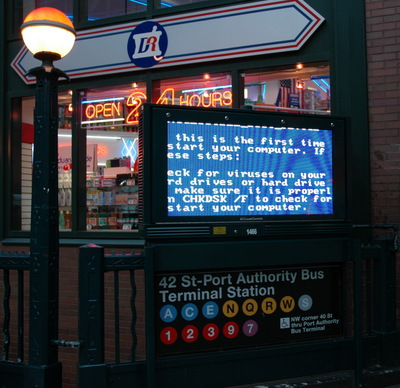
Groups that campaign for free technology, like the Free Software Foundation and the Electronic Frontier Foundation, tend to be supported primarily by technologists. Both groups have struggled to communicate their messages to non-geeks. I have written an article and helped create a new weblog, both called Revealing Errors, that attempt to address a root cause of this issue in what I hope is both an insightful and entertainingly manner. Geeks support groups like the FSF and EFF because, as people who understand technology, they understand just how powerful technology is. Geeks know that control of our communication technologies is control over what we can say, who we can say it to, and how and when we can say it. In an increasingly technologically mediated age, control over technology is not only the power to control our actions; it is the power to limit our possible actions. Our freedom to our technology is our freedom, full stop. This message fails to resonate with non-geeks but it does not fail because non-geeks are happy to hand over their freedom. It fails to resonate simply because the vast majority of people do not understand that technology, and control over it, is powerful enough to impact their freedom. Most people fail to see the power because, quite simply, most people fail to see technology. While we all see the effects of technologies, the technologies themselves are frequently hidden. We see emails but not mail transport agents. We see text messages but not the mobile phone network. Before one can argue that such systems must be free, one must reveal their existence. Technologists are keenly aware of the existence of these systems. To everyone else, they are completely invisible. Marc Weisner of Xerox PARC cited eyeglasses as an ideal technology because, with spectacles, "you look at the world, not the eyeglasses." When technology works smoothly, its nature and effects are invisible. But technologies do not always work smoothly. A tiny fracture or a smudge on a lens renders glasses quite visible to the wearer indeed. Similarly, people see their MTAs when messages bounce. They see Windows on their ATM or phone when the system crashes. Technological errors are moments when usually invisible technology becomes visible. They are, in this sense, also an educational opportunity. /copyrighteous/images/blue_screen.jpg I have recently published an article in Media/Culture Journal from the University of Melbourne within a special issue called Error. If you are interested in learning more about what I'm trying to do or looking at some examples, please read the article. With support and ontributions from Aaron Swartz, I have also created a new weblog, Revealing Errors, that reveals errors that reveal technology by posting descriptions of errors with commentary on what the error reveals. I've posted a few examples there already and I will be updating it regularly. The goal is to help explain the power and influence of technology in the service of broadening the base of people who can get excited about freedom to technology. Eventually, I hope to be able to communicate this message to a less technical audience. With that said, I hope that even seasoned technologists will learn things about their technological environment through the analysis and interaction. I hope readers of this blog will subscribe to it and, if possible, comment on and contribute to the project as it moves forward.
Jeff Bailey: Fog!

Wow! I'd totally forgotten about fog. It didn't happen so much in Toronto, but was the way that I used to be able to tell that autumn was here back in Vancouver. It wasn't anywhere near as thick as I like it, but for the first one, it wasn't bad.

I biked to work this morning for the first time, and there were a lot of cyclists out this morning. Yay!

Raphael Geissert: mass bugs filing: debian/watch fails to report upstream's version

About five minutes ago I started a script I wrote which is sending over 780 bug reports :).

I have to say at first I was a little bit afraid of something wrong happening (I've never done this before so I didn't want to create a massive mess) so after it sent like 7 bug reports I stopped the script to make sure it was all right.

After verifying the already sent bug reports I started the script once again :)

Right now I'm watching the script's output just to make sure it is all right:

...
Sending report for galrey (2p3-9)...done
Sending report for pads (1.0.2-1)...done
Sending report for qtemu (1.2-7)...done
Sending report for latrine (1.0.4-2)...done
Sending report for libfile-rsync-perl (0.10.0-1)...done
Sending report for mednafen (0.42-1)...done
Sending report for tau (0.8.1-1)...done
Sending report for trang (2.16.4-1)...done
Sending report for xoo (20030619-5.1)...done
...


All bug reports are user-tagged dehs-no-upstream.

This is only the first step on making Debian maintainers more "DEHS-aware" :D

6 November 2007

Enrico Zini: axi-searchasyoutype

apt-xapian-index: search as you type I've recently posted: Note that I've rewritten all the old posts to only show the main code snippets: if you were put off by the large lumps of code, you may want to give it another go. Today I'll show how to implement a very attractive feature for a user interface: search as you type. The idea is that you don't need to press enter to fire up a query: instead, the results materialise in front of your eyes as you type them. The example I created uses curses, but the idea is good on any interactive user interface. The main thing to keep in mind with search as you type is that the last word is likely to be partially typed, unless maybe some timeout expired since the user's last keystroke. Xapian comes into help here, as it allows us to expand the partially typed word into an OR query with all the terms that start with it. This means that if we are typing, for example, "progr", we can turn the query into "program OR programmer OR programming OR programmed [...and so on...]". I won't show the UI code, except a simple input loop that triggers the query at every keystroke:
    def mainloop(self):
        while True:
            c = self.win.getch()
            self.line += chr(c)
            self.results.update(self.line)
The interesting part is in the update function. First we split the line in words and convert the words into a query:
        # Split the line in words
        args = self.splitline.split(line)
        # Convert the words into terms for the query
        terms = termsForSimpleQuery(args)
Then we expand the last word with all possible completions:
        # Since the last word can be partially typed, we add all words that
        # begin with the last one.
        terms.extend([x.term for x in db.allterms(args[-1])])
Now we can build the query. Of course you can add all other sorts of things to the query, for example a boolean expression of tag filter like in axi-query-pkgtype.py; Xapian will cope.
        # Build the query
        query = xapian.Query(xapian.Query.OP_OR, terms)
Finally the query. For bonus points you can do the adaptive cutoff trick to discard bad results. In my case, since I don't implement scrolling of results, I also limit them to what fits in the window:
        # Retrieve as many results as we can show
        mset = enquire.get_mset(0, self.size - 1)
Finally, draw the results on screen:
        # Redraw the window
        self.win.clear()
        # Header
        self.win.addstr(0, 0, "%i results found." % mset.get_matches_estimated(), curses.A_BOLD)
        # Results
        for y, m in enumerate(mset):
            # /var/lib/apt-xapian-index/README tells us that the Xapian document data
            # is the package name.
            name = m[xapian.MSET_DOCUMENT].get_data()
            # Get the package record out of the Apt cache, so we can retrieve the short
            # description
            pkg = cache[name]
            # Print the match, together with the short description
            self.win.addstr(y+1, 0, "%i%% %s - %s" % (m[xapian.MSET_PERCENT], name, pkg.summary))
        self.win.refresh()
That's it, try it out. You can use the wsvn interface to get to the full source code and the module it uses. You can see a similar technique working in goplay, where it is also integrated with an interactive tag filter.

Russell Coker: Xen for Training

I’m setting up a training environment based on Xen. The configuration will probably be of use to some people so I’m including it below the fold. Please let me know if you have any ideas for improvements. The interface for the user has the following documentation:
(more…)

Wouter Verhelst: Programming languages suck?

Bruno De Wolf blogs about programming languages. His statement: "all programming languages suck". Not sure whether I agree. But's let look at his arguments. In his words, a good programming language, among others, is readable by a guy who didn't write the original program and who doesn't know all the language details or libraries. Personally, I don't agree. Code readability, above all, depends on the programmer. Programming languages that impose structure can probably help, but it's possible to create unreadable code in any language—that doesn't need goto. Since I went to the 'karel de grote' institute of higher education, I learned quite a number of programming languages. Hairy code is possible with all of them. Unreadable code is easy with some of them, and some of those I do consider good programming languages. I guess my criteria are different: That's it, I guess. In my book, a programming language is a tool to get a job done. A good tool is flexible, not too unwieldly, and somewhat intuitive. Like a hammer. If you want to build a table, you probably need a hammer, among other things. The better the hammer, the more likely it is that you'll get a nice table. But even the best hammer won't get you a wonderfully crafted table if your carpenter sucks at his craft. And so it is with programming languages: it might help if you use a proper language, but any good programmer can write readable code in any programming language.

Christian Perrier: RWC: France punished by Argentina

France sank against Argentina tonight. Last time France played in Parc des Princes, they were crushed by South-Africa, 10 years ago. The same happened tonight with an impressive victory by Argentina against France. France dominated the first 20 minutes but Argentina's defense was heroic and strong. Certainly the best defense play of this entire world cup, in this match, with a great organization around mauls, an impressive scrum and explosive tackles. After being dominated 26 minutes long and anyway scoring a try an, Argentina had to resist 10 minutes before half time when France unsuccessfully attempted to score a try (which would probably have changed the match). I think I will have to review these 10 minutes again as this was a demonstration of defensive play. It is indeed not a surprise that Ibanez lost his nerves and got expelled at the very end of 1st half time. Sad end of career...very similar to Zidane's one, indeed. In second half time, seeing France being crushed so hard was sometimes saddening but Argentina played so wonderfully that we could just be admirative of that play. Again, their solidarity and defensive play made the difference and, 5 tries later, they finally logically beat France. The Argentinian team is really a great satisfaction of the world cup. Playing only with 18 players, they only half-missed one match: their semi-final against South-Africa. I think they now really deserve to play in the Tri-Nations tournament along with New Zealand, Australia and South-Africa: if that doesn't happen, I will really think that other southern hemisphere nations are just cowards..:-) What about France? Well, this is a really sad ending for that world cup. Finishing with two very bad matches is really worrying for the future of that team. There are many promising players in that team (such as Dusautoir, Szarzewski...) and they can probably rebuild something and we still be enthusiast about that sport in this country.

Christian Perrier: RWC: Stunning Georgia

We watched either parts or the entire three matches yesterday. So, long report..:-) The day began with the most unbalanced game of this world cup, featuring New Zealand, world's top rugby team, against Portugal, ranked 22nd. Rugby in Portugal is played by about 4200 people only, in less than 50 clubs. All players are amateur but one (Gon alvo Uva, playing in Montpellier, France), being dentists, students, etc...and coming to RWC during their holidays. The result (108-13 and 16 tries) was expected but the feeling when Portugal scored a try was great, with the 40,000 attendees in Lyon supporting Portugal. Personnally, I had great time chatting on IRC with Miguel Figueiredo, one of the leaders of the portuguese l10n team in Debian, during the match. We watched Wales-Australia (20-32) during the evening. That game was obviously the key match of this pool, with the winner very probably finishing 1st in the pool. Wales playing in Millenium Stadium in Cardiff is always astonishing and show how much the Welsh people love this sport. During 1st half, Australia strongly dominated and logically lead 25-3 with 3 tries. Berrick Barnes, their new fly half (Stephen Larkham injured), is a very promising player and, imho, the match's MVP (even after being severely bashed by Gareth Thomas on Australia's first try). After half time, the Welsh team courageously fought and came back to 13-25, menacing Australia which was more hesitating. Unfortunately, Australia scored a try after a big mistake by Stephen Jones. So, even with good play by Wales and another try by the incredible wing player Shane Williams, Australia logically won this game. Again, a southern hemisphere team dominated a northern hemisphere one. This is probably what will happen during this entire WC and I bet that New Zealand, Australia and South Africa will end up in semi-finals, quite probably along with Argentina, unless France does a miracle and ends up 1st in their pool. I think that Australia is slightly weaker than NZ and RSA, though. So, my current bet is NZ-RSA for the final (this can happen, given their respective track to the final and given that they certainly will end up first of their respective pools). Finally, we watched the second half of Ireland-Georgia (14-10). *That* was quite a surprise. Ireland was very close to lose this game with Georgian forwards crushing them repeatedly at the end of the match and nearly scoring a try that would have made them win. Everybody was waiting for Georgia to swell after their strong 1st half (3-7) but they managed to fight until the last second, supported by Bordeaux 40,000 attendees (minus a few thousands of Irish supporters, of course). So, while the initial question was whether Ireland would score a bonus point, the final question became about them to *win* the match. This gives even more credit to Argentina's victory last Tuesday. Full standing ovation for Georgia at the end of the match. Today is again a busy day. I'll probably skip Fidji-Canada (which happens at the same time than France-Namibia) but certainly won't miss Samoa-Tonga and, of course, France-Namibia. Samoa have to win to keep their chances of qualifying (they can beat England, really) and, well, France has of course to win *and* score a bonus point. In this world cup where to so-called "small" teams are not that small, everything can happen and France is anything but safe, ehre.

Christian Perrier: RWC: Wales quietly to the 1/4th, France still alive

Thursday featured Wales-Japan which we briefly watched. Easy win for the Welsh who begin to secure down their qualification for the 1/4th finals. They'll just need a victory over Fidji on Sept 29th to do so (but Fidji would qualify by winning so that match will be one of those to watch during last round). Nothing really interesting to say about WAL-JPN (72-10). The difference in the front lines was too obvious for Japan to get any chance to win. However, at least during the first half of the first half-time, the were even leading after scoring one of the best tries as of now in the tournament. Yesterday was a key day for the French team. Victory against Ireland was mandatory. They made it (25-3, two tries) which is by far the most important. That wasn't definitely an easy match but noone was hoping it to be one. The french game is still far from being perfect (sometimes strange kick play and weird decisions by the rear players, sometimes slow assistance to players in rucks and sometimes stupid fouls giving their opponents opportunities to kick penalties (or expelled players as Traille was at the end of the game). On the other hand, some parts of the game were good quality: scrums (two balls won), line-outs (4 or 5 balls won on opponents' throw: great Julien Bonnaire there) and the magic inspiration of Elissalde and Michalak on the two tries as well as Clerc scoring these tries. There is still room for progress for the French, definitely (the same play against New Zealand, Australia or South Africa would be a loss). They're however on a good way. Next step is winning over Georgia, hopefully scoring a bonus point (that may be harder than expected as Georgia showed good defense) and hope that the Irish team will win over Argentina. Again, this week-end will be busy:

Christian Perrier: See you in BLR

The talks I proposed for FOSS.in, the major FLOSS conference in India, have been accepted for the Project Days, in the Debian-Ubuntu sessions. Thanks to the event organizers who will sponsor my travel to Bangalore, I'll probably leave as of Sunday Dec. 2nd and attend the entire conference from Dec. 4th to Dec. 8th. During earlier weeks, Sam Hocevar, the Debian Project Leader, also agreed to come to the conference and give two talks there. And, this morning, I had the nice surprise to discover that Lucas Nussbaum, one of our most tireless QA animators in Debian, will also come and give a talk about QA in Debian. So, that should make three French DD attending and, therefore, bring a strong Debian representation in this conference, which is something I definitely find interesting as I invested quite a lot of time and energy last years to increase the Debian presence in South Asia. This will certainly be a great occasion for us to give credit to the few people who contribute to Debian (and related projects) in India, and of course meet them in person. Please check the list of talks to get an idea of talks. Now for the challenge: the organizers expect our slides....by 7 days as of now. I don't know for Sam and Lucas but I have just begun working on one of my two talks (the i18n one, of course...you know: the one with the cute maps....). Would someone have a ready "How to contribute to Debian" talk somewhere? :-)

Christian Perrier: RWC: That will be South Africa-England

...and, really, we nearly never thought that Argentina could win tonight. South Africa was really too strong for them. The only domain where Argentinians dominated were scrums but this was much compensated by their great weakness on line-outs, losing something like 5 or 6 of them. South Africa thus logical won very easily...and Bryan Habana is now the best try scorer all along RWCs, along with Jonah Lomu. He is a really great player, indeed. Much much impressive South Africa: they'll be by far the favourites of the final against England, which they beated already during that World Cup. I said several times that I'm not a deep fan of RSA's play, but I could become one. Their game improved all along the World Cup and today, they probably played their best match. Two remakes next week-end: France-Argentina for the 3rd place and South Africa-England as final. That will be good matches, no doubt...and I hope that Bernard Laporte will change the French team to play against Argentina.

Christian Perrier: RWC: pronostic for the final

OK, I'm taking the risk of being ridiculous and have all my English friends laugh loudly in 3 hours. So, my bet is South Africa winning over England, 25-16 (3 tries, 2 transformed and 2 penalty kicks while England scores one trandformed try and 3 penalty kicks). The weather is *perfect* over Paris tonight. That will be a great final.

Christian Perrier: RWC: Argentina still there, Italy wakes up

After one day off, we watched Argentina-Georgia yesterday evening. Interesting game because it directly affect France's chances to qualify after Argentina's win on Friday. Argentina had a big disadvantage by playing only 4 days after their historic battle against France. As a logical consequence, they appeared quite tired and very imprecise. On the other hand, Georgia fought very courageously with a strong pack of forwards, encouraged by most of the crowd in Lyon. Finally, Argentina won *and* scored the bonus point by scoring a try in the very last minute (which might become very important to qualify in this pool. Good game even if Argentina was not that impressive, but I still think this is mostly because of the 4-days delay. Today, 3 games were scheduled. We didn't watch USA-Tonga (15-25). USA was slightly favourite for that one but they also were quite tired by playing 4 days only after their battle against England on Saturday. This was the first match for Tonga and obviously the island players were less tired and played a good rugby to win that one. Japan-Fidji (31-35) seems to have been the most uncertain match as of now. I somewhat regret not watching it as these two are among the teams I like watching and 7 tries in the match probably made it very interesting. Tonight, we watched Italy-Romania (24-18). The italians compete with Scotland for the remaining qualifying spot in that pool, if one assumes that New Zealand will obviously win all its matches. So, Italy *had* to win that match. The quality of romanian rugby has decreased in the last 10 years, but they still have a good set of great players, most of them playing...in France (just like one third of the italian team, indeed). The match was quite indecise with italy keeping the ball all first half long, but only leading 8-0 on half time....and being surprised by two romanian tries at the beginning of second half (8-12). After a strong domination of Italy, Romania was logically sanctioned by one expulsion and a penalty try (for successive voluntary faults), but, until the end, Italy was still in danger. They finally made it, which was the most important for them, 4 days after they were sweeped out by the All Blacks. We're now eagerly waiting for *THE* game of this week, England-South Africa in the Stade de France on Friday. Elizabeth found out that a few tickets are still available, but for 253 euros each, we decided to watch it on TV. So, between 21:00 and 23:00UTC that day, don't even think about pinging me on IRC. I still haven't decided who I'll support the most as I'm not a huge fan of either team....but they're still among the best in the world, of course.

Christian Perrier: DADVSI critical day

Today is the day where the very controversial DADVSI bill will be examined by the French Parliament. DADVSI stands for "Droit d'Auteur et les Droits Voisins dans la Soci t de l'Information" which can be roughly translated to "Author Rights and Related Rights in the Information Society". This very controversial bill includes some very ambiguous parts about software "that could be used to illegally exchange data over the Internet". The text is so vague that it can even interpreted as possibly allowing to forbig software authors to publish their sources....which explains why the French Free Software community reacted so strongly. This text is promoted by the major entertainment companies (Vivendi Universal and the like...). Some even said to representatives of the Free Software communities: "we will foirbid you to publish your sources". I'm feeling they're failing, though. The very active lobbying promoted by the EUCD.INFO initiative has already reached one goal: the bill will not be examined confidentially. For instance, I'm currently watching the LCI TV channel, one of the major news channels among satellite/cable/Internet channels in France and this problem is now in their major headlines. You're screwed, pals. Bottom line note: in France, laws are proposed by the government and must be examined, then voted, by the Parliament. The Parliament may "amend" a law (ie propose changes) which sometimes means completely changing it. We now have a great hope that this will happen as many of our representatives ("d put s"), including some from the current majority (right wing) and most of the left wing representatives, have expressed very strong reserves. Additionnal side note: at this moment, there are no less than 200 amendments proposed to this bill...:-)

Russell Coker: Squid and SE Linux

Is Squid not returning some data you need on a SE Linux system? The default configuration of the SE Linux policy for Squid only allows it to connect to a small number of ports which are used for web servers. For example ports http (80) and https (443) are labelled as http_port_t which permits serves such as Apache to bind to them and Squid to connect to them. But sometimes services run on non-standard ports and periodically new services are devised which use the HTTP protocol and thus you have Squid and Apache using new ports. semanage port -a -t http_port_t -p tcp 11371 One example of such a port is hkp (11371) - the latest protocol for sending and receiving GPG/OpenPGP keys. Running the above command relabelled the TCP port 11371 in question as http_port_t and thus allowed everything to work. setsebool -P squid_connect_any 1
An alternate option would be to run the above command to allow Squid to connect to any port. I will suggest that the upstream policy be changed to make the default labelling of TCP port 11371 be http_port_t, but the same operations can be used for other ports. Some people may claim that this makes things difficult for sys-admins. But the fact is that a well known port is a significant resource that you don’t want to permit any random user to access. Not only do the SE Linux port access controls prevent malice, but they also prevent system programs from accidentally using the wrong ports. A common example of accidental mis-use is the port 631 used for the IPP (Internet Printing Protocol - CUPS). When system programs need to use TCP source ports below 1024 they start at 1023 and work their way down, having such programs get down to 631 is not uncommon (there are some error conditions which result in ports being reserved for some minutes after use). In terms of malicious operations, it seems that the ports used by database servers such as MySQL and PostgreSQL would ideally be inaccessible to a Squid proxy, and services such as network backup should be inaccessible to everything other than the backup software.

John Goerzen: American Priorities

Number of people killed on Sept. 11, 2001: 2,974
Number of suicides in 2004: 32,439
Number of people killed on American highways in 2006: 38,588
Annual deaths from obesity:300,000
Total deaths from cancer in 2007:559,650
Total deaths from heart disease in 2004:871,500
 
Total military spending in FY2008: $1228 billion
Funding for health research & improvement (NIH):$29 billion
Total support of Amtrak (safer, cleaner than highways):$1.6 billion
National Highway Traffic Safety Admin. spending in FY2008: $0.8 billion
 
WHAT IS WRONG WITH THIS PICTURE?

Next.

Previous.

