Iustin Pop: Server upgrades and monitoring
Undecided whether the title should be "exercises in Yak shaving" or
"paying back technical debt" or "too much complexity for personal
systems". Anyway
I started hosting my personal website and some other small stuff on a
dedicated box (rented from a provider) in early 2008. Even for a
relatively cheap box, it worked without issues for a good number of
years. A surprising number of years, actually; the only issue was a
power supply failure that was solved by the provider automatically and
then nothing for many years. Even the harddrive (mechanical) had no
issues at all for 7 years (
Power_On_Hours: 64380; I probably got it
after it had a few months of uptime). I believe it was the longest
running harddrive I've ever used (for the record: Seagate
Barracuda 7200.10, ST3250310AS).
The reason I delayed upgrade for a long time was twofold: first, at
the same provider I couldn't get a similar SLA for the same amount of
money. I could get better hardware, but with worse SLA and
options. This is easily solvable, of course, by just finding a
different provider.
The other issue was that I never bothered to setup proper
configuration management for the host; after all, it was only supposed
to run Apache with ikiwiki and some other trivial small other
things. The truth was that over time it started pilling up more and
more "small things" so actually changing the host is expensive.
As the age of the server neared 7 years, I thought to combine upgrade
from Wheezy to Jessie with a HW upgrade. Managed to find a different
provider that had my desired SLA and HW configuration, got the server
and the only thing left was to do the migration.
Previous OS upgrades were simple as they were on the same host;
i.e. rely on Debian's reliable upgrade and nothing else to, eventually
adjust slightly some configs. With a cross-host upgrade (I couldn't
just copy the old OS since it was also a 32-to-64 bit change) it's
much worse: since there's no previous installation, I had to manually
check and port the old configuration for each individual service. This
got very tedious, and I realised I have to make it somehow better.
"Proper" configuration management aside, I thought that I need proper
monitoring first. I already had (for a long while actually) graphing
via Munin, but no actual monitoring. Since the host only had few
services, this was again supposed to be easy - same mistake again.
The problem is that once you have any monitoring system setup, it's
very easy to actually add "just one more" host or service to it. First
it was only the external box, then it was my firewall, then it was the
rest of my home network. Then it was the cloud services that I use for
example, checking whether my domain registrar's nameservers still are
authoritative for my domain or whether the expiration date it still
far in the future. And so on
In the end, what was in previous iterations (e.g. Squeeze to Wheezy
upgrade) a half-weekend job only, spread out over many weekends
(interleaved with other activities, not fully working on it). I had to
keep the old machine running for a month more in order to make sure
everything was up and running, and I ended up with 80 services
monitored across multiple systems; the migrated machine itself has
almost half of these. Some of these are light items (e.g. a checking
that a single vhost responds) other are aggregates. I still need to
add some more checks though, especially more complex (end-to-end)
ones.
The lesson I learned in all this is that, with or without
configuration management in place, having monitoring makes it much
easier do to host or service moves, as you know much better when
everything is done whether it's "done-done" or just "almost done".
The question that remains though: with 80 services for a home network
plus external systems (personal use); I'm not sure if I'm doing things
right (monitor the stuff I need) or wrong (do I really need these many
things)?
 I rarely watched TV online when I was located in the UK, but now I've moved to Finland with appalling local TV choices it has become more common.
The biggest problem with trying to watch BBC's iPlayer, and similar services, is the location restrictions.
Not a huge problem though:
 One of the packages that got


 For a while I've been wanting to tidy up some of my existing

 Like

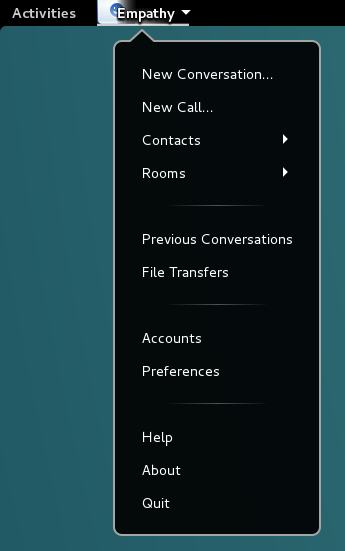
 We have to use the Empathy menu to start calls (New Call...) or access account settings:
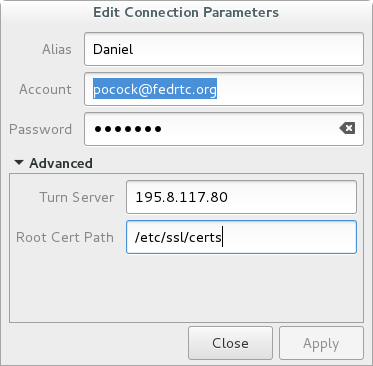
 The account settings are very simple. Everything can be discovered using NAPTR and SRV queries, saving the user typing. For now, the TURN server is entered manually but that can also be discovered using an SRV query.
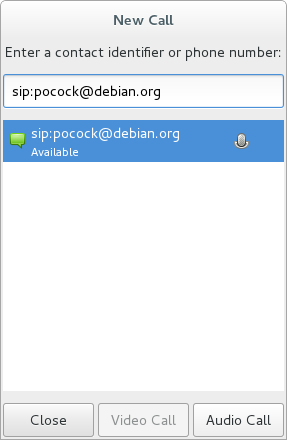
 Placing a call from my
 Project status and direction
More work is required to make this connection manager fully functional. It is available now for testing against other products and to get feedback about how the design should evolve.
 A big update of all related packages (tex-common 6.04, texlive-bin 2015.20150524.37493-7, texlive-base/lang/extra package 2015.20151016-1) due to the move to support multi-arch. Of course, the regular updates of the TeX Live are included, too. With this change it should be possible to run a multi-arch system with only one TeX Live installed.
 Thanks to the excellent support and testing of the Multi-arch guys, in particular Thorsten Glaser, Helmut Grohne, Johannes Schauer, and Wookey, I learned a lot about multi-arch, and I hope that the current setup is safe. All the packages but the various lib* packages are tagged as Multi-Arch: foreign, while the lib packages are tagged Multi-Arch: same. Anyway, if you find a bug concerning multi-arch, that is that some of the programs exhibit architecture information, please let us know via a bug report.
Updated packages
acro, alegreya, amiri, assoccnt, attachfile, babel-french, babel-hungarian, barr, beebe, biblatex-philosophy, bidi, bnumexpr, caption, chemfig, chemformula, chemmacros, cjk-gs-integrate, csplain, dantelogo, dataref, dtxgen, dvipdfmx-def, dvips, eledmac, elements, fcolumn, fithesis, fontspec, genealogytree, gradstudentresume, gtl, jfontmaps, knuth-local, koma-script, kotex-oblivoir, kotex-plain, kotex-utf, kpathsea, l3build, l3experimental, l3kernel, l3packages, latex, latexconfig, ledmac, ltxfileinfo, lualatex-math, luamplib, luatex, luatexbase, luatexja, luatexko, make4ht, mcf2graph, mflogo, modiagram, multiexpand, newtx, odsfile, old-arrows, paracol, pdfpages, pdftex, plain, pst-stru, pxchfon, randomwalk, reledmac, resumecls, rubik, selnolig, showhyphens, siunitx, suftesi, tetex, teubner, tex4ebook, tex4ht, texlive-scripts, tikzsymbols, tipfr, tools, tudscr, uassign, unicode-math, unravel, visualfaq, xepersian, xetex-def, xint.
New packages
archaeologie, ctablestack, dynamicnumber, exercises, fibeamer, h2020proposal, imfellenglish, lstbayes, tempora, xellipsis.
Enjoy.
 Earlier today,
 Note: 2015/10/16: I need to add some links but I won t delay this more, posting now, will edit later.
Summer ended long time ago, but believe me, I m still catching up with all the things that I began in June/July, all the things I left in August when I went holidays, and more things that appeared in August and September.
This is a long overdue post, I hope you bear with me for waiting so long, and writing (now) so long too!
June
In June, I was 100% sure that I would not attend


 I am not going to talk about Norbert Preining's continuous ranting
against Debian's Code of Conduct. Suffice to say that it annoys me, and
that I think he is wrong.
I am, however going to mention that contrary to
 I haven't had a blog for a few years now (and I might at some point be
tempted to import all the old content), but occasionally I just want to
point at something cool, rant about technology, or talk about my projects
in the hope that someone else gets inspired to point at, or rant about
them.
My current interests are
 Step by step, one slips towards the bottom:
 There are some things that I didn't mention in my sort-of quickly written entry about
 Two years ago, I

 In particular do I want to answer to two blogs: Lars Wirzenius
 What happened in the