Search Results: "tim"

7 July 2012

Tiago Bortoletto Vaz: Some pictures of DC11 Cheese and Wine party

In DebConf9 i worked on some photo editing and ended with a sort of over-saturated album which is still available online. For the C&W party in DebConf11 i tried to delivery a black and white set of pictures by just doing some adjustments using ufraw. Pictures were taken with a Nikon D50 camera + Nikkor 50mm 1/1.4 in raw mode. Here are some examples of the result:
debconf11debconf11debconf11
You can enjoy these and other DebConf11 shots by following the links in DC11 wikipage. (update: sorry for this old post being re-published in the planet, i've migrated my blog and this post got a new timestamp)

Bartosz Feński: God bless LVM

Correct me if I m wrong (and I really want to be wrong).
Is that whole LVM crap expects me to be forecaster/fortune-teller? I wanted to upgrade some squeeze based virtual machine to wheezy. Sounds nice, yeah?
So before the upgrade you should ensure that you have backup, right?
Assuming that whole system is LVM based all you have to do before upgrade is LVM snapshot.
I did it and I was quite surprised that I had to declare its size.
I did it basing on assumption that upgrade shouldn t take more than let say 5GB. Tada!
mastersrv:~# lvs
  LV       VG      Attr   LSize   Origin  Snap%  Move Log Copy%  Convert
  backup   virtual -wi-ao  50,00g                                       
  mainsrv  virtual -wi-ao 300,00g                                       
  redminbu virtual swi-a-   5,00g redmine   0,00                        
  redmine  virtual owi-a-  19,53g
Now I did upgrade redmine virtual machine and this is what I got:
mastersrv:~# lvs
  LV       VG      Attr   LSize   Origin  Snap%  Move Log Copy%  Convert
  backup   virtual -wi-ao  50,00g                                       
  mainsrv  virtual -wi-ao 300,00g                                       
  redminbu virtual Swi-I-   5,00g redmine 100.00                        
  redmine  virtual owi-ao  19,53g
These attr flags mean Snapshot invalid and Invalid snapshot .
End of the story this is last time I actually tried that method of backup.
Happily I have also some traditional backup (mysqldump+rsync) but I m really surprised that LVM works this way.
There was plenty of free space to enlarge that volume and this is what you get in your logs:
[13402279.777238] device-mapper: snapshots: Invalidating snapshot: Unable to allocate exception.
Unable to allocate exception? Did it really try to do it?
mastersrv:~# pvs
  PV         VG      Fmt  Attr PSize   PFree  
  /dev/md0   virtual lvm2 a-   884,01g 514,46g
I don t think so.

Petter Reinholdtsen: Free Timetabling Software - nice free software

Included in Debian Edu / Skolelinux is a large collection of end user and school specific software. It is one of the packages not installed by default but provided in the Debian archive for schools to install if they want to, is a system to automatically plan the school time table using information about available teachers, classes and rooms, combined with the list of required courses and how many hours each topic should receive. The software is named FET, and it provide a graphical user interface to input the required information, save the result in a fairly simple XML format, and generate time tables for both teachers and students. It is available both for Linux, MacOSX and Windows. This is the feature list, liftet from the project web site: I have not used it myself, as I am not involved in time table planning at a school, but it seem to work fine when I test it. If you need to set up your schools time table, and is tired of doing it manually, check it out. A quick summary on how to use it can be found in a blog post from MarvelSoft. If you find FET useful, please provide a recipe for the Debian Edu project in the Debian Edu HowTo section.

Keith Packard: FEC

Forward Error Correction with the TI CC1120 Sub-GHz transceiver We re building a new, fancier flight computer and decided to give the new, fancier TI CC1120 chip a try. It has significantly more transmit power (+16dBm) and receive sensitivity (-109dBm) than the transciever built in to the TI CC1111 RF SoC that we ve built our other boards with. Given that we d already decided to use a fancier STM32L processor, using the nicest stand-alone radio chip we could find seemed to make good sense. One of the nice features found in the CC1111 is support for FEC using a 1/2 rate constraint length 4 convolutional code. Both the encoder and the soft-decision Viterbi decoder are built right into the chip; all we had to do was flip a couple of bits and we got error correction, interleaving, data whitening and CRC checking all for free. We assumed that, as the CC1120 was advertised as a better replacement for our CC1111 radio, that it would also include all of these fine features. After we got the chip all soldered down to our first prototype boards, we read through the reference manual looking for the right register values to flip for forward error correction. We found support for CRC computation and data whitening, but no mention of interleaving or forward error correction at all. Thanks, TI. Of course, without the FEC pieces, the other packet handling hardware is worthless you can t exactly do a CRC on the encoded data and expect it to be useful on the other end of the link, and data whitening happens after the CRC. Basic CC1120 driver I assumed I d eventually figure out something to do about the FEC pieces and started writing a basic CC1120 driver AltOS, the operating system used in all of our projects. I started with the transmit side, as that seemed easier as I could use the existing packet hardware by uploading the desired bit sequence using whatever fancy encoding desired and the hardware would happily transmit it. I first tested that using low data-rate bits (2kbps), transmitting an alternating sequence of zeros and ones to generate a 1kHz tone on a regular 70cm receiver. That seemed to work just fine, demonstrating that I had some grasp of the basic operation of the chip. Convolutional Encoding in Software Not to be daunted by a small challenge in software, I set out to replicate the encoding scheme used in the CC1111 chips for use in our CC1120-based design. We obviously want our CC1120 boards to interoperate with the CC1111 boards. Fortunately, TI fully documents the CRC, data whitening, convolutional encoding and interleaving done in the hardware. I created my own implementation of the encoder (licensed, as usual, under the GPLv2) which you can see in the file ao_fec_tx.c It s not quite as flexible as the hardware, it always whitens the data and always appends the CRC bytes to the end of the packet, along with the necessary trellis termination bytes. The core of that code is surprisingly simple:
static const uint8_t ao_fec_encode_table[16] =  
/* next 0  1      state */
    0, 3,   /* 000 */
    1, 2,   /* 001 */
    3, 0,   /* 010 */
    2, 1,   /* 011 */
    3, 0,   /* 100 */
    2, 1,   /* 101 */
    0, 3,   /* 110 */
    1, 2    /* 111 */
 ;
uint8_t
ao_fec_encode(const uint8_t *in, uint8_t len, uint8_t *out)
 
    uint8_t     extra[AO_FEC_PREPARE_EXTRA];
    uint8_t     extra_len;
    uint32_t    encode, interleave;
    uint8_t     pair, byte, bit;
    uint16_t    fec = 0;
    const uint8_t   *whiten = ao_fec_whiten_table;
    extra_len = ao_fec_prepare(in, len, extra);
    for (pair = 0; pair < len + extra_len; pair += 2)  
        encode = 0;
        for (byte = 0; byte < 2; byte++)  
            if (pair + byte == len)
                in = extra;
            fec  = *in++ ^ *whiten++;
            for (bit = 0; bit < 8; bit++)  
                encode = encode << 2   ao_fec_encode_table[fec >> 7];
                fec = (fec << 1) & 0x7ff;
             
         
        interleave = 0;
        for (bit = 0; bit < 4 * 4; bit++)  
            uint8_t byte_shift = (bit & 0x3) << 3;
            uint8_t bit_shift = (bit & 0xc) >> 1;
            interleave = (interleave << 2)   ((encode >> (byte_shift + bit_shift)) & 0x3);
         
        *out++ = interleave >> 24;
        *out++ = interleave >> 16;
        *out++ = interleave >> 8;
        *out++ = interleave >> 0;
     
    return (len + extra_len) * 2;
 
ao_fec_encode_table takes care of the convolutional piece, ao_fec_whiten_table (not shown) contains the data whitening codes while the little loop at the bottom does the interleaving. I didn t spend a lot of time optimizing this as it seemed to run plenty fast on the 32MHz processor. With the bits all nicely encoded, I passed them to my simple CC1120 driver and let it send them along to our CC1111 receiver. Much to my delight, with only a few bugs fixed, it worked just fine! I d managed to get one direction working, validating the hardware and making it clear that we d at least be able to use the board in flight for telemetry. Getting Soft-decision data out of the CC1120 In packet mode, the CC1120 receiver converts the incoming GFSK stream directly into bits, making its best guess as to whether the detected value was a one or zero. Of course, like any FM modulation, the receiver will be producing intermediate values, especially when the signal is weak or masked by interference. A Viterbi decoder can make good use of this information;these noisy intermediate values are less influential in the final resulting path cost which allows the strong 0/1 values to pull the solution to the right one. Soft decision decoding yields a theoretical 2dB gain over hard decision decoders, and given our desire for maximum packet reception over long distances, it seemed important to make this work. The CC1120 has a way to recover the soft decision values, but only one 8-bit value at a time. It does, however, helpfully provide a GPIO wire which can be programmed to interrupt the CPU when the soft decision data has arrived. So, I hooked up a GPIO line on the processor to the GPIO line on the CC1120 and let it interrupt once per bit time, or 38400 times per second, to read this valuable soft decision data out of the radio part. According to TI support, this is the only way to make this work, and that they generally recommend that developers use the packet mode stuff and throw away this valueable source of data. I was happily surprised to learn that the STM32L can in fact survive this interrupt rate, and by setting interrupt priorities appropriately, I manage to reliably capture an entire packets worth of data without dropping a single bit. I set up a simple packet dumping function to run on the prototype board and captured raw encoded bytes from our CC1111-based flight computer so that I d have some real data to work from. Soft-decision Viterbi Decoding The sample encoding implementation from TI made that piece fairly straightforward. Lacking a similar sample for the decoding piece meant that I d be starting from scratch. And, implementing something that seemed like magic to me when I started. I started by reading a few articles on Viterbi decoding: I found Chip Fleming s tutorial very useful as it included a bunch of worked examples using a convolutional encoders with constraint length (k) of 3 instead of 4; this makes all of the trellis diagrams half the size. I also sent my friend, Phil Karn, a query about this process, and he responded with a bunch of helpful suggestions, while also recommending that I just steal his DSP and FEC library implementation. Of course, I don t like using code that I can t understand, and his code only implements much longer codes than I needed, so I d have to understand it anyways to make it work for me. Phil s code is a marvel, but it s not exactly comprehensible to someone who doesn t even know what a Viterbi decoder is supposed to do. So, with Chip s tutorial on my screen, I wrote a primitive Viterbi decoder. This did only the Viterbi step, and split that into two phases. The first computed the cost for each state in the system for every received pair of symbols received. It also tracked the chain of states through the entire decode process:
    for (state = 0; state < 8; state++)  
        struct ao_soft_sym zero = ao_soft_sym(ao_fec_encode_table[state * 2 + 0]);
        struct ao_soft_sym one = ao_soft_sym(ao_fec_encode_table[state * 2 + 1]);
        uint8_t zero_state = ao_next_state(state, 0);
        uint8_t one_state = ao_next_state(state, 1);
        int zero_cost = ao_cost(s, zero);
        int one_cost = ao_cost(s, one);
        zero_cost += cost[b][state];
        one_cost += cost[b][state];
        if (zero_cost < cost[b+1][zero_state])  
            prev[b+1][zero_state] = state;
            cost[b+1][zero_state] = zero_cost;
         
        if (one_cost < cost[b+1][one_state])  
            prev[b+1][one_state] = state;
            cost[b+1][one_state] = one_cost;
         
     
At the end of the packet, it found the least costly path and walked that from back to front, generating output bits (yes, one bit per element of the bits array):
for (state = 1; state < 8; state++)  
    if (cost[b][state] < c)  
        c = cost[b][state];
        min_state = state;
     
 
for (b = len/2; b > 0; b--)  
    bits[b-1] = min_state & 1;
    min_state = prev[b][min_state];
 
Completely separate from this code were the interleaving and data whitening stages. Keeping those separate allowed them to be tested independently, which made debugging them far easier. None of this code ever ran on the STM32L processor, it was instead run in a test framework on my laptop. I first got this working with data generated by the software convolutional encoder, then I managed to get it to decode the raw packets that I had recorded directly from the receiver it self. This marked a significant milestone in my mind I d managed to replace, in software, the CC1111 FEC encoder and decoder. However, the decoder performance was not fast enough to manage back-to-back packets yet. Having something in hand that worked meant that further development would be directly comparable to something that did work, making optimization much easier. Yet another lesson in making it work, and then making it work fast. Optimizing the Viterbi Decoder The first step was to reduce memory usage within the decoder. While it s best to defer computing the path until the very last bit has been received, it s also true that the chances of a bit affecting old data reduces as the distance between the new and old data increases. With the rule of thumb being a distance of k 6 or k 7, I saved 32 output bits for each state and wrote the oldest of 8 each time the buffer filled up, making a distance of 24 bits between the newest saved data and the current decoding position. That meant a fixed amount of storage was needed for an arbitrarily long packet. I tested a variety of different history sizes from 8 to 56 bits (cooresponding to 16, 32 and 64 bits of saved data for each state). With 100000 random packets generated that had gaussian noise added to each bit, here are the error rates for the different history lengths:
History LengthTotal PacketsCorrectIncorrect
8 bits10000090520 (90.52%)9480 (9.48%)
24 bits10000093614 (93.61%)6386 (6.39%)
56 bits10000093620 (93.62%)6380 (6.38%)
The performance of the 8-bit history and 16-bit history versions turned out to be essentially identical (given the 32-bit nature of the STM32L, that shouldn t be too surprising). The performance of the 56-bit version, which manipulated uint64_t data types was sigificantly slower, and given the very modest benefit, deemed not worth it. If we move to a larger constraint length (k > 4), or started using a punctured convolutional encoding, we would want to re-measure this. The next step was to combine the de-interleaving, decoding, de-whitening and CRC computation into a single loop. This would eliminate a pile of data copying and extra memory usage. Nothing fancy here, but it made enough of a difference that I could decode most of the incoming packets now, dropping only about 25% of them. To get to being able to decode every packet, I needed to start decoding the packet while it was being received. Because of interleaving, I had to have 32 bits of data to be able to decode anything, so it was a simple matter of having my per-soft-value interrupt handler start the decoder going after each interleave block of data was received. With this in place, I was able to decode a 76-byte payload (160 transmitted bits) in 14.7 ms, or just about 50% of the time it took to transmit the packet. Unrolling one of the inner decoding loops eliminated a bunch of computation and sped this up even more, decoding packets in 9.5ms. Success at last, a solid 100% of packets received were being decoded, as long as the CPU was otherwise idle. Finally, I went and re-read Phil Karn s code and pondered over how it works. It was opaque until I wrote a message back to Phil asking how it worked and pointing out sections that were confusing. Fortunately, simply phrasing my confusion in words made me understand how the code works. Here s my original code for computing the per-state cost metric:
/* Metric for a zero bit */
uint32_t    bitcost = ((uint32_t) (s0 ^ ao_fec_decode_table[(state<<1)]) +
               (uint32_t) (s1 ^ ao_fec_decode_table[(state<<1)+1]));
 
    /* Total path metric and state for a zero bit */
    uint32_t    cost0 = cost[p][state] + bitcost;
    uint8_t     state0 = ao_next_state(state, 0);
    /* Compare the total path metric against all existing
     * metrics heading into the same new state, choosing
     * the least expensive and killing the others.  Record
     * the new lowest cost and output bit.
     */
    if (cost0 < cost[n][state0])  
        cost[n][state0] = cost0;
        bits[n][state0] = (bits[p][state] << 1)   (state & 1);


    /* Total path metric and state for a one bit.  Because
     * encoding a one is always exactly the opposite of
     * encoding a zero from any state, this cost is
     * 255*2 - bitcost
     */
    uint32_t    cost1 = cost[p][state] + 510 - bitcost;
    uint8_t     state1 = ao_next_state(state, 1);
    if (cost1 < cost[n][state1])  
        cost[n][state1] = cost1;
        bits[n][state1] = (bits[p][state] << 1)   (state & 1);
     
 
Before this loop is run, I have to initialize cost[n] to a large value so that the comparisons will be true for the first case to reach each state. Phil s code, in contrast, doesn t have to initialize cost[n] as we know which two states can reach any possible new state. His code looks like this:
/* Metric for a zero bit */
bitcost = ((uint32_t) (s0 ^ ao_fec_decode_table[(state<<1)]) +
       (uint32_t) (s1 ^ ao_fec_decode_table[(state<<1) 1]));
/* Only state and state+4 reach state<<1 with a zero bit */
/* Cost from state to state<<1 for a zero bit*/
m0 = cost[p][state] + bitcost;
/* Cost from state+4 to state<<1 for a zero bit */
m1 = cost[p][state+4] + (510 - bitcost);
/* Which source state is cheaper? */
bit = m0 > m1;
/* Record the cheaper cost and the add to the path of bits */
cost[n][state<<1] = bit ? m1 : m0;
bits[n][state<<1] = (bits[p][state + (bit<<2)] << 1)   (state&1);
/* State and state+4 reach (state<<1)+1 with a one bit */
/* Cost from state to (state<<1)+1 for a one bit */
m0 -= (bitcost+bitcost-510);
/* Cost from state+4 to (state<<1)+1 for a one bit */
m1 += (bitcost+bitcost-510);
/* Which source state is cheaper? */
bit = m0 > m1;
/* Record cheaper cost and add to the path of bits */
cost[n][(state<<1)+1] = bit ? m1 : m0;
bits[n][(state<<1)+1] = (bits[p][state + (bit<<2)] << 1)   (state&1);
This code does two states at a time, and so while it s slightly longer than the above, it only needs to run half as many times. The resulting code now decodes packets in 5.7ms. The final version of the code can be see in ao_fec_rx.c The whole AltOS operating system, with many drivers and support for CC1111, AVR and STM32L processirs is available, under the GPLv2 from git://git.gag.com/scm/git/fw/altos

Robert Collins: Reprap driver pinouts

This is largely a memo-to-my-future self, but it may save some time for someone else facing what I was last weekend. I ve been putting together a Reprap recently, seeded by the purchase of a partially assembled one from someone local who was leaving town and didn t want to take it with them. One of the issues it had was that 2 of the stepstick driver boards it uses were burnt out, and in NZ there are no local suppliers that I could find. There is however a supplier of Easydriver driver boards, which are apparently compatible. (The Reprap electronics is a sanguinololu, which has a fitted strip that exactly matches stepstick (or pololu) driver boards. The Easydrivers are not physically compatible, but they should be pin compatible.. no? I mapped across all the pins carefully, and the only issues were: there are three GND s on the Easydriver vs 2 on the stepstick, and the PFD pin isn t exposed on the stepstick board so it can t be mapped across. I ended up with this mapping (I m not sure where pin 1 is *meant* to be on the stepstick, so I m starting with VMOT, the anti-clockwise corner pin on the same side as the 2B/2A/1A/1B pins, when looking down on an installed board pin 1, and going clockwise from there). Stepstick Easydriver VMOT M+
GND GND
2B B2
2A A2
1A A1
1B B1
VDD +5V
GND GND
Dir Dir
Step Step
Slp Slp
Rst Rst
Ms3 Nothing
Ms2 Ms2
Ms1 Ms1
En Enable But, when I tried to use this, the motor just jammed up solid. A bit of debugging and trial and error later and I figured it out. The right mapping for the motor pins: 2B B2
2A B1
1A A1
1B A2 Thats right, the two boards have chosen opposed elements for labelling of motors coils pins on the step stick 1/2 refers to the coil and A/B the two ends that need to have voltage put across them, on the easydriver A/B refer to the coil and 1/2 the two ends Super confusing, especially as I haven t been doing much electronics for oh, a decade or so. I m reminded very strongly of Rusty s scale of interface usability here.

6 July 2012

Gregor Herrmann: DebCamp impressions

I'm here in managua since sunday evening, & by now DebCamp is slowly getting to its end. So here are some of my impressions so far: thanks to all organizers & sponsors who make this experience happen!

Christian Perrier: DebConf running: take 4 (Masaya volcano)

Yet another Grand Plan today: run in Masaya Volcan National Park. Masaya Volcano is one of the most active volcanoes in Nicaragua. It is located only 20km south-east of Managua, so going there is as easy as renting a taxi. The original plan was to drive to the entrance of the National park (on the road to Masaya city), then run up to the volcan, so from 250m altitude up to about 600m. I therefore rented a taxi with the kind help of Norman, and we agreed to meet up at 08:30 at the hotel, along with No l and Daniel (who was planning to walk up, not running). After discussing here or there, Kurt and Gaudenz joined, both with the intent of running up. Others would also have liked to join, but I wasn't in the mood of organizing a full bus of Debconfers..:-). My plan was to enjoy pyself the hike...not to manage several taxis, etc. We thus packed in Denis blue taxi...a fancy and very visible customized blue car that looked like it had been the topic of on episode of the "Pimp My Ride" TV show..:-) Sitting 4 people at the back of a regular car without hitting some blue neon lights, or 7" TV screens is kinda tricky, but we made it. When arriving at the park's entrance, we however learned that it is forbidden to walk or hike up the road by foot, because of potential high concentrations of Carbon Dioxide. Sadly, we then had to pack again in the car and go up with it. After reaching the parking close to the volcano's active crater (that is said to have a small lava lake at its bottom, one of the very few in the world), we decided to head up for going round the Nindira crater, an inactive crater located slightly above. Unfortunately, again, the path around the Masaya crater is forbidden to walk on, because of landslides. We indeed still had great fun by running around this crater (which is about a 2.5 kilometers round trip, very very hilly and sometimes hard to run on such as a mountain path. After about 50 minutes and two laps (after all, we had a giant stadium!), we headed back to the parking, packed 5 sweating geeks in the car and went back to the hotel. Full GPS trace is here. I also put a few pictures on Facebook, supposedly visible by anybody : Masaya crater and Nindiri crater.

Matthew Garrett: DMI checks are a last resort

Most x86 devices export various bits of system information via SMBIOS, including the system manufacturer, model and firmware version. This makes it possible for the kernel to alter its behaviour depending on the machine it's running on, usually referred to as "DMI quirking". This is a very attractive approach to handling machine-specific bugs - unfortunately it also means that we often end up working around symptoms with no understanding of the underlying issue.

Almost all x86 hardware is tested with Windows. For the most part vendors don't ship devices that don't work - if you install a stock copy of Windows on a system, you expect it to boot successfully and reboot properly. Basic ACPI functionality should be present and correct, including processor power-saving states. Time should pass at something approximating the real rate. And since stock Windows isn't updated with large numbers of DMI quirk entries, the hardware needs to do this with an operating system that's already shipped.

Which means that if Linux doesn't provide the same level of functionality, it means we're doing something different to Windows. Sometimes this is because we're doing something fundamentally different with the hardware - the HP NX6125, for example, resets its thermal trip points if the timer is set up in a different way to Windows. In this case we've decided that the additional functionality of doing things the Linux way is worth it, and we'll just blacklist the small set of machines that are broken by it.

But other times there's no need for the difference. For years we were triggering system reboots in a different way to Windows and then adding DMI workarounds for any systems that didn't work. The problem with this approach is that it's basically impossible to guarantee that you've found the full set of broken hardware. It's very easy to add another DMI quirk, but it doesn't solve the problem for anyone who bought a machine, tried Linux and gave up when they found reboot didn't work. More recently we've added a pile of quirks for Dells - turns out that in all cases we're working around a bug in their firmware that hangs if we're using VT-d.

We typically don't merge code that fixes a specific example of a problem without at least considering whether there's a wider class of similar problems that could all be solved at once. We should take the same attitude to DMI quirks. Sometimes they're the least harmful way of handling an issue, but most of the time they're just fixing one person's itch and leaving a larger number of people to continue cursing at Linux. There should at least be a demonstration of an attempt to understand the underlying problem before just adding another quirk, and every patch that permits the removal of some DMI checks should be greeted with great cheer.

comment count unavailable comments

John Goerzen: How to listen to music?

This seems like a simple question: how do you listen to music? But in a way, I think I ve fallen behind the times. I ve enjoyed listening to digital music for years, since well before MP3 even existed (MIDI files could be comfortably downloaded over dialup; some of you may even remember MOD files). Anyhow, a few years ago, I digitized my entire CD collection, ripping it to FLAC and encoding to high-bitrate MP3 for storage on my 160GB iPod. Since, I ve purchased some music from DRM-free MP3 retailers, and even FLAC files from Magnatune, but at this point I basically say that I have enough music. I have only rarely bought anything new in the last couple of years. I have used Musicbrainz Picard to enforce consistent tagging across almost my entire collection. I am usually in front of a Linux machine. I run mt-daapd on my fileserver, so I can stream music from it to any other machine in the house. However, this has a lot of drawbacks. It is generally impossible to create or modify persistent playlists with this protocol. I can t modify metadata. I can t assign ratings. Though perhaps I don t need to. There are a lot of online services I could think of: Pandora, Spotify, Rdio, Slacker. Plus, of course, the upload your music to the cloud services such as Google and Amazon. Have people tried these? I m hesitant to use a service where I pay a monthly fee, unless I wind up owning the music in a DRM-free fashion. And I m a little nervous about the privacy implications of uploading a vast amount of music to the cloud. There are some items in my collection that I am certain are not available on any of those others, but for the most part I m willing to take what is out there if it meets my tastes. My tastes, by the way, typically run to classical and opera but also can go towards middle eastern or certain new age music (though I m very picky about that, since I don t care for most new age stuff I hear.) But these are huge categories; sometimes I d like to hear some load and noisy classical (say, Beethoven s Ninth conclusion, some Wagner, Verdi arias, etc.) And other times, something more contemplative (a Mozert concerto) or even quiet (a nice sonata) meet my mood. I have playlists for these on my iPod Classic a bit of a problem, since I don t use that device much anymore except in the car, and it takes a LOT of time to categorize things into these playlists. (An opera or a symphony could have parts in various styles and various levels of energy, for instance.) I keep a small manually-managed subset on my Android phone, which works fine. A recommendation engine for things like this could be useful, if it works well. My requirements, basically: I want something that will play the same music on my Linux machines. I want to be able to have playlists kept in sync across my machines. And I don t want a monthly fee. Ideally, the software will work on Android as well, and provide similar features there. Anything that requires Windows is a non-starter. I ve considered NFS mounts, but that s a bit annoying when the laptop disconnects from the network or when it s not at home. What are your thoughts? Ideas?

Lucas Nussbaum: Debian Maintainer Dashboard update

I ve spent some more time on Debian Maintainer Dashboard (DMD), a maintainer/team-centric dashboard relying on Ultimate Debian Database. Done:
- added tabs (jquery really rocks) see example
- added a hacking.html file that describes how to setup a development environment
- created a pad (http://debian.titanpad.com/DMD) to store ideas. TODO:
- recruit contributors ;)

Paul Tagliamonte: Thinkpad t520i Palmrest

Hello, Internets! After a bit of a disappointment with Lenovo, they ve come through with flying colors, My 520i s palmrest fractured in a couple of really gnarly ways. The machine was still usable, but the fractures were really bad, looked really gnarly and creaked a bit when I put any pressure around it. After having fancyhands call them a few times, each time returning a different part number, I complained on twitter only tagging @lenovo as an afterthought which (to my surprise) got a fast response and helpful email service. Here I am, 3 days later with a replaced palmrest. Nice ending, but I hope it won t happen again :)

5 July 2012

Steve McIntyre: DebCamp

Yay, got to Nicaragua OK last night. It's the first time I've managed to get to DebCamp in quite a while, and I'm making the most of it. I've got slides ready for two of my BoF sessions next week (both ARM-related), and I'm preparing for the other four now. Why did I sign up to run six sessions? Maybe because I'm a bit silly, or maybe because they needed doing and other people hadn't registered them. Maybe both. :-) BTW: these are all BoF (Birds of a Feather) sessions, not lectures. While I have an interest in each topic, I'm neither wanting nor expecting to just talk at a room full of people - I'm wanting to provoke discussions in each case. If you're interested, please join in those discussions, either physically in Managua or virtually using the live video streaming and IRC back-channels: See you there...!

Don Armstrong: Wikipedia Deletion Reviews

Many community driven projects have a problem with overgrown bureaucratic processes reducing the desire and ability of casual contributors to contribute. Debian has struggled with this problem, with efforts like Debian Maintainers and sponsorship to address it, but it's insidious and difficult to completely overcome. I recently ran into this problem again with Wikipedia, where I'm a casual contributor (I probably average an edit a month). Sometime in 2006, I uploaded an image of a Boojum tree I took in 2004 to Wikipedia to provide an image for the Boojum tree article. It wasn't a particularly awe inspiring image, as I took it while I was teaching second quarter freshmen biology on campus, and showing the students the awesome Botanical Gardens at UCR. In 2011, a Wikipedia user asked for deletion of the image because of some confusion about the copyright on the image, as Apache::Gallery's default template footer contains Apache::Gallery's copyright. I didn't notice that during the 7 day deletion review period because I rarely log into Wikipedia. A few days ago, I noticed the deletion and asked for a Deletion Review. I assumed that my explanation that the copyright notice was for Apache::Gallery would be understood (or at least believed), and that at least the original reason for the deletion would be seen to be invalid. Instead, during the process I was questioned as to whether I actually took the picture, why I used GPLv2+ for the pictures, whether I was claiming other people's images, and whether the image was actually good enough to be in Wikipedia in the first place. Hundreds of lines of text, an edit to the template in A::G, hours wasted, people still unsatisfied, and the potential contributor (myself) feeling so annoyed with the entire process that I bothered to write this blog entry. While I'm not sure what to do about Wikipedia, I've been forcibly reminded of how important enabling easy contributions are, and how alienated one can feel when one is stymied by them to the point that your (admittedly insignificant) contribution to a project no longer seems worth the effort.

Michal &#268;iha&#345;: Roadmap for Weblate 1.2

As Weblate 1.1 is out, it's time to schedule next release. This release will bring some small improvements to the workflow, especially it will allow to tune it to different use cases than I originally had in mind. I've already started tagging bugs and feature requests to be fixed in 1.2 in [issue tracker][4]. Basically no big features on the list, just smaller things like notifications and locking. And of course dozen of bugfixes as the bugs will appear :-). As you can see there as well, 1.2 should be ready about month from now. This will be possible only thanks to Hackweek VIII (the wiki is still showing last one), which will happen from July 23rd to July 27th. The rest is time for testing the features and polishing the features. Anyway I might have time for some other features as well, so 1.2 might bring more things than I currently plan. But that depends on how fast I will be in implementing planned stuff.

Filed under: English Suse Weblate 0 comments Flattr this!

4 July 2012

Christian Perrier: DebConf running: take 2

Second day in managua, second day running. Today, after breakfast, so at about 7h45, I went out running with Gaudenz Steinlin. The goal was to go to laguna de Tiscapa, a lagoon of volcanic origin, in the middle of the city of Managua. The laguna is not really far away from the place we're staying at (about 2.5km). However, as usual here, the only way to get there is along the streets. Noisy streets. Often smelly streets. But that's the only way. For instance, it took Gaudenz several minutes before he could manage to cross the "Pista Beljamin Zelodon", a quite busy highway. The lagoon per se is really nice, particularly the view from the Sandino monument where you can see the Peninsula de Chiltepe. However, apart from that, it was sometimes a quite boring run because of the traffic, noise, etc. But I enjoyed again having a good run with Gaudenz. We'll do this again, but in another place..:-) GPS trace for that run is here.

Johannes Schauer: enumerating elementary circuits of a directed_graph

For my GSoC project this year I need to be able to enumerate all elementary circuits of a directed graph. My code is written in Ocaml but neither the ocamlgraph library nor graph libraries for other languages seem to implement a well tested algorithm for this task. In lack of such a well tested solution to the problem, I decided to implement a couple of different algorithms. Since it is unlikely that different algorithms yield the same wrong result, I can be certain enough that each individual algorithm is working correctly in case they all agree on a single solution. As a result I wrote a testsuite, containing an unholy mixture of Python, Ocaml, D and Java code which implements algorithms by D. B. Johnson, R. Tarjan, K. A. Hawick and H. A. James.
Algorithm by R. Tarjan The earliest algorithm that I included was published by R. Tarjan in 1973.
Enumeration of the elementary circuits of a directed graph
R. Tarjan, SIAM Journal on Computing, 2 (1973), pp. 211-216
http://dx.doi.org/10.1137/0202017
I implemented the pseudocode given in the paper using Python. The git repository can be found here: https://github.com/josch/cycles_tarjan

Algorithm by D. B. Johnson The algorithm by D. B. Johnson from 1975 improves on Tarjan's algorithm by its complexity.
Finding all the elementary circuits of a directed graph.
D. B. Johnson, SIAM Journal on Computing 4, no. 1, 77-84, 1975.
http://dx.doi.org/10.1137/0204007
In the worst case, Tarjan's algorithm has a time complexity of O(n e(c+1)) whereas Johnson's algorithm supposedly manages to stay in O((n+e)(c+1)) where n is the number of vertices, e is the number of edges and c is the number of cycles in the graph. I found two implementations of Johnson's algorithm. One was done by Frank Meyer and can be downloaded as a zip archive. The other was done by Pietro Abate and the code can be found in a blog entry which also points to a git repository. The implementation by Frank Meyer seemed to work flawlessly. I only had to add code so that a graph could be given via commandline. The git repository of my additions can be found here: https://github.com/josch/cycles_johnson_meyer Pietro Abate implemented an iterative and a functional version of Johnson's algorithm. It turned out that both yielded incorrect results as some cycles were missing from the output. A fixed version can be found in this git repository: https://github.com/josch/cycles_johnson_abate

Algorithm by K. A. Hawick and H. A. James The algorithm by K. A. Hawick and H. A. James from 2008 improves further on Johnson's algorithm and does away with its limitations.
Enumerating Circuits and Loops in Graphs with Self-Arcs and Multiple-Arcs.
Hawick and H.A. James, In Proceedings of FCS. 2008, 14-20
www.massey.ac.nz/~kahawick/cstn/013/cstn-013.pdf
In contrast to Johnson's algorithm, the algorithm by K. A. Hawick and H. A. James is able to handle graphs containing edges that start and end at the same vertex as well as multiple edges connecting the same two vertices. I do not need this functionality but add the code as additional verification. The paper posts extensive code snippets written in the D programming language. A full, working version with all pieces connected together can be found here: https://github.com/josch/cycles_hawick_james The algorithm was verified using example output given in the paper. The project README states how to reproduce it.

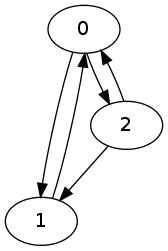
Input format All four codebases have been modified to produce executables that take the same commandline arguments which describes the graphs to investigate. The first argument is the number of vertices of the graph. Subsequent arguments are ordered pairs of comma separated vertices that make up the directed edges of the graph. Lets look at the following graph as an example: cycle example The DOT source for this graph is:
digraph G  
  0;
  1;
  2;
  0 -> 1;
  0 -> 2;
  1 -> 0;
  2 -> 0;
  2 -> 1;
   
To generate the list of elementary circuits using Tarjan's algorithm for the graph above, use:
$ python cycles.py 3 0,1 0,2 1,0 2,0 2,1
0 1
0 2
0 2 1
The commandline arguments are the exact same for the other three methods and yield the same result in the same order. If the DOT graph is in a format as simple as above, the following sed construct can be used to generate the commandline argument that represents the graph:
$ echo  sed -n -e '/^\s*[0-9]\+;$/p' graph.dot   wc -l   sed -n -e 's/^\s*\([0-9]\) -> \([0-9]\);$/\1,\2/p' graph.dot 

Testsuite As all four codebases take the same input format and have the same output format, it is now trivial to write a testsuite that compares the individual output of each algorithm for the same input and checks for differences. The code of the testsuite is available via this git repository: https://github.com/josch/cycle_test The other four repositories exist as submodules of the testsuite repository.
$ git clone git://github.com/josch/cycle_test.git
$ cd cycle_test
$ git submodule update --init
A testrun is done via calling:
$ ./test.sh 11
The argument to the shell script is an integer denoting the maximum number N of vertices for which graphs will be generated. The script will compile the Ocaml, Java and D sourcecode of the submodules as well as an ocaml script called rand_graph.ml which generates random graphs from v = 1..N vertices where N is given as a commandline argument. For each number of vertices n, e = 1..M number of edges are chosen where M is maximum number of edges given the number of vertices. For every combination of number of vertices v and number of edges e, a graph is randomly generated using Pack.Digraph.Rand.graph from the ocamlgraph library. Each of those generated graphs is checked for cycles and written to a file graph-v-e.dot if the graph contains a cycle. test.sh then loops over all generated dot files. It uses the above sed expression to convert each dot file to a commandline argument for each of the algorithms. The outputs of each algorithm are then compared with each other and only if they do not differ, does the loop continue. Otherwise the script returns with an exit code. The tested algorithms are the Python implementation of Tarjan's algorithm, the iterative and functional Ocaml implementation as well as the Java implementation of Johnson's algorithm and the D implementation of the algorithm by Hawick and James.

Future developments Running the testsuite with a maximum of 12 vertices takes about 33 minutes on a 2.53GHz Core2Duo and produces graphs with as much as 1.1 million cycles. It seems that all five implementations agree on the output for all 504 generated graphs that were used as input. If there should be another implementation of an algorithm that enumerates all elementary circuits of a directed graph, I would like to add it. There are some more papers that I would like to read but I lack access to epubs.siam.org and ieeexplore.ieee.org and would have to buy them. Benchmarks seem a bit pointless as not only the algorithms are very different from each other (and there are many ways to tweak each of them) but also the programming languages differ. Though for the curious kind, it follows the time each algorithm takes to enumerate all cycles for all generated graphs up to 11 vertices.
algorithmtime (s)
Johnson, Abate, Ocaml, iterative137
Johnson, Abate, Ocaml, functional139
Tarjan, Python153
Hawick, D175
Johnson, Meyer, Java357
The iterative Ocaml code performs as well as the functional one. In practice, the iterative code should probably be preferred as the functional code is not tail recursive. On the other hand it is also unlikely that cycles ever grow big enough to make a difference in the used stack space. The Python implementation executes surprisingly fast, given that Tarjan's algorithm is supposedly inferior to Johnson's and given that Python is interpreted but the Python implementation is also the most simple one with the least amount of required datastructures. The D code potentially suffers from the bigger datastructures and other bookkeeping that is required to support multi and self arcs. The java code implements a whole graph library which might explain some of its slowness.

Michael Banck: 4 Jul 2012

Update on computational chemistry packages in Debian

For many years, me and the Debichem team maintained two computational chemistry packages, first MPQC and later PSI3. In recent years however, two respected quantum chemistry codes have been open sourced and are now available in Debian: ACESIII and NWChem. Make no mistake, those are not recently started codes or some Ph.D.'s pet-project but state-of-the-art projects targeted at massively parallel supercomputers and developed at the University of Florida's Quantum Chemistry Project (QTP) in the case of ACESIII and at Pacific Northwest National Laboratory (PNNL) for NWChem.

While ACESIII has a somewhat narrow focus on Coupled-Cluster (unfortunately, the current version does not yet implement analytic gradients for the "golden standard" CCSD(T) method) and Multi-Body Perturbation Theory methods, NWChem is a very versatile package supporting a variety of molecular quantum chemistry methods (including Density Functional Theory (DFT)), as well as periodic plane-wave electronic structure and (ab-initio and classical) molecular dynamics. At this point, NWChem probably covers 90% of all use cases for routine computational chemistry compared to the popular non-free codes Gaussian and GAMESS, while likely exhibiting superior parallel scaling at least compared to Gaussian.

Over the last year, I have packaged and integrated NWChem and ACESIII for Debian, and they are now both in testing. Furthermore, I have recently overhauled the packaging of MPQC and enabled parallel execution via MPI. Further, both MPQC and PSI will see updated versions (MPQC3 and PSI4) in the near future with significant increased functionality, including some unique (at least among open source codes) features like Symmetry-Adapted Perturbation Theory (SAPT) for PSI4 and general explicitly correlated corrections ([2]f12) for MPQC3. Unfortunately, they both did not get released in time for the wheezy freeze.

On the periodic/plane-wave front, I have also packaged and uploaded Quantum ESPRESSO (formerly PwSCF), a set of plane-wave programs, and I have been working with lafur Jens Sigur sson to get the latest Abinit release packaged. The nanoscale-physics team is also targeting further periodic ab-initio packages like BigDFT and Octopus, but those as well did not land in time for the freeze.

Finally, I also packaged and uploaded CP2K, a well-engineered and versatile periodic plane-wave/pseudo-potential code which focuses on state-of-the-art ab-initio Molecular Dynamics (AIMD) using Density Functional Theory. Some of the authors have recently published a paper reporting linear scaling benchmark calculations on a system with a million atoms using almost 50,000 CPU cores.

All of the above mentioned packages are included either in the molecular ab-initio or the periodic ab-initio Debichem tasks.

Stefano Zacchiroli: bits from the DPL for June 2012

Monthly DPL bits, fresh from the oven^W^W^W hot from DebConf12, and just posted to d-d-a.
Howdy from DebConf12. It's hot, but it's also time to bother you again with a (not so) brief DPL activity report, this time for June 2012. Time-based freeze: DONE, short freeze: TODO Two highlights for this month. First, you've probably noticed Wheezy is now frozen, YAY. This is huge achievement for the release, but also for the project. It's the first time we do a time-based freeze, and it took some quite heated discussion at the beginning of the release cycle to decide to do this. And we did it properly: respecting the planned month and narrowing down the period later. This exercise has hopefully helped both DDs in their package planning and our upstreams in targeting Wheezy with stable releases of their software. Kudos to the release team for their coordination work! Now we've the second part still TODO: releasing Wheezy, without RC bugs, with a freeze period as short as possible. See the beginning of my last "bits from the DPL" mail for my usual song and dance :-P on how to deliver that, together. DebConf12 A lot of us will attend DebConf12. Enjoy it! ... and take the chance to both have fun and make great plans for Debian's future. But remember that "if it didn't happen on a mailing list, it didn't happen". Not all of us will be lucky enough to attend DebConf (in person or remotely). Make sure that those who don't can take part in your team decisions and get informed of what is going to happen here. Politics Zack's spring tour I spent a significant part of June doing Debian talks ins some sort of "spring tour" between Italy and France. In particular: Many thanks to the organizers of these events for inviting and sponsoring me (as well as other Debian people, in the ESRF case) and for their interest in Debian. Sprints Assets Discussions Some relevant discussions for project evolution has been going on in June and I took part into them. You might want to have a look at them: Misc Cheers.
PS the boring day-to-day activity log for June is available at master:/srv/leader/news/bits-from-the-DPL.txt.201206

Dirk Eddelbuettel: RcppBDT 0.2.0

A new release of the RcppBDT package appeared on CRAN earlier today. RcppBDT uses Rcpp, and in particular the nifty Rcpp modules feature of wrapping C++ code for R just by declaring the (class or function) interfaces. It uses this to bring in some useful functions from Boost Date.Time to R so that one can do things like
R> library(RcppBDT)
R> sapply(2012:2016, function(year)
+         format(getNthDayOfWeek(first, Mon, Sep, year)))
[1] "2012-09-03" "2013-09-02" "2014-09-01" "2015-09-07" "2016-09-05"
R> 
to compute the next five Labor Day dates in the US, given the year and the first Monday of September requirement. More examples are e.g. on the earlier blog post announcing version 0.1.0. Changes are mostly internal. R 2.15.1 brough a better / easier way to load such 'modules' into R, and Rcpp 0.9.13 allows us to use this. So RcppBDT continues to be useful as an example package for Rcpp modules. I also streamlines the interface a little: identifiers are now directly accessible in the package's NAMESPACE rather than just via the an instantiated object. I also added a NEWS file, using the .Rd format so that we can import the marked-up text:
News for Package RcppBDT Changes in version 0.2.0 (2012-07-02)
  • The core module, which wraps what in C++ is boost::gregorian::date, is now exposed as an Rcpp module bdtDate. As all example and demos operated off a (package-global) variable 'bdt', no user visible change was needed outside of the code instantiating at package load.
  • Updated package instantiation to the new facilities offered by the current versions R 2.15.1 and Rcpp 0.9.13 which make Rcpp module initialization easier and more streamlined.
Changes in version 0.1.0 (2011-01-17)
  • First CRAN upload (and see ChangeLog for more granular details) bug fix in svm cross validation
Courtesy of CRANberries, there is also a diffstat report for 0.2.0 relative to 0.1.0. As always, feedback is welcome and the rcpp-devel mailing list off the R-Forge page for Rcpp is the best place to start a discussion.

3 July 2012

Ryan Kavanagh: Fixing mutt header cache

Every now and then I have to kill mutt, which if done at the wrong time, can leave the header cache in an open state. Then attempting to restart mutt will cause it to hang at the "Selecting INBOX" stage. If mutt is compiled with support for the Tokyo Cabinet header cache backend (as it appears to be in Debian), a quick fix for this issue is to repair the header cache database using the Tokyo Cabinet utility tcbmgr from the tokyocabinet-bin package. Simply running tcbmgr optimize -nl ~/.mutt/cache/headers does the trick, and is much nicer of a fix than deleting the header cache.

Next.

Previous.
