Search Results: "mak"

17 July 2010

Joachim Breitner: How forky may one maintain a Debian package?

I maintain most of my Debian packages because I use them myself. Sometimes, I have some needs that go slightly beyond what is currently offered by the software. This is not a problem: Debian ships Free Software and I can program, therefore I can patch the software to also do what I want it to do. Trying to be a good member of the Free Software community, I then submit the patch to the upstream author. If he accepts the patch (which is usually the case), everything is fine. But what if he does not reply to the report or rejects it because he does not want this feature (although the patch is technically fine)? I see two options:
  1. I could continue to use a privately patched and built version of the package, while separately building packages for Debian. This way, Debian ships the software as intended by the upstream maintainer while I can use the features I need. On the other hand, I would not be using the version that I upload to Debian, which is not good, and it causes double work when a a new version is released.
  2. I could upload a package to Debian that contains my patch. The technical infrastructure to add patch in Debian packages has always been there... I would actually use the package as it is in Debian and only manage one line of versions. But would I be abusing my powers as a Debian maintainer? If I were not the maintainer, I could not make this decision by myself (this happend with my patch to nagstamon). Plus it could have a negative effect on the Debian-upstream relationship.
How do other Debian Developers handle such issues? The actual case I m considering is a feature enhancement for link-monitor-applet (but I only just wrote the patch, so it does not yet fall in the category upstream does not reply ).

Petter Reinholdtsen: What are they searching for - PowerDNS and ISC DHCP in LDAP

This is a followup on my previous work on merging all the computer related LDAP objects in Debian Edu. As a step to try to see if it possible to merge the DNS and DHCP LDAP objects, I have had a look at how the packages pdns-backend-ldap and dhcp3-server-ldap in Debian use the LDAP server. The two implementations are quite different in how they use LDAP. To get this information, I started slapd with debugging enabled and dumped the debug output to a file to get the LDAP searches performed on a Debian Edu main-server. Here is a summary. powerdns Clues on how to set up PowerDNS to use a LDAP backend is available on the web. PowerDNS have two modes of operation using LDAP as its backend. One "strict" mode where the forward and reverse DNS lookups are done using the same LDAP objects, and a "tree" mode where the forward and reverse entries are in two different subtrees in LDAP with a structure based on the DNS names, as in tjener.intern and 2.2.0.10.in-addr.arpa. In tree mode, the server is set up to use a LDAP subtree as its base, and uses a "base" scoped search for the DNS name by adding "dc=tjener,dc=intern," to the base with a filter for "(associateddomain=tjener.intern)" for the forward entry and "dc=2,dc=2,dc=0,dc=10,dc=in-addr,dc=arpa," with a filter for "(associateddomain=2.2.0.10.in-addr.arpa)" for the reverse entry. For forward entries, it is looking for attributes named dnsttl, arecord, nsrecord, cnamerecord, soarecord, ptrrecord, hinforecord, mxrecord, txtrecord, rprecord, afsdbrecord, keyrecord, aaaarecord, locrecord, srvrecord, naptrrecord, kxrecord, certrecord, dsrecord, sshfprecord, ipseckeyrecord, rrsigrecord, nsecrecord, dnskeyrecord, dhcidrecord, spfrecord and modifytimestamp. For reverse entries it is looking for the attributes dnsttl, arecord, nsrecord, cnamerecord, soarecord, ptrrecord, hinforecord, mxrecord, txtrecord, rprecord, aaaarecord, locrecord, srvrecord, naptrrecord and modifytimestamp. The equivalent ldapsearch commands could look like this:
ldapsearch -h ldap \
  -b dc=tjener,dc=intern,ou=hosts,dc=skole,dc=skolelinux,dc=no \
  -s base -x '(associateddomain=tjener.intern)' dNSTTL aRecord nSRecord \
  cNAMERecord sOARecord pTRRecord hInfoRecord mXRecord tXTRecord \
  rPRecord aFSDBRecord KeyRecord aAAARecord lOCRecord sRVRecord \
  nAPTRRecord kXRecord certRecord dSRecord sSHFPRecord iPSecKeyRecord \
  rRSIGRecord nSECRecord dNSKeyRecord dHCIDRecord sPFRecord modifyTimestamp
ldapsearch -h ldap \
  -b dc=2,dc=2,dc=0,dc=10,dc=in-addr,dc=arpa,ou=hosts,dc=skole,dc=skolelinux,dc=no \
  -s base -x '(associateddomain=2.2.0.10.in-addr.arpa)'
  dnsttl, arecord, nsrecord, cnamerecord soarecord ptrrecord \
  hinforecord mxrecord txtrecord rprecord aaaarecord locrecord \
  srvrecord naptrrecord modifytimestamp
In Debian Edu/Lenny, the PowerDNS tree mode is used with ou=hosts,dc=skole,dc=skolelinux,dc=no as the base, and these are two example LDAP objects used there. In addition to these objects, the parent objects all th way up to ou=hosts,dc=skole,dc=skolelinux,dc=no also exist.
dn: dc=tjener,dc=intern,ou=hosts,dc=skole,dc=skolelinux,dc=no
objectclass: top
objectclass: dnsdomain
objectclass: domainrelatedobject
dc: tjener
arecord: 10.0.2.2
associateddomain: tjener.intern
dn: dc=2,dc=2,dc=0,dc=10,dc=in-addr,dc=arpa,ou=hosts,dc=skole,dc=skolelinux,dc=no
objectclass: top
objectclass: dnsdomain2
objectclass: domainrelatedobject
dc: 2
ptrrecord: tjener.intern
associateddomain: 2.2.0.10.in-addr.arpa
In strict mode, the server behaves differently. When looking for forward DNS entries, it is doing a "subtree" scoped search with the same base as in the tree mode for a object with filter "(associateddomain=tjener.intern)" and requests the attributes dnsttl, arecord, nsrecord, cnamerecord, soarecord, ptrrecord, hinforecord, mxrecord, txtrecord, rprecord, aaaarecord, locrecord, srvrecord, naptrrecord and modifytimestamp. For reverse entires it also do a subtree scoped search but this time the filter is "(arecord=10.0.2.2)" and the requested attributes are associateddomain, dnsttl and modifytimestamp. In short, in strict mode the objects with ptrrecord go away, and the arecord attribute in the forward object is used instead. The forward and reverse searches can be simulated using ldapsearch like this:
ldapsearch -h ldap -b ou=hosts,dc=skole,dc=skolelinux,dc=no -s sub -x \
  '(associateddomain=tjener.intern)' dNSTTL aRecord nSRecord \
  cNAMERecord sOARecord pTRRecord hInfoRecord mXRecord tXTRecord \
  rPRecord aFSDBRecord KeyRecord aAAARecord lOCRecord sRVRecord \
  nAPTRRecord kXRecord certRecord dSRecord sSHFPRecord iPSecKeyRecord \
  rRSIGRecord nSECRecord dNSKeyRecord dHCIDRecord sPFRecord modifyTimestamp
ldapsearch -h ldap -b ou=hosts,dc=skole,dc=skolelinux,dc=no -s sub -x \
  '(arecord=10.0.2.2)' associateddomain dnsttl modifytimestamp
In addition to the forward and reverse searches , there is also a search for SOA records, which behave similar to the forward and reverse lookups. A thing to note with the PowerDNS behaviour is that it do not specify any objectclass names, and instead look for the attributes it need to generate a DNS reply. This make it able to work with any objectclass that provide the needed attributes. The attributes are normally provided in the cosine (RFC 1274) and dnsdomain2 schemas. The latter is used for reverse entries like ptrrecord and recent DNS additions like aaaarecord and srvrecord. In Debian Edu, we have created DNS objects using the object classes dcobject (for dc), dnsdomain or dnsdomain2 (structural, for the DNS attributes) and domainrelatedobject (for associatedDomain). The use of structural object classes make it impossible to combine these classes with the object classes used by DHCP. There are other schemas that could be used too, for example the dnszone structural object class used by Gosa and bind-sdb for the DNS attributes combined with the domainrelatedobject object class, but in this case some unused attributes would have to be included as well (zonename and relativedomainname). My proposal for Debian Edu would be to switch PowerDNS to strict mode and not use any of the existing objectclasses (dnsdomain, dnsdomain2 and dnszone) when one want to combine the DNS information with DHCP information, and instead create a auxiliary object class defined something like this (using the attributes defined for dnsdomain and dnsdomain2 or dnszone):
objectclass ( some-oid NAME 'dnsDomainAux'
    SUP top
    AUXILIARY
    MAY ( ARecord $ MDRecord $ MXRecord $ NSRecord $ SOARecord $ CNAMERecord $
          DNSTTL $ DNSClass $ PTRRecord $ HINFORecord $ MINFORecord $
          TXTRecord $ SIGRecord $ KEYRecord $ AAAARecord $ LOCRecord $
          NXTRecord $ SRVRecord $ NAPTRRecord $ KXRecord $ CERTRecord $
          A6Record $ DNAMERecord
    ))
This will allow any object to become a DNS entry when combined with the domainrelatedobject object class, and allow any entity to include all the attributes PowerDNS wants. I've sent an email to the PowerDNS developers asking for their view on this schema and if they are interested in providing such schema with PowerDNS, and I hope my message will be accepted into their mailing list soon. ISC dhcp The DHCP server searches for specific objectclass and requests all the object attributes, and then uses the attributes it want. This make it harder to figure out exactly what attributes are used, but thanks to the working example in Debian Edu I can at least get an idea what is needed without having to read the source code. In the DHCP server configuration, the LDAP base to use and the search filter to use to locate the correct dhcpServer entity is stored. These are the relevant entries from /etc/dhcp3/dhcpd.conf:
ldap-base-dn "dc=skole,dc=skolelinux,dc=no";
ldap-dhcp-server-cn "dhcp";
The DHCP server uses this information to nest all the DHCP configuration it need. The cn "dhcp" is located using the given LDAP base and the filter "(&(objectClass=dhcpServer)(cn=dhcp))". The search result is this entry:
dn: cn=dhcp,dc=skole,dc=skolelinux,dc=no
cn: dhcp
objectClass: top
objectClass: dhcpServer
dhcpServiceDN: cn=DHCP Config,dc=skole,dc=skolelinux,dc=no
The content of the dhcpServiceDN attribute is next used to locate the subtree with DHCP configuration. The DHCP configuration subtree base is located using a base scope search with base "cn=DHCP Config,dc=skole,dc=skolelinux,dc=no" and filter "(&(objectClass=dhcpService)( (dhcpPrimaryDN=cn=dhcp,dc=skole,dc=skolelinux,dc=no)(dhcpSecondaryDN=cn=dhcp,dc=skole,dc=skolelinux,dc=no)))". The search result is this entry:
dn: cn=DHCP Config,dc=skole,dc=skolelinux,dc=no
cn: DHCP Config
objectClass: top
objectClass: dhcpService
objectClass: dhcpOptions
dhcpPrimaryDN: cn=dhcp, dc=skole,dc=skolelinux,dc=no
dhcpStatements: ddns-update-style none
dhcpStatements: authoritative
dhcpOption: smtp-server code 69 = array of ip-address
dhcpOption: www-server code 72 = array of ip-address
dhcpOption: wpad-url code 252 = text
Next, the entire subtree is processed, one level at the time. When all the DHCP configuration is loaded, it is ready to receive requests. The subtree in Debian Edu contain objects with object classes top/dhcpService/dhcpOptions, top/dhcpSharedNetwork/dhcpOptions, top/dhcpSubnet, top/dhcpGroup and top/dhcpHost. These provide options and information about netmasks, dynamic range etc. Leaving out the details here because it is not relevant for the focus of my investigation, which is to see if it is possible to merge dns and dhcp related computer objects. When a DHCP request come in, LDAP is searched for the MAC address of the client (00:00:00:00:00:00 in this example), using a subtree scoped search with "cn=DHCP Config,dc=skole,dc=skolelinux,dc=no" as the base and "(&(objectClass=dhcpHost)(dhcpHWAddress=ethernet 00:00:00:00:00:00))" as the filter. This is what a host object look like:
dn: cn=hostname,cn=group1,cn=THINCLIENTS,cn=DHCP Config,dc=skole,dc=skolelinux,dc=no
cn: hostname
objectClass: top
objectClass: dhcpHost
dhcpHWAddress: ethernet 00:00:00:00:00:00
dhcpStatements: fixed-address hostname
There is less flexiblity in the way LDAP searches are done here. The object classes need to have fixed names, and the configuration need to be stored in a fairly specific LDAP structure. On the positive side, the invidiual dhcpHost entires can be anywhere without the DN pointed to by the dhcpServer entries. The latter should make it possible to group all host entries in a subtree next to the configuration entries, and this subtree can also be shared with the DNS server if the schema proposed above is combined with the dhcpHost structural object class. Conclusion The PowerDNS implementation seem to be very flexible when it come to which LDAP schemas to use. While its "tree" mode is rigid when it come to the the LDAP structure, the "strict" mode is very flexible, allowing DNS objects to be stored anywhere under the base cn specified in the configuration. The DHCP implementation on the other hand is very inflexible, both regarding which LDAP schemas to use and which LDAP structure to use. I guess one could implement ones own schema, as long as the objectclasses and attributes have the names used, but this do not really help when the DHCP subtree need to have a fairly fixed structure. Based on the observed behaviour, I suspect a LDAP structure like this might work for Debian Edu:
ou=services
  cn=machine-info (dhcpService) - dhcpServiceDN points here
    cn=dhcp (dhcpServer)
    cn=dhcp-internal (dhcpSharedNetwork/dhcpOptions)
      cn=10.0.2.0 (dhcpSubnet)
        cn=group1 (dhcpGroup/dhcpOptions)
    cn=dhcp-thinclients (dhcpSharedNetwork/dhcpOptions)
      cn=192.168.0.0 (dhcpSubnet)
        cn=group1 (dhcpGroup/dhcpOptions)
    ou=machines - PowerDNS base points here
      cn=hostname (dhcpHost/domainrelatedobject/dnsDomainAux)
This is not tested yet. If the DHCP server require the dhcpHost entries to be in the dhcpGroup subtrees, the entries can be stored there instead of a common machines subtree, and the PowerDNS base would have to be moved one level up to the machine-info subtree. The combined object under the machines subtree would look something like this:
dn: dc=hostname,ou=machines,cn=machine-info,dc=skole,dc=skolelinux,dc=no
dc: hostname
objectClass: top
objectClass: dhcpHost
objectclass: domainrelatedobject
objectclass: dnsDomainAux
associateddomain: hostname.intern
arecord: 10.11.12.13
dhcpHWAddress: ethernet 00:00:00:00:00:00
dhcpStatements: fixed-address hostname.intern
One could even add the LTSP configuration associated with a given machine, as long as the required attributes are available in a auxiliary object class.

Tim Retout: Gnash

Adobe aren't supporting their flash player on amd64 right now. The cognitive dissonance gets a little draining, anyway, and I've seen the hoops I'd have to jump through to get the 32-bit version running. So I'm going to try tracking gnash trunk for a while. First impressions: gnash seems easier to build than it used to be (or maybe I just read the instructions this time). I chose the AGG graphics backend, with gstreamer and gtk. I also chose to install the browser plugins system-wide. The bzr repository ships copies of the necessary Mozilla libraries, which I'd usually frown upon as a packager, but it did mean I didn't have to worry about them. So the whole process looked like:
bzr branch http://bzr.savannah.gnu.org/r/gnash/trunk
cd trunk
./autogen.sh
./configure --enable-renderer=agg \
            --enable-media=GST \
            --enable-gui=gtk \
            --with-plugins-install=system
make
sudo make install
sudo make install-plugins
The README file was very helpful, as was the configure script output. So, off to youtube... "An error has occurred, please try again later." Hmpf. Off to read the mailing list... there was a problem discussed a while ago about cookies that YouTube has started sending. I checked the patch discussed at the time, and a version of it seems to be in trunk, but the symptoms are still happening for me. But... disable all cookies in the browser, and it starts working. (There's a chance that libcurl might not be configured properly.) I'll have to report the problem or track it down further, but for now, I'm sitting back and declaring success. Co-incidentally, the video was discussing another cookie problem. ("Put pinky down. Down pinky. Good.")

John Goerzen: KD0MJT

Wow tonight was thrilling. It s hard to explain why, but it s pretty exciting to have a radio setup that is all wrong in so many ways work well enough for me to sit in my kitchen in Kansas and talk to someone in Indianapolis using only two-way HF radios. I recently passed my technician and general amateur radio exams. I ve been talking to some very nice people locally on the 2m band, which permits local (say, 100-200mi radius) communication. It s been fun, but Kansas is sparsely populated enough that sometimes there just isn t any activity. At all. Earlier this week, my Yaesu FT-857D and two antennas arrived. I tried it first on VHF, and had a nice chat with Kent (KB0RWI) a few miles away. But tonight was the big experiment. I bought a 20m dipole antenna. This is basically a 30-foot-long wire, connected to a balun and a coax feed line in the middle. You re supposed to put it at least 30 feet off the ground, and away from trees, houses, etc. You re supposed to have a nice RF ground for your transmitter, power supply, antenna tuner, and all that stuff. You re not supposed to just run the coax under that (until today, annoying) small hole in the seal under the kitchen storm door. You re supposed to have to have the correct connectors on your coax, instead of soldering an RG-8 PL-259 onto some RG-8X because you re new at this and didn t realize that you need to buy an adapter. And, I m really pretty sure that you re not supposed to have an aggressive outdoor cat complete with a full set of claws and teeth attack the coax RG-8X cable as it s being pulled through the grass. Fail to do any of these things, and the thing might not work well, or might not work at all, or for people that use old equipment, might burn out your radio or something. So anyway I got out the ladder today, and I got the antenna maybe 10-15 feet in the air. I have three trees in a row with the perfect separation to hang each end and the center balun from. So while Jacob went around playing with water and trying out the ladder on occasion (with my help), I used some string to hang the antenna. In the trees, not far from them. Near the house. Not 30ft off the ground. I strung the feed line into the house, set up all my equipment on our kitchen table, flipped the switch. And nothing. Just the occasional familiar whine while tuning. I tried the 20m band, then the 40m, then even 15, 12, and 10. No activity anywhere. So what was wrong? I improvised some grounding extracted the ground conductor from an old strip of AC house wiring, shoved it into the ground, and grounded the tuner and transmitter. No difference. I unplugged the coax, and tested it with my multimeter. It tested out OK. I plugged it back in and wiggled the connector. Turns out the connector isn t in great shape, but it had been working. I tried transmitting. The tuner made a whole bunch of alarming-sounding clicking noises (sounded like a symphony of relays), indicated SWR over 3, and the ammeter on my power supply went a bit nuts. Later I realized that I just wasn t giving the tuner enough time to tune up; with a few more seconds, it tuned up just fine on every frequency. (So yes, it was supposed to do that.) And, it turns out, that all I needed to do was wait a little while longer to hear some signals. Pretty soon I was finding stuff all over the 40m band. I heard a discussion from Chicago, another from Oklahoma City, some apparent broadcasters from Africa. I decided I would try and transmit. I was hearing one side of a discussion very clearly and decided I would wait for an opportunity to try to contact that person. I heard his callsign, K9RM. I looked it up, and realized he was near Indianapolis, where I had lived for awhile. Eventually he invited a station trying to get in to participate. And: KD0MJT (I announced my callsign, as a request to join the conversation) He said he only made out the 0, but eventually we were talking quite well. It was a brief conversation, but interesting; the person he was talking to was in Portland, and couldn t hear me (and I could barely hear him, but not loud enough to make out). That with no phone lines, no Internet provider needed, etc. And with a rig that is far from being at peak efficiency. I had no idea what to expect tonight and was surprised that just tossing an antenna up in a tree let me talk to someone in Indiana. That s 650 miles away. I wonder what I ll be able to do once I get things done the right way. This hobby is going to be fun. Many thanks to Mike_W for equipment suggestions, Kent and Dan from Newton ARC for encouragement and coming out to the house to test things, Kent for being my first ham radio contact ever (on 2m while I was using an old 1981 radio), Chuck (K9RM) for taking a few minutes to be my first HF contact, and my dad for helping plan out exterior wall penetration methods that will eliminate this coax under the kitchen door and lack of grounding business. Jacob, by the way, still loves his radios and is starting to take an interest in mine. It wouldn t shock me at all of he s one of these kids that gets his technician license in the 2nd grade or something. I think he and I can do this together for a long time.

16 July 2010

Tim Retout: Starting the Emacs daemon

The daemon feature of Emacs is great. But when should the daemon be started? At one time I used an '@reboot' line in my crontab. But when you want to use things like Tramp mode (for editing files on remote servers transparently), you very quickly wish that emacs could talk to your ssh-agent. So if you accept that you will be running a desktop environment (not always true), you can add the daemon to your equivalent of "System >> Preferences >> Startup Programs". But then you find that Flymake (when used with cperl-mode) is not picking up any of your uninstalled, work-in-progress Perl modules. Wouldn't it be great if you could set $PERL5LIB to fix this? And doesn't M-x copyright require you to set "$ORGANIZATION"? Ever since Debian bug #411639 was fixed at the end of 2007, we have the option of "~/.xsessionrc" for setting environment variables that will cover everything in your desktop session, including things launched from panels and startup scripts. So now that's what I do. But I've yet to figure out a good equivalent for console-only systems. Maybe I don't need one?

Mark Brown: LPC 2010 submit your papers now!

As Lennart just posted the Call for Papers for the 2010 Linux Plumbers Conference (LPC)closes this Monday (the 19th of July). The goal of LPC is to get people working on the various projects that make up the key Linux infrastructure where the kernel and application layers meet together so that everyone understands everyone else s needs and all the components of the system can be made to work together as well as possible. This is the third year the conference has been run, with the previous two years having been very productive, and we hope that the event this year will be equally successful. This year I ll be joining Lennart Poettering in helping to organize the audio track, with my particular focus being on the needs of embedded systems. Embedded audio is currently undergoing a rapid evolution, especially for mobile phones, so there s a lot of exciting work to be done to make sure that the software stack can readily meet the needs of practical applications. Things like the move from analogue to digital audio routing within devices and the increasingly rich audio feature sets provided by systems like smartphones are driving rapid development in this area that has an impact over the full software stack from device drivers up to the application layer. If you are involved with implementing or deploying the Linux audio infrastructure please join us there to discuss the work that needs doing and help improve the Linux audio experience even further, and please also submit a proposal.

Patrick Schoenfeld: Facebook aggressively advertising dubious features

Yesterday some confusion arised on my side when I saw a new facebook advertising campaign in my facebook account (yes, I am a member of facebook, although I'm aware of the privacy concerns). Basically it was saying that I should try the friends finder and that some of my friends (showing and naming me three of them) would have used it already.

Some background:
The friends finder feature of facebook is a feature that asks for the password of your e-mail account. It will then crawl through your emails to find contacts that might already be on facebook but not connected to you (in a facebook sense).

My first feeling was: Oh my god. How can it be that friends (and family) of mine are so naive? Especially since there were people included which I consider to be quiet clever. But honestly: Who would be so naive to give an unknown company direct unsupervised (you can't tell what they really do) access to your mail account? Would you give it to your friend? Your husband? Your father? I guess the answer will be "No" in the most cases and these people are most likely people you trust. Well, I know, you could state similar things for Googlemail who crawl your mails to show you personalized advertising. And in fact you are right. But if one decides to use gmail for your email hosting you have to trust them anyway. Like you have to trust anybody else you retain to host your mails (who could do the same but just don't tell you). But in this case its a third party, Facebook.

But if you now think that this becomes a rant against my friends: You are wrong. Over the day I found out that it basically shows up all my friends in a rotation. Every time I open the start page it randomly picks three people from my friend list and shows them to me, telling the same lie to me all over again.

So what do we have here? Facebook tries to advertise the most dubious feature they have in the most aggressive way one could imagine. By pretending wrong facts. Wouldn't that even be an element of crime in Germany ("Irref hrung" 5 UWG or maybe also 4 UWG, "unsachliche Beeinflussung")?

Facebook, you can do better.

Update: Stefano raised a good point. I didn't actually make clear that it has been verified that those people actually did not use the "feature":

1. I asked some of them. They said, they didn't use it and were in fact surprised that I asked.
2. Others told me they saw that ad stating that I used the feature. I definitely did not use this "feature".
3. Probably weak: IMHO its highly unlikely that all of my friends used that feature and at the point I've written this it had already shown my whole friend list.

Romain Beauxis: What's this thing with CDBS ?

What's this thing with CDBS that makes people so angry at it ? I can understand that one may not like that it is a bunch of makefiles, but, hell, the whole makefile system is obscured all the way, so I guess those people NEVER write (complex) makefile.. :-) More seriously, I have used CDBS for years, I've always been very happy with it. I understand that some people prefer other solutions, but it does not mean that there should be a war between this or that. Those are simply personal options/opinions et c'est tout !

15 July 2010

Jordi Mallach: Hiking through the Pyrenean GR 11

Tomorrow, at this time, I'll probably be unsuccessfully trying to find a comfortable position on a seat of the Bilmanbus to Irun. Very early on Saturday, as soon as we get off the bus, Maria and I will quickly head to Hondarribia's beach in Cape Higer to symbolically wet our feet in the waters of the Cantabrian Sea. We won't have much time to enjoy the cold waters of the ocean, though. Soon after that, we'll have to take a deep breath, look East, and start walking if we want to achieve our utmost objective: take a bath in the beautiful beaches of the Cap de Creus, in the Mediterranean sea. In between, 30 days and 840 kilometres of thick woods, deep valleys, high peaks and cold waters, all of which shape incredible landscapes.


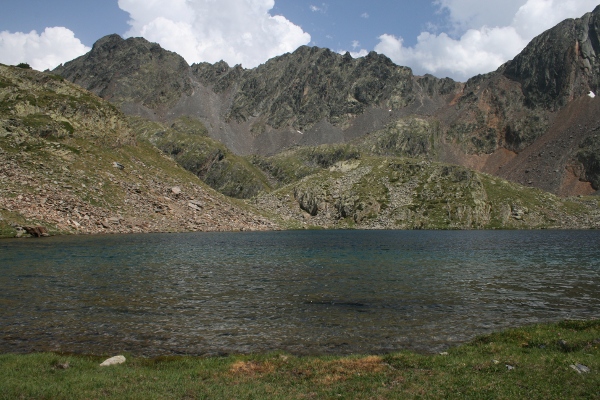
The Portella de Baiau, during our 2008 trip For a whole month, we'll be mostly disconnected from everything else that isn't our knee ache, our blisters, the Sun over our heads or where to get food. It's the first time I leave on a hiking trip as long and tough as this one, and I feel both uncertainty and eagerness. We've been so busy during the last few months that we've been unable to train at all for this, and I'm probably in the worst physical condition in a decade. It's too late to take care of that now, so we'll try to take good care of our legs and spine. In order to get back home in the Mediterranean, we'll have to be fast, some days joining two stages and skipping a few that we know are not that interesting (sections over asphalt, etc.). It's hard to make it in just one month, but we'll try our best. The plan is going to sleep not long after sunset, getting up at dawn, to be able to walk for a decent time before the heat starts being a handicap and just resting at midday, when the Sun is <strongest.> Of course, this means that I'm missing, yet again, this year's edition of DebConf in New York City, which is really sad because I was looking forward hanging around with Mako, Mika, Biella, micah, Clint and the rest of the NYC/ Boston gang, but when the idea of doing a long trip this summer popped up around January, it was clear DebConf seemed unlikely this year. I hope all of you have a lot of fun, and see you in a few weeks!

Enrico Zini: On python, frameworks and TOOWTDI

On python, frameworks and TOOWTDI The Python world is ridden with frameworks, microframeworks, metaframeworks and their likes. They are often very clever things, but more often than not they are a tool of despair. A very peculiar thing about Python web frameworkish things is that there are so many of them. There's cherrypy (in its various API redesigns), fapws, gunicorn, bottle and flask, paste, werkzeug and flup, tornado, pylons, turbogears 1 and 2, django, repoze who, what and whatnot, all the myriad of rendering engines and buffet as a metathing on top of them, diesel, twisted, and I apologise if I don't spend my day listing and hyperlinking them all, I hope I made my point. Frameworks are supposed to standardise some aspects of programming; the nice thing about standards is that there are so many of them to choose from, and they all suck, so I'll make my own. But wasn't Python supposed to be the world of TIOOWTDI? Ok, everbody knows it isn't. Just in the standard library there are 2 implementations of pickle and 2 urllibs. But people like the TIOOWTDI idea. I believe the reason people like the TIOOWTDI idea is because it creates a framework. It standardises some aspects of programming, and defines building blocks that guarantee that people doing similar jobs will be using similar sets of components. Let's take for example the datetime module in the standard library. It is an embarassing example of a badly designed module, so embarassing that the standard library documentation continuously fails to document its fundamental design flaws and common work-arounds hoping that noone notices them, but as a consequence each poor soul starting to use it for nontrivial things has to google for hours in despair to rediscover in how many ways it's broken. But still, datetime works as a structure to hold those values that make a date, time, or full UTC timestamp. For that job it's become the standard, and as such it's an important component of the Python TIOOWTDI framework: one can use it to exchange datetimes among different libraries: for example ORMs are using it instead of rolling their own, which makes database programming so much easier when date/time is involved. Even if the implementation is far from perfect, once we apply TIOOWTDI to dates and timestamps, python code from different authors can exchange dates without worries. This is much better than having 3 different superior datetime libraries and having to convert date objects from one to another when passing values from a web form to an ORM. There is an often overlooked Python framework. The Pyton framework. It's called TIOOWTDI. All the micro-mini-midi-maxi-meta-frameworks that people scatter around, are, or should be, just experiments, proofs of concept, competing ideas waiting to be distilled in The Only One Way, bringing the Python experience one step forward. What is unfortunate is that this last distillation thing happens so rarely that people get used to the idea of having to use proof of concept code to get things done. Update: this post apparently wasn't very clear, so here is some clarification:

Rapha&#235;l Hertzog: Social Micropayment Can Foster Free Software, Discover Flattr

Social Micropayment Flattr LogoA social micropayment system allows you to donate a small amount of money (a few pennies/cents) to thank someone else for a good blog post, piece of music, or for a free software that you enjoy. That s what Flattr is all about. How Flattr works With Flattr, donating is as easy as a single click on a Flattr button that content providers (read free software developers ) embed on their websites. A Flattr button is very similar to a Digg button or other social buttons (you can look at the end of this blog post for a sample). The amount donated per flattr varies from month to month because you define a fixed amount of money to spend each month (minimum 2 ) and it s split evenly between all the things that you appreciated. You can flattr as much as you want, it won t cost you more. Support Free Software with Flattr Free Software lacks a good business model to fund the creation of software, yet someone has to pay the time spent in writing the code. Many projects have tried to ask for donations but the amount collected rarely covers more than the expenses for the website hosting. Flattr makes it so easy to donate that this is possibly about to change. Flattr users have to spend their monthly amount each month, otherwise it gets donated to charity. Thus if it takes off, most Flattr users will grow the habit of doing regular donations to projects that they use and appreciate. Bootstrapping the Process Flattr FLOSS LogoFlattr is a new service, not many projects are using it to accept donations and not many users are participating yet. But it s growing quickly on both sides. In order to help users who want to support Free Software with Flattr, I have started the Flattr Free and Open Source Software project. You can subscribe to a newsletter to receive a monthly reminder with recommendations of Free Software to Flattr. If you have more time, you can also browse public directories listing various Free Software projects using Flattr so that you can manually pick your favorites. To learn more about the Flattr FOSS project, click here. I also invite Free Software developers to setup Flattr on their websites, blogs, and to register those sites so that Flattr users can easily find them. To learn more about this, check out the Earn a Living With Free Software page. Share the News Flattr can change the situation of many small but popular free software projects struggling with a single developer who started it as a hobby and who can t afford to spend more free time on it. But this can only happen if lots of users start using Flattr to support the Free Software that they benefit from. So share the news, tell the friends, join Flattr FOSS and give some Flattr-love every month. Get Your Free Flattr Invite! Flattr is still in beta, but they like Free Software a lot and have offered 30 invites for the launch of Flattr FOSS. You can get yours by subscribing either to my main newsletter or to the Flattr FOSS one. Just reply to the welcome email you get after having subscribed and ask for your invite. Flattr this Share/Bookmark No comment Support my work

Biella Coleman: A User s Guide to Lulzy Media, the Pleasure of Trickery, and the Politics of Spectacle: From the Luddities to Anonymous

One of my favorite conferences is HOPE, which I have missed the last 2 times as I was away from NYC, so I am glad I am around this year. I find it especially valuable when there is some controversy brewing in the air, as there is with Wikileaks, Adrian Lamo, and Manning. I am also giving a talk, description below, with a fabulous postdoctoral researcher, Finn Brunton, who works on spam! But we will be talking about pleasure, trickery, and exploitable media for activists. Our talk is late, like really late: 11:00 PM on Saturday night. At first I was a bit annoyed at the scheduling but then I figured, when will i ever give a talk at 11:00 PM?
Following a brief lecture on Project Chanology, the question will be posed: how can we harness the power of lulzy virality, of pleasure, of trickery, of spectacular trolling for purposes above and beyond sharing the wisdom of Advice Dog? It ll start with a brief look at great activist media in the past, from Guernica and the picture of the whole Earth to projects by the Yes Men - how they spread ideas and helped people get informed, organize, and act. What makes the creation of lulzy memes different? Learn about how to create exploitable forms and rapid variations, and mechanisms for bringing the best stuff forward. Can we make media memes with goals beyond lulz, and teach activists who ve never heard of 4chan to make them too? Part lecture, part workshop, this will feature cameos by Rageguy, Pablo Picasso, V, alt.pave.the.earth, Kathe Kollwitz, Courage Wolf, Stewart Brand, Sarah Palin, Batman, Goya, Philosoraptor, Adolf Hitler, Trollface, Shepard Fairey, Joseph Ducreux, David Cameron, lots of Spartan warriors, and lots and lots of (trollish) cats.

Uwe Hermann: Using the HP Pavilion dv7-3127eg laptop with Debian GNU/Linux

HP Pavilion dv7-3127eg Yep, so I bought a new laptop recently, my IBM/Lenovo Thinkpad T40p was slowly getting really unbearably sloooow (Celeron 1.5 GHz, 2 GB RAM max). After comparing some models I set out to buy a certain laptop in a local store, which they didn't have in stock, so I spontaneously got another model, the HP Pavilion dv7-3127eg (HP product number VY554EA). Why this one? Well, the killer feature for me was that it has two SATA disks, hence allows me to run a RAID-1 in my laptop. This allows me to sleep better at night, knowing that the next dying disk will not necessarily lead to data loss (yes, I do still perform regular backups, of course). Other pros: Much faster than the old notebook, this one is an AMD Turion II Dual-Core Mobile M520 at 2.3 GHz per core, it has 4 GB RAM (8 GB max), and uses an AMD RS780 / SB700 chipset which is supported by the Free-Software / Open-Source BIOS / firmware project coreboot, so this might make the laptop a good coreboot-target on the long run. I'll probably start working on that when I'm willing to open / dissect it or when the warranty expires, whichever happens first. Anyway, I set up a page at randomprojects.org which contains lots more details about using Linux on this laptop:
http://randomprojects.org/wiki/HP_Pavilion_dv7-3127eg
Most of the hardware is supported out of the box, though I haven't yet tested everything. There may be issues with suspend-to-disk / suspend-to-RAM, sometimes it seems to hang (may be just a simple config change is needed in /etc/hibernate/disk.cfg). Cons: Pretty big and heavy (but that's OK, I use it mostly as "semi-mobile desktop replacement"), glossy screen, loud fans (probably due to the two disks). For reference, here's an lspci of the box:
  $ lspci -tvnn
  -[0000:00]-+-00.0  Advanced Micro Devices [AMD] RS780 Host Bridge Alternate [1022:9601]
           +-02.0-[01]--+-00.0  ATI Technologies Inc M96 [Mobility Radeon HD 4650] [1002:9480]
                        \-00.1  ATI Technologies Inc RV710/730 [1002:aa38]
           +-04.0-[02-07]--
           +-05.0-[08]----00.0  Atheros Communications Inc. AR9285 Wireless Network Adapter (PCI-Express) [168c:002b]
           +-06.0-[09]----00.0  Realtek Semiconductor Co., Ltd. RTL8111/8168B PCI Express Gigabit Ethernet controller [10ec:8168]
           +-0a.0-[0a]--
           +-11.0  ATI Technologies Inc SB700/SB800 SATA Controller [AHCI mode] [1002:4391]
           +-12.0  ATI Technologies Inc SB700/SB800 USB OHCI0 Controller [1002:4397]
           +-12.1  ATI Technologies Inc SB700 USB OHCI1 Controller [1002:4398]
           +-12.2  ATI Technologies Inc SB700/SB800 USB EHCI Controller [1002:4396]
           +-13.0  ATI Technologies Inc SB700/SB800 USB OHCI0 Controller [1002:4397]
           +-13.1  ATI Technologies Inc SB700 USB OHCI1 Controller [1002:4398]
           +-13.2  ATI Technologies Inc SB700/SB800 USB EHCI Controller [1002:4396]
           +-14.0  ATI Technologies Inc SBx00 SMBus Controller [1002:4385]
           +-14.2  ATI Technologies Inc SBx00 Azalia (Intel HDA) [1002:4383]
           +-14.3  ATI Technologies Inc SB700/SB800 LPC host controller [1002:439d]
           +-14.4-[0b]--
           +-18.0  Advanced Micro Devices [AMD] K10 [Opteron, Athlon64, Sempron] HyperTransport Configuration [1022:1200]
           +-18.1  Advanced Micro Devices [AMD] K10 [Opteron, Athlon64, Sempron] Address Map [1022:1201]
           +-18.2  Advanced Micro Devices [AMD] K10 [Opteron, Athlon64, Sempron] DRAM Controller [1022:1202]
           +-18.3  Advanced Micro Devices [AMD] K10 [Opteron, Athlon64, Sempron] Miscellaneous Control [1022:1203]
           \-18.4  Advanced Micro Devices [AMD] K10 [Opteron, Athlon64, Sempron] Link Control [1022:1204]
Full lspci -vvvxxxxnnn, lsusb -vvv, and a much more detailed list of tested hardware components is available in the wiki.

14 July 2010

Petter Reinholdtsen: Combining PowerDNS and ISC DHCP LDAP objects

For a while now, I have wanted to find a way to change the DNS and DHCP services in Debian Edu to use the same LDAP objects for a given computer, to avoid the possibility of having a inconsistent state for a computer in LDAP (as in DHCP but no DNS entry or the other way around) and make it easier to add computers to LDAP. I've looked at how powerdns and dhcpd is using LDAP, and using this information finally found a solution that seem to work. The old setup required three LDAP objects for a given computer. One forward DNS entry, one reverse DNS entry and one DHCP entry. If we switch powerdns to use its strict LDAP method (ldap-method=strict in pdns-debian-edu.conf), the forward and reverse DNS entries are merged into one while making it impossible to transfer the reverse map to a slave DNS server. If we also replace the object class used to get the DNS related attributes to one allowing these attributes to be combined with the dhcphost object class, we can merge the DNS and DHCP entries into one. I've written such object class in the dnsdomainaux.schema file (need proper OIDs, but that is a minor issue), and tested the setup. It seem to work. With this test setup in place, we can get away with one LDAP object for both DNS and DHCP, and even the LTSP configuration I suggested in an earlier email. The combined LDAP object will look something like this:
  dn: cn=hostname,cn=group1,cn=THINCLIENTS,cn=DHCP Config,dc=skole,dc=skolelinux,dc=no
  cn: hostname
  objectClass: dhcphost
  objectclass: domainrelatedobject
  objectclass: dnsdomainaux
  associateddomain: hostname.intern
  arecord: 10.11.12.13
  dhcphwaddress: ethernet 00:00:00:00:00:00
  dhcpstatements: fixed-address hostname
  ldapconfigsound: Y
The DNS server uses the associateddomain and arecord entries, while the DHCP server uses the dhcphwaddress and dhcpstatements entries before asking DNS to resolve the fixed-adddress. LTSP will use dhcphwaddress or associateddomain and the ldapconfig* attributes. I am not yet sure if I can get the DHCP server to look for its dhcphost in a different location, to allow us to put the objects outside the "DHCP Config" subtree, but hope to figure out a way to do that. If I can't figure out a way to do that, we can still get rid of the hosts subtree and move all its content into the DHCP Config tree (which probably should be renamed to be more related to the new content. I suspect cn=dnsdhcp,ou=services or something like that might be a good place to put it. If you want to help out with implementing this for Debian Edu, please contact us on debian-edu@lists.debian.org.

Mike Hommey: I/O patterns on ELF binary initialization

[ I meant to finish this article much earlier, but i had to leave it in a half-written draft state for quite some time due to other activities ] One particular issue that arises with big binary files is that of I/O patterns. It looks like it is not something under the usual scope for both ld.so and programs/libraries, but it can have a dramatic influence on startup times. My analysis is far from complete, would need to be improved by actually investigating ld.so code further, and so far has been limited to libxul.so built from mozilla-central, with the help of icegrind, on x86-64 linux. As I wrote recently, icegrind allows to track memory accesses within mmap()ed memory ranges. As ld.so does mmap() the program and library binaries, tracking the memory accesses within these mmap()s allows to get a better idea at I/O patterns when an ELF binary is initialized. I only focused on local accesses within a single given binary file (libxul.so) because the case of Firefox loading many files at startup is already being scrutinized, and because most of the non-Firefox files being read at Firefox startup (system and GNOME libraries) are most likely already in the page cache. I also focused on that because it was an interesting case that could be helpful to understand how big (and maybe less big) binaries may be affected by the toolchain (compiler, linker and dynamic linker) and possibly by some coding practices. For the record, what I did to get these results is to use icegrind and elflog, with further additions to the sections file with some output from objdump -h : I added sections that elflog wouldn t give (such as .plt, .hash, .dynsym, etc.), and even down to the entry level for the .rela.dyn section. The latter is particularly interesting because icegrind only outputs the first access for any given section. To see sequential accesses within that section, you need to split it in smaller pieces, which I did for .rela.dyn entries (each one being 24 bytes on x86-64). Uncommenting some parts of the icegrind code was also useful to track where some accesses were made from, code-wise. Now, the interesting data: One of the first accesses is a nullification of a few variables within the .bss section. The .bss section is usually an anonymous piece of memory, that is, a range of mmap()ed memory that is not backed by a file, and filled with zeroes by the kernel (I think it even does that lazily). It is used for e.g. variables that are initialized with zeroes in the code, and obviously, any code accessing these variables would be addressing at some offset of the .bss section. It means the section needs to start in memory at the offset it has been assigned by the linker at build time. This is actually where problems begin. When the .bss section offset as assigned by the linker doesn t align on a page (usually 4KB), the mmap()ed .bss can t be at that location, and really starts on the next page. The remainder is still mmap()ed from the binary file, and ld.so will itself fill that part. As the .bss section doesn t start on a page boundary, any write at this location will trigger the kernel reading the entire page. This means one of the first set of data being read from the file is the end of the section preceding .bss, and the beginning of the following one. Most likely, respectively the .data and .comment sections. While this probably doesn t matter much when the binary file is small, when it is big enough, reading in a non sequential manner will trigger hard disk seeks, and we all know how they can hurt performance. Although thankfully, cheap SSDs should be coming some day, in the meanwhile, we still need to cope with the bad performance. The interesting part is, the .bss section is really empty in the binary file, so its virtual memory address could be anywhere. Why the linker wouldn t align it at a page boundary without having to resort to a linker script is beyond me. The next accesses go back and forth between .dynamic, .gnu.hash, .dynstr, .gnu.version_r, .gnu.version and .dynsym. These are probably all related to symbol version resolution and DT_NEEDED library loading. While most of these sections are at the beginning of the file (not necessarily in the order they are read from), the .dynamic section is much nearer to the end, but way before .data, so that it won t even have been loaded as a by-product of the .bss section loading. After that, the .rela.dyn section is read, and for each relocation entry it contains, the relocations are being applied. Relocations is one of the mechanisms by which position independent code (PIC) is made possible. When a library is loaded in memory, it is not necessarily loaded at the same address every time. The code and data contained in the library thus need to cope with that constraint. Fortunately, while the base address where the library is mmap()ed in memory is not necessary constant, the offsets of the various sections are still as codified in the binary. The library code can thus directly access data at the right offset if it knows the base offset of the library (which is what is done on the x86 ABI), or if it knows where the current instruction is located (which is what is done on the x86-64 ABI). Static data (initialized in e.g. a const or a global variable, or, in C++ case, vtables), on the other hand, may contain pointers to other locations. This is where relocation enters the scene. The .rela.dyn section contains a set of rules describing where in the binary some pointers need to be adjusted depending on the base library offset (or some other information), and how they should be updated. ld.so thus reads all .rela.dyn entries, and applies each relocation, which means that while .rela.dyn is being read sequentially, reads and writes are also performed at various places of the binary, depending on the content of the .rela.dyn entries. This is where this gets ugly for Firefox: there are near 200000 such relocations. On x86-64 an entry is 24 bytes (12 on x86), and each of these is going to read/write a pointer (8 bytes on x86-64, 4 on x86) at some random (though mostly ordered) location. The whole .rela.dyn section not being read ahead, what actually happens is that it is read in small batches, with seeks and reads of other data at various locations in between. In libxul.so case, this spreads over .ctors, .data.rel.ro, .got, and .data. The relocation entries are somehow ordered by address to be rewritten, though they occasionally jump backwards. Some of these relocations also appear to be touching to .gnu.version, .dynsym and .dynstr, because their type involves a symbol resolution. Once .rela.dyn relocation have been dealt with comes .rela.plt s turn. The principle is the same for this section: entries describe what kind of relocation must be done where, and how the result must be calculated. The scope of this section, though, is apparently limited to .got.plt. But before explaining these relocations, I ll explain what happens with the PLT. The PLT (Procedure Linkage Table) is used when calling functions from external libraries. For example, in a Hello World example, the PLT would be used for calls to the puts function. The function making the call would in fact call the corresponding PLT location. The PLT itself, on x86 and x86-64, at least, consists of 3 instructions (I ll skip the gory details, especially for x86, where the caller needs to also set some register before calling the PLT). The first instruction is the only one to be called most of the time: it reads the final destination in the .got.plt section, and jumps there. That final destination, obviously, is not fixed in the library file, since it needs to be resolved by its symbol. This is why the two subsequent instructions exist : originally, the destination stored in the .got.plt section points back to the second instruction ; the first instruction will effectively be a nop (no operation), and the following instructions will be executed. They will jump into code responsible for symbol resolution, update of the .got.plt entry for the next call, and call of the real function. But pointing back to the second instruction is like the pointers in static data we saw above : it s not possible in position independent code. So, the .rela.plt relocations are actually filling the .got.plt section with these pointers back to the PLT. There are a tad more than 3000 such relocations. All these relocations should be going away when prelinking the binaries, but from my several experimentations, it looks like prelinking only avoids relative relocations, and not the others, while it technically could skip all of them. prelink even properly applies all the relocations in the binary, but executing the binary rewrites the same information at startup for all but relative relocations. That could well be a bug in either ld.so not skipping enough relocations or prelink not marking enough relocations to be skipped. I haven t dug deep enough in the code to know how prelinking works exactly. Anyways, prelinking is not a perfect solution, as it also breaks ASLR. Sure, prelink can randomize library locations, but it relies on the user or a cron job doing so at arbitrary times, but that s far from satisfying. An interesting thing to note, though, is that a good part of the relocations prelinking doesn t rid us of in libxul.so (more than 25000) are due to the __cxa_pure_virtual symbol, which is used for, well, pure virtual methods. In other words, virtual methods that don t have an implementation in a given class. The __cxa_pure_virtual function is set as method in the corresponding field(s) of the class VTABLE in the .data.rel.ro section. This function is provided by libstdc++, and as such, is dynamically linked. But this function is just a dummy function, doing nothing. Defining an empty __cxa_pure_virtual function to be included in libxul.so makes these relocations become relative, thus taken care of by prelinking. After all relocations occur, the library initialization itself can begin, and the content of the .init section is executed. That section, indirectly, executes all functions stored in the .ctors section. This includes static initializers, which are unfortunately called backwards, as Taras pointed out already. Each of these static initializers are also accessing various locations in the .data or .bss sections, which may or may not have already been loaded during the relocation phase. The execution of these initializers will also (obviously) read various pieces of the .text section (despite its name, it contains executable sections, i.e. functions code). The initialization of the library ends there, and no access should happen until a function from the library is called. In libxul.so case, XRE_main is first called, then many other functions, but that s another story. All that needs to be remembered about the startup process past this point is that the .text section will be read heavily, as well as the various data, got, plt and dynamic symbol sections, in a very scattered way. While most of these sections may have been retrieved in memory already, as a byproduct of the various initialization processes described above, some may have not, increasing even more the need to seek at all places in the binary file. Now the main problem with all these I/O patterns at startup, is that it seems the only way reorganizing the binary layout may have a visible impact is by considering all the above, and not only a part of it, because only addressing a part of it is very likely to only move part of the problem to a different layer. All in all, making sure the relevant sections of libxul.so are read by the kernel before ld.so enters the game is a good short-term solution to avoid many seeks at startup.

13 July 2010

Bastian Venthur: I m going to DebConf10

Awesome! Thanks to all the sponsors and all the people helping to organize this year s DebConf for making it happen! See you soon in New York City!

Luciano Bello: /home/duijvestijn

I have a new guest in my apartment. Give a warm welcome to the Adrianus Johannes Wilhelmus Duijvestijn s spirit. Thanks a lot to Bartu and Rezlaj, who carried out the necessary seance that make this possible. The complete photo set is here. If you do not have the slightest idea of what I m talking about, take a look to Wikipedia or my previous post (Spanish only). (esta entrada tambi n est disponible en Espa ol)

Fathi Boudra: What s going on in Debian Qt world?

Qt 4.7.0 beta 2 and Qt Creator 2.0.0 have been released upstream. There s some

noticeable changes in our Qt packages compared to Qt 4.6.x series:
- legacy Qt Assistant (ADP) is removed
- new Qt declarative module is introduced
- Qt Multimedia and Qt Webkit aren t being built anymore In case your package depends on the deprecated Qt Assistant, it is still being
shipped in a separated Qt Assistant compatibility package called
qt-assistant-compat. Qt Multimedia is now shipped from Qt Mobility API instead of Qt. The module has
been renamed to Qt Mobility MultimediaKit. Qt Mobility delivers a set of APIs
for mobile device functionality. Qt WebKit is shipped standalone, separated from Qt. Hopefully, it will make
Qt WebKit security support easier. There are also a new component in the family: Qt Messaging Framework (QMF).
The Qt Messaging Framework, QMF, consists of a C++ library and daemon server
process that can be used to build email clients, and more generally software
that interacts with email and mail servers. Finally, I have started to ship a snapshot of a new Phonon backend: Phonon VLC,
one backend to rule them all ! All the packages can be found in Debian Experimental repository, except
Qt Simulator, a simulator for Qt applications running on Nokia devices.
This package should land soon in Debian archives. I encourage you to try building your Qt applications against these packages and
please, report any bugs you encounter. Enjoy. http://packages.qa.debian.org/q/qt4-x11.html
http://packages.qa.debian.org/q/qtcreator.html
http://packages.qa.debian.org/q/qt-assistant-compat.html
http://packages.qa.debian.org/q/qtmobility.html
http://packages.qa.debian.org/q/qtwebkit.html
http://packages.qa.debian.org/q/qmf.html
http://packages.qa.debian.org/p/phonon-backend-vlc.html
http://bugs.debian.org/cgi-bin/bugreport.cgi?bug=587759

12 July 2010

Matthew Garrett: Power management at Plumbers

I'm running a power management track at the Linux Plumbers Conference again this November. Unlike most conferences which focus on presenting completed work, Plumbers is an opportunity to focus on unsolved problems and throw around as many half-baked solutions as you want in order to try to find one that seems to stick. The suspend/resume problem in Linux is mostly solved[1], which means that it's time for us to focus on runtime power management and quality of service.

This has been an especially interesting year in the field. We've landed the infrastructure for generic runtime power management, glued that into PCI and started implementing that at the driver level. pm_qos is being reworked to improve performance and scalability as we start seeing more drivers that need to express their own constraints. And, of course, we had the wakelock/suspend blockers conversation that didn't end in a terribly satisfactory manner, although Rafael is now working on an implementation that presents equivalent functionality with a different userspace API. Runtime full-system suspend isn't solved yet either - the current cpuidle-based solution doesn't work well on multicore systems. And maybe we could be more aggressive still by looking at reclocking more system components on the fly even if the existing interfaces don't allow that. Do we have all the hooks we need to identify which system resources are being used? Are we doing the best we can in terms of avoiding trading off performance for power savings?

So if you'd like to talk about any of these things, or if there's any other problems that you don't think have been solved yet, head on over to the call for submissions and help make sure that we can make Linux the most power-efficient OS possible.

[1] Yes, some machines are broken, but those tend to be individual weird bugs which we're gradually tracking down rather than fundamental issues in our core code, so they're not really in the scope of Plumbers

Next.

Previous.