Search Results: "ag"

12 February 2015

Daniel Leidert: Setting up a network buildd with pbuilder ... continued

Last year I'd described my setup of a local network-buildd using pbuilder, ccache, inoticoming and NFS. One then-still-open goal was to support different Debian releases. This is especially necessary for backports of e.g. bluefish. The rules to contribute backports require to include all changelog entries since the last version on debian-backports or since stable if it's the first version in an uploaded package. Therefor one needs to know the last version in e.g. wheezy-backports. Because I'm not typing the command (the source package only gets uploaded and inoticoming starts the build process) I was looking for a way to automatically retrieve that version and add the relevant -vX.Y-Z switch to dpkg-buildpackage.The solution I found requires aptitude and a sources.list entry for the relevant release. If you are only interested in the solution, just jump to the end :)I'm going to add the version switch to the DEBBUILDOPTS variable of pbuilder. In my setup I have a common (shared) snippet called /etc/pbuilderrc.inc and one configuration file per release and architecture, say /etc/pbuilderrc.amd64.stable. Now the first already contains ...
DEBBUILDOPTS="-us -uc -j2"
... and DEBBUILDOPTS can be extended in the latter:
DEBBUILDOPTS+="..."
Because the config file is parsed pretty early in the process the package name has not yet been assigned to any variable. The last argument to pbuilder is the .dsc file. So I use the last argument and parse the file to retrieve the source package name.
cat $ @: -1    grep -e ^Source   awk -F\  '  print $2  '
The solution above works, because pbuilder is a BASH script. Otherwise it maybe needs some tweaking. I use the source package name, because it is unique and there is just one :) Now with this name I check for all versions in wheezy* and stable* and sort them. The sort order of aptitude is from low to high, so the last line shopuld contain the highest version. This covers the possibility that there has not yet been a backport or that there is one:
aptitude versions -F '%p' --show-package-names=never --group-by=none --sort=version \
"?narrow(?source-package(^PACKAGE\$), ?or(?archive(^wheezy.*), ?archive(^stable.*)))" \
tail -n 1 sed -e 's#~bpo.*$##g'
The sed-part is necessary because otherwise dh_genchanges will add a superfluous changelog entry (the last one of the last upload). To make things easier, I assign the name and version to variables. So this is the complete solution:

[..]
MYPACKAGE=" cat $ @: -1 grep -e ^Source awk -F\ ' print $2 ' "
MYBPOVERS=" aptitude versions -F '%p' --show-package-names=never --group-by=none --sort=version "?narrow(?source-package(^$MYPACKAGE\$), ?or(?archive(^wheezy.*), ?archive(^stable.*)))" tail -n 1 sed -e 's#~bpo.*$##g' "

log "I: Package is $MYPACKAGE and last stable/bpo version is $MYBPOVERS"

DEBBUILDOPTS+=" -v$MYBPOVERS"
[..]
ExamplesI've recently built a new bluefish backport. The last backport version is 2.2.6-1~bpo70+1. There is also the stable version 2.2.3-4. So the version I need is 2.2.6-1 (2.2.6-1~bpo70+1 < 2.2.6-1!!). Checking the log it works:
I: Package is bluefish and last stable/bpo version is 2.2.6-1
A different example is rsync. I've recently locally rebuilt it for a stable system (wanted to make use of the --chown switch). There is not yet a backport. So the version I (would) need is 3.0.9-4. Checking the logs again and works too:
I: Package is rsync and last stable/bpo version is 3.0.9-4
Feedback appreciated ... Links

11 February 2015

John Goerzen: Reactions to Has modern Linux lost its way? and the value of simplicity

Apparently I touched a nerve with my recent post about the growing complexity of issues. There were quite a few good comments, which I ll mention here. It s provided me some clarity on the problem, in fact. I ll try to distill a few more thoughts here. The value of simplicity and predictability The best software, whether it s operating systems or anything else, is predictable. You read the documentation, or explore the interface, and you can make a logical prediction that when I do action X, the result will be Y. grep and cat are perfect examples of this. The more complex the rules in the software, the more hard it is for us to predict. It leads to bugs, and it leads to inadvertant security holes. Worse, it leads to people being unable to fix things themselves one of the key freedoms that Free Software is supposed to provide. The more complex software is, the fewer people will be able to fix it by themselves. Now, I want to clarify: I hear a lot of talk about ease of use. Gnome removes options in my print dialog box to make it easier to use. (This is why I do not use Gnome. It actually makes it harder to use, because now I have to go find some obscure way to just make the darn thing print.) A lot of people conflate ease of use with ease of learning, but in reality, I am talking about neither. I am talking about ease of analysis. The Linux command line may not have pointy-clicky icons, but at least at one time once you understood ls -l and how groups, users, and permission bits interacted, you could fairly easily conclude who had access to what on a system. Now we have a situation where the answer to this is quite unclear in terms of desktop environments (apparently some distros ship network-manager so that all users on the system share the wifi passwords they enter. A surprise, eh?) I don t mind reading a manpage to learn about something, so long as the manpage was written to inform. With this situation of dbus/cgmanager/polkit/etc, here s what it feels like. This, to me, is the crux of the problem: It feels like we are in a twisty maze, every passage looks alike, and our flashlight ran out of battieries in 2013. The manpages, to the extent they exist for things like cgmanager and polkit, describe the texture of the walls in our cavern, but don t give us a map to the cave. Therefore, we are each left to piece it together little bits at a time, but there are traps that keep moving around, so it s slow going. And it s a really big cave. Other user perceptions There are a lot of comments on the blog about this. It is clear that the problem is not specific to Debian. For instance: This stuff is really important, folks. People being able to maintain their own software, work with it themselves, etc. is one of the core reasons that Free Software exists in the first place. It is a fundamental value of our community. For decades, we have been struggling for survival, for relevance. When I started using Linux, it was both a question and an accomplishment to have a useable web browser on many platforms. (Netscape Navigator was closed source back then.) Now we have succeeded. We have GPL-licensed and BSD-licensed software running on everything from our smartphones to cars. But we are snatching defeat from the jaws of victory, because just as we are managing to remove the legal roadblocks that kept people from true mastery of their software, we are erecting technological ones that make the step into the Free Software world so much more difficult than it needs to be. We no longer have to craft Modelines for X, or compile a kernel with just the right drivers. This is progress. Our hardware is mostly auto-detected and our USB serial dongles work properly more often on Linux than on Windows. This is progress. Even our printers and scanners work pretty darn well. This is progress, too. But in the place of all these things, now we have userspace mucking it up. We have people with mysterious errors that can t be easily assisted by the elders in the community, because the elders are just as mystified. We have bugs crop up that would once have been shallow, but are now non-obvious. We are going to leave a sour taste in people s mouth, and stir repulsion instead of interest among those just checking it out. The ways out It s a nasty predicament, isn t it? What are your ways out of that cave without being eaten by a grue? Obviously the best bet is to get rid of the traps and the grues. Somehow the people that are working on this need to understand that elegance is a feature a darn important feature. Sadly I think this ship may have already sailed. Software diagnosis tools like Enrico Zini s seat-inspect idea can also help. If we have something like an ls for polkit that can reduce all the complexity to something more manageable, that s great. The next best thing is a good map good manpages, detailed logs, good error messages. If software would be more verbose about the permission errors, people could get a good clue about where to look. If manpages for software didn t just explain the cavern wall texture, but explain how this room relates to all the other nearby rooms, it would be tremendously helpful. At present, I am unsure if our problem is one of very poor documentation, or is so bad that good documentation like this is impossible because the underlying design is so complex it defies being documented in something smaller than a book (in which case, our ship has not just sailed but is taking on water). Counter-argument: progress One theme that came up often in the comments is that this is necessary for progress. To a certain extent, I buy that. I get why udev is important. I get why we want the DE software to interact well. But here s my thing: this already worked well in wheezy. Gnome, XFCE, and KDE software all could mount/unmount my drives. I am truly still unsure what problem all this solved. Yes, cloud companies have demanding requirements about security. I work for one. Making security more difficult to audit doesn t do me any favors, I can assure you. The systemd angle To my surprise, systemd came up quite often in the discussion, despite the fact that I mentioned I wasn t running systemd-sysv. It seems like the new desktop environemt ecosystem is the systemd ecosystem in a lot of people s minds. I m not certain this is justified; systemd was not my first choice, but as I said in an earlier blog post, jessie will still boot . A final note I still run Debian on all my personal boxes and I m not going to change. It does awesome things. For under $100, I built a music-playing system, with Raspberry Pis, fully synced throughout my house, using a little scripting and software. The same thing from Sonos would have cost thousands. I am passionate about this community and its values. Even when jessie releases with polkit and all the rest, I m still going to use it, because it is still a good distro from good people.

Daniel Leidert: Blogger RSS feed and category URLs with combined labels/tags

Run a blog on blogger.com? Maybe made it bilingual? Maybe blog on different topics? Wondering how the URL for an RSS feed for e.g. two labels looks like? Asking how to see all articles matching two tags (labels)? Finding a keyword under one or more labels? Many things are possible. I'll show a few examples below. Maybe that is even interesting for the planet Debian folks. I happen to blog mostly in English about Debian topics. But sometimes I also want to post something in German only (e.g. about German tax software). It is discouraged to put the latter on planet-debian. Instead it can be published in the language specific planet feed. So instead of adding new tags, one could easily combine two labels: the one for language of the feed and the one for Debian related posts (e.g. debian+english or debian+german). Therefor this post goes to the Debian planet. Search for combbined labels/tagsSay I want to view all postings related to the topics FOO and BAR. Then it is:

http://domain.tld/search/label/FOO+BAR OR
http://domain.tld/search/?q=label:FOO+label:BAR
Be aware that labels are case sensitive and that more labels can be added. The examples below will show all postings related to the topics debian and n54l and xbmc:

http://www.wgdd.de/search/label/debian+n54l+xbmc
http://www.wgdd.de/search/?q=label:debian+label:n54l+label:xbmc
It is also possible to search for all posts related to the topics FOO or BAR:

http://domain.tld/search/?q=label:FOO label:BAR
Say for example, you want to see all postings related to the topics logitech or toshiba, then it is:

http://www.wgdd.de/search/?q=label:logitech label:toshiba
Feed URLsTo get back to the first example lets say, the feed shall contain all posts related to the topics FOO and BAR. Then it is:

http://domain.tld/feeds/posts/default/-/FOO/BAR/ OR
http://domain.tld/feeds/posts/default?q=label:FOO+label:BAR
Respecitvely to show all feeds related to either of those topics use:

http://domain.tld/feeds/posts/default/?q=label:FOO label:BAR
To get a feed of the example topics as shown above then would be:

http://www.wgdd.de/feeds/posts/default/-/debian/n54l/xbmc/
http://www.wgdd.de/feeds/posts/default?q=label:debian+label:n54l+label:xbmc
http://www.wgdd.de/feeds/posts/default?q=label:logitech label:toshiba
Coming back to planet Debian, below is a solution for a multi-lingual planet contribution (if both planets would exist):

http://www.wgdd.de/feeds/posts/default?q=label:planet-debian+label:english
http://www.wgdd.de/feeds/posts/default?q=label:planet-debian+label:german
Advanced ...There is much more possible. I'll just show two more examples. AND and OR can be combined ...
http://www.wgdd.de/feeds/posts/default?q=label:debian+(label:logitech label:toshiba)
... and a keyword search can be added too:
http://www.wgdd.de/feeds/posts/default?q=stick+(label:debian+(label:logitech label:toshiba))
Links

Daniel Leidert: Issues with Server4You vServer running Debian Stable (Wheezy)

I recently acquired a vServer hosted by Server4You and decided to install a Debian Wheezy image. Usually I boot any device in backup mode and first install a fresh Debian copy using debootstrap over the provided image, to have a clean system. In this case I did not and I came across a few glitches I want to talk about. So hopefully, if you are running the same system image, it saves you some time to figure out, why the h*ll some things don't work as expected :) Cron jobs not runningI installed unattended-upgrades and adjusted all configuration files to enable unattended upgrades. But I never received any mail about an update although looking at the system, I saw updates waiting. I checked with
# run-parts --list /etc/cron.daily
and apt was not listed although /etc/cron.daily/apt was there. After spending some time to figure out, what was going on, I found the rather simple cause: Several scripts were missing the executable bit, thus did not run. So it seems, for whatever reason, the image authors have tempered with file permissions and of course, not by using dpkg-statoverride :( It was easy to fix the file permissions for everything beyond /etc/cron*, but that still leaves a very bad feeling, that there are more files that have been tempered with! I'm not speaking about customizations. That are easy to find using debsums. I'm speaking about file permissions and ownership.Now there seems no easy way to either check for changed permissions or ownership. The only solution I found is to get a list of all installed packages on the system, install them into a chroot environment and get all permission and ownership information from this very fresh system. Then compare file permissions/ownership of the installed system with this list. Not fun. init from testing / upstart on holdToday I've discovered, that apt-get wanted to update the init package. Of course I was curious, why unattended-upgrades didn't yet already do so. Turns out, init is only in testing/unstable and essential there. I purged it, but apt-get keeps bugging me to update/install this package. I really began to wonder, what is going on here, because this is a plain stable system:
  • no sources listed for backports, volatile, multimedia etc.
  • sources listed for testing and unstable
  • only packages from stable/stable-updates installed
  • sets APT::Default-Release "stable";
First I checked with aptitude:
# aptitude why init
Unable to find a reason to install init.
Ok, so why:
# apt-get dist-upgrade -u
Reading package lists... Done
Building dependency tree
Reading state information... Done
Calculating upgrade... Done
The following NEW packages will be installed:
init
0 upgraded, 1 newly installed, 0 to remove and 0 not upgraded.
Need to get 0 B/4674 B of archives.
After this operation, 29.7 kB of additional disk space will be used.
Do you want to continue [Y/n]?
JFTR: I see a stable system bugging me to install systemd for no obvious reason. The issue might be similar! I'm still investigating. (not reproducible anymore)Now I tried to debug this:
# apt-get -o  Debug::pkgProblemResolver="true" dist-upgrade -u
Reading package lists... Done
Building dependency tree
Reading state information... Done
Calculating upgrade... Starting
Starting 2
Investigating (0) upstart [ amd64 ] < 1.6.1-1 1.11-5 > ( admin )
Broken upstart:amd64 Conflicts on sysvinit [ amd64 ] < none -> 2.88dsf-41+deb7u1 2.88dsf-58 > ( admin )
Conflicts//Breaks against version 2.88dsf-58 for sysvinit but that is not InstVer, ignoring
Considering sysvinit:amd64 5102 as a solution to upstart:amd64 10102
Added sysvinit:amd64 to the remove list
Fixing upstart:amd64 via keep of sysvinit:amd64
Done
Done
The following NEW packages will be installed:
init
0 upgraded, 1 newly installed, 0 to remove and 0 not upgraded.
Need to get 0 B/4674 B of archives.
After this operation, 29.7 kB of additional disk space will be used.
Do you want to continue [Y/n]?
Eh, upstart?
# apt-cache policy upstart
upstart:
Installed: 1.6.1-1
Candidate: 1.6.1-1
Version table:
1.11-5 0
500 http://ftp.de.debian.org/debian/ testing/main amd64 Packages
500 http://ftp.de.debian.org/debian/ sid/main amd64 Packages
*** 1.6.1-1 0
990 http://ftp.de.debian.org/debian/ stable/main amd64 Packages
100 /var/lib/dpkg/status
# dpkg -l upstart
Desired=Unknown/Install/Remove/Purge/Hold
Status=Not/Inst/Conf-files/Unpacked/halF-conf/Half-inst/trig-aWait/Trig-pend
/ Err?=(none)/Reinst-required (Status,Err: uppercase=bad)
/ Name Version Architecture Description
+++-=============================-===================-===================-===============================================================
hi upstart 1.6.1-1 amd64 event-based init daemon
Ok, at least one package is at hold. This is another questionable customization, but in case easy to fix. But I still don't understand apt-get and the difference to aptitude behaviour? Can someone please enlighten me? Customized filesThis isn't really an issue, but just for completion: several files have been customized. debsums easily shows which ones:
# debsums -ac
I don't have the original list anymore - please check yourself

Michal &#268;iha&#345;: Hosted Weblate welcomes new projects

In past days, several new free software projects have been added to Hosted Weblate. If you are interested in translating your project there, just follow instruction at our website. The new projects include: PS: Added later during the week:

Filed under: English phpMyAdmin SUSE Weblate 0 comments Flattr this!

Rhonda D'Vine: Zaz

It is time for some more music. This woman was introduced to me by a friend who actually understands what she sings about, because she sings in French. Regardless, her voice and feeling for music touched me deep, so today I want to present to you Zaz (homepage seems French only). Like mentioned, she sings in French, and her connection with the Chanson genre brought her (deserved) comparison with the great dith Piaf. Without further ado, here are the songs: I hope you can enjoy her as much as I do.

/music permanent link Comments: 1 Flattr this

Mike Hommey: Announcing git-cinnabar 0.1.0

As you may or may not know, I have been working on this project for quite some time, but actually really started the most critical parts a couple months ago. After having looked for (and chosen) a new name for what was a prototype project, it s now time for a very first release. So what is this all about? Cinnabar is the common natural form in which mercury can be found on Earth. It contains mercury sulfide and its powder is used to make the vermillion pigment. What does that have to do with git? Hint: mercury. Git-cinnabar is a git remote helper (you can think of that as a plugin) to interact with mercurial repositories. It allows to clone, pull and push from/to mercurial remote repositories, using git. Numerous such tools already exist. Where git-cinnabar stands out is that it doesn t use a local mercurial clone under the hood (unlike all the existing other such tools), and is close to an order of magnitude faster to clone a repository like mozilla-central than the git-remote-hg that used to be shipped as a contrib to git. I won t claim it is exempt of problems and limitations, which is why it s not a 1.0. I m however confident enough with its state to make the first official release. Get it on github. If you ve been using the prototype, you can actually continue to use that clone and update it. Github conveniently keeps things working after a rename. You can update the remote url if you feel like it, though. If you are a Gecko developer, you can take a look at a possible workflow.

10 February 2015

Enrico Zini: systemd-default-rescue

seat-inspect Four months ago I wrote this somewhere:
Seeing a DD saying "this new dbus stuff scares me" would make most debian users scared. Seeing a DD who has an idea of what is going on, and who can explain it, would be an interesting and exciting experience. So, let's be exemplary, competent and patient. Or at least, competent. Some may like or not like the changes, but do we all understand what is going on? Will we all be able to support our friends and customers running jessie? I confess that although I understand the need for it, I don't feel competent enough to support systemd-based machines right now. So, are we maybe in need of help, cheat sheets, arsenals of one-liners, diagnostic tools? Maybe a round of posts on -planet like "one debian package a day" but with new features that jessie will have, and how to understand them and take advantage of them?
That was four months ago. In the meantime, I did some work, and it got better for me. Yesterday, however, I've seen an experienced Linux person frustrated because the shutdown function of the desktop was doing nothing whatsoever. Today I found John Goerzen's post on planet. I felt like some more diagnostic tools were needed, so I spent the day making seat-inspect. seat-inspect tries to make the status of the login/seat system visible, to help with understanding and troubleshooting. The intent of running the code is to have an overview of the system status, both to see what the new facilities are about, and to figure out if there is something out of place. The intent of reading the code is to have an idea of how to use these facilities: the code has been written to be straightforward and is annotated with relevant bits from the logind API documentation. seat-inspect is not a finished tool, but a starting point. I put it on github hoping that people will fork it and add their own extra sanity checks and warnings, so that it can grow into a standard thing to run if a system acts weird. As it is now, it should be able to issue warnings if some bits are missing for network-manager or shutdown functions to work correctly. I haven't really tested that, though, because I don't have a system at hand where they are currently not working fine. Another nice thing of it is that when running seat-inspect -v you get a dump of what logind/consolekit think about your system. I found it an interesting way to explore the new functionalities that we recently grew. The same can be done, and in more details, with loginctl calls, but I lacked a summary. After writing this I feel a bit more competent, probably enough to sit at somebody's computer and poke into loginctl bits. I highly recommend the experience.

Petter Reinholdtsen: Nude body scanner now present on Norwegian airport

Aftenposten, one of the largest newspapers in Norway, today report that three of the nude body scanners now is put to use at Gardermoen, the main airport in Norway. This way the travelers can have their body photographed without cloths when visiting Norway. Of course this horrible news is presented with a positive spin, stating that "now travelers can move past the security check point faster and more efficiently", but fail to mention that the machines in question take pictures of their nude bodies and store them internally in the computer, while only presenting sketch figure of the body to the public. The article is written in a way that leave the impression that the new machines do not take these nude pictures and only create the sketch figures. In reality the same nude pictures are still taken, but not presented to everyone. They are still available for the owners of the system and the people doing maintenance of the scanners, as long as they are taken and stored. Wikipedia have a more on Full body scanners, including example images and a summary of the controversy about these scanners. Personally I will decline to use these machines, as I believe strip searches of my body is a very intrusive attack on my privacy, and not something everyone should have to accept to travel.

Benjamin Mako Hill: Kuchisake-onna Decision Tree

Mika recently brought up the Japanese modern legend of Kuchisake-onna ( ). For background, I turned to the English Wikipedia article on Kuchisake-onna which had the following to say about the figure (the description matches Mika s memory):
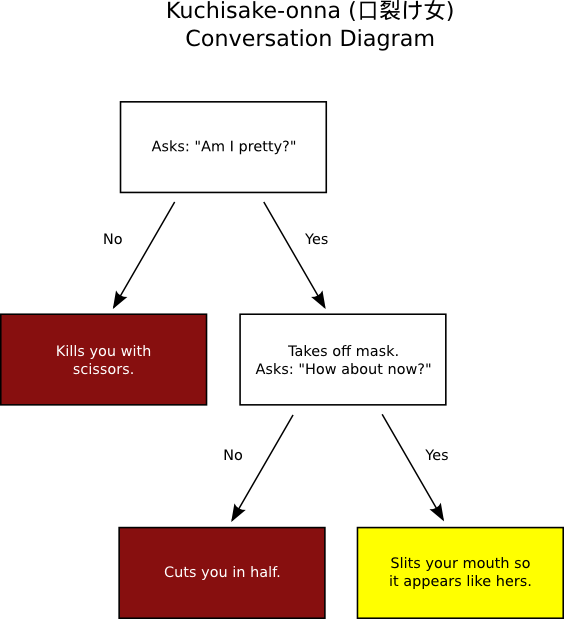
According to the legend, children walking alone at night may encounter a woman wearing a surgical mask, which is not an unusual sight in Japan as people wear them to protect others from their colds or sickness. The woman will stop the child and ask, Am I pretty? If the child answers no, the child is killed with a pair of scissors which the woman carries. If the child answers yes, the woman pulls away the mask, revealing that her mouth is slit from ear to ear, and asks How about now? If the child answers no, he/she will be cut in half. If the child answers yes, then she will slit his/her mouth like hers. It is impossible to run away from her, as she will simply reappear in front of the victim.
To help anyone who is not only frightened, but also confused, Mika and I made the following decision tree of possible conversations with Kuchisake-onna and their universally unfortunate outcomes.
Decision tree of conversations with Kuchisake-onna.Decision tree of conversations with Kuchisake-onna.
Of course, we uploaded the SVG source for the diagram to Wikimedia Commons and used the diagram to illustrate the Wikipedia article.

John Goerzen: Has modern Linux lost its way? (Some thoughts on jessie)

For years, I used to run Debian sid (unstable) on all my personal machines. Laptops, workstations, sometimes even my personal servers years ago ran sid. Sid was, as its name implies, unstable. Sometimes things broke. But it wasn t a big deal, because I could always get in there and fix it fairly quickly, whatever it was. It was the price I paid for the latest and greatest. For the last number of months, I ve dealt with a small but annoying issue in jessie: None of Nautilus, Thunar, or digikam (yes, that represents Gnome, XFCE, and KDE) can mount USB drives I plug in anymore. I just get Not authorized to perform operation. I can, of course, still mount -o uid=1000 /dev/sdc1 /mnt, but I miss the convenience of doing it this way. One jessie system I switched to systemd specifically to get around this problem. It worked, but I don t know why. I haven t had the time to switch my workstation, and frankly I am concerned about it. Here s the crux of the issue: I don t even know where to start looking. I ve googled this issue, and found all sorts of answers pointing to polkit, or dbus, or systemd-shim, or cgmanager, or lightdm, or XFCE, or I found a bug report of this exact problem Debian #760281, but it s marked fixed, and nobody replied to my comment that I m still seeing it. Nowhere is it documented that a Digikam mounting issue should have me looking in polkit, let alone cgmanager. And even once I find those packages, their documentation suffers from Bad Unix Documentation Disease: talking about the nitty-gritty weeds view of something, without bothering to put it in context. Here is the mystifying heading for the cgmanager(8) manpage:
cgmanager is a daemon to manage cgroups. Programs and users can make D-Bus requests to administer cgroups over which they have privilege. To ensure that users may not exceed their privilege in manipulating cgroups, the cgroup manager accepts regular D-Bus requests only from tasks within its own process-id and user namespaces. For tasks in private namespaces (such as containers), SCM-enhanced D-Bus calls are available. Using these manually is not recommended. Rather, each container is advised to run a cgproxy, which will forward plain D-Bus requests as SCM-enhanced D-Bus requests to the host cgmanager.
That s about as comprehensible as Vogon poetry to me. How is cgmanager started? What does SCM-enhanced mean? And I even know what a cgroup is. This has been going on for months, which has me also wondering: is it only me? (Google certainly suggests it s not, and there are plenty of hits for this exact problem with many distros, and some truly terrible advice out there to boot.) And if not, why is something so basic and obvious festering for so long? Have we built something that s too complex to understand and debug? This is, in my mind, orthogonal to the systemd question. I used to be able to say Linux was clean, logical, well put-together, and organized. I can t really say this anymore. Users and groups are not really determinitive for permissions, now that we have things like polkit running around. (Yes, by the way, I am a member of plugdev.) Error messages are unhelpful (WHY was I not authorized?) and logs are nowhere to be found. Traditionally, one could twiddle who could mount devices via /etc/fstab lines and perhaps some sudo rules. Granted, you had to know where to look, but when you did, it was simple; only two pieces to fit together. I ve even spent time figuring out where to look and STILL have no idea what to do. systemd may help with some of this, and may hurt with some of it; but I see the problem more of an attitude of desktop environments to add features fast without really thinking of the implications. There is something to be said for slower progress if the result is higher quality. Then as I was writing this, of course, my laptop started insisting that it needed the root password to suspend when I close the lid. And it s running systemd. There s another quagmire Update: Part 2 with some reactions to this and further thoughts is now available.

Dirk Eddelbuettel: RPushbullet 0.2.0

A new releases of the RPushbullet package (interfacing the neat Pushbullet service) arrived on CRAN today. It brings several weeks of extensions, corrections and cleanups---with key contributions by Mike Birdgeneau and Henrik Bengtsson. RPushbullet now has support for channels (a reasonably new feature upstream). Setup, initialization and tests all got improved as well. Changes are summarized below based in the extract from the NEWS.Rd file.
Changes in version 0.2.0 (2015-02-07)
  • Added support for Pushbullet 'channels' (once again thanks to Mike Birdgeneau for the initial push on this)
  • Support for pushes was solidified: proper choices of either device, email or channel should work in all cases
  • S3 methods are now properly exports (thanks to Henrik Bengtsson)
  • File transfer mode has been improved / corrected (thanks to Mike Birdgeneau)
  • The regression test suite was expanded and robustified
  • This NEWS file was added. Better late than never.
Courtesy of CRANberries, there is also a diffstat report for this release. More details about the package are at the RPushbullet webpage and the RPushbullet GitHub repo.

This post by Dirk Eddelbuettel originated on his Thinking inside the box blog. Please report excessive re-aggregation in third-party for-profit settings.

9 February 2015

Carl Chenet: Backup Checker 1.0, the fully automated backup checker

Follow me on Identi.ca or Twitter or Diaspora*diaspora-banner Backup Checker is the new name of the Brebis project. Backup Checker is a CLI software developed in Python 3.4, allowing users to verify the integrity of archives (tar,gz,bz2,lzma,zip,tree of files) and the state of the files inside an archive in order to find corruptions or intentional of accidental changes of states or removal of files inside an archive. Brebis version 0.9 was downloaded 1092 times. In order to keep the project growing, several steps were adopted recently: This new version 1.0 does not only provide project changes. Starting from 1.0, Backup Checker now verifies the owner name and the owner group name of a file inside an archive, enforcing the possible checks for both an archive and a tree of files. Moreover, the recent version 0.10 of Brebis published 9 days ago provided the following features As usual, any feedback is welcome, through bug reports, emails of the author or comments on this blog.

Eddy Petri&#537;or: uClibc based toolchain using Gentoo for NSLU2

I was asked in the previous post why I didn't used the Debian armel port for my NSLU2.

My intention was to create a uclibc based system (and a uclibc based toolchain) for my NSLU2. This was not obvious in the post because building the uclibc based toolchain resulted in this error:
crossdev armv5-softfloat-linux-uclibceabi
[..]/var/tmp/portage/cross-armv5-softfloat-linux-uclibceabi/gcc-4.9.2/work/gcc-4.9.2/libsanitizer/sanitizer_common/sanitizer_platform_limits_posix.cc:67:21: fatal error: wordexp.h: No such file or directory
#include
^
compilation terminated.
Makefile:416: recipe for target 'sanitizer_platform_limits_posix.lo' failed
make[4]: *** [sanitizer_platform_limits_posix.lo] Error 1
make[4]: *** Waiting for unfinished jobs....

So, yesterday, to not forget what I did, I tried building a glibc based toolchain and posted that.

Today, after looking at the offending error, it seems gcc 4.9.2 assumes wordexp.h is always available on non-Android platforms and Gentoo does not make that file availble when installing uclibc.


I think the problem was introduced in gcc in 2013 with this commit, but I haven't cheked in detail. What I know for sure is that gcc 4.8.3 works at this moment with uclibc and the buildroot guys are still using gcc 4.8.4 in their default uClibc based toolchain. So here it is the command that generated the uClibc based toolchain:

crossdev --g 4.8.3 armv5-softfloat-linux-uclibceabi

I hope this helps other people. Yes, I know I should report the issue to GCC/Gentoo after further investigation.

8 February 2015

Gregor Herrmann: RC bugs 2015/04-06

my small contributions around RC bugs during the last weeks:

Diego Escalante Urrelo: Link Pack #06

The story of Mel Blanc being saved by Bugs Bunny
Such a fantastic and romantic story. Mel Blanc, voice of half the Looney Tunes characters was in an car crash and hanging from a thread in a comma. And it took his characters to save him. It s a very interestingly edited podcast too:
( ) a crazy story about Mel nearly dying in a crash on Dead Man s Curve on Hollywood Boulevard and about the moment two weeks later when Bugs Bunny emerged from Mel s coma before Mel did. In fact, according to neurosurgeon Louis Conway who attended to Mel at the time, it seemed as though Bugs Bunny was trying to save his life.
The audacious rescue plan that might have saved space shuttle Columbia
This is probably the best documentary/kinda fiction article I have read in a long time. It s a long read going over the hypothetical, and nail bitting, plan to rescue the Columbia if it ever got in trouble. It s really intense, and something to sit down and read fully focused, book style.
But imagine an alternate timeline for the Columbia mission in which NASA quickly realized just how devastating the foam strike had been. Could the Columbia astronauts have been safely retrieved from orbit?
Ocean Gravity: Riding sea currents
Cool video of a sea diver running through seafloor currents, really cool and fascinating :). El chavo del ocho en el infierno
This one is in Spanish, and it s a funny take on El chavo del ocho and how it follows some classic models and myths of literature. Chespirito was very fond of classics, so this would make sense. But, of course, the whole article is written on a tongue in cheek style.
En El Chavo del Ocho, Bola os, o el Camus azteca, cre su propia versi n del mito de S sifo. El chavo y compa a est n condenados a empujar por una empinada colina todos los d as esta piedra enorme que siempre regresa, obligandolos al tormento del eterno retorno. La piedra de Quico es cuadrada, no rueda, se desliza. Es c mico, a pesar de tr gico.

Go for some more Link Pack, it s sugar free

Ian Wienand: Netgear CG3100D-2 investigation

The Netgear CG3100D-2 is the default cable-modem you get for Telstra Cable, at least at one time. Having retired it after changing service providers, I wanted to see if it was somewhat able to be re-purposed. In short it's hackability is low. First thing was to check out the Netgear Open Source page to see if the source had anything interesting. There is some source, but honestly when you dig into the platform code and see things like kernel/linux/arch/mips/bcm963xx/setup.c:
/***************************************************************************
 * C++ New and delete operator functions
 ***************************************************************************/
/* void *operator new(unsigned int sz) */
void *_Znwj(unsigned int sz)
 
    return( kmalloc(sz, GFP_KERNEL) );
 
/* void *operator new[](unsigned int sz)*/
void *_Znaj(unsigned int sz)
 
return( kmalloc(sz, GFP_KERNEL) );
 
...
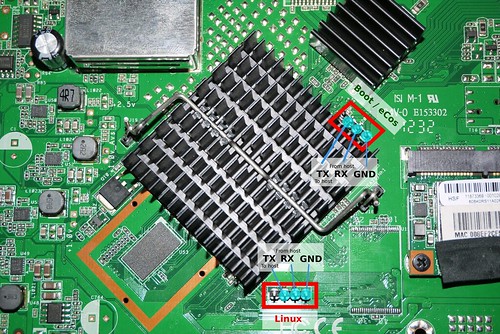
there's a bit of a red-flag that this is not the cleanest code in the world (I guess it interfaces with some sort of cross-platform SDK written in some sort of C++). So next we can open it up, where it turns out there are two separate UARTs as shown in the following image.
UART connections on Netgear CG3100D 2BPAUS
One of these is for the bootloader and eCOS environment, and the other seems to be connected to the Linux side. A copy of the boot-logs for the bootloader and eCOS and Linux don't show anything particuarly interesting. The Linux boot does identify itself as Linux version 2.6.30-V2.06.05u while the available source lists its version as 2.6.30-1.0.5.83.mp2 so it's questionable if the source matches whatever firmware has made it onto the modem. We do see that this identifies as a BCM338332 which seems to be one of the many sub-models of the BCM3383 SoC cable-modem solution. There is an OpenWrt wiki page that indicates support is limited. Both Linux and eCos boot to a login prompt where all the usual default combinations of login/passwords fail. So my next thought was to try and get to the firmware via the bootloader, which has a simple interface
BCM338332 TP0 346890
Reset Switch - Low GPIO-18 50ms
MemSize:            128 M
Chip ID:     BCM3383G-B0
BootLoader Version: 2.4.0alpha14R6T Pre-release Gnu spiboot dual-flash reduced DDR drive linux
Build Date: Mar 24 2012
Build Time: 14:04:50
SPI flash ID 0x012018, size 16MB, block size 64KB, write buffer 256, flags 0x0
Dual flash detected.  Size is 32MB.
parameter offset is 49944
Signature/PID: a0e8
Image 1 Program Header:
   Signature: a0e8
     Control: 0005
   Major Rev: 0003
   Minor Rev: 0000
  Build Time: 2013/4/18 04:01:11 Z
 File Length: 3098751 bytes
Load Address: 80004000
    Filename: CG3100D_2BPAUS_V2.06.02u_130418.bin
         HCS: 1e83
         CRC: b95f4172
Found image 1 at offset 20000
Image 2 Program Header:
   Signature: a0e8
     Control: 0005
   Major Rev: 0003
   Minor Rev: 0000
  Build Time: 2013/10/17 02:33:29 Z
 File Length: 3098198 bytes
Load Address: 80004000
    Filename: CG3100D_2BPAUS_V2.06.05u_131017.bin
         HCS: 2277
         CRC: a6c0fd23
Found image 2 at offset 800000
Image 3 Program Header:
   Signature: a0e8
     Control: 0105
   Major Rev: 0002
   Minor Rev: 0017
  Build Time: 2013/10/17 02:22:30 Z
 File Length: 8277924 bytes
Load Address: 84010000
    Filename: CG3100D_2BPAUS_K2630V2.06.05u_131017.bin
         HCS: 157e
         CRC: 57bb0175
Found image 3 at offset 1000000
Enter '1', '2', or 'p' within 2 seconds or take default...
. .
Board IP Address  [0.0.0.0]:           192.168.2.10
Board IP Mask     [255.255.255.0]:
Board IP Gateway  [0.0.0.0]:
Board MAC Address [00:10:18:ff:ff:ff]:
Internal/External phy? (e/i/a)[a]
Switch detected: 53125
ProbePhy: Found PHY 0, MDIO on MAC 0, data on MAC 0
Using GMAC0, phy 0
Enet link up: 1G full
Main Menu:
==========
  b) Boot from flash
  g) Download and run from RAM
  d) Download and save to flash
  e) Erase flash sector
  m) Set mode
  s) Store bootloader parameters to flash
  i) Re-init ethernet
  p) Print flash partition map
  r) Read memory
  w) Write memory
  j) Jump to arbitrary address
  X) Erase all of flash except the bootloader
  z) Reset
Flash Partition information:
Name           Size           Offset
=====================================
bootloader   0x00010000     0x00000000
image1       0x007d0000     0x00020000
image2       0x007c0000     0x00800000
linux        0x00800000     0x01000000
linuxapps    0x00600000     0x01800000
permnv       0x00010000     0x00010000
dhtml        0x00200000     0x01e00000
dynnv        0x00040000     0x00fc0000
vennv        0x00010000     0x007f0000
The "read memory" seems to give you one byte at a time and I'm not certain it actually works. So I think the next step is solder some leads to dump out the firmware from the flash-chip directly, which is on the underside of the board. At that point, I imagine the passwords would be easily found in the image and you might then be able to leverage this into some sort of further hackability. If you want a challenge and have a lot of time on your hands, this might be your platform but practically I think the best place for this is the recycling bin.

Petter Reinholdtsen: Nagios module to check if the Frikanalen video stream is working

When running a TV station with both broadcast and web stream distribution, it is useful to know that the stream is working. As I am involved in the Norwegian open channel Frikanalen as part of my activity in the NUUG member organisation, I wrote a script to use mplayer to connect to a video stream, pick two images 35 seconds apart and compare them. If the images are missing or identical, something is probably wrong with the stream and an alarm should be triggered. The script is written as a Nagios plugin, allowing us to use Nagios to run the check regularly and sound the alarm when something is wrong. It is able to detect both a hanging and a broken video stream. I just uploaded the code for the script into the Frikanalen git repository on github. If you run a TV station with web streaming, perhaps you can find it useful too. Last year, the Frikanalen public TV station transformed into using only Linux based free software to administrate, schedule and distribute the TV content. The source code for the entire TV station is available from the Github project page. Everyone can use it to send their content on national TV, and we provide both a web GUI and a web API to add and schedule content. And thanks to last weeks developer gathering and following activity, we now have the schedule available as XMLTV too. Still a lot of work left to do, especially with the process to add videos and with the scheduling, so your contribution is most welcome. Perhaps you want to set up your own TV station?

Keith Packard: Altos1.6

AltOS 1.6 TeleDongle v3.0 support and bug fixes Bdale and I are pleased to announce the release of AltOS version 1.6. AltOS is the core of the software for all of the Altus Metrum products. It consists of firmware for our cc1111, STM32L151, STMF042, LPC11U14 and ATtiny85 based electronics and Java-based ground station software. This is a major release of AltOS, including support for our new TeleDongle v3.0 board and a selection of bug fixes AltOS Firmware TeleDongle v3.0 added along with some fixes Our updated ground station, TeleDongle v3.0, works just like the original TeleDongle, but is an all-new design: AltOS Bug Fixes We also fixed a few bugs in the firmware: AltosUI and TeleGPS applications A few minor new features are in this release Bug Fixes There are a bunch of minor bug fixes, including the usual collection of attempts to make stuff behave better on Windows platforms.

Hideki Yamane: ThinkPad x121e firmware bug with UFEI

Okay I'm wrong, d-i 8 rc1 can be installed to Thinkpad X121e, thanks.

However, I recommend to install Debian (or other distro) with legacy BIOS mode, instead of UFEI, because X121e has firmware bug, Fn key is always enabled when you back from suspend, see posts on Lenovo users forum.

Probably it would annoy you (especially with Vim - oh, "Esc"! ;)

Next.

Previous.