Search Results: "ron"

25 November 2007

Julien Blache: Pommed: how should the video switch button work?

The radeonhd xorg driver recently gained full RandR 1.2 support, I’ve tested it out moments ago and it works. It just works. (DIE fglrx, DIE DIE DIE). Joy and happiness today, and thanks to Julien CRISTAU, it’s even packaged in experimental (I owe you a beer, obviously). Now, given that we now have a working video driver, and an opensource one even, let’s think about implementing something in pommed for that nice little video switch button that’s on F7. I don’t really know how to go about implementing the video switch feature. Either I’m doing it in pommed in the form of a shell script that will have to “steal” the user’s X session, or I’m doing it in the frontends, which will obviously be a bit easier. Which raises another question: shell script around xrandr, or RandR support in the frontends? That latter option doesn’t look terribly appealing to me, as it involves quite some code that will have to be maintained up-to-date wrt RandR evolutions, and that also means being backward-compatible with older RandR versions etc. So it’s probably going to be only a simple shell script, executed by the frontend. I’d like more input on this, so if you have a take on how it should/could be done, please drop me a mail. Otherwise you’ll have to live with whatever I’ll come up with ;-)

Ingo Juergensmann: Another one bites the dust...

In reply to a blog post by Russell Coker about air filters for server environments, I just confirm how important it is to take care of a dust free machine.
In most cases the users won't have air conditioning with filters, but are just using plain desktop machines that are collecting dust. In some cases one might argue that a computer with all of its fans is some sort of air filter by itself, but well... ;)

So, keep your machine and yourself happy and remove regularily the dust from the inside of your machines. For example, I just removed the dust from one of the Debian m68k buildds last week. It was running for about a whole year now without any problem or downtime, so removing the dust was necessary.

I removed the case, the expansion cards and other stuff to get most direct access to the machine. I bought some canned air (spray duster) and blew the dust out of the case. Take care to remove the dust from inside of the power supply as well (of course remove the power plug before opening the case anyway for your own security!). After dusting off with the spray cleaner, I'm always using an old tooth brush to clean the dust from the fans itself. All in all, it's some dirty work and maybe you should do it outside of your house whenever possible. ;)

But in the long run, cleaning your machines once or twice a year prolongs the life of your machines. Some of my machines are now running since 1991 in 24/7 mode. Alas, maybe the reason for some people not cleaning their machines is to raise a nice dust puppy. :-)


P.S.: If you can afford it, choose a compressor instead of compressed air in cans.

Russell Coker: Air Filtering for Servers

Serious server rooms have large (and expensive) air-conditioning and filtering systems. Most “server rooms” however are not like that, often it’s just some space in a store-room, sometimes near printers (which are a source of air pollution [1]). The servers that are stored in serious server rooms have air filters as a standard feature. For small server installations it’s often a desktop PC used as a server which has no filters (and often lacking other server features such as ECC RAM). Recently Dell in Australia started selling low-end PowerEdge servers for $450 plus delivery (similar machines to the $800 Dell servers I previously blogged about [2]). Also refurbished machines from HP and IBM can often be purchased at auction for similar prices. Even if you have a proper server with filters on all air inlets it’s still a benefit to have reasonably clean air in the server area. A few years ago I bought four Sunbeam HEPA [3] air filters for my home to alleviate allergy problems. I’ve had one running 24*7 in my main computer area for most of the time since then. As well as wanting to keep my machines free of dust I have the extra issue of machines that I buy at auction which often are filled with dust - the process of cleaning them frees some dust in the air and it’s good to have a filter running to remove it. Excessive dust in the air can prevent cooling fans from operating and cause damage to hardware and loss of data. Of course the really good servers have fan speed sensors that allow the CPU to be throttled or the machine to be halted in case of severe problems. But for desktop machines you often only have the temperature control mechanisms that are built in to the CPU and sometimes machines just start having memory errors when the fan malfunctions and the machine gets hot. As one of the biggest problems facing server rooms is heat dissipation I decided to measure my air filters and see how much electricity they use (it seems reasonably to assume that all their energy eventually gets converted to heat). I’ve now got a blog page about power use of items related to computers [4]. My air filters take 114W when on the highest speed and 13.9W when on the lowest. Initially I was a little surprised at the figure for the high speed, but then I recalled that the energy required to move air is proportional to the speed cubed. I’ll just have to make sure I don’t leave an air filter on overnight in summer… I’m now going to recommend such filters to some of my clients. Spending $400 on an air filter is nothing compared to the amount of money that a server failure costs (when you have expensive down-time and pay people like me to fix it).

Gunnar Wolf: Klezmerson!

Yesterday I went with Nadezhda to the always interesting teatro/bar el Vicio. as she found that Klezmerson were going to play there. We tried to get some more friends to join, but gave too short notice, and ended up having a great night out just by ourselves. Just as a side rant: I just hate that places I want to refer to, and I want other people to get to know, have Flash-only sites! You can read some more things about Klezmerson at -ugh- their MySpace site, even get some of their music there.Their name give away their basic lines: Klezmer and son. The common line to all of the songs they performed is a strong Klezmer feel. Benjam n Shwartz and Mar a Emilia Jimenez (violin/keyboard and flute respectively) are responsible IMHO for most of that spirit, as their instruments are the most traditional ones, and they carry the melodies. But the rythms they play to are plain crazy and extremely well engineered - Cuban son, Colombian cumbia, jazz, rock, and... Well, I'm not a musician. But I really, really enjoyed them. Of course, bought their CD as well.Congratulations to a very surprising and unexpected band!

24 November 2007

loldebian - Can I has a RC bug?: WRIGHT & WRONGZ

WRIGHT & WRONGZ

WRIGHT & WRONGZ

submitted by KiBi

Lucas Nussbaum: Where is the NM bottleneck?

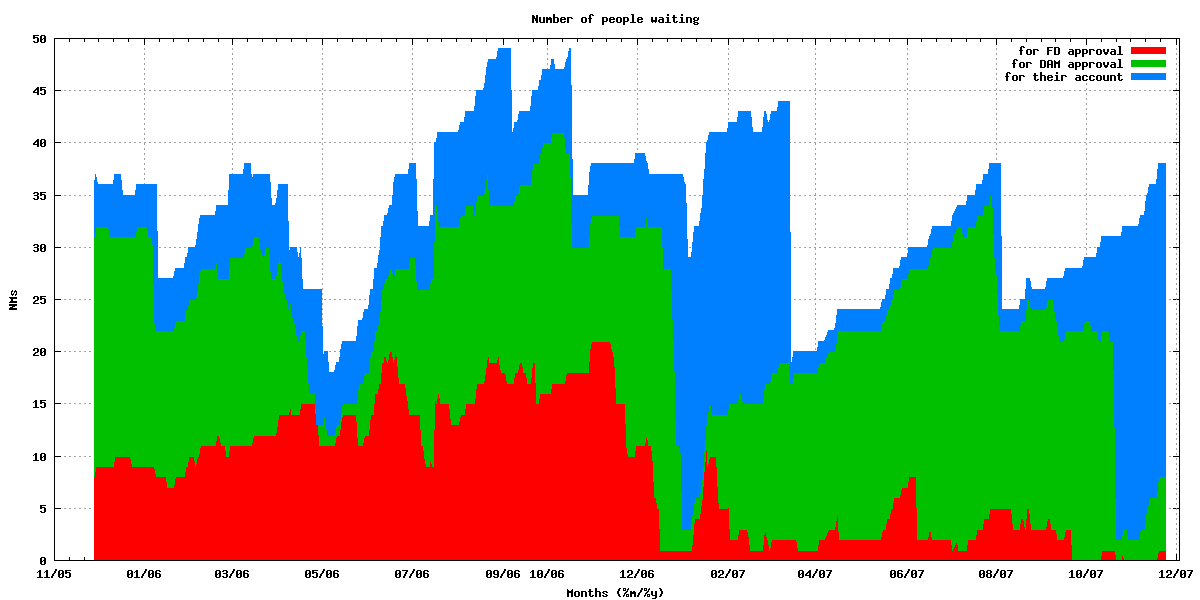
The current status of the NM process, with 1 NM awaiting FD approval, 7 awaiting DAM approval, and 30 waiting for their accounts to be created, leads people to thinking that the big bottleneck is the account creation stage. However, when you look at what happened since december 2005, it’s not that simple. NM queues status See the graph linked above, which shows where people are waiting. While it seems that the FD stage hasn’t been blocking people for nearly a year, it’s the DAM stage which has been the biggest blocker. Indeed, on average, 8.3 NMs have been blocked by FD, 16.2 by DAM, and 9.0 by account creation. I understand that processing NM reports in batch mode makes it more efficient. However, I’m wondering if processing them 20 per 20, is really that more efficient than processing them 5 per 5, which would justify such long queues. The NEW queue, which used to be a problem, is now being processed on a very regular basis, and hasn’t grown widely recently, except after Debconf when the ftpmaster processing NEW was on VAC. Couldn’t we have the same thing for DAM, account creations, and while we are at it, removals from unstable? Having clearly defined human-crontab-jobs would certainly make working on Debian less frustrating.

23 November 2007

Steve Kemp: No, I don't want your number

I'm still in the middle of a quandry with regards to revision control. 90% of my open code is hosted via CVS at a central site. I wish to migrate away from CVS in the very near future, and having ummed and ahhed for a while I've picked murcurial as my system of choice. There is extensive documentation, and it does everything I believe I need. The close-runner was git, but on balance I've decided to choose mercurial as it wins in a few respects. Now the plan. I have two options: e.g. My xen-tools could be hosted at mercurial.xen-tools.org, my blog compiler could live at mercurial.steve.org.uk. Alternatively I could just leave the one site in place, ignoring the fact that the domain name is now inappropriate. The problem? I can't decide which approach to go for. Both have plusses and minuses. Suggestions or rationales welcome - but no holy wars on why any particular revision control system is best... I guess ultimately it matters little, and short of mass-editing links its 50/50.

Russell Coker: Election 2007

I am a member of the Greens. The main reason for joining them is that they have principles. The Greens Charter [1] guides everything, policy must comply with the charter and candidates agree to uphold the policies which have been ratified if they get elected. There are no “non-core promises“. The policies of the Greens are all positive. The major parties have some mean-spirited policies that aim to help Australians by making things worse for people in other countries. Unfortunately for them the world is very inter-connected at the moment, so it’s difficult to harm other countries without harming yourself in the process. As you might expect the Greens are very positive towards the environment. Anyone who expects to live for more than 30 years (or who has children) should be very concerned about this. Currently even the most cautious estimates of the scope of the climate change problem by reputable scientists suggest that there will be serious problems in the next few decades. If you are young or have children then you should vote for the Greens (that covers most people). Many religious groups have determined that God wants them to help the environment, for example the Australian Anglican Church General Synod 2007 resolved that “the Anglican Communion’s 5th mark of mission to safeguard the integrity of creation and sustain and renew the life of the earth; and recognises that human activity contributing to Climate change is one of the most pressing ethical issues of our time”. Anglicans and believers in other religions that have similar ideas should vote for the Greens. The Greens have policies that are very positive towards minority groups. If you are not a straight-white-Christian then this is a strong reason for voting for the Greens. If you are a straight-white-Christian but have compassion for others (as advocated in the Bible) then again voting for the Greens is the right thing to do. The Greens policies are humane towards people in unfortunate situations, including drug addicts, the mentally ill, and the unemployed. When considering who to vote for keep in mind that at some future time you or a close friend or relative may fall into one of those categories. Finally the Howard government’s industrial relations legislation is very bad for the majority of workers. If the Greens get the balance of power in the Senate then they will be able to get such laws significantly changed or removed. The Greens election web site is here [2]. As an aside, I never liked Paul Keating (our last Prime Minister) until I read his op-ed piece in The Age about John Howard [3]. Also here is an interesting article on preferences and why the major parties want people to misunderstand the Australian electoral system [4]. In summary if you vote for the Greens as your first preference and they don’t win, then your second preference gets counted, and if that party doesn’t win then the third preference counts, etc. So if you have the two major parties in last and second-last position then your second-last preference may make an impact on the result! Putting Greens in the #1 position does not “waste” your vote. Parties get government funding based on the number of #1 votes, vote for the Greens as your first preference and you effectively give them $2 for their next campaign. Finally when a party wins an election they immediately look at where the #1 votes went and often adjust their policies to please the people. Vote #1 for the Greens and if Labour wins they will have more of an incentive to adopt policies that are similar to those of the Greens.

22 November 2007

Neil Williams: Debian GPE team

I'd better put some details of this somewhere, so here goes.
Moray Allen and I have formed a Debian GPE team at Alioth. The idea is to gather all the GPE packaging stuff onto a mailing list as a single point of contact for all things related to GPE - the G Palmtop Environment.
I'm now busy updating the GPE packages to add the Debian GPE team as Uploader and taking advantage of these uploads to also add cross building support for all these packages for Emdebian as well as the normal upload tasks for keeping up with the Debian Menu transition and fixing lintian warnings that arose since the last upload, etc.
My basic idea is that everything under the "Debian GPE team" banner should be cross-buildable - it's only logical.
Once dpkg is fixed to once again allow cross-building properly, I'll upload these packages to Emdebian and lots more of their dependencies.
Next task is to file a few more ITP bugs and make good on my existing ones so that GPE can be a complete environment within Debian and Emdebian.

Russell Coker: Drugs and an Election

As mentioned in my previous post [1] the government is using our money to advertise its policies. I previously covered the “Internet as a threat to children” issue, the other big one is drugs. The first significant message in the “Talking with your kids about drugs” document concerns the criminal penalties for drug use. That could largely be removed if the penalties were dramatically decreased and if hard drugs were administered to registered addicts for a nominal fee. Forcing addicts to commit crimes or work as prostitutes to pay for their addiction just doesn’t work, economically or socially. The next message is that parents should be involved in their children’s lives and be trusted enough that their children will accept advice. A large part of this would be related to the amount of time spent with children which is determined to a large degree by the amount of time not spent working. As I mentioned in my previous post it seems that the actions of the Howard government over the last 10 years has made things significantly worse in this regard by forcing more parents to spend large amounts of their time working (including situations where both parents work full-time) just to pay for a home. One notable omission from the document was any mention of alcohol problems (apart from when mixed with illegal drugs). By many metrics alcohol causes more harm than all the illegal drugs combined. The US attempted to prohibit alcohol and failed dismally, and alcohol is legal in most countries. The government doesn’t want to adopt a harm-minimisation approach to drugs (which bears some similarities to the approach taken to alcohol) and therefore is stuck trying to claim that one somewhat addictive mind-altering substance is somehow inherently different to all other mind-altering substances. The document provided no information at all on harm minimisation. The idea seems to be that it’s better for some children to die of overdoses than for other children to potentially be less scared of the consequences of drug use. The problem is that children are very bad at assessing personal risk so they simply won’t be scared off. It’s best to provide equipment for testing drug purity etc to reduce the harm. The list of reasons for young people to try drugs starts with “availability and acceptability of the drug“, Parmesan cheese is more available and acceptable than any drug but I’ve been avoiding it at every opportunity since I was very young. :-# More serious reasons in the list include “rebellion“, “depression“, “as a way to relax or cope with stress, boredom or pain“, and “to feel OK, at least temporarily (self-medication)“. But predictably there was nothing in the document about why children might consider that their life sucks to badly that they want to rebel in that way, be depressed, stressed, bored, or in pain to a degree that drugs seem like the solution. It seems unreasonable to believe that the school system isn’t a significant part of the cause of teenage problems. Flag poles for flying the Australian Flag [2] seems to be John Howard’s idea of a solution to school problems. I believe that the solution to school problems (both in terms of education and protection of children) is smaller classes, better supervision, an active program to eradicate bullying, and better salaries for teachers. I’ve written about related issues in my school category. I believe that the best thing for individual families to do is to home-school their children from the age of 12 instead of sending them to a high-school (which is much more damaging than a primary school). Another significant issue is drug pushers. They are usually drug users who try to finance their own drug use by selling to others. As most drug users get the same idea there is a lot of competition for sales and therefore they try to encourage more people to use drugs to get more customers. In the Netherlands, Coffee Shops sell a range of the milder drugs at reasonable prices which removes the street market and therefore the pushers. When drugs are produced commercially the quality is standardised which dramatically reduces the risk of infection and overdoses. When drugs are sold by legal companies they are not sold to children (a typical pusher can be expected to sell to anyone). The document has 3.5 pages of information about some of the illegal drugs (out of 23 pages total). They include all the most severe symptoms that most users don’t encounter. If someone reads that information and then talks to a drug user they will be laughed at. They also group drugs in an unreasonable way, for example listing “marijuana” and “hashish” as synonyms and list problems that are caused indirectly. If alcohol was included in that list it would include beer and methylated spirits (ethanol mixed with methanol to supposedly make it undrinkable - rumoured to be consumed by homeless people) in the same section and imply that blindness and other bad results of drinking “metho” apply to beer. It would also say that alcohol kills many people through drunk-driving and is responsible for rapes, wife-beating, and any other crime which can statistically shown to be more likely to be committed by a drunk person. A final issue with the document is that it advises parents to be “informed, up-front and honest” when talking to their children about drugs. Unfortunately the document itself doesn’t demonstrate such qualities. By omitting all information on harm minimisation it is not being up-front at all, and by not mentioning alcohol it’s simply being dishonest. Anyone who tries to convince someone else to not use illegal drugs can expect to hear “but you drink alcohol” as the immediate response from the drug user, it’s necessary to have sensible answers to that issue if you want to be effective in discouraging drug use.

Antti-Juhani Kaijanaho: Planet Debian RSS 2.0 feed is broken

Tollef Fog Heen asks:
Also, why does bloglines link to the completely wrong place on dburrow’s posts? It links to http://planet.debian.org/tag:blogger.com,1999:blog-$blah rather than the real URL.
I think I know why. I don’t know which Planet feed Tollef is reading, but a look at the Planet Debian RSS 2.0 feed is illuminating. Looking up Daniel’s entry, we can find the following sub-element:
<guid>tag:blogger.com,1999:blog-12729767.post-4989856010680867140</guid>
Looking at the RSS 2.0 specification, we can find the following note:
If the guid element has an attribute named “isPermaLink” with a value of true, the reader may assume that it is a permalink to the item, that is, a url that can be opened in a Web browser, that points to the full item described by the element. An example: <guid isPermaLink=”true”>http://inessential.com/2002/09/01.php#a2</guid> isPermaLink is optional, its default value is true. If its value is false, the guid may not be assumed to be a url, or a url to anything in particular.
Thus the Planet RSS 2.0 feed claims that tag:blogger.com,1999:blog-12729767.post-4989856010680867140 is a valid URL. There is no basis for this claim in Daniel’s Atom feed, as that string only occurs inside an id element, and RFC 4287 specifies that the string cannot be assumed to be dereferencable.

Tollef Fog Heen: Killing hold periods

Daniel Burrows writes about the feature of some call centres whereas if all operators are busy, it gives the caller the option of being called back. He'd like the nice twist of being able to enter his phone number on a web page and then be called back so he doesn't actually have to call, then wait. I'm not sure where Daniel lives, but I'm happy to report that this practice is quite common here in Norway, so it might well be on its way to whatever companies are local to Daniel. Also, why does bloglines link to the completely wrong place on dburrow's posts? It links to http://planet.debian.org/tag:blogger.com,1999:blog-$blah rather than the real URL.

Kartik Mistry: The festival story Or how to deal with dirty .diff.gz

* Once upon a time, I adopted ‘festival‘ and ‘speech-tools‘ packages. Updated it to my standard style of packaging (learned from different mentors) and fixed long pending bugs. I came to know that there is ‘New Upstream Version’ available from long time. Somehow, .diff.gz was so dirty that didn’t dare to touch it and apply and build the packages. Then, Kumar came and handed over me a nice little script.
#!/usr/bin/awk -f
/^—/
name = $2;
sub(/^[^[\/]+\//, “”, name);
gsub(/\//, “_”, name);
if (name !~ /\.diff$/)
name = name “.diff”;


print $0 >> name;
What it will do? gunzip your dirty .diff.gz and run it over .diff. It will split single .diff in multiple .diff s. You now need to merge or un-merge it manually (ah!). Dpatch can also converts .diff.gz in single patch (then you need to split it yourself! Correct me if I’m wrong!!) We are now able to successfully packaged festival and speech-tools. Thanks a lot to Kumar for help, patient and tweaks! I am now quilt lover! Package will be maintain using ‘collab-maint’ in near future. Ah, learning git for it!

21 November 2007

Wouter Verhelst: Debian work

Been a while since I did so much Debian work in a fairly short time. Today, I finished work on belpic 2.6.0, the support software for the Belgian electronic ID card. My initial builds wouldn't work since I made some stupid (no, really, stupid) errors in properly using that ugly beast, but eventually I saw the light. Working packages are now in incoming, and will soon be on a Debian Mirror Near You(TM). Oh, in case you wonder: the difference between 2.6.0 upstream and 2.5.9 upstream is pretty small, mostly some housekeeping bugfixes; meaning, if 2.5.9 is working for you, there's probably no need to worry about getting the update. I've also added some extra changes to the packaging bits, so that you now no longer have to install the -dev packages just so you can use the browser plugins. Isn't that nice. I did some more work on getting emile, the Early Mac Image LoadEr, to work properly again. Unfortunately, after the initial 0.10-1 upload that I did to Debian, none of my other builds managed to actually work on my test machine. Since I don't want to break existing machines that are using emile, I didn't think to upload those non-working binaries; but now with #451415, I can't ignore that problem any longer. I think I've nailed it now, though, and once barok (my IIci) has finished building (which will take a few hours), the packages should work. Cross your fingers. Finally, I've also prepared an upstream bugfix update of nbd, the userland support tools for the Network Block Device in the Linux kernel, and have uploaded a package from that release into Debian. As if that wasn't enough, and since I genuinely care about the state of my packages in Debian derivatives, I've poked some Ubuntu-people to get it synced there, too. I guess I'm back in shape now.

20 November 2007

Jacobo Tarr&#237;o Barreiro: AGPL

If I think that the FSF did the wrong thing, is there any way in which I can display my opposition? Can I become a negative member? Can I make an antidonation: get them to give me money? Update: In other words: I think that the AGPL is not free. Clause 13 is a restriction on usage. I’m very disappointed. (And the GPLv3 is not a high note for the FSF either).

19 November 2007

Meike Reichle: Symptoms

The German language has an expression that is "Zeichen der Zeit". Literally translated this means "Signs of the time", the idea behind that expression is that sometimes there are certains things or events that are symptopmatic for a current development or a general change of times. One of these "Zeichen der Zeit" can currently be observed very nicely in our neighbourhood. In the last half year three shops in our direct vicinity closed down. One was a quite cute 60s cafe that was later rented out to a citizens' action committee, the second was a shop that sold wooden toys, the third was a health food shop. I don't know how long these shops where around, but all of them had lasted for at least a couple years if not longer. Now all three shops are rented out again, two are now temp work agencies, the third is a "consumer bank" that specialises on small consumer credits for things like cars, washing machines or entertainment electronics. Apparently they also cooperate with some mail order firms. Is this really where we want to go?

Steve McIntyre: Happy Birthday ORG!

Wow, time flies when you're not paying much attention. It seems that the Open Rights Group is two years old. I was one of the original thousand people who pledged to support ORG financially (a fiver per month), hoping that they would help us stand up for our digital rights in the UK in much the same way as the EFF do in the US. The group have done a good job so far, facing off against the big corporates and the government on key subjects like DRM, electronic voting, ID cards and data protection. Unfortunately, it seems that there are more and more of these fights coming and they are gaining in importance as more and more of our lives are lived online. ORG are always looking for more support; please help if you can.

Miriam Ruiz: Happy :)

I’m really happy today, what more can I say? :)

Evan Prodromou: 28 Brumaire CCXVI

I'm glad to note that there's been a lot of movement over the last few weeks for the Montreal Coworking space. Patrick Tanguay, who's been organizing the project, let me know recently that we're closing in on a space. Which is just fantastic. Coworking is a loose term for a number of different ways of working together. The term is most commonly used for a kind of shared office where participants pay for either a fixed space (their own desk) by the month, or they pay for the use of a pool of free spaces (shared desks) on a daily or part-time basis. There are the kind of office resources, like WiFi, conference rooms, printers, copiers, etc. that you expect from an office, but unlike most shared-office situations, there's also an emphasis on community and communications. It's a great kind of work environment for people who would otherwise work at home or in caf s, such as freelancers, contractors, and startuppers -- or for people visiting from out-of-town. I've been to a couple of the Bay Area (California) coworking spaces -- the one at Citizen Space in San Francisco and the one at SocialText in Palo Alto. Both were convenient, fun, and social -- a good place to get some work done. Patrick's been working on a Montreal coworking space for a while -- talking to the City and neighbourhood development organizations -- and he's settled on a space in Mile End. It looks pretty fantastic. You can see the pictures and a map at the Montreal Coworking Web site. I've been working out of the house for about 5 years, and I really like the freedom and convenience it affords. That said, I'm really looking forward to having a more formal environment to work in than my home office. It's great here, and I feel very comfortable, but it would be nice to be out of the house. I also tend to meet with contractors and partners at local caf s, which can be distracting -- I'm looking forward to having meeting rooms. There's a 5 7 ("sank ah set" -- it's what we call a cocktail party here in Montreal) planned for people who'll be involved in the site planned for this Wednesday, November 21, at Bar Inc. (250 Mont-Royal Est). I won't be there -- we'll be in New Jersey by then -- but I hope others interested in the coworking take the chance to go. tags:

JS-Kit and data portability I've been a big fan of JS-Kit since I heard about it. I featured it in my list of 10 Web APIs for LinuxWorld, and I use it on my own personal site for comments. But one thing that concerns me, and that I've asked for clarification from JS-Kit about, is data portability. If they went out of business (heaven forfend), or if I figured out another cool way to do comments on my site, I'd like to be able to migrate old comments to the new system I'd build/use/buy. But as far as I can tell, there's no interface to download all comments on a site (either in HTML or some other structured format). I think this is going to be a key issue for people building Web sites with UI widgets in the future. It's a really, really useful way to make sites, but I don't think many developers are going to be willing to invest in a platform with no "insurance" that they can be flexible in the future. Sure, it's free of charge, and it seems kind of mean to use the poor JS-Kit folks and then move on to someone else -- but realistically it's an option you need for development. tags:

One-liners Some other stuff I'm thinking about today:
  • On the "upcoming events" front, we've got some plans to make BarCampCanada1 happen here in Montreal in May 2008. I'm not sure how that's going to shake out, but I'm excited about the possibility of a nationwide BarCamp.
  • I'm interested in Heather Ford's and Jimmy Wales's 50 parties idea - having fifty parties in one year to bring together local Free Culture people. I think we should have a party here in Montreal. Maybe in the Spring...? Maybe to coincide with BarCampCanada1?
tags:

Adam Rosi-Kessel: Is the MBTA killing its passengers?

A few days ago, I asked, is the MBTA killing itself? Now I’m wondering if it’s actually killing its passengers. The following is cut-and-pasted from my submission to the MBTA “write to the top” program for commuter rail:
My wife boarded the Needham Train in Roslindale this morning (around 10am) with a carriage for our newborn baby. The only place you can board the train in Roslindale with a carriage is the last car which has a ramp. When the train arrived at Back Bay station (where she intended to get off), there was no way to exit the train from the back car, because the train didn’t pull far enough into the station, so there was only a wall at her exit. The carriage was too big to fit through the door to pass between cars (which I understand is discouraged while moving anyway). She pressed the emergency call button three times (and heard the emergency call announcement) but was ignored by the conductors. She was unable to get off and thus ended up at South Station, two miles from her destination. The same problem would occur for someone in a wheelchair. This seems like a major ADA violation and a safety concern — how can you ignore the emergency call button pressed three times?
Okay, I’ve probably had enough hating on the MBTA for one month. What is wrong with these people, though? Technorati Tags: , ,

Next.

Previous.