Search Results: "tar"

21 March 2011

Joerg Jaspert: Debian FTPMaster meeting 2011 - Alright Brain...Its all up to you

And so there went a day of work. Minutes done, come back tomorrow
Okok, more text: We did lots of stuff. There was breakfast, soon after we had Lunch, and guess, Dinner also. Now, would you please come back tomorrow?
Anyways, we did some things. One of those was to have PostgreSQL 9.0 and to enable the replication to the machine any DD can access. Which is, from today on, ries.debian.org. And for the first time ever (since that time ftp-master got closed to the public), DDs can now see the live status of the archive, literally a second after a package got accepted a dak ls on ries will show you that fact. Torsten worked on fixing up old remnants of code and database entries around contents and also tackled a problem between our usage of SQLalchemy and the python multiprocessing module. He also started working on the source contents and was weird enough to get us standardized logging into a dak tool. Mark worked with DSA on the Postgres 9.0 upgrade to fix what was to fix in out database and did some tests with our environment in squeeze and coordinated changes in python-apt needed for multiarch and xz. He then started working on some larger database changes around the built-using feature. I myself started off with getting generate-packages-sources to behave when there is an error instead of silently ignoring that. I also did a bit of groundwork to enable us to do NEW processing adding overrides for all affected binary packages, not just those from the architecture currently uploaded. That will allow stuff like linux-2.6 to pass NEW just once, not once per architecture. That involves a new field in our dsc files and the status of that is tracked in Bug #619131.

Martin Meredith: Japan Disaster

It seems that once again, the squirrel has it right:- <iframe allowfullscreen="allowfullscreen" frameborder="0" height="390" src="http://www.youtube.com/embed/5_mZrUkzabk" title="YouTube video player" width="480"></iframe> For those of you reading this via a planet, or similar, please click on the title of this post to see the video I ve embedded above. (Please note, may contain language that offends some)


flattr this!

Steve Kemp: New software always causes surprises

I recently deployed my node.js proxy server, removing all traces of Apache2 from my main server. During the course of this transition I discovered:
Bugs in my code
Not unexpected, in all honesty. There were two main issues; the first was relating to how I handled the 304 response, the second was relating to how I performed rewrites for my mercurial repository vhost.
Bugs in node.js
Given how new node.js is there wasn't a huge surprise here either, although I thought I'd been good testing against 0.2.x. As it turned out I needed to run the more recent 0.4.x to avoid a couple of issues: In short I have a backported node.js package for Squeeze which is almost worthless. I'll update it in the near future. For the moment:
cd node-v0.4.3/
./configure --without-ssl --prefix=/opt/node-0.4.3 && make && make install
ln -fs /opt/node-0.4.3  /opt/node
Oddities in thttpd
thttpd is what actually runs my websites and I discovered during some extended debugging sessions that it just does not like HTTP requests starting with a doubled "/" character. For example this works fine:
wget http://www.acme.com/software/thttpd/
But this fails:
wget http://www.acme.com//software/thttpd/
Previously it seems that Apache was (silently) fixing this up before it proxied requests. Now I have to do it myself, no big thing, but still a surprise.
All in all it was worth it to be able to run:
dpkg --purge libapache2-mod-rpaf \
             apache2.2-common \
             apache2.2-bin \
             apache2-utils \
             apache2-mpm-prefork \
             apache2 \
             libaprutil1-dbd-sqlite3 \
             libaprutil1-ldap \
             libaprutil1 \
             libapr1
ObQuote: "Bad news. The fog's getting thicker." - Airplane!

Lars Wirzenius: Obnam version 0.15 and 0.15.1, and btree/larch 0.19

I've just made a couple of software releases: This is the first release of Obnam this year. Below is a summary of the changes. My apt repository has binary packages for amd64, i386, and armel. I've started mentoring someone to help me maintain the Debian packages, and hope to start uploading Obnam and its dependencies to Debian within a few weeks. Obnam is still in ALPHA, but the only missing thing for moving to BETA is encryption support. There's a bunch of bugs that need to be fixed, but I'm not going to block the BETA on them. I'd be very interested to hear any feedback on this version. Bugs fixed: Improvements and other changes:

20 March 2011

Ana Beatriz Guerrero Lopez: Small applications missing in KDE 4

I have been working in the last weeks in the removal of the last pieces of KDE 3 from the Debian archive and I have found there are a lot of packages that is sad having to remove. If you are looking for a good idea/excuse to learn and improve your KDE 4 / C++ /Qt4 skills, have to do a small application for school or you just feel like some useful coding, here is the list: Note that I do not list here software whose port in KDE 4 is being developed although it is still not finished and therefore it is not packaged in Debian. By the way, even if all those packages are being removed from Debian testing and unstable, they will remain in Squeeze, so you can keep using them or install it from there.

Jan Wagner: small announcement: Chemnitzer Linuxtage 2011

This weekend we did run a booth at Chemnitzer Linuxtage. As always, it was a joy to be at this event. We had great discussions and talks with guests and exhibitors, I also enjoyed a small number of lectures. The booth did run well, beside some quirks. Some pictures can be found here.

Christian Perrier: Current work in Debian

Now that I sent an update about my running activities, I have to report about what I'm doing these weeks in Debian to try keeping a fair balance for those of you who read this blog through Planet Debian. Most January was spent in preparing the release of squeeze. Of course, I didn't work directly on the release, not being involved in the release team. However, last bits of preparation for Debian Installer as well as rushing out the last remaining bits of localization work took most of my time. After the release of squeeze, time came to resume back some activities. First of all, on the l10n front, I resumed the work on "l10n NMUs", trying to get old l10n bugs fixed. I restarted proposing NMUs or, more precisely, help to perform translation updates rounds to these maintainers. Most of them had "old" l10n bugs because of the freeze. So, I indeed did not end up in doing many NMUs...but got several l10n bugs closed anyway. Work being resumed in unstable also lead to many changes in packages' debconf templates (new packages using debconf, packages introducing new templates, etc.). As these are the trigger for Smith reviews (reviews of English in debconf templates and packages' description, this activity, which was very low during the freeze, resumed again (we'll soon celebrate the 4th anniversary of this project). I also decided to invest more time in D-I again. The D-I team is currently more active than it was last years. Thanks to a few individual, work resumed in some areas and bug triaging has been very active. I recently resyned a nice improvement which had been contributed by a user to iso-scan, then polished by Frans Pop. This will allow to choose among several different ISO images when installing Debian from a USB stick while, previously, only the first found was being used. I also worked with a new translator, to prepare the activation of Uyghur translation in D-I. Some work happend in the pkg-fonts team. I had a few fonts adopted by the team, as part of the general effort to get rid of defoma. I sent patches for a few others, but many remain. If you maintain font packages, please help us in getting rid of defoma. Changes are easy to do; ask the team if you need help (pkg-fonts-devel@lists.alioth.debian.org). Samba packages also ate a significant part of my time. First of all, DSA-2175 lead to prepare fixes for samba in squeeze and lenny. Then, upstream released samba 3.5.8 which I uploaded to unstable. I briefly considered trying to get the Stable Release managers approval to push that version in squeeze, but the number of fixes made by upstream was discouraging. So, I chose to examine them slowly and cherry-pick those I consider important enough to warrant an upload for squeeze. More git wizardry learned doing so (thanks to Julien Cristau for his help). And I now have a pending proposal for three of these fixes (that represent 14 atomic patches from upstream) to be included in squeeze.

Christian Perrier: [life] [running] Updates on running plans

The first two months of this year have seen me quite busy preparing for my March-April peak of activity. So, most of these were spent accumulating kilometers, mostly on trail runs with mud, slope, obstacles, etc. January was meant to accumulate kilometers, which succeeded quite well..:-). Not as crazy as November 2010 (close to 300km) but the point was also testing a few long runs, over 25km and up to 32. February saw my first official race, with Bullion half-marathon. This is a nice race which I already ran last year. It features small roads in the Rambouillet Forest. Not the best place to achieve a personal best because the race is not flat, with two hills in the first half. Moreover, I was just recovering from a small flu, so I wasn't really planning to achieve a PB. Still, I managed to do it in 1h39'49", two minutes more than my PB. Moreover, I managed to do it in a small negative split, with first half in 50'38" and second half in 49'11". More encouraging, I ran a 35km solo trail the next week-end after this and completed it fairly well with the pace I plan for the 50km Eco-Trail. Still, that flu introduced some minor perturbation in this preparation and, thus, I included more activity in early March. I was originally planning to run Paris half-marathon on 6th, but an invitation for a friends 50th birthday made me cancel that one. So, most of the first 3 weeks of March were spent in 15-18km style runs, plus running daily to go to and back from work. The last preparation was today with a short 12km run with all equipment needed for Eco-Trail (backpack, 2lit. waterbag) and the targeted pace (10km/h). So, on Saturday, will be the Paris Eco-trail 50km race from Versailles Castle to Eiffel Tower....through woods in the South and South-West neighbourhood, with 1000m positive slope. This will be my first ultra race, so I'm a little bit in a grey area, here. As a consequence, the only ambition is finishing. I expect it to be in aroung 5h30 or so. Most importantly, I have to keep reserves, as, two weeks later, I'll run my yearly Paris marathon. Two long distance races in two weeks...we'll see if I'm crazy or not..:-) Now, I'm heading for a quiet week: grow glucides reserves, eat pasta, do one or two footings...and wait for Saturday! You may want to watch my blog on Sunday to see whether I survived this first stage.

19 March 2011

Gunnar Wolf: Starting work on KindleClip

Starting work on KindleClip
Quite probably, the best thing got for myself during the last year was my Kindle. I just love it! It has changed the way I interact with knowledge, and saved me from hours of boredom. But it has also taught me the value of scribbling along the book pages and of underlining passages. Yes, I hold a deep regard for my regular (paper) books, and I never scribble on them, not even on text books. In any case, I can scribble on a post-it or something like that. Still, when you underline or comment on a passage in the Kindle, what can you do with your annotation? Well, not much. Annotations (called clippings in Kindlespeak) are stored on an easily accessible My Clippings.txt text file, very easy to parse and work with. So, I devoted yesterday evening to coming up with a first prototype of an app that I think can be very useful if you use clippings extensively: It displays each clipping with its base information separately, allows you to filter on the specific book to which each clipping is related as well as on the clipping type. So, if it interests you, clone it away from github!
git://github.com/gwolf/kindleclip.git
Written in Ruby, Gtk (Glade). No further libraries are (currently?) needed. The code is far from beautiful, but is a first stab towards functionality. Any comments welcome!

18 March 2011

Julien Danjou: Org-contacts now part of Org contrib

Thanks to my recent promotion allowing me to commit directly in Org-mode, I've moved Org-contacts into the contrib directory of the Orgmode distribution. Flattr this

Adnan Hodzic: Debian CUT, a new rolling release?

This post is also available on/was written for OMG! Ubuntu

It looks like 2011 started well for Debian. The project won awards in two out of seven categories at the Linux New Media Awards 2011 ( Best Open Source Server Distribution and Outstanding Contribution to Open Source/Linux/Free Software ). Just recently Internet.com declared Debian the most influential distribution ever, stating that ~63% of all distributions now being developed come ultimately from Debian. However, my intention for this article is not solely to praise Debian for its recent awards, but rather to focus on a new project, Debian CUT. Don t be surprised if you haven t heard about CUT; it seems most Debian community hasn t either. Then again, maybe it s because it is only labelled as unofficial/development so far.
A bit of history One of the greatest criticisms of Debian is that its release cycles are too long. Debian stable release is seen as often as Ubuntu s LTS release. As a server solution this doesn t present a problem at all, it can even seen as a pro. However, for desktop use and for your average Joe who needs to have the latest software and is unable to get it, this may well present a problem. Of course he can always turn to backports to get what he needs but by the time you have finished reading this very sentence, Joe has already moved to Ubuntu. For those who are completely unaware how things work within Debian, let me try to shed some light. Debian has 3 main branches: Unstable , is a branch used mainly by developers, where the latest changes to the software they are working on are made. Usually, after approximately 10 days this software is pushed to testing , branch which is going to become next Debian stable release. For comparison, in the process of a new Ubuntu release at one point in this process, changes from testing/unstable are frozen where Ubuntu fixes bugs until they are ready to release new Ubuntu release. Debian s testing branch is said by some to be more stable then most of the stable distributions out there. Last but not least is stable branch, which follows the (in)famous mantra it s released when it s ready , although last two releases have been released in a more timely manner. Okay, so what is Debian CUT? The idea stretches back more then 2 years, to Joey Hess proposing the idea of Constantly Usable Testing . For users/developers who can t wait ~2 years to see new Debian release, they usually turn to Debian testing branch. To clarify, testing images are released weekly, but most of us in Debian don t recommend you jump to testing by installing it from weekly image, but rather by upgrading from stable. To make the situation even worse, these builds frequently don t work due to all the changes that have been pushed from unstable. But this is where Constantly Usable Testing idea comes in, where the installer is always installable and you re already using what s going to be next stable release. You wouldn t have to worry about whether the next update is going to break your system, but would get regular security updates, while the big updates would come in shape of new testing snapshot versions. Frequency of release of these snapshots is ought to be on monthly basis, so you can plan on seeing the next release on April 6th (exactly one month after the current release, provided of course if there are no showstopper bugs). To sum it all up, you wouldn t have to wait ~2 years before new Stable release shows up, nor (in case you have already switched to testing) would you have to worry whether your next update will break your system. You would get your updates in form of timely (ie: monthly) snapshots until it s time for major milestone which would turn out to be new Debian release. Even though this might be long term goal, in these early stages no one can guarantees this. Rolling release? The simplest way to explain this concept is that there are two types of Linux distributions: one with milestone version numbers and other where new updates keep coming through their rolling release cycles. Some of the rolling distributions are Gentoo and Arch Linux, while on the other side you have RedHat and Suse. Novell announced that OpenSuse is moving to rolling release with project codename Tumbleweed. It s also worth mentioning that Debian already has its rolling counters and perfect examples are: LMDE and aptosid. It is a way to continuously develop software, a way that best fits Debian as a platform where software is continuously developed. Especially because most of its greatest values could get lost with the release of that big stable version . Perfect case of that could be the almost drop of Chromium in Squeeze. Another great example could be Android, which is criticised most for its versioning. Companies are refusing to release new Android versions to their current phones, because they want you to buy new phone with latest Android version, even though your current one is perfectly capable of running latest Android. Personally, I m sure the future will reveal that rolling releases are the future, towards which all Linux platforms should be heading. Perhaps the definition of rolling releases I gave earlier is why I believe this project has such bright future ahead of it. Debian would be somewhat of a hybrid of this definition, it would be rolling release until it s time to mark a big milestone with a version number, and before you know it, we re rolling again. Unofficial Debian Monthly Testing Snapshot Release (version 2011.03 final) Michael Gilbert took on a big responsibility, trying experimentally to prove the feasibility of such a project. He has released a first wheezy snapshot installer (versioned 2011.03) as a test for the development community to try out and evaluate. Please read official announcement along with download links. While you can use this snapshot to have constantly working installer, after it is installed you could move to testing altogether if you wish. Conclusion As I have already mentioned, this project is still in the development/experimental stage, which makes all of this its very conception. Also, apart from rumors of Ubuntu becoming rolling release, if Ubuntu is to get its rolling release this how it s going to get it Smile If you d like to find out more about Debian CUT, I suggest you read Raphael Hertzog s article A constantly usable testing distribution for Debian , and watch the video of Joey Hess CUT BoF on DebConf10 in NYC. Of course, if you d like to get involved into this project, please use the project s mailing list. If you have any comments, please do share, as I d be happy to answer any of your questions.

DebConf team: DebConf11: Short insiders summary of recent developments in DC11 organization (Posted by Vedran Omeragic)

Recently there has been some major developments in DebConf11 organization. In short, I will list some of the most important.

Website

Official DC11 website has finally been completed and now contains a great deal of information for those interested in attending this years conference. Some of the most notable changes include:

Navigation

Frontpage now contains a small menu with links to most important parts of website, like About, Registration, Contact Sidebar menu is now divided in 3 categories:

  • The Conference Links to pages which are directly connected with the Conference like About DC, Debian Day, Registration, Call for Papers, Talk Schedules, Payments Most of these links are hidden at the moment, and will be until the registration is open, to avoid any unnecessary confusion.
  • More Information Basic information for attendees like Important Dates, Accommodations, Venue, Visa Everything you need to know about your stay in Banja Luka.
  • Practical While these pages have almost nothing to do with the Conference itself, they do provide a vast information about city, getting to Bosnia, some practical information, as well as the Map of the whole city made my me :)

New Pages added
  • How Can I Help This page contains some basic information for anyone who wants to help out. Weather by volunteering, sponsoring, or just by adding a banner on their website
    DC11: How Can I Help?
  • Contact Instead of just sending visitors to mailto, we replaced it by a page which contains ALL contact information, emails AND phone numbers (which will be added just before DebCamp starts).
    DC11: Contact
  • Sponsorship Just like with the contact page, we made a page to be more user friendly to any interested parties or individuals, and contains most important info, such as sponsorship levels and contact address.
    DC11: Sponsorship
  • About DebConf11 Actually it s just a page with a content copied from frontpage (which is now used for something else).
    DC11: About DebConf11

New features:
  • Documentation Is now used to store all important documents and records for public use and sharing, like brochures, official government documents, important public mails, as well as the recordings of all IRC meeting logs. Can be found at:
    DC11: Documentation
  • Frontpage: Navigation To ensure the main goal of website, information availability, frontpage has been redesigned to provide maximum accessibility as well as easy access to any part of the website. DC11: Frontpage
  • Frontpage: Latest News To keep the public and attendees well informed of any important events and developments, we decided to add latest news section. Note however, that if you want to stay completely informed of any changes and updates, we still recommend subscribing to our mailing list, which can be found under contact page.
    DC11: Frontpage
  • Map of Banja Luka Because of lack of data on Google Maps and Open Street Map, as well as some other minor local maps, we made a small map of almost whole city and added around 60 or 70 locations which we consider to be of importance for our attendees. Such locations include hotels, parking spots, restaurants, bars, clubs, petrol stations, taxi stations, etc. This page uses simple JavaScript and is not dragable . Therefore we added Index Location to auto-locate the needed locations, as well as the legend to clarify the category of locations. Pointing your mouse over a certain location will open a small bubble with some info on that location/object. We should also point out that some of this data may not be 100% correct (ie working hours may be off ). Map is available at:
    DC11: Banja Luka City Map
Bosnian language

Site is now available on Bosnian language for native speaking attendees, should they have problems with English version. Every page is available on both languages, which can be changed by clicking on ba/en flag in upper left corner, or DC11: Bosnian Version.

Design

As you may have noticed, the official page received a small face lift. New header with the Government building, a small token of appreciation for all the help the Government is providing; as well as some minor changes in CSS and color scheme. While talking about design, we d like to thank Leandro G mez for his help with the header.

Sponsorship Sponsorship Levels

As agreed on the meeting, which took place on 22. of February, [Meeting logs], following sponsorship levels will be used for this years conference:

  • Steel < 1.000
  • Bronze > 1.000
  • Silver > 5.000
  • Gold > 10.000
  • Platinum > 20.000

Main reason for lowering amounts is due to last years results of high increase in the same. As for the benefits of these levels, the only thing changed is t-shirts / bags places; we believe t-shirts are much more noticeable than bags, and have therefore been promoted to Silver, while bags have been downgraded to Bronze. For a full list of requirements and benefits, please visit: DC11: Sponsorship Sponsorship Brochure

Sponsorship brochures have finally been completed and are available for a public distribution. The brochures are available in 3 qualities: low, high and original. Low and high quality brochures, ~6Mb and ~8Mb respectively, are for normal distribution to our sponsors, while original quality, at around 240Mb, is intended for maximum quality printing. Just as with the website, each quality is available in both Bosnian and English. Current version of the brochure is 1.1 and is most likely the final one. These brochures are available at Documentation page: DC11: Documentation >> Documents made by Local Team Or download them directly:

Also, I d like to thank Mirosal Remetic for making a great template and Pablo Duboue for some very valuable suggestions regarding the structure of the brochure.

Visas and Customs Rules

Many questions have been raised regarding Bosnian visa regime. We got in contact with the embassy and they clarified who can enter our country with(out) Visa. The list can be found on DC11 Wiki: Visa regime. It also states, which countries have a privilidge of ID-only entrance. If your country is not listed, that means you will need visa. If you want to know what exactly you need to get one, please visit the this official Government page and chose your country from a drop-down menu. As for the visa itself, as well as the list of Customs Rules, please read DC11: Visa.

Also, thanks to Darjan Prtic for getting the list from the Government officials.

So, what s next?

If you think, that is it for now, you are dead wrong. At this very moment following is being organized and developed:

  • Registration Registration Team is currently hacking penta and modifying it for this years needs and conditions. We expect to have registrations open by the end of March / beginning of April.
  • Travel and getting to Banja Luka Being one of the greatest obstacle, Travel Team is working hard on finding best routes for attendees and mapping the city
  • Sponsorship With final decision and agreement for sponsorship levels and brochures ready for public distribution, Sponsorship Team is now actively looking for new sponsors, global and local, preparing various promotional material, as well as planning our advertising strategy.

Final word

Well, these are pretty much the highlights of some recent and some future developments of DebConf11 organizational team. Mind you, there s a lot more going on, but I tried to give a small summary from the inside. Should you be interested in attending, helping out, sponsoring or just have some questions, feel free to ask them on our mailing list at: debconf11-localteam@lists.debconf.org. I should inform you that this is a public mailing list and its archives are available for a broader public. If you do not wish for your mail to be made public, please direct any enquiry directly to me trough the Contact Form or any other member of Core Local Team, Adnan Hodzic or Velimir Iveljic.

17 March 2011

DebConf team: DebConf6 Blog - Live from Mexico, Oaxtepec, first day down here (Posted by Joerg Jaspert)

So, this should be the first blog post of the DebConf6 Live Blog , run by the DebConf6 Organizers, which appears on Planet Debian. Lets start with some pictures: I have put up some pictures from my flight (the food :) ), and then from today here in Oaxtepec online. You can find them at our gallery, below the DebConf6 album. Everyone else who takes picture: Feel free to register at the gallery, and then send a little mail to gallery-admins@debconf.org, then you can put all your pictures also online there. On the network side - well, we dont have network up in the Vacational Centre yet, Im sitting in a Internet Cafe down in the town, where some locals are building up Wifi Stuff to get Net to our events place. Lets see how that works out. For the rest: Its a very nice place, really.

16 March 2011

John Goerzen: A Proud Dad

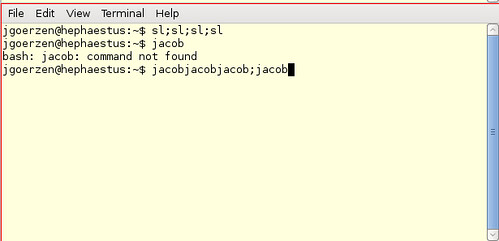
I saw this on my computer screen the other day, and I ve got to say it really warmed my heart. I ll explain below if it doesn t provoke that reaction for you. Evidence a 4-year-old has been using my computer So here s why that made me happy. Well for one, it was the first time Jacob had left stuff on my computer that I found later. And of course he left his name there. But moreover, he s learning a bit about the Unix shell. sl is a command that displays an animated steam locomotive. I taught him how to use the semicolon to combine commands. So he has realized that he can combine calls to sl with the semicolon to get a series of a LOT of steam trains all at once. And was very excited about this discovery. Also he likes how error messages start with the word bash .

Gerfried Fuchs: Games Team IRC Meeting

As Paul Wise already blogged, there is going to be a IRC meeting of the Debian/Ubuntu Games Team on the upcoming friday night. It will be held at 18th of March at 21:00 UTC in #debian-games on irc.oftc.net, so if you are interested in bringing the Games Team up to pace again, want to join and wonder how you could help, please attend. The agenda isn't final yet, the doodle poll about it is still open, if you want to put your preferences in.

/debian permanent link Comments: 0 Flattr this

Alexander Reichle-Schmehl: Video of the Linux New Media Award Ceremony online

I've just been told, that the video of the Linux New Media Award Ceremony (you might remember that Debian won in two categories) is now available online. Update: To watch that video without a proprietary plugin, you can download the video and watch with xine or some other free media player. Thanks to Rhonda for the hint! My (German) interview with RadioTux is also available online.

Gintautas Miliauskas: Google Munich

It looks like I have made it through most of the hurdles of the Google hiring process, and I should be starting my new job at Google's Munich office soon. Now I just need to haul my stuff to Munich and get the paperwork done. It sure looks like this is going to be a very interesting year.

Daniel Kahn Gillmor: CryptLib and the OpenSSL License

I spent part of today looking at packaging Peter Gutmann's CryptLib for debian. My conclusion: it may not be worth my time. One of the main reasons i wanted to package it for debian is because i would like to see more OpenPGP-compliant free software available to debian users and developers, particularly if the code is GPL-compatible. Cryptlib makes it quite clear that it intends to be GPL-compatible:
cryptlib is distributed under a dual license that allows free, open-source use under a GPL-compatible license and closed-source use under a standard commercial license.
However, a significant portion of the cryptlib codebase (particularly within the bn/ and crypt/ directories) appears to derive directly from OpenSSL, and it retains Eric Young's copyright and licensing. This licensing retains the so-called "advertising clause" that is generally acknowledged to be deliberately incompatible with the GPL. (A common counterargument for this incompatibility is that OpenSSL should be considered a "System Library" for GPL'ed tools that link against it; whether or not you believe this for tools linked against OpenSSL, this counterargument clearly does not hold for a project that embeds and ships OpenSSL code directly, as CryptLib does) This does not mean that CryptLib is not free software (it is!), nor does it mean that you cannot link it against GPL'ed code (you can!). However, you probably can't distribute the results of linking CryptLib against any GPL'ed code, because the GPL is incompatible with the OpenSSL license. The un-distributability of derived GPL-covered works makes the CryptLib package much less appealing to me, since i want to be able to write distributable code that links against useful libraries, and many of the libaries i care about happen to be under the GPL. I also note that Peter Gutmann and CryptLib Security Software (apparently some sort of company set up to distribute CryptLib) may be in violation of Eric Young's License, which states:
 * 3. All advertising materials mentioning features or use of this software
 *    must display the following acknowledgement:
 *    "This product includes cryptographic software written by
 *     Eric Young (eay@cryptsoft.com)"
 *    The word 'cryptographic' can be left out if the rouines from the library
 *    being used are not cryptographic related :-).
A Google search for Eric Young's name on cryptlib.com yields no hits. I do find his name on page 340 of the Cryptlib manual, but that hardly seems like it covers "All advertising materials mentioning features or use of this software". I suppose it's also possible that CryptLib has negotiated an alternate license with Eric Young that I simply don't know about. In summary: i think CryptLib could go into debian, but its incorporation of OpenSSL-licensed code makes it less useful than i was hoping it would be. I have a few other concerns about the package after looking it over in more detail. I suspect these are fixable one way or another, but i haven't sorted them out yet. I'm not sure i'll spend the time to do so based on the licensing issues i sorted out above. But in case anyone feels inspired, the other concerns i see are:
embedded code copies
In addition to embedded (and slightly-modified) copies of bn/ and crypt/ from OpenSSL, CryptLib contains an embedded copy of zlib. Debian has good reasons for wanting to avoid embedded code copies. I've got it CryptLib building against the system copy of zlib, but the bits copied from OpenSSL seem to be more heavily patched, which might complicate relying on the system version.
executable stack
lintian reports shlib-with-executable-stack for the library after it is built. I don't fully understand what this means or how to fix it, but i suspect it derives from the following set of object files that also have an executable stack:
0 dkg@pip:~/src/cryptlib/cryptlib$ for foo in $(find . -iname '*.o'); do
>  if ! readelf -S "$foo"   grep -q .note.GNU-stack ; then
>   echo "$foo"
>  fi
> done
./shared-obj/desenc.o
./shared-obj/rc5enc.o
./shared-obj/md5asm.o
./shared-obj/castenc.o
./shared-obj/bfenc.o
./shared-obj/rmdasm.o
./shared-obj/sha1asm.o
./shared-obj/bn_asm.o
./shared-obj/rc4enc.o
0 dkg@pip:~/src/cryptlib/cryptlib$ 
They probably all need to be fixed, unless there's a good reason for them to be that way (in which case they need to be documented).
non-PIC code
lintian reports shlib-with-non-pic-code on the library after it is built. I don't fully understand what this means, or how to resolve it cleanly, but i imagine this is just a question of sorting out the details.
Anyone interested in using my packaging attempts as a jumping off point can start with:
git clone git://lair.fifthhorseman.net/~dkg/cryptlib
Oh, and please correct me about anything in this post; I'd be especially happy to hear that my analysis of the licensing issues above is wrong :) Tags: cryptlib, gpl, licensing, openssl

15 March 2011

David Welton: Coming Soon: Easy Kindle Publishing with LiberWriter.com

The Kindle isn't the most beautiful device out there - it's not "beautiful", the keyboard takes away some elegance, but I'm absolutely smitten with mine. I like to read, a lot, and being able to instantly beam books to my house is just fantastic. Kindles and other devices like them are also changing the world of publishing, going from the known world of physical books that can't be easily copied to another information good like movies or songs with something of an uncertain future. Yet they're also opening up many possibilities: thanks to Amazon's Kindle Direct Publishing program, it just got very easy to publish books to a platform that a lot of people regularly search for good things to read. Once upon a time, "vanity publishing" was something done by those who simply wanted to see their names in print, but couldn't actually find a publisher, and thus carried some stigma. Now, though, why not publish something you've always wanted to? Granted, without an editor, and publisher to promote your work, you probably won't become rich or famous, but many people write for the enjoyment of doing so. And who knows... there are already several cases of people publishing directly to the Kindle and making a decent income at it. Indeed, I have several things I'm thinking of writing about that clicked when I found the Kindle publishing program. Maybe now it's time to dust off some ideas I've had and start working on them a little bit at a time. Then, of course, my geeky side took over and I started wondering how the mechanics of it actually work. Messily, it turns out: the preferred format for Kindle authoring is variant of HTML that's not at all what we're used to in these days of ever more potent CSS. The good side of it is that books mostly come out looking the same on the Kindle, and the end user can control how they want to visualize them. The bad side of the system utilized is that there are a lot of tips and tricks and little things to know about the whole process that can be annoying even for someone who knows HTML pretty well. For someone who just wants to write stuff and not worry about it, and who perhaps is not very familiar with HTML, the whole thing can be a huge mess and very frustrating. Which of course looks like an interesting challenge. I set out to work on LiberWriter.com several weeks ago, and it should be ready within the next week or two. In short, it's a system that lets you concentrate on writing and, as much as possible, tries to get out of your way in order to let you concentrate on your content. It is also targeted very specifically at the Kindle (for the time being at least), so as to really focus on making things work on that platform. For instance, it can automatically generate a table of contents, a noted pain point in writing for the Kindle. I have a number of other ideas up my sleeve too, that I'm excited to work on. I'm also definitely abandoning the "let's release it for free, for fun, and see if I can find a way to make money later" model of many past projects, and treating it like a business. I think the price I have in mind is very competitive, if you look at, for instance, conversion services that take word and spit out Kindle-specific HTML. Anyway, have a look at the site and sign up if you're interested: as soon as it's ready, I'll email and let you know. There'll be a somewhat limited trial version so that you can play around with it and see if you like it before buying the full version.

Michal &#268;iha&#345;: GPL violation - getting more sources

It has been some time since I updated information about Gammu usage in proprietary software, so here it comes (see other posts tagged with gpl for more information). I still have troubles to explain Anwsoft what they are supposed to release. The good news is that they are still communicating and even providing some updated sources (see git repository), unfortunately they still construct fake projects rather than providing real sources of the application. Anyway if anybody is interested in digging in the sources and finding bits which might be interesting for porting to current Gammu code base, please go ahead, I probably won't have time for that in near future.

Filed under: English Gammu Gpl 3 comments Flattr this!

Next.

Previous.