Search Results: "mak"

7 August 2010

Christian Perrier: Developers per country

Back in 2009, I did some analysis of the number of developers per country. Apparently, some people at DebConf remember this and asked if I could update this data. So, here we are with the 2010 version, sorted by the ratio of *active* developers per million population for each country.
Act: number of active developers
Dev: total number of developers
A/M: number of active devels per million pop.
D/M: number of devels per million pop.
2009: rank in 2009
2010: rank in 2010
Code	Name		Population	Act	Dev	A/M	D/M	2009	2010
fi	Finland		5359538		21	32	3,92	5,97	1	1
ch	Switzerland	7782900		22	26	2,83	3,34	2	2
nz	New Zealand	4386207		11	15	2,51	3,42	4	3
no	Norway		4895500		11	14	2,25	2,86	5	4
lu	Luxemburg	502202		1	1	1,99	1,99	8	5
se	Sweden		9354462		18	34	1,92	3,63	3	6
de	Germany		81757600	148	212	1,81	2,59	7	7
at	Austria		8356707		14	23	1,68	2,75	6	8
ie	Ireland		6197100		9	12	1,45	1,94	13	9
au	Australia	22413132	32	56	1,43	2,5	9	10
be	Belgium		10827519	14	16	1,29	1,48	10	11
fr	France		65447374	84	112	1,28	1,71	12	12
nl	Netherlands	16607943	20	38	1,2	2,29	11	13
uk	United-Kingdom	62041708	64	102	1,03	1,64	14	14
ca	Canada		34199000	27	56	0,79	1,64	15	15
es	Spain		46030109	34	52	0,74	1,13	16	16
dk	Denmark		5540241		4	8	0,72	1,44	17	17
hr	Croatia		4489409		3	3	0,67	0,67	20	18
lt	Lithuania	3341966		2	2	0,6	0,6	28	19
cz	Czech Rep	10506813	6	6	0,57	0,57	21	20
us	USA		309913000	165	360	0,53	1,16	19	21
it	Italy		60231214	32	46	0,53	0,76	23	22
bg	Bulgaria	7563710		4	4	0,53	0,53	25	23
il	Israel		7602400		4	6	0,53	0,79	24	24
hu	Hungary		10005000	5	11	0,5	1,1	18	25
lv	Latvia		2217969		1	2	0,45	0,9	26	26
uy	Uruguay		3494382		1	2	0,29	0,57	22	27
jp	Japan		127420000	32	45	0,25	0,35	30	28
pl	Poland		38192000	9	13	0,24	0,34	29	29
cr	Costa Rica	4253897		1	1	0,24	0,24	31	30
sk	Slovakia	5379455		1	1	0,19	0,19	32	31
pt	Portugal	11317192	2	4	0,18	0,35	27	32
ar	Argentina	40134425	6	8	0,15	0,2	34	33
tw	Taiwan		23119772	3	3	0,13	0,13	37	34
br	Brazil		192272890	20	21	0,1	0,11	36	35
by	Belarus		9648533		1	1	0,1	0,1	35	36
mg	Madagascar	20653556	2	2	0,1	0,1	44	37
gr	Greece		11306183	1	3	0,09	0,27	33	38
kr	South Korea	48758000	4	6	0,08	0,12	39	39
ec	Ecuador		14790608	1	1	0,07	0,07		40
cl	Chile		17063000	1	2	0,06	0,12	42	41
ru	Russia		141927297	7	8	0,05	0,06	43	42
ro	Romania		22215421	1	2	0,05	0,09	45	43
co	Colombia	45393050	2	3	0,04	0,07	41	44
ve	Venezuela	26814843	1	1	0,04	0,04	40	45
pe	Peru		29461933	1	1	0,03	0,03	46	46
tr	Turkey		72561312	2	2	0,03	0,03	47	47
za	South Africa	49991300	1	8	0,02	0,16	38	48
mx	Mexico		111211789	2	2	0,02	0,02	49	49
th	Thailand	66404688	1	2	0,02	0,03	50	50
eg	Egypt		78737000	1	2	0,01	0,03	51	51
in	India		1184344000	7	7	0,01	0,01	52	52
cn	China		1338612968	6	10	0	0,01	53	53
ua	Ukraine		45888000	0	0	0	0	48	54
								
								
					873	1410	61,91%			
A few interesting facts:

6 August 2010

Matthew Garrett: AE_AML_BUFFER_LIMIT in \_SB_._OSC

If you get messages like this:

ACPI Error (psparse-0537): Method parse/execution failed [\_SB_._OSC] (Node ffff8801e8c62b30), AE_AML_BUFFER_LIMIT

then you've fallen foul of one of the less appealing aspects of ACPI. _OSC methods are defined as methods to allow the operating system and the firmware to handshake over their support of optional features. Different _OSC methods apply to different types of hardware. CPU _OSC methods allow the operating system to inform the firmware that it supports ACPI 3.0 throttling states, while PCIe _OSC methods allow the operating system to indicate that it can manage native PCIe hotplug. The firmware can choose whether or not to give up control of these features, and the OS then has to cope.

The problem arises when we get to the _OSC method on the system bus. This wasn't specified until ACPI 4.0, leaving an attractive mechanism for vendors to add OS/firmware integration. To that end, we now have at least three different _SB_._OSC methods in the wild:
  1. The ACPI specified _OSC. This exists purely for the OS to tell the firmware what it supports, without the firmware having the opportunity to disagree. As such it passes 8 bytes of data to the method.
  2. The Microsoft WHEA _OSC. This exists to allow the firmware and Windows to handshake over whether or not the firmware supports Microsoft's hardware error reporting.
  3. HP's PCC _OSC method, designed to allow handshaking between the OS and the firmware in order to determine whether they support OS interaction with the firmware-level CPU scaling


This wouldn't be enough to be a problem in itself. The ACPI spec requires _OSC methods to have GUIDs in order to protect users from exactly this kind of situation - Windows can attempt to enable WHEA on a machine with a spec-compliant _OSC, and the _OSC method will return an immediate failure because the GUID doesn't match. Except that the WHEA and PCC versions of _SB_._OSC pass 12 bytes of data in the third argument, against the ACPI spec version's 8. And many _OSC implementations attempt to access the region between bytes 9 and 12 before checking the GUID, resulting in the AE_AML_BUFFER_LIMIT error.

This is made even more annoying due to the fact that argument 2 contains the number of parameters being passed in argument 3, making it straightforward to avoid this kind of failure. Firmware authors, tbh.

David Welton: Geek Dad: "Skywalker Story"

I don't usually talk about personal stuff here, but I'll make an exception: I got tired of telling our two year old daughter the same old stories about children lost in forests, bears, witches, evil stepmothers and so on, so I turned to some other material I know fairly well. I started recounting simplified bits and pieces of the first Star Wars movie over the course of a week. She thought it was great fun, what with wookies and robots and a princess and lots of adventures, and now, every evening, asks for "Skywalker story!". I'm quite proud, although my wife rolls her eyes a bit.

5 August 2010

Dirk Eddelbuettel: RcppArmadillo 0.2.5

Hot on the heels of RcppArmadillo release 0.2.4 a few days ago comes a new release 0.2.5 which is now on CRAN. RcppArmadillo makes it easy to write highly efficient and highly readable C++ code for linear algebra (based on Armadillo) in R extensions (using Rcpp for the interface). This release upgrades the included Armadillo version to Conrad's just-released version 0.9.60. This overcomes some of minor issues we had with 'older' compilers such as g++ 4.2.x with x being 1 or 2. No other changes were made from our end. The short NEWS file extract follows:
0.2.5   2010-08-05
    o   Upgraded to Armadillo 0.9.60 "Killer Bush Turkey"
More information is on the RcppArmadillo page. Questions, comments etc should go to the rcpp-devel mailing list off the R-Forge page.

Joey Hess: announcing Branchable

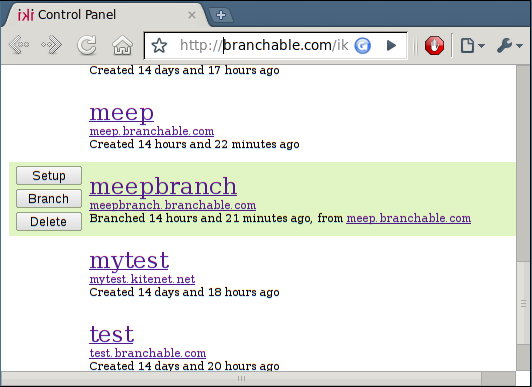
Time to introduce what I've been working on for these past too many months.. Branchable is an Ikiwiki hosting site, making it very easy to create blogs and wikis. The name "Branchable" was chosen because with its git backend, and ikiwiki-hosting frontend, sites hosted there can be easily branched by their owner (or by anyone, if the owner allows). branched site in control panel The ability to take your data and configuration and go home, as well as everything being free software, means Branchable follows the vision of the Franklin Street Statement on Freedom and Network Services, like identi.ca and last.fm. This is very important to me and to my cofounder, Lars Wirzenius. Branchable has a one month free trial, so if you've been meaning to do something with Ikiwiki, I hope you'll sign up. Also, we are offering free hosting for Free Software projects that sign up while Branchable is in beta.

Benjamin Mako Hill: My August

I've got a pretty packed August. I just wrapped the Open and User Innovation Conference at MIT -- the academic conference on user and open innovation connected to my research. I organized the program and was MC for the 120+(!) talks and research updates on the program so it's a huge relief to see it come off successfully. On Thursday, August 5th (at 14:30 UTC) I'll be giving a talk on antifeatures at DebConf (the Annual Debian conference). It was accidentally listed as "Revealing Errors" until a few minutes ago -- sorry about that! It will be streamed live (details on the DC site) for those outside of New York City who might want to follow it. As soon as DebConf is done on August 8th, I'm going to head to Kor ula in Croatia to relax, read, and hopefully get a bit of research done, before I head off to Outlaws and Inlaws in Split on the 19th, a sort of piracy and (vs?) free software summit put on by mi2 connected to the recurring Nothing Will Happen where, from what I hear, quite a lot does. I'm going to have to leave Nothing Will Happen a little early to head to FrOSCon on the 21st where I'll be doing an antifeatures keynote again on the 22nd. I tend not to like to do the same talk too many times, or for more than a year, so this might be one of the last times I present on antifeatures in this form. After that, I'm going to head to Italy where I'll be between the 23rd and the 3rd of September. I'll fly and in and out of Rome and plan to spend some time in Rome, Tuscany, and Florence, but don't have a lot of set plans and might travel to Bologna or elsewhere. My schedule is pretty open. As always, I'm interested in meeting up for coffee or a drink with like-minded hackers, Wikipedians, researchers, activists, etc. If folks are interested in organizing talks or presentations, that sounds fun too. I'm keeping a brief description of my schedule updated alongside a bunch of ways to get in touch with me on my contact page. Don't hesitate to drop me a line!

4 August 2010

Neil Williams: FreedomBox

Eben Moglen's talk at DebConf10 has inspired a flood of responses and activity at DebConf10. The original talk overran the allotted time within the venue and then outside the venue for something like an hour, HackLab discussions migrated to the single theme and brought in more and more people over lunch. When the Skype talk was left without a speaker in the afternoon, it morphed into a FreedomBox BOF with maybe 100 delegates planning and contributing to the ideas and another BOF is planned for Friday. A rough outline is appearing on the wiki page for those who want to follow it and the video of the original talk is available, linked from that Wiki page.

What gets people excited about this project is that we already have all the components to do the work, people have been doing most of this stuff at home, on their own, for some time and it needs to be brought together as a series of packages and meta packages and other middleware glue to get it working. (multistrap is part of that glue - it's already being used commercially in a similar role. Debian Pure Blends is another part of the glue. This can be a Debian solution, it doesn't have to be a separate project.)

The software and glue doesn't have to be dependent on a single hardware platform, this is about getting the software right and deploying it on whatever hardware can run it - albeit that the architecture itself is likely to be ARM-something.

It is time for social networking to be freed from the man-in-the-middle - time to withdraw user data from central servers owned by some third-party and share directly with your friends (whichever network they use). Aggregate all data from all your friends, keep all your data in your own plug and access it from wherever you are using whatever devices you have to hand. What's more, your friends - especially the non-techy friends - can just buy a cheap beige box that hides away in the corner of their home and have all the same access too - everyone gets to choose exactly which pieces of data get shared and to whom and can then use their friends plugs to store encrypted backups of their other data. Or maybe the final solution will be slightly different - it's up to people in Debian to make it happen. The tools are in our own hands, if we want this, we just need to do it.

What is needed now is some direction, there are choices to be made about how the glue is designed and how this is turned into a "self-discoverable" distributed network service. Yes, IPv6 will make this easier but only once ordinary users can deploy the device transparently and without configuration, so an interim solution will be needed.

Who's up for the challenge?

Russell Coker: Why Clusters Usually Don t Work

It s widely regarded that to solve reliability problems you can just install a cluster. It s quite obvious that if instead of having one system of a particular type you have multiple systems of that type and a cluster configured such that broken systems aren t used then reliability will increase. Also in the case of routine maintenance a cluster configuration can allow one system to be maintained in a serious way (EG being rebooted for a kernel or BIOS upgrade) without interrupting service (apart from a very brief interruption that may be needed for resource failover). But there are some significant obstacles in the path of getting a good cluster going. Buying Suitable Hardware If you only have a single server that is doing something important and you have some budget for doing things properly then you really must do everything possible to keep it going. You need RAID storage with hot-swap disks, hot-swap redundant PSUs, and redundant ethernet cables bonded together. But if you have redundant servers then the requirement for making one server reliable is slightly reduced. Hardware is getting cheaper all the time, a Dell R300 1RU server configured with redundant hot-plug PSUs, two 250G hot-plug SATA disks in a RAID-1 array, 2G of RAM, and a dual-core Xeon Pro E3113 3.0GHz CPU apparently costs just under $2,800AU (when using Google Chrome I couldn t add some necessary jumper cables to the list so I couldn t determine the exact price). So a cluster of two of them would cost about $5,600 just for the servers. But a Dell R200 1RU server with no redundant PSUs, a single 250G SATA disk, 2G of RAM, and a Core 2 Duo E7400 2.8GHz CPU costs only $1,048.99AU. So if a low end server is required then you could buy two R200 servers that have no redundancy built in which cost less than a single server that has hardware RAID and redundant PSUs. Those two servers have different sets of CPU options and probably other differences in the technical specs, but for many applications they will probably both provide more than adequate performance. Using a server that doesn t even have RAID is a bad idea, a minimal RAID configuration is a software RAID-1 array which only requires an extra disk per server. That takes the price of a Dell R200 to $1,203. So it seems that two low-end 1RU servers from Dell that have minimal redundancy features will be cheaper than a single 1RU server that has the full set of features. If you want to serve static content then that s all you need, and a cluster can save you money on hardware! Of course we can debate whether any cluster node should be missing redundant hot-plug PSUs and disks. But that s not an issue I want to address in this post. Also serving static content is the simplest form of cluster, if you have a cluster for running a database server then you will need a dual-attached RAID array which will make things start to get expensive (or software for replicating the data over the network which is difficult to configure and may be expensive), so while a trivial cluster may not cost any extra money a real-world cluster deployment is likely to add significant expense. My observation is that most people who implement clusters tend to have problems getting budget for decent hardware. When you have redundancy via the cluster you can tolerate slightly less expected uptime from the individual servers. While we can debate about whether a cluster member should have redundant PSUs and other expensive features it does seem that using a cheap desktop system as a cluster node is a bad idea. Unfortunately some managers think that a cluster solves the reliability problem and therefore you can just use recycled desktop systems as cluster nodes, this doesn t give a good result. Even if it is agreed that server class hardware is used for all servers so features such as ECC RAM are used you will still have problems if someone decides to use different hardware specs for each of the cluster nodes. Testing a Cluster Testing a non-clustered server or some servers that use a load-balancing device at the front-end isn t that difficult in concept. Sure you have lots of use cases and exception conditions to test, but they are all mostly straight-through tests. With a cluster you need to test node failover at unexpected times. When a node is regarded as having an inconsistent state (which can mean that one service it runs could not be cleanly shutdown when it was due to be migrated) it will need to be rebooted which is sometimes known as a STONITH. A STONITH event usually involves something like IPMI to cut the power or a command such as reboot -nf , this loses cached data and can cause serious problems for any application which doesn t call fsync() as often as it should. It seems likely that the vast majority of sysadmins run programs which don t call fsync() often enough, but the probability of losing data is low and the probability of losing data in a way that you will notice (IE it doesn t get automatically regenerated) is even lower. The low probability of data loss due to race conditions combined with the fact that a server with a UPS and redundant PSUs doesn t unexpectedly halt that often means that problems don t get found easily. But when clusters have problems and start calling STONITH the probability starts increasing. Getting cluster software to work in a correct manner isn t easy. I filed Debian bug #430958 about dpkg (the Debian package manager) not calling fsync() and thus having the potential to leave systems in an inconsistent or unusable state if a STONITH happened at the wrong time. I was inspired to find this problem after finding the same problem with RPM on a SUSE system. The result of applying a patch to call fsync() on every file was bug report #578635 about the performance of doing so, the eventual solution was to call sync() after each package is installed. Next time I do any cluster work on Debian I will have to test whether the sync() code seems to work as desired. Getting software to work in a cluster requires that not only bugs in system software such as dpkg be fixed, but also bugs in 3rd party applications and in-house code. Please someone write a comment claiming that their favorite OS has no such bugs and the commercial and in-house software they use is also bug-free I could do with a cheap laugh. For the most expensive cluster I have ever installed (worth about 4,000,000 UK pounds back when the pound was worth something) I was not allowed to power-cycle the servers. Apparently the servers were too valuable to be rebooted in that way, so if they did happen to have any defective hardware or buggy software that would do something undesirable after a power problem it would become apparent in production rather than being a basic warranty or patching issue before the system went live. I have heard many people argue that if you install a reasonably common OS on a server from a reputable company and run reasonably common server software then the combination would have been tested before and therefore almost no testing is required. I think that some testing is always required (and I always seem to find some bugs when I do such tests), but I seem to be in a minority on this issue as less testing saves money unless of course something breaks. It seems that the need for testing systems before going live is much greater for clusters, but most managers don t allocate budget and other resources for this. Finally there is the issue of testing issues related to custom code and the user experience. What is the correct thing to do with an interactive application when one of the cluster nodes goes down and how would you implement it at the back-end? Running a Cluster Systems don t just sit there without changing, you have new versions of the OS and applications and requirements for configuration changes. This means that the people who run the cluster will ideally have some specialised cluster skills. If you hire sysadmins without regard to cluster skills then you will probably end up not hiring anyone who has any prior experience with the cluster configuration that you use. Learning to run a cluster is not like learning to run yet another typical Unix daemon, it requires some differences in the way things are done. All changes have to be strictly made to all nodes in the cluster, having a cluster fail-over to a node that wasn t upgraded and can t understand the new data is not fun at all! My observation is that the typical experience of having a team of sysadmins who have no prior cluster experience being hired to run a cluster usually involves learning experiences for everyone. It s probably best to assume that every member of the team will break the cluster and cause down-time on at least one occasion! This can be alleviated by only having one or two people ever work on the cluster and having everyone else delegate cluster work to them. Of course if something goes wrong when the cluster experts aren t available then the result is even more downtime than might otherwise be expected. Hiring sysadmins who have prior experience running a cluster with the software that you use is going to be very difficult. It seems that any organisation that is planning a cluster deployment should plan a training program for sysadmins. Have a set of test machines suitable for running a cluster and have every new hire install the cluster software and get it all working correctly. It s expensive to buy extra systems for such testing, but it s much more expensive to have people who lack necessary skills try and run your most important servers! The trend in recent years has been towards sysadmins not being system programmers. This may be a good thing in other areas but it seems that in the case of clustering it is very useful to have a degree of low level knowledge of the system that you can only gain by having some experience doing system coding in C. It s also a good idea to have a test network which has machines in an almost identical configuration to the production servers. Being able to deploy patches to test machines before applying them in production is a really good thing. Conclusion Running a cluster is something that you should either do properly or not at all. If you do it badly then the result can easily be less uptime than a single well-run system. I am not suggesting that people avoid running clusters. You can take this post as a list of suggestions for what to avoid doing if you want a successful cluster deployment.

Jaldhar Vyas: Sita Sings the Blues

In the evening today (Tuesday), the Debconf organizers arranged for a screening of the Creative Commons licensed film "Sita Sings the Blues" by Nina Paley. I went to see it as I had missed it when it was first released among tales of trials and tribulation at the hands of copyright meanies. So first let me say yay Free Culture!, boo Intellectual Property! etc. etc. Now we have that out of the way... "Sita Sings the Blues" has two main narrative threads: The breakup of Ninas relationship with her boyfriend and the Ramayana particularly a story from the uttarakanda about how after Shri Rama returned from Lanka, Sita had to undergo the agnipravesha to prove her chastity and even after she passed that test was eventually banished to the forest. I had an adverse reaction to this film. In fact I stayed to the end to be polite but I left afterwards as soon as I could. I had almost a physical feeling of nausea and I was surprised by this. Since then I have been pondering why this is so. It's not that its blasphemous. Shri Rama is not just a "perfect man", he is God (an avatar of Vishnu Bhagavan as is briefly touched upon in the film) for millions of people so, well, yes it is blasphemous but its more Rowan Atkinson style rather than Norwegian Black Metal style blasphemy. One never gets the impression that the author hates Hinduism or Indian culture the opposite in fact. And in fact it is not uncommon in our culture to speak of Sita and Rama in this way. They are not remote authority figures but as familiar to us as our own friends and family and the Ramayana is not just about events that happened long ago it is relevant to our lives right now. Even the "good woman done wrong by big dumb male jerk" narrative is not unknown. (See the Uttararamacharita of Bhavabhuti for instance.) though I would suggest reducing the Ramayana this way is akin to treating the Hitchhikers Guide to the Galaxy as a book about towels. Even the milder criticism that it is not accurate is offbase because although the Sanskrit poem by Maharshi Valmiki is the canonical rendition of the Ramayana, there are other well-known versions. Not just in Sanskrit, the Hindi retelling by Sant Tulsidas called Ramacharitamanasa is more popular than Valmiki. Also speaking as someone who has preached Ramakatha "professionally" I can tell you that even the priests do not stick to the letter of the text. It is encouraged and expected that they will riff on the basic stories adding or removing details according to the needs and taste of the audience. And the device of the three narrators made me smile as this is exactly the kind of discussions that go on after hearing the Ramakatha. (I must say Paley picked a notably illiterate trio though.) One place where this fell flat was when they discussed the alleged discrepancy between Sita living simply in the forest and dropping a trail of jewellery on the way to Lanka. Although I can imagine someone at some point saying, "Do not question these stories" not at this point. Even the most retarded westernized Indian would know that removing ones ornaments is a sign of widowhood. A married woman would only do that in extremis certainly not just merely because she was a hermit. In a few cases some extra details might have helped the story. It was not explained that Ravana does not just have rakshasas in his command but he is one himself. (And he certainly wasn't a good guy until one day he got up and kidnapped Sita.) Shri Ramas brother Lakshamana accompanied the couple into the forest to Lanka and back but he only pops up (for no apparent reason) at the end. But look at me, I'm turning into one of those people who rant about Star Trek continuity errors or complain that the Romans in a gladiator movie have the wrong helmets for that time period etc. One has to cut a storyteller some slack and I entered the screening determined to be charitable. It's also not because I don't really see much connection between the two stories. Getting dumped by someone who simply loses interest in you hardly seems equivalent to being trapped by a moral code that doesn't allow for individuals feelings. Paley could have easily made "Princess Leia Sings the Blues" and it wouldn't have changed the significance much. But in India people make far more tenuous connections between the epics and events in their own life so one can hardly complain about that. Aesthetics are not the problem either. The first version of the Ramayana I ever read was the Amar Chitra Katha comicbook version which partly influenced the visual style of this film. (In fact you briefly see it in one scene when different editions of the Ramayana flash by.) Hindu popular culture is very gaudy. (See Ramanand Sagars '80s Ramayana Hindi TV serial, which was very reverential, insanely popular and tacky beyond belief.) The animation in this film is very good and quite artistic. "So Jaldhar", you might be asking if you've read this far, "what exactly is your problem with this film?" I have read the Valmiki Ramayana in Sanskrit with the commentaries from beginning to end. I've read other Ramayanas in Sanskrit, Gujarati, and English. I have read the comicbook, I've read anti-Ramayana polemics. When you learn Sanskrit in the traditional way the first lesson, in the declension of masculine gendered nouns ending in vowels is rAma.h rAmau rAmA.h ... I am well aware there are different emphases, different interpretations in various versions. Why can't I accept this as just another take on a story that has shown its fluidity over and over again? It's just...wrong on a subrational level. How can I put this? Imagine you are flipping through the TV channels and you see your grandparents amongst Lady Gaga's backup dancers. Or you came home one night to find everything that was on the floor meticulously glued to the ceiling. Over the course of my life (to hear my mother tell it my first exposure to the Ramayana was before I could speak.) I have developed a mental bond with this story a certain idea of how it should be. I think so has Nina Paley. And this is the problem. "Sita Sings the Blues" is Nina Paleys Ramayana not mine.

3 August 2010

Joachim Breitner: ipatch, the interactive patch editor

The problem: Splitting patches As a Debian maintainer, I often work with patches (files listing changes to text files), for example when tracking the modification I make to some software before I upload the package to Debian. To manage these patches, quilt is a nice tool: It helps you maintain a stack of patches on top of the original code and encourages you to keep your variously modifications separate. One use case is not supported by quilt at all: Splitting patches. One often has a large patch containing several independent changes. This might happen after you fix a few problems in the upstream code and then run dpkg-buildpackage, which will create one patch of your changes and put it in debian/patches. Before, I had to manually edit the patch and write the hunks, which are the building blocks of patches, into separate file. Where it already works There is no such problem when using a version control system, such as Darcs. Especially Darcs is rightly famous for its user-friendly interface and powerful hunk-selection features. You can even split a single hunk (which could be a change to one line) into two separate steps! Have a look at the HunkEditor page on the Darcs wiki to see how that works.
Let s steal a feature Well, it is not stealing if it is Free Software... Darcs has these nice capabilities and provides them in the context of version control systems, while we need them in the context of patch files. But Darcs is providing an API to its code, so shoudn t it be possible to create a program that uses the Darcs code to split patch files? As a matter of fact, it is possible: You can see that program in action on this 3min Ogg Theora-Video or directly here if your browser supports HTML5:
<video controls="true" height="448" src="http://www.joachim-breitner.de.nyud.net/various/ipatch-demo.ogv" tabindex="0" width="704">Looks like your browser does not support HTML5</video>
Nice, can I use it? The code is a working proof of concept. What you see works. You do not see how it handles patches that create or delete files, patches that do not apply cleanly or are already applied or any kind of error handling. That does not work yet. If you still want to try it, you can grab the code from the Darcs repository at http://darcs.nomeata.de/ipatch, but you need to build the latest development state of the Darcs library first. I think ipatch could become a very useful and powerful tool with applications in areas where nobody would think of using Darcs. I definitely want some integration into quilt, replacing the splitted patch in the series by the replacing patches automatically. Maybe even a git plugin could be created? But I don t think I can push this project far enough on my own. So this is an invitation to join me and make ipatch a great tool. This invitation goes especially to the Darcs developers: Please have a look how the code uses the Darcs API and help to improve the collaboration here. I think we can use the darcs-users mailing list until there is need for a dedicated mailing list.

Rog rio Brito: First post from DebConf 10

Even though I am late with this post, it is nice to say that I am writing here from this year s DebConf10, in NYC. Today (well, yesterday) was the day of the Cheese and Wine party and I think that it was cool, at least for the moments that I were there. This post, though, isn t technical in any sense. I only talks shortly about my impressions of the community, as this is my first DebConf ever (despite the fact that I have been using Debian since the late nineties). I was very pleased to have met Bdale Garbee. I saw him the other day arriving with Keith Packard, but I just didn t want to disturb them at that point. We only talked for, say, 2 minutes, and his was one of the nicest receptions that I had here. And there were some other people that were equally easy to approach, nice to talk with and, to my surprise, knew my name after some brief moments (yes, this does make a difference, especially when you are in a strange country, when you don t know anybody with whom you have worked for some years). Being involved in the organization stuff, one would think that Jimmy Kaplowitz would be so busy, but he was so kind. I had longer conversations with T ssia Cam es, Tiago Vaz (as always) and some other people that I had not yet had the pleasure of meeting in person. In particular, Daniel Baumann (who apparently is now crazy about our FISL and wants to drink all Guaran that he can get :-) ), Chris Lamb and Ot vio Salvador and his mom. Those people are so cool and it is nice to discuss some legal issues among different continents in the lounge of their building at late night. :-) Too bad that I am allocated to the other building. :-) I am forgetting many other people (hey, it is 2 am here in NYC), but I would feel guilty if I had not mentioned at least three people more: Martin Michlmayr, Phil Hands, and Reinhard Tartler (who is uploading lame to the debian repository, as the patents regarding it are expiring or expired already). Thanks! P.S.: I just created an account on flickr that I hope to populate with some photos that I took here. And even with a nice squirrel. :-)

Dirk Eddelbuettel: RcppExamples 0.1.1

On Friday, I quickly provided a new release of RcppExamples, our example package for using Rcpp, to CRAN. Very little content has been updated --- and a new TODO file even notes that we need to add more documentation for the new Rcpp API. And update existing documentation as lots has changed since the initial release in March. But at least this package now joins RcppArmadillo is using the highly-recommened LinkingTo: Rcpp directive in the DESCRIPTION file to let R find the Rcpp headers, making the build process a little more robust. A few more details on the page are on the RcppExamples page.

Lucas Nussbaum: On extending Debian membership to non-programming contributors

Stefano raised again the issue of providing some kind of Debian membership to people that contribute to Debian in unusual ways (not involving deep purely technical skills), like doing translation, documentation, marketing, design, etc. Each time this discussion comes back, people seem to think that we need another membership status for them. But what for? It s true that the name Debian Developer is suboptimal for non-programmers. But it s also suboptimal for most DDs, since most of us don t strictly develop software: we just maintain packages, mainly developing meta-data around the upstream source code. Debian Developer is how we call our full-fledged project members. Do we want to classify those non-programming contributors as second-class citizens? If not, we need to make them Debian Developers , not some strange other name. Of course, there s the issue of security and trust. Debian Developers have upload rights on all packages, and access to the project s machines. And it s a bit strange to trust non-programmers with that level of power. On the other hand, we have many Debian Developers that are mostly inactive, became DDs half a decade ago, and have the same access rights. Worst, it s possible that they remember how to use dput, having used it before! And 95% of DDs (me included) should probably not be uploading the libc, even if they can. Why should they be more trusted than active non-programming contributors that probably would be quite scared by the idea of breaking something? Overall, I think that this issue is actually a non-issue. We should:

2 August 2010

Matt Zimmerman: DebConf 10: Day 2

Today was the first day of DebConf proper, where all of the sessions were aimed at project participants. Bits from the DPL (Stefano Zacchiroli) Stefano delivered an excellent address to the Debian project. As Project Leader, he offered a perspective on how far Debian has come, raised some of the key questions facing Debian today, and challenged the project to move forward and improve in several important ways. He asked the audience: Is Debian better than other distributions? Is Debian still relevant? Why/how? Having asked this question on identi.ca and Twitter recently, he presented a summary. There was a fairly standard list of technical concerns, but also: He pointed out some areas which we would like to see improve, including: All in all, I thought this was an accurate, timely and inspirational message for the project, and the talk is worth watching for any current or prospective contributor to Debian. Debian Policy BoF (Russ Albery) Russ facilitated a discussion about the Debian policy document itself and the process for managing it. He has recently put in a lot of time working on the backlog (down from 160+ to 120), but this is not sustainable for him, and help is needed. There was a wide-ranging discussion of possible improvements including: There was also some discussion in passing of the long-standing confusion (presumably among people new to the project) with regard to how policy is established. In Debian, best practices are first implemented in packages, then documented in policy (not the reverse). Sometimes, improvements are suggested at the policy level, when they need to start elsewhere. I m not very familiar with how the policy manual is maintained at present, but listening to the discussion, it sounded like it might help to extend the process to include the implementation stage. This would allow standards improvements to be tracked all the way through from concept, to implementation, to documentation. The Java Packaging Nightmare (Torsten Werner) Torsten described the current state of Java packaging in Debian and the general problems involved, including licensing issues, build system challenges (e.g. maven) and dependency management. His slides were information-dense, so I didn t take a lot of notes. His presentation inspired a lively discussion about why upstream developers of Java applications and libraries often do not engage with Debian. Suggested reasons included: Collaboration between Ubuntu and Debian (Jorge Castro) Jorge talked about the connections between Debian and Ubuntu, how people in the projects perceive each other, and how to foster good relationships between developers. He talked about past efforts to quantify collaboration between the projects, but the focus is now on building personal relationships. There were many good questions and comments afterward, and I m looking forward to the Debian derivatives BoF session tomorrow to get into more detail. Tonight is the traditional wine and cheese party. When this tradition started, I was one of just a handful of people in a room with some cheese and paper plates, but it s now a large social gathering with contributions of cheese and wine from around the world. I m looking forward to it.

Christine Spang: lolbikeride to debconf

DebConf being in New York City this year, clearly the right way to get there was to bike, together with Molly and Daf. Being touring newbs, there were a few mishaps.

Day 1 We aimed to catch the 10:00 commuter rail train from Boston to Providence, Rhode Island, but we ran late (predictable) and had problems with the bicycle rack for my racing bike, which attaches without frame mounts (also predictable, since Mako and Mika test-rode it earlier in the week), so we didn't make it in to the station until around 10:20. We used the extra time to eat and fix up the bikes, though, so it's not clear how much of a setback that was. Here are our bikes ready to go at the Providence commuter rail station. bikes at Providence We then had some problems with Molly's brakes, and it took a long time to navigate out of the city, but eventually we found ourself on the "Washington Secondary Trail" a wonderful bike path along an old rail line. Every couple miles there'd be an old covered rail bridge over the river, and it was a well-paved straight shot for about ten miles, with no cars and no need to navigate. Molly on a train bridge Just as we were getting into things after the bike trail ended, something completely unexpected happened. This is Daf's derailleur after it sheared off in the middle as we attempted to start after a red light outside Tractor Supply Co. broken derailleur Luckily, John and his son Chris lent us a hand and hauled Daf and his bike to the nearest bicycle shop in the back of their pickup truck. They'd just come from there, where John had bought Chris a new helmet. Greenway Cycles, the only bike shop in a twenty mile radius, was three miles away. We got there an hour before it closed and Rick replaced the derailleur and straightened the hanger in a jiffy. Due to all these things, we didn't get as far as we'd planned in the first day and ended up camping in Seaport Campground in Mystic, Connecticut, rolling in at around 22:00. We did about 65 miles, including six due to the detour to the cycle shop. Carrying camping gear is heavy! Several delicious peanut butter and jelly bagels and some wheatberry and couscous salad later, we were passed out.



Day 2 Molly at the campground The second day included less bike trouble, but was no less eventful, and we were tired from the previous day's riding. The highlights included taking a tiny sidewalk path that I'm baffled how Google knows about up onto a sidewalk alongside the I-95 bridge across the Thames to New London, Connecticut. the Thames bridge The 13:00 ferry from New London to Orient Point, New York, where we got some remarkably good veggie burgers (whole edamame visible!) for lunch. Cross Sound Ferry And a vineyard on the north fork of Long Island, where we stopped for a quick tasting and ended up picking up a bottle of barrel-fermented chardonnay. The vineyard was small 23 acres, with 11 acres of grapes and the proprietors were friendly and extremely interested in our trip. They gave us a dollar off on the bottle due to our method of transport. The Old Field Vineyard It turns out there are only two trains a day on the Long Island rail, and we just barely caught the 18:52 return from Riverhead. We had mere seconds in the station and ended up without enough cash to pay for tickets onboard, but the conductor just took what we had and gave us tickets to Penn Station anyway. Outside Penn, a girl with a mohawk and a messenger bag overheard us talking about biking up Broadway and told us to bike up 8th Avenue instead. "Always bike up 8th and down Broadway because they have bike lanes in those directions." Thus, we didn't die dodging taxis in the dark. So basically, due to various people being extremely nice to us for no good reason, we made it to Columbia University around 22:30, on the correct day. Warm fuzzies for humanity all around. :)



Gunnar Wolf: We have released!

If you have seen me anywhere near my computer at DebConf, you probably have seen the face of a hurried, worried developer. Still, if you monitor my Debian-related activity, you will notice it is still quite low, even given my (much needed and very much enjoyed) vacations pre-DebConf. Yes, orga-team work is very time consuming, even if my role is far from central this year. And yes, DebCamp+DebConf are known for sucking time into social interaction, which is great but not so (formally) productive. And yes, I even took 1.5 days off to visit my family and a friend who live in the area... Still, I managed to release! \ / Release what? I have been working with Pooka for the last ~2 years on the Seminary on Collaborative Knowledge Construction. We assembled a group of ~10 speakers/authors, each of whom prepared a chapter for a book meant for publication. Pooka and me coordinated the work, which took a long time because it was also an interaction experiment (and because we both did it only in our free time). After the coordination work started fading, I took up the task of coming up with a way to translate it all into LaTeX (and fix a host of conversion bugs, and play with the available packages, and... Hey, I'm after all just a LaTeX newbie, and had to learn to tame the beast!), I stumbled upon that precious fact that makes so many projects release. I stumbled upon a deadline. We want to publish the book under the seal of IIEc-UNAM. Besides my workplace, it is a very well regarded university, and having its seal in our work is definitively a big plus. And the Publications Committee of my Institute is meeting this week - So I had to send our final manuscript by today. Having a deadline overlapping with DebConf sucks. But somehow, I managed to do the needed work to my complete satisfaction. The work is now in the Committee's hands, and I expect to have more news soon(ish). Oh, and where can you get our work? Well, if you register in our site, you will be able to read the whole contents. And once the book is approved and published, the whole work will be published online under a free (CC-BY-SA) license. BTW, that probably means I will have more time to fix my Debian bugs and pending stuff! \ /

Lucas Nussbaum: Ubuntu bugs with patches on the PTS and the QA Packages Overview

Like the Debian BTS, Launchpad is full of open bugs with patches[1]. They have an ongoing effort called Operation Cleansweep whose goal is to get the number of bugs with patches to zero, by reviewing patches and forwarding them upstream or to Debian. Since it really makes sense to expose bugs with patches to the Debian maintainers, I ve modified the Ubuntu box on the Packages Tracking System and the Ubuntu column on the QA Packages Overview (hidden by default for now) to include that information. You can see the result on the dpkg PTS page and the debian-pkg@ packages overview page. Many thanks to Brian Murray for making this possible on the Launchpad side.
[1] Debian has 55115 open bugs affecting unstable, of which 4011 have a patch. Ubuntu has 76916 open bugs, of which 2207 have a patch. [Insert here disclaimer that this is not at all a judgement of value on the abilities of any distribution at triaging bugs, or at generating patches]
Relevant UDD queries:
select count(*) from bugs
where affects_unstable and status = 'pending'
and id in (select id from bugs_tags where tag ='patch');
select count(*) from bugs
where affects_unstable and status = 'pending';
select count(distinct bugs.bug)
from ubuntu_bugs_tasks tasks,ubuntu_bugs bugs
where tasks.bug = bugs.bug
and distro in ('', 'Ubuntu')
and status not in ('Invalid', 'Fix Released', 'Won''t Fix')
and bugs.patches is true;
select count(distinct bugs.bug)
from ubuntu_bugs_tasks tasks,ubuntu_bugs bugs
where tasks.bug = bugs.bug
and distro in ('', 'Ubuntu')
and status not in ('Invalid', 'Fix Released', 'Won''t Fix');

Jaldhar Vyas: PreventaCamp Days 3 and 4

I missed yesterdays report but there was not a lot to say anyway. I've made further progress on the DHCP problem in the sense that I can make it go away if I use NAT in VMWare instead of Bridged networking. Tried compiling gcc 4.4.4 and ran out of disk space. I've been feeling guilty about not volunteering so that evening I assisted the organizers by eating some of their excess baked ziti. It's my civic duty. Today (Sunday) was Debian day. I spent some time in the hacklab trying to compile gcc again. This time I ran out of inodes. I did manage to get to two of the presentations. One was about the GSoC projects various students are doing. Perhaps next year Debian Minix will be a subject for GSoC? The other one was by Andy Oram about FLOSS Manuals. They are doing important work in Free Software documentation and have developed some interesting tech towards that end. One is CSS3 print profile support. This will be a relief for anyone who has had to deal with the bletcherous XSL. Another is booki a platform for collaborative writing and editing. I shall be following the progress of this project as I hope to make a big contribution to Debian documentation soon. Andy works for O'Reilly and after the talk we had some informative discussion about the publishing world. This "hallway track" is the great thing about gatherings like Debconf.

John Goerzen: The Best Place of Ever

Jacob and Oliver have enjoyed our recent train trip, and our stay, from Kansas to New York City for Debconf. All told, that s a 40-hour trip, including the layover in Chicago. When we got on the train, in the middle of the night as usual, Jacob couldn t stop chattering about how great , fun , and exciting it is. He told us about all the lots of great things on the train, the fact that we were on a night train , and generally couldn t stop chattering. For an hour. At 3:30AM. This was a typical sight from Jacob: IMG_4284 It wasn t as relaxing as usual for Terah and me. Oliver is at the grabbing everything in sight stage. Which worked fine when Jacob was at the age, but with Jacob also along it was a bit more difficult to manage. I suspect that our next trip, when Oliver is a few months older, will go easier. A highlight for both boys, as usual, is the dining car. Oliver loves anything related to eating solid food it s still novel to him and Jacob loves anything relating to trains. What could go wrong? (Parents will probably identify the capability for two hyper-excited young boys to have plenty of things go wrong at a table in a restaurant here fortunately we didn t have anything go terribly wrong.) Oliver turned out to find the things outside the window to require intense concentration intense enough to stick out his tongue while he worked it all out. IMG_4296 And Jacob, of course, wanted to get the wrapper off his straw by himself. Which he can do, but takes a minute. IMG_4305 They also enjoyed the lounge car. IMG_4292 We were in a sleeper room on both trains. That was nice, and when we needed to go explore , we could. Jacob s favorite part of the trip was when I folded down the upper bunk during the day for him to play. I pointed out that it was like a train treehouse. His face sure lit up. He loved that he had his own window up there to look out of. He climbed up the ladder, and after awhile of playing, said, Dad, would you like to play with me up here? Of course I would it always makes me happy when he asks if I want to play with him. As I was playing with him, I asked him if he was having fun in his train treehouse. He gave me a sweet smile, and said, Dad, this is the best place of ever! IMG_4321 In Chicago, Jacob and I went outside and walked around. He enjoyed walking across the bridges over the canal by Union Station. I checked some work email when we got back, tried but failed to reach some local hams with my handheld, and then we got on the train for New York. The boys loved it too, and Jacob was very ready to be in New York when we got there. We got out at Penn Station which was, I think, pretty much what my mind had imagined of an underground station robbed of its former glory (especially having been in that part of Chicago Union Station). We found the connection to the 2 train uptown, bought some MetroCards for the subway, and got on. Jacob was very interested in the subway. He sat very, very still I thought he was scared but on asking him some questions, realized that he was just very interested and engrossed in it all. I had been trying out my HF antenna for my amateur radio setup a few days ago, and by some coincidence, kept making contact with people that grew up in New York. A guy from Fargo, ND a native of Brooklyn told me to make sure to get pretzels from a hot sauce vendor, Pastrami on rye or corned beef on rye from a Jewish deli (because they have the best meat), pizza from guys wearing red and white shirts, and don t be afraid of rats on the subway tracks, and that our boys will love to feed leftover bits of pretzels to pigeons and squirrels. He got so excited about NYC that he went on and on, saying, Man, you re making me hungry now. During times I m not at sessions at Debconf, we ve found some time to do some things as a family. We went to Grand Central Terminal, just to see it it is indeed still Grand. I knew there was a Jewish deli there, so I thought hey try out his advice. It was closed, and when I realized it was Saturday, I realized why. Oops. We hopped on another train to Brooklyn and checked out the New York Transit Museum, which is great and has a lot of exhibits about the history of the city s subway and bus systems. It s housed in a former subway station, and they have a lot of old subway cars down there dating back to 1905 most of which are open to go inside of. It s been nice to meet people at Debconf that I have only known via email or IRC. The organizers of this conference have done a fabulous job. I have every expectation that this will turn out to be the best conference I ve been to in at least 12 years this is my first Debconf. It doesn t skimp on the technical details, people are friendly, and there is a sense of common purpose. But just as important, while there is a set schedule, there is an easy way to add other ad-hoc sessions to the conference schedule. People can get together a group interested in a topic, and schedule an event about it for the next day very easily. I m quite impressed by that, and am looking forward to the virtualization discussion that grew out of a question to the mailing list. It was also neat to meet people that sort of knew our family from my blog posts. I had no idea that there were all that many people that actually read these things ;-) The Debconf kick-off was great. As I was walking across the campus of Columbia towards it, it was a nice temperature, with some light rain, and I heard bagpipes in the distance. Beautiful. And when I left after the evening sessions, I still heard bagpipes. So I went to check it out, and ran into Gabriella Coleman, one of the Debconf organizers and the person that gave the talk I just left on the way, with the same idea. The Columbia campus is beautiful and historic, and it is an excellent venue for the conference. New York is a great city and I m sure we ll be back. It is great to walk out of the hotel in the morning, buy a fresh peach or two from the street vendor 20 feet away, and then go buy a roll or two ($0.75 each) from the bakery down the street. I have been so missing rolls like that since we got back from Germany in March. These weren t quite like the German bakeries, but the closest I ve had to it. It is interesting to note how differently people from different places look at things. Terah has told several people how we live 6 miles from a town with 500 people in it, and people that stop to think about it realize how different it is from New York. It was a surprise to me to hear that some New Yorkers think of Columbia as country . It is beautifully landscaped, and feels different than the rest of the city. The numbers I ve seen suggest that a typical fall weekday has more people on the Columbia campus than in the entire county where we live. And that county is twice the size of New York City. That s not to say that there s anything wrong with New Yorkers thinking of it as country, any more than there is of me thinking of a town with 15,000 people as a pretty big town. It s a different perspective, and I enjoy different perspectives which is another thing I like about Debconf. There are so many people from all over the world there that different perspectives are inevitable.

Bastian Venthur: Debconf: Day 2


Second day in the big city and after the obligatory pancakes, scrambled eggs and bacon breakfast, I spend almost the entire day in the hacklab fixing the documentation for the debbugs SOAP interface. Thanks to Don I think I finally have the get_status part at an accurate state. Accordingly I was very busy making changes in python-debianbts which uses the SOAP interface to query the BTS. Some Bugreport attributes disappeared, others got their data type fixed, Unittests where added and docstrings updated. Finally I uploaded the new version to unstable. Between that mess I met a lot of nice people, and heard a talk whose slides consisted almost entirely of lolcat images which was of course awesome! I definitively have to try that in one of my next scientific talks. Hopefully tomorrow I ll find some time to actually prepare my talk.

Next.

Previous.