Search Results: "ag"

28 February 2015

Petter Reinholdtsen: The Citizenfour documentary on the Snowden confirmations to Norway

Today I was happy to learn that the documentary Citizenfour by Laura Poitras finally will show up in Norway. According to the magazine Montages, a deal has finally been made for Cinema distribution in Norway and the movie will have its premiere soon. This is great news. As part of my involvement with the Norwegian Unix User Group, me and a friend have tried to get the movie to Norway ourselves, but obviously we were too late and Tor Fosse beat us to it. I am happy he did, as the movie will make its way to the public and we do not have to make it happen ourselves. The trailer can be seen on youtube, if you are curious what kind of film this is. The whistle blower Edward Snowden really deserve political asylum here in Norway, but I am afraid he would not be safe.

Zlatan Todori : Interviews with FLOSS developers: Joey Hess

Edit: Now translated to Chinese. Thanks zhang wei! There is really hardly a better way to open a series of interviewing with developers behind Free Libre Open Source Software project, then with incredible mind such as Joey Hess. To write his contributions to Free software ecosystem, especially in Debian, would be a book by itself. His impact exceeds even his projects - people literally follow his blog posts to see what he is doing and how is he living. A hacker from cabin. If you really need to have a picture of true hacker, then Joey is the one. As this isn't a book I will just mention few projects that he has been behind - git-annex, ikiwiki, etckeeper, debian installer, parts of dpkg, debhelper, devscripts, taskel. So without further waiting here it is. Picture of Joey Hess me: Who are you? joeyh: I'm Joey -- https://joeyh.name/ me: How did you start programming? joeyh: Atari 130XE which came with BASIC and a boring word processor and not much else. No other friends had one, so the only way to get software was to type in demo programs from manual and then begin to change and write my own. So, the easy way to learn. Also some Logo in school. me: How would you now advise others to start programming? joeyh: Difficult question, it seems much harder to get an intimate understanding of things than when I started, and much harder to be motivated to program when there's so much stuff easily available. Maybe simple bare-metal systems like Arduino coupled with real-world interaction are the answer. I've recently been mentoring my nephew who is learning python and Python the Hard Way has gotten him far impressively fast. me: Setup of your development machine? joeyh: Lenovo laptop de-spywared with Debian unstable, xmonad, xfce, vim. me: Your thoughts on Purism (the open hardware laptop initiative that got recently funded on CrowdSupply)? joeyh: I don't know much about that one, but it seems that consumer level hardware has gotten so low quality, and so closed and untrustworthy that it makes sense to either build alternatives that are open, or pick out, as a community, the stuff we can adapt to our needs and concentrate on it. Several projects are trying, I hope they succeed. me: How do you see future of Debian development? joeyh: Well, I've mostly stopped worrying about it. If you look back at my presentations at the past 2 or 3 DebConfs, you'll find my best thoughts on the matter. me: You retired as Debian developer - do you intend sometime soon to come back and/or do you plan to join some other communities? joeyh: It would be glorious to come back, wouldn't it? But I don't think I will. Can't step in the same river twice, and all. Instead, Debian will probably have to put up with me as an annoying upstream author who doesn't ship tarballs, but does ship debian/ directories, and as a bug reporter who enjoys reporting amusing bugs like -0 NaN. I seem to have more time to spend in other online communities since I left Debian, but in a more diffuse way. Maybe that's just what it's like, to be involved in Free Software but not in the embrace of a big project like Debian. me: Some memorable moments from Debian conferences? joeyh: There are so many! Picnicing on berries and tamales at the Portland farmer's market right outside the venue; rainbows and bonfire in Switzerland after crazy busy days; impromptu pipe organ repair in a weird night venue in Edinburgh; walking through Porto Alegre at night with Ian Murdock and how humble he was about what he'd started; hacking all night in Spain; failing to sleep through midnight sun and incessent partying Finland; hanging out in the hotel lobby in Atlanta where we designed Build-Depends. me: Are you a gamer? Valve Steam games are offered for free to Debian Developers - do you use steam and play Valve games? joeyh: I've played through Half Life and Portal, but nethack has claimed more of my time. I mostly enjoy short, indie games, or games that tell us something new about the medium of games, A recent favorite was A Dark Room. But really, I have more pure fun playing real world Tabletop games with friends, like Carcassanne Discovery and Hive. In March, I am going to try to write a roguelike game in one week, in Haskell, for the Seven Day Roguelike Challenge and I'll be blogging about my progress daily. me: You are nowdays a Haskell hacker (git-annex) - what would you like to say about this language and how does it compare to Python, C, JavaScript, Ruby and Perl? joeyh: Not just git-annex; all my current projects are written in Haskell. I think it's amazing how much we expect programmers to keep in their heads while writing code. Is that buffer going to overflow? Is changing the value of that global variable going to break some other part of the code? Is that input sanitized yet? Did that interface change? Haskell solves some of these outright, but more, it makes you start noticing this kind of pervasive issue, and it provides ways to completely eliminate a class of problems from your code. For example http://joeyh.name/blog/entry/making_propellor_safer_with_GADTs_and_type_families/. The class of bugs I avoided there had never affected my code even once, but it was still worth preventing that whole class of bugs, so I don't have to worry about them ever again. me: Would you suggest Haskell as first language to learn especially for those that have an itch for mathematics? joeyh: I think that can work well. Or it can go other the way -- I had an affinity to mathematics when I was young, but it got knocked out of me in the way that happens to many people, and languages like perl and C don't do much to make you want to learn more about higher-order math. I've been picking up a bit more here and there via Haskell. me: How do you compare your productivity in Haskell compared to your Perl days? joeyh: It's very different; I'm a very different programmer now. I probably would bang out quick hacks more quickly when I was writing Perl. But, they tended to stay quick hacks. Now, I might take a little longer to get there, but the code seems a lot more solid, while also being more malleable to turn into larger or different programs. I'm also a lot more drawn toward writing software libraries. me: Can you describe your philosophy of life (you live in cabin, in forest, using a lot of solar power - many people are intrigued (including myself) what drives you towards that kind of life and how does it impact your overall quality of life and happiness. Looking the todays modern predator capitalistic society, in which you could easily earn more then $10.000 a month, you seem to be an anarchist and very humble human)? joeyh: I want to build worthwhile things that might last. Which is super hard in the world of software, both because it's hard to think far ahead at all, and because most jobs don't emphasize that kind of real value. I've been lucky and bootstrapped up to a point where I've been able to work full time on free software for years, and I'm willing to forgo a lot to continue that. Living in the woods without modern conveniences is great, because it's quiet and you can think as much as you like; the internet is just as close as it is anywhere else (maybe a bit slower); and when you've spent too much time quietly thinking you'll need to go chop wood, or haul water, or jump in the river to cool off, depending on the season. (Humble? Like most programmers, I am internally a flaming tower of ego...)
Vote on Hacker News

Mathieu Parent: Hello Planet Debian

After more than five years of being a Debian developer, here is my first post on Planet Debian! I currently maintain 165 packages. My focus has changed since 2009, but those are still mostly sysadmin packages: Now that the first post is online, I will try to keep up!

Dirk Eddelbuettel: RcppEigen 0.3.2.4.0

A new release of RcppEigen is now on CRAN and in Debian. It synchronizes the Eigen code with the 3.2.4 upstream release, and updates the RcppEigen.package.skeleton() package creation helper to use the kitten() function from pkgKitten for enhanced package creation. The NEWS file entry follows.
Changes in RcppEigen version 0.3.2.4.0 (2015-02-23)
  • Updated to version 3.2.4 of Eigen
  • Update RcppEigen.package.skeleton() to use pkgKitten if available
Courtesy of CRANberries, there is also a diffstat report for the most recent release.

This post by Dirk Eddelbuettel originated on his Thinking inside the box blog. Please report excessive re-aggregation in third-party for-profit settings.

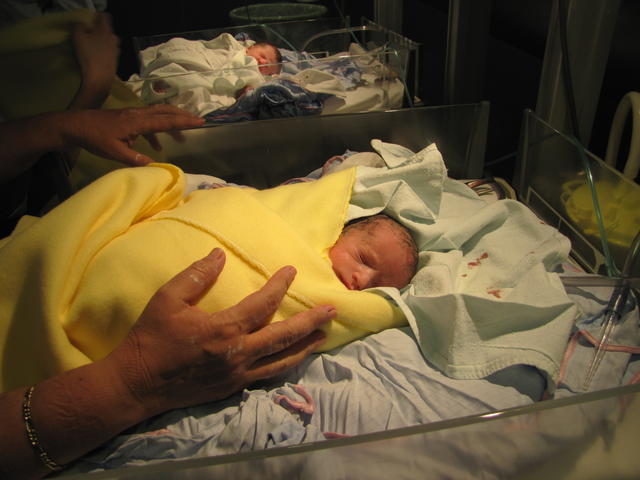
Gunnar Wolf: Welcome to the world, little ones!

Welcome to the world, little ones!
Welcome little babies! Yesterday night, we entered the hospital. Nervous, heavy, and... Well, would we ever be ready? As ready as we could. A couple of hours later, Alan and Elena Wolf Daichman became individuals on their own right. As is often the case in the case of twins, they were brought to this world after a relatively short preparation (34 weeks, that's about 7.5 months). At 1.820 and 1.980Kg, they are considerably smaller than either of the parents... But we will be working on that! Regina is recovering from the operation, the babies are under observation. As far as we were told, they seem to be quite healthy, with just minor issues to work on during neonatal care. We are waiting for our doctors to come today and allow us to spend time with them. And as for us... It's a shocking change to finally see the so long expected babies. We are very very very happy... And the new reality is hard to grasp, to even begin understanding :) PS- Many people have told me that my blog often errors out under load. I expect it to happen today :) So, if you cannot do it here, there are many other ways to contact us. Use them! :)

27 February 2015

Richard Hartmann: Release Critical Bug report for Week 09

The UDD bugs interface currently knows about the following release critical bugs: How do we compare to the Squeeze and Wheezy release cycles?
Week Squeeze Wheezy Jessie
43 284 (213+71) 468 (332+136) 319 (240+79)
44 261 (201+60) 408 (265+143) 274 (224+50)
45 261 (205+56) 425 (291+134) 295 (229+66)
46 271 (200+71) 401 (258+143) 427 (313+114)
47 283 (209+74) 366 (221+145) 342 (260+82)
48 256 (177+79) 378 (230+148) 274 (189+85)
49 256 (180+76) 360 (216+155) 226 (147+79)
50 204 (148+56) 339 (195+144) ???
51 178 (124+54) 323 (190+133) 189 (134+55)
52 115 (78+37) 289 (190+99) 147 (112+35)
1 93 (60+33) 287 (171+116) 140 (104+36)
2 82 (46+36) 271 (162+109) 157 (124+33)
3 25 (15+10) 249 (165+84) 172 (128+44)
4 14 (8+6) 244 (176+68) 187 (132+55)
5 2 (0+2) 224 (132+92) 175 (124+51)
6 release! 212 (129+83) 161 (109+52)
7 release+1 194 (128+66) 147 (106+41)
8 release+2 206 (144+62) 147 (96+51)
9 release+3 174 (105+69) 152 (101+51)
10 release+4 120 (72+48)
11 release+5 115 (74+41)
12 release+6 93 (47+46)
13 release+7 50 (24+26)
14 release+8 51 (32+19)
15 release+9 39 (32+7)
16 release+10 20 (12+8)
17 release+11 24 (19+5)
18 release+12 2 (2+0)
Graphical overview of bug stats thanks to azhag:

Dirk Eddelbuettel: RcppArmadillo 0.4.650.1.1 (and also 0.4.650.2.0)

A new Armadillo release 4.650.1 was released by Conrad a few days ago. Armadillo is a powerful and expressive C++ template library for linear algebra aiming towards a good balance between speed and ease of use with a syntax deliberately close to a Matlab. It turned out that this release had one shortcoming with respect to the C++11 RNG initializations in the R use case (where we need to protect the users from the C++98 RNG deemed unsuitable by the CRAN gatekeepers). And this lead to upstream release 4.650.1 which we wrapped into RcppArmadillo 0.4.650.1.1. As before this, was tested against all 107 reverse dependencies of RcppArmadillo on the CRAN repo. This version is now on CRAN, and was just uploaded to Debian. Its changes are summarized below based on the NEWS.Rd file.
Changes in RcppArmadillo version 0.4.650.1.1 (2015-02-25)
  • Upgraded to Armadillo release Version 4.650.1 ("Intravenous Caffeine Injector")
    • added randg() for generating random values from gamma distributions (C++11 only)
    • added .head_rows() and .tail_rows() to submatrix views
    • added .head_cols() and .tail_cols() to submatrix views
    • expanded eigs_sym() to optionally calculate eigenvalues with smallest/largest algebraic values fixes for handling of sparse matrices
  • Applied small correction to main header file to set up C++11 RNG whether or not the alternate RNG (based on R, our default) is used
Now, it turns out that another small fix was needed for the corner case of a submatrix within a submatrix, ie V.subvec(1,10).tail(5). I decided not to re-release this to CRAN given the CRAN Repository Policy preference for releases no more than every 1 2 months . But fear not, for we now have drat. I created a drat package repository in the RcppCore account (to not put a larger package into my main drat repository often used via a fork to initialize a drat). So now with these two simple commands
## if needed, first install 'drat' via:   install.packages("drat")
drat:::add("RcppCore")
update.packages()
you will get the newest RcppArmadillo via this drat package repository. And course install.packages("RcppArmadillo") would also work, but takes longer to type :) Lastly, courtesy of CRANberries, there is also a diffstat report for the most recent CRAN release. As always, more detailed information is on the RcppArmadillo page. Questions, comments etc should go to the rcpp-devel mailing list off the R-Forge page.

This post by Dirk Eddelbuettel originated on his Thinking inside the box blog. Please report excessive re-aggregation in third-party for-profit settings.

26 February 2015

Daniel Pocock: PostBooks accounting and ERP suite coming to Fedora

PostBooks has been successful on Debian and Ubuntu for a while now and for all those who asked, it is finally coming to Fedora. The review request has just been submitted and the spec files have also been submitted to xTuple as pull requests so future upstream releases can be used with rpmbuild to create packages. Can you help? A few small things outstanding:
  • Putting a launcher icon in the GNOME menus
  • Packaging the schemas - they are in separate packages on Debian/Ubuntu. Download them here and load the one you want into your PostgreSQL instance using the instructions from the Debian package.
Community support The xTuple forum is a great place to ask any questions and get to know the community. Screenshot Here is a quick look at the login screen on a Fedora 19 host:

EvolvisForge blog: tomcat7 log encoding

TIL: the encoding of the catalina.out file is dependent on the system locale, using standard Debian wheezy tomcat7 package. Fix for ? instead of umlauts in it:
cat >>/etc/default/tomcat7 <<EOF
LC_CTYPE=C.UTF-8
export LC_CTYPE
EOF
My problem here is that I have the system locale be the C locale, to get predictable behaviour; applications that need it can set a locale by themselves. (Many don t bother with POSIX locales and use different/separate means of determining especially encoding, but possibly also i18n/l10n. But it seems the POSIX locales are getting more and more used.) Update: There is also adding -Dfile.encoding=UTF-8 to $JAVA_OPTS which seems to be more promising: no fiddling with locales, no breakage if someone defined LC_ALL already, and it sets precisely what it should set (the encoding) and nothing else (since the encoding does not need to correlate to any locale setting, why should it).

EvolvisForge blog: tomcat7 init script is asynchronous

TIL: the init script of tomcat7 in Debian is asynchronous. For some piece of software, our rollout (install and upgrade) process works like this: The first tomcat7 start here is just to unzip the *.war files. For some reason, people like to let tomcat7 do that. This failed today; there were two webapps. Manually unzipping it also did not work for some reason. Re-doing it, inserting a sleep 30 after the here , made it work. In a perfect world, initscripts only return when the service is running, so that the next one started in a nice sequential (not parallel!) init or manual start sequence can do what it needs to, assuming the previous command has fully finished. In this perfect world, those who do wish for faster startup times use a different init system, one that starts things in parallel, for example. Even there, dependencies will wish for the depended-on service to be fully running when they are started; even more so, since the delays between starting things seem to be less for that other init system. So, this is not about the init system, but about the init script; a change that would be a win-win for users of both init schemes. Update: Someone already contacted me with feedback: they suggested to wait until the shutdown port is listened on by tomcat7. We ll look at this later. In the meantime, we re trying to also get rid of the config (and logs) in webapps/ part
PS: If someone is interested in an init script (Debian/LSB sysvinit, I made the effort to finally learn that some months before the other system came) that starts Wildfly (formerly known as JBoss AS) synchronously, waiting until all *.?ar files are fully deployed before returning (though with a timeout in case it won t ever finish), just ask (maybe it will become a dialogue, in which we can improve it together). (We have two versions of it, the more actively maintained one is in a secret internal project though, so I d have to merge it and ready it for publication though, plus the older one is AGPLv3, the newer one was relicenced to a BSDish licence.)

Michael Banck: 26 Feb 2015

My recent Debian LTS activities

Over the past months, my employer credativ has sponsored some of my work time to keep PostgreSQL updated for squeeze-lts. Version 8.4 of PostgreSQL was declared end-of-life by the upstream PostgreSQL Global Development Group (PGDG) last summer, around the same time official squeeze support ended and squeeze-lts took over. Together with my colleagues Christoph Berg (who is on the PostgreSQL package maintainer team) and Bernd Helmle, we continued backpatching changes to 8.4. We tried our best to continue the PGDG backpatching policy and looked only at commits at the oldest still maintained branch, REL9_0_STABLE.

Our work is publicly available as a separate REL8_4_LTS branch on Github. The first release (called 8.4.22lts1) happened this month mostly coinciding with the official 9.0, 9.1, 9.2, 9.3 and 9.4 point releases. Christoph Berg has uploaded the postgresql-8.4 Debian package for squeeze-lts and release tarballs can be found on Github here (scroll down past the release notes for the tarballs).

We intend to keep the 8.4 branch updated on a best-effort community basis for the squeeze-lts lifetime. If you have not yet updated from 8.4 to a more recent version of PostgreSQL, you probably should. But if you are stuck on squeeze, you should use our LTS packages. If you have any questions or comments concerning PostgreSQL for squeeze-lts, contact me.

Wouter Verhelst: Dear non-Belgian web developer,

Localization in the web context is hard, I know. To make things easier, it may seem like a good idea to use GeoIP to detect what country an IP is coming from and default your localization based on that. While I disagree with that premise, this blog post isn't about that. Instead, it's about the fact that most of you get something wrong about this little country. I know, I know. If you're not from here, it's difficult to understand. But please get this through your head: Belgium is not a French-speaking country. That is, not entirely. Yes, there is a large group of French-speaking people who live here. Mostly in the south. But if you check the numbers, you'll find that there are, in fact, more people in Belgium who speak Dutch rather than French. Not by a very wide margin, mind you, but still by a wide enough margin to be significant. Wikipedia claims the split is 59%/41% Dutch/French; I don't know how accurate those numbers are, but they don't seem too wrong. So please, pretty please, with sugar on top: next time you're going to do a localized website, don't assume my French is better than my English. And if you (incorrectly) do, then at the very least make it painfully obvious to me where the "switch the interface to a different language" option in your website is. Because while it's annoying to be greeted in a language that I'm not very good at, it's even more annoying to not be able to find out how to get the correctly-localized version. Thanks.

25 February 2015

Joachim Breitner: DarcsWatch End-Of-Life d

Almost seven years ago, at a time when the VCS wars have not even properly started yet, GitHub was seven days old and most Haskell related software projects were using Darcs as their version control system of choice, when you submitted a patch, you simply ran darcs send and mail with your changes would be sent to the right address, e.g. the maintainer or a mailing list. This was almost as convenient as Pull Requests are on Github now, only that it was tricky to keep track of what was happening with the patch, and it would be easy to forget to follow up on it. So back then I announced DarcsWatch: A service that you could CC in your patch submitting mail, which then would monitor the repository and tell you about the patches status, i.e. whether it was applied or obsoleted by another patch. Since then, it quitely did its work without much hickups. But by now, a lot of projects moved away from Darcs, so I don t really use it myself any more. Also, its Darcs patch parser does not like every submissions by a contemporary darcs, so it is becoming more and more unreliable. I asked around on the xmonad and darcs mailing lists if others were still using it, and noboy spoke up. Therefore, after seven years and 4660 monitored patches, I am officially ceasing to run DarcsWatch. The code and data is still there, so if you believe this was a mistake, you can still speak up -- but be prepared to be asked to take over maintaining it. I have a disklike for actually deleting data, so I ll keep the static parts of DarcsWatch web page in the current state running. I d like to thank the guys from spiny.org.uk for hosting DarcsWatch on urching for the last 5 years.

Holger Levsen: 20150225-apparmor-user-stories

Developing is a use case too For whatever reason Ulrike's blog post about AppArmor user stories and user tags was not syndicated to planet.d.o, despite it should have been and despite planet admins nicely having looked into it. Whatever... As you might have guessed by now, the user stories referred to in this blog post are about developers supporting AppArmor (a kernel module for restricting capabilities of processes) in their Debian packages. So if you're maintaining packages and have always been pondering to look into this apparmor thingy, go read that blog post! Hopefully the next post will "magically" appear on planet again ;-)

Zlatan Todori : Net neutrality for average Joe

If you are still unsure what it means, here is perfectly simple example.

Jonathan Dowland: CD ripping on Linux

A few months ago I decided it would be good to re-rip my CD collection, retaining a lossless digital copy, and set about planning the project. I then realised I hadn't the time to take the project on for the time being and parked it, but not before figuring a few bits and pieces out. Starting at the beginning, with ripping the CDs. The most widely used CD ripping software on Linux systems is still cdparanoia, which is pretty good, but it's still possible to get bad CD rips, and I've had several in a very small sample size. On Windows systems, the recommended ripper is Exact Audio Copy, or EAC for short. EAC calculates checksums of ripped CDs or tracks and compares them against an online database of rips called AccurateRip. It also calibrates your CD drive against the same database and uses the calculated offset during the rip. I wasn't aware of any AccurateRip-supporting rippers until recently when Mark Brown introduced me to morituri. I've done some tentative experiments and it appears to be produce identical rips to EAC for some sample CDs (with different CD reading hardware too). Fundamentally, AccurateRip is a proprietary database, and so I think the longer term goal in the F/OSS community should be to create an alternative, open database of rip checksums and drive offsets. The audio community has already been burned by the CDDB database going proprietary, but at least we now have the far superior MusicBrainz.

Eddy Petri&#537;or: Occasional Rsnapshot v1.3.0

It is almost exactly 1 year and a half since I came up with the idea of having a way of making backups using Rsnapshot automatically triggered by my laptop when I have the backup media connected to my laptop. This could mean connecting a USB drive directly to the laptop or mounting a NFS/sshfs share in my home network. Today I tagged Occasional Rsnapshot the v1.3.0 version, the first released version that makes sure even when you connect your backup media occasionally, your Rsnapshot backups are done if and when it makes sense to do it, according to the rsnapshot.conf file and the status of the existing backups on the backup media.

Quoting from the README, here is what Occasional Rsnapshot does:

This is a tool that allows automatic backups using rsnapshot when the external backup drive or remote backup media is connected.

Although the ideal setup would be to have periodic backups on a system that is always online, this is not always possible. But when the connection is done, the backup should start fairly quickly and should respect the daily/weekly/... schedules of rsnapshot so that it accurately represents history.

In other words, if you backup to an external drive or to some network/internet connected storage that you don't expect to have always connected (which is is case with laptops) you can use occasional_rsnapshot to make sure your data is backed up when the backup storage is connected.

occasional_rsnapshot is appropriate for:
  • laptops backing up on:
    • a NAS on the home LAN or
    • a remote or an internet hosted storage location
  • systems making backups online (storage mounted locally somehow)
  • systems doing backups on an external drive that is not always connected to the system
The only caveat is that all of these must be mounted in the local file system tree somehow by any arbitrary tool, occasional_rsnapshot or rsnapshot do not care, as long as the files are mounted.

So if you find yourself in a simillar situation, this script might help you to easily do backups in spite of the occasional availability of the backup media, instead of no backups at all. You can even trigger backups semi-automatically when you remember to or decide is time to backup, by simply pulging in your USB backup HDD.

But how did I end up here, you might ask?

In December 2012 I was asking about suggestions for backup solutions that would work for my very modest setup with Linux and Windows so I can backup my and my wife's system without worrying about loss of data.

One month later I was explaining my concept of a backup solution that would not trust the backup server, and leave to the clients as much as possible the decision to start the backup at their desired time. I was also pondering on the problems I might encounter.

From a security PoV, what I wanted was that:
  1. clients would be isolated from each other
  2. even in the case of a server compromise:
      • the data would not be accessible since they would be already encrypted before leaving the client
      • the clients could not be compromised


    The general concept was sane and supplemental security measures such as port knocking and initiation of backups only during specific time frames could be added.

    The problem I ran to was that when I set up this in my home network a sigle backup cycle would take more than a day, due to the fact that I wanted to do backup of all of my data and my server was a humble Linksys NSLU2 with a 3TB storage attached on USB.

    Even when the initial copy was done by attaching the USB media directly to the laptop, so the backup would only copy changed data, the backup with the HDD attached to the NSLU2 was not finished even after more than 6 hours.

    The bottleneck was the CPU speed and the USB speed. I tried even mounting the storage media over sshfs so the tiny xscale processor in the NSLU2 would not be bothered by any of the rsync computation. This proved to an exercise in futility, any attempt to put the NSLU2 anywhere in the loop resulted in an unacceptable and impractically long backup time.

    All these attempts, of course, took time, but that meant that I was aware I still didn't have appropriate backups and I wasn't getting closer to the desired result.

    So this brings us August 2013, when I realized I was trying to manually trigger Rsnapshot backups from time to time, but having to do all sorts of mental gymnastics and manual listing to evaluate if I needed to do monthly, weekly and daily backups or if weekly and daily was due.

    This had to stop.
    Triggering a backup should happen automatically as soon as the backup media is available, without any intervention from the user.
    I said.

    Then I came up with the basic concept for Occasional Rsnapshot: a very silent script that would be called from cron every 5 minutes, would check if the backup media is mounted, if is not, exit silently to not generate all sorts of noise in cron emails, but if mounted, compute which backup intervals should be triggered, and trigger them, if the appropriate amount of time passed since the most recent backup in that backup interval.

    Occasional Rsnapshot version v1.3.0 is the 8th and most recent release of the script. Even if I used Occasional Rsnapshot since the day 1, v1.3.0 is the first one I can recommend to others, without fearing they might lose data due to it.

    The backup media can be anything, starting from your regular USB mounted HDD, your sshfs mounted backup partition on the home NAS server to even a remote storage such as Amazon S3 online storage, and there are even brief instructions on how to do encrypted backups for the cases where you don't trust the remote storage.

    So if you think you might find anything that I described remotely interesting, I recommend downloading the latest release of Occasional Rsnapshot, go through the README and trying it out.

    Feedback and bug reports are welcome.
    Patches are welcomed with a 'thank you'.
    Pull requests are eagerly waited for :) .

    Andrew Cater: Cubietruck now running Debian :)

    Following a debootstrap build of sid on one machine to complete the cross-compilation of mainline u-boot, I managed to get vanilla Debian installed on my Cubietruck

    A USB-serial cable is a must for the install and for any subsequent major reconfiguration as the stock Debian installer does not have drivers for the video / audio. Various Cubietruck derivative distributions do - but the Sunxi kernel appears flaky

    All was fine for a few days, then I decided to try and configure the Wifi by hand configuring /etc/network/interfaces and wpasupplicant files. I managed to break the network connectivity by doing things in a hurry and typing blind. I'd put it into the appropriate closed metal case so was rather stuck.

    A friend carefully took the case apart by easing off the metal cover plates, removed two screws holding the whole thing together and precision drilled the metal cover plates on one side so that four screws can be undone and the entire inner part of the case can slide out as one while the other metal clover plate remains captive. He will follow this procedure with his two later.

    Very pleased with the way it's turned out. The WiFi driver has non-free firmware but I now have a tiny, silent machine, drawing about 3W tops and both interfaces are now working.


    Petter Reinholdtsen: The Norwegian open channel Frikanalen - 24x7 on the Internet

    The Norwegian nationwide open channel Frikanalen is still going strong. It allow everyone to send the video they want on national television. It is a TV station administrated completely using a web browser, running only Free Software, providing a REST api for administrators and members, and with distribution on the national DVB-T distribution network RiksTV. But only between 12:00 and 17:30 Norwegian time. This has finally changed, after many years with limited distribution. A few weeks ago, we set up a Ogg Theora stream via icecast to allow everyone with Internet access to check out the channel the rest of the day. This is presented on the Frikanalen web site now. And since a few days ago, the channel is also available via multicast on UNINETT, available for those using IPTV TVs and set-top boxes in the Norwegian National Research and Education network. If you want to see what is on the channel, point your media player to one of these sources. The first should work with most players and browsers, while as far as I know, the multicast UDP stream only work with VLC. The Ogg Theora / icecast stream is not working well, as the video and audio is slightly out of sync. We have not been able to figure out how to fix it. It is generated by recoding a internal MPEG transport stream with MPEG4 coded video (ie H.264) to Ogg Theora / Vorbis, and the result is less then stellar. If you have ideas how to fix it, please let us know on frikanalen (at) nuug.no. We currently use this with ffmpeg2theora 0.29:
    ./ffmpeg2theora.linux <OBE_gemini_URL.ts> -F 25 -x 720 -y 405 \
     --deinterlace --inputfps 25 -c 1 -H 48000 --keyint 8 --buf-delay 100 \
     --nosync -V 700 -o -   oggfwd video.nuug.no 8000 <pw> /frikanalen.ogv
    
    If you get the multicast UDP stream working, please let me know, as I am curious how far the multicast stream reach. It do not make it to my home network, nor any other commercially available network in Norway that I am aware of.

    24 February 2015

    EvolvisForge blog: Java , logging and the locale

    A coworker and I debugged a fascinating problem today. They had a tomcat7 installation with a couple of webapps, and one of the bundled libraries was logging in German. Everything else was logging in English (the webapps themselves, and the things the other bundled libraries did). We searched around a bit, and eventually found that the wrongly-logging library (something jaxb/jax-ws) was using, after unravelling another few layers of library bundling another library as convenience copy (gah, Java!), com.sun.xml.ws.resources.WsservletMessages which contains quite a few com.sun.istack.localization.Localizable members. Looking at the other classes in that package, in particular Localizer, showed that it defaults to the java.util.Locale.getDefault() value for the language. Which is set from the environment. Looking at /proc/pid-of-JVM-running-tomcat7/environ showed nothing, of course . The system locale was, properly, set to English. (We mostly use en_GB.UTF-8 for better paper sizes and the metric system (unless the person requesting the machine, or the admin creating it, still likes the system to speak German *shudder*), but that one still had en_US.UTF-8.) Browsing the documentation for java.util.Locale proved more fruitful: it also contains a setDefault method, which sets the new default locale JVM-wide. Turns out another of the webapps used that for some sort of internal localisation. Clearly, the containment of tomcat7 is incomplete in this case. Documenting for the larger net, in case someone else runs into this. It s not as if things like this would be showing up in the USA, where the majority of development appears to happen.

    Next.

    Previous.