Search Results: "will"

31 March 2011

Christoph Berg: PostgreSQL in Debian

At work, I'm dealing with lots of different database setups, luckily mostly PostgreSQL running on Debian. At the same time, a fair amount of the tools in the PostgreSQL ecosystem (not the PostgreSQL server packages itself) are not in the best shape in the Debian archive. I'm trying to change that by adopting some of the packages. So far, I have fixed a few RC bugs where packages where suddenly trying to build against PostgreSQL 9.0 while expecting 8.4. To my surprise, there are no packages yet in the archive that support multiple PostgreSQL versions in parallel. There is even a package ready to help doing this - postgresql-server-dev-all, but apparently nobody has used it yet. It turned out that after working around a few trivial problems and adding just a few lines of sh code, it was pretty straightforward to port skytools and postgresql-pllua to 9.0 while keeping 8.4 support. The latter has no version-specific code left in debian/ except for a list of supported versions in debian/pgversions, so a future port to 9.1 will be trivial. (Fun fact: the old postgresql-pllua version 0.8.1 was actually a typoed 0.3.1 version.) Most PostgreSQL tools use a common subversion repository on Alioth, but there is no common mailing list address that is put into the Uploaders fields, so it is hard to get an overview over the state of all packages. I've compiled a list of all packages in svn, git, bzr (the server packages), and a few others in DDPO to fix that for now. Other packages I've updated so far are pgtune, pgbouncer, and pgpool2.

Josselin Mouette: News@11: Mozilla gives the finger to embedders

There have been a lot of web browsers embedding the Gecko engine, especially through the gtkmozembed library (it was not really a proper library but let s call it like that). I remember being a happy user of galeon, which went on as epiphany, but there were also all these small applications that just need a good HTML renderer in one of their widgets, like yelp, or several Python applications using python-gtkmozembed. Anyone having had to deal with these applications, especially the most complex ones, could tell you a few things: So, today, it is official: Mozilla is dropping gtkmozembed from their codebase. I don t think this will come as a surprise to anyone. You can t develop a new version of a behemoth, monolithic application every 3 months while still caring about the interfaces underneath. Embedded applications have been migrating to webkit over the recent years, and those that don t do it really soon will die. The interesting part of the announcement is not here. It can be found hidden in a bug report: a stable and versioned libmozjs will just never happen. What does it mean? First of all, it means that Debian and Ubuntu will have to go on maintaining their own versioning of libmozjs so that it can be linked to in a decent way by applications using the SpiderMonkey JS engine. It also means that this version will have to be bumped more often. But it also puts into question the whole future of SpiderMonkey as a separate library. With a shortened release cycle, the Mozilla developers will be tempted to add more specific interfaces to SpiderMonkey, reducing its genericity in favor of its use in Firefox itself. This will produce less and less useful libmozjs versions, until we reach the point when they ll make the same announcement as above, with s/gtkmozembed/libmozjs/. This is especially relevant in the context of the GNOME Shell, which is at the core of the GNOME 3 experience. The developers deliberately chose to avoid using JavaScriptCore (the JS library inside webkit) through the Seed engine, and used GJS instead, that relies on libmozjs. In my opinion this was done for frivolous reasons (being able to use more language extensions); and not only this put the GNOME developers in an awkward situation where 2 JS interpreters compete in the same desktop, but now it puts a risk on a technology which is at the core of the desktop. One of the reasons for the limited adoption of JSCore is that it lies currently in the same library as Webkit, which is a huge dependency. I ve been very glad to learn that Gustavo is considering the idea of splitting it. We need to provide an escape route for applications using libmozjs, and it looks like more than a decent one. I hope that GNOME Shell follows it sooner than later.

Pau Garcia i Quiles: A wish a day 7: make emerge a generic package manager for Windows

A while ago I said Koen from Emweb made an interesting proposal at FOSDEM about emerge, the KDE Windows build tool. Yesterday, Jaros aw Staniek and I reaffirmed our commitment to emerge . Today, I d like to go a bit further: let s bring more developers to emerge by opening it up to other projects. Keep reading! What is emerge, why is it important and what was Koen s proposal? Fact: Microsoft Windows is very different to Unix in regards to development. On Unix platforms -that includes Linux and Mac OS X-, software is usually installed to /usr: applications in /usr/bin and /usr/sbin, libraries in /usr/lib, headers in /usr/include, common resources in /usr/share, etc. Also, dependency management is usually something you can count on: when you install kdelibs5-dev in Ubuntu, it will automatically install libqt4-dev, kdelibs5-data, libfreetype (runtime), etc That makes setting up a development environment a very easy task: look for shared libraries, header files, etc in the common places and you will probably find them. On Windows there is nothing like that. When you want to compile an application, you need to provide (build and install) all its dependencies, and you need to tell Visual Studio where to find everything. Even CMake usually needs some help in the form of a hint for CMAKE_PREFIX_PATH. As you may imagine, building KDE, which has more than 200 third party dependencies and tens of modules (and with the move + split to git, many more) becomes an almost insurmountable task. Emerge to the rescue: inspired by Gentoo s emerge, Ralf Habacker, Christian Ehrlicher, Patrick Spendrin and others (yours faithfully included) developed a tool which downloads the source, configures, builds, installs and packages KDE and its dependencies. It makes a world of difference when building KDE. Actually, it makes building KDE on Windows possible. Once more: thank you very much guys, impressive tool. There are two well-differentiated parts in emerge, the engine and the recipes . The engine takes care of downloading the sources (tarballs, checkouts from Subversion and git clones, etc) , configuring and building for the usual build systems (QMake, CMake, NMake makefiles, etc), installing, bundling packages together and much more. All that for four compilers (MSVC2008, MSVC2010, MinGW32 and MinGW-W64). It s the equivalent to Gentoo s emerge, Debian s dpkg + debhelper/cdbs or Homebrew and MacPorts for Macintosh. The recipes are the package-specific instructions a particular piece of software needs to build: what s the name of the tarball? URL to download from? What versions are available? What build system to use to configure and build? Does it need any Windows-specific patch? They are written in Python using some helper modules emerge provides (the debhelper-like part I mentioned above). Currently, there are about 70 recipes in emerge, organized in our portage tree (bear in mind the names are taken from Gentoo but the internals of the tool are completely different). With those 70 recipes, we are able to build most KDE modules. Problem is to provide all the optional features, we are missing probably 200 to 250 more recipes. Given that KDE on Windows is quite short on developers, we have to decide: either we fix bugs and improve the integration of KDE on Windows, or we keep track of the dependencies. I won t lie: for KDE on Windows, I d rather focus on development than on packaging. Given that writing and maintaining recipes does not strictly require programming skills (although they help :-) ), during my talk at FOSDEM I kept asking people to join the KDE on Windows team as packagers, even if you know little to nothing about software development. If you think about it, that s what we have in Linux distributions: there are hundreds (thousands?) of packagers in Debian, Fedora, openSuse, etc which take care of the recipes to build software developed by someone else ( upstream , in the parlance). What we have in KDE on Windows, where we are the KDE packagers, the KDE developers (upstream) and the emerge developers, is actually an anomaly. Then Koen took the microphone and said: why don t you open emerge to other projects? And I there I realized he was damn right We have developed an awesome tool to download, configure, build, package and install third party software on Windows, to manage dependencies, to update, etc. For four compilers, no less. The engine of emerge is not really tied to KDE. We already have a lot of recipes for software which is not KDE specific: openssl, Qt, bzip2, libpng, mysql, etc. I see no actual reason to disallow Gnome, GStreamer, OpenSceneGraph, LibreOffice and many others in (assuming someone wants to take care of them, of course no, do not look at me! I don t have time!). Currently, the only barrier preventing those recipes in is emerge is developed in the KDE repository and you need a KDE developer account to commit your recipes. That s about it. There is also a perception problem: if emerge is developed in KDE, it s because it s a KDE-thingy, right? . Well, no. One way to avoid that would be to graduate emerge from KDE and make it an independent project, one in which the current developers have accounts, and new developers get an emerge project account instead of a KDE account to commit recipes. Please note graduating does not mean expelling , firing or anything peyorative. It does not mean that emerge developers (engine and recipes) are worse than KDE developers, or less KDE developers than our god David Faure: in KDE, we consider Debian, Fedora, openSuse, etc KDE packagers as equals, they are also KDE developers and many of them are in the KDE eV (funny thing is I am not). My wish for today: think of one application or library you d like to see in Windows and become its maintainer in emerge for Windows. For now, let s do this in the kde-windows mailing list and if this idea succeeds, then we ll talk about graduating. You could also try to add support for a new compiler (OpenWatcom, Intel C++, etc) but that s a lot more more and it s not a priority now. PS: Yes, I know about CoApp, Microsoft s similar effort, with some magic involved. I ve been watching and trying it since day 1. I m really interested. It s just not there yet and I do not have spare time to help Garrett (hey Microsoft, hire me and I ll have all the time in the world! :-) )

Russell Coker: Links March 2011

Cory Doctorow wrote an interesting article for The Guardian about Harper-Collins attempts to make self-destructing books [1]. They claim that a traditional book falls apart after being read 26 times (a claim that Cory disputes based on personal experience working at libraries) and want ebooks to be deleted after being borrowed so often. Really the copy-right fascists are jumping the shark here.Socialogical Images has an interesting archive of adverts for supposed treatments for autism, obsessive-compulsive disorder, asperger syndrome, and attention deficit and hyperactivity disorder [2]. The New York University Child Study Center conducted the campaign of fake ransom notes to describe a psychological difference as something that kidnaps a child. The possibility that parents should to some extent learn to adapt to their child s nature rather than fixing them with medication is something that most people can t seem to understand.William Cronon has written an interesting analysis of the way Conservative , lobby groups work [3]. They are more organised than I expected.The Reid Report has a good summary of some of the corporat issues related to the Japanese nuclear melt-down [4], apparently the company that runs the reactors decided to delay using sea-water in the hope that their investment could be salvaged and thus put everyone at increased risk. I think that this proves that reactors shouldn t be privately owned.Ian Lowe wrote a good summary of the reasons why Australia should not be using nuclear power when we believed that the Fukushima disaster was over [5]. But it turns out that the Fukushima problems were worse than we thought and the melt-down is getting worse.Christopher Smart wrote a good analysis of Microsoft s latest attempt to extort money from Linux users where they assert patent claims over Android [6]. He points out that .NET/Mono is a risk to Linux.Major Keary wrote a positive review of Snip Burn Solder Shred which is a book about Seriously geeky stuff to make with your kids [7]. Sounds like a fun book.The internal network of RSA has been cracked in some way that apparently weakens the security of SecureID, Bruce Schneier s blog comments section has an interesting discussion of the possibilities [8]. I expect that it s a fairly bad attack, if the attack was minor then surely the RSA people would have told us all the details.Hans Rosling gave an interesting TED talk about The Magic Washing Machine [9]. He describes how his family benefited when his mother first got a washing machine and how this resulted in better education as his mother had more time to get library books for her children. It seems that deploying more electric washing machines should be a priority for improving education and food supplies in third-world countries.Paul Root Wolpe gave an interesting and disturbing TED talk about bio-engineering [10]. He catalogues the various engineered animals and talks about the potential for future developments.Ron Rosenbaum wrote an interesting and insightful article for Slate about Maj. Harold Hering who s military career ended after he asked how to determine whether a nuclear launch order is lawful, legitimate, and comes from a sane president [11]. The question never received a good answer, this is a good reason for moving towards nuclear disarmament and for Americans to vote for the sanest and most intelligent candidate in the presidential elections.Eythor Bender gave an inspiring TED talk about human exoskeletons [12]. He had live demonstrations on stage of a soldier using an exo-skeleton to carry a heavy backpack and a woman who suffered a severe spinal-cord injury walking after being in a wheel-chair for 19 years.

30 March 2011

Benjamin Drung: Hardware review I

This month I built two systems with identical hardware component (except for the case). Here s the list of components: Cases often don t meet my high requirements. Many cases are sharp-edged, bad designed (inside and outside), use cheep plastic, and/or vibrate, because the hard drives confer their vibration to the case. The Sugo SG02-F case is not perfect, but I will recommend it. The Silentium T11 case has no shard edges, but I won t recommend it. Too much plastic and optical not appealing. You probably have to replace the boxed CPU heat sink and use a better power supply if you want a silent system. How well do these components work with Ubuntu 10.10 (and probably other recent GNU/Linux distributions)? Perfectly. Everything that I tested worked: Flattr this

Ingo Juergensmann: Updated: Automatically restore files from lost+found

Today, in an IRC channel near you, the discussion came to recover files from lost+found somehow. Two years ago I wrote some scripts to automatically recover files from lost+found, so this is some sort of a repost. There are two scripts: one that generates some kind of ls-LR file to have all the information needed for the second script, which restores those files in lost+found to their original folders. Here is the information from the original blog post: make-lsLR.sh - call this regularly (cron) to create the needed files that are stored in /root/. Of course you can alter the location easily and exclude other directories from being scanned. check_lost+found.py - The second script is to be run when your fsck managed to mess up with your files and stored them into lost+found directory. It takes 3 arguments: 1) the source directory where your messed up lost+found directory is, 2) the target directory to which the data will be saved and 3) a switch to actually make it happen instead of a dry-run. You can find both files as attachment end the end of this blog post.

I've chosen to copy the files to a different place instead of moving them within the same filesystem to their original place for safety reasons. Primary goal is to retrieve the files from lost+found, not to replace a full featured backup and restore application. Because of this the script doesn't handle hard- nor symlinks correctly. It just copy files.

Of course there's still room for improvements, like handling hard-/symlinks correctly or using inode number instead of md5sums to move data back to its prior location. But it works for me[tm] well enough in this way, so I'm satisfied so far. You're welcome, though, to improve this piece of ugliness if you like.

Maybe someone else finds this usefull as well. Use it on your own risk, of course. :)

29 March 2011

Olivier Berger: New stronger personal GnuPG key

I have generated a new GPG key (4096R/7C5BB6A5) associated to my personal identity, for the needs of my application as Debian Developer. Therefore, the old key (1024D/B4C5F37F) will soon be retired. If you happen to meet me, I d be glad to have my public key signed again by you.
Here s a copy of the new public key, and one, signed with the old. I ve also added a transition document here. If it suits your signing policy, you may as well sign the new key without meeting me again, if you had signed the old one already. As usual, you may download it from keyservers with something like (for instance on keys.gnupg.net):
gpg --keyserver your-preferred-key-server --recv-key 7C5BB6A5

David Paleino: View a specific SVN revision on web

I just found this out, so I'm posting it, since it might be useful both as a reminder, and for others to read. Suppose you have a "classical" Subversion web interface, like svn.openstreetmap.org. This will show you the last revision by default. What if you want to see a particular revision? I found this by googling a bit:
http://<yoursvn>/!svn/bc/<revision>/<path>
So, say, using the above example, you want to see the sites/ directory of revision 20000: here you are (compare with current). This obviously works with files too.

Steve Langasek: Multiarch Monomania

So the other day, I was able to do this in an Ubuntu natty amd64 chroot for the first time.
# cat > /etc/apt/apt.conf.d/multiarch-me
APT::Architectures   "amd64"; "i386";  ;
^D
# cat >> /etc/dpkg/dpkg.cfg
foreign-architecture i386
^D
# apt-get update
# apt-get install flashplugin-installer:i386
Reading package lists... Done
Building dependency tree       
Reading state information... Done
[...]
The following NEW packages will be installed:
  flashplugin-installer:i386 flashplugin-nonfree:i386 gcc-4.5-base:i386
  libatk1.0-0:i386 libavahi-client3:i386 libavahi-common-data:i386
  libavahi-common3:i386 libc6:i386 libcairo2:i386 libcomerr2:i386
  libcups2:i386 libdatrie1:i386 libdbus-1-3:i386 libdrm2:i386
  libegl1-mesa:i386 libexpat1:i386 libfontconfig1:i386 libfreetype6:i386
  libgcc1:i386 libgcrypt11:i386 libgdk-pixbuf2.0-0:i386 libgl1-mesa-glx:i386
  libglib2.0-0:i386 libgnutls26:i386 libgpg-error0:i386 libgssapi-krb5-2:i386
  libgtk2.0-0:i386 libgtk2.0-common libice6:i386 libjasper1:i386
  libjpeg62:i386 libk5crypto3:i386 libkeyutils1:i386 libkrb5-3:i386
  libkrb5support0:i386 libnspr4:i386 libnspr4-0d:i386 libnss3:i386
  libnss3-1d:i386 libpango1.0-0:i386 libpcre3:i386 libpixman-1-0:i386
  libpng12-0:i386 libselinux1:i386 libsm6:i386 libsqlite3-0:i386
  libstdc++6:i386 libtasn1-3:i386 libthai-data libthai0:i386 libtiff4:i386
  libudev0:i386 libuuid1:i386 libx11-6:i386 libx11-data libx11-xcb1:i386
  libxau6:i386 libxcb-dri2-0:i386 libxcb-render0:i386 libxcb-shape0:i386
  libxcb-shm0:i386 libxcb-xfixes0:i386 libxcb1:i386 libxcomposite1:i386
  libxcursor1:i386 libxdamage1:i386 libxdmcp6:i386 libxext6:i386
  libxfixes3:i386 libxft2:i386 libxi6:i386 libxinerama1:i386 libxrandr2:i386
  libxrender1:i386 libxt6:i386 libxxf86vm1:i386 x11-common zlib1g:i386
0 upgraded, 78 newly installed, 0 to remove and 3 not upgraded.
Need to get 15.1 MB/15.6 MB of archives.
After this operation, 48.9 MB of additional disk space will be used.
Do you want to continue [Y/n]?
It is a truly heady experience, after so many years of talking about the need to properly support multiarch in Debian and Ubuntu, to see support for cross-installation of packages come to fruition. If you've talked to me any time in the past couple of weeks and noticed it's a little hard to get me to change the subject, well, that's why. Many who have grown accustomed to Debian and Ubuntu's lack of support for installing i386 packages on amd64 (or vice versa) may wonder what the fuss is about. (Whereas others who are well versed in distributions such as Red Hat and SuSE may laugh and wonder what took us so long...) So maybe a few words of explanation are in order. If you've ever installed ia32-libs on an amd64 machine anywhere; if you've ever noticed a bug where ia32-libs didn't work right because of wrong system paths, or had to file a request for another library to be added to ia32-libs because it wasn't included in the set of libraries Debian decided to package up in this grotesque, all-in-one 32-bit compatibility bundle; if you've ever decided not to install a 64-bit OS on your perfectly 64-bit-capable hardware because of concern that you wouldn't be able to run $random32-bitonly_application; multiarch is for you. If you've gotten stuck maintaining a lib32foo "biarch" package in Debian due to popular demand, multiarch is definitely for you. :) If you've ever cross-compiled software for a different Debian architecture than the one you were running, multiarch is for you. If you've ever wanted to run binaries for a different architecture under emulation, and found it awkward to set up the library dependencies, multiarch is for you, too. Because although the .deb world may be a little late to the party, we're also naturally taking things much further than anyone's done with rpm. Multiarch won't just give you the ability to install 32-bit libs on 64-bit systems; it'll give you the ability to install libs for any known architecture on any system. And a whole lot of pain just falls out of the equation in the process. A cross-compiling environment looks the same as a native-compiling environment. An emulated system looks the same as a native system. We can start to seriously consider cross-grading systems from one architecture to another. And all this is happening now. The groundwork is there in Ubuntu natty. Wheezy will be the release that brings multiarch to Debian. When dpkg 1.16.0 is uploaded to unstable real soon now, the bootstrapping will begin. I am immensely grateful to everyone who's helped make multiarch a reality - to Tollef, Matt and others for seeding the vision; Aurelien, Matthias and Arthur for their work to ready the toolchain; David and Michael for the apt implementation; Guillem and Raphael for the dpkg implementation, and Linaro's support to help make this possible; and the many other developers who've helped to refine this design over the years in numerous other BoFs, sessions and mailing list threads. I'm excited to find out what the Debian community will do with multiarch now that it's upon us. Christian, maybe you should start a pool for how long it will take before all the libraries shipped in ia32-libs have been converted to multiarch and we can drop ia32-libs from the archive?

28 March 2011

R&#233;mi Vanicat: Booting rarely used os

For some time, I was looking for a way to change grub default entry for only one boot. I want to tell it that next time it should boot the entry 0, and the time after that, use the usual default (the entry 1). Founding documention for this is not as easy at it should, and the information on the debian wiki wasn't clear enough for me to understand. So I edit the wiki page to make clear that grub-reboot also available for those using grub2, and that it will only configure the boot, but not reboot the computer itself. As each time I wrote some text in English, I'm not sure my version correctly transmit my meaning. By the way, I'm changing my blog. The old one contain a post on my search of a solution for this. Thanks to stbuehler and Jochen for the indication leading to the correct solution for this. Thanks also to Vadim Solomin for a patch to make pm-hibernate notice the configured method for shutting-down the computer.

Charles Plessy: Debian on an iMac

For the second time, I chose an iMac as a computer at work. I like a lot its simplicity. Only one cable, few options, a big screen and that's all. The other manufacturer where it is easy to order has a complex offer. Is the computer for playing ? for the office ? at home or in a company ? A public one, a private one ? I nervously installed Debian as soon as the machine arrived. What if it did not work, would I have to use OS X for the next three or four years ? Luckily, everything went well, and the procedure is much simpler than it looks: install rEFIt, shrink the system partition with diskutil, add two partitions for Debian and its virtual memory with Disk Utility, and restart on the Squeeze installation CD-ROM, be guided by the installer, make sure to install the GRUB on the Debian partition, not on the master boot record. Just in case I would suddenly need it, I also installed the proprietary ATI drivers, that provide graphical acceleration. I then installed Grid Engine, to take the best out of the hyper-threaded four cores of the processor. The README.Debian file is very clear and allows a simple configuration in a couple of minutes. Being a beginner, I still had to try two times, because at the beginning I was using localhost instead of a more proper name for the machine. It also took me some time to find two key parameters: slots for executing multiple jobs simultaneoutly, and priority to avoid the calculations freeze my desktop, because it is still just a desktop computer. I do not know if under OS X recent iMacs heat that much, but in these times of heater restrictions, I can conveniently heat my hands on the aluminum case of the machine. However, I am a bit worried for this summer, when restrictions will be on air conditioning.

Christian Perrier: [life] [running Post Eco-Trail update

So, the first half of my spring challenge is over. I managed to run the 50km version of Paris Eco-Trail on Saturday. 50km, this is what was advertized... The reality was 55km and, believe me, these extra 5K were worth a lot of pain..:-). I managed to complete the whole run in 6h36. As you can see, a lot slower (about 8.5km/h) than marathon races (where I managed to keep a 11.5 km/h pace) but, eh, marathons don't have 1000m positive slope! Eco-Trail is a great race. The start was in Versailles Castle park, with 5 kilometers around the Grand Canal and a few more in the castle's neighbourhood, so that the 1500-runners crowd can be a little bit dispersed before we start the forests' single track trails. Then, after 8K, we enter forests, which we won't leave until km 45, except a few street crossing here or there. Paris forests (Satory, Versailles, V lizy, Meudon, Fausses-Reposes, Saint-Cloud) are great in the springtime. The weather was a little bit "hot", which explains the quite high ratio of non finishers (11% for the 50K trail and nearly 15% for the 80K race). I managed well until KM44 where cramps began to appear. The difference between road races and trail races are rhythm differences: nobody (except the very first runners) is running when climbing hills, that would be virtual suicide. So, you have to manage this as well. My goal was keeping a 6'/km pace on the first 15K, which was quite achieved. Later on, the succession of hills makes it impossible to use one's pace as a reference. The point is mostly keeping things smooth, arrive at first food point on KM26 in very good shape and drink, drink, drink. After a 5mins stop at KM26, I started the hardest part of the trail, until KM44: this part is mostly made of ups and downs and is the real challenge: legs start burning, downhill running becomes harder and harder and you need to save some energy for the final kilometers. The second food point was in St-Cloud park, with a very nice view on the Eiffel Tower, far far away. That one is the Grail to reach...but, when here, we already have more than a marathon in our legs. So, the stop is quite longer (about 10 minutes), just to be sure about "drink, drink, drink" (eating is nearly a no-no at this point). The final 10K along river Seine, from Saint-Cloud to Eiffel Tower were really though. I was alternating walk and running, in attempts to avoid cramps (I still remember my 35K trail back in June, where I completed the last 3K with cramps in both legs, a real nightmare). I still managed to run most of the time, though very slowly. Most of us were indeed looking like zombies when crossing a small park on le Saint-Germain with kids playing football and families hanging around, enjoying the (still nice) weather. Now, even a 3-meter high climbing means walking..:-) The final kilometer was fun: at that point, you know you'll make it and you try to look proud and fine while running among the Eiffel Tower neighbourhood tourist crowd. And the applauses for the final 500meters are the real final gift with dozens of people yelling your name (it was written along with our numbers, of course!). Yay. I finally managed to finish 416th out of 1291 finishers, 50th in my age/gender category. Not that bad for the first test beyond 42K. Now the challenge is "rest, rest, rest" until April 10th and the Paris Marathon. The first marathon of my second half-century. I, of course, know that this one will be really hard. No idea, indeed, what goal I should set. Certainly not my marathon personal best (3h40'). I think I would probably already be happy to finish in less than 4 hours. If I feel really really well, I'll set 3h49' as my goal (that was my time in Paris Marathon last year). We'll see if that's crazy or not. Doh, I really have weird ideas for the gifts I offer myself for my birthday...

Michal &#268;iha&#345;: phpMyAdmin in GSoC

As students will be able to submit applications to GSoC later today (see timeline), it's time to promote that phpMyAdmin again participates. The ideas list is based on the one from last year with few additions, but as always, you are welcome to bring your own ideas. All information you want to know before applying can be found in our applicant guide. The most important thing is that we require you to submit patches to fix some bug or implement feature request before deadline for application submission. This proved last year to be useful to get people in touch with code base before accepting them, so that they have all things set up even before community bonding period. So all students are welcome, you will be able to apply later today on our GSoC page.

Filed under: English Phpmyadmin 1 comments Flattr this!

Rapha&#235;l Hertzog: People behind Debian: Bdale Garbee, chair of the technical committee

Bdale is a long-time Free Software believer, he has been contributing even before Debian existed in the prehistoric era of free software. :-) Anyone who went to a big Free Software conference has seen one of his colorful t-shirts. Or maybe you have heard the story where he got his beard shaved by Linus Torvalds to raise funds to protect the Tasmanian Devil. More seriously Bdale has played and continue to play a number of important roles in the Debian community. He also represents one of the biggest corporate sponsors (both for DebConf and for the servers that Debian owns): Hewlett Packard. My questions are in bold, the rest is by Bdale. Who are you? I made my first personal contribution of source code to what we now call Free Software in 1979. I started with HP in 1986 and for nearly a decade have served the company as Chief Technologist for Open Source & Linux. I am president of Software in the Public Interest, which is the umbrella organization providing legal and financial existence for Debian in the USA. I also represent users, developers, and Debian interests on a number of boards including at the Linux Foundation and the Freedombox Foundation. I m happily married with two children. Many people in Debian have met some or all of my family. They all joined me for Debconf in Edinburgh, and my daughter Elizabeth also attended in Caceres and New York. I joined Debian in 1994. I ve been responsible for a number of packages essential to our base system continuously since that time. But I ve also contributed to the project in many other ways over the years. I ran the first server that was fully dedicated to Debian. Ideas of mine influenced the development of project infrastructure, from the early design of our mirror network to structuring the archive around a package pool . I started or made significant early contributions to 5 ports of Debian to non-i386 architectures. I served as Debian Project Leader (DPL) in 2002-2003, was acting Secretary for a while, and have served on the Technical Committee for a number of years. Over the years, I ve also had some interesting hobbies. I helped design, build, and program pieces of various amateur radio satellites. I enjoy making physical things, and have many tools for working in wood and metals. My son and I are very active in the world of high power model rockets. And with my partner (and fellow Debian developer!) Keith Packard I m now running a small business making and selling open hardware and open source avionics for hobby rockets. You can read more about that at http://altusmetrum.org. You re the chair of the Debian technical committee. Can you quickly explain the role of this committee? I think many people assume the Technical Committee has a larger role in Debian than it really does. Section 6 of Debian s constitution defines the official role of the Technical Committee. Most importantly, the committee exists as a last resort place to resolve technical conflicts between Debian developers that they are unable to resolve by themselves. Most of the power in Debian is left in the hands of individual developers, who are usually able to collaborate with each other to make good technical decisions. So the Technical Committee s resolution process has only rarely been needed, which I think is a very good thing. From my point of view, the technical committee is not working. In many cases, the committee does not take any (timely) decision and just waits until the underlying situation has evolved to a point where the intervention of the committee is no longer needed. Do you agree with this and how can you explain it? I think it s very important for all of us to remember that everyone working on Debian does so voluntarily, and people who volunteer their time generally deserve a measure of respect and appreciation for their efforts. No issue is brought to the Technical Committee unless resolving it is expected to be really difficult, or at least contentious. And often, the issues brought to the committee have been as much or more about personality than technology. That makes some of them really hard to solve. So I do not agree that the technical committee is not working. It seems to me that the decisions that bog down and take a long time are the ones where arguments start out or become emotional instead of technical. In this context, if committee members can help lead public and private discussions in a way that causes a situation to evolve to the point where a decision is no longer needed, that may be healthier for the project in the long term than a quick vote that satisfies some contributors at the expense of others. The last important change that was made to try to revive the committee was the addition of two new members (Don Armstrong and Russ Allbery). Is there anything else that could be tried? The biggest improvement I could personally wish for is something people sending issues to the committee can help with. As the ultimate technical decision making body for a project whose output is mostly software, the more a request can be put in terms of a decision about source code, the easier it will be for us to make a decision. That won t always be possible, but when we re forced to try and dream up alternatives and then figure out whether anyone would actually be willing to write the code to implement those alternatives, the process takes a lot longer than choosing between competing patch sets or deciding whether a patch should be included. Besides your role in the technical committee, you have held the role of mediator/facilitator/advisor on numerous occasions. Because you re an old wise bearded guy who travels a lot and knows many Debian contributors I would like to thank you for all this work that few people notice. Are there been times where this has been a real burden for you? Thank you for mentioning this. I ve put a lot of my heart into Debian over the years, largely because it s a project and a community that continues to amaze and inspire me. I feel fortunate to have been able to meet and work on Debian with so many outstanding people from around the world. Many are now my friends, with all the silly and serious things being a friend implies. I ve been asked for and have given advice many times. I ve helped celebrate birthdays, marriages, new jobs, and the arrival of children. Sadly, I have also found myself having to try and find the right words to mark the loss of some of these friends The only time any of this feels like a burden is when there s some important problem that many people care about, that I m working behind the scenes to help fix, but can t really talk about publicly without causing more harm than good. It s distressing to have people think you don t care or aren t helping, when really you re doing everything you possibly can just not in a publicly visible way. Of course I understand that this is an impossible situation. If you can t see what s happening, there s no way to know if something is happening or not. That s why I advocate doing as much as possible in Debian, and SPI, and everywhere else I contribute in as open a way as possible. You have been Debian Project Leader and you promoted the vision of Debian as the Universal Operating System. What does universal mean for you? The biggest thing to me at the time was the idea that Debian could be anything. Those who chose to work on Debian would ultimately determine what Debian became. I also wanted to make sure we thought about as broad a set of potential users and collaborators as possible. But this vision provided a framework for pursuing a whole range of worthwhile increases in Debian s scope of utility, some of which I articulated in my DPL platforms, some others put forward. Internationalization, porting to more supported architectures, our inclusive and evolving approaches to accepting new developers and new packages, and so forth. I think this vision has served us well, and it pleases me that it has stayed a part of our collective thinking for so long. We re again in Debian s electoral period, what do you think of the work done by the current DPL? I m very happy with what I ve observed of Stefano s activities during his first year as DPL. He has an obvious enthusiasm for Debian, communicates well both in one to one interactions and in front of a crowd, and I think represents Debian very well. It is interesting that he s running unopposed for re-election this year. I choose to interpret that as evidence he s doing a good job, the project is running well, and nobody feels the need to try and take the job away From him. I m glad he s willing to continue in this role for another year. What s the most important thing that Debian should achieve in the wheezy timeframe? I don t yet have a very crisp personal wish-list for wheezy. But I would certainly like to see multiarch support finally completed! I m also very interested to see what comes from the CUT work. You have been an early supporter of multiarch , a project to allow easy installation of foreign architecture packages. It s on good track for Wheezy. Do you think it s an important milestone? My original motivation for requesting multiarch support was to enable support for 32-bit x86 binaries on ia64 Itanium systems, in the time leading up to the sarge release. I ended up creating the ia32-libs package, which I m not proud of. The emergence of 64-bit extensions to x86 (the amd64 architecture) made this a much broader issue. Today, I run a 64 bit kernel and a 32 bit user space on my notebook. There are problems with just moving entirely to 64 bit but I would like to be able to run some applications that work with large data sets in full 64 bit mode!
Thank you to Bdale Garbee for the time spent answering my questions. I hope you enjoyed reading his answers as I did. Subscribe to my newsletter to get my monthly summary of the Debian/Ubuntu news and to not miss further interviews. You can also follow along on Identi.ca, Twitter and Facebook.

4 comments Liked this article? Click here. My blog is Flattr-enabled.

Peter Van Eynde: how to grow a zfs file system

I'm experimenting with zfs at home, for the moment on top of my md/lvm setup, and I ran out of disk space. Growing the lv is pretty easy:

frost:~# lvextend --size +110G /dev/new-vg/zfs-test
  Extending logical volume zfs-test to 120.00 GiB
  Logical volume zfs-test successfully resized
frost:~# zpool list
NAME       SIZE  ALLOC   FREE    CAP  DEDUP  HEALTH  ALTROOT
zfs-pool  9.94G  9.78G   161M    98%  1.00x  ONLINE  -


Hmm it did not notice the 110GB extra, so I did:

frost:~# zpool export zfs-pool
frost:~# zpool import zfs-pool
frost:~# zpool list
NAME       SIZE  ALLOC   FREE    CAP  DEDUP  HEALTH  ALTROOT
zfs-pool   120G  9.78G   110G     8%  1.00x  ONLINE  -


so simply doing an import/export is enough.

I'm looking at zfs to have a better idea of what btrfs will mean in the future for us.

This entry was originally posted at http://pvaneynd.dreamwidth.org/139208.html. Please comment there using OpenID.

26 March 2011

Philipp Kern: Debian ftpmaster Meeting Almost over

So since the last progress report I also got round to take a look at the following issues:
It was a productive hacking event for me, that for sure. But now it's almost over and they're actually stealing us an hour tonight. I would've liked to go home with less items on my to-do list, though (i.e. it just grew, it didn't shrink).

Joerg Jaspert: Debian FTPMaster meeting 2011 - Internet! Is that thing still around?

And here we are again. And we still have energy for one more day (and a half). Barely, but still. And it is actually looking good, we do think we will have a working archive when we are leaving here tomorrow at noon. And compared to last year we won t even need a session until 3AM to make this work (and still have half of the tools not working). Yay. Yesterday had Ansgar fixing up various issues until we set him onto Generate Packages/Sources files out of the database . Which got us some funny quotes later on, like are 3.6 seconds to write a Sources file ok or too slow? (compared to the roughly 90 seconds it takes today). Torsten had various bugfixes (as we all, somehow there is never an end of them) and is currently looking at DSUS , which is the result we got out of a GSOC project. Mark tried to continue the multi-archive stuff but got distracted a lot, we regularly asked him to look at other items and then we also made him restart all the thoughts on it by slightly redefining the parameters for the multiple archives. I myself continued with shell scripting around the buildd autosigning and today I take to check up on all our cronjobs (besides unchecked/dinstall which we know do work) to ensure we can turn them back on starting this afternoon.

Mark Brown: ASoC conference 2011 Edinburgh, 4-5th May

There will be an ASoC conference in Edinburgh 4th-5th May this year, held in the Scotch Malt Whisky Society in Edinburgh. Full details are in the announcement if you ve got an interest in embedded audio on Linux I recommend you attend, there s a lot of development going on in this area right now and it promises to be a great opportunity to coordinate development plans and make sure things work well for everyone. Having met quite a few of the attendees who ve signed up already I can also say that it should be an opportunity to meet some really excellent people.

25 March 2011

Philipp Kern: Debian ftpmaster Meeting Autosigning

Proposals for autosigning were floating around for quite some time. The most controversial parts were how we secure the machines that do the building (and in turn: how do we secure the key) and who's going to manage the keyring (because there are multiple teams involved; such discussions can indeed take quite a bit time).

What we've agreed upon now is as follows:
Kudos to Mark Hymers and Joerg Jaspert (both ftpmasters) for implementing the necessary bits on the archive side. It turned out that dak grew support for most bits already in the meantime and it boiled down to sane key management, keyring distribution and setup. sbuild and buildd needed a bit more hackery, but a few patches later it seems to work fine.

So what's the point of this exercise? The main goal is to reduce the build turnaround time. This means cleaning Dependency-Waits and Build-Depends-Uninstallable much more quickly than it used to be. (With a signing run once a day and multiple dependency levels you'd need to wait some days for a leaf package to be buildable again.) This should help speeding up transitions a fair bit. Autosigning also means getting security updates faster, at least if there's a buildd that is not occupied otherwise.

The key generation and configuration deployment will gradually happen in the next days and weeks. It will be used on the regular archive, the security archive and backports (i.e. the archives run by the ftpmasters). As some logs will still need regular signing the deployment cannot happen entirely centralized as the buildd admins need to cope with a new log format. But those steps are tiny given that we can now add keys by ourselves and the archive will even accept them.

Dirk Eddelbuettel: R inside Qt: A simple RInside application

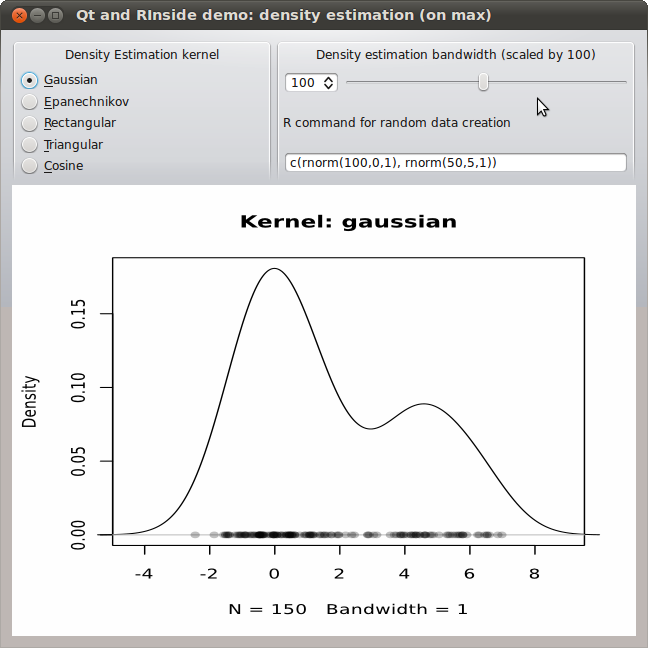
The RInside package makes it pretty simple and straightforward to embed R, the wonderful statistical programming environment and language, inside of a C++ application. This uses both the robust embedding API provided by R itself, and the higher-level abstractions from our Rcpp package. A number of examples are shown on this blog both here and here as well as on the RInside page; and the source package actually contains well over a dozen complete examples which cover anything from simple examples to parallel use via MPI for parallel computing. Beginning users sometimes ask about how to use RInside inside larger projects. And as I had meant to experiment with embedding inside of the powerful Qt framework anyway, I started to dabble a little. A first result is now in the SVN sources of RInside. My starting point was the classic tkdensity demo that comes with R itself. It is a good point of departure as Tcl/Tk makes it very portable---in fact it should run on every platform that runs R---and quite expressive. And having followed some of the GUI experiments around R over the years, I have also seen various re-implementations using different GUI frameworks. And so I am adding mine to this body of work: Example of embedding R via RInside into a Qt C++ application: density estimation for a mixture The problem I addressed first was actual buildability. For the RInside examples, Romain and I provide a Makefile that just works by making calls to R itself to learn about flags for R, Rcpp and RInside such that all required headers and libraries are found. That is actually relatively straightforward (and documented in our vignettes) but a little intimidating at first---which is why a ready-made Makefile is a good thing. Qt of course uses qmake and the .pro files to encode / resolve dependencies. So task one was to map what our Makefile does into its variables. Turns out that wasn't all that hard:
## -*- mode: Makefile; c-indent-level: 4; c-basic-offset: 4;  tab-width: 8; -*-
##
## Qt usage example for RInside, inspired by the standard 'density
## sliders' example for other GUI toolkits
##
## Copyright (C) 2011  Dirk Eddelbuettel and Romain Francois
TEMPLATE =              app
HEADERS =               qtdensity.h 
SOURCES =               qtdensity.cpp main.cpp
QT +=                   svg
## comment this out if you need a different version of R, 
## and set set R_HOME accordingly as an environment variable
R_HOME =                $$system(R RHOME)
## include headers and libraries for R 
RCPPFLAGS =             $$system($$R_HOME/bin/R CMD config --cppflags)
RLDFLAGS =              $$system($$R_HOME/bin/R CMD config --ldflags)
RBLAS =                 $$system($$R_HOME/bin/R CMD config BLAS_LIBS)
RLAPACK =               $$system($$R_HOME/bin/R CMD config LAPACK_LIBS)
## if you need to set an rpath to R itself, also uncomment
#RRPATH =               -Wl,-rpath,$$R_HOME/lib
## include headers and libraries for Rcpp interface classes
RCPPINCL =              $$system($$R_HOME/bin/Rscript -e \'Rcpp:::CxxFlags\(\)\')
RCPPLIBS =              $$system($$R_HOME/bin/Rscript -e \'Rcpp:::LdFlags\(\)\')
## for some reason when building with Qt we get this each time
## so we turn unused parameter warnings off
RCPPWARNING =           -Wno-unused-parameter 
## include headers and libraries for RInside embedding classes
RINSIDEINCL =           $$system($$R_HOME/bin/Rscript -e \'RInside:::CxxFlags\(\)\')
RINSIDELIBS =           $$system($$R_HOME/bin/Rscript -e \'RInside:::LdFlags\(\)\')
## compiler etc settings used in default make rules
QMAKE_CXXFLAGS +=       $$RCPPWARNING $$RCPPFLAGS $$RCPPINCL $$RINSIDEINCL
QMAKE_LFLAGS +=         $$RLDFLAGS $$RBLAS $$RLAPACK $$RCPPLIBS $$RINSIDELIBS
## addition clean targets
QMAKE_CLEAN +=          qtdensity Makefile
The double dollar signs and escaping of parentheses are a little tedious, but hey it works and expands the compiler and linker flags such that everything <emjust works="Works">. The code itself is pretty straightforward too. We instantiate the RInside object as well as the main Qt application object. We then instantiate a new object of class QtDensity that will launch the main widget; it is given a reference to the RInside object.
// -*- mode: C++; c-indent-level: 4; c-basic-offset: 4;  tab-width: 8; -*-
//
// Qt usage example for RInside, inspired by the standard 'density
// sliders' example for other GUI toolkits
//
// Copyright (C) 2011  Dirk Eddelbuettel and Romain Francois
#include <QApplication>
#include "qtdensity.h"
int main(int argc, char *argv[])
 
    RInside R(argc, argv);  		// create an embedded R instance
    QApplication app(argc, argv);
    QtDensity qtdensity(R);
    return app.exec();
 
The definition of the main object is pretty simple: a few private variables, and a few functions to interact with the GUI and get values from the radio buttons, slider or input field---as well as functions to update the chart or re-draw the random variables.
// -*- mode: C++; c-indent-level: 4; c-basic-offset: 4;  tab-width: 8; -*-
//
// Qt usage example for RInside, inspired by the standard 'density
// sliders' example for other GUI toolkits
//
// Copyright (C) 2011  Dirk Eddelbuettel and Romain Francois
#ifndef QTDENSITY_H
#define QTDENSITY_H
#include <RInside.h>
#include <QMainWindow>
#include <QHBoxLayout>
#include <QSlider>
#include <QSpinBox>
#include <QLabel>
#include <QTemporaryFile>
#include <QSvgWidget>
class QtDensity : public QMainWindow
 
    Q_OBJECT
public:
    QtDensity(RInside & R);
private slots:
    void getBandwidth(int bw);
    void getKernel(int kernel);
    void getRandomDataCmd(QString txt);
    void runRandomDataCmd(void);
private:
    void setupDisplay(void);    // standard GUI boilderplate of arranging things
    void plot(void);            // run a density plot in R and update the
    void filterFile(void);      // modify the richer SVG produced by R
    QSvgWidget *m_svg;          // the SVG device
    RInside & m_R;              // reference to the R instance passed to constructor
    QString m_tempfile;         // name of file used by R for plots
    QString m_svgfile;          // another temp file, this time from Qt
    int m_bw, m_kernel;         // parameters used to estimate the density
    QString m_cmd;              // random draw command string
 ;
#endif
Lastly, no big magic in the code either (apart from the standard magic provided by RInside). A bit of standard GUI layouting, and then some functions to pick values from the inputs as well as to compute / update the output. One issue is worth mentioning. The screenshot and code show the second version of this little application. I built a first one using a standard portable network graphics (png) file. That was fine, but not crisp as png is a pixel format so I went back and experimented with scalable vector graphics (svg) instead. One can create svg output with R in a number of ways, one of which is the cairoDevice package by Michael Lawrence (who also wrote RGtk2 and good chunks of Ggobi). Now, it turns out that Qt displays the so-called SVG tiny standard whereas R creates a fuller SVG format. Some discussion with Michael reveals that one can modify the svg file suitably (which is what the function filterFile below does) and it all works. Well: almost. There is a bug (and Michael thinks it is the SVG rendering) in which the density estimate does not get clipped to the plotting region.
// -*- mode: C++; c-indent-level: 4; c-basic-offset: 4;  tab-width: 8; -*-
//
// Qt usage example for RInside, inspired by the standard 'density
// sliders' example for other GUI toolkits -- this time with SVG
//
// Copyright (C) 2011  Dirk Eddelbuettel and Romain Francois
#include <QtGui>
#include "qtdensity.h"
QtDensity::QtDensity(RInside & R) : m_R(R)
 
    m_bw = 100;                 // initial bandwidth, will be scaled by 100 so 1.0
    m_kernel = 0;               // initial kernel: gaussian
    m_cmd = "c(rnorm(100,0,1), rnorm(50,5,1))"; // simple mixture
    m_R["bw"] = m_bw;           // pass bandwidth to R, and have R compute a temp.file name
    m_tempfile = QString::fromStdString(Rcpp::as<std::string>(m_R.parseEval("tfile <- tempfile()")));
    m_svgfile = QString::fromStdString(Rcpp::as<std::string>(m_R.parseEval("sfile <- tempfile()")));
    m_R.parseEvalQ("library(cairoDevice)");
    setupDisplay();
 
void QtDensity::setupDisplay(void)   
    QWidget *window = new QWidget;
    window->setWindowTitle("Qt and RInside demo: density estimation");
    QSpinBox *spinBox = new QSpinBox;
    QSlider *slider = new QSlider(Qt::Horizontal);
    spinBox->setRange(5, 200);
    slider->setRange(5, 200);
    QObject::connect(spinBox, SIGNAL(valueChanged(int)), slider, SLOT(setValue(int)));
    QObject::connect(slider, SIGNAL(valueChanged(int)), spinBox, SLOT(setValue(int)));
    spinBox->setValue(m_bw);
    QObject::connect(spinBox, SIGNAL(valueChanged(int)), this, SLOT(getBandwidth(int)));
    QLabel *cmdLabel = new QLabel("R command for random data creation");
    QLineEdit *cmdEntry = new QLineEdit(m_cmd);
    QObject::connect(cmdEntry,  SIGNAL(textEdited(QString)), this, SLOT(getRandomDataCmd(QString)));
    QObject::connect(cmdEntry,  SIGNAL(editingFinished()), this, SLOT(runRandomDataCmd()));
    QGroupBox *kernelRadioBox = new QGroupBox("Density Estimation kernel");
    QRadioButton *radio1 = new QRadioButton("&Gaussian");
    QRadioButton *radio2 = new QRadioButton("&Epanechnikov");
    QRadioButton *radio3 = new QRadioButton("&Rectangular");
    QRadioButton *radio4 = new QRadioButton("&Triangular");
    QRadioButton *radio5 = new QRadioButton("&Cosine");
    radio1->setChecked(true);
    QVBoxLayout *vbox = new QVBoxLayout;
    vbox->addWidget(radio1);
    vbox->addWidget(radio2);
    vbox->addWidget(radio3);
    vbox->addWidget(radio4);
    vbox->addWidget(radio5);
    kernelRadioBox->setMinimumSize(260,140);
    kernelRadioBox->setMaximumSize(260,140);
    kernelRadioBox->setSizePolicy(QSizePolicy::Fixed, QSizePolicy::Fixed);
    kernelRadioBox->setLayout(vbox);
    QButtonGroup *kernelGroup = new QButtonGroup;
    kernelGroup->addButton(radio1, 0);
    kernelGroup->addButton(radio2, 1);
    kernelGroup->addButton(radio3, 2);
    kernelGroup->addButton(radio4, 3);
    kernelGroup->addButton(radio5, 4);
    QObject::connect(kernelGroup, SIGNAL(buttonClicked(int)), this, SLOT(getKernel(int)));
    m_svg = new QSvgWidget();
    runRandomDataCmd();         // also calls plot()
    QGroupBox *estimationBox = new QGroupBox("Density estimation bandwidth (scaled by 100)");
    QHBoxLayout *spinners = new QHBoxLayout;
    spinners->addWidget(spinBox);
    spinners->addWidget(slider);
    QVBoxLayout *topright = new QVBoxLayout;
    topright->addLayout(spinners);
    topright->addWidget(cmdLabel);
    topright->addWidget(cmdEntry);
    estimationBox->setMinimumSize(360,140);
    estimationBox->setMaximumSize(360,140);
    estimationBox->setSizePolicy(QSizePolicy::Fixed, QSizePolicy::Fixed);
    estimationBox->setLayout(topright);
    QHBoxLayout *upperlayout = new QHBoxLayout;
    upperlayout->addWidget(kernelRadioBox);
    upperlayout->addWidget(estimationBox);
    QHBoxLayout *svglayout = new QHBoxLayout;
    svglayout->addWidget(m_svg);
    QVBoxLayout *outer = new QVBoxLayout;
    outer->addLayout(upperlayout);
    outer->addLayout(svglayout);
    window->setLayout(outer);
    window->show();
 
void QtDensity::plot(void)  
    const char *kernelstrings[] =   "gaussian", "epanechnikov", "rectangular", "triangular", "cosine"  ;
    m_R["bw"] = m_bw;
    m_R["kernel"] = kernelstrings[m_kernel]; // that passes the string to R
    std::string cmd1 = "Cairo(width=6,height=6,pointsize=10,surface='svg',filename=tfile); "
                       "plot(density(y, bw=bw/100, kernel=kernel), xlim=range(y)+c(-2,2), main=\"Kernel: ";
    std::string cmd2 = "\"); points(y, rep(0, length(y)), pch=16, col=rgb(0,0,0,1/4));  dev.off()";
    std::string cmd = cmd1 + kernelstrings[m_kernel] + cmd2; // stick the selected kernel in the middle
    m_R.parseEvalQ(cmd);
    filterFile();               // we need to simplify the svg file for display by Qt 
    m_svg->load(m_svgfile);
 
void QtDensity::getBandwidth(int bw)  
    if (bw != m_bw)  
        m_bw = bw;
        plot();
     
 
void QtDensity::getKernel(int kernel)  
    if (kernel != m_kernel)  
        m_kernel = kernel;
        plot();
     
 
void QtDensity::getRandomDataCmd(QString txt)  
    m_cmd = txt;
 
void QtDensity::runRandomDataCmd(void)  
    std::string cmd = "y <- " + m_cmd.toStdString();
    m_R.parseEvalQ(cmd);
    plot();                     // after each random draw, update plot with estimate
 
void QtDensity::filterFile()  
    // cairoDevice creates richer SVG than Qt can display
    // but per Michaele Lawrence, a simple trick is to s/symbol/g/ which we do here
    QFile infile(m_tempfile);
    infile.open(QFile::ReadOnly);
    QFile outfile(m_svgfile);
    outfile.open(QFile::WriteOnly   QFile::Truncate);
    
    QTextStream in(&infile);
    QTextStream out(&outfile);
    QRegExp rx1("<symbol"); 
    QRegExp rx2("</symbol");    
    while (!in.atEnd())  
        QString line = in.readLine();
        line.replace(rx1, "<g"); // so '<symbol' becomes '<g ...'
        line.replace(rx2, "</g");// and '</symbol becomes '</g'
        out << line << "\n";
     
    infile.close();
    outfile.close();
 
What the little application does is actually somewhat neat for the few lines. One key features is that the generated data can be specified directly by an R expression which allows for mixtures (as shown, and as is the default). With that it easy to see how many points are needed in the second hump to make the estimate multi-modal, and how much of a distance between both centers is needed and so on. Obviously, the effect of the chosen kernel and bandwidth can also be visualized. And with the chart the being a support vector graphics display, we can resize and scale at will and it still looks crisp. The code (for both the simpler png variant and the svg version shown here) is in the SVN repository for RInside and will be in the next release. Special thanks to Michael Lawrence for patiently working through some svg woes with me over a few emails.

Update: Some typos fixed.

Update 2: Two URLs corrected.

Next.

Previous.