Search Results: "tim"

28 July 2012

Luke Faraone: Google Cr-48 first impressions

On a lark, I signed up for the pilot program of the Google Cr-48 about a week ago. To my surprise, I found the distinctive box on my doorstep a week later. After initially mistaking it for an overpacked, late-model OLPC XO-1 I would have to repair, I sort of did a double-take as I realized what I had received.
Using Chrome OS


Wow, they weren't kidding about the boot time. Chrome OS responds (to suspend / resume and boot / power-off) very quickly. Responsiveness elsewhere in the OS of course varies on system load and other factors. On the "terms" page, there is a "system security setting" which tells me I have a Trusted Platform Module, and that my TPM has a randomly generated password. The dialog could use some rewording; I'm pretty familiar with the idea of a TPM, but I'm still not sure what I'm to do with that information.

Cloud print is really a problem for me, right now. I use school printers for the majority of my work, which I was previously able to use by adding them by IP address. Unless there's some magic I'm missing here, I can't do that with Chrome OS, and such a feature will not be supported. (except by "connectors" on Windows and Mac computers)
General thoughts
I can't imagine using a system running Chrome OS as a primary computer. The biggest missing feature is PGP (or any sort of encryption) support for email. This is probably not terribly difficult to implement as an extension, but the idea of my cryptographic software being automatically updated is rather unsettling. I think I'll have to agree with Paul Buchheit that ChromeOS will have to merge with Android; there is a utility for local apps, even if they're becoming less and less critical.

27 July 2012

Michal Čihař: Weblate hacking #5

Last day of Hackweek VIII is over and I think Weblate is pretty much ready for 1.2 release. Today I continued to analyzing performance and did few optimizations of some frequently used code paths. There is still lot of area for improvement, but I think Weblate is now fast enough for daily usage on even quite big projects. Rest of the day was spend by looking at various questions which people have asked me and distilling that into documentation. The most extended part were frequently asked questions, which now includes some hints for setup. Of course the demo server is running latest and greatest git version, I will probably push it soon to http://l10n.cihar.com/ as well.

Filed under: English Suse Weblate 0 comments Flattr this!

Julien Danjou: Ceilometer, the OpenStack metering project

For the last months, I've been working on a metering project for OpenStack, so it's time to talk a bit about it. OpenStack is a growing cloud platform providing IaaS. A problem easily identified by everyone building a public cloud platform is that nothing is provided to retrieve the platform usage data. Some data are available in some places, but not everything is, and you have to do a lot of processing from the various components to get something useful in the end. But in order to bill customers that are using your public cloud platform, you need to dot his. In this regard, a lot of companies running public OpenStack based infrastructure wrote their own solution to cover this functional areas, and to become able to bill theirs customers. To avoid everybody doing and maintaining such a stack in their corners, the Ceilometer has been created. The project aims to cover the metering aspect of the OpenStack components, pulling usage data from every components and storing them into a single place. It then offer a retrieving point for this data via a REST API. The initial specifications have been written in April this year, and actual implementation started in May. The project is currently worked on by me, Dreamhost and Canonical. We already have designed an architecture that we are implementing, and we hope to release a first usable version with Folsom. Ceilometer architecture I did a presentation of this project yesterday at XLCloud, which has been very well received. <iframe allowfullscreen="true" frameborder="0" height="389" mozallowfullscreen="true" src="https://docs.google.com/presentation/embed?id=11ALGC4xuWcRvXKTSnnsteJUkArsTfQW-7IAfWRRI5kQ&amp;start=false&amp;loop=false&amp;delayms=3000" webkitallowfullscreen="true" width="480"></iframe> If you are interested in helping us and contributing, feel free to join us during one of our weekly IRC meeting or fix some bugs. :-)

Keith Packard: sandybridge-caching

Playing around with LLC controls on Sandybridge today. What I wanted to know was how caching backbuffers affects application performance. The reason for this question is that when the driver uses page flipping to display a new frame, we force the new scanout buffer to be uncached because the display hardware only scans out from main memory. However, when we go back to using this buffer as the next back-buffer, we don t turn the caching bits back on as that requires writing GTT entries to change caching modes. This means that swapping via page-flipping and swapping via copying has a large change in main memory access patterns during rendering page flipping applications use an uncached back buffer while copying applications use a cached back buffer. What effect does the back-buffer caching-mode have on application performance? The changes In the kernel, I have three modes 1) Existing code. Set buffer objects to cache mode none when preparing them as scanout buffers. The first time the application flips to a back buffer, caching is disabled on that buffer forever 2) Flip back and forth. Set buffers to cache mode none when used as scanout. When that stops, flip them back to cache mode llc. This involves a whole lot of clflushing and GTT rewriting, obviously. 3) Flush to memory, but don t disable caching. In this mode, the buffer gets flushed (from both CPU and GPU) before being used as a scanout, but the cache mode isn t changed. Benchmarking with glxgears The first test was pretty simple I hacked up glxgears (yes, glxgears is not a benchmark) to redraw the same frame multiple times (including the clear) per swap to provide a scalable amount of work per swap. No pixel operations, so this is just writing to the back buffer. Thes numbers are the median of 5 runs, except for those obviously limited by the refresh rate.
RepsExistingFlipFlush
10606060
20606060
4042.07034.11337.130
8021.25917.95718.658
Note the linear scaling over reps (once you get below refresh). I think this means that the swap overhead is in the noise, including flushing and rewriting GTT entries. Given that my screen is (yuck) 1366x768 pixels, or just over 4MB, and my total LLC is 4MB, it s seems like the performance changes here are likely caused by the rendering ejecting every other object from the cache. What s wrong with benchmarking with glxgears? Of course, glxgears is not a benchmark, and I realized while collecting this data that, in particular, it never reads from the backbuffer, and most pixels are only written once by the clear operation at the start of the rendering code. So, it forces everything else out of the cache at the start of each drawing cycle, but doesn t stick anything useful into the cache. Benchmarking nexuiz, a (more) real application For the next test, I ran nexuiz demo1.dem in all three modes. Numbers out of that weren t nearly as stable as glxgears, and I m afraid I didn t write all of them down, but I got numbers between 45 and 50 frames per second in all three modes. None significantly faster, none significantly slower. So, for these two tests, caching has no positive effect on overall rendering performance. Obviously, I need to collect data from more applications to see if the effect is general. I sure hope so, because the alternative will be to find some heuristic to direct when to enable caching. The patch This is on top of kernel version 3.5.
diff --git a/drivers/gpu/drm/i915/i915_drv.h b/drivers/gpu/drm/i915/i915_drv.h
index b0b676a..f69fba8 100644
--- a/drivers/gpu/drm/i915/i915_drv.h
+++ b/drivers/gpu/drm/i915/i915_drv.h
@@ -1335,6 +1335,10 @@ int __must_check
 i915_gem_object_pin_to_display_plane(struct drm_i915_gem_object *obj,
                     u32 alignment,
                     struct intel_ring_buffer *pipelined);
+
+void
+i915_gem_object_unpin_from_display_plane(struct drm_i915_gem_object *obj);
+
 int i915_gem_attach_phys_object(struct drm_device *dev,
                struct drm_i915_gem_object *obj,
                int id,
diff --git a/drivers/gpu/drm/i915/i915_gem.c b/drivers/gpu/drm/i915/i915_gem.c
index 288d7b8..b606bd2 100644
--- a/drivers/gpu/drm/i915/i915_gem.c
+++ b/drivers/gpu/drm/i915/i915_gem.c
@@ -2851,6 +2851,9 @@ int i915_gem_object_set_cache_level(struct drm_i915_gem_object *obj,
    return 0;
  
+#define JUST_FLUSH 0
+#define FLIP_CACHING   0
+
 /*
  * Prepare buffer for display plane (scanout, cursors, etc).
  * Can be called from an uninterruptible phase (modesetting) and allows
@@ -2883,7 +2886,11 @@ i915_gem_object_pin_to_display_plane(struct drm_i915_gem_object *obj,
     * of uncaching, which would allow us to flush all the LLC-cached data
     * with that bit in the PTE to main memory with just one PIPE_CONTROL.
     */
+#if JUST_FLUSH
+   ret = i915_gem_object_finish_gpu(obj);
+#else
    ret = i915_gem_object_set_cache_level(obj, I915_CACHE_NONE);
+#endif
    if (ret)
        return ret;
@@ -2913,6 +2920,16 @@ i915_gem_object_pin_to_display_plane(struct drm_i915_gem_object *obj,
    return 0;
  
+void
+i915_gem_object_unpin_from_display_plane(struct drm_i915_gem_object *obj)
+ 
+   i915_gem_object_unpin(obj);
+#if FLIP_CACHING
+   if (HAS_LLC(obj->base.dev))
+       i915_gem_object_set_cache_level(obj, I915_CACHE_LLC);
+#endif
+ 
+
 int
 i915_gem_object_finish_gpu(struct drm_i915_gem_object *obj)
  
diff --git a/drivers/gpu/drm/i915/intel_display.c b/drivers/gpu/drm/i915/intel_display.c
index a8538ac..76a2012 100644
--- a/drivers/gpu/drm/i915/intel_display.c
+++ b/drivers/gpu/drm/i915/intel_display.c
@@ -1821,7 +1821,7 @@ err_interruptible:
 void intel_unpin_fb_obj(struct drm_i915_gem_object *obj)
  
    i915_gem_object_unpin_fence(obj);
-   i915_gem_object_unpin(obj);
+   i915_gem_object_unpin_from_display_plane(obj);
  
 static int i9xx_update_plane(struct drm_crtc *crtc, struct drm_framebuffer *fb,

26 July 2012

Charles Plessy: Adopted mime-support.

With L szl B sz rm nyi we adopted mime-support, which was maintained since September 1996 by Brian White. It is the first package of standard priority that I take care of. It gives me the same feeling as when side wheels were removed from my bicycle, a long, long time ago. We transferred the source package on Alioth, and uploaded a first update allowing the extraction of information for the mailcap file directly from Desktop files. I think that the next two works will be to resolve the bug about the handling of PHP files, and to update the mime.types base, if possible in synergy with Fedora or other distributions.

Michal &#268;iha&#345;: Weblate hacking #4

Fourth day of Hackweek VIII was for me again mostly spent on Weblate. This time there are no new nice features, but rather general improvements to the code. First task was to add support for django-registration 0.8. Originally my plan was to support both 0.7 and 0.8, but that proven to be too complicated so Weblate now requires 0.8, which brings quite a lot of differences in API. Later I've installed django-debug-toolbar and looked at some bottlenecks in some hot paths. This resulted in few optimizations of translations merging and new caching for translation stats. This turned out to be too expensive for bigger translations and caching these can save few seconds on page load. I will probably focus more on performance tuning tomorrow as I don't plan to add any new features to 1.2 release.

Filed under: English Suse Weblate 0 comments Flattr this!

25 July 2012

Vincent Sanders: Fowlers Delight?

Fowler published his paper on Continuous Integration (CI) way back in 2000. Personally at the time I was a much more naive developer, I was not really an adherent to the whole XP community and had worked for a series of companies where the idea of a release build was of a month long process and the concept that the whole codebase could be built and tested on every commit was a comical notion at best.

By the time the time the 2006 edition of the paper came out however I was convinced. Ever since then I have tried to make the projects I worked on have as many CI features as possible. It is one reason I ran the ARM Kernel autobuilder for years as an attempt to provide at least build coverage.

I especially like the way these concepts mean that releases are much less "scary" events and release anxiety is reduced to a minimum. When every commit produces something that is of release quality a project really is doing it right.

The reason I mention any of this is I have recently set up the NetSurf projects CI server. The heavy lifting is being done by a Jenkins instance running on a VPS fulfilling the "Every Commit Should Build the Mainline on an Integration Machine" part of the Fowler guidelines.

Setting up Jenkins was much less trouble than many of the previous systems I have used. I have been a little underwhelmed by the support for plain old make based projects which you have to resort to shell scripts for, but leaving that aside the rest was straightforward. The documentation could do with a purge pass for the old hudson name and the error reporting (especially under memory pressure) is not great.

And there lies my one real issue with the tool, memory. The VPS has 512MByte RAM and runs nothing beyond a web server, jenkins and the C compiler to build the project components. One would hope that was plenty of memory, doing the builds by hand it did seem gcc is happy in that space, alas Jenkins is a Java application and guzzles RAM (over 60% of RSS right now) and causes itself out of memory exceptions with distressing frequency.

The project is left with the choices:
It is such a pity too, aside from the RAM issues it is all going well and it has already encouraged us to get the toolchains for the less commonly built targets (ppc amiga and windows for a start) working.

Michal &#268;iha&#345;: Weblate hacking #3

As you can see on github, there are currently no open issues for Weblate's 1.2 milestone. Looks like I've done most of my Hackweek VIII project faster than expected, but I might add some more improvements. Everything went quite smoothly, but anyway I've decided to postpone some issues. The major reason is that I'm not really sure whether these are good ideas and won't implement something until I'll get more feedback. You can find such issues labeled "needs decision". Comments there are especially welcome :-). On the code side, I've improved support for po file headers, did various improvements on maintenance scripts and improved about page. Also current code from git is now deployed at demo.weblate.org, so feel free to test it. I'm especially curious how the simple and stupid spam protection will work in reality. Now it's time for ice cream and then I'll think what to implement next :-).

Filed under: English Suse Weblate 0 comments Flattr this!

Vincent Sanders: Travels with Mr. Brown

My return from Debconf12 has been tinged with a little wistfulness, I had a great time but wish I could have spent a little more time there to justify the seventeen hours travel each way. I took a lot of pictures which gave me a good record of my trip.

The talks, BOF and discussions were, as usual, very useful. The release team explaining what needed to be done for Wheezy was both informative and amusing.

The numerous BOF from Steve Mcintyre were a great source of discussion and ideas and appear to have generated progress on some quite contentious issues.

I especially enjoyed the Sylvestre Ledru talk on building the archive with clang and how this might be another useful tool in finding bugs.

Hideki Yamane gave a really useful talk "Let's shrink Debian package archive!" He gave a practical explanation on how Debian could benefit from using xz compression, where it is not appropriate and had a selection of real numbers to help the discussion. Given this was Hideki first talk at a Debconf I must congratulate him on doing an excellent job.

There were many other talks which I have not singled out here but that says nothing about their quality or usefulness, more about why I should blog immediately after an event and not leave it a week. Though the video team have managed to capture many of the talks so you can go and watch them too.

The event was well organised and the accommodation was pleasant, if a little crowded with three to a room. The hotel had a pool which was the centre for evening activities most days, though I did miss Neil McGovern (one of my room mates) unintentionally swimming in his kilt.
The lunch and dinner catering was outdoors which was novel. The food was generally good if a little limited for those of us with less straightforward dietary requirements.

Some of us did venture out to have dinner at the continental hotel on one evening for a change of scene.
There was of course the obligatory conference meal by the lakeside and an awesome day trip where I saw a mangrove swamp and (fortunately) no salt water crocodiles.
All in all I had a fabulous and productive time. I would like to thank Collabora for travel sponsorship to the event and to Neil who was a great travelling companion.

Dirk Eddelbuettel: RcppClassic 0.9.2

Similar to yesterday's post about RcppGSL, we have another pure maintenance release to announce, this time of RcppClassic, the package supporting the deprecated older classic Rcpp API defined in the earlier 2005 to 2006 releases, is now on CRAN. There is no new code, as the only changes were made to accomodate CRAN Policy updates. Courtesy of CRANberries, here is a link to the changes relative to the previous release 0.9.1. Questions, comments etc should go to the rcpp-devel mailing list off the R-Forge page.

Vincent Sanders: A sad state of affairs

Surprisingly my previous post on my Debconf trip has gathered more queries over its title than anything else.

Mostly my blog titles are, if I can manage it, relevant quotes or book titles. For the last post I used the title of a collection of Mark Twain scripts surrounding his trip through Nicaragua in 1866.

I have not been able to read the publication myself beyond the quoted excerpts in more modern articles because, somehow, almost 150 years after the words were written the only access to these words is to buy a very expensive and rare 1940 publication.

This appears to stem from the fact the original Clements scripts were simply not published before 1940 and hence appear to gain copyright from that date (IANAL I might be wrong here is the source I used) and thanks to the US government effectively making copyrighted works published after 1922 be "protected" forever I may never read it at all.

Rather sad really, but if you do have a copy I could borrow...oh no that is probably illegal too? better just let the words fade to dust eh?

24 July 2012

Gunnar Wolf: Ten theses in favor of free download of cultural goods on the Internet (by Enrique G. Gallegos)

This is one of the days where reading my everyday newspaper was worth more than just getting bitter at the news. I found this text in La Jornada, my usual newspaper. I liked it very much, and decided to translate it for a wider audience. Of course, if you can read Spanish, do yourself a favor and go to the original. It is not that the text is so easy to translate. And, after all, I'm not a native English writer. I'm trying to do a literal translation, even when disagreeing with the author. Ten theses in favor of free download of cultural goods on the Internet Enrique G. Gallegos Poet and philosopher. Currently a researcher in Universidad Aut noma Metropolitana-C
  1. Historical legacy. Criticists who promote the persecution of piracy and free downloads of cultural works from the Internet argue that the patrimonial rights have been wronged; they start off suposing that a cultural work is formed from a historical void, as if there was a "nothing" to begin with, and then a "something" appeared. Nothing more fallacious: All cultural products has its precedents, and thanks to these it generates part of its best forces.
  2. Opening towards the future. Human beings are projected into the future. As the main philosophies of the 20th century have explored, one of the singular characteristics of mankind is the ability to think and imagine the future. Products of culture are the best ways to think and project society, politics, love, hope, needs, failures A song, a poem, an essay, can trigger imaginary worlds with a transformative potential. To deny this to humanity with "patrimonial damage" as an argument is to mutilate man's temporal nature.
  3. Recognition of the present. Cultural works generate moments of reflection, criticism and pleasure; they can trigger actions demanding commitment, solidarity and strong indignation against injustice. If every cultural work is adscribed in some way to a historic tradition, and if cultural products anre necessary to imagine other possible worlds and open our future, it's not less true that they also allow us to recognize our present by making us more sensitive to others' ideas, sensations and emotions. Without culture, there is no present nor others' presence.
  4. Divulgation of the cultural heritage. If culture is "heritage of mankind", it should be also spread by any possible way. But not just spread, but actively sought for the biggest number of people to be able to effectively have access to it. In a potentially interconnected world, Internet is the most adequate world for it (despite its limitations). Therefore, penalizing free downloads means avoiding spreading it and restricting access to those groups who don't have enough economic resources.
  5. Preserving cultural heritage. If we agree that cultural works are heritage of mankind, we need to take every action needed to preserve them. But preserving culture does not only mean keeping the products in museums, galleries or never-polluted drawers; it rather means to keep them in the collective memory and in the flow of constant interpretations and appropiations. Said in other words, the genuine way to preserve culture is to allow universal access to cultural goods. That's why, holding that free copies and downloads of books, music, videos, etc. over the Internet are harmful, is an incompatible argument with the obligation to preserve cultural heritage.
  6. They are not goods. Cultural works are material and spiritual manifestations of mankind, concretions of its historicity; they are, also, expressions of emotions, ideas and projections of other lives and other worlds. That's why they cannot be equated to goods or inserted in patrimonialist logic. The market might want to cheat by giving a certain price to a painting by Orozco or auctioning a Baudelaire manuscript, but it will never be able to aprehend their true meaning as cultural works. And it's not that culture is not faluable, but taht its estimation criteria do not follow the rules of market, but those of the imponderable and unlimited.
  7. Price disproportion. Assuming we accept the possibility that intermediaries charge for the services they perform, the value of a book, record or movie should never exceed the daily wage of a worker or employee. But this ellection would only be one more option within the effective possibility that people opt to download or freely copy the cultural work. The final decision as to which media to go to should be a sovereign resolution of the culture-interested person.
  8. The principle of the most benefit. Even when copies and free downloads over Internet could generate a patrimonial "wrong" to third parties, the cultural benefit obtained by it will always be greater in as much that it carries out intensely the principle to foster, spread and access the cultural heritage of mankind. To think otherwise is to privilege the few over the many.
  9. The real evil is elsewhere. Murder, women- and children-trade, poverty and misery are the real evils that ache mankind. According to the United Nations, in 2010 there were 468 thousand murders in the world; the estimation is that 3500 million people live in poverty; in their 2009 inform, the UN found over 2400 victims of "people trade", kidnapped as sex slaves; in some regions in Africa, close to 30% of children suffer acute malnutrition and six people (between children and adults) die every day from hunger. That's why pretending that free download of cultural works is an evil is clearly a tricky and deceptive speech
  10. Against the intermediary-salesman. Culture does not need intermedieries that reduce cultural works to goods. Culture is too important to leavie it in the hands of salespeople that simplistly equate cultural goods with cakes. An intermediary of this kind will never understand the difference between a work of art and a disposable razor blade. What the world needs is more support from the government from every country to artists, creators and poets, as well as ensuring the conditions for the absolute mobility freedom for cultural works.

Wouter Verhelst: Runner scripts

Bert Desmet blogs about having to run a script more than once per minute, and using a runner script (started from cron) to do that. Unfortunately, his implementation contains a race condition:
if ! ps -p $(cat /path/to/runner.pid);
  then
    echo $$ > /path/to/runner.pid
If the script is accidentally started twice on approximately the same moment, chances are pretty high you'll see them both executing the ps call at approximately the same time, concluding that no other script is running, and then both executing the echo call at the same time. Result: your script will be running twice, yet you'll have only one pid file. Of course, if you do indeed run the script only from cron, and just once every 30 minutes, as in Bert's case, chances that you'll hit this race condition are pretty low. However, race conditions are bad, especially if they're easy to avoid.
set -o noclobber
if ! echo $$ > /var/run/runner.pid
then
  echo pidfile exists; exiting
  exit 0
fi
This code uses the noclobber shell option, which causes the shell to issue an error state if the file we try to overwrite with > already exists, and to do so in an atomic operation (so, no race condition there: either the file exists and we fail, or the file does not exist yet and we create it with our PID). Of course, that leaves out the check for is the other process running? Adding a second check for that is fairly complex to do right, as this cannot be done in an atomic operation; so it's usually better use exit traps to clean up the file:
set -o noclobber
if ! echo $$ > /var/run/runner.pid
then
  echo pidfile exists; exiting
  exit 0
fi
trap EXIT rm -f /var/run/runner.pid
This will fail if the system dies when the script is running, but then since we use /var/run (which is cleared on bootup, either because it's a tmpfs or because the initscripts clean it) this means the file should only ever be stale if some genius kills our process with kill -9 or kill -11.

Wouter Verhelst: DebConf 12 is over :(

As I write this, DebConf12 has actually been over for more than a week. Usually during DebConf, I'm a more proficient blogger than during other times of the year, since I'm not doing as much work that I have to remain quiet about at that time, which simply means I have more to blog about. Unfortunately, however, this year the server on which this blog runs managed to become unavailable on the second day of DebCamp, an issue that I could only fix once I was back in Belgium, which meant I haven't been able to blog as much as I would've wanted to. Anyway, all I can say is that both DebConf and DebCamp have been a huge success for me again, this year. I'd started the second rewrite of ipcfg a few weeks before DebCamp, and spent most of DebCamp whipping the basic framework into shape. It's nowhere near ready yet, but I'm confident it'll get further this time than it did before. During DebConf, I was also responsible for doing the group photo. I'd done that (together with Andrew McMillan) during DebConf8 before (if you look closely, you'll see me pressing the remote which actually triggers that picture), and I still like that picture. This time around, we didn't have a beach nearby (at least not as nearby as during DebConf8), so we had to do things slightly differently. Rather than doing one large picture, I took several pictures and used Hugin to stitch them together. Unfortunately however, some things did go wrong with the group photo. For starters, the weather wasn't very helpful, in that I noticed it was about to rain. As such, the main bunch of pictures were taken slightly before the announced time of 14:30, which meant that some people had missed it. To make matters worse, I had rushed to the group and handed the camera to someone else, so that I could gimp myself onto the picture too; but that meant that some people who were arriving as these pictures were being taken thought they were on the picture, when they really weren't. I've fixed most of these by just gimping them into the picture as well, but I might've missed some of them. If you're one of them, talk to me! Preferably now. If you're not one of them (or even if you are), hold off on doing things like printing it in large format or some such. I'll re-upload improved versions onto the same location once they're ready.

23 July 2012

Jon Dowland: 6music

I recently discovered the excellent BBC 6 Music: a digital-only radio station so good I'm almost convinced to buy a DAB radio for this one station alone. In particular, Stuart Maconie and Mark Radcliffe, former Radio 2 exiles, hold an excellent afternoon slot. Stuart Maconie's late-night "Freak Zone" often has some really interesting stuff on it worth listening to, for example an entire episode dedicated to Brian Eno's "Obscure Records" label. Ubuweb recently put up the entire catalogue, by the way. @WhatsOn6Music is a twitter bot I follow which tweets songs as they are played. This works because most of the BBC's DJ consoles are wired up to last.fm. In recent times this bot has been broken a lot, so I got tired of it and made my own: @6musicbot. This one is powered by IFTTT so should not be plagued by whatever keeps breaking the other one: although it's also only as good as the last.fm feed powering it. Let me know if you find it useful, interesting or have any other feedback.

Michal &#268;iha&#345;: Weblate hacking #1

The first day of Hackweek VIII is about to end for me and it's time to share some of the results. As planned, I've started hacking on Weblate. The most prominent feature from today are email notifications. You can now monitor the translation in various ways - be informed about new strings to translate, new contributor, added suggestion or simply watch all translations. Another bigger change is rearranging of main page, which now provides instant access to per language stats, which were quite hidden before. Rest of time was spent on adding some sort of spam protection (need to deploy this to demo to see how successful it is) and one more promoting widget (88x31 pixels). There are 6 open issues targeted for 1.2 release, so there is still something to do in next days :-).

Filed under: English Suse Weblate 0 comments Flattr this!

Tollef Fog Heen: Automating managing your on-call support rotation using google docs

At work, we have a rotation of who is on call at a given time. We have few calls, but they do happen and so it's important to ensure both that a person is available, but also that they're aware they are on call (so they don't stray too far from their phone or a computer). In the grand tradition of abusing spreadsheets, we are using google docs for the roster. It's basically just two columns, one with date and one with user name. Since the volume is so low, people tend to be on call for about a week at a time, 24 hours a day. Up until now, we've just had a pretty old and dumb phone that people have carried around, but that's not really swish, so I have implemented a small system which grabs the current data, looks up the support person in LDAP and sends SMSes when people go on and off duty as well as reminding the person who's on duty once a day. If you're interested, you can look at the (slightly redacted) script.
Enrico Zini: Evolution's old odd mail folders to mbox

Evolution's old odd mail folders to mbox Something wrong happened in my dad's Evolution. It just would get stuck checking mail forever, with no useful diagnostic that I could find. Fun. Not. Anyway, I solved by resetting everything to factory defaults, moving away all gconf entries and .evolution/ files. Then it started to work again, of course then I needed to reconfigure it from scratch. It turned out however that some old mail was only archived locally, and in a kind of weird format that looks like this:
$ ls -la Enrico/
total 336
drwx------ 2 enrico enrico   4096 Jul 23 03:05 .
drwxr-xr-x 7 enrico enrico   4096 Jul 23 03:12 ..
-rw------- 1 enrico enrico   3230 Dec  4  2010 113.HEADER
-rw------- 1 enrico enrico  14521 Dec  4  2010 113.TEXT
-rw------- 1 enrico enrico   3209 Oct 22  2010 134.HEADER
-rw------- 1 enrico enrico   2937 Oct 22  2010 134.TEXT
-rw------- 1 enrico enrico   3116 Jun 27  2011 15.
-rw------- 1 enrico enrico   3678 Jun 27  2011 168.
-rw------- 1 enrico enrico     73 Apr 27  2009 22.1.MIME
-rw------- 1 enrico enrico   3199 Apr 27  2009 22.2
-rw------- 1 enrico enrico     88 Apr 27  2009 22.2.MIME
[...]
I couldn't even find the name of that mail folder layout, let alone conversion tools. So I had to sit down and waste my sunday break writing software to convert that to a mbox file. Here's the tool, may it save you the awful time I had today: http://anonscm.debian.org/gitweb/?p=users/enrico/evo2mbox.git Note: feel free to fork it, or send patches, but don't bother with feature requests. Evolution isn't and won't be a personal interest of mine. Anything that makes an afternoon at my parents more tiresome than a whole busy month of paid work, doesn't deserve to be. Luckily they now seem to have changed the local folder format to Maildir.

22 July 2012

Sylvestre Ledru: Who is in control of LLVM/Clang ?

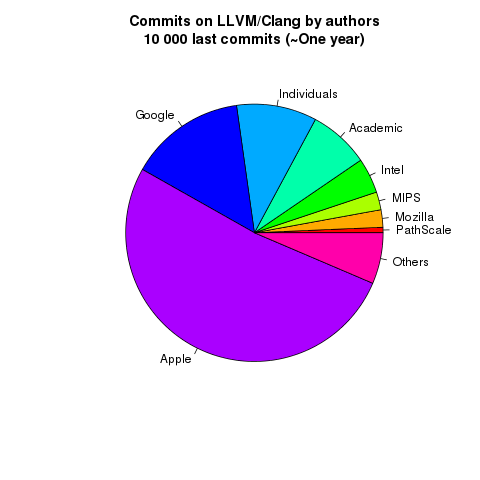
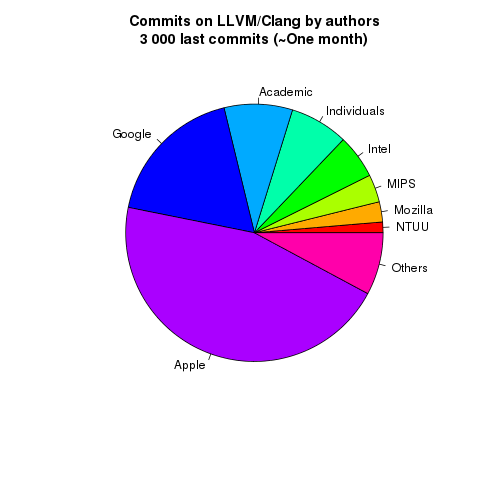
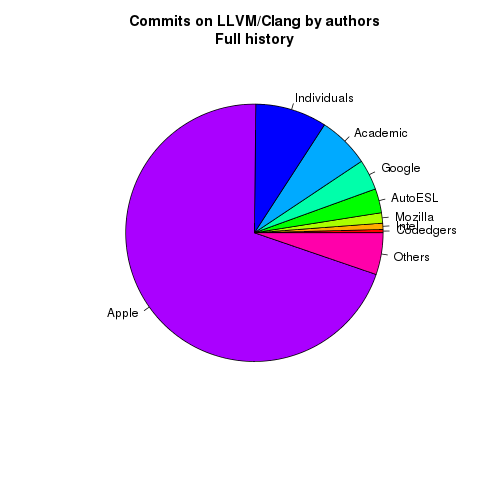
During my various chats and presentations on LLVM/Clang, one of the common criticism on LLVM/Clang is about the Apple's (supposed?) control on the platform. Even if I am not concerned by this concern, here are some statistics about the development. Basically, I used the git history to build a list of all the author. If domain names were clear (ex: @google.com, @apple.com, etc), I used them for the paternity of the commit. If there were not clear (ex: @gmail.com, @me.com), I dig on the web to find the employer (Linkedin was my friend). Of course, identifying individuals are pretty tough. Their percentages can be considered as a minimal figure. Full history 10 000 commits (about a year)
3 000 commits (~a month)
To sum up, we can easily see that the percentage of contributions of Apple is decreasing over the time.
However, we all know that the number of commits is not the best metric to measure the control of one on a project. Source: Processed data (please contact me in case of mistake)

Mark Brown: regmap updates in 3.5

A surprisingly large series of updates for regmap this time, mostly due to all the work Stephen Warren has done to add support for MMIO buses. This wasn t really the target for the framework but it turns out that there s a reasonable number of cases where it s very helpful to use the register cache support to allow the register map to remain available while the device is suspended.

Next.

Previous.