Search Results: "cas"

3 February 2007

Adam Rosi-Kessel: Weather Methodology

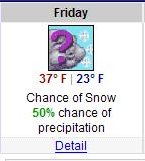
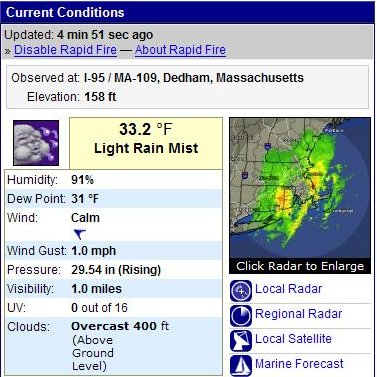
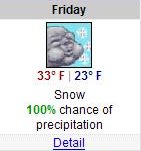
Can someone explain weather methodology? Yesterday’s forecast: Predicted Weather This morning’s forecast: This Morning s Prediction Actual conditions: Actual Weather Apparently, they don’t teach Cromwell’s Rule in meteorology school. (HT to Steve, a statistics major in college, for the reference.)

2 February 2007

Meike Reichle: First day in Luxembourg

Enrico Zini: pmdraft

Second generation package manager I have created many prototypes for advanced package manager features. Erich Schubert also made a tag cloud prototype. Recently, I wrote:
We have lots of interesting, usable metadata; we have algorithms; we have prototypes; we have ideas for lots of cool, implementable features. The question is, are we able to write applications that just combines what is needed from all this treasure to provide the right interface(s) for our base(s) of users?
Most of the back-end code is already implemented in Python, and I'm thinking of putting it together into a working prototype for a new concept of a file manager. This could be even implemented quickly, if someone joins me who is good at: What follows is a sketch description of what I have in mind. The user
Debora is 34, working as a web designer in a small enterprise. She has a laptop running Debian which she uses both for work and at home. She likes Debian for the wide range of software, that allows her to be always able to access the best tools for the job, even in a highly changing environment like the one of web design. At home she enjoys the various tools for photo editing and management, and of course, having a husband and a 6 years old son, the selection of games.
The tasks Looking for new software Use the smart tag search for searching: it allows a Google-like search interface, which afterwards allows categories to be used to semantically refine the results. This last step is conceptually very simple, as it maps to a sequence of "more like this" and "less like this". The search results can be sorted using popcon suggestions, that are very effective at showing software not in the system that many other people use. Looking at what is installed Let's see if this package does what I need Given an installed pacakge, show the contents of its bin/ directories and showing manpages as the details for the bin/ file: thanks to the Debian Policy, executables are all in /(usr/)?s?bin/ and they must have manpages. For packages that are tagged as interface::3d, interface::text-mode or interface::x11, allow to run them directly from the interface. Also show the contents of /usr/share/doc/pkgname and /usr/share/doc/suggested-and-recommended-pkgnames and allow to open documentation with the appropriate software. If there is an html directory which contains an index.html, only show that and not all the other HTML files. Find info documentation and allow to open it into a proper info browser. If there are manpages that don't have a corresponding executable, show them as extra documentation. What was that nice package I installed yesterday? List installed packages sorted by when was the last time they have been installed. Let's get rid of the cruft There are also some "unusefulness" scores one can compute, but I haven't yet been playing with them yet: Task filter Have a look at the popcon suggestion page: there is a "Suggestion type" box. Of course the same idea can be used in a package manager to restrict it to a significant subset of the packages. More filters, as you can imagine, can be easily created. This is how it is implemented:
case "any": $filter = "'!role::shared-lib'"; break;
case "gui": $filter = "'!role::shared-lib && role::program && (interface::x11   interface::3d)'"; break;
case "devel": $filter = "'!role::shared-lib && devel::*'"; break;
case "game": $filter = "'!role::shared-lib && role::program && game::*'"; break;
default: $filter = ""; break;
The same filter can be gived to Debtags:
debtags search '!role::shared-lib'
debtags search '!role::shared-lib && role::program && (interface::x11   interface::3d)'
debtags search '!role::shared-lib && devel::*'
debtags search '!role::shared-lib && role::program && game::*'
Conclusion As I said:
There is so much really cool stuff to be written, just within reach.
So?

Stefano Zacchiroli: surprising xslt

XSLT's principle of greatest surprise Ruby and Python both claim to adhere to the principle of least surprise, that is: things should work as the human coding in them expects to. But for today the rants about that are on hold. Still, in the last few days I made up my mind on something related: XSLT adheres to the principle of greatest surprise. /me stops at 50% of my ~/Desktop/xslt-sucks.txt If only CDuce had a syntax I'm able to remember ...

1 February 2007

Biella Coleman: 2 articles on the problematic effects of scientific endeavors

Technology and science are, at times, part of some solution. But once unleashed in the world, they can also perpetuate problems and act as barriers. I just finished two articles that have addressed this conundrum in provocative ways and I recommend both to read just for the sake of reading as they are written stunningly well and if you teach a course related to science, technology, medicine and society, these two would make excellent introductions to the importance of critically dissecting science, technology, and medicine (and I think you could unpack them for hours and hours, which is very helpful if you are looking to fill up some time). One, Happy Meal is by the author of the immensely popular Omnivore’s Dilemma, Michael Pollan. In the article he starts with the simple suggestion of trashing most fast/junk/processed food in favor of whole foods, notably plants. But then he delves into the much more complicated topic of the science of nutrition, making a pretty sharp critique of the field, especially for 1) its reductionism 2) and the ways in which the food industry mobilizes nutrition data it is favor and often to the detriment of furthering the goals of real nutrition. After I posted the link on an IRC Debian channel, I had a pretty heated conversation with a number of Debian developers about the nature of science and how one goes about critique it (and mobilizing data to make counter-claims). As often is the case, we ended up arguing over the merit of his attack (though everyone agreed that his food suggestions were quite sound, and I find this disjuncture pretty interesting), as some felt like his attack on the science of nutrition went too far. I did not feel like his article was anti-science or alarmist but saw it as attacking a particular configuration of nutrition science (the reductionism, the inability to admit more complexity, and the turning away from common sense principles), which carry with it serious consequences in the so-called real world. He offers a critical edge that I think does not attack the principle of science generally (after all, he is using the techniques of skepticism and he marshals plenty of scientific data, like studies on omega 3s and 6 to make his point, though he does not only employ the rhetoric of science, which I think is key to understand his critique too) but just what is sees as a particularly problematic rendition of it that is especially problematic for nutrition (though I am sure many of his critiques are easily transfered to other domains). Here, for example, is an attack on reductionism:
If nutritional scientists know this, why do they do it anyway? Because a nutrient bias is built into the way science is done: scientists need individual variables they can isolate. Yet even the simplest food is a hopelessly complex thing to study, a virtual wilderness of chemical compounds, many of which exist in complex and dynamic relation to one another, and all of which together are in the process of changing from one state to another. So if you re a nutritional scientist, you do the only thing you can do, given the tools at your disposal: break the thing down into its component parts and study those one by one, even if that means ignoring complex interactions and contexts, as well as the fact that the whole may be more than, or just different from, the sum of its parts. This is what we mean by reductionist science.
And muses on the effects of this narrow path:
No one likes to admit that his or her best efforts at understanding and solving a problem have actually made the problem worse, but that s exactly what has happened in the case of nutritionism. Scientists operating with the best of intentions, using the best tools at their disposal, have taught us to look at food in a way that has diminished our pleasure in eating it while doing little or nothing to improve our health. Perhaps what we need now is a broader, less reductive view of what food is, one that is at once more ecological and cultural. What would happen, for example, if we were to start thinking about food as less of a thing and more of a relationship?
.
But you will see here that he reaches into scientific facts so that he is not throwing out the bathwater with the baby:
Eat less is the most unwelcome advice of all, but in fact the scientific case for eating a lot less than we currently do is compelling. Calorie restriction has repeatedly been shown to slow aging in animals, and many researchers (including Walter Willett, the Harvard epidemiologist) believe it offers the single strongest link between diet and cancer prevention. Food abundance is a problem, but culture has helped here, too, by promoting the idea of moderation. Once one of the longest-lived people on earth, the Okinawans practiced a principle they called Hara Hachi Bu : eat until you are 80 percent full. To make the eat less message a bit more palatable, consider that quality may have a bearing on quantity: I don t know about you, but the better the quality of the food I eat, the less of it I need to feel satisfied. All tomatoes are not created equal.
There is no doubt that the article is advocating, very strongly, a point and he is not being all impassioned and neutral as may happen with a purely scientific rendition of the the topic. This will no doubt cause debate and reaction, which I am sure is what he was aiming for. And whether you end up agreeing or not with his critique, it makes for one fascinating read. Along with this piece is another engrossing, somewhat older one piece by Carl Elliot: A New Way to be Mad that examines the ethical complexities of what seems to be a relatively new phenomenon: Body Integration Identity Disorder (which he may have helped fuel a little via his very article and it is this issue of looping, first discussed by the philosopher of science, Ian Hacking that Carl Elliot nicely captures). Since the article is not available for free, here is another one, also by Carl Elliot, that addresses the same topic Unlike Pollan, Elliot does not have any clear cut answers or a really trenchant critique. More than anything he serves up a tasty meal that will in all likelihood be new to many readers, and the flavors he adds are those that make us confront the many interesting moral quandaries that this case presents.
Martin F. Krafft: Mark J Ray and the user database

Mark, in response to your thoughtful response: I am confused. See, I don't know you and so all I could do was refer to the user database to learn your name. Is that unconstitutional? Or are you trying to get at something else? I don't understand... Anyway, welcome to the club. PS: debian.ch is neither an enterprise, nor does it fund me. And we also don't specify how our by-laws may be changed, because it is dictated by Swiss law. I assume it's not too different in the Debian UK case. PPS: Only posting this because you're probably not going to approve my comment to your moderated blog. NP: OSI / Free

MJ Ray: Environment: Links for 2007-02-01

Milton Country Park
This park near Cambridge is under threat, partly due to council mismanagement.
Climate change prompts Cabinet change in Canada - CNN.com
Carry on flying, says Blair - science will save the planet Special Reports Guardian Unlimited Politics
Weston and Worle News: Recycling Service Branded Rubbish
"A Weston resident has branded the town's recycling service rubbish and joined calls for it to be investigated.Carolyn Jones, who moved to Weston Village from south Gloucestershire 18 months ago,..." I've had to telephone and get Biffa to come back after they missed my collection every time since New Year. What's going on?
Linux Ecology-HOWTO
Nuclear Power?
Cycle Parking Farcility of the Month
CTC - Cyclist who refused to stay in the gutter wins
So you are allowed to cycle on the roads in Telford, despite what the police there think. More coverage:
Cyclist's conviction thrown out : Shropshire Star
BBC NEWS England Shropshire Cyclist wins road blocking appeal
Cycle-lanes - epetition reply
A relevant reminder from Tony Bliar's office that cyclists don't have to use useless cycle lanes.
Trains Swindon - Melksham - Westbury - SLASHED by the DfT and First
Campaign site about the government-enforced cuts to Great Western services in the Wiltshire/Somerset/Bristol area.
EDP24 - Dangerous driver in cyclist death jailed
BBC NEWS England Norfolk Tired motorist jailed over death
High-res plans of the TdF London stages

30 January 2007

Daniel Burrows: I Sansa no more

Well, I did it. My Sansa e280 is now once again the property of the Bellevue Circuit City. The gadget had pretty sweet hardware (holding my entire music collection in the palm of my hand was a cool thing), but I have no real need for it -- certainly nothing that would be worth putting up with Sandisk's attitude regarding non-Windows computers.

I'm currently trying to decide whether to remain portable-less for now (on the theory that portable media players are likely to advance ridiculously in the next few months), to buy a simple 4GB or 2GB Flash player, or to give up on Flash for the time being and get a hard disk-based player. I'm leaning towards waiting until the 4GB model of the Cowon D2 becomes available in the U.S., and then ordering it -- its feature set is pretty amazing, and hopefully 4GB will be enough storage capacity (especially considering that you can insert an SD flash card to get more storage space). In the meantime, I can cover most of what I was using the player for with a combination of podcasts, .oggs of my music, and borrowing Kate's portable FM radio. Less convenient, but entirely workable.

Martin Michlmayr: Upcoming conferences

I have a number of upcoming talks at conferences in the next few weeks and months that I thought I'd mention in case people want to attend or meet up: I will update my talks page as more details become available. I hope to see some of you at these conferences.

Jonathan McDowell: MythTV wants more than 1GHz

Well, tonights experiment has shown that a 1GHz Via EPIA-M motherboard with 512MB RAM/200GB IDE HD isn't quite fast enough to run MythTV with a USB2 DVB-T stick on a 1280x768 screen. It's close, but there are too many noticeable wibbles in the display. Stock Debian etch install with MythTV packages from http://www.debian-multimedia.org/. Back to VDR it is, until I get round to buying a Core 2 Duo based box. Speaking of which, does anyone have any recommendations for a HTPC case? I currently have a Silverstone LC02, which is nice but I'd need a new riser card to cope with a ADD2 DVI card and a bit more room internally would be nice. I'd love an Antec Fusion but it's just slightly too wide to fit into my TV unit. The Silverstone GD01 looks pretty good, but is about twice the price of the Antec. sigh.

Christian Perrier: fr: 99.726% / cs: 91.940%

These are the current translation ratios for French and Czech in unstable, after 12 days of "blitz l10n NMU". Nothing happened yesterday, which explains why I didn't post. Today, a few packages uploads in unstable should have improved the stats for French. However, this is also the day where dpkg-cross introduced 3 strings without prior notification to translators. A good occasion to test my "Please interact with translators" new script..:-) Czech has improved a lot as a consequence of numerous package uploads after my strong activity during the week-end. Thanks again to all these responsive maintainers. So, now we're hunting tha last remaining parts for French: Another package will soon appear, out from NEW: emdebian-tools, uploaded by Neil Williams, who took care to request for translation updates in debian-i18n. Thanks, Neil.

Meike Reichle: They're at it again

(Almost all links in this text lead to German sources. Sorry, but this is a local topic and there aren't any English sources.) Unfortunately, Hildesheim is home to some rather prominent figures of the German neo-nazi scene. One of them has now registered for a protest march through Hildesheim on the 24 February 2007. The reason for this is, that an other neo-nazi event, that had been disguised as a "birthday party", but was in fact a propaganda event featuring talks by "contemporary witnesses" and "an evening of ballads" and was arranged by "National Forces of Hildesheim and the Association of German Women" had been prevented by the Hildesheim police. As a reaction to this, the aforementioned gentleman has now registered for a demonstration with the Hildesheim city council. (In Germany you need to register demonstrations.) Official head of the whole thing is this other gentleman, who has a history of trying to organise nazi demonstrations. He occasionally does so in Leipzig, where he tries to organise such demonstrations about twice a year. Their attendance is dropping though and they are usually met with about ten times as many counter demonstrators and thus have to be ended prematurely, exposing them as the unwanted and ridiculous farces they really are. However, the fact that people still try to register demonstrations such as this one is worrying. And the fact that this one is meant to be in the town I live in makes me pretty angry. Fortunately the demonstration is met with broad opposition. An alliance has been formed, consisting of the German adult education centre of Hildesheim (VHS), the Federation of German Trade Unions (DGB), Verdi, our public services union, Attac, the Antifa, the refugee council of Lower Saxony and the political parties with the Hildesheim Greens as the most active part at the moment. It is good to see, that such neo-nazi endeavours are met with such a broad opposition, and that this opposition does not only originate from the "usual suspects", but from the centre of society. (The VHS for example is usually a non-political organisation, and seeing them engage in such an alliance and even hosting its meetings is pretty cool!) It's not sure yet, whether the demonstration will be approved. It probably will, but with a bunch of extra conditions. If it is approved, it is even more important to meet it with the resistance it deserves! So, if you are living near Hildesheim, watch this space for announcements of the planned counter measures.

Uwe Hermann: Per-application GNOME settings

Dear Lazyweb, how the .... am I supposed to tell GNOME to use or not use an HTTP proxy for specific applications? Sample scenario: Now guess what happens when I disable the HTTP proxy in Epiphany. It's disabled in Galeon, too. Enable it in Galeon, and Rhythmbox will use the proxy (thus slowing down huge downloads for no reason). Aargh. Is it really so hard to have per-application settings? I mean, this isn't exactly rocket-science, right? And yes, I do want to use all those applications at the same time. And no, I do not run a full GNOME desktop environment (I use IceWM, thanks), so I don't care about any GNOME-Desktop-Foo solutions — I just want each of those freaking applications to have their own settings.

Joey Hess: bug scribbling

This is something I do when I'm working on a hard or perplexing bug. I'll write down a verbose description, as if I'm describing the bug to someone, or having a conversation with myself. I include all the debugging data I find, as I come up with tenative hypothesis, write them down, as I disprove them go on to say why that hypothesis failed, etc. I just dealt with an OpenID signin bug in ikiwiki, which ended up being several hundred lines of text descibing my process for solving the bug, including amusing blind alleys involving a sha1sum implementation being broken (it wasn't). And then I committed the one line fix, and :q!'d out of the buffer containing my bug solving log, because all that text now seems both boring, and, given the cause, embarrasing.. Anyone else do that? It has its good and its bad points. I suspect most of the time that I spend typing into the log, I'm also spending organising my thoughts, and it makes sure that all relevant debugging information is all in one place and well organised to look at, and avoids me looping back into blind paths that I've visited before. On the other hand, I could probably go read a book (or in some cases, an appropriate man page :-/) or sleep and process the bug in the background without all that typing.

29 January 2007

Joerg Jaspert: Events/Papers for DebConf7

As you may have read DebConf is soon closing the Call for Papers for the upcoming DebConf7 in Edinburgh. To make sure your talk gets the best possible rating from the papers committee you should have all details filled out, especially including Abstract and Description. There are multiple events who miss at least one, sometimes both. Now, while the CfP is closing soon, this doesnt mean you cant submit any events anymore. First there are the usual BoFs which you could always submit, but this year our interface is open to more. You can submit more than talks and BoFs, so we should make use of this. In case you plane a dance event, a cheese or/and wine party, or even a “Torture Ganneff and hug him” thing - enter it. This helps us and you, as we can easily keep it in the schedule and later allow people to “subscribe” to such events, so they can download ical/xcal files for their PDAs. Or XML files. After DebConf is over this also helps as then people who visited such an event can rate it. Ok, thats more important for “official” talks, but hey, didnt you ever wanted to know how others thought about various “events” at DebConf? I mean - I know how I would rate one of the above examples. :) And yet another thing - if you plan to have someone helping you/be a second speaker for an event - contact me and I add them to your event. That again helps - for sponsorship requests now, as we see who people are active in/want to help with, and later for the HTML export of the schedule, as you can easily see who is involved with a special event. Or what other events someone “runs”, in case you are interested in more…

Annabelle Tully: Bags

Thanks to numerous of helpful replies from Planet readers, I have come across quite a few decent bags. My favourites so far are these;
#1
Classic Messenger
Upsides; Roomy, casual, good quality
Downsides; No seperate space for laptop, you’d need a laptop sleeve, from the picture there doesen’t seem to be that many extra pockets #2
Laptop Courier
Upsides; Roomy, casual, seperate space for laptop, pockets
Downsides; Could do with another big protective pocket for my video camera, but now I’m being picky #3
Choroka K2
Upsides; Casual, very roomy with space for video camera, seperate place for laptop
Downsides; Looks a bit big, then again so do the others #4
Cargo
Upsides; Many pockets, a pocket very suitable for video camera, seperate place for laptop
Downsides; A bit big, looks kinda laptop’ishy. madduck has provided me with a new favourite band. Kino! I’ve gotten addicted to their album ‘Picture’. Thanks madduck.

28 January 2007

Annabelle Tully: Concentration

I have become painfully aware of the fact that I cannot concentrate on anything for more than fifteen seconds before I am distracted by something. This ofcourse results in a severe decrease in productivity. I’ve also noticed this is a very common issue.
A list of things that distract me include IRC (Admit it, you too.), shiny objects, music containing lyrics, lack of sleep.
To do list; Cut down on IRC, spend one or two hours a day in a silent room with no shiny objects, sleep at normal hours.
I will lock myself in a work environment for one hour a day to do something 100% productive, and gradually increase the time as I get used to it.
How long will I be able to keep this up I wonder? PS: I have noticed that there are no decent laptop bags out there. I’m looking for something casual that can be used for everyday use as well as containing a laptop, that suits a 12″ laptop and is preferably not bigger than that, and that most importantly does not scream “HEY I HAVE A LAPTOP” (You’re just asking to get robbed). Inform me if you know of any.

Erich Schubert: How Microsoft might already have lost the desktop wars

I was recently asked to help someone understand the OpenSource movement, and the effects it might have on companies such as Oracle or SAP. I talked a bit that these companies can benefit from being independant of big vendors like Microsoft, while still not having to do everything themselves. But also on how opensource alternatives to their products will threaten their business in the long run and force them to be more innovative and constantly improve their product. I then talked about the 'viral' aspects in OpenSource; not about that GPL licensing bullshit (just read the licenses of stuff you want to use, and don't use them if you don't like the license...; this virality is highly overrated due to Microsofts FUD), but a very different kind of virality: Let's say you are supposed to evaluate different CMS solutions. So you install one or another that sounds promising. Most likely you'll install an opensource database like MySQL or Postgresql. And when you've decided upon a solution, you are quite likely to go with this database, and say to yourself: "if MySQL doesn't scale up well enough for our needs, we can still but an Oracle license". This would be probably different if you had had installed Oracle in the first place. Say a demo or so. But the demo versions of the CMS you tried already made you comfortable in using MySQL; it's easy to install (most likely included with your system anyway), and it just works. But would you have tried a CMS in first place that actuall required you to setup Oracle? Anyway, this "social" virality brought me to another point: developers and administrators. When you see numbers on the market share of Microsoft, they're still huge. Some 95% of users are using Microsoft as their primary operation system (I'm discounting the fact that a huge share of DSL modems here is running Linux, so actually many people are Linux users, and I'm also discounting the use of www.google.com, which would make 99.9% of people Linux users...). But these are the average users. But they aren't on their own. The software choice of the "average user" is influenced by a couple of factors, including: But if you look at the computer geeks around you, what are they using? A huge share of the people I know are using Linux. Not everyone is using Linux as their main desktop system, but many are. Others are using Linux just for their development stuff, some only on servers. It doesn't really matter, Linux is huge with the geeks. When I look at the sofware my mom has installed on her Windows system (which also dual-boots Linux, and interestingly is the primary choice for watching a movie - Windows doesn't playback sound with some videos...): half of it is opensource. There is OpenOffice.org, Gimp, Gaim, Firefox, Thunderbird, Inkscape, LyX, Mplayer and a couple others. He favourite game? PySol. My dad already has switched to Linux as his main operating system. So why did they switch to so much opensource software? Because it's what I recommended them, and where I can help them. My mom needed a software to record something for her blog (yes, she's "podcasting" now) - of course I recommended her an opensource application, audacity. My mom is giving private lessons in math and physics; she's very successful at that. When one of her students got herself a laptop, she of course was given all kinds of (opensource!) software. For her highschool thesis she needed a vector graphics program - she ended up with inkscape. Now if my parents have some problem with Windows, who are they going to ask? I didn't manage to solve the video playback issues, my mom by herself switched to Linux for watching movies. It didn't work with Windows, I couldn't help her - she switched to something where she knews she'd get more support (and where the problem by chance didn't occur). Now let's have a look at the university. Our computer pool for the students is all Linux. There are a few windows systems for legacy purposes, I never found out if they are accessible to regular students; I only know they're supposed to exist. When doing some assignment, you're very often required to use some opensource software. For a thesis, you'll very likely be building upon some opensource system. The mathematics institute is still on solaris, but recently Gnome was installed there. Physics and electrical engineering also have mostly Linux systems, I've heard. For software development, it's pretty much a "develop on Linux, run anywhere", whereas Windows-only developers usually need to port their applications (or trust on Wine being able to run them good enough on Linux). So more and more people start developing on Linux, and get to love it's great development environment (after all, Linux was pretty much completely done by software developers...). And that is how Microsoft might already have lost the desktop war: developers, technical students and administrators (who usually also love their Linux boxes). They're only a small share of the userbase, but they're influential. In fact, other users rely on them being able to eventually fix their systems for them. But since these are using Windows much less already, they will be less capable of assisting others with Windows. They'll be putting Linux systems everywhere, and keep on encouraging them to make the switch. Of course it will still take some years, but you can expect more and more companies (and cities) to switch over, like the city of Munich. Windows support staff on the other hand might even become more expensive. I don't know of any numbers on the MCSE programme (Minesweeper Consultant, Solitaire Expert) - does anyone have numbers on "graduates" for that?

David Welton: Mobile Phone Shopping List 1.0

I created a mobile phone shopping app a while ago with Hecl, and since it seems to have become fairly popular, I did a second, more polished version that is still very simple to use: ShopList. I think it's a good way of utilizing a mobile phone and the web together - you enter the list of things to get in a web page, then the phone fetches that list. Realistically, inputting a long grocery list on a phone would drive you mad, whereas with this application, it's quite fast, and what's more, it makes use cases like this possible and simple: I'm going to the store, so my wife creates a list on the web site, and sends me the list id, which I use to fetch the list when I'm at the store.

Evan Prodromou: 8 Pluvi se CCXV

I got some email from Dan Brickley on Friday asking for some help getting the MediaWiki OpenID extension working. It looks like the FOAF wiki now allows you to login with OpenID. Cool beans on that! tags:

Wikicalc Speaking of people whose names match the production "Dan Brick*", Dan Bricklin just releases WikiCalc 1.0. WikiCalc is an awesome piece of software that provides shared spreadsheets with a Wiki flavor. I'm interested in using it for some new projects, so I'm really glad Dan's worked so hard on it. Congratulations to him and to sponsor SocialText for such good work. tags:

Lucinda I'm excited to see that one of my favorite people in Montreal has set up a blog. Lucinda Catchlove is a Montreal writer, and also a good friend with a clear voice and an honest opinion. I'm looking forward to seeing what her blog will have to offer. tags:

Google in Montreal It's probably not an overstatement to say that Montreal's digerati are a-twitter with gossip that Google will be opening a small office in Montreal (note: link in French). It's only space for a dozen or so people in downtown, but more tantalizing is the prospect that they're shopping for commercial real estate capable of handling 200-300 employees. The blogosph re (or is it the blogod me...? I get those confused all the time) here is pretty excited about the news, but a post by star podcaster Julien Smith has been more controversial. In Montreal... Needs... Brains... he says that he thinks the Montreal tech scene isn't as dynamic and interdependent as in other cities. He thinks the city needs a Google office as a shot-in-the-arm for developing our technology culture. I don't believe that this is the case. Montreal has a vibrant tech scene with a lot of cross-pollination. There are a lot of formal and informal venues for discussion in Montreal. We have the monthly Yulblog and Wiki Wednesday, last year's BarCampMontreal and the upcoming BarCampMontreal2, as well as RoCoCo. There's also the quarterly Montreal Creative Commons Salon. On the informal side, Seb Paquet's had a few group lunches with some of the most interesting people in town, and le Sans Fil gives us great hotspots like La ka and L'Utopik for serendipitous or on-purpose path-crossings. I guess my main point is that Montreal's got a great Scene, and I don't think it needs a big infusion of Googloids to make it better. Is there more that could be done? Sure. I think we need to get a Web Montag going to pull together the various sub-cultures forming. And we should probably be using SAT more -- it's a great space. But I think we're doing pretty good overall. Side notes: Hugh MacGuire has a quick list of Montreals doing stuff, and Robin Millette has some ideas about Montreal Action. tags:

Next.

Previous.