Search Results: "pa"

26 April 2015

Patrick Schoenfeld: Sharing code between puppet providers

So you ve written that custom puppet type for something and start working on another puppet type in the same module. What if you needed to share some code between this types? Is there a way of code-reuse that works with the plugin sync mechanism? Yes, there is. Puppet even has two possible ways of sharing code between types. Option #1: a shared base provider A provider in puppet is basically a class associated with a certain (puppet) type and there can be a lot providers for a single type (just look at the package provider!). It seems quiet natural, that it s possible to define a parent class for those providers. So natural, that even the official puppet documentation writes about it. Option #2: Shared libraries The second option is a shared library, shipped in a certain namespace in the lib directory of the module, whereas the idea is mostly sketched in the feature ticket #14149. Basically one defines a class in the special Puppetx namespace, using the author- and module-name in the class name, in order to avoid conflicts with other modules.
require 'puppetx'
module Puppetx::<Author>
  module Puppetx::<Author>::<Modulename>
   ... your helper functions go here ...
  end
end
This example would be saved to
lib/<author>/<modulename>
in your module s folder and be included in your provider with something along the following:
require 
  File.expand_path(File.join(File.dirname(__FILE__), "..", "..", "..",
    "puppet_x", "<author>", "<modulename>.rb"))
Compatibility with Puppet 4: In puppet 4 the name of the namespace has changed slightly. It s now called PuppetX instead of Puppetx and is stored in a file puppet_x.rb , which means that the require and the module name itself need to be changed:
require 'puppet_x'
module PuppetX::<authorname>
  module PuppetX::<authorname>::<modulename>
For backward compatibility with puppet 3 you could instead add something like this, according to my co-worker mxey, who knows way more about ruby then I do:
module PuppetX
 module <Author>
 <Modulename> = Puppetx::<Authorname>::<Modulename>
 end
end
Apart from this you d need to change the require to be conditional on the puppet-version and refer to the module by the aliased version (which is left as an exercise for the reader ;))

25 April 2015

Neil Williams: ARMMP Jessie

Whilst the rest of Debian was very busy actually making the Jessie release, I was trying to prepare the ground to test the armhf installer images. Cubietruck is fine, it s a nice install and the documentation on the wiki works nicely. I tried to automate it (as it would be something I d like to test in LAVA which is new in Jessie) with preseeding but although I have got a jessie-x86 preseed file which works in libvirt, the cubietruck installer doesn t seem to want to listen to all of the preseeding. Some of the options (notably the wifi firmware screen, hostname and user passwords) don t go away. x86 wasn t completely as expected either though it works nicely in libvirt and Virtual Machine Manager but trying to (automate it again) do it manually on the command line with qemu raised an awkward grub2 bug where it couldn t work out where to install and failed to then reboot if manually installed. iMX.53 was the next target got a few steps along the road with that one, except that the kernel in the installer isn t able to see the SATA even though the bootloader can, nor can it see the USB stick. This means that the only media the installer can see is the SD card from which the installer was booted trying to use that ends badly. Beaglebone-black required a little bit of tweaking. Don t forget that the firmware & partition.img together don t give a lot of space, so creating a second partition on the SD card upon which to put the CD image itself is useful. The Debian ARMMP kernel in Jessie doesn t see USB, so the option here is actually what I wanted. Install from SD card onto eMMC. It s a 2Gb space, but it s ideal for a default location, leaving the SD card for other testing. I ran out of time to see about preseeding BBB installs to eMMC but one word of warning, installing to the eMMC doesn t mean that you have a bootloader on the eMMC the SD card is still needed to reboot, unless that is fixed manually post-install. (Haven t got that working yet either.) Speaking of time, this post is more brief on the detail than I would like for a couple of reasons:
  1. I haven t actually got things working well enough (clearly from some of the end states above)
  2. the new code to test these in LAVA isn t ready yet either
I did mean to test on an iMX6.quad Wandboard will see about that, hopefully, later. In general, the armhf SD card support is the best start for installing Jessie on a range of ARMv7 hardware. (I haven t got as far as ARMv8 yet either.) However, when I describe that as the best start , it is lacking in many areas typically due to restrictions in the u-boot support, mainline kernel support and general board variability. It s a lot easier than it used to be but ARMv7 boards are some distance from a single installer setup or even a single set of installer documentation, for any distribution.

Dominique Dumont: The #newinjessie game: automatic configuration upgrade and other stuff in Debian/Jessie

Here are my contribution for the #newinjessie game, i.e. what new stuff I ve contributed to the Jessie release of Debian. See you in 2 years for Stretch release All the best

Patrick Schoenfeld: WordPress(ed) again.

I just migrated my blog(s) to WordPress. Just recently I decided to put more time into blogging again. I wasn t entirely happy with Movable Type anymore, especially since the last update broke my customized theme and I struggled with the installation of another theme, which basically just were never found, no matter which path I put it into. What I wanted is just more blogging, not all that technical stuff. And since the Movable Type makers also seem to have gone crazy (their Getting started site tells users to head over to movabletype.com to get a 999$ license) I decided to get back to WordPress. There were reasons, why I haven t chosen WordPress back when I migrated from blogger to MT, but one has to say anyway, that things have moved a lot since then. And WordPress is as easy as it can be and has a prosper community, something I cannot say about MovableType. The migration went okay, although there were some oddities in the blog entries exported by MT (e.g. datetime strings with EM and FM at the EOL) and I needed to figure out how the multisite feature in WordPress works. But now I have exactly what I want.

Jonathan McCrohan: New packages in Debian 8.0 Jessie

[I liked the #newinwheezy effort for the last Debian release, so I tipped Mika off about it again this time] A short post about what is #newinjessie, Debian's new 8.0 Jessie release. See Mika's debian-devel post for more information. For this release cycle, I have uploaded two new packages: I've also have taken over as (co-)maintainer of some existing packages during this release cycle: I've updated nearly all of my existing packages during this release cycle: The following package received no updates during this release cycle due to a combination of no upstream releases and the existing package already being in good shape: I hope you find them useful. Enjoy!

24 April 2015

Jonathan Wiltshire: What to expect on Jessie release day

Release day is a nerve-wracking time for several teams. Happily we ve done it a few times now*, so we have a rough idea of how the process should go. There have been some preparations going on in advance:
  1. Last week we imposed a quiet period on migrations. That s about as frozen as we can get; it means that even RC bugs need to be exceptional if they aren t to be deferred to the first point release. Only late-breaking documentation (like the install guide) was accepted.
  2. The security team opened jessie-updates for business, carried out a test upload, and have since released several packages so that those updates are available immediately after release.
  3. The debian-installer team made a final release.
  4. Final debtags data was updated.
  5. Yesterday the testing migration script britney and other automatic maintenance scripts that the release team run were disabled for the duration.
  6. We made final preparations of things that can be done in advance, such as drafting the publicity announcements. These have to be done in advance so translators get chance to do their work overnight (the announcement was signed off at 15:30UTC today, translations are starting to arrive right now!).
The following checklist makes the release actually happen:
  1. Once dinstall is completed at 07:52, archive maintenance is suspended the FTP masters will do manual work for now.
  2. Very large quantities of coffee will be prepared all across Europe.
  3. Release managers carry out consistency checks of the Jessie index files, and confirm to FTP masters that there are no last-minute changes to be made. RMs get a break to make more coffee.
  4. While they re away FTP masters begin the process of relabelling Wheezy as oldstable and Jessie as stable. If an installer needs to be, er, installed as well, that happens at this point. Old builds of the installer are removed.
  5. A new suite for Stretch (Debian 9) is initialised and populated, and labelled testing.
  6. Release managers check that the newly-generated suite index files look correct and consistent with the checks made earlier in the day. Everything is signed off both in logistical and cryptographic terms.
  7. FTP masters trigger a push of all the changes to the CD-building mirror so that production of images can begin. As each image is completed, several volunteers download and test it in as many ways as they can dream up (booting and choosing different paths through the installer to check integrity).
  8. Finally a full mirror push is triggered by FTP masters, and the finished CD images are published.
  9. Announcements are sent by the publicity team to various places, and by the release team to the developers at large.
  10. Archive maintenance scripts are re-enabled.
  11. The release team take a break for a couple of weeks before getting back into the next cycle.
During the day much of the coordination happens in the #debian-release, #debian-ftp and #debian-cd IRC channels. You re welcome to follow along if you re interested in the process, although we ask that you are read-only while people are still concentrating (during the Squeeze release, a steady stream of people turned up to say congratulations! at the most critical junctures; it s not particularly helpful while the process is still going on). The publicity team will be tweeting and denting progress as it happens, so that makes a good overview too. If everything goes to plan, enjoy the parties! (Disclaimer: inaccuracies are possible since so many people are involved and there s a lot to happen in each step; all errors and omissions are entirely mine.) * yes yes, I am being particularly English today.
What to expect on Jessie release day is a post from: jwiltshire.org.uk Flattr

Michael Prokop: The #newinjessie game: new forensic packages in Debian/jessie

Repeating what I did for the last Debian release with the #newinwheezy game it s time for the #newinjessie game: Debian/jessie AKA Debian 8.0 includes a bunch of packages for people interested in digital forensics. The packages maintained within the Debian Forensics team which are new in the Debian/jessie stable release as compared to Debian/wheezy (and ignoring wheezy-backports): Join the #newinjessie game and present packages which are new in Debian/jessie.

Richard Hartmann: Release Critical Bug report for Week 17

At the current rate, Jessie should release... tomorrow! :) The UDD bugs interface currently knows about the following release critical bugs: How do we compare to the Squeeze and Wheezy release cycles?
Week Squeeze Wheezy Jessie
43 284 (213+71) 468 (332+136) 319 (240+79)
44 261 (201+60) 408 (265+143) 274 (224+50)
45 261 (205+56) 425 (291+134) 295 (229+66)
46 271 (200+71) 401 (258+143) 427 (313+114)
47 283 (209+74) 366 (221+145) 342 (260+82)
48 256 (177+79) 378 (230+148) 274 (189+85)
49 256 (180+76) 360 (216+155) 226 (147+79)
50 204 (148+56) 339 (195+144) ???
51 178 (124+54) 323 (190+133) 189 (134+55)
52 115 (78+37) 289 (190+99) 147 (112+35)
1 93 (60+33) 287 (171+116) 140 (104+36)
2 82 (46+36) 271 (162+109) 157 (124+33)
3 25 (15+10) 249 (165+84) 172 (128+44)
4 14 (8+6) 244 (176+68) 187 (132+55)
5 2 (0+2) 224 (132+92) 175 (124+51)
6 release! 212 (129+83) 161 (109+52)
7 release+1 194 (128+66) 147 (106+41)
8 release+2 206 (144+62) 147 (96+51)
9 release+3 174 (105+69) 152 (101+51)
10 release+4 120 (72+48) 112 (82+30)
11 release+5 115 (74+41) 97 (68+29)
12 release+6 93 (47+46) 87 (71+16)
13 release+7 50 (24+26) 97 (77+20)
14 release+8 51 (32+19) ???
15 release+9 39 (32+7) 82 (49+17)
16 release+10 20 (12+8) 53 (49+4)
17 release+11 24 (19+5) 66 (57+9)
18 release+12 2 (2+0)
Graphical overview of bug stats thanks to azhag:

Jonathan Wiltshire: Jessie Countdown: 1

One further contributor became a non-uploading Debian Developer in 2015, joining 11 others who achieved that status its introduction in 2010. Non-uploading developers are really important to our project. They re a recognition of the invaluable work that contributors do which doesn t involve packaging, for which they may not have the skill nor inclination. Nevertheless we would be much weaker without those tireless contributions in the community, translations, bug handling the list is much longer and covers every aspect of Debian life. If you re reading this and thinking I have a sustained involvement in some aspect of Debian, and make regular contributions , please consider chatting to those you work with and see if you re ready to be recognised too. (source: https://nm.debian.org/public/people#dd)
Jessie Countdown: 1 is a post from: jwiltshire.org.uk Flattr

23 April 2015

Zlatan Todori : Internet freedom

Why did internet succeed and is growing by incredible pace? Because there were no politicians, no lawyers no economist or managers. Period.

Jonathan Dowland: Deterministic Doom

What happens if you remove randomness from Doom? For some reason, recently I have been thinking about Doom. This evening I was wanting to explore some behaviour in an old version of Doom and to do so, I hex-edited the binary and replaced the random number lookup table with static values. Rather than consume system randomness, Doom has a fixed 256-value random number table from which numbers are pulled by aspects of the game logic. By replacing the whole table with a constant value, you essentially make the game entirely deterministic. What does it play like? I tried two values, 0x00 and 0xFF. With either value, the screen "melt" effect that is used at the end of levels is replaced with a level vertical wipe: the randomness was used to offset each column. Monsters do not make different death noises at different times; only one is played for each category of monster. The bullet-based (hitscan) weapons have no spread at all: the shotgun becomes like a sniper rifle, and the chain-gun is likewise always true. You'd think this would make the super-shotgun a pretty lethal weapon, but it seems to have been nerfed: the spread pattern is integral to its function. With 0x00, monsters never make their idle noises (breathing etc.) On the other hand, with 0xFF, they always do: so often, that each sample collides with the previous one, and you just get a sort-of monster drone. This is quite overwhelming with even a small pack of monsters. With 0xFF, any strobing sectors (flickering lights etc.), are static. However, with 0x00, they strobe like crazy. With 0x00, monsters seem to choose to attack much more frequently than usual. Damage seems to be worst-case. The most damaging floor type ("super hellslime"/20%) can hurt you even if you are wearing a radiation suit: There was a very low chance of it hurting whilst wearing the suit (~2.6%) each time the game checked; this is rounded up to 100%. Various other aspects of the game become weird. A monster may always choose to use a ranged attack, regardless of how close you are. They might give up pursuing you. I've seen them walk aimlessly in circles if they are obstructed by another thing. The chance of monster in-fighting is never, or a certainty. The player is either mute, or cries in pain whenever he's hurt. If you want to try this yourself, the easiest way is to hack the m_random.c file in the source, but you can hex-edit a binary. Look for a 256-byte sequence beginning beginning ['0x0', '0x8', '0x6d', '0xdc', '0xde', '0xf1'] and ending ['0x78', '0xa3', '0xec', '0xf9'].

Jonathan Wiltshire: Jessie Countdown: 2

Two years, give or take a few weeks, is roughly the time required to prepare a new stable release since Sarge in 2005 (source: http://en.wikipedia.org/wiki/Debian#Release_timeline). A Spring release has also been a pretty stable pattern during that time. Debian often has a reputation for being very slow to release (in terms of cadence), or for freezes to hold up development for an excessive length of time, but the current pattern does lend itself well to two attributes: predictability and reliability (in terms of high-quality releases). It s true that this means shipping with slightly older versions of major software, but you can sleep well knowing they re thoroughly tested and that s really important in Debian s core market, which tends to be highly-available services rather than desktop machines. There s always backports.
Jessie Countdown: 2 is a post from: jwiltshire.org.uk Flattr

Steve McIntyre: Ready for Jessie! (aka bits from the debian-cd team)

I'm happy with the progress we've made for debian-installer and related packages for the Jessie release. We're going to end up with a release that's better in a number of ways than what we've had before. 1. Big EFI enhancements I've already blogged a lot about the stuff I've worked on here, so I'll just summarise for now some of the improvements we've got over Wheezy.

  1. A fix for systems that (badly) dual-boot in EFI and BIOS mode such that after installing Debian you wouldn't get a sensible choice of which OS to boot (#763127).
  2. A workaround for broken EFI implementations: an option to install the grub-efi bootloader to the removable media path in case the system firmware does not load grub-efi from the correctly registered boot path. (#746662).
  3. Addition of 32-bit EFI to our i386 installation images, to support both some older systems and some brand new systems that need it. This has unfortunately stopped those i386 images from working on some of the oldest Intel-based Apple Mac machines, so we've added an extra Mac-only flavour of i386 netinst without EFI in case people need it.
  4. Significantly better support for Intel-based Apple Macs in general, to the point that installing Debian on lots of these machines should now be much easier and doesn't depend on extra third-party software such as rEFIt or rEFInd. I've massively updated the Debian wiki page at https://wiki.debian.org/MacMiniIntel with more details for specific models of Mac Mini. I'm hoping to provide similarly updated information for Mac laptops too - see below!
    Massive thanks to the lovely folks at Mythic Beasts for providing me with a range of machines to test with here!
  5. Support for mixed-mode EFI systems like the Intel Bay Trail: a 64-bit platform crippled with a 32-bit EFI firmware. I believe Jessie will be the first release of a Linux distribution to support these machines fully!
2. Openstack images In collaboration with Thomas Goirand, we now have amd64 Openstack Jessie image builds being produced every week, and there will be an official image made to go with the Jessie release too. See http://cdimage.debian.org/cdimage/openstack/testing/ for the current image. 3. Debian-live images As of a few weeks ago, we've also added started doing weekly builds of live Debian images for amd64 and i386, using software and configuration from the Live Systems Project. See http://cdimage.debian.org/cdimage/weekly-live-builds/ for the current weekly images. These will be produced in sync with the Jessie release too. 4. New architectures We've added installation media for the two new architectures added in Jessie: arm64 and ppc64el. I'm particularly proud of the arm64 images. With help from Ian Campbell, Leif Lindholm and Thomas Schmitt I've managed to make EFI-compatible CD images in an isohybrid design that means they should also work when copied directly to a USB stick. Hopefully this will help this new platform to become just as easy to install as any x86 PC is today. Hopefully post-Jessie we'll even be able to start providing live images and openstack images for more architectures too. More help needed yet! First of all, we're planning to release Jessie as Debian 8 this coming Saturday (25th April). Help with testing the installation and live images as they're produced would be lovely - please join us on the #debian-cd channel on irc.debian.org and we'll co-ordinate there. Secondly, there's an almost endless variety of machines out there. I've updated information about how Debian installation works on some of the more awkward Mac Mini machines, but we don't yet cover all the bases even there. It would be great to update the information about other machines such as the Macbook range as well - currently a lot of these pages are well out of date and won't be helpful for new users. Please test on machines if you have them, and help improve Debian's documentation here.

22 April 2015

Jonathan Wiltshire: Jessie Countdown: 3

Three is the new number for continuing oldstable security support: thanks to the efforts of those behind the Long-Term Support initiative, the full stable lifecycle of a release has therefore become five years (source: https://www.debian.org/News/2014/20140424). Where do those numbers come from? 2 years as stable, 1 year overlap support as oldstable, plus 2 new years under LTS = 5 years. Having been successful for Squeeze (6), LTS is widely anticipated to follow a similar pattern for Wheezy (7) and Jessie (8) for the same lifetimes. Some reduction in coverage is unavoidable (for example, Squeeze only covers the most popular amd64 and i386 architectures), but for a majority of users this reduces the need to follow a three-year upgrade cycle invaluable when you are managing hundreds or thousands of servers and can t achieve that in a single year.
Jessie Countdown: 3 is a post from: jwiltshire.org.uk Flattr

Lars Wirzenius: Jessie release part in Helsinki

There will be a gathering of Debian people to celebrate the release of jessie this Saturday in Helsinki. For details, see the wiki page. Welcome, everyone.

Riku Voipio: Fastest way to change running dtb

Tollef posted about using BeagleBone Black for temperature monitoring. There was a passage about patching the DTB (device tree) file:
... This needs to be compiled into a .dtb. I found the easiest way was just to drop the patched .dts into an unpacked kernel tree and then running make dtbs.
There are easier ways. For example, you can get the current device tree file generated from /proc:

apt-get install device-tree-compiler
dtc -I fs -O dts -o current.dts /proc/device-tree/
(Why /proc and not /sys ? because device tree predates /sys) Now you can just modify and build the dtb again, and install it back to where bootloader reads the dtb from:

vim current.dts
dtc -I dts -O dtb -o new.dtb current.dts
Alternative, of course, is to build a brand new mainline kernel and use the dynamic Device tree code now available.

Dirk Eddelbuettel: RcppArmadillo 0.5.000.0

A new major version 5.000 of Armadillo was released by Conrad a couple of days ago. Armadillo is a powerful and expressive C++ template library for linear algebra aiming towards a good balance between speed and ease of use with a syntax deliberately close to a Matlab. This version brings several new functions for sparse matrices, and automagically switches to 64-bit matrix indices in C++11 mode. See below for a short description of all the major changes based on the NEWS.Rd file. This version is now on CRAN, as well as in Debian. The integration into CRAN was delayed by a few days as my testing had a shortcoming. We run full reverse-dependency checks against all 115 CRAN package depending in RcppArmadillo, and we even made full pre-release 0.4.999.1 and 0.5.000.0 shipped to the drat repo of the RcppCore GitHub organization (which was described in the previous release post). But a minor flaw in my setup made it miss how the change in indexing affected packages dfcomb and dfmta. My thanks to its maintainer Marie-Karelle Riviere for providing updates to her packages permitting this release to get onto CRAN. The testing process has been tightened and this should not happen again.
Changes in RcppArmadillo version 0.5.000.0 (2015-04-12)
  • Upgraded to Armadillo release Version 5.000 ("Ankle Biter")
    • added spsolve() for solving sparse systems of linear equations
    • added svds() for singular value decomposition of sparse matrices
    • added nonzeros() for extracting non-zero values from matrices
    • added handling of diagonal views by sparse matrices
    • expanded repmat() to handle sparse matrices
    • expanded join_rows() and join_cols() to handle sparse matrices
    • sort_index() and stable_sort_index() have been placed in the delayed operations framework for increased efficiency
    • use of 64 bit integers is automatically enabled when using a C++11 compiler
    • workaround for a bug in recent releases of Apple Xcode
    • workaround for a bug in LAPACK 3.5
Changes in RcppArmadillo version 0.4.999.1.0 (2015-04-04)
  • Upgraded to Armadillo release preview 4.999.1
  • Non-CRAN test release
Courtesy of CRANberries, there is also a diffstat report for the most recent CRAN release. As always, more detailed information is on the RcppArmadillo page. Questions, comments etc should go to the rcpp-devel mailing list off the R-Forge page.

This post by Dirk Eddelbuettel originated on his Thinking inside the box blog. Please report excessive re-aggregation in third-party for-profit settings.

Tollef Fog Heen: Temperature monitoring using a Beaglebone Black and 1-wire

I've had a half-broken temperature monitoring setup at home for quite some time. It started out with a Atom-based NAS, a USB-serial adapter and a passive 1-wire adapter. It sometimes worked, then stopped working, then started when poked with a stick. Later, the NAS was moved under the stairs and I put a Beaglebone Black in its old place. The temperature monitoring thereafter never really worked, but I didn't have the time to fix it. Over the last few days, I've managed to get it working again, of course by replacing nearly all the existing components. I'm using the DS18B20 sensors. They're about USD 1 a piece on Ebay (when buying small quantities) and seems to work quite ok. My first task was to address the reliability problems: Dropouts and really poor performance. I thought the passive adapter was problematic, in particular with the wire lengths I'm using and I therefore wanted to replace it with something else. The BBB has GPIO support, and various blog posts suggested using that. However, I'm running Debian on my BBB which doesn't have support for DTB overrides, so I needed to patch the kernel DTB. (Apparently, DTB overrides are landing upstream, but obviously not in time for Jessie.) I've never even looked at Device Tree before, but the structure was reasonably simple and with a sample override from bonebrews it was easy enough to come up with my patch. This uses pin 11 (yes, 11, not 13, read the bonebrews article for explanation on the numbering) on the P8 block. This needs to be compiled into a .dtb. I found the easiest way was just to drop the patched .dts into an unpacked kernel tree and then running make dtbs. Once this works, you need to compile the w1-gpio kernel module, since Debian hasn't yet enabled that. Run make menuconfig, find it under "Device drivers", "1-wire", "1-wire bus master", build it as a module. I then had to build a full kernel to get the symversions right, then build the modules. I think there is or should be an easier way to do that, but as I cross-built it on a fast AMD64 machine, I didn't investigate too much. Insmod-ing w1-gpio then works, but for me, it failed to detect any sensors. Reading the data sheet, it looked like a pull-up resistor on the data line was needed. I had enabled the internal pull-up, but apparently that wasn't enough, so I added a 4.7kOhm resistor between pin 3 (VDD_3V3) on P9 and pin (GPIO_45) on P8. With that in place, my sensors showed up in /sys/bus/w1/devices and you can read the values using cat. In my case, I wanted the data to go into collectd and then to graphite. I first tried using an Exec plugin, but never got it to work properly. Using a [python plugin] worked much better and my graphite installation is now showing me temperatures. Now I just need to add more probes around the house. The most useful references were In addition, various searches for DS18B20 pinout and similar, of course.
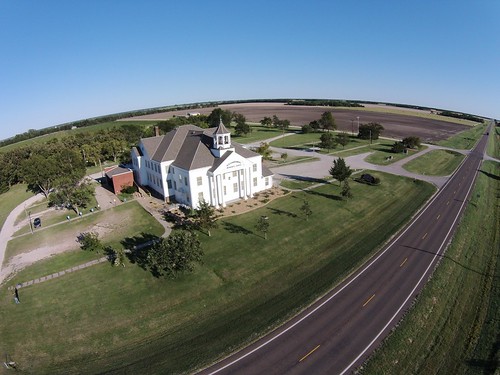
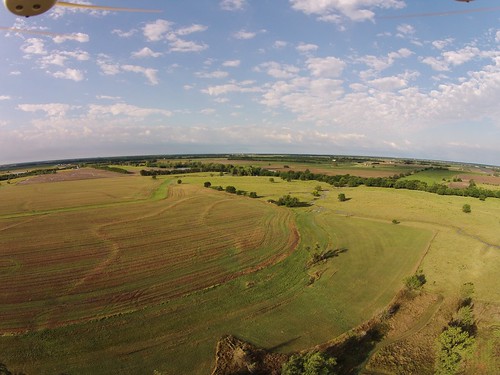
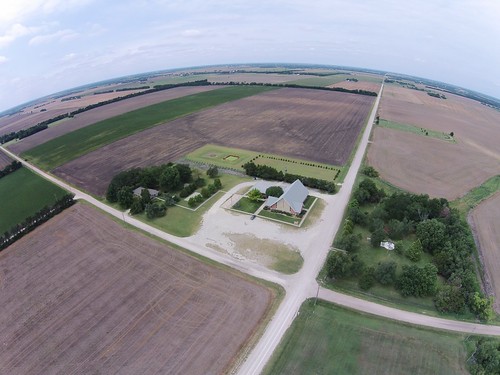
John Goerzen: Today I FLEW A PLANE

DJI00694
For once you have tasted flight,
You will walk the earth with your eyes turned skyward;
For there you have been,
And there you long to return. Leonardo da Vinci
There is something of a magic to flight, to piloting. I remember the first flight I ever took, after years of dreaming of flying in a plane: my grandma had bought me a plane ticket. In one of the early morning flights, I witnessed a sunrise above cumulus clouds. Although I was just 10 or so at the time, that still is a most beautiful image seared into my memory. I have become meh about commercial flight over the years. The drive to the airport, the security lines, the lack of scenery at 35,000 feet. And yet, there is much more to flight than that. When I purchased what was essentially a flying camera, I saw a whole new dimension of the earth s amazing beauty. All the photos in this post, in fact, are ones I took. I then got a RC airplane, because flying the quadcopter was really way too easy. DJI00620
It s wonderful to climb the liquid mountains of the sky.
Behind me and before me is God, and I have no fears. Helen Keller
Start talking to pilots, and you notice a remarkable thing: this group of people that tends to be cool and logical, methodical and precise, suddenly finds themselves using language almost spiritual. Many have told me that being a pilot brings home how much all humans have in common, the unifying fact of sharing this beautiful planet together. Many volunteer with organizations such as Angel Flight. And having been up in small planes a few times, I start to glimpse this. Flying over my home at 1000 up, or from lake to lake in Seattle with a better view than the Space Needle, seeing places familiar and new, but from a new perspective, drives home again and again the beauty of our world, the sheer goodness of it, and the wonderful color of the humanity that inhabits it. DJI00120
The air up there in the clouds is very pure and fine, bracing and delicious. And why shouldn t it be? It is the same the angels breathe. Mark Twain
The view from 1000 feet, or 3000, is often so much more spectacular than the view from 35,000 ft as you get on a commercial flight. The flexibility is too; there are airports all over the country that smaller planes can use which the airlines never touch. Here is one incredible video from a guy that is slightly crazy but does ground-skimming, flying just a few feet off the ground: (try skipping to 9:36) So what comes next is something I blame slightly on my dad and younger brother. My dad helped get me interested in photography as a child, and that interest has stuck. It s what caused me to get into quadcopters ( a flying camera for less than the price of a nice lens! ). And my younger brother started mentioning airplanes to me last year for some reason, as if he was just trying to get me interested. Eventually, it worked. I started talking to the pilots I know (I know quite a few; there seems to be a substantial overlap between amateur radio and pilots). I started researching planes, flight, and especially safety the most important factor. And eventually I decided I wanted to be a pilot. I ve been studying feverishly, carrying around textbooks and notebooks in the car, around the house, and even on a plane. There is a lot to learn. And today, I took my first flight with a flight instructor. Today I actually flew a plane for awhile. Wow! There is nothing quite like that experience. Seeing a part of the world I am familiar with from a new perspective, and then actually controlling this amazing machine I really fail to find the words to describe it. I have put in many hours of study already, and there will be many more studying and flying, but it is absolutely worth it. Here is one final video about one of the most unique places you can fly to in Kansas. And a blog with lots of photos of a flight to Beaumont called Horse on the runway .

21 April 2015

Jonathan Wiltshire: Tube in a Day

For some reason, I ve decided that gallivanting around the London Underground for the day one Saturday is a fine way to raise money for a local children s hospice. You d make my day by supporting us we aren t deducting expenses from pledges, so there s no penalty to the charity for our travel. We re going to run a modified version of the Guinness-recognised Tube Challenge starting about 05:15 (modified to allow for unavoidable maintenance works; we don t have the luxury of being able to pick a day when that s not going to be a problem) and likely finishing about midnight. I m also interested to hear ideas for some kind of micro-blogging platform that we can update on the move, preferably presenting in stream format and with an Android-friendly site/app that can cope with uploading a photo smoothly. Not Twitter or Facebook; it ll probably be a short-lived account. I don t want to part with personal information and I want to be able to throw it away afterwards. Suggestions?
Tube in a Day is a post from: jwiltshire.org.uk Flattr

Next.

Previous.