Search Results: "ed"

27 September 2015

Ben Armstrong: Annual Bluff Hike, 2015

Here is a photo journal of our hike on the Bluff Wilderness Trail with my friend, Ryan Neily, as is our tradition at this time of year. Rather than hike all four loops, as we achieved last year, we chose to cover only the Pot Lake and Indian Hill loops. Like our meandering pace, our conversations were enjoyable and far ranging, with Nature doing her part, stimulating our minds and bodies and refreshing our spirits.
A break at the summit of Pot Lake loop. Click to start slideshow.A break at the summit of Pot Lake loop. Click to start slideshow.
Northern bayberry A few showers quickly dissipated into light mist on the first leg of the hike Ryan, enjoying one of the many beautiful views Cormorant or shag. Hard to say from this poor, zoomed cellphone shot. Darkened pool amongst the rugged trees Late summer colours A riot of life shoots up in every crevice Large boulders and trees, forming a non-concrete alley along the trail margin Huckleberries still plentiful on the Indian Hill loop Sustenance to keep us going Not at all picked over, like the Pot Lake loop We break here for lunch Just about ready to embark on the last half We are surprised by the productivity of these short, scrubby huckleberries Barely rising from the reindeer moss, each huckleberry twig provides sweet, juicy handfuls A small pond on the trip back A break on the home stretch Common juniper, which nevertheless is not so common out here Immature green common juniper berries (actually cones)
facebooktwittergoogle_plusredditpinterestlinkedinmail

Lunar: Reproducible builds: week 22 in Stretch cycle

What happened in the reproducible builds effort this week: Toolchain fixes Packages fixed The following 22 packages became reproducible due to changes in their build dependencies: breathe, cdi-api, geronimo-jpa-2.0-spec, geronimo-validation-1.0-spec, gradle-propdeps-plugin, jansi, javaparser, libjsr311-api-java, mac-widgets, mockito, mojarra, pastescript, plexus-utils2, powerline, python-psutil, python-sfml, python-tldap, pythondialog, tox, trident, truffle, zookeeper. The following packages became reproducible after getting fixed: Some uploads fixed some reproducibility issues but not all of them: Patches submitted which have not made their way to the archive yet: diffoscope development The changes to make diffoscope run under Python 3, along with many small fixes, entered the archive with version 35 on September 21th. Another release was made the very next day fixed two encoding-related issues discovered when running diffoscope on more Debian packages. strip-nondeterminism development Version 0.12.0 now preserves file permissions on modified zip files and dh_strip_nondeterminism has been made compatible with older debhelper. disorderfs development Version 0.3.0 implemented a multi-user mode that was required to build Debian packages using disorderfs. It also added command line options to control the ordering of files in directory (either shuffled or reversed) and another to do arbitrary changes to the reported space used by files on disk. A couple days later, version 0.4.0 was released to support locks, flush, fsync, fsyncdir, read_buf, and write_buf. Almost all known issues have now been fixed. reproducible.debian.net disorderfs is now used during the second build. This makes file ordering issue very easy to identify as such. (h01ger) Work has been done on making the distributed build setup more reliable. (h01ger) Documentation update Matt Kraii fixed the example on how to fix issues related to dates in Sphinx. Recent Sphinx versions should also be compatible with SOURCE_DATE_EPOCH. Package reviews 53 reviews have been removed, 85 added and 13 updated this week. 46 packages failing to build from source has been identified by Chris Lamb, Chris West, and Niko Tyni. Chris Lamb was the lucky reporter of bug #800000 on vdr-plugin-prefermenu. Issues related to disorderfs are being tracked with a new issue.

Ritesh Raj Sarraf: Laptop Mode Tools 1.68.1

I am please to announce the release of Laptop Mode Tools 1.68.1. The last release (1.68) was mostly about systemd integration, and so is this release. There were a couple of bugs reported, and most of them fixed, with this release. All downstreams are requested to upgrade. For RPM packages for Fedora and OpenSUSE (Tumbleweed), please see the homepage.
1.68.1 - Sun Sep 27 14:00:13 IST 2015
    * Update details about runtime-pm in manpage
    * Revert "Drop out reload"
    * Log error more descriptively
    * Write to common stderr. Do not hardcode a specific one
    * Call lmt-udev in lmt-poll. Don't call the laptop_mode binary directly.
      Helps in a lot of housekeeping
    * Direct stderr/stdout to journal
    * Fix stdout descriptor
    * Install the new .timer and poll service
    * Use _sbindir for RPM

Categories:

Keywords:

Like:

26 September 2015

Norbert Preining: Kobo firmware 3.18.0 mega update (KSM, nickel patch, ssh, fonts)

In short succession a new firmware from Kobo, this time 3.18.0. And here is my mega-update. On request from a reader I have now prepared updates for all three hardwares, Mark4 (Glo), Mark5 (Aura), and Mark6 (GloHD). Kobo Logo Changes since last release: Included patches from the Metazoa firmware patches: Other things that are included are as usual: koreader, pbchess, coolreader, the ssh part of kobohack, and some side-loaded fonts. For details on the respective parts please see the previous post Download Mark6 Kobo GloHD firmware: Kobo 3.18.0 for GloHD Mega update: Kobo-3.18.0-combined/Mark6/KoboRoot.tgz Mark5 Aura firmware: Kobo 3.18.0 for Aura Mega update: Kobo-3.18.0-combined/Mark5/KoboRoot.tgz Mark4 Kobo Glo, Aura HD firmware: Kobo 3.18.0 for Glo and AuraHD Mega update: Kobo-3.18.0-combined/Mark4/KoboRoot.tgz Enjoy.

25 September 2015

Clint Adams: This can or cannot be copyrighted

Honey Mojito Combine 12 oz. of honey with 8 oz. of warm water. Stir mixture together until the honey has completely dissolved. Juice limes in a juicer and pour into the honey and water. Squeeze the bunch of mint sprigs and add to a pitcher of crushed ice. Pour the honey /lime mixture over the ice. Stir and top with sparkling water. Add more honey , water, limes, or rum to your taste. Enjoy! Serves 2

Jonathan Dowland: WadC 2.0 released

WadC
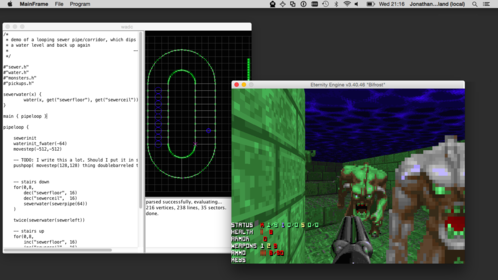
This week I released version 2.0 of Wad Compiler, a lazy functional programming language and IDE for the construction of Doom maps. Version 2.0 is the first version in about four years and adds a fair number of features, most notably the ability to compose textures in your code and a basic command-line interface. For more information see the release notes and the reference.

Sven Hoexter: Ubuntu 14.04 php-apcu 4.0.7 backport

Looks like the php-apcu release shipped with Ubuntu 14.04 is really buggy. Since nobody at Ubuntu seems to care about packages in universe I've added a backport of php-apcu 4.0.7 to my ppa. It's just a rebuild, so no magic involved. Update: I've used the requestbackport thingy now to request a backport the Ubuntu way.

Sven Hoexter: getting rid of xchat

I'm lazy. So I sticked to xchat for way too long. It seems to be dead since 2010 but luckily some good souls maintain a fork called hexchat. That's what I moved myself to a few weeks ago. Now looking at the Debian xchat package I feel the urgent need to fill a request for removal. Sine I'm not a member of QA I asked for some advice, but the feedback is a bit sparse so far. Maybe everyone still using xchat could just switch to hexchat so we can remove xchat next year and nobody would notice it? The only obvious drawback I can see at the moment is the missing Tcl plugin. The rest of the migration is more or less reconfiguring everything to your preferences.

Sven Hoexter: whiteboards

If you visit your potentially new team in the office and there is no whiteboard, or only a barely used one, you might be better off looking for a different team.

Christian Perrier: Bugs #780000 - 790000

Thorsten Glaser reported Debian bug #780000 on Saturday March 7th 2015, against the gcc-4.9 package. Bug #770000 was reported as of November 18th so there have been 10,000 bugs in about 3.5 months, which was significantly slower than earlier. Salvatore Bonaccorso reported Debian bug #790000 on Friday June 26th 2015, against the pcre3 package. Thus, there have been 10,000 bugs in 3.5 months again. It seems that the bug report rate stabilized again. Sorry for missing bug #780000 annoucement. I'm doing this since....November 2007 for bug #450000 and it seems that this lack of attention is somehow significant wrt my involvment in Debian. Still, this involvment is still here and I'll try to "survive" in the project until we reach bug #1000000...:-) See you for bug #800000 annoucement and the result of the bets we placed on the date it would happen.

Christian Perrier: Bug #800000 has been reported...Tomasz Muras wins a 2.5-year-old bet..:-)

Here it is. Debian had eight hundred thousand bugs reported in its history. Tomasz Muras guessed, more than 2 years ago, that it would be reported on September 24h, and it has been reported on 25th. Good catch! Chris Lamb is the happy bug submitter for this release critical bug against the vdr-plugin-prefermenu package. Of course, I will soon open the wiki page for the bug #900000 bet, which will again include a place where you can also bet for bug #1000000. Be patient, the week-end is coming..:-) It took two years, 7 months and 18 days to report 100,000 bugs in Debian since bug #700000 was reported.

Norbert Preining: jfontmaps release 20150923.0

After a year without a release we finally pushed out a new version of the Japanese font maps. The main addition is support for the fonts shipped in the upcoming El Capitan OSX release, which brings a whole new set of Hiragino fonts, most of them in Truetype collections. The update is available from CTAN and will be in TeX Live within one or two days. For suggestions and improvements, please use the issue system at the github development place.

Dirk Eddelbuettel: RcppEigen 0.3.2.5.1

A bugfix release of RcppEigen is now on CRAN and in Debian. The NEWS file entry follows.
Changes in RcppEigen version 0.3.2.5.1 (2015-09-23)
  • Corrected use of kitten() thanks to Grant Brown (#21)
  • Applied upstream change to protect against undefined behaviour with null pointers
Courtesy of CRANberries, there is also a diffstat report for the most recent release.

This post by Dirk Eddelbuettel originated on his Thinking inside the box blog. Please report excessive re-aggregation in third-party for-profit settings.

Steve McIntyre: Linaro VLANd v0.4

VLANd is a python program intended to make it easy to manage port-based VLAN setups across multiple switches in a network. It is designed to be vendor-agnostic, with a clean pluggable driver API to allow for a wide range of different switches to be controlled together. There's more information in the README file. I've just released v0.4, with a lot of changes included since the last release: VLANd is Free Software, released under the GPL version 2 (or any later version). For now, grab it from git; tarballs will be coming shortly.

24 September 2015

Lars Wirzenius: FUUG grant for Obnam development

I'm very pleased to say that the FUUG foundation in Finland has awarded me a grant to buy some hardware to help development of Obnam, by backup program. The announcement has more details in Finnish.

Jonathan McDowell: New GPG key

Just before I went to DebConf15 I got around to setting up my gnuk with the latest build (1.1.7), which supports 4K RSA keys. As a result I decided to generate a new certification only primary key, using a live CD on a non-networked host and ensuring the raw key was only ever used in this configuration. The intention is that in general I will use the key via the gnuk, ensuring no danger of leaking the key material. I took part in various key signings at DebConf and the subsequent UK Debian BBQ, and finally today got round to dealing with the key slips I had accumulated. I m sure I ve missed some people off my signing list, but at least now the key should be embedded into the strong set of keys. Feel free to poke me next time you see me if you didn t get mail from me with fresh signatures and you think you should have. Key details are:
pub   4096R/0x21E278A66C28DBC0 2015-08-04 [expires: 2018-08-03]
      Key fingerprint = 3E0C FCDB 05A7 F665 AA18  CEFA 21E2 78A6 6C28 DBC0
uid                 [  full  ] Jonathan McDowell <noodles@earth.li>
I have no reason to assume my old key (0x94FA372B2DA8B985) has been compromised and for now continue to use that key. Also for the new key I have not generated any subkeys as yet, which caff handles ok but emits a warning about unencrypted mail. Thanks to those of you who sent me signatures despite this. [Update: I was asked about my setup for the key generation, in particular how I ensured enough entropy, given that it was a fresh boot and without networking there were limited entropy sources available to the machine. I made the decision that the machine s TPM and the use of tpm-rng and rng-tools was sufficient (i.e. I didn t worry overly about the TPM being compromised for the purposes of feeding additional information into the random pool). Alternative options would have been flashing the gnuk with the NeuG firmware or using my Entropy Key.]

Petter Reinholdtsen: The life and death of a laptop battery

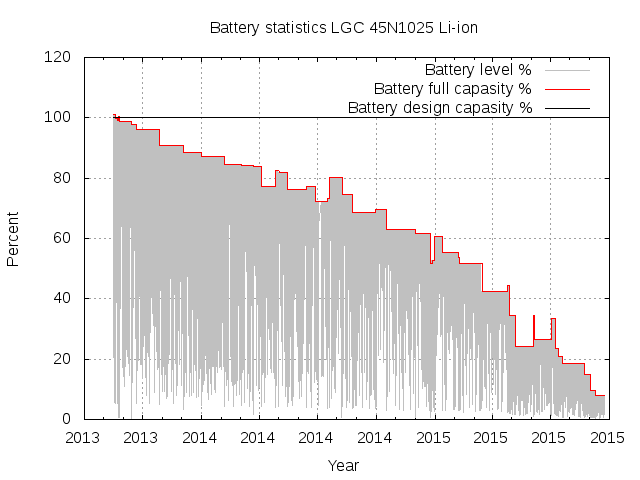
When I get a new laptop, the battery life time at the start is OK. But this do not last. The last few laptops gave me a feeling that within a year, the life time is just a fraction of what it used to be, and it slowly become painful to use the laptop without power connected all the time. Because of this, when I got a new Thinkpad X230 laptop about two years ago, I decided to monitor its battery state to have more hard facts when the battery started to fail. First I tried to find a sensible Debian package to record the battery status, assuming that this must be a problem already handled by someone else. I found battery-stats, which collects statistics from the battery, but it was completely broken. I sent a few suggestions to the maintainer, but decided to write my own collector as a shell script while I waited for feedback from him. Via a blog post about the battery development on a MacBook Air I also discovered batlog, not available in Debian. I started my collector 2013-07-15, and it has been collecting battery stats ever since. Now my /var/log/hjemmenett-battery-status.log file contain around 115,000 measurements, from the time the battery was working great until now, when it is unable to charge above 7% of original capacity. My collector shell script is quite simple and look like this:
#!/bin/sh
# Inspired by
# http://www.ifweassume.com/2013/08/the-de-evolution-of-my-laptop-battery.html
# See also
# http://blog.sleeplessbeastie.eu/2013/01/02/debian-how-to-monitor-battery-capacity/
logfile=/var/log/hjemmenett-battery-status.log
files="manufacturer model_name technology serial_number \
    energy_full energy_full_design energy_now cycle_count status"
if [ ! -e "$logfile" ] ; then
    (
	printf "timestamp,"
	for f in $files; do
	    printf "%s," $f
	done
	echo
    ) > "$logfile"
fi
log_battery()  
    # Print complete message in one echo call, to avoid race condition
    # when several log processes run in parallel.
    msg=$(printf "%s," $(date +%s); \
	for f in $files; do \
	    printf "%s," $(cat $f); \
	done)
    echo "$msg"
 
cd /sys/class/power_supply
for bat in BAT*; do
    (cd $bat && log_battery >> "$logfile")
done
The script is called when the power management system detect a change in the power status (power plug in or out), and when going into and out of hibernation and suspend. In addition, it collect a value every 10 minutes. This make it possible for me know when the battery is discharging, charging and how the maximum charge change over time. The code for the Debian package is now available on github. The collected log file look like this:
timestamp,manufacturer,model_name,technology,serial_number,energy_full,energy_full_design,energy_now,cycle_count,status,
1376591133,LGC,45N1025,Li-ion,974,62800000,62160000,39050000,0,Discharging,
[...]
1443090528,LGC,45N1025,Li-ion,974,4900000,62160000,4900000,0,Full,
1443090601,LGC,45N1025,Li-ion,974,4900000,62160000,4900000,0,Full,
I wrote a small script to create a graph of the charge development over time. This graph depicted above show the slow death of my laptop battery. But why is this happening? Why are my laptop batteries always dying in a year or two, while the batteries of space probes and satellites keep working year after year. If we are to believe Battery University, the cause is me charging the battery whenever I have a chance, and the fix is to not charge the Lithium-ion batteries to 100% all the time, but to stay below 90% of full charge most of the time. I've been told that the Tesla electric cars limit the charge of their batteries to 80%, with the option to charge to 100% when preparing for a longer trip (not that I would want a car like Tesla where rights to privacy is abandoned, but that is another story), which I guess is the option we should have for laptops on Linux too. Is there a good and generic way with Linux to tell the battery to stop charging at 80%, unless requested to charge to 100% once in preparation for a longer trip? I found one recipe on askubuntu for Ubuntu to limit charging on Thinkpad to 80%, but could not get it to work (kernel module refused to load). I wonder why the battery capacity was reported to be more than 100% at the start. I also wonder why the "full capacity" increases some times, and if it is possible to repeat the process to get the battery back to design capacity. And I wonder if the discharge and charge speed change over time, or if this stay the same. I did not yet try to write a tool to calculate the derivative values of the battery level, but suspect some interesting insights might be learned from those. Update 2015-09-24: I got a tip to install the packages acpi-call-dkms and tlp (unfortunately missing in Debian stable) packages instead of the tp-smapi-dkms package I had tried to use initially, and use 'tlp setcharge 40 80' to change when charging start and stop. I've done so now, but expect my existing battery is toast and need to be replaced. The proposal is unfortunately Thinkpad specific.

Joachim Breitner: The Incredible Proof Machine

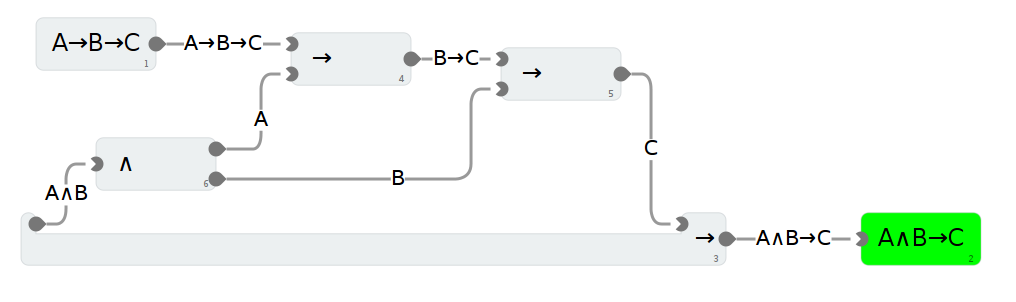
In a few weeks, I will have the opportunity to offer a weekend workshop to selected and motivated high school students1 to a topic of my choice. My idea is to tell them something about logic, proofs, and the joy of searching and finding proofs, and the gratification of irrevocable truths. While proving things on paper is already quite nice, it is much more fun to use an interactive theorem prover, such as Isabelle, Coq or Agda: You get immediate feedback, you can experiment and play around if you are stuck, and you get lots of small successes. Someone2 once called interactive theorem proving the worlds most geekiest videogame . Unfortunately, I don t think one can get high school students without any prior knowledge in logic, or programming, or fancy mathematical symbols, to do something meaningful with a system like Isabelle, so I need something that is (much) easier to use. I always had this idea in the back of my head that proving is not so much about writing text (as in normally written proofs) or programs (as in Agda) or labeled statements (as in Hilbert-style proofs), but rather something involving facts that I have proven so far floating around freely, and way to combine these facts to new facts, without the need to name them, or put them in a particular order or sequence. In a way, I m looking for labVIEW wrestled through the Curry-Horward-isomorphism. Something like this:
A proof of implication currying

A proof of implication currying

So I set out, rounded up a few contributors (Thanks!), implemented this, and now I proudly present: The Incredible Proof Machine3 This interactive theorem prover allows you to do perform proofs purely by dragging blocks (representing proof steps) onto the paper and connecting them properly. There is no need to learn syntax, and hence no frustration about getting that wrong. Furthermore, it comes with a number of example tasks to experiment with, so you can simply see it as a challenging computer came and work through them one by one, learning something about the logical connectives and how they work as you go. For the actual workshop, my plan is to let the students first try to solve the tasks of one session on their own, let them draw their own conclusions and come up with an idea of what they just did, and then deliver an explanation of the logical meaning of what they did. The implementation is heavily influenced by Isabelle: The software does not know anything about, say, conjunction ( ) and implication ( ). To the core, everything is but an untyped lambda expression, and when two blocks are connected, it does unification4 of the proposition present on either side. This general framework is then instantiated by specifying the basic rules (or axioms) in a descriptive manner. It is quite feasible to implement other logics or formal systems on top of this as well. Another influence of Isabelle is the non-linear editing: You neither have to create the proof in a particular order nor have to manually manage a proof focus . Instead, you can edit any bit of the proof at any time, and the system checks all of it continuously. As always, I am keen on feedback. Also, if you want to use this for your own teaching or experimenting needs, let me know. We have a mailing list for the project, the code is on GitHub, where you can also file bug reports and feature requests. Contributions are welcome! All aspects of the logic are implemented in Haskell and compiled to JavaScript using GHCJS, the UI is plain hand-written and messy JavaScript code, using JointJS to handle the graph interaction. Obviously, there is still plenty that can be done to improve the machine. In particular, the ability to create your own proof blocks, such as proof by contradiction, prove them to be valid and then use them in further proofs, is currently being worked on. And while the page will store your current progress, including all proofs you create, in your browser, it needs better ways to save, load and share tasks, blocks and proofs. Also, we d like to add some gamification, i.e. achievements ( First proof by contradiction , 50 theorems proven ), statistics, maybe a share theorem on twitter button. As the UI becomes more complicated, I d like to investigating moving more of it into Haskell world and use Functional Reactive Programming, i.e. Ryan Trickle s reflex, to stay sane. Customers who liked The Incredible Proof Machine might also like these artifacts, that I found while looking whether something like this exists:

  1. Students with migration background supported by the START scholarship
  2. Does anyone know the reference?
  3. We almost named it Proofcraft , which would be a name our current Minecraft-wild youth would appreciate, but it is alreay taken by Gerwin Kleins blog. Also, the irony of a theorem prover being in-credible is worth something.
  4. Luckily, two decades ago, Tobias Nipkow published a nice implementation of higher order pattern unification as ML code, which I transliterated to Haskell for this project.

Matthew Garrett: Filling in the holes in Linux boot chain measurement, and the TPM measurement log

When I wrote about TPM attestation via 2FA, I mentioned that you needed a bootloader that actually performed measurement. I've now written some patches for Shim and Grub that do so.

The Shim code does a couple of things. The obvious one is to measure the second-stage bootloader into PCR 9. The perhaps less expected one is to measure the contents of the MokList and MokSBState UEFI variables into PCR 14. This means that if you're happy simply running a system with your own set of signing keys and just want to ensure that your secure boot configuration hasn't been compromised, you can simply seal to PCR 7 (which will contain the UEFI Secure Boot state as defined by the UEFI spec) and PCR 14 (which will contain the additional state used by Shim) and ignore all the others.

The grub code is a little more complicated because there's more ways to get it to execute code. Right now I've gone for a fairly extreme implementation. On BIOS systems, the grub stage 1 and 2 will be measured into PCR 9[1]. That's the only BIOS-specific part of things. From then on, any grub modules that are loaded will also be measured into PCR 9. The full kernel image will be measured into PCR10, and the full initramfs will be measured into PCR11. The command line passed to the kernel is in PCR12. Finally, each command executed by grub (including those in the config file) is measured into PCR 13.

That's quite a lot of measurement, and there are probably fairly reasonable circumstances under which you won't want to pay attention to all of those PCRs. But you've probably also noticed that several different things may be measured into the same PCR, and that makes it more difficult to figure out what's going on. Thankfully, the spec designers have a solution to this in the form of the TPM measurement log.

Rather than merely extending a PCR with a new hash, software can extend the measurement log at the same time. This is stored outside the TPM and so isn't directly cryptographically protected. In the simplest form, it contains a hash and some form of description of the event associated with that hash. If you replay those hashes you should end up with the same value that's in the TPM, so for attestation purposes you can perform that verification and then merely check that specific log values you care about are correct. This makes it possible to have a system perform an attestation to a remote server that contains a full list of the grub commands that it ran and for that server to make its attestation decision based on a subset of those.

No promises as yet about PCR allocation being final or these patches ever going anywhere in their current form, but it seems reasonable to get them out there so people can play. Let me know if you end up using them!

[1] The code for this is derived from the old Trusted Grub patchset, by way of Sirrix AG's Trusted Grub 2 tree.

comment count unavailable comments

23 September 2015

Simon Josefsson: Cosmos A Simple Configuration Management System

Back in early 2012 I had been helping with system administration of a number of Debian/Ubuntu-based machines, and the odd Solaris machine, for a couple of years at $DAYJOB. We had a combination of hand-written scripts, documentation notes that we cut n paste d from during installation, and some locally maintained Debian packages for pulling in dependencies and providing some configuration files. As the number of people and machines involved grew, I realized that I wasn t happy with how these machines were being administrated. If one of these machines would disappear in flames, it would take time (and more importantly, non-trivial manual labor) to get its services up and running again. I wanted a system that could automate the complete configuration of any Unix-like machine. It should require minimal human interaction. I wanted the configuration files to be version controlled. I wanted good security properties. I did not want to rely on a centralized server that would be a single point of failure. It had to be portable and be easy to get to work on new (and very old) platforms. It should be easy to modify a configuration file and get it deployed. I wanted it to be easy to start to use on an existing server. I wanted it to allow for incremental adoption. Surely this must exist, I thought. During January 2012 I evaluated the existing configuration management systems around, like CFEngine, Chef, and Puppet. I don t recall my reasons for rejecting each individual project, but needless to say I did not find what I was looking for. The reasons for rejecting the projects I looked at ranged from centralization concerns (single-point-of-failure central servers), bad security (no OpenPGP signing integration), to the feeling that the projects were too complex and hence fragile. I m sure there were other reasons too. In February I started going back to my original needs and tried to see if I could abstract something from the knowledge that was in all these notes, script snippets and local dpkg packages. I realized that the essence of what I wanted was one shell script per machine, OpenPGP signed, in a Git repository. I could check out that Git repository on every new machine that I wanted to configure, verify the OpenPGP signature of the shell script, and invoke the script. The script would do everything needed to get the machine up into an operational stage again, including package installation and configuration file changes. Since I would usually want to modify configuration files on a system even after its initial installation (hey not everyone is perfect), it was natural to extend this idea to a cron job that did git pull , verified the OpenPGP signature, and ran the script. The script would then have to be a bit more clever and not redo everything every time. Since we had many machines, it was obvious that there would be huge code duplication between scripts. It felt natural to think of splitting up the shell script into a directory with many smaller shell scripts, and invoke each shell script in turn. Think of the /etc/init.d/ hierarchy and how it worked with System V initd. This would allow re-use of useful snippets across several machines. The next realization was that large parts of the shell script would be to create configuration files, such as /etc/network/interfaces. It would be easier to modify the content of those files if they were stored as files in a separate directory, an overlay stored in a sub-directory overlay/, and copied into the file system s hierarchy with rsync. The final realization was that it made some sense to run one set of scripts before rsync ing in the configuration files (to be able to install packages or set things up for the configuration files to make sense), and one set of scripts after the rsync (to perform tasks that require some package to be installed and configured). These set of scripts were called the pre-tasks and post-tasks respectively, and stored in sub-directories called pre-tasks.d/ and post-tasks.d/. I started putting what would become Cosmos together during February 2012. Incidentally, I had been using etckeeper on our machines, and I had been reading its source code, and it greatly inspired the internal design of Cosmos. The git history shows well how the ideas evolved even that Cosmos was initially called Eve but in retrospect I didn t like the religious connotations and there were a couple of rewrites on the way, but on the 28th of February I pushed out version 1.0. It was in total 778 lines of code, with at least 200 of those lines being the license boiler plate at the top of each file. Version 1.0 had a debian/ directory and I built the dpkg file and started to deploy on it some machines. There were a couple of small fixes in the next few days, but development stopped on March 5th 2012. We started to use Cosmos, and converted more and more machines to it, and I quickly also converted all of my home servers to use it. And even my laptops. It took until September 2014 to discover the first bug (the fix is a one-liner). Since then there haven t been any real changes to the source code. It is in daily use today. The README that comes with Cosmos gives a more hands-on approach on using it, which I hope will serve as a starting point if the above introduction sparked some interest. I hope to cover more about how to use Cosmos in a later blog post. Since Cosmos does so little on its own, to make sense of how to use it, you want to see a Git repository with machine models. If you want to see how the Git repository for my own machines looks you can see the sjd-cosmos repository. Don t miss its README at the bottom. In particular, its global/ sub-directory contains some of the foundation, such as OpenPGP key trust handling.

Next.

Previous.