Search Results: "cas"

12 February 2007

Alastair McKinstry: [astronomy] Maybe I can just hold it steady ...

Now the proud owner of a Meade 200mm SCT, with accessories. Pics, and the story behind it, here. Unfortunately, the accessories didn't include a mount. So now, I'm in the market for a mount, looking for a Celestron ADM or equivalent at the moment. Any recommendations or reviews, anyone? Of course, cloudy skies are forecast for Galway for the foreseeable future. Update: Celestron ADM mount on order from Telescope-Service, Germany. Expect clear skies for the next few days until it arrives.

11 February 2007

Martin F. Krafft: Adding a note for IE users

I am not a web site designer, but occasionally I'll find myself creating a new website. No matter how ambitious I may be, it won't take long until I trip over Internet Explorer's pathetic XHTML+CSS handling. For sites that are not classified "business," I have long been using a little note at the top of pages, which would use the * html body hack along with display:none to display only in IE, simply because I can't be bothered and do not have the time to write hacks to cater for the family of broken browsers Microsoft forces upon most of the WWW users. This note would alert the reader that s/he'd be able to read all content, but as long as s/he'd be using an inferior browser, the layout and design would be off. There were three problems with this approach: text-mode browsers, search engines, and IE 7.0: text-mode browsers and search engines got to see the text (as they don't process CSS, generally), and I could not figure out how to prevent IE7 from hiding the note the massively skilled and capable Microsoft programmers fixed the oh-so-handy * html body hack and thus prevented CSS to be catered for the broken MS browsers, even though they still need cludges all over the place. I am sure it was just a side effect of clumsiness, but it's now fixed (as opposed to the million other bugs that persist). So today I sat down and implemented a Javascript solution, which uses the DOM to insert content, if it determined that it's running on Internet Explorer. I could have used the <!--[if IE]> ... <![endif]--> construct, but that only works on Windows and not on the Mac. Thus, the Javascript solution is better as it will reach more Internet Explorer users. I ended up using innerHTML, which is a non-DOM Microsoft hack, but in the end, I am coding this only for the Microsoft browsers, so I can just as well use their stuff. Note that you are welcome to use this script under the terms of the Artistic Licence 2.0. You will, however, need to ensure that the insertNote() function gets called after the DOM has loaded. I use this event handler for that. You can see the script in action on my Debian site, using a little hack to display it even in non-IE browsers. Suggestions welcome! NP: Amorphis / Elegy Update: lots of people have contacted me to let me know that the note was visible in Opera and Firefox and so on and so forth. This is due to the ?ie-note query string in the URL, which I added to allow non-IE visitors to view the note (for whatever reason). Simply remove the query string and visit the page directly and you will not see the note unless you are using Internet Exploder.

Antti-Juhani Kaijanaho: Announcing darcs-monitor

There aren’t many features I grew fond of with CVS that I haven’t yet found a satisfactory solution for in Darcs. One of them was, until today, sending commit mails to mailing lists. There are a number of more or less ugly hacks floating around the net, but I never found them very satisfactory, so I wrote my own. Darcs-monitor will send email to a specified recipient about new changes added to a specific darcs repository. It can be run as an apply posthook (resulting in near-instantaneous “push” emails), or periodically from Cron, or occasionally by hand, whatever seems most convenient. You can get it by darcs at http://antti-juhani.kaijanaho.fi/darcs/darcs-monitor/ (darcsweb available), or as a tarball at http://antti-juhani.kaijanaho.fi/software/dist/. It depends on mtl and HaXml and is written in Haskell, naturally. It has been tested only with GHC 6.6 so far. For installation and usage instructions, refer to the README. Please note that this software is very new and thus can be buggy. As with any email-sending software, bugs can result in major annoyance; user caution is warranted.

9 February 2007

Alastair McKinstry: [astronomy] Galway Astronomy Festival, 2007.

I went to the Astronomy Festival on Jan 27 organised by Galway Astronomy Club. Worth seeing; it attracted about 100 people (the Hotel conference room was full); successful for a town like Galway, so frequently covered in Cloud. Dr. Lucie Green save a good talk on Solar Physics, describing the different methods we now have of exploring the Suns behaviour, Flares, Sunspots, etc. and the different missions such as SOHO and the new STEREO mission to observe the Sun. Prof. Chris Dainty gave a clear presentation describing the state of the Art in Adaptive Optics, and work his group has been doing, both in Astronomy and pushing AO into other fields, such as opthalmology (treating the eye as the obstacle and observing the retina behind) and productising A.O. for 'non-professional' use. He hopes in the near future to be able to provide Adaptive Optics to Amateurs (price range around Eur 5000, status: not ready yet, the first units would be for 'University Dept' observatories, costing 20-30k, in the next year or two). Of particular interest were one by Prof. Dick Butler, head of the Chemistry dept. here in NUIG; it was on Organic Chemistry and meteorites. He is a long-time amateur astronomer but professional chemist; he was particularly interested in the organic chemistry of the Murchison meteorite. After pointing out the out the false alarm of ALH 84001, he gave a convincing presentation of the extra-terrestrial origin of complex organic compounds, including amino acids, etc. in the Murchison meteorite. In particular he disputed claims that the meteorite was contaminated, pointing to the Deuterium enrichment of the compounds within; as the C-D bond is stronger that C-H, Carbon-Hydrogen compounds are more likely to be broken up by extraterrestrial radiation that their deuterium variants, leading to deuterium enrichment over terrestrial equivalents. Later he gave a nice summary of conditions on Saturn's moon Titan, pointing to its rich supply of organic compounds, showing that when hit by meteorites, lakes of water would be possible for several hundred years at a time, as the impact craters cooled, and called Titan a utopia for organic chemistry exploration. This seems to make the idea of panspermia: life originating off-Earth more plausible. For a while now I've had a book (found in the Bargain bin somewhere) by Fred Hoyle and Chandra Wickramasinghe, From Grains to Bacteria, a collection of papers documenting their belief that they've discovered bacteria in free space via spectroscopy. I must admit my spectroscopy is not up to challenging them; time to dig deeper and fish it out. Dr. Aaron Golden gave a very interesting talk on Brown Dwarfs: Planets or Pulsars that he and his students have been doing. Basically it turns out that while Brown Dwarfs have long been seen as the 'runt' of the Stellar world, stars that didn't make it, some of them it seems are Pulsars. (He's invented the acronym SPUDs: Sporadically Pulsating Ultracool Dwarfs, for them; maybe it'll help people remember that Pulars were originally discovered by an Irishwoman, too). This was first seen by Andys Postgrads Greg Hallinan and Steve Bourke - (see the papers). Kinda interesting as Aaron studied under Dr. Andy Shearer in NUIG working on Pulsars, so knew a bit about them, and had seen behaviour like this before, with a bit of a clue what might be causing it. It was wierd going to this talk; Andy hired me to work in ICHEC, and we have an office in NUIG; Greg and Steve work down the hall, and indeed, I see them occasionally working on our computers; but didn't know what they'd been working on until now. So, it appears that these Brown Dwarfs (they've seen Pulsar behaviour in several) have Starspots (details here and here; some hot-off-the-press stuff: rumour has it he was checking the results of observations from the night before to ensure they didn't disprove what he was about to say). Aaron was pointing out the coherent maser behaviour was similar to that seen at Jupiter, leading to its strong radio emissions. I didn't get to talk to him about it in detail, but the idea of an Object with both sunspots and clouds sounds fairly exotic and interesting. Beyond that, the Festival was a good opportunity to see what Irish Amateur Astronomers have been doing, and meet some interesting people. Kudos to all those who organised it.

Christian Perrier: Interacting with translators: what to do?

Holger Levsen made an interesting suggestion to me today: instead of whining against maintainers who do not interact with translators without explaining what I expect from maintainers, I should maybe explain what we expect. This makes pretty much sense indeed...:-) So, below is the mail I usually send to these maintainers:
Hello,
I just noticed new/modified debconf templates appearing for this
package.
I would like to suggest you to consider calling for translations when
introducing new debconf templates or changing the debconf templates in a
package or, if you prefer, to send a call for translations after uploading
the first version that introduces new templates or templates changes.
How to do this?
0) Install po-debconf
---------------------
If you test-build your package on your system, you shoud already have
it. Otherwise, consider apt-get installing it.
it will bring the needed utility.
1) Call for new translations
----------------------------
Just go to your package's build tree and use:
$ podebconf-report-po --call
This will propose you a generic mail which is to be sent to
debian-i18n@lists.debian.org and call for new translations.
This utility will mention existing translations to avoid duplicate
work.
It will also attach the needed material to this mail.
Please also think about giving a deadline to translators. We like
deadlines..:-)
2) Call for translation updates
-------------------------------
If your package already includes debconf translations (ie *.po files
in debian/po), please consider calling for translation updates if you
happen to change something in the templates...or just in case when you
release a new version.
This is done with the following command:
$ podebconf-report-po
This will build private mails to translators (ie people listed in
"Last-Translator" in the PO files) for translations that are
incomplete. These mails will included the needed PO file for each
translator.
3) Check for writing style compliance
-------------------------------------
The Debian i18n contributors have developed a set of suggestions for
the writing style of debconf templates, to give them an overall
consistency all around Debian. These writing style suggestions are
explained in the Developers Reference. Lintian also warns about common
writing style concerns.
If you change your templates to fit this, please consider 2), of
course..:-)
Of course, everybody will notice that this can be applied to any gettext-based internationalised software.

8 February 2007

John Goerzen: Haskell Time Travel

There is something very cool about a language in which the easiest, most direct way to explain how it solves a problem is to say, "When we pass the output of [this function] into the input for the oracle we are actually sending the data backwards in time. So when [the code] queries the oracle we get a result from the future."

Sweet.

The story goes on to say, however, "Time travel is a very dangerous business. One false move and you can create a temporal paradox that will destroy the universe (which in this case means that the computation will diverge). When programming with values from the future, it is important never, never, to do anything with the values that might change the future. This is the temporal prime directive."

Lucas Nussbaum: Working evince and poppler in Debian Etch

Evince and poppler (the library used to render PDFs) are quite outdated in etch, and fail to display correctly a number of PDF files (including PDFs generated by latex-beamer). There’s a new poppler version (0.5.x, vs 0.4.5 in etch), but it bumps the soname, so it’s a no-go. Since I was particularly annoyed by this (I’m an evince fan), I looked at the issue, and found that entry in poppler’s changelog for version 0.5.1:
2006-02-16  Albert Astals Cid
        * qt4/src/Makefile.am:
        * qt/Makefile.am:
        * poppler/Makefile.am:
        * glib/Makefile.am: Update soname as we are not really compatible
        anymore with previous releases that had soname 0.0.0
And I thought that maybe, the soname update was not totally justified. I modified the package in experimental (v.0.5.4) to remove the soname bump, and renamed the binary packages so it becomes a drop-in replace for the version in etch. It works fine for me with the version of evince in etch, and seems to fix at least #369164, #409758, and #410085. Packages are available here. Of course, this is totally unsupported, and I have not done any careful testing. But it works for me until now, and I’l update this entry if I discover some problems. Also, I don’t plan to maintain this on the long term, so beware of security bugs. Update : This breaks tetex (see #356079). Arg. I’ll have to use the experimental version…

Lucas Nussbaum: Running Debian on your Linksys WRT54G* sort of

I’m the happy owner of a Linksys WRT54GL. OpenWRT is nice, but … well. Debian is just nicer. And I couldn’t resist the idea of running Debian on this little MIPS system. Since there’s clearly not enough space available on the Linksys, I decided to install etch in a chroot, that I would mount using NFS. Joey tried that already, the Debian wiki provides some information, but I use another technique. First, on another system (an i386, I debootstrap’ed a mipsel etch, using –foreign. This tells debootstrap not to run the second stage:
debootstrap –arch mipsel –foreign etch /space/debian-mipsel http://ftp.fr.debian.org/debian Then, I modified /etc/exports to allow the router to mount that chroot:
/space/debian-mipsel 192.168.1.1(rw,sync,no_root_squash) I mounted it on the router:
ipkg install kmod-nfs
insmod sunrpc
insmod lockd
insmod nfs
mount -t nfs star:/space/debian-mipsel /debian -o nolock
mount -t proc /dev/null /debian/proc
I set up some swap space on the NFS mount (mandatory, or debootstrap’s second stage will fail):
ipkg install losetup
ipkg install kmod-loop
ipkg install swap-utils
dd if=/dev/zero of=/debian/swapfile bs=1M count=100
losetup /dev/loop/0 /debian/swapfile
mkswap /dev/loop/0
swapon /dev/loop/0
I chrooted inside /debian, and ran debootstrap’s second stage:
chroot /debian /bin/bash
debootstrap/debootstrap –second-stage
When you are done playing, you can disable the swap space and umount everything:
swapoff /dev/loop/0
losetup -d /dev/loop/0
umount /debian/proc
sleep 1 # or umount /debian will fail
umount /debian
If you want to re-mount everything, all you need to do is:
insmod sunrpc
insmod lockd
insmod nfs
mount -t nfs star:/space/debian-mipsel /debian -o nolock
mount -t proc /dev/null /debian/proc
losetup /dev/loop/0 /debian/swapfile
swapon /dev/loop/0
chroot /debian /bin/bash
That first stage/second stage split in debootstrap is really cool: it’s an easy way to run Debian anywhere, only requiring to be able to chroot at some point.

Erich Schubert: Calendaring in a semantic wiki

... is the working title of my diploma thesis. Tomorrow I'll hold the introductory presentation on my topic in the research seminar. This is to explain my project to other members of the working group, so they can give me feedback and suggestions. What I'll be doing: Where I am: Difficulties: Fortunately, we have a rather strong research group here in Munich. There are experts for query and transformation languages (e.g. Xcerpt, SPEX - Querying XML Streams), temporal calculations (Computational Treatment of Temporal Notions, CTTN) and time modeling Calendar and Temporal Type System CaTTS); and I'm also working closely together with the author of IkeWiki and Xcerpt. And of course they're all nice people to work with!

7 February 2007

Matthew Garrett: 7 Feb 2007

Since ncm asked so nicely, here's an article on how ACPI suspend/resume actually works. Or doesn't, as the case may be.

6 February 2007

David Welton: Popouts with Rails

In a previous article about Stuff To Do, my ajaxified priority queue program, I talked about how best to keep track of the user's state of activity, should they so desire. I opted for the popup, as that was the best compromise between simplicity, and ease of use for the end user. From an end-user point of view, it's similar to how gtalk can detach from gmail if you want to run it in its own window. The trick was to implement the popup/popout in Rails, which actually ended up being pretty easy, and, all things considered, is a pretty cool technique. It's neat to pop stuff in and out of a web page. The easy part is popping out the window:
<%= link_to_remote("Pop out " + image_tag('popout', :border => 0),
                    :url =>   :controller => 'tasks', :action => 'popout'    ,
                   :title => 'Pop the status window into a popup window') -%>
Which subsequently calls popup.rjs:
page.replace_html('status', "<i><small>status in popup window</small></i></br>" +
                  link_to_remote("<small>Restore</small>",
                                  :url =>   :controller => 'tasks', :action => 'popin'  ,
                                 :title => 'Restore the status window'))
page << 'statuspopup();'
Which is pretty simple - the first call replaces the html in the status div, and the second calls the javascript function statuspopup. This lets us replace what was in the status window with some placeholder text and a 'restore' link in case things get screwy and the user wants to simply restore the old content of the div in question. It's worth noting that we also store the popped out status in session[:popped_out] in order to let the application know that the window is "popped out". This doesn't actually pop the window itself up. The statuspopup function in javascript (located in application.js) takes care of that:
function statuspopup()  
  window.newwindow = window.open('/tasks/openstatus','status',
                                 'height=10,width=210,status=no');
  return false;
 
And then the openstatus action opens the same rails partial that the regular page does:
<%= render(:partial => '/tasks/status', ...
Meaning that you don't have to rewrite the same code in two places. So, that's all it takes to pop up a new window, and replace the contents of the old div in the html page giving the user the sense of having popped a piece of the page out into a popup. So far so good. Now what happens when the user closes the popup? Luckily, we get a reference to the window that opened the popup called window.opener that we can use to comunicate with the main window. For instance, in our case we set up an event listener to fire when the window closes:
window.addEventListener("unload", statusClosed, false);
And this, in turn, takes care of popping the window back into the main page:
function statusClosed()  
new Ajax.Request('/tasks/popin',   method: 'get', asynchronous: false  )
$('popoutlink').style.display = 'inline';
w = window.opener;
target = w.window.document.getElementById('status');
code = $('onidle').childNodes[1].innerHTML;
target.innerHTML = $('status').innerHTML;
target.style['backgroundColor'] = '#bbddbb';
w.eval(code);
 
Once again, pretty simple. What's happening: We also fix up the color just a bit, to mark the user as active. All in all, it's pretty useful for time tracking. In Linux, it's ver easy to set the new popup to follow you around the screen, making it so that it's not a bother at all to wave the mouse at it to let the application know you're online. All you do is set the 'on top' and 'always on visible workspace' options - at least in Gnome.

Alexander Schmehl: The never ending story...

It seems some of my fellow students have found my blog. Wow, took you only four month to do so. I'm impressed ;) Beside the fact, that I mostly blog in English (most of my posts appear on planet.debian.org) the thing which interested them most was a recent rant blog. Most found it quite funny and some warned me, that it might be a bad idea to continue posting blogs like that... just in case someone tells the lecturer1. Many thanks for the warning! Indeed, many thanks! But why should I be afraid of someone, who needs three attempts to count without error in binary from 0 to 111? 1: I would really like to point out, that he is not a regular professor at our university. It's just that some people thought it would be a good idea to let him teach that course because of his experience as administrator.

Ross Burton: Xrandr 1.2

Since I got my 20" widescreen monitor in the summer, I discovered how bad X's support for resizing displays is. I wanted to have the ability to plug my laptop into the 20" display in the office and expand the desktop to 1680x1050, or remove the 20" display and shrink the desktop back down to the native resolution of 1024x768. It turns out that a number of factors were stopping this, and the only way to do it would have been to restart X. Because of this I ended up using the display at 1024x768 when I did use it, but mostly I stayed on the sofa. Then I heard about xrandr 1.2, the all-singing all-dancing revision of the X Resize and Rotate extension. Basically, it would solve my problem, and as luck would have it my laptop has an Intel chipset and the people hacking on it work at Intel. Yesterday after lots of poking I finally made it all work for this. This involved a lot of poking and a little black magic. The first step is getting an X server new enough. First, you'll need to update some X protocol headers. We'll start with the easy ones that have had releases (grab the latest release you can find): Then you'll need to update various other bits of X: Once this is done and X still works, it's time to brave the perilous world of git. If you've never used git before, it's quite simple for this. Go to the git browser and find the module you want to check out. Click on it, and you'll see two URLs: you want the anongit one. Do git clone [url], and then if I've specified a branch other than master, cd into the directory and do git checkout [branch]. For example:
git clone git://anongit.freedesktop.org/git/xorg/driver/xf86-video-intel
cd xf86-video-intel
git checkout modesetting
You'll need to grab: Build it all in that order. The order is important as if you build the Intel driver against randr 1.0 instead of 1.2, it won't do what you want. By now you should have an X that looks no different. But...
$ xrandr
Screen 0: minimum 320 x 240, current 1024 x 768, maximum 1680 x 1050
VGA disconnected 0mm x 0mm
LVDS connected 1024x768+0+0 246mm x 185mm
   1024x768       50.0 +   60.0*    40.0  
   800x600        60.3  
   640x480        60.0     59.9  
TV disconnected 0mm x 0mm
Now that is clever. Here you can see that I don't have anything connected via VGA, my LVDS (no idea what this stands for, but it means the laptop's panel) has a preferred mode of 1024x768 (thats what the * means), and I have nothing connected to the TV output (because Lenovo didn't wire it up). Now if I plug something into the VGA and run xrandr -s 0 (select default screen size), the external display should power on. Xrandr doesn't try to be too clever, it will leave that to desktop daemons, but by default it will try and make something appear on all of the connected displays. In this case, my 20" TFT gets a clone of my laptop panel, at 1024x768. That is no good though, I want to turn off the laptop panel (as I'll be shutting the laptop) and switch the external display to 1680x1050. This is where the black magic starts... Currently the Intel driver cannot resize the physical framebuffer in memory after X has started, so it defaults to a framebuffer of 1200x1024 (IIRC). That isn't big enough to hold 1680x1050. Also the Intel driver doesn't detect any modes from the TFT. This may be Dell being stupid, or the EDID parser in the driver being too restrictive, I don't know. Luckily we can still use modelines in xorg.conf so I added this:
Section "Monitor"
        Identifier "Dell TFT"
        # This is a standard modeline for 1680x1050 at 60Hz
        Modeline "1680x1050" 149.00  1680 1760 1944 2280  1050 1050 1052 1089
EndSection
        
Section "Screen"
        Identifier      "Screen"
        Device          "Intel"
        Monitor         "Monitor"
        # This says that when using a monitor on the output called VGA, use the
        # settings in the monitor "Dell TFT"
        Option "monitor-VGA" "Dell TFT"
        DefaultDepth    24
        SubSection "Display"
                Depth 24
                # This tells the screen to allocate a frame buffer up to
                # 1680x1050.
                Virtual 1680 1050
        EndSubSection
EndSection
With this, everything just works. If I xrandr with various displays plugged in I can see what they support and can switch modes. To make everything nice and easy I wrote a small script that I bound to an unused function key:
if xrandr -q   grep -q  "VGA connected"; then
  xrandr --output LVDS --off --output VGA --mode 1680x1050
else
  xrandr --output VGA --off --output LVDS --mode 1024x768
fi
(thanks to Eric for pointing out that I don't need to use the hex values). Simple! As you can see the new xrandr is very powerful. If you want to do Xinerama-style dual screen you can do that too: xrandr 1.2 encompasses that behaviour. The final thing to point out is how glad I am that GNOME seems to handle the screen resizing like this so nicely already. When the desktop shrinks Metacity moves windows so they are visible, and when the desktop expands the panel applets on the right stay on the right instead of sitting in the middle. The script I run when I change screens does more than I pasted here: it changes the wallpaper to match the aspect ratio, and also changes the fonts. I hope this has made sense, I know there are a few people out there who were waiting for me to test this before they gave it a go. If anything is too vague, leave a comment and I'll expand it. I should also mention that I've got Ubuntu Edgy packages for everything here in my repository. NP: Animal Magic, Bonobo
Eddy Petri&#537;or: Google Video restrictions?

"We're sorry, but the provider of this video has not authorized Google to display this video in your location."

This is what I got when I clicked on one of the videos on the first page at video.google.com.

Are they implementing restrictions like they do for China? Digital split anyone?


And in case you are asking, this is the URL: http://video.google.com/videoplay?docid=-4240715483782231113

Adam Rosi-Kessel: Google Observations

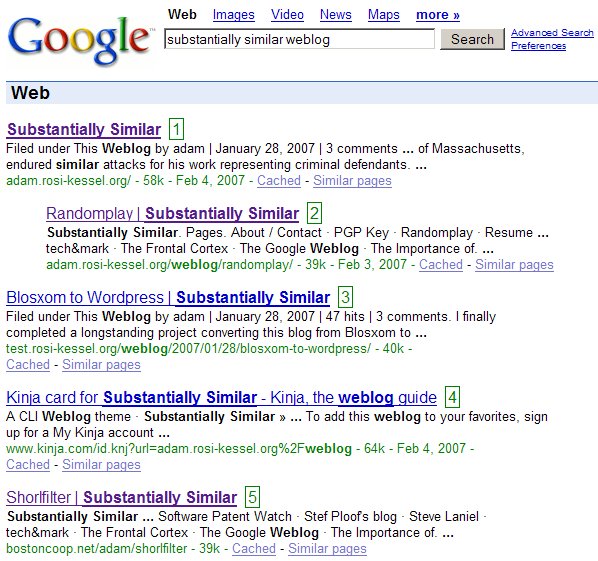
Changes are afoot at Google. A couple of weeks ago Google announced that it is refining its algorithms to minimize the impact of “Google Bombs.” (It’s curious that they made a big announcement rather than just doing it covertly, but perhaps this way they get to control how the news is framed.) Apparently, link text will be weighted less heavily in determining relevance to search terms. Presumably this means the page content will get more weight — ultimately there are only a few parameters that can serve as inputs in PageRank. A couple of weeks ago, I adopted the name Substantially Similar for this blog. I was looking for something clever and suggestive of the focus of this blog, but not overly clever or too narrowly focused. (I leave it to my readers to tell me if it works.) As a test case for Google’s new algorithm, this seems to be proof positive: Substantially Similar Web Search I am fairly certain no one has created a link to me yet with the link text “substantially similar,” yet I’m already the top result. Another change I noticed is the substitution of third-party descriptions of URLs instead of excerpt text. I don’t know if this is a new development or not, but it’s an interesting departure from what I’ve seen before: Google Excerpt Text That last link above is my old law school outline site — and the text “not fancy, but tons of outlines” doesn’t appear anywhere on the page itself. Instead, it is a description of the site from a couple of outline “portal” pages.

5 February 2007

Christian Perrier: fr: 99.817%, cs: 92.647%

These are the current translation ratios for French and Czech in unstable, after 18 days of "blitz l10n NMU". The sing package modifications lower French stats, as expected. However, the package has already been fixed by its maintainer (kudos!). viewvc has got an RC bug today so that gives me a very good excuse to push for an urgent update...including of course our beloved l10n bugs. That leaves us with dpkg-cross again, for which I have no answer yet. Small pause today in uploads as the Samba packaging team had to take care of a security update, which has been uploaded, for unstable, 3 hours after the official annoucement by the Samba Team. We are very grateful to these wonderful people, and more particularly to Gerald "Jerry" Carter who is not only a nice guy but also a very efficient developer. Thanks also to Steve Langasek for his commitment to this issue, to No l K the for being ready to upload in case I fail, to Eloy Paris for keeping the contact and to Moritz Muehlenhoff who prepared/is preparing the update for sarge.

Adam Rosi-Kessel: Cully Resigns

I’ve written twice before about Charles “Cully” Stimson, the Pentagon official who urged corporate clients to boycott law firms representing Guant namo detainees pro bono. The latest, via the legal tabloid abovethelaw.com, is that Cully has resigned over his remarks, a fitting end to the episode.

Joachim Breitner: Linux flexibility

One of the things about the GNU/Linux system that I wouldn t want to miss anymore is the general flexibility: I had to send my main machine, a ThinkPad, for warranty repair (again...). But I wanted to continue to use my programs with all my settings and all my data. So I took my old desktop machine, upgraded the Debian to unstable (which is what my laptop was running), using dpkg --get-selections and dpkg --set-selections I made sure that it had all programs installed that were on my laptop and then I mounted the laptop s harddrive, which I put in a USB case, on /home. Et voil , I can continue to work just as before. I wonder if this would have been as easy with, say, Microsoft Windows.

Martin F. Krafft: Install full Vista from upgrade version

This is just hilarious and representative of a company that seems to have no idea about security or the ways of the hackers (from Monsters and Cirtics.com): With a DVD-based Windows Vista upgrade, you can install the complete version, even if you've never owned (or installed) Windows before. Simply don't enter the product key after booting from the DVD and install a 30-day trial. Then reboot with the DVD a second time, and now enter the product key. It will upgrade the trial to a full version. I am definitely not advocating anyone to do this because there are plenty of reasons to avoid Windows Vista; I just post this for the giggles. Microsoft, you are morons. Get a grip. You can't beat the "bad" guys at security. Noone can. And when it's about licencing costs, the only lucrative way seems to find real business models based on a non-volatile basis and with a more sustainable edge to them. NP: Green Carnation / Light of Day, Day of Darkness Update: In the light of the above story, this interview makes me laugh for the sheer amount of hot air. And then there is this this gem, an email from Jim Allchin to Billie Boy and his mate Stevie with fabulous statements, like "... our teams lost sight of what bug-free means, ... what security means..." (as if they ever knew...), or "I would buy a Mac today if I was not working at Microsoft." That was 2004. Three years later it is as if this email had never been written.

3 February 2007

David Welton: In Thrall to Scarcity

As I've talked about in this space in the past, I've been coming to some conclusions about free software (open source, or whatever you want to call it): the economics of it, like anything else, are rooted in scarcity, and if you don't have a bit of that scarcity yourself, you have a lot less leverage This line of thought comes from the age-old question "how to create free software and make money at it?". This is a very important question for me, because I enjoy hacking on free software very much, and would love nothing more than to spend my days doing so. Creating new things, though, rather than working as a "system integrator" and tying pieces together with the smallest amount of glue possible. It's obvious that there is plenty of money to be had for people who simply use free software for their own ends. But what are those ends? We live in a world of scarcity - not everyone can have a fancy car, the nicest house in town, or the fastest computer. Market economies work via the exchange of scarce goods and services. If you have nothing to trade, you have nothing. Now, free software is worth something. Worth a great deal - that is beyond the shadow of a doubt. But since anyone can make a copy, there is no scarcity - once it's out there, you can't trade for it. So... where does this leave our potential free software creator? Let's think about some of the ways around this problem. I've alluded to it in the past, but consulting operations have several problems, especially when considered from the point of view of someone who wishes to create software: So, there you have it. In one way or the other, to make money at something in the long run, you are going to have to find and sell a product that people cannot effortlessly get for free.

Next.

Previous.