Julien Blache: forked-daapd: v0.15
- the code generating the song list was slightly reworked;
- hash tables of static data were replaced with static hash tables generated by gperf;
- the artwork code can now send out both PNG and JPEG to clients.
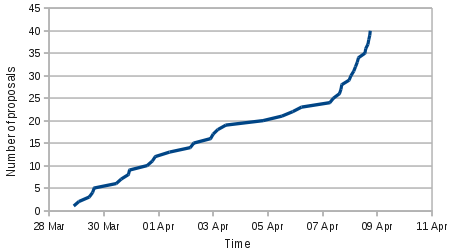
If you're an admin or a mentor, you can produce a similar graph for your
own org(s) - just download this OpenDocument spreadsheet and follow the
instructions inside.
Now the task of selection starts in earnest. I've gone through and marked
the seven spam proposals as ineligible (that's one line proposals,
proposals with no connection at all to Xapian, and proposals which are just a
title and/or paste from our ideas list with a generic biography).
That leaves 33, but not all are really in the running, before our student
applicants start to despair! I don't have a good picture yet, but it
looks like there are something like 10-15 we'll be seriously considering.
I've got a Debian GNU/Linux lenny installation (2.6.26-2-vserver-amd64 kernel) running on a Dell Poweredge 2950 with BIOS 2.0.1 (2007-10-27). It has two Intel(R) Xeon(R) CPU 5160 @ 3.00GHz processors (according to /proc/cpuinfo, 8 1GiB 667MHz DDR2 ECC modules (part number HYMP512F72CP8N3-Y5), according to dmidecode, and an Intel Corporation 5000X Chipset Memory Controller Hub (rev 12) according to lspci. The machine has been running stably for many months. On the morning of March 31st, i started getting the following messages from the kernel, on the order of one pair of lines every 3 seconds: Mar 31 07:04:38 zamboni kernel: [16883514.141275] EDAC i5000 MC0: NON-FATAL ERRORS Found!!! 1st NON-FATAL Err Reg= 0x800 Mar 31 07:04:38 zamboni kernel: [16883514.141278] EDAC i5000: NON-Retry Errors, bits= 0x800A bit of digging turned up a redhat bug report that seems to suggest that these warnings are just noise, and should be ignorable. Another link thinks it's a conflict with IPMI, though i don't think this model actually has an IPMI subsystem correction: this machine does have IPMI, though i am not making use of it. However, i also notice from munin logs that at the same time the error messages started, the machine exhibited a marked change in CPU activity (including in-kernel activity) and local timer interrupts:
![[Individual interrupts - by month]](http://dkg.fifthhorseman.net/blog/i5000_edac/irqstats-month.png)
I also note that more rescheduling interrupts started happening, and fewer megasas interrupts at about the same time. I'm not sure what this means. A review of other logs and graphs on the system turns up no other evidence of interaction that might cause this kind of elevated activity. One thought was that the elevated activity was just due to writing out a bunch more logs. So i tried removing the i5000_edac module just to keep dmesg and /var/log/kern.log cleaner. Leaving that turned off doesn't lower the CPU utilization or change the interrupts, though. Any suggestions on what might be going on, or further diagnostics i should run? The machine is in production, and I'd really rather not take down the machine for an extended period of time to do a lengthy memory test. But i also don't want to see this kind of extra CPU usage (more than double the machine's baseline).Tags: i5000_edac, troubleshooting
On next Monday this cycle s Ubuntu Application Developer Week classes will start.
The topic that kept me busy most in this cycle was Python gobject-introspection, and porting pygtk2 apps to PyGI (see my initial steps and my report from the PyGI hackfest.)
To spread the love, there will be two talks about this next week: On Monday 17:00 UTC the very Tomeu Vizoso himself will explain what gobject-introspection ( GI ) is, why we need it, and how library developers use it to ship a good and useful GI binding ( typelib ) for application developers. I will then follow up on Tuesday 16:00 UTC about the app developer side, in particular how to use the GI typelibs in Python, and how to port PyGTK2 applications to PyGI.
For the most part these sessions are distribution neutral (we don t have any special sauce for this in Debian/Ubuntu, it all happened right upstream
Adam D. Barratt is a Debian developer since 2008, in just a few years he got heavily involved to the point of being now Release manager , a high responsibility role within the community. He worked hard with the other members of the release team to make Squeeze happen.
You could expect the release managers to have some rest after a big release, but it s not really the case. With the long freeze, loads of transitions have accumulated and they are now busy to get all those updated packages in the new testing (wheezy). Despite this Adam took some time to answer my questions.
He shares with us his impression on the Squeeze release, his opinion on time-based freezes (regular/predictable freeze) and much more. Read on. My questions are in bold, the rest is by Adam.
Who are you?
I m a 31 year old software developer and part-time sysadmin for a software and IT services company based in the south of England. I have no children, no pets and a long-suffering partner who puts up with me spending far too much time tinkering with things and people making fun of her Macbook during Debconf.
As well as being on the release team, I m a member of the maintainer teams for devscripts and lintian.
Can you describe your journey in Debian and in the release team?
I was introduced to Debian as part of an infrastructure upgrade at work, moving from a set of Red Hat and Solaris-based systems. As part of that, we submitted some bugs for issues we found during the upgrade and for small patches we included in some software to add extra functionality we wanted. From that starting point I became more interested in Debian in general and began following some of the mailing lists and IRC channels.
When Julian Gilbey asked for help with the maintenance of devscripts, I submitted some patches for some of the outstanding bug reports and was invited to join the team which was being created to handle maintenance for the package. One of the then Release Managers was also on the team and asked if I d be interested in working on a couple of updates they wanted to the scripts which generate the proposed-updates overview pages. I added the new functionality which was merged in to the live scripts and a little while later I was invited to join the team, shortly before Debconf 9.
As most readers will be aware, we unfortunately reached a point during last year where we didn t have anyone filling the Release Manager role. During that period, I became more active in handling transitions and requests for updates to stable and as time went on more people started to suggest that I should put myself forward for the position, or refer to me as already being RM. I procrastinated over the decision for some time but after discussions during Debconf 10 I came round to the idea that we should have the RM role filled again and agreed to take it on, together with Neil. The rest, as they say
How much time do you usually spend working for the release team ?
I ve been trying to work out how to usefully answer this question. My initial answer was approximately two hours each day , but the longer I thought about it the more I started debating exactly what I should include under the umbrella of release work; after some to-and-fro I ve decided to stick with my initial answer.
During periods when Debian is frozen and particularly in the lead up to the release that time commitment increases significantly, particularly over weekends. I m reliably informed that at that point the correct answer to the question is too much time . No comment Liked this article? Click here. My blog is Flattr-enabled.
I just received a strange call. Basically, someone phoned me up and tried to convince me to change my computer s settings. They called my direct line (not the co-op switchboard), so I think they might be calling other numbers in the Weston-super-Mare area. Watch out for this attack.
I d heard about these calls from Box Bush Farm a year or so ago, but this is the first one I ve had. They introduced themselves as calling from Kilman IT Services (if I heard it correctly I didn t find it in a web search, so hopefully they re not defaming a real company) and say they re calling about the critical error that I reported from my computer (I guess they mean the dialogue that some applications pop up when they crash). I said something non-commital like riiight and they continued.
Apparently, that error has been registered in my computer s files and could cause damage at any time! So, they need me to edit my computer s registers to remove the error. Then they started trying to talk me through the process of running regedit. I m guessing the changes would have allowed them to control a Windows computer somehow.
At this point, I introduced myself and hung up the phone. Of course, there was no caller ID shown. If only I d picked up the call from a phone with a record button, I would post a recording! It sounded like a call centre and the caller spoke English with a far-eastern accent, but of course it could be from anywhere.
This is a crude social engineering attack. Don t fall for it. As it says on Get Safe Online: How to spot social engineering: You get an unexpected call, email or visit from a technical support person . Better yet, make sure you know the names of your tech support providers and refer any unsolicited repair calls to them. I think real IT services would talk to your lead support provider.
This sort of obnoxiousness is part of the reason why our co-op doesn t publish our client list. I m posting this mainly so if anyone searches for Kilman IT Services they ll find details of the call.
A pure maintenance release of
RcppGSL---our
interface package between
R and the
GNU GSL using our
Rcpp package for
seamless R and C++ integration---is now on
CRAN
It contains no new code, but smoothes one or two edges in the build process
and noticed by the newest versions of
R CMD check. It also adds vignette from the unit tests as some
of our other packages do.
The short NEWS file extract follows below.
0.1.1 2011-04-05
o Unit tests produce a summary vignette as for some of the other packages
o The documentation Makefile now uses the $R_HOME environment variable
o The documentation Makefile no longer calls clean in the all target
And courtesy of
CRANberries, here are
the changes to
the previous release.
Diff between RcppGSL versions 0.1.0 dated 2010-12-01 and 0.1.1 dated 2011-04-06 ChangeLog 22 ++++++++++++++++++++ DESCRIPTION 8 +++---- inst/NEWS 8 +++++++ inst/doc/Makefile 28 ++++++++++++++++++++------ inst/doc/RcppGSL-unitTests.Rnw only inst/doc/RcppGSL-unitTests.pdf only inst/doc/RcppGSL-unitTests.tex only inst/doc/RcppGSL.pdf binary inst/doc/RcppGSL/RcppGSL.Rnw 43 ++++++++++++++++++----------------------- inst/doc/unitTests only src/Makevars.in 2 - 11 files changed, 75 insertions(+), 36 deletions(-)More information is on the RcppGSL page. Questions, comments etc should go to the rcpp-devel mailing list off the R-Forge page.
The Background
If you weren't online last Friday you probably have missed the big news announcement on the various community distribution websites. The main pages of them got replaced by a placeholder announcing the birth of The Canterbury Project. People started to wonder whether it is an April fool's prank or for real. This blog post is meant to shine a bit more light on it and address one comment received about it.
If you go to the news item on the Debian site you'll get your answer about that it indeed was an April fool's prank. The idea for doing something in coordination with other distributions came to me when I thought about last year's (or was it already two year's ago?) prank that the various web cartoon sites pulled: they replaced their main page with the page of another cartoonist. My original idea was actually along that lines. So I started to dig up website contacts from different distributions, I was aiming at the big names in the community distribution sector.
Given that my time is pretty limited these days with renovating the house we plan to live in soonish I knew I had to let in others in within Debian. I though didn't want to involve too many people, for several reasons: it should be a surprise to as many as possible, but more importantly, I didn't want to shy away other distributions by an overwhelming Debian involvement. That's also part of the reason why I didn't contact many Debian based distributions.
So first contacts where made, a dedicated IRC channel used for coordination, and people involved joined in. Then the thing happened which the Free Software community is so well known for: additional ideas came in, two people independently addressed me whether it wouldn't be better that instead of a circle replacement of the frontpage, why not display the same page on all of them. And one of them added that a corresponding news item might make sense.
So there we were, having to think about text to put into two things: the news item and the replacement page itself. At this stage Alexander threw in a project name with a background that was adopted. Francesca started with an idea for the news item, I started to put quotes in and asked for ones from the other involved people that fit their distribution well. Klaas came up with a template for the replacement page that we tweaked. Fortunately we ended up being five distributions and the colors of the banner did match the distribution ones rather well (except for one, we had to tweak the color of one banner).
The Credits
We were all set, and actually everything went fine. And it definitely caught the attention. This blog post goes out in thanks to the following people:
Collaboration Across Bordersactually is possible. And the background information put into the news section of the replacement site is real. Also, my personal quote in the news item was meant dead honest. I do believe that DEX has a limited point of view and only tackles part of the problem. Unfortunately, for such efforts to really come to life it takes people with a really long breath and dedication to it. Efforts like the VCS-PKG and the Freedesktop Games effort are more or less stalled. Even though a lot of people do believe in stronger collaboration to be a good thing, the basis is not working out too well. I'm in the fortunate position that for some of the packages I maintain there is exchange between packagers from different distributions to avoid common troubles. If it can't be done in the big it should at least be tried in the small. I want to specifically highlight again one part of the updates in the replacement page: the CrossDistro track at this year's FOSDEM. This one was more than fruitful, on several levels. From what I've heard a lot of discussion happened besides the talks too, and connections got established. It doesn't sound unlikely like this might be done again next year. So again, thanks for enjoying this April fool's prank, thanks to everyone who helped to deliver it, and especially a lot of thanks to the people who this might have got thinking of possibilities to improve on the collaboration front!
Looking at current state of some phpMyAdmin translations, I came to conclusion that some are not worth shipping, because they really do not translate reasonable amount of the interface. The problematic question is where to draw the line. For 3.4.0-rc1 I drew it at 50% of messages, what means that 25 languages currently pass. It might look too strict and the threshold will most likely change for final 3.4.0, but we need to start somewhere.
While discussing this topic on mailing list, Tyron Madlener came with idea to tell users of incomplete translations about it and point them to information how to contribute. I quickly implemented this idea and it is now in git and live on demo server. I deliberately decided not to remove incomplete translations on demo server, maybe they will attract new contributors thanks to new warning on main page.
Filed under: English Phpmyadmin 2 comments Flattr this!
I recently set up debian on a Thecus N8800Pro. It seems to be a decent rackmount 2U chassis with 8 3.5" hot-swap SATA drives, dual gigabit NICs, a standard DB9 RS-232 serial port, one eSATA port, a bunch of USB 2.0 connectors, and dual power supplies. I'm happy to be able to report that Thecus appears to be attempting to fulfill their obligations under the GPL with this model (i'm fetching their latest source tarball now to have a look). Internally, it's an Intel Core 2 Duo processor, two DIMMS of DDR RAM, and a PCIe slot for extensions if you like. It has two internally-attached 128MiB SSDs that it wants to boot off of. The downsides as i see them: Vendor: Phoenix Technologies, LTD
Version: 6.00 PG
Release Date: 02/24/2009
A brand new and shiny 0.9.3 release of
Rcpp
is now on CRAN and
Debian.
This version contains an actual bug fix for Rcpp modules and a few build improvements, including for
both clang/llvm and
g++-4.6 (which,
being in Debian, is already used for
conformance checks on CRAN's incoming
directory) and g++-4.5.
We also updated the main introductory vignette
Rcpp-introduction
to the content of what should be a forthcoming paper in the
Journal of Statistical Software.
The complete NEWS entry is below; more details are in
the ChangeLog file in the package and on the
Rcpp Changelog page.
0.9.3 2011-04-05
o Fixed a bug in which modules code was not behaving when compiled
twice as can easily happen with inline'ed version
o Exceptions code includes exception_defines.h only when g++ is 4.5 or
younger as the file no longer exists with g++-4.6
o The documentation Makefile now uses the $R_HOME environment variable
o The documentation Makefile no longer calls clean in the all target
o C++ conformance issue found by clang/llvm addressed by re-ordering
declarations in grow.h as unqualified names must be declared before
they are used, even when used within templates
o The 'long long' typedef now depends on C++0x being enabled as this
was not a feature in C++98; this suppresses a new g++-4.5 warning
o The Rcpp-introduction vignette was updated to the forthcoming JSS paper
Thanks to
CRANberries, there is
also a
diff to the previous release 0.9.2:
Diff between Rcpp versions 0.9.2 dated 2011-02-24 and 0.9.3 dated 2011-04-05 ChangeLog 60 DESCRIPTION 8 R/00_classes.R 5 R/01_show.R 44 R/Module.R 1 cleanup 2 inst/NEWS 23 inst/doc/Makefile 74 inst/doc/Rcpp-FAQ.pdf binary inst/doc/Rcpp-FAQ/Rcpp-FAQ.Rnw 2 inst/doc/Rcpp-extending.pdf binary inst/doc/Rcpp-introduction.Rnw 1355 +++++++------ inst/doc/Rcpp-introduction.pdf binary inst/doc/Rcpp-modules.pdf binary inst/doc/Rcpp-package.pdf binary inst/doc/Rcpp-quickref.pdf binary inst/doc/Rcpp-sugar.pdf binary inst/doc/Rcpp-unitTests.pdf binary inst/doc/Rcpp.bib 99 inst/doc/jss.bst only inst/doc/unitTests-results/Rcpp-unitTests.html 18 inst/doc/unitTests-results/Rcpp-unitTests.txt 46 inst/include/Rcpp/Module.h 40 inst/include/Rcpp/Vector.h 6 inst/include/Rcpp/config.h 2 inst/include/Rcpp/grow.h 91 inst/include/Rcpp/module/Module_generated_ctor_signature.h 18 inst/include/Rcpp/vector/RangeIndexer.h 5 inst/include/RcppCommon.h 6 inst/unitTests/runit.Module.R 19 inst/unitTests/testRcppModule/src/stdVector.cpp 7 src/exceptions.cpp 2 32 files changed, 1167 insertions(+), 766 deletions(-)As always, even fuller details are on the Rcpp Changelog page and the Rcpp page which also leads to the downloads, the browseable doxygen docs and zip files of doxygen output for the standard formats. A local directory has source and documentation too. Questions, comments etc should go to the rcpp-devel mailing list off the R-Forge page
I took part in a occupational-health-related thread recently, and wrote a bit of my experience which might be helpful for my readers, many of them avid keyboard users, with usually 8hr of typing per day.
( ) I suffered not from RSI but from painful back aches. I started using standard keyboards in a different fashion, not putting so much stress on my wrists (and on the muscles connecting them to the rest of the body, of course): I exclusively use US keymaps (with some modifications to allow for proper Spanish input and characters), but instead of making the middle row my fingers' home row, I type with the base position of my fingers in a V shape Fingers resting on (approx.) w-e-f-v-spacebar and spacebar-m-l-;-]; the fingers doing most of the travelling are the index and middle, and with no straining for the little fingers to reach or backspace. On the other side, the most straining keys become Control and Shift, which requires closing the hands a bit too much, but are not that bad. My way does induce some new kind of stress, as my arms also have to move to reach 6 and 7, but it... Works for me .
It looks weird and is somewhat strange to get used to, but I must say it has worked great for me. I work this way on regular and laptop keyboards, even on my netbook's noticeably smaller one.
We're heading to release candidates for phpMyAdmin 3.4.0, so the translators have less time to make the translations better. The Italian translation got to 100% this week thanks to Rouslan Placella. So there are now 14 translations at 100%:
Filed under: English Phpmyadmin 0 comments Flattr this!
"It seems to be a common belief between some developers that users should have to read dozens of pages of documentation before attempting to do anything.I think this is an interesting quote as it shows an important misunderstand of what Debian is for many people. Debian (and Linux in general) was in its beginnings quite complicated and often not very easy to use. People still felt a deep relieve to have it and a strong love. Why? Because it's not so much about about how you can use it, but how you can fix it. A system that only has a nice surface and hides everything below it, that does in a majority of cases just what you most likely want it is nice. But if the only options are "On", "Off" and perhaps some "something is not working as it should, try to fix it" (aka "Repair") it is essentially a form of paternalism: There is your superior that decided what is good for you, you would not understand it anyway, just swallow what you get. Not very surprisingly many people to be in the position of the inferior of a computer (the less the more stupid the computer is, but even modern computers are still stupid enough for most people). So what those people want is not necessarily a system that can only be used after reading a dozen pages of documentation, but a system they know they can force to do what they want even if that might then mean reading some pages of documentation. So a good software in that sense might have some nice interface and some defaults working most of the time. But more importantly it has a good documentation, easy enough internals so one can grasp them and be transparent enough that one can understand why it is currently not working and what to do against this and then allowing enough user interference to fix it. If all I get offered is some "interface for users too stupid to understand it anyway" and all options to fix it are checking and unchecking all boxes and restarting a lot or perhaps some gracious offer of "There is the source code, just read that spaghetti code, you can there see anything it does though you might need to build a debug version just to see why it does not work" then I would not call any strong feelings against this situation "elitist".
"I m happy that not all of us share this elitist view of software. I thought we were building the Universal Operating System, not the Operating System for bearded gurus."
Mandatory warning: What follows is for testing only, and
insecure (root all over the place, giving access to host devices
from the container, etc.).
Problem of the day
mesa needs to be rebuilt against the
library. Doing so on a system running stable doesn t seem too
good: some newer libraries might be needed; and using make
install could make it harder to remember additional bits installed
all over the place ($DESTDIR is our friend but that might mean
more work on the build system side to get everything
detected).squeeze system.apt-get install lxc, read its README.Debian, get the mount
point set up./usr/lib/lxc/templates/lxc-debian template somewhere as
lxc-squeeze, and edit it:
dhcp-client with dhcp3-client.lenny with squeeze.ftp.debian.org.lxc-test directory, and create a container:
./lxc-squeeze -p lxc-test.lxc-start -n
test -f lxc-test/config (the test name passed through -n can
be used to call lxc-stop -n test). Use root/root to get in./etc/apt/sources.list to point to sid instead, and
dist-upgrade (using squeeze to start with means fewer headaches
while bootstrapping, in case sid breaks or gets into some
transition).lxc-stop and lxc-start to make sure the container can be
stopped and restarted at will.udev + LXC =
fail. So let s install it, note that it can t be configured, edit
/var/lib/dpkg/info/udev.postinst, add exit 0 at the top, and
dpkg --configure udev./dev. Using mknod would be
too easy, that s called a container for a reason. So let s edit
the config file (the one passed to lxc-start earlier) to add a
few devices (see below for an example).lxc-stop/lxc-start) the container,
mknod on those devices is now possible.crw-rw---- 1 root video 226, 0 Apr 5 02:34 /dev/dri/card0
crw-rw---- 1 root video 29, 0 Apr 5 02:34 /dev/fb0
crw------- 1 root root 4, 7 Apr 5 02:34 /dev/tty7
crw------- 1 root root 4, 8 Apr 5 02:34 /dev/tty8
Note the major, minor right between owner groups and dates, and edit
the config file accordingly, adding those lines (watch the syntax,
it doesn t like extra whitespaces):
lxc.cgroup.devices.allow = c 226:0 rwm
lxc.cgroup.devices.allow = c 29:0 rwm
lxc.cgroup.devices.allow = c 4:7 rwm
lxc.cgroup.devices.allow = c 4:8 rwm
Once the container restarted, create the devices:
cd /dev
mkdir -p dri
mknod -m 666 dri/card0 c 226 0
mknod -m 666 fb0 c 29 0
mknod -m 666 tty7 c 4 7
mknod -m 666 tty8 c 4 8
Getting serious
apt-get install xorgstartxstrace -f can help diagnose issues. If /dev/dri/card0 shows up
with ENODEV, an old libdrm could even remove that device, so
running mknod is needed again (but not sufficient)startx from the
container again should give better results (that s what happened
here).startx just works , just use ^Z then bg to put it in the
background.awesome)
and mesa-utils, and enjoy!export DISPLAY=:0
awesome &
# this is not a benchmark:
glxgears &
# direct rendering:
glxinfo egrep '(direct renderer)'
which printed here:
direct rendering: Yes
OpenGL renderer string: Gallium 0.4 on ATI RS690
As you may know, Apache's mod_authzn_ldap allows to authenticate users in
Apache HTTP server using an LDAP server. Unfortunately, it has a little
implementation flaw.
The filter used to authenticate the user is built by abusing the RFC 2255
which specifies the LDAP URL format. This format has an "attribute" field
which is normally used to specify which attributes should be returned. But
mod_authzn_ldap uses this attribute to compare with the username given by
the client. That means that you have to have an attribute in your LDAP
entries which matches the username, and you have to use it in the
"attribute" part of the URL to get things working.
Therefore, I wrote a patch to add a format string in the LDAP URL in order
to user the provided username in the filter, and ignore the attribute part
of the URL, which has no use in such a context anyway.
The bug has been opened in ASF Bugzilla and has number #51005, with the
patch. The patch is backward compatible with the current configuration
format, which is not the best choice in theory, but probably the more
pragmatic.
I've no clue on the typical delay for patches in clusion in Apache HTTP
server, so let's just wait'n see.
Today was the 30th annual
Race That's Good for Life 5k race in Oak
Park. I had run this in
2003,
2004,
2005
and
2006
but not afterwards as the spring marathons got in the way. As I am now on a
more relaxed (and seemingly non-marathon ;-) schedule, I was able to
participate again. Really nice to leave your house fifty minutes before race
start and cycle over... And kudos to the Oak Park
Runner's Club who once again put a nice race together.
Given the lack of (more intense) training, I am also a lot slower: 21:50.7 was
the chip time, or a 7:02 pace. We will see if I ever get faster again. On
race day I am usually motivated; it remains to be seen if I get over to the
track in the early morning to push myself through some speedwork.
sudo apt-get install emdebian-archive-keyringThen we add a
/etc/apt/sources.list.d/emdebian.list file with the following content:
deb http://ftp.uk.debian.org/emdebian/toolchains lenny main deb-src http://ftp.uk.debian.org/emdebian/toolchains lenny mainThe we update the package list to install the needed packages:
sudo apt-get update sudo apt-get install libc6-armel-cross libc6-dev-armel-cross libstdc++6-armel-cross binutils-arm-linux-gnueabi gcc-4.3-arm-linux-gnueabi g++-4.3-arm-linux-gnueabiThat s it ! We have now our cross-compilation toolchain installed from packages, so easy to update or remove. The kernel sources Samsung released it s modified 2.6.29.4 version. By cloning the kernel 2.6.29.y git branch, I could quickly see that their changes applied well to the 2.6.29.6 version (the last in the branch). In order to better sort the changes michel.s had splat them into several patches
series file allowing to apply those patches with quilt or better to import them to a git branch with git quiltimport. The order I choose allows to drop easily some patches (the last ones).
One particular point on those patches is that some include binary files:
fs/rfs/*.o a proprietary journaling layer over FAT. If you want my point ov vue, we don t need that. After all we have free journaling file systems available and linux is able to mount something else than FAT over USB drivers/usb/gadget/file_storage.o also the corresponding .c file was removed, the BSD/GPL license from the original code allows a binary distribution (however I didn t check if Alan Stern s name appears in the doc) but I d have liked that Samsung give that source code.mkimage utility from U-Boot. Here, Let s build the U-Boot released by Samsung, and let s just copy the tools/mkimage to a location in our PATH (that s the only install method I could find).
make smdkc100_config make CROSS_COMPILE=arm-linux-gnueabi- cp tools/mkimage ~/bin/Building linux For the config, one of the patches includes a
.config. That file is a copy of config_rfs so even without the previous patch, we can get Samsung s config.
Finally we can compile!
make CROSS_COMPILE=arm-linux-gnueabi- CFLAGS="-march=armv4t -mtune=cortex-a8" CXXFLAGS="-march=armv4t -mtune=cortex-a8" ARCH=arm uImageWe can then load our kernel by following The kernel testing howto from e60-open project. To load the kernel we will need the following command:
sudo dnw arch/arm/boot/uImageThat it, and it works ! Well almost, the kernel cannot find his modules. This will not be a big deal for the ones included in the sources (but the subject of a next post) but the
/lib/modules/max14540.ko and lib/modules/dhd.ko modules are not included in the sources while reporting a GPL license to the kernel.
Missing source code
The Samsung Open Source Release Center website has a contact form, but it does not seam to work (I even booted my netbook on windows to try with IE8 without success). After browsing the french e60 forum I found their email address and mailed them, no answer so far (not even automatic). Let s wait
Conclusion
We can compile a kernel for the e60 reader without using the cross tools from Samsung.
So, the last countdown to Paris
marathon started today for me.
One week left. Nearly last run before it, today, with a quiet 12.5km
trail at marathon speed. The point was testing my legs one week after
the Eco-Trail 55km run.
I'm balanced. Things seem to be OK but running 42km two weeks after
such a hard trail is really like jumping in unknown water. I feel a
small pain in my right leg. Not something really worrying, just not
perfect at all.
The hard choice is the starting pace. I'll probably be as careful as
possible, with something like 5'25"/km, which should end up in
3h48'. If things are OK at half-marathon distance (OK being
"perfect"), then I'll try to speed up slightly to 5'20", trying to hit
the 3h45' mark. This one is probably the very best I can do.
If things aren't OK, then I'll probably slow down from km 15, or even
before, and try to keep up with 5'40" and stay below 4h.
Marathon start is 8h45 in Champs-Elys es. Eh, maybe Zack and Ralf will
show up in Bastille neighbourhood, between km 23 and 24, as they did
last year. I should be there between 10h50 and 11h05 (watch the red
cap!).
Now.....just rest, drink, eat pasta and sleep!
Next.