Search Results: "spa"

5 May 2007

Clint Adams: Rudyard Kipling likes balls

I was greeted yesterday with Do you work at Trader Joe's? and while I sit here, wreaking the Lord's vengeance on that little lady, I have time to reflect on gossip. The rumor is out: Purse is engaged to be married to.. a Canadian. Where is your nationalistic pride, Purse? What of the ethnic impurity? Will you spawn and allow your half-breed progeny to gambol across the tundra, sweating to the oldiest from coast to coast, studying geography so they can one day hunt down the elusive and infamous Brunswick dugong? Woe to all of us for not letting you visit Kashmir.

David Moreno Garza: To Edinburgh

I just booked and paid my tickets to reach Edinburgh next month and attend DebConf7. I’ll be flying to New York on June, 16th through Delta from MEX. Then, I’ll go over the Atlantic with Flyglobespan, from JFK to Liverpool John Lennon Airport. From there, I’m still not completely sure, but I guess I’ll go by train to Edinburgh. Same way to return, on Sunday 24th, after spending a Saturday night in NYC. There’s a small thing that it’s still worrying me. I got the best deal ever from the US to the UK with Flyglobespan, but their first transatlantic flight will be by the end of May and I’m travelling in the middle of June. So, I’m bit skeptical on the matter. But reaching the UK from the US for only 550 USD, return, was impressive and I took the chance. If I don’t appear on DebConf on Sunday 17th around midday, it’ll be because I’ll be in NYC waiting for some answers from Flyglobespan. Anyway, I just moved and this travel expense was not easy. Actually, I wasn’t considering to attend, but after receiving sponsorship, I reconsidered and well, it couldn’t be possible at all without the support of the DebConf orga team, Gunnar, who lent me the sponsorship money for faster and local moves; my employer who is paying the MEX-JFK-MEX flight, but after all, my beloved fianc e, Raquel, who has been an incredible support for a guy like me (a fat, lazy, farty, stupid, anger-tending dude). I really, couldn’t be the happiest person I am today, without you: I love you, peque :-). Have I mentioned that any Debian friend visiting Mexico City can crash on our apartment? Yes! Just like bubulle’s hotel in Paris! ;-)

4 May 2007

Cord Beermann: private Spamstats April 2007


you see my Spamstats for the time i run an own server for my domain.

The input consists mainly from cord@Wunder-Nett.org that is in existence since mid-1996, and a (tuned) catch all on cord.de.


In 05/2004 i had a big downtime due to broken Harddisk and/or cheap IDE-Cables (which was finally solved in 2006).

In 11/2004 i became Debian-Listmaster, and forwarded the listmaster-mails to my system.

In 08/2005 i stopped forwarding listmaster-Mail and the admin-mail from LUG-OWL and let them drop into a local Mailbox on the specific servers.

In 06/2006 The power supply of my server died, and HaJo had a fitting spare device, so i took it to the local hardware gods (C&M sorry, only Flash) and they put implanted it, they also replaced all Fans (6 of which 4 were stuck) and replaced the IDE-Cables. Now i even could switch on DMA without risking a crash. (Man, 3years of crippled server). As you see, the system is now able to accept even more spam.

In 12/2006 i added greylisting on my server. My 2nd MX currently doesn't do greylisting.


Management-summary: With massive filtering i can keep mail somewhat useable for me.

DebConf team: DebConf7 accommodation (Posted by Moray Allan)

It looks like there are still a few spare beds in the hostel block booking for DebConf. So if you don’t have sponsored accommodation for DebConf, but would like to stay with other DebConf attendees, write to accommodation@debconf.org now. The spare beds will be allocated to people in the order emails are received; the price per night will be £12 (currently €17.60), which is a special reduced rate due to our large bookings.

Russell Coker: school rating

The web site http://au.ratemyteachers.com/ allows Australian students to rate their teachers. Ratings are anonymous and give teachers a score out of 5 as well as allowing students to comment on teachers. The Sydney Morning Herald has an article about the site that describes the actions that the NSW Department of Education and the NSW Teachers Federation are taking to block the site. The solution to this however is really quite simple. There needs to be a formal method for students to rate their teachers which will be used when it comes time to give pay rises to good teachers and dismiss or transfer to non-teaching duties the teachers who can’t do their job. I encourage students to submit essays and debate topics about the anonymous news-papers published in the Soviet Union and other repressive states, why they were necessary (because criticism of the government was prohibited) and why they were morally right (a system with no method of correction will inevitably do bad things). Then teachers will have a choice of supporting the actions of the Soviet Union or the use of ratemyteacher.com, it will be interesting to see which option they choose. I think that it’s most likely that they will take the hypocritical path and support anonymous newspapers in the Soviet Union while attacking such free speech in supposedly free countries. It’s interesting that an article on the failures of Mentone Grammar has just been published. Maybe if Mentone had been listed on the ratemyteachers.com site the Taylor’s would not have made the mistake of sending their son there. Or maybe if the Mentone senior staff had been reading that site they would have been able to correct the problems before they became cause for a legal dispute.

Alastair McKinstry: Gliese 581 : Transit tonight ?

Greg Laughlin from UCO Lick pointed out that there is a transit possible of Gliese 581c on May7. Looking at the ephemeris, its at 17:13 UT, though: not very good for those of us in Ireland. Yesterdays Nature (subscription required) shows that someone is going one better:
On 26 April, just three days after the planet's existence was revealed, Dimitar Sasselov of Harvard University began using the small Canadian space telescope MOST (Microvariability and Oscillations of Stars) to observe Gliese 581. Sasselov predicts that, if the geometry is right, his team should see the star dim on 7 May as the planet passes in front of it.
They reckon on 50/1 against a transit, on geometrical grounds. Good luck to them though. The point of all of this is that the current planetary detections of Gliese 581b and 581c are Doppler radial velocity measurements. While they tell us the period, they only give us a lower bound on the mass : 581c is at least 5 Earth masses, but could be much more (its M Sin(i), where i is the inclination relative to us is unknown). We also don't know the radius of the planet : the figure quoted in the news articles to date is just a guess based on 5 Earth masses and current theory. A transit measurement, where the planet passes in front of the star, could answer these questions. But it occurs to be we could get numbers tonight: there is a transit (alignment) of Gliese 581b tonight at 22:40 UT. Much more favourable to those of us in Europe. A transit of GL 581b, the big neighbour of Gl 581c, would tell is that a transit of 581c is likely, and would give us an accurate mass for 581b, and from this, a measure of the inclination. So we could also calculate the mass of 581b. Unfortunately I don't have a photometer or CCD. Anyone else up for it? Clear Skies over Ireland forecast , too ... Tags ,

3 May 2007

MJ Ray: Crackers: Evil Mambots and a com_extcalendar exploit

A couple of hours of today went on dealing with the effects of a big spam attack on a managed server. One user had installed the Joomla ExtCal component on their web site, while another reported that email was running slowly. The attacker was exploiting com_extcalendar/admin_events.php to send spam and trying to send 9000 emails meant they hit the maximum permitted sending rate quite quickly. As soon as I spotted it, I shut down outgoing mail, killed the sending process, disabled the exploited site and component, cleaned the spam from the queue and restarted mail. I'm searching the rest of the server for any other com_extcalendar installations and then I should contact the other exploited servers I've seen during this attack. It looks like there's an entire class of evil "Mambots" out there, using exploitable Mambo and Joomla sites to crawl in search of others. I don't think the exploited site's owner will be billed for the clean-up, because I can't find a security advisory for this. Neither the mambo site (whose site search doesn't work for me) nor the joomla site seems clear about security alerts. I didn't find a third-party advisory that was clearly about this (but there were a few maybe-relevant ones). The homepage at Mambo last released in 2005 and doesn't mention this in its release notes, while the homepage listed by Joomla 404s (and I don't enjoy using the Joomla site because, as it says,
"we are aware, and regret, that our website does not comply with many WCAG/508 requirements"
). If you are using com_extcalendar on your site, check whether it's safe, or replace it with a better calendar.

Gunnar Wolf: 09 F9 11 02 9D 74 E3 5B D8 41 56 C5 63 56 88 C0

This looks like random blabbering, right? A very specific random blabbering that has somehow appeared in blogs of at least tens (if not hundreds, maybe even more) blogs of techies all over the place. What is it?
For the more tech-friendly readers, it has some resemlance to a number - a long number, a 32128 bit one. And for those of you who are not Computer Science minded, you might actually prefer to see it as a simple base-10 (that means, decimal system) number: 13'256,278'887,989'457,651'018,865'901,401'704,640. I don't know how to spell it in English, but I do in Spanish (why? Because we have this difference: In Spanish, a billion is a million millions, and a trillion is a million billions - unlike English, where a billion is a thousand millions and a trillion is a thousand billions). So, lets do the excercise in Spanish:
Trece sextillones, doscientos cinuenta y seis mil doscientos setenta y ocho quintillones, ochocientos ochenta y siete mil novecientos ochenta y nueve cuatrillones, cuatrocientos cincuenta y siete mil seiscientos cincuenta y un trillones, dieciochomil ochocientos sesenta y cinco billones, novecientos un mil cuatrocientos un millones, setecientos cuatromil seiscientos cuarenta
Hah! I guess my fifth-grade teacher would be quite proud of me!
Now, I hereby pronounce my transcription of this utterly long and basically random-generated number into the beautiful Spanish language copyrighted by me, and publicly available under the Creative Commons Attribution-ShareAlike 3.0 Unported License, as it is a very valuable and hard literary work.
But, really, what is it? Well, this mindboggingly long number is the key with which most HD-DVD movies processed so far is encrypted with. Of course, the Motion Picture Ass. of America (MPAA) does not want this (again, randomly generated) number to be out there in the wild, so they say the number is copyrighted by them - This does not hold up, as it has been widely shown before (i.e. Intel dropped its 286/386/486 numbering scheme because a number is not copyrightable or trademarkable - and AMD was perfectly able to legally sell 386/486 chips). So, I have put more work into this number than what they have. I deserve the credit - the transcription is mine. Use it freely.
Oh, and of course, some more examples: [update]: Yes, sorry, I was counting with half of my brain shut down and the other half brain trying to fetch some coffeine, or something like that. It's a 128 bit number, not 32!

2 May 2007

Michal Čihař: What happened on last day of April?

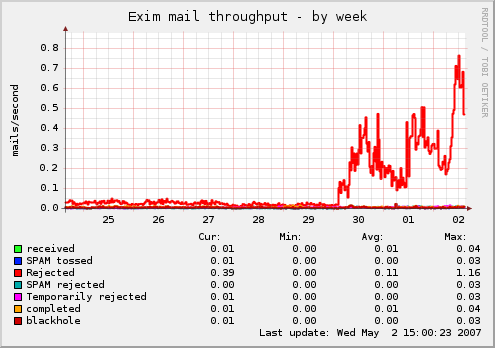
I just looked on server statistics and I was shocked by amount of spam and viruses rejected during last three days. Is there some new virus for Windows which tries random email addresses on all servers it can reach? I didn't analyse those messages, as they are rejected at RCPT time, because sender tries random addresses which do not work on my server. For now I try to reduce them by blacklisting in iptables, but this doesn't seem to help much as IP addresses change too often. I think that graph shows best what big change has happened: Mail graphs Update: It seems to be new Sober variant causing this mess.

MJ Ray: Moving slickly from ranting to advertising

I love email newsletters that move slickly from ranting to advertising. Here's one from Gossypium:
"We believe that something is critically wrong with all those head in the sand neoclassical giant companies, that have been built on economical models that we would now consider antique and even dangerous for the human evolution. New business models like Gossypium have managed to rebalance the relationships between the economy, society and the environment. It is now accepted by all that we will need to change and that there is no turning back. We as a brand are trying to make this easier by offering positive alternatives. So here is our great T-shirt collection"
Source I just wish I could do that in such an amusing way. But I can't, so I'm currently shuffling a few things around to make my Business feed a bit more work-relevant. If you are subscribed to my Business-only feed for the Media items, please switch to the Hacks feed. Meanwhile, Webmastering articles will change from the Hacks feed to the Business one. And there's some more changes which I'm still working out. Watch this space.

Chris Lamb: April s search strings

This is clearly a meme now.

1 May 2007

Cord Beermann: Debian Weekly News is late? - Blame listmasters!

Hi.

We were notified that German DWN, and the Original DWN weren't sent out. Investigation showed that Diplomats (in German translation Diplomaten) matched the bad word 'Diploma', so it is dropped in our spambox.

I resent German DWN yesterday and the Original DWN some minutes ago.

sorry for the inconvinience.

Isaac Clerencia: Back from the States + so it turns out I m celiac

Hi there! I’m back :P I spent a really nice time in the United States with my friends. We stayed two weeks in Boston and New York, and basically did everything we had planned to do and more … We visited the MIT at Boston, went to several comedy shows, ice skated in Central Park, spent a whole day in the Barnes and Noble book megastore, went to an NBA basketball game, saw Monty Python’s Spamalot musical, discussed politics with fellow Americans, visited the Delaware Water Gap waterfalls, enjoyed an helicopter ride, even watched The Grindhouse in its first day in the cinemas, and well, did lots of other stuff. Now for the celiac thing … I was somewhat sick during the whole trip, I felt weary the whole day without any reason, so as soon as I got back to Spain I went to the doctor and after some tests that spanned over a week and a quick visit to the hospital they diagnosed me with celiac disease. That means that I can’t ever eat anything containing gluten, a protein present in wheat, barley and rye. It’s quite an inconvenient illness, but nothing more than that, as just following an strict gluten-free diet is enough to keep it at bay. The main drawback is that you have to be really careful when you go out for dinner. I have already been in sick leave for three weeks because I had lost weight and was a bit anemic, but I’m quite ok again, and I expect to be back at work really soon now :)

Russell Coker: LUG talks today

Today I gave three talks at my local LUG. The first was my latest SE Linux talk (I’ll put the notes online soon). The second was a talk about voting. I asked for a show of hands, who has already decided which party they will vote for at the next federal election (about 12 people put their hands up). I then asked people to put their hands down if they were not a member of the party that they intend to vote for, including myself there were only two raised hands in the room (including mine)! With the way party politics works nowadays the major parties are not very interested in representing their core voters. Why try to please for people who will vote for you anyway? Instead they try to appeal to swinging voters and pressure groups. If you have decided to vote for a party they have no reason to try and impress you. Therefore you should join the party and try and influence the policy decision making process from within. The issues that I believe are most important to the Linux community are free software use in government, sane intellectual property laws, the right to a fair trial, and not pandering to the US (which is related to the previous two points). If you have already decided who to vote for then you should join that party and make your vote count in the party room. One member of the audience said that he had been a member of one of the major parties but that the internal politics turned him off. If that is your experience then I think you should ask yourself whether you want to vote for a group of people that you can’t work with. The final talk I gave was about getting speakers for Linux Users’ Groups. There is always difficulty in finding speakers for clubs. Ideally we would have meetings planned a few months ahead of time so that they could be advertised in various ways. Newspapers often have columns dedicated to providing information about public meetings but the lead time is usually at least a week (and the meeting would have to be advertised at least two weeks in advance - so more than a month’s planning ahead is required). Getting a larger number and variety of speakers will attract new members, encourage existing members to attend more meetings, and inspire members in their Linux work. Talks can be given by almost anyone. There is a constant demand for speakers who have expert knowledge in the topic, but anyone who is a decent speaker and has the confidence to stand up at the podium can give a good talk. For expert speakers possibilities include academics, industry leaders, leaders of free software development projects, and journalists. But that’s not all, anyone who wants to spend the time researching a topic can give a talk on it. For example I’ve been learning about MySQL recently for my own servers and will probably offer a talk about MySQL aimed at sys-admins who don’t want to become DBAs but who just want to get a database running. I’m not a MySQL expert (and don’t plan to become one) but I believe that there are many people who want to do the things I do with MySQL and who could benefit from a talk that I might give. The best place to find speakers is a conference or trade-show. If they give a talk that works well you can suggest that they give it again for your local LUG. You can also find speakers at conferences that you can’t attend. If someone visits your country for a trade-show in a different city you could send them an email saying “unfortunately I can’t attend your talk, but if you are interested in visiting my city in the same trip then there will be an audience of X people interested in seeing you”. There’s no harm in asking, the worst that they can do is decline. Ask everyone who you think can do a good job. Also make sure that you don’t make any commitment (unless you are member of the LUG committee).

Ross Burton: For Sale: Discworld Novels

In order to make some space and a little cash, I'm selling my collection of Discworld novels. I have the first 24 in paperback, but sadly not Lords and Ladies. They are all in very good quality and I'm offering the lot for about £60. Reasonable offers accepted, and this is for collection or personal delivery if I'm feeling nice (say, you live in Cambridge). I can provide photographic evidence of the books if required, I just need to get them out from behind another pile of books. Anyone interested? If so, mail me. NP: Soulmates, Nobody

Simon Law: Party on for Net Freedom


CFP 2007
Originally uploaded by sfllaw.
Tonight, I'm going to be attending an open panel discussion at Computers, Freedom, and Privacy 2007. It's completely open to the public and will be a discussion on freedom on the Internet. There are going to be a number of famous people there, including Whit Diffie, Peter Neumann, Anita Allen, Bruce Schneier, and Ed Viltz. I'm not sure exactly what they're going to be talking about, but I bet it'll be thought-provoking. At around 20:30, I'll be down at the CFP Welcome Party, which is basically a big fundraiser for Creative Commons and EPIC. You've probably heard me mention Creative Commons a few times, because they're a big proponent of having a healthy body of creative work that artists can draw from. Almost all of the art I produce is available under a Creative Commons license, which I've chosen so that you can share, copy, and modify it. So I'm more than happy to socialize with interesting people and to support a good cause. Sounds interesting? You bet! How do you get there? Well, the panel is at Hotel Bonaventure, and starts at 18:30. Details here. Then the welcome party is at 20:30, at Austin's place. Details here. For directions to Austin's house, send me an e-mail. Austin's address is on this flyer. If you're leaving from the Hilton, try these directions. Hope to see you there!

Russell Coker: more about Heartbeat

In a comment on my blog post “a Heartbeat developer comments on my blog post” Alan Robertson writes:


I got in a hurry on my math because of the emergency. So, there are even more assumptions (errors?) than I documented. In particular, the probability model I gave was for a particular node to fail. So the probability of either of two failing would be double that, and either of three failing would be triple that. Note that the probability of multiple simultaneous failures goes up as a power, but the probability of either of only goes up linearly. I really need to sit down and do the math carefully - but the idea of the simultaneous failures going up as a power is true. And the “any of” probability goes up linearly. That’s also true. This is why people can actually use larger HA clusters ;-). The 5 years figure is the industry standard quoted figure for an average Intel-based server to fail. The four hours to repair is a common high-quality of service response time from a hardware vendor. I admit that’s not the same as actual repair time, but if some “repairs” are just reboots, then it’s not a horrible number to start with - if your vendor has cached some spares nearby. I suppose I should sit down and do the math right, and make a spreadsheet of it. (I wonder if I remember that much math?) I assume disk failures are taken care of by hot swap disks, RAID, etc. and so in effect they “never fail” (at least not totally) so that these failures don’t have to be accounted for by the overall availability model. Here’s an intuitive way of thinking about it “from your gut”… If I took your whole data center and made a cluster out of it, what’s the chance that at least half of your servers would fail at once? Pretty darn small, is the short answer ;-). If it’s not pretty darn small, you need to buy better servers, and IBM has just the servers for you ;-). Or maybe they need to hire a better SysAdmin ;-) If you ask yourself “when is the last time at least half my machines in my data center couldn’t communicate with the other half”, then hopefully that’s also a “pretty darn small” chance too. If not, there are well-known methods for making networks highly reliable too. [I’m still ignoring “catastrophes” that you haven’t accounted for in your HA architecture]. I’m not saying this is free, and it can be pricey. One of my other favorite sayings is “Paranoia is an expensive hobby”. How much do you want to spend? You tell me how much you want to spend, and you can figure out how to spend it. I’ll make a separate comment on quorum models later. It’s getting late here.

My only comment in response to that is to say that I still believe the calculations of probability to be correct in my original post and I am interested to see someone prove otherwise. Another comment by Alan:


Data corruption, no doubt, is almost always much worse than loss of availability. And some kinds of data corruption are worse than others. For example, mounting a non-clustered shared disk filesystem twice simultaneously is usually much worse, than updating two replicas of the data simultaneously. In the first case, you have to restore to your previous backups and lose all data since then. In the second case, you only lose updates that were made to one of the sides, and you instantly have a working copy of the data which is nearly always much newer than your last backup (with the possibility of recovering them by significant effort). Typically you would only lose a few minutes of updates at worst - and depending on the kind of networking failure, you might not lose anything. Heartbeats certainly aren’t enough. You need to monitor the health of your servers and the health of your applications. Heartbeat monitors applications and can easily be informed of and act on the health of your servers (with release 2 style Linux-HA Heartbeat configurations).


Followed by:


Since data corruption is so serious, this is why cluster designers worry so much about split-brain, which is managed using the ideas of quorum and it’s sibling fencing. This is all about keeping bad things from happening. This post is really about quorum, since Russ had expressed interest in it. Quorum is the idea that you can uniquely choose a subcluster to represent the whole cluster in those cases where communication failure has caused the cluster to split into separate sub-clusters which cannot properly communicate with each other. In this way, only one of the subclusters continues on, and the others will sit on their hands and do nothing waiting for a person to fix things. Some of the kinds of quorum mentioned below are better than others. But, most importantly, they can be used in combination as described later. The most common kind of quorum is that Russ mentioned in his earlier post - the majority quorum. In this method, for a cluster of n nodes, you grant quorum to a sub-cluster which has more than INT(n/2) members. This means that if you have a 3-node cluster, you have to have two nodes to continue. If you have 4 nodes, you have to have 3 nodes to continue. For 5 nodes, you have to have 3 nodes, and so on. Other basic methods include disk reserve, so that you have reserve a disk to have quorum. In this case, if only one node survives and it can reserve the disk, it continues to run. However, the disk becomes a single point of failure. This may not be a problem if this single disk is required to run any of the cluster services, since they would fail without it anyway. [Heartbeat does not support this method]. An analagous method is to implement a software resource which grants quorum to one subcluster in a fashion analagous to the disk reserve method. This has the advantage of not requiring disk reserves, or a shared disk, but it has the same SPOF disadvantage as the disk reserve method. Heartbeat does support this method using the quorum daemon. It’s incredibly useful for those cases (like split-site clusters) where you cannot use fencing. Another method is to grant quorum to any subcluster which can ping a certain set of nodes, and not grant it to any which can’t access those nodes. This isn’t a wonderful method, and has obvious disadvantages with respect to uniqueness, and single points of failure. (Heartbeat doesn’t yet implement this one). Another method is to grant quorum to any node which is a member of a 2-node cluster. This is better than losing quorum and stopping when one node stops, but obviously completely ignores the uniqueness requirement of quorum. Another method is to ask a human being if you have quorum. This is hardly an ideal circumstance, but useful in some contexts as described below. (Heartbeat doesn’t yet implement this one). Perhaps you say, really the only one of these that’s really good is the first one - the majority vote method. And, I would generally agree with you. But, Heartbeat has the ability to use these in combination which makes some of those methods that seem flaky to be much more reasonable. Heartbeat has the ability to have multiple quorum modules declared, and they’re used in this way: Any module can return HAVEQUORUM, NOQUORUM, or TIE. If they return HAVEQUORUM or NOQUORUM, then no further quorum modules are consulted. However, if they return TIE, then the next quorum module is consulted for its opinion. If the last quorum module returns TIE, it is treated the same as NOQUORUM. This enables you to use one quorum module to break the tie declared by a previous quorum module. You could then use the quorumd to break the tie created by a voting module. Or you could use the quorumd instead of the “two-node” module. Or you could use the “pingable” module instead of the “two-node” module. Or you could at the end always tack on a “human” module, in case all else returns TIE. This is kind of cool, actually. My favorites for next implementation are the pingable and consult human modules. And, of course, if your cluster loses quorum due to real server failures failures, there are always ways to work around it, with a little human intervention. One method is to tell Heartbeat to ignore quorum. Another is to tell Heartbeat to remove certain nodes from the cluster, after you verify that they’re really dead. And, I’m sure that in a pinch, some new methods will be invented. And some of them might actually work ;-).


Regarding the quorumd, it seems that this is an extra server that will generally run on another machine separate from the rest of the cluster. So if we had a two-node cluster with a quorumd then it would effectively be a three-node cluster where one node is not configured to run any resources. It seems that the simpler approach in many cases would be to merely have a three-node cluster with resources not configured to run on one of the nodes. For example if I was running a mail server cluster for an ISP I might configure a three node cluster of the two mail server back-end machines and one other machine that is lightly loaded (EG a DNS server) and have it configured not to run MTA resoures on the DNS machine.

30 April 2007

Kai Hendry: Etrex plotting

Etrex via a USB interface This morning I thought I couldn’t get my GPS tracklog from my bike ride through London off my Etrex GPS device as I didn’t have:
  1. A serial port on my X40
  2. Google plus (20USD for getting data off my GPS!) on my Windows desktop at work
As I left work, a colleague suggested I try an USB serial adaptor that was lying around. He also gave me a CD with the drivers. I said I don’t need drivers! I run Debian, much to my colleague’s bemusement. Anyhoo, the USB/Serial interface works well, it comes up like so:
Apr 30 22:56:53 monty kernel: usbcore: registered new driver usbserial
Apr 30 22:56:53 monty kernel: drivers/usb/serial/usb-serial.c: USB Serial support registered for generic
Apr 30 22:56:53 monty kernel: usbcore: registered new driver usbserial_generic
Apr 30 22:56:53 monty kernel: drivers/usb/serial/usb-serial.c: USB Serial Driver core
Apr 30 22:56:53 monty kernel: drivers/usb/serial/usb-serial.c: USB Serial support registered for pl2303
Apr 30 22:56:53 monty kernel: pl2303 2-1:1.0: pl2303 converter detected
Apr 30 22:56:53 monty kernel: usb 2-1: pl2303 converter now attached to ttyUSB0
Then I ran: gpsbabel -t -i garmin -f /dev/ttyUSB0 -o gpx -F tracklog.gpx To download the track log from the Garmin. Then I converted the GPX into KML with this Gpsvisualizer Web application. Then I load up the KML with Google Earth to see where and when I have been cycling London. Google Earth really needs the package libgl1-mesa-dri installed to get DRI working on my X40 machine. Google earth showing my track log Though I prefer not to use Google Earth. I wish I could load the data with this Google maps animator, though the service doesn’t seem to accepting new accounts. Grrr… Update: Just a couple of comments about riding in London:

Michael Prokop: Mercurial: remote: abort: No space left on device

I got ‘remote: abort: No space left on device:’ when running ‘hg push’ via ssh during a repository migration (from subversion to mercurial). Huh?! The partition with all the repositories on it has enough free space, so what? Ah, wait a second. When pushing data via ssh, mercurial does a ’ssh $HOST hg -R /path/to/repos serve –stdio’ and the data is put into /tmp/hg-unbundle-… in the meanwhile. As I’m running the mercurial repository inside a vserver system /tmp was limited to 16M tmpfs. So the temporary fix was pretty easy:
vnamespace -e repos mount -t tmpfs -o remount,size=32m,mode=1777 \
              none /var/lib/vservers/repos/tmp
I just talked to mercurial devs, quoting them:
00:24 < mpm> It finds the tmp dir based on the standard environment variables.
00:24 < mpm> We'll probably move it to .hg/
[...]
00:33 < brendan> defaults to /tmp if unset
Excellent. :-)

Cord Beermann: Listmaster vs. Gmail

We get regular requests from Gmail-Users that don't receive their own mails back, when they post something on a mailinglist to which they are subscribed.

So if this happens to you, first check if your mail shows up in our mailarchive.

If it appears there (wait some time that the archive can catch up) your mail has been successfully posted to the list, and your copy has also been send and is most likely accepted by Gmail. But Gmail seems to drop that mail internally (or sort it in a spamdropbox?) maybe because From and Receipient-address are the same. (We get two or three requests of that kind per week, and everytime we investigated, we found this is the case)

If it doesn't appear in the Mailarchive and your mail has been accepted by our mailserver murphy.debian.org, you most likely have lost against our Spamfiltering. (Did you know that ControlExtension matches the string Rolex?).

Then feel free to report to listmaster@lists.debian.org and provide as much info about your lost mail as possible, helpful would be:


Keep flamemailing.

Next.

Previous.