Search Results: "ina"

8 November 2010

Raphaël Hertzog: 5 reasons why a Debian package is more than a simple file archive


Folder with gearsYou re probably manipulating Debian packages everyday, but do you know what those files are? This article will show you their bowels Surely they are more than file archives otherwise we would just use TAR archives (you know those files ending with .tar.gz). Let s have a look! 1. It s two TAR file archives in an AR file archive! A .deb file is actually an archive using the AR format, you can manipulate it with the ar command. This archive contains 3 files, you can check it yourself, download any .deb file and run ar t on it:
$ ar t gwibber_2.31.91-1_all.deb
debian-binary
control.tar.gz
data.tar.gz
debian-binary is a text file indicating the version of the format of the .deb file, the current version is 2.0 .
$ ar p gwibber_2.31.91-1_all.deb debian-binary
2.0
data.tar.gz contains the real files of the package, the content of that archive gets installed in your root directory when you run dpkg --unpack . But the most interesting part which truly makes .deb files more than a file archive is the last file. control.tar.gz contains meta-information used by the package manager. What are they?
$ ar p gwibber_2.31.91-1_all.deb control.tar.gz   tar tzf -
./
./postinst
./prerm
./preinst
./postrm
./conffiles
./md5sums
./control
2. It contains meta-information defining the package and its relationships The control file within the control.tar.gz archive is the most fundamental file. It contains basic information about the package like its name, its version, its description, the architecture it runs on, who is maintaining it and so on. It also contains dependency fields so that the package manager can ensure that everything needed by the package is installed before-hand. If you want to learn more about those fields, you can check Binary control files in the Debian Policy. Those information end up in /var/lib/dpkg/status once the package is installed. 3. It contains maintainer scripts so that everything can just work out of the box At various steps of the installation/upgrade/removal process, dpkg is executing the maintainer scripts provided by the package: Note that this description is largely simplified. In fact the scripts are executed on many other occasions with different parameters. There s an entire chapter of the Debian Policy dedicated to this topic. But you might find this wiki page easier to grasp: http://wiki.debian.org/MaintainerScripts. While this looks scary, it s a very important feature. It s required to cope with non-backwards compatible upgrades, to provide automatic configuration, to create system users on the fly, etc. 4. Configuration files are special files Unpacking a file archive overwrites the previous version of the files. This is the desired behavior when you upgrade a package, except for configuration files. You prefer not to loose your customizations, don t you? That s why packages can list configuration files in the conffiles file provided by control.tar.gz. That way dpkg will deal with them in a special way. 5. You can always add new meta-information And in fact many tools already exploit the possibility to provide supplementary files in control.tar.gz: Once installed, those files are kept by dpkg in /var/lib/dpkg/info/package.* along with maintainer scripts.
If you want to read more articles like this one, click here to subscribe to my free newsletter. You can also follow me on Identi.ca, Twitter and Facebook.

19 comments Liked this article? Click here. My blog is Flattr-enabled.

Joey Hess: chop chop

I've always loathed cheap particle board and peg bookcases, and when I broke one while reorgaising the living room at the Hollow today, I finally found a good use for them. They're great fun to chop up with an axe, and make for a very hot fire in the stove later. I released git-annex 0.03 today. The main improvements are being able to configure the backend to use on a per-extension basis in .gitattributes, a fsck subcommand that will find dangling annexed content, and bugfixes, including massive memory use savings. The big feature under development next is an idea Josh Triplett and I batted around; a way to checkout annexed files to edit their contents. Today I also got the radio working well here. Set up a car radio with a 40 foot wire for an antenna, and I finally got it almost static free. Pity that running a nslu2 on the same power circuit causes interference, so I am not able to use that to feed in music via the radio's AUX jack yet, which is the eventual plan. And the radio's powered USB outlet is wasted, I had hoped to run the nslu2 from that. Seems I can run the radio for 9 hours and still have plenty of solar power, even this time of year. Wish it were colder..

7 November 2010

Jonathan McDowell: New laptop: Acer Aspire TimelineX 1830T

I blogged back in August about my frustration in finding a new laptop that had everything I was looking for. I'd figured I would eventually end up with the Toshiba R700, given my positive experiences with the R200. The lack of stock proved a problem, and the differing specs between the US and UK models also annoying. I started trying to source the Sony and finally found the HD model in stock from Vizik, but the helpful people there talked themselves out of a sale by saying the Full HD was too much for 13" (they also failed to have a 3G Full HD model).

I'd only brought the EEE 901 to the US with me, so after a month of that as my only machine at home I was starting to get a bit fed up; the keyboard is too small for constant use and it crawls when subjected to my normal usage patterns rather than just used as a lightweight network terminal. So it became obvious I was going to have to compromise on what I wanted. And if I was doing that I wanted something a lot cheaper, as I thought I may potentially want to upgrade sooner than usual.

In the end I've gone with an Acer Aspire TimelineX 1830T. It cost about a third of what the more fully featured laptops I was looking at were going for, which was a considerable bonus. The 2 things I ended up compromising on were the SSD and 3G support. And the name; I wasn't entire sure about what the build quality would be like.

As it turned out I needn't have worried; it appears to be perfectly well constructed - no noticeable flex while typing, solid enough, yet still fairly light. The keyboard is pleasant to use (admittedly I'm coming from the EEE, but it's a good size and responsive enough for me). I'm a bit uncertain about the touchpad, which has no physical separation from the rest of the case, but it's been ok so far. I miss the multitouch of the EEE, but it looks like there are some patches for Synaptics multitouch flying around that might eventually lead to useful support. I've ended up with a Core i5 470UM at 1.33GHz - what I ordered was the i5-430UM at 1.2GHz (and that's what the box/label on the laptop said), but I'm not complaining at the slight speed bump. It's fine for my needs. The 1366x768 screen is lovely, even in 11.6". Bright, if sometimes a little too shiny..

Installing was of course fun; it reminded me of when I got the R200 - neither the wifi nor wired interfaces were supported by the Debian installer, even from testing. I found a patch to get the (Atheros) LAN working (and have filed #599771 about potentially getting the support into squeeze's kernel) and that got me up and going. The wifi is a Broadcom BCM43225; too new for the old Free driver and the recently released Broadcom Free code causes the machine to instantly crash (I understand it has some SMP issues). So I'm stuck with the binary blob wl driver from broadcom-sta for now. I have hopes the Broadcom driver will improve though; it seems to be getting active love in the staging tree. The graphics are Intel, so well supported. And I'm getting at least 4 hours of battery life out of it, which I think could be improved with some tweaking.

So, er, yeah. Not what I set out looking for, but considerably cheaper and actually seems to meet my needs pretty well - it had its first weekend away trip this weekend and performed admirably; not too heavy in my hand luggage, decent battery life and no worries about it being too flimsy to survive. I'm still surprised it's an Acer...

Adnan Hodzic: Ubuntu Developer Summit (UDS-N) Debianized Summary

Last week I was on my first Ubuntu Developer Summit (UDS-N), I wanted to attended this summit for couple of reasons: 1. Developer, I m part of Debian Java, working on Eclipse IDE, and as you re developing Debian, you re automatically developing Ubuntu, no? Nerd 2. DebConf11 main organizer, I really wanted to see how it s all done on corporate level, for instance we re going with hotels instead of student dorms and so on. 3. Migration to Linux infrastructure, make contacts and have some talks on this topic, because after DebConf11 in Bosnia a lot of institution will most probably open doors to open solutions such as Linux. I went to this summit without any expectations or plans, just said I ll play it by ear. This years UDS was held in Orlando, Florida before Orlando I was planning to stay in NYC for couple of days, therefor my whole plan was to get to NYC, then Orlando then head back home Smile I Heart NYC I spent couple of days here with my cousins and friends, as always NYC never fails to surprise me, and I ll always stop by even if it s only for couple of days Wink I wanted to meet up with couple of Debian people as well, but unfortunately my schedule was too tight so Caribe Royale, Orlando Please note that this whole trip was crazy (in a good way) starting from Sarajevo; on my flight from NYC to Orlando I see a guy that s sitting in front of me is wearing Canonical Landscape tshirt, I approach him and it turns he was Jamu Kakar working on Landscape. Since my luggage was late we had conversations from Debian over Ubuntu to Java to everything pretty much. While we were still at the airport, we bump into two more people going to UDS. As we got to hotel, same moment we walked out of cab there he was Jorge Castro, was he there just to smoke a cigarette or whatever doesn t even matter, what matters is that even before walking into hotel building I knew where reception, my tower and bar was, everything I needed to know at that moment High Five! Hotel where everything was held was Caribe Royale and even though I looked at their website I thought there was no way it s all going to be that nice, to my delight it was exact replica. Place is All-Suite Hotel and Convention Center , which meant that both accomodation, venue and everything else was in one place which is Yes 15 minutes later after I checked in, I was at a bar talking to Jim Baker about Java, Jython and Python, exact things I wanted to talk about at that given moment. What I said in these last couple of paragraphs sounds pretty cool eh? Well to me this whole UDS was just like this, everybody was so accessible and open for discussion, from Jono Bacon walking around offering candy to UDS reception staff Michelle, Marianna and others who were always there whether you had a complaint, problem or a praise. I really should stop mentioning names, because I ll forget somebody, and since it s just not fair because I had a feeling everybody was just there for you, whatever it was you needed. Ubuntu Developer Summit (UDS-N) Ubuntu, Debian, DebConf, differences? Even though I said I ll play it by ear, from very beginning I thought I d be complete outsider, being part of Debian and all. Quite contrary, I was everything but outsider, and even more there was plenty of Debian people there, including current DPL Stefano Zacchiroli, Colin Watson, Riku Voipio just to name few. There was also a Debian Healt Check plenary. But overall, there are differences between DebConf and UDS. One of the things is that you can attend UDS remotely I m not sure how much is this doable on DebConf, but then again vast differences are that UDS is filled with BOF s (as we would call it in Debian) meetings of different teams, I attended a lot of these, and most of them end with some kind of conclusion. While each day there was (only?) an hour of lectures on various topics, which on DebConf we would characterize maybe even as speed talks . However, everything was high paced, and it all ended up on You think that s a problem? How do you think we could solve it? . I had a feeling even if I didn t say something out loud that someone would hear me and approach me to discuss it. Everything was straight forward, all in goal to resolve certain issue or a problem, which I absolutely loved. Clap Fun It wasn t all work, even though Orlando doesn t seem to be my kind of city from what I saw, it s way too magical for my taste Party There was a lot of places where you could go to enjoy yourself. Good people at Canonical even offered me free ticket to Disney World, there was a lot of destinations to visit and transpiration was also organized by Canonical. Unfortunately I missed the notorious UDS party on Friday because I had to head home early, but possibly I ll make it next year Razz Even though, hotel was that great and to be honest you didn t have to leave to look for party. My favorite was Universal City Walk, one night I decided to go to see Blue Man Group, best part of it was that I got pulled up on stage by one of the members and was part of one of the acts! ROTFL This is definitely something everyone should see during his life, one moment you re laughing like a lunatic, while other moment you re just having goose bumps from the performance itself. Amazing stuff. After all I wrote here along with the pictures, is there even anything else I need to say? Smile I believe that even if I didn t play it by ear, this whole trip would exceed all my expectations in every possible sense. Because that s really what happened, those three reasons I was going to UDS for? Far more happened than that. All I can say in the end is that I ll move closer to having a part in Ubuntu development, and yea, I ll try to be regular on UDS from now on Smile See you in Budapest? If all these photos weren t enough, you can find official group photo as well as personal set of photos can be found on: UDS-N photos by 2010 Sean Sosik-Hamor

Debian News: Debian project accepted in the Google Code-in 2010

Google Code-in, Google s contest to introduce pre-university students of ages between 13 and 18, to the many kinds of contributions that make open source software development possible, is starting on November 22, 2010 and Debian is one of the 20 organizations selected to take part.

If you are student interested in contributing to Debian, you can find more information in the wiki page http://wiki.debian.org/GoogleCodeIn2010.
A list of tasks is available at http://wiki.debian.org/GoogleCodeIn2010/Tasks and if you a Debian Developer, you still can add tasks by filling the template provided in the top of that wiki page.

You can join the IRC channel #debian-soc (on irc.debian.org) and the Debian GSOC mailing list to talk about your ideas and applications or if you have any question.

Christian Perrier: Help cleaning spam in Debian mailing lists

Debian mailing lists' standard policy is to allow posts from unsubscribed users. That of course fits our standards for opened development but has the drawback of allowing a lot of spam to reach our mailing lists. This spam also clutters the mailing lists archives. However, 1.5 years ago, listmasters established a well-working system to clean out spam from the mailing lists. It basically works in four steps:
  1. first, spam can be "reported" by anyone meeting it. While you are reading the mailing lists, reporting spam is as simple as bouncing the offending mail to a dedicated address: report-listspam@lists.debian.org. I, for instance, use a mutt macro to set ESC-L as a "report spam" hotkey. Spam can also be reported when browsing the mailing lists archives and clicking on the "Report as spam" button;
  2. when a given mail has been reported as spam more than five times, it is then "nominated" for review;
  3. nominated mails must the be reviewed by volunteers in order to confirm they really are spam. The review algorithm is complex but, in short, when a mail has been confirmed as spam by 3 reviewers without being qualified as "ham" by anyone else, then it is considered spam;
  4. such mails are then removed from the mailing lists archives.
Steps 2 and 4 are performed by a weekly script that runs on Sunday mornings (5:00 UTC, IIRC) How can you help? Process nominated spam We need more reviewers for step 3. At this moment 2 people are doing this on a regular basis (every Sunday with the morning coffee). Some others are working on this in a less frequent way. It seems that 1 or 2 more regulars reviewers would guarantee that we can cope with the nominated spam incoming flow. Only Debian developers can do that step. They should read instructions, ask for a password, then start reviewing. The first 1 or 2 people joining this will have a quite big amount of nominated spam to process, for their first effort. However, as most of these have been classified as spam by at least the two people doing this for months....the amount will slowly decrease. I, for instance, now only spend 5-10 minutes reviewing the nominated mails every week. Report spam Everybody can work on reporting spam. You can start by doing this on mailing lists you read by just bouncing spams to the spam report address; If you want to do more, you can join existing spam cleaning efforts, such as the one running for debian-boot or the one running in debian-l10n-french (the latter probably more for French speakers). Or you can of course start a similar effort for your pet list. To be efficient, this effort needs to gather 5-6 people who will process the mailing lists archives systematically. Let's clean out these archives!

Petter Reinholdtsen: Making room on the Debian Edu/Sqeeze DVD

Prioritising packages for the Debian Edu / Skolelinux DVD, which is supposed provide a school with all the services and user applications needed on the pupils computer network has always been hard. Even schools without Internet connections should be able to get Debian Edu working using this DVD. The job became a lot harder when apt and aptitude started installing recommended packages by default. We want the same set of packages to be installed when using the DVD and the netinst CD, and that means all recommended packages need to be on the DVD. I created a patch for debian-cd in BTS report #601203 to do this, and since this change was applied to the Debian Edu DVD build, we have been seriously short on space. A few days ago we decided to drop blender, wxmaxima and kicad from the default installation to save space on the DVD, believing that those needing these applications are few and can get them from the Debian archive. Yesterday, I had a look what source packages to see which packages were using most space. A few large packages are well know; openoffice.org, openclipart and fluid-soundfont. But I also discovered that lilypond used 106 MiB and fglrx-driver used 53 MiB. The lilypond package is pulled in as a dependency for rosegarden, and when looking a bit closer I discovered that 99 MiB of the 106 MiB were the documentation package, which is recommended by the binary package. I decided to drop this documentation package from our DVD, as most of our users will use the GUI front-ends and do not need the lilypond documentation. Similarly, I dropped the non-free fglrx-driver package which might be installed by d-i when its hardware is detected, as the free X driver should work. With this change, we finally got space for the LXDE and Gnome desktop packages as well as the language specific packages making the DVD more useful again.

6 November 2010

Thorsten Glaser: Debian/m68k progress, MirBSD notes

I m almost finished with sort of re-bootstrapping Debian/m68k (I can use etch-m68k as well as what was in unstable at the moment as dependencies, so it was not that much, still, 305 binary packages build from 84 source packages, most for unstable (very few for unreleased, with very responsive maintainers, thanks all, who will include the patches in their next uploads) is a bit including rebuilds with newer versions, more patches, more testing or newer dependencies installed. I ll probably upload on Sunday evening, as I ll be off for 2-4 days at least from then (see below). Ingo tried to test on real hardware, but as Murphy wants a hard disc failed we ll still try to get something done over the weekend. If you want to have a look, see my repository index (sources.txt contains a sample sources.list file, 0-NOTE.txt some hints, including the right debootstrap/cowbuilder magic and speed tricks). I ll need to learn how to use LVM and set up a buildd now I ve not been in much of a hacking mood recently all these visits to the dentist leave me in unrest and disturb my equilibrium. Hence, not much activity even in mksh even if there was need, almost none in MirBSD. This is only temporary, but I won t attend OpenRheinRuhr, or, if I come at all, it ll be for socialising only and probably only one day. Benny s done with his Doctor (in France, no idea whether it s one in Germany as well) of Chemistry and has returned to hacking some (World of) Google-Go(o) code. I expect MirBSD activity to slowly raise once we can come back. Please accept our apologies.

Russell Coker: Unparliamentary Language and Free Software

I ve just read the Wikipedia page about Unparliamentary Language [1]. I recommend that everyone read it, if only for the amusement value, among other things it links to incidents where elected representatives acted in a way that would be expected of primary school children. The general concept of having rules about Unparliamentary Language is that MPs are permitted to say anything in Parliament without the risk of being sued or prosecuted, but certain things are inappropriate the most common example is directly accusing another MP of lying. One of the main aims of rules against Unparliamentary Language is to prevent attacks on the honor of another member. Having just witnessed a mailing list discussion go widely off track when a free software project was denigrated, it seems to me that we could do with some similar guidelines for mailing list discussions. The aim would be not to just prevent excessive attacks on the honor of other members but to also protect the honor of the free software projects. So for example one might recommend not using a particular program because of design decisions which seem dubious or a bad security history, but saying it s crap would be considered to be inappropriate. Not that rejecting a program based on design decisions or a history of security flaws would be uncontroversial, but at least that gives objective issues to discuss so if there is a debate it will educate some of the lurkers. Note that I m not claiming to be better than other people in this regard, I ve described software as crap on more than a few occasions. But I will try to avoid such things in future. Finally does anyone have a good suggestion for a Free Software equivalent to the term Unparliamentary Language ? It seems that to a large extent the support of certain ideas depends on having a catchy name and I can t think of one.

5 November 2010

Vincent Sanders: Keeping kindling dry

I, along with a great number of people I know, now posses a 3rd generation Kindle. It seems Amazon have found a feature set and price point which makes this device a winning solution.

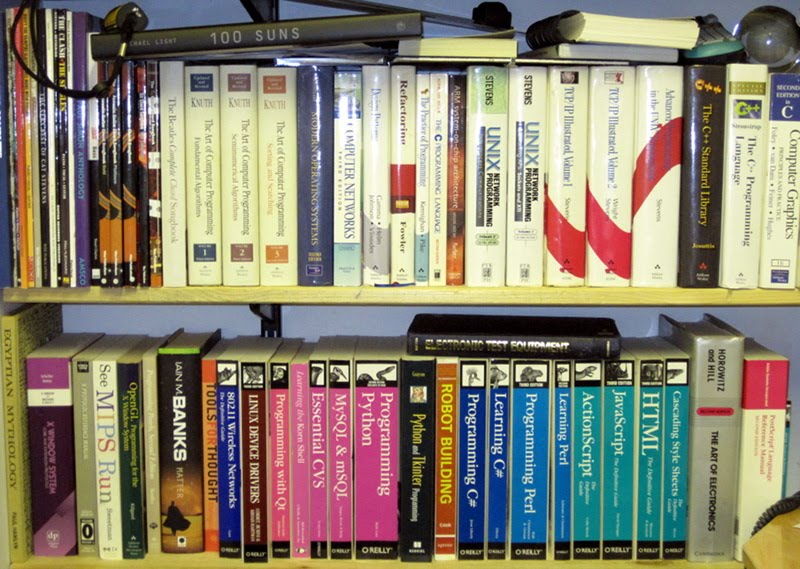
My bookshelf complete with covered kindle
I did look at a huge number of alternatives like the Sony PRS600 and others but they were all more expensive than the 110 for the Kindle and did not have enough features to make a compelling argument for spending more.

Yes it has DRM. Yes it "only" supports PDF, MOBI and mp3. Yes it will not win any style or usability awards. But I went into this eyes open the device is "good enough".

The device lets me read books from a reasonable display. The integration with amazon.com is so seamless it poses a serious danger to my bank account. I should expand on that last point :-) Amazon have got the whole spending money for a book thing executed so well that you do not think twice about a couple of pounds here and there, this soon adds up. I have set myself a rigid budget.

My main complaints are really just niggles:

  • Another different USB connector! Wahh, I thought everyone had agreed on mini USB? seems that I now have to have yet another lead for micro USB

  • The commercial book selection is a bit limited and missing a surprising number of popular titles. Some of this appears to be the publishers and authors simply clinging to their old business model. I fear some of them might not survive and early indications are they are behaving like the music industry did...Guys you are selling an infinite good a scarcity model is going to fail!

  • The price of some of the books is absurd...they are asking hardback prices for the electronic edition! Seriously? how on earth can that possibly be justified? I can see that a hardback book with its print run could cost 5 per physical item (going from hulu print on demand prices as a worst case) plus shipping and stocking fees. So how can you possibly justify charging the same price for a pile of bits where none of that applies? Also the pile of bits cannot be lent or sold, not impressed.

  • eBook formatting is generally dreadful. I do not know who is mastering these books but they need to do a better job. If they tried to pull this in the physical editions they would get a seriously large number of returns.

  • I still have to pay for whispernet delivery fees even though, because its the wi-fi model, I am providing the bandwidth myself. I can see that differentiating between 3G and wi-fi delivery is a bit hard for them though.
However my one and only real complaint with the offering as a whole is the astronomical asking price for the leather cover. The cover is currently 25% of the price of the kindle itself! ( 30 cover 110 kindle) which is just silly. It is a pretty nice cover and the clever clip attachment means it does offer an integrated solution to protecting your kindle, but not 30 nice.

Kindle in a sock cover
So my lovely wife (her kindle was bought with the cover) made me a sock for mine. This is great for casual round the house usage to stop me scuffing the screen but was a bit lightweight for protecting the kindle when out and about.

One day last week I had an idea. I would make my own protective cover by crafting something I had wanted to do for ages. And the (unoriginal I am sure) project of a hollowed out book for housing my kindle was implemented.


My hollowed out book kindle cover
A quick Google later and I had a set of plausible instructions to follow. I used possibly the most out of date book ever (published 1981) on electronic test equipment, partly because it was a ex library sell off book which cost 10pence back in 1995 but mainly because it was the right size to just enclose the kindle without adding to much size.

I learnt a couple of things doing this:
  • Do not let your pva (white) glue mix get too runny, you want it fluid enough to be easily absorbed but not watery - this is important because otherwise the paper absorbs too much water and crinkles
  • Do not use a book where the binding has gone bad already and select a "clean" book. The spine of this book was yellowed and cracking before I started. This means the book spine simply cracks open at the hollowed out bit and it is very obvious.
  • Work out where the "solid" part at the back is going to be and treat that separately so you get a nice solid base at the back of the hole. In mine its not all stuck together and is a bit wavy. Do be sure you left enough depth for the kindle though.
  • Take your time and be careful with the glue, it is amazing how obvious even a simple splash of glue in the wrong place is. Use a small brush for this a paint brush is fast but sloppy.
  • Measure carefully and cut only a few pages at a time, it takes a bit longer but looks much better. Also I did not drill the corners of my hole which means they are a little scruffy.
  • Use the sharpest thinnest knife you can, this really helps. I started with a small stanley knife but switching to my hobby scalpel gave much better results.
  • If you have some, use woodworking clamps to clamp a bit of timber (I had some offcuts of shelving) around the book to compress it while the glue dries. Do not clamp the spine if you can avoid it. This method ensures:
    1. Heavy things do not fall off the book while it dries.
    2. An even strong pressure is applied.
    3. The book does not warp or bend while the glue dries
All in all I kinda like the results and I think I will try again with a more modern book where the spine is not so broken to begin with.

Christian Perrier: Russian debconf translations complete in testing

The Russian l10n team is the first team to reach one of our translators' Grails: all debconf templates translations are now fully translated in Russian, in testing. Russian is the first language to reach this ever (I formerly announced 100% completion for a few languages, but that was in unstable: we never tracked testing up to now). It means that, in theory, on can do a full installation of all packages in squeeze (in case some crazy folks want to do this!) and always be prompted in Russian. French and German are lagging very close to this, the only missing bit being the udev package, which had two consecutive urgent uploads that couldn't include a full translation coordination. For these, we're indeed waiting for another udev upload, but I already nagged Marco about this..:-) Portuguese should make it, though I still have to track 7 packages for it. Swedish is only missing 2 packages. I'm less sure that Czech and Spanish (the other two teams working hard on 100% completion) will make it.

4 November 2010

Andrew Pollock: [life] Zoe at six months

Today, Zoe is six months old. The last three months certainly feel like they've taken their time, but a lot has happened. Developmentally, she's doing great. She's now in the 70th percentile for height (up from around the 25th percentile), and 31st percentile for weight (up from the 25th percentile). She cut her bottom front teeth a few days ago. Crawling is imminent, I'd say. She can already scoot around in reverse, and by a combination of shuffling and rolling, doesn't seem to be having problems moving around the floor. We started her on solids at five months, and she's taken like a duck to water to pureed pumpkin, sweet potato, beans, zucchini, apple, pear, banana and avocado. Speaking of water, she's also decided she likes to drink water from our glasses whenever she sees us doing it. Hilarity usually ensues, closely followed by a change of outfit. She's sleeping well, only waking up once a night under normal circumstances, and that wake-up is getting later and later. She loves her baths. She usually lets out a series of loud sighs as soon as we put her in the bath. She got her first cold a couple of weeks ago. It coincided with her first day in ad hoc daycare, but Sarah and I were both sick as well, so I think it's more likely that she caught the cold from us than from daycare. She's still battling it, but it hasn't really bothered her all that much. She's just a bit snotty. The NoseFrida has been very handy for dealing with this. She had her six month shots today, and seems to be tolerating them fairly well. Sarah says she hardly even cried when she got them. She continues to be a remarkably happy baby. She always wakes up with a smile, she really only fusses if we keep here away for more than a couple of hours, or haven't fed her on time. Even with this current cold she has, she's still stayed very happy. We feel incredibly lucky to have such a wonderful baby. The next big adventure is to try a babysitter. Zoe and me in early October

Gintautas Miliauskas: Living a monastic life for 10 days

About a month ago, at the end of August, I finished a 10-day Vipassana meditation course. This was probably one of the more extreme activities I have ever participated in, and it's well worth a blog post. I found out about the course in a ridiculously trivial way, by following a link in a Reddit comment (I wonder if I could track down that comment...). The website referenced by the comment contained (almost) no new-agey mumbo-jumbo and looked legit in general. I also appreciated the fact that this was a relatively serious and intensive course, which should be enough to form a reasonably founded opinion on meditation in general. When learning sporadically, in small bits, it is hard to say whether the material itself is no good, or you just do not understand it yet and need to study more; I was quite skeptical towards the practice, but wanted to give it fair trial. I was quite impressed that there was a course available in Lithuania, a few hours by train from where I live. Finally, the course was free (by tradition Vipassana is taught without monetary compensation). I went ahead and signed up for a standard introductory 10-day course. Vipassana (also called insight meditation) is a meditation technique allegedly coming back from Gautama Buddha himself (well, all the traditions like to claim that origin...). It has been experiencing a renaissance, partly due to an organization set up by a meditation teacher S. N. Goenka which has founded meditation centers all over the world. The essence of Vipassana is a method of teaching your mind to act instead of merely reacting to outside stimuli such as pain, anger of other people or hardships. The technique provided is to monitor your sensations, watch them with equanimity and suspend any reaction, and slowly it sinks in that all things are temporary and you can choose what to react to and how. That's the basic idea; I don't want to go deep into exposition of Vipassana as there is plenty of information about that (also at the same time the information is almost useless because you have to experience it to really understand it). Instead, I will sure some of the more personal remarks and experiences. The course took place in an cottage near Kretinga, housing around 50 people. The living conditions were absolutely great, and this would have been a true holiday if not for the regime and the rules. The day would start very early, at 4 AM (ending at around 9:30 PM), and we'd do about 12 hours of meditation in total inbetween, with occasional breaks, but the most gruesome part is that no communication at all was allowed with anyone except the manager of the camp (and the teacher during a specified time). That gets to you after a few days, but still, there are people around you, so it's bearable; on the other side, the senses (touch, smell) become very acute. The food was taken care of by volunteers (students who have finished the course), and I could say it was quite good actually. The goal, of course, was to keep the environment from interfering with meditation, and I think it was done very well. The presentation of the actual technique also did not disappoint. Each day a new step would be introduced, with the whole day to practice before moving on. Looking back, the pacing worked well. Every day in the evening there were lectures on theory. They were somewhat informative, but also sometimes annoyingly primitive and verbose. The little mistakes, holes in logic and slight doses of mumbo-jumbo almost drove me nuts by the middle of the course, until I learned not to react to them. Despite the shortcomings of presentation, the simplicity and lucidity of the practice and lightness of theoretical baggage really appealed to me. The whole organisation in general gave the impression of complete transparency, with no strings attached, no financial interests in play and no agitation for further involvement. While there are many meditation techniques, I am happy that I've gone with Vipassana in particular for one reason: Vipassana meditation uses no artificial tools to help you concentrate, such as mantras, visualisations, counting, etc. Such methods make concentration much easier, but they also create a dependence on the methods themselves. I appreciate the purity of Vipassana in this regard. Not everything in the practice is roses though. First, a particular worldview supported by Vipassana is presented as "scientific" and supposedly "the right way to live", and if even if you don't agree, "the truth" of Vipassana will become obvious to you with time. This is a distinctive mark of ideologies. The thing that makes everything break is the reincarnation, which is generally assumed as true, even if it's not shoved down the student's throat. Every rationalization of a world view has a "white lie" (usually related to the concept of eternity somehow) at the core, and in this context reincarnation is it. Given what we know now about the relationship between the mind and the body, reincarnation is absolutely ridiculous and completely untenable, and that breaks all "moral" reasoning for practicing meditation as opposed to doing something else. I'm not the first to bring up this problem, there's plenty of material about it online. The second slippery idea is that the concept of "negative happiness" is central in Vipassana, that is: happiness is defined as lack of suffering. This point is not that unreasonable actually, from personal experience I could indeed call the state of non-suffering happiness, but there is definitely something missing when compared to the state of mind when I'm truly, positively happy. Whether you consider that something important or not, it's definitely there. Third, Vipassana suggests that it is only you who is at fault when your inner state is disturbed; the world affects you as much as you let it, and in order to find happiness you should learn to control the "interface" rather than the outside world, which will usually not behave as you want. This may be correct, but sometimes it could just be easier to fix the world rather than change yourself, and I have the suspicion that it this is much more frequently the case in the modern world compared to the pre-modern environment. (This is one of the points which break when reincarnation is rejected, as with reincarnation you have the whole eternity to fix yourself.) While the complaints are serious, they do not mean complete rejection of Vipassana but rather integration among the various other techniques available. The actual meditation technique is still great for gaining and maintaining mental composure, reducing anxiety and improving well-being. Now, if I could only get used to meditating regularly... If you have the chance, I highly recommend you try out an introductory 10-day course. There is little to lose and a lot to gain. And if you do go ahead, I have two hints. First, do not even think about leaving the course before it's over. Any hardships are temporary and will be overcome quickly. Second, use the time with the teacher, those interactions were very helpful to me. Also, given the "noble silence", talking to someone once in a while will not hurt.

3 November 2010

Andrew McMillan: Something a little different

During my recent trip to Massachusetts for CalConnect XIX I passed back via New York, surfing a few nights on the couch at the Washington Cube Garden1. This was just enough time for my new Davis VantagePro2 to arrive by UPS ground (phew!) causing me much consternation, as the box was about twice as wide as I expected it to be. On opening it I discovered that the reason for the size was the physical dimensions of the rain gauge, leading me to realise that I had actually bought exactly what I wanted: a high quality weather station. Also leading me to wonder how the hell I was going to get it halfway around the world with me the next day. Unfortunately that extra wide carrying case was in no way going to fit inside my suitcase. Fortunately it came with a handle. And those wonderful people at Air New Zealand gave me a Koru Gold upgrade for a 50th birthday present, so it was time to put it to the test... Travelling on the subway out to JFK was it's own little adventure, but I made it out to terminal 5 and wandered around a bit before concluding I needed to be in terminal 7. Once I was in the right place I found the fancy people's check in counter and the nice lady there was only too happy for me to carry it to New Zealand, though she did aver that perhaps the security scanners would be dubious. Not a hitch there though: I guess they're used to letting everything through that's not specifically denied, so weather stations are fine because nobody would be silly enough to even think of doing that... Being Koru Gold really helped at this point though, because it enabled me to queue jump use the priority boarding line when getting onto the plane, and every airline in the US seems to have gone all-out for this "checked baggage costs more" approach, so the planes all fly with empty baggage holds and totally overstuffed overhead lockers. If this progresses I shouldn't wonder that the planes will get so top-heavy they roll over, but through the miracles of priority boarding I was able to commandeer all the locker space I needed before anyone else had even made it past row 40. I confess that I was a little worried that it wouldn't be quite such plain sailing getting through LAX. I mean we all know what reputation this delightful little exit port has. In the event it was totally anitclimactic. If it has a handle on it, and it's about the same size and shape as a largish carryon then it's fine. There have been no recorded stabbings with wind vanes anyway - at least on aeroplanes - so clearly they are perfectly safe. Finally back in my country of birth, thinking I was home free, I breathed a sigh of relief transferred my bags and nipped off to the Koru lounge for a much needed shower and change of clothes after I snuck the station through another scanner. By now the handle had broken, so it was looking decidedly more 'box' like and less 'carryon' like, and when I eventually rolled up at the gate with my boarding pass the attendant made a valiant attempt to relieve me of it, but she was too slow and I danced around her and swanned up the gangway to take my seat. I was slow, this time, having missed the first boarding call, and all overhead lockers were crammed full. There was no seat in front of me to put the weather station under. Fortunately a nearby cupboard proved fit for purpose and it was secreted there and we were underway. At this point the guy two seats over said "didn't I see that weather station in New York?". Of course being bright yellow does make it a little conspicuous I guess, and I'm not renowned for my own inconspicuousness myself. So that's how I got my new weather station home, and you can see right away that doing things the easy way would never even occur to me. Possibly this is why I run Linux: there just isn't enough challenge when you run a different operating system. On Windows someone has always written a program for your new weather station, and a Mac user wouldn't be seen dead with it because it's black and beige and comes in a bright yellow box! So now I had to find some code to write. I looked around and very rapidly discovered that some software called vproweather was available, which would happily talk to my weather station and download the data from it, write web pages, stuff it into a MySQL database and so forth. All, obviously, far too easy, so I thought aha! I could convert that to PostgreSQL, and then I would be happy and relax with the thought of a job well done. So I downloaded the code in question an impressive several hundred kb of C code, cranked open a text editor and started to crawl through it and see where I could add the magic pixie dust to make it work with PostgreSQL. But it was not to be. My eyes glazed over or scales fell from them or something, and I realised that this particular edifice was beyond my help. Back to square one. I downloaded the Vantage Serial Protocol docs from the Davis Instruments website did some quick googling and decided I should write a module to talk this protocol. And I should write it in Perl (it was a Thursday, and Perl always seems more sensible on a Thursday, and not because of Douglas Adams, either). I beavered away into the night. Rain threatened, so I raced outside and installed the new weather station on the roof in the hopes that it's magnificent rain collector would collect. I raced back inside and was able to count the first (and so far, only) tip of the bucket. And so I now release upon the world Davis::VantagePro my first perl module. Well, the first one I care to share with the world, anyway. I have stressed it with very little testing, lumbered it with no planning or design whatsoever and so I feel it only fair that I should cast it upon the world with very little thought for it's survival or existential goals.

1 I seem to recall one night we came up with some fantastic names for Micah & Biella's Washington Square apartment, but I couldn't remember any of the good ones and had to slap a new one on there. I should also mention my stay at the Acetarium in Boston, which was a fabulous few days, but it would pad this blog post needlessly, and I've already done that.

2 November 2010

Francois Marier: RAID1 alternative for SSD drives

I recently added a solid-state drive to my desktop computer to take advantage of the performance boost rumored to come with these drives. For reliability reasons, I've always tried to use software RAID1 to avoid having to reinstall my machine from backups should a hard drive fail. While this strategy is fairly cheap with regular hard drives, it's not really workable with SSD drives which are still an order of magnitude more expensive.

The strategy I settled on is this one:This setup has the benefit of using a very small SSD to speed up the main partition while keeping all important data on the larger mirrored drives.

Resetting the SSDThe first thing I did, given that I purchased a second-hand drive, was to completely erase the drive and mark all sectors as empty using an ATA secure erase. Because SSDs have a tendency to get slower as data is added to them, it is necessary to clear the drive in a way that will let the controller know that every byte is now free to be used again.

There is a lot of advice on the web on how to do this and many tutorials refer to an old piece of software called Secure Erase. There is a much better solution on Linux: issuing the commands directly using hdparm.

Partitioning the SSDOnce the drive is empty, it's time to create partitions on it. I'm not sure how important it is to align the partitions to the SSD erase block size on newer drives, but I decided to follow Ted Ts'o's instructions anyways.

Another thing I did is leave 20% of the drive unpartitioned. I've often read that SSDs are faster the more free space they have so I figured that limiting myself to 80% of the drive should help the drive maintain its peak performance over time. In fact, I've heard that extra unused unpartitionable space is one of the main differences between the value and extreme series of Intel SSDs. I'd love to see an official confirmation of this from Intel of course!

Keeping the RAID1 array in sync with the SSDOnce I added the solid-state drive to my computer and copied my root partition on it, I adjusted my fstab and grub settings to boot from that drive. I also setup the following cron job (running twice daily) to keep a copy of my root partition on the old RAID1 drives (mounted on /mnt):
nice ionice -c3 rsync -aHx --delete --exclude=/proc/* --exclude=/sys/* --exclude=/tmp/* --exclude=/home/* --exclude=/mnt/* --exclude=/lost+found/* --exclude=/data/* /* /mnt/

Tuning the SSDFinally, after reading this excellent LWN article, I decided to tune the SSD drive (/dev/sda) by adjusting three things:


Is there anything else I should be doing to make sure I get the most out of my SSD?

Tollef Fog Heen: Temperature logging with 1-wire

Last night, I finally got my temperature sensors going, including a nice and shiny munin plugin giving me pretty graphs. So far, I only have a sensor in the loft, but I'll spend some days putting sensors in the rest of the house as well. Robert McQueen asked me on twitter how this all was set up, so I figured I'd blog about it. The sensors I'm using are the DS18B20 ones from Dallas Semiconductor. You can probably buy them from your local electronics supplier, but mine charges around 75 NOK a piece, so I just bought some off Ebay. It takes a bit longer, but I paid about 1/10th the price. For logging, I'm using my NAS, which is just a machine running Debian, an USB to serial adapter and an serial-to-1-wire adapter. Thanks a lot to Martin Bergek for the writeup and the ELFA part numbers for diodes. Since I'm lazy, I ended up just writing a plugin for munin. It uses owfs, which I downloaded from mentors.debian.net. I also offered sponsorship for it, assuming a few small issues are cleaned up, so hopefully you can install using just Debian in the near future. owfs is fairly easy to work with, and the plugin uses the aliased names if you provide aliases, so you can know what the temperature in a given location is, rather than having to remember 64 bit serial numbers.

1 November 2010

Maximilian Attems: "We'll Always Have Paris" linux-2.6

At the mini-DebConf Paris 2010 the Debian linux-2.6 team released latest 2.6.32-27 adding stable 2.6.32.25 plus security fixes and drm/intel fixes from the Ubuntu shared drm 2.6.33 tree. Beside the productive Debian kernel team meeting, whose minutes will be forthcoming, the mini Debconf had a great welcoming setup and friendly chats. We enjoyed an impulsive Saturday evening at Chatelet in middle of the funny Parisian Halloween mess.
Update: Photo of the last busy meeting session during lunch break that allowed us to finalise all Paris meeting topics.

John Goerzen: Some Amateur Radio Statistics

I ve had a lot of fun with amateur radio since I got licensed in July! Here are some numbers regarding my HF contacts. Not included in this are probably hundreds of more contacts on VHF or UHF, which are more local bands and not typically logged. One of my favorite moments happened recently when I turned on my digital program (fldigi) and happened to tune to 17m. I don t have antennas there and don t usually bother, since there s rarely something I can receive. But I saw two PSK-31 (digital) signals. One of them was a Japenese station calling CQ. I replied, and although we had some noise (perhaps due to my lack of a 17m antenna), made my first contact with Japan! Things like this are part of the fun of amateur radio. Sometimes things that have no business working actually do, and I get a surprise like this.

Adnan Hodzic: I want Xperia X10 Android 2.1 update now!

Story I bought Xperia X10i this summer during DebConf10 in NYC, I loved this phone from very beginning however what bothered me was that it was still stuck on outdated Android 1.6. To get your own custom Android on it, wasn t quite possible because no one managed to hack bootloader even though some of the guys at XDA where getting pretty close. Long story made short, Sony Ericsson has finally release their Android 2.1 update, but made it available only for Nordic region, they explained it all on their blog where they also sent a message for paranoid users as they called them. I thought, if I gave it all this time I can wait a little bit longer, but then one of my friends (@sahinovic) gave me a good pointer to go in right direction with using custom ROM, Nordic for example? So this is where I got my idea. I want 2.1 update now! Please note steps below will get you Android 2.1 update, but AFAIK you ll also lose your warranty 1. Root your phone If you don t have your phone rooted, this can now be done in single click. Get X10 Root and follow instructions on screen. 2. Edit system/default.prop Get Root Explorer, mount r/w (upper right corner), edit system/default.prop Lines you re concentrating on are 1 and 3 Let s say they are:
ro.semc.version.cust=1237-0333
ro.product.name=X10_1237-0333
Edit them to look like:
ro.semc.version.cust=1234-8465
ro.product.name=X10_1234-8465
Save the file and it s gonna create automatic backup of original file. 3. Get the updates using SEUS Turn off your phone, launch SEUS, plugin in the USB cable while holding back button, SEUS is going to tell you have updates for your phone Smile Follow on screen instructions. Enjoy the update Smile Conclusion X10 is a pretty sweet phone, but with it being so closed, it also closes a lot of doors to hacking it and playing with it, great example would be this update itself, since right now Android 2.1 update is an outdated one. However 2.1 update brings new life into it, just as it s a brand new phone, it s more responsive and much much faster. And do take a backup before this update, because I lost everything from my contacts to internet settings, but all files on my sd card remained intact. If you want to discuss anything regarding this topic please do so in comment area below or find me on Twitter.

Russell Coker: Communication Shutdown and Autism

The AEIOU Foundation The AEIOU Foundation [1] is a support and advocacy organisation for people on the Autism Spectrum, note that they clearly say Autism Spectrum Disorder (ASD) on their About page, some of what they write would be less wrong if it was claimed to apply to only non-verbal Autistics or people claimed to be Low Functioning Autistic (LFA). But in regard to the Autism Spectrum they just don t seem to know much about it, a lot of their web pages seem to be based on the assumption that anyone who is on the Spectrum will be lucky if they can ever live independently. However it seems that most people who can be diagnosed with an ASD have typical social skills by the standards of the IT industry and can get by without any special assistance. The entire site seems to be written about people on the Spectrum by people who know little of their experiences and contains hardly any information that matches what I ve read from various people on the Spectrum (of course there are a wide range of experiences that differ greatly). They have a link to Autism Related Sites which starts with Autism Speaks (the Wikipedia page about Autism Speaks is worth reading note the section about immunisation research which has been repeatedly debunked and the section about legal action against a young autistic blogger). There are many good reasons why Autism Speaks is so widely hated among people on the Spectrum. I think that recommending Autism Speaks is a sign of willful ignorance of almost everything related to Autism. In their page about describing Autism to NTs they say Imagine if you suddenly woke up in a foreign country, did not speak the language and had no way of effectively communicating with the people around you . I ve been diagnosed with Asperger Syndrome by a psychologist who considers that to be the same as High Functioning Autism (HFA) and I ve visited more than a few countries. I find the comparison of the Autistic experience to visiting another country to be so strange that I don t even know where I would begin if I was to comment on where it went wrong. Finally they have a scrolling bar listing their advertisers at the bottom of ever single page on their site. If someone was going to design a web site specifically to annoy people on the Spectrum then such a scrolling banner would be a good place to start. Now they probably do some good things to help families with children on the Spectrum. But their ability to do good is really hindered by the lack of input from people on the spectrum, Rachel Cohen-Rottenberg (leader of the Vermont Chapter of the Autistic Self Advocacy Network) wrote an interesting post about AEIOU and noted that none of the people who run AEIOU are Autistic [2]. The Communication Shutdown Someone got the idea that Neuro-Typical people (NTs) should try and understand what it s like to be on the Spectrum which is a reasonable idea. But they decided that the way to do so is to have them refrain from Internet based socialisation and not use Facebook and Twitter for one day. It seems to me that most people on the Spectrum primarily socialise via the Internet, so ceasing Internet based socialisation is likely to make their experience less like that of people on the Spectrum. I m getting a mental image of a bunch of NTs deciding to go to a night-club for their Internet free evening and then imagining that they are somehow empathising with the experience of people who can never enjoy a night-club. As an aside, a web site which has anything at all related to disabilities shouldn t rely on Flash the Communication Shutdown site totally fails in this regard. No Stereotypes Here has an interesting analysis of this situation, among other things they comment on the irony of having someone ask them to stop using twitter as part of this campaign [3]. One thing that they suggest is for NTs to have a day without any communication at all. Some Suggestions for People who Want to Understand As a communication exercise, try going shopping without speaking, just use hand gestures. For bonus points try doing so in a foreign country where you don t know the language so you need bidirectional non-verbal communication with some luck you can complete a transaction without the shopkeeper realising that you are a foreigner. This won t actually give you much of the Autistic experience, but it s a good exercise in understanding how communication works. Someone who wanted to know the down-side of being on the Spectrum could find a sports bar where most patrons support one team and then enter the bar while wearing a jersey indicating support for an opposing team. I don t recommend doing this because it really wouldn t be fun, but for a quick approximation of the experience it would probably work well. It seems to me that paying $5 to a charity and then boasting about doing so on your Facebook page for a day is an easy thing to do. A harder task would be to spend a day reading about the experiences of the people in question and then giving $5 to a charity that is well regarded by the target group. Another possible way of gaining some understanding would be to have a party where everyone brings their laptop and uses only electronic communication no speaking at all. This is in fact fairly close to what some of the Geekier (possibly Autistic) members of the IT community do.

Next.

Previous.