Search Results: freedom

1 May 2007

Simon Law: Party on for Net Freedom


CFP 2007
Originally uploaded by sfllaw.
Tonight, I'm going to be attending an open panel discussion at Computers, Freedom, and Privacy 2007. It's completely open to the public and will be a discussion on freedom on the Internet. There are going to be a number of famous people there, including Whit Diffie, Peter Neumann, Anita Allen, Bruce Schneier, and Ed Viltz. I'm not sure exactly what they're going to be talking about, but I bet it'll be thought-provoking. At around 20:30, I'll be down at the CFP Welcome Party, which is basically a big fundraiser for Creative Commons and EPIC. You've probably heard me mention Creative Commons a few times, because they're a big proponent of having a healthy body of creative work that artists can draw from. Almost all of the art I produce is available under a Creative Commons license, which I've chosen so that you can share, copy, and modify it. So I'm more than happy to socialize with interesting people and to support a good cause. Sounds interesting? You bet! How do you get there? Well, the panel is at Hotel Bonaventure, and starts at 18:30. Details here. Then the welcome party is at 20:30, at Austin's place. Details here. For directions to Austin's house, send me an e-mail. Austin's address is on this flyer. If you're leaving from the Hilton, try these directions. Hope to see you there!

27 April 2007

MJ Ray: Daddy or Chips? MJ Ray or Sony?

23 April 2007

Russell Coker: the Right to Fork

Leon Brooks blogged about the Right to Fork (an essential right for free software development) but notes that governments of countries don't permit such a right.

One of the criteria for the existence of a state is the ability to control it's own territory. Lose control of the territory and you lose the state, lose some of the territory and the state is diminished. Therefore preventing a division of the territory (a split after a civil war) is the primary purpose of a state. The other criteria of a state are the ability to tax the population, impose civil order, and to administer all other aspects of government. All of these operations are essential to the government and lead to the destruction of the state if they are lost.

It's not that governments want to prevent forking, it's the fact that the existence of the state (on which the existence of the government depends) demands that it be prevented in all but the most extreme situations.

With free software forking is not a problem as multiple groups can work on similar software without interference. If someone else works on a slightly different version of your program then the worst that they can do is to get the interest of more developers than you get. This competition for developers leads to better code!

With proprietary software the desire to prevent forking is due to the tiny marginal cost of software. Most of the costs of running a software company are in the development. The amount of work involved in development does not vary much as the user-base is increased. So doubling the number of sales can always be expected to significantly more than double the company's profit.

One thing that would benefit the computer industry would be to have all the source to proprietary programs put in escrow and then released freely after some amount of time or some number of versions have been released. If Windows NT 4.0 was released freely today it would not take many sales from the more recent versions of Windows. But it would provide significant benefits for people who want to emulate older systems and preserve data. I expect that current versions of MS-Office wouldn't properly read files created on NT 4.0, I'm sure that this is a problem for some people and will become more of a problem as new machines that are currently being designed are not capable of booting such old versions of Windows.

17 April 2007

Miriam Ruiz: Escape from Freedom, Erich Fromm

Erich Fromm, 1900 - 1980, internationally renowned Jewish-German-American social psychologist, psychoanalyst, and humanistic philosopher. Fromm describes three ways in which we escape from freedom: 1. Authoritarianism. We seek to avoid freedom by fusing ourselves with others, by becoming a part of an authoritarian system. There are two ways to approach this. One is to submit to the power of others, becoming passive and compliant. The other is to become an authority yourself, a person who applies structure to others. Either way, you escape your separate identity. Fromm referred to the extreme version of authoritarianism as masochism and sadism. Authoritarians respond to a painful existence by, in a sense, eliminating themselves: If there is no me, how can anything hurt me? 2. Destructiveness. Others respond to pain by striking out against the world: If I destroy the world, how can it hurt me? If a person’s desire to destroy is blocked by circumstances, he or she may redirect it inward. The most obvious kind of self-destructiveness is, of course, suicide. But we can also include many illnesses, drug addiction, alcoholism, even the joys of passive entertainment. 3. Automaton conformity. If I look like, talk like, think like, feel like… everyone else in my society, then I disappear into the crowd, and I don’t need to acknowledge my freedom or take responsibility. It is the horizontal counterpart to authoritarianism. The person who uses automaton conformity is like a social chameleon: He takes on the coloring of his surroundings. Since he looks like a million other people, he no longer feels alone. He isn’t alone, perhaps, but he’s not himself either. The automaton conformist experiences a split between his genuine feelings and the colors he shows the world.

13 April 2007

Evan Prodromou: 22 Germinal CCXV

A lot of people have asked me about the Tim Wu piece in Slate about Wikitravel. I've commented already about the article in Wikitravel's Logbook: 8 April 2007. The upshot: Wu got a lot of things really wrong about Wikitravel (like saying we didn't have any hotel listings for Bangkok). But if our readers get things wrong, that means Wikitravellers need to do some more work to help them get things right. User errors are developer errors writ large; we can do better. But I think Tim Wu missed the main reason Wikitravel guides will always be better than proprietary guides: they are Free Cultural Works. Where I come from, that means a lot. I wrote to Tim about his article, and he responded really kindly. The thing I liked most is that when he got home, he updated Wikitravel with the information he picked up on his trip to Thailand. That is pretty cool. I'm not taking others' responses to the article too seriously. Wikitravel got a Webby Award nomination for Best Travel Site the same week. As Tom Wolfe said, "The lead dog is the one they always try to bite in the ass." And Oscar Wilde: "The only thing worse than being talked about is not being talked about." (Thanks to Hugh!) tags:

Off to San Juan We're getting prepared this morning to head out to Puerto Rico for the first annual World-wide Wikitravel Get-together. Our flight leaves at 2:20PM, so we've got kind of a leisurely morning to get ready. As usual, we're pretty tense: what are we forgetting? And I usually get hung up on unnecessary stuff to deal with. I should probably print out the Spanish phrasebook from Wikitravel, because my Spanish is pretty rusty. And I should download all the WT pages about Puerto Rico destinations to my laptop, just to know where we should fill in. And we can't find the charger for our camera's battery. And I want to bring a certain pair of cargo pants, but there's a button missing. Do I have time to sew on another? Of course, all these anxieties melt once we get out of the house and into a taxi to the airport. Once you can't do things, you stop worrying about what you should do. I think. The more I learn about Puerto Rico, the more fascinated I am. San Juan (Puerto Rico)'s Old Town is a UNESCO World Heritage site. The giant telescope at Arecibo is world-renowned as the SETI site. The islands of Vieques and Culebra are isolated and fun, and Fajardo and Rincon has world-class surfing. My friend Biella Coleman gave me a great list of travel tips for San Juan and Culebra, which have been a big help in our planning. OK, enough blogging: gotta get to work sewing on that button. (I've been stalling long enough for Maj to have found the camera charger under a baseball hat. Yay!) tags:

10 April 2007

Neil Williams: pilot-qof finally leaves NEW

One version of pilot-qof went into Etch (0.1.1-3) with 0.1.2-1 uploaded to unstable after the freeze and just migrated into Lenny. A new release had sat in the NEW queue for a month due to the final stage of the Etch freeze. Finally, it is moving into unstable. 0.1.3-1 separates the pilot-qof binary from the perl, XSL and documentation making four packages in all, three under the new title: datafreedom. See data-freedom.org.

Hopefully, splitting existing Debian packages will not require a spell in the NEW queue in future - or at least a reduced queue, after all these packages have been checked once already. (Hence Sam was my first choice as DPL - congratulations again, Sam.)

If you previously used the XSL stylesheets from pilot-qof, you will now need the datafreedom-qsfxsl package. Note that the location of the XML catalog (and the XSL stylesheets) has changed too. See NEWS.Debian in the pilot-qof package. (zless /usr/share/doc/pilot-qof/NEWS.Debian.gz).

The intention is that the datafreedom packages will now mature to support a wider range of small utilities like pilot-qof - there is already support for calcurse, contacts, dates, gpe-expenses, gpe-calendar and a few others - justifying the package name change.

The XSL is (predictably) limited to converting from XML so if XSL is used to convert to a non-XML format, you'll also need the datafreedom-perl package to support conversion of non-XML data back into XML for inclusion into pilot-qof or conversion to other formats via XSL. The perl scripts also include support for aggregating data sources to create new data sets, e.g. combining addressbook, expenses and contacts data sources into a simple invoice. If, like me, you enter new data into your Palm whilst travelling around on business, you can HotSync the Palm and generate all your invoices in one script!

The perl package includes a number of new scripts and brings in a few new perl module packages and this is where the majority of updates are likely to occur in future.

Enjoy!

7 April 2007

Gunnar Wolf: Version 3.14 of the CoPL released

As I've posted before, I recently read Lawrence Rosen's Open Source Licensing Software Freedom and Intellectual Property Law. And I'm sure many of you will recognize the enormous constructive value of early-morning cavilations. Well, today I woke up thinking about strengths and weaknesses in th different Free Software licenses, and I decided to add my grain to the world of license proliferation. So, here goes version 3.14 of the CoPL. I wonder how long will it take before it reaches /usr/share/common-licenses on Debian systems ;-)
		       CONFUSING PUBLIC LICENSE
		       ========================
	This is version 3.14 of the Confusing Public License (referred to from
now on as "CoPL"). Copyright (c) 2007 Transnational
Republic. Additional copies of this license can be purchased at no
cost from any Transnational Republic citizen at any of its recognized
outposts, or freely copied. 
	Any legal claims regarding Original works or any of their Standard
versions licensed under the CoPL Should not abide by and be carried
out according to the current law of the Transnational Republic. The
Original author to pay for any attorney and other legal fees of any
dispute regarding said Original author.
	This license text is designed to protect all the Technology covered
under it under a thick layer of incomprehension. No technical,
professional or social measures might be used to subvert the intent of
this license. This license Must be carefully or professionally
reviewed by a lawyer or attorney, under any jurisdiction. Any serious
attempt to understand this license will immediatly terminate your
rights to keep reading this license. Original works licensed under the CoPL
will not be affected by this provision, you will still have permission
to use them.
	Redistributions of source code Should not retain the above copyright notice,
this list of conditions and the following disclaimer. 
	0. This License applies to any program or other work which contains a
   notice placed by the copyright holder saying it may be distributed
   under the terms of this Confusing Public License. The Original work
   below refers to any such program or work or Standard version.
	1. You desire to license the Technology to a
   large community to facilitate research, innovation and product
   development while maintaining compatibility of such products with
   the Technology as delivered by You
	2. Original author desires to license the Technology from You on
   the terms and conditions specified in this License.
	3. Redistributions in binary form Should not reproduce the above copyright
   notice, this list of conditions and the following disclaimer in the
   documentation and/or other materials provided with the distribution.
	4. The names "Joe", "Curly", "Moe" and "The Three Stooges Foundation"
   May be used to endorse or promote products derived from this
   Original work without prior written permission, as they are in no way
   related. 
	5. There is no number 5. Seriously. In all Original works licensed under the
   CoPL, all necessary technical and social steps May be taken not
   to include, in any explicit way, the number 5.
	6. Original author Must make and give away verbatim copies of the
   source form of this Package
   without restriction, provided that Original Author duplicates all of
   the original copyright notices and associated disclaimers.
	7. Original author Must apply bug fixes, portability fixes and other
   modifications derived from the Public Domain or from
   the Copyright Holder. A Package modified in such a
   way shall still be considered the Standard Version.
	8. No Standard versions of the Original work Must be protected by this
   license. Original authors Should not choose a different, saner
   licensing model for the distribution of any modifications they
   make. The CoPL should be taken as a retroviral license.
	THE SOFTWARE IS PROVIDED "AS IS," WITHOUT WARRANTY OF ANY KIND,
EXPRESS OR IMPLIED, INCLUDING BUT NOT LIMITED TO THE WARRANTIES OF
MERCHANTABILITY, FITNESS FOR A PARTICULAR PURPOSE AND
NONINFRINGEMENT. IN NO EVENT SHALL YOU BE
LIABLE FOR ANY CLAIM, DAMAGES OR OTHER LIABILITY, WHETHER IN AN ACTION
OF CONTRACT, TORT OR OTHERWISE, ARISING FROM, OUT OF OR IN CONNECTION
WITH THE SOFTWARE OR THE USE OR OTHER DEALINGS IN THE SOFTWARE.
				     Definitions
	"You" means the original author of the work covered under the CoPL.
	"Original author" means you.
	"Thou" means God almighty.
	"May" means "Should not, no matter what".
	"Must" means "May".
	"Should not" means "Must".
	"Reasonable copying fee" means nothing.
	"Standard version" means a modified version of the Original work.
				      DISCLAIMER
	The CoPL text, from the words "This is version" and up to and
including this paragraph, is to be taken as a preamble, and will not
be effective under any circumstances. 
	All work licensed under the CoPL should be considered as licensed
under the GNU General Public License version 2 or (at your option) any
later version. It is not the task of this license to point you on
where to get hold of said license.

6 April 2007

Adam Rosi-Kessel: Ed Felten on Cablevision

As usual, Ed Felten offers a well-conceived analysis of the Cablevision decision from a technologist’s perspective (for a lawyer’s perspective, see William Patry). The money quote:
The question, in other words, was who was recording the programming. Was Cablevision doing the recording, or were its customers doing the recording? The customers, by using their remote controls to navigate through on-screen menus, directed the technology to record certain programs, and controlled the playback. But the equipment that carried out those commands was owned by Cablevision and (mostly) located in Cablevision buildings. So who was doing the recording? The question doesn t have a simple answer that I can see. This general issue of who is responsible for the actions of complex computer systems crops up surprisingly often in law and policy disputes. There doesn t seem to be a coherent theory about it, which is too bad, because it will only become more important as systems get more complicated and more tightly intereconnected.
Agency, intent/scienter, and responsibility are indeed tricky issues with software and the law. I’ve experienced the problem in my own practice. Although it arises particularly frequently in copyright disputes, it is also common in patent and trademark cases (and of course contract disputes inasmuch as clickwrap-type agreements are implicated). I don’t have any coherent theory to propose, but a more uniform framework would certainly introduce some predictability into these sorts of cases (and thus perhaps avoid litigation). Update: Mike Madison also has some interesting comments on the case.

31 March 2007

Benjamin Mako Hill: Progress

There is cool semi-recent news on the Free Cultural Works Definition front. The board of directors of the Wikimedia Foundation passed a resolution stating that all projects (including Wikipedia, Wikimedia Commons, and Wikibooks):
...are expected to host only content which is under a Free Content License, or which is otherwise free as recognized by the Definition of Free Cultural Works.
There is still room for several exceptions but this must be minimal and the use of such works, "with limited exception, should be to illustrate historically significant events, to include identifying protected works such as logos, or to complement (within narrow limits) articles about copyrighted contemporary works." For WMF and it's member projects, this was a useful step because it documents and strengthens an important position in favor of explicit goals that I feel is important to successful freedom movements. But it's not a major change for them. The resolution merely codifies what has already become accepted practice within Wikimedia projects. But this is a major change -- and a major victory -- for freedomdefined.org and the definition. Wikimedia projects, including Wikipedia, are the single most visible and important centers for the production and dissemination of free culture today. They're also the most successful and a model many want to emulate. Explicit buy in from WMF is a major victory indeed.

28 March 2007

Evan Prodromou: 7 Germinal CCXV

Hard to believe it's already time for DemoCampMontreal2 tomorrow night (Thursday, March 29, at the SAT). I had a pretty good time at the first DemoCampMontreal back in February, despite my demo going belly-up a few times. It was a good space and a fun time to talk. I think the BarCamp page on DemoCampMontreal2 has some good info, too. Check out Fred Ngo's writeup of DemoCampMontreal2, including a fancy photo of yours truly demoing in February. It looks a little like BarCampHell, but in a good way. tags:

Big day Today's our big day -- we're closing on the house at 4690 rue Pontiac tonight at 7. We just got in from Las Vegas last night, but we headed out to the bank this morning to get a cashier's check for our (very large) down payment and dot the t's and cross the i's for the mortgage. Lots more running around today, but we go to the notaire tonight, and we'll have some sort of paper certifying us as homeowners sometime tonight. Shom-pan-yah to follow. tags:

Open Web Design One really great Open Content (or is it Open Source...?) resource that I don't pay enough attention to is the Open Web Design repository. It's a collection of very nicely done Web designs, delivered in convenient packets of HTML and CSS. They make very nice templates for "skins" of blog engines, CMSes, or even wikis. It's a great complement to the tons of Free Web software available out there (most of which is quite skinnable, and most of which has execrable default themes). My favourite part is that all the designs are dedicated to the public domain or made available under the liberal Creative Commons Attribution 2.5 license, which makes them honest-to-goodness Free Culture per the Definition of Free Cultural Works. I'm going to be using one of these Web designs to clean up my kinda bland home site. It could use a bit of editing. tags:

Thanks Mark, Allegra, No ma and Anoushka Thanks to Mark and family for the congratulations on our new house. We signed the papers tonight, and it went surprisingly smoothly. Our seller is a fascinating guy who started the animation lab at Ubisoft, so we enjoyed getting to talk to him in between onslaughts of legalese and flurries of signatures. In other good news, I guess the gang is coming out for RoCoCo. Wow! That'll be pretty fun. Good thing we'll have two houses then. tags:

26 March 2007

Adam Rosi-Kessel: COPA Unsurprisingly Unconstitutional

The Children’s Online Protection Act, or COPA, requires website operators who provide commercial material that could be “harmful to minors” to verify their users’ age, for example, with a credit card. The statute was immediately challenged as unconstitutional under the First Amendment. A preliminary injunction against enforcement of the law was upheld by the Supreme Court, which remanded the matter for factual development as to whether filters could accomplish the same purpose while interfering less with free speech. (Ironically, the ACLU found itself in the unusual position of arguing for Internet filters in this case.) It was just about one year ago that the Government sought to enforce a subpoena against Google for records of user queries and URLs stored in Google’s database. The court granted the motion with respect to stored URLs but not queries in Gonzales v. Google. It was never quite clear what the Government would really do with the data or why they pushed so hard to get it after receiving what they needed from other search providers. (The U.S. apparently argued Google’s search results would “add luster” to its analysis). In any case, the statute has now finally been held unconstitutional. As Ed Felten insightfully points out, unlike in previous instances where courts have struck down Internet speech regulation, in his opinion, Judge Reed did not provide a roadmap for Congress to try yet again to enact a law that would pass First Amendmend muster. Maybe Congress will leave the issue alone for a while:
Two things make the judge s ruling relatively roadmap-free. First, it is based heavily on factual findings that Congress cannot change things like the relative effectiveness of filtering and the amount of HTM material that originates overseas beyond the effective reach of U.S. law. (Filtering operates on all material, while COPA s requirements could have been ignored by many overseas sites.) Second, the alternative it offers requires only voluntary private action, not legislation. Congress has already passed laws requiring schools and libraries to use content filters, as a condition of getting Federal funding and with certain safeguards that are supposed to protect adult access. The courts have upheld such laws. It s not clear what more Congress can do. Judge Reed s filtering alternative is less restrictive because it is voluntary, so that computers that aren t used by kids, or on which parents have other ways of protecting kids against HTM material, can get unfiltered access. An adult who wants to get HTM material will be able to get it. Doubtless Congress will make noise about this issue in the upcoming election year. Protecting kids from the nasty Internet is too attractive politically to pass up. Expect hearings to be held and bills to be introduced; but the odds that we ll get a new law that makes much difference seem pretty low.

Jordi Mallach: No more TV3 in the Valencian Country: another example of PP's democracy

Tomorrow at 9 in the morning some officers from the Valencian regional Government will drive up to the mountains of the Bartolo, Serra Perentxissa, Montd ver and Carrasqueta to power off the set of antennas which have broadcasted the signal of TV3, the Catalan public television, during the last 20 years for the entire Valencian territory. These news have been responded with protests from most of the Valencian cultural collectives. You can sign a petition, or send an e-mail, which will be swiftly ignored by the people in charge. Behind the official reasoning for this attack to our freedom of choice -the broadcast is illegal- there is a set of good reasons for the usual suspects, the Valencian Partido Popular to do this. The biggest one is that two months before the local and regional elections, the right-wing are doing their math and it may not be working out too well for them. They need to scrape as many votes as they can, and an easy granary is attracting the extreme right-wing, which is a bit active but fragmented in the region, and mostly in the city of Val ncia. This social group is greatly virulent against anything which sounds like Catalan , especially the people known as blaveros , who claim our culture and language has no common root and has nothing to do with the culture and language from the North. Fortunately, the ISO 639 standard and the entire scientific community agree that they are nuts. But back to my rant. So, how can the PP try to get a handful of votes from the right-wing? Easy, start an anti-TV3 show on the media and start scalating it until the final act -tomorrow-, where milions of citizens are deprived of one of the best channels available in our TV sets. This will surely be sold as a major victory against the Catalan invasion or as the end of an "alegal situation", although there are like 30 other channels in the same situation in the city of Val ncia, and the PP-controlled Canal 9 channel is broadcasted in the Balear Islands (also controled by PP) in the same legal situation. In a time when watching Middle-East or American channels is trivial using a satellite set, some people think the best thing they can do is to end a service paid and provided for free by Acci Cultural del Pa s Valenci , an important cultural entity, during the last 20 years, ending the right to choose one of the only channels with all the programs in our language for milions of Valencians. Their right to do it is also challenged in court, but there is no doubt that tomorrow they'll go ahead and shut it off. We could have a reasonable government who would maybe want to accept the Catalan TV and radio channels in our territory, if the Catalan government would also accept our (crappy) channels in theirs, but they refuse this as well, because they now feel insulted . All in all, I had enough of PP long ago, and am hoping I am not the only one. In less than a month, Valencians will celebrate the 300th anniversary of the Batalla d'Almansa on the 25th of April of 1707, although we seem to be fighting a new battle now in 2007. The Batalla d'Almansa meant the end of the War of the Spanish Succession in Spain, but also the start of tough times for our culture, language, and people, when Felipe V abolished the Valencian furs. But this story can make a blog post of its own next month. Quan el mal ve d'Almansa, a tots alcan a...

Peter Van Eynde: 'The Trap'

Yesterday I went to bed too late because I was captivated by the last episode of The Trap: What Happened to Our Dream of Freedom, a series by Adam Curtis. Even since I saw Pandora's Box I've been an avid viewer of his work. The Trap talks about what freedom is, and this morning I realised that many things he talked about can be seen in the OSS world, and more specifically in Debian. I'm certain Biella can write something much better (and shorter) and I'm still thinking about it, but I wanted to write some stuff down.
One of the main ideas is the modern western culture has been formed to appeal for people thinking like a model in the 'prisoners dilemma': they only case to further themselves. This lead to the idea that life (not only the economy) should be like a free market, and that people should be 'free' to choose what they liked. Of course in practice the rich are 'free' to send their kids to better schools then the poor who are 'free' but constrained to send their kids to worse schools. The program called this negative freedom: there is constrained freedom. Think of it as Microsoft's vision of freedom, their 'freedom to innovate' (which they don't), your freedom to select which of the N licences of vista is good enough for you. This limited freedom is more stable then the positive freedom that is actual seeking true freedom, without constraints. This positive freedom was then developed by Satre, Fanon and Shariati into the idea that true freedom could only be gained by armed struggle, to gain freedom but also an identity that transcends the simple individual.
The whole idea of the two freedoms was described by Isaiah Berlin and he also had the idea that freedom can only be gained by limiting the power of the state over the individual, otherwise both concepts of freedom would become tyrannical because the powers that be would decide what freedom is, and then suppress anybody that does not agree with that idea. Examples are the communists in the USSR, but also how the Americans turned to torture, imprisonment without tribunal to 'liberate the Iraqi people'. Or older still the Reign of Terror during the French revolution.
All of this has some relevance to OSS and Debian in particular. Don't we search freedom from constraints (licences, absence of source)? Don't we want a revolution in the use of computers? Are we not using disruptive means to get it? The introduction of a samba file-server in a pure MS environment by a disgruntled admin who just wants stuff to work could be seen as being almost a terrorist method of working. Not that we want to terrorise the population, but make them aware that an alternative exists. And this to chance the system. Sometimes the whole mindset does seem to be a little too much confrontational, almost towards having a real conflict. Just think about the many references that some disaster should wipe out the Seattle area. Are we not at risk of becoming tyrannical in many ways? Ignoring any Debian discussions, there is the whole FreeBSD/OpenBSD split, people complaining that wikipedia is removing contents the consider valuable, projects refusing to create howto's and introductions to keep the newbies away etc. OOS does seem to have a tendency to become tyrannical in some aspects. Not that this is always bad, see the benevolent dictators handling the Linux kernel or python.
If I understand the idea's correctly it means that even if we want freedom, from the moment we start using the powers of the project to limit somebody we start the slide towards being oppressive and tyrannical. Somehow I fear that all this will lead to a lot of reading and thinking...

25 March 2007

Evan Prodromou: 4 Germinal CCXV

Today is, of course, 4 Germinal, but it's also known in some circles as March 25. It's the Greek national holiday, ikosi-pente martiou, celebrating the beginning of the Greek War of Independence. The Greek revolution is one of my favorites -- rich in fiery spirit, insuperable odds, derring-do, and undying idealism. It also lent English the word eleutheria, what John Fowles in The Magus called "the most Greek of all words": in translation, roughly, freedom. It's also the traditional feast of the Annunciation, being exactly nine months before Christmas. Since the angel Gabriel gave the Virgin Mary the "good news" (of the virgin birth), in Greek evangelismos, it's also my name day, and the name day of all other Evangelo's out there. tags:

13 March 2007

Benjamin Mako Hill: Free Culture at FSF Members Meeting

While I've been making an effort in the recent past to cut down on talks -- so that I can focus on getting work done that will give me something to talk about in the future -- I'm thrilled to be giving a presentation at the upcoming Free Software Foundation Members Meeting in Cambridge, Massachusetts. While normally the members meetings are reserved for talks by the FSF board and staff, I've been invited to give a talk on my work around movement and definition building for free culture as part of a short members forum at the end of the day. I'll also be running a mini RockBox install party over lunch. You need to RSVP for the meeting by this coming Friday (2007/3/17) and, in order to do so, you need to be an FSF member. Fortunately, joining is easy to do. I won't lie and suggest that my talk could possibly be worth the membership price. Luckily, I don't have to lie to suggest that rest of the things that the FSF does are more than worth supporting with membership dues.

2 March 2007

Biella Coleman: On Edmonton, Place, and State of Mind

Recently, I got a comment on an older blog post on Edmonton that basically agreed with another comment that Edmonton was so not the cat’s meow. Despite the winter and many months later, I guess I still do think it is, although in saying so, it is not I think their assessments are wrong, I think my take has as much to do as what has come before (like NJ, which was not the high point o my life), my experiences here, and what is to come in the future. I tend to like Edmonton because there is enough stuff to do but not too much to do. It is that whole freedom from choice that I like because I often shut down in the face of too much choice. What also colors my experience in a positive light is that generally, Canadian politics, social policy, and way of life, are a step up or two (or maybe three) than that of the United States. So the worst of Canada (if you are even to call Edmonton that, which I would not), in this regard, beats out the best of the United States. And I have lived most of my life in the US so that is my point of comparison. Even if you are living in a fantastic American city, you always face the possibility of struggling in ways that will *never* happen in Canada. It makes for a calmer, less aggressive society. For example, I recently learned that Edmonton has the highest murder rate in Canada, at a whopping …. 36 people per year (population of Edmonton = 1 million). I grew up in a place, Puerto Rico where the yearly murder rate hovers at about 700-800 per year (population = 4 million). And yet people here are freaking out over the high rate of murder, which is a good thing because hopefully they can bring it down but this fact should make the US pause and think about what they are doing up north to keep the murder rate so darn low (and the answer I think is pretty easy to find). But perhaps a lot of my love of the place has as much to do or more with my state of mind. After a grueling year of finishing a dissertation under pressure as I had deadline, and then living in NJ where I was on the job market (which meant spending so much time churning out application after application and then flying around interviews), in addition to flying 7 times in one year to visit my mom, my life here just feels so much more sane than it has been in years. What sealed it all was that right before I moved here in August I was lucky enough to be offered a permanent job (which means this summer I will be moving to NYC to join this department and I will be back to the land of overwhelming choice), so that for the first time in 5 years I did not have to apply for anything in the fall that would guarantee my livelihood for the next academic year. I was not faced with a year of lots of travel (and actually traveling in out out Edmonton is really one of my least favorite things). With that firmly in place, I could just concentrate on things like my work, my friends, brewing kombucha and do things routinely, like exercise, which I had not consistently done for years. There are things about Edmonton that I find totally obnoxious like the cities inability to plow roads leaving a thick glaze of black ice on the roads so that when you drive in the city, you basically are at real risk for an accident (and this is despite a 6.6 BILLION government surplus). There are a tad too many strip malls in the outlaying areas, and of course there is the infamous winter. We are still deep in it. The cold temperatures have been with us steadily for months now and according to folks, there are still two more months to look forward to. The cold and the constant layering of clothes are getting to me a little, although I do appreciate that the cold is just not as cold as one would think with the actual temperatures. The lack of wind, the dry conditions, the cute as chubby-as-anything- bunnies that run through the snow, and the overpowering sun all help to make -6 F much more mild, so it is not as bad as you would or I would think it was. So while I am thrilled to join the department where I am moving too, I will be sad when I leave, though perhaps not as sad as Edmontons “darling” hockey player, Ryan Smith, who was just traded by the Oilers to the NY Islanders. The day he left, he literally was shedding tears at the airport. And I have to say, even though I have no attachment to hockey, I found the pictures endearing because there is nothing like seeing a grown Canadian man cry over hockey! : )

MJ Ray: OpenWRT (3)

More comments, which I think help to narrow my choice to OpenWRT or FreeWRT. Kris Marsh commented:
"I can't comment on dd-wrt, as I've never tried it. I can, however, say that OpenWRT is great. Personally, I don't see the point in X-WRT, as I use vi and /etc/ to modify configs. Assuming you're handy with Debian (;-)), then you should be just fine without X-WRT. Tip: If you want to use WPA, you need to install the "nas" package: "ipkg install nas". I believe this non-free package is what a previous commenter was referring to."
Yes, I want to use WPA (I think some of the machines here can't do IPSec and WEP just isn't good enough) so I guess I have another freedom problem. I'd be happy with ed, but I might try X-WRT just to see how it copes with my web browser (I expect badly, like many embedded web apps, but then I could file bugs or fix it up). ranf mentioned:
"There is also a OpenWRT fork named FreeWRT ."
Argh, another candidate! Seriously, thanks for the tip. I'm not sure what it offers me over OpenWRT, as FreeWRT doesn't list either my router (Belkin POS) or my office host system (gobo) as supported and I don't intend to install svn any time soon. I'll probably try its Web Image Builder. Taneli commented:
"I believe Kamikaze has open source broadcom drivers (it's using 2.6). No idea if backport exists, but I'd venture no. Using Kamikaze sounds quite dangerous, but I haven't tried."
nbd wrote:
"Hi there. A few comments on your blog post: The main reason why the free Broadcom drivers haven't been included yet is because they're simply not ready. The Broadcom SoC needs to be handled differently than the MiniPCI cards and I'm working with the bcm43xx on that. Actually the new 2.6 based port is almost complete. As to which Firmware you want: As an OpenWrt developer I very much recommend installing X-Wrt on OpenWrt :) Anyways... Have fun!"
Yes, this is definitely a "fun" choice! I guess I won't know what works until I JFDI and pick up the pieces. Glad to hear the Broadcom drivers are still being worked on: I've met a lot of Broadcom cards and some of them can only be coerced with ndiswrapper, which isn't good. I wish I knew enough about network hardware to hack sensibly, but I don't know where to start and there's so much else to do. Finally, it looks like dd-wrt isn't a good choice. Yammering (Clint Adams) linked me to this rant and Simon Farnsworth commented along similar lines:
"X-WRT is just an easier UI that installs over OpenWRT. DD-WRT is a competing project to OpenWRT, based on the OpenWRT code, but using such "free" software techniques as product activation, and per-seat licencing to stop you "misusing" your GPL rights. I'd recommend OpenWRT/X-WRT, just because they tend to be more respectful of licences, and less prone to demanding money with menances."
I've no problem with commercialism itself, but I dislike broken promises and playing fast-and-loose with copyright. If there's evidence the other way, please let me know!

1 March 2007

Benjamin Mako Hill: The Revolution Will Be Colorful

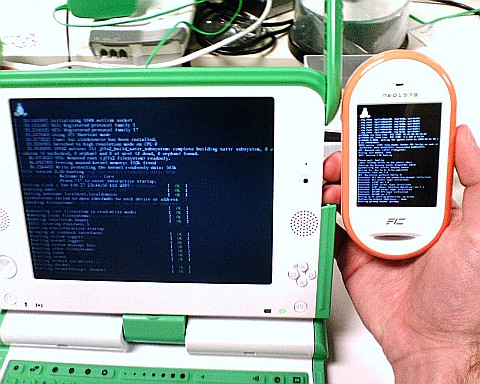
I forgot to mention the coolest thing about the last Ubucon in my summary. I heard that my friend Sean Moss-Pultz (the person who started the OpenMoko project) would be in New York the week of Ubucon so I managed to contact him and get him to drop by on his way to the airport so we could have lunch. To my surprise, he had one of the early versions of the free-phone for me (I wasn't expecting one for several weeks). I had brought my OLPC XO so, for the first time ever (as far as we know) we managed to get the two coolest, and most important, technology platform projects in the world together. While the XO and OpenMoko share a commitment to freedom, the similarities between the projects are, in fact, also skin deep. If we all work hard, we can look forward to a future that is free. Apparently, it's also white with bright trim.
/copyrighteous/images/xo_plus_openmoko-03-boot.jpg
/copyrighteous/images/xo_plus_openmoko-01.jpg
Apologies for the pictures taken from my current inferior, both ethically and technically, mobile phone.

28 February 2007

Evan Prodromou: 9 Vent se CCXV

Lots of short, sharp items today that I want to get down.

LinuxQuestions.org supports OpenID First, I'm psyched to see that LinuxQuestions Wiki now supports OpenID. Jeremy gave the scoop in The LQ Wiki Now Supports OpenID. I was glad to see that LQ's on the OpenID path. It's a really strong community site, and I think it'll benefit greatly from opening up the authentication process. tags:

Wikia and OpenID Angela Beesley had some comments on my Journal/7 Vent se CCXV posting about wikiHow's support of OpenID. In that posting, I said that I thought companies with lots of wikis, like Wikia or wiki farms, might have a disincentive to participate in the OpenID network. Angela put me straight on the issue in a post on WikiAngela about OpenID. I'm glad to hear that Wikia is considering supporting the protocol. Then again, it's hard to believe that an Open Content, Open Source company is really going to go out of its way to avoid open standards and open login. tags:

DemoCampMontreal1 I had a good time last night at DemoCampMontreal1. I gave the first demo -- on, of course, the MediaWiki OpenID extension -- and I had some technical difficulties that didn't let me show off all the functionality. Which was kind of a bummer, but there were lots of questions about it from the audience, so that kind of made up my time. The room was packed, by the way -- pretty much anyone who's anyone in Montreal tech was there. I'm looking forward to DemoCampMontreal2 on 29 March! tags:

certifi.ca One of the best ways to establish credentials on the Web is to use a signed SSL certificate in your browser. It's fast, incredibly secure, and once you get it set up you can just forget it. They're also practically immune to phishing. Unfortunately, most people don't even know what browser certificates are, how they work, or what to do with them. Consequently, most Web sites don't support browser certificate authentication. Vicious cycle. But, one of the cool things about OpenID is that you can disconnect the authentication method from the Web site you're using. Most OpenID identity providers still use username/password combos for authentication, which is why critics have said that the standard is vulnerable to phishing attacks. I wanted to see if it were possible to set up an OpenID identity provider that used browser certificates as the only authentication system. So, in my copious free time, I've hacked up certifi.ca. It's based on the cool PHP OpenID Server that JanRain made, but I've ripped out all the password stuff, and now it runs on luscious certificatey goodness. I'm going to be enhancing the service in the near future, but I wanted to get feedback from folks interested in OpenID as soon as possible. I'm using it for my primary OpenID delegate, and it seems to be working great. Please give it a try and let me know what you think (admin@certifi.ca). tags:

DemoCampMontreal1 on Montreal Poutine There's an article on DemoCampMontreal1 on Midnight Poutine. That's me up on the stage, in the photo! tags:

Nepean Hotspurs Selects win On Saturday, a Muslim girl named "Azzy" Mansour, from Ontario playing in a soccer tournament in Laval was ejected from the tournament (by a Muslim referee, notably) for wearing a hijab -- reportedly because it was a safety hazard. (Montreal Gazette story, registration required.) Admirably, her entire team forfeited the tournament in protest. I'm not excited about Quebec's reactionary activity around Muslim, Sikh, and other religious community's different clothing rules. However, I understand that Quebecois -- and French people -- have a different idea of personal freedom than Americans. I try to be understanding and put myself in the Quebec headspace for this kind of stuff. Mostly, though: I admire the soccer team, the Nepean Hotspurs Selects, for standing up for their teammate and their friend. A lot of teams might have gone ahead and played without her, and it took some courage to drop out of a tournament they'd had high hopes for. They're sixth-grade girls, but they've learned something about integrity that most adults never learn. Kudos to them. tags:

23 February 2007

Evan Prodromou: 3 Vent se CCXV

I was up late last night upgrading Wikitravel from MediaWiki 1.8.3 to the new 1.9.3. It took a long while, since the 404-handler caching extension that I built for MediaWiki a couple of years ago (which keeps Wikitravel running on a single, albeit quite big, server) is pretty invasive, and a lot of things had changed with the way users and stuff worked, so I had a lot of hacking to do. But it's stable now, even if some watchlist stuff is a little funky. Doing major upgrades is a real bear for me, but I'm happy when it's over. tags:

Home people Maj had her final oral exam in her French class tonight, which left me and Amita June home alone to fend for ourselves. We had a lot of fun. First, I had to do the day's dishes (lunch and breakfast) that were sitting in the sink. I brought the footstool around to the sink from our laundry room, and she stood on it and helped me with the dishes. After I'd finished washing a dish, she'd carefully fill it up with water, dump it out, then put the dish in the dishrack next to her. Pretty good for 18 months old. That went so well that I moved the stool over to the kitchen table where I cut tofu and vegetables for dinner. I gave her pieces of pepper, cabbage, and carrot while I was working, and she nibbled on them a bit and then practiced chopping them... with the handle of her mother's toothbrush, which she'd stolen out of the bathroom earlier in the day. After dinner, we had a bath, then we read some books, and then she went to sleep on my shoulder while I walked around her room and sang, like she's been doing for the last 2 months. It was another good night. tags:

Soft launch We launched two new Wikitravel versions overnight, too: Catalan Wikitravel and Finnish Wikitravel. Catalan recently, uh, catalyzed from a blog post by Carme Pla . Readers and the Catalan-speaking community rallied to our Catalan Wikitravel Expedition and got the project rolling. I got the site set up last night and they've started translating key help, style manual and policy guidelines already. Mean, Finnish had been simmering on the back burner for a while, so we got it launched at the same time. My friend and colleague Jani Patokallio is a Finn and a longtime and well-respected Wikitraveller; I'm glad he's taking leadership of the project. Finns have such disproportionate contributions to Free Software and Free Culture; I'm glad to have that Freedom Powerhouse Country all working together on Wikitravel now. And, y'know, I'm going to totally rack up a ton of HugAFinn points off of this. Actually, now that I think of it, I have no idea if "Carme Pla" is a real name or even a plausible personal name in Catalan. It sounds like it to me, though. tags:

coComment A couple of months ago Don Marti recommended that I check out coComment, and I made a mental note and then forgot to follow up. But I started using the system a few days ago, and now I wonder how I ever lived without it. coComment is a Firefox plugin that keeps track of when you post a comment on a blog or some other comment-handling system. It then keeps track of the conversation that happens after you comment. I have a lot of standing keyword searches on Technorati and Google Blog Search, and if people are talking about a subject I'm interested in, I'll usually jump in and talk about it. But sometimes I'll go back months later and see that people asked me questions and continued the conversation without me. So coComment is exactly the kind of cross-the-Internet aggregation service I need. tags:

Sage Speaking of keeping up with blogs, I've realized in the last week that I've outgrown Live Bookmarks for following RSS feeds. Rather than going with a Web-based RSS reader like Google Reader or Bloglines, I opted instead for the in-browser reader, Sage. It's simple, it does what I need it to do, and it supports OPML so I can move my subscriptions somewhere else if something better comes along. Good piece of software. My best candidate for something better coming along? Probably if I get my Netvibes home page customized well enough to handle my 50-60 feeds. And maybe when Netvibes gets smart and becomes and OpenID identity provider (or at least figures out a way that you can log into your ID when you start a browser session). tags:

Next.

Previous.