Search Results: "uli"

25 June 2011

Philipp Kern: Porting a library to gtk3: change soname

Last week I tried switching a library to Gtk3. The needed changes to the code are available through --with-gtk3. However this is generally not enough. Even if your symbol list doesn't change, the ABI changes implicitly. The library in question had a .symbols file, but that's not enough because the resulting GUI application will bail out at runtime if symbols of both Gtk2 and Gtk3 are found in the same address space. That's mostly because C symbols don't contain any signatures with return types and parameters.

So if your library upstream did not change the soname for the Gtk3 build, please encourage them to do so. Also keep in mind that this most likely means new pkg-config files specific to the Gtk3 build, too. At least if you want your reverse-depends to be able to build against either Gtk2 or Gtk3 in a predictable way.

An example is this change to gtk-vnc, which uses gtk-vnc-2.0 as the new API/pkg-config name for the Gtk3 build, gtk-vnc-1.0 remains the old Gtk2 one. The soname changes from libgtk-vnc-1.0.so.0 to libgtk-vnc-2.0.so.0.

(Thanks to Michael Biebl and Julien Cristau for pointing out the obvious to me.)

Andrew Pollock: [tech] On trying to find the resource limits of a running process on an old kernel

I had cause to try and get a core dump from a segfaulting process at work the other day, and I wanted to figure out if fiddling with /etc/security/limits.conf was going to do the trick (I didn't) or if I had to modify the initscript to include a ulimit -c unlimited call. Of course, on a modern system (>= 2.6.24), one would just take a look at /proc/PID/limits and get on with life, but unfortunately the system in question was running 2.6.18, so more fiddling around was required. I'd found something once before that told me how to do it with GDB, but all I could find this time around was a rather over-complicated Knol article, which made a bunch of assumptions (well mainly that the binary in question wasn't stripped). So with some help from the Knol article, I muddled through it. Disclaimer: I don't profess to be an expert on system internals like this, so if this eats your first-born, don't come crying to me. Firstly, you need to know that it's the getrlimit(2) system call that you want to be using, and then you need to figure out the number for the resource limit you want to retrieve. The man page for getrlimit(), tells you it's defined in /usr/include/sys/resource.h, but I've found that the actual useful bits end up being in /usr/include/bits/resource.h I wanted the resource limit for the maximum core dump size, which is RLIMIT_CORE and has a value of 4. Next, you need to know that the getrlimit() system call takes an integer and a pointer to an rlimit structure as arguments. We've just figured out the value for the integer, but we're also going to need to pass a pointer as the second parameter. A pointer to enough memory to hold an rlimit structure. Fortunately, the rlimit structure is pretty simple:
struct rlimit  
    rlim_t rlim_cur;  /* Soft limit */
    rlim_t rlim_max;  /* Hard limit (ceiling for rlim_cur) */
 ;
After a bit of grepping around in /usr/include, I determined that an rlim_t is essentially an unsigned long int, so we need to allocate a pointer big enough to hold two of them. Note that if we had an unstripped binary, we could have saved a lot of faffing around by just going
print sizeof(struct rlimit)
in GDB (assuming that the binary has the getrlimit symbol in it) The sure-fire way of figuring out how much memory we need for this pointer is to go
print sizeof(unsigned long int)
in GDB, and then double that (since we want two of them). On my system an unsigned long int is four bytes, so I'm going to want to allocate enough memory for 8 bytes. Now it's time to attach GDB to the offending process and see what the resource limit currently is. (gdb -p PID)
(gdb) print malloc(8)
$1 = 152186904
(gdb) print getrlimit(4, $1)
$2 = 0
(gdb) x/2xw $1
0x9123018:	0x00000000	0x7fffffff
(gdb) quit
So in this particular case, we've retrieved the soft and hard limits of the RLIMIT_CORE resource limit, and you can see that the soft limit is zero, and the hard limit is unlimited. Note that the getrlimit() function returns an integer as its return code, which is what the $2 = 0 is above. Now it's just a case of altering the the resource limits via the preferred mechanism, restarting the process and then repeating this GDB examination of the process to check they were changed successfully. Circumstances where this can all fall down would appear to be ones where the getrlimit symbol isn't present in the binary, or the binary is compiled as a position-independent executable. I'd think that in the latter case, the system is probably modern enough to be running a kernel that supports directly examining the resource limits via the /proc filesystem.

22 June 2011

Mike Hommey: Iceweasel 5.0 in experimental

I just pushed Iceweasel 5.0 to Debian experimental. Why not unstable, some will ask? Well, because we still need to give some time after a first notice before breaking plenty of packages (Thanks to Julien Cristau for the MBF, by the way). I also discontinued the Iceweasel 4.0 backport for Squeeze, as Iceweasel 4.0 won t be receiving security updates. Speaking of security updates, 3.6.18 was also made available on mozilla.debian.net for Wheezy, Squeeze and Lenny. However, I still have to backport the necessary patches to 3.5 in Squeeze and 3.0 in Lenny. My real life schedule wasn t compatible with the security release schedule, so I got late on the security backport train. In the coming weeks, there will also be some additional changes to the mozilla.debian.net repository, but I ll give more details when that happens.

21 June 2011

Julien Blache: forked-daapd: v0.17, libav 0.7, GCD codebase

forked-daapd v0.17 is out; the main purpose of this release is to add support for libav 0.7. There are also a few bugfixes that made it into this release, but nothing earth-shattering. One More Thing You ll notice an extra tarball and tag in this release, both marked 0.17gcd. With this release, the GCD (Grand Central Dispatch / libdispatch) codebase is making its debut. libdispatch replaces libevent and allows for greater concurrency inside forked-daapd. This makes forked-daapd snappier, which shows when using Remote or a SoundBridge. The filescanner also benefits from this; it now scans several directories concurrently, reducing the time needed for a rescan by making better use of the machine resources. Thanks to Mark Heily s efforts on libdispatch/libkqueue/libpthread_workqueue over the past year, we now have a Linux version of libdispatch that works well enough to support forked-daapd. This codebase will become the primary codebase for forked-daapd once the database performance issue will be fixed. After this point, the current libevent 1.4 codebase will be legacy and won t see any further development (we ll discuss bugfixes in due time). This new codebase comes with new requirements: libdispatch and its dependencies are available in Debian unstable; it s best and easier to use whatever is in unstable, instead of mixing and matching the libdispatch/libkqueue/libpthread_workqueue versions until they all work together. Due to platform support in Clang, the GCD codebase can only be built for and will only run on i386 and amd64, as far as Linux is concerned. Other architectures will have to wait until support for them is added to Clang. FreeBSD is untested and will probably require some modifications to work; recent enough versions of FreeBSD have a native pthread_workqueue implementation and do not need libpthread_workqueue. Packages are available in experimental for Debian users; they ll end up in unstable in a few weeks, before the libevent2 migration happens there. Tarballs available at http://alioth.debian.org/~jblache/forked-daapd/ ; GPG signatures made with my Debian key F5D65169.

MJ Ray: Re: Cyberunions Podcast: Building links with the Co-operative Movement

John Atherton sent me a link to cyberunions discussing open-source and worker co-ops. In general, it s a very good show and worth a listen by anyone from the union movement, in my opinion. It s available in Ogg as well as MP3, which I think is also a plus point. There were a couple of points where I was ranting at the radio, though The first was the choice to try Skype alternatives. Leaving aside the danger of playing the alternatives game, I can understand why they chose that (the change of corporate control to Microsoft has been in the headlines recently and the phones affect them but not their listeners or readers), but open internet phones are a bit fiddly because they try to move quite a lot of data (audio) in real-time and a lot of domestic network devices don t behave correctly with the protocols that they use to do it. I agree with their conclusion that the problem is probably networking, but I wonder why they didn t log in to their routers, look at any debugging output and try to find the setting to change? Or try switching on debugging in the software and see what s wrong, or send it to someone who can help? Instead, it seemed like Linphone and Ekiga got blamed for not doing Skype-style router-busting without asking. They don t mention whether they tried switching on the STUN option mentioned in the Linphone FAQ and I don t see a email on linphone-users asking for support but I don t read every mail on that list. Am I being unfair, expecting them to seek support? Maybe but I m not sure. If you got the software from a store, what would you do? Would you throw it away and tell people that the stupid thing doesn t work? Moreover, would you use your podcast to say it doesn t work because users need to be clever enough for that obscure tool? That s a great way to scare people off unnecessarily. Wouldn t you usually think you might be overlooking some detail and ask for support, from its maker or the place where you got it? I think you d ask. I d probably ask, even though I m available for hire to fix FOSS problems and it s not the proudest feeling when I have a script-reading call-centre worker solve my mistake. Of course, with most from-store software, you ve paid an artificially-inflated box price, but the bigger cost is your time and that s the same for downloaded free and open source software, so why give it less of a chance to work? I also think they had easier options, like switching more of their website over to free and open source software, like getting rid of the rubbish comment system which doesn t work if you don t let it run javascript on your browser. I ve had a bit of discussion with them since the show and it seems my first suggestion may no longer work (typical!), so we ll see how that goes. Back to the show: the next segment did a good job of linking FOSS to the co-operative movement. I really think they should call it Free and Open Source Software and not just open source because I feel the freedom should be important to the labour movement. Also, calling the whole thing open source seems like calling all of the political left Revolutionary Socialism : inaccurate at best. I don t often express this objection these days (I ve bigger targets to work on), but it s important when trying to inform new audiences, else they only see part of our rainbow, a less radical part. Pretty interesting to suggest Orbea bikes as Mondragon s most famous brand. I d pick Eroski or Caja Laboral. What about you? Then it moved on to a pretty good description of UK co-ops, mentioning co-ops that I m a member of (the Co-operative Group) or buy from (John Lewis and Suma). I was surprised that it seemed to stop short and didn t mention any of the co-ops that work with free software, or with any software in fact. Of course, I d love software.coop to be mentioned, but there are other interesting and very different ones like BristolWireless.net and OSAlliance.com. Globally, many of the worker tech co-ops are linked through the tech-coop mailing list. This was the second part where I was shouting at the speakers. After all, Debian is a great voluntary project making a fantastic GNU/Linux distribution, but it is not a worker co-op by a long way and I suspect some of my fellow developers would be horrified to hear that suggested. Why not mention some actual tech worker co-ops? Finally, before the listener feedback, suggestions of tools which union activists could use. There was some minor confusion about exactly which version or name was really FOSS and a surprising claim about openoffice into LibreOffice (I thought Oracle were still screwing that up with Apache s help but I may have missed some news), but it was a good list of door-opening suggestions. I hope some activists will take them up. It seems there s an earlier show about open social networks, which is a topic I ll look at after I finish my series of posts about mailing lists. So, please let me know if you have comments on this show, that show, open social networks or mailing lists which you think I might find interesting, or if there s anything above you d like me to expand upon (or correct often, correct ).

17 June 2011

Timo Jyrinki: Ubuntu 10.04 LTS release fest in Tampere, Finland

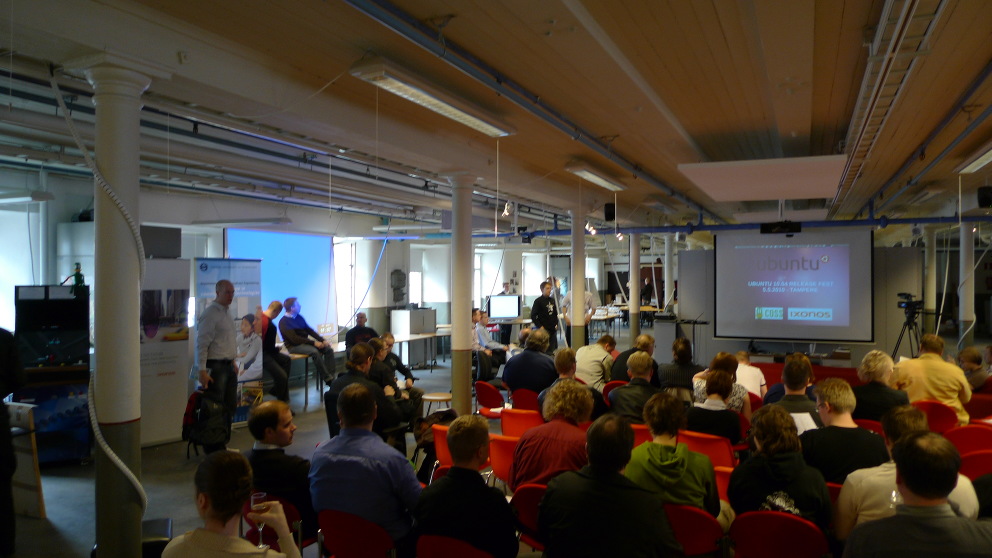
The main release party in Finland was held at Tampere, Finland and organized by Ixonos Plc and COSS. It was a great success, as proven by the almost 200 participants and great speakers.

The first sessions were mostly about the basics of Ubuntu and its roots in Debian and elsewhere. Then Tuure Vartiainen from Tampere University of Technology shared with us the release from the official Finnish mirror perspective (fi.archive.ubuntu.com, fi.releases.ubuntu.com, ...). 10.04 LTS release date was very hectic and the transfer speeds were not constantly optimal, but quite good anyway. For 10.10 they hope to up the network connectivity to 10G. I also took the opportunity to thank him later personally for the Ubuntu Finnish Remix mirroring which was arranged right before the release as well.

The next-to-final session was about Ubuntu for senior people with brief demoing of how Ubuntu UI can be customized. To give a little different perspective to usage of Ubuntu, the final speaker was a theater director and dramatist Jotaarkka Pennanen from Interactive Film Productions. Blender among else was praised.

In addition to speakers, we had 300 Ubuntu Finnish Remix CD:s, Ubuntu posters, Free Software Foundation Europe flyers, COSS flyers et cetera. After the main program there was a dinner and some wine offered to participants, which was a great social ending to the event.

Now a few photos follow. Unfortunately they are from before the event actually began, so others have probably more crowded photos and photos of the speakers themselves.


16 June 2011

Wouter Verhelst: Attaching in mutt

All mail clients suck. Some just suck less. But they all have their own peculiarities. mutt, for instance, is a full-featured text-mode mail client. As such, it's pretty popular amongst many Linux enthousiasts, including me. A common error made amongst mutt users is to talk about attaching a file in a mail, but then forgetting to actually do so afterwards. This is because mutt starts an external editor to allow you to edit the message in question, which since it's not mutt itself would seem to make it impossible to attach a file while you're editing a mail, requiring one to remember to actually perform the attach step. One solution to this problem could be to use the little script that Steve wrote, which will complain if you mention something about an attachment in a mail without actually attaching anything. While I'm sure it works to some extent, this kind of script has the downside that it's never going to be 100% correct in all cases (you might mistype the word 'attach', or you might use another word that you didn't think about when you wrote the script, or you might be replying to someone who sent you an attachment). However, a better way could be to realize that mutt does, actually, support attaching files while you're editing a mail text, by way of the 'Attach:' pseudo-header. It requires two steps:
  1. Make sure that you have set 'edit_headers' to 'yes' in your configuration. This will cause mutt to fire your editor on a file that also contains the (relevant) headers for your mail, rather than just the body.
  2. When you want to attach a file, rather than trying to remember to do so after exiting your editor, just add an 'Attach:' header to the headers section of your mail, with as argument a filename optionally followed by a description. When mutt finds that header, it'll attach the named file, and all is well.
Yes, of course, that does mean you'll have to change your habits, and actually remember to add the damn pseudo-header rather than be like me and still forget to attach files. But hey, can't help you with that.

15 June 2011

Julian Andres Klode: dh-autoreconf v4 released, patching ltmain.sh for as-needed support

Yesterday I released version 4 of dh-autoreconf, fixing two bugs, and introducing a new feature: Patching ltmain.sh to make -Wl, as-needed work. For this new feature, run dh_autoreconf with the as-needed option. dh_autoreconf will then patch all ltmain.sh equal to the system one (which should be all ltmain.sh files if libtoolize ran before or via dh_autoreconf). On clean, dh_autoreconf_clean reverses the patch again. So, if your package runs autoreconf, and patches ltmain.sh via a patch you can now do this automatically via dh-autoreconf and be future-proof. The only problem is that this might break once the patch no longer applies to libtool, at which point I need to update the package to include an updated patch. A solution for this problem would be to include the patch in libtool itself, as I proposed in Bug#347650. In case this works well, the option could also become the default which would make things even easier.
Filed under: Debian

14 June 2011

Cyril Brulebois: mesa: a disturbance in the Force?

Just a quick heads-up: I ve just uploaded mesa 7.10.2-4, which is multiarch-enabled, thanks to Steve Langasek. As explained in its changelog, this breaks the X server currently in testing and in unstable, but a rebuild is already pending, which will make everyone upgradable. For curious people, those commands took care of scheduling the binNMU, with a proper dep-wait:
wb nmu xorg-server . ALL . -m 'Rebuild against new (multiarch-enabled) mesa.'
wb dw xorg-server . ALL . -m 'libgl1-mesa-dev (>= 7.10.2-4)'
In the meanwhile, if your mirror gets a new mesa without the rebuilt server, your package manager should bail out and refuse to upgrade mesa (or propose to remove the server). So wait a bit, upgrade everything, and enjoy! mesa 7.10.3 (released a few hours ago) should reach unstable tomorrow, so that we can ask our users to track (possible) regressions between 7.10.2-3 and 7.10.3-1 to either 7.10.2-4 (multiarchification), or to 7.10.3-1 (the stable upgrade), thanks to the excellent http://snapshot.debian.org/ service.

11 June 2011

Dirk Eddelbuettel: United Sounds of America: New York

Last night was the kick-off concert in a series the Chicago Symphony has been preparing (and pushing) for the last little while: United Sounds of America: A Journey through Musical Roots. Five concerts featuring New York (last night), Chicago/Route 66 (tonight), New Orleans (tomorrow), Detroit (next Friday) and Austin (next Saturday). The New York evening was organized by pianist Bill Charlap (wikipedia) who also headlined and MC-ed the first set. Covering the birth of Jazz until early post-war bebop in chronological fashion, it was a pretty decent jazz set with a very nice band featuring Kenny Washington (dr), Peter Washington (b), Jeremy Pelt (tp), Jimmy Greene (ts) and Ken Peplowski (cl) --- and local favourite Kurt Elling (wikipedia) who was simply outstanding with the classic songbook material. Having seen him live once before a few years ago, I happened to listen a lot to Elling of late, following the random find of this stream from a live concert in February as well as his two most recent records, the Grammy-winning Dedicated to You (which retakes the wonderful Coltrane/Hartman album from 1963) and the simply amazing very recent The Gate (which you should go and buy right now). And I was not disappointed. He has a great four-octave-spanning baritone voice and great stage presence. The second set was dedicated to post-war folk and singer/songwriter material and organized by Suzanne Vega. That was neat too, if somewhat different in format and more like your standard (rock-ish) concert. Vega brought her own band featuring Gerry Leonard (g), Mike Visceglia (b), Graham Hawthorne (dr) along with guest appearances by Tom Paxton (g, vocals) and Richard Julian (g, vocals). Somehow Vega seems a little trapped in her own success in the 1980s and rehashed a lot of old hits. Nothing wrong that per se as it is good material (more on that below). Only during three encores did she provide new material which was ... excellent. So maybe some rebalancing towards new stuff was neat. Also nice was the additiona of four string players from the Chicago Symphony which had joined the band for a Simon and Garfunkel's song The Boxer. Oh, and of course seeing Vega perform Tom's Diner was nice, especially in such a fast and rocking version, even enhanced by the those strings. Just a few months ago I had gone over the passage from the original a-capella version of Tom's Diner to the various beat-box remixes which were then remixed by Vega in various live performances (e.g. videos of a capella, rockish, another rockish and beatboxish versions). Good fun, and it is nice to see she is playing along and enjoying it as well. All told, a really nice iniative by the CSO. If you're in Chicagoland, go and see some of the remaining shows.

10 June 2011

Raphaël Hertzog: People behind Debian: Philipp Kern, Stable Release Manager

Philipp is a Debian developer since 2005 and a member of the release team since 2008. Since he took the responsibility of Stable Release Manager, the process has evolved for the best. I asked him to explain how the release team decides what s fit for stable or not. His work on the buildd infrastructure is also admirable but I ll let him describe that. My questions are in bold, the rest is by Philipp. Who are you? I m a 24 year old Computer Science student, living in Karlsruhe, Germany. As a student assistant I m currently in two jobs: one is taking care of getting our university IPv6 network in shape, or rather generally getting fringe technologies into the network. The second is taking care of a s390x machine in the basement which my faculty got sponsored recently. In my spare time I tend my Debian duties and I m active in the student council (Fachschaft) as a sys-admin, software developer and until recently as treasurer. I got accepted as a Debian Developer in 2005. I m only really active since I was invited to join the Release Team in early 2008 after I contributed rewrites of some scripts that got lost in a disk crash of ftp-master. In late 2008 I also took on wanna-build/buildd duties. What s your notable achievement within Debian? For one I worked on the deployment of a single buildd/sbuild combination over all of our buildds and I rebased it on the sbuild in the archive several times already. All buildds basically look the same on all architectures, with only few variations. The chroots are now also created in a mostly predictable manner. Then we finally got build autosigning after years of constant poking. However the policy decision to allow it was made by the ftp-masters anyway, for which I m grateful, as it eases the workload of the buildd maintainers, the Security Team and the Release Team quite a bit. On the release side there s the integration of volatile into the proper structures of Debian. But there I m guilty for choosing the bad name squeeze-updates is, in comparision with security s squeeze/updates. Let s see if we can improve that for wheezy. The policy for stable updates have changed over time. Can you summarize what kind of updates are allowed nowadays? All the changes that were made to the policy were driven by the aim to keep stable (and to some lesser degree oldstable) usable throughout its lifetime. I have to admit that we got slightly more liberal in what we accept since I took over. The previous stable update policy included the fixes of critical bugs that break the system in interesting ways and security fixes. We also opened up the possibility of including important fixes for annoying bugs on a case-by-case basis. The whole don t update that much part of the stable release management is rooted in let s don t change the behaviour of a running system and let s have as few regressions as possible . We currently try to counter that with a review process that only allows self-contained fixes that were tested in unstable first, if applicable. In the future I d also like to have a feedback process that includes the users of the packages to report problems more early. In fact that s also why we now send calls for testing to debian-stable-announce one week in advance (see this mail as an example). So stable is updated through point releases that happen roughly every two months for stable and roughly every four for oldstable. They are accompanied by announcements and new CD/DVD sets. To be able to push some updates with less delay to our users and to avoid that they have to pick them from proposed-updates, there is stable-updates. The current policy for this suite is available in this post on debian-devel-announce. It boils down to everything urgent like tzdata, regression fixes and volatile packages. We noticed that some packages in stable just weren t useful anymore when they got updated through volatile. Hence those are folded into stable, too. We also relaxed the rules a bit so that leaf packages like clive, that rely on external websites not to change their URLs, can be updated too. If somebody wonders what happened to the and a half releases Those were intended to mark the inclusion of new hardware support (mostly by including a co-installable new kernel version). This kind of flag point release is thankfully no longer needed because our marvellous kernel team now backports certain hardware drivers to the kernel version in stable. They have some trouble soliciting test feedback for them, though. It would be cool if more people using stable could respond to their calls for testing. What are your plans for Debian Wheezy? Luckily the wanna-build/buildd side isn t much dependent on release cycles. The stable release management also just takes care of what gets dumped on them by the testing RMs. ;-) The near-term goals are certainly: Apart from that my work is mainly squashing the bugs on buildd.debian.org for the wanna-build part, so if you want something fixed, you need to report it, I m afraid. You have several roles within Debian, in particular stable release manager and member of the wanna-build team. Which role do you enjoy more and why? So the regular duties of the SRM, apart from setting up policies, are reviewing requests for uploads to proposed-updates, accepting them, chasing builds and scheduling point releases. It s mainly steady work. As for the Release Team it s working in a fabulous team where everyone s doing an awesome job. For me the wanna-build role is holding the things together and fixing up stuff that breaks while the world continues to evolve. And occassionally taking a stab at the ftp-masters. So rather different. My heart is probably siding with the buildd side because it s infrastructure but release work is fun, too. What s the biggest problem of Debian? Mainly that we re not quick in picking up new technologies and that we got slow on innovation. Distro-wide changes are usually a very big effort to coordinate and to finally complete. I guess people should be able to push fixes for release goals more eagerly into the archive. Also it seems to me that many DDs are actually disengaging from the release process, especially during the freeze but also before, which makes me a bit sad. However I m still not sure how we could counter that. As we re all volunteers you can t suddenly make others love the idea of releasing something together, I guess. Do you have wishes for Debian Wheezy? It s getting old, but there s certainly multiarch. Also a usable Python 3 is something I d really appreciate. Is there someone in Debian that you admire for their contributions? Peter Palfrader did an awesome job of getting a nicely working team together for DSA and got many tasks as automated as they are now. It s a pleasure to work with them and setting up a new buildd is, for example, a real breeze. He also developed a sane archive snapshot service, kudos for that.
Thank you to Philipp for the time spent answering my questions. I hope you enjoyed reading his answers as I did. Subscribe to my newsletter to get my monthly summary of the Debian/Ubuntu news and to not miss further interviews. You can also follow along on Identi.ca, Twitter and Facebook.

3 comments Liked this article? Click here. My blog is Flattr-enabled.

4 June 2011

Jan Wagner: Monitoring related package updates

Some more about packaging nagios and icinga related packages can be found at our team site.

2 June 2011

Julien Blache: pommed v1.39: Linux 2.6.39 maintenance release

I ve just released pommed v1.39 ; this is a maintenance release for Linux 2.6.39, following the renaming of the mbp_backlight driver to apple_backlight.

1 June 2011

Vincent Bernat: GNOME Power Manager without GNOME desktop

When I installed my new laptop, I decided to switch from sleepd to GNOME Power Manager (GPM). The rationale behind this decision was to get screen dimming for free while keeping other features because GPM uses UPower which uses pm-suspend and pm-powersave behind the scene. This means that it is easy to execute scripts on suspend or when the AC is unplugged by putting them in /etc/pm. I don t use a full GNOME desktop. My desktop is running FVWM which is just a window manager. However, I already use some parts of the GNOME environment:

What s working It happens that most of the features just do not work. However, suspend when closing the lid works fine. The icon in the systray works fine too (but there is a small bug). The screen dimming feature on idle also works (but there are annoying bugs with it). The visual feedback when pressing brightness keys works too.

What s not working It seems that I am not the only one to have problem with GPM: there are currently 115 bugs opened in the Debian BTS. If you want to get some debug output from gnome-power-manager, run it with --verbose flag. --debug flag does nothing (and supersedes --verbose).

Nothing happens when pressing the power button I have configured GPM to ask me what to do when I press the power button. But when I press the button, nothing happens. Looking at the source, here is the snippet of code that is executed:
1
2
3
4
5
6
7
if (policy == GPM_ACTION_POLICY_INTERACTIVE)  
    GpmSession *session;
    egg_debug ("logout, reason: %s", reason);
    session = gpm_session_new ();
    gpm_session_logout (session);
    g_object_unref (session);
 
In fact, this is not GPM that will ask you the question, but GNOME session manager because GPM triggers logout. If you don t run a full GNOME session, nothing will happen. My workaround is just to set the action to Suspend .

Does not sleep when idle GPM is configured to go to sleep after 2 hours on AC or 30 minutes on battery. This does not work for me because idle detection is delegated to external programs. There are four variables used by GPM to determine if we are idle:
  • session_idle which is the idle hint from ConsoleKit,
  • idle_inhibited which is set when another program asks to disable idle detection (a video player which does not want the screen to be dimmed),
  • suspend_inhibited which means a program do not want we going to sleep (a music player for example)
  • x_idle which tells if X is idle or not (someone is moving the mouse or typing on the keyboard).
To allow GPM to suspend when we are idle, x_idle and session_idle must be true while suspend_inhibited and idle_inhibited must be false. For screen dimming purpose, you just need to have x_idle set to true and idle_inhibited set to false. Currently, only GNOME Screensaver seems to tell ConsoleKit if the session is idle or not. XScreenSaver does not contain anything about this. I am using xautolock with xlock and I am pretty sure they won t tell GPM if I am idle. You can use dbus-send to circumvent this problem:
 1
 2
 3
 4
 5
 6
 7
 8
 9
10
11
$ dbus-send --system --dest=org.freedesktop.ConsoleKit \
>   --type=method_call --print-reply --reply-timeout=2000 \
>   /org/freedesktop/ConsoleKit/Manager \
>   org.freedesktop.ConsoleKit.Manager.GetCurrentSession
method return sender=:1.6 -> dest=:1.106 reply_serial=2
   object path "/org/freedesktop/ConsoleKit/Session1"
$ dbus-send --system --dest=org.freedesktop.ConsoleKit \
>   --type=method_call --print-reply --reply-timeout=2000 \
>   /org/freedesktop/ConsoleKit/Session1 \
>   org.freedesktop.ConsoleKit.Session.SetIdleHint boolean:true          
method return sender=:1.6 -> dest=:1.108 reply_serial=2
While I understand what is the rationale behind those choices (no code duplicate and allowing external programs to hinder power management), it lacks some fallback in case you don t use GNOME Screensaver (which is the key component here). I first though this was bug #594706 but this is not the case. I have opened (and closed) bug #628755. UPDATED: Jump to the conclusion for an updated solution for this problem.

Brightness is not restored to the previous value after idle When GPM undims the screen, it does not restore the previous value. It seems to be bug #617310 which is marked as fixed in upstream. I did not investigate it.

Wrong number of batteries reported I only have one battery but after one suspend/resume cycle, GPM thinks I have two. Maybe this is a bug of UPower. Maybe this is bug #606434. I did not investigate it. Maybe there is an happy interaction with bug #456280.

Inability to set configure actions when the UPS runs out of battery This is bug #390602. In addition to laptop batteries, UPower also supports UPS. In this case, GPM displays a special icon to tell if the UPS is fully charged. However, there is no possibility to execute special actions when the UPS is unplugged, like hibernate after 10 minutes or something like this. This seems to be a problem with the interface because looking with gconftool-2, we can spot variables like low_ups or critical_ups which allow to set actions when the UPS is almost out of battery. Moreover, the UPS icon only displays after one suspend/resume cycle but I am too lazy to report and debug this issue. Since, the icon disappear if I restart GPM, I am confident that the bug is in GPM.

Conclusion The conclusion is that GPM is not really that buggy but it really needs to be run in a full-blown GNOME desktop. The main problem is not really GPM. New technologies like UPower and ConsoleKit get pushed by freedesktop.org initiative, they get implemented by GNOME (and, I suppose, KDE) because they have tons of people following the appropriate mailing lists and any alternative just gets crushed by all those unpublicized changes. UPDATED: I got several helpful comments about this problem. There are two possible solutions:
  1. Use xfce4-power-manager. It handles brightness control in a better way and don t need an external program to tell when the current session is idle. It still needs a session manager to ask what to do when using the power button. The drawback to this solution is that you start to pull another desktop environment into your environment. You had some parts of GNOME and now you have some parts of XFCE. This solution was proposed by Sylvain Collilieux.
  2. Use gnome-session, gnome-screensaver and keep gnome-power-manager. As pointed by Julien Valroff, gnome-screensaver needs gnome-session to detect idleness. However, gnome-session starts a whole GNOME desktop. Again, there are two solutions. The first one is to replace gnome-session by something lighter implementing the bare minimum to make gnome-screensaver happy. Another suggestion is to configure gnome-session to start your favorite environment.
I start mine from ~/.xsession and here is what I have added at the top of it:
 1
 2
 3
 4
 5
 6
 7
 8
 9
10
11
12
13
14
15
16
17
# If not done, restart ourself with gnome-session
if [ -z "$SESSION_MANAGER" ]; then
    [ -d ~/.config/autostart ]   mkdir ~/.config/autostart
    rm -f ~/.config/autostart/*
    cat <<EOF > ~/.config/autostart/xsession.desktop
[Desktop Entry]
Name=Xsession
Comment=Start .xsession
Exec=$(readlink -f $0)
Type=Application
X-GNOME-Autostart-enabled=true
EOF
    exec gnome-session --autostart=$HOME/.config/autostart
fi
# Otherwise, keep starting stuff
# [...]
exec fvwm-crystal

30 May 2011

Julian Andres Klode: 0x15 + 1/365

Yesterday was my 21st birthday, and I received all Hitchhiker s Guide to the Galaxy novels, the five ones in one book, and the sixth one written by Eoin Colfer in another book. Needless to say, the first book weights more than an N900. I did not read them yet, so now is the perfect chance to do so. Yes, I did not know that 25th is towel day, sorry for that. I also bought a Toshiba AC100 before my birthday, a Tegra 2 based notebook/netbook/ web companion with 1 GHz dual core ARM Cortex A9 chip and 512 MB RAM. It runs Android by default, and had a price of 160 which is low compared to anything else with Cortex A9. It currently runs Ubuntu 11.04 with a specialised kernel 2.6.37 from time to time, without sound and accelerated video (and not functioning HDMI). Mostly waiting for Nvidia to release a new binary blob for the video part (And yes, if you just want to build packages, you can probably get happy without those things). Another thing happening last week is the upload of python-apt 0.8.0 to unstable, marking the beginning (or end) of the API transition I started more than a year ago. Almost all packages not supporting it have proper Breaks in python-apt [most of them already fixed, only 2 packages remaining, one of which is "maintained" (well, not really maintained right now) by me], but there may be some which do not work correctly despite being fixed (or at least thought to be fixed). If you know any other interesting thing I did last week, leave a comment, I wrote enough now. And yes, WordPress wants to write a multiplication sign instead of an x, so I had to use &#120 instead.
Filed under: Debian, General, Ubuntu

24 May 2011

Julien Blache: forked-daapd git repository: don t panic

The Alioth admins have been hard at work over the past few days to migrate Alioth to a new configuration split over a pair of servers. As a consequence, personal git repositories aren t working anymore for the time being. So, don t panic, the git repository will be back soon, one way or another.

17 May 2011

Julien Danjou: Python sets comparisons

This week I lost some time playing with Python's sets. After digging into Python source code, I finally discovered there is what seems to be little bug. Anyway, it has been "fixed" in Python 3, fortunately. I did not find if it was reported somewhere, but since it's fixed, it's not a big deal.

Python 2.7.1+ (default, Apr 20 2011, 10:53:33) 
[GCC 4.5.2] on linux2
Type "help", "copyright", "credits" or "license" for more information.
>>> class A(object):
...     def __eq__(self, other):
...             return True
... 
>>> A() == A()
True
>>> [A()] == [A()]
True
>>> set([A()]) == set([A()])
False
This clearly did not make any sense to me. I've then tested under Python 3.2:
Python 3.2.1a0 (default, May  4 2011, 19:59:25) 
[GCC 4.6.1 20110428 (prerelease)] on linux2
Type "help", "copyright", "credits" or "license" for more information.
>>> class A(object):
...     def __eq__(self, other):
...             return True
... 
>>> set([A()]) == set([A()])
Traceback (most recent call last):
  File "<stdin>", line 1, in <module>
TypeError: unhashable type: 'A'
At least, raising an error is saner. It actually helped me to understand what I needed to do to have my sets working correctly with Python 2:
Python 2.7.1+ (default, Apr 20 2011, 10:53:33) 
[GCC 4.5.2] on linux2
Type "help", "copyright", "credits" or "license" for more information.
>>> class A(object):
...     def __eq__(self, other):
...             return True
...     def __hash__(self):
...             return 123456789
... 
>>> set([A()]) == set([A()])
True
Flattr this

11 May 2011

Julian Andres Klode: Project APT2: new cache format and small things

I did not write much code or merge much of my prototype code, but some things happened since the last blog post about APT2 specific things in August and I forgot to write about them. First of all, I dropped the GVariant-based cache. The format strings were simply getting ugly long and were not very understandable, performance was just much too slow (needing more than a few nanoseconds for a package lookup is obviously too slow for solving dependency problems); furthermore, building the cache was also slow and complicated because we needed all attributes of an object at once to pass them to GVariant, leading to ugly API. I replaced the GVariant cache with one that can be easily mmap()ed and is described completely in C. It s derived from APT s cache design (but more robust, as it includes the size of the cache and we can thus detect to small files, although that s scheduled for the next ABI break in APT as well), but has fewer duplicate data, and uses arrays where APT uses linked lists. The reason for arrays is simple: They take up less space and can be represented naturally in Python and other languages using array-based lists. The cache also contains a coalesced hash table which does use a linked list, but that one is a bit different, as it is for searching only and not exposed. Everything non-stringy is 64-bit aligned in order to keep things as simple as possible. All integers are fixed size, thus the format is architecture-independent if you fix byte orders. The format is described at http://people.debian.org/~jak/apt2-doc/apt-Cache-Format.html. I stole one more idea from cupt and changed the configuration system to verify types of variables. APT2 s configuration system knows more types than cupt s, though, including regular expressions, directory and filenames (i.e. it does not let you store a value /d/ in a file variable), strings (which store everything), unsigned and signed integers, and boolean options; all of which are checked when parsing files (producing warnings) or command-line options (producing errors). I have also simplified the type world by removing all iterator types except for one, replacing them with get_thing() and n_things() functions in the objects holding the arrays. Makes cool bindings slightly harder, but makes the C API much easier to use from C. Most things expected from a package manager are still missing, but what is there looks good in most cases (especially AptConfiguration has a nice API, and no complaints from valgrind anywhere). Currently I am working on Python bindings so I can interact with the functions easily and check things in an interactive fashion; and I am also writing a document explaining the concepts behind APT2, drafts at http://people.debian.org/~jak/midlevel.pdf. I also have some more code pending further thoughts (including complete index parsing), but it might still take some time before I have something usable in the wild. On other package managers: From time to time I also use Cupt, look at Cupt code, hack Cupt code, and report bugs against Cupt. I still do not really understand the (extreme) nesting of directory structures in the source code, why there are so (extremely) many source files split all over them, or the general concepts of Cupt, but I can hack together what I need for my personal testing. I also play with yum whenever I end up on a Fedora system (which happens from time to time).
Filed under: APT2

Julian Andres Klode: underscores and undefined behavior

As everyone should know, underscores in C are not cool, as they cause undefined behavior per 7.1.3:
All identifiers that begin with an underscore and either an uppercase letter or another underscore are always reserved for any use.
[...]
If the program declares or defines an identifier in a context in which it is reserved (other than as allowed by 7.1.4), or defines a reserved identifier as a macro name, the behavior is undefined.
Yet, they are widely used everywhere. Here are some examples: All of this triggers undefined behavior and is thus uncool. Of course in APT, it s most stupid, as we do not have any namespace and could thus
end up redefining things we should not much more likely then the other two. But why were those solutions chosen in the first place, and what is the alternative? I cannot answer the first question, but for the second one, the obvious alternative is to use trailing underscores: Then there is another class of reserved identifiers with underscores:
All identifiers that begin with an underscore are always reserved for use as identifiers
with file scope in both the ordinary and tag name spaces.
Meaning that everything except for parameters, local variables and members of structs/unions that starts with an underscore is reserved. So, if you happen to create a variable _mylibrary_debug_flag, you trigger undefined behavior as well. And while we re at it, do not think you can create a type ending in _t: POSIX reserves all identifiers ending in _t for its own use. In summary, whenever you write C and want to be 100% safe of undefined-behavior-because-of-naming, do not start any identifier with an underscore and do not end any identifier with _t.
Filed under: General

9 May 2011

Evgeni Golov: playing sick games (RC-bugs 2011/18)

I ve been a little sick the last days and decided to be productive instead of just drinking tea all the time.The result are some (10) squashed bugs from pkg-games, and one long standing nmu.adonthell#624998 LP#765984
FTBFS: py_adonthell_wrap.cc:27357:44: error: taking address of temporary [-fpermissive]
Patch by Peter De Wachter, I just had to sign and upload.alex4#624884
FTBFS: stat.h:106:22: error: expected identifier or ( before [' token
Include defs.h *after* particle.h, thus not redifining __unused from glibc's bits/stat.hfenix#554286 LP#770962
FTBFS with binutils-gold
Fixed since 0.92a.dfsg1-6, bug closed. Found different FTBFS though, fix uploaded as -9.freeciv#554411
FTBFS with binutils-gold
Closed after verifying that it is fixed since at least 2.2.1 as upstream wrote.kball#624978
FTBFS: src/gamemenu.cpp:224:52: error: 'mkdir' was not declared in this scope
Include sys/stat.h in 06_homedir_game.patch and 07_homedir_editor.patch.kiki-the-nano-bot#625047 LP#770970
FTBFS: ../src/../SWIG/KikiPy_wrap.cpp:13045:63: error: taking address of temporary [-fpermissive]
Patch by Peter De Wachter, I just had to sign and upload.late#624937 LP#770857
FTBFS: ball.h:113:19: error: NULL was not declared in this scope
Include stddef.h in ball.h to define NULL.libclaw#625038 #624919 LP#770805
FTBFS: avl_base.hpp:137:15: error: ptrdiff_t does not name a type
Patch by Julien Jorge, I just had to sign and upload.liquidwar#555468
FTBFS with binutils-gold
Patch by Stephen Kitt, I just had to sign and upload.lordsawar#555564
FTBFS with binutils-gold
Closed after verifying that it is fixed since at least 0.1.8xnecview#621392
FTBFS on armel: expected identifier before numeric constant
R0 is already taken as a register name on armel, rename xnecview s constant to DEFFAULTR0. (Patch basically stolen from Ubuntu)

Next.

Previous.