Search Results: "tg"

16 July 2012

Thorsten Glaser: Apache 2, https clients linked against GnuTLS, connection errors

I ve been debugging a weird problem at work after upgrading a complex system from lenny to wheezy, some https clients failed to connect: GNU wget and Debian s version of lynx(1) which is linked against libgnutls26 fail. NSS applications continue to work, as does cURL; wget and lynx on MirBSD (linked with OpenSSL of course) work. Even Debian s gnutls-cli tools from both gnutls26 and gnutls28 work. Huh. The error_log shows renegotiation problems, yet setting the new Apache 2 configuration option to use insecure renegotiation doesn t help either. (The option is a total #FAIL: its only other value is use secure TLSv1.x renegotiation , but I don t want/need SSL renegortiation at all, anyway.) Natureshadow told me this was a hot issue on Debianforum at the moment, yet, nobody had a clue or enough information to file a formal bugreport against (initially) apache2, as that s what changed. I tracked it down on a new VM with no configuration otherwise, and here are my findings so others don t run into it.

Tracking down the problem, this can be reduced to the following configuration (minimised, to show the problem) in /etc/apache2/sites-enabled/1one:

	<VirtualHost *:443>
		ServerName wiki-70.lan.tarent.de
		RedirectMatch permanent . https://evolvis-70.lan.tarent.de/
		SSLEngine on
		SSLCertificateFile /etc/ssl/W_lan_tarent_de.cer
		SSLCertificateKeyFile /etc/ssl/private/W_lan_tarent_de.key
		SSLCertificateChainFile /etc/ssl/godaddy.ca
	</VirtualHost>
 

Do not mind the actual content, this is a very stripped-down demo on a not-actually-set-up-yet box.

Same is valid for the companion configuration file /etc/apache2/sites-enabled/2two:

	NameVirtualHost *:443
	<VirtualHost *:443>
		ServerName evolvis-70.lan.tarent.de
		SSLEngine on
		# workaround for BEAST (CVE-2011-3389), short-term
		SSLCipherSuite RC4-SHA
		SSLCertificateFile /etc/ssl/W_lan_tarent_de.cer
		SSLCertificateKeyFile /etc/ssl/private/W_lan_tarent_de.key
		SSLCertificateChainFile /etc/ssl/godaddy.ca
		SSLProtocol TLSv1
	</VirtualHost>
 

Turns out the BEAST workaround was at fault here: the differing SSLCipherSuites between the vhosts (on the same Legacy IP / TCP Port tuple, as we use Wildcard SSL Certificates) made Apache 2 want to renegotiate, so either commenting it on 2two or, better, adding it to 1one helped. Interestingly enough, the SSLProtocol directive did not matter (in my tests). So, keep SSL settings synchronised between vhosts. In fact, those were already from include files, but 2two was from the Evolvis 5 generation, whereas we added to 1one an Include of the httpd.ssl1.inc file generated by the previous releases of EvolvisForge and had not switched those legacy vhosts to the new configuration, as everything worked on lenny. This wlog entry brought to you by the system administrators of tarent solutions GmbH and the Evolvis Project, based on FusionForge.

14 July 2012

Thorsten Glaser: bubulle s Cool prompt for git users with mksh

Originally posted by bubulle on Planet Debian, a shell prompt that displays the current git branch, in colour on some terminals, after the current working directory. The following snippet does similar things for mksh users, except it doesn t redefine your prompt but amend it just throw it at the bottom of your ~/.mkshrc before that last line beginning with a colon (copy from /etc/skel/.mkshrc if you haven t done that yet):

	function parse_git_branch  
		git branch 2>/dev/null   sed -n '/^\* \(.*\)/s//(\1)/p'
	 
	function amend_prompt_with_git  
		local p q='$(parse_git_branch)' r
		if [[ $TERM = @(xterm-color xterm screen*) ]]; then
			if [[ $ PS1:1:1  = $'\r' ]]; then
				p=$ PS1:0:1 
			else
				p=$'\001'
				PS1=$p$'\r'$PS1
			fi
			q=$p$'\e[1;33m'$p$q$p$'\e[0m'$p
		fi
		p=$ PS1%%*( )[#$]*( ) 
		if [[ $p != "$PS1" ]]; then
			# prompt ends with space + #-or-$ + space, we can amend
			r=$ PS1: $ #p 
			PS1=$p$q$r
		fi
	 
	amend_prompt_with_git
	unset -f amend_prompt_with_git
 

The indirection by use of a function is not strictly necessary but allows the use of locals. I took the liberty of adding an asterisk after screen to match the GNU/Linux nonsense of having TERM=screen.xterm or somesuch.

12 July 2012

Ritesh Raj Sarraf: Reporting bugs with Apport

So yet another bug reporting tool. :-)When I prepared Apport for Debian, I wasn't sure how it will look going forward. If you look at the current one lying in experimental, it just detects your crashes and pops up in your systray. It doesn't have the mechanism to interact with BTS.So, like the title of this post says, this is the first worthy feature for Apport in the context of Debian.Apport Detail ReportNothing special here. You would have seen a similar window before if you have installed apport. What changes with this release is, that now, when you check the Send an error report to help fix this problem, it will really file a bug report on the BTS.Here's what the emailed bug report will look like:
Package: leafnode
Version: 2.0.0.alpha20090406a-1
=============================
ProblemType: Crash
Architecture: amd64
Date: Tue Jul  3 00:08:02 2012
Dependencies:
 adduser 3.113+nmu3
 base-passwd 3.5.24
 cron 3.0pl1-123
 debconf 1.5.44
 debianutils 4.3.1
 dpkg 1.16.4.3
 gcc-4.7-base 4.7.1-2
 libbz2-1.0 1.0.6-3
 libc-bin 2.13-33
 libc6 2.13-33
 libclass-isa-perl 0.36-3
 libdb5.1 5.1.29-4
 libfile-copy-recursive-perl 0.38-1
 libgcc1 1:4.7.1-2
 libgdbm3 1.8.3-11
 liblzma5 5.1.1alpha+20120614-1
 libpam-modules 1.1.3-7.1
 libpam-modules-bin 1.1.3-7.1
 libpam-runtime 1.1.3-7.1
 libpam0g 1.1.3-7.1
 libpcre3 1:8.30-5
 libpopt0 1.16-7
 libselinux1 2.1.9-5
 libsemanage-common 2.1.6-6
 libsemanage1 2.1.6-6
 libsepol1 2.1.4-3
 libswitch-perl 2.16-2
 libustr-1.0-1 1.0.4-3
 libwrap0 7.6.q-23
 logrotate 3.8.1-4
 lsb-base 4.1+Debian7 [modified: lib/lsb/init-functions]
 multiarch-support 2.13-33
 netbase 5.0
 openbsd-inetd 0.20091229-2
 passwd 1:4.1.5.1-1
 perl 5.14.2-12
 perl-base 5.14.2-12
 perl-modules 5.14.2-12
 sensible-utils 0.0.7
 tar 1.26-4
 tcpd 7.6.q-23
 update-inetd 4.43
 zlib1g 1:1.2.7.dfsg-13
Disassembly:
 => 0x7f8e69738475 <*__GI_raise+53>:	cmp    $0xfffffffffffff000,%rax
    0x7f8e6973847b <*__GI_raise+59>:	ja     0x7f8e69738492 <*__GI_raise+82>
    0x7f8e6973847d <*__GI_raise+61>:	repz retq 
    0x7f8e6973847f <*__GI_raise+63>:	nop
    0x7f8e69738480 <*__GI_raise+64>:	test   %eax,%eax
    0x7f8e69738482 <*__GI_raise+66>:	jg     0x7f8e69738465 <*__GI_raise+37>
    0x7f8e69738484 <*__GI_raise+68>:	test   $0x7fffffff,%eax
    0x7f8e69738489 <*__GI_raise+73>:	jne    0x7f8e697384a2 <*__GI_raise+98>
    0x7f8e6973848b <*__GI_raise+75>:	mov    %esi,%eax
    0x7f8e6973848d <*__GI_raise+77>:	nopl   (%rax)
    0x7f8e69738490 <*__GI_raise+80>:	jmp    0x7f8e69738465 <*__GI_raise+37>
    0x7f8e69738492 <*__GI_raise+82>:	mov    0x34e97f(%rip),%rdx        # 0x7f8e69a86e18
    0x7f8e69738499 <*__GI_raise+89>:	neg    %eax
    0x7f8e6973849b <*__GI_raise+91>:	mov    %eax,%fs:(%rdx)
    0x7f8e6973849e <*__GI_raise+94>:	or     $0xffffffff,%eax
    0x7f8e697384a1 <*__GI_raise+97>:	retq
DistroRelease: Debian 7.0
ExecutablePath: /usr/sbin/fetchnews
ExecutableTimestamp: 1265584779
Package: leafnode 2.0.0.alpha20090406a-1
PackageArchitecture: amd64
ProcCmdline: /usr/sbin/fetchnews
ProcCwd: /
ProcEnviron:
 LANGUAGE=en_US:en
 LC_TIME=en_IN.UTF-8
 LC_MONETARY=en_IN.UTF-8
 PATH=(custom, no user)
 LC_ADDRESS=en_IN.UTF-8
 LANG=en_US.UTF-8
 LC_TELEPHONE=en_IN.UTF-8
 LC_NAME=en_IN.UTF-8
 SHELL=/bin/sh
 LC_MEASUREMENT=en_IN.UTF-8
 LC_NUMERIC=en_IN.UTF-8
 LC_PAPER=en_IN.UTF-8
ProcMaps:
 00400000-00421000 r-xp 00000000 08:06 4464934                            /usr/sbin/fetchnews
 00621000-00622000 rw-p 00021000 08:06 4464934                            /usr/sbin/fetchnews
 00622000-00623000 rw-p 00000000 00:00 0 
 00be4000-00c05000 rw-p 00000000 00:00 0                                  [heap]
 7f8e68edc000-7f8e68eef000 r-xp 00000000 08:06 1179776                    /lib/x86_64-linux-gnu/libresolv-2.13.so
 7f8e68eef000-7f8e690ee000 ---p 00013000 08:06 1179776                    /lib/x86_64-linux-gnu/libresolv-2.13.so
 7f8e690ee000-7f8e690ef000 r--p 00012000 08:06 1179776                    /lib/x86_64-linux-gnu/libresolv-2.13.so
 7f8e690ef000-7f8e690f0000 rw-p 00013000 08:06 1179776                    /lib/x86_64-linux-gnu/libresolv-2.13.so
 7f8e690f0000-7f8e690f2000 rw-p 00000000 00:00 0 
 7f8e690f2000-7f8e690f7000 r-xp 00000000 08:06 1180036                    /lib/x86_64-linux-gnu/libnss_dns-2.13.so
 7f8e690f7000-7f8e692f6000 ---p 00005000 08:06 1180036                    /lib/x86_64-linux-gnu/libnss_dns-2.13.so
 7f8e692f6000-7f8e692f7000 r--p 00004000 08:06 1180036                    /lib/x86_64-linux-gnu/libnss_dns-2.13.so
 7f8e692f7000-7f8e692f8000 rw-p 00005000 08:06 1180036                    /lib/x86_64-linux-gnu/libnss_dns-2.13.so
 7f8e692f8000-7f8e692fa000 r-xp 00000000 08:06 1183392                    /lib/libnss_mdns4_minimal.so.2
 7f8e692fa000-7f8e694f9000 ---p 00002000 08:06 1183392                    /lib/libnss_mdns4_minimal.so.2
 7f8e694f9000-7f8e694fa000 rw-p 00001000 08:06 1183392                    /lib/libnss_mdns4_minimal.so.2
 7f8e694fa000-7f8e69505000 r-xp 00000000 08:06 1180055                    /lib/x86_64-linux-gnu/libnss_files-2.13.so
 7f8e69505000-7f8e69704000 ---p 0000b000 08:06 1180055                    /lib/x86_64-linux-gnu/libnss_files-2.13.so
 7f8e69704000-7f8e69705000 r--p 0000a000 08:06 1180055                    /lib/x86_64-linux-gnu/libnss_files-2.13.so
 7f8e69705000-7f8e69706000 rw-p 0000b000 08:06 1180055                    /lib/x86_64-linux-gnu/libnss_files-2.13.so
 7f8e69706000-7f8e69883000 r-xp 00000000 08:06 1179700                    /lib/x86_64-linux-gnu/libc-2.13.so
 7f8e69883000-7f8e69a83000 ---p 0017d000 08:06 1179700                    /lib/x86_64-linux-gnu/libc-2.13.so
 7f8e69a83000-7f8e69a87000 r--p 0017d000 08:06 1179700                    /lib/x86_64-linux-gnu/libc-2.13.so
 7f8e69a87000-7f8e69a88000 rw-p 00181000 08:06 1179700                    /lib/x86_64-linux-gnu/libc-2.13.so
 7f8e69a88000-7f8e69a8d000 rw-p 00000000 00:00 0 
 7f8e69a8d000-7f8e69a95000 r-xp 00000000 08:06 1180031                    /lib/x86_64-linux-gnu/libcrypt-2.13.so
 7f8e69a95000-7f8e69c94000 ---p 00008000 08:06 1180031                    /lib/x86_64-linux-gnu/libcrypt-2.13.so
 7f8e69c94000-7f8e69c95000 r--p 00007000 08:06 1180031                    /lib/x86_64-linux-gnu/libcrypt-2.13.so
 7f8e69c95000-7f8e69c96000 rw-p 00008000 08:06 1180031                    /lib/x86_64-linux-gnu/libcrypt-2.13.so
 7f8e69c96000-7f8e69cc4000 rw-p 00000000 00:00 0 
 7f8e69cc4000-7f8e69cc6000 r-xp 00000000 08:06 1180047                    /lib/x86_64-linux-gnu/libdl-2.13.so
 7f8e69cc6000-7f8e69ec6000 ---p 00002000 08:06 1180047                    /lib/x86_64-linux-gnu/libdl-2.13.so
 7f8e69ec6000-7f8e69ec7000 r--p 00002000 08:06 1180047                    /lib/x86_64-linux-gnu/libdl-2.13.so
 7f8e69ec7000-7f8e69ec8000 rw-p 00003000 08:06 1180047                    /lib/x86_64-linux-gnu/libdl-2.13.so
 7f8e69ec8000-7f8e69ed5000 r-xp 00000000 08:06 1179893                    /lib/x86_64-linux-gnu/libpam.so.0.83.0
 7f8e69ed5000-7f8e6a0d4000 ---p 0000d000 08:06 1179893                    /lib/x86_64-linux-gnu/libpam.so.0.83.0
 7f8e6a0d4000-7f8e6a0d5000 r--p 0000c000 08:06 1179893                    /lib/x86_64-linux-gnu/libpam.so.0.83.0
 7f8e6a0d5000-7f8e6a0d6000 rw-p 0000d000 08:06 1179893                    /lib/x86_64-linux-gnu/libpam.so.0.83.0
 7f8e6a0d6000-7f8e6a112000 r-xp 00000000 08:06 1182916                    /lib/x86_64-linux-gnu/libpcre.so.3.13.1
 7f8e6a112000-7f8e6a312000 ---p 0003c000 08:06 1182916                    /lib/x86_64-linux-gnu/libpcre.so.3.13.1
 7f8e6a312000-7f8e6a313000 rw-p 0003c000 08:06 1182916                    /lib/x86_64-linux-gnu/libpcre.so.3.13.1
 7f8e6a313000-7f8e6a333000 r-xp 00000000 08:06 1180134                    /lib/x86_64-linux-gnu/ld-2.13.so
 7f8e6a503000-7f8e6a507000 rw-p 00000000 00:00 0 
 7f8e6a530000-7f8e6a532000 rw-p 00000000 00:00 0 
 7f8e6a532000-7f8e6a533000 r--p 0001f000 08:06 1180134                    /lib/x86_64-linux-gnu/ld-2.13.so
 7f8e6a533000-7f8e6a534000 rw-p 00020000 08:06 1180134                    /lib/x86_64-linux-gnu/ld-2.13.so
 7f8e6a534000-7f8e6a535000 rw-p 00000000 00:00 0 
 7fffbc06e000-7fffbc08f000 rw-p 00000000 00:00 0                          [stack]
 7fffbc1ff000-7fffbc200000 r-xp 00000000 00:00 0                          [vdso]
 ffffffffff600000-ffffffffff601000 r-xp 00000000 00:00 0                  [vsyscall]
ProcStatus:
 Name:	fetchnews
 State:	S (sleeping)
 Tgid:	6872
 Pid:	6872
 PPid:	6871
 TracerPid:	0
 Uid:	9	9	9	9
 Gid:	9	9	9	9
 FDSize:	64
 Groups:	9 
 VmPeak:	   21440 kB
 VmSize:	   21276 kB
 VmLck:	       0 kB
 VmPin:	       0 kB
 VmHWM:	     984 kB
 VmRSS:	     984 kB
 VmData:	     380 kB
 VmStk:	     136 kB
 VmExe:	     132 kB
 VmLib:	    2132 kB
 VmPTE:	      64 kB
 VmSwap:	       0 kB
 Threads:	1
 SigQ:	0/23227
 SigPnd:	0000000000000000
 ShdPnd:	0000000000000000
 SigBlk:	0000000000000000
 SigIgn:	0000000000000000
 SigCgt:	0000000000000000
 CapInh:	0000000000000000
 CapPrm:	0000000000000000
 CapEff:	0000000000000000
 CapBnd:	ffffffffffffffff
 Cpus_allowed:	f
 Cpus_allowed_list:	0-3
 Mems_allowed:	00000000,00000001
 Mems_allowed_list:	0
 voluntary_ctxt_switches:	6
 nonvoluntary_ctxt_switches:	1
Registers:
 rax            0x0	0
 rbx            0x0	0
 rcx            0xffffffffffffffff	-1
 rdx            0x6	6
 rsi            0x1ad8	6872
 rdi            0x1ad8	6872
 rbp            0x0	0x0
 rsp            0x7fffbc08d4f8	0x7fffbc08d4f8
 r8             0x7f8e6a504700	140249645729536
 r9             0x6d6f642064656966	7885631562835126630
 r10            0x8	8
 r11            0x246	582
 r12            0x0	0
 r13            0x7fffbc08d920	140736348084512
 r14            0x0	0
 r15            0x0	0
 rip            0x7f8e69738475	0x7f8e69738475 <*__GI_raise+53>
 eflags         0x246	[ PF ZF IF ]
 cs             0x33	51
 ss             0x2b	43
 ds             0x0	0
 es             0x0	0
 fs             0x0	0
 gs             0x0	0
Signal: 6
SourcePackage: leafnode
Stacktrace:
 #0  0x00007f8e69738475 in *__GI_raise (sig=<optimized out>) at ../nptl/sysdeps/unix/sysv/linux/raise.c:64
         pid = <optimized out>
         selftid = <optimized out>
 #1  0x00007f8e6973b6f0 in *__GI_abort () at abort.c:92
         act =  __sigaction_handler =  sa_handler = 0x7f8e69850d3d, sa_sigaction = 0x7f8e69850d3d , sa_mask =  __val =  140736348083740, 140249634747968, 0, 0, 140736348084512, 140249631083424, 140249645738440, 0, 4294967295, 206158430232, 1, 6427272, 0, 0, 0, 0 , sa_flags = 1781664242, sa_restorer = 0x1 
         sigs =  __val =  32, 0 <repeats 15 times> 
 #2  0x0000000000416292 in ?? ()
 No symbol table info available.
 #3  0x0000000000411c80 in ?? ()
 No symbol table info available.
 #4  0x0000000000406952 in ?? ()
 No symbol table info available.
 #5  0x00007f8e69724ead in __libc_start_main (main=<optimized out>, argc=<optimized out>, ubp_av=<optimized out>, init=<optimized out>, fini=<optimized out>, rtld_fini=<optimized out>, stack_end=0x7fffbc08d918) at libc-start.c:228
         result = <optimized out>
         unwind_buf =  cancel_jmp_buf =  jmp_buf =  0, 498162418289285118, 4206480, 140736348084512, 0, 0, -498021567843461122, -435434157313288194 , mask_was_saved = 0 , priv =  pad =  0x0, 0x0, 0x418360, 0x7fffbc08d928 , data =  prev = 0x0, cleanup = 0x0, canceltype = 4293472 
         not_first_call = <optimized out>
 #6  0x0000000000402fb9 in ?? ()
 No symbol table info available.
 #7  0x00007fffbc08d918 in ?? ()
 No symbol table info available.
 #8  0x000000000000001c in ?? ()
 No symbol table info available.
 #9  0x0000000000000001 in ?? ()
 No symbol table info available.
 #10 0x00007fffbc08ee96 in ?? ()
 No symbol table info available.
 #11 0x0000000000000000 in ?? ()
 No symbol table info available.
StacktraceTop:
 ?? ()
 ?? ()
 ?? ()
 __libc_start_main (main=<optimized out>, argc=<optimized out>, ubp_av=<optimized out>, init=<optimized out>, fini=<optimized out>, rtld_fini=<optimized out>, stack_end=0x7fffbc08d918) at libc-start.c:228
 ?? ()
ThreadStacktrace:
 .
 Thread 1 (LWP 6872):
 #0  0x00007f8e69738475 in *__GI_raise (sig=<optimized out>) at ../nptl/sysdeps/unix/sysv/linux/raise.c:64
         pid = <optimized out>
         selftid = <optimized out>
 #1  0x00007f8e6973b6f0 in *__GI_abort () at abort.c:92
         act =  __sigaction_handler =  sa_handler = 0x7f8e69850d3d, sa_sigaction = 0x7f8e69850d3d , sa_mask =  __val =  140736348083740, 140249634747968, 0, 0, 140736348084512, 140249631083424, 140249645738440, 0, 4294967295, 206158430232, 1, 6427272, 0, 0, 0, 0 , sa_flags = 1781664242, sa_restorer = 0x1 
         sigs =  __val =  32, 0 <repeats 15 times> 
 #2  0x0000000000416292 in ?? ()
 No symbol table info available.
 #3  0x0000000000411c80 in ?? ()
 No symbol table info available.
 #4  0x0000000000406952 in ?? ()
 No symbol table info available.
 #5  0x00007f8e69724ead in __libc_start_main (main=<optimized out>, argc=<optimized out>, ubp_av=<optimized out>, init=<optimized out>, fini=<optimized out>, rtld_fini=<optimized out>, stack_end=0x7fffbc08d918) at libc-start.c:228
         result = <optimized out>
         unwind_buf =  cancel_jmp_buf =  jmp_buf =  0, 498162418289285118, 4206480, 140736348084512, 0, 0, -498021567843461122, -435434157313288194 , mask_was_saved = 0 , priv =  pad =  0x0, 0x0, 0x418360, 0x7fffbc08d928 , data =  prev = 0x0, cleanup = 0x0, canceltype = 4293472 
         not_first_call = <optimized out>
 #6  0x0000000000402fb9 in ?? ()
 No symbol table info available.
 #7  0x00007fffbc08d918 in ?? ()
 No symbol table info available.
 #8  0x000000000000001c in ?? ()
 No symbol table info available.
 #9  0x0000000000000001 in ?? ()
 No symbol table info available.
 #10 0x00007fffbc08ee96 in ?? ()
 No symbol table info available.
 #11 0x0000000000000000 in ?? ()
 No symbol table info available.
Title: fetchnews crashed with SIGABRT in __libc_start_main()
Uname: Linux 3.4-trunk-amd64 x86_64
UserGroups: 
The first 2 lines should be enough for the BTS server to file the bug report to the correct package and against the correct version.If you paid attention in the screen shot and the email report, you will notice that the email report does not include the CoreDump section. This was knocked off intentionally as we currently might not need it. If there is a need, the data is always available on the user's apport database, and the dev/user and seek it on a need basis. But in case, if a day comes when we really want it, that too is possible. The same email report will have the CoreDump seciton with a section like the following:
CoreDump: base64 
H4sICAAAAAAC/0NvcmVEdW1wAOx9C0AU1f7/7LLAggirouF7VDQ0xcVXWGqLoq4Kur6KMmV5CoqwwqJYVquggYqhlVm3B3mt7OWlbnXtZeubHtfobc9Lb6xUemiU5f7PmfkcmBl3VMzbvff3Px89fPb7nfOeM2fOOfOdMzeNT5pgNBgEBpMwRmiRBMEmnA6bEC8MbfYvI6eN4BePBfvX0zQC6Q9RJyULY6NKpuGC6A8rO56uE07wH44lI7YynINlc6cmnFE3n1L5nNB7j+Ssv8lPelbDaeEkuBCu8ag6HENjz9PCmZTh6sNz/aanVz4PS6+V4aoQTohQhxM1rK2XGoQTI/yn5xD814sX4VyacGerFxbOObh15atj6Z17OKl89Qjn0Qkn6pSvEeGqB59z+YKU4aqmtS6fQgDS0wlXo5NPC8I5HK07DyyczdW68yCy9FytK58V4Zw64eou8l8+G8JZy/2Xj51Abfmaw21Th7Np+LTrD+Fc21p5/SGcRxPOoX8dye0T4ep00vPotU92Hh5u3Xln4Wwvt6587A7jaGU4C8I5X/afz3qd/pqFs73WuutWZOm91rr20hzuu9aVz4pwru9adz3YEM6jE65Op3wOdh6OtO68s3C2tgtaVT4nS+/cw0nlc7H61AnnDfBfPg/Cie0WnOv5C1KFi2tdPqsQzqoTTtAZ91SzcI4Frepf6tlIbeaCc71PyyECcXxm686fBeGsrQwnIpytleGsCFcX9IJPVT6jmrXnwRHM2q863NnOn5MNbJ0+irOFo2EcBjn8uGkzxgvN/ZuMID8t7lAXQXiPuHfhLjTE983qMmswAVVmhpydm5UpZhYsEiaq254PCFLkW8nfQF9cViT1HUM18Te9LefjEhahJv6zgV3DtI7LMaJhdSzMwMFo+cIIgdPWbXaWOyMnP2tpEbwPLi4qHFyUnps/uPmI+EfqOhBD/SBF3nq19J1S+VmT8Z389iVVm8CBdhAzwQHNl 7xNNReLV6SpPH/NUzH0OWZNHkPAVYPl+Npo9GEaua1GDtfIF2ni7wz+5QP5fOOOIXxxTJYjWPgP/bfLQHSLRkUd3hTgv749PWm7FP7r0FcDP15U/cmO9fL4jLFNgzkaiBr4zwWL//QaYtey3vH/NtBrxEbbBHFJk6bOTuFt4v9cmwj4N/vn4ODg4ODg4ODg4OD4/wE3aZ7/G/H8n60B2aDfFmVs9kOf/5vJ325CV2n+HSgol59tKvYiasZmxRzNJCeIhG0q7gY1Y4OCA1UlsKl4b5hRxWxhu2Vdmq0Dp6vYi8UxS5SgCmdEuBiEi4F

Now, Is this going to be useful? Will we get flooded with bug reports?
 
Usefulness: I think this will uncover many bugs that might be getting unnoticed today. Take this example itself. This bug was detect against the leafnode package's fetchnews binary. That binary does a quiet job in the background, fetching news. I never was aware that it had been crashing. As a system-wide monitoring tool, apport was able to detect, trap and inform the user of the crash. So I think this will be useful and improve the overall quality.
Abuse/Flood: This is something I can't predict. Perhaps it will bring in challenges if people just blindly click on the Send Report button. One option can be to have the "Send Report" checkbox unchecked by default. That'll hopefully lower down the possibilities.
 
What do you think? Let me know your comments.
This change will soon be pushed to apport in experimental. Hopefully this weekend.
 
I want to wrap up this post with a Thank You note to Martin Pitt and his team who created Apport, and with such simplicity. It took me 30 lines of code to adapt it to Debian. My intent with Apport is to keep the changes to the minimum so that we can always leverage new features and fixes that Apport brings in. So, as far as I'll try, there will be no drift from its original shape.
Categories:
Keywords:

9 July 2012

Jonathan McDowell: SVG::TT::Graph::TimeSeries and the Debian keyring

I'm at DebConf 12 and I've decided to use my time to clear out some minor bits and pieces I've been planning for a while. One of these was to do some graphing of the Debian keyrings over time. The bzr repository goes back to March 2008, but I've also got copies of keyrings for releases back to slink (February 1999). I've been a long time user of GD::Graph under Perl, but recently discovered SVG::TT::Graph and have been meaning to play with it. So I did. First up, number of keys in each keyring: ring-totals.png Most of the interesting data is towards the right, but we can also see the point where our v4 keyring overtook v3 keys back in 2001. More recently there's the end of our v3 support in 2010, and the steady increase of Debian Maintainers. The tiny green line is the Debian non-upload keyring. Next I looked at key size (limiting myself to the DDv4 keyring to make things simpler): key-sizes.png Here we can see the steady increase of 4096 bit keys since 2009, and to a lesser extent 2048 bit keys. There are a few other sizes - 1 10k key, 1 8k key and 2 3k keys (I suspect these are tied to OpenPGPv2 cards). We're up to 28% of the keyring being stronger keys, but there's still a long way to go. (Interestingly the Debian Maintainer keyring is much better with 65% of keys being 2k or larger. The non-upload keyring is all 2k or greater.) Finally I graphed key type, again limiting myself to the DDv4 keyring: key-types.png No real surprises here; DSA far and away the most common with RSA usage increasing as part of the move to larger key sizes. In the past we had a few Elgamal signing keys, but these were shown to be compromised thus disappeared entirely. What do these graphs show me? At least the following: (You should be able to click on the graphs for larger version.)

24 June 2012

Russell Coker: Targeted Advertising

Don Marti has written another blog post about targeted advertising [1]. His main point is that when a company uses the most targeted adverts (such as Google advertising) everyone knows that they are paying a small number of cents per click and nothing for the people who don t click. This compares to TV adverts which cost a lot of money and for which most viewers either leave the room or use fast-forward. Therefore using Google adverts doesn t send a signal about the amount of money invested in the products. Don also cited an example of a company sponsoring an OK Go film clip, that was a great idea, it shows that the company can do expensive things which are also a bit creative and fans will thank them (watch all the OK Go videos on Youtube, they are great). The next question is how else companies can advertise? One thing I d really like to see is sponsorship of authors. Pick an author and pay them a salary with paid editorial services for releasing a book a year for free in HTML and ebook formats. Having a fixed salary is a significant benefit when it comes time to apply for a mortgage or plan a holiday and being able to freely distribute books would be a significant benefit for an author who hasn t got a large fan base. In the computer industry it seems that there s a lot of potential for sponsoring people who produce free things. That ranges from free software and designs for free hardware to blog posts and documentation. Five years ago Sun had a blogging contest and my friend Dave Hall won a server that was worth $21K [2]. It would be nice if some other companies started doing similar things and if Sun did a repeat so some other people I like could get some free kit. Related posts:
  1. What is Appropriate Advertising? Colin Charles writes about a woman who is selling advertising...
  2. Advertising Free Software Projects Today I just noticed the following advert on one of...
  3. Friends and Adverts For some time I have been running Google Adsense adverts...

17 June 2012

C.J. Adams-Collier: Service Interruption

They heard my internets were down BEGIN PGP SIGNED MESSAGE
Hash: SHA256 , During the month of June, we experienced a service interruption which
has caused our mutual customer, School, an
inability to initiate outgoing calls. CenturyLink has also caused the
interruption of the school s DSL Internet service. During the interim
period, I have installed a VoIP phone and tied in to one of my backup
providers so that the school can function during the CenturyLink outage. My understanding is that will begin paying CenturyLink
directly for its service again due to the service interruption. Until
such time as I receive acknowledgment from you, we will continue paying
roughly $27/mo for the school s phone service. Once the transfer has
been completed to the satisfaction of the school board, Collier
Technologies LLC will discontinue payment for the DID - - ,
leaving a single DID, - - . I expect that the DID will be
moved back into the school s name within the next week. Please confirm
this or provide information as to why this will not happen. I have CC d
and , who represent the school board on this
email. Please include them in the reply. Since the DSL service has been interrupted at both the School s address
and at ours, and since CenturyLink has failed to provision the remaining
two $14.99/mo 10Mbit DSL circuits which Collier Technologies LLC has
been paying for despite their un-provisioned state, we will be reducing
the monthly payment from $150 to $70. My understanding is that $70 will
be more than sufficient to cover the two voice lines, inside wire
maintenance and regulatory fees. If this is not the case, please keep
us appraised of the situation. Do note that our decision to stop payment for service which is not being
provided does not, in our estimation, relieve CenturyLink from the three
year contract period negotiated verbally by you on its behalf on October
4th 2011. We currently consider CenturyLink to be in breach of
contract. Sincerely, C.J. Adams-Collier BEGIN PGP SIGNATURE
Version: GnuPG v1.4.12 (GNU/Linux) iQEcBAEBCAAGBQJP3TqdAAoJEEyimPmPQm23qqoH/jRmiIVHNCnH8EqgzsNQiUIm
LVrFg7kvpRIM692mzrGgkZTxG9KlVK+1/dZl1aPsmMP5Q6ni3NigzRDnywJZI53a
yTwTZhid8B4Tf+JOrhUhKPpmm+2YoHTYaobwgxk+rRgUGUHEMCZMPnjKNGGPDCgO
2jNz5fSnI6IinRz4nXwhAtGQRUXVJWXGrUCX1kQXGH4pNvjbgE8n6yAsC6sixlPa
ljDaNjxUEjUY4PmQdKNetkzQLxlq/OGJgRHZXHzfg37cJEF4L28DJBYvf8CHbt2K
87ELXGs6nDn54yI4q4ojODln9k/GzC+NY6MDXYdof7dNbeEPujvjQCiyRgjLc9E=
=uLKs
END PGP SIGNATURE

15 June 2012

Thorsten Glaser: Tricks for dealing with modern-day X.org

KiBi is my hero of the day. I ve long wondered why I couldn t select fixed-misc as font on my workstation at the dayjob, which is running Kubuntu Hardon Heroin. (Luckily, I managed to avoid upgrading to Prolonged Pain.) Now I guess that ll work again. My work laptop (running testing) also has got this X.org thingy. My keyboard layout now has got a grml branch (named after the person who first cursed about the insane idea of those toy-breaking boys to rearrange the keycodes) that works with it. Since Debian is marginally more sane than Kubuntu, in contrast to the gnu branch I use on my orkstation, the grml branch still has Meta on the left Alt key, not Mode_switch, as it still works in uxterm, which reduces the diff between the MAIN branch (HEAD) on XFree86 and this beast.

And finally: X.org defaults to a black screen and disabled mouse pointer until an application first requests it. Totally unacceptable for evilwm(1) users, and letting people think it crashed, to boot. The Arch Linux guys found this, among others; the fix is: startx(1) users edit /etc/X11/xinit/xserverrc to add -retro behind the X, or copy the file to ~/.xserverrc and change it there:

	#!/bin/sh
	exec /usr/bin/X -retro -nolisten tcp "$@"
 

For display managers,similar files exist in /etc/kde4/kdm and related places.

9 June 2012

Mike Hommey: Attempting to close a LinkedIn account

Following the trend, I attempted to close my LinkedIn account. Closing a LinkedIn account involves confirming and confirming and confirming again. Once it s all done, you d expect to, well, be done with it. I m outraged at the result: The only upside is that after I login, I can only see a page saying Your LinkedIn account has been temporarily restricted . Contact our customer service team to get this resolved as soon as possible. Update: After contacting their customer service, the account was closed and the public profile is now unavailable.

4 June 2012

Martin Pitt: New PostgreSQL microreleases with two security fixes

New PostgreSQL microreleases with two security fixes and several bug fixes was just announced publically. I spent the morning with the packaging orgy for Debian unstable and experimental (now uploaded), Debian Wheezy (update sent to security team), Ubuntu hardy, lucid, natty, oneiric, precise (LP #1008317) and my backports PPA. I tested these fairly thoroughly, but please let me know if you encounter any problem with these.

3 June 2012

Johannes Schauer: cross-compilable and bootstrappable Debian

When packaging software for Debian, there exist two important assumptions:
  1. Compilation is done natively
  2. Potentially all of Debian is available at compile time
Both assumptions make the life of a package maintainer much easier and they do not create any problem unless you are one of the unlucky few who want to run Debian on an architecture that it does not yet exist for. You will then have to use other distributions like OpenEmbedded or Gentoo which you compiled (or retrieved otherwise) for that new architecture to hack a core of Debian source packages until they build a minimal Debian system that you can chroot into and continue natively building the rest of it. But even if you manage to get that far you will continue to be plagued by cyclic build and runtime dependencies. So you start to hack source packages so that they drop some dependencies and you can break enough cycles to advance step by step. The Debian ports page lists 24 ports of Debian, so despite its unpleasant nature, porting it is something that is not done seldom. The process as laid out above has a number of drawbacks: If Debian would provide a set of core packages that are cross-compilable and which suffice for a minimal foreign build system, and if it would also have enough source packages that provide a reduced build dependency set so that all dependency cycles can be broken, building Debian for a yet unknown architecture could be mostly automated. The benefits would be: With three of this year's GSoC projects, this dream seems to come into reach. There is the "Multiarch Cross-Toolchains" project by Thibaut Girka and mentored by Hector Oron and Marcin Juszkiewicz. Cross-compiling toolchains need packages from the foreign architecture to be installed alongside the native libraries. Cross-compiler packages have been available through the emdebian repositories but always were more of a hack. With multiarch, it is now possible to install packages from multiple architectures at once, so that cross-compilation toolchains can be realized in a proper manner and therefor can also enter the main archives. Besides creating multiarch enabled toolchains, he will also be responsible for making them build on the Debian builld system as cross-architecture dependencies are not yet supported. There is also the "Bootstrappable Debian" project by Patrick "P. J." McDermott and mentored by Wookey and Jonathan Austin. He will make a small set of source packages multiarch cross-compilable (using cross-compilers provided by Thibaut Girka) and add a Build-Depends-StageN header to critical packages so that they can be built with reduced build dependencies for breaking dependency cycles. He will also patch tools as necessary to recognize the new control header. And then there is my project: "Port bootstrap build-ordering tool" (Application). It is mentored by Wookey and Pietro Abate. In contrast to the other two, my output will be more on the meta-level as I will not modify any actual Debian package or patch Debian tools with more functionality. Instead the goal of this project is threefold:
  1. find the minimal set of source packages that have to be cross compiled
  2. help the user to find packages that are good candidates for breaking build dependency cycles through added staged build dependencies or by making them cross-compilable
  3. develop a tool that takes the information about packages that can be cross compiled or have staged build dependencies to output an ordering with which packages must be built to go from nothing to a full archive
More on that project in my follow-up post.

1 June 2012

Pietro Abate: apt-get with external solvers : call for testers

Last year we invited David to work with us for a few days to add a generic interface to apt to call external solvers. After a few iterations, this patch finally landed in master and recently (about 3 months ago), in debian unstable.
  [ David Kalnischkies ]
  * [ABI-Break] Implement EDSP in libapt-pkg so that all front-ends which
    use the internal resolver can now be used also with external
    ones as the usage is hidden in between the old API
  * provide two edsp solvers in apt-utils:
    - 'dump' to quickly output a complete scenario and
    - 'apt' to use the internal as an external resolver
Today the new version of apt-cudf was upload in unstable and with it the latest bug fixes that makes it ready for daily use. I've used it quite a lot myself to upgrade my machine and it seems working pretty well so far... The most important difference with the old version is the support for multi-arch enabled machines. This marks an important milestone in our efforts to integrate external solvers, built using different technologies, directly into apt. From a user prospective, this means that (s)he will have the possibility to check if there exists a better (best ?) solution to an installation problem then what proposed by the internal apt solver. Moreover, even if apt-get gives very satisfactory answers, there are occasions where it fails miserably, leaving the user wondering how to unravel the complex web of dependencies to accomplish his task. Available cudf solvers in debian are at the moment : aspcud, mccs and packup. From an architectural point of view this is accomplished by abstracting the installation problem via a simple textual protocol (EDSP) and using an external tool to do the heavy duty translation. Since all solvers now available in debian are not meant to be debian-specific, using them involve a two step translation. The EDSP protocol specification is for the moment "hidden" in the apt documentation. I hope to find a better place for it soon : it would be cool if other package managers as smart or cupt could add an implementation on EDSP in their code so to automatically benefit of this technology. To make it happen, Apt first creates an EDSP file that is then handled to apt-cudf that takes care of the translation to cudf and back into EDSP that is then read back by apt. Apt-cudf is the bridge between edsp and the external solvers and takes care of doing the book keeping and to select the right optimization criteria. Roberto recently wrote a very nice article explaining how to use apt-get with an external solver. In a nutshell, if you want to try this out you just need to install apt-cudf, one external solver like aspcud from the university of Pasdam and then call apt-get using the --solver option (that is not yet documented #67442 ). For example :
apt-get install -s gnome --solver aspcud
This will install gnome while using the a optimization criteria that tries to minimizing the changes on the system. Various other optimization criteria for all apt-get default actions can be specified in the apt-cudf configuration file /etc/apt-cudf.conf I hope the new release of apt-cudf make it into testing before the freeze. Time to test !!!

28 May 2012

Jonathan McDowell: Go go gadget multiarch

Multiarch has been coming RSN for an extremely lengthy meaning of the word "soon". I remember watching Tollef give a presentation about it at DebConf4 and I'm pretty sure it's been talked about at every DebConf since then as well. Deemed the "correct" answer to the issue of running i386 binaries on x86_64 machines, or old ARM ABI programs on more modern hardware, it's always seemed to be at least another Debian release away. Not so anymore. Through foolishness I ended up buying a Brother HL3040CN when I first moved to the US. It was a cheap networked laser printer and it touted Linux support. Quality wise it's been fine. I don't use it a lot, but unlike an inkjet I don't have to worry about not using it for a month and then needing to print something in a hurry and having to clean print heads etc. Where it falls down is that I failed to check that "Linux support" involved source. No. Instead it involves an i386 binary (at least packaged as a .deb, but in a horrible fashion). Up until now I've mostly been printing from my laptop, so all the drivers are installed there. I've got some guests this week and they needed to print their boarding passes, so I decided it was time to make the house server act as a print server too. It's an AMD64 box and before now I haven't had any need to run i386 code on it, so when I installed the driver deb it failed to work. Normally I'd just install ia32-libs, but this time I decided to try multiarch. So I did:
# dpkg --add-architecture i386
# apt-get update
# apt-get install libc6:i386
and magically I was now able to run the printer driver binary. I know there's a lot more work still to be done (I need to check if I can ditch ia32-libs on my laptop which runs a few more i386 only apps), but this is pretty cool - thanks to all those involved in making it happen! Update: I tried to install all the multiarch bits required for Skype on my laptop but hit an issue with libqtgui4:i386 which ends up pulling in liblcms1:i386 which isn't yet multiarch enabled. There was already a bug, #637732 filed by vorlon, and mhy did the appropriate NMU a week ago, so it should hopefully hit testing in the next week. Thanks guys.

24 May 2012

Ingo Juergensmann: About Gallery3 in Debian and MySQL

Years ago, when I started using a cheap Kodak DX3600 digital camera to make some digital photos, I used Gallery from Menalto to collect these pictures within a gallery. Gallery (version 1) was using plain text files to keep its information about galleries and photos and as the number of photos I put into the gallery the more it got slower and slower. Then Gallery2 was released which used a database, either MySQL or PostgreSQL, and was a huge improvement in speed. My main galleries do have about 10-20.000 pictures each. But Gallery2 is aged nowadays and the next logical step would be to migrate to Gallery3. But what a mess! Gallery3 has some drawbacks:
  1. there is currently no gallery3 package in Debian, although it's been released upstream for some time now.
  2. there is actually a bug open (#511715), stating that there are some license issues with Gallery3 and some SWF files
  3. it's been said that Gallery3 doesn't support per picture permissions anymore, only permission per album is now possible, which is giving me headache as I changed permissions of some personal pictures in the past for privacy reasons and which would either lead to completely unavailable albums to the public or the need of splitting album into a public and a private section, which breaks the timely order of the pictures
  4. whereas G2 supported both MySQL and PostgreSQL as database backends, G3 only supports MySQL. That's a real pitty because I prefer PostgreSQL because of its stability and easiness over MySQL. It already happened several times that MySQL databases were gone after a kernel crash or something. Even mysql.user table was gone more than once, whereas PostgreSQL never ever has shown such behaviour to me. It just works.
I'm really upset about the last point! Why is there such a strong believe in MySQL. In my eyes, MySQL is utter crap. It's more like MS Access than a real thing when talking DBMS/SQL. And my impression is that, after Oracle bought MySQL, Oracle did a good job to scare their customers off. PostgreSQL on the other hand gained a good momentum in usage since the Oracle/MySQL deal. So, it's a total mystery to me how a big software package with dozens of developers can decide not to support PostgreSQL or even drop the support of PostgreSQL for a new release! It's driving me nuts, again and again. Other big software packages like Drupal are doing the right thing: while PostgreSQL support in drupal6 was weak and buggy because of all these awful MySQLisms around, Drupal now uses a database abstraction layer in drupal7 to allow even sqlite or Oracle to be used as underlying database. That's the way to go, but it's totally awkward to drop PostgreSQL support as Gallery3 did. So, is there a way out of my dilemma? Will gallery3 be a package within Debian soon (no offense to Michael Schultheiss, I think he's doing a great job and needs assistance from upstream in this case)? Is there any good replacement for Gallery3 that can deal with tenthousends of images and dozens of users and supports PostgreSQL and has some kind of import tool from gallery2?
Kategorie:

19 May 2012

Thorsten Glaser: MirBSD goes webservice manpages and WTF

While wtf(1) always has been a bit central to MirBSD, and the acronym database has been accessible by CVSweb, what we never had was a DAU compatible (and shellsnippets compatible) lookup. This has now changed: the above link to the acronyms file is a persistent link to its latest version (well, latest when the website was last recompiled), tooltips may very well follow soon, and we ve got an online WTF lookup service.
Contributions to the acronym database are welcome, of course; just eMail them to tg mirbsd org. Not to stop there, our online HTML manpage search is also new, shiny, and should replace the !mbsdman DuckDuckGo hash-bang shortly. (Both of these services offer a DDG search as fallback. Note that DDG is an external service included herein by linking, under their request to spread it, and not affiliated with The MirOS Project. They do, however, donate some advertising money to Debian.)
For all those who didn t know: only manpages for software in the MirOS BSD base system and for the MirPorts Framework package tools are listed, not for third-party applications installable using ports or, recently, pkgsrc . Still, if you want to have a peek at a modern classic BSD s documentation, you re welcome. (Not to mention content like re_format(7) and style(9) and that some of our documentation is much more legible than others.) And because writing all that perl(1) made me ill, not to mention I don t even know that language, I ve hacked a bit more in the mir make(1) and mksh(1) parts of the MirWebsite, finally implementing pointing out where in the navigation sidebar the visitor currently is. We also have exciting mksh porting news involving RT trying a larger number of ancient platforms than I dare count, me fixing bugs in Linux klibc and diving into other things, learning more about why I consider me lucky for hacking a BSD operating system sorry, I want to keep this short as it s mostly an announcement. The MirWebsite source code is, of course, also available. Improvements welcome. Except for these three CGIs, our website is fully statically precompiled, and that s a good thing. Please help in making the CGIs secure.

Richard Hartmann: Mongolia

I will start linking to places we stayed at etc, from now on. On the one hand, we already left those places so my paranoid self can rest assured that no one will come hunt us down, on the other hand, I decided to only to name and link to those places which really deserve a mention. If they are linked here, I can whole-heartedly recommend them. Mongolia After leaving through the Russian border fortifications, Mongolia was an instant and welcome change. Trees growing right next to the tracks, branches forming a bit of a natural tunnel; the trains passing by keeping branches at bay, but the trees free to grow wherever else they pleased. A few hundred meters later below a rocky ledge, a cow had apparently fallen down and died. Partially decomposed flesh still clinging halfway to its rib-cage, it proved to be a sign of the (mostly) more laid-back attitude Mongolians tend to take. After finally getting our passports back and being allowed to leave the train, we first headed to the station to get some money. At ~1800:1, the exchange rate for Tugruk against Euro speaks volumes about inflation; imagine my surprise that the MNT 20,000 note is the largest one. It's also the one and only amount any and all ATMs will default to. We were quite surprised by how cheap everything was, even in the one single store within the station directly behind the border. In Russia, travellers expect to pay hefty markups when shopkeepers know they can charge them, not so in Mongolia. The woman in the trash Upon returning from the station, our waggon was just merrily being driving away on its own by a lone engine, something we had not anticipated or appreciated a whole lot. A woman (we hadn't noticed her before) who was busy scavenging a trash container for food for herself and her scrawny-looking son happily stopped what she was doing and, with a big smile, moved her hands around and smacked them back together, signalling us that our waggon would be attached to a different train for the subsequent journey. To put it mildly, I was stunned; we had met people eating from the trash in Russia as well (yes, I always make a point of giving them enough for a few decent meals; anyone eating out of the trash actually needs and definitely deserves something good happening to them), but they were glum and disheartened. Here, there was someone who not only had to look out for herself, but for a three or four year old boy as well, and still was just so... positive... I don't know if I would have it in me to act the same way... As an aside, even though we were just a few kilometers across the border from Russia, she did not actually take the money from me, she cupped her hands to receive it by having me place it into her hands; this is a very Asian thing in my experience and something we would see both in Mongolia and China consistently. Later, when we were back in our waggon, she passed by and happened to see the Spot Messgenger 2 dangling in front of our window, its lights blinking every five seconds. For a solid twenty minutes, until the train started moving again, she squatted down with her son, oggling the Spot. I have no idea what she was thinking it was and I had no chance to explain it to her, but she was really fascinated and just kept staring and staring. When we finally left the station, we waved to and smiled at each other, she ran after us, and then she was gone. All in all, this was one the more memorable things which happened to us. Mongolian Infrastructure When I say that Mongolians as a whole tend to be a lot more laid back than Russians, this extends to infrastructure as well, but not in the good way. Ulan Bator Little Dhingis Khan We arrived in Ulan Bator at six in the morning and started haggling with taxi drivers. Our hostel had (stale, it turned out) information about acceptable fare from station to their place on their website, 5,000 MNT was supposedly OK. Our driver tried to get 20,000, then 15,000, then 12,000, then 10,000, went down to 7,000 and finally settled for 5,000, all this interspersed with frequent "no" by us and walking away. Once on the road, he wanted to convince me that we had agreed upon 5,000 per person, something that did not quite work out for him. When we arrived, he started to tell me that he was good friends with the hostel manager and that said manager would surely want us to pay more; again, that did not work too well. He made the mistake of getting our luggage out of his trunk immediately (we always kept all our stuff in the passenger area afterwards...) before I paid and even though I only had a 10,000 or 20,000 note, I insisted on correct change. The same old dance began anew, with him edging closer to the correct change in steps of 1,000 MNT. He tried to get away several times, but I stood in his door and held it open; if he had just driven off, I couldn't have stopped him, but that thankfully didn't occur to him. After he shoved all small change (MNT is bill only, no coins) he had with him at me and wanted to make off yet again, I was close to throwing all the small crap at him, but after he, a man of maybe 1.65 meter and sitting down, tried to signal his willingness for a fist fight and me, a man of 1.94 meter and standing started laughing, he gave me 2,000 more and drove off cursing. In case you forgot, at that exchange rate, we argued about two to three Euro, but as he tried to cheat, it became a matter of principle. The Hostel, part one All parking lots and other property in Ulan Bator have a small watchtower with private 24/7 guards; said guard ambled down, let us in and woke the poor woman who was forced to let us check in. As she was Mongolian as well, we were a bit surprised when she switched from broken English to perfect German, but the owners of the OASIS are a German-Austrian couple so I guess that makes sense. Fighting through the war Traffic in Ulan Bator is war. Lonely Planet talks about the city being too newly motorized and that it did not have to develop a culture of driving, yet. This is a euphemism for "no one has any qualms maiming or killing you". Everyone is driving like mad, nudging and racing their way in front of each other. If a driver has an oppurtunity to get ahead by a few centimeters with his small car, thereby blocking the way for several buses, making a whole parking lot grind to a halt and thereby deadlocking themselves, they will take said opportunity, and gladly. Red lights are gentle suggestions, there to be mainly ignored; police will not drive over red lights, but they will not stop anybody else from doing so, either. A hearse will have a dozen or more cars following it, all driving in a tight pack, aggressively attacking anyone who dares to wedge in between them and expecting all other traffic to make way even if they are driving over a red light. Crossing a main street in Ulan Bator as a pedestrian is hell. There are a few traffic lights and they help to some extent, but you still need to be extremely careful when crossing a street. Thailand, India, Russia, China, no matter where it's supposedly hard to cross a street by foot, I never had any issues weaseling through. In UB, it takes planning, determination, and a lot of attention, especially as there are stretches where there's not a traffic light in sight. While maintaining eye contact with a driver usually ensures that they will try not to hit you, this does not work in the least in UB. In the evening, I took to shining a high-powered flashlight at the ground to the oncoming traffic's side to mark ourselves and decrease the likelihood of being hit. This worked well in combination with sprinting through gaps in the traffic, except for one guy who actively aimed for us and did not slow down. He even changed lanes, just to keep us in front of his car... Shining the flashlight directly at him in highest mode made him break quite violently though; a good thing, as he may have hit us had he not slowed down. UB itself Ulan Bator is weird. It has clear signs of westernization, but it's still very much an old city. There is one large store which would fit into any random shopping center in Germany (which are tiny when compared to most other countries) and which carries most goods, if with a limited selection. Its supermarket is extremely well stocked with food and drink from all other the world and laughably cheap (for us) prices. While its infrastructure is definitely crumbling, the city is clean, especially when compared to Russia. Two girls from Stuttgart who we met during our Trans-Siberian travels commented on how clean Russian cities were when compared to home, but that may be more of a statement about Stuttgart than about Russia... Anyway, in Mongolia in general and in UB in particular, there's a concise effort to make what they have look nice and clean. There is no trash in the streets, loose gravel and earth is removed from the curb by dedicated workers, all areas of packed earth are sieved and all large stones removed. All in all, it's a lot cleaner (if more dusty and sandy) than Russian cities if somewhat older and more shabby-looking. That being said, Mongolia's countryside is littered There were several street stalls consisting of nothing more than a cardboard box on a stool selling single chewing gums and cigarettes from the original packaging; it's normal for people to buy one cigarette or one piece of chewing gum and walk on. The sights of UB were nice, but nothing too special. Outlook In the next part, I'll cover "The Hostel, part disaster" and generally talk more about excrement than I thought one could write before moving on to China (were I am located at the time of this writing).

15 May 2012

Martin Pitt: Debian/Ubuntu Packages for PostgreSQL 9.2 Beta 1

The first Beta of the upcoming PostgreSQL 9.2 was released yesterday (see announcement). Your humble maintainer has now created packages for you to test. Please give them a whirl, and report any problems/regressions that you may see to the PostgreSQL developers, so that we can have a rock solid 9.2 release. Remember, with the postgresql-common infrastructure you can use pg_upgradecluster to create a 9.2 cluster from your existing 8.4/9.1 cluster and run them both in parallel without endangering your data. For Debian the package is currently waiting in the NEW queue, I expect them to go into experimental in a day or two. For Ubuntu 12.04 LTS you can get packages from my usual PostgreSQL backports PPA. Note that you need at least postgresql-common version 0.130, which is available in Debian unstable and the PPA now. I (or rather, the postgresql-common test suite) found one regression: Upgrades do not keep the current value of sequences, but reset them to their default value. I reported this upstream and will provide updated packages as soon as this is fixed.

27 April 2012

Ana Beatriz Guerrero Lopez: Debian in the Google Summer of Code 2012

This year our efforts have paid off and despite there being more mentoring organizations than there were in 2011 (175 in 2011 and 180 in 2012), this year in Debian we got 81 submissions versus 43 submissions in 2011.
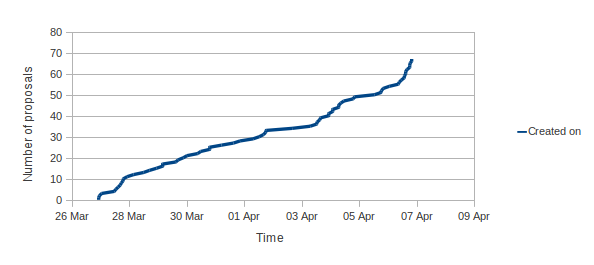
You can see here the graphs of applications against time from this year: 2012 The result is this year we ll have 15 students in Debian versus 9 students last year! Without further ado, here is the list of projects and student who will be working with us this summer: If you want to know more about these projects, follow the links and ask the students (and mentors)!

15 April 2012

Vasudev Kamath: Update: Falcon Debian package Status

Recently I wrote about packaging Falcon programming language for Debian. So here is the status of package. Package builds multiple binaries and we have successfully separated modules from core Falcon language component
  1. falconpl (Falcon language itself )
  2. falconpl-dbg (Debug symbols)
  3. libfalconpl-engine1 (Falcon engine library)
  4. libfalconpl-engine1-dbg (Debug symbols for Falcon enging)
Core modules like feathers and modules writtein Falcon itself are part of libfalconpl-engine1. Rest of modules are separated into following packages
  1. falconpl-mongodb: Mongodb connector module
  2. falconpl-dbi : Database Abstraction layer
  3. falconpl-dbi-sqlite3: SQLite3 connector based on DBI module
  4. falconpl-dbi-postgresql: PostgreSQL connector based on DBI module
  5. falconpl-dbi-mysql: MySQL connector based on DBI module
  6. falconpl-dbi-firebird: Firebird DB server connector
  7. falconpl-curl: Curl bindings for Falcon
  8. falconpl-dbus: DBus bindings for Falcon
  9. falconpl-dmtx: Data Matrix reader/writer for Falcon
  10. falconpl-hpdf: Haru based PDF module for Falcon
  11. falconpl-gd2: Graphic manipulation module for Falcon
There are 4 modules which I'm not sure how to build (dependency) or if at all possible to build for Linux they are dynlib, wopi, sdl, conio. I need to consult upstream on these modules status and ability to build. Modules not built We didn't build dbi-oracle and dbi-odbc modules as these are proprietary software dependant. Additionally in a conversation with upstream on IRC it was told dynlib module can't be built for 64bit and X86 version of Linux because lack of assembler, but I've not fully confirmed this. Legal Issues To enable the curl bindings I added curl dependency which in turn has dependency on libssl1.0 library which is part of openssl source package which is causing lintian thrown GPL violation error. Kartik will be looking into this. Patches submitted I've submitted total of 6 patches of which 5 patches are already applied to upstream git repo and 6th one is waiting to be applied. In other words upstream is really helpful to us. Well thats all for this week more updates next week (or may be even before that ;-) )

13 April 2012

David Welton: Mr. Blank, we're outside the building, and we want eBooks!

Steve Blank is known for his teachings on the Silicon Valley type of entrepreneurship, with his ideas forming the basis for the "lean startup movement" amongst other things. He writes frequently on entrepreneurship, and with a great deal of credibility, having been involved in various startups in a number of roles. He has, without a doubt, walked the walk in terms of startups, and now seems to be spending his time helping other people learn how to walk the same path. That's a noble thing to be doing when, with the money he's made, he could probably be off doing pretty much whatever he wants. If you've heard of Steve Blank, you've probably also heard his famous phrase: "get out of the building", an admonition to startup founders to get out and talk with their customers to validate their ideas, rather than huddling in their offices building something that may or may not have a market. With that in mind, when I saw he had a new book out, The Startup Owner's Manual, I thought "great, that's one I'll get without hesitating!". Unfortunately, though, an eBook wont' be out until "2nd half of 2012"! Ouch. To me, his ignoring eBooks is indicative of a need to get a bit further outside the building, though. "I want an eBook" was probably the biggest request on his blog post announcing the new book, along side messages of thanks for writing the book. After reading, on Blank's blog about the availability of the book from BookDepository Ltd, who offer free worldwide shipping, I went ahead and ordered it even if I would have prefered the eBook. Since they're in the UK, and I'm in Italy, I figure it can't take that long, right? Wrong. I ordered on March 15th, and as of April 13th, it still isn't here. Compare and contrast with the other books I'm currently reading which I was able to order and start looking at in just a few minutes on my Kindle. Granted, Steve Blank surely isn't doing this for the money, and from that point of view has little real need to listen to his customers - it's not wrong to say he's doing the world a favor by writing the book in the first place. If he thinks a paper version is far superior, that's his perogative. However, I think he's doing a lot of his readers a disservice by not making the eBook available sooner. I know I would have liked to start reading what he had to say last month, rather than waiting for a paper book to make its way (by mule train?) down here to Italy. The crux of the matter is that while he may well be right in thinking a paper book is "better", for some people, an eBook is the only option, and for them, an "inferior" eBook is a heck of a lot better than no book at all. Also, on a more constructive note, with eBooks, you can get pretty creative. For instance, if you have a tabular worksheet, you can simply hyperlink to it in, say, Google Docs, so that those with more advanced devices like iPads can open up the link and start working with a real, live spreadsheet immediately, rather than a chart in a printed book. Granted, that means 'giving away' the worksheet, but presumably it's not that valuable on its own, and makes for great advertising if it gets a lot of attention. Finally, since I actually run a business that does eBook conversions , on the blog post announcing the book, I offered to donate our services, so he'd get his book done for free, so you can't accuse me of just complaining! Mr. Blank, get out of that building and make an eBook available, please!

Peter Eisentraut: Enabling core files for PostgreSQL on Debian

The other day, I was a bit puzzled over a seemingly simple task: Enable core files to be generated from a PostgreSQL instance running on Debian. That instance has unfortunately been segfaulting on occasion, but never left a core file.

Now in principle it is clear that
ulimit -c unlimited
is the incantation to get this done. But where do you put this? You could hack it into the init script, but that seemed a bit ugly, and I wanted a sustainable solution.

A useful thing in the meantime is to check the current settings. That information is available in /proc/$PID/limits with the PID of the postmaster process (or any child process, really), and it looked like this to begin with:
Limit                     Soft Limit           Hard Limit           Units     
Max cpu time unlimited unlimited ms
Max file size unlimited unlimited bytes
Max data size unlimited unlimited bytes
Max stack size 8388608 unlimited bytes
Max core file size 0 unlimited bytes
...
Use sudo grep core /proc/$(sudo cat /var/run/postgresql/8.4-main.pid)/limits if you want it automated.

So it's good to know that we only need to set the soft limit.

One way to configure this properly would appear to be in /etc/security/limits.conf. There you can add a line like
*               soft    core            unlimited
to enable core dumps globally. I'm not actually sure whether that would work if the service is started during the boot without PAM. In any case, I didn't want to enable core files globally; who knows what that would lead to.

One could replace the * by a user name, such as postgres, and then enable pam_limits.so in /etc/pam.d/su. But the postgresql init script in Debian is nested about four levels deep, so it wasn't clear whether it called su at all.

Now as it turns out, the init script ends up changing the user using this Perl code:
$) = $groups;
$( = $gid;
$> = $< = $uid;
(see change_ugid in /usr/share/postgresql-common/PgCommon.pm), so the whole PAM line of thought wasn't going to work anyway. (Other packages such as pgbouncer and slony1 do got through su, so that would be a solution for those.)

The way to solve this is the pg_ctl -c option, which sets the soft limit for core files to unlimited. And the way to pass this option through the init script maze is the file /etc/postgresql/8.4/main/pg_ctl.conf, which should contain a line like this:
pg_ctl_options = '-c'
Then restart postgresql, and check /proc/$PID/limits again:
Limit                     Soft Limit           Hard Limit           Units     
Max cpu time unlimited unlimited ms
Max file size unlimited unlimited bytes
Max data size unlimited unlimited bytes
Max stack size 8388608 unlimited bytes
Max core file size unlimited unlimited bytes
OK.

Another thing that's recommendable in this context is to change the core file names to have a unique element, so that if multiple backends crash before you can take a look, they don't overwrite each other's core files. The core(7) man page explains the configuration options; I went with this sysctl setting:
kernel.core_pattern = core.%e.%p
which includes process name and PID. The PID file still ends up in the data directory of the PostgreSQL instance, which could also be changed, but I didn't find it necessary.

Stick the above line in /etc/sysctl.d/local.conf and reload with
service procps force-reload
I actually use a setting like that on all machines now; it's just nicer.

OK, and now I'll wait for the next core file. Or not.

Next.

Previous.