Search Results: "sto"

4 September 2024

Reproducible Builds: Reproducible Builds in August 2024

Welcome to the August 2024 report from the Reproducible Builds project! Our reports attempt to outline what we ve been up to over the past month, highlighting news items from elsewhere in tech where they are related. As ever, if you are interested in contributing to the project, please visit our Contribute page on our website. Table of contents:
  1. LWN: The history, status, and plans for reproducible builds
  2. Intermediate Autotools build artifacts removed from PostgreSQL distribution tarballs
  3. Distribution news
  4. Mailing list news
  5. diffoscope
  6. Website updates
  7. Upstream patches
  8. Reproducibility testing framework

LWN: The history, status, and plans for reproducible builds The free software newspaper of record, Linux Weekly News, published an in-depth article based on Holger Levsen s talk, Reproducible Builds: The First Eleven Years which was presented at the recent DebConf24 conference in Busan, South Korea. Titled The history, status, and plans for reproducible builds and written by Jake Edge, LWN s article not only summarises Holger s talk and clarifies its message but it links to external information as well. Holger s original talk can also be watched on the DebConf24 webpage (direct .webm link and his HTML slides are available also). There are also a significant number of comments on LWN s page as well. Holger Levsen also headed a scheduled discussion session at DebConf24 on Preserving *other* build artifacts addressing a topic where a number of Debian packages are (or would like to) produce results that are neither the .deb files, the build logs nor the logs of CI tests. This is an issue for reproducible builds as this 4th type of build artifact are typically shipped within the binary .deb packages, and are invariably non-deterministic; thus making the .deb files unreproducible. (A direct .webm link and HTML slides are available).

Intermediate Autotools build artifacts removed from PostgreSQL distribution tarballs Peter Eisentraut wrote a detailed blog post on the subject of The new PostgreSQL 17 make dist . Like many projects, the PostgreSQL database has previously pre-built parts of its GNU Autotools build system: the reason for this is a mix of convenience and traditional practice . Peter astutely notes that this arrangement in the build system is quite tricky as:
You need to carefully maintain the different states of clean source code , partially built source code , and fully built source code , and the commands to transition between them.
However, Peter goes on to mention that:
a lot more attention is nowadays paid to the software supply chain. There are security and legal reasons for this. When users install software, they want to know where it came from, and they want to be sure that they got the right thing, not some fake version or some version of dubious legal provenance.
And cites the XZ Utils backdoor as a reason to care about transparent and reproducible ways of distributing and communicating a source tarball and provenance. Because of this, intermediate build artifacts are now henceforth essentially disallowed from PostgreSQL distribution tarballs.

Distribution news In Debian this month, 30 reviews of Debian packages were added, 17 were updated and 10 were removed this month adding to our knowledge about identified issues. One issue type was added by Chris Lamb, too. [ ] In addition, an issue was filed to update the Salsa CI pipeline (used by 1,000s of Debian packages) to no longer test for reproducibility with reprotest s build_path variation. Holger Levsen provided a rationale for this change in the issue, which has already been made to the tests being performed by tests.reproducible-builds.org.
In Arch Linux this month, Jelle van der Waa published a short blog post on the topic of Investigating creating reproducible images with mkosi, motivated by the desire to make it possible for anyone to re-recreate the official Arch cloud image bit-by-bit identical on their own machine as per [the] reproducible builds definition. In addition, Jelle filed a patch for pacman, the Arch Linux package manager, to respect the SOURCE_DATE_EPOCH environment variable when installing a package.
In openSUSE news, Bernhard M. Wiedemann published another report for that distribution.
In Android news, the IzzyOnDroid project added 49 new rebuilder recipes and now features 256 total reproducible applications representing 21% of the total offerings in the repository. IzzyOnDroid is an F-Droid style repository for Android apps[:] applications in this repository are official binaries built by the original application developers, taken from their resp. repositories (mostly GitHub).

Mailing list news From our mailing list this month:
  • Bernhard M. Wiedemann posted a brief message to the list with some helpful information regarding nondeterminism within Rust binaries, positing the use of the codegen-units = 16 default and resulting in a bug being filed in the Rust issue tracker. [ ]
  • Bernhard also wrote to the list, following up to a thread in November 2023, on attempts to make the LibreOffice suite of office applications build reproducibly. In the thread from this month, Bernhard could announce that the four patches previously mentioned have landed in LibreOffice upstream.
  • Fay Stegerman linked the mailing list to a thread she made on the Signal issue tracker regarding whether device-specific binaries [can] ever be considered meaningfully reproducible . In particular: the whole part about allow[ing] multiple third parties to come to a consensus on a correct result breaks down completely when correct is device-specific and not something everyone can agree on. [ ]
  • Developer kpcyrd posted an update for source code indexing project, whatsrc.org. Announcing that it now importing packages from live-bootstrap ( a usable Linux system [that is] created with only human-auditable, and wherever possible, human-written, source code ) into its database of provenance data.
  • Lastly, Mechtilde Stehmann posted an update to an earlier thread about how Java builds are not reproducible on the armhf architecture, enquiring how they might gain temporary access to such a machine in order to perform some deeper testing. [ ]

diffoscope diffoscope is our in-depth and content-aware diff utility that can locate and diagnose reproducibility issues. This month, Chris Lamb released versions 274, 275, 276 and 277, uploaded these to Debian, and made the following changes as well:
  • New features:
    • Strip ANSI escapes usually colour codes from the output of the Procyon Java decompiler. [ ]
    • Factor out a method for stripping ANSI escapes. [ ]
    • Append output from dumppdf(1) in more cases, avoiding situations where we fallback to a binary diff. [ ]
    • Add support for versions of Perl s IO::Compress::Zip version 2.212. [ ]
  • Bug fixes:
    • Also catch RuntimeError exceptions when importing the PyPDF library so that it, or, crucially, its transitive dependencies, cannot not cause diffoscope to traceback at runtime and build time. [ ]
    • Do not call marshal.load( ) of precompiled Python bytecode as it, alas, inherently unsafe. Replace for now with a brief summary of the code section of .pyc. [ ][ ]
    • Don t include excessive debug output when calling dumppdf(1). [ ]
  • Testsuite-related changes:
    • Don t bother to check version number in test_python.py: the fixture for this test is fixed. [ ][ ]
    • Update test_zip text fixtures and definitions to support new changes to the Perl IO::Compress library. [ ]
In addition, Mattia Rizzolo updated the available architectures for a number of test dependencies [ ] and Sergei Trofimovich fixed an issue to avoid diffoscope crashing when hashing directory symlinks [ ] and Vagrant Cascadian proposed GNU Guix updates for diffoscope versions 275 and 276 and 277.

Website updates There were a rather substantial number of improvements made to our website this month, including:
  • Alba Herrerias:
    • Substantially extend the guidance on the Contribute page. [ ]
  • Chris Lamb:
    • Set the future: true configuration value so we render all files and documents in the website, regardless of whether they have a date property in the future. After all, we don t re-generate the website on a timer, and have other ways of making unpublished, draft posts. [ ][ ]
  • Fay Stegerman:
  • hulkoba:
  • kpcyrd:
  • Mattia Rizzolo:
  • Pol Dellaiera:

Upstream patches The Reproducible Builds project detects, dissects and attempts to fix as many currently-unreproducible packages as possible. We endeavour to send all of our patches upstream where appropriate. This month, we wrote a large number of such patches, including:

Reproducibility testing framework The Reproducible Builds project operates a comprehensive testing framework running primarily at tests.reproducible-builds.org in order to check packages and other artifacts for reproducibility. In August, a number of changes were made by Holger Levsen, including:
  • Temporarily install the openssl-provider-legacy package for the Debian unstable environments for running diffoscope due to Debian bug #1078944. [ ][ ][ ][ ]
  • Mark Debian armhf architecture nodes as being down due to proxy down. [ ][ ]
  • Detect proxy failures. [ ][ ][ ]
  • Run the index-buildinfo for the builtin-pho script with the -q switch. [ ]
  • Disable all Arch Linux reproducible jobs. [ ]
In addition, Mattia Rizzolo updated the website configuration to install the ruby-jekyll-sitemap package as it is now used in the website [ ], Roland Clobus updated the script to build Debian live images to treat openQA issues as warnings [ ], and Vagrant Cascadian marked the cbxi4b node as down [ ].

If you are interested in contributing to the Reproducible Builds project, please visit our Contribute page on our website. However, you can get in touch with us via:

Dirk Eddelbuettel: RcppCNPy 0.2.13 on CRAN: Micro Bugfix

Another (again somewhat minor) maintenance release of the RcppCNPy package arrived on CRAN earlier today. RcppCNPy provides R with read and write access to NumPy files thanks to the cnpy library by Carl Rogers along with Rcpp for the glue to R. A change in the most recent Rcpp appears to cause void functions wrapper via Rcpp Modules to return NULL, as opposed to being silent. That tickles discrepancy between the current output and the saved (reference) output of one test file, leading CRAN to display a NOTE which we were asked to take care of. Done here in this release and now that we know we will also look into restoring the prior Rcpp behaviour. Other small changes involved standard maintenance for continuous integration and updates to files README.md and DESCRIPTION. More details are below.

Changes in version 0.2.13 (2024-09-03)
  • A test script was updated to account for the fact that it now returns a few instances of NULL under current Rcpp.
  • Small package maintenance updates have been made to the README and DESCRIPTION files as well as to the continuous integration setup.

CRANberries also provides a diffstat report for the latest release. As always, feedback is welcome and the best place to start a discussion may be the GitHub issue tickets page. If you like this or other open-source work I do, you can now sponsor me at GitHub.

This post by Dirk Eddelbuettel originated on his Thinking inside the box blog. Please report excessive re-aggregation in third-party for-profit settings.

Samuel Henrique: DebConf24 was fun!: Security, curl, wcurl, Debian's quality

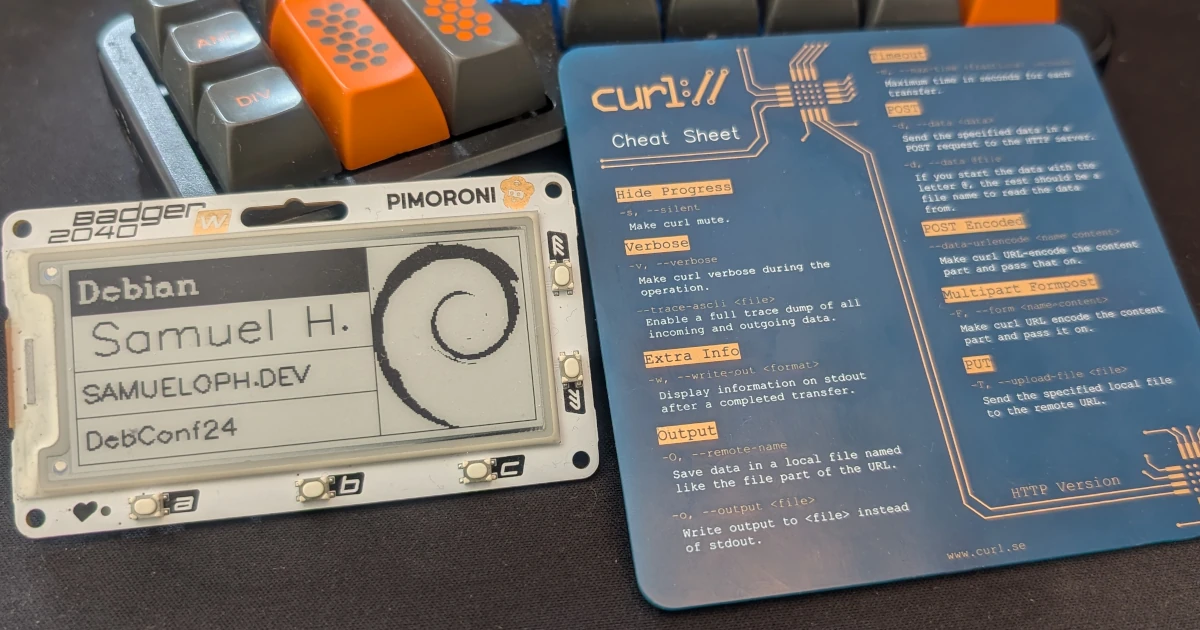
A picture of a badger2040w with Samuel's badge and the curl manpage PCB on the side

tl;dr DebConf24 was fun! A playlist of all of my talks, with subtitles (en, pt-br) and chapters is available on YouTube.

Overview DebConf24 was held in Busan, South Korea, between Sunday July 28th to Sunday August 4th 2024. As usual for DebConfs, I had a great time meeting my friends, but also met new people and got to learn a bit about the interesting things they're working on. I ended up getting too excited during the talk submission stage of the conference and as a result I presented 5 different activities (3 talks, 1 BoF and 1 lightning talk). Since I was too busy with the presentations, I did not have a lot of time to actually hang out with folks, or even to go out in the city, I guess I've learned my lesson for next time. The main purpose of this post is to write about all of the things I presented at the conference. I did want to list some of the interesting talks I've watched, but that I would not be able to be fair as I'm sure I would miss some. You can get the schedule and the recordings of any talks from the conference's website: https://debconf24.debconf.org/schedule/

wcurl Lightning Talk The most fun of my presentations, during the second-to-last day of the conference, I've asked for help from Sergio Durigan Junior <sergiodj> to setup an URL containing a whitespace and redirecting that to wcurl's manpage. I then did a little demo to showcase why me (and a lot others) struggle with downloading things with curl, and how wcurl solves that. https://www.youtube.com/watch?v=eM8M5qa4pPM

Fixing CVEs on Debian: Everything you probably know already I've always felt like DebConf was missing security-related talks, so I decided to do something about it and presented a few of the things I've learned when fixing CVEs for Debian. This is an area where we don't get a lot of new contributors, I'm trying to change that, and this talk can be used to introduce newcomers to it. https://www.youtube.com/watch?v=XzNVVILVyUM

The secret sauce of Debian Debian is not very vocal about all of the nice things it has regarding quality-assurance, testing, or CI, even though it's at the state-of-the-art for a lot of things. This talk is an initial step towards making people aware of the cool things happening behind the scenes. Ideally we should have it well-documented somewhere. https://www.youtube.com/watch?v=x_X2IBnpjic

"I use Debian BTW": fzf, tmux, zoxide and friends One of my earliest good memories of Debian was when it started coming with a colored PS1 by default, I still remember the feeling of relief whenever I jumped into a Debian server and didn't have to deal with a black and white PS1. There's still a lot of room for Debian to ship better defaults, and I think some of them can actually happen. This talk is a bit of a silly one where I'm just making people aware of the existence of a few Golang/Rust CLI tools, and also some dotfiles configurations that should probably be the default. https://www.youtube.com/watch?v=tfto3Seokn4

curl The curl project does such a great job with their security advisories that it will likely never receive the amount of praise it deserves, but I did my best at mentioning it throughout my CVEs talk. Maybe I will write more extensively about this someday, but in case I don't:
There's no other project which always consistently mentions the exact range of commits that are affected by a given CVE. Forget about whether the versions are EOL, curl doesn't have LTS releases, yet they do such a great job at clearly documenting their CVEs that I would take that over having LTS releases anytime (that's for curl at least, I acknowledge some types of projects have a different need for LTS releases). Not only that, but they are also always careful about explaining alternative mitigations such as configuration changes, build flags that defuse the exploitation, or parameters that you should not use.
Just like we tend to do every time we meet, me and the other Debian curl maintainers spent the first 2 or 3 days of the conference talking about how we wanted to eventually meet up to discuss the package. It was going to be informal, maybe during the Cheese and Wine party, but then I've realized we should make it part of the official schedule, which would also give us the recordings for later. And so the "curl maintainers BoF" happened, where we spoke about HTTP3, GnutTLS, wcurl and other things. https://www.youtube.com/watch?v=fL7hSypUTdM

wcurl Right after that BoF, Daniel Stenberg asked if we were interested in having wcurl adopted into curl, which we definitely were, so wcurl is now part of the curl project. Daniel was also kind enough to design a logo for the project, which makes me especially happy because I can stop with my own approach at a logo (which I had to redo every few days): A laptop with a curl and a GoHorse sticker, there's a 'w' handwritten with a marker on the right side of the curl sticker, making it 'wcurl' And here is the new logo: 'wcurl' written with the same font and colors as the curl logo, with the 'w' being green instead of blue, and a download icon at the end Much better, I would say :)

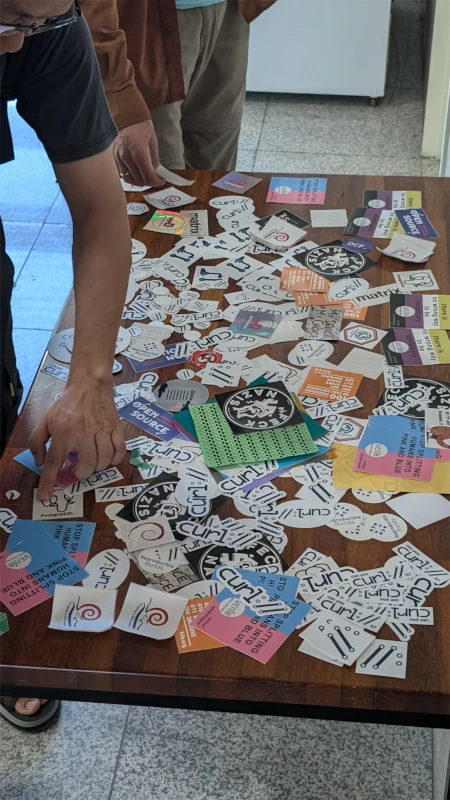
curl Swag DebConf24 was my chance at forwarding some curl swag items to the other curl maintainers, so both Sergio Durigan Junior <sergiodj> and Carlos Henrique Lima Melara <charles> got the curl-up t-shirt and the very cool curl PCB coaster, both gifted by Daniel Stenberg. Unfortunately I didn't have any of that for DebConf attendees, but I did drop loads of curl stickers at the stickers table, they were gone very quickly. A table full of different stickers, curl stickers can be seen over the whole table

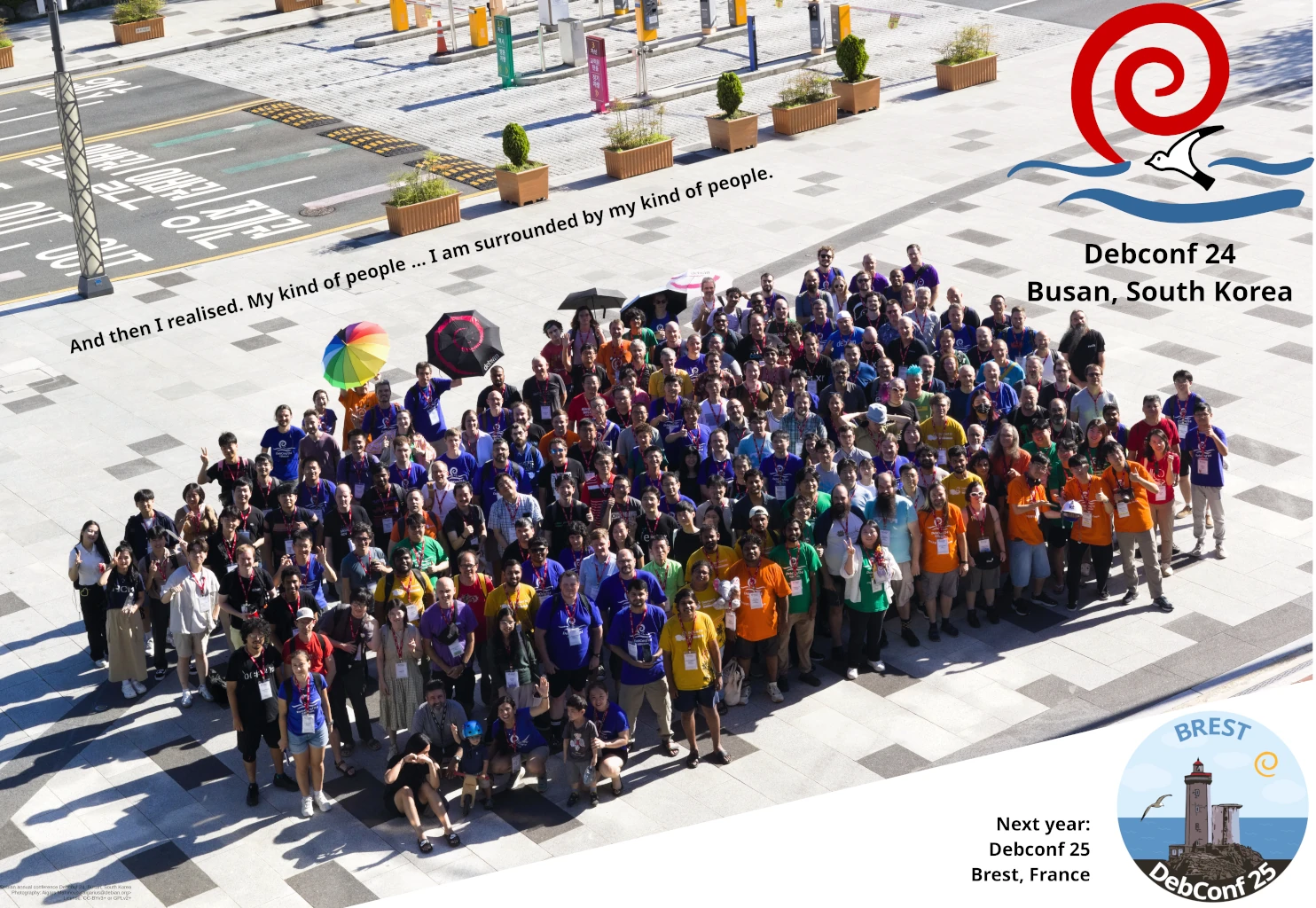
For the future I used to think the most humbling experience you could have as someone who presented a talk was to have to watch it yourself, you notice a lot of mistakes and you instantly think about things that should be done differently. It turns out the most humbling thing to do is actually to write subtitles for your talks, I noticed every single mistake, often multiple times. So after spending more than 30 hours writing the subtitles for both English and Brazilian Portuguese for my talks, I feel like it's going to be much easier to avoid committing the same mistakes again. After some time you stop feeling shame about those mistakes and you're just left with feelings of annoyance, and at that point it becomes easier to consciously avoid them. I am collecting a list of things I wish I had done differently on all of those talks, so if I end up presenting any one of them again, it will be an improved version. A picture from the top of a group of conference attendees, there's about 150 people in the picture

2 September 2024

Gunnar Wolf: Free and open source software and other market failures

This post is a review for Computing Reviews for Free and open source software and other market failures , a article published in Communications of the ACM
Understanding the free and open-source software (FOSS) movement has, since its beginning, implied crossing many disciplinary boundaries. This article describes FOSS s history, explaining its undeniable success throughout the 1990s, and why the movement today feels in a way as if it were on autopilot, lacking the steam it once had. The author presents several examples of different industries where, as it happened with FOSS in computing, fundamental innovations happened not because the leading companies of each field are attentive to customers needs, but to a certain degree, despite them not even considering those needs, it is typically due to the hubris that comes from being a market leader. Kemp exemplifies his hypothesis by presenting the messy landscape of the commercial, mutually incompatible systems of Unix in the 1980s. Different companies had set out to implement their particular flavor of open Unix computers, but with clear examples of vendor lock-in techniques. He speculates that, if we had been able to buy a reasonably priced and solid Unix for our 32-bit PCs nobody would be running FreeBSD or Linux today, except possibly as an obscure hobby. He states that the FOSS movement was born out of the utter market failure of the different Unix vendors. The focus of the article shifts then to the FOSS movement itself: 25 years ago, as FOSS systems slowly gained acceptance and then adoption in the serious market and at the center of the dot-com boom of the early 2000s, Linux user groups (LUGs) with tens of thousands of members bloomed throughout the world; knowing this history, why have all but a few of them vanished into oblivion? Kemp suggests that the strength and vitality that LUGs had ultimately reflects the anger that prompted technical users to take the situation into their own hands and fix it; once the software industry was forced to change, the strongly cohesive FOSS movement diluted. The frustrations and anger of [information technology, IT] in 2024, Kamp writes, are entirely different from those of 1991. As an example, the author closes by citing the difficulty of maintaining despite having the resources to do so an aging legacy codebase that needs to continue working year after year.

1 September 2024

Russ Allbery: Review: Reasons Not to Worry

Review: Reasons Not to Worry, by Brigid Delaney
Publisher: Harper
Copyright: 2022
Printing: October 2023
ISBN: 0-06-331484-3
Format: Kindle
Pages: 295
Reasons Not to Worry is a self-help non-fiction book about stoicism, focusing specifically on quotes from Seneca, Epictetus, and Marcus Aurelius. Brigid Delaney is a long-time Guardian columnist who has written on a huge variety of topics, including (somewhat relevantly to this book) her personal experiences trying weird fads. Stoicism is having a moment among the sort of men who give people life advice in podcast form. Ryan Holiday, a former marketing executive, has made a career out of being the face of stoicism in everyone's podcast feed (and, of course, hosting his own). He is far from alone. If you pay attention to anyone in the male self-help space right now (Cal Newport, in my case), you have probably heard something vague about the "wisdom of the stoics." Given that the core of stoicism is easily interpreted as a strategy for overcoming your emotions with logic, this isn't surprising. Philosophies that lean heavily on college dorm room logic, discount emotion, and argue that society is full of obvious flaws that can be analyzed and debunked by one dude with some blog software and a free afternoon have been very popular in tech circles for the past ten to fifteen years, and have spread to some extent into popular culture. Intriguingly, though, stoicism is a system of virtue ethics, which means it is historically in opposition to consequentialist philosophies like utilitarianism, the ethical philosophy behind effective altruism and other related Silicon Valley fads. I am pretty exhausted with the whole genre of men talking to each other about how to live a better life Cal Newport by himself more than satisfies the amount of that I want to absorb but I was still mildly curious about stoicism. My education didn't provide me with a satisfying grounding in major historical philosophical movements, so I occasionally look around for good introductions. Stoicism also has some reputation as an anxiety-reduction technique, and I could use more of those. When I saw a Discord recommendation for Reasons Not to Worry that specifically mentioned its lack of bro perspective, I figured I'd give it a shot. Reasons Not to Worry is indeed not a bro book, although I would have preferred fewer appearances of the author's friend Andrew, whose opinions on stoicism I could not possibly care less about. What it is, though, is a shallow and credulous book that falls squarely in the middle of the lightweight self-help genre. Delaney is here to explain why stoicism is awesome and to convince you that a school of Greek and Roman philosophers knew exactly how you should think about your life today. If this sounds quasi-religious, well, I'll get to that. Delaney does provide a solid introduction to stoicism that I think is a bit more approachable than reading the relevant Wikipedia article. In her presentation, the core of stoicism is the practice of four virtues: wisdom, courage, moderation, and justice. The modern definition of "stoic" as someone who is impassive in the presence of pleasure or pain is somewhat misleading, but Delaney does emphasize a goal of ataraxia, or tranquility of mind. By making that the goal rather than joy or pleasure, stoicism tries to avoid the trap of the hedonic treadmill in favor of a more achievable persistent contentment. As an aside, some quick Internet research makes me doubt Delaney's summary here. Other material about stoicism I found focuses on apatheia and associates ataraxia with Epicureanism instead. But I won't start quibbling with Delaney's definitions; I'm not qualified and this review is already too long. The key to ataraxia, in Delaney's summary of stoicism, is to focus only on those parts of life we can control. She summarizes those as our character, how we treat others, and our actions and reactions. Everything else wealth, the esteem of our colleagues, good health, good fortune is at least partly outside of our control, and therefore we should enjoy it when we have it but try to be indifferent to whether it will last. Attempting to control things that are outside of our control is doomed to failure and will disturb our tranquility. Essentially all of this book is elaborations and variations on this theme, specialized to some specific area of life like social media, anxiety, or grief and written in the style of a breezy memoir. If you're familiar with modern psychological treatment frameworks like cognitive behavioral therapy or acceptance and commitment therapy, this summary of stoicism may sound familiar. (Apparently this is not an accident; the predecessor to CBT used stoicism as a philosophical basis.) Stoicism, like those treatment approaches, tries to refocus your attention on the things that you can improve and de-emphasizes the things outside of your control. This is a lot of the appeal, at least to me (and I think to Delaney as well). Hearing that definition, you may have some questions. Why those virtues specifically? They sound good, but all virtues sound good almost by definition. Is there any measure of your success in following those virtues outside your subjective feeling of ataraxia? Does the focus on only things you can control lead to ignoring problems only mostly outside of your control, where your actions would matter but only to a small degree? Doesn't this whole philosophy sound a little self-centered? What do non-stoic virtue ethics look like, and why do they differ from stoicism? What is the consequentialist critique of stoicism? This is where the shortcomings of this book become clear: Delaney is not very interested in questions like this. There are sections on some of those topics, particularly the relationship between stoicism and social justice, but her treatment is highly unsatisfying. She raises the question, talks about her doubts about stoicism's applicability, and then says that, after further thought, she decided stoicism is entirely consistent with social justice and the stoics were right after all. There is a little bit more explanation than that, but not much. Stoicism can apparently never be wrong; it can only be incompletely understood. Self-help books often fall short here, and I suspect this may be what the audience wants. Part of the appeal of the self-help genre is artificial certainty. Becoming a better manager, starting a business, becoming more productive, or working out an entire life philosophy are not problems amenable to a highly approachable and undemanding book. We all know that at some level, but the seductive allure of the self-help genre is the promise of simplifying complex problems down to a few approachable bullet points. Here is a life philosophy in a neatly packaged form, and if you just think deeply about its core principles, you will find they can be applied to any situation and any doubts you were harboring will turn out to be incorrect. I am all too familiar with this pattern because it's also how fundamentalist Christianity works. The second time Delaney talked about her doubts about the applicability of stoicism and then claimed a few pages later that those doubts disappeared with additional thought and discussion, my radar went off. This book was sounding less like a thoughtful examination of one specific philosophy out of many and more like the soothing adoption of religious certainty by a convert. I was therefore entirely unsurprised when Delaney all but says outright in the epilogue that she's adopted stoicism as her religion and approaches it with the same dedicated practice that she used to bring to Catholicism. I think this is where a lot of self-help books end up, although most of them don't admit it. There's nothing wrong with this, to be clear. It sounds like she was looking for a non-theistic religion, found one that she liked, and is excited to tell other people about it. But it's a profound mismatch with what I was looking for in an introduction to stoicism. I wanted context, history, and a frank discussion of the problems with adopting philosophy to everyday issues. I also wanted some acknowledgment that it is highly unlikely that a few men who lived 2000 years ago in a wildly different social context, and with drastically limited information about cultures other than their own, figured out a foolproof recipe for how to approach life. The subsequent two millennia of philosophical debates prove that stoicism didn't end the argument, and that a lot of other philosophers thought that stoicism got a few things wrong. You would never know that from this book. What I wanted is outside the scope of this sort of undemanding self-help book, though, and this is the problem that I keep having with philosophy. The books I happen across are either nigh-incomprehensibly dense and academic, or they're simplified into catechism. This was the latter. That's probably more the fault of my reading selection than it is the fault of the book, but it was still annoying. What I will say for this book, and what I suspect may be the most useful property of self-help books in general, is that it prompts you to think about basic stoic principles without getting in the way of your thoughts. It's like background music for the brain: nothing Delaney wrote was very thorny or engaging, but she kept quietly and persistently repeating the basic stoic formula and turning my thoughts back to it. Some of those thoughts may have been useful? As a source of prompts for me to ponder, Reasons Not to Worry was therefore somewhat successful. The concept of not trying to control things outside of my control is simple but valid, and it probably didn't hurt me to spend a week thinking about it. "It kind of works as an undemanding meditation aid" is not a good enough reason for me to recommend this book, but maybe that's what someone else is looking for. Rating: 5 out of 10

31 August 2024

Russell Coker: Links August 2024

Bruce Schneier and Kim C rdova wrote an insightful article about the changes that corporations make to culture as technical debt [1]. We need anti-trust laws to be enforced before it s too late! Bruce Schneier posted the transcript of an insightful lecture he gave on rethinking democracy for the age of AI [2]. Cory Doctorow wrote an insightful blog post about companies that are too big to care [3]. We need to break up those monopolies. Science Alert has an interesting article on plans to get renewable energy by drilling into the magma chamber of an active volcano [4]. What I want to know is whether using the energy could reduce the power of an eruption or even prevent it from happening. Bruce Schneier wrote an interesting article about Crowdstrike and the market incentives for brittle systems [5]. Also we need to have more formally proven software and more use of systems like seL4. Dave s Garage on YouTube has an interesting video about modern Mainframes [6]. Their IO capacity dwarfs the memory bandwidth of most PC servers. Framework has an interesting YouTube video about the process of developing a RISC-V motherboard for their laptops [7]. The documentary series Who Broke Britain by ABC news gives a good insight into the harm caused by austerity policies [8]. Rolling Stone has an interesting story about the consequences of being a CIA agent in al Quaeda [9].

Vincent Bernat: Fixing layout shifts caused by web fonts

In 2020, Google introduced Core Web Vitals metrics to measure some aspects of real-world user experience on the web. This blog has consistently achieved good scores for two of these metrics: Largest Contentful Paint and Interaction to Next Paint. However, optimizing the third metric, Cumulative Layout Shift, which measures unexpected layout changes, has been more challenging. Let s face it: optimizing for this metric is not really useful for a site like this one. But getting a better score is always a good distraction. To prevent the flash of invisible text when using web fonts, developers should set the font-display property to swap in @font-face rules. This method allows browsers to initially render text using a fallback font, then replace it with the web font after loading. While this improves the LCP score, it causes content reflow and layout shifts if the fallback and web fonts are not metrically compatible. These shifts negatively affect the CLS score. CSS provides properties to address this issue by overriding font metrics when using fallback fonts: size-adjust, ascent-override, descent-override, and line-gap-override. Two comprehensive articles explain each property and their computation methods in detail: Creating Perfect Font Fallbacks in CSS and Improved font fallbacks.

Interactive tuning tool Instead of computing each property from font average metrics, I put together a tool for interactively tuning fallback fonts.1

Instructions
  1. Load your custom font.
  2. Select a fallback font to tune.
  3. Adjust the size-adjust property to match the width of your custom font with the fallback font. With a proportional font, it is not possible to achieve a perfect match.
  4. Fine-tune the ascent-override property. Aim to align the final dot of the last paragraph while monitoring the font s baseline. For more precise adjustment, disable the option.
  5. Modify the descent-override property. The goal is to make the two boxes match. You may need to alternate between this and the previous property for optimal results.
  6. If necessary, adjust the line-gap-override property. This step is typically not required.
The process needs to be repeated for each fallback font. Some platforms may not include certain fonts. Notably, Android lacks most fonts found in other operating systems. It replaces Georgia with Noto Serif, which is not metrically-compatible.

Tool

This tool is not available from the Atom feed.

Results For the body text of this blog, I get the following CSS definition:
@font-face  
  font-family: Merriweather;
  font-style: normal;
  font-weight: 400;
  src: url("../fonts/merriweather.woff2") format("woff2");
  font-display: swap;
 
@font-face  
  font-family: "Fallback for Merriweather";
  src: local("Noto Serif"), local("Droid Serif");
  size-adjust: 98.3%;
  ascent-override: 99%;
  descent-override: 27%;
 
@font-face  
  font-family: "Fallback for Merriweather";
  src: local("Georgia");
  size-adjust: 106%;
  ascent-override: 90.4%;
  descent-override: 27.3%;
 
font-family: Merriweather, "Fallback for Merriweather", serif;
After a month, the CLS metric improved to 0:
Core Web Vitals scores for vincent.bernat.ch showing all 6 metrics as green. Notably the Cumulative Layout Shift is 0.
Recent Core Web Vitals scores for vincent.bernat.ch

About custom fonts Using safe web fonts or a modern font stack is often simpler. However, I prefer custom web fonts. Merriweather and Iosevka, which are used in this blog, enhance the reading experience. An alternative approach could be to use Georgia as a serif option. Unfortunately, most default monospace fonts are ugly. Furthermore, paragraphs that combine proportional and monospace fonts can create visual disruption. This occurs due to mismatched vertical metrics or weights. To address this issue, I adjust Iosevka s metrics and weight to align with Merriweather s characteristics.

  1. Similar tools already exist, like the Fallback Font Generator, but they were missing a few features, such as the ability to load the fallback font or to have decimals for the CSS properties. And no source code.

Russ Allbery: Review: The Shepherd's Crown

Review: The Shepherd's Crown, by Terry Pratchett
Series: Discworld #41
Publisher: Harper
Copyright: 2015
Printing: 2016
ISBN: 0-06-242998-1
Format: Trade paperback
Pages: 276
The Shepherd's Crown is the 41st and final Discworld novel and the 5th and final Tiffany Aching novel. You should not start here. There is a pretty major character event in the second chapter of this book. I'm not going to say directly what it is, but you will likely be able to guess from the rest of the review. If you're particularly adverse to spoilers, you may want to skip reading this until you've read the book. Tiffany Aching is extremely busy. Witches are responsible for all the little tasks that fall between the cracks, and there are a lot of cracks. The better she gets at her job, the more of the job there seems to be.
"Well," said Tiffany, "there's too much to be done and not enough people to do it." The smile that the kelda gave her was a strange one. The little woman said, "Do ye let them try? Ye mustn't be afraid to ask for help. Pride is a good thing, my girl, but it will kill you in time."
And that's before an earth-shattering change in the world of witches, one that leaves Tiffany shuttling between Lancre and the Chalk trying to be too many things to too many people. Plus the kelda is worried some deeper trouble is brewing. And then Tiffany gets an exiled elven queen who has never understood the worth of other people dumped on her, and has to figure out what to do with her. The starting idea is great. I continue to be impressed with how well Pratchett handles Tiffany's coming-of-age story. Finding one's place in the world isn't one lesson or event; it's layers of them, with each new growth in responsibility uncovering new things to learn that are often quite different from the previous problems. Tiffany has worked through child problems, adolescent problems, and new adulthood problems. Now she's on a course towards burnout, which is exactly the kind of problem Tiffany would have given her personality. Even better, the writing at the start of The Shepherd's Crown is tight and controlled and sounds like Pratchett, which was a relief after the mess of Raising Steam. The contrast is so sharp that I found myself wondering if parts of this book had been written earlier, or if Pratchett found a new writing or editing method. The characters all sound like themselves, and although some of the turns of phrase are not quite as sharp as in earlier books, they're at least at the level of Snuff. Unfortunately, it doesn't last. There are some great moments and some good quotes, but the writing starts to slip at about the two-thirds point, the sentences began to meander, the characters start repeating the name of the person they're talking to, and the narration becomes increasingly strained. It felt like Pratchett knew the emotional tone he wanted to evoke but couldn't find a subtle way to express it, so the story and the characters start to bludgeon the reader with Grand Statements. It's never as bad as Raising Steam, but it doesn't slip smoothly off the page to rewrite your brain the way that Pratchett could at his best. What makes this worse is that the plot is not very interesting. I wanted to read a book about Tiffany understanding burnout, asking for help, and possibly also about mental load and how difficult delegation is. There is some movement in that direction: she takes on some apprentices, although we don't see as much of her interactions with them as I'd like, and there's an intriguing new male character who wants to be a witch. I wish Pratchett had been able to give Geoffrey his own book. He and his goat were the best part of the story, but it felt rushed and I think he would have had more impact if the reader got to see him develop his skills over time the way that we did with Tiffany. But, alas, all of that is side story to the main plot, which is about elves. As you may know from previous reviews, I do not get along with Pratchett's conception of elves. I find them boring and too obviously evil, and have since Lords and Ladies. Villains have never been one of Pratchett's strengths, and I think his elves are my least favorite. One of the goals of this book is to try to make them less one-note by having Tiffany try to teach one of them empathy, but I didn't find any of the queen's story arc convincing. If Pratchett had pulled those threads together with something more subtle, emotional, and subversive, I think it could have worked, but instead we got another battle royale, and Lords and Ladies did that better.
"Granny never said as she was better than others. She just got on with it and showed 'em and people worked it out for themselves."
And so we come to the end. I wish I could say that the quality held up through the whole series, and it nearly did, but alas it fell apart a bit at the end. Raising Steam I would skip entirely. The Shepherd's Crown is not that bad, but it's minor Pratchett that's worth reading mainly because it's the send-off (and there are a lot of reasons within the story to think Pratchett knew that when writing it). There are a few great lines, some catharsis, and a pretty solid ending for Tiffany, but it's probably not a book that I'll re-read. Content warning: major character death. Special thanks to Emmet Asher-Perrin, whose Tor.com/Reactor re-read of all of Discworld got me to pick the series up again and finally commit to reading all of it. I'm very glad I did. Rating: 6 out of 10

30 August 2024

Sahil Dhiman: Debconf24 Busan

DebConf24 was held in Busan, South Korea, from July 28th to August 4th 2024 and preceded by DebCamp from July 21st to July 27th. This was my second IRL DebConf (DC) and fourth one in total. I started in Debian with a DebConf, so its always an occasion when one happens. This year again, I worked in fundraising team, working to raise funds from International sponsors. We did manage to raise good enough funding, albeit less than budgeted. Though, the local Korean team was able to connect and gather many Governmental sponsors, which was quite surprising for me. I wasn t seriously considering attending DebConf until I discussed this with Nilesh. More or less, his efforts helped push me through the whole process. Thanks, Nilesh, for this. In March, I got my passport and started preparing documents for South Korean visa. It did require quite a lot of paper work but seeing South Korea s s fresh passport visa rejection rate, I had doubts about visa acceptance. The visa finally got approved, which could be attributed to great documentation and help from DebConf visa team. This was also my first trip outside India, and this being to DebConf made many things easy. Most stuff were documented on DebConf website and wiki. Asking some query got immediate responses from someone in the DebConf channels. We then booked a direct flight from Delhi, reaching Seoul in the morning. With good directions from Sourab TK who had reached Seoul a few hours earlier, we quickly got Korean Won, local SIM and T Money card (transportation card) and headed towards Seoul by AREX, airport metro. We spent the next two days exploring Seoul, which is huge. It probably has the highest number of skyscrapers I have ever seen. The city has a good mix of modern and ancient culture. We explored various places in Seoul including Gyeongbokgung Palace, Statue of King Sejong, Bukchon Hanok village, N Seoul Tower and various food markets which were amazing. A Street in Seoul
A Street in Seoul
Next, we headed to Busan for DebConf using KTX (Korean high speed rail). (Fun fact, slogan for City of Busan is Busan is Good .) South Korea has a good network of frequently running high speed trains. We had pre-booked our tickets because, despite the frequency, trains were sold out most of the time. KTX ride was quite smooth, despite travelling at 300 Kmph at times through Korean countryside and long mountain tunnels. View from Dorm Room
PKNU Entrance
The venue for DebConf was Pukyong National University (PKNU), Daeyeon Campus. PKNU had two campuses in the Busan and some folks ended up in wrong campus too. With good help and guidance from the front desk, we got our dormitory rooms assigned. Dorms here were quite different, ie: View from Dorm Room
View from Dorm Room
Settling in was easy. We started meeting familiar folks after almost a year. The long conversations started again. Everyone was excited for DebConf. Like everytime, the first day was full of action (and chaos). Meet and greet, volunteers check in, video team running around and fixing stuff and things working (or not). There were some interesting talks and sponsors stalls. After day one, things more or less settled down. I again volunteered for video team stuff and helped in camera operations and talk directions, which is always fun. As the tradition applies, saw few talks live on stream too sitting in the dorm room during the conf, which is always fun, when too tired to get ready and go out. From Talk Director's chair
From Talk Director's chair
DebConf takes care of food needs for vegan/vegetarianism folks well, of which I m one. I got to try different food items, which was quite an experience. Tried using chopsticks again which didn t work, which I later figured that handling metal ones were more difficult. We had late night ramens and wooden chopsticks worked perfectly. One of the days, we even went out to an Indian restaurant to have some desi aloo paratha, paneer dishes, samosas and chai (milk tea). I wasn t particularly craving desi food but wasn t able to get something according to my taste so went there. As usual Bits from DPL talk was packed
As usual Bits from DPL talk was packed
For day trip, I went to Ulsan. San means mountains in Korean. Ulsan is a port city with many industries including Hyundai car factory, petrochemical industry, paint industry, ship building etc. We saw bamboo forest, Ulsan tower (quite a view towards Ulsan port), whale village, Ulsan Onggi Museum and the sea (which was beautiful). The beautiful sea
The beautiful sea

View from Ulsan Bridge Observatory
Amongst the sponsors, I was most interested in our network sponsors, folks who were National research and education networks (NREN) here. We had two network sponsors, KOREN and KREONET, thanks to efforts by local team. Initially it was discussed that they ll provide 20G uplink each, so 40G in total, which was whopping but by the time the closing talk happened, we got to know we had 200G uplink to the Internet. This was a massive update to last year when we had 1G main and 100M backup link. 200G wasn t what is required, but it was massive capacity and IIRC from the talk, we peaked at around 500M in usage, but it s always fun to have astronomical amount of bandwidth for bragging rights ;) Various mascots in attendance
Various mascots in attendance

Video and Network stats. Screengrab from closing ceremony
Now let s talk about things I found interesting about South Korea in general: Gyeongbokgung Palace Entrance Gyeongbokgung Palace Entrance Gyeongbokgung Palace Entrance
Grand Gyeongbokgung Palace, Seoul

Starfield Library
Starfield Library, Seoul
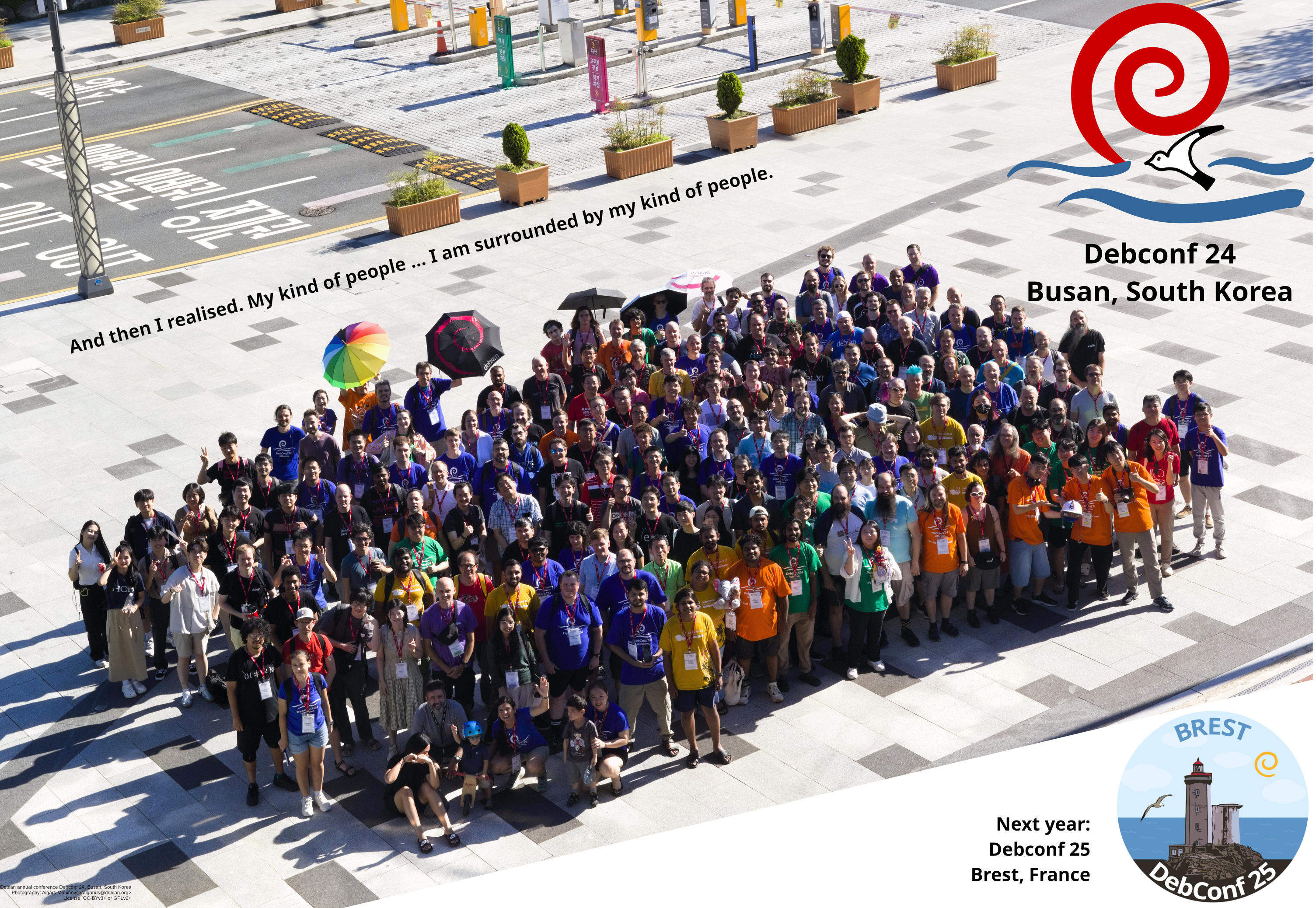
If one has to get the whole DebConf experience, it s better to attend DebCamp as well because that s when you can sit and interact with everyone better. As DebConf starts, everyone gets busy in various talks and events and things take a pace. DebConf days literally fly. This year, attending DebConf in person was a different experience. Attending DebConf without any organizational work/stress so was better, and I was able to understand working of different Debian team and workflows better while also identified a few where I would like to join and help. A general conclusion was that almost all Debian teams needs more folks to help out. So if someone want to join, they can probably reach out to the team, and would be able to onboard new folks. Though this would require some patience. Kudos to the Korean team who were able to pull off this event under this tight timeline and thanks for all the hospitality. DebConf24 Group Photo
DebConf24 Group Photo. Click to enlarge.
Credits - Aigars Mahinovs
This whole experience expanded my world view. There s so much to see and explore and understand. Looking forward to DebConf25 in Brest, France. PS - Shoutout to abbyck (aka hamCK)!

Russ Allbery: Review: Thornhedge

Review: Thornhedge, by T. Kingfisher
Publisher: Tor
Copyright: 2023
ISBN: 1-250-24410-2
Format: Kindle
Pages: 116
Thornhedge is a fantasy novella by T. Kingfisher, the pen name that Ursula Vernon uses for her adult writing. It won the 2024 Hugo Award for best novella. No matter how much my brain wants to misspell the title, it is a story about a hedge, not a Neolithic earthwork.
The fairy was the greenish-tan color of mushroom stems and her skin bruised blue-black, like mushroom flesh. She had a broad, frog-like face and waterweed hair. She was neither beautiful nor made of malice, as many of the Fair Folk are said to be.
There is a princess asleep in a tower, surrounded by a wall of thorns. Toadling's job is to keep anyone from foolishly breaking in. At first, it was a constant struggle and all that she could manage, but with time, the flood of princes slowed to a trickle. A road was built and abandoned. People fled. There was a plague. With any luck, the tower was finally forgotten. Then a knight shows up. Not a very rich knight, nor a very successful knight. Just a polite and very persistent knight who wants to get into the tower that Toadling does not want him to get into. As you might have guessed, this is a Sleeping Beauty retelling. As you may have also guessed from the author, or from the cover text that says "not all curses should be broken," this version is a bit different. How and why it departs from the original is a surprise that slowly unfolds over the course of the story, in parallel to a delicate, cautious, and delightfully kind-hearted conversation between the knight and the fairy. If you have read a T. Kingfisher story before, particularly one of her fractured fairy tales, you know what to expect. Toadling is one of her typical well-meaning, earnest, slightly awkward protagonists who is just trying to do the right thing in a confusing world full of problems and dangers. She's constantly overwhelmed and yet she keeps going, because what else is there to do. Like a lot of Kingfisher's writing, it's a story about quiet courage from someone who doesn't consider herself courageous. One of the twists this time is that the knight is a character from a similar vein: doggedly unwilling to leave any problem alone, but equally determined to try to be kind. The two of them together make for a story with a gentle and rather melancholy tone. We do, eventually, learn the whole backstory of the tower, the wall of thorns, and Toadling. There is a god, a rather memorable one, who is frustratingly cryptic in the way that gods are. There are monsters who are more loving than most humans. There are humans who turn out to be surprisingly decent when it matters. And, like most of Kingfisher's writing, there is a constant awareness of how complicated the world is, how full it is of people who are just trying to get through each day, and how heavy of burdens people can shoulder when they don't see another way. This story pulled me right in. It is not horror, although there are a few odd bits like there always are in Kingfisher stories. Your largest risk as a reader is that it might make you cry if stories about earnest people doing their best in overwhelming situations hit you that way. My primary complaint is that there was nowhere near enough ending for me. After everything I learned about the characters, I wanted to spend some time with them outside of the bounds of the story. Kingfisher points the reader in a direction and then leaves the rest to your imagination, and I can see why she chose that story construction, but I wanted more catharsis than I got. That complaint aside, this is quintessential T. Kingfisher, and I am unsurprised that it won a Hugo. If you've read any of her other fractured fairy tales, or the 2023 Hugo winner for best novel, you know the sort of stories she tells, and you probably know whether you will like this. I am one of the people who like this. Rating: 8 out of 10

29 August 2024

Jonathan Carter: Orphaning bcachefs-tools in Debian

Around a decade ago, I was happy to learn about bcache a Linux block cache system that implements tiered storage (like a pool of hard disks with SSDs for cache) on Linux. At that stage, ZFS on Linux was nowhere close to where it is today, so any progress on gaining more ZFS features in general Linux systems was very welcome. These days we care a bit less about tiered storage, since any cost benefit in using anything else than nvme tends to quickly evaporate compared to time you eventually lose on it. In 2015, it was announced that bcache would grow into its own filesystem. This was particularly exciting and it caused quite a buzz in the Linux community, because it brought along with it more features that compare with ZFS (and also btrfs), including built-in compression, built-in encryption, check-summing and RAID implementations. Unlike ZFS, it didn t have a dkms module, so if you wanted to test bcachefs back then, you d have to pull the entire upstream bcachefs kernel source tree and compile it. Not ideal, but for a promise of a new, shiny, full-featured filesystem, it was worth it. In 2019, it seemed that the time has come for bcachefs to be merged into Linux, so I thought that it s about time we have the userspace tools (bcachefs-tools) packaged in Debian. Even if the Debian kernel wouldn t have it yet by the time the bullseye (Debian 11) release happened, it might still have been useful for a future backported kernel or users who roll their own. By total coincidence, the first git snapshot that I got into Debian (version 0.1+git20190829.aa2a42b) was committed exactly 5 years ago today. It was quite easy to package it, since it was written in C and shipped with a makefile that just worked, and it made it past NEW into unstable in 19 January 2020, just as I was about to head off to FOSDEM as the pandemic started, but that s of course a whole other story. Fast-forwarding towards the end of 2023, version 1.2 shipped with some utilities written in Rust, this caused a little delay, since I wasn t at all familiar with Rust packaging yet, so I shipped an update that didn t yet include those utilities, and saw this as an opportunity to learn more about how the Rust eco-system worked and Rust in Debian. So, back in April the Rust dependencies for bcachefs-tools in Debian didn t at all match the build requirements. I got some help from the Rust team who says that the common practice is to relax the dependencies of Rust software so that it builds in Debian. So errno, which needed the exact version 0.2, was relaxed so that it could build with version 0.4 in Debian, udev 0.7 was relaxed for 0.8 in Debian, memoffset from 0.8.5 to 0.6.5, paste from 1.0.11 to 1.08 and bindgen from 0.69.9 to 0.66. I found this a bit disturbing, but it seems that some Rust people have lots of confidence that if something builds, it will run fine. And at least it did build, and the resulting binaries did work, although I m personally still not very comfortable or confident about this approach (perhaps that might change as I learn more about Rust). With that in mind, at this point you may wonder how any distribution could sanely package this. The problem is that they can t. Fedora and other distributions with stable releases take a similar approach to what we ve done in Debian, while distributions with much more relaxed policies (like Arch) include all the dependencies as they are vendored upstream. As it stands now, bcachefs-tools is impossible to maintain in Debian stable. While my primary concerns when packaging, are for Debian unstable and the next stable release, I also keep in mind people who have to support these packages long after I stopped caring about them (like Freexian who does LTS support for Debian or Canonical who has long-term Ubuntu support, and probably other organisations that I ve never even heard of yet). And of course, if bcachfs-tools don t have any usable stable releases, it doesn t have any LTS releases either, so anyone who needs to support bcachefs-tools long-term has to carry the support burden on their own, and if they bundle it s dependencies, then those as well. I ll admit that I don t have any solution for fixing this. I suppose if I were upstream I might look into the possibility of at least supporting a larger range of recent dependencies (usually easy enough if you don t hop onto the newest features right away) so that distributions with stable releases only need to concern themselves with providing some minimum recent versions, but even if that could work, the upstream author is 100% against any solution other than vendoring all its dependencies with the utility and insisting that it must only be built using these bundled dependencies. I ve made 6 uploads for this package so far this year, but still I constantly get complaints that it s out of date and that it s ancient. If a piece of software is considered so old that it s useless by the time it s been published for two or three months, then there s no way it can survive even a usual stable release cycle, nevermind any kind of long-term support. With this in mind (not even considering some hostile emails that I recently received from the upstream developer or his public rants on lkml and reddit), I decided to remove bcachefs-tools from Debian completely. Although after discussing this with another DD, I was convinced to orphan it instead, which I have now done. I made an upload to experimental so that it s still available if someone wants to work on it (without having to go through NEW again), it s been removed from unstable so that it doesn t migrate to testing, and the ancient (especially by bcachefs-tools standards) versions that are in stable and oldstable will be removed too, since they are very likely to cause damage with any recent kernel versions that support bcachefs. And so, my adventure with bcachefs-tools comes to an end. I d advise that if you consider using bcachefs for any kind of production use in the near future, you first consider how supportable it is long-term, and whether there s really anyone at all that is succeeding in providing stable support for it.

Michael Ablassmeier: proxmox backup S3 proxy

A few weeks ago Tiziano Bacocco started a small project to implement a (golang) proxy that allows to store proxmox backups on S3 compatible storage: pmoxs3backuproxy, a feature which the current backup server does not have. I wanted to have a look at the Proxmox Backup Server implementation for a while, so i jumped on the wagon and helped with adding most of the API endpoints required to seamlessly use it as drop-in replacement in PVE. The current version can be configured as storage backend in PVE. You can then schedule your backups to the S3 storage likewise. It now supports both the Fixed index format required to create virtual machine backups and the Dynamic index format, used by the regular proxmox-backup-client for file and container backups. (full and incremental) The other endpoints like adding notes, removing or protecting backups, mounting images using the PVE frontend (or proxmox-backup-client) work too. It comes with a garbage collector that does prune the backup storage if snapshots expire and runs integrity checks on the data. You can also configure it as so called remote storage in the Proxmox Backup server itself and pull back complete buckets using proxmox-backup-manager pull , if your local datastore crashes. I think it will become more interesting if future proxmox versions will allow to push backups to other stores, too.

27 August 2024

Russ Allbery: Review: Dark Horse

Review: Dark Horse, by Michelle Diener
Series: Class 5 #1
Publisher: Eclipse
Copyright: June 2015
ISBN: 0-9924559-3-6
Format: Kindle
Pages: 366
Dark Horse is a science fiction romance novel, the first of a five book series as of this writing. It is self-published, although it is sufficiently well-edited and packaged that I had to do some searching to confirm that. Rose was abducted by aliens. The Tecrans picked her up along with a selection of Earth animals, kept her in a cell in their starship, and experimented on her. As the book opens, she has managed to make her escape with the aid of an AI named Sazo who was also imprisoned on the Tecran ship. Sazo dealt with the Tecrans, dropped the ship in the middle of Grih territory, and then got Rose and most of the animals on shuttles to a nearby planet. Dav Jallan is the commander of the ship the Grih sent to investigate the unexplained appearance of a Class 5 Tecran warship in the middle of their territory. The Grih and the Tecran, along with three other species, are members of the United Council, which means in theory they're all at peace. With the Tecran, that theory is often strained. Dav is not going to turn down one of their highly-advanced Class 5 warships delivered to him on a silver platter. There is only the matter of the unexpected cargo, the first orange dots (indicating unknown life forms) that most of the Grih have ever seen. There is a romance. That romance did not work for me. I thought it was highly unprofessional on Dav's part and a bit too obviously constructed on the author's part. It also leans on the subgenre convention that aliens can be remarkably physically similar and sexually compatible, which always causes problems for my suspension of disbelief even though I know it's no less plausible than faster-than-light travel. Despite that, I had so much fun with this book! It was absolutely delightful and weirdly grabby in a way that caught me by surprise. I was skimming some parts of it to write this review and found myself re-reading multiple pages before I dragged myself back on task. I think the most charming part of this book is that the United Council has a law called the Sentient Beings Agreement that makes what the Tecran were doing extremely illegal, and the Grih and the other non-Tecran aliens take this very seriously and with a refreshing lack of cynicism. Rose has a typical human reaction to ending up in a place where she doesn't know the rules and isn't entirely an expected guest. She almost reflexively smoothes over miscommunications and tensions, trying to adapt to their expectations. And then, repeatedly, the Grih realize how much work she's doing to adapt to them, feel enraged at the Tecran and upset that they didn't understand or properly explain something, and find some way to make Rose feel more comfortable. It's surprisingly soothing and comforting to read. It occurred to me in several places that Dark Horse could be read as a wish-fulfillment fantasy of what life as a woman could be like if men took their fair share of the mental load. (This concept is usually applied to housework, but I think it generalizes to other social and communication contexts.) I suspect this was not an accident. There is a lot of wish fulfillment in this book. The Grih are very human-like but hunky, which is convenient for the romance subplot. They struggle to sing, value music exceptionally highly, and consider Rose's speaking voice beautifully musical. Her typical human habit of singing to herself is a source of immediate and almost overwhelming fascination. The supplies Rose takes from the Tecran ship when she flees just happen to be absurdly expensive scented shampoo and equally expensive luxury adaptable clothing. The world she lands on, and the Grih ship, are low-gravity compared to Earth, so Rose is unusually strong for her size. Grih military camouflage has no effect on her human vision. The book is set up to make Rose special. If that type of wish fulfillment is going to grate, wait on this book until you're more in the mood for it. But I like wish fulfillment books when they're done well. Part of why I like to read is to imagine a better world. And Rose isn't doted on; despite their hospitality, she's constantly underestimated by the Grih. Even with their deep belief in the Sentient Beings Agreement, they find it hard to believe that an unknown sentient, even an advanced sentient, is really their equal. Their concern at the start is somewhat patronizing, so watching Rose constantly surprise them delighted the part of my brain that likes both competence porn and deserved reversals, even though the competence here is often due to accidents of biology. It helps that Diener tells the story in alternating perspectives, so the reader first watches Rose do something practical and straightforward from her perspective and then gets to enjoy the profound surprise and chagrin of the aliens. There is a plot beneath this first contact story, and beyond the political problem of figuring out what to do with Rose and the Tecran. Sazo, Rose's AI friend, does not want the Grih to know he exists. He has a history that Rose does not know about and may not be entirely safe. As the political situation with the Tecran escalates, Sazo is pursuing goals of his own, and Rose has a firm opinion about where her loyalties should lie. The resolution is nothing ground-breaking as far as SF goes, but I thought it was satisfyingly tense and complex. Dark Horse leaves obvious room for a sequel, but it comes to a satisfying conclusion. The writing is serviceable, particularly once you get into the story. I would not call it great, and it's not going to win any literary awards, but it didn't interfere with my enjoyment of the story. This is not the sort of book that will make anyone's award list, but it is easily in the top five of books I had the most fun reading this year. Maybe save it for when you're looking for something light and wholesome and don't mind some rather obvious tropes, but if you're in the mood for imagining people who take laws seriously and sincerely try to help other people, I found this an utterly delightful way to pass the time. I immediately bought the sequel. Recommended. Followed by Dark Deeds. Rating: 8 out of 10

25 August 2024

Thomas Lange: Custom Live Media, also for Newer Hardware

At this years Debian conference in South Korea I've presented1 the new feature of the FAIme web service. You can now build your own Debian live media/ISO. The web interface provides various settings, for e.g. adding a user name and its password, selecting the Debian release (stable or testing), the desktop environment and the language. Additionally you can add your own list of packages, that will be installed into the live environment. It's possible to define a custom script that gets executed during the boot process. For remote access to the live system, you can easily sepcify a github, gitlab or salsa account, whose public ssh key will be used for passwordless root access. If your hardware needs special grub settings, you may also add those. I'm thinking about adding an autologin checkbox, so the live media could be used for a kiosk system. And finally newer hardware is supported with the help of the backports kernel for the Debian stable release (aka bookworm). This combination is not available from the official Debian live images or the netinst media because the later has some complicated dependencies which are not that easy to resolve2. At DebConf24 I've talked to Alper who has some ideas3 how to improve the Debian installer environment which then may support a backports kernel. The FAI web service for live ISO is available at https://fai-project.org/FAIme/live

24 August 2024

Jonathan Dowland: Fediverse and feeds

It's clear that Twitter has been circling the drain for years, but things have been especially bad in recent times. I haven't quit (I have some sympathy with the viewpoint don't cede territory to fascists) but I try to read it much less, and I certainly post much less. Especially at the moment, I really appreciate distractions. Last time I wrote about Mastodon (by which I meant the Fediverse1), I was looking for a new instance to try. I settled on Debian's social instance2. I'm now trying to put any energy I might spend engaging on Twitter, into engaging in the Fediverse instead. (You can follow me via the handle @jon@dow.land, I think, which should repoint to my actual handle, @jmtd@pleroma.debian.social.) There are other potential successors to Twitter: two big ones are Bluesky and Facebook-owned Threads. They are effectively cookie-cutter copies of the Twitter model, and so, we will repeat the same mistakes there. Sadly I see the majority of communities and sub-cultures I follow are migrating to one or the other of these. The Fediverse (or the Mastodon-ish bits of it) should avoid the fate of Twitter. JWZ puts it better and more succinctly than I can. The Fedi experience is, sadly, pretty clunky. So I want to try and write a bit from time to time with tips and tricks that might improve people's experiences. First up, something I discovered only today about Mastodon instances. As JWZ noted, If you are worried about picking the "right" Mastodon instance, don't. Just spin the wheel.. You can spend too much time trying to guess a good answer to this. Better to just get started. At the same time, individual instances are supposed to cater to specific niches. So it could be useful to sample the public posts from an entire instance. For example, to find people to follow, or decide to hop over to that instance yourself. You can't (I think) follow an entire instance from within yours, but, they usually have a public page which shows you the latest traffic. For example, the infosec-themed instance infosec.exchange has one here: https://infosec.exchange/public/local These pages don't provide RSS or Atom feeds3, sadly. I hope that's on the software's roadmap, and hasn't been spurned for ideological reasons. For now at least, OpenRSS provide RSS/Atom feeds for many Mastodon instances. For example, an RSS/Atom feed of the above: https://openrss.org/infosec.exchange/public/local One can add these feeds to your Feed reader and over time get a flavour for the kind of discourse that takes place on given instances. I think the OpenRSS have to manually add Mastodon instances to their service. I tried three instances and only one (infosec.exchange) worked. I'm not sure but I think trying an instance that doesn't work automatically puts it on OpenRSS's backlog.

  1. the Fediverse-versus-Mastodon nomenclature problem is just the the tip of the iceberg, in terms of adoption problems. Mastodon provides a twitter-like service that participates in the Fediverse. But it isn't correct to call the twitter-like service "Mastodon" because other softwares also participate in/provide that service. And it's not correct to call it "Fediverse" because that describes a bigger thing, with e.g. youtube clones also taking part. I'm not sure what the right term should be for "the twitter-like thing". Also, everything I wrote here is probably subtly wrong.
  2. Debian's instance actually runs Pleroma, an alternative to Mastodon. Why should it matter? I think it's healthy for there to be more than one implementation in an open ecosystem. However the experience can be janky, as the features don't perfectly align, some Mastodon features/APIs are not documented/standardised/etc.
  3. I have to remind myself that the concept of RSS/Atom feeds and Feedreaders might need explaining to a modern audience too. Perhaps in another blog post.

Russell Coker: Wifi 6E Mesh

I am looking into getting a Wifi mesh network. The aim is to use it for providing access to devices through my home especially for devices on the congested 2.4GHz frequency. Ideally I want 6GHz Wifi6E for the communication between mesh nodes as well as for talking to the few devices that are new enough to support it (I like buying cheap second hand devices). 2.5Gbit ethernet connections on all mesh nodes would be good too. Wifi 7 is semi-released, you can buy devices even though the specs aren t entirely finalised. I expect that next year when Wifi 7 devices are more common the second hand prices of Wifi 6E will drop. Currently Wifi 6E devices are somewhat expensive. One major problem at the moment is cloud configuration . Here is a 41 page forum thread of TP-Link customers asking in vain for non-cloud configuration [1]. The problems with cloud configuration are that it doesn t allow configuration without Internet access (so no fixing things when internet breaks and no use for a private network without Internet), it relies on a proprietary phone app (so a problem with your phone breaks everything), and it adds a dependency on an unpaid service that TP-Link might decide to turn off at some future time. The TP -Link Deco X55 AX3000 looks like a good set of devices, it currently costs $328 for a set of three Wifi 6 (not 6E) devices is a good deal, pity that the poor software options let it down. TP-Link also seems to be scanning web traffic and sending the analysis to an external site [2], it seems to be operating as malware. The TP-Link software seems to be most accurately described as malware. There is the OpenWrt project for open firmware on Wifi APs which is a great project [3] but it doesn t seem to support any Wifi 6 mesh systems yet. If most Wifi hardware requires malware for operation it seems that running a VPN over Wifi is the way to go. A hostile party being able to sniff your home network is much worse than a hostile party sniffing public Internet traffic. The Google Nest mesh devices have good specs and price, $359 for a three node Wifi 6E mesh that has 2.5Gbit ethernet. But they can only be configured with a Google app for Android or iOS and require a Gmail account. Giving Google the ability to shut down all my stuff by deleting my gmail account is not acceptable. Also Google is well known for cancelling services [4]. A mitigating factor is that there should be enough of those devices sold to make them a good target for an OpenWRT port. As an aside it looks like the TailScale mesh VPN system could be a solution to the security issues related to malware on Wifi APs problem [5]. There is also HeadScale which is the fully open source variant of that [6]. Even when the vendor isn t overtly hostile they can make mistakes so encryption is good. Kogan is selling an own-brand Wifi 6 mesh network package that comes with 1/2/3 devices for $70/$120/$140. It doesn t do Wifi 6E but supports the better encoding methods of Wifi 6 over Wifi 5 and will be good for bridging a LAN in one part of a house to a Wifi 2.4GHz or Ethernet connected device in another part. They also support up to 7 nodes so you could buy two of the 3 device packages and run one network with 2 and another with 4. The pricing is very competitive and they support web based administration! I ve just ordered the $140 Wifi 6 pack from Kogan. If it doesn t do what I want then I can find someone else who will be happy with whatever functionality it gives and $140 is an amount I can risk without concern. If it works well then I might upgrade to Wifi 6E or Wifi 7 next year and deploy the Wifi 6 one for a relative. It seems that for my needs a cheap and OK Wifi 6 device is better than an expensive Wifi 6E device.

Russell Coker: Is Secure Boot Worth Using?

With news like this one cited by Bruce Schneier [1] people are asking whether it s worth using Secure Boot. Regarding the specific news article, this is always a risk with distributed public key encryption systems. Lose control of one private key and attackers can do bad things. That doesn t make it bad it just makes it less valuable. If you want to setup a system for a government agency, bank, or other high value target then it s quite reasonable to expect an adversary to purchase systems of the same make and model to verify that their attacks will work. If you want to make your home PC a little harder to attack then you can expect that the likely adversaries won t bother with such things. You don t need security to be perfect, making a particular attack slightly more difficult than other potential attacks gives a large part of the benefit. The purpose of Secure Boot is to verify the boot loader with a public key signature and then have the boot loader verify the kernel. Microsoft signs the shim that is used by each Linux distribution to load GRUB (or another boot loader). So when I configure a Debian system with Secure Boot enabled that doesn t stop anyone from booting Ubuntu. From the signatures on the boot loader etc there is no difference from my Debian installation and a rescue image from Debian, Ubuntu, or another distribution booted by a hostile party to do things against my interests. The difference between the legitimate OS image and malware is a matter of who boots it and the reason for booting it. It is possible to deconfigure Microsoft keys from UEFI to only boot from your own key, this document describes what is necessary to do that [2]. Basically if you boot without using any option ROMs (which among other things means the ROM from your video card) then you can disable the MS keys. If it s impossible to disable the MS keys that doesn t make it impossible to gain a benefit from the Secure Boot process. You can use a block device decryption process that involves a signature of the kernel and the BIOS being used as part of the decryption for the device. So if a system is booted with the wrong kernel and the user doesn t recognise it then they will find that they can t unlock the device with the password. I think it s possible on some systems to run the Secure Boot functionality in a non-enforcing mode such that it will use a bootloader without a valid signature but still use the hash for TPM calculations, that appears impossible on my Thinkpad Yoga Gen3 which only has enabled and disabled as options but should work on Dell laptops which have an option to run Secure Boot in permissive mode. I believe that the way of the future is to use something like EFIStub [3] to create unified kernel images with a signed kernel, initrd, and command-line parameters in a single bundle which can be loaded directly by the UEFI BIOS. From the perspective of a distribution developer it s good to have many people using the current standard functionality of shim and GRUB for EFI as a step towards that goal. CloudFlare has a good blog post about Linux kernel hardening [4]. In that post they cover the benefits of a full secure boot setup (which is difficult at the current time) and the way that secure boot enables the lockdown module for kernel integrity. When Secure Boot is detected by the kernel it automatically enables lockdown=integrity functionality (see this blog post for an explanation of lockdown [5]). It is possible to enable this by putting lockdown=integrity on the kernel command line or lockdown=confidentiality if you want even more protection, but it happens by default with Secure Boot. Secure Boot is something you can set to get a selection of security features enabled and get a known minimum level of integrity even if the signatures aren t used for anything useful, restricting a system to only boot kernels from MS, Debian, Ubuntu, Red Hat, etc is not useful. For most users I think that Secure Boot is a small increase in security but testing it on a large number of systems allows increasing the overall security of operating systems which benefits the world. Also I think that having features like EFIStub usable for a large portion of the users (possibly the majority of users) is something that can be expected to happen in the lifetime of hardware being purchased now. So ensuring that Secure Boot works with GRUB now will facilitate using EFIStub etc in future years. The Secure Boot page on the Debian wiki is worth reading, and also worth updating for people who want to contribute [6].

22 August 2024

Jonathan McDowell: Thoughts on Advent of Code + Rust

Diego wrote about his dislike for Advent of Code and that reminded me I hadn t written up my experience from 2023. Mostly because, spoiler, I never actually completed it and always intended to do so and then write it up. I think it s time to accept I m not going to do that, and write down some thoughts before I forget all of them. These are somewhat vague, given the time that s elapsed, but I think still relevant. You might also find Roger s problem write up interesting. I ve tried AoC a couple of times before; I think I had a very brief attempt back in 2021, and I got 4 days in for 2022. For Advent of Code 2023 I tried much harder to actually complete the challenges, and got most of the way there. I didn t allow myself to move on to the next day until fully completing the previous day, and didn t end up doing the second half of December 24th, or any of December 25th.

Rust First I want to talk about Rust, which is the language I chose to use for the problems. I ve dabbled a little in it, but I d like more familiarity with the basic language, and some programming problems seemed like a good way to get that. It s a language I want to like; I ve spent a lot of my career writing C, do more in Go these days, and generally think Rust promises a low level, run-time light environment like C but with the rough edges taken off. I set myself the challenge of using just bare Rust; no external crates, no use of cargo. I was accused of playing on hard mode by doing this, but it really wasn t the intention - I figured that I should be able to do what I needed without recourse to anything outside the core language, and didn t want what seemed like the extra complexity of dealing with cargo. That caused problems, however. I m used to by-default generic error handling in Go through the error type, but Rust seems to have much more tightly typed errors. I was pointed at anyhow as the right way to do this in Rust. I still find this surprising; I ended up using unwrap() a lot when I think with more generic error handling I could have used ?. The other thing I discovered is that by default rustc is heavy on the debug output. I got significantly better results on some of the solutions with rustc -O -C target-cpu=native source.rs. I probably shouldn t be surprised by this, but worth noting. Rust, to me, has a syntax only a C++ programmer could love. I am not a C++ programmer. Coming from C I found Go to be a nice, simple syntax to learn. Rust has not been the same. There s a lot more punctuation, and it s not always clear to me what it s doing. This applies more when reading other people s code than when writing it myself, obviously, but I see a lot of Rust code that could give Perl a run for its money in terms of looking like line noise. The borrow checker didn t bug me too much, but did add overhead to my thinking. The Rust compiler is generally very good at outputting helpful error messages when the programmer is an idiot. I ended up having to use a RefCell for one solution, and using .iter() for loops rather than explicit iterators (why, why is this different?). I also kept forgetting to explicitly mark variables as mutable when declaring them. Things I liked? There s a rich set of first class data types. Look, I m a C programmer, I m easily pleased. You give me some sort of hash array and I ll be happy. Rust manages that, tuples, strings, all the standard bits any modern language can provide. The whole impl thing for adding methods to structures I like as a way of providing some abstraction, though I think Go has a nicer syntax for it. The compiler, as mentioned, is great at spitting out useful errors for the most part. Also although I wasn t using external crates for AoC I do appreciate there s a decent ecosystem there now (though that brings up another gripe: rust seems to still be a fairly fast moving target, to the extent I can no longer rely on the compiler in Debian stable to be able to compile random projects I find).

Advent of Code Let s talk about the advent of code bit now. Hopefully it s long enough since it came out that this won t be spoilers for anyone, but if you haven t attempted the 2023 AoC and might, you might want to stop reading here. First, a refresher on the format for those who might not be aware of it. Problems are posted daily from December 1st until the 25th. Each is in 2 parts; the second part is not viewable until you have provided the correct answer for the first part. There s a whole leaderboard thing going on, but the puzzle opens at midnight UTC-5 so generally by the time I wake up and have time to look the problem has been solved many times over; no chance of getting listed. Credit to AoC creator, Eric Wastl, for writing up the set of problems in an entertaining fashion. I quite enjoyed seeing how the puzzle would be phrased each day, and the whole thing obviously brings a lot of joy to folk I know. I always start AoC thinking it ll be a fun set of puzzles to solve. Then something happens and I miss a day or two, and all of a sudden I ve a bunch of catching up to do and it s all a bit more of a chore. I hit that at some points this time, but made a concerted effort to try and power through it. That perseverance was required up front, because I found the second part of Day 1 to be ill specified, and had to iterate a few times to actually calculate the desired solution (IIRC, issues about whether sevenone at the end of a line ended up as 7 or 1 really tripped me up). I don t recall any other problems that bit me as hard on the specification as this one, but it happening up front was unfortunate. The short example input doesn t always help with this either; either it s not enough to be able to extrapolate patterns, or it doesn t show all the variations you need to account for (that aren t fully specified in the text), or in a few cases it turned out I needed to understand the shape of the actual data to produce a solution that could actually complete in a reasonable time. Which brings me to another matter, sometimes brute force doesn t actually work. This is fine, but the second part of the day s problem can change the approach you d take. So sometimes I got lucky in the way I handled the first half, and doing the second half was a simple 5 minute tweak, and sometimes I had to entirely change the way I was storing data. You might claim that if I was a better programmer I d have always produced a first half solution that was amenable to extension for the second half. First, I dispute that; I think there are always situations where the problem domain can change in enough directions that you can t handle all of them without a lot of effort. Secondly, I didn t find AoC an environment that encouraged me to optimise for generic solutions. Maybe some of the puzzles in isolation would allow for that, but a month of daily problems to solve while still engaging in regular life meant I hacked things up, took short cuts based on the knowledge I had of the input data, etc, etc. Overall I can see the appeal, but the sheer quantity and the fact I write code as part of my day job just made it feel too much like a chore, rather than a fun mental exercise. I did wonder how they d look as a set of interview puzzles (obviously a subset, rather than all of them), but I m not sure how you d actually use them for that - I wouldn t want anyone to have to solve them in a live interview. So, in case it s not obvious, I m not planning to engage in AoC again this yet. But I m continuing to persevere with Rust (though most of my work stuff is thankfully still Go).

Debian Brasil: Debian Day 2024 em Natal/RN - Brasil

por Allythy O Debian Day um evento anual que celebra o anivers rio do Debian, uma das distribui es GNU/Linux mais importante do Software Livre, criada em 16 de Agosto de 1993, por Ian Murdock. No ltimo s bado (17/08/2024) no Sebrae-RN comemoramos os 31 anos Debian em Natal, no Rio Grande do Norte. A celebra o, foi organizada pela PotiLivre(Comunidade Potiguar de Software Livre), destacou os 31 anos de hist ria do Debian. O evento contou com algumas palestras e muitas discuss es sobre Software Livre. Tivemos 70 inscri es, 40 estiverem presentes. O Debian Day em Natal foi uma ocasi o para celebrar a trajet ria do Debian e refor ar a import ncia do Software Livre. Palestrantes Agradecemos imensamente a Isaque Barbosa Martins, Eduardo de Souza Paix o, Fernando Guisso,que palestraram nessa edi o! Obrigado por compartilhar tanto conhecimento com a comunidade. Esperamos ver voc s novamente em futuros encontros! foto da palestra conhecendo projeto Debian Link dos slides do Debian Day Participantes Um grande obrigado tamb m a todos os participantes, n s fazemos isso por voc s! Esperamos que tenham aprendido, se divertido e feito novas conex es entre a comunidade Participantes do Debian Day Natal-RN Essa edi o do Debina Day Natal foi organizada por: Allythy, Clara Nobre, Gabriel Damazio e Marcel Ribeiro.

Matthew Garrett: What the fuck is an SBAT and why does everyone suddenly care

Short version: Secure Boot Advanced Targeting and if that's enough for you you can skip the rest you're welcome.

Long version: When UEFI Secure Boot was specified, everyone involved was, well, a touch naive. The basic security model of Secure Boot is that all the code that ends up running in a kernel-level privileged environment should be validated before execution - the firmware verifies the bootloader, the bootloader verifies the kernel, the kernel verifies any additional runtime loaded kernel code, and now we have a trusted environment to impose any other security policy we want. Obviously people might screw up, but the spec included a way to revoke any signed components that turned out not to be trustworthy: simply add the hash of the untrustworthy code to a variable, and then refuse to load anything with that hash even if it's signed with a trusted key.

Unfortunately, as it turns out, scale. Every Linux distribution that works in the Secure Boot ecosystem generates their own bootloader binaries, and each of them has a different hash. If there's a vulnerability identified in the source code for said bootloader, there's a large number of different binaries that need to be revoked. And, well, the storage available to store the variable containing all these hashes is limited. There's simply not enough space to add a new set of hashes every time it turns out that grub (a bootloader initially written for a simpler time when there was no boot security and which has several separate image parsers and also a font parser and look you know where this is going) has another mechanism for a hostile actor to cause it to execute arbitrary code, so another solution was needed.

And that solution is SBAT. The general concept behind SBAT is pretty straightforward. Every important component in the boot chain declares a security generation that's incorporated into the signed binary. When a vulnerability is identified and fixed, that generation is incremented. An update can then be pushed that defines a minimum generation - boot components will look at the next item in the chain, compare its name and generation number to the ones stored in a firmware variable, and decide whether or not to execute it based on that. Instead of having to revoke a large number of individual hashes, it becomes possible to push one update that simply says "Any version of grub with a security generation below this number is considered untrustworthy".

So why is this suddenly relevant? SBAT was developed collaboratively between the Linux community and Microsoft, and Microsoft chose to push a Windows update that told systems not to trust versions of grub with a security generation below a certain level. This was because those versions of grub had genuine security vulnerabilities that would allow an attacker to compromise the Windows secure boot chain, and we've seen real world examples of malware wanting to do that (Black Lotus did so using a vulnerability in the Windows bootloader, but a vulnerability in grub would be just as viable for this). Viewed purely from a security perspective, this was a legitimate thing to want to do.

(An aside: the "Something has gone seriously wrong" message that's associated with people having a bad time as a result of this update? That's a message from shim, not any Microsoft code. Shim pays attention to SBAT updates in order to avoid violating the security assumptions made by other bootloaders on the system, so even though it was Microsoft that pushed the SBAT update, it's the Linux bootloader that refuses to run old versions of grub as a result. This is absolutely working as intended)

The problem we've ended up in is that several Linux distributions had not shipped versions of grub with a newer security generation, and so those versions of grub are assumed to be insecure (it's worth noting that grub is signed by individual distributions, not Microsoft, so there's no externally introduced lag here). Microsoft's stated intention was that Windows Update would only apply the SBAT update to systems that were Windows-only, and any dual-boot setups would instead be left vulnerable to attack until the installed distro updated its grub and shipped an SBAT update itself. Unfortunately, as is now obvious, that didn't work as intended and at least some dual-boot setups applied the update and that distribution's Shim refused to boot that distribution's grub.

What's the summary? Microsoft (understandably) didn't want it to be possible to attack Windows by using a vulnerable version of grub that could be tricked into executing arbitrary code and then introduce a bootkit into the Windows kernel during boot. Microsoft did this by pushing a Windows Update that updated the SBAT variable to indicate that known-vulnerable versions of grub shouldn't be allowed to boot on those systems. The distribution-provided Shim first-stage bootloader read this variable, read the SBAT section from the installed copy of grub, realised these conflicted, and refused to boot grub with the "Something has gone seriously wrong" message. This update was not supposed to apply to dual-boot systems, but did anyway. Basically:

1) Microsoft applied an update to systems where that update shouldn't have been applied
2) Some Linux distros failed to update their grub code and SBAT security generation when exploitable security vulnerabilities were identified in grub

The outcome is that some people can't boot their systems. I think there's plenty of blame here. Microsoft should have done more testing to ensure that dual-boot setups could be identified accurately. But also distributions shipping signed bootloaders should make sure that they're updating those and updating the security generation to match, because otherwise they're shipping a vector that can be used to attack other operating systems and that's kind of a violation of the social contract around all of this.

It's unfortunate that the victims here are largely end users faced with a system that suddenly refuses to boot the OS they want to boot. That should never happen. I don't think asking arbitrary end users whether they want secure boot updates is likely to result in good outcomes, and while I vaguely tend towards UEFI Secure Boot not being something that benefits most end users it's also a thing you really don't want to discover you want after the fact so I have sympathy for it being default on, so I do sympathise with Microsoft's choices here, other than the failed attempt to avoid the update on dual boot systems.

Anyway. I was extremely involved in the implementation of this for Linux back in 2012 and wrote the first prototype of Shim (which is now a massively better bootloader maintained by a wider set of people and that I haven't touched in years), so if you want to blame an individual please do feel free to blame me. This is something that shouldn't have happened, and unless you're either Microsoft or a Linux distribution it's not your fault. I'm sorry.

comment count unavailable comments

Next.

Previous.