Search Results: "pm"

14 July 2021

Pavit Kaur: GSoC: First Phase of Coding Period

Hello there. I still can t believe that the first half of GSoC period is almost over. So it s been about 5 weeks working on the project and that means I have a lot to share about it. So without further ado, let s get started. coding-period-1 I will be listing up my work done in the respective tasks.

Task: Migrating Logins to Salsa The objective of this task was that the users could log in to their account on debci using their Debian Salsa account (collaborative development server for Debian based on the GitLab software) and this is implemented with the help of OmniAuth, the ruby authentication framework. At the beginning of this, I had to discuss quite a few issues with my mentors that I was bumping into, and by the end of it with multiple revisions and discussions, the following was implemented:
  • The previous users' table schema of debci comprises the username field which contained mostly the emails of the users with some exceptions and to accommodate the Salsa logins, a new uid field is added to the table to store the Salsa uid of the logged-in user with the username field storing Salsa usernames now and as the Salsa users have the liberty to change their usernames, the updation of username as well as in debci database is also taken care of.
  • For Salsa login, the ruby-omniauth-gitlab strategy has been used and for login in development mode, the developer strategy which comes with ruby-omniauth has been set up.
  • Added a Login Page giving the option to log in using Salsa and an additional option to login in Developer Mode which is accessible only in Development Setup so that other contributors don t have to set up dummy Salsa applications for working.
  • Added specs for the new login process. This was an interesting part, as I got the chance to understand RSpec and facilities provided by OmniAuth to mock the authentication for Integration Testing.
  • One blocker that I dealt with was that the Debian release from where packages were pulled out for debci have the OmniAuth version 1.8, which was not working well with the developer strategy implementation for the application so to resolve that I did a minor change to the callback API for developer strategy until the time that release have the newer version of OmniAuth.
  • Another thing we discussed in one of the meetings that in the existing database structure, the tests do not have a real reference to the users' table and rather the username is stored directly as a string for the requestor field, so this thing was fixed as part of this task.
The migration of the existing users' data for the new logins was handled by my mentor Antonio Terceiro and with this, our first task is concluded. All these changes are now part of Debian Continuous Integration platform and you can find the blogpost for same by Antonio here. This task also allowed me to write my first ever tutorial Tutorial: Integrating OmniAuth with Sinatra Application to help people looking to integrate their ruby application with OmniAuth. Moving further to the next task in progress.

Task: Adding support for testing security uploads and Debian LTS This is the next task I am working on enabling private tests in debci for adding support for testing security uploads and Debian LTS. Since it s a bigger task, it is broken down into about 6-7 steps and till now, the following has been done:
  • The schema of jobs' (tests) table is updated to have a boolean field to store whether the job is private or not.
  • The is_private parameter is added to both API and Self-Service section so the private test can be submitted through the API as well as through GUI form on the web platform.
  • Another thing which comes up through discussion in meetings that a parameter is required to add extra-apt-sources for getting packages of security repository and this is the part in progress.

So that concludes my work till now. It has been an amazing journey with lots of learning and also the guidance from the wonderful mentors of my project and I am looking forward to more exciting parts ahead. That s all for now. See you next time!

8 July 2021

Thorsten Alteholz: My Debian Activities in June 2021

FTP master This month I accepted 105 and rejected 6 packages. The overall number of packages that got accepted was 111. Debian LTS This was my eighty-fourth month that I did some work for the Debian LTS initiative, started by Raphael Hertzog at Freexian. This month my all in all workload has been almost 30h. During that time I did LTS and normal security uploads of: I also made further progress on gpac. Last but not least I did some days of frontdesk duties. Debian ELTS This month was the thirty-sixth ELTS month. During my allocated time I uploaded: Last but not least I did some days of frontdesk duties. Other stuff On my neverending golang challenge I again uploaded lots of packages either for NEW or as source upload.

7 July 2021

Vincent Fourmond: Upcoming features of QSoas and github repository

For the past years, most of the development has happened behind the scene in a private repository, and the code has appeared in the public repository only a couple of months before the release, in the release branch. I have now decided to publish the current code of QSoas in the github repository (in the public branch). This way, you can follow and use all the good things that were developed since the last release, and also verify whether any bug you have is still present in the currently developed version !

Upcoming features
This is the occasion to write a bit about the some of the features that have been added since the publication of the 3.0 release. Not all of them are polished nor documented yet, but here are a few teasers. The current version in github has: Check out the github repository if you want to know more about the new features !

As of now, no official date is planned for the 3.1 release, but this could happen during fall.

About QSoas
QSoas is a powerful open source data analysis program that focuses on flexibility and powerful fitting capacities. It is released under the GNU General Public License. It is described in Fourmond, Anal. Chem., 2016, 88 (10), pp 5050 5052. Current version is 3.0. You can download its source code there (or clone from the GitHub repository) and compile it yourself, or buy precompiled versions for MacOS and Windows there.

5 July 2021

B lint R czey: Hello zstd compressed .debs in Ubuntu!

When Julian Andres Klode and I added initial Zstandard compression support to Ubuntu s APT and dpkg in Ubuntu 18.04 LTS we planned getting the changes accepted to Debian quickly and making Ubuntu 18.10 the first release where the new compression could speed up package installations and upgrades. Well, it took slightly longer than that. Since then many other packages have been updated to support zstd compressed packages and read-only compression has been back-ported to the 16.04 Xenial LTS release, too, on Ubuntu s side. In Debian, zstd support is available now in APT, debootstrap and reprepro (thanks Dimitri!). It is still under review for inclusion in Debian s dpkg (BTS bug 892664). Given that there is sufficient archive-wide support for zstd, Ubuntu is switching to zstd compressed packages in Ubuntu 21.10, the current development release. Please welcome hello/2.10-2ubuntu3, the first zstd-compressed Ubuntu package that will be followed by many other built with dpkg (>= 1.20.9ubuntu2), and enjoy the speed!

4 July 2021

Pavit Kaur: Tutorial: Integrating OmniAuth with Sinatra Application

As part of my GSoC project, my first task includes that user could login into their account on debci using their Debian Salsa account (collaborative development server for Debian based on the GitLab software). The task is officially completed using OmniAuth library and while implementing it, I found that the documentation of OmniAuth is quite a mix-match and more focused on using it with Rails app and this gives me a idea to write a tutorial for people looking to integrate OmniAuth with Sinatra application. So here it is. Now, depending on the provider, Omniauth requires specific strategy which are generally released individually as RubyGems. For this tutorial, I would be using omniauth-gitlab which I used for Debian Salsa in my project, omniauth-twitter and a developer strategy which could be used for project in development mode and comes with omniauth gem itself. For simplicity purposes, I have included all routes and OmniAuth configurations in a single file app.rb. Let s start.

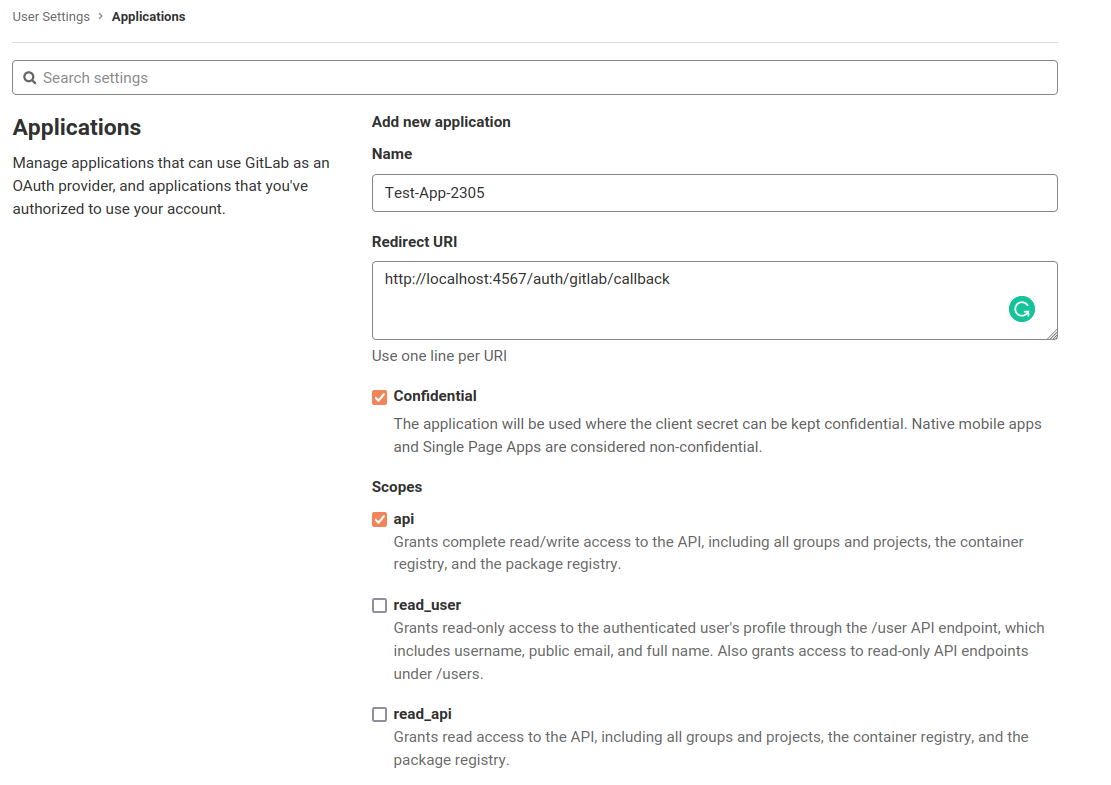
Register your application This can be easily done just head over to provider (Twitter, Salsa) website and find the option to create a new application and fill in the form. In the callback URL field, you need to append /auth/:provider/callback to whichever URL you used in the website field. tutorial-register-app The client-id and client-secret is obtained from the console which is used in further step to set up OmniAuth.

Gems At the top of the file, we require the necessary gems of for our project
require 'sinatra'
require 'omniauth'
require 'omniauth-gitlab'
require 'omniauth-twitter'

Enable sessions In order for OmniAuth to work and to store the logged in user across requests, sessions need to be activated and if activated, you have one session hash per user session.
configure do
    set :sessions, true
end

Set up OmniAuth configurations OmniAuth::Builder Rack middleware build up your list of OmniAuth strategies for use in your application:
use OmniAuth::Builder do
    if development?
      provider :developer,
               fields: [:name],
               uid_field: :name
    end
    provider :gitlab, #client-id , #client-secret,
             scope: "read_user",
             client_options:  
               site: 'https://salsa.debian.org/api/v4/'
              
    provider :twitter, #client-id , #client-secret,
end
Here, few things to note could be the extra options used with providers, as
In developer:
fields : to specify the form fields for login in developer mode and by default it has name and email.
uid_field: to specify that which field s value could be obtained as uid and by default it is email.
In gitlab:
scope: to limit the scope of application, by default, the api scope is requested and must be allowed in GitLab s application configuration.
client_options: to specify the server being used as client based on Gitlab software.
Note: In case you want to have a different callback url other than the default /auth/:provider/callback, it can be specified using redirect_url option in case of gitlab provider and accordingly update it in your Application Configuration at provider s console.

Extra configurations To redirect to auth/failure route in case of failure even in developer mode, following could be added:
OmniAuth.config.on_failure = proc do  env 
    OmniAuth::FailureEndpoint.new(env).redirect_to_failure
end
By default, OmniAuth will log to STDOUT but you can configure this. If you don t want OmniAuth to log to STDOUT, following could be used:
OmniAuth.config.logger.level = Logger::UNKNOWN

Setting up routes

Login route Starting with GET /login route, where you can specify the options available to login:
get '/login' do
    <<~HTML
    <form method='post' action='/auth/gitlab'>
    <input type="hidden" name="authenticity_token" value='# request.env["rack.session"]["csrf"] '>
    <button type='submit'>Login with Salsa</button>
    </form>
    <form method='post' action='/auth/twitter'>
    <input type="hidden" name="authenticity_token" value='# request.env["rack.session"]["csrf"] '>
    <button type='submit'>Login with Twitter</button>
    </form>
    <form method='post' action='/auth/developer'>
    <input type="hidden" name="authenticity_token" value='# request.env["rack.session"]["csrf"] '>
    <button type='submit'>Login with Developer</button>
    </form>
  HTML
end
The auth/:provider path is created and configured automatically by OmniAuth, so you just need to send the request to that paths and auth process will start.
As per the OmniAuth version 2.0, OmniAuth now defaults to only POST as allowed request_phase methods and authenticity_token is required to validate your requests so make sure to take care of this.
Callback routes: On success from authentication, Omniauth will return the hash of information to the auth/:provider/callback in the Rack environment under the key omniauth.auth so this is what you can use in your desired way like creating a entry to your database and storing the current user in session params.
get '/auth/:provider/callback' do
    erb "
    <h1>Hello # request.env['omniauth.auth']['info']['name'] </h1>"
end
post '/auth/developer/callback' do
    erb "
    <h1>Hello # request.env['omniauth.auth']['info']['name'] </h1>"
end
Here, POST request method is used for developer strategy and GET request method for twitter and gitlab as that is how their working is defined in their respective strategies.
Failure route: If user authentication fails on the provider side, OmniAuth will catch the response and then redirect the request to the path /auth/failure, passing a corresponding error message in a parameter named message.
get '/auth/failure' do
    halt(403, erb("<h2>Authentication Failed</h2><h4>Reason: </h4><pre># params[:message] </pre>"))
end

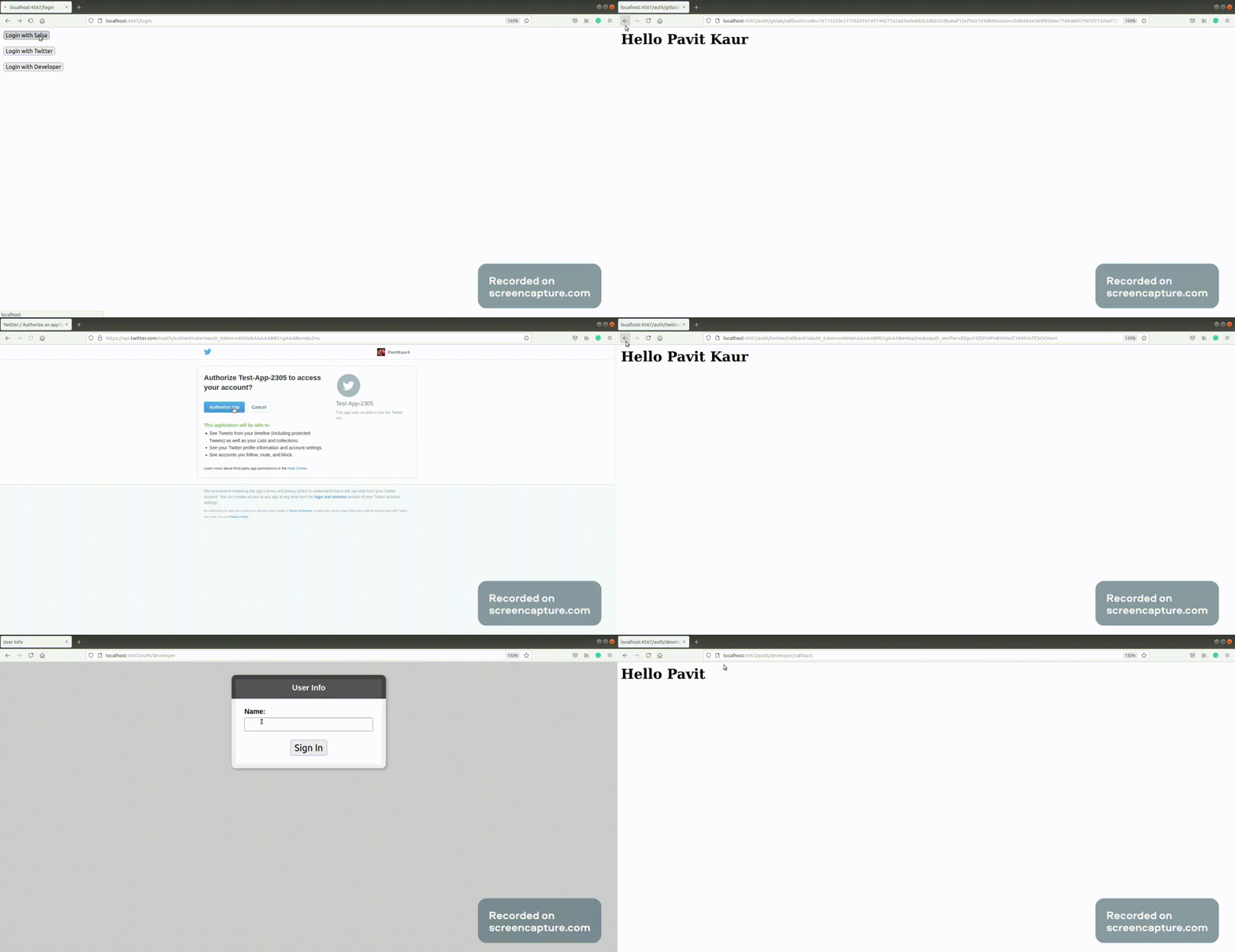
Final result That s it, our application is all set to be tested. And this is how it will be working. Tutorial Here, I have already logged into my respective accounts so page for entring credentials does not show up but if the user has not logged into his account, he would be first asked to log in. For complete code, you can check out: OmniAuth with Sinatra Tutorial So this completes the tutorial. I hope it helps others who are looking to integrate their Ruby Applications with OmniAuth. If you have any feedback, feel free to let me know. See you next time!

30 June 2021

Anton Gladky: 2021/06, FLOSS activity

LTS This is my fourth month of working for LTS. I was assigned 12 hrs and worked all of them.

Released DLAs
  1. DLA 2672-1 imagemagick_6.9.7.4+dfsg-11+deb9u13
    • CVE-2020-27751 A flaw was found in MagickCore/quantum-export.c. An attacker who submits a crafted file that is processed by ImageMagick could trigger undefined behavior in the form of values outside the range of type unsigned long long as well as a shift exponent that is too large for 64-bit type. This would most likely lead to an impact to application availability, but could potentially cause other problems related to undefined behavior.
    • CVE-2021-20243 A flaw was found in MagickCore/resize.c. An attacker who submits a crafted file that is processed by ImageMagick could trigger undefined behavior in the form of math division by zero.
    • CVE-2021-20245 A flaw was found in coders/webp.c. An attacker who submits a crafted file that is processed by ImageMagick could trigger undefined behavior in the form of math division by zero.
    • CVE-2021-20309 A division by zero in WaveImage() of MagickCore/visual-effects.c may trigger undefined behavior via a crafted image file submitted to an application using ImageMagick.
    • CVE-2021-20312 An integer overflow in WriteTHUMBNAILImage of coders/thumbnail.c may trigger undefined behavior via a crafted image file that is submitted by an attacker and processed by an application using ImageMagick.
    • CVE-2021-20313 A potential cipher leak when the calculate signatures in TransformSignature is possible.
  2. DLA 2677-1 libwebp_0.5.2-1+deb9u1
    • CVE-2018-25009 An out-of-bounds read was found in function WebPMuxCreateInternal. The highest threat from this vulnerability is to data confidentiality and to the service availability.
    • CVE-2018-25010 An out-of-bounds read was found in function ApplyFilter. The highest threat from this vulnerability is to data confidentiality and to the service availability.
    • CVE-2018-25011 A heap-based buffer overflow was found in PutLE16(). The highest threat from this vulnerability is to data confidentiality and integrity as well as system availability.
    • CVE-2018-25012 An out-of-bounds read was found in function WebPMuxCreateInternal. The highest threat from this vulnerability is to data confidentiality and to the service availability.
    • CVE-2018-25013 An out-of-bounds read was found in function ShiftBytes. The highest threat from this vulnerability is to data confidentiality and to the service availability.
    • CVE-2018-25014 An unitialized variable is used in function ReadSymbol. The highest threat from this vulnerability is to data confidentiality and integrity as well as system availability.
    • CVE-2020-36328 A heap-based buffer overflow in function WebPDecodeRGBInto is possible due to an invalid check for buffer size. The highest threat from this vulnerability is to data confidentiality and integrity as well as system availability.
    • CVE-2020-36329 A use-after-free was found due to a thread being killed too early. The highest threat from this vulnerability is to data confidentiality and integrity as well as system availability.
    • CVE-2020-36330 An out-of-bounds read was found in function ChunkVerifyAndAssign. The highest threat from this vulnerability is to data confidentiality and to the service availability.
    • CVE-2020-36331 An out-of-bounds read was found in function ChunkAssignData. The highest threat from this vulnerability is to data confidentiality and to the service availability.
    CVE-2020-36332 was marked as ignored for stretch due to too disruptive patch for older versions of libwebp.
  3. DLA-2687-1 prosody_0.9.12-2+deb9u3
    • CVE-2021-32917 The proxy65 component allows open access by default, even if neither of the users has an XMPP account on the local server, allowing unrestricted use of the server s bandwidth.
    • CVE-2021-32921 Authentication module does not use a constant-time algorithm for comparing certain secret strings when running under Lua 5.2 or later. This can potentially be used in a timing attack to reveal the contents of secret strings to an attacker.
  4. DLA-2687-2 prosody_0.9.12-2+deb9u4 Upload prosody_0.9.12-2+deb9u3 introduced a regression in the mod_auth_internal_hashed module. Big thanks to Andre Bianchi for the reporting an issue and for testing the update. CVE-2021-32918, CVE-2021-32920, were marked as ignored for stretch: the affected code is not existing in that version of prosody.

LTS-Meeting I attended the Debian LTS team Jitsi-meeting.

Debian Science Team

openpiv-python I started to package python-openpiv. The software implements PIV (Particle Image Velocimetry) method to compare two images and obtain velocity field.

Other FLOSS activities

Admesh Admesh is the first package which I adopted over 10 years ago! Upstream is not active for a very long time, so I created a github-repo back in 2013. The software helps to manipulate STL-files. STL is the file format for meshes, mostly developed for CAD programs. This month I decided to clean the build system. It was switched to cmake. CI was updated, now it compiles the sources under Linux/Windows environment, runs tests, AddressSanitizer and UndefinedBehaviourSanitizer were employed. Work is ongoing.

26 June 2021

Dirk Eddelbuettel: RcppRedis 0.1.11: Minor Update

A new minor release of RcppRedis arrived on CRAN, the first update since the last release in January of last year. RcppRedis is one of several packages connecting R to the fabulous Redis in-memory datastructure store (and much more). RcppRedis does not pretend to be feature complete, but it may do some things faster than the other interfaces, and also offers an optional coupling with MessagePack binary (de)serialization via RcppMsgPack. The package has carried production loads for several years now. This release updates CI to using r-ci, adds a quit() methods, and updates the windows library in builds thanks to a PR by Jeroen which also enables builds under the experimemtal UCRT windows flavor.

Changes in version 0.1.11 (2021-06-26)
  • The CI setup was updated to use run.sh from r-ci (Dirk).
  • A new function quit can be used to close a connection (Dirk).
  • The windows build was updated to libhiredis 1.0.0, and UCRT support was added (Jeroen in #42).

Courtesy of CRANberries, there is also a diffstat report for this release. More information is on the RcppRedis page. If you like this or other open-source work I do, you can now sponsor me at GitHub.

This post by Dirk Eddelbuettel originated on his Thinking inside the box blog. Please report excessive re-aggregation in third-party for-profit settings.

22 June 2021

Lisandro Dami n Nicanor P rez Meyer: Creating an app with QML: a heater control

Last week I took the ICS course "Building an Embedded Application with Qt" and now it's time to put the gained knowledge into action. I decided to create an application to (simulate?) a heater control. Why? Because I have a very basic one at home, and I always dreamed of getting something better. So time to implement it.
Requirements General Try to do the business logic in C++ as much as possible. Thermostat Temperature profiles Profile selection The system should be able to configure the desired profile in slots of 15' for each day (Monday to Sunday). So 96 slots per day. Manual button Sometimes I want to override the predefined configuration for a special situation. This button should allow me to set a new target temperature in a time slot from 15 minutes to 3 hours. Heater on indicator We want to know when the heater is being commanded to turn on. Temperature sensor This is not strictly decided, so the ability to use different kinds of sensors, one at a time, would be just nice.
User interface I did some sketches on what I would want as a UI. But I'm not a graphic designer, so I will first do a very simple but yet functional UI and then try to switch to a better designed UI. I dream on emulating an horizontal disc gauge, those where the user sees the border of the disc and the center of it shows the current temperature, perhaps even with a magnifier in the middle. Something like this, but with the needle fixed in the center.
Implementing the idea The backend Code repository at GitLab. My first steps where to implement the C++ backend: a Settings class and a TemperatureEngine class. For the temperature sensor I decided to make a very simple AbstractTemperatureSensor class and also implement a FakeTemperatureSensor. The later will come handy in order to be able to run tests. Later on I can implement other temperature sources like reading an analog voltage from some GPIO, getting the data trough MQTT, etc. The GUI That's definitely Work In Progress :-)

21 June 2021

Lisandro Dami n Nicanor P rez Meyer: Firsts steps into QML

After years of using and maintaining Qt there was a piece of the SDK that I never got to use as a developer: QML. Thanks to ICS I've took the free (in the sense of cost) QML Programming Fundamentals and Beyond. It consists of seven sessions, which can be easily done in a few days. I did them all in 4 days, but with enough time available you can do them even faster. Of course some previous knowledge of Qt comes handy. The only drawback was the need of a corporate e-mail in order to register (or at least the webpage says so). Apart from that it is really worth the effort. So, if you are planning into getting into QML this is definitely a nice way to start.

Russ Allbery: Review: Demon Lord of Karanda

Review: Demon Lord of Karanda, by David Eddings
Series: The Malloreon #3
Publisher: Del Rey
Copyright: September 1988
Printing: February 1991
ISBN: 0-345-36331-0
Format: Mass market
Pages: 404
This is the third book of the Malloreon, which in turn is a sequel trilogy to The Belgariad. Eddings, unlike most series authors, does a great job of reminding you what's happening with prologues in each book, but you definitely do not want to start reading here. When we last left our heroes, they had been captured. (This is arguably a spoiler for King of the Murgos, but it's not much of one, nor one that really matters.) This turns out to be an opportunity to meet the Emperor of Mallorea, the empire from which their adversary Zandramas (and, from the earlier trilogy, the god Torak) comes. This goes much better than one might expect, continuing the trend in this series of showing the leaders of the enemy countries as substantially similar to the leaders of the supposedly good countries. This sounds like open-mindedness on Eddings's part, and I suppose it partly is. It's at least a change from the first series, in which the bad guys were treated more like orcs. But the deeper I read into this series, the more obvious how invested Eddings is in a weird sort of classism. Garion and the others get along with Zakath in part because they're all royalty, or at least run in those circles. They just disagree about how to be a good ruler (and not as much as one might think, or hope). The general population of any of the countries is rarely of much significance. Zakath is a bit more cynical than Garion and company and has his own agenda, but he's not able to overcome the strong conviction of this series that the Prophecy and the fight between the Child of Light and the Child of Dark is the only thing of importance that's going on, and other people matter only to the extent that they're involved in that story. When I first read these books as a teenager, I was one of the few who liked the second series and didn't mind that its plot was partly a rehash of the first. I found, and still find, the blatantness with which Eddings manipulates the plot by making prophecy a character in the novel amusing. What I had forgotten, however, was how much of a slog the middle of this series is. It takes about three quarters of this book before there are any significant plot developments, and that time isn't packed with interesting diversions. It's mostly the heroes having conversations with each other or with Zakath, being weirdly sexist, rehashing their personality quirks, or shrugging about horrific events that don't matter to them personally. The last is a reference to the plague that appears in this book, and which I had completely forgotten. To be fair to my memory, that's partly because none of the characters seem to care much about it either. They're cooling their heels in a huge city, a plague starts killing people, they give Zakath amazingly brutal and bloodthirsty advice to essentially set fire to all the parts of the city with infected people, and then they blatantly ignore all the restrictions on movement because, well, they're important unlike all those other people and have places to go. It's rather stunningly unempathetic under the best of circumstances and seems even more vile in a 2021 re-read. Eddings also manages to make Ce'Nedra even more obnoxious than she has been by turning her into a walking zombie with weird fits where she's obsessed with her child, and adding further problems (which would be a spoiler) on top of that. I have never been a Ce'Nedra fan (that Garion's marriage ever works at all appears to be by authorial decree), but in this book she's both useless and irritating while supposedly being a tragic figure. You might be able to tell that I'm running sufficiently low on patience for Eddings's character quirks that I'm losing my enthusiasm for re-reading this bit of teenage nostalgia. This is the third book of a five-book series, so while there's a climax of sorts just like there was in the third book of the Belgariad, it's a false climax. One of the secondary characters is removed, but nothing is truly resolved; the state of the plot isn't much different at the end of this book than it was at the start. And to get there, one has to put up with Garion being an idiot, Ce'Nedra being a basket case, the supposed heroes being incredibly vicious about a plague, and one character pretending to have an absolutely dreadful Irish accent for pages upon pages upon pages. (His identity is supposedly a mystery, but was completely obvious a hundred pages before Garion figured it out. Garion isn't the sharpest knife in the drawer.) The one redeeming merit to this series is the dry voice in Garion's head and the absurd sight of the prophecy telling all the characters what to do, and we barely get any of that in this book. When it wasn't irritating or offensive, it was just a waste of time. The worst book of the series so far. Followed by Sorceress of Darshiva. Rating: 3 out of 10

20 June 2021

Mike Gabriel: BBB Packaging for Debian, a short Heads-Up

Over the past days, I have received tons of positive feedback on my previous blog post about forming the Debian BBB Packaging Team [1]. Feedback arrived via mail, IRC, [matrix] and Mastodon. Awesome. Thanks for sharing your thoughts, folks... Therefore, here comes a short ... Heads-Up on the current Ongoings ... around packaging BigBlueButton for Debian: Credits light+love
Mike Gabriel

[1] https://sunweavers.net/blog/node/133
[2] https://bigbluebutton.org/event-page/
[3] https://docs.google.com/document/d/1kpYJxYFVuWhB84bB73kmAQoGIS59ari1_hn2...

16 June 2021

Julien Danjou: Python Tools to Try in 2021

Python Tools to Try in 2021The Python programming language is one of the most popular and in huge demand. It is free, has a large community, is intended for the development of projects of varying complexity, is easy to learn, and opens up great opportunities for programmers. To work comfortably with it, you need special Python tools, which are able to simplify your work. We have selected the best Python tools that will be relevant in 2021.


MailtrapAs you may probably know, in order to send an email, you need SMTP (Simple Mail Transfer Protocol). This is because you can't just send a letter to the recipient. It needs to be sent to the server from which the recipient will download this letter using IMAP and POP3.Mailtrap provides an opportunity to send emails in python. Moreover, Mailtrap provides #rest #api to access current emails. It can be used to automate email testing, which will improve your email marketing campaigns. For example, you can check the password recovery form in the Selenium Test and immediately see if an email was sent to the correct address. Then take a new password from the email and try to enter the site with it. Cool, isn't it?

Pros
  • All emails are in one place.
  • Mailtrap provides multiple inboxes.
  • Shared access is present.
  • It is easy to set up.
  • RESTful API

ConsNo visible disadvantages were found.

Django
Python Tools to Try in 2021
Django is a free and open-source full-stack framework. It is one of the most important and popular among Python developers. It helps you move from a prototype to a ready-made working solution in a short time since its main task is to automate processes and speed up work through associations and libraries. It s a great choice for a product launch.You can use Django if at least a few of the following points interest you:
  • There is a need to develop the server-side of the API.
  • You need to develop a web application.
  • In the course of work, many changes are made, you have to constantly deploy the application and make edits.
  • There are many complex tasks that are difficult to solve on your own, and you will need the help of the community.
  • ORM support is needed to avoid accessing the database directly.
  • There is a need to integrate new technologies such as machine learning.
Django is a great Python Web Framework that does its job. It is not for nothing that it is one of the most popular, and is actively used by millions of developers.

ProsDjango has quite a few advantages. It contains a large number of ready-made solutions, which greatly simplifies development. Admin panel, database migration, various forms, user authentication tools are extremely helpful. The structure is very clear and simple.A large community helps to solve almost any problem. Thanks to ORM, there is a high level of security and it is comfortable to work with databases.

ConsDespite its powerful capabilities, Django's Python Web Framework has drawbacks. It is very massive, monolithic, therefore it develops slowly. Despite the many generic modules, the development speed of Django itself is reduced.

CherryPy
Python Tools to Try in 2021
CherryPy is a micro-framework. It is designed to solve specific problems, capable of running the program on any operating system. CherryPy is used in the following cases:
  • To create an application with small code size.
  • There is a need to manage several servers at the same time.
  • You need to monitor the performance of applications.
CherryPy refers to Python Frameworks, which are designed for specific tasks. It's clear, user-friendly, and ideal for Android development.

ProsCherryPy Python tool has a friendly and understandable development environment. This is a functional and complete framework, which can be used to build good applications. The source code is open, so the platform is completely free for developers, and the community, although not too large, is very responsive, and always helps to solve problems.

ConsThere are not so many cons to this Python tool. It is not capable of performing complex tasks and functions, it is intended more for specific solutions, for example, for the development of certain plugins or modules.

Pyramid
Python Tools to Try in 2021
Python Pyramid tool is designed for programming complex objects and solving multifunctional problems. It is used by professional programmers and is traditionally used for identification and routing. It is aimed at a wide audience and is capable of developing API prototypes.It is used in the following cases:
  • You need problem indicator tools to make timely adjustments and edits.
  • You use several programming languages at once;
  • You work with reporting and financial calculations, forecasting;
  • You need to quickly create a simple application.
At the same time, the Python Web Framework Pyramid allows you to create complex applications with great functionality like a translation software.

ProsPyramid does an excellent job of developing basic applications quickly. It is quite flexible and easy to learn. In fact, the key to the success of this framework is that it is completely based on fundamental principles, using simple and basic programming techniques. It is minimalistic, but at the same time offers users a lot of freedom of action. It is able to work with both small applications and powerful multifunctional programs.

ConsIt is difficult to deviate from the basic principles. This Python tool makes the decision for you. Simple programs are very easy to implement. But to do something complex and large-scale, you have to completely immerse yourself in the study of the environment and obey it.

Grok
Python Tools to Try in 2021
Grok is a Python tool that works with templates. Its main task is to eliminate repetitions in the code. If the element is repeated, then the template that was already created earlier is simply applied. This greatly simplifies and speeds up the work.Grok suits developers in the following cases:
  • If a programmer has little experience and is not yet ready to develop his modules.
  • There is a need to quickly develop a simple application.
  • The functionality of the application is simple, straightforward, and the interface does not play a key role.

ProsThe Grok framework is a child of Zope3, which was released earlier. It has a simplified structure of work, easy installation of modules, more capabilities, and better flexibility. It is designed to develop small applications. Yes, it is not intended for complex work, but due to its functionality, it allows you to quickly implement a project.

ConsThe Grok community is not very large, as this Python tool has not gained widespread popularity. Nevertheless, it is used by Python adepts for comfortable development. It is impossible to implement complex tasks on it since the possibilities are quite limited.Grok is one of the best Python Web Frameworks. It is understandable and has enough features for comfortable development.

Web2Py
Python Tools to Try in 2021
Web2Py is a Python tool that has its own IDEwhich, which includes a code editor, debugger, and deployment. It works great without the need for configuration or installation, provides a high level of data security, and is suitable for work on various platforms.Web2Py is great in the following cases:
  • When there is a need to develop something on different operating systems.
  • If there is no way to install and configure the framework.
  • When a high level of data security is required, for example, when developing financial applications or sales performance management tools.
  • If you need to carefully track bugs right during development, and not during the testing phase.

ProsWeb2Py is capable of working with different protocols, has a built-in error tracker, and has a backward compatibility feature that helps to work on the basis of previous versions of the framework. This means that code maintenance becomes much easier and cheaper. It's free, open-source, and very flexible.

ConsAmong the many Python tools, there are not many that require the latest version of the language. Web2Py is one of those and won't work on Python 3 and below. Therefore, you need to constantly monitor the updates.Web2Py does an excellent job of its tasks. It is quite simple and accessible to everyone.

BlueBream
Python Tools to Try in 2021
BlueBream used to be called Zope3 before. It copes well with tasks of the medium and high level of complexity and is suitable for working on serious projects.

ProsThe BlueBream build system is quite powerful and suitable for complex tasks. You can create functional applications on it, and the principle of reuse of components makes the code easier. At the same time, the speed of development increases. The software can be scaled, and a transactional object database provides an easy path to store it. This means that queries are processed quickly and database management is simple.

ConsThis is not a very flexible framework, it is better to know clearly in advance what is required of it. In addition, it cannot withstand heavy loads. When working with 1000 users at the same time, it can crash and give errors. Therefore, it should be used to solve narrow problems.Python frameworks are often designed for specific tasks. BlueBream is one of these and is suitable for applications where database management plays a key role.

ConclusionPython tools come in different forms and have vastly different capabilities. There are quite a few of them, but in 2021 these will be the most popular and in demand. Experienced programmers always choose several development tools for their comfortable work.

15 June 2021

Rapha&#235;l Hertzog: Freexian s report about Debian Long Term Support, May 2021

A Debian LTS logo
Like each month, have a look at the work funded by Freexian s Debian LTS offering. Debian project funding In May, we again put aside 2100 EUR to fund Debian projects. There was no proposals for new projects received, thus we re looking forward to receive more projects from various Debian teams! Please do not hesitate to submit a proposal, if there is a project that could benefit from the funding! We re looking forward to receive more projects from various Debian teams! Learn more about the rationale behind this initiative in this article. Debian LTS contributors In May, 12 contributors have been paid to work on Debian LTS, their reports are available: Evolution of the situation In May we released 33 DLAs and mostly skipped our public IRC meeting and the end of the month. In June we ll have another team meeting using video as lined out on our LTS meeting page.
Also, two months ago we announced that Holger would step back from his coordinator role and today we are announcing that he is back for the time being, until a new coordinator is found.
Finally, we would like to remark once again that we are constantly looking for new contributors. Please contact Holger if you are interested! The security tracker currently lists 41 packages with a known CVE and the dla-needed.txt file has 21 packages needing an update. Thanks to our sponsors Sponsors that joined recently are in bold.

14 June 2021

Enrico Zini: Pipelining

This is part of a series of posts on ideas for an ansible-like provisioning system, implemented in Transilience. Running actions on a server is nice, but a network round trip for each action is not very efficient. If I need to run a linear sequence of actions, I can stream them all to the server, and then read replies streamed from the server as they get executed. This technique is called pipelining and one can see it used, for example, in Redis, or Mitogen. Roles Ansible has the concept of "Roles" as a series of related tasks: I'll play with that. Here's an example role to install and setup fail2ban:
class Role(role.Role):
    def main(self):
        self.add(builtin.apt(
            name=["fail2ban"],
            state="present",
        ))
        self.add(builtin.copy(
            content=inline("""
                [postfix]
                enabled = true
                [dovecot]
                enabled = true
            """),
            dest="/etc/fail2ban/jail.local",
            owner="root",
            group="root",
            mode=0o644,
        ), name="configure fail2ban")
I prototyped roles as classes, with methods that push actions down the pipeline. If an action fails, all further actions for the same role won't executed, and will be marked as skipped. Since skipping is applied per-role, it means that I can blissfully stream actions for multiple roles to the server down the same pipe, and errors in one role will stop executing that role and not others. Potentially I can get multiple roles going with a single network round-trip:
#!/usr/bin/python3
import sys
from transilience.system import Mitogen
from transilience.runner import Runner
@Runner.cli
def main():
    system = Mitogen("my server", "ssh", hostname="server.example.org", username="root")
    runner = Runner(system)
    # Send roles to the server
    runner.add_role("general")
    runner.add_role("fail2ban")
    runner.add_role("prosody")
    # Run until all roles are done
    runner.main()
if __name__ == "__main__":
    sys.exit(main())
That looks like a playbook, using Python as glue rather than YAML. Decision making in roles Besides filing a series of actions, a role may need to take decisions based on the results of previous actions, or on facts discovered from the server. In that case, we need to wait until the results we need come back from the server, and then decide if we're done or if we want to send more actions down the pipe. Here's an example role that installs and configures Prosody:
from transilience import actions, role
from transilience.actions import builtin
from .handlers import RestartProsody
class Role(role.Role):
    """
    Set up prosody XMPP server
    """
    def main(self):
        self.add(actions.facts.Platform(), then=self.have_facts)
        self.add(builtin.apt(
            name=["certbot", "python-certbot-apache"],
            state="present",
        ), name="install support packages")
        self.add(builtin.apt(
            name=["prosody", "prosody-modules", "lua-sec", "lua-event", "lua-dbi-sqlite3"],
            state="present",
        ), name="install prosody packages")
    def have_facts(self, facts):
        facts = facts.facts  # Malkovich Malkovich Malkovich!
        domain = facts["domain"]
        ctx =  
            "ansible_domain": domain
         
        self.add(builtin.command(
            argv=["certbot", "certonly", "-d", f"chat. domain ", "-n", "--apache"],
            creates=f"/etc/letsencrypt/live/chat. domain /fullchain.pem"
        ), name="obtain chat certificate")
        with self.notify(RestartProsody):
            self.add(builtin.copy(
                content=self.template_engine.render_file("roles/prosody/templates/prosody.cfg.lua", ctx),
                dest="/etc/prosody/prosody.cfg.lua",
            ), name="write prosody configuration")
            self.add(builtin.copy(
                src="roles/prosody/templates/firewall-ruleset.pfw",
                dest="/etc/prosody/firewall-ruleset.pfw",
            ), name="write prosody firewall")
    # ...
This files some general actions down the pipe, with a hook that says: when the results of this action come back, run self.have_facts(). At that point, the role can use the results to build certbot command lines, render prosody's configuration from Jinja2 templates, and use the results to file further action down the pipe. Note that this way, while the server is potentially still busy installing prosody, we're already streaming prosody's configuration to it. If anything goes wrong with the installation of prosody's package, the role will be marked as failed and all further actions of the same role, even those filed by have_facts() will be skipped. Notify and handlers In the previous example self.notify() also appears: that's my attempt to model the equivalent of Ansible's handlers. If any of the actions inside the with produce changes, then the RestartProsody role will be executed, potentially filing more actions ad the end of the playbook. The runner will take care of collecting all the triggered role classes in a set, which discards duplicates, and then running the main() method of all resulting roles, which will cause more actions to be filed down the pipe. Action conditions Sometimes some actions are only meaningful as consequences of other actions. Let's take, for example, enabling buster-backports as an extra apt source:
        a = self.add(builtin.copy(
            owner="root",
            group="root",
            mode=0o644,
            dest="/etc/apt/sources.list.d/debian-buster-backports.list",
            content="deb [arch=amd64] https://mirrors.gandi.net/debian/ buster-backports main contrib",
        ), name="enable backports")
        self.add(builtin.apt(
            update_cache=True
        ), name="update after enabling backports",
           # Run only if the previous copy changed anything
           when= a: ResultState.CHANGED ,
        )
Here we want to update Apt's cache, which is a slow operation, only after we actually write /etc/apt/sources.list.d/debian-buster-backports.list. If the file was already there from a previous run, we can skip downloading the new package lists. The when= attributes adds an annotation to the action that is sent town the pipeline, that says that it should only be run if the state of a previous action matches the given one. In this case, when on the remote it's the turn of "update after enabling backports", it gets skipped unless the state of the previous "enable backports" action is CHANGED. Effects of pipelining I ported enough of Ansible's modules to be able to run the provisioning scripts of my VPS entirely via ansible. This is the playbook run as plain Ansible:
$ time ansible-playbook vps.yaml
[...]
servername       : ok=55   changed=1    unreachable=0    failed=0    skipped=0    rescued=0    ignored=0
real    2m10.072s
user    0m33.149s
sys 0m10.379s
This is the same playbook run with Ansible speeded up via the Mitogen backend, which makes Ansible more bearable:
$ export ANSIBLE_STRATEGY=mitogen_linear
$ time ansible-playbook vps.yaml
[...]
servername       : ok=55   changed=1    unreachable=0    failed=0    skipped=0    rescued=0    ignored=0
real    0m24.428s
user    0m8.479s
sys 0m1.894s
This is the same playbook ported to Transilience:
$ time ./provision
[...]
real    0m2.585s
user    0m0.659s
sys 0m0.034s
Doing nothing went from 2 minutes down to 3 seconds! That's the kind of running time that finally makes me comfortable with maintaining my VPS by editing the playbook only, and never logging in to mess with the system configuration by hand! Next steps I'm quite happy with what I have: I can now maintain my VPS with a simple script with quick iterative cycles. I might use it to develop new playbooks, and port them to ansible only when they're tested and need to be shared with infrastructure that needs to rely on something more solid and battle tested than a prototype provisioning system. I might also keep working on it as I have more interesting ideas that I'd like to try. I feel like Ansible reached some architectural limits that are hard to overcome without a major redesign, and are in many way hardcoded in its playbook configuration. It's nice to be able to try out new designs without that baggage. I'd love it if even just the library of Transilience actions could grow, and gain widespread use. Ansible modules standardized a set of management operations, that I think became the way people think about system management, and should really be broadly available outside of Ansible. If you are interesting in playing with Transilience, such as: do get in touch or send a pull request! :) Next step: Reimagining Ansible variables.

Fran ois Marier: Self-hosting an Ikiwiki blog

8.5 years ago, I moved my blog to Ikiwiki and Branchable. It's now time for me to take the next step and host my blog on my own server. This is how I migrated from Branchable to my own Apache server.

Installing Ikiwiki dependencies Here are all of the extra Debian packages I had to install on my server:
apt install ikiwiki ikiwiki-hosting-common gcc libauthen-passphrase-perl libcgi-formbuilder-perl libcrypt-sslauthen-passphrase-perl libcgi-formbuilder-perl libcrypt-ssleay-perl libjson-xs-perl librpc-xml-perl python-docutils libxml-feed-perl libsearch-xapian-perl libmailtools-perl highlight-common libsearch-xapian-perl xapian-omega
apt install --no-install-recommends ikiwiki-hosting-web libgravatar-url-perl libmail-sendmail-perl libcgi-session-perl
apt purge libnet-openid-consumer-perl
Then I enabled the CGI module in Apache:
a2enmod cgi
and un-commented the following in /etc/apache2/mods-available/mime.conf:
AddHandler cgi-script .cgi

Creating a separate user account Since Ikiwiki needs to regenerate my blog whenever a new article is pushed to the git repo or a comment is accepted, I created a restricted user account for it:
adduser blog
adduser blog sshuser
chsh -s /usr/bin/git-shell blog

git setup Thanks to Branchable storing blogs in git repositories, I was able to import my blog using a simple git clone in /home/blog (the srcdir):
git clone --bare git://feedingthecloud.branchable.com/ source.git
Note that the name of the directory (source.git) is important for the ikiwikihosting plugin to work. Then I pulled the .setup file out of the setup branch in that repo and put it in /home/blog/.ikiwiki/FeedingTheCloud.setup. After that, I deleted the setup branch and the origin remote from that clone:
git branch -d setup
git remote rm origin
Following the recommended git configuration, I created a working directory (the repository) for the blog user to modify the blog as needed:
cd /home/blog/
git clone /home/blog/source.git FeedingTheCloud
I added my own ssh public key to /home/blog/.ssh/authorized_keys so that I could push to the srcdir from my laptop. Finaly, I generated a new ssh key without a passphrase:
ssh-keygen -t ed25519
and added it as deploy key to the GitHub repo which acts as a read-only mirror of my blog.

Ikiwiki config While I started with the Branchable setup file, I changed the following things in it:
adminemail: webmaster@fmarier.org
srcdir: /home/blog/FeedingTheCloud
destdir: /var/www/blog
url: https://feeding.cloud.geek.nz
cgiurl: https://feeding.cloud.geek.nz/blog.cgi
cgi_wrapper: /var/www/blog/blog.cgi
cgi_wrappermode: 675
add_plugins:
- goodstuff
- lockedit
- comments
- blogspam
- sidebar
- attachment
- favicon
- format
- highlight
- search
- theme
- moderatedcomments
- flattr
- calendar
- headinganchors
- notifyemail
- anonok
- autoindex
- date
- relativedate
- htmlbalance
- pagestats
- sortnaturally
- ikiwikihosting
- gitpush
- emailauth
disable_plugins:
- brokenlinks
- fortune
- more
- openid
- orphans
- passwordauth
- progress
- recentchanges
- repolist
- toggle
- txt
sslcookie: 1
cookiejar:
  file: /home/blog/.ikiwiki/cookies
useragent: ikiwiki
git_wrapper: /home/blog/source.git/hooks/post-update
urlalias:
- http://feeds.cloud.geek.nz/
- http://www.feeding.cloud.geek.nz/
owner: francois@fmarier.org
hostname: feeding.cloud.geek.nz
emailauth_sender: login@fmarier.org
allowed_attachments: admin()
Then I created the destdir:
mkdir /var/www/blog
chown blog:blog /var/www/blog
and generated the initial copy of the blog as the blog user:
ikiwiki --setup .ikiwiki/FeedingTheCloud.setup --wrappers --rebuild
One thing that failed to generate properly was the tag cloug (from the pagestats plugin). I have not been able to figure out why it fails to generate any output when run this way, but if I push to the repo and let the git hook handle the rebuilding of the wiki, the tag cloud is generated correctly. Consequently, fixing this is not high on my list of priorities, but if you happen to know what the problem is, please reach out.

Apache config Here's the Apache config I put in /etc/apache2/sites-available/blog.conf:
<VirtualHost *:443>
    ServerName feeding.cloud.geek.nz
    SSLEngine On
    SSLCertificateFile /etc/letsencrypt/live/feeding.cloud.geek.nz/fullchain.pem
    SSLCertificateKeyFile /etc/letsencrypt/live/feeding.cloud.geek.nz/privkey.pem
    Header set Strict-Transport-Security: "max-age=63072000; includeSubDomains; preload"
    Include /etc/fmarier-org/blog-common
</VirtualHost>
<VirtualHost *:443>
    ServerName www.feeding.cloud.geek.nz
    ServerAlias feeds.cloud.geek.nz
    SSLEngine On
    SSLCertificateFile /etc/letsencrypt/live/feeding.cloud.geek.nz/fullchain.pem
    SSLCertificateKeyFile /etc/letsencrypt/live/feeding.cloud.geek.nz/privkey.pem
    Redirect permanent / https://feeding.cloud.geek.nz/
</VirtualHost>
<VirtualHost *:80>
    ServerName feeding.cloud.geek.nz
    ServerAlias www.feeding.cloud.geek.nz
    ServerAlias feeds.cloud.geek.nz
    Redirect permanent / https://feeding.cloud.geek.nz/
</VirtualHost>
and the common config I put in /etc/fmarier-org/blog-common:
ServerAdmin webmaster@fmarier.org
DocumentRoot /var/www/blog
LogLevel core:info
CustomLog $ APACHE_LOG_DIR /blog-access.log combined
ErrorLog $ APACHE_LOG_DIR /blog-error.log
AddType application/rss+xml .rss
<Location /blog.cgi>
        Options +ExecCGI
</Location>
before enabling all of this using:
a2ensite blog
apache2ctl configtest
systemctl restart apache2.service
The feeds.cloud.geek.nz domain used to be pointing to Feedburner and so I need to maintain it in order to avoid breaking RSS feeds from folks who added my blog to their reader a long time ago.

Server-side improvements Since I'm now in control of the server configuration, I was able to make several improvements to how my blog is served. First of all, I enabled the HTTP/2 and Brotli modules:
a2enmod http2
a2enmod brotli
and enabled Brotli compression by putting the following in /etc/apache2/conf-available/compression.conf:
<IfModule mod_brotli.c>
  <IfDefine !TRANSFER_COMPRESSION>
    Define TRANSFER_COMPRESSION BROTLI_COMPRESS
  </IfDefine>
</IfModule>
<IfModule mod_deflate.c>
  <IfDefine !TRANSFER_COMPRESSION>
    Define TRANSFER_COMPRESSION DEFLATE
  </IfDefine>
</IfModule>
<IfDefine TRANSFER_COMPRESSION>
  <IfModule mod_filter.c>
    AddOutputFilterByType $ TRANSFER_COMPRESSION  text/html text/plain text/xml text/css text/javascript
    AddOutputFilterByType $ TRANSFER_COMPRESSION  application/x-javascript application/javascript application/ecmascript
    AddOutputFilterByType $ TRANSFER_COMPRESSION  application/rss+xml
    AddOutputFilterByType $ TRANSFER_COMPRESSION  application/xml
  </IfModule>
</IfDefine>
and replacing /etc/apache2/mods-available/deflate.conf with the following:
# Moved to /etc/apache2/conf-available/compression.conf as per https://bugs.debian.org/972632
before enabling this new config:
a2enconf compression
Next, I made my blog available as a Tor onion service by putting the following in /etc/apache2/sites-available/blog.conf:
<VirtualHost *:443>
    ServerName feeding.cloud.geek.nz
    ServerAlias xfdug5vmfi6oh42fp6ahhrqdjcf7ysqat6fkp5dhvde4d7vlkqixrsad.onion
    Header set Onion-Location "http://xfdug5vmfi6oh42fp6ahhrqdjcf7ysqat6fkp5dhvde4d7vlkqixrsad.onion% REQUEST_URI s"
    Header set alt-svc 'h2="xfdug5vmfi6oh42fp6ahhrqdjcf7ysqat6fkp5dhvde4d7vlkqixrsad.onion:443"; ma=315360000; persist=1'
    ... 
<VirtualHost *:80>
    ServerName xfdug5vmfi6oh42fp6ahhrqdjcf7ysqat6fkp5dhvde4d7vlkqixrsad.onion
    Include /etc/fmarier-org/blog-common
</VirtualHost>
Then I followed the Mozilla Observatory recommendations and enabled the following security headers:
Header set Content-Security-Policy: "default-src 'none'; report-uri https://fmarier.report-uri.com/r/d/csp/enforce ; style-src 'self' 'unsafe-inline' ; img-src 'self' https://seccdn.libravatar.org/ ; script-src https://feeding.cloud.geek.nz/ikiwiki/ https://xfdug5vmfi6oh42fp6ahhrqdjcf7ysqat6fkp5dhvde4d7vlkqixrsad.onion/ikiwiki/ http://xfdug5vmfi6oh42fp6ahhrqdjcf7ysqat6fkp5dhvde4d7vlkqixrsad.onion/ikiwiki/ 'unsafe-inline' 'sha256-pA8FbKo4pYLWPDH2YMPqcPMBzbjH/RYj0HlNAHYoYT0=' 'sha256-Kn5E/7OLXYSq+EKMhEBGJMyU6bREA9E8Av9FjqbpGKk=' 'sha256-/BTNlczeBxXOoPvhwvE1ftmxwg9z+WIBJtpk3qe7Pqo=' ; base-uri 'self'; form-action 'self' ; frame-ancestors 'self'"
Header set X-Frame-Options: "SAMEORIGIN"
Header set Referrer-Policy: "same-origin"
Header set X-Content-Type-Options: "nosniff"
Note that the Mozilla Observatory is mistakenly identifying HTTP onion services as insecure, so you can ignore that failure. I also used the Mozilla TLS config generator to improve the TLS config for my server. Then I added security.txt and gpc.json to the root of my git repo and then added the following aliases to put these files in the right place:
Alias /.well-known/gpc.json /var/www/blog/gpc.json
Alias /.well-known/security.txt /var/www/blog/security.txt
I also followed these instructions to create a sitemap for my blog with the following alias:
Alias /sitemap.xml /var/www/blog/sitemap/index.rss
Finally, I simplified a few error pages to save bandwidth:
ErrorDocument 301 " "
ErrorDocument 302 " "
ErrorDocument 404 "Not Found"

Monitoring 404s Another advantage of running my own web server is that I can monitor the 404s easily using logcheck by putting the following in /etc/logcheck/logcheck.logfiles:
/var/log/apache2/blog-error.log 
Based on that, I added a few redirects to point bots and users to the location of my RSS feed:
Redirect permanent /atom /index.atom
Redirect permanent /comments.rss /comments/index.rss
Redirect permanent /comments.atom /comments/index.atom
Redirect permanent /FeedingTheCloud /index.rss
Redirect permanent /feed /index.rss
Redirect permanent /feed/ /index.rss
Redirect permanent /feeds/posts/default /index.rss
Redirect permanent /rss /index.rss
Redirect permanent /rss/ /index.rss
and to tell them to stop trying to fetch obsolete resources:
Redirect gone /~ff/FeedingTheCloud
Redirect gone /gittip_button.png
Redirect gone /ikiwiki.cgi
I also used these 404s to discover a few old Feedburner URLs that I could redirect to the right place using archive.org:
Redirect permanent /feeds/1572545745827565861/comments/default /posts/watch-all-of-your-logs-using-monkeytail/comments.atom
Redirect permanent /feeds/1582328597404141220/comments/default /posts/news-feeds-rssatom-for-mythtvorg-and/comments.atom
...
Redirect permanent /feeds/8490436852808833136/comments/default /posts/recovering-lost-git-commits/comments.atom
Redirect permanent /feeds/963415010433858516/comments/default /posts/debugging-openwrt-routers-by-shipping/comments.atom
I also put the following robots.txt in the git repo in order to stop a bunch of authentication errors coming from crawlers:
User-agent: *
Disallow: /blog.cgi
Disallow: /ikiwiki.cgi

Future improvements There are a few things I'd like to improve on my current setup. The first one is to remove the iwikihosting and gitpush plugins and replace them with a small script which would simply git push to the read-only GitHub mirror. Then I could uninstall the ikiwiki-hosting-common and ikiwiki-hosting-web since that's all I use them for. Next, I would like to have proper support for signed git pushes. At the moment, I have the following in /home/blog/source.git/config:
[receive]
    advertisePushOptions = true
    certNonceSeed = "(random string)"
but I'd like to also reject unsigned pushes. While my blog now has a CSP policy which doesn't rely on unsafe-inline for scripts, it does rely on unsafe-inline for stylesheets. I tried to remove this but the actual calls to allow seemed to be located deep within jQuery and so I gave up. Update: now fixed. Finally, I'd like to figure out a good way to deal with articles which don't currently have comments. At the moment, if you try to subscribe to their comment feed, it returns a 404. For example:
[Sun Jun 06 17:43:12.336350 2021] [core:info] [pid 30591:tid 140253834704640] [client 66.249.66.70:57381] AH00128: File does not exist: /var/www/blog/posts/using-iptables-with-network-manager/comments.atom
This is obviously not ideal since many feed readers will refuse to add a feed which is currently not found even though it could become real in the future. If you know of a way to fix this, please let me know.

10 June 2021

Petter Reinholdtsen: Nikita version 0.6 released - free software archive API server

I am very pleased to be able to share with you the announcement of a new version of the archiving system Nikita published by its lead developer Thomas S dring:
It is with great pleasure that we can announce a new release of nikita. Version 0.6 (https://gitlab.com/OsloMet-ABI/nikita-noark5-core). This release makes new record keeping functionality available. This really is a maturity release. Both in terms of functionality but also code. Considerable effort has gone into refactoring the codebase and simplifying the code. Notable changes for this release include:
  • Significantly improved OData parsing
  • Support for business specific metadata and national identifiers
  • Continued implementation of domain model and endpoints
  • Improved testing
  • Ability to export and import from arkivstruktur.xml
We are currently in the process of reaching an agreement with an archive institution to publish their picture archive using nikita with business specific metadata and we hope that we can share this with you soon. This is an interesting project as it allows the organisation to bring an older picture archive back to life while using the original metadata values stored as business specific metadata. Combined with OData means the scope and use of the archive is significantly increased and will showcase both the flexibility and power of Noark. I really think we are approaching a version 1.0 of nikita, even though there is still a lot of work to be done. The notable work at the moment is to implement access-control and full text indexing of documents. My sincere thanks to everyone who has contributed to this release! - Thomas Release 0.6 2021-06-10 (d1ba5fc7e8bad0cfdce45ac20354b19d10ebbc7b)
  • Refactor metadata entity search
  • Remove redundant security configuration
  • Make OpenAPI documentation work
  • Change database structure / inheritance model to a more sensible approach
  • Make it possible to move entities around the fonds structure
  • Implemented a number of missing endpoints
  • Make sure yml files are in sync
  • Implemented/finalised storing and use of
    • Business Specific Metadata
    • Norwegian National Identifiers
    • Cross Reference
    • Keyword
    • StorageLocation
    • Author
    • Screening for relevant objects
    • ChangeLog
    • EventLog
  • Make generation of updated docker image part of successful CI pipeline
  • Implement pagination for all list requests
    • Refactor code to support lists
    • Refactor code for readability
    • Standardise the controller/service code
  • Finalise File->CaseFile expansion and Record->registryEntry/recordNote expansion
  • Improved Continuous Integration (CI) approach via gitlab
  • Changed conversion approach to generate tagged PDF documents
  • Updated dependencies
    • For security reasons
    • Brought codebase to spring-boot version 2.5.0
    • Remove import of necessary dependencies
    • Remove non-used metrics classes
  • Added new analysis to CI including
  • Implemented storing of Keyword
  • Implemented storing of Screening and ScreeningMetadata
  • Improved OData support
    • Better support for inheritance in queries where applicable
    • Brought in more OData tests
    • Improved OData/hibernate understanding of queries
    • Implement $count, $orderby
    • Finalise $top and $skip
    • Make sure & is used between query parameters
  • Improved Testing in codebase
    • A new approach for integration tests to make test more readable
    • Introduce tests in parallel with code development for TDD approach
    • Remove test that required particular access to storage
  • Implement case-handling process from received email to case-handler
    • Develop required GUI elements (digital postroom from email)
    • Introduced leader, quality control and postroom roles
  • Make PUT requests return 200 OK not 201 CREATED
  • Make DELETE requests return 204 NO CONTENT not 200 OK
  • Replaced 'oppdatert*' with 'endret*' everywhere to match latest spec
  • Upgrade Gitlab CI to use python > 3 for CI scripts
  • Bug fixes
    • Fix missing ALLOW
    • Fix reading of objects from jar file during start-up
    • Reduce the number of warnings in the codebase
    • Fix delete problems
    • Make better use of cascade for "leaf" objects
    • Add missing annotations where relevant
    • Remove the use of ETAG for delete
    • Fix missing/wrong/broken rels discovered by runtest
    • Drop unofficial convertFil (konverterFil) end point
    • Fix regex problem for dateTime
    • Fix multiple static analysis issues discovered by coverity
    • Fix proxy problem when looking for object class names
    • Add many missing translated Norwegian to English (internal) attribute/entity names
    • Change UUID generation approach to allow code also set a value
    • Fix problem with Part/PartParson
    • Fix problem with empty OData search results
    • Fix metadata entity domain problem
  • General Improvements
    • Makes future refactoring easier as coupling is reduced
    • Allow some constant variables to be set from property file
    • Refactor code to make reflection work better across codebase
    • Reduce the number of @Service layer classes used in @Controller classes
    • Be more consistent on naming of similar variable types
    • Start printing rels/href if they are applicable
    • Cleaner / standardised approach to deleting objects
    • Avoid concatenation when using StringBuilder
    • Consolidate code to avoid duplication
    • Tidy formatting for a more consistent reading style across similar class files
    • Make throw a log.error message not an log.info message
    • Make throw print the log value rather than printing in multiple places
    • Add some missing pronom codes
    • Fix time formatting issue in Gitlab CI
    • Remove stale / unused code
    • Use only UUID datatype rather than combination String/UUID for systemID
    • Mark variables final and @NotNull where relevant to indicate intention
  • Change Date values to DateTime to maintain compliance with Noark 5 standard
  • Domain model improvements using Hypersistence Optimizer
    • Move @Transactional from class to methods to avoid borrowing the JDBC Connection unnecessarily
    • Fix OneToOne performance issues
    • Fix ManyToMany performance issues
    • Add missing bidirectional synchronization support
    • Fix ManyToMany performance issue
  • Make List
  • and Set
  • use final-keyword to avoid potential problems during update operations
  • Changed internal URLs, replaced "hateoas-api" with "api".
  • Implemented storing of Precedence.
  • Corrected handling of screening.
  • Corrected _links collection returned for list of mixed entity types to match the specific entity.
  • Improved several internal structures.
If free and open standardized archiving API sound interesting to you, please contact us on IRC (#nikita on irc.oftc.net) or email (nikita-noark mailing list). As usual, if you use Bitcoin and want to show your support of my activities, please send Bitcoin donations to my address 15oWEoG9dUPovwmUL9KWAnYRtNJEkP1u1b.

Dirk Eddelbuettel: #33: Collaborative Editing and Execution in Shared Byoby Sessions

Welcome to the 33th post in the rigorously raconteuring R recommendations series, or R4 for short. This post is also a post in the T4 series of tips, tricks, tools, and toys as it picks up and extends earlier posts on byobu. And it fits nicely in the more recent ESS-Intro series as we show some Emacs. You can find earlier R4 posts here, and the T4 posts here; the ESS-Intro series is here. The focus of this short video (and slides) is on collaboration using files, but also entire sessions, execution and all aspects of joint exploration, development or debugging. Anything you can do in a terminal you can also do shared in a terminal. The video contains a brief lightning talk, and a shared session jointly with Grant McDermott and Vicent Arel-Bundock. My big big thanks to both of them for prodding and encouragement, as well as fearless participation in the joint section of the video:

The corresponding pdf slides are here. If you like this or other open-source work I do, you can sponsor me at GitHub.

This post by Dirk Eddelbuettel originated on his Thinking inside the box blog. Please report excessive re-aggregation in third-party for-profit settings.

7 June 2021

Mike Gabriel: UBports: Packaging of Lomiri Operating Environment for Debian (part 05)

Before and during FOSDEM 2020, I agreed with the people (developers, supporters, managers) of the UBports Foundation to package the Unity8 Operating Environment for Debian. Since 27th Feb 2020, Unity8 has now become Lomiri. Recent Uploads to Debian related to Lomiri (Feb - May 2021) Over the past 4 months I attended 14 of the weekly scheduled UBports development sync sessions and worked on the following bits and pieces regarding Lomiri in Debian: The largest amount of work (and time) went into getting lomiri-ui-toolkit ready for upload. That code component is a absolutely massive beast and dearly intertwined with Qt5 (and unit tests fail with every new warning a new Qt5.x introduces). This bit of work I couldn't do alone (see below in "Credits" section). The next projects / packages ahead are some smaller packages (content-hub, gmenuharness, etc.) before we will finally come to lomiri (i.e. main bit of the Lomiri Operating Environment) itself. Credits Many big thanks go to everyone on the UBports project, but especially to Ratchanan Srirattanamet who lived inside of lomiri-ui-toolkit for more than two weeks, it seemed. Also, thanks to Florian Leeber for being my point of contact for topics regarding my cooperation with the UBports Foundation. Packaging Status The current packaging status of Lomiri related packages in Debian can be viewed at:
https://qa.debian.org/developer.php?login=team%2Bubports%40tracker.debia... light+love
Mike Gabriel (aka sunweaver)

Russell Coker: Dell PowerEdge T320 and Linux

I recently bought a couple of PowerEdge T320 servers, so now to learn about setting them up. They are a little newer than the R710 I recently setup (which had iDRAC version 6), they have iDRAC version 7. RAM Speed One system has a E5-2440 CPU with 2*16G DDR3 DIMMs and a Memtest86+ speed of 13,043MB/s, the other is essentially identical but with a E5-2430 CPU and 4*16G DDR3 DIMMs and a Memtest86+ speed of 8,270MB/s. I had expected that more DIMMs means better RAM performance but this isn t what happened. I firstly upgraded the BIOS, as I expected it didn t make a difference but it s a good thing to try first. On the E5-2430 I tried removing a DIMM after it was pointed out on Facebook that the CPU has 3 memory channels (here s a link to a great site with information on that CPU and many others [1]). When I did that I was prompted to disable advanced ECC (which treats pairs of DIMMs as a single unit for ECC allowing correcting more than 1 bit errors) and I had to move the 3 remaining DIMMS to different slots. That improved the performance to 13,497MB/s. I then put the spare DIMM into the E5-2440 system and the performance increased to 13,793MB/s, when I installed 4 DIMMs in the E5-2440 system the performance remained at 13,793MB/s and the E5-2430 went down to 12,643MB/s. This is a good result for me, I now have the most RAM and fastest RAM configuration in the system with the fastest CPU. I ll sell the other one to someone who doesn t need so much RAM or performance (it will be really good for a small office mail server and NAS). Firmware Update BIOS The first issue is updating the BIOS, unfortunately the first link I found to the Dell web site didn t have a link to download the Linux installer. It offered a Windows binary, an EFI program, and a DOS binary. I m not about to install Windows if there is any other option and EFI is somewhat annoying, so that leaves DOS. The first Google result for installing FreeDOS advised using unetbootin , that didn t work at all for me (created a USB image that the Dell BIOS didn t recognise as bootable) and even if it did it wouldn t have been a good solution. I went to the FreeDOS download page [2] and got the Lite USB zip file. That contained FD12LITE.img which I could just dd to a USB stick. I then used fdisk to create a second 32MB partition, used mkfs.fat to format it, and then copied the BIOS image file to it. I booted the USB stick and then ran the BIOS update program from drive D:. After the BIOS update this became the first system I ve seen get a totally green result from spectre-meltdown-checker ! I found the link to the Linux installer for the new Dell BIOS afterwards, but it was still good to play with FreeDOS. PERC Driver I probably didn t really need to update the PERC (PowerEdge Raid Controller) firmware as I m just going to run it in JBOD mode. But it was easy to do, a simple bash shell script to update it. Here are the perccli commands needed to access disks, it s all hot-plug so you can insert disks and do all this without a reboot:
# show overview
perccli show
# show controller 0 details
perccli /c0 show all
# show controller 0 info with less detail
perccli /c0 show
# clear all "foreign" RAID members
perccli /c0 /fall delete
# add a vd (RAID) of level RAID0 (r0) with the drive 32:0 (enclosure:slot from above command)
perccli /c0 add vd r0 drives=32:0
The perccli /c0 show command gives the following summary of disk ( PD in perccli terminology) information amongst other information. The EID is the enclosure, Slt is the slot (IE the bay you plug the disk into) and the DID is the disk identifier (not sure what happens if you have multiple enclosures). The allocation of device names (sda, sdb, etc) will be in order of EID:Slt or DID at boot time, and any drives added at run time will get the next letters available.
----------------------------------------------------------------------------------
EID:Slt DID State DG       Size Intf Med SED PI SeSz Model                     Sp 
----------------------------------------------------------------------------------
32:0      0 Onln   0  465.25 GB SATA SSD Y   N  512B Samsung SSD 850 EVO 500GB U  
32:1      1 Onln   1  465.25 GB SATA SSD Y   N  512B Samsung SSD 850 EVO 500GB U  
32:3      3 Onln   2   3.637 TB SATA HDD N   N  512B ST4000DM000-1F2168        U  
32:4      4 Onln   3   3.637 TB SATA HDD N   N  512B WDC WD40EURX-64WRWY0      U  
32:5      5 Onln   5 278.875 GB SAS  HDD Y   N  512B ST300MM0026               U  
32:6      6 Onln   6 558.375 GB SAS  HDD N   N  512B AL13SXL600N               U  
32:7      7 Onln   4   3.637 TB SATA HDD N   N  512B ST4000DM000-1F2168        U  
----------------------------------------------------------------------------------
The PERC controller is a MegaRAID with possibly some minor changes, there are reports of Linux MegaRAID management utilities working on it for similar functionality to perccli. The version of MegaRAID utilities I tried didn t work on my PERC hardware. The smartctl utility works on those disks if you tell it you have a MegaRAID controller (so obviously there s enough similarity that some MegaRAID utilities will work). Here are example smartctl commands for the first and last disks on my system. Note that the disk device node doesn t matter as all device nodes associated with the PERC/MegaRAID are equal for smartctl.
# get model number etc on DID 0 (Samsung SSD)
smartctl -d megaraid,0 -i /dev/sda
# get all the basic information on DID 0
smartctl -d megaraid,0 -a /dev/sda
# get model number etc on DID 7 (Seagate 4TB disk)
smartctl -d megaraid,7 -i /dev/sda
# exactly the same output as the previous command
smartctl -d megaraid,7 -i /dev/sdc
I have uploaded etbemon version 1.3.5-6 to Debian which has support for monitoring smartctl status of MegaRAID devices and NVMe devices. IDRAC To update IDRAC on Linux there s a bash script with the firmware in the same file (binary stuff at the end of a shell script). To make things a little more exciting the script insists that rpm be available (running apt install rpm fixes that for a Debian system). It also creates and runs other shell scripts which start with #!/bin/sh but depend on bash syntax. So I had to make /bin/sh a symlink to /bin/bash. You know you need this if you see errors like typeset: not found and [: -eq: unexpected operator and then the system reboots. Dell people, please test your scripts on dash (the Debian /bin/sh) or just specify #!/bin/bash. If the IDRAC update works it will take about 8 minutes. Lifecycle Controller The Lifecycle Controller is apparently for installing OS and firmware updates. I use Linux tools to update Linux and I generally don t plan to update the firmware after deployment (although I could do so from Linux if needed). So it doesn t seem to offer anything useful to me. Setting Up IDRAC For extra excitement I decided to try to setup IDRAC from the Linux command-line. To install the RAC setup tool you run apt install srvadmin-idracadm7 libargtable2-0 (because srvadmin-idracadm7 doesn t have the right dependencies).
# srvadmin-idracadm7 is missing a dependency
apt install srvadmin-idracadm7 libargtable2-0
# set the IP address, netmask, and gatewat for IDRAC
idracadm7 setniccfg -s 192.168.0.2 255.255.255.0 192.168.0.1
# put my name on the front panel LCD
idracadm7 set System.LCD.UserDefinedString "Russell Coker"
Conclusion This is a very nice deskside workstation/server. It s extremely quiet with hardly any fan noise and the case is strong enough to contain the noise of hard drives. When running with 3* 3.5 SATA disks and 2*10k 2.5 SAS disks on a wooden floor it wasn t annoyingly loud. Without the SAS disks it was as quiet as you can expect any PC to be, definitely not the volume you expect from a serious server! I bought the T320 systems loaded with SAS disks which made them quite loud, I immediately put the disks on ebay and installed SATA SSDs and hard drives which gives me more performance and more space than the SAS disks with less cost and almost no noise. 8*3.5 drive bays gives room for expansion. I currently have 2*SATA SSDs and 3*SATA disks, the SSDs are for the root filesystem (including /home) and the disks are for a separate filesystem for large files.

5 June 2021

Utkarsh Gupta: FOSS Activites in May 2021

Here s my (twentieth) monthly update about the activities I ve done in the F/L/OSS world.

Debian
This was my 29th month of actively contributing to Debian. I became a DM in late March 2019 and a DD on Christmas 19! \o/ Interesting month, surprisingly. Lots of things happening and lots of moving parts; becoming the new normal , I believe. Anyhow, working on Ubuntu full-time has its own advantage and one of them is being able to work on Debian stuff! So whilst I couldn t upload a lot of packages because of the freeze, here s what I worked on:

Uploads and bug fixes:

Other $things:
  • Mentoring for newcomers and assisting people in BSP.
  • Moderation of -project mailing list.

Ubuntu
This was my 4th month of actively contributing to Ubuntu. Now that I ve joined Canonical to work on Ubuntu full-time, there s a bunch of things I do! \o/ This month, by all means, was dedicated mostly to PHP 8.0, transitioning from PHP 7.4 to 8.0. Naturally, it had so many moving parts and moments of utmost frustration, shared w/ Bryce. :D So even though I can t upload anything, I worked on the following stuff & asked for sponsorship.
But before, I d like to take a moment to stress how kind and awesome Gianfranco Costamagna, a.k.a. LocutusOfBorg is! He s been sponsoring a bunch of my things & helping with re-triggers, et al. Thanks a bunch, Gianfranco; beers on me whenever we meet!

Merges:

Uploads & Syncs:

MIRs:

Seed Operations:

Debian (E)LTS
Debian Long Term Support (LTS) is a project to extend the lifetime of all Debian stable releases to (at least) 5 years. Debian LTS is not handled by the Debian security team, but by a separate group of volunteers and companies interested in making it a success. And Debian Extended LTS (ELTS) is its sister project, extending support to the Jessie release (+2 years after LTS support). This was my twentieth month as a Debian LTS and eleventh month as a Debian ELTS paid contributor.
I was assigned 29.75 hours for LTS and 40.00 hours for ELTS and worked on the following things:

LTS CVE Fixes and Announcements:

ELTS CVE Fixes and Announcements:

Other (E)LTS Work:
  • Front-desk duty from 24-05 until 30-05 for both LTS and ELTS.
  • Triaged rails, libimage-exiftool-perl, hivex, graphviz, glibc, libexosip2, impacket, node-ws, thunar, libgrss, nginx, postgresql-9.6, ffmpeg, composter, and curl.
  • Mark CVE-2019-9904/graphviz as ignored for stretch and jessie.
  • Mark CVE-2021-32029/postgresql-9.6 as not-affected for stretch.
  • Mark CVE-2020-24020/ffmpeg as not-affected for stretch.
  • Mark CVE-2020-22020/ffmpeg as postponed for stretch.
  • Mark CVE-2020-22015/ffmpeg as ignored for stretch.
  • Mark CVE-2020-21041/ffmpeg as postponed for stretch.
  • Mark CVE-2021-33574/glibc as no-dsa for stretch & jessie.
  • Mark CVE-2021-31800/impacket as no-dsa for stretch.
  • Mark CVE-2021-32611/libexosip2 as no-dsa for stretch.
  • Mark CVE-2016-20011/libgrss as ignored for stretch.
  • Mark CVE-2021-32640/node-ws as no-dsa for stretch.
  • Mark CVE-2021-32563/thunar as no-dsa for stretch.
  • [LTS] Help test and review bind9 update for Emilio.
  • [LTS] Suggest and add DEP8 tests for bind9 for stretch.
  • [LTS] Sponsored upload of htmldoc to buster for Havard as a consequence of #988289.
  • [ELTS] Fix triage order for jetty and graphviz.
  • [ELTS] Raise issue upstream about cloud-init; mock tests instead.
  • [ELTS] Write to private ELTS list about triage ordering.
  • [ELTS] Review Emilio s new script and write back feedback, mentioning extra file created, et al.
  • [ELTS/LTS] Raise upgrade problems from LTS -> LTS+1 to the list. Thread here.
    • Further help review and raise problems that could occur, et al.
  • [LTS] Help explain path forward for firmware-nonfree update to Ola. Thread here.
  • [ELTS] Revert entries of TEMP-0000000-16B7E7 and TEMP-0000000-1C4729; CVEs assigned & fix ELTS tracker build.
  • Auto EOL ed linux, libgrss, node-ws, and inspircd for jessie.
  • Attended monthly Debian LTS meeting, which didn t happen, heh.
  • Answered questions (& discussions) on IRC (#debian-lts and #debian-elts).
  • General and other discussions on LTS private and public mailing list.

Until next time.
:wq for today.

Next.

Previous.