Search Results: "pini"

5 January 2009

Sandro Tosi: What would you like to see in a book about Matplotlib?

I received the interesting proposal to author a book on Matplotlib, the powerful 2D plotting library for Python.

While preparing the arguments list, I'd like to hear even your opinion, because different points-of-view will lead to a better product.

Some basic question I'd like to ask are:

- what are you using matplotlib for?
- what are the things you like the most of matplotlib, that you want to give emphasis to? And why?
- what are the (basic) things that, when you were beginning to use matplotlib, you wanted to see grouped up but couldn't find?
- what would you like to see in a book about matplotlib?
- what are some those advanced feature that made you yell "WOW!!" ?
- what are the things you'd like to explore of matplotlib and never had time to do?

Your suggestions are really appreciated :) And wish me good luck!

4 January 2009

Sami Haahtinen: About Usability

Some people consider the gnome usability guidelines a nuisance and some consider certain applications way too simplistic. While it is really hard to get the usability right, it's well worth it. We need to keep in mind that as computer oriented people we tend to see things differently. Things that are simple to us aren't really that simple to the "normal people". But one of the simple things we can do the insure that the software we write serve the people it's designed for is to remove all not needed pop-ups and questions. A good way to detect these would be to ask yourself why would a user choose anything else but the most logical option. It's kind of hard to explain, so lets pick an example: Firefox is updated, the first question it usually asks after upgrade is about incompatible extensions. The user is presented with choices, check for updates or cancel. Now, we are dealing with internet browser so the user should be connected to the internet so there is no problem with checking for the updates, we can rule out that scenario. The other scenario that I can come up with is that a developer doesn't want to update some certain extension. So at least I can't come up with any reasonable scenario why someone would want to select anything else but to upgrade the main option of upgrading the extensions. Why not just leave out the option and instead do the upgrade automatically. If you wish to be transparent, you can show the user that you are doing the upgrade. Or you can do like some applications do and just do it without bothering the user with the options. I know I sound like a Google fanboy, but Google generally gets this right. Their applications skip out all upgrade related notices and just do the upgrade. Regular user doesn't want to upgrade because the user has been scared with incompatibility notices and upgrade checklists for so long. Just going ahead with the upgrade in complete silence keeps their software up to date as well. Another example would be from few years back: The Ubuntu installation. Back in the day Debian was working on Debian Installer, which is also used as the main installer in Ubuntu alternative installation media. Debian Installer is capable of doing most things silently, but with Debian it by default asks a lot of questions. It doesn't matter, since most people who install Debian can be categorized as developers. But in my opinion, the thing that made Ubuntu a success was that it doesn't ask the questions that can be answered without asking the user. So, back to usability. There are basically 2 camps, the "normal" users and the developers. Developers want and need to see a lot of the backend behaviour, just to debug problems. Currently a lot of the open source software is focused towards developers while they are gaining grounds on the "normal" population as well. We should start focusing on the users for a change.

3 January 2009

Julian Andres Klode: python-apt: Deprecation of mixedCase names, re-organisation of apt.progress, and more


[as sent to deity@lists.debian.org] Hello, while hacking a bit on python-apt in the last days, I formulated some
proposals which I want to present to you. I have already implemented proposals I and VII, started with the implementation
of proposal II, and have partially implemented proposal III, all in
my local branch. I could implement the rest next week, and this could
result in python-apt 0.7.9~exp2 (at least this is my wish, I do not
have commit access to the python-apt repository, and this mail is not
discussed yet :) ). My local branch is not online yet, but I m working on it. It is based
off debian-sid revision 202 (which is 0.7.9~exp1). I would have also suggest to (at least partially) follow PEP 7 (C code),
but re-indenting the whole extension code is not a good idea. Before I go on, I would like to know your opinions about these proposals,
what you like and what not, your suggestions, etc, etc List of Proposals
 I   Deprecation of mixedCase naming conventions in apt module
 II  Re-organisation of the apt.progress module
 III Language updates
 IV  Unification of testing code
 V   Cleanup of the code
 VI  Using unique variable names throughout the modules
 VII Some other changes
 
I. Deprecation of mixedCase naming conventions in apt module In order to comply with PEP 8, we should start to change our names
from mixedCase to lowercasewithunderscores style. This style is
more common in the Python world, and used eg. in the Python library. I hereby propose that:
  1. a new module apt.deprecate is introduced, which provides functions
    for compatibility and a class named DeprecateMixedCase
  2. Most classes are changed to subclass DeprecateMixedCase instead of
    object.
  3. All methods, attributes and variable names are changed from the
    mixedCase style to the lowercasewithunderscores style.
  4. apt_pkg will be changed to call the new methods on progress objects,
    and fall back to the old names if methods with new names are not
    available.
How backward compatibility is implemented: The DeprecatedMixedName class provides the methods getattr()
and setattr(). These classes will forward all access to attributes
with mixedNames to the ones with lowercasewithunderscores names. In case of methods, the getattr() method returns a helper function
which fixes all keyword arguments with mixedCase names and than calls
the right function. As this only works for methods with mixedCase names, methods which have
mixedCase-named args, get the argument **kwds, and its content will be
checked for mixedCase-named arguments. [On the other side, given that
the API is marked as not stable, we could also drop that level of
compatibility.] Schedule:
  1. Implement all the changes in an experimental version of python-apt
    as soon as possible.
  2. (A) Once all packages have been adjusted to use the new names, remove
    the old ones (about 50 binary packages, and I would write the needed
    patches). This would Breaks: about 50 packages.
    or
    (B) After the release of Debian Squeeze, remove the compatibility
    functions (and the deprecate module from apt). This is the same
    as (A), but does not require Breaks on 50 packages.
Known Issues:
  1. The methods will not be available using their oldName at class
    level, only at object level. This means that some code subclassing
    apt.* classes may fail. Most code will not break, however.
II. Re-organisation of the apt.progress module The apt.progress module is not very consistent in the way classes
are named. For example, there is OpTextProgress but TextFetchProgress. Therefore, I hereby propose that:
  1. For each of the for types of progress ( Cdrom , Fetch , Install , Op ),
    a new class is introduced with the name: Abstract%sProgress % progress
  2. For each type of progress a class Text%sprogress % progress is introduced,
    which subclasses Abstract%sProgress and provides textual output
  3. For further classes, a general naming scheme is introduced, which is
    %(outputtype)s%(progresstype)sProgress [whereas (1) and (2) implement
    this naming scheme]
Schedule: Same as in proposal I. III. Language updates The apt package has been written some time ago, and has not been updated
to make use of the latest language features. Therefore, I propose that:
  1. all code using old language features is adjusted to use language
    features as of Python 2.5.
    1.1 Examples include the use of decorators, and the use
    of str methods instead of functions of the string module.
  2. The with statement will be used where appropriate, and that
    apt_pkg.*Lock() gain support for being used as context managers.
Schedule: Implement as soon as possible. IV. Unification of testing code Most modules ship test code which will be called when the module is
run as a script. Therefore, I propose that:
  1. All testing code in the apt module is removed
  2. All the tests in the tests directory of python-apt
    are converted to a unified testing suite.
  3. Testing code which has been removed as part of (1) is
    reintroduced in the relevant test module, if appropriate.
Schedule: Implement as soon as possible. V. Cleanup of the code In accordance to PEP 8, which is also named as a rule in apt/README.apt,
code will be reformatted where needed. This includes 2 lines between module-level definitions, spaces after
, , comparing to None using is instead of = , and more. Schedule: Implement as soon as possible. VI. Using unique variable names throughout the modules I hereby propose the following names:
 cache    - An apt.cache.Cache() object
 pkg      - An object returned by cache[str()] (in special cases)
 pkg      - An apt.package.Package() object
 cand     - An object returned by depcache.GetCandidateVer()
This would remove some confusion for developers, especially
if you see that apt.Package() objects are named cand in debfile,
but pkg everywhere else. Schedule: Implement as soon as possible. VII. Some other changes Here is a list of other changes I have already made in my branch:
  • Remove apt.package.Record(), it behaves exactly like the
    object it is wrapping (apt_pkg.ParseTagFile() result)
  • Move the Origin class out of the Package() class and at
    the module level.
  • If a package should be marked for upgrade, but is not upgradable
    raise an exception (which will be apt.package.NotUpgradableError)
Schedule: Implement as soon as possible. Posted in Debian

Andre Luis Lopes: Em poca de crise, mesmo blog, mas com motor recauchutado

Para n o fugir ao clich , aproveitei os feriados de final e in cio de ano para atualizar o Wordpress e fazer uma limpeza b sica no blog (troca de temas, desabilita o/habilita o de plugins, etc). Ainda estava utilizando a vers o 2.3.2 e atualizei direto para a vers o 2.7. Aparentemente, tudo foi bastante tranquilo. Demorei mais para fazer backups (como medida de precau o, n o que fosse algo estritamente necess rio) do que para concluir totalmente o processo de atualiza o. A equipe do Wordpress est de parab ns por tornar a experi ncia de atualiza o algo bastante suave, ainda mais em meu caso, com um pulo de uma vers o jur ssica diretamente para a ltima. Agora que o Wordpress est usando e abusando de conceitos Web 2.0/AJAX tudo ficou mais intutito. A interface de postagens, por exemplo, ficou bem mais amig vel em minha opini o. Outra novidade foi que o ScribeFire voltou a funcionar 100% agora, mas com as melhorias sens veis na interface de postagens provavelmente vou acabar abandonando-o. Quem sabe agora com as novas facilidades eu n o me anime a voltar a postar com maior frequ ncia ?

2 January 2009

Wouter Verhelst: Sven Luther and Debian mailinglists

A few days ago, I forwarded a mail from Sven Luther to the debian-vote and debian-project mailinglists. The reason I did so was that, apart from the last two paragraphs, the mail's tone was reasonable, polite, and did not try to rehash the old arguments. Also, and more importantly, I thought it was a useful contribution to the discussion at hand. I then received a private email in response to that forward from someone who shall remain nameless that expressed disapproval of this forwarding. Not because of the content (which i could understand), but because of the person whose mail I forwarded. I am shocked beyond words that such a thing is possible. Mind you, I'm not supporting at this point that we just allow Sven back in the project; the decision to throw him out was based on solid arguments, and though I am sad that it was necessary, I do support the decision that has been made. However, I would think we would have expelled him because of the problems that resolved around his person, rather than because we didn't like his name, background, or, say, the color of his skin. Problems can be solved. Personalities can change. Throwing a person out of the project because of interpersonal problems is one thing. Forbidding him to ever join it again is quite another. I'm not saying we should just forget the whole thing, pretend it never happened, and move on. However, I do not think that just because the man has a history, we should ignore his useful contributions. Although I disagree with some of the suggestions he made, I do happen to think that this particular contribution was useful, and so I forwarded it. I do disapprove of some of the things he's done, but that doesn't mean I disapprove of the person; I do believe any person deserves a minimum of respect. Apparently some people in this project disagree with me on that, however. I'm not sure what I'll do about that, but suffice to say that I will not be part of a project that considers a person's history to be of more importance than a person's current behaviour. Let's hope this is just the opinion of one person...

29 December 2008

Patrick Schoenfeld: New year resolutions

This post remembered me about new year resolutions. Literally my opinion about such resolutions is not that good. Its something quiet useless, because people often do promise resolutions to themselves with the intension to break it. Anyways...

I setup the following resolutions for myself:
Actually the last bullet is a joke, because I do not smoke (regular) since two years. So lets rephrase it:

27 December 2008

Jaldhar Vyas: No Blobs!

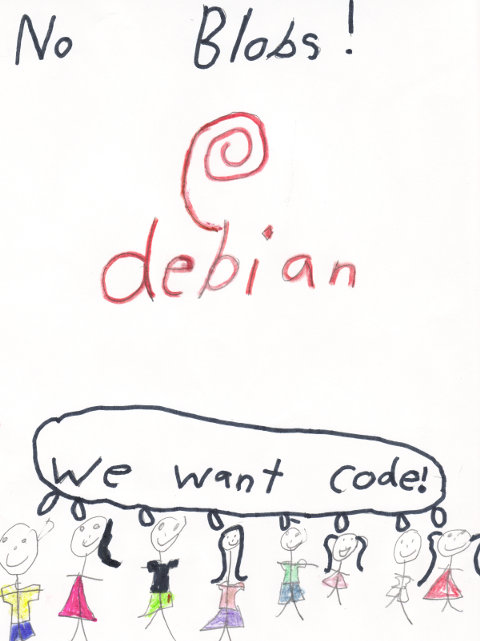
So in the end I decided to vote in the Lenny/DFSG violations GR despite lingering apathy. Option 5 won so hopefully we can get on with releasing the next stable version of Debian. For giggles, I explained all the issues to my daughter Shailaja and asked for her opinion. Her advice is that we should not worry about firmware being non-free because it could take a long time to sort out and in the mean time people would get fed up of waiting for Debian and go somewhere else. However we should make a big list of all the devices that require the binary blobs and tell everyone not to use them. To this end she has made the following sign you can copy and send to recalcitrant hardware manufacturers. no blobs
24 December 2008

MJ Ray: Representing Developers

Open and voluntary membership is a point of principle for me, so I see SPI s membership structure as a big plus. As I wrote back in August:
In my opinion, a key difference of Software in the Public Interest is that it is managed by free software developers in a more-or-less democratic fashion. Even though I ve failed in two elections, I still think it s better than the alternatives.
One of the other major free software organisations has moved in the right direction this month, with the announcement that FSFE adds Fellowship representation to General Assembly. It s not perfect - I still disagree with fellowship being conditional on payment instead of effort - but I think getting democratic representation in FSF Europe is a big step forwards for free software developers. If only FSF.org would do that too. One challenge of representation is that members have a responsibility to oversee the organisation. That s a bit difficult if the board adds reports and resolutions to the agenda at the last minute, which happened at the December 2008 meeting. Ian Jackson has asked the board to arrange that all the appropriate notifications are sent and I ask other SPI members (contributing or non-contributing - both seem to be fine for this) to second it. Finally, happy Christmas or whatever other festival you re celebrating (if any).

23 December 2008

Ondřej Čertík: Experience with git after 4 months

I switched to git from mercurial about 4 months ago. As Matt Mackall (the main author of mercurial) has pointed out, my arguments were partially just excuses for the switch, because everything could be fixed in mercurial as well (eventually). On the other hand, I really wasn't expecting to switch when I invested time and energy to learn mercurial. Also because I thought that git doesn't have such a nice documentation, has a steep learning curve and the community is hostile, because it is developed by the kernel people who are famous for sometimes being not so nice on the mailinglists (as I now found out, none of these are true). I was getting annoyed by small things one by one, after finally I said to myself enough is enough, let's just switch.

So as to the steep learning curve --- it took me a day or two to being able to do what I want, so it seems to me it's really easy to learn once you know some distributed vcs. I found out the documentation is much better than in mercurial --- in git one just types "git help command" and a full man page fires up with lot's of information and examples. In mercurial, one just gets a couple lines (compared to git) of help in the terminal, without examples. Also the first (actually second) thing I noticed is that "git log" (and other commands like "git diff") doesn't scroll out my terminal, but uses "less" automatically -- that's just great. The first thing I noticed is that git is superfast for almost every operation, especially it's noticeable with "git diff". As to the community, I only had a chance to send a few emails to the git list, so I cannot really say, but so far it's very responsive and friendly.

However, those are just little things that can (and I am sure they will) be fixed in mercurial as well. What is a big thing are branches, especially remote branches. One just fetches a remote repository and then works with it like with any other local branch, e.g. one can switch to it, or just "git log some_remote_branch" to see what is in there. One can easily compare them etc. With mercurial, I was using "hg out" and "hg in" commands to see what changes I will pull or push, but those commands require internet connection, so it really sucks and it's slow. In mercurial, I was using different directories for different branches, but that's just extremely inconvenient and also slow (creating a new branch is just a matter of adding one file, not copying the whole repository --- for example with the sympy hg repository, I often had to wait several seconds to clone a repo, while with the git repository it's just instant) and big (in terms of megabytes).

The bible of Mercurial, the hgbook says:
In most instances, isolating branches in repositories is the right approach.

But I think it's the wrong approach. The only argument for doing this that I accept is that sometimes you are not sure which branch you are in in git --- well, I use this trick (actually, just read the documentation of __git_ps1 in /etc/bash_completion.d/git), so my bash line always says which branch I am in using the red color. I never do any mistakes with this.

Anyways, I could continue like this (e.g. check out "git svn", "git rebase -i" and many other things), but you can read why git is better for example here, no need to repeat here. I am very happy now and I can only recommend to learn git.

So let me also say some things that are worse in git --- one thing that could be improved are URLs of the gitweb (hgweb urls are neat, gitweb urls use "?id=..." stuff). Another thing is that the debian package git is not git! You need to install git-core to get git (but this seems to be getting fixed).

There is also an interesting discussion happening right now in the debian-python mailinglist about switching the DPMT repositories to git. I think almost all opinions (for and against) were already stated, but if you have some opinion that wasn't yet said, please do so.

Patrick Schoenfeld: How to NOT improve relationships to your peer projects

I don't know if Aaron is an Ubuntu Developer. I hope not. And I hope that no one of the commenters is one. But this post and especially the comments to it (because the article may have some justification) is certainly not a way to improve the relationship between projects like Ubuntu and the projects its based on.

Yes, it is true, that we have a rough tone in our mailing lists and yes it is sad that every now and then topics pop up that need to be discussed till somebody is hurt and leaves (the project). I certainly hope that this can be improved over the time, but most likely this is not something which breaks the project. Who knows what its worth. We have a large community, very much different opinions and therefore conflicts. Possibly it enhances the quality of our distribution, because things that certainly would make our product worse (e.g. lowering quality standards) won't get done, because they'll get a strong opposition.

But whats the point with the innovations, Aaron? Is it the job of a distribution to serve with innovations? A distribution that serves as a base for more then 10 other distributions? A distribution that is known to care a lot about freedom and is known (and appreciated) for a high quality standard. I don't think we need to serve innovations. We served innovations back in a time where it was needed. Where things were missing. Like a good package management, like conf.d directories. Apart from this I think there were enough innovations in the past years. Possibly not that user-visible and trendy as a graphical virtualization frontend. What about xen-tools for example?
Now its all about reinventing the wheel or developing frontends. Launchpad for example is just reinventing the wheel. Savannah exists, GForge exists. Bazaar is just reinventing the wheel. Git exists. So does Mercurial.

But whats most sad about your posts and the comments is that you (and your commentors) seem to share the opinion that all Debian does is packaging software and nothing more. According to you Debian developers do not fix bugs, forward patches, file (important) wishlist bugs, encourage upstreams to remove horribly broken licensed software, improve their own software and tools (dpkg, aptitude, apt-get, the devscripts, ....), do integration work (alternatives, $EDITOR usage, ...), documentation work (writing manpages). The reality is that there are many small and greater things driven by Debian Developers that serve the whole community. Additional to the ground work that your favorite operating system is based on and without which it could not exist.
Its just not beeing doped like it is done by companies with their marketing departments that actually earn money with what they do. Take the projects you named. They all have one. They all have paid developers.

In any way such a ranting (with no real
constructiveness) will not serve the relationships between other projects and Debian.

21 December 2008

Kurt Roeckx: Debian and (non-free) firmware: where to put it?

One of the discussion that always seems to come back is what to do with firmware. It's mostly about freedom versus usability. I think the main question is where do we want to put non-free firmware in our archive. The opinion seems to range from that it should be in the non-free archive to that it should be in the main archive, with many opinions in between, and they all have good arguments. We have 3 options that are related to it in our current vote that seem to come down to: I don't see the point of that second option, and really have to wonder if there is any firmware under a license that would comply with the DFSG except that the source isn't available. The third option can make sense for some of the blobs in the kernel that are basically settings that are written to the device. You could write an editor for it, assuming there is documentation for it. But I doubt that they're all settings, and it just seems to ignore the problem. I find Theodore Ts'o' suggestion about creating a new section for firmware the best idea so far, specially if we can agree that our official CD/DVD images will have that section on it. It has the advantage that all software in our main archive can comply with the DFSG, that you don't need to add the non-free section just to be able to use hardware that requires firmware and that you can just take a CD/DVD that works.

Neil Williams: Debian Quality and Releases

Sticking with the theme that blogs are all about completely biased and probably controversial opinion and not much else, I'm glad that Thomas has made his thoughts clear. Thomas - I fully agree (but your blog doesn't support comments, so I'm putting it here).

Debian, to me, needs to about Quality over quantity (being very aggressive over orphaned packages and their reverse dependencies) and about everyone working towards the releases. Not to pick arbitrary time-based deadlines for releases but actively fixing release-critical bugs, so that the release can proceed smoothly with stable, reliable packages. Debian developers who feel unable to fix release critical bugs maybe should not be developers any more - or at least be banned from mailing lists on lists.debian.org which appear to be the only "contribution" being made.

There's no reason to continue using Gtk1.2 and no point in complaining about it because there is no prospect of anyone stepping up to maintain gtk1.2 itself. There is therefore no point in the long threads complaining about removing gtk1.2 because nobody is going to do any work to retain gtk1.2.

If you aren't prepared to do the work, you should not feel you have any rights to complain about the lack of such work being done. We're all volunteers - don't expect someone else to sift the wheat from the chaff, get rid of your own cruft. Debian needs to be an association of people who do, not the current association of people who complain, moan and generally fight amongst themselves. The answer to this negativity is a can-do attitude - it is not as if there aren't enough problems out there to fix, get out there and raise the quality. (First though, get Lenny released.)

Not everyone can do the same amount of workload but within the work that you are able to do, there must be a balance between the work you do for yourself and the work you do for the distribution. I'm not expecting people to have to match my levels of output, I am expecting people to match the proportion of time that they allocate to fixing problems outside their own limited niche. If that proportion approaches zero then maybe Debian doesn't need you any more.

There is no reason to have project members who do not contribute to either quality or releases - that doesn't just mean not fixing bugs, it means not being a part of any team or other group in Debian that provides support for general quality or the release.

If you aren't fussed about the quality of packages (in general, not just your own) and aren't willing to contribute just a small amount of your time to use your privileges to fix release-critical issues, then those privileges should be removed - you obviously don't need them. (Also, if you aren't a DD yet and you want sponsorship, these rules apply to you too. I won't sponsor people who have no feel for quality or want to help Debian make releases. I'm beginning to wish other sponsors would do the same. Quality is far more important than quantity - merely adding packages because they exist and because someone posts a request for a sponsor is insufficient. Completely insufficient, counter-productive too. See my sponsorship requirements.)

Note: this post is entirely opinionated and I don't care if you disagree. I will take a particularly brutal approach to comments that do not grasp this fact.

20 December 2008

David Paleino: Free software yes, free speech too!

Dear Julien, that proposal is not about censoring mails sent in by people. Think to it as that "karma" thing many sites have. And yes, I'm one of those in favour of such project. I'm a free software,speech guy, but just hate all the flames seen lately on -devel. We must find a way to stop that, or at least to control it. Again, it's not censorship, as I read it, all messages would go in. Citing:
I have also seen opinions that other "obvious" ways of addressing the issue,
such as moderation of the lists or a new organizational entity, which
would act as a list watchdog, is not the way to go, as it adds yet
another layer of bureacracy and raises the usual questions of choosing
the "right" people for the privileged position.
It's just an alternative way of expressing opinions about a mail. Consider it as those "+1"/"-1" mails that you can often see.

19 December 2008

Julian Andres Klode: Short review: Fedora 10 and Ubuntu 8.10


After I tried OpenSolaris 2008.11, I also tried Fedora 10 and Ubuntu 8.10, each for almost one day. Creation of bootable USB stick: For both distributions, I created a bootable USB stick because it is faster to install from USB than from CD/DVD. The creation was easy in both cases. Fedora ships a shell script and Ubuntu a graphical program for this task. Both very equally easy to use. Booting from USB: Both distributions booted perfectly from USB. But there was a big difference in boot speed: Fedora 10 booted in about the same time Ubuntu needed to find the USB stick. Installation from USB to HDD: Installation of both systems went very well, without any problems. Fedora s installer is far more powerful than Ubuntu s, e.g. it allows to use LVM or encrypted partitions. To setup LVM and encrypted volumes with Ubuntu, you need to use the text installer on Ubuntu s alternate disk (It s debian-installer). Ubuntu s graphical installer received a new partioning screen. Boot: Fedora s boot time seems to have improved a lot since the last release. Ubuntu s boot time seems to be roughly the same as in 8.04. Both distributions provide a progress bar, whereas Ubuntu s usplash looks better. But this may change once kernel-based modesetting works on Intel cards in Fedora, because Fedora s splash program needs it for graphics. Else, it only displays ASCII progress bar. Login: Fedora 10 shipped with GDM 2.24, which means that there are no themes yet. But this was no problem, as the non-themed design of GDM has improved a lot. I even like it more than any themed GDM I have seen. It reminds me a bit of OSX. Desktop: Both distributions ship with GNOME 2.24. The default themes look good, whereas Fedora s uses more GNOME-like icons, whereas Ubuntu uses Human, which is based on Tango. And that is important for me, since I normally do not change any aspect of my desktop, except for adding cpu frequency and tomboy applets to the panel. Hardware support: Both distributions provide good hardware support. Ubuntu leads here, at the cost of having non-free drivers included on the disk.For users needing windows wireless LAN drivers, Ubuntu is the right choice, as it ships ndiswrapper and the graphical frontend (ndisgtk) on the installation medium. Fedora does not include ndiswrapper, because of what it is used for (installing non-free Windows drivers). Both distributions ship firmware, and consider firmware images as free enough, as they do not run on the CPU. EXT4: Fedora 10 ships with patches for EXT4 backported from Kernel 2.6.28. It also supports the installation on ext4 partitions, but only using the DVD and if booted with the ext4 option. The Live discs do not support installation to ext4. Package management: Both distributions ship with good package managment software. YUM really improved since the early times, where it downloaded an extra metadata file for every package. Nowadays, yum and apt seem to be on a nearly equal level, but aptitude lets Ubuntu win, because it can handle problems much better (ie. it proposes ways to solve problems) than YUM. Graphical package management: Ubuntu wins here. Fedora only ships PackageKit for package managment, which, in my opinion, is not able to really compete with Synaptic and gnome-app-install. Conclusion: Both distributions are very solid. Ubuntu still has the better package managment, and a bigger selection of packages. This has only been possible due to Debian, which is the base of Ubuntu. I tried to write this blog post not as an Ubuntu member. I always liked Red Hat and Fedora, and one of my first Linux distributions was Red Hat 9. Links: Posted in General, Ubuntu

MJ Ray: Debian, Lenny GR and the Secretary

Two policy issues have been brewing in debian and I ve been mostly quiet about them because I ve been busy with TTLLP work. One is the Lenny release GR which I m still trying to make sense of. I mean: yikes! I ve been reading debian-legal and -vote for years and this ballot confuses me. I think I ll vote 5324671 but I m really not sure what that means. The other big issue is that Manoj has resigned as secretary. I think this is a good thing, if for no other reason than he s been secretary for 7 years and I feel it s not healthy for one person to hold that post too long in a thousand-strong group. I ve disagreed with Manoj about some tasks, but I didn t see any point in making this difficult job even less fun, so I stopped criticising him a while ago. Since then, my comments on the secretary s work have usually been limited to small review comments on ballots (which are then apparently ignored anyway, but at least I offer help). I m apprehensive about who will replace Manoj. In the short term, Bdale Garbee acts as secretary, but surely Bdale is busy enough already? Given his increased vote-taking activity, Neil McGovern seems a likely choice, but the work left undone after his term as SPI secretary may count against him. More generally, I think there s a problem with Debian s secretary, so anyone who would be a good secretary would probably refuse to do it as currently defined. There s an email about bundled votes and the secretary by Steve Langasek which touches on this major problem:
the secretary is the *only* line of defense against gaming of the GR process by a small group of developers who propose an uncontroversial but orthogonal amendment that will always win over the alternatives, in the process preventing the will of the project from being formally enacted
In other words, in Debian, the secretary is both secretary (usually an appointed or consensual post in most organisations, in my experience) and chairman (usually an elected post) - both doing the hard administrative leg-work and actually ruling on contentious issues, rather than just giving an opinion to the chairman. Manoj commented that he would be happy if the constitution was changed, to clarify the issue, or to explicitly add another entity to handle intepretations . Is it time to split the secretary s role?

Julian Andres Klode: Short Review: OpenSolaris 2008.11


The installation was fast and easy, comparable to the installation of Ubuntu. OpenSolaris seems to have big problems in terms of wireless LAN. I am using a WPA/WPA2 encrypted wireless LAN, and it asked to me to enter my passphrase. I entered it, and nothing happened. I was able to get wireless working via commandline, but this lead me to the problem that domain names were not resolved. I could solve this, too. But none of this was permanently, and it should work the graphical way or tell me it does not work. Maybe this whole thing happened because I have a space in the name of my Wi-Fi network. Another problem is suspend/resume, which is not yet working for most laptops; whereas recent Linux distributions support suspend/resume out-of-the-box. OpenSolaris ships non-free components, e.g. NVIDIA display drivers, or Java 6 Update 10. Hopefully, there will be an option in future to install it without this stuff. Talking about the desktop, there is GNOME 2.24 with a custom theme. In my opinion, the theme looks quite good, although I do not like the colours of the minimize,maximize,close buttons of the windows sometimes. One feature introduced with this release is Time Slider. Time slider worked very well, although for reasons I do not know, I do not really like it. The integration with nautilus is good, but I would still like to see an interface using a calender widget instead of this slider. I remember that the slider sometimes did not work as I expected, e.g. it jumped from left to right. The package management is interesting, but it is to hard to use in my opinion. Debian and derived distributions provide far better package managment in my opinion. Especially the graphical part needs a lot of work in order to compete with Debian. The overall speed was quiet good, and memory usage was 512MB. There is one problem with measuring memory consumption in gnome-system-monitor: I installed netbeans 6.5 and started it, and gnome-system-monitor showed a memory usage of around 20MB, while the program used more than 200MB (according to top). All in all, OpenSolaris gets closer to modern Linux distributions like Fedora 10 or Ubuntu 8.10, but it is not there yet. But with improvements in the area of Wi-Fi and Suspend/Resume, future releases of OpenSolaris might become a good alternative to Linux distributions, at least if you do not really care about the ideas of free software. Posted in General

Neil Williams: Opinions and blogs

Taking on from Wouter's post on metablogging, I can only say that official sounding blogs are very off-putting and I stop reading them very quickly. If a blog (or more typically the blogger) starts thinking too much of their blog, considering it an enduring reference or a permanent piece of documentation then that blogger is deluded. A typical sign of such a blog is a long list of references at the end and topics that try to stipulate how other people should blog.

To me a blog is merely the opinion of the blogger. I do use my blog for announcements but only when the subject matter isn't finalised and / or isn't ready for widespread usage outside a limited list of developers. Where things are more certain, I use mailing lists and if things are just records of what happened at a particular event, I'll use the News parts of websites. As for the time taken to write a blog entry - as short as possible - like this one. Gotta go....

18 December 2008

Wouter Verhelst: Metablogging

Ciar n O'Riodan blogs about how to blog, and his post is a good read. Most of it is solid advice, and I find there's little I disagree with; if you want to get a blog that's well-read by many people, then his advice is probably sound. So why am I posting this in my 'retorts' category? Because I feel that blogging isn't something that should be taken too seriously. A blog is an outlet, a place to get your thoughts out; it is a bit of a combination between a column and the readers' letters section in a newspaper. The writing style of a blog should reflect that; when I write a blog post, I don't care about what the truth is, I only care about my opinion. If I want to write the truth, I'll write a wikipedia article. If I want to read about the truth, I'll go and kill myself because I'm not naive enough to think something like "the truth" exists in this life. And if I want to read a magazine-style article, how about I'll go buy a magazine instead of reading a blog post? A blog post doesn't require references (beyond, perhaps, what you're replying to); a blog is a reference, one to the personal opinion of the author. If you think something is great, then as far as your blog is concerned, that something may be the best thing since sliced bread. If you think something is ugly, crap, and should be forgotten about, then on your blog it is. In more than one sense, blogs are like opinions: everybody has one. That doesn't mean I disagree with most of what Ciar n wrote; on the contrary. Points 1 through 3, and 6 through 10, will help you develop a good writing style. I couldn't agree more on point 11, that you have to push for publication yourself; and it's certainly true that being aggregated is a good way to put your thoughts in context, and to expose yourself to a larger readership. But I vehemently disagree with his point 4:
It can take time. A good article-style blog entry can take six hours to write!
Not that I think writing a blog post should take no time at all this particular one has been almost an hour in the making, now but because I feel that, simply, articles, with all their references, scientific or other background, and whatnot, simply do not belong on a blog. A bunch of articles with an RSS feed is not a blog, plain and simple. So while I do agree that it can take time, I do think you're doing fundamentally wrong if your blog post takes more than, say, an hour and a half, to be written. So, in the interest of being constructive, here are my own suggestions:
  1. Don't think too much, just write. It may sound stupid, but the most important part about blogging is actually doing it, and not wondering about how or why.
  2. Do reread if possible. While blog posts are usually read in a few minutes, they take much longer to write; it's easy to lose track of your line of thinking during that process, in which case you may end up with a completely incoherent post. That certainly is to be avoided.
  3. Ciar n's argument that if it's worth doing, it's worth blogging about certainly holds merit, but I'd go one step further: if it's worth thinking about, it's also worth blogging about. After all, a blog is mostly a braindump, so why not?
    That's not to say every thought can be turned into a coherent blog post, and I have a bunch of half-finished unpublished blog posts on my local hard disk which I may revisit at some undefined point in the future; but the principle is there.
  4. And last, but not least: don't care about what other people are doing. Your blog is your own, not someone else's; if you get an email that your content sucks, ignore it. If you get an email that you should be writing about something else instead, ignore it. You're not getting paid for your blog, are you?

Raphaël Hertzog: Release Lenny GR

This is the worst vote that has come up since I m part of Debian. And Manoj the secretary has refused to listen to the remarks of many developers about the misleading titles/summaries, about the unjustified 3:1 ratio, and worst of all, about the mixing of multiple questions in a single ballot. I have ranked misleading options ( Reaffirm social contract at least) lowest and below Further discussion and sorted all the other options according to my preference, and ranked some of them equally when the choices answer different questions (where I can not prioritize any preferred outcome). I m not yet sure if I put Further discussion first or not. There s some hope that the vote will be cancelled and redone with separate ballots but I ve lost trust in Manoj s abilities to do his job properly. I m sure he s convinced that he s doing the right thing but that doesn t help at all, on the contrary. It also means we probably should fix the constitution to make it crystal-clear how the secretary should decide whether 3:1 ratio is needed for a given resolution or not. Not really the kind of thing I enjoy within Debian, but that s the price to pay if we want to continue to work together. On this and much more I agree with Russ Alberry. Update: Manoj resigned as secretary. I want to thank him for having taken this hard decision. And I sincerely hope he doesn t resign from Debian completely as our strength is also in our diversity of opinions. Partagez cet article / Share This

17 December 2008

Steve Kemp: I am not going to sit on my ass as the events that affect me unfold to determine the course of my life

So I finally got round to vote on the Debian Lenny Firmware issue. I can't help thinking that most of the discussion so far has been a waste of time, on the grounds that developers either Either way the discussion has two, or more, sides talking past each other rather than any convergence upon a consensus. (Me? I'm in the middle. On the fence. Getting bored. Hitting "Delete thread" a lot. Who knows, maybe I could have my vote influenced, but right now I'm just not caring enough either way.) Anyway enough on that subject. Tonight I have mostly been looking around to come up with a simple way to give an "overview" of mail traffic. Something like: Individually these jobs are easy. Making it look pretty is hard. (Also I'd like to have archives of the lists in question, which are searchable.) Seems like nothing out there does everything I want. ObFilm: Ferris Bueller's Day Off.

Next.

Previous.
