Search Results: "phil"

30 August 2007

Enrico Zini: gpl-and-business-faq

GPL and Business FAQ I sometimes happen to be in a dialogue like this:
X: According to GPL, you can sell copies of your software at any price you want, right? Me: Right. X: But your customers can in turn sell copies of your software at any price they want, right? Me: Right. X: So, the only way a GPL developer can make money is by charge for development of their software? Me: Not only for development: also for maintenance, improvements, customisation, installation, training, gadgets, support...
The market is quite big, actually. In fact, one can even make business by selling the software in a box, if one makes a box that people would like to have (for example, including things like useful documentation, a few gadgets, a support contract and a pony). The idea is that the business of selling software alone is a useless extortion that provides no particular benefit to the user (and in many cases, no particular benefits to the developer either). If you put that aside, there is a plethora of ways to charge the customers more, and for things and services that are useful to them and make them happy. Actually, if you develop a GPL software for someone who is then happy about it, they may then pass it on to other people in the same sector. Who then maybe need help with installation, support, maintenance, custom features, training, gadgets and ponies. If your software hits the spot, a niche market can end up growing by itself. The last discussion on this topic then ended up with another question:
X: Ok. But to do a good job you have to be many people at once: for example you sometimes need to be a sysadmin as well as a developer. Me: Yes. Being many people at once is what starting a company is all about.
He complained that answers like these could not be found in the Selling Free Software article of FSF: in the meantime I'll publish them here. The license of this post is GPL. The FSF and any of their regional chapters are welcome to use all or part of this text, with or without modification as they see fit, alone or included in documents that use any license they see fit, even some of the not really free ones they use sometimes, such as the one used by Selling Free Software itself :-P

24 August 2007

Clint Adams: Volta, ick

There's this Brit named Steve. Steve loves strip clubs. Now, being a Londoner, he has the requisite interest in talk of sex, boozing, and sport, three topics that bore me numb, but I have only ever seen Steve get truly excited about two things in life. The first is the culture of strip clubs, best exemplified by a sex act Steve calls (complete with pantomime) feeding the pony . The other has to do with Ali G. Steve (remember Steve?) is tickled pink that people wanted to sue Sacha Baron Cohen for racism but could not, for since he is a Jew, he is incapable of bigotry. This made no sense to me, but after witnessing the insanity of the UK legal system, I see no reason to doubt it. I am standing up to my nipples in salt water. I saw someone who looked remarkably like Steve yelling with a mildly impressive accent but poor grammar. I knew it wasn't Steve because he wasn't being tailed by an Eastender shouting blimey . I am standing up to my neck in salt water. J rg points out the reasoning for why normal peon developers don't have access to NEW. This makes perfect sense once you realize that each member of the ftp team is both a citizen and resident of the United States of America. The sea is rough. It is difficult to keep the laptop dry, and, well, the Piers Anthony book in my other hand is going to smell like ocean for weeks. That's precisely why I brought it, though; it would take extreme effort to keep it from getting wet. As it stands, or as I stand, there are three options available to me. I can retreat to the beach, where I will be mostly safe from the water. You could call this turning tail and running, or you could call it mastering my environment. It's all in the marketing. I'm going to succumb to this option anyway, and now is not the time for it. So I could also keep doing what I'm doing, keeping my head and laptop and book above water by expending near-constant effort. It's a little easier than in Puerto Rico at the place some random passerby kindly informed me that i was going to die a horrible death just like the 12 other people who had died in that spot that year. In essence though, it's like the futility of continuing living when you're surrounded by INTPs. Then there's the most appealing option: to be as the reed in some Taoist metaphor. I can just let go, and let the tides have their way with me, coolly caressing my face, washing over me, drenching my book, short-circuiting my keyboard, and filling my lungs with plant matter and some kind of 0.479M NaCl solution. My lungs see a problem with this otherwise-logically-sound philosophy. There's an old Middle Eastern proverb that goes something like Be as the date palm, above the spites. When she is hit with a rock, she strikes back with her sweetest fruits. Disthrust! Dilute! Disthrust! There may have been some corruption in the intermediate language.

8 August 2007

Miriam Ruiz: El rei de la casa

The Proof of the PuddingThis is an updated translation into English of the one-question interview with pjorge (based on Darren Rowse’s one-question interviews idea) in which Javier Candeira (Barrapunto co-founder and editor among many other things, and a good, loved friend of mine) comments about an interesting game of his creation that’s being exhibited in Barcelona and that deals with the fears many parents have towards the Internet and the new enterntainment technologies and videogames. The game code will be released as GPL, even though the game data will have a non-free Creative Commons (with a non-commercial clause). The game has a really interesting approach, and mixes the concept of pinball games with that of graphics generated with “paper dolls” techniques, to try to make people think about the ideas mainstream media are pushing, and the way they try to tell everybody how to raise their kids. You might like it or not, but it will probably won’t leave you indifferent. That’s what art is about, in fact, isn’t it? What is ‘El rei de la casa’? ‘El rei de la casa‘ (an expression that in Catalan and Spanish means “the precious child”) is an exhibition and a videogame. The exhibition deals with the cultural construction of the idea of childhood, and can be visited until September 24 in the Palau de la Virreina in Barcelona. From there. Among other works, in the exhibition there are photos by Loretta Lux and Bego a Egurbide, paintings by Marc Ryden, Kiki Smith and James Reilly… it’s really worth a visit. El rei/la reina de la casa. ( The videogame is a commission from Andr s Hispano and Marc Roig, curators of the exhibition. They wanted to portray Internet and videogame arcades (or cybercafes, which are their modern equivalent) as one of the “new forests”, these places where parents don’t dare allow their children go alone for fear of the dangers (real or imagined) that may lie in ambush. The Internet has entered into the collective imagination, and one of the memetic niches that it has crept into is that of the bogeyman, the scapegoat that bears the brunt of all the evil that happens in society. It is enough to look at the news programmes from right-wing TV stations with their adversative Internet coverage: “it’s good, but…”. All over the media you see headlines like “gang of pedophiles arrested who sold child pornography *on the internet*”. They conveniently skip that pedophiles filmed those poor kids *in a flat*, and that they did it *on a bed* and used *videocameras* just like those used by the reporters now sounding the alarm. But no, what’s bad is *the Internet*.
The other theme that we wanted to touch on with the pinball game is how videogames are presumed to corrupt childhood. When pinball games were introduced, the North American authorities laid down the law: it was an infernal machine that incited gambling and even lust. From the religious right to the secular left, every moral guardian has denounced the supposed harmful effects of videogames on childhood: because of them children and teenagers engage in murder, robbery, truancy, bad school grades and even untidy bedrooms and doubtful personal hygiene. For this reason, the “new forest” of the Internet and videogames had to be a videogame, proving once more that games are cultural vectors, a form of artistic, political or commercial expression like any other. It also had to be a videogame about the a triangle: on one side the children, on the second one the children minders (parents and society at large), and finally the Great Scapegoat: the Internet. After many abandoned and reworked proposals we arrived at the present design for the game: an emulated pinball game presented on a panoramic TV screen, and having two levels: one set in the real world and named after the exhibition, and a second one set in a more or less conventional cyberspace. This second level is called “Prey of the Net”, and portrays the vision of the Internet that a Fox viewer may have: you have Spam, game-playing killers, kids making more money than their parents, S&M gear, dildos… in short, everything that is scary and nothing that is comforting, at least to some.  Presa de la red! (All the illustrations for this pinball, both on the gameplay field and on the scoreboard, are by Mauro Entrialgo. For the scoreboard I asked him to prepare a set of drawings similar to KISS dolls (like the cut-up dolls that kids still played with in the last century). Thanks to these dress-up dolls the scoreboard shows more than the score (which grows randomly anyway); it also portrays the state of the boy or girl protagonist of the game. I say “boy” or “girl” because in the game, just like in real life, you have a 50/50 chance of starting the game of life with either sex. The fist level, ‘El rei de la casa’, portrays the stress that families feel when facing children’s media consumption. The targets trigger lines from the parents: “All day in front of the Idiot Box!” when you hit the tv, or “without a degree, you are nothing” when you hit the school. There are four targets on the right, which can be reached shooting the ball with the left flipper (the one representing the parents): school, museum, church and reading. On the left, and reachable from the right flipper, representing the kids’ id, are the TV, the kid’s peers and the videogame console; at the top of the playing field, towering above it, the internet-enabled computer. As the ball hits the different targets, the scoreboard dresses the kids in a housecoat, a leather jacket, and gives them a mortarboard or a saint’s halo. They are the pride of their parents, kids still not perverted by the Internet. It is cheap symbolism, I confess, two-dimensional sociology, but that was also something we aimed for. After all, pinballs have always been complicated allegories rather than complex ones. In a first design I planned to make computer accessible only under certain conditions, but that is not something that would have work in this exhibition: some people just play and play (which gives me an immense joy), but other people can’t or won’t give it much effort. It’s best to make it easier for everyone, so they can send the ball into the next level even without meaning to. The second level, “Prey of the Net”, is accessed when the player puts the ball through the PC’s screen. Here the character on the scoreboard keeps smiling while the game dresses them in a straightjacket, S&M headgear, or leaves them in their underwear, with their hands full of money, playing cards, bloody knives and sex toys… to their parents’ horror. The player has no fixed goal here, only to make the ball go through the pachinko and the spinning spider. These elements work as an atrocity generator and a rebuke distributor. Parents’ voices scold the player, faced with the horrors of the Internet. But the star is the scoreboard. Mauro rocks. Right now the code and content for downloadable game are done, and the people responsible for the ISO are giving it the final touches. It will be a bootable liveCD with some Debian variant that (hopefully) will run on any PC bought in the last two or three years. We will treat the computer as a games console, which may or may not be symbolic (if you want it symbolic, we can make it symbolic!). The game itself is under the GPL license (the pinball part is based on Henrik Enkvist’s Emilia, which is packaged in Debian), and only the graphic resources will be under a non-commercial Creative Commons license. The music is also under a non-free Creative Commons license because of the status of the original samples, but I recommend you download it and play it because its author is none other than man, the Barrapunto founder and sometimes editor.
6 August 2007

David Welton: Squeezed Books summary licensing

Given my desire to see the community around Squeezed Books grow, I went ahead and added a creative commons 'attribution/share alike' license to it. I also did this in the spirit of reciprocity towards other people pursuing similar initiatives and using similar licensing. The goal really is to give people an idea of what some of these well known business books are about. Even though the book in question may present a unique and interesting idea, many of them can be summed up pretty quickly. As Phil Greenspun says:
This book illustrates a fault in the publishing industry. If you have a 50-page idea it is too long for a magazine. But it is too short for a book. So if you wanted to get it distributed before the Web came along, you had to drop in words until you reached 200 pages.
I don't really think the web has changed things that much, either. Who wants to simply put up a web page when they could publish a book? The idea isn't necessarily to avoid buying books, either - some of the good ones are really good reads, and a summary just isn't the same thing as the book itself.

27 July 2007

John Goerzen: OSCon Friday

Fudge Update

Yesterday I blogged about the guy handing out fudge. He saw my post and explained why he was doing it. Today he was around handing out fudge, and I thanked him for his comment. He gave me two pieces of fudge for blogging about it.

Pineapple

At most of the breaks, they have this truly wonderful real (non-canned) pineapple. I think I have eaten more pineapple this week than any other week, ever. Very insidious, O'Reilly.

Conference materials

Slides of talks are available. Apparently keynotes are being posted on Youtube and Google Video, though they haven't provided a specific link AFAICT.

Philip Rosedale, Founder/CEO of Linden Lab

Second Life and the XPrize are two examples of escapism: you can escape to virtual earth, or escape the planet entirely.

In order for Second Life to grow, it has to become profoundly open. It has to be a standardized protocol. They are working on code to let people run their own servers. They are trying to make the server trusted and make it able to be open sourced as well. They see openness as the key way for it to grow.

If you are writing a web app that depends on the network effect -- such as Facebook -- you should open source everything right from the beginning. Not because it's best for humanity, but because you will win.

Jimmy Wales

He's trying to do open source search. Nice idea, could have been summarized in 45 seconds, I think.

Simon Wardli

Was going to talk about Zimki, which was going to open sourced, but they decided not to.

Funny and interesting talk, I sorta forgot to take notes while listening...

Nat Torkington

OSCon program chair.

Funny talk about Linux, an adolescent at 16 years old. Thinking about different languages and how they're doing. How the Linux community is organized: are we fighting battles, and do we need to?

James Larsson

This guy takes old hardware and makes insane devices out of it. 15,000 volts running over a coat hanger used as a "game controller", for instance.

In all, awesome keynotes today.

24 July 2007

MJ Ray: Preface to FSF Radio Interviewee Promotes Skype

Preface to the last post: I'm aware that my surprise at FSF using Skype does raise the old question "where do you draw the line?" - For example, do you refuse to use the fixed-line telephone system if your exchanges are not running free software? Me, I use the telephone system because it's effectively a monopoly and we don't have an alternative that works for me. I sometimes try to nibble at the system with the Phone Co-op and more VoIP use, but it's no fun banging my head against a wall. However, I boycott Skype because I can't tell what it's doing, there have been enough bad reports that I don't trust it and the alternatives of SIP and IAX work for me, but I expected FSF not to use Skype for idealistic reasons. FSF leaders like RMS have promoted things like Why schools should exclusively use free software [by Richard Stallman], carefully corrected inaccurate claims about free software and refused to mention some proprietary software products. They were often criticised for it, but they continued to do it (for good reasons IMO, even when I disagreed with them). So, FSF's Controller giving an interview over Skype seemed a rather surprising about-face. Then the interviewer claimed "Skype is free" and it went unchallenged. After the show, I sent the email...

MJ Ray: Flash Floods of Weston

Although a small puddle formed uphill of our house, it soon soaked away, so I thought we'd got away without any problems from the unexpected Summer Rain [niq's soapbox] around here, but it seems I was wrong... Walking along Kewstoke Road yesterday, I was surprised to see sandbags outside one house. When I mentioned it in the greengrocer's, Nicky (excuse any misspelling) said they'd been sweeping the water flowing down the hill away from the shop door, as it would kill the wood floor and the electrics beneath if they didn't. It seems the other side of the hill also had some flash floods, reported in The Weston Mercury - News: The day the rains came down. Even so, it was much less than up-river in Gloucestershire and across in Oxfordshire, where Midcounties Co-op has mobilised its resources to combat flood chaos [coop news] by distributing essentials like water. It seems finding out whether you're in a flood risk area is unnecessarily difficult because the Environment Agency gives its reasons for stopping flood data being used [Free Our Data] - in short, they want to sell us our data a second time! In the longer term, it looks like things may change drastically around here if an entrepreneur from Burnham-on-Sea succeeds in his plan to wall in Weston-super-Mare with Severn Lake. (tip WWN ) What would that do to floods?

23 July 2007

Evan Prodromou: 3 Thermidor CCXV

My brother Ted and his partner Nabil had a great commitment ceremony yesterday afternoon in Dolores Park in San Francisco. It was a beautiful day, and they had lots of friends who came out for them. I came up from Los Altos Hills with our parents, and my brothers Nate and Andy came with their friends and/or families, too. Ted and Nabil march to a different drummer, to put it mildly. Their ceremony was remarkably like a Quaker wedding, although I don't think they planned it that way. They had a nice picnic and tea party in the park for a few hours, let the guests get to know each other, and then called everyone together to listen to their promises to each other. (Very sweet, by the way). They then exchanged bejewelled carabiners -- those funky little mountain-climbing metal loops that people also use as keyrings. "We may lose necklaces or rings, but we're not going to lose our keys." The carabiners were decorated with the California state gem, benitoite (Benito-ite), which is rarer than diamonds. Brilliantly, their friends who designed the carabiners also managed to include a USB thumbdrive, on which they're going to copy all the pictures, stories, movies, and other digital paraphernalia from the ceremony itself. Ted and Nabil will be carrying around those pictures as long as they have the carabiners. Clever! After they'd exchanged the carabiners, they hooked them to their belts, and then hooked them together. "And now... we're HITCHED!" Thunderous applause. They then invited up anyone who wanted to make a toast. My brother Nate went first, and girt in a bastard sword (for unclear reasons), he made a great toast. A dozen other people, including my Dad, came up to speak. By then, Ted and Nabil were falling over with fatigue, so we had mercy on them and stopped coming up to say nice things about them. Everyone dug in to champagne and cake, and Amita June and her two cousins Elena and Tessa ran around on the huge playground in the park. Definitely a good, good wedding-like event. tags:

Long day This morning we had a Skype conference call relatively early in the morning, and then a brunch with Nabil's family (who are visiting from Virginia and Philadelphia). It was really nice -- my folks decided to build a huge patio in their backyard, and it's great for having kids and family running around, as well as for outdoor brunches. (We haven't had a meal inside since we got here, actually.) This afternoon we drove up to Novato to visit Maj's grandmother Jeannette and her Uncle Kevin and Aunt Robin. Also present were Jeannette's lifelong friend Roseanne and Kevin's highschool pal Jim. Amita June loved running around their big backyard and playing with their sweet old dog Holly. She also got a lot of mileage out of their porch swing. Maj and Robin swapped cooking tips and renovation horror stories, and I got to listen to Jeannette and Roseanne tell gambling stories from various Southern California Indian casinos. Jim, meanwhile, was on his cell phone in another corner of the yard, negotiating with another gold prospector with a hand injury to work the friend's claim. Quite an evening. After a dinner of barbecued salmon, caprese salad, and corn-on-the-cob, Kevin and Robin's neighbors came over, and we talked more about statistical analysis, sheep-farming in Marin County and driving through Austria. A long drive back to my folks', but Amita slept the entire time, thankfully. Good for us all. tags:

Voice jail I had to call Air Canada a few days ago to get our tickets to come out here to California, and I had a terribly frustrating time working my way through their automated systems to get to a human being that I needed to talk to. And I thought to myself, "Why do I hate these automated voice systems so?" I never call a 1-800 number or another voice system if my problem could in any way be handled automatically. I always go to the Web first, and only try to get on the phone if the particular special-purpose request I have hasn't been, or can't be, built into the Web interface. But the economics of call centres makes the company want to shunt me into one or another automated voice systems in hopes that I'll be satisfied and not bother a real human being. My only goal with a phone call is to talk to an intelligent human being who can handle my exceptional situation. But the interface is designed precisely to deny me that goal. Can that interface ever be anything but frustrating? tags:

Least likely to succeed Ross Mayfield posted a nice pic of me offering to run his company in exchange for a hot meal. It's a good shot of me, actually. In other linking issues, my Technorati "Authority" value is now 101, putting me squarely into B-list Bloglebrity territory. Hooray for the second string! tags:

22 July 2007

Raphaël Hertzog: On Debian Maintainers

I won’t re-explain in great length why I think it’s good to endorse the concept of Debian Maintainers. I have been enough involved in the debian-vote discussions (and the previous debian-project discussions). I would just like to remind everybody that we elected sam to see changes and progress on many areas. We haven’t seen many results yet, but I know that sam has been working hard and I’ve been helping him as much as I can on the problem of our DSA team (one day I might blog about it or even start a GR if the situation continues to not improve despite the numerous efforts that we’ve put into it). Here we have a concrete proposal for a change, and I believe a change for the better. But just like for every change, people have fears: they fear people who only care about technical excellence and not too much about philosophy, they fear that the quality level will drop, they fear that nobody will care about NM afterwards, etc. It’s legitimate to have concerns, to express them and to discuss them. But we should not let them take us over or we’ll end up abandoning all initiatives that are required to evolve and adjust to our moving environment. We need to encourage people who are ready to try out new things. In cases where it’s not entirely clear how the situation will evolve, it’s better to try out and react accordingly instead of doing nothing and hoping that people will wait us. When we do things while hoping for the best, the worst won’t come up true so easily. Have faith in our future.

Martin Michlmayr: Dr Michlmayr

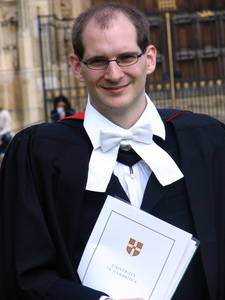
Martin at his PhD graduation Having passed all requirements for the Doctor of Philosophy, I had my graduation today.

20 July 2007

MJ Ray: Sat.1 starts Tour coverage. ZDF promises to drop football.

For part of Stage 11, I watched the new Tour live coverage on Sat.1 who bought the German rights. When Sat.1 is busy, Pro7 will cover it. The two stations are owned by the same company, along with Kabel1, N24 and 9Live. The coverage was OK - the same French pictures as everyone else, but fewer extra features than ARD/ZDF. Commentary was a bit pedestrian, but that's like ZDF. I like Eurosport's commentary much more. International Herald Tribune reports that Eurosport's ratings tripled for stage 10 which is unsurprising. Eurosport and Sat.1 both seem to be on the same ~30% of German DVB-T as well as DVB-S. In comments on my last post about this, Thomas asked:
"You don't read German papers, do you?"
No. I've not even tried to buy one since moving to this village.
"I do, and I'm neither outraged nor surprised. It is a fairly logical step in light of the debate and the public reception of the tour, cycling pros, and Team T-Mobile in particular."
Is it public reception? Around 50% of those polled by ZDF disagreed with the decision (according to the IHT link above). Given all the ZDF spin on this, that's shockingly low. Is this driven by the silly debate of Bundestag members, rather than public opinion? (I've still not forgiven them for booting Eurosport off of ZDFvision. CDU seem to like messing ARD/ZDF about.) Are German papers in a feeding frenzy? In some days, they'll move onto football or boxing or something else. Get this in context: it's not like the old scandals where we had pro teams or wives being caught with car boots full of drug kits.
"I'd also bet that T-Mobile will quit as a sponsor."
It didn't seem like that from TV interviews, but I guess they wouldn't say yet. I think if they were going to jump ship, they would have done it after last year's worse problems. AIUI, their contract expires 2010 anyway and I wonder whether all the good publicity from their tour outing in England will help them stay until then.
"Some things belong in pharmacology textbooks and not on TV screens."
Does this mean drugs or incomplete drug tests? ;-)
"If I paid German TV fees, I'd be outraged that this comes that late. But then, I know better and don't have a TV in the first place."
Oh, well! Then I guess nothing would convince you to watch the tour! Philipp Kern commented:
"they did not threaten for a year actually. After the big doping scandal some months ago they explicitly announced that they will drop the Tour de France if a new doping case pops up. Granted, the person in question did dope before the Tour."
We don't know that yet - only one sample has been tested so far and even then, this test is controversial and has been successfully appealed against before. It's only a case. Also, maybe it wasn't the TdF, but here's a comment about ARD in 2006 threatening to drop cycling (scroll to 25.10.).
"The argumentation is that the Tour should not be a contest of the best doping substances like it could have been the last years. But I am probably biased because I don't watch the Tour, or sports in general."
No more biased than ARD/ZDF's producers, it seems. In an interview on itv4, a ZDF producer said they would drop any sporting event with a doping problem like cycling. So, if ZDF have dropped cycling for 1 in 189 participants being accused of doping, then if any footballer is accused of drugs offences, they cannot show any matches involving them. If you want to take football off ZDF, you know what to do... Thijs Kinkhorst reports in "Too much testosterone" that NOS also continues coverage, like our itv. Good on them. Let's applaud any drug cheats getting caught and punished, after we're reasonably sure.

16 July 2007

Russell Coker: Documentaries about Gifted Children

On several occasions I have watched part of a TV documentary on gifted children, but I have never been able to watch one completely because every one that I have seen has been offensively wrong. One thing that they always seem to do is say that gifted children have special needs and often claim that they have problems socialising. This sounds quite reasonable, but if that’s the case then why would you make such children perform tricks on TV? Putting the children on TV is a very poor example of journalism and often of parenting - the parents’ desire to boast about their children’s performance (and implicitly their own parenting skills) is apparently more important than protecting the children. I think that the only situation in which gifted children should have their talents demonstrated on TV is if their skill is related to the performing arts. Not that TV coverage is necessarily good for children who have abilities related to performing (a casual scan of the news regarding adults in Hollywood shows the problems that people have dealing with fame), but it’s something that they will be driven to anyway. Also if they are going to demonstrate the intelligence of a child on TV then they really should make sure that they don’t demonstrate a lack of intelligence (on the part of the child as well as the producers). Asking a child to provide a definition of a word is often used as an example of intelligence (when it’s really an example of vocabulary). In one documentary a child defined a philanthropist as “someone who has a lot of money” (according to dict on my system it is “Love to mankind; benevolence toward the whole human family; universal good will; desire and readiness to do good to all men“). In another a child defined a genius as “someone who knows a lot“, while the definition of genius is not clear and there is some disagreement about what it is, most people agree that it’s about ability not knowledge. Being able to recognise when you don’t know something and admit would surely be correlated with intelligence… Telling a child that they are a genius or telling them their IQ seems like a bad idea at the best of times, and doing so in front of a documentary camera crew isn’t the best of times. Children are able to determine how their skills compare to others, there are more than enough attitude problems in schools related to skill comparisons without encouragement from adults. When I was in high school a friend who studied a martial art refused to tell me which belt he wore - he had been taught that such things shouldn’t be discussed outside the dojo to avoid creating a hierarchy based on belt rating in the community. I think that the same thing could be applied to IQ ratings. The term genius is grossly overused generally, I believe that showing greater than average ability in one area is not enough to qualify. I think that the minimum criteria would be to produce dramatic new developments/inventions in one area of research (EG Albert Einstein or Stephen Hawking) or to advance multiple fields of science or art (EG Leonardo da Vinci) would be the minimum criteria. I had people call me a genius when I was young because I won prizes in maths competitions, was good at programming computers, playing chess, etc. The main criteria for achieving such things is to avoid wasting time on sport - in a school run by idiots with a focus on sport this was more a tribute to being stubborn than being smart! The TV documentaries mention many things that gifted children supposedly require, but strangely I don’t recall any of them mentioning the need to meet adults who are significantly smarter than average! You might think that this is the most obvious thing. The Big Brother and Big Sister programs of mentoring children who are at risk of crime and drugs apparently provide significant benefits, something similar for gifted children might do some good, probably more based on meetings of a few intelligent adults with a small group of intelligent children instead of the BB-BS model of one-on-one meetings. Washingtonienne seems like a good example of the need for this. There are some useful print articles however, this article in The Age makes some good points, it’s particularly interesting to note that some schools lie about special programs to support gifted children to attract students (someone should name the schools that do this). But then you get awful ones like this, naming the child in such a situation is irresponsible journalism. The girl in question may be forced to change her name to escape google when she’s older. It’s strange that it’s illegal to name a child who is involved in a court case but it’s not illegal to name them in such an article (let’s hope that the journalist used pseudonyms). Also you might expect an organisation such as Mensa to have someone smart enough to realise that bringing such attention on a 2yo is not in the child’s best interests. Does anyone know of a good TV documentary about gifted children? I guess that it would be extremely difficult to make one without showing the children on TV so that would restrict the film maker to children who’s abilities are related to the performing arts.

12 July 2007

Benjamin Mako Hill: Footnotes

At the risk of seeming a self-aggrandizing, I wanted to point folks to a nice biographical profile that Linux.com is running about me upon my election my to the FSF board. I'm pretty honored, and excited, by the whole thing. The article talks a little bit about my road to free software and the FSF board in particular and about some of my ideas about the foundation and its work. There are three little footnotes I thought I would add to what I think is a great article:

9 July 2007

David Moreno Garza: Back

Yeah, we are almost two weeks back now, but until now I can feel we are done with lots of pending issues.

To summarize, I left DebConf on Saturday morning, arrived NYC on the afternoon where Raquel was waiting for me. By Sunday, we had the very nice chance to meet with abrotman, rcox and stew. We stayed at stew and rcox’s place until Tuesday, when we got back. We also had the chance to meet with people that we have been working for remotely. We were walking around in NYC, and suddenly, the 5th avenue became multicolor. It was the gay pride parade. You can take a look at the pics on the gallery, lots of gay people. Our visit to NYC was pretty gayish actually, since we spent our first night in Chelsea, presenced an electronic music festival or similar for lesbians, and the next day, first row on the parade :-)

And that’s it, since we came back until like yesterday, life was a mess; lots of work pending to deliver and many other issues. Finally, we are right now settled up again, enjoying a cold rainy nice weather in Mexico City with very cheap beer (compared with UK pints!) and loved people :-) Thanks to all who made such a wonderful DebConf, even that, in my case, I arrived late and left early, it was just great (thanks also to MJ Ray, specially; and also to all people who was worried about my arrival, you know who you are, thanks). Thanks also to Mike and Rachel who hosted us, they are a very nice couple. And also, thanks to Alex who joined us in NYC, coming from Philadelphia, spent a nice day with us, took us to Chinatown and Little Italy and gave me a Phillies baseball cap (just as exchange of the worldwide famous umbrella hat).

5 July 2007

Peter Makholm: Aniversaries

Principia Mathematica 320 years, Spam 70 years and Debian Social Contract 10 years. Things that changed the world?

2 July 2007

Gunnar Wolf: Keep rolling!

It seems that I've held up -at least for half a year- what I stated back in January - I come by bike to work almost every day, and really enjoy the time spent on two wheels. My times have -of course- improved, as has my dominion of the bike - I make ~10 minutes each way (must be a bit more on my way to work than on my way back, as it is uphill).
My city's government seems to be seriously promoting people to consider using the bicycle as means for regular transport and not just as a recreational device - I see some of its measures as quite silly, but some are just perfect. One week ago, while I was on the plane from Edinburgh, we had the first Ciclot n, a 32Km ride open to everybody (and of course, Nadezhda was among them). Over 70,000 people took part, reportedly, and it seems it will be held monthly. Besides that, yesterday we had the paseo dominical in Coyoac n very close to my house - What's that? Something similar to the ciclot n, only much smaller (14Km), much less publicized, and in a different place of the city every Sunday. Well, we started up the day at 8 AM by cycling from Metro Copilco to Miguel ngel de Quevedo, Av. Universidad, R o Churubusco, Divisi n del Norte and Henriquez Ure a back to Metro Copilco. We later learnt that around 10,000 people took part. 14 Km, 30 minutes - not bad, and quite enjoyable!
We didn't go for the second round, because we wanted to be by ~10 AM at Reforma, probably the city's most emblematic avenue, to be part of the demonstration marking one year of the electoral fraud. But... Well, we didn't want to just leave the bikes at home and go by metro - What can we do? Yes, take the open streets. We followed a bit of the path we had taken a bit earlier, then took Minerva, Insurgentes until Reforma (~45 minutes). And once we got to the meeting point, we didn't want to step down and crawl the bikes along... So we both found out that not only we dared take the main streets where people are not really used to cyclists and where taxi drivers will often try to make a point that if you don't own a car you should use a taxi and not a bike - We were able to cycle most of our way to Z calo, going slowly and moving through people, in what seemed to be almost an unthinkable feat for me just a couple of months ago. We can now control the bike, we can even be almost still while riding it, and not crash into anybody!
Of course, the way back was similar - We took our bikes across Obrera, Doctores, Algar n and lamos, then took Av. Universidad all the way down to Copilco, and -after some three hours riding, with my arms quite red and of course somewhat dehydrated and sore-butted- got home.
It feels great to have a well-deserved siesta! And... Well, biking is just too enjoyable. I guess we had ~45Km yesterday, plus some ~5 extra zig-zagging through the crowd. It rules.

28 June 2007

Biella Coleman: Minimizing Lingusitic Drift for the Sake of Political Clarity and Integrity

I am finally catching up with the remarkably thick goulash of email and blogs entries that comes from traveling for well over a month and today I read one in particular When is Open Source not Open Source? that captivated my interest for it compellingly addresses the dangers that follow from diluting, or one might say hijacking, the term open source. When people learn that I study “free software” one of the most common questions I get asked is: why did I chose free software over open source? The answer is quite simple: given that the bread and butter of my research covers ethics, freedom, and liberalism, free software is the obvious path to follow, yet I also feel like a lot of my work is still relevant to the open source camp because of the affinities between the two. I have long maintained that the ideological gulf between open source and free software is not so great nor impassable, but more modest. As most know, both share a certain strong commitment to access and in a strict technical sense they refer to the same set of licenses. Philosophically there is agreement that openness and, especially, non-discrimination are essential for the quality of software and often by close extension, the vibrancy of community responsible for the software. Of course, when pontificating the ramifications and implications of openness, they do part company and enter into different territories. Free software tends to flag rights and freedoms, while open source meanders into a discussion of markets, business, and competition and in this regard they do craft different visions of the social world and human behavior, etc. But the case that Karl Fogel writes about, where OSI is strongly opposing the use of the term open source for licenses that don’t adhere to the definition demonstrates where the two positions join. As Michael Tiemann from the OSI succinctly put it:
The FSF may have got the orthodoxy wrong, and the OSI may have got the interpretation wrong, but we both agree that prohibition of commercial use without special permission is antithetical to both positions.
There is a unmistakable kernel of agreement and it is great to see the OSI taking such a strong stance in this regard. Now, David Richard’s response, who seeks, I think, to essentially dilute the term open source, is as (or perhaps even more) fascinating for in a nut shell, and using a lot of florid religious imagery, it accuses the OSI of being too rigid! In his own words:
I believe the OSI has a wonderful opportunity to continue being relevant and helping to lead the movement forward. If, however, y’all choose to define your denomination of this religion in a way that we don’t fit in, that’s fine. No hard feelings. It’s your choice. You’ll ultimately be excluding a large congregation and we for one will continue trying to build a church made up of others like ourselves.
In response, I would say that the goal of F/OSS is not to be inclusive of anyone who wants to release bits of source code, but to create the conditions under which software, as it has been defined by the community, can be created. Join the church if you would like to make free/open source software as defined and you can go elsewhere (i.e., create a different term) if you are creating something different, even if it is only slightly different. Integrity matters. And again inclusiveness, if it comes at the expense of the main goal, is not a boon but a danger to F/OSS. The OSI will remain relevant by halting the dilution of the term OSI, not by expanding the definition so that it is left with no substance. And in contradistinction to what David Richard maintains, however, there is a great degree of flexibility within this domain but it does not lie in the strict definition of F/OSS but in the realm of interpretation. You are also free, as Mako and I have argued elsewhere to interpret the significance of F/OSS in multiple ways. And I think this is where the political strength of free software lies. There is interplay between a well-defined goal (in this case for creating free software) and a more flexible realm of interpreting the significance of these technical practice. And we wold lose and I might add, a lot if we became flexible about the strict definition of F/OSS and inflexible about its political significance. I get irked with folks like David Richards who would like to bend open source rules to meet their (often commercial) interests and I find it pretty na ve when folks say the political significance of F/OSS is just x (or worse should be x) for in reality its political significance lies in the fact that it has spawned multiple types of political and economic projects. And there is something almost playfully ironic, (or at least it makes me smile) in this fact. Though there is strict definition contained withing F/OSS, this strictness has, at least to some extent, encouraged by an extreme and very healthy form of political proliferation and promiscuity. More than anyone else I know, Mako has most passionately and thoughtfully argued for the importance of what I would call political clarity and integrity. That is, the importance of having a well articulated definition for social movements, for they act, as he says a rallying point to realize a social movement. Urging the Creative Commons to learn from F/OSS and dare to simultaneously narrow and more clearly define their goals, he states it quite nicely in the following terms:
Free software advocates have been able to use the free software definition as the rallying point for a powerful social movement. Free software, like the concept of freedom in any freedom movement, is something that one can demand, something that one can protest for, and something that one can work toward. Working toward these goals, free and open source software movements have created the GNU/Linux operating system and billions of lines of freely available computer code.
In essence, a definition that people can abide by, respect, and perhaps eventually cherish is the condition of possibility to make working political code. And given how hard it is to make social change happen (at least in comparison to build computer code), we should learn from what F/OSS has to offer. And at the same time there is another lesson embedded in F/OSS. The Free Software Definition is well defined; but it must be emphasized, narrowly so. It does not try to do everything and have everyone pledge allegiance to an inordinately complex set of commitments. Clarity, narrowness, and well-defined goals –> these three attributes have powered it far and wide and I hope it remains so. Now, since the term open source is not trademarked, we are left with the problem of how to challenge the current hijacking of the term. For the solution, I will leave you with Karl Fogel, who I think proposes a good solution:
Note that the OSI s objection is not to the Zimbra license per se. The objection is just to Zimbra s calling that license open source . They can use any license they want, but they shouldn t call it open source unless it actually is. Freedom is freedom, and no amount of spin will change that. So what should we do about this? The term open source isn t trademarked. Years ago, the OSI tried to register it, but it was apparently too generic. …But there is public opinion. What Danese and Michael are proposing doing is organizing a lot of open source developers (and I mean open source according to the traditional definition, the one the OSI and I and most other open source developers I know adhere to) to stand up and, basically, say All of us agree on what the definition of open source is, and we reject as non-open source any license that does not comply with the letter and spirit of the Open Source Definition.

Antti-Juhani Kaijanaho: The Dying Philosophers Problem

Reading a masters thesis draft that mentions the dining philosophers problem – a parable about the difficulties of process synchronization very well known in computer science – it occurred to me that it must not be a very good idea to eat just spaghetti (or just rice). I asked a nutritionist about it, and here is her answer. Even if they manage to avoid deadlock or livelock, dying of malnutrition is not going to be their first problem, go read the full story! [Typos and thinkos corrected after initial publication]

25 June 2007

Wouter Verhelst: Joshua Bell in the metro

A few months ago, the Washington Post featured an article about Joshua Bell playing his violin (which happens to be a Stradivarius) in a Washington metro station. Contrary to their expectations, nobody stopped by to listen. The article tries to find reasons for why this happened, digging into theories by a number of famous philosophers. While those are undoubtedly not far from the truth, let me dig up another theory: Joshua Bell may be one of the best musicians in the world; that doesn't mean he's one of the best street musicians in the world. You see, if you play your Stradivarius in a concert hall, you don't have to do much to get people's attention. If your name is Joshua Bell and you play in the New York Opera House, people pay good money to get a seat months in advance, they circle the date on their calendar, and they look forward to it for weeks. When the big day arrives, they dress up, they drive up to the opera house, they queue for the privilege of being allowed to show their tickets and being allowed in, they take their seats, and they wait in excitement and anticipation until the big moment arrives. If your name is Joshua Bell and you play your Stradivarius in a concert hall, people will clap their hands you before you've even started. You'd better make it be good, or they'll demand their money back. If, however, you play on the street, then that's a completely different matter. You don't get to have people circle the date of your street concert months in advance. You have exactly one second to let them know you're playing. You don't get to have an audience that will clap their hands the very moment they see you turn the corner; instead, you'll see an audience that would rather you did not stand in the middle of the way like that, so that they would not have to look out for you. In short, you don't get their attention on a silver platter; instead, you have to earn it. As someone who's done street music in the past, I can tell you that earning someone's attention isn't something you will do by playing the most difficult music that can be found. You should remember that you've got just a few seconds to catch someone's attention; from the moment they vaguely hear someone's playing, until that time when they're getting annoyed at the volume your, no doubt wonderful, instrument is making. If you want people to stop and listen, you need to do it in that very short timeframe. A wild and fast virtuoso piece, while sure to get you a great reaction by an audience in an opera house, is only a very noisy thing if you just get a few seconds of it—even if those few seconds are by the best violin player alive. The best way to get someone's attention is to give them something they recognize. The article notes the reactions from a few passers-by. It did not surprise me that of the three or four people who actually stopped and listened, one recognized the violinist as Joshua Bell, and the other had been a violinist himself in a previous life. Both had something they recognized, which made both stop for a few moments to check what they were seeing. That's what gave them more time to appreciate how truly beatifull this music was, and that's why they waited. The real way to get people to stop, to get a crowd around you, and to have them to listen to you, is not to play what gets you the best results in an Opera House or other concert hall. Instead, you should play something that will catch people's attention. A brilliant piece that is unknown will not do that. A funny variation on "Oh When The Saints" will, because people recognize the music. That's not to say that street musicians should only play stuff like "Oh When The Saints". Getting money from playing on the street has more to it than just the music you're playing; just as important is the place where you're playing, and the time when you're doing it: A good street musician knows these things, and applies them even without knowing. He'll instinctively know whether it's a good day to do street music, and he'll rather go to a bar and have a hot drink if it's not. So why didn't Joshua Bell get a crowd around him? Easy: he isn't a very good street musician.

MJ Ray: Blogging from debconf7: 5. How many rainstorms does it take to kill one audio player?

Partly because of a lack of funding for debconf, partly because of bad organisation (long story, may be told later) and partly to get back to work (got a new contract on Thursday, so it was worth it), I left debconf on Wednesday, the day of the day trip. Those of you who were there may have noticed it rained pretty damn hard. After I checked out, I sat in the lobby and lined all my luggage with plastic, to make really sure it was waterproof. I left a few things which didn't matter, like bottles, in the side pockets, outside the plastic. I headed out with the intention of visiting Teviot one last time, to pick up things from the Front Desk which arrived after I did, but as I waded uphill, I changed my plan and headed straight for Waverley station. There I sat, snacking and drip-drying until my train left. I watched the day trippers leave, but I don't think they looked up to the bridge where I sat. There was a very strange sign fragment on the ground on the far side of the train tracks at Waverley platform 7: it said
"How many assassins does it take to kill one man?"
How debconf-coincidence is that? I tried to get a picture, but my camera wasn't happy about the light levels. Anyone else see it? Is it still there? I met some very nice people on the train to Manchester. Sat at the same table as me were a young web designer and someone who was stationed in London (during World War 2, IIRC). Both had interesting stories and both had connections to France. A fourth person got on in Lancashire and just sat quietly, reading the University of Lancaster Travel Plan 2004. Manchester city centre was fascinating. I travelled through it quite a few times more than 10 years ago, but it has poshed up since then. Most buildings seem relentlessly gothic, like someone took London St Pancras as the inspiration for an entire city, but there's the occasional classical and modernist building punctuating things. I'll put the photos up soon. After a quick walk around, I felt it was about to rain again and I didn't fancy a second soaking in one day, so I headed into a pretty good cafe called "Java" by Oxford Road station and waited for my train. The rest of the journey back was pretty uneventful, as far as I can recall. Unfortunately, once I got home, I discovered that some of my hardware was outside the plastic lining and was soaked by the first rainstorm... these posts have been delayed while I got some of it working again, but it seems that the infernal Samsung YP-U2 audio player is totally dead.

Next.

Previous.