Reproducible Builds (diffoscope): diffoscope 305 released
305. This version includes the following changes:
[ Chris Lamb ]
* Upload to unstable/sid after the release of trixie.
305. This version includes the following changes:
[ Chris Lamb ]
* Upload to unstable/sid after the release of trixie.
When I recently announced that I was starting an open source crowd-funding experiment, I wasn t sure what would happen.
Perhaps there d be radio silence, or a huge out-pouring of interest from people who wanted to see more open source code in the world.
What s happened so far has been interesting.
I chose to focus on action-validator because it s got a number of open feature requests, and it solves a common problem that people have.
The thing is, I ve developed and released a lot of open source over the multiple decades I ve been noodling around with computers.
Much of that has been of use to many people, the overwhelming majority of whom I will never, ever meet, hear from, or even know that I ve helped them out.
One person, however, I do know about a generous soul named Andy, who (as far as I know) doesn t use action-validator, but who does use another tool I wrote some years ago: lvmsync.
It s somewhat niche, essentially rsync for LVM-backed block devices , so I m slightly surprised that it s my most-starred repository, at nearly 400(!) stars.
Andy is one of the people who finds it useful, and he was kind enough to reach out and offer a contribution in thanks for lvmsync existing.
In the spirit of my open source code-fund, I applied Andy s contribution to the general pool, and as a result have just released action-validator v0.8.0, which supports a new --rootdir command-line option, fixing action-validator issue #54.
Everyone who uses --rootdir in their action-validator runs has Andy to thank, and I thank him too.
This is, of course, still early days in my experiment.
You can be like Andy, and make the open source world a better place, by contributing to my code-fund, and you can get your name up in lights, too.
Whether you re an action-validator user, have gotten utility from any of the other things I ve written, or just want to see more open source code in the world, your contribution is greatly appreciated.
The x13binary team
is happy to share the availability of Release 1.1.61.1 of the x13binary
package providing the X-13ARIMA-SEATS program
by the US Census Bureau which arrived on CRAN earlier today.
This release responds to a recent change in gfortran
version 15 which now picks up a missing comma in a Fortran format string
for printing output. The change is literally a one-char
addition which we also reported upstream. At the same time this release
also updates one README.md URL to an archive.org URL of an apparently
deleted reference. There is now also an updated upstream release 1.1-62
which we should package next.
Courtesy of my CRANberries, there
is also a diffstat report for this release showing
changes to the previous release.
This post by Dirk Eddelbuettel originated on his Thinking inside the box blog. If you like this or other open-source work I do, you can sponsor me at GitHub.
cryptsetup has a cryptsetup-reencrypt command,
surely we can do this in place?
Having not set aside enough room for /boot, I briefly
considered a "encrypted /boot" configuration and conversion (e.g. with
this guide) but remembered grub's support for this is flaky, at
best, so I figured I would try something else.
Here, I'm going to guide you through how I first converted from grub
to systemd-boot then to UKI kernel, then re-encrypt my main
partition.
Note that secureboot is disabled here, see further discussion below.
/boot. This neatly solves my problem,
because I already have such a clear-text partition and won't need to
re-partition my disk to convert.
Debian has started some preliminary support for this. It's not
default, but I found this guide from Vasudeva Kamath which was
pretty complete. Since the guide assumes some previous configuration,
I had to adapt it to my case.
Here's how I did the conversion to both systemd-boot and UKI, all at
once. I could have perhaps done it one at a time, but doing both at
once works fine.
Before your start, make sure secureboot is disabled, see the
discussion below.
apt install systemd-ukify systemd-boot
systemd-ukify, in /etc/kernel/install.conf:
layout=uki
initrd_generator=dracut
uki_generator=ukify
TODO: it doesn't look like this generates a initrd with dracut, do
we care?/etc/kernel/uki.conf:
[UKI]
Cmdline=@/etc/kernel/cmdline
The /etc/kernel/cmdline file doesn't actually exist here, and
that's fine. Defaults are okay, as the image gets generated from
your current /proc/cmdline. Check your /etc/default/grub and
/proc/cmdline if you are unsure. You'll see the generated
arguments in bootctl list below.dpkg-reconfigure linux-image-$(uname -r)
bootctl list
Look for a Type #2 (.efi) entry for the kernel.reboot
systemd-boot because (a) you won't
see grub and (b) the /proc/cmdline will reflect the configuration
listed in bootctl list. In my case, a systemd.machine_id variable
is set there, and not in grub (compare with /boot/grub/grub.cfg).
By default, the systemd-boot loader just boots, without a menu. You
can force the menu to show up by un-commenting the timeout line in
/boot/efit/loader/loader.conf, by hitting keys during boot
(e.g. hitting "space" repeatedly), or by calling:
systemctl reboot --boot-loader-menu=0
See the systemd-boot(7) manual for details on that.
I did not go through the secureboot process, presumably I had
already disabled secureboot. This is trickier: because one needs a
"special key" to sign the UKI image, one would need the collaboration
of debian.org to get this working out of the box with the
keys shipped onboard most computers.
In other words, if you want to make this work with secureboot enabled
on your computer, you'll need to figure out how to sign the generated
images before rebooting here, because otherwise you will break your
computer. Otherwise, follow the following guides:
cryptsetup-reencrypt for this which, amazingly, supports
re-encrypting devices on the fly. The trick is it needs free space at
the end of the partition for the LUKS header (which, I guess, makes it
a footer), so we need to resize the filesystem to leave room for that,
which is the trickiest bit.
This is a possibly destructive behavior. Be sure your backups are up
to date, or be ready to lose all data on the device.
We assume 512 byte sectors here. Check your sector size with fdisk
-l and adjust accordingly.
apt install cryptsetup systemd-cryptsetup cryptsetup-initramfs
Note that this requires network access, of course.qalc> 32Mibyte / ( 512 byte )
(32 mebibytes) / (512 bytes) = 65536
fdisk -l /dev/nvme0n1 awk '/filesystem/ print $1 " " $4 '
For example, here's an example with a /boot and / filesystem:
$ sudo fdisk -l /dev/nvme0n1 awk '/filesystem/ print $1 " " $4 '
/dev/nvme0n1p2 999424
/dev/nvme0n1p3 3904979087
qalc> set precision 100
qalc> 3904979087 - 65536
Or, last step and this one, in one line:
fdisk -l /dev/nvme0n1 awk '/filesystem/ print $1 " " $4 - 65536 '
e2fsck -f /dev/nvme0n1p2
resize2fs /dev/nvme0n1p2 $(fdisk -l /dev/nvme0n1 awk '/nvme0n1p2/ print $4 - 65536 ')s
Notice the trailing s here: it makes resize2fs interpret the
number as a 512 byte sector size, as opposed to the default (4k
blocks).cryptsetup reencrypt --encrypt /dev/nvme0n1p2 --resize-device-size=32M
This is it! This is the most important step! Make sure your laptop
is plugged in and try not to interrupt it. This can, apparently,
be resumed without problem, but I'd hate to show you how.
This will show progress information like:
Progress: 2.4% ETA 23m45s, 53GiB written, speed 1.3 GiB/s
Wait until the ETA has passed.cryptsetup open /dev/nvme0n1p2 crypt
mount /dev/mapper/crypt /mnt
mount /dev/nvme0n1p1 /mnt/boot/efi
If this fails, now is the time to consider restoring from backups.chroot
for fs in proc sys dev ; do
mount --bind /$fs /mnt/$fs
done
chroot /mnt
Pro tip: this can be done in one step in GRML with:
grml-chroot /mnt bash
crypttab:
echo crypt_dev_nvme0n1p2 UUID=$(blkid -o value -s UUID /dev/nvme0n1p2) none luks,discard >> /etc/crypttab
/etc/fstab, make sure you have a line
like this:
/dev/mapper/crypt_dev-nvme0n1p2 / ext4 errors=remount-ro 0 1
If you were already using a UUID entry for this, there's nothing
to change!initrd:
echo root=/dev/mapper/crypt_dev_nvme0n1p2 > /etc/kernel/cmdline
dpkg-reconfigure linux-image-$(uname -r)
Be careful here! systemd-boot inherits the command line from the
system where it is generated, so this will possibly feature some
unsupported commands from your boot environment. In my
case GRML had a couple of those, which broke the boot. It's still
possible to workaround this issue by tweaking the arguments at
boot time, that said.exit
reboot
initramfs-tools and grub, while I, above, switched to dracut and
systemd-boot). RHEL also has a similar guide, perhaps even
better.
Somehow I have made this system without LVM at all,
which simplifies things a bit (as I don't need to also resize the
physical volume/volume groups), but if you have LVM, you need to tweak
this to also resize the LVM bits. The RHEL guide has some information
about this.
ServiceEntry,
DestinationRule and VirtualService to publish a service name within the istio mesh.
Since we do not have host names and DNS for those endpoint IP addresses we need to
rely on istio itself to intercept the DNS traffic and deliver a virtual IP address to
access the service. The sample given here leverages the exportTo configuration to
make the service name only available in the same namespace. If you need broader access
remove or adjust that. As usual in kubernetes you can resolve the name also as FQDN,
e.g. acme-service.mynamespace.svc.cluster.local.
---
apiVersion: networking.istio.io/v1beta1
kind: ServiceEntry
metadata:
name: acme-service
spec:
hosts:
- acme-service
ports:
- number: 12345
name: acmeglue
protocol: HTTPS
resolution: STATIC
location: MESH_EXTERNAL
# limit the availability to the namespace this resource is applied to
# if you need cross namespace access remove all the exportTo s in here
exportTo:
- "."
# use endpoints: in this setup, addreses: did not work
endpoints:
# region1
- address: 192.168.0.1
ports:
acmeglue: 12345
# region2
- address: 10.60.48.50
ports:
acmeglue: 12345
---
apiVersion: networking.istio.io/v1beta1
kind: DestinationRule
metadata:
name: acme-service
spec:
host: acme-service
# limit the availability to the namespace this resource is applied to
exportTo:
- "."
trafficPolicy:
loadBalancer:
simple: LEAST_REQUEST
connectionPool:
tcp:
tcpKeepalive:
# We have GCP service attachments involved with a 20m idle timeout
# https://cloud.google.com/vpc/docs/about-vpc-hosted-services#nat-subnets-other
time: 600s
---
apiVersion: networking.istio.io/v1beta1
kind: VirtualService
metadata:
name: acme-service
spec:
hosts:
- acme-service
# limit the availability to the namespace this resource is applied to
exportTo:
- "."
http:
- route:
- destination:
host: acme-service
retries:
attempts: 2
perTryTimeout: 2s
retryOn: connect-failure,5xx
---
# Demo Deployment, istio configuration is the important part
apiVersion: apps/v1
kind: Deployment
metadata:
name: foobar
labels:
app: foobar
spec:
replicas: 1
selector:
matchLabels:
app: foobar
template:
metadata:
labels:
app: foobar
# enable istio sidecar
sidecar.istio.io/inject: "true"
annotations:
# Enable DNS capture and interception, IP resolved will be in 240.240/16
# If you use network policies you've to allow egress to this range.
proxy.istio.io/config:
proxyMetadata:
ISTIO_META_DNS_CAPTURE: "true"
spec:
containers:
- name: nginx
image: nginx:latest
ports:
- containerPort: 80
Now we can exec into the deployed pod, do
something like curl -vk https://acme-service:12345, and it will talk to one of the endpoints
defined in the ServiceEntry via an IP address out of the 240.240/16 Class E network.
Documentation
Armadillo is a powerful
and expressive C++ template library for linear algebra and scientific
computing. It aims towards a good balance between speed and ease of use,
has a syntax deliberately close to Matlab, and is useful for algorithm
development directly in C++, or quick conversion of research code into
production environments. RcppArmadillo
integrates this library with the R environment and language and is
widely used by (currently) 1268 other packages on CRAN, downloaded 41 million times
(per the partial logs from the cloud mirrors of CRAN), and the CSDA paper (preprint
/ vignette) by Conrad and myself has been cited 642 times according
to Google Scholar.
Conrad made three minor
bug fix releases since the 4.6.0
release last month. We need to pace releases at CRAN so we do not immediately
upload there on each upstream release and then CRAN also had the usual (and
well-deserved) summer rest leading to a slight delay relative to the
last upstream. The minor changes in the three releases are summarized
below. All our releases are always available via the GitHub repo and
hence also via r-universe, and
still rigorously tested via our own reverse-dependency checks. We also
note that the package once again passed with flying colours and no human
intervention which remains impressive given the over 1200 reverse
dependencies.
Courtesy of my CRANberries, there is a diffstat report relative to previous release. More detailed information is on the RcppArmadillo page. Questions, comments etc should go to the rcpp-devel mailing list off the Rcpp R-Forge page.Changes in RcppArmadillo version 14.6.3-1 (2025-08-14)
- Upgraded to Armadillo release 14.6.3 (Caffe Mocha)
- Fix OpenMP related crashes in
Cube::slice()on Arm64 CPUsChanges in RcppArmadillo version 14.6.2-1 (2025-08-08) (GitHub Only)
- Upgraded to Armadillo release 14.6.2 (Caffe Mocha)
- Fix for corner-case speed regression in
sum()- Better handling of OpenMP in
omit_nan()andomit_nonfinite()Changes in RcppArmadillo version 14.6.1-1 (2025-07-21) (GitHub Only)
- Upgraded to Armadillo release 14.6.1 (Caffe Mocha)
- Fix for speed regression in
mean()- Fix for detection of compiler configuration
- Use of
powoptimization now optional
This post by Dirk Eddelbuettel originated on his Thinking inside the box blog. If you like this or other open-source work I do, you can sponsor me at GitHub.
glmark2 --size 1920x1080 which is testing the performance of an OpenGL implementation, hardware + drivers. OpenGL is the classic 3D API used by most opensource gaming on Linux (Doom3 Engine, SuperTuxCart, 0AD, Cube 2 Engine).
Vulkan is getting traction as a newer 3D API however the equivalent Vulkan vkmark benchmark was crashing using the NVIDIA semi-proprietary drivers. (vkmark --size 1920x1080 was throwing an ugly Error: Selected present mode Mailbox is not supported by the used Vulkan physical device.
)
# apt install glmark2
$ lspci grep -i vga # integrated GPU
00:02.0 VGA compatible controller: Intel Corporation HD Graphics 615 (rev 02)
$ glmark2 --size 1920x1080
...
...
glmark2 Score: 2063
$ lspci grep -i vga # integrated GPU
00:02.0 VGA compatible controller: Intel Corporation Meteor Lake-P [Intel Graphics] (rev 08)
glmark2 Score: 3095
$ lspci grep -i vga # discrete GPU, using nouveau
0000:01:00.0 VGA compatible controller: NVIDIA Corporation AD107GL [RTX 2000 / 2000E Ada Generation] (rev a1)
glmark2 Score: 2463
$ lspci grep -i vga # discrete GPU, using nvidia-open semi-proprietary driver
0000:01:00.0 VGA compatible controller: NVIDIA Corporation AD107GL [RTX 2000 / 2000E Ada Generation] (rev a1)
glmark2 score: 4960
Nouveau has currently some graphical glitches with Doom3 so I am using the nvidia-open driver for this hardware.
In my testing with Doom3 and SuperTuxKart, post 2015 integrated Intel Hardware is more than enough to play in HD resolution.
We are extremely pleased to announce the upcoming Reproducible Builds summit, which will take place from October 28th 30th 2025 in the historic city of Vienna, Austria. This year, we are thrilled to host the eighth edition of this exciting event, following the success of previous summits in various iconic locations around the world, including Hamburg (2023 2024), Venice (2022), Marrakesh (2019), Paris (2018), Berlin (2017), Berlin (2016) and Athens (2015). If you re excited about joining us this year, please make sure to read the event page which has more details about the event and location. As in previous years, we will be sending invitations to all those who attended our previous summit events or expressed interest to do so. However, even if you do not receive a personal invitation, please do email the organizers and we will find a way to accommodate you.

Matthew blogged about his Amiga CDTV
project, a truly
unique Amiga hack which also manages to be a
novel Doom project (no mean feat: it's a crowded space)
This re-awakened my dormant wish to muck around with my
childhood Amiga some more. When I last wrote about
it (four years ago ) I'd upgraded the disk drive emulator
with an OLED display and rotary encoder.
I'd forgotten to mention I'd also sourced a modern trapdoor RAM expansion which
adds 2MiB of RAM. The Amiga can only see 1.5MiB1 of it at the moment, I
need perform a mainboard modification to access the final 512kiB2, which
means some soldering.
Amiga Test Kit showing 2MiB RAM
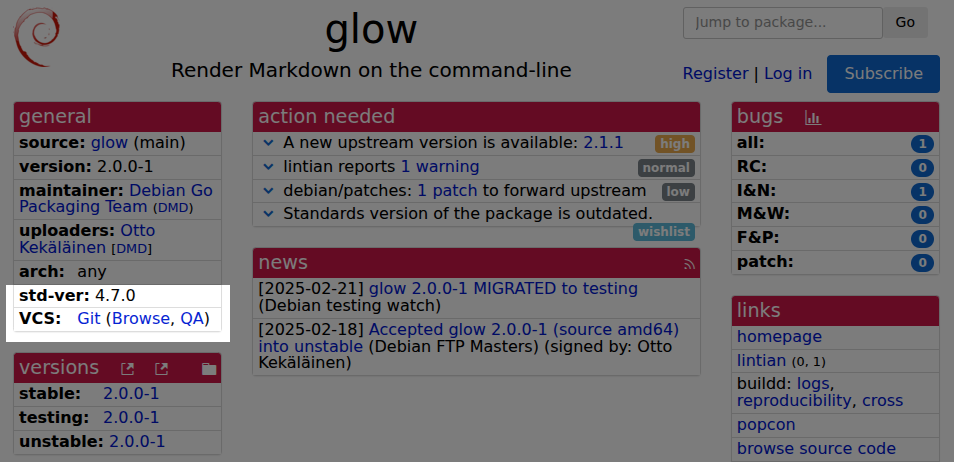
Historically the primary way to contribute to Debian has been to email the Debian bug tracker with a code patch. Now that 92% of all Debian source packages are hosted at salsa.debian.org the GitLab instance of Debian more and more developers are using Merge Requests, but not necessarily in the optimal way. In this post I share what I ve found the best practice to be, presented in the natural workflow from forking to merging.
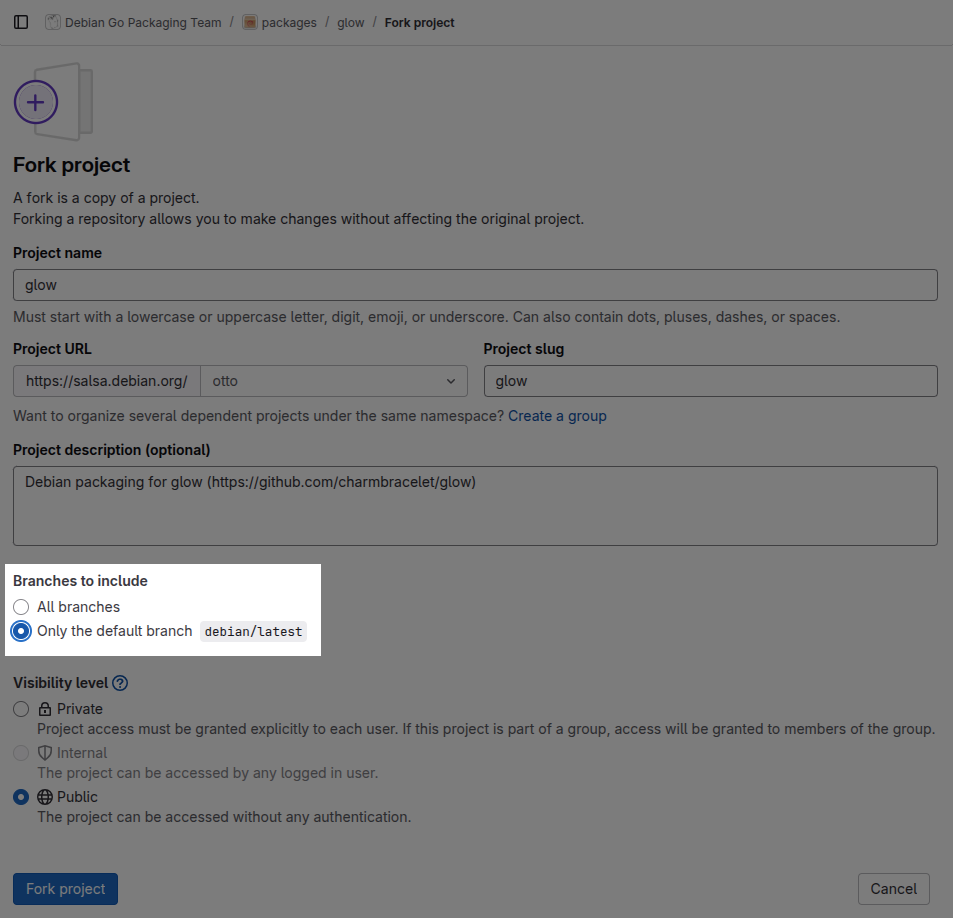
Once forking is complete, clone it with git-buildpackage. For this example repository, the exact command would be gbp clone --verbose git@salsa.debian.org:otto/glow.git.
Next, add the original repository as a new remote and pull from it to make sure you have all relevant branches. Using the same fork as an example, the commands would be:
git remote add go-team https://salsa.debian.org/go-team/packages/glow.git
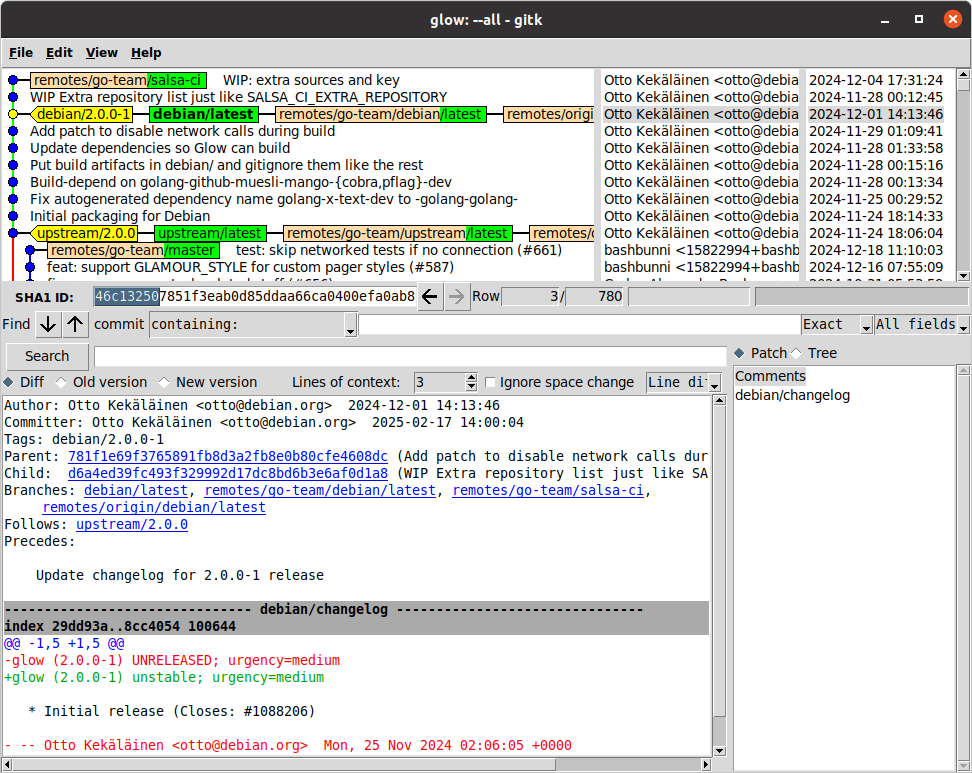
gbp pull --verbose --track-missing go-teamgbp pull command can be repeated whenever you want to make sure the main branches are in sync with the original repository. Finally, run gitk --all & to visually browse the Git history and note the various branches and their states in the two remotes. Note the style in comments and repository structure the project has and make sure your contributions follow the same conventions to maximize the chances of the maintainer accepting your contribution.
It may also be good to build the source package to establish a baseline of the current state and what kind of binaries and .deb packages it produces. If using Debcraft, one can simply run debcraft build in the Git repository.
git checkout -b <branch name> to clearly separate your work from the main branch.
When making changes, remember to follow the conventions you already see in the package. It is also important to be aware of general guidelines on how to make good Git commits.
If you are not able to immediately finish coding, it may be useful to publish the Merge Request as a draft so that the maintainer and others can see that you started working on something and what general direction your change is heading in.
If you don t finish the Merge Request in one sitting and return to it another day, you should remember to pull the Debian branch from the original Debian repository in case it has received new commits. This can be done easily with these commands (assuming the same remote and branch names as in the example above):
git fetch go-team
git rebase -i go-team/debian/latestgit push --force. While GitLab does allow squashing, I recommend against it. It is better that the submitter makes sure the final version is a neat and clean set of commits that the receiver can easily merge without having to do any rebasing or squashing themselves.
When ready, remove the draft status of the Merge Request and wait patiently for review. If the maintainer does not respond in several days, try sending an email to <source package name>@packages.debian.org, which is the official way to contact maintainers. You could also post a comment on the MR and tag the last few committers in the same repository so that a notification email is triggered. As a last resort, submit a bug report to the Debian bug tracker to announce that a Merge Request is pending review. This leaves a permanent record for posterity (or the Debian QA team) of your contribution. However, most of the time simply posting the Merge Request in Salsa is enough; excessive communication might be perceived as spammy, and someone needs to remember to check that the bug report is closed.
When you see a new Merge Request, try to review it within a couple of days. If you cannot review in a reasonable time, posting a small note that you intend to review it later will feel better to the submitter compared to not getting any response.
Personally, I have a habit of assigning myself as a reviewer so that I can keep track of my whole review queue at https://salsa.debian.org/dashboard/merge_requests?reviewer_username=otto, and I recommend the same to others. Seeing the review assignment happen is also a good way to signal to the submitter that their submission was noted.
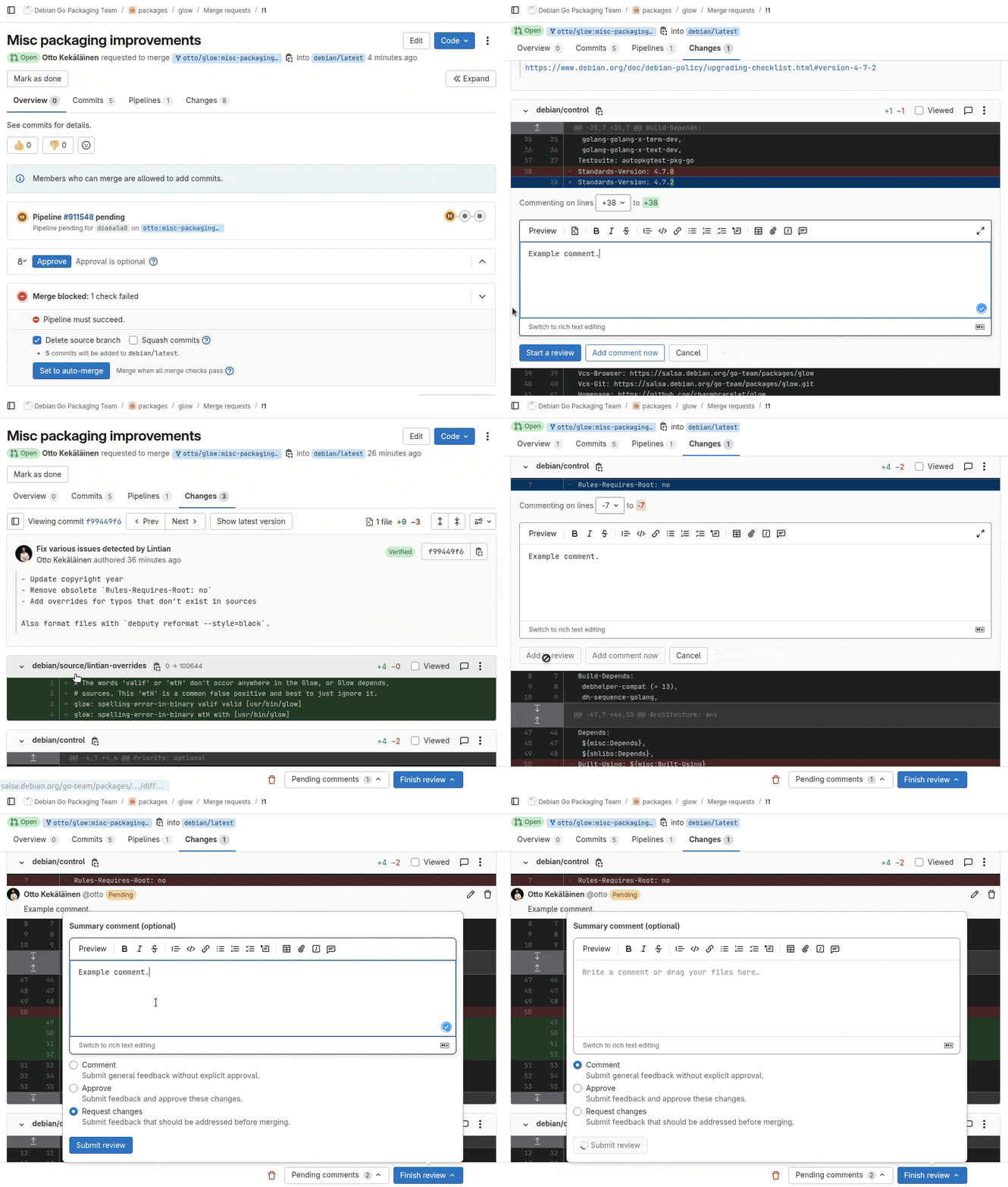
When adding the first comment, I choose Start review and for the following remarks Add to review. Finally, I click Finish review and Submit review, which will trigger one single email to the submitter with all my feedback. I try to avoid using the Add comment now option, as each such comment triggers a separate notification email to the submitter.
git pull <remote url> <branch name>. There is no need to run git remote add as pulling using a URL directly works too and saves from needing to clean up old remotes later.
Pulling the Merge Request contents locally allows me to build, run and inspect the code deeply and review the commits with full metadata in gitk or equivalent.
debian/ subdirectory that contains the actual Debian packaging. For the same reason, a typical Debian packaging Git repository has a debian/latest branch that has changes only in the debian/ subdirectory while the surrounding upstream files are the actual upstream files and have the actual upstream Git history. For details, see my post explaining Debian source packages in Git.
Because of this Git branch structure, importing a new upstream version will typically modify three branches: debian/latest, upstream/latest and pristine-tar. When doing a Merge Request for a new upstream import, only submit one Merge Request for one branch: which means merging your new changes to the debian/latest branch.
There is no need to submit the upstream/latest branch or the pristine-tar branch. Their contents are fixed and mechanically imported into Debian. There are no changes that the reviewer in Debian can request the submitter to do on these branches, so asking for feedback and comments on them is useless. All review, comments and re-reviews concern the content of the debian/latest branch only.
It is not even necessary to use the debian/latest branch for a new upstream version. Personally, I always execute the new version import (with gbp import-orig --verbose --uscan) and prepare and test everything on debian/latest, but when it is time to submit it for review, I run git checkout -b import/$(dpkg-parsechangelog -SVersion) to get a branch named e.g. import/1.0.1 and then push that for review.
gbp pull to automate fetching all branches from the submitter s fork. Assume you are reviewing a submission targeting the Glow package repository and there is a Merge Request from user otto s fork. As the maintainer, you would run the commands:
git remote add otto https://salsa.debian.org/otto/glow.git
gbp pull --verbose ottogbp pull --force will not suffice, and this trick of manually fetching each branch and resetting them to the submitter s version is needed:
for BRANCH in pristine-tar upstream debian/latest
do
git checkout $BRANCH
git reset --hard origin/$BRANCH
git pull --force https://salsa.debian.org/otto/glow.git $BRANCH
done
It appears that the fragile masculinity tech evangelists have identified Debian as a community with boundaries which exclude them from abusing its members and they re so angry about it! In response to posts such as this, and inspired by Dr. Conway s piece, I ve composed a poem which, hopefully, correctly addresses the feelings of that crowd.
I am the very model of a modern patriot online, My keyboard is my rifle and my noble cause is so divine. I didn't learn my knowledge in a dusty college lecture hall, But from the chans where bitter anonymity enthralls us all. I spend a dozen hours every day upon my sacred quest, To put the globo-homo narrative completely to the test. My arguments are peer-reviewed by fellas in the comments section, Which proves my every thesis is the model of complete perfection. I m steeped in righteous anger that the libs call 'white fragility,' For mocking their new pronouns and their lack of masculinity. I m master of the epic troll, the comeback, and the searing snark, A digital guerrilla who is fighting battles in the dark. I know the secret symbols and the dog-whistles historical, From Pepe the Frog to Let s Go Brandon, in order categorical; In short, for fighting culture wars with rhetoric rhetorical, I am the very model of a patriot polemical. *** I stand for true expression, for the comics and the edgy clown, Whose satire is too based for all the fragile folks in town. They say my speech is 'violence' while my spirit they are trampling, The way they try to silence me is really quite a startling sampling Of 1984, which I've not read but thoroughly understand, Is all about the tyranny that's gripping this once-blessed land. My humor is a weapon, it s a razor-bladed, sharp critique, (Though sensitive elites will call my masterpiece a form of hate speech ). They cannot comprehend my need for freedom from all consequence, They call it 'hate,' I call it 'jokes,' they just don't have a lick of sense. So when they call me bigot for the spicy memes I post pro bono, I tell them their the ones who're cancelled, I'm the victim here, you know! Then I can write a screed against the globalist cabal, you see, And tell you every detail of their vile conspiracy. In short, when I use logic that is flexible and personal, I am the very model of a patriot controversial. *** I'm very well acquainted with the scientific method, too, It's watching lengthy YouTube vids until my face is turning blue. I trust the heartfelt testimony of a tearful, blonde ex-nurse, But what a paid fact-checker says has no effect and is perverse. A PhD is proof that you've been brainwashed by the leftist mob, While my own research on a meme is how I really do my job. I know that masks will suffocate and vaccines are a devil's brew, I learned it from a podcast host who used to sell brain-boosting goo. He scorns the lamestream media, the CNNs and all the rest, Whose biased reporting I've put fully to a rigorous test By only reading headlines and confirming what I already knew, Then posting my analysis for other patriots to view. With every "study" that they cite from sources I can't stand to hear, My own profound conclusions become ever more precisely clear. In short, when I've debunked the experts with a confident "Says who?!", I am the very model of a researcher who sees right through you. *** But all these culture wars are just a sleight-of-hand, a clever feint, To hide the stolen ballots and to cover up the moral taint Of D.C. pizza parlors and of shipping crates from Wayfair, it s true, It's all connected in a plot against the likes of me and you! I've analyzed the satellite photography and watermarks, I understand the secret drops, the cryptic Qs, the coded sparks. The habbening is coming, friends, just give it two more weeks or three, When all the traitors face the trials for their wicked treachery. They say that nothing happened and the dates have all gone past, you see, But that's just disinformation from the globalist enemy! Their moving goalposts constantly, a tactic that is plain to see, To wear us down and make us doubt the coming, final victory! My mind can see the patterns that a simple sheep could never find, The hidden puppet-masters who are poisoning our heart and mind. In short, when I link drag queens to the price of gas and child-trafficking, I am the very model of a patriot whose brain is quickening! *** My pickup truck's a testament to everything that I hold dear, With vinyl decals saying things the liberals all hate and fear. The Gadsden flag is waving next to one that's blue and starkly thin, To show my deep respect for law, except the feds who're steeped in sin. There's Punisher and Molon Labe, so that everybody knows I'm not someone to trifle with when push to final shoving goes. I've got my tactical assault gear sitting ready in the den, Awaiting for the signal to restore our land with my fellow men. I practice clearing rooms at home when my mom goes out to the store, A modern Minuteman who's ready for a civil war. The neighbors give me funny looks, I see them whisper and take note, They'll see what's what when I'm the one who's guarding checkpoints by their throat. I am a peaceful man, of course, but I am also pre-prepared, To neutralize the threats of which the average citizen's unscared. In short, when my whole identity's a brand of tactical accessory, You'll say a better warrior has never graced a Cabela's registry. *** They say I have to tolerate a man who thinks he is a dame, While feminists and immigrants are putting out my vital flame! There taking all the jobs from us and giving them to folks who kneel, And "woke HR" says my best jokes are things I'm not allowed to feel! An Alpha Male is what I am, a lion, though I'm in this cubicle, My life's frustrations can be traced to policies Talmudical. They lecture me on privilege, I, who have to pay my bills and rent! While they give handouts to the lazy, worthless, and incompetent! My grandad fought the Nazis! Now I have to press a key for one To get a call-rep I can't understand beneath the blazing sun Of global, corporate tyranny that's crushing out the very soul Of men like me, who've lost their rightful, natural, and just control! So yes, I am resentful! And I'm angry! And I'm right to be! They've stolen all my heritage and my masculinity! In short, when my own failures are somebody else's evil plot, I am the very model of the truest patriot we've got! *** There putting chips inside of you! Their spraying things up in the sky! They want to make you EAT THE BUGS and watch your very spirit die! The towers for the 5G are a mind-control delivery tool! To keep you docile while the children suffer in a grooming school! The WEF, and Gates, and Soros have a plan they call the 'Great Reset,' You'll own no property and you'll be happy, or you'll be in debt To social credit overlords who'll track your every single deed! There sterilizing you with plastics that they've hidden in the feed! The world is flat! The moon is fake! The dinosaurs were just a lie! And every major tragedy's a hoax with actors paid to cry! I'M NOT INSANE! I SEE THE TRUTH! MY EYES ARE OPEN! CAN'T YOU SEE?! YOU'RE ALL ASLEEP! YOU'RE COWARDS! YOU'RE AFRAID OF BEING TRULY FREE! My heart is beating faster now, my breath is short, my vision's blurred, From all the shocking truth that's in each single, solitary word! I've sacrificed my life and friends to bring this message to the light, so... You'd better listen to me now with all your concentrated might, ho! *** For my heroic struggle, though it's cosmic and it's biblical, Is waged inside the comments of a post that's algorithm-ical. And still for all my knowledge that's both tactical and practical, My mom just wants the rent I owe and says I'm being dramatical.
ERROR: '<file>' is too small (should be <size> bytes).
Some searxing later, I ve4 found this was caused by the 64-bit time_t
transition, which
changed the format of the files, and that (somewhat unexpectedly)
there was no way to fix it on the machine itself.
What needed to be done
instead was to export the data on an XML dump before the upgrade, and
then import it back afterwards.
Easy enough, right? If you know about it, which is why I m blogging
this, so that other people will know in advance :)
Anyway, luckily I still had the other containers on bookworm, so I
copied the files over there, did the upgrade, and my home monitoring
system is happily running as before.
On August 16, 1993, Ian Murdock announced the Debian Project to the world.
Three decades (and a bit) later, Debian is still going strong, built by a
worldwide community of developers, contributors, and users who believe in a
free, universal operating system.
Over the years, Debian has powered servers, desktops, tiny embedded devices, and
huge supercomputers. We have gathered at DebConfs, squashed countless bugs,
shared late-night hacking sessions, and helped keep millions of systems secure.
Debian Day is a great excuse to get together, whether it is a local meetup, an
online event, a bug squashing party, a team sprint or just coffee with fellow
Debianites. Check out the Debian Day wiki to see if there is a celebration
near you or to add your own.
Here is to 32 years of collaboration, code, and community, and to all the
amazing people who make Debian what it is.
Happy Debian Day!
sway brings,
among a lot of other features, updated support for touchpad gestures and
support for the
ext-session-lock-v1
protocol, which allows for more robust and secure screen locking. The
configuration snippet that activates the default sway background is now shipped
in the sway-backgrounds package instead of being part of the sway package
itself.
The default menu application was changed from dmenu to wmenu. wmenu is a
Wayland native alternative to dmenu which I packaged and it is now
recommended by sway.
There are some small helper tools for sway that were updated: swaybg was
bumped from 1.2.0 to 1.2.1, swaylock was bumped from 1.7.2 to 1.8.2.
The grimshot script, which is a script for making screenshots, was part
of the sway s contrib folder for a long time (but was shipped as a separate
binary package). It was removed from sway and is now part of the
sway-contrib project. There are
some other useful utilities in this source package that I might package in the
future.
slurp, which is used by grimshot to select a region, was updated from
version 1.4 to version 1.5.
labwc package two years ago and I m happy it is now part
of a stable Debian release. Labwc is also based on
wlroots, like sway. It is a window-stacking compositor and is inspired by
openbox. I used openbox for a long time back in the day
before I moved to i3 and I m very happy to see that there is a Wayland
alternative.
foot was updated from version
1.13.1 to 1.21.0. The probably most important change for users updating might be
the fact that:
Control+Shift+uis now bound tounicode-inputinstead ofshow- urls-launch, to follow the convention established in GTK and Qtshow-urls-launchnow bound toControl+Shift+o
cage was updated from 0.1.4 to 0.2.0.
The waybar bar for wlroots compositors was updated from 0.9.17 to 0.12.0.
swayimg was updated from 1.10 to 3.8 and now brings support for custom key
bindings, support for additional image types (PNM, EXR, DICOM, Farbfeld,
sixel) and a gallery mode.
tofi, another dmenu replacement was updated from 0.8.1 to 0.9.1,
wf-recorder a tool for screen recording in wlroots-based compositors, was
updated from version 0.3 to version 0.5.0. wlogout was updated from version
1.1.1 to 1.2.2. The application launcher wofi was updated from 1.3 to 1.4.1.
The lightweight status panel yambar was updated from version 1.9 to 1.11.
kanshi, the tool for managing and automatically switching your output
profiles, was updated from version 1.3.1 to version 1.5.1.
usbguard was updated from version 1.1.2 to 1.1.3.
fnott - a lightweight notification daemon for wlroots based compositorsfyi - a utility to send notifications to a notification daemon, similar
to notify-sendpipectl - a tool to create and manage short-lived named pipes, this is a
dependency of wl-present. wl-present is a script around
wl-mirror which implements output
mirroring for wlroots-based compositorspoweralertd - a small daemon that notifies you about the power status of
your battery powered deviceswlopm - control power management of outputswlrctl - command line utility for miscellaneous wlroots Wayland extensionswmenu - already mentioned, the new default launcher of swaywshowkeys - shows keypresses in wayland sessions, nice for debugginglibsfdo - libraries implementing some freedesktop.org specs, used by labwc
Like each month, have a look at the work funded by Freexian s Debian LTS offering.

People keep asking me when I ll write the next instalment of my local voice assistant journey. I didn t mean for it to be so long since the last one, things have been busier than I d like. Anyway. Last time we d built Tensorflow, so now it s time to sort out openWakeWord. As a reminder we re trying to put a local voice satellite on my living room Debian media machine.
The point of openWakeWord is to run on the machine the microphone is connected to, listening for the wake phrase ( Hey Jarvis in my case), and only then calling back to the central server to do a speech to text operation. It s wrapped up for Wyoming as wyoming-openwakeword.
Of course I ve packaged it up - available at https://salsa.debian.org/noodles/wyoming-openwakeword. Trixie only released yesterday, so I m still running all of this on bookworm. That means you need python3-wyoming from Trixie - 1.6.0-1 will install fine without needing rebuilt - and the python3-tflite-runtime we built last time.
Like the other pieces I m not sure about how this could land in Debian; it s unclear to me that the pre-trained models provided would be accepted in main.
As usual I start it with with a systemd unit file dropped in /etc/systemd/service/wyoming-openwakeword.service:
[Unit]
Description=Wyoming OpenWakeWord server
After=network.target
[Service]
Type=simple
DynamicUser=yes
ExecStart=/usr/bin/wyoming-openwakeword --uri tcp://[::1]:10400/ --preload-model 'hey_jarvis' --threshold 0.8
MemoryDenyWriteExecute=false
ProtectControlGroups=true
PrivateDevices=false
ProtectKernelTunables=true
ProtectSystem=true
RestrictRealtime=true
RestrictNamespaces=true
[Install]
WantedBy=multi-user.target
0.5, but the device lives under the TV and seems to get a bit confused by it sometimes. There s some talk about using speex for noise suppression, but I haven t explored that yet (it s yet another Python module to bind to the C libraries I d have to look at).
This is a short one; next post is actually building the local satellite on top to tie everything together.
$ incus remote add docker https://docker.io --protocol=oci
$ incus launch docker:debian:sid sid
$ incus shell sid
root@sid:~# apt update && apt upgrade -y
root@sid:~# cat /etc/os-release
PRETTY_NAME="Debian GNU/Linux forky/sid"
NAME="Debian GNU/Linux"
VERSION_CODENAME=forky
ID=debian
HOME_URL="https://www.debian.org/"
SUPPORT_URL="https://www.debian.org/support"
BUG_REPORT_URL="https://bugs.debian.org/"
sshd listener process into two pieces: a minimal network listener (still
called sshd), and an sshd-session process dealing with each individual
session. Before this change, when sshd received an incoming connection, it
forked and re-executed itself with some special parameters to deal with it;
after this change, it forks and executes sshd-session instead, and sshd no
longer accepts the parameters it used to accept for this.sshd
received the connection and tried to hand it off to a freshly-executed copy of
the new sshd binary on disk, which no longer supports this. This wasn t much
of a problem when upgrading OpenSSH on its own or with a small number of other
packages, but in release upgrades it left a large gap when you can t SSH to the
system any more, and if anything fails in that interval then you could be in
trouble.openssh-server package divert /usr/sbin/sshd to
/usr/sbin/sshd.session-split before the unpack step of an upgrade from before
9.8, then removing the diversion and moving the new file into place once it s
ready to restart the service. This reduces the period when new connections fail
to a minimum.
sshd, check for a compatible version of
the OpenSSL library when they start up. This check used to be very picky, among
other things requiring both the major and minor part of the version number to
match. OpenSSL 3 has a better versioning policy,
and so OpenSSH 9.4p1 relaxed this check.sshd stopped working. This
couldn t be fixed by a change in trixie; we needed to change bookworm in advance
of the upgrade so that it would tolerate newer versions of OpenSSL, and time was
tight if we wanted this to be available before the release of Debian 13.stable-updates
mechanism for exactly this sort of thing, and the stable release managers kindly
accepted Colin s proposal to fix this there.
stable-updates / bookworm-updates, which is enabled by default) before
starting the upgrade to trixie, everything should be fine.
python3-dev:any, libpython3-dev) yetkconf_update (thanks to Aur lien COUDERC)trixie release, about two thirds of the packages can satisfy their cross
Build-Depends and about half of the packages actually can be cross built.
hurd-any mostly reviewing Samuel s patches. He proposed a
patch for improving bash s detection of its pipesize
and a change to dpkg-shlibdeps to improve behavior for building cross toolchains.glibc upgrade failure
induced by a /usr-move mitigation of systemd and sent a patch and regression
fix both of which reached trixie in time. Thanks to Aurelien Jarno and the
release team for their timely cooperation.Architecture: all packages in a multiarch context in order to improve the
long-standing interpreter problem. With help from Tollef Fog Heen better
semantics were discovered and agreement was reached with Guillem Jover and
Julian Andres Klode to consider this change. The idea is to record a concrete
architecture for every Architecture: all package in the dpkg database and
enable choosing it as non-native.debvm.
$ b4 am 20250715-pci-port-reset-v6-0-6f9cce94e7bb@oss.qualcomm.com
# follow hint from b4
$ git checkout -b v6_20250715_manivannan_sadhasivam_oss_qualcomm_com 19272b37aa4f83ca52bdf9c16d5d81bdd1354494
$ git am ./v6_20250715_manivannan_sadhasivam_pci_add_support_for_resetting_the_root_ports_in_a_platform_specifi.mbx
$ git rebase -i collabora/rockchip-devel
$ cp /boot/config-6.16.0-rc7+ .config
$ make olddefconfig
# this generates a message about "reform2_lpc config not found!!"
# and "rockchip_vdec2 config not found!!"
# hopefully this is ok
$ yes '' make localmodconfig
$ make KBUILD_IMAGE=arch/arm64/boot/Image bindeb-pkg -j$(nproc)
Next.