Search Results: "otto"

22 October 2007

Joerg Jaspert: Clusterssh

Some people did ask me to add a “tech” category to my blog, and randomly post about useful little things that help making life easier. Well, Im not making a dedicated category for it, but one where I will put all my not-strictly-debian related “tech” content in. Up to now my blog only knew a debian category… :) Well, so the first thing i have a little to write about is clusterssh. It is similar to dsh, with the difference that clusterssh opens an xterm for every host you want to control, while dsh simply takes one commandline and executes it on the remote host(s). This way clusterssh allows you to step in and control a single host, if that one needs a little extra action, while keeping the connection to all other hosts open. After you are done with the extra action - just go back to control all hosts at once. Very helpful if you edit configuration files, and one hosts needs a little different value, while most stuff is the same. Or doing security upgrades and find out one of your colleagues was so “clever” to install an extra package which now makes aptitude want to remove half of your system. You can step in and fix the situation and then simply continue with all hosts. Usage of clusterssh is pretty simple - after you installed it type
  cssh machine1 machine2 machine3
and clusterssh will open 3 xterms and one control window. Whatever you type into that control window is then send to all 3 machines. cssh example1 As you can see in the picture I first executed one command on both hosts, by typing it into the CSSH window, and then selected one host directly, typing a command only this host sees. Now, we are all lazy, so lets make cssh easier to use. Noone wants to type hundreds of hostnames all the time. Luckily clusterssh has a concept where you map tags to servernames. If you are the admin of your machine and want to setup such a mapping for all of your users you edit /etc/clusters, if you just want to do it for yourself edit $HOME/.csshrc. Actually - do not edit it, but run
  cssh -u >$HOME/.csshrc
and edit the generated file. Ignore all of the config stuff for now, defaults are nice and good. Go to the bottom and add something similar to the following lines:
 clusters = foo bar
 foo = miau wuff:2222 root@milk:98 root@elsewhere
 bar = root@miau:443 web@ftp:443
Replace with hosts you can actually login to. The above defines two set of hosts, foo and bar. Now all I need to do to login to the defined machines is to type
 cssh foo
and clusterssh will open 4 xterms and login to the machines. At work I usually have up to 200-250 machines open with clusterssh, so it can handle large numbers of hosts at once. In such cases you might want to consider adding the -G parameter to the commandline, to not get clusterssh to resize the xterms. A last thing I like to do is - give the xterms opened by clusterssh a different layout. My window manager is setup to draw all my terminals maximized and also has some other settings that do not really help clusterssh terminals . But there is a simple way round this. Edit the following options in your .csshrc to look similar like
terminal_allow_send_events=-xrm '*.VT100.allowSendEvents:true'
terminal_args=-class CSSH
This will put all xterms into the class CSSH. As your normal settings usually apply to class XTerm this already ignores them. If you want to setup some more things, like a blue background and red foreground in CSSH windows, just add the following into your $HOME/.Xdefaults file (or do whatever steps your window manager might like to configure such things):
CSSH*background: Blue
CSSH*foreground: Red
Activate with xrdb -load ~/.Xdefaults, done.

Holger Levsen: Small report from the meeting in Extremadura

The last five days I've spent at the combined Debian Edu, FAI and CDD meeting in M rida in Extremadura, together with 17 others. The Debian Edu / Skolelinux crowd was the biggest, followed by FAI, followed by CDD people, though many were part of more than one project. "As usual" it was great to meet many known faces and some unknown ones and to be able to discuss stuff in RL.

Besides various small different things, I worked on the Debian Edu etch r1 release, our lenny roadmap (see the bottom of our roadmap page which also covers etch r1) and the (technical side of the) german translation of the Debian Edu documentation. Non edu related the new setupharddisk2 for FAI took most of my brain activity. And I've signed all keys allready :-)

We stayed at a very nice hotel in the even much nicer city of Merida, which features a lot of roman ruins and history. For example, we walked over the biggest roman bridge in the world! The only thing that was bigger was the amount of good food we were forced to eat every day... Incredible. This was my second visit to Merida and this time I finally managed to visit the amphitheatre (with seats for 15000 people) and the Roman theatre. (Unfortunatly the english page about Emerita Augusta is a stub.) If you happen to come around that area make sure to spend some time sight seeing, it is really worth it! People living in Merida literally fear to rebuild their houses, because as soon as they start to dig, they find something historical and have to turn their property into a museum :-)

In case you have not seen it yet, you should watch this small movie from euro news about the free software efforts in Extremadura. Insightful and very good promotion, also to show around.

Many thanks to C sar, Jos Luis and the Junta de Extremdura for hosting such a great meeting! You rock!

On a unrelated note, spam has gone crazy yesterday while traveling back, 15000 mails were not catched by my so far well working setup. ARG. I still used to have a catchall setting, which was useful to give out addresses like $company@mydomain, but now I will explicitly list those addresses and disable catchall. And luckily for you I will not blog about every spam mail I got... :) Generally I dont consider spam (the source of) evil, it's money: as long as money rules the world, there will be spam. So since it's a social problem, it is hardly solvable by technology. (That is, as long as you want to receive mails from strangers, which I do.) IMO what's worse than spammers are autoresponders to spam. Most of those 15000 mails were auto-replies to spam. OMFSM.

16 October 2007

Russell Coker: War is Bad for the Environment

I just read a nutty post claiming that Neo-Conservatism is good for the environment [1]. The first bogus claim is that Saddam had WMD and war was required because he was a despot. The fact is that the Iraqi government was always repressive, there are many factions in Iraq that don’t like each other and a repressive government is the only way to keep such groups in a united country. The current civil war in Iraq and the effective secession of Kurdistan (which currently seems to be involved in an undeclared border war with Turkey) demonstrates this. Saddam was always a despot, but he did improve the living conditions of most Iraqis - the best way to avoid a revolution is to convince the majority of the population that things will get worse if there is change. I suggest reading the Wikipedia page about Saddam Hussein [2]. The best information on Fourth Generation Warfare (4GW) seems to be on the conservative military analysis site Defense and the National Interest [7]. It covers all the issues related to invading other countries from a conservative point of view. Note that Neo-Conservatives are not Conservatives, the real Conservatives hate the Neo-Cons more than anyone else does. The amusing statement is made that “apologists claim it was one of the most advanced Arab nations” and then a link is provided to information on Saudi Arabian censorship. It’s worth reading the wikipedia page about the history of Saudi Arabia [3], among other interesting facts “the U.S. Army Corps of Engineers built the country’s television and broadcast facilities and oversaw the development of its defense industry” (does the US army share responsibility for the censorship?). It’s widely regarded that if the US military support was removed then the Saudi government would be overthrown. Referring to Saudi Arabia hardly seems like something you want to do if trying to justify occupying other middle-eastern states. An unsubstantiated claim is made that under-developed countries produce excess pollution due to inefficient technology. Unlike some people I try to get some facts before posting so I looked up the wikipedia page on CO2 emissions per capita [4]. It seems that the highest ranking first-world country is Luxembourg at #4, the next is the US at #10. The countries on the list that rank higher than the US have a combined population of about 11,000,000 while the US population is 302,000,000 - some quite mental arithmetic suggests that the US produces about 20 times more CO2 than the top 9 countries on the list combined! It doesn’t seem that having the highest technology is helping the US protect the environment, I guess that they just use it to build bigger cars. The next thing I noticed is the countries that are at the bottom of the list - they are the world’s poorest countries. It seems that countries without much money just can’t afford to burn lots of oil, while countries with lots of money can. No real surprises there. The lowest ranking on the list for a country that is unlikely to be regarded as being in abject poverty is India at position #133. The next lowest is Turkey at position #98 followed by China at #91. As a final point of reference Switzerland is at position #69 a produces just under 27% the CO2 that the US does (on a per-capita basis). According to the CIA World Fact Book Switzerland has an infant mortality rate of 4.28/1000 and a life expectancy of 80.62 [5], while the US has an infant mortality rate of 6.37/1000 and a life expectancy of 78 [6]. I believe that the infant mortality rate and the life expectancy are the two factors that are most representative of quality of life as they are the easiest factors for measuring the overall health of the population. Being healthy is one of the most important factors in quality of life. It seems to me that by all objective measures the Swiss are doing better than the people of the US, yet they produce less pollution and never invade other countries. Probably the most ridiculous statement in the post is “see rapidly dwindling resources wasted on jihad and revolution“. A revolution (locals using force to create a new government) takes little resources and most actions that a more simple-minded analysis might call “jihad” takes almost none. Sending an invasion force to the other side of the world and supporting an occupying army for years does however use significant resources, consider that the Hummvee is the least fuel-efficient vehicle on American roads in terms of work done (trucks and buses use more fuel but carry large amounts of cargo or many people), but it’s also the most fuel-efficient vehicle used by the US army in Iraq. There is the possibility that Jaldhar was attempting satire. If so then I suggest that satire be kept separate from serious web content to avoid confusion about where the satire ends. But if you want some satire about oil then I suggest consulting theonion.com. Before someone accuses me of being impolite, over a year ago the best estimate for the death toll from the occupation of Iraq was 655,000 [8]. Current extrapolations from the previous medical research suggest that the death toll has now exceeded 1,000,000. Regardless of whether the original post was intended as satire or not, I’m not laughing and I don’t feel the need to be polite to someone who makes excuses for such loss of life. Finally as a positive suggestion towards the environment (and any other issue that you may want to discuss), I suggest analysing the issues before writing about them and not blindly trusting other people. When you write a post make objective claims with references to back them up. When you read a post consider the points that are made and the references that are cited. Do the references support the claims? Are there other interpretations of the evidence? Are the reference sites reputable?

MJ Ray: Stuttering through comment spam

I get too much spam and some of it isn't obvious from the subject line, particularly if it's a blog comment, so I use the following script to read the suspicious emails and pause at the bottom of each mail. It takes two optional parameters, explained in the comments below. Please comment on any obvious improvements to this quick hack.
#!/usr/bin/mzscheme -qr
(let ((c (or (and (> (vector-length argv) 0)
                  (string->number (vector-ref argv 0)))
             1)) ; first arg is how long to pause in seconds, default 1
      (re (or (and (> (vector-length argv) 1)
                   (regexp (vector-ref argv 1)))
              (regexp "^From [^ ]*@"))) ; second arg is regexp to pause at
      (i #f))
  (let loop ((l (read-line)))
    (if (regexp-match re l) (if i (sleep c) (set! i #t)))
    (write-string l) (newline)
    (if (not (eof-object? (peek-char))) (loop (read-line)))))
(exit)
;
#!/usr/bin/perl
# An earlier version in perl
$c = ($ARGV[0] 1); # How long to pause, in seconds
$re = ($ARGV[1] '^From [^ ]*@'); # What to pause on
$i = 0;
while (<STDIN>)  
  if (/$re/)   if ($i)   sleep ($c)   $i=1;  
  print $_;
 

3 October 2007

James Morrison: Birthday!

I got a little older yesterday. I'm 26 now. It was a fun day. It started out by going to the Federal Police to get my temporary id. The agents who register foreigners are on strike for the last week or so, but there was someone there dealing with the registration. So my name got put in a big book and I've got a piece of paper that will let me back into the country next week.

Now for the actual birthday. A bunch of use went out to a place called Pinguin (yes, Penguin in Portuguese). We had some chopp, some very good garlic bread. Then since it was my birthday we got a cotton candy cake, and a nice little Penguin!

Andrew Pollock: [tech] Double drive failure, the sequel

Today I received the replacement hard drives for the two that failed the other week. Despite me not ticking the box (or paying the $10 for the upgrade), they gave me 500Gb drives to replace the 400Gb drives that I'd shipped them. I was a little dismayed to find that they were labelled as refurbished drives though. Oh well. I plugged the first drive in, and it started exhibiting the same behaviour as the one that had failed, and I immediately thought "oh, they've shipped me a dud refurbished drive". So I tried the other one. It also did the same thing. I started to smell a rat. I have a slightly convoluted power setup for these four disks. They're all connected to minotaur via IDE-USB adapters, and they have external DC power supplies. They're just sitting on top of minotaur, which is a Pentium III 1-RU server, in the bottom of my linen cupboard. In order to reduce the number of plugs involved, I have an IEC Y-cable, which goes to two of these DC power supplies (which take an IEC cable in one end and has a Molex connector on the other end), and the Molex cable from the DC power supply has a Molex splitter cable on it. So I'm powering two drives from each DC power supply, and each DC power supply is connected to an IEC Y-cable. There's no redundancy whatsoever, and I'm not that concerned. I don't have a UPS anyway, and the whole thing has worked fine for months, and it reduces the rats nest of cables a little bit, which is good. I already have way too many things plugged into my linen cupboard. Anyway, so after both new drives appeared to be faulty, I discovered that both drives that had failed within a day of each other were connected to the same DC power supply. The plot thickened. So I dug out a standalone IDE-USB hard drive enclosure (with a separate power supply) and tried that. Everything worked. I tried it with just the enclosure's power supply and either of the IDE-USB adapters I'd been using previously. Everything worked. So I'd managed to narrow it down to the power supply. Most unusual. So fortunately I have four of these DC power supplies, as they came with the IDE-USB adapters, and I freed up two of them when I went for the aforementioned crazy power splitting setup, so I dug out one of the two spares, and tried that, and everything worked. So I've no idea why the power supply decided to go dicky after months of working. I've yet to introduce my multimeter to it to try and work out what's going on. I'm a bit embarrassed that I didn't do more homework before I declared the drives to be faulty. To be honest, they were clicking and generally looking "failed", and I've had a lot going on lately, so I just jumped to the conclusion. Oh well, at least I still haven't lost any data. Too bad I have 200 Gb that is going to go to waste.

19 September 2007

Mike O'Connor: tritium-0.3.1

I finally got it together to release a new version of tritium. Probably the most exciting feature in this release is that you can allocate an area of the desktop to be used for a status bar / panel / dock area.
Here is a screenshot of my desktop showing a working gnome-panel at the bottom. Debian packages/sources are available here, and from sourceforge. The git repository is here. The next big task for me will be to add some kind of 'scratchpad' functionality similar to what ion3 has. update: A number of people have pointed out some missing files in the .deb, so I have posted a 0.3.2-1 to http://vireo.org/debian/tritium/ ; thanks for the feedback.

17 September 2007

MJ Ray: Run on the Bank

For one UK bank, "innovation" has included funding long-term home loans mostly with short-term inter-bank loans. So, the increased costs of obtaining inter-bank loans during a credit crisis caused Northern Rock to obtain support from the central bank, the Bank of England. Once that became public knowledge, as it must, it started a predictable run on the bank, as described in Guardian Unlimited: Between Rock and a hard place - savers besiege bank. Savings are leaving at a rate of almost a billion pounds (1.6bn euro?) each day just now. In turn, that makes the bank's loans-to-savings ratio even more extreme, which then worries more savers and we're into a feedback loop, with queues growing out of the bank's doors, customer sit-ins [BBC West] and other unsettling side-effects. Northern Rock is a former member-owned building society which demutalised (converted to a shareholder-owned bank) in 1997. In just ten years, it has become committed to a business model which seems to scare many of its savers. Would it have done that if it was still controlled by its savers and borrowers? Is this exodus of savings going to be matched by loan customers moving away too? Will any of these customers return to the mutual and co-operative sector? It now seems sort of academic whether Northern Rock is on the list of online banks that work with free software, as commentators suggest it may be taken over soon. 2007-09-18 Update: the UK government has guaranteed all deposits in the dodgy bank. This is a bad thing, as explained on niq's soapbox: Race to the bottom.

13 September 2007

Simon Richter: Things I do after spending a day in front of a computer

Okay, apart from finishing the move from the laptop back to the Pegasos (I compiled d2x-xl yesterday, today is reserved for the more serious stuff), this evening will be dedicated to cooking and my other pet project, xcontrol. So, it will be risotto, wireless networks and autobuilders, in no particular order. In other news, I've been running an archive rebuild to find out which packages actually implement the build-arch and build-indep targets. Out of the first 70, I've counted 11. Since so many packages would be affected, a mass filing of wishlist bugs is probably not the way to go, so I guess I'll set up a web page with the results (after making my autobuilder more robust; it still gets too easily confused) and try to shame people into updating their packages.

11 September 2007

Joachim Breitner: Cron s syslog messages

On a modern debian system (and other linuxes as well), the cron daemon is PAM-enabled, which is probably a good thing. One downside is that you get your /var/log/auth.log full of messages like:
Sep 11 11:15:01 otto CRON[8755]: pam_unix(cron:session): session opened for user jojo by (uid=0)
Sep 11 11:15:01 otto CRON[8755]: pam_unix(cron:session): session closed for user jojo
I think these are pretty useless and make it harder to find real authentication related entries in auth.log, especially if you get them every five minutes. Luckily, the fix is pretty simple: Just edit /etc/pam.d/cron and comment out the line @include common-session, as that only calls pam_unix.so which in turn, for session management, does nothing but logging anyways.To further separate the cron logs, you can remove these entries to syslog:
Sep 11 07:17:01 quimby /USR/SBIN/CRON[7949]: (root) CMD (   run-parts --report /etc/cron.hourly)
by configuring /etc/syslog.conf to move them to a logfile on its own:
*.*;auth,authpriv,cron.none     -/var/log/syslog
cron.*                          -/var/log/cron.log

3 September 2007

Holger Levsen: dancing and singing

Today I'm dancing and singing. :-)

In part because I've just uploaded a new version of tuxmath which IMO has a great improvement: tuxmath is a math game for children, where the player has to solve little math computations, otherwise the cities on the bottom of the screen get destroyed like in space invaders. Which is not exactly suited very well for little children. So the idea came up, to instead use igloos, which melt, so that in the end a penguin has to escape from the igloo when it gets destroyed. Very cute, but still the same gameplay. And the best thing is, those igloos were painted by a third grade daughter of one the developers.

29 August 2007

John Goerzen: Desktop Linux: Gnome

I had been intending to write an entire series of posts about our corporate switch to Linux on the Desktop. To date, I wrote only one introducing the project and our reasons for switching from Windows. That was back in April.

Today I'd like to start talking about it all some more.

We have standardized on Gnome for our desktops. Given the Windows background of our user base, it was pretty much a given that we would have to use either Gnome or KDE. Something like fvwm or a non-integrated environment just wouldn't be a good option.

We evaluated both Gnome and KDE. The very "clean" appearance of Gnome was a nice thing for us. KDE seemed to be to "chatty", talked about entering in audiocd:/ when it shouldn't have needed to, and generally violated the KISS and principle of least surprise too often. That said, I continue to run KDE for my personal desktop because Gnome just doesn't have the flexibility that KDE does. It is too bad that Gnome has gone on this remove functionality kick, and KDE hasn't gotten the KISS religion yet.

Anyway, Gnome worked well for the most part. We have set some defaults in gconf for things like panel icons. We also set a few mandatory defaults. I fixed a couple of bugs in the vfs system related to nfs4 support, which manifested themselves as icons for files newly saved to the desktop never showing up.

We wanted to present a customized menu to people based on what their job function is. That is, we are using a single system image, so all apps will be installed on all machines. But we didn't want people to have to see a ton of software that they don't use. That was easily enough accomplished for custom apps by creating desktop files with mode 0640 and setting the group to the set of people that should see the program on their menu. We removed a few stock programs (such as the terminal) from the menu as well, using dpkg-statoverride. That was also quite easily done. However, I will say that the entire Gnome XDG menu thing is woefully under-documented.

We use Firefox for the standard web browser. It is integrated well enough with Gnome and we have no problems there, aside from sites that are IE-only. We solve that with a Windows terminal server, which I'll discuss later.

Our network printing was already based on Cups. The individual machines are set up as Cups clients only, which works fine. We did find, however, that gnome-cups-manager automatically installs a tray monitor for cups. This monitor puts little printer icons on the tray when printers are in use. Unfortunately, it figures out which printers are in use by polling the server, and it is turned on by default out of the box, with no good way to disable it short of dpkg-statoverriding it to 0000. You can imagine that hundreds of users times dozens of printers times numerous polls per minute created quite the load on the server. This was a really braindead design and the people that wrote it should have known better. It is also quite useless to have icons coming on for all the printers on the network, which on some networks could be thousands, and not even on the same continent as the user.

Printing is generally a bit iffy in Gnome. They seem to be transitioning between about 3 different printing toolkits, all of which have different print dialog boxes with different supported features and different ways of selecting printers. One chief annoyance is that the print box in evince (the document/PDF viewer) does not let people access printer-specific features such as hole punching and stapling. So we installed gtklp and xpdf for people. The people that print heavy PDFs are huge fans of gtklp these days; it's a nicer solution than we had in Windows. Nobody really likes evince. We also have had some trouble with evince generating PostScript output that some printers can't grok. It sounds like all this should be much better in newer versions of Gnome, which if true, would be welcome news.

The Gnome screenshot tool makes it easy to save off a screenshot to a file, or to drag it into an email, but it is difficult to print it (you have to save it first). That was a common complaint around here, so I wrote a little wrapper around xwd and gtklp for printing screenshots. People really like that because gtklp gives them lots of options about orientation and size of the image if they want it, or a simple "Print" button to click if they don't care. We set a gconf default to bind this to Ctrl-PrintScr and it works well. KDE's screenshot tool is much more capable, and if we were using KDE, we wouldn't have had any problem with screenshots.

The bottom line on Gnome is that we, and are users, are happy with it after we've made these customizations. But we have had to do more customization that we should have. I still think that Gnome has been better for our users than KDE, but I do wonder how long we'll be able to survive with our "no KDE libraries" policy, as people want ksnapshot, kolour, etc.

28 August 2007

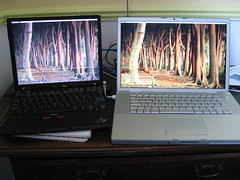
Kai Hendry: MBP versus X40

Thinkpad X40 vs MBP I’ve spent a bit of the bank holiday weekend by probably violating the warranty of a new 15” Macbook Pro (MBP) from work. I also was at the Debian bbq 2007 in Cambridge and met some friendly faces. :) More MBP & X40 porn So now I can boot into MacOSX and run Ubuntu or boot straight into Ubuntu from rEFIt. There are a couple of problems. There are some things I quite like about the MBP compared to the X40: Currently I remain not totally convinced about the Apple MBP. I’ll keep my Debian X40 my personal machine and the MBP for work. Now I can compile Webkit on Apple OSX (Debian can too) and see what’s happening in Ubuntu.

27 August 2007

Russell Coker: Hydrogen Powered Cars Will Never Work

One of the most important issues for a commodity fuel for vehicles is that it be convenient and safe to transport. For quite a while LP Gas has been available as a cheaper car fuel. Even with increasing petrol prices it’s acceptance is well below 100% due to extra expense in storing the fuel (high pressure and more insulation are required), the more expensive technology in the engine to heat the fuel before injecting it into the engine, and the extreme difficulty in creating something as convenient as a Jerry Can for transporting LPG. LPG is mostly comprised of Propane and Butane. Propane has the lower boiling point of -42.09C. Hydrogen however has a boiling point of -252.87C and therefore is much more difficult to store and transport. The next problem with hydrogen as a fuel is that it has a very low density. The energy density per volume of liquid hydrogen is 10.1MJ/L while the energy density of petrol/gasoline is 34.6MJ/L. Not only is liquid hydrogen difficult to transport but the vessels you transport it in need to be 3.4 times the size! Having a 3.4x larger fuel tank in a car may not be a huge obstacle, but then there is the issue of trucks used to transport it to fuel stations which are already at maximum size so the truck fleet will need to be 3.4x larger with more people driving them etc. Once these problems are solved there are a variety of safety issues. Hydrogen burns with an almost invisible flame, sustains a fire when at a concentration of between 4% and 75% of the air and ignites at a low temperature. For an explosion you need a concentration of between 18.3% and 59%. I won’t risk promoting foolish behaviour by describing details, but when younger I have performed experiments with ethanol and witnessed experiments with petrol that demonstrate that they are both far less dangerous. Page 22 of this document by the US Bureau of Transportation and Statistics gives more information about the fire risks posed by hydrogen fuel. Page 35 of the same document describes fuel cells as being 45% efficient and an internal combustion engine for methane gas as being 30% efficient thus giving overall efficiencies of 33% and 29.5% respectively. Of course using an Atkinson Cycle engine will give a significant efficiency benefit over an Otto Cycle engine and outweigh this. Also it should be noted that fuel cells tend to require expensive materials such as Platinum in their manufacture. Hydrogen is promoted by clean-coal advocates (not that any form of coal power is clean) and the nuclear industry (electrolysis is one way of using a huge amount of electricity). But there are many better options for powering cars that are available right now at minimal cost, these include bio-Diesel, ethanol, and plug-in hybrid or electric vehicles.

21 August 2007

Miriam Ruiz: PiX Frogger: help the frog cross the street

Does the name “Frogger” ring a bell? Introduced in 1981, developed by Konami and distributed by Sega/Gremlin, it’s one of the most classic from the earliest ages of computer videogames. PiX Frogger is a clone of the classic game Frogger, in which you must help a frog cross the street to avoid becoming roadkill by cars and trucks. The frog starts at the bottom of the screen and the only control the player has is navigating the direction for the frog to hop. The game allows 4 players playing simultaneously with the keyboard. PIX Frogger is on the way. Implemented in F nix, an interpreted script programming language, specially designed to developing and running 2D games and added to Debian repositories some weeks ago, it has really cute graphics and the visual layout has been nicely taken care of. The game in itself is quite simple, so it shouldn’t be hard for smaller kids to play, especially when they can compete against each other 4 at a time. For more grown-ups, I guess it’s so cool to have a version in Debian from this historical game. I’m sure many people missed it. I hope it enters the repositories soon, but meanwhile you can get it from here. Thake care while crossing the street, though.

18 August 2007

Bdale Garbee: Conservation: It's in the Bag

I was just reading the latest issue of Home Power magazine, which is celebrating 20 years of publication with this issue. One of the articles, by Kathleen Jarschke-Schultze, talks about the value of reusable cotton bags for shopping instead of accepting the usual "paper or plastic". It caught my eye because my wife Karen is an avid cotton-bag user. Kathleen ends the article with an idea that I think is worth repeating:
So how about this new etiquette: Conservation in everything except courtesy and generosity. Seems like that would be a refreshing change. We all need to just put one foot in front of the other to keep moving forward on conserving global resources. Even if it is slow or small, take that first step.
I like that. Conservation, courtesy, and generosity should never go out of style...

17 August 2007

John Goerzen: Time: Failing Our Geniuses

An interesting article on Time today: Failing Our Geniuses about how the most talented students are being sidelined by current education policy. Some choice bits:

Since well before the Bush Administration began using the impossibly sunny term "no child left behind," those who write education policy in the U.S. have worried most about kids at the bottom, stragglers of impoverished means or IQs. But surprisingly, gifted students drop out at the same rates as nongifted kids--about 5% of both populations leave school early. Later in life, according to the scholarly Handbook of Gifted Education, up to one-fifth of dropouts test in the gifted range.

It can't make sense to spend 10 times as much to try to bring low-achieving students to mere proficiency as we do to nurture those with the greatest potential.

We take for granted that those with IQs at least three standard deviations below the mean (those who score 55 or lower on IQ tests) require "special" education. But students with IQs that are at least three standard deviations above the mean (145 or higher) often have just as much trouble interacting with average kids and learning at an average pace. Shouldn't we do something special for them as well?

In a no-child-left-behind conception of public education, lifting everyone up to a minimum level is more important than allowing students to excel to their limit. It has become more important for schools to identify deficiencies than to cultivate gifts. Odd though it seems for a law written and enacted during a Republican Administration, the social impulse behind No Child Left Behind is radically egalitarian. It has forced schools to deeply subsidize the education of the least gifted, and gifted programs have suffered. The year after the President signed the law in 2002, Illinois cut $16 million from gifted education; Michigan cut funding from $5 million to $500,000. Federal spending declined from $11.3 million in 2002 to $7.6 million this year.

13 August 2007

Eric Warmenhoven: Does this flash make me look small?

.flickr-photo .flickr-frame float: left; text-align: center; margin-right: 15px; margin-bottom: 15px; .flickr-caption font-size: 0.8em; margin-top: 0px;
IMG_2959.jpg

IMG_2959.jpg,
originally uploaded by warmenhoven.
I’ve been playing around with my flash a bit. I’m more comfortable with the extra weight and all the controls now. I still haven’t gotten used to using it to add light very well though. A while back when I was looking for my tripod, I got to play with a 30D. The extra size felt really good in my hands, and ever since I’ve wanted a slightly bigger camera. Not that I’ve been unhappy with the XTI at all; it’s just that it could be better. And so, I’ve been following the rumors of a 40D somewhat closely, even though I don’t think I’ll get one. I’ll probably wait until next August in hopes that Canon announces an update to the current 5D.

11 August 2007

Steve Kemp: Are you talking to me?

My GNOME desktop is broken upon my primary machine, and it has taken me too long to get it sorted out. Short version: metacity will not run:
skx@vain:~$ metacity
metacity: symbol lookup error: /usr/lib/libgthread-2.0.so.0: undefined symbol: g_thread_gettime
The .so file referenced is a symlink to libgthread-2.0.so.0.1200.13, and using nm I can see there are no symbols listed:
skx@vain:~$ nm /usr/lib/libgthread-2.0.so.0.1200.13
nm: /usr/lib/libgthread-2.0.so.0.1200.13: no symbols
That seems weird to me, but libraries are mysterious beasts, so I might be expecting this behaviour? Anyway dpkg claims this file is installed by libglib2.0-0, and the package hasn't had an upload since July 17th, so I can't believe this is the reason for the recent breakage (Even given that I don't logout often..) Reinstalling both packages (metacity + libglib2.0-0) has failed to fix the problem so I'm lost. Right now I'm running GNOME with a different window manager, icewm, via a ~/.gnome2/session file:
gnome-wm --default-wm /usr/bin/icewm-gnome --sm-client-id default0
This works almost perfectly - it is better than metacity in the sense that new windows don't overlap existing ones if there is spare screen space, but worse in that alt-TAB shows two windows "Top extended Edge Panel" and "Bottom Extended Edge Panel" - which I don't need/want to see. I'd be happy to stay with IceWM if I could fix those two problems, but I'd love to know why metacity is broken, and how I can fix it. I can't see any obvious bug reports - and I'm not 100% certain that the gthread package is the source of the error... Any suggestions welcome.
ii  metacity       1:2.18.5-1     A lightweight GTK2 based Window Manager
ii  libglib2.0-0   2.12.13-1      The GLib library of C routines

9 August 2007

Filip Van Raemdonck: Dell's soon to be missing segment?

Last monday I had to order a computer for use as a workstation for a graphic designer. When I called Dell and asked for a specification on a Dimension system, the — overall very helpful and friendly — account manager stated that the Dimension range was discontinued for business customers and available for consumers only. He told me that the new Vostro line was their new SMB offer.

When I pointed out to him that not only was the Dimension still listed on their SMB web pages, but that the Vostro was inattractive because it could not be upgraded beyond 4GB of memory, he was surprised at first and then stated that a 64 bit OS was needed anyway to be able to use more than 4GB of memory'.
But if I needed more memory, a Precision workstation would be a good alternative. Well, any Precision I could configure on the Dell website would end up costing 1.5 times as much as a similarly configured Dimension. (which means that I had to add a graphics card with higher 3D performance on the Dimension as what was needed, since this computer was meant for 2D graphic design)
At this point, the sales representative tried building a Precision configuration himself to specifications I had provided him with, but with maximum discount he could apply the price still came out over 30% (meaning, over 300 EUR) more than a Dimension to these same specs. At which point he gave in :)

I seriously hope that the sales person was mistakenly saying that the Dimension would go away as a Dell business offer (though that means that some review of internal communications would be in order). While I'm sure the Vostro line has it's merit, these are some points that make it a lousy or at least undesirable option in some cases: The way I see it, the Vostro should be a valuable add-on to Dell's SMB offering at the bottom segment. Throwing out the Dimension would leave a hole between Vostro and Precision. And I'm not sure where exactly the Optiplex fits in; it appears to be more along the Vostro looking at specs, but it's price tag is closer to Precision — it's main feature seems to be a highr default support level.

Next.

Previous.
