Search Results: "hug"

9 October 2013

John Goerzen: Two Kittens

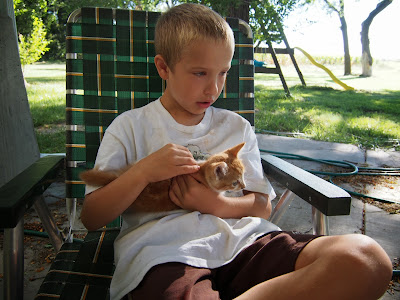
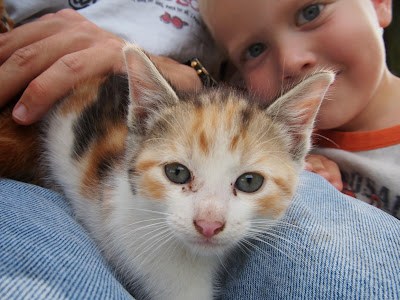
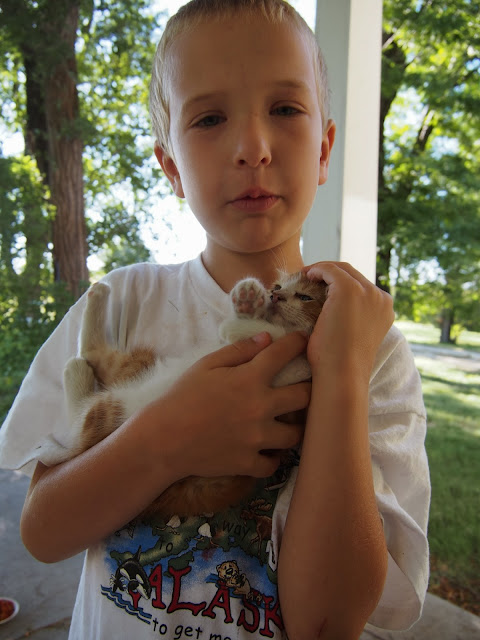
Almost every time he got off the bus for the past month and a half, Jacob started his afternoon in the same way. Before toys, before his trains and his toy bus, before anything indoors, he went for our cats. Here he is, cradling his favorite, Tigger: Laura and I both grew up around cats. We had been talking about kittens, and shortly after we got engaged, one of my relatives offered us some free kittens. We went to his place one evening and selected two of them one calico and one tiger-colored. Since what is now my place will soon be our place, they came to live with me. Our cats were one of the first things we did to prepare for our lives together. Oliver wanted to name them some rather impractical sentence-long names ( The Cat Who Always Likes To Run ), so Laura and I suggested some names from one of their favorite books: Tigger and Roo. They both liked the names, but Oliver thought they should be called Tigger the Digger and Roo the Runner . Never mind that they were just 6 weeks old at the time, and not really old enough to either dig or run. Here s Oliver with Roo, the day after the kittens arrived here. I have always had outside cats, both because I m allergic to cats so I need them to be outside, and because they sometimes literally quiver with joy of being outdoors. Tigger and Roo often chased insects, wrestled with each other, ran up (and slowly came back down) trees, and just loved the outside. Sometimes, I have taken my laptop and wireless headset and work from the back porch. The kittens climb up my jeans, inspect the laptop, and once Roo even fell asleep on my lap at one of those times. Jacob has been particularly attached to Tigger, calling him my very best friend. When Jacob picks him up after school, Tigger often purrs while cradled in Jacob s arms, and Jacob comments that Tigger loves me. Oh dad, he knows I am his friend! The kittens have been growing, and becoming more and more comfortable with their home in the country. Whenever I go outside, it isn t long before there are two energetic kittens near my feet, running back and forth, sometimes being very difficult to avoid stepping on. I call and I see little heads looking at me, from up in a tree, or peeking out from the grain elevator door, or from under the grill. They stare for just a second, and then start running, sometimes comically crashing into something in their haste. Yesterday when I went to give them food, I called and no cats came. I was concerned, and walked around the yard, but at some point either they come or they don t. Yesterday afternoon, just after the bus dropped off Jacob, I discovered Tigger on the ground, motionless. Once Jacob was in the house, I went to investigate, and found Tigger was dead. As I was moving his body, I saw Roo was dead, too. Both apparently from some sort of sudden physical injury a bit mysterious, because neither of them were at a place where they had ever gone before. While all this was happening, I had to also think about how I was going to tell the boys about this. I tried to minimize what he could see, Jacob had caught an unavoidable glimpse of Tigger as we were walking back from the bus, but didn t know exactly what had happened. He waited in the house, and when I came back, asked me if Tigger was dead. I said he was. Jacob started crying, saying, Oh Dad, I am so sad , and reached up for a hug. I picked him up and held him, then sat down on the couch and let him curl up on my lap. I could quite honestly let him know he wasn t alone, telling him I am sad, too. Oliver arrived not long after, and he too was sad, though not as much as Jacob. Both boys pretty soon wanted to see them. I decided this was important for them for closure, and to understand, so while they waited in the house, I went back out to arrange the kittens to hide their faces, the part that looks most unnatural after they die. The boys and I walked out to where I put them, then I carried both of them the last few feet. We stood a little ways back close enough to see who was there, far enough to not get too much detail and they were both sniffling. I tried to put voice to the occasion, saying, Goodbye, Tigger and Roo. We love you. Oliver asked if they could hear us. I said No, but I told them what I felt like anyway. Jacob, through tears, said, Dad, maybe they are in heaven now. We went back inside. Jacob said, Oh dad, I am so sad. This is the saddest day of my life. My heart is breaking. Hearing a 7-year-old say that isn t exactly easy for a dad. Pretty soon he was thinking of sort of comfort activities to do, saying I think I would feel better if we did So they decided to watch a favorite TV program. Jacob asked if Laura knew yet, and when I said no, he got his take-charge voice and said, Dad, you will start the TV show for us. While we are watching, you will send Laura an email to tell her about Tigger and Roo. OK? What could I say, it wasn t a bad idea. Pretty soon both boys were talking and laughing. It was Big Truck Night last night, at a town about half an hour away. It s an annual event we were already planning to attend, where all sorts of Big Trucks firetrucks, school bus, combine, bucket truck, cement truck, etc show up and are open for kids to climb in and explore. It s always a highlight for them. They played and sang happily as we drove, excitedly opened and closed the big door on the school bus and yelled All Aboard! from the top of the combine. We ate dinner, and drove back home. When we got home, Jacob mentioned the cats again, in a sort of matter-of-fact way, and also wanted to make sure he knew Laura had got the message. A person never wakes up expecting to have to dump a bowl of un-eaten cat food, or to give an impromptu cat funeral for little boys. As it was happening, I wished they hadn t been around right then. But in retrospect, I am glad they were. They had been part of life for those kittens, and it is only right that they could be included in being part of death. They got visual closure this way, and will never wonder if the cats are coming back someday. They had a chance to say goodbye. Here is how I remember the kittens.


8 October 2013

Gergely Nagy: Onto the margin of a summer of code

Just as last year, BalaBit applied to become a mentoring organisation for this year's Google Summer of Code, but like the year before, were not accepted. Instead, the openSUSE project was kind enough to give us two slots of their own, similarly to the year before - we are very thankful for this, and this year, both of the projects we took were closed successfully! So much so, that one of them was already merged into syslog-ng 3.5.0beta2, and the other one is being prepared for getting merged into the Incubator. I also helped out a little with Clojure & Leiningen packaging, although my contributions there were minimal at best.On the whole, I really liked this year's programme, our students accomplished a lot, and the whole summer was a great experience in itself, I learned a lot about mentoring, and about working with other people, people who are very new to the codebase they're working on. I would like to summarise what I learned and observed this year, in the hopes that others may find them useful too.This year, we set fairly ambitious goals for our students: they had to write a Redis and a MySQL destination, both of which presented interesting challenges to the students. None of them had prior experience with the syslog-ng source code, and their programming knowledge was mostly in C#, not plain old C which syslog-ng is written in. They also had to dabble a bit in the bowels of our overly complex configure.ac and a few Makefiles. Wasn't an easy task.In the beginning, we tasked the students to write proof of concept code, to get familiar with the libraries they will need to use - no syslog-ng involved at this point. This sounded like a good idea on paper, but without clear goals and milestones, a lot of time was spent on this task, and the students ran into a few dead-ends which could have been avoided, if we, the mentors, were more careful. This resulted in a reasonably poor first term, frustration and caused many a sleepless nights. We had to change our approach if we wanted to see the projects succeed.So we sat down with the students, and took one big leap: in person, we explained some of the internals of syslog-ng, did code reviews with them, and so on. But the best thing we did was what my colleague (and the main mentor), Viktor Tusa, came up with: we wrote a test script, that started syslog-ng, configured it, and ran tests against it. Students had to make their code pass the test by the next in-person meeting. This helped tremendously, and increased the speed they worked at by an order of magnitude at least. We kept developing the test script further, and so did the projects improve.ConclusionsThere are a couple of conclusions I arrived at as the programme concluded, things we (or other mentors, as I plan to participate as a student next year) will need to improve upon in the coming years.

Russ Allbery: krb5-strength 2.0

This is a rather huge release of my password strength checking package for Heimdal and MIT Kerberos KDCs, incorporating quite a bit of new work as well as some substantial restructuring. The largest change is that MIT Kerberos is now fully supported, not just with provided patches, thanks to work by Greg Hudson and MIT. The package can now build plugins for either MIT or Heimdal, as well as an external password quality program for Heimdal (the preferred method for that implementation). Alongside that change, the plugin installation path has changed to fit the layout of MIT plugins (as well as I understand it). This version also now supports password dictionaries other than CrackLib. You can generate a CDB dictionary from a wordlist using a utility included in the package and use it instead of or as a supplement to CrackLib. This dictionary lookup uses a much simpler set of permutations (the password as given plus removing some leading and trailing characters), providing a simpler approach suitable for much larger dictionaries. (CrackLib does a lot of transformations before dictionary lookup that are dubious, such as ignoring case and punctuation.) Also in this release are new configuration options to control additional checks: minimum password length (independent of whatever length CrackLib requires), requiring at least one non-alphabetic character, and rejecting non-ASCII or non-printable characters. The latter isn't to make the password stronger, but to prevent user frustration since those characters often can't be reliably entered in different situations and can result in an unreproducible password, particularly since Kerberos doesn't define a password normalization. In support of these changes, and to make testing easier, the plugin can be configured without a dictionary of any kind, or with any combination of CDB and CrackLib dictionaries. The checks for passwords based on principals are now more comprehensive, checking not only the local part but also each component of the principal with leading or trailing digits. Since many sites put their institution name in the Kerberos realm, this will also check for passwords based on the institution name. There are also some fixes to the internal CrackLib implementation, in case it is used instead of the system CrackLib, to better handle long passwords by scaling the test for simplistic passwords. You can get the latest release from the krb5-strength distribution page.

5 October 2013

Steve Kemp: I understand volunterering is hard

The tail end of this week was mostly spoiled by the discovery that libbeanstalkclient-ruby was not included in Wheezy. Apparently it was removed because the maintainer had no time, and there were no reverse dependencies - #650308. Debian maintainers really need to appreciate that no official dependencies doesn't mean a package is unused. Last year I needed to redesign our companies monitoring software, because we ran out of options that scaled well. I came up with the (obvious) solution: I chose beanstalkd for my central queue precisely because it was packaged for Debian, had a client library I could use, and seemed to be a good fit. It was a good fit, a year on and we're still running around 5000 tests every minute with 10 workers. The monitoring tool is called Custodian Custodian, and I think I've mentioned it before here and on the company blog. It looks like we'll need to re-package the Ruby beanstalk client, and distribute it alongside our project now. That's not ideal, but also not a huge amount of work. In summary? Debian you're awesome. But libraries shouldn't be removed unless it can't be helped, because you have more users than you know.

30 September 2013

Sylvain Le Gall: OUnit 2.0, official release

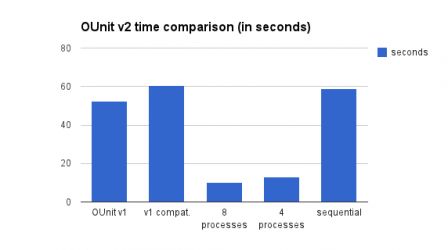
After 1.5 month of work, I am proud to officialy release OUnit 2.0.0. This is a major rewrite of OUnit to include various feature that I think was missing from OUnit1. The very good news is that the port of the OASIS test suite has proven that this new version of OUnit can drastically improve the running time of a test suite. OUnit is a unit test framework for OCaml. It allows one to easily create unit-tests for OCaml code. It is based on HUnit, a unit testing framework for Haskell. It is similar to JUnit, and other XUnit testing frameworks. Download OUnit v2.0.0 Documentation of v2.0.0 Website The basic features: Migration path OUnit 2.0.0 still provides the OUnit module which is exactly the same as the last OUnit 1.X version. This way, you are not forced to migrate. However, this means that you will gain no advantage of the new release and even some slowdown due to increase complexity of the code. Though, I strongly recommend to upgrade to OUnit2. Here is a checklist to do the migration: The OASIS test suite migration In order to check that everything was working correctly, I have migrated the OASIS test suite to OUnit2. This is a big test suite (210 test cases) and it includes quite big sequences of tests (end to end tests from calling oasis setup to compiling and installing the results). This was really time consuming and I wish to see a significant speedup for the tests with OUnit2. You can see the result in term of code of the full migration here. Here are the results on my Intel Core i7 920/SSD: OUnit v2 benchmark The migration was quite heavy because this test suite had a big design problem. It uses in-place modification of the test data. I think I pick this design because I thought this was a good idea to decrease the running time. As a matter of fact, this was a huge mistake, that keeps popping failed test cases because one of the previous tests was failing. I have refactored all this and now we start by copying the test data into a temporary directory, which ensure that everything is always starting from pristine test data. During the redesign, I have decided to reduce the number of tests by merging some of them. This should have no big impact on the running time, although this is not as pure 1:1 comparison with OUnit v1. Although it is still testing exactly the same thing. This explain the loss of ~50 tests, which in fact has been merged in other tests. The overall speedup is 4x compared to OUnit v1, when using processes. However there is a 12% increase compared to OUnit v1 for sequential and a 15% increase when using OUnit v1 compatibility layer. While this is not very good score, I hope this is small enough to compensate the huge win of being able to run tests in parallel with processes. And now the magic ! At this point, if you read carefully the numbers, you would have noticed that there is a 4.5x decrease in speed when you compare sequential and 4 processes for OUnit2. Since we are only actively testing in 4 shards, it looks strange. I don't expect a super-linear speedup due to the use of processes. I have checked that every tests was indeed running and found no solutions to this mystery. Right now, I think this is due to the fact that we are running less tests in more processes which should lighten the load of the GC (which may not trigger at all). I am not sure about this explanation and will welcome any bug report which shows a problem in the implementation of either sequential or processes runner. Although, this is great. Help still wanted If you find any bugs with OUnit v2, this is the time to submit a bug. OUnit BTS If you want to try to fix bugs by yourself, please checkout the latest version of OUnit:

 $> darcs get http://forge.ocamlcore.org/anonscm/darcs/ounit/ounit
Patches always welcome.

Russell Coker: Links September 2013

Matt Palmer wrote an insightful post about the use of the word professional [1]. It s one factor that makes me less inclined to be a member of professional societies. The TED blog has an interesting article about Wikihouse which is a project to create a set of free designs for houses to be cut out of plywood with a CNC milling machine [2]. The article also links to a TED talk by Alastair Parvin of the Wikihouse project which covers many interesting things other than designing houses. An XKCD comic has one of the best explanations of bullying I ve ever seen [3]. If you aren t familiar with XKCD then make sure you hover your mouse over it to read the hidden text. The Fair Phone is a project to develop a smart phone starting with conflict-free resources and with fully free software (not like a typical Android build) [4]. It s an interesting project and the price and specs seem within the normal range so you re not paying a huge premium for a conflict-free phone. Unfortunately they only have one model with a 4.3 display, if they had a competitor for the Galaxy Note then I d be interested. Patrick Stokes wrote an insightful article about why I m entitled to my opinion is a bogus argument [5]. Jim Daly wrote an interesting TED blog post interviewing Rishi Manchanda about Upstream Doctors who look for the root causes of medical problems rather than just treating the symptoms [6]. Brian Krebs wrote an insightful article about the value of a hacked email account [7]. If you are trying to convince your users to use better passwords then this should help. Ron Garrett wrote an insightful series or articles on morality hooked on the premise of whether it s wrong to torture kittens [8]. Part of his conclusion is that people who believe it s wrong to do such things tend to be more capable of working in large groups and forming a productive and efficient society. The TED blog has an interesting post by Karen Eng summarising Andreas Raptopoulos talk about using autonomous drones to deliver parcels in parts of the world that don t have usable roads [9]. Delivering parcels (which would start with medical supplies but would presumably move on to commercial transport) by drone is apparently really cheap. Being cheaper than building roads isn t going to be difficult but it seems that they are going to make it cheaper than paying people to deliver parcels even if the roads were built. The main web site about this project is www.matternet.us, they are hiring electrical engineers. Here is the link for Andreas TED talk [10]. The TOR blog has an interesting article by Emily Asher-Perrin comparing the different houses of Hogwarts [11]. It s an insightful article about personality attributes and gives more information than is available in the movies (I d read the books if I had time).

28 September 2013

Jelmer Vernooij: Book Review: Bazaar Version Control

Packt recently published a book on Version Control using Bazaar written by Janos Gyerik. I was curious what the book was like, and they kindly provided me with a digital copy. The book is split into roughly five sections: an introduction to version control using Bazaar's main commands, an overview of the available workflows, some chapters on the available extensions and integration, some more advanced topics and finally, a quick introduction to programming using bzrlib. It is assumed the reader has no pre-existing knowledge about version control systems. The first chapters introduce the reader to the concept of revision history, branching and merging and finally collaboration. All concepts are first discussed in theory, and then demonstrated using the Bazaar command-line UI and the bzr-explorer tool. The book follows roughly the same track as the official documentation, but it is more extensive and has more fancy drawings of revision graphs. The middle section of the book discusses the modes in which Bazaar can be used - centralized or decentralized - as well as the various ways in which code can be landed in the main branch ("workflows"). The selection of workflows in the book is roughly the same as those in the official Bazaar documentation. The author briefly touches on a number of other software engineering topics such as code reviews, code formatting and automated testing, though not sufficiently to make it useful for people who are unfamiliar with these techniques. Both the official documentation and the book complicate things unnecessarily by listing every possible option. The next chapter is a basic howto on the use of Bazaar with various hosting solutions, such as Launchpad, Redmine and Trac. The Advanced Features chapter covers a wide range of obscure and less obscure features in Bazaar: uncommit, shelves, re-using working trees, lightweight checkouts, stacked branches, signing revisions and using e-mail hooks. The chapter on foreign version control system integration is a more extensive version of the public docs. It has some factual inaccuracies; in particular, it recommends the installation of a 2 year old buggy version of bzr-git. The last chapter provides quite a good introduction to the Bazaar APIs and plugin writing. It is a fair bit better than what is available publically. Overall, it's not a bad book but also not a huge step forward from the official documentation. I might recommend it to people who are interested in learning Bazaar and who do not have any experience with version control yet. Those who are already familiar with Bazaar or another version control system will not find much new. The book misses an opportunity by following the official documentation so closely. It has the same omissions and the same overemphasis on describing every possible feature. I had hoped to read more about Bazaar's data model, its file format and some of the common problems, such as parallel imports, format hell and slowness.

27 September 2013

Erich Schubert: Big Data madness and reality

"Big Data" has been hyped a lot, and due to this now is burning down to get some reality checking. It's been already overdue, but it is now happening.
I have seen a lot of people be very excited about NoSQL databases; and these databases do have their use cases. However, you just cannot put everything into NoSQL mode and expect it to just work. That is why we have recently seen NewSQL databases, query languages for NoSQL databases etc. - and in fact, they all move towards relational database management again.
Sound new database systems seem to be mostly made up of three aspects: in-memory optimization instead of optimizing for on-disk operation (memory just has become a lot cheaper the last 10 years), the execution of queries on the servers that store the actual data (you may want to call this "stored procedures" if you like SQL, or "map-reduce" if you like buzzwords), and optimized memory layouts (many of the benefits of "colum store" databases come from having a single, often primitive, datatype for the full column to scan, instead of alternating datatypes in records.

However, here is one point you need to consider:
is your data actually this "big"? Big as in: Google scale.
I see people use big data and Hadoop a lot when they just shouldn't. I see a lot of people run Hadoop in a VM on their laptop. Ouch.
The big data technologies are not a one-size-fits-all solution. They are the supersize-me solution, and supersize just does not fit every task.
When you look at the cases where Hadoop is really successful, it is mostly in keeping the original raw data, and enabling people to re-scan the full data again when e.g. their requirements changed. This is where Hadoop is really good at: managing 100 TB of data, and allowing you to quickly filter out the few GB that you really need for your current task.
For the actual analysis - or when you don't have 100 TB, and a large cluster anyway - then just don't try to hadoopify everything.
Here is a raw number from a current experiment. I have a student work on indexing image data; he is implementing some state of the art techniques. For these, a large number of image features are extracted, and then clustering is used to find "typical" features to improve image search.
The benchmarking image set is 56 GB (I have others with 2 TB to use next). The subset the student is currently processing is 13 GB. Extracting 2.3 million 128 dimensional feature vectors reduces this to about 1.4 GB. As you can see, the numbers drop quickly.
State of the art seems to be to load the data into Hadoop, and run clustering (actually, this is more of a vector quantization than clustering) into 1000 groups. Mahout is the obvious candidate to run this on Hadoop.
However, as I've put a lot of effort into the data mining software ELKI, I considered also to try processing it in ELKI.
By cutting the data into 10 MB blocks, Mahout/Hadoop can run the clustering in 52x parallel mappers. k-Means is an iterative algorithm, so it needs multiple processes. I have fixed the number of iterations to 10, which should produce a good enough approximation for my use cases.
K-means is embarrassingly parallel, so one would expect the cluster to really shine at this task. Well, here are some numbers:

So what is happening? Why is ELKI beating Mahout by a factor of 10x?
It's (as always) a mixture of a number of things:
Let me emphasize this: I'm not saying, Hadoop/Mahout is bad. I'm saying: this data set is not big enough to make Mahout beneficial.

Conclusions: As long as your data fits into your main memory and takes just a few hours to compute, don't go for Hadoop.
It will likely be faster on a single node by avoiding the overhead associated with (current) distributed implementations.
Sometimes, it may also be a solution to use the cluster only for preparing the data, then get it to a powerful workstation, and analyze it there. We did do this with the images: for extracting the image features, we used a distributed implementation (not on Hadoop, but on a dozen PCs).
I'm not saying it will stay that way. I have plans for starting "Project HELKI", aka "ELKI on Hadoop". Because I do sometimes hit the barrier of what I can compute on my 8 core CPU in an "reasonable" amount of time. And of course, Mahout will improve over time, and hopefully lose some of its "Java boxing" weight.
But before trying to run everything on a cluster, always try to run it on a single node first. You can still figure out how to scale up later, once you really know what you need.
And last but not least, consider whether scaling up really makes sense. K-means results don't really get better with a larger data set. They are averages, and adding more data will likely only change the last few digits. Now if you have an implementation that doesn't pay attention to numerical issues, you might end up with more numerical error than you gained from that extra data.
In fact, k-means can effectively be accelerated by processing a sample first, and only refining this on the full data set then. And: sampling is the most important "big data" approach. In particular when using statistical methods, consider whether more data can really be expected to improve your quality.
Better algorithms: K-means is a very crude heuristic. It optimizes the sum of squared deviations, which may be not too meaningful for your problem. It is not very noise tolerant, either. And there are thousands of variants. For example bisecting k-means, which no longer is embarrassingly parallel (i.e. it is not as easy to implement on MapReduce), but took just 7 minutes doing 20 iterations for each split. The algorithm can be summarized as starting with k=2, then always splitting the largest cluster in two until you have the desired k. For many use cases, this result will be just as good as the full k-means result.
Don't get me wrong. There are true big data problems. Web scale search, for example. Or product and friend recommendations at Facebook scale. But chances are that you don't have this amount of data. Google probably doesn't employ k-means at that scale either. (actually, Google runs k-means on 5 mio keypoints for vector quantization; which, judging my experience here, can still be done one a single host; in particular with hierarchical approaches such as bisecting k-means)
Don't choose the wrong tool for the wrong problem!

23 September 2013

Daniel Pocock: PostBooks packages available

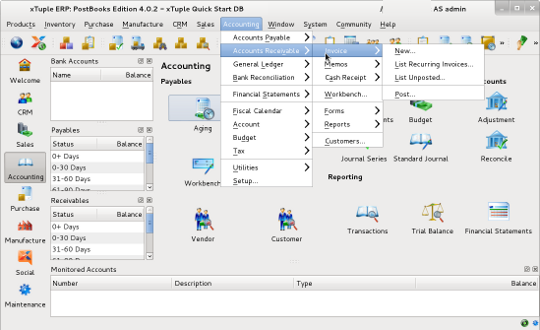
A common theme that comes up in free software evangelism is the question of how to tap into the huge expenditure that small to medium-sized businesses make for off-the-shelf licensed software. It is well known that many small companies are paying over the odds compared to the site-license rates given to big business, so why is it that small businesses are not rushing to adopt free and open source solutions? The answer is not likely to be found by fighting a battle on pricing (even though it is a battle that free software is inherently well prepared for). Rather, the most compelling strategy involves helping businesses find better ways to solve their own problems. A problem that every business encounters in every industry is the maintenance of proper financial records. Up until now, packaged solutions like GnuCash and HomeBank, available in many Linux distributions, have only catered for the smallest businesses and household accounting. At the other end of the spectrum, solutions like Compiere/Adempiere and OpenERP require a level of effort to install and maintain that makes them unsuitable for small users and businesses that don't need their full range of features. OpenERP briefly appeared as a Debian package but subsequently dropped out due to difficulties supporting the package. There is another choice, PostBooks. PostBooks has recently been packaged for Debian and this experience leads me to believe it will be supportable in Fedora and other distributions too. PostBooks, which started off as a commercial product, was re-licensed as an open source solution in 2007. In March 2013, PostBooks was project of the month on Sourceforge. Of particular note,
  • PostBooks has a Qt-based GUI where users of equivalent commercial solutions are likely to feel comfortable very quickly
  • PostBooks does not depend on any dedicated server processes other than a PostgreSQL database
  • Using the quickstart database, it can be set up in less than half a day, making it suitable for many consultants and freelancers who may otherwise use a product having a setup wizard (such as QuickBooks).
  • However, with features like inventory, invoicing, a sophisticated data import GUI (known as CSVImp), a true SQL backend, multi-currency and multiple concurrent users, it scales beyond the use cases that Quickbooks and Sage Accounting are capable of servicing.
  • The company behind PostBooks, xTuple, is well established and offers related services such as training and an annual user conference (which takes place in just a few weeks). Many business users are likely to find this style of support very reassuring and familiar, even if they don't plan to immediately take advantage of these things.
Limitations Two particular limitations caught my attention early when evaluating PostBooks: The developers have acknowledged these limitations and offered to complete these solutions with a crowd-funding campaign dubbed Feature Mob 2.

While everybody likes a free lunch, I personally feel that developers are perfectly entitled to request payment for their work. Having already taken a great leap of faith in open-sourcing a product that had previously been developed in-house, companies like xTuple need to look at new ways to generate revenue. Having looked at some of the prices of equivalent solutions, I felt quite comfortable pledging a similar amount based on four things:
  • it is based on the Kickstarter model, they only keep the money if their funding target is reached and feature implementation goes ahead
  • they are releasing the work as open source
  • the desire to have the option of using a highly capable free software solution that will be around well into the future
  • the probability that this is one piece of software that is likely to create more commercial opportunities for free software developers
Next steps People trying the packages and people who potentially want to package PostBooks for other distributions are very welcome to come and ask questions in the xTuple Debian maintainers packaging list or using the xTuple web forums. Please also feel free to report bugs through the Debian bug tracker.

22 September 2013

Russ Allbery: Review: Throne of the Crescent Moon

Review: Throne of the Crescent Moon, by Saladin Ahmed
Series: Crescent Moon Kingdoms #1
Publisher: DAW
Copyright: January 2013
ISBN: 0-7564-0778-8
Format: Mass market
Pages: 367
Doctor Adoulla Makhslood is the last ghul hunter in Dhamsawaat. He's an old man, and tired, and increasingly uncertain whether he wants to continue putting his life in danger to fight one more fight. But there are no replacements; his young and idealistic dervish apprentice, despite obvious skill, is too inexperienced and uninterested in the knowledge and investigation that makes Adoulla so good at what he does. So, when a young boy shows up on his doorstep, a survivor of a vicious ghul attack, he goes hunting once again. And both finds something much darker and stronger than he expected and meets an unexpected ally: a shape-shifting girl who is herself a survivor of something far worse than ghuls. Throne of the Crescent Moon is a first-novel fantasy that has made quite a splash, including a Hugo nomination (although I thought a win was unlikely, and I was right). One of the more interesting comments I've read about it was the observation by Jo Walton that if it had come out in 1980, it would have been an amazing, unusually wonderful, non-normative book. That it isn't is evidence of the changes in fantasy since then. The field has grown. As you might guess from the publisher's insistence on comparing it with The Arabian Nights, and from the names mentioned above, this book is set in an unspecified Middle Eastern culture and draws heavily from its mythology. It does not contain any western characters; the entire story is native to its region. The same is true of the mythology, which gave it a refreshing originality for me. And while I'm not the best one to judge, the presentation of that setting seemed free of the tint of the exotic. People live here, there are factions and multiple cultures, and the supernatural is a backdrop to most of the city. This would be very unusual decades ago. It's a bit less unusual now, and the story itself is a familiar ensemble fantasy, if refreshingly free of extended map exploration journeys. Ahmed brings together five characters with very different backgrounds and throws their varying talents at a problem. A few of those elements are a bit too familiar: female sexuality as a threat to male power is a world-building element that I could do without, for example. I also found the villain completely inadequate in its unidimensional evil (reinforced with a few more torture scenes than I needed to read), and even the attempted complication felt too predictable to me. Except for one touch of perspective, I'd call Throne of the Crescent Moon a competent, enjoyable, but somewhat forgettable fantasy novel, albeit one that's refreshingly concerned with a city instead of countrysides and travel. That touch is in the age of several of the protagonists. We get sections following several of the main characters in tight third person, but Adoulla is the first protagonist and the focus of much of the book. And Adoulla is neither young nor inexperienced, and is not going through the typical fantasy bildungsroman. He's old, experienced, a bit set in his ways, cranky, cantankerous, and deeply in love with his city. In tone, this shifts the story towards Star Wars as seen through the eyes of Obi-Wan Kenobi instead of Luke Skywalker. And that change I really liked, and would be happy to see become more common in fantasy. There was a bit of a downside for me in three of the five main characters being older. At times, Throne of the Crescent Moon has an elegiac tone, a feeling of life, power, and time slipping away and cultures and ways of life being lost. That's not my favorite thematic element. I tend to find it more depressing than I really want in my reading. But, here, the mature perspective more than makes up for some occasional negativity. I particularly liked how the older characters treated the likely budding young romance, which would have been the center of many books in this genre, with bemused detachment and playful encouragement without giving it more significance than it deserves. There's another romance that ends up being more significant, and which needs the weight of time and well-lived lives to become so. I don't think this book deserves a Hugo, but it is an enjoyable fantasy with some interesting characters and a refreshing perspective and setting. The villain really isn't adequate to the story, there's a bit too much torture for my liking, and I could have done without a few of the tropes, but it's a solid entry in its genre and a pleasant few hours of reading. And despite being advertised as the first of a series, it comes to a satisfying conclusion. Rating: 7 out of 10

21 September 2013

Niels Thykier: Lintian 2.5.18

I have just uploaded Lintian 2.5.18 to unstable. While fixing 22 bugs, it only features 5 new tags. The release also include fixes to some false-positives, such as python:any dependencies triggering python-script-but-no-python-dep, a rewritten README file. We also included a patch to make Lintian accept the Original-Maintainer field by default for non-Debian vendors (even if they do not have a profile and Lintian ends up loading the debian/main profile). We also added support for running Lintian directly from a git checkout or source tree without setting LINTIAN_ROOT (or passing root). Since that was the primary use-case for root that option has now been deprecated. I also had lintian and lintian-info require the include-dir and [no-]user-dir options as the first if given at all. I would like to thank Bastien Roucari s, Gaudenz Steinlin, Gunnar Wolf, J r my Bobbio and Lucas Nussbaum for contributing to Lintian and the many who submitted reports or suggestions for improvements. I would also like to thank Brian hugmeir Fraser, who assisted me in identifying and working around a bug in Perl s glob function when run under threads (filed upstream as RT#119897).

18 September 2013

Russell Coker: Advice for Web Editing

A client has recently asked for my advice on web editing software. There are lots of programs out there for editing web sites and according to a quick Google search there are free Windows programs to do most things that you would want to do. The first thing I m wondering about is whether the best option is to just get a Linux PC for web editing. PCs capable of running Linux are almost free nowadays (any system which is too slow for the last couple of Windows versions will do nicely). While some time will have to be spent in learning a new OS someone who uses Linux for such tasks will be able to use fully-featured programs such as the GIMP which are installed as part of the OS. While it is possible to configure a Windows system to run rsync to copy a development site to the production server and to have all the useful tools installed it s much easier to run a few apt-get or yum commands to install the software and then copy some scripts to the user s home directory. The next issue is whether web editing is the best idea. Sites that are manually edited tend to be very simple, inconsistent, or both. Some sort of CMS seems to be the better option. WordPress is a CMS that I m very familiar with so it s easy for me to install it for a client, while I try and resist the temptation to force my favorite software on clients there is the issue that I can install WordPress quickly which therefore saves money for my client. WordPress is a CMS that supports installing different themes (and has a huge repository of free themes). The content that it manages consists of pages and posts , two arbitrary types of document. Supporting two types of document with a common look and feel and common important data in a side-bar seems to describe the core functionality used by most web sites for small businesses. Does anyone have any other ideas for ways of solving this problem? Note that it should be reasonably easy to use for someone who hasn t had much experience at doing such things, it shouldn t take much sysadmin time to install or cost to run.

15 September 2013

Robert Millan: Rooting the LG Optimus L3 (and just about any Android model, really)

I recently purchased an LG Optimus L3 ( e400 ) mobile phone. I ve to admit it would be a perfectly fine purchase if it wasn t for the huge amount of time I had to invest in order for this thing to recognize me as its master. Even though I wanted to install CyanogenMod in it, the device blocked my attempts to install it through ROM Manager. Yes, for some awkward reason LG kept on thinking they still owned the device even after they sold it to me. Anyway, as none of the rooting instructions for LG Optimus L3 I found on the net worked for me, I figured I should try with the recently-discovered master key vulnerability. A bit of research shows there s very extensive documentation on this hole and how to exploit it, as well as proof-of-concept exploits. But unfortunately, I haven t been able to find any complete solution to implement this in easy steps. On the soulders of giants After running through the whole manual setup of this exploit (and succesfully rooting my LG Optimus L3), I figured it would be useful if I put the pieces together into a unified script. So here it is, an exploit for the Android master key vulnerability which will give you root access to almost every Android device in existance: https://github.com/robertmillan/mkbreak Enjoy. Oh and btw: fuck you LG.

10 September 2013

Daniel Kahn Gillmor: Support privacy-respecting network services!

Support privacy-respecting network services! Donate to Riseup.net! There's a lot of news recently about some downright orwellian surveillance executed across the globe by my own government with the assistance of major American corporations. The scope is huge, and the implications are depressing. It's scary and frustrating for anyone who cares about civil society, freedom of speech, cultural autonomy, or data sovereignty. As bad as the situation is, though, there are groups like Riseup and May First/People Link who actively resist the data dragnet. The good birds at Riseup have been tireless advocates for information autonomy for people and groups working for liberatory social change for years. They have provided (and continue to provide) impressive, well-administered infrastructure using free software to help further these goals, and they have a strong political committment to making a better world for all of us and to resisting strongarm attempts to turn over sensitive data. And they provide all this expertise and infrastructure and support on a crazy shoestring of a budget. So if the news has got you down, or frustrated, or upset, and you want to do something to help improve the situation, you could do a lot worse than sending some much-needed funds to help Riseup maintain an expanding infrastructure. This fundraising campaign will only last a few more days, so give now if you can! (note: i have worked with some of the riseup birds in the past, and hope to continue to do so in the future. I consider it critically important to have them as active allies in our collective work toward a better world, which is why i'm doing the unusual thing of asking for donations for them on my blog.)

5 September 2013

Daniel Pocock: Will Baby Boomers strangle Australia's Internet?

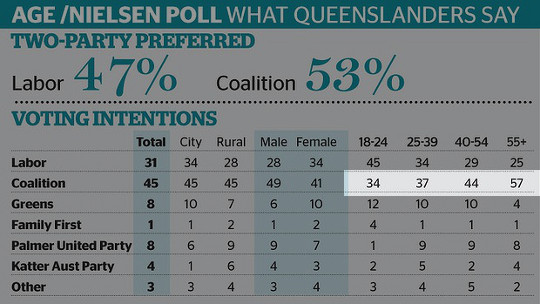
When Labor's Communications Minister Stephen Conroy won the title Internet villain of the year most educated people realised it wasn't something to celebrate. So it might be surprising for some that the title could potentially be returning to Australia so soon... Australia's main opposition party, the deceptively named Liberals (who actually lurk at the Marine Le Pen grade of conservatism) have just announced plans to resurrect the plan by implanting filtering technology in all modems, routers and smartphones. Whether they do or don't, there are serious concerns that they have described Australia's still-under-construction national broadband network as a wasteful project (which is potentially true) but failed to provide any credible alternative: who really thinks the conservative's proposed 25MBps will be a serious technology when they finish deploying it in 2019?. It is interesting to look at the bigger picture to see where this stupidity comes from. A political poll released early this week gives us half the story: Big bad baby boomers It is obvious that older voters prefer the conservative "coalition" parties, 57% of over-55s in particular. It is a huge jump from the 44% of voters in the age group below them. What this table doesn't tell us is that Australia's population is top-heavy with Baby Boomers. In other words, there are actually quite a lot of those over-55-year-old voters. In fact, it is estimated that close to 1 in 3 Australians will be in this category within the next 10 years. People who want the world to be the way it was in the 60s: many have already paid off a mortgage on a home in the suburbs with no access to things like public transport. They grew up under the white Australia policy and are frustrated at the presence of educated hard working foreigners from countries like India and China. Retired, no longer working, expecting the state to provide roads to their poorly located McMansions and free health care but little concern for broadband or anything that smells new. As they are no longer working, many have no commercial demand for broadband but will happily vote for a policy to censor it even if they don't use it themselves, simply because they want to see a Government that is blocking change. Sadly, they are shooting themselves in the foot: younger generations of Australians need to work and pay tax if there is to be any hope of keeping the dream alive for older Australians. However, with the conservatives cutting education to fund an over-dramatised response to immigration that costs billions of dollars every year, cutting corners and dumbing-down essential technology like the Internet, it seems that working-age Australians will struggle to compete in the global marketplace.

Keith Packard: Airfest-altimeter-testing

Altimeter Testing at Airfest Bdale and I, along with AJ Towns and Mike Beattie, spent last weekend in Argonia, Kansas, flying rockets with our Kloudbusters friends at Airfest 19. We had a great time! AJ and Mike both arrived a week early at Bdale s to build L3 project airframes, and both flew successful cert flights at Airfest! Airfest was an opportunity for us to test fly prototypes of new flight electronics Bdale and I have spent the last few weeks developing, and I thought I d take a few minutes today to write some notes about what we built and flew. TeleMega We ve been working on TeleMega for quite a while. It s a huge step up in complexity from our original TeleMetrum, as it has a raft of external sensors and six pyro circuits. Bdale flew TeleMega in his new fiberglass 4 airframe on a Loki 75mm blue M demo motor. GPS tracking was excellent; you can see here that GPS altitude tracked the barometric sensor timing exactly: GPS lost lock when the motor lit, but about 3 seconds after motor burnout, it re-acquired the satellite signals and was reporting usable altitude data right away. The GPS reported altitude was higher than the baro sensor, but that can be explained by our approximation of an atmospheric model used to convert pressure into altitude. The rest of the flight was also nominal; TeleMega deployed drogue and main chutes just fine. TeleMetrum We ve redesigned TeleMetrum. The new version uses better sensors (MS5607 baro sensor, MMA6555 accelerometer) and a higher power radio (CC1120 40mW). The board is the same size, all the connectors are in the same places so it s a drop-in replacement, and it s still got two pyro channels and USB for configuration, data download and battery charging. I loaded up my Candy-Cane airframe with a small 5 grain 38mm CTI classic: The flight computer worked perfectly, but GPS reception was not as good as we d like to see: Given how well TeleMega was receiving GPS signals, I m hopeful that we ll be able to tweak TeleMetrum to improve performance. TeleMini We ve also redesigned TeleMini. It s still a two-channel flight computer with logging and telemetry, but we ve replaced the baro sensor with the MS5607, added on-board flash for increased logging space and added on-board screw terminals for an external battery and power switch. You can still use one of our 3.7V batteries, but you can also use another battery providing from 3.7 to 15V. I was hoping to finish up the firmware and fly it, but I ran out of time before the launch. The good news is that all of the components of the board have been tested and work correctly, and the firmware is feature complete , meaning we ve gotten all of the features coded, it s just not quite working yet. EasyMini EasyMini is a new product for us. It s essentially the same as a TeleMini, but without a radio. Two channels, baro-only, with logging. Like TeleMini, it includes an on-board USB connector and can use either one of our 3.7V batteries, or an external battery from 3.7V to 15V. EasyMini and TeleMini are the same size, and have holes in the same places, so you can swap between them easily. I flew EasyMini in my Koala airframe with a 29mm 3 grain CTI blue-streak motor. EasyMini successfully deployed the main chute and logged flight data: We also sent a couple of boards home with Kevin Trojanowski and Greg Rothman for them to play with. TeleGPS TeleGPS is a GPS tracker, incorporating a u-blox Max receiver and a 70cm transmitter. It can send position information via APRS or our usual digital telemetry formats. I was also hoping to have the TeleGPS firmware working, and I spent a couple of nights in the motel coding, but didn t manage to finish up. So, no data from this board either. Production Plans Given the success of the latest TeleMega prototype, we re hoping to have it into production first. We ll do some more RF testing on the bench with the boards to make sure it meets our standards before sending it out for the first production run. The goal is to have TeleMega ready to sell by the end of October. TeleMetrum clearly needs work on the layout to improve GPS RF performance. With the testing equipment that Bdale is in the midst of re-acquiring, it should be possible to finish this up fairly soon. However, the flight firmware looks great, so we re hoping to get these done in time to sell by the end of November. TeleMini is looking great from a hardware perspective, but the firmware needs work. Once the firmware is running, we ll need to make enough test flights to shake out any remaining issues before moving forward with it. EasyMini is also looking finished; I ve got a stack of prototypes and will be getting people to fly them at my local launch in another couple of weeks. The plan here is to build a small batch by hand and get them into the store once we re finished testing, using those to gauge interest before we pay for a larger production run.

1 September 2013

Russ Allbery: Review: Redshirts

Review: Redshirts, by John Scalzi
Publisher: Tor
Copyright: June 2012
ISBN: 1-4299-6360-3
Format: Kindle
Pages: 317
The next few reviews deserve a small apology in advance. Normally, I try to write reviews within a few weeks, or at most a month, after reading a book, while it's still fresh in my mind. This is particularly important since I read a lot and sometimes don't have a good memory for specific detail. But this summer has made it completely impossible to keep to any sort of regular writing schedule. As a result, this book, and the subjects of the next few reviews that follow, are books that I read four months ago and am reviewing from memory. Hopefully, I'll still get the details right. Ensign Andrew Dahl is one of the newest crew members of the Universal Union Capital Ship Intrepid. It's his first posting, just out of the Academy. He's one of five new ensigns, expecting a normal tour of duty (albeit with the pride of being on a capital ship of the fleet). But very shortly after arriving on the ship, Andrew and and the other new ensigns discover that something is very... strange. The casualty rate on the ship is surprisingly high (as foreshadowed in a prologue). The other crew members avoid the bridge crew, and particularly away missions, with startling effectiveness (and desperation). And things regularly happen on the ship that, for lack of a better description, simply make no sense. Redshirts starts off as a very obvious Star Trek parody. So obvious, in fact, that it's eyeroll-inducing. The prologue reads exactly like a section of a Star Trek episode written by a third-rate hack, leavened with some of the humor that readers of Scalzi's blog have come to expect. But it's obvious that Scalzi is doing this intentionally, and it doesn't take long before the subject of the book shifts. It's a Star Trek parody that functions much more like a Star Trek parody than any universe should, to the degree that it becomes obvious to the characters. And the characters, despite being straight from central casting, are clearly not expecting their universe to act that way and find this extremely strange. By far the best part of this book is the second quarter: the characters have been introduced, they're starting to figure out what's going on, and they have to do so while dodging away-team duty (or trying to survive it) and participating in the ridiculous plot contrivances that keep occurring. Scalzi mixes a feeling of serious consequences with wry humor and handles the mix deftly. I was both laughing and eagerly reading to see what comes next. The last half of the book, though, has problems. How many problems the reader perceives will, I think, depend on how hard one thinks about the situation Scalzi has set up, or how much one has thought about similar constructs in the past. But I'm afraid the setup does not survive serious scrutiny in ways that, for me at least, seriously damaged my ability to engage with the story. I'm going to avoid saying explicitly where Scalzi goes with this plot, since it is a spoiler (although it's commonly mentioned in discussions of this book on the Internet). But it happens to be an idea that some friends of mine and I pounded on for years in some of our role-playing scenarios, poking at the corners and implications, and subsequently gave up on because it doesn't work for storytelling. The idea is compelling, and on first glance seems like a great story seed. But it's too large. The problem with really big ideas with huge implications is that they can change the nature of a story so much that there's no longer any point of commonality for the reader and the entire nature of story falls apart. And I think that's what happens here. Scalzi handles the deeper implications of the concept by, essentially, ignoring them. He focuses on one narrow set of implications for one specific set of people, largely skips over any discussion of anything larger, and tries a pivot from wry humor (and a bit of slapstick) into serious emotional depth. For me, in part because I'm so familiar with the concept, none of this really worked. The implications of the discovery that drives this story are so much broader and so much more significant than the characters seem to admit that it threw me right out of the story. The ethical implications are absolutely paralyzing, to the point that I don't think you can write a coherent story about them, but ignoring them doesn't work either. It's the kind of discovery that requires action of some kind beyond the attempt by the characters to go back to what they consider a normal life, even if I have a hard time imagining what that action could be. To be fair, he does try to salvage this in the first epilogue, which is all about the implications of his idea and its effects. But it's still too small. That epilogue just barely touches on the implications on a single person, but if one thinks a bit longer, one starts coming up with more and more implications for all of society, for how we talk about story, for how we raise children, for nearly every form of creativity. Implications that involve nasty concepts like slavery and mind control and murder and the nature of consent in ways that are very difficult to avoid. I think Scalzi's attempts at serious emotional connection, including in the other two attached epilogues (which are perspective-shifting close focuses on some of the characters), also suffer from his world setup, but in a different way. The characters are simply too bland to sustain the level of emotional connection he's striving for. They're bland for a very specific reason that is entirely justified by the story that Scalzi is handling, and the implications of that for the primary protagonist were, I thought, one of the best-handled moments of the book. But they're still bland, which undermines the attempted pivot. All that being said, this is not a bad book. Parts of it, particularly the second quarter, are excellent. And even when I wasn't engaging with the characters, Scalzi's writing on a paragraph level is snappy and often quite funny. The first epilogue in particular is hilarious, even if I think it was too limited in the scope of implications that it considers and a bit too meta in where it goes with those implications. And the story is a fun romp, with drama and humor and tension and a fairly satisfying ending. Everyone's a bit too bland and earnest when Scalzi isn't being funny, but he's funny enough that I didn't mind that much. Despite the relatively low rating, I actually recommend this book. If you don't dive into the metaphysical implications, it's a lot of fun, and if you've thought a lot about this particular set of metaphysical implications, it's somewhat satisfying to argue with (and to internally point out all of the hard questions that Scalzi is skipping over). It's particularly fun if you've watched a lot of Star Trek, since Scalzi gets some of the absurdities note-perfect. But be aware that the character reactions to Scalzi's concept don't hold up to much scrutiny. Rating: 7 out of 10

30 August 2013

Michael Stapelberg: How git performs when you throw all of Debian at it

During DebConf, Asheesh presented the idea of using git instead of the file system for storing the contents of Debian Code Search. The hope was that it would lead to fewer disk seeks and less data due to gits delta-encoding. Maybe the reduction would be big enough that enough data could be held in RAM to allow for fast retrieval. Joey Hess helped me out with a couple of details: he revealed that using git repack -a -d will lead to a single packfile that optimally contains HEAD, not caring about the history. Also, he showed me how to use git cat-file. We did a small-scale experiment and the results were promising. I told him I ll do the experiment of just committing the entire unpacked source mirror to git and promised to follow up with the results, so here goes:
stapelberg@couper ~/unpacked master $ time cat <<EOT   git cat-file --batch >/dev/null
:linux_3.2.32-1/sound/pci/ice1712/aureon.c
:linux_3.2.32-1/sound/soc/codecs/sgtl5000.c
:linux_3.2.32-1/sound/pci/hda/patch_conexant.c
EOT
cat <<<''  0,00s user 0,00s system 62% cpu 0,006 total
git cat-file --batch > /dev/null  4,38s user 1,08s system 99% cpu 5,477 total
stapelberg@couper ~/unpacked master $ time cat linux_3.2.32-1/sound/pci/ice1712/aureon.c linux_3.2.32-1/sound/soc/codecs/sgtl5000.c linux_3.2.32-1/sound/pci/hda/patch_conexant.c >/dev/null
cat linux_3.2.32-1/sound/pci/ice1712/aureon.c   > /dev/null  0,00s user 0,00s system 69% cpu 0,006 total
stapelberg@couper ~/unpacked master $ time cat <<EOT   git cat-file --batch >/dev/null
:i3-wm_4.6-1/libi3/font.c
EOT
cat <<<':i3-wm_4.6-1/libi3/font.c'  0,00s user 0,00s system 51% cpu 0,008 total
git cat-file --batch > /dev/null  4,30s user 1,18s system 99% cpu 5,533 total
stapelberg@couper ~/unpacked master $ time cat i3-wm_4.6-1/libi3/font.c >/dev/null
cat i3-wm_4.6-1/libi3/font.c > /dev/null  0,00s user 0,00s system 0% cpu 0,004 total
Even after repeating those tests a couple of times to get a warm page cache, the result stays the same: git takes about 5 seconds to resolve the deltas in a large repository. Even if this was 5 seconds startup time and a very small amount of additional time per file, it would not be acceptable for our use case. The conclusion is that git is clearly not suitable for this kind of usage, which is not surprising after having heard a couple of times that git does not scale :-). For the curious, the .git/objects directory is 29 GiB for roughly 140 GiB of source code, so the delta encoding is quite impressive in terms of saving space. However, keep in mind that the compressed (!) Debian source archive is about 35 GiB, so the savings are not that huge.

25 August 2013

Joey Hess: idea: git push requests

This is an idea that Keith Packard told me. It's a brilliant way to reduce GitHub's growing lockin, but I don't know how to implement it. And I almost forgot about it, until I had another annoying "how do I send you a patch with this amazing git technology?" experience and woke up with my memory refreshed. The idea is to allow anyone to git push to any anonymous git:// repository. But the objects pushed are not stored in a public part of the repository (which could be abused). Instead the receiving repository emails them off to the repository owner, in a git-am-able format. So this is like a github pull request except it can be made on any git repository, and you don't have to go look up the obfuscated contact email address and jump through git-format-patch hoops to make it. You just commit changes to your local repository, and git push to wherever you cloned from in the first place. If the push succeeds, you know your patch is on its way for review. Keith may have also wanted to store the objects in the repository in some way that a simple git command run there could apply them without the git-am bother on the receiving end. I forget. I think git-am would be good enough -- and including the actual diffs in the email would actually make this far superior to github pull request emails, which are maximally annoying by not doing so.
Hmm, I said I didn't know how to implement this, but I do know one way. Make the git-daemon run an arbitrary script when receiving a push request. A daemon.pushscript config setting could enable this. The script could be something like this:
#!/bin/sh
set -e
tmprepo="$(mktemp -d)"
# this shared clone is *really* fast even for huge repositories, and uses
# only a few 100 kb of disk space!
git clone --shared --bare "$GIT_DIR" "$tmprepo"
git-receive-pack "$tmprepo"
# XXX add email sending code here.
rm -rf "$tmprepo"
Of course, this functionality could be built into the git-daemon too. I suspect a script hook and an example script in contrib/ might be an easier patch to get accepted into git though. That may be as far as I take this idea, at least for now..

24 August 2013

Marko Lalic: PTS rewrite: Django Memory Usage


Rewriting the PTS in a fairly large Web framework such as Django is sure to cause larger memory consumption by even the more simple tasks, when compared to a couple of (loosely related) perl scripts. If anything, simply due to the fact that the entire Django machinery needs to be loaded.

However, just how large the memory consumption difference between the two can be seen in the example of the command to dispatch received package emails to users. In the new version, the command is implemented as a Django management command, whereas before it was a perl script dispatch.pl relying on the common.pl script for some additional functions.

The reason this command's memory usage is important is an incident with the current test deployment of the new PTS found at http://pts.debian.net. All package mails that the old PTS receives are also forwarded to the new instance in order to expose the new implementation to real-world mail traffic. At a certain point, over a hundred mails were received instantly causing over a hundred dispatch processes to be launched. This led to the system running out of memory and the kernel had to run the OOM Killer which brought down PostgreSQL server thereby causing the site to become unavailable.

For now, such a problem seems to have been prevented from reoccurring by setting up exim to queue messages when a certain system average load is exceeded, however it is interesting to check how large the memory consumption difference between the old and new dispatch really is.

Measurement setupIn order to measure the memory use, two messages of different sizes were used: 1KB and 1MB.

For the new PTS two cases were considered, when the database used is sqlite3 and PostgreSQL. In both cases, it was simply initialized by syncdb, meaning it contained only the default keywords found in the initial fixture and no registered users and subscriptions. The DEBUG setting was set to False.

For testing the old PTS's dispatch.pl, the database was also initialized empty.

This way, the tests should show the actual difference between the two implementations.

Since the main concern here is the maximum memory usage of the dispatch script, a simple bash script was written which takes a PID of a running process and outputs the maximum memory usage as reported by ps once the process is terminated. The script used is shown below.

#!/usr/bin/env bash

pid=$1

while ps $pid >/dev/null
do
ps -o vsz= $ pid
sleep 0.1
done sort -n tail -n1

Old PTS Measurements
The maximum memory usage of the old PTS was:
  1. 37.8 MB for the 1 KB message
  2. 38.2 MB for the 1 MB message

New PTS Measurements

sqlite3
The maximum memory usage of the new PTS using sqlite3 was:
  1. 91.77 MB for the 1 KB message
  2. 92.59 MB for the 1 MB message

PostgreSQL

The maximum memory usage of the new PTS using PostgreSQL was:
  1. 148 MB for the 1 KB message
  2. 160 MB for the 1 MB message

Comparison and DiscussionWhen comparing the memory used by the old dispatch.pl implementation and the new PTS running sqlite3, the difference does not seem to be too large and is to be expected, since, as mentioned, the whole Django framework is loaded when executing a management command.

However, the huge difference between the two versions of the new PTS: the one using sqlite3 and the one using PostgreSQL is very surprising indeed.

Another interesting measurement is the difference between running a bare Django management command: one including only a sleep statement (in order to allow enough time to measure its memory usage) on PostgreSQL and sqlite3. In both cases, the memory usage was only about 1 MB less than what the respective maximum memory usage when processing the 1 KB message.

All this considered, the logical conclusion seems to be that either psycopg2 package and/or the Django postgresql_psycopg2 database engine use a lot more memory than the corresponding sqlite3 alternatives.

Could anyone shed some more light as to what causes this stark difference between using sqlite3 and Postgres in Django? Anything that could be done to mitigate it?

Next.

Previous.