Sergio Talens-Oliag: Hugo meets Marc
 As promised a photo of the first meeting between Hugo and Marc.
 With luck this afternoon the whole family will be at home.
As promised a photo of the first meeting between Hugo and Marc.
With luck this afternoon the whole family will be at home.
I've been using Subversion and
Trac for some years now, and I have encouraged
its use at work since the last couple of years, with the undesired effect of
having to maintain four different
Trac installations with different database
systems (SQLite3 and PostgreSQL), plugins (more than 15 on the big
servers), authentication systems (htpass files, LDAP and a database based
system) and tons of projects published (two internal servers have 64 and 16
projects, one of the client system has 33 projects and there is only one
single project installation, but it is living at a client's system).
Yesterday night, while reading Planet Debian I
found a post from
John Goerzen about tools to replace Trac,
including the option to use Git as the project
VCS.
In the post he talks about different options, mainly projects that I would
categorize as issue tracking systems (mantis, roundup, etc.), but it
also talks about Redmine, a project management
system implemented using the Ruby on Rails
framework that is similar to Trac.
As it looked interesting I downloaded, installed and executed an instance in
about 15 minutes (I love the systems that support
sqlite3 for this quick tests, not having to touch
real database servers speeds up simple tests a lot).
I played a little bit with the system and I believe that I will spend some
more time testing it at work next week, as it looks quite promising; the
standard version has almost all the features I'm interested in without the
need to install additional plugins and it can do most of the things I was
missing from Trac to do lightweight project management.
I evaluated ]project-open[ to use it together with
Trac for our internal project management tasks, mainly because we miss
important features from Trac, like having clean systems to view the tasks of
a user in all projects or a clean way to do the project planning using
tickets and gantt charts. Of course there are ways to do it, but the
plugins I've tried are not as good and simple as I would like.
The problem with the use of ]project-open[ is that I don't really like it
for us, as it has tons of features that I feel we don't need nor will use and,
on a first try, the system seemed difficult to deploy and maintain, probably
because my lack of knowledge about OpenACS and
TCL.
In fact we still don't have ]po[ running at work because I was unable to to
integrate the authentication system with our LDAP server on my first tries
and have had no time to investigate further since then.
The good thing about trying Redmine is that if we don't end up using it at
least I can take the most of this opportunity by looking at Ruby on Rails
and the Ruby Programming Language, at least
from the administration side, as I have never looked at it seriously.
A couple of weeks ago I updated my Debian Sid setup on the MacBook to
use disk encryption; this post is to document what I did for later reference.
The system was configured for dual booting Debian or Mac OS X using
refit and grub2 as documented on the Debian
Wiki; I don't use the Mac OS X system
much, but I left it there to be able to test things and be able to answer
questions of Mac OS X users when I have to.
The Debian installation was done using two primary partitions, one for swap
(I used a partition to be able to suspend to disk without troubles) and an
ext3 file system used as the root file system.
The plan was to use the Debian Installer to do the disk setup and recover
the Sid installation from a backup once the encrypted setup was working OK.
Backup for later recovery
My first step was to install all the needed packages on the original system;
basically I verified that I had the lvm2 and cryptsetup packages
installed.
The second step was to backup the root file system; to do it I changed to
run level 1 and copied the files to an external USB disk using rsync.
My third step was to boot into Mac OS X to reduce the space assigned to
it; I had a lot of free space that I didn't plan to use with Mac OS X and
I thought that this was the best occasion to reassign it to the Debian
file system.
Encrypted Lenny installation
Now the machine was ready for the installer. As I formatted the system a couple
of weeks ago I used a daily build of the Lenny Debian Installer, now that
Lenny is out I would have used the official version.
I booted the installer and on the partition disk step I selected the manual
method; I left sda1 and sda2 as they were (the Mac OS X installation
uses them) and set up sda3 and sda4 as follows:
sda3: 256 MB, use as ext3, mount point: /bootsda4: 86 GB, use as physical volume for LVM/boot on a plain ext3 partition to be able to
use grub2 as the boot loader (if we put the kernel on an LVM logical volume
we need to use lilo as the boot loader).
Once sda4 was adjusted as LVM I entered on the LVM setup and created a LVM
Volume Group (VG) with the name debian, using sda4 as the physical volume.
Once the VG was defined I created a couple of Logical Volumes (LV):
root: 82 GBswap: 2 GBdebian-root pass phrase.
Back on the main partitioning menu I set up the debian-root_crypt encrypted
volume:
ext3, mount point: /.debian-swap_crypt, it was configured
automatically as swap because I choose a random encryption key.
At this point I was finished with the partitioning; to finish I installed a
minimal system and rebooted to try the system.
As I had changed the disk layout I had to re-sync the partition tables from
refit; once that was done I was able to boot from the newly installed
system.
Setting up suspend to disk
I was using s2disk to suspend the system; to test if it still worked with
the new setup I installed the uswsusp package and adjusted the resume
device on the /etc/uswsusp.conf to /dev/mapper/debian-swap_crypt.
After my first try I noticed that the resume step failed with the encrypted
swap partition because it was using a random key, which means that the swap
contents are unrecoverable after a reboot.
Looking at the cryptsetup documentation I found that the solution was to use
a derived key for the swap partition instead of a random one.
The command sequence was as follows:
# disable swap
swapoff -a
# close encrypted volume
cryptsetup luksClose debian-swap_crypt
# change the swap partition setup on the /etc/crypttab file
sed -e -i 's%^debian-swap.*%debian-swap_crypt /dev/mapper/debian-swap debian-root_crypt cipher=aes-cbc-essiv:sha256,size=256,swap,hash=sha256,keyscript=/lib/cryptsetup/scripts/decrypt_derived,swap%' /etc/crypttab
# open the encrypted volumes with the new setup
/etc/init.d/cryptdisks start
# enable swap
swapon -a
# update the initrd image
update-initramfs -u
/etc/fstab,
/etc/crypttab, /etc/uswsusp.conf and the current /boot contents to be
able to boot in case of failure with my old kernel) from the current
installation, after that I recovered all the files from the initial backup
(except the ones just saved) using rsync again and regenerated the initrd
images of my old kernels:
update-initramfs -u -k all
sda4 in my case), eliminating the need of
derived keys (i. e. my swap setup) or key files (I use them to mount snapshots
of the encrypted partition non interactively).
On the negative side I believe that this setup looses some flexibility:
After my followup to the Tuesday
post I've received some additional comments
and I'm writing this entry to close the subject... ;)
One of the comments was from Gunnar to tell me that the
followup setup was the same provided by the automatic partitioner of the
Debian Installer since 2007.
I was unaware of that because until some weeks ago I never tried to install a
system with encryption support and when I did it on my laptop I used the
manual setup because I wanted to keep the MacOS X partitions.
Anyway my followup blog entry made
sense anyway, as I just wanted to comment my thoughts about the advantages and
disadvantages of each partitioning schema.
I also received a couple of messages proposing the use of three layers to
keep the flexibility of the original setup and the simplicity of the second;
the setup is as follows:


 At 17:55 of the 21th of August of 2008 (four days late from the expected
schedule) passenger Marc Talens i Blasco landed at La F Hospital in
Valencia.
 On my next post... Hugo meets Marc!
On recent years I've only been in one or two free software related conferences
per year, usually because I've been invited to go for a day or two and give a
talk.
The truth is that my day to day activities don't leave me enough time to
contribute or participate a little bit more in free software projects, but
this year I decided (and negotiated) that I had to go to Debconf,
as it is the best opportunity to go to a Debian conference that I'm going to
have in the near future.
So this summer it is going to be a free software summer, the 3rd of July
I'll be giving a talk at the Jornades de Programari Lliure in Barcelona
and from the 23th to the 30th or 31th I'll be at Debconf 9 in
C ceres.
In Barcelona I will talk about building IT infrastructures using free
software, explaining which programs I use, why I've choosen them and how I
configure things depending on my needs and in C ceres I will be just listening
and exchanging gpg keys.
 I finalised the initial upload of the ISC DHCP 4.1.0 packages a couple of
days ago, and it sat in NEW,
because I've renamed the source package (no more dhcp3). Today it
was ACCEPTed into experimental.
(Kudos to the ftp-team
for their quick processing of NEW)
It should deal with upgrading from dhcp3-client or
dhcp3-server to the newly-named equivalents, at least for the
common cases. The rest will come out in the wash (which is why it's in
experimental).
Thanks also to AJ for
letting me NMU
ifupdown twice to sort out some problems with the way it invokes
/sbin/dhclient (thinking it's the v2 client) as opposed to
/sbin/dhclient3.
I think the criteria for uploading to unstable will be:
 Something that has been annoying me recently with my bank has been that their website tells me that they will never ask for my password over the phone. And then their call centre asks me for my password. Over the phone. Of course the call centre doesn't mean my website password - they mean the special 'ultra-secure 5ekr1t code phrase', but they don't have a good, universally understood word to use for that. Hopefully they'll work one out, but they appear to have got the message anyway.
This got me to thinking about how these phrases are used, and how insecure they are in reality. After all when I store a website password I go to significant lengths to ensure that the same password is not represented by the same string of characters in my database. How vulnerable are our secrets in the databases of organisations we do business with?
davical=# select username, password from usr;
  username                       password
-------------+------------------------------------------------
 user1          SSHA qCctCH5dirYCf29uxJiE68LvmLRDdnBkbldiWlE=
 user2          SSHA y8yOzjoh9fSkVwLaXGoVtWdiIYxmU2FCb2dOZXc=
(2 rows)
When the user wants to log in I apply the same transformation to their incoming password (appending the same salt) and compare against my stored hash. If they match then it must be the same password they used previously. Storing passwords in this way secures them from casual, or even reasonably determined access, although naturally they can still be logged at the beginning and end of the communication - or even in the middle, if we didn't encrypt that bit! The PHP function I use to salt and hash the password is as follows:
/**
* Make a salted SHA1 string, given a string and (possibly) a salt.  PHP5 only (although it
* could be made to work on PHP4 (@see http://www.openldap.org/faq/data/cache/347.html). The
* algorithm used here is compatible with OpenLDAP so passwords generated through this
* function should be able to be migrated to OpenLDAP.
*
* If no salt is supplied we will generate a random one.
*
* @param string $instr The string to be salted and SHA1'd
* @param string $salt Some salt to sprinkle into the string to be SHA1'd so we don't
*                     get the same PW always hashing to the same value.
* @return string  SSHA  followed by a base64 encoded SHA1 of the salted string.
*/
function session_salted_sha1( $instr, $salt = "" )
  if ( $salt == "" )
    $salt = substr( base64_encode(sha1(rand(100000,9999999),true))), 2, 9);

  return ( sprintf(" SSHA %s", base64_encode(sha1($instr.$salt, true) . $salt)));
What about Secret Code Phrases?
The problem with these secret code phrases, apart from all of the forgetability and guessability problems that have repeatedly been identified elsewhere, is that they are much less likely to be stored in a one-way hash. Are you going to ask your call-centre staff to type in the customer's secret code phrase? Didn't think so. And if you did it's going to add pronouncability issues to the whole mix.
So this means that those organisations who have our secret code phrases in their database will, in all likelihood, have them stored directly as plain text, displaying them to the random call-centre staffer along with all of our other account details, and especially making them vulnerable to accidental disclosure. Disclosure of a sort that doesn't necessarily involve knowing they have been disclosed.
Proliferation of Use
These things provide the appearance of security - 'Security Theatre' as Bruce Schneier terms it - and because of that they're taken up in a kind of a cargo cult of security: "if the banks do it that way it must be a really good form of security". This makes the problem much worse, because now I have to remember a secret code phrases not only for banks, but for ISPs, phone companies, online auction websites, and so on.
How many mother's maiden names, favourite teachers and friend's phone numbers do I have? I'm sure I'm at well up whatever curve it is that measures the number of passwords a person has, because five years ago I had so many I started to store them all in an encrypted database - protected by a yet another password, of course. Now in order to get my story straight I have to store my 'secret code phrases' in there too.
If I didn't store my secret code phrases in that database, I'd obviously be re-using them everywhere, from a very small set - perhaps the same one that everyone around me overhears, every time I have to ring my bank to authorise another payment from my account.
Because the proliferation of use is not just the breadth of wannabe thespians hoping to climb on the stage of this latest play, but the way they want to use it all the time, too. In fact the only conversation I've had recently with my bank where they didn't want it was when they rang me. Obviously I was the only person who could answer a phone in my house, right? It isn't just security theatre: I think we can see that this analogy belongs much deeper into the sub-genre of 'Security Farce'.
Is there a solution?
I don't have any easy answers - other than the ones to my security questions, of course - but some improvements are possible.
Other banks have quizzed me about stuff like recent expenditure or credit card limits from time to time, but I've usually passed those tests by reading my last bank statement - or failed them by not having it to hand! I don't really think that the answers can lie in that direction because the information is only quite loosely tied to my identity.
For some parts of the call-centre handling of secret code phrases there are changes that could make them more secure, but in the fairly short term these organisations need to find a different way to perform these out of band identity checks.
For the actual storage of the code phrases it would be a marginal improvement if the database did not contain the actual phrase. Perhaps it could be encrypted with some application-known key, so that it can be unencrypted when it needs to be displayed, but never stored in the clear. Of course there's still the problem with that key...
Verification of the secret code phrase could be done by someone not involved in the transaction, so that the call could be temporarily passed into a 'verification stream' where a different person performed the verification step without the context of the account details or enquiry. Though this sort of complexity seems unlikely with call centres seemingly being outsourced to the cheapest supplier.
One thing does seem likely to become increasingly true: there is less and less private data in our lives, and every time we share one of these little nuggets with our bank, or our electricity company, or our on-line associates-we-call-friends, is one more chance that it escapes into the hands of the foaming-at-the-mouth-terrorist-cracker-communist-nazi-right-wing-religious-fruitcake hordes.
The highest bar for personal verification which any of my banks currently sets for me is a random choice from a set of personally entered questions, with a set of personally entered answers, for which I have to enter two randomly selected characters using my mouse. That's not bad for safe verification, and I'd have to be really impressed with their security if that was stored in the database by a passphrase-protected encryption key. With that bank I don't know what they do over the phone - I assume they've concluded they can trust my logged on persona enough that I can do what I want online, consequently I haven't had to call them and share those secrets with everyone in earshot.
Maybe paranoid freaks like me will go back to a chequebook and close down on-line access to their bank accounts entirely when they find themselves having to supply a skin scraping in order to authorise their next $500 payment. "Please insert your finger in the AccuYou(tm) BloodSucker(tm) to proceed with this payment" - well, I guess it might cut down my spending! In any case, biometrics need to be understood before they can be used effectively and appropriately - and remotely over the phone is probably not one of the ways that they can be trusted to work.
 Today I went to the La Merced area to finally buy a foldable bike. There were basically four options: Benotto's 20" Utopia, Alubike 16" Foldingbike, Alubike 24" and a custom-made bike at a smaller store, Bici Universo. In Mexico it is also possible to buy a Brompton, although they are not available in larger stores and their pricing is prohibitive. Sergio Mendoza advised me to look for the Dahon bikes at Benotto, but they have discontinued them in favor of their own making.
I ended up buying the Bici Universo one. I must say this: I sincerely hope not to regret this option I got this bike because neither of the other ones satisfied me, and this one was at about two thirds the price (MX$1800, plus some extras I requested, MX$2100 That means, US$187 or 113).
First of all, after thinking about it for a while, I decided I didn't want a larger, more normal wheel The Alubike 24 (which I'd have to build shopping piece by piece, as they had only the frame for sale Would be a good ocassion to learn more about the whole process!) is basically a great regular bike you can put in a regular car trunk, but is still too large for taking it into public transport or lugging along when travelling, by bus or by plane. Besides, the manubrium1 is not foldable. So it is basically as portable as this venerable Compaq.
The Benotto's manubrium does fold, but the bike does not hold itself together when folded, it is not stable. You have to explicitly keep it folded. Not exactly comfortable.
I had tested the smaller Alubike at another bike store closer to my home. It feels a bit freer than the Universo one (I'll get to it soon), but still feels a bit kludgy... And at a price about MX$1000 higher, I decided against it.
Now, why am I wary with the Universo? Because after all... It is just a bike for kids age 4-7 and 7-12 (?) cut in half, and with a hinge soldered on:
 It is also a heavy bike (I have not weighed it yet, but comparative guesstimates puts it over the Alubikes), so it might be problematic when travelling... I'll see when in Nicaragua in a couple of weeks ;-) I have yet a couple of adjustments to make to it, but I am very looking forward to travelling with my bike on. I hope it turns out to be comfortable.
And in any case, I can of course! donate it to my nephews... who are in the right age group.
Some photos:

 and
 Being a lot time without any post but finally I see the things more clear, I changed my $paid-job on March, I leave my sysadmin job on a midle-range local ISP, to go on a sort of similar job in another one, more big company, first I though that this will give me more spare time but I was wrong, at least for the first months, but at this time I m finally getting enough time to rest, but not enough time to devote to some Debian tasks(but things will change!!).
but looks like everything is going better, I get my $paid-job permission to go to DebConf, and I will also attending just 2 days to ECSL; ECSL is Encuentro Centroamericano de Software Libre , it is actually the first gathering with people related to Free Software communities on this small area(Central America), we expect about 100 people from Central America, Mexico, and some other places, this is could be a nice opportunity to create efforts on a region that is having political and social efforts to integrate all countries in a political/social block.
So, see you all at C ceres and Gunnar, see you on ECSL at Estel
 You might have noticed that during last week the Mexican Debian mirror, nisamox.fciencias.unam.mx (a.k.a. ftp.mx.debian.org, a.k.a. debian.unam.mx), went offline. The motherboard died on us, and Facultad de Ciencias was kind enough to give us a brand new one. So, excuse us for the blackout, but we are back Meaner and badder than ever before!
Now, Sergio (nisamox's main admin) prefered to rebuild the whole mirror, as there was a shadow of doubt regarding the data integrity. So, rsync was pulling as fast as he could for the whole weekend (leading to some people scratching their heads regarding the 404 for the missing files; sorry, we should have left Apache shut down until the mirror was complete!). After three days of sustaining a 10-20Mbps download from the main mirrors, all 364GB of Debian are finally installed and as you can clearly see we are back to normality, with small, regular mirror pulses and a nice sustained 5-10Mbps (with some up to 40Mbps peaks We have seen up to 100Mbps peaks in the past, and I doubt with the current network infrastructure we won't top that).
You can see we have currently plenty of disk space still to fill up. Among our plans is to host the most popular ISOs, which are a common request, and... What else? Well, ask us and we shall do so (quite probably).
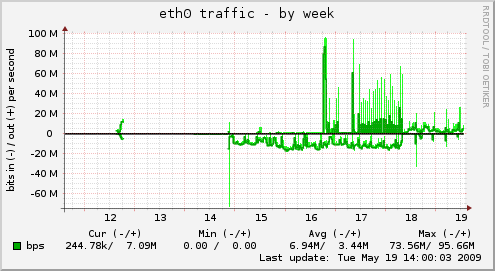
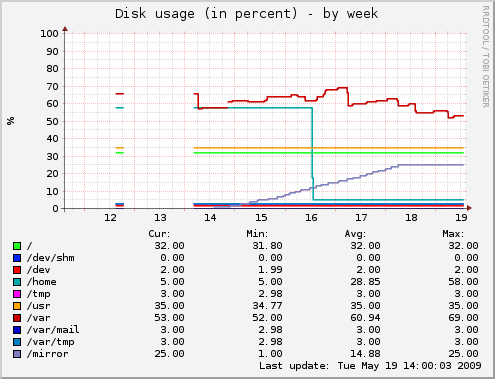 So, if you switched away from ftp.mx.debian.org due to our downtime, readjust your mirror settings. Nisamox is back!
| Attachment | Size |
|---|---|
| Nisamox Ethernet statistics for the last week | 23.38 KB |
| Nisamox disk space statistics for the last week | 24.29 KB |
 Russel, I agree that some porn sites are facing interesting technical challenges, but I wouldn't suggest using them as example for anything, just like a talk about the challenges of torture is always inappropriate in a human society.
Next.