Search Results: "ghe"

18 December 2010

Jonathan McDowell: Why Linux? (Part 3: It's cheap)

(This is part of a series of posts on Why Linux?) Linux, to me as an end user, is cheap. Even taking into account the fact most PCs come with a Windows licence included it's still cheaper for me to run Linux. I paid Steve minimal amounts for my first set of Debian install CDs. These days I can burn my own netinst CDs and pull the rest over the internet. I legally have access to a tremendous range of excellent software, for nothing. All the apps I need are available without having to shell out more. How is that not awesome? I get free updates, both for bugs and also for major features. I'm not left with the option of paying lots of money for the latest and greatest, or dealing with an unsupported old release with known bugs. The counter argument from my Windows using friends is often about how they didn't pay for their Windows updates nor their copy of Office. I'm unimpressed with anyone who tells me Windows is a better option, but is unprepared to pay for it. If you have to illegally obtain it in order for it to compete with Linux then you're not really comparing on equal terms, are you? Also don't tell me that Free software takes away jobs from software engineers and then pirate software, eh? Cost isn't just about the money though. I've put many hours into being involved in Debian. I've provided project resources when I was in a position to do so. I've contributed to the Linux kernel. Not quite the same as paying for it, but I think does indicate that I'm trying to give back a little too. I also accept that at an organisational level the basic cost of the software licences is often negligible compared to things like hardware, training and support. I still think cost is a compelling argument for the home user, and for decisions at an organisational level. As mentioned I realise there are issues with training and support, but I don't believe these costs are any higher than for alternative OSes. Linux also makes it remarkably easy to remotely administer machines, and perform common actions across an entire installed estate, without needing extra bolt ons from 3rd parties. Cost doesn't provide sufficient justification for an individual desktop in an organisation that has site licences for an alternative however (and in fact running Linux requires extra work on my part to do the install and maintenance compared to allowing central IT to manage my machine). So that's not a good enough reason.

14 December 2010

Theodore Ts'o: Is Nokia Doomed?

There s been a lot of discussion regarding whether or not Nokia is Doomed or not. The people who say Nokia are doomed basically point out that Nokia doesn t have any attractive products at the high end, and at the low end the margins are extremely thin. The high end products suffer from the Symbian being essentially dead (even Nokia is recommending that developers not develop native applications for Symbian, but to use Qt instead), and Nokia doesn t have much of a development community following it, and it certainly does have much in the way of 3rd party applications, either targetting Symbian or Qt at the moment. So what do I think of the whole debate between Tomi and Scoble? First of all, I think there is a huge difference in American and European assumptions and perspectives, and a big question is whether the rest of the world will end up looking more like Europe or America vis-a-vis two key areas: cost of data plans, and whether phones become much more application centric. Tomi took Apple to task in the comments section of his 2nd article for not having an SD card slot (how else would people share photos with their friends?) and for not supporting MMS in its earlier phones. My first reaction to that was: Um, isn t that what photo-sharing sites are for? Is it really that hard to attach a photo to an e-mail? And then it hit me. In Europe, data is still like MMS a few years ago a place for rapacious carriers to make way too much money. Many European telco s don t have unlimited data plans, and charge by the megabyte and even if you re lucky enough to live in a country which does have an American-like data plan, the cost of data roaming is still incredibly expensive. In contrast, in the US, I can pay $30/month for an unlimited data plan, and I can travel 2000 miles south or west and it will still be valid. Try doing that in Europe! The US had consumer-friendly data plans much earlier than Europe did, and so perhaps it s not surprising that Nokia has engineered phones that were far more optimized for the limitations caused by the Europe s Wireless carriers. The second area of debate where I think Scoble and Tomi are far apart is whether phones of the future are fundamentally about applications or well, making phone calls. Here I don t have proof that this is a fundamentally European vs. US difference, but I have my suspicions that it might be. Tomi spent a lot of time dwelling on how Nokia was much better at making phone calls (i.e., better microphones, better radios, etc). And my reaction to that was, Who cares? I rarely use my phone for making phone calls these days! And that was certainly one of the reasons why I gave up on Nokia after the E70 its contacts database was garbage! It was OK as a phone directory, but as a place for storing multiple addresses and e-mail addresses, it didn t hold a candle to the Palm PDA. And that s perhaps the key question how much is a smart phone and about being a phone , versus being a PDA (and these days I want a cloud-synchronized PDA, for my calendar, contacts, and todo lists), and how much is it about applications? This is getting long, so I think I ll save my comments about whether I think Meego will be an adequate savior for Nokia for another post. But it s worthwhile to talk here about Tomi s comments about most smartphones being much cheaper than the luxury iPhone, and so it doesn t matter that Nokia s attempt in the higher end smart phones has been a continuous history of fail. First of all, it s worth noting that there are much cheaper Android phones available on the market today, which are price-competitive with Nokia s low-end smartphones (i.e., available for free from T-Mobile in the States with a two year commitment). Secondly, the history in the computer market over the last twenty years is that features inevitably waterfall into the cheaper models, and prices will tend to drop over time as well. Apple started only with the iPod, but over time they added the iPod Nano and the iPod Shuffle. And it would not surprise me if they introduce a lower-end iPhone as well in time as well. It would shock me if they aren t experimenting with such models even as we speak, and have simply chosen not to push one out to the market yet. So even if you buy Tomi s argument that the high-end smartphones don t matter, and you only care about volume, and not about profit margins (talk to the people at Nokia that will need to be laid off to make their expenses match with their lowered revenue run rates; I bet they will care), the question is really about whether Nokia has time to execute on the Meego vision before it s too late and the current application-centric smartphone ecosystems (Android and iPhone) start eating into the lower-end smartphone segment. More on that in my next post. No related posts.

13 December 2010

Joey Hess: snow and stats

It's been an intense couple of days out at the Hollow. Did it only start to snow yesterday? It feels like a long time in winter. Yesterday was the first day that the solar panels produced no power, it was too cloudy and snowing most of the time. I cleaned an inch of slushy snow off the panels to no avail, and wondered if the power would last. But the wood stove has kept it nice and warm, so yesterday was spent cosily in the living room enjoying the snowfall, nethack, and podcasts. Also, I'm very much enjoying cooking on the wood stove. I've never been in a position to cook on one before; when I lived at Wortroot the stove was in the cabin, and the cold kitchen in a different building. So cooking on the stove, or even keeping a kettle on, was mostly only done in emergencies. Here, I am constantly using it, and the propane stove is still on its first 20 pound tank. Long slow cooked beany or roastish stuff does especially well. Yesterday I did a great pork loin roast with homemade quick sauerkraut. Today, after cleaning another 3 inches of snow off the solar panels, and scraping off a layer of ice, I am getting a decent amount of power for a cloudy day with some snow still falling. Turns out it was good I cleaned them yesterday after all, since a part I missed has a inch+ layer of hard ice, which I don't dare chip away at for fear of damaging the panels. I'd not want to live someplace where it snowed a lot with solar panels that didn't have some kind of a heating system. I wish I had a camera to show the long walk down the driveway, through the winter woods, and past the field where the wind blows gusts of snow into the air. But my cell phone is on a Caribbean cruise. I have been recording data ever since the fall equinox, and it's almost to the winter solstice now. Time to geek out with some graphs! Solar production has surely been falling off with the waning days, but it seems like it will get through the shortest day with enough, and from then on, no worries.
Highest watt production seen each day I've been here.
Zero all day yesterday.
Power system voltages.
Charge controller limits it to a maximum of 15 volts during the day.
Originally, it was limiting it to 13 volts.

Gustavo Noronha Silva: WebKitGTK+ hackfest 2010!

Last week I attended the WebKitGTK+ 2010 hackfest. It was a great opportunity to meet up with the other developers, discuss some plans for the future, hack away at WebKitGTK+. But, most importantly, play Street Figher 2 =). Thanks to Collabora and Igalia for sponsoring the hackfest, Igalia for hosting and organizing it (well done!), and the GNOME foundation for having sponsored my trip to Coru a! Unlike last year we didn t find any big design issues hurting our work (page cache, I m looking at you!) on new futures. I also didn t have any huge plans for new API, although we did manage to get some new stuff in there, like the plugins management API Xan created, and the further work done by Dan in soup. This meant, from my point of view the hackfest has been a great oportunity to look at refactorings that we could do to further simplify understanding the code, changing it, and even sharing it =). Besides pushing the debian packaging of the 1.3.x series a bit further. Coru a was great as always, and I enjoyed going around, eating and hacking there, although I got a cold on the last days which kinda hindered my ability to stare at the screen for too long, some times. Now that I m at the hot brazilian summer again I ll hopefully get better soon =) Cheers \o/ Sponsored by the GNOME Foundation

27 November 2010

Russell Coker: Open Respect

On the 5th of November Jono Bacon wrote a blog post titled MAKING OUR WORLD MORE RESPECTFUL [1]. He then registered the domain OpenRespect.org for his manifesto [2].Aaron Siego supports the general concept of being more respectful while listing some of the practical problems that occur in a multi-cultural world [3]. If you read nothing else about this issue I recommend reading Aaron s post (which I summarised very poorly, I can t think of a good one-sentence explanation).Sam Varghese wrote an article suggesting that it was an attempt to deflect criticism from Ubuntu [4]. I think that Ubuntu receives a lot of unfair criticism, but don t think it s really relevant to the issue at hand. Sam criticises some of the Open Respect supporters for failing to show respect in the past.Jono wrote a follow-up blog post titled REFLECTIONS ON RESPECT [5], in that post he said Sometimes we were disrespectful, and frankly, sometimes we were also inadvertently assholes. We never set out to be assholes, but we did set out to be edgy in a satirical way, but we sometimes went too far and I apologize for that. But you know what, we all grow and mature in different parts of our lives about his past LugRadio work. Maybe instead of focusing on being respectful of others it would give more benefit to focus on how to apologise, back down, and move on after being disrespectful. It seems that the situations of epic disrespect tend not to be one-off incidents but are instead arguments of greatly expanded scope that arose from someone refusing to admit any error after doing something that is considered to be offensive. [Someone has registered OpenApology.org, just in case you were wondering.]Maybe advocating Rogerian Argument would be another way of reducing some of the problems in the community.Finally Kirrily wrote an insightful post about the ineffectiveness of discussing offensive things [6]. In terms of issues such as Feminism (which Kirrily uses as an example and which is also a matter of significant interest for her) discussions about offense apparently tend to end up being about the person who was offended rather than the person who might be described as acting in an offensive manner. She suggests using terms such as marginalised, belittled, stereotyped, frustrated, humiliated, threatened, patronised, silenced, intimidated, misrepresented, etc instead. It seems to me that there may be a similar issue with respect . Objective claims about people being dismissed, ignored, patronised, etc can be evaluated more easily than a claim about being disrespected.

25 November 2010

Russell Coker: The Wikireader

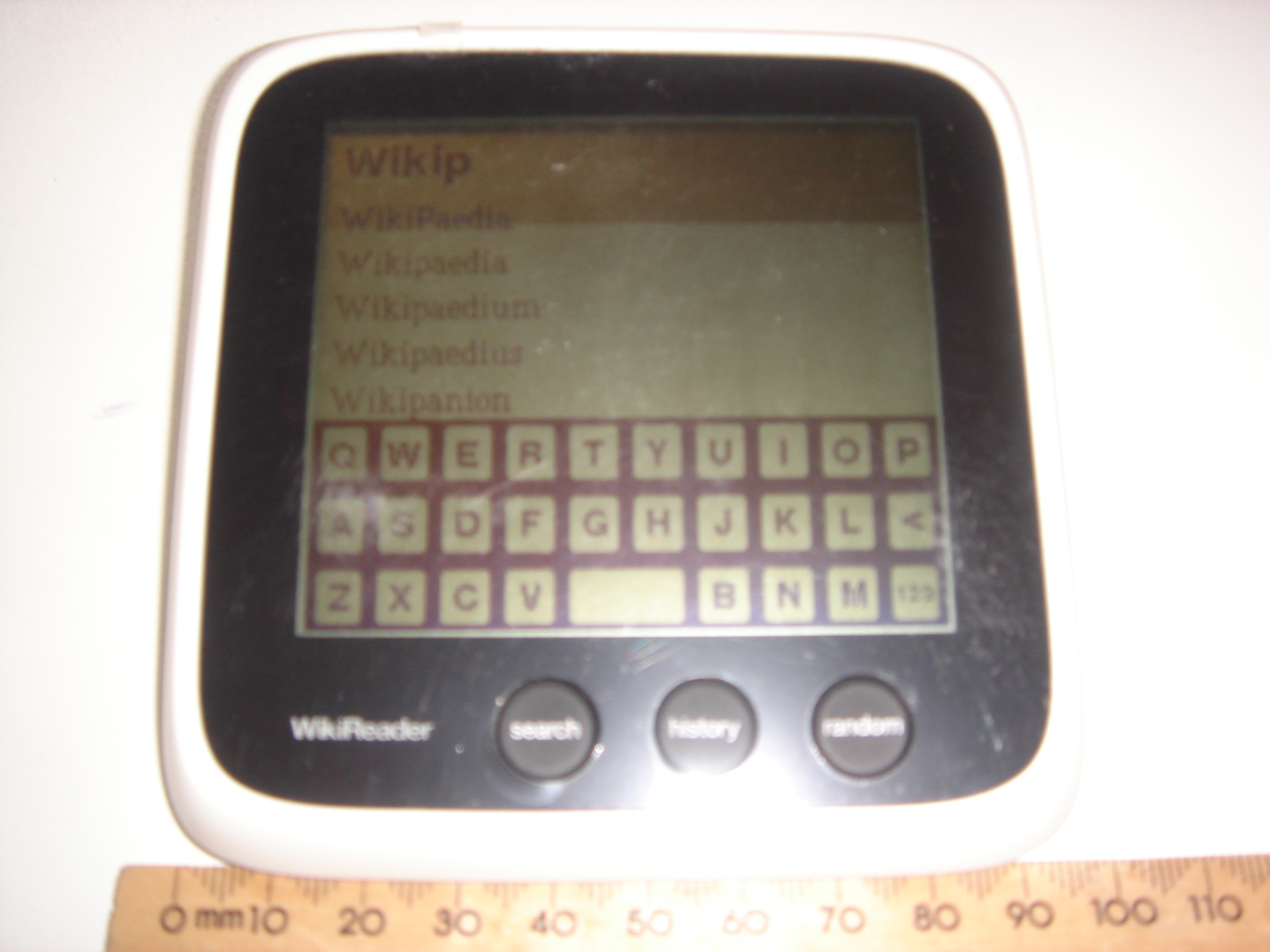
Just over a month ago I bought a Wikireader [1] from Officeworks (an Australian chain of stores that sell all manner of office supplies). It cost only $99, thanks to Brianna for informing me about this [2]. When I purchased my Wikireader an Officeworks employee had to get one from the back office and told me that I was the first person to buy one. I suggested to him that when a product isn t mentioned in their advertising and isn t put on the shelves it s unlikely to sell in quantity and that they shouldn t rely on bloggers to promote what is possibly one of the most desirable products that they stock.The Wikireader stores a copy of the text of the English language version of Wikipedia on a micro-SD card. They have a service whereby you can get two updates posted to you every year for $29, which would make it pretty close to free once postage and the cost of the micro-SD cards is taken into account. Also you can download new content. I have no immediate plans for updating my Wikireader as the content is more than good enough to answer idle questions while waiting for a bus but as it s lacking external links due to no net access and images it can t be used for serious Wiki reading IMHO.Brianna has documented the process of updating a Wikireader to add more content [3], she added the Chinese version and discovered that inter-wiki links are preserved! I have no immediate plans to add extra content (I don t know any other language well enough to read an encyclopaedia). Also an 8GB MicroSD card (which is the minimum requirement to use multiple languages) costs $35 and is a significant portion of the original purchase price.In terms of functionality the device is pretty good. The screen is not back-lit, but if it was then the two AA batteries wouldn t last anywhere near a year. The screen is not high resolution and the touch functionality isn t particularly accurate or sensitive but I guess that s a necessary trade-off to get the $99 price. The Wikipedia content seems quite complete, so far the only page which I found to be missing was the bio of an Australian architect, I m not sure if his page was removed from the Wikireader to save space or whether my device has a snapshot that predates the addition of the page.The Wikipedia page about downloading the database is interesting [4], it s 6GB of compressed data for the text of the English pages (not including history or talk pages) and for years they haven t even tried to provide a dump of the images. So I guess that a Wikireader that displays pictures is out of the question.The Wikireader has a parental filter, in my quick tests the only page that has been blocked is Sexual Intercourse , I could read all about safe-sex, infidelity, and lots of other related adult topics without being asked for a password. It also shows pages about goatse and other related things without asking for a password NB if you don t know what goatse is then you probably don t want to learn, trust me that it s something that most people won t want their children to learn about. The filter is so bad that I think they shouldn t include it, it will just give people false confidence. It s OK to sell a cheap device that is designed to give a detailed description of goatse etc on request to anyone, but IMHO it s not OK to sell such a device with a claim that it is kid safe and has parental controls . Note that holding down the History button will allow you to clear your history this is useful if you have just verified that goatse isn t blocked and you want to give the device to a young child.There is a button to give a random page, I believe that this would be more useful if it had some metric to make it more often return pages that might be interesting. It could weight the randomness by the length of the page (usually a longer page is more interesting to more people and has more links to other pages) or by some other metric that indicates the potential popularity. Random links often get me pages about obscure country towns and other things that probably aren t of interest to people who don t live near them.But overall this is a great product, $99 is not much to pay, and I recommend getting one!

23 November 2010

Russell Coker: A First Digital Camera

I ve just been asked for advice on buying a digital camera. I m not an expert on cameras but I have a good general knowledge of technology and I m sure that the readers of my blog will correct me rapidly if I make any serious mistakes. ;)Types of CameraThe Wikipedia Page about Digital Cameras is worth reading [1].Here are the types of camera that are useful as a stand-alone camera (IE not camera phones or industrial cameras):I suggest that people not start out a hobby of digital photography with a DSLR or other interchangeable lens camera. I think that it s best to start out with simple gear that s cheap if you decide that digital photography is not your thing then you have wasted less money, and if you really get into it then you ll be able to make a more informed choice about an expensive camera after getting some experience.A spare cheap compact camera can be useful even if you own a more expensive camera. There are times when you don t want the bulk of a DSLR or Bridge Camera and when you have a risk of theft or accidental damage such that you don t want to take an expensive camera. People who are really serious about photography apparently take a camera everywhere, you could have a compact camera in your front pocket for fast pictures and a bulky camera in your backpack for when you have time to prepare a quality shot. So buying a cheap camera and then buying an expensive one a few months later would not be wasting money!As the person who asked for advice has never owned a digital camera before I ll focus on cheap compact cameras for the rest of this post.Pixels and LensesCameras are typically advertised with the resolution in Megapixels described in bold. Presumably most people search for the camera with the highest resolution. The first thing to beware of is cameras that don t have hardware which is capable of taking a picture of the stated resolution, they use interpolation to generate a higher resolution image. There are probably some cameras with interpolation that are OK and provide a decent picture at a low price, but generally I recommend avoiding all cameras that do interpolation.Optical zoom is a very important feature. Often pictures have to be cropped to remove unwanted background, if you zoom in appropriately you can avoid cropping and make better use of the available resolution. Beware of cameras that advertise things such as advanced zoom , anything that doesn t exactly say optical zoom is using digital zoom IE interpolation. I suggest not considering a compact camera unless it can do at least 4* optical zoom, with 5* or better being preferable.The physical size of the lens is important. A bigger lens allows better pictures in adverse lighting and also allows a faster shutter speed to give better photos of moving objects and better photos when you are moving. Generally you can get a rough idea of the potential that a camera has by just glancing at the lens, if it s the size of a lens in a mobile phone then the pictures won t be that great. If it is on a telescopic mount and it s wide then the result will be better. When buying a lens for a DSLR or other detachable lens camera you should be able to read specifications of the lens which indicate it s size. For compact cameras the specifications of the lens are usually available from the vendor and often available from review sites but generally aren t included in adverts by retailers. If you are comparing cameras in the store looking at them seems like the best option.The ratio of the lens area to the number of pixels determines how much light is received by the sensors for each pixel. So when there are two cameras that are essentially identical apart from the number of megapixels the one with the highest number isn t necessarily better in all situations. A 12MP camera might not give a better result than a 10MP camera, a monitor described as Full HD has a resolution of 1920*1080 which is 2MP. A 5MP camera is useful to allow cropping but if the aim is to display pictures on current monitors then anything much bigger than 5MP is probably wasted at this time and 10MP will provide pictures that can use the capabilities of monitors that are developed for a while.PrintingSome printers that are affordable for home use might require something like a 7MP camera to print a picture at A4 or Letter size at the highest quality. Professional printing will probably require something even greater. But if your intended use of a digital camera doesn t involve printing the pictures, or only rarely involves printing them at A4 or Letter size then you don t need a high resolution for printing. I expect that there are some available printers that can use paper at sizes such as B3 which might require a 20MP camera for best quality. But if the aim of the printing is to put a picture on your wall (the most common case) then even if it s not at the ideal resolution then probably no-one will notice the difference you can t see the pixels from a few meters away.If the aim of the camera is to photograph professional artwork for the purpose of selling it on the Internet then a high resolution camera really isn t desired. You want to offer pictures on the Internet which aren t good enough to be usefully printed.VideoThe capabilities for recording video can vary significantly between different cameras in the same range. If you don t care about video then that s fine, but if video matters to you then you have to read the specs. It s also worth considering digital video cameras, I have previously summarised the available digital video cameras although I m sure that there have been some new models since then [3]. A good (expensive) digital camera will have video functionality that compares well to most digital video cameras but it will cost a lot more.Choosing a Compact CameraThere are many compact cameras in the $100 to $150 price range. Ted s has the Samsung Digimax ES65 for $99.95 which has 10MP and 5* optical zoom. This seems like a good deal. Practice with a cheap camera could easily allow you to make a better choice when buying a more expensive camera that saves you more than $100 so it seems unlikely that you will have any great regrets about buying a $100 camera.Buying from the specs is a bad idea, I recommend testing a camera in the store before buying every store that you want to buy from allows this. But don t expect that quality pictures in the store means much, the people who run the camera stores usually set them up with good lighting so that pictures will tend to turn out well. The aim of an in-store test is not to discover what the camera does well, but to discover what (if anything) it does badly. Also it s useful to test the ergonomics of the camera before buying, discover whether you would be happy to hold the camera for an hour.It s a good idea to ask the staff at a camera store for advice, but don t rely on such advice. My experience is that they tend not to ask what the prospective customer plans to do with the camera and this significantly limits the quality of their recommendations.ConclusionMake your first digital camera a cheap compact camera that doesn t cost much more than $100. Make sure it has at least 4* optical zoom with 5* being preferred. Don t worry too much about the number of megapixels, anything more than 5 will do. Test the camera in the store to look for any obvious reasons that make it unsuitable for your use. If you want video then be prepared to pay a little more as the cheapest cameras have a low resolution for video.

15 November 2010

Tim Retout: Gnash and librtmp

Having studied librtmp over the weekend, it doesn't drop into gnash as neatly as I'd hoped. Gnash already has classes to implement NetConnection and NetStream, which it makes sense to use - but librtmp is designed to replace the need for such classes to exist. So it implements certain higher-level responses to various calls from the server, that are necessary when downloading a stream. Gnash probably needs to hook in instead, and let the flash application decide what to do in these cases. So more work required, and possibly changes to librtmp in future - but I've started fixing up Gnash's RTMP code instead, for now, and have sent a couple of initial patches to Savannah. I don't think YouTube exercises these code paths, so they're a little rusty - I hope to make more progress through the week.

9 November 2010

Matt Zimmerman: Management and information distortion

It ain t what you don t know that gets you into trouble. It s what you know for sure that just ain t so
attributed to Mark Twain
There is a lot that I don t know about what goes on in my organization. This isn t only because I can t observe everything, or because it s too complex, or because I make mistakes. These are all true, of course, but they re also obvious. Much more devious is the way the flow of information to me is distorted. It s distorted by me, and by the people around me, whether any of us are aware of it or not. This is most apparent in considering how people feel about their managers: this is why I have a deeply flawed view of what it s really like to work for me. My theory is that power bends information like gravity bends light. The effect is more pronounced with people of greater mass (more authority), and lessened with distance (less direct influence). The more directly you influence someone else s fate, the more it is in their self-interest to be guarded around you. This means that the people closest to you, who you receive the most information from, may have the most difficulty being open with you, especially if it s bad news. It also means that the higher your standing in the corporate hierarchy, the more influence you wield, the more people are affected by this. Pretty scary, right? Some managers respond to this terrifying reality by trying to collect more information. They ll quietly cross-check what people are telling them, asking people in different levels of the organization, routing around managers, hoping to get the real story . This usually backfires, because it signals distrust to the people involved and makes the distortion worse. Another common response is to check in constantly, trying to monitor and control the work as closely as possible (so-called micro-management). This is even worse; not only does it signal distrust, but managers who do this become more personally attached to outcomes, and lose perspective on progress and quality due to information overload, self-enhancement bias, and neglect of managerial work. The more it becomes your work rather than the team s, the harder it is to see it objectively. So what s a better way to respond to this phenomenon? Here s what I try to do: I was inspired to think and write about this today after listening to Prof. Robert Sutton s speech at the California Commonwealth Club, which Lindsay Holmwood shared with me.

7 November 2010

Joachim Breitner: Haskell Hackathon in Gent

The BelHac in Gent, Belgium, is about to end. A friend of mine and me arrived on Friday, when the event started with interesting talks about Haskell in Industry and a reception. My hacking was less productive than I wished. It might have been since I did not have a project of my own (as I had at the Hackathon in Z rich). After revising the Debian Haskell Policy, I worked a bit on the integration of distribution data on Hackage2, the next generation Haskell code repository, and submitted a patch to cabal-install to have a cabal checkout command which checks out a project s code from the version control repository mentioned in the package description much like debcheckout does for Debian package. At the lightning talks I advertised that in a real lightning talk I ll give exact timing information once the video is uploaded, but it might have been well under 3 minutes.

3 November 2010

Matt Zimmerman: Weathering the Ubuntu brainstorm

In our first few years, Ubuntu experienced explosive growth, from zero to millions of users. Because Ubuntu is an open project, these people don t just use Ubuntu, but can see what s happening next and influence it through suggestions and contributions. The volume of suggestions quickly became unmanageable through ad hoc discussion, because the volume of feedback overwhelmed the relatively few people who were actively developing Ubuntu.

Ubuntu Brainstorm logo In order to better manage user feedback at this scale, Ubuntu Brainstorm was created in 2008. It s a collaborative filtering engine which allows anyone to contribute an idea, and have it voted on by others. Since then, it s been available to Ubuntu developers and leaders as an information source, which has been used in various ways. The top ideas are printed in the Ubuntu Weekly Newsletter each week. We experimented with producing a report each release cycle and sharing it with the developer community. People have been encouraged to take these suggestions to the Ubuntu Developer Summits. We continue to look for new and better ways to process the feedback provided by the user community. Most recently, I asked my colleagues on the Ubuntu Technical Board in a meeting whether we should take responsibility for responding to the feedback available in Ubuntu Brainstorm. They agreed that this was worth exploring, and I put forward a proposal for how it might work. The proposal was unanimously accepted at a later meeting, and I m working on the first feedback cycle now. In short, the Technical Board will ensure that, every three months, the highest voted topics on Ubuntu Brainstorm receive an official response from the Ubuntu project. The Technical Board won t respond to all of them personally, but will identify subject matter experts within the project, ask them to write a short response, and compile these responses for publication. My hope is that this approach will bring more visibility to common user concerns, help users understand what we re doing with their feedback, and generally improve transparency in Ubuntu. We ve already selected the topics for the first iteration based on the most popular items of the past six months, and are organizing responses now. Please visit brainstorm.ubuntu.com and cast your votes for next time!

2 November 2010

Francois Marier: RAID1 alternative for SSD drives

I recently added a solid-state drive to my desktop computer to take advantage of the performance boost rumored to come with these drives. For reliability reasons, I've always tried to use software RAID1 to avoid having to reinstall my machine from backups should a hard drive fail. While this strategy is fairly cheap with regular hard drives, it's not really workable with SSD drives which are still an order of magnitude more expensive.

The strategy I settled on is this one:This setup has the benefit of using a very small SSD to speed up the main partition while keeping all important data on the larger mirrored drives.

Resetting the SSDThe first thing I did, given that I purchased a second-hand drive, was to completely erase the drive and mark all sectors as empty using an ATA secure erase. Because SSDs have a tendency to get slower as data is added to them, it is necessary to clear the drive in a way that will let the controller know that every byte is now free to be used again.

There is a lot of advice on the web on how to do this and many tutorials refer to an old piece of software called Secure Erase. There is a much better solution on Linux: issuing the commands directly using hdparm.

Partitioning the SSDOnce the drive is empty, it's time to create partitions on it. I'm not sure how important it is to align the partitions to the SSD erase block size on newer drives, but I decided to follow Ted Ts'o's instructions anyways.

Another thing I did is leave 20% of the drive unpartitioned. I've often read that SSDs are faster the more free space they have so I figured that limiting myself to 80% of the drive should help the drive maintain its peak performance over time. In fact, I've heard that extra unused unpartitionable space is one of the main differences between the value and extreme series of Intel SSDs. I'd love to see an official confirmation of this from Intel of course!

Keeping the RAID1 array in sync with the SSDOnce I added the solid-state drive to my computer and copied my root partition on it, I adjusted my fstab and grub settings to boot from that drive. I also setup the following cron job (running twice daily) to keep a copy of my root partition on the old RAID1 drives (mounted on /mnt):
nice ionice -c3 rsync -aHx --delete --exclude=/proc/* --exclude=/sys/* --exclude=/tmp/* --exclude=/home/* --exclude=/mnt/* --exclude=/lost+found/* --exclude=/data/* /* /mnt/

Tuning the SSDFinally, after reading this excellent LWN article, I decided to tune the SSD drive (/dev/sda) by adjusting three things:


Is there anything else I should be doing to make sure I get the most out of my SSD?

1 November 2010

Tim Retout: Boxes

Today I bought two Ikea boxes. Possibly the best 8 I have ever spent - I still have a load of bits of paper to sort out, but now they're all hidden from sight in a sleek, black and chrome rivet-effect container. More than simply reclaiming my sofa from the piles of notes, they seem to point to a higher truth; they fit their purpose in a way that is hard to articulate, like some platonic Form. Taking complexity, and making it manageable; but more than that, elegant. At some point, I lost the ability to explain to my friends and family what it is I spend my spare time doing. I feel isolated; I cannot express what motivates me, or even what it is I do. In fact, sometimes I can't even describe it to myself. Perhaps I never could. I don't believe that you can buy happiness; but if I surround myself with metaphors, maybe I can buy clarity.

22 October 2010

Erich Schubert: Gnome panel applet alignment

Dear Gnome people. Is there a reliable way to right-attach panel applets? May laptop screen and my external monitor have different resolutions, and I havn't found a reliable way (except making two panels) of getting some of my applets to stick to the right. I usually keep my launchers on the left, while vairous system status icons on the right part. But when switching to a higher resolution, at most one will move to the right end of the panel at the new resolition, while the others just stay in place (i.e. left-attached at a given pixel position). There are so many smart layout managers, GTK pretty much always uses flexible layout managers, why is the Gnome panel relying pixel offsets? It has been suggested to me a couple of times that I could achieve this via gconf. However, since the gconf changes are not reflected at runtime but frequently overwritten I did not get this to work reliably even just for two applets. Thank you. If you have any comments, please email me via erich () debian org. On a side note, this is also the first true post to my new blog. :-)

18 October 2010

Benjamin Mako Hill: Redefining "Realistic"

When talking about free culture or free software, many people suggest that they would love to support free models, but that they don't see how to make it all work. Until they have an alternate model in front of them, they cannot bring themselves to argue for a more ethical alternative. I disagree with this approach. Instead, I say, "this is the world I want to live in and, even though I don't know exactly how to get to there from here, I'm going to refuse to settle for anything short of this ideal." Most people dismiss such thinking as "impractical" and "unrealistic." I think most people are being unimaginative. Robot jockeys are one recent illustrative reason, among many, that I feel comfortable taking this position. Some background is necessary for those that are unfamiliar with the example. A decade ago, several Gulf emirates used thousands of young boys from Sudan and South Asia as jockeys for camel racing. Human rights groups campaigned against the practice and suggested that these boys were at sometimes held as slaves and intentionally underfed to keep their weight low. Despite criticism, camel racers resisted moving away from young boys as jockeys. If they moved to heavier adults instead of young boys, they reasoned, the camels would be much slower. Of course, they were right. But they were being unimaginative in the alternatives they were considering. As the young jockeys became a increasingly unjustifiable public relations disaster for the states that supported it, law-makers in several Gulf states gave in to calls from UNICEF and others and created laws to outlaw the practice. Within three years of UAE passing strict laws against child jockeys, Swiss engineers, funded by racers desperate for an alternative, had created the first robotic camel jockey. Within several years these jockeys were lighter, cheaper, more responsive to the owner, and well on their way to being more effective than any young boy. When forced, by law and by an ethical prerogative, to come up with an alternative to young boys, racers created a solution that was superior, along nearly every axis, to the system they had fought to keep. Although the costs to society of proprietary software cannot be compared to slavery and abuse, the basic same pattern of solution-seeking can be seen in the example of free software. Early free software advocates suggested that most programmers would likely need to take a paycut. As it turned out, vibrant and successful economic models to support free software have supported a large and growing free software industry. But we have free software business models only because a small group of principled individuals refused to settle for what they knew, came up with creative ethical business models that "just might work," and put their own paychecks on the line to try them out. As open source has shown, some of these creative solutions offered models superior to what we had before. In the world of software development, free software redefined "practical" and "realistic." One can think of solving human problems as like searching for the highest point in hilly terrain in thick fog. It's easy to get stuck on the top of the first little hill you walk up (i.e., a local maximum) and then conclude you can never do better. If we refuse to compromise and force ourselves to leave that first little hill, chances are pretty good we'll find a "higher" peak. Of course, it is also possible that we will find the global maximum or the best possible solution to a given problem. In those cases, any change will mean a sacrifice. But when dealing with most most social and legal dilemmas, there are enough variables involved that this seems very unlikely. Indeed, most big problems can be thought of as having many interacting dimensions -- and only some of these will be ethical concerns. In other words, most social problems are more like the problem of child camel jockeys than they are like trying to transcend the laws of physics. Business models and laws for the regulation of technology and knowledge are extremely complicated human creations. Do we really think we cannot create ethical systems to compensate cultural creators that are at least as good as what we have now? If we never force ourselves to be "impractical" and "unrealistic", we will never find out.

15 October 2010

Enrico Zini: Award winning code

Award winning code Me and Yuwei had a fun day at hhhmcr (#hhhmcr) and even managed to put together a prototype that won the first prize \o/ We played with the gmp24 dataset kindly extracted from Twitter by Michael Brunton-Spall of the Guardian into a convenient JSON dataset. The idea was to find ways of making it easier to look at the data and making sense of it. This is the story of what we did, including the code we wrote. The original dataset has several JSON files, so the first task was to put them all together:
#!/usr/bin/python
# Merge the JSON data
# (C) 2010 Enrico Zini <enrico@enricozini.org>
# License: WTFPL version 2 (http://sam.zoy.org/wtfpl/)
import simplejson
import os
res = []
for f in os.listdir("."):
    if not f.startswith("gmp24"): continue
    data = open(f).read().strip()
    if data == "[]": continue
    parsed = simplejson.loads(data)
    res.extend(parsed)
print simplejson.dumps(res)
The results however were not ordered by date, as GMP had to use several accounts to twit because Twitter was putting Greather Manchester Police into jail for generating too much traffic. There would be quite a bit to write about that, but let's stick to our work. Here is code to sort the JSON data by time:
#!/usr/bin/python
# Sort the JSON data
# (C) 2010 Enrico Zini <enrico@enricozini.org>
# License: WTFPL version 2 (http://sam.zoy.org/wtfpl/)
import simplejson
import sys
import datetime as dt
all_recs = simplejson.load(sys.stdin)
all_recs.sort(key=lambda x: dt.datetime.strptime(x["created_at"], "%a %b %d %H:%M:%S +0000 %Y"))
simplejson.dump(all_recs, sys.stdout)
I then wanted to play with Tf-idf for extracting the most important words of every tweet:
#!/usr/bin/python
# tfifd - Annotate JSON elements with Tf-idf extracted keywords
#
# Copyright (C) 2010  Enrico Zini <enrico@enricozini.org>
#
# This program is free software: you can redistribute it and/or modify
# it under the terms of the GNU General Public License as published by
# the Free Software Foundation, either version 3 of the License, or
# (at your option) any later version.
#
# This program is distributed in the hope that it will be useful,
# but WITHOUT ANY WARRANTY; without even the implied warranty of
# MERCHANTABILITY or FITNESS FOR A PARTICULAR PURPOSE.  See the
# GNU General Public License for more details.
#
# You should have received a copy of the GNU General Public License
# along with this program.  If not, see <http://www.gnu.org/licenses/>.
import sys, math
import simplejson
import re
# Read all the twits
records = simplejson.load(sys.stdin)
# All the twits by ID
byid = dict(((x["id"], x) for x in records))
# Stopwords we ignore
stopwords = set(["by", "it", "and", "of", "in", "a", "to"])
# Tokenising engine
re_num = re.compile(r"^\d+$")
re_word = re.compile(r"(\w+)")
def tokenise(tweet):
    "Extract tokens from a tweet"
    for tok in tweet["text"].split():
        tok = tok.strip().lower()
        if re_num.match(tok): continue
        mo = re_word.match(tok)
        if not mo: continue
        if mo.group(1) in stopwords: continue
        yield mo.group(1)
# Extract tokens from tweets
tokenised = dict(((x["id"], list(tokenise(x))) for x in records))
# Aggregate token counts
aggregated =  
for d in byid.iterkeys():
    for t in tokenised[d]:
        if t in aggregated:
            aggregated[t] += 1
        else:
            aggregated[t] = 1
def tfidf(doc, tok):
    "Compute TFIDF score of a token in a document"
    return doc.count(tok) * math.log(float(len(byid)) / aggregated[tok])
# Annotate tweets with keywords
res = []
for name, tweet in byid.iteritems():
    doc = tokenised[name]
    keywords = sorted(set(doc), key=lambda tok: tfidf(doc, tok), reverse=True)[:5]
    tweet["keywords"] = keywords
    res.append(tweet)
simplejson.dump(res, sys.stdout)
I thought this was producing a nice summary of every tweet but nobody was particularly interested, so we moved on to adding categories to tweet. Thanks to Yuwei who put together some useful keyword sets, we managed to annotate each tweet with a place name (i.e. "Stockport"), a social place name (i.e. "pub", "bank") and a social category (i.e. "man", "woman", "landlord"...) The code is simple; the biggest work in it was the dictionary of keywords:
#!/usr/bin/python
# categorise - Annotate JSON elements with categories
#
# Copyright (C) 2010  Enrico Zini <enrico@enricozini.org>
# Copyright (C) 2010  Yuwei Lin <yuwei@ylin.org>
#
# This program is free software: you can redistribute it and/or modify
# it under the terms of the GNU General Public License as published by
# the Free Software Foundation, either version 3 of the License, or
# (at your option) any later version.
#
# This program is distributed in the hope that it will be useful,
# but WITHOUT ANY WARRANTY; without even the implied warranty of
# MERCHANTABILITY or FITNESS FOR A PARTICULAR PURPOSE.  See the
# GNU General Public License for more details.
#
# You should have received a copy of the GNU General Public License
# along with this program.  If not, see <http://www.gnu.org/licenses/>.
import sys, math
import simplejson
import re
# Electoral wards from http://en.wikipedia.org/wiki/List_of_electoral_wards_in_Greater_Manchester
placenames = ["Altrincham", "Sale West",
"Altrincham", "Ashton upon Mersey", "Bowdon", "Broadheath", "Hale Barns", "Hale Central", "St Mary", "Timperley", "Village",
"Ashton-under-Lyne",
"Ashton Hurst", "Ashton St Michael", "Ashton Waterloo", "Droylsden East", "Droylsden West", "Failsworth East", "Failsworth West", "St Peter",
"Blackley", "Broughton",
"Broughton", "Charlestown", "Cheetham", "Crumpsall", "Harpurhey", "Higher Blackley", "Kersal",
"Bolton North East",
"Astley Bridge", "Bradshaw", "Breightmet", "Bromley Cross", "Crompton", "Halliwell", "Tonge with the Haulgh",
"Bolton South East",
"Farnworth", "Great Lever", "Harper Green", "Hulton", "Kearsley", "Little Lever", "Darcy Lever", "Rumworth",
"Bolton West",
"Atherton", "Heaton", "Lostock", "Horwich", "Blackrod", "Horwich North East", "Smithills", "Westhoughton North", "Chew Moor", "Westhoughton South",
"Bury North",
"Church", "East", "Elton", "Moorside", "North Manor", "Ramsbottom", "Redvales", "Tottington",
"Bury South",
"Besses", "Holyrood", "Pilkington Park", "Radcliffe East", "Radcliffe North", "Radcliffe West", "St Mary", "Sedgley", "Unsworth",
"Cheadle",
"Bramhall North", "Bramhall South", "Cheadle", "Gatley", "Cheadle Hulme North", "Cheadle Hulme South", "Heald Green", "Stepping Hill",
"Denton", "Reddish",
"Audenshaw", "Denton North East", "Denton South", "Denton West", "Dukinfield", "Reddish North", "Reddish South",
"Hazel Grove",
"Bredbury", "Woodley", "Bredbury Green", "Romiley", "Hazel Grove", "Marple North", "Marple South", "Offerton",
"Heywood", "Middleton",
"Bamford", "Castleton", "East Middleton", "Hopwood Hall", "Norden", "North Heywood", "North Middleton", "South Middleton", "West Heywood", "West Middleton",
"Leigh",
"Astley Mosley Common", "Atherleigh", "Golborne", "Lowton West", "Leigh East", "Leigh South", "Leigh West", "Lowton East", "Tyldesley",
"Makerfield",
"Abram", "Ashton", "Bryn", "Hindley", "Hindley Green", "Orrell", "Winstanley", "Worsley Mesnes",
"Manchester Central",
"Ancoats", "Clayton", "Ardwick", "Bradford", "City Centre", "Hulme", "Miles Platting", "Newton Heath", "Moss Side", "Moston",
"Manchester", "Gorton",
"Fallowfield", "Gorton North", "Gorton South", "Levenshulme", "Longsight", "Rusholme", "Whalley Range",
"Manchester", "Withington",
"Burnage", "Chorlton", "Chorlton Park", "Didsbury East", "Didsbury West", "Old Moat", "Withington",
"Oldham East", "Saddleworth",
"Alexandra", "Crompton", "Saddleworth North", "Saddleworth South", "Saddleworth West", "Lees", "St James", "St Mary", "Shaw", "Waterhead",
"Oldham West", "Royton",
"Chadderton Central", "Chadderton North", "Chadderton South", "Coldhurst", "Hollinwood", "Medlock Vale", "Royton North", "Royton South", "Werneth",
"Rochdale",
"Balderstone", "Kirkholt", "Central Rochdale", "Healey", "Kingsway", "Littleborough Lakeside", "Milkstone", "Deeplish", "Milnrow", "Newhey", "Smallbridge", "Firgrove", "Spotland", "Falinge", "Wardle", "West Littleborough",
"Salford", "Eccles",
"Claremont", "Eccles", "Irwell Riverside", "Langworthy", "Ordsall", "Pendlebury", "Swinton North", "Swinton South", "Weaste", "Seedley",
"Stalybridge", "Hyde",
"Dukinfield Stalybridge", "Hyde Godley", "Hyde Newton", "Hyde Werneth", "Longdendale", "Mossley", "Stalybridge North", "Stalybridge South",
"Stockport",
"Brinnington", "Central", "Davenport", "Cale Green", "Edgeley", "Cheadle Heath", "Heatons North", "Heatons South", "Manor",
"Stretford", "Urmston",
"Bucklow-St Martins", "Clifford", "Davyhulme East", "Davyhulme West", "Flixton", "Gorse Hill", "Longford", "Stretford", "Urmston",
"Wigan",
"Aspull New Springs Whelley", "Douglas", "Ince", "Pemberton", "Shevington with Lower Ground", "Standish with Langtree", "Wigan Central", "Wigan West",
"Worsley", "Eccles South",
"Barton", "Boothstown", "Ellenbrook", "Cadishead", "Irlam", "Little Hulton", "Walkden North", "Walkden South", "Winton", "Worsley",
"Wythenshawe", "Sale East",
"Baguley", "Brooklands", "Northenden", "Priory", "Sale Moor", "Sharston", "Woodhouse Park"]
# Manual coding from Yuwei
placenames.extend(["City centre", "Tameside", "Oldham", "Bury", "Bolton",
"Trafford", "Pendleton", "New Moston", "Denton", "Eccles", "Leigh", "Benchill",
"Prestwich", "Sale", "Kearsley", ])
placenames.extend(["Trafford", "Bolton", "Stockport", "Levenshulme", "Gorton",
"Tameside", "Blackley", "City centre", "Airport", "South Manchester",
"Rochdale", "Chorlton", "Uppermill", "Castleton", "Stalybridge", "Ashton",
"Chadderton", "Bury", "Ancoats", "Whalley Range", "West Yorkshire",
"Fallowfield", "New Moston", "Denton", "Stretford", "Eccles", "Pendleton",
"Leigh", "Altrincham", "Sale", "Prestwich", "Kearsley", "Hulme", "Withington",
"Moss Side", "Milnrow", "outskirt of Manchester City Centre", "Newton Heath",
"Wythenshawe", "Mancunian Way", "M60", "A6", "Droylesden", "M56", "Timperley",
"Higher Ince", "Clayton", "Higher Blackley", "Lowton", "Droylsden",
"Partington", "Cheetham Hill", "Benchill", "Longsight", "Didsbury",
"Westhoughton"])
# Social categories from Yuwei
soccat = ["man", "woman", "men", "women", "youth", "teenager", "elderly",
"patient", "taxi driver", "neighbour", "male", "tenant", "landlord", "child",
"children", "immigrant", "female", "workmen", "boy", "girl", "foster parents",
"next of kin"]
for i in range(100):
    soccat.append("%d-year-old" % i)
    soccat.append("%d-years-old" % i)
# Types of social locations from Yuwei
socloc = ["car park", "park", "pub", "club", "shop", "premises", "bus stop",
"property", "credit card", "supermarket", "garden", "phone box", "theatre",
"toilet", "building site", "Crown court", "hard shoulder", "telephone kiosk",
"hotel", "restaurant", "cafe", "petrol station", "bank", "school",
"university"]
extras =   "placename": placenames, "soccat": soccat, "socloc": socloc  
# Normalise keyword lists
for k, v in extras.iteritems():
    # Remove duplicates
    v = list(set(v))
    # Sort by length
    v.sort(key=lambda x:len(x), reverse=True)
# Add keywords
def add_categories(tweet):
    text = tweet["text"].lower()
    for field, categories in extras.iteritems():
        for cat in categories:
            if cat.lower() in text:
                tweet[field] = cat
                break
    return tweet
# Read all the twits
records = (add_categories(x) for x in simplejson.load(sys.stdin))
simplejson.dump(list(records), sys.stdout)
All these scripts form a nice processing chain: each script takes a list of JSON records, adds some bit and passes it on. In order to see what we have so far, here is a simple script to convert the JSON twits to CSV so they can be viewed in a spreadsheet:
#!/usr/bin/python
# Convert the JSON twits to CSV
# (C) 2010 Enrico Zini <enrico@enricozini.org>
# License: WTFPL version 2 (http://sam.zoy.org/wtfpl/)
import simplejson
import sys
import csv
rows = ["id", "created_at", "text", "keywords", "placename"]
writer = csv.writer(sys.stdout)
for rec in simplejson.load(sys.stdin):
    rec["keywords"] = " ".join(rec["keywords"])
    rec["placename"] = rec.get("placename", "")
    writer.writerow([rec[row] for row in rows])
At this point we were coming up with lots of questions: "were there more reports on women or men?", "which place had most incidents?", "what were the incidents involving animals?"... Time to bring Xapian into play. This script reads all the JSON tweets and builds a Xapian index with them:
#!/usr/bin/python
# toxapian - Index JSON tweets in Xapian
#
# Copyright (C) 2010  Enrico Zini <enrico@enricozini.org>
#
# This program is free software: you can redistribute it and/or modify
# it under the terms of the GNU General Public License as published by
# the Free Software Foundation, either version 3 of the License, or
# (at your option) any later version.
#
# This program is distributed in the hope that it will be useful,
# but WITHOUT ANY WARRANTY; without even the implied warranty of
# MERCHANTABILITY or FITNESS FOR A PARTICULAR PURPOSE.  See the
# GNU General Public License for more details.
#
# You should have received a copy of the GNU General Public License
# along with this program.  If not, see <http://www.gnu.org/licenses/>.
import simplejson
import sys
import os, os.path
import xapian
DBNAME = sys.argv[1]
db = xapian.WritableDatabase(DBNAME, xapian.DB_CREATE_OR_OPEN)
stemmer = xapian.Stem("english")
indexer = xapian.TermGenerator()
indexer.set_stemmer(stemmer)
indexer.set_database(db)
data = simplejson.load(sys.stdin)
for rec in data:
    doc = xapian.Document()
    doc.set_data(str(rec["id"]))
    indexer.set_document(doc)
    indexer.index_text_without_positions(rec["text"])
    # Index categories as categories
    if "placename" in rec:
        doc.add_boolean_term("XP" + rec["placename"].lower())
    if "soccat" in rec:
        doc.add_boolean_term("XS" + rec["soccat"].lower())
    if "socloc" in rec:
        doc.add_boolean_term("XL" + rec["socloc"].lower())
    db.add_document(doc)
db.flush()
# Also save the whole dataset so we know where to find it later if we want to
# show the details of an entry
simplejson.dump(data, open(os.path.join(DBNAME, "all.json"), "w"))
And this is a simple command line tool to query to the database:
#!/usr/bin/python
# xgrep - Command line tool to query the GMP24 tweet Xapian database
#
# Copyright (C) 2010  Enrico Zini <enrico@enricozini.org>
#
# This program is free software: you can redistribute it and/or modify
# it under the terms of the GNU General Public License as published by
# the Free Software Foundation, either version 3 of the License, or
# (at your option) any later version.
#
# This program is distributed in the hope that it will be useful,
# but WITHOUT ANY WARRANTY; without even the implied warranty of
# MERCHANTABILITY or FITNESS FOR A PARTICULAR PURPOSE.  See the
# GNU General Public License for more details.
#
# You should have received a copy of the GNU General Public License
# along with this program.  If not, see <http://www.gnu.org/licenses/>.
import simplejson
import sys
import os, os.path
import xapian
DBNAME = sys.argv[1]
db = xapian.Database(DBNAME)
stem = xapian.Stem("english")
qp = xapian.QueryParser()
qp.set_default_op(xapian.Query.OP_AND)
qp.set_database(db)
qp.set_stemmer(stem)
qp.set_stemming_strategy(xapian.QueryParser.STEM_SOME)
qp.add_boolean_prefix("place", "XP")
qp.add_boolean_prefix("soc", "XS")
qp.add_boolean_prefix("loc", "XL")
query = qp.parse_query(sys.argv[2],
    xapian.QueryParser.FLAG_BOOLEAN  
    xapian.QueryParser.FLAG_LOVEHATE  
    xapian.QueryParser.FLAG_BOOLEAN_ANY_CASE  
    xapian.QueryParser.FLAG_WILDCARD  
    xapian.QueryParser.FLAG_PURE_NOT  
    xapian.QueryParser.FLAG_SPELLING_CORRECTION  
    xapian.QueryParser.FLAG_AUTO_SYNONYMS)
enquire = xapian.Enquire(db)
enquire.set_query(query)
count = 40
matches = enquire.get_mset(0, count)
estimated = matches.get_matches_estimated()
print "%d/%d results" % (matches.size(), estimated)
data = dict((str(x["id"]), x) for x in simplejson.load(open(os.path.join(DBNAME, "all.json"))))
for m in matches:
    rec = data[m.document.get_data()]
    print rec["text"]
print "%d/%d results" % (matches.size(), matches.get_matches_estimated())
total = db.get_doccount()
estimated = matches.get_matches_estimated()
print "%d results over %d documents, %d%%" % (estimated, total, estimated * 100 / total)
Neat! Now that we have a proper index that supports all sort of cool things, like stemming, tag clouds, full text search with complex queries, lookup of similar documents, suggest keywords and so on, it was just fair to put together a web service to share it with other people at the event. It helped that I had already written similar code for apt-xapian-index and dde before. Here is the server, quickly built on bottle. The very last line starts the server and it is where you can configure the listening interface and port.
#!/usr/bin/python
# xserve - Make the GMP24 tweet Xapian database available on the web
#
# Copyright (C) 2010  Enrico Zini <enrico@enricozini.org>
#
# This program is free software: you can redistribute it and/or modify
# it under the terms of the GNU General Public License as published by
# the Free Software Foundation, either version 3 of the License, or
# (at your option) any later version.
#
# This program is distributed in the hope that it will be useful,
# but WITHOUT ANY WARRANTY; without even the implied warranty of
# MERCHANTABILITY or FITNESS FOR A PARTICULAR PURPOSE.  See the
# GNU General Public License for more details.
#
# You should have received a copy of the GNU General Public License
# along with this program.  If not, see <http://www.gnu.org/licenses/>.
import bottle
from bottle import route, post
from cStringIO import StringIO
import cPickle as pickle
import simplejson
import sys
import os, os.path
import xapian
import urllib
import math
bottle.debug(True)
DBNAME = sys.argv[1]
QUERYLOG = os.path.join(DBNAME, "queries.txt")
data = dict((str(x["id"]), x) for x in simplejson.load(open(os.path.join(DBNAME, "all.json"))))
prefixes =   "place": "XP", "soc": "XS", "loc": "XL"  
prefix_desc =   "place": "Place name", "soc": "Social category", "loc": "Social location"  
db = xapian.Database(DBNAME)
stem = xapian.Stem("english")
qp = xapian.QueryParser()
qp.set_default_op(xapian.Query.OP_AND)
qp.set_database(db)
qp.set_stemmer(stem)
qp.set_stemming_strategy(xapian.QueryParser.STEM_SOME)
for k, v in prefixes.iteritems():
    qp.add_boolean_prefix(k, v)
def make_query(qstring):
    return qp.parse_query(qstring,
        xapian.QueryParser.FLAG_BOOLEAN  
        xapian.QueryParser.FLAG_LOVEHATE  
        xapian.QueryParser.FLAG_BOOLEAN_ANY_CASE  
        xapian.QueryParser.FLAG_WILDCARD  
        xapian.QueryParser.FLAG_PURE_NOT  
        xapian.QueryParser.FLAG_SPELLING_CORRECTION  
        xapian.QueryParser.FLAG_AUTO_SYNONYMS)
@route("/")
def index():
    query = urllib.unquote_plus(bottle.request.GET.get("q", ""))
    out = StringIO()
    print >>out, '''
<html>
<head>
<title>Query</title>
<script src="http://ajax.googleapis.com/ajax/libs/jquery/1.4.2/jquery.min.js"></script>
<script type="text/javascript">
$(function() 
    $("#queryfield")[0].focus()
 )
</script>
</head>
<body>
<h1>Search</h1>
<form method="POST" action="/query">
Keywords: <input type="text" name="query" value="%s" id="queryfield">
<input type="submit">
<a href="http://xapian.org/docs/queryparser.html">Help</a>
</form>''' % query
    print >>out, '''
<p>Example: "car place:wigan"</p>

<p>Available prefixes:</p>

<ul>
'''
    for pfx in prefixes.keys():
        print >>out, "<li><a href='/catinfo/%s'>%s - %s</a></li>" % (pfx, pfx, prefix_desc[pfx])
    print >>out, '''
</ul>
'''
    oldqueries = []
    if os.path.exists(QUERYLOG):
        total = db.get_doccount()
        fd = open(QUERYLOG, "r")
        while True:
            try:
                q = pickle.load(fd)
            except EOFError:
                break
            oldqueries.append(q)
        fd.close()
        def print_query(q):
            count = q["count"]
            print >>out, "<li><a href='/query?query=%s'>%s (%d/%d %.2f%%)</a></li>" % (urllib.quote_plus(q["q"]), q["q"], count, total, count * 100.0 / total)
        print >>out, "<p>Last 10 queries:</p><ul>"
        for q in oldqueries[:-10:-1]:
            print_query(q)
        print >>out, "</ul>"
        # Remove duplicates
        oldqueries = dict(((x["q"], x) for x in oldqueries)).values()
        print >>out, "<table>"
        print >>out, "<tr><th>10 queries with most results</th><th>10 queries with least results</th></tr>"
        print >>out, "<tr><td>"
        print >>out, "<ul>"
        oldqueries.sort(key=lambda x:x["count"], reverse=True)
        for q in oldqueries[:10]:
            print_query(q)
        print >>out, "</ul>"
        print >>out, "</td><td>"
        print >>out, "<ul>"
        nonempty = [x for x in oldqueries if x["count"] > 0]
        nonempty.sort(key=lambda x:x["count"])
        for q in nonempty[:10]:
            print_query(q)
        print >>out, "</ul>"
        print >>out, "</td></tr>"
        print >>out, "</table>"
    print >>out, '''
</body>
</html>'''
    return out.getvalue()
@route("/query")
@route("/query/")
@post("/query")
@post("/query/")
def query():
    query = bottle.request.POST.get("query", bottle.request.GET.get("query", ""))
    enquire = xapian.Enquire(db)
    enquire.set_query(make_query(query))
    count = 40
    matches = enquire.get_mset(0, count)
    estimated = matches.get_matches_estimated()
    total = db.get_doccount()
    out = StringIO()
    print >>out, '''
<html>
<head><title>Results</title></head>
<body>
<h1>Results for "<b>%s</b>"</h1>
''' % query
    if estimated == 0:
        print >>out, "No results found."
    else:
        # Give as results the first 30 documents; also use them as the key
        # ones to use to compute relevant terms
        rset = xapian.RSet()
        for m in enquire.get_mset(0, 30):
            rset.add_document(m.document.get_docid())
        # Compute the tag cloud
        class NonTagFilter(xapian.ExpandDecider):
            def __call__(self, term):
                return not term[0].isupper() and not term[0].isdigit()
        cloud = []
        maxscore = None
        for res in enquire.get_eset(40, rset, NonTagFilter()):
            # Normalise the score in the interval [0, 1]
            weight = math.log(res.weight)
            if maxscore == None: maxscore = weight
            tag = res.term
            cloud.append([tag, float(weight) / maxscore])
        max_weight = cloud[0][1]
        min_weight = cloud[-1][1]
        cloud.sort(key=lambda x:x[0])
        def mklink(query, term):
            return "/query?query=%s" % urllib.quote_plus(query + " and " + term)
        print >>out, "<h2>Tag cloud</h2>"
        print >>out, "<blockquote>"
        for term, weight in cloud:
            size = 100 + 100.0 * (weight - min_weight) / (max_weight - min_weight)
            print >>out, "<a href='%s' style='font-size:%d%%; color:brown;'>%s</a>" % (mklink(query, term), size, term)
        print >>out, "</blockquote>"
        print >>out, "<h2>Results</h2>"
        print >>out, "<p><a href='/'>Search again</a></p>"
        print >>out, "<p>%d results over %d documents, %.2f%%</p>" % (estimated, total, estimated * 100.0 / total)
        print >>out, "<p>%d/%d results</p>" % (matches.size(), estimated)
        print >>out, "<ul>"
        for m in matches:
            rec = data[m.document.get_data()]
            print >>out, "<li><a href='/item/%s'>%s</a></li>" % (rec["id"], rec["text"])
        print >>out, "</ul>"
        fd = open(QUERYLOG, "a")
        qinfo = dict(q=query, count=estimated)
        pickle.dump(qinfo, fd)
        fd.close()
    print >>out, '''
<a href="/">Search again</a>

</body>
</html>'''
    return out.getvalue()
@route("/item/:id")
@route("/item/:id/")
def show(id):
    rec = data[id]
    out = StringIO()
    print >>out, '''
<html>
<head><title>Result %s</title></head>
<body>
<h1>Raw JSON record for twit %s</h1>
<pre>''' % (rec["id"], rec["id"])
    print >>out, simplejson.dumps(rec, indent=" ")
    print >>out, '''
</pre>
</body>
</html>'''
    return out.getvalue()
@route("/catinfo/:name")
@route("/catinfo/:name/")
def catinfo(name):
    prefix = prefixes[name]
    out = StringIO()
    print >>out, '''
<html>
<head><title>Values for %s</title></head>
<body>
''' % name
    terms = [(x.term[len(prefix):], db.get_termfreq(x.term)) for x in db.allterms(prefix)]
    terms.sort(key=lambda x:x[1], reverse=True)
    freq_min = terms[0][1]
    freq_max = terms[-1][1]
    def mklink(name, term):
        return "/query?query=%s" % urllib.quote_plus(name + ":" + term)
    # Build tag cloud
    print >>out, "<h1>Tag cloud</h1>"
    print >>out, "<blockquote>"
    for term, freq in sorted(terms[:20], key=lambda x:x[0]):
        size = 100 + 100.0 * (freq - freq_min) / (freq_max - freq_min)
        print >>out, "<a href='%s' style='font-size:%d%%; color:brown;'>%s</a>" % (mklink(name, term), size, term)
    print >>out, "</blockquote>"
    print >>out, "<h1>All terms</h1>"
    print >>out, "<table>"
    print >>out, "<tr><th>Occurrences</th><th>Name</th></tr>"
    for term, freq in terms:
        print >>out, "<tr><td>%d</td><td><a href='/query?query=%s'>%s</a></td></tr>" % (freq, urllib.quote_plus(name + ":" + term), term)
    print >>out, "</table>"
    print >>out, '''
</body>
</html>'''
    return out.getvalue()
# Change here for bind host and port
bottle.run(host="0.0.0.0", port=8024)
...and then we presented our work and ended up winning the contest. This was the story of how we wrote this set of award winning code.

9 October 2010

Sylvain Le Gall: OCaml Meeting, FOSDEM and holiday

Next week will be quiet busy. I will travel a lot. Of course, I am talking about OCaml Meeting and FOSDEM. The OCaml Meeting subscription is over and we reach a quiet good number of attendees: 45. This is the approximate number of people who come last year. There is now some details to finish (dinner for the previous day, schedule for talks...) but enough time left. The only thing I hope for the meeting is that it generates the same effect as last year: another impulse in the OCaml community. Many people are working continuously on OCaml but last year event has generated a lot of post-event discussion and many people started different project. Some of these projects are still alive, some are not as vivid as they deserve. I enjoy being at FOSDEM last year, but I only stay 1 day and it was not enough. I will be able to stay during the 2 days and attend more Debian conference than last year. I will visit Brussels and Ghent just after. Belgium is a really nice country and it has been a long time I haven't take a break. I'm going to FOSDEM, the Free and Open Source Software Developers' European Meeting

8 October 2010

Joey Hess: getting to know my batteries

I should probably have researched the batteries in this old solar-powered house before I installed a charge controller. I had assumed that the 24 6-volt batteries in the house's battery bay were standard lead-acid deep cycle batteries. It wasn't until I stumbled over a receipt from 1997 that I learned that the batteries are really NiCads. Specifically Saft model STM5-180. Thirty of these were purchased in 1997 from TVA in Chatanooga, for $350 total. An amazing price, since a single deep cycle battery is in that ballpark, new. These batteries were used, they had been in a "bus" -- perhaps it was a 1995 Chrysler TEVan, or maybe one of the pilot electric buses running there in the late 90's. They were probably not in this '79 VW TVA Bus. All mentions of these batteries I can find involve electric vehicles -- it's unusual for them to be used to power a house. Being vented NiCads probably accounts for these batteries' long useful life -- surely at least 15 years. Still, with only twenty-four good ones left, they are probably toward the end of their lifespan and need to be taken care of in order to last. Once I realized they were NiCads, I knew the charge controller was charging them wrong. NiCads like to be charged at a higher voltage than the 13 or so volts used for lead acid. I would have liked to charge them at 16 volts, but that would feed back through the house wiring, and could fry 12 volt stuff. Checking ratings, 15 volts seemed the highest voltage I could risk. Coming back a week later, I found the batteries charged up to 13.4 volts. And they are now working great. Through several cloudy days, we had all the power we needed. And when the sun was out fully, I sometimes saw the solar panels charging the batteries at 125 watts -- fully half of the panels' rated capacity, and much better than before. The batteries start each evening at 13.4 volts, and only drop to 13.3 by morning. We started using electric lights more, and then just leaving them on all evening, and the nslu2 online all night, and the batteries remained at the magic 13.3 in the morning. This is because NiCad batteries have a near-constant voltage until they are perhaps 30% discharged. In other words, I had been charging them less than half full before. I have figured out how to combine the two banks the batteries are in into one large bank, and once I get the cables to do that, I hope to have battery capacity to get through up to a week of solid clouds in midwinter.
battery box and solar panel

Russell Coker: Web Video, Global Innovation, and Free Software

Web Video and Global Innovation Chris Anderson (the curator of TED) gave an insightful TED talk about Web Video and Global Innovation [1]. Probably most people who have used the Internet seriously have an intuitive knowledge of the basic points of this talk, Chris had the insight to package it together in a clear manner. He describes how the printing press decreased the importance of verbal communication skills and services such as Youtube have caused a resurgence in the popularity and importance of speeches. He has some interesting theories on how this can be leveraged to improve education and society. Lectures for Developers vs Users Now how can we use these principles to advance the development of Free Software? It seems to me that a good lecture about Free Software achieve will achieve some of the following goals:
  1. Promoting projects to new developers.
  2. Teaching developers some new aspects of software development related to the system.
  3. Promoting projects to new users.
  4. Teaching users (and prospective users) how to use the software.
The talks aimed at developers need to be given by technical experts, but talks aimed at users don t need to be given by experts on the technology and someone who has less knowledge of the software but better public speaking skills could probably do a better job when speaking to users. Would it do some good to encourage people to join Free Software projects for the purpose of teaching users? It seems that there are already some people doing such work, but there seems little evidence of people being actively recruited for such work which is a stark contrast to the effort that is sometimes put in to recruiting developers. One problem in regard to separating the user-training and developer-training parts of Free Software advocacy and education is that most conferences seem to appeal to developers and the more Geeky users. Talks for such conferences tend to be given by developers but the audience is a mix of developers and users. Would it be better to have streams in conferences for developers and users with different requirements for getting a talk accepted for each stream? Publishing Videos It has become a standard feature of Free Software related conferences to release videos of all the talks so anyone anywhere in the world can watch them, but it seems that this isn t used as much as we would like. The incidence of Free Software developers citing TED talks in blog posts appears to exceed the incidence of them citing lectures by their peers, while TED talks are world leading in terms of presentation quality the talks by peers are more relevant to the typical Free Software developer who blogs. This seems to be an indication that there is a problem in getting the videos of talks to the audience. Would it help this to make it a standard feature to allow comments (and comments that are rated by other readers) on every video? Would having a central repository (or multiple repositories) of links to Free Software related talks help? Would it help to have a service such as Youtube or Blip.tv used as a separate repository for such talks? Instead of having each conference just use it s own servers if multiple conferences uploaded talks to Youtube (or one of it s competitors) then users could search for relevant talks (including conference content and videos made by individuals not associated with conferences). What about video replies ? What if after each conference there was an RSS feed of links to videos that had one video featured per day in a similar manner to the way TED dribbles the talks out. If you publish 40 videos of 45 minute lectures in one week you can be sure that almost no-one will watch them all and very few people will watch even half of them. But if you had an RSS feed that gave a summary of one talk per day for 6 weeks then maybe many people would watch half of them. Defining Success Chris cites as an example of the success of online video the competition by amateur dancers to create videos of their work and the way that this was used in selecting dancers for The LXD (Legion of eXtraordinary Dancers) [2]. I think that we need a similar culture in our community. Apart from people who give lectures at conferences and some of the larger user group meetings there are very few people giving public video talks related to Free Software. There is also a great lack of instructional videos. This is something that anyone could start doing at home, the basic video mixing that you need can be done with ffmpeg (it s not very good for that purpose, but for short videos it s probably adequate) and Istanbul is good for making videos of X sessions. If we had hundreds of Free Software users making videos of what they were doing then I m sure that the quality would increase rapidly. I expect that some people who made such videos would find themselves invited to speak at major conferences even if they hadn t previously considered themself capable of doing so (the major conferences can be a bit intimidating). How do we Start? Publishing videos requires some significant bandwidth, a cheap VPS has a bandwidth quota of 200GB per month, if short videos are used with an average size of 30MB (which seems about typical for Youtube videos) then that allows more than 6000 video views per month which is OK but as my blog averages about 2000 visits per day (according to Webalizer) it seems that 6000 views per month isn t enough for any serious vlogging. Not to mention the fact that videos in higher resolution or a sudden spike in popularity can drive the usage a lot higher. It seems that a site like Youtube or blip.tv is necessary, which one is best? There are lots of things that can be changed along the way, but a hosting service is difficult to change when people link to it. Conclusion I don t claim to have many answers to these questions. I m planning to start vlogging soon so I will probably learn along the way. I would appreciate any suggestions. Also if anyone has a long suggestion then a blog post will be best (I ll link to any posts that reference this one). If anyone has a long suggestion that is worthy of a blog post but they don t have a blog then I would be happy to post it on my blog.

Next.

Previous.