Search Results: "dom"

9 January 2021

Louis-Philippe V ronneau: puppetserver 6: a Debian packaging post-mortem

I have been a Puppet user for a couple of years now, first at work, and eventually for my personal servers and computers. Although it can have a steep learning curve, I find Puppet both nimble and very powerful. I also prefer it to Ansible for its speed and the agent-server model it uses. Sadly, Puppet Labs hasn't been the most supportive upstream and tends to move pretty fast. Major versions rarely last for a whole Debian Stable release and the upstream .deb packages are full of vendored libraries.1 Since 2017, Apollon Oikonomopoulos has been the one doing most of the work on Puppet in Debian. Sadly, he's had less time for that lately and with Puppet 5 being deprecated in January 2021, Thomas Goirand, Utkarsh Gupta and I have been trying to package Puppet 6 in Debian for the last 6 months. With Puppet 6, the old ruby Puppet server using Passenger is not supported anymore and has been replaced by puppetserver, written in Clojure and running on the JVM. That's quite a large change and although puppetserver does reuse some of the Clojure libraries puppetdb (already in Debian) uses, packaging it meant quite a lot of work. Work in the Clojure team As part of my efforts to package puppetserver, I had the pleasure to join the Clojure team and learn a lot about the Clojure ecosystem. As I mentioned earlier, a lot of the Clojure dependencies needed for puppetserver were already in the archive. Unfortunately, when Apollon Oikonomopoulos packaged them, the leiningen build tool hadn't been packaged yet. This meant I had to rebuild a lot of packages, on top of packaging some new ones. Since then, thanks to the efforts of Elana Hashman, leiningen has been packaged and lets us run the upstream testsuites and create .jar artifacts closer to those upstream releases. During my work on puppetserver, I worked on the following packages:
List of packages
  • backport9
  • bidi-clojure
  • clj-digest-clojure
  • clj-helper
  • clj-time-clojure
  • clj-yaml-clojure
  • cljx-clojure
  • core-async-clojure
  • core-cache-clojure
  • core-match-clojure
  • cpath-clojure
  • crypto-equality-clojure
  • crypto-random-clojure
  • data-csv-clojure
  • data-json-clojure
  • data-priority-map-clojure
  • java-classpath-clojure
  • jnr-constants
  • jnr-enxio
  • jruby
  • jruby-utils-clojure
  • kitchensink-clojure
  • lazymap-clojure
  • liberator-clojure
  • ordered-clojure
  • pathetic-clojure
  • potemkin-clojure
  • prismatic-plumbing-clojure
  • prismatic-schema-clojure
  • puppetlabs-http-client-clojure
  • puppetlabs-i18n-clojure
  • puppetlabs-ring-middleware-clojure
  • puppetserver
  • raynes-fs-clojure
  • riddley-clojure
  • ring-basic-authentication-clojure
  • ring-clojure
  • ring-codec-clojure
  • shell-utils-clojure
  • ssl-utils-clojure
  • test-check-clojure
  • tools-analyzer-clojure
  • tools-analyzer-jvm-clojure
  • tools-cli-clojure
  • tools-reader-clojure
  • trapperkeeper-authorization-clojure
  • trapperkeeper-clojure
  • trapperkeeper-filesystem-watcher-clojure
  • trapperkeeper-metrics-clojure
  • trapperkeeper-scheduler-clojure
  • trapperkeeper-webserver-jetty9-clojure
  • url-clojure
  • useful-clojure
  • watchtower-clojure
If you want to learn more about packaging Clojure libraries and applications, I rewrote the Debian Clojure packaging tutorial and added a section about the quirks of using leiningen without a dedicated dh_lein tool. Work left to get puppetserver 6 in the archive Unfortunately, I was not able to finish the puppetserver 6 packaging work. It is thus unlikely it will make it in Debian Bullseye. If the issues described below are fixed, it would be possible to to package puppetserver in bullseye-backports though. So what's left? jruby Although I tried my best (kudos to Utkarsh Gupta and Thomas Goirand for the help), jruby in Debian is still broken. It does build properly, but the testsuite fails with multiple errors: jruby testsuite failures aside, I have not been able to use the jruby.deb the package currently builds in jruby-utils-clojure (testsuite failure). I had the same exact failure with the (more broken) jruby version that is currently in the archive, which leads me to think this is a LOAD_PATH issue in jruby-utils-clojure. More on that below. To try to bypass these issues, I tried to vendor jruby into jruby-utils-clojure. At first I understood vendoring meant including upstream pre-built artifacts (jruby-complete.jar) and shipping them directly. After talking with people on the #debian-mentors and #debian-ftp IRC channels, I now understand why this isn't a good idea (and why it's not permitted in Debian). Many thanks to the people who were patient and kind enough to discuss this with me and give me alternatives. As far as I now understand it, vendoring in Debian means "to have an embedded copy of the source code in another package". Code shipped that way still needs to be built from source. This means we need to build jruby ourselves, one way or another. Vendoring jruby in another package thus isn't terribly helpful. If fixing jruby the proper way isn't possible, I would suggest trying to build the package using embedded code copies of the external libraries jruby needs to build, instead of trying to use the Debian libraries.2 This should make it easier to replicate what upstream does and to have a final .jar that can be used. jruby-utils-clojure This package is a first-level dependency for puppetserver and is the glue between jruby and puppetserver. It builds fine, but the testsuite fails when using the Debian jruby package. I think the problem is caused by a jruby LOAD_PATH issue. The Debian jruby package plays with the LOAD_PATH a little to try use Debian packages instead of downloading gems from the web, as upstream jruby does. This seems to clash with the gem-home, gem-path, and jruby-load-path variables in the jruby-utils-clojure package. The testsuite plays around with these variables and some Ruby libraries can't be found. I tried to fix this, but failed. Using the upstream jruby-complete.jar instead of the Debian jruby package, the testsuite passes fine. This package could clearly be uploaded to NEW right now by ignoring the testsuite failures (we're just packaging static .clj source files in the proper location in a .jar). puppetserver jruby issues aside, packaging puppetserver itself is 80% done. Using the upstream jruby-complete.jar artifact, the testsuite fails with a weird Clojure error I'm not sure I understand, but I haven't debugged it for very long. Upstream uses git submodules to vendor puppet (agent), hiera (3), facter and puppet-resource-api for the testsuite to run properly. I haven't touched that, but I believe we can either: Without the testsuite actually running, it's hard to know what files are needed in those packages. What now Puppet 5 is now deprecated. If you or your organisation cares about Puppet in Debian,3 puppetserver really isn't far away from making it in the archive. Very talented Debian Developers are always eager to work on these issues and can be contracted for very reasonable rates. If you're interested in contracting someone to help iron out the last issues, don't hesitate to reach out via one of the following: As for I, I'm happy to say I got a new contract and will go back to teaching Economics for the Winter 2021 session. I might help out with some general Debian packaging work from time to time, but it'll be as a hobby instead of a job. Thanks The work I did during the last 6 weeks would be not have been possible without the support of the Wikimedia Foundation, who were gracious enough to contract me. My particular thanks to Faidon Liambotis, Moritz M hlenhoff and John Bond. Many, many thanks to Rob Browning, Thomas Goirand, Elana Hashman, Utkarsh Gupta and Apollon Oikonomopoulos for their direct and indirect help, without which all of this wouldn't have been possible.

  1. For example, the upstream package for the Puppet Agent vendors OpenSSL.
  2. One of the problems of using Ruby libraries already packaged in Debian is that jruby currently only supports Ruby 2.5. Ruby libraries in Debian are currently expected to work with Ruby 2.7, with the transition to Ruby 3.0 planned after the Bullseye release.
  3. If you run Puppet, you clearly should care: the .deb packages upstream publishes really aren't great and I would not recommend using them.

5 January 2021

Steve Kemp: Brexit has come

Nothing too much has happened recently, largely as a result of the pandemic killing a lot of daily interests and habits. However as a result of Brexit I'm having to do some paperwork, apparently I now need to register for permanent residency under the terms of the withdrawal agreement, and that will supersede the permanent residency I previously obtained. Of course as a UK citizen I've now lost the previously-available freedom of movement. I can continue to reside here in Helsinki, Finland, indefinitely, but I cannot now move to any other random EU country. It has crossed my mind, more than a few times, that I should attempt to achieve Finnish citizenship. As a legal resident of Finland the process is pretty simple, I just need two things: Of course the latter requirement is hard, I can understand a lot of spoken and written Finnish, but writing myself, and speaking a lot is currently beyond me. I need to sit down and make the required effort to increase my fluency. There is the alternative option of learning Swedish, which is a hack a lot of immigrants use: Finland has two official languages, and so the banks, the medical world, the tax-office, etc, are obliged to provide service in both. However daily life, ordering food at restaurants, talking to parents in the local neighborhood? Finnish, or English are the only real options. So if I went this route I'd end up in a weird situation where I had to learn a language to pass a test, but then would continue to need to learn more Finnish to live my life. That seems crazy, unless I were desperate for a second citizenship which I don't think I am. Learning Finnish has not yet been a priority, largely because I work in English in the IT-world, and of course when I first moved here I was working (remotely) for a UK company, and didn't have the time to attend lessons (because they were scheduled during daytime, on the basis that many immigrants are unemployed). Later we had a child, which meant that early-evening classes weren't a realistic option either. (Of course I learned a lot of the obvious things immediately upon moving, things like numbers, names for food, days of the week were essential. Without those I couldn't have bought stuff in shops and would have starved!) On the topic of languages a lot of people talk about how easy it is for children to pick up new languages, and while that is broadly true it is also worth remembering just how many years of correction and repetition they have to endure as part of the process. For example we have a child, as noted already, he is spoken to by everybody in Finnish. I speak to him in English, and he hears his mother and myself speaking English. But basically he's 100% Finnish with the exception of: If he speaks Finnish to me I pretend to not understand him, even when I do, just for consistency. As a result of that I've heard him tell strangers "Daddy doesn't speak Finnish" (in Finnish) when we've been stopped and asked for directions. He also translates what some other children have said into English for my benefit which is adorable Anyway he's four, and he's pretty amazing at speaking to everybody in the correct language - he's outgrown the phase where he'd mix different languages in the same sentence ("more leip ", "saisinko milk") - when I took him to the UK he surprised and impressed me by being able to understand a lot of the heavy/thick accents he'd never heard before. (I'll still need to train him on Rab C. Nesbitt when he's a wee bit older, but so far no worries.) So children learn languages, easily and happily? Yes and no. I've spent nearly two years correcting his English and he still makes the same mistake with gender. It's not a big deal, at all, but it's a reminder that while children learn this stuff, they still don't do it as easily as people imagine. I'm trying to learn and if I'd been corrected for two years over the same basic point you'd rightly think I was "slow", but actually that's just how it works. Learning languages requires a hell of a lot of practice, a lot of effort, and a lot of feedback/corrections. Specifically Finnish doesn't have gendered pronouns, the same word is used for "he" and "she". This leads to a lot of Finnish people, adults and children, getting the pronouns wrong in English. In the case of our child he'll say "Mommy is sleeping, when he wake up?" In the case of adults I've heard people say "My girlfriend is a doctor, he works in a hospital", or "My dad is an accountant, she works for a big firm". As I say I've spent around two years making this correction to the child, and he's still nowhere near getting it right. Kinda adorable actually:

4 January 2021

Russ Allbery: Review: The Once and Future Witches

Review: The Once and Future Witches, by Alix E. Harrow
Publisher: Redhook Books
Copyright: October 2020
ISBN: 0-316-42202-9
Format: Kindle
Pages: 515
Once upon a time there were three sisters. They were born in a forgotten kingdom that smelled of honeysuckle and mud, where the Big Sandy ran wide and the sycamores shone white as knuckle-bones on the banks. The sisters had no mother and a no-good father, but they had each other; it might have been enough. But the sisters were banished from their kingdom, broken and scattered.
The Once and Future Witches opens with Juniper, the youngest, arriving in the city of New Salem. The year is 1893, but not in our world, not quite; Juniper has witch-ways in her pocket and a few words of power. That's lucky for her because the wanted posters arrived before she did. Unbeknownst to her or to each other, her sisters, Agnes and Bella, are already in New Salem. Agnes works in a cotton mill after having her heart broken one too many times; the mill is safer because you can't love a cotton mill. Bella is a junior librarian, meek and nervous and uncertain but still fascinated by witch-tales and magic. It's Bella who casts the spell, partly by accident, partly out of wild hope, but it was Juniper arriving in the city who provided the final component that made it almost work. Not quite, not completely, but briefly the lost tower of Avalon appears in St. George's Square. And, more importantly, the three sisters are reunited. The world of the Eastwood sisters has magic, but the people in charge of that world aren't happy about it. Magic is a female thing, contrary to science and, more importantly, God. History has followed a similar course to our world in part because magic has been ruthlessly suppressed. Inquisitors are a recent memory and the cemetery has a witch-yard, where witches are buried unnamed and their ashes sown with salt. The city of New Salem is called New Salem because Old Salem, that stronghold of witchcraft, was burned to the ground and left abandoned, fit only for tourists to gawk at the supposedly haunted ruins. The women's suffrage movement is very careful to separate itself from any hint of witchcraft or scandal, making its appeals solely within the acceptable bounds of the church. Juniper is the one who starts to up-end all of that in New Salem. Juniper was never good at doing what she was told. This is an angry book that feels like something out of another era, closer in tone to a Sheri S. Tepper or Joanna Russ novel than the way feminism is handled in recent work. Some of that is the era of the setting, before women even had the right to vote. But primarily it's because Harrow, like those earlier works, is entirely uninterested in making excuses or apologies for male behavior. She takes an already-heated societal conflict and gives the underdogs magic, which turns it into a war. There is likely a better direct analogy from the suffrage movement, but the comparison that came to my mind was if Martin Luther King, Jr. proved ineffective or had not existed, and instead Malcolm X or the Black Panthers became the face of the Civil Rights movement. It's also an emotionally exhausting book. The protagonists are hurt and lost and shattered. Their moments of victory are viciously destroyed. There is torture and a lot of despair. It works thematically; all the external solutions and mythical saviors fail, but in the process the sisters build their own strength and their own community and rescue themselves. But it's hard reading at times if you're emotionally invested in the characters (and I was very invested). Harrow does try to balance the losses with triumphs and that becomes more effective and easier to read in the back half of the book, but I struggled with the grimness at the start. One particular problem for me was that the sisters start the book suspicious and distrustful of each other because of lies and misunderstandings. This is obvious to the reader, but they don't work through it until halfway through the book. I can't argue with this as a piece of characterization it made sense to me that they would have reacted to their past the way that they did. But it was still immensely frustrating to read, since in the meantime awful things were happening and I wanted them to band together to fight. They also worry over the moral implications of the fate of their father, whereas I thought the only problem was that the man couldn't die more than once. There too, it makes sense given the moral framework the sisters were coerced into, but it is not my moral framework and it was infuriating to see them stay trapped in it for so long. The other thing that I found troubling thematically is that Harrow personalizes evil. I thought the more interesting moral challenge posed in this book is a society that systematically abuses women and suppresses their power, but Harrow gradually supplants that systemic conflict with a villain who has an identity and a backstory. It provides a more straightforward and satisfying climax, and she does avoid the trap of letting triumph over one character solve all the broader social problems, but it still felt too easy. Worse, the motives of the villain turn out to be at right angles to the structure of the social oppression. It's just a tool he's using, and while that's also believable, it means the transfer of the narrative conflict from the societal to the personal feels like a shying away from a sharper political point. Harrow lets the inhabitants of New Salem off too easily by giving them the excuse of being manipulated by an evil mastermind. What I thought Harrow did handle well was race, and it feels rare to be able to say this about a book written by and about white women. There are black women in New Salem as well, and they have their own ways and their own fight. They are suspicious of the Eastwood sisters because they're worried white women will stir up trouble and then run away and leave the consequences to fall on black women... and they're right. An alliance only forms once the white women show willingness to stay for the hard parts. Black women are essential to the eventual success of the protagonists, but the opposite is not necessarily true; they have their own networks, power, and protections, and would have survived no matter what the Eastwoods did. The book is the Eastwoods' story, so it's mostly concerned with white society, but I thought Harrow avoided both making black women too magical or making white women too central. They instead operate in parallel worlds that can form the occasional alliance of mutual understanding. It helps that Cleopatra Quinn is one of the best characters of the book. This was hard, emotional reading. It's the sort of book where everything has a price, even the ending. But I'm very glad I read it. Each of the three sisters gets their own, very different character arc, and all three of those arcs are wonderful. Even Agnes, who was the hardest character for me to like at the start of the book and who I think has the trickiest story to tell, becomes so much stronger and more vivid by the end of the book. Sometimes the descriptions are trying a bit too hard and sometimes the writing is not quite up to the intended goal, but some of the descriptions are beautiful and memorable, and Harrow's way of weaving the mythic and the personal together worked for me. This is a more ambitious book than The Ten Thousand Doors of January, and while I think the ambition exceeded Harrow's grasp in a few places and she took a few thematic short-cuts, most of it works. The characters felt like living and changing people, which is not easy given how heavily the story structure leans on maiden, mother, and crone archetypes. It's an uncompromising and furious book that turns the anger of 1970s feminist SF onto themes that are very relevant in 2021. You will have to brace yourself for heartbreak and loss, but I think it's fantasy worth reading. Recommended. Rating: 8 out of 10

2 January 2021

Paul Wise: FLOSS Activities December 2020

Focus This month I didn't have any particular focus. I just worked on issues in my info bubble.

Changes

Issues

Review

Administration
  • Debian: restart bacula director, ping some people about disk usage
  • Debian wiki: unblock IP addresses, approve accounts, update email for accounts with bouncing email

Communication
  • Respond to queries from Debian users and contributors on the mailing lists and IRC

Sponsors All work was done on a volunteer basis.

1 January 2021

Jonathan Wiltshire: WordPress in a subdirectory

For many years now I ve had WordPress installed as a subdirectory to my site but appearing to at the domain level, i.e. /wordpress/index.php is transparently presented as the homepage. This is done by setting the WordPress Address and Site Address settings and then mapping requests which do not match an existing file or directory through as a PHP pathinfo using Apache s mod_rewrite rules in a .htaccess file or server configuration. In this way most of the site is WordPress s dynamic pages and posts, but WordPress itself is neatly contained and random static resources such as /screentest/1024.GIF work as expected. Those .htaccess rules were originally hand-crafted but didn t take account of changing recommendations, e.g. the Authorization header. When I rearranged matters recently I decided to take advantage of WordPress s own generated rules and ditch my old rules. They look like this:
# BEGIN WordPress
# The directives (lines) between "BEGIN WordPress" and "END WordPress" are
# dynamically generated, and should only be modified via WordPress filters.
# Any changes to the directives between these markers will be overwritten.
<IfModule mod_rewrite.c>
RewriteEngine On
RewriteRule .* - [E=HTTP_AUTHORIZATION:% HTTP:Authorization ]
RewriteBase /
RewriteRule ^index\.php$ - [L]
RewriteCond % REQUEST_FILENAME  !-f
RewriteCond % REQUEST_FILENAME  !-d
RewriteRule . /index.php [L]
</IfModule>
# END WordPress
If .htaccess is writable, WordPress adds these rules automatically. Unfortunately, when I switched to them and not my own, the site broke. Crucially the generated rules do not cater for WordPress being in a subdirectory. No matter what combination of settings I tried, local changes to the rules (like RewriteRule . /wordpress/index.php [L]) were rewritten back to the original values at random times and clearly couldn t be relied upon to stay as I need them. This feels like a bug: my intuition is that if the WordPress Address and Site Address settings are different, but within the same domain, the rules should be generated to take care of that. One option is to make the .htaccess file read-only, which WordPress detects and avoids trying to make changes at all. But this rather defeats the object of letting it take care of future changes as the software and specifications change. The second option, which I stuck with, is to add an index.php file with the following contents:
<?php
include('wordpress/index.php');
Now the generated rules, though incorrect, result in the right behaviour and won t break on every setting change.

Keith Packard: kgames

Reviving Very Old X Code I've taken the week between Christmas and New Year's off this year. I didn't really have anything serious planned, just taking a break from the usual routine. As often happens, I got sucked into doing a project when I received this simple bug report Debian Bug #974011

I have been researching old terminal and X games recently, and realized
that much of the code from 'xmille' originated from the terminal game
'mille', which is part of bsdgames.
...
[The copyright and license information] has been stripped out of all
code in the xmille distribution.  Also, none of the included materials
give credit to the original author, Ken Arnold.
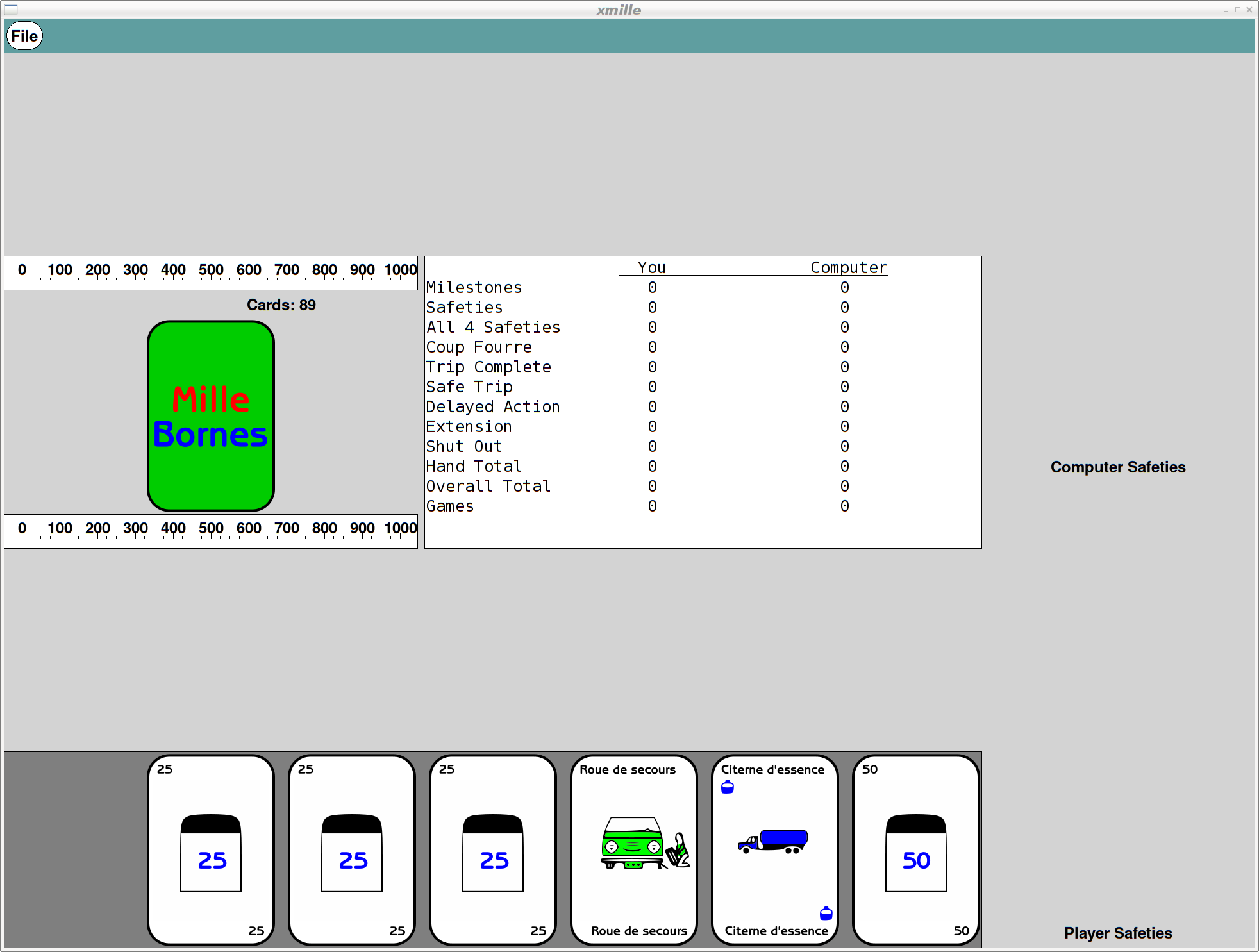
The reason the 'xmille' source is missing copyright and license information from the 'mille' files is that they were copied in before that information was added upstream. Xmille forked from Mille around 1987 or so. I wrote the UI parts for the system I had at the time, which was running X10R4. A very basic port to X11 was done at some point, and that's what Debian has in the archive today. At some point in the 90s, I ported Xmille to the Athena widget set, including several custom widgets in an Xaw extension library, Xkw. It's a lot better than the version in Debian, including displaying the cards correctly (the Debian version has some pretty bad color issues). Here's what the current Debian version looks like: Fixing The Bug To fix the missing copyright and license information, I imported the mille source code into the "latest" Xaw-based version. The updated mille code had a number of bug fixes and improvements, along with the copyright information. That should have been sufficient to resolve the issue and I could have constructed a suitable source package from whatever bits were needed and and uploaded that as a replacement 'xmille' package. However, at some later point, I had actually merged xmille into a larger package, 'kgames', which also included a number of other games, including Reversi, Dominoes, Cribbage and ten Solitaire/Patience variants. (as an aside, those last ten games formed the basis for my Patience Palm Pilot application, which seems to have inspired an Android App of the same name...) So began my yak shaving holiday. Building Kgames in 2020 Ok, so getting this old source code running should be easy, right? It's just a bunch of C code designed in the 80s and 90s to work on VAXen and their kin. How hard could it be?
  1. Everything was a 32-bit computer back then; pointers and ints were both 32 bits, so you could cast them with wild abandon and cause no problems. Today, testing revealed segfaults in some corners of the code.
  2. It's K&R C code. Remember that the first version of ANSI-C didn't come out until 1989, and it was years later that we could reliably expect to find an ANSI compiler with a random Unix box.
  3. It's X11 code. Fortunately (?), X11 hasn't changed since these applications were written, so at least that part still works just fine. Imagine trying to build Windows or Mac OS code from the early 90's on a modern OS...
I decided to dig in and add prototypes everywhere; that found a lot of pointer/int casting issues, as well as several lurking bugs where the code was just plain broken. After a day or so, I had things building and running and was no longer hitting crashes. Kgames 1.0 uploaded to Debian New Queue With that done, I decided I could at least upload the working bits to the Debian archive and close the bug reported above. kgames 1.0-2 may eventually get into unstable, presumably once the Debian FTP team realizes just how important fixing this bug is. Or something. Here's what xmille looks like in this version: And here's my favorite solitaire variant too: But They Look So Old Yeah, Xaw applications have a rustic appearance which may appeal to some, but for people with higher resolution monitors and well seasoned eyesight, squinting at the tiny images and text makes it difficult to enjoy these games today. How hard could it be to update them to use larger cards and scalable fonts? Xkw version 2.0 I decided to dig in and start hacking the code, starting by adding new widgets to the Xkw library that used cairo for drawing instead of core X calls. Fortunately, the needs of the games were pretty limited, so I only needed to implement a handful of widgets: The other Xkw widgets all got their rendering switched to using cairo, plus using double buffering to make updates look better. SVG Playing Cards Looking on wikimedia, I found a page referencing a large number of playing cards in SVG form That led me to Adrian Kennard's playing card web site that let me customize and download a deck of cards, licensed using the CC0 Public Domain license. With these cards, I set about rewriting the Xkw playing card widget, stripping out three different versions of bitmap playing cards and replacing them with just these new SVG versions. SVG Xmille Cards Ok, so getting regular playing cards was good, but the original goal was to update Xmille, and that has cards hand drawn by me. I could just use those images, import them into cairo and let it scale them to suit on the screen. I decided to experiment with inkscape's bitmap tracing code to see what it could do with them. First, I had to get them into a format that inkscape could parse. That turned out to be a bit tricky; the original format is as a set of X bitmap layers; each layer painting a single color. I ended up hacking the Xmille source code to generate the images using X, then fetching them with XGetImage and walking them to construct XPM format files which could then be fed into the portable bitmap tools to create PNG files that inkscape could handle. The resulting images have a certain charm: I did replace the text in the images to make it readable, otherwise these are untouched from what inkscape generated. The Results Remember that all of these are applications built using the venerable X toolkit; there are still some non-antialiased graphics visible as the shaped buttons use the X Shape extension. But, all rendering is now done with cairo, so it's all anti-aliased and all scalable. Here's what Xmille looks like after the upgrades: And here's spider: Once kgames 1.0 reaches Debian unstable, I'll upload these new versions.

31 December 2020

Chris Lamb: Free software activities in December 2020

Here is my monthly update covering what I have been doing in the free software world during December 2020 (previous month):

Reproducible Builds One of the original promises of open source software is that distributed peer review and transparency of process results in enhanced end-user security. However, whilst anyone may inspect the source code of free and open source software for malicious flaws, almost all software today is distributed as pre-compiled binaries. This allows nefarious third-parties to compromise systems by injecting malicious code into ostensibly secure software during the various compilation and distribution processes. The motivation behind the Reproducible Builds effort is to ensure no flaws have been introduced during this compilation process by promising identical results are always generated from a given source, thus allowing multiple third-parties to come to a consensus on whether a build was compromised. This month, I: I also made the following changes to diffoscope, our in-depth and content-aware diff utility that can locate and diagnose reproducibility issues, including releasing version 163:

Debian Uploads I also sponsored an upload of adminer (4.7.8-2) on behalf of Alexandre Rossi and performed two QA uploads of sendfile (2.1b.20080616-7 and 2.1b.20080616-8) to make the build the build reproducible (#776938) and to fix a number of other unrelated issues. Debian LTS This month I have worked 18 hours on Debian Long Term Support (LTS) and 12 hours on its sister Extended LTS project. You can find out more about the Debian LTS project via the following video:

Russ Allbery: Review: Billion Dollar Loser

Review: Billion Dollar Loser, by Reeves Wiedeman
Publisher: Little, Brown and Company
Copyright: October 2020
ISBN: 0-316-46134-2
Format: Kindle
Pages: 315
WeWork was founded in 2010 by Adam Neumann and Miguel McKelvey as a successor company to their similar 2008 GreenDesk business. (Adam's wife Rebekah is now presented as a co-founder. This seems dubious in Wiedeman's account, although Rebekah's role in the company is murky, ever-changing, and hard to pin down.) Its business model in reality was to provide turn-key, pre-furnished and stocked co-working and small office space to individuals and businesses on flexible, short-term leases. Its business model in Neumann's speeches and dreams, and represented by the later renaming of the company to the We Corporation, was nothing less than to transform the way people worked, learned, and lived. Through aggressive, money-losing expansion, WeWork grew rapidly to over 500 locations in 29 countries and became the largest office tenant in New York City. Based primarily on massive financial support from Masayoshi Son, CEO of Japanese holding company SoftBank, WeWork's private valuation rose to $47 billion. In 2019, the company attempted to go public, but its IPO collapsed, in part due to deeper analysis of the company's books. Neumann was forced out of the company (with an individual payout valued at $1.7 billion), the IPO was withdrawn, SoftBank wrote down 90% of their investment in the company and took control of it, and WeWork laid off more than 20% of its workforce. This book is a detailed history of WeWork's rise and fall, joining a genre that includes The Smartest Guys in the Room (Enron), Bad Blood (Theranos), and Super Pumped (Uber). I believe it's the first full book on WeWork, although it was preceded by several long-form stories, including "The I In We" by Wiedeman for New York magazine. As the first history, it's a somewhat incomplete cut: litigation between Neumann and WeWork is still pending, WeWork staggered into 2020 and a world-wide pandemic that made cramped open-plan offices an epidemiological disaster, and there will doubtless be new revelations yet to come. The discovery process of lawsuits tends to be good for journalists. But despite being the first out of the gate, Billion Dollar Loser reaches a satisfying conclusion with the ouster of Neumann, who had defined WeWork both internally and externally. I'm fascinated by stories of failed venture capital start-ups in general, but the specific question about WeWork that interested me, and to which Wiedeman provides a partial answer, is why so many people gave Neumann money in the first place. Explaining that question requires a digression into why I thought WeWork's valuation was absurd. The basic problem WeWork had when justifying its sky-high valuation is competition. WeWork didn't own real estate; it rented properties from landlords with long-term leases and then re-rented them with short-term leases. If its business was so successful, why wouldn't the landlords cut out the middle man, do what WeWork was doing directly, and pocket all the profit? Or why wouldn't some other company simply copy WeWork and drive the profit margins down? Normally with startups the answer revolves around something proprietary: an app, a server technology, patents, a secret manufacturing technique, etc. But nothing WeWork was doing was different from what innumerable tech companies and partner landlords had been doing with their office space for a decade, and none of it was secret. There are two decent answers to that question. One is simple outsourcing: landlords like being passive rent collectors, so an opportunity to pay someone else to do the market research on office layouts, arrange all the remodeling, adapt to changing desires for how office space should be equipped and stocked, advertise for short-term tenants, and deal with the tenant churn is attractive. The landlord can sit back and pocket the stable long-term rent. The second answer is related: WeWork is essentially doing rental arbitrage between long-term and short-term rents and thus is taking on most of the risk of a commercial real estate downturn. If no one is renting office space, WeWork is still on the hook for the long-term rent. The landlord is outsourcing risk, at least unless WeWork goes bankrupt. (One infuriating tidbit from this book is that Neumann's explicit and often-stated goal was to make WeWork so large that its bankruptcy would be sufficiently devastating to the real estate industry that it would get a bailout.) There's a legitimate business here. But that business looks like a quietly profitable real estate company that builds very efficient systems for managing short-term leases, remodeling buildings, and handling the supply chain of stocking an office. That looks nothing like WeWork's business, has nothing to do with transforming the world of work, and certainly doesn't warrant sky-high valuations. WeWork didn't build an efficient anything. It relied on weekend labor from underpaid employees and an IT person who was still in high school. And WeWork actively resisted being called a real estate company and claimed it was a tech company or a lifestyle company on the basis of essentially nothing. Wiedeman seems almost as baffled by this as I am, but it's clear from the history he tells that part of the funding answer is the Ponzi scheme of start-up investing. People gave Neumann money because other people had previously given Neumann money, and the earlier investors cashed out at the expense of the later ones. Like any Ponzi scheme, it looks like a great investment until it doesn't, and then the last sucker is left holding the bag. That sucker was Masayoshi Son, who in Wiedeman's telling is an astonishingly casual and undisciplined investor who trusted knee-jerk personal reactions to founders over business model analysis and historically (mostly) got away with it by getting extremely lucky. (I now want to read one of these books about SoftBank, since both this book and Super Pumped make it look like a company that makes numerous wild gambles for the flimsiest of reasons, pushes for completely unsustainable growth, and relies on the sheer volume of investments catching some lucky jackpots and cashing out in IPOs. Unfortunately, the only book currently available seems to be a fawning hagiography of Son.) On one hand, the IPO process worked properly this time. The sheer madness of WeWork's valuation scared off enough institutional investors that it collapsed. On the other hand, it's startling how close it came to success. If WeWork had kept the Ponzi scheme going a bit longer, the last sucker could have been the general investing public. Another interesting question that Billion Dollar Loser answers is how Neumann got enough money to start his rapid growth strategy. The answer appears to be the oldest and most obvious explanation: He made friends with rich people. The initial connections appear to have been through his sister, Adi Neumann, who is a model and hosted parties in her New York apartment (and also started dating a Rothschild heir). Adam met his wealthy wife Rebekah, cousin to actress and "wellness" scam marketer Gwyneth Paltrow, via a connection at a party. He built social connections with other parts of the New York real estate scene and tapped them for investment money. The strong impression one gets from the book is that all of these people have way more money than sense and we should raise their taxes. It won't come as a surprise that Adam and Rebekah Neumann are good friends of Jared Kushner and Ivanka Trump. Those are the questions I was the most curious about, but there's much more here. Wiedeman's style is nearly straight chronological reporting with little analysis, but the story is so wild and absurd that it doesn't need much embellishment. Neumann is obviously a megalomaniac whose delusions of grandeur got worse and worse as WeWork was apparently succeeding. Rebekah Neumann is if anything even less in touch with reality than he is, although in her case that appears to stem from having so much money that reality is an inconvenient speed bump. Miguel McKelvey, Neumann's co-founder, is an odd and interesting side note to the story; he appears to have balanced Adam out a bit in the early going but then wisely started to cash out and pocket his winnings while letting Adam dominate the stage. There are some places where I don't think Wiedeman pushed hard enough, and which cut against the view of Neumann as a true believer in his impossible growth vision. Neumann took several investment opportunities to cash out large amounts of his stock even while WeWork employees were being underpaid and told their stock options would make up for it. He clearly used WeWork as a personal piggy bank on multiple occasions. And Wiedeman documents but doesn't, at least in my opinion, make nearly enough of Neumann's self-dealing: buying real estate that WeWork then rented as a tenant, or paying himself for a license for the name We Holdings (although there at least he later returned the money). I think a good argument could be made that Neumann was embezzling from WeWork, at least morally if not legally, and I wish Wiedeman would have pressed harder on that point. But that aside, this is a great first history of the company, told in a clean, readable, and engaging style, and with a lot more detail here than I've touched on (such as Rebekah Neumann's WeGrow school). It's not as good as Bad Blood (what is), but it's a respectable entry in the corporate collapse genre. If you like this sort of thing, recommended. Rating: 7 out of 10

29 December 2020

Shirish Agarwal: Inequality in Indian Education

Farmer on-going protests Before I start with the education system in India which I have talked about many times in the past, first let me share couple of pieces about the farmer movement which is still at Sanghu Delhi border.
<Manjeet Kaur,62 at farmer protest with her friends.
The above picture became somewhat viral as it showed Manjeet Kaur, who drove down from Patiala, Punjab to Sanghu border along with her friends to take part in the on-going protests. The picture not only shares how the women are part and parcel of this protest but also they are independently taking part in the protest. The other were two articles I read today, first was an article in tribune which questions that if the policy worked, why it didn t work in the state of Bihar. The other by a young law student who had to go from Chandigarh to Delhi with family for some work and her experience with the ongoing protest. In fact, an interesting observation was made by the CJI in the many suits against farmer protests in the SC. This makes for much more interesting read when you see an RTI query filed by Saket Gokhale to NHAI , a Central Govt. agency which is supposed to be independent and asks if they had filed an FIR and asked compensation from Haryana State and Haryana State Police which had dug up National Highway 44 and if any permission was asked for the same from NHAI. And NHAI unable to take any action for the same. If this isn t shameful, I dunno what is
Saket Gokhale s RTI query on digging up NH44
NHAI response to Saket Gokhale s query.
Sadly, the way the response has been worded makes it impossible for NHAI to discharge its own responsibilities and this becomes a precedent for other states now that know that NHAI is vulnerable. A pretty sad turn on events. Indian Education can t go online There was a recent article on scroll which shared how Indian education can t go online as only a few have computers with decent netlink speeds as well as other factors which are needed for online education. But there are also many things that the article doesn t take into account which actually make the task more difficult and raise the boundary more. Now in most schools and colleges, the number of students to teacher ratio could be anywhere between 70-150 or even more. In the last few years, a lot of schools have been closed down by various Governments, including and not limited to the ruling Govt. They have in fact intensified closures of public schools wherever their Govt. has been in power. Closing to 5000+ schools in one state in a year is a dramatic shift and such has been happening time and again. In fact, the rising costs of Indian education has made many to leave Indian shores and do studies abroad. And once they do their masters or whatever, the chances of them coming back to India become more and more remote. In India the costs have been becoming so bad that NBFC s have started products targeting the same. How NBFC and Banks have (both public and private) have fared with respect to Indian consumers needs its own blog post but one word to describe it is bad . But as shared above, needs its own blog post. Coming to the Indian context though, what has not been captured in that article is that the responsibility of making new content also raises huge barriers for teachers. My own experience in teacher s trainings for ICT usage has shown that most teachers do not know and use internet effectively both to sustain their own curiosity as well as their students. Part of which is whether you are private employee or a public school teacher, the teacher is not paid enough. I have had multiple conversations with friends over the years who are teachers who shared that they get 50% salary in-hand while they sign for 100%. This is more in the case or private schools though. In Govt. schools, the teachers apart from their regular administrative duties apart from teaching duties are also unpaid labor for Govt. policy. Take the recent covid crisis, it was the teachers who for months together went from door-to-door asking if they had a covid patient. This was all over India. Even for voter registration, census, polio and various other immunization efforts, the teachers are roped in. So apart from that, they somehow have to figure out how to make ends meet and also boost student morale. Hence the attention is only limited to the first couple of benches rather than the whole as a 45-minute to an hr. session is just not enough to go through a class of 70-150 school students giving individual attention. And this is when for most teachers, teaching is a means to an end and not the end itself. I am going to take one example of science and sort of break-it-down in multiple steps and how I would have approached that topic for say the 5th-6th standard students in say a public school in Pune and especially if Covid would not have been an issue so you have face-to-face meetup. There was recent news about a mysterious radio signal which came from one of our closest galactic neighbors Proxima Centauri. Now let s say there was a class I was teaching/sharing which I had shared before and there already is trust formed. So before coming to the news, I would tell the students about frequency and more generally the notation of why we like to measure things and how we measure things. There is so much beautiful history which could be acted and enacted which can show and remains in mind why measurement is needed. Once that is understood, discussed and an underpinning is established, we could move to human perception or the lack of it. We know that humans have lots of limits in almost everything, whether it is talking, touching, hearing, all of our five senses are pretty limited with what we know of spectrum available in the immediate family kingdom as well as in the Universe. I would start with how far can a person throw his voice and be heard without using any other means. There does come a point where they need to use anything from a megaphone to a loudspeaker and what it actually does. The other thing I would then talk is about the radio and ask the students to find more about the internals of a radio. If possible to bring an old radio to school where it could be disassembled. After they are familiar with some names of the electronic components and what they do, take them to the electronics market where they try to source all the things needed to make a radio and whatever they encounter. This would allow the students to try and do bargain shopping as well as learn from where to source things. Some might even get a copy or two of electronic projects where the shop themselves sell blueprints to hobbyists so that they can tinker. If there is a place in the school where soldering can be done, then all can try and sooner or later we come to know if something works or not. There is also possibility of talking about noise cancellation and then the topic of ITU can also be bought up and how they do frequency allocation. Last but not the least then the topic can be approached about an alien civilization and an unknown radio signal and what it means and what it can mean. Now if just one topic can give such a wide range of things to do and develop an understanding about not the subject itself but surrounding subjects as well I see no reason why teachers can t do this except they are handcuffed to lot of policy as well as real-life constraints. For e.g. I remember in my school days, we used to go out once or twice a year and that used to be either a school picnic or something similar. The only other I know is going to Mumbai for Nehru planetarium and Nehru science Centre. Unfortunately, I didn t go at that time because the school was taking students via air and the tickets were super costly at the time and that too for a 10 minute journey between the two cities. Those were different days, today you can t have a direct flight between the two cities as it doesn t make an economic sense. It makes more sense to go to Mumbai via train or bus as you will reach Mumbai in about couple of hrs. Of course, Pune does have its own planetarium at New English school and there are a few amateur astronomy clubs in Pune but nothing on the scale that what Mumbai has, but then this is getting off-topic. Now, again in an online world could this be done? Not without both the teacher and the student both spending lot of resources online and even then will be a lower understanding as both the hands-on experience as well as interacting with other students and learning from other students (aping) would be hugely limited. Even the social skills that students develop in a school setting will be rusted. My own social skills probably have weakened and rusted as I have very limited interaction with people over the past few months due to Covid fears and would be at least for the next few years till a large enough population is not vaccinated.

28 December 2020

Russ Allbery: Review: Your Day, Your Way

Review: Your Day, Your Way, by Timothy Caulfield
Publisher: Running Press
Copyright: December 2020
ISBN: 0-7624-7248-0
Format: Kindle
Pages: 236
In case you're wondering why I would pick up a self-help book with such an uninspiring title, it's because this book was originally published in Canada with the title Relax, Damnit! Why Caulfield's US publishers would have changed that title is beyond me. Canada clearly got the better end of this deal. (I'm hoping it's not because they thought "damn" would scare someone off, but it probably is.) The topic of this book is a scientific take on all the little decisions that you may worry about throughout the day: whether to eat breakfast, how much water to drink, whether public toilet seats are risky, whether to weigh yourself, how important flossing is, and much more. Caulfield is a law professor at the University of Alberta specializing in health law and scientific ethics, but the hat he's wearing when writing this book is that of professional skeptic. I found out about this book through Dr. Jen Gunter, a connection that you won't find surprising when I mention that one of Caulfield's earlier books is titled Is Gwyneth Paltrow Wrong About Everything?. (Spoiler: yes.) Caulfield chose to organize this collection of random essays around the timeline of a single day, starting with waking up (how long should you sleep?) and morning routines (what do scientific studies say about brushing your teeth?), going through a work day (there's a chapter on multitasking and why you really shouldn't do it), and concluding with dinner (no, you can't taste the difference between most wines even if you think you can), evening routines, and sleep. This worked for me. It's still a bit arbitrary, but it's hard to organize random bits of skepticism, and this layout let Caulfield make a point about how frequently most people check their phones. (Stop doomscrolling. It makes you feel bad. Yes, I'm talking to myself.) I've now read several books, and considerably more essays, on scientific skepticism of this type. They're all a bit the same, and unless you enjoy this general genre of writing, there aren't many compelling reasons to read this specific entry. (Ben Goldacre's Bad Science is still my favorite.) I think the only tidbit that I found surprising and hadn't heard elsewhere is that the science on flossing is meh at best. The rest is the standard mix of mainstream scientific advice (don't drink raw milk, you're not going to catch something from a public toilet seat, multivitamins just give you expensive urine), advice that's scientifically correct but that I'm still not going to follow (there's no scientific reason to wash your hair daily but I still prefer how it feels), and advice to not worry about things with no evidence on either side (it doesn't matter whether you eat breakfast, ten thousand steps is a marketing gimmick, drink water when you're thirsty and don't worry about how much). Caulfield does have a particularly good debunking of the myth that angry ranting helps you calm down and feel better (it does the exact opposite), but if you're reasonably well-read on scientific trivia, nothing here will be that novel. If you don't follow scientific trivia and want a good collection of debunking essays, this book is fine. I certainly won't discourage you from reading it. Caulfield is engaging and succinct, and there's a balanced mix of odd trivia, debunking of pseudoscience, and good public health advice, all comfortably in line with what I've read elsewhere. That said, I found it striking to read this book shortly after Can't Even. I was hoping that Caulfield would tackle the larger problem of anxiety and overload that is in part created by the proliferation of arbitrary standards and rules to which we hold ourselves. He does tackle some related topics, such as our bizarre belief in the US (and apparently Canada) that it is unsafe to let children walk to school without adult supervision, but Caulfield's solutions are nearly all individual. He wants to inform the reader, he wants to show you how to analyze scientific research and notice when news articles are scaring you unnecessarily, and he wants you to become more immune to fear-mongering. Petersen's salient point in Can't Even is that many of us are burned out already and this is even more work. In order to avoid being gratuitously frightened and deceived by con artists and sensational news stories, we have to run a mental checklist of evidence evaluation and go do independent research. Sure, this works, makes you better at risk analysis, and may thus make you feel calmer, but this takes a lot of time and energy. Wasn't a point of having the news media that other people would do some of that work for you? Once again, everything that's wrong with the world becomes another chore or energy expenditure that we all have to independently make. I know, it's asking too much of a harmless book on the scientific evidence behind daily life decisions to make a political point about individual versus collective effort. But it's hard to shake the feeling that asking individuals to try harder to ignore intentionally deceptive and well-funded propaganda campaigns doesn't scale. Not everyone enjoys skepticism as a hobby, and there's only so much individual energy to go around. Relax, Damnit! is good advice as far as it goes. But I'm more in the mood for the books that look at who is making us so anxious in the first place and how we can (collectively) get them to stop. I don't know what that looks like (there are obvious free speech concerns), but we need reliable sources of information that don't make us anxious. Rating: 6 out of 10

27 December 2020

Russ Allbery: Review: King of the Murgos

Review: King of the Murgos, by David Eddings
Series: The Malloreon #2
Publisher: Del Rey
Copyright: April 1988
Printing: November 1991
ISBN: 0-345-35880-5
Format: Mass market
Pages: 403
This is the second book of the Malloreon, which in turn is a sequel trilogy to The Belgariad. You could start here, since Eddings does a good job at summarizing previous volumes, but I'm not sure why you'd want to. This is the sort of book that gives epic fantasy series a bad name. After a lot of action in Guardians of the West, our band of heroes has been mostly assembled. They set out after the villain through the novel strategy of exploring the parts of the world map we have not yet seen. By the end of 400 pages of traveling they... are on the trail of the villain while exploring parts of the world map we have not yet seen. What I'm saying is that you'd better be really enjoying Silk's nose twitching and Belgarath being grumpy at Polgara, because that's about all you get. The protagonists collect a few important plot coupons and set up some emotional conflicts whose resolutions are already telegraphed, and that's about it. After wasting a bunch of time getting to and wandering around Nyissa, all of which felt pointless except for one moment of Errand doing something nifty (often the best parts of this series), the band of heroes ventures into enemy territory as foreshadowed by the title. The structure of Eddings's series is basically Suikoden (collect all the protagonists), so as one might expect the point of this excursion is to pick up another protagonist. In the process, we get to see a bit more of the Murgos than we have before. I've commented before that Eddings takes racial essentialism to such an absurd degree that these books start feeling like animal fairy tales, which is why I'm willing to tolerate all of the stereotyping. It's Planet of Hats except with fantasy countries. That tolerance is stretched rather thin when it comes to the bad guys, since the congruence with real-life racism and dehumanization of enemies is a bit too strong. Eddings dodges this mostly by not putting many of the bad guys in the page, but in King of the Murgos he has a golden opportunity to undercut his racial structure and surprise the reader. What if one of the Murgos is a protagonist and is vital to the series plot? I won't spoil what Eddings actually does, but if you imagine the stupidest and most obvious way to avoid having to acknowledge his fantasy races are not uniform, you probably just guessed the big reveal in this book. It's sadly not surprising, since Eddings is all in on his racial construction of this fantasy world, but it's still disgusting. The main reason why I decided to re-read this series, which is notorious for being a re-run of the Belgariad, is because I think what Eddings does here with prophecy, the voice in Garion's head, and the meddling of the seers is hilarious. The plot is openly on rails to the point that the characters actively grumble about it. I find that oddly entertaining, a bit like watching a Twitch streamer play an RPG. In this installment, Errand does something random in the middle of a Murgo temple, Garion gets a level-up chime, the prophecy gets very smug about how well things are going, and no one knows why. It's an absolute delight, and I don't know of any other series that isn't pure parody that would be willing to use that as a plot element. Sadly, King of the Murgos has only one or two enjoyable moments like that, a whole lot of frankly boring map exploration, some truly egregious racist claptrap, and no plot development worth speaking of. I probably should have skipped this one when re-reading this series. Followed by Demon Lord of Karanda. Rating: 4 out of 10

John Goerzen: Asynchronous Email: Exim over NNCP (or UUCP)

Following up to yesterday s article about how NNCP rehabilitates asynchronous communication with modern encryption and onion routing, here is the first of my posts showing how to put it into action. Email is a natural fit for async; in fact, much of early email was carried by UUCP. It is useful for an airgapped machine to be able to send back messages; errors from cron, results of handling incoming data, disk space alerts, etc. (Of course, this would apply to a non-airgapped machine also). The NNCP documentation already describes how to do this for Postfix. Here I will show how to do it for Exim. A quick detour to UUCP land When you encounter a system such as email that has instructions for doing something via UUCP, that should be an alert to you that here is some very relevant information for doing this same thing via NNCP. The syntax is different, but broadly, here s a table of similar NNCP commands:
Purpose UUCP NNCP
Connect to remote system uucico -s, uupoll nncp-call, nncp-caller
Receive connection (pipe, daemon, etc) uucico (-l or similar) nncp-daemon
Request remote execution, stdin piped in uux nncp-exec
Copy file to remote machine uucp nncp-file
Copy file from remote machine uucp nncp-freq
Process received requests uuxqt nncp-toss
Move outbound requests to dir (for USB stick, airgap, etc) N/A nncp-xfer
Create streaming package of outbound requests N/A nncp-bundle
If you used UUCP back in the day, you surely remember bang paths. I will not be using those here. NNCP handles routing itself, rather than making the MTA be aware of the network topology, so this simplifies things considerably. Sending from Exim to a smarthost One common use for async email is from a satellite system: one that doesn t receive mail, or have local mailboxes, but just needs to get email out to the Internet. This is a common situation even for conventionally-connected systems; in Exim speak, this is a satellite system that routes mail via a smarthost. That is, every outbound message goes to a specific target, which then is responsible for eventual delivery (over the Internet, LAN, whatever). This is fairly simple in Exim. We actually have two choices for how to do this: bsmtp or rmail mode. bsmtp (batch SMTP) is the more modern way, and is essentially a derivative of SMTP that explicitly can be queued asynchronously. Basically it s a set of SMTP commands that can be saved in a file. The alternative is rmail (which is just an alias for sendmail these days), where the data is piped to rmail/sendmail with the recipients given on the command line. Both can work with Exim and NNCP, but because we re doing shiny new things, we ll use bsmtp. These instructions are loosely based on the Using outgoing BSMTP with Exim HOWTO. Some of these may assume Debianness in the configuration, but should be easily enough extrapolated to other configs as well. First, configure Exim to use satellite mode with minimal DNS lookups (assuming that you may not have working DNS anyhow). Then, in the Exim primary router section for smarthost (router/200_exim4-config_primary in Debian split configurations), just change transport = remote_smtp_smarthost to transport = nncp. Now, define the NNCP transport. If you are on Debian, you might name this transports/40_exim4-config_local_nncp:
nncp:
  debug_print = "T: nncp transport for $local_part@$domain"
  driver = pipe
  user = nncp
  batch_max = 100
  use_bsmtp
  command = /usr/local/nncp/bin/nncp-exec -noprogress -quiet hostname_goes_here rsmtp
.ifdef REMOTE_SMTP_HEADERS_REWRITE
  headers_rewrite = REMOTE_SMTP_HEADERS_REWRITE
.endif
.ifdef REMOTE_SMTP_RETURN_PATH
  return_path = REMOTE_SMTP_RETURN_PATH
.endif
This is pretty straightforward. We pipe to nncp-exec, run it as the nncp user. nncp-exec sends it to a target node and runs whatever that node has called rsmtp (the command to receive bsmtp data). When the target node processes the request, it will run the configured command and pipe the data in to it. More complicated: Routing to various NNCP nodes Perhaps you would like to be able to send mail directly to various NNCP nodes. There are a lot of ways to do that. Fundamentally, you will need a setup similar to the UUCP example in Exim s manualroute manual, which lets you define how to reach various hosts via UUCP/NNCP. Perhaps you have a star topology (every NNCP node exchanges email with a central hub). In the NNCP world, you have two choices of how you do this. You could, at the Exim level, make the central hub the smarthost for all the side nodes, and let it redistribute mail. That would work, but requires decrypting messages at the hub to let Exim process. The other alternative is to configure NNCP to just send to the destinations via the central hub; that takes advantage of onion routing and doesn t require any Exim processing at the central hub at all. Receiving mail from NNCP On the receiving side, first you need to configure NNCP to authorize the execution of a mail program. In the section of your receiving host where you set the permissions for the client, include something like this:
      exec:  
        rsmtp: ["/usr/sbin/sendmail", "-bS"]
       
The -bS option is what tells Exim to receive BSMTP on stdin. Now, you need to tell Exim that nncp is a trusted user (able to set From headers arbitrarily). Assuming you are running NNCP as the nncp user, then add MAIN_TRUSTED_USERS = nncp to a file such as /etc/exim4/conf.d/main/01_exim4-config_local-nncp. That s it! Some hosts, of course, both send and receive mail via NNCP and will need configurations for both.

26 December 2020

Russ Allbery: Review: The Biggest Bluff

Review: The Biggest Bluff, by Maria Konnikova
Publisher: Penguin Press
Copyright: 2020
ISBN: 0-525-52263-8
Format: Kindle
Pages: 335
After a particularly unlucky year for her family, Maria Konnikova was reading about the balance between luck and control in life and discovered, to her surprise, that John von Neumann, one of the foundational thinkers of computer science, was fascinated by poker. He found most card games boring because they relied on luck. Poker, however, he thought was the perfect balance between luck and skill: enough skill to make its effect undeniable, but enough luck that one could not control the game fully regardless of skill. Konnikova decided on a research project: spend one year learning No Limit Texas Hold'em from one of the best poker players in the world, with a goal of competing in the World Series of Poker. She had studied the description-experience gap during her doctoral research in psychology and wanted to see if the experience of randomness in poker would teach her something the description of the randomness of life could not. Before starting this project, she didn't know the basic rules and had never watched a game. Erik Seidel agreed to mentor her, and The Biggest Bluff is her account of that experience. This book is simultaneously frustrating and fascinating in ways that I don't think can be untangled without making it a far different book. Fitting, I suppose, for a book about how our brains entangle luck and skill. First, if you're looking for a book about poker play, this is not one. Konnikova rarely talks about specific hands or tournaments in more detail than her overall trajectory. That was a disappointment. In the few places she does describe some of her betting decisions, analysis of the other players, and tournament strategy, her accounts are engrossing and suspenseful. I would have happily read a book chronicling her poker tournaments and the decisions she made, but this is not that book. What The Biggest Bluff is instead is a psychological and philosophical examination of the process of learning poker. Konnikova uses her experiences as launching points into philosophical digressions. Even the lessons that have limited surface utility outside of poker, such as learning to suppress body language to avoid giving away information, turn into digressions about interpersonal dynamics and personality types. There are interesting tidbits here, but I've read a lot of popular psychology and was more interested in the poker. My frequent reading experience was impatiently waiting for Konnikova to finish lecturing and get back to her narrative. What Konnikova does do though, at a level that I haven't seen before before in a book of this type, is be brutally honest about her mistakes and her learning process. And I do mean brutally: The book opens with her throwing up in a casino bathroom. (This is not a fun book to read if you don't like reading about stress reactions and medical problems. There aren't many of them, but they're... memorable.) Konnikova knows and can explain the psychological state she's trying to reach, but still finds it hard to do in the moment. Correctly reacting to probabilities, cutting losses, and neither being too over-confident or too scared is very hard. Most books of this type elide over the repeated failures in a sort of training montage, which makes the process look easier than it feels. Konnikova tries to realistically show the setbacks and failures, and I think succeeds. That relentless introspection and critical honesty is the best part of this book, but I think it's also behind the stream of consciousness digressions about psychology and philosophy. It's a true portrayal of how Konnikova makes sense of the world. A more polished and streamlined book about the poker would have been more dramatically engrossing, but it might have lost the deep examination of how she combines poker with her knowledge of psychology to change her thinking. The one place where I think that self-reflection may fall a bit short, which I want to mention because I thought it was a missed opportunity, is around knowledge of hand probabilities. Konnikova makes a point, early in the book, of not approaching poker through the memorization and mathematics route and instead trying to find a play style that focuses on analyzing the other players and controlling her own emotions. This is a good hook, but by the end of the book it's not entirely true. The point that I think she was trying to make is that her edge against other poker players at her same level comes more from psychology than from calculation of precise odds in rare situations. This is true. But by the time she reaches high levels of play, she is using statistical simulators, practice tools, and intensive study just like any professional poker player. There is a minimum level of pure knowledge and memorization required that cannot be avoided. It's clear from the few things she says about this that those tools became more interesting to her as she became better at poker, and I wish she would have dug more into why and how that happened. How much of her newfound ability to make decisions and stick to a plan comes from emotional changes, and how much from that background store of confident knowledge? Or maybe those are different ways of looking at the same change? I did appreciate Konnikova's explicit acknowledgment at the end of the book that poker did not, in the end, provide some deep insight into the balance of luck and skill in real life. Learning poker instead gave Konnikova more personal ability to make a plan for the things that she can control and let go of the things she can't. I'm glad that worked for her, but since reading this book I have noticed former poker players who think life is more knowable than it is. Poker combines random chance with psychological play against other people, but it does so in a way and to an extent that is quantifiable. You can make the correct play and still lose a hand, but you can also know when this has happened. When you're used to analyzing the world through that frame and real life fails to provide that certainty, it's tempting to impose it anyway and insist your simplified models are more accurate because they're more comprehensible. But poker is a game, not a model; being more predictable and more constrained than real life is part of what makes it fun. The skill that Konnikova learned from it has a potential downside that she doesn't talk about. I'm not sure how to sum up this book. Konnikova's internal analysis and honesty is truly admirable and illuminating, but it left me wanting to read a different book that was more focused on poker narration. I know there are lots of those books out there, but I doubt they would be written with Konnikova's self-awareness and lack of ego. However, they would probably also lack the moments that made me cringe or that were deeply uncomfortable to read. My feelings are mixed. But if you want popular psychology wrapped around a deeply honest account of the process of learning poker, I suspect this book is one of a kind. Rating: 7 out of 10

23 December 2020

Sven Hoexter: Jenkins dynamically parameterized pipelins for terraform execution

Jenkins in the Ops space is in general already painful. Lately the deprecation of the multiple-scms plugin caused some headache, becaue we relied heavily on it to generate pipelines in a Seedjob based on structure inside secondary repositories. We kind of started from scratch now and ship parameterized pipelines defined in Jenkinsfiles in those secondary repositories. Basically that is the way it should be, you store the pipeline definition along with code you'd like to execute. In our case that is mostly terraform and ansible. Problem Directory structure is roughly "stage" -> "project" -> "service". We'd like to have one job pipeline per project, which dynamically reads all service folder names and offers those as available parameters. A service folder is the smallest entity we manage with terraform in a separate state file. Now Jenkins pipelines are by intention limited, but you can add some groovy at will if you whitelist the usage in Jenkins. You have to click through some security though to make it work. Jenkinsfile This is basically a commented version of the Jenkinsfile we copy now around as a template, to be manually adjusted per project.
// Syntax: https://jenkins.io/doc/book/pipeline/syntax/
// project name as we use it in the folder structure and job name
def TfProject = "myproject-I-dev"
// directory relative to the repo checkout inside the jenkins workspace
def jobDirectory = "terraform/dev/$ TfProject "
// informational string to describe the stage or project
def stageEnvDescription = "DEV"
/* Attention please if you rebuild the Jenkins instance consider the following:
- You've to run this job at least *thrice*. It first has to checkout the
repository, then you've to add permisions for the groovy part, and on
the third run you can gather the list of available terraform folder.
- As a safeguard the first first folder name is always the invalid string
"choose-one". That prevents accidential execution of a random project.
- If you add new terraform folder you've to run the "choose-one" dummy rollout so
the dynamic parameters pick up the new folder. */
/* Here we hardcode the path to the correct job workspace on the jenkins host, and
   discover the service folder list. We have to filter it slightly to avoid temporary folders created by Jenkins (like @tmp folders). */
List tffolder = new File("/var/lib/jenkins/jobs/terraform $ TfProject /workspace/$ jobDirectory ").listFiles().findAll   it.isDirectory() && it.name ==~ /(?i)[a-z0-9_-]+/  .sort()
/* ensure the "choose-one" dummy entry is always the first in the list, otherwise
   initial executions might execute something. By default the first parameter is
   used if none is selected */
tffolder.add(0,"choose-one")
pipeline  
    agent any
    /* Show a choice parameter with the service directory list we stored
       above in the variable tffolder */
    parameters  
        choice(name: "TFFOLDER", choices: tffolder)
     
    // Configure logrotation and coloring.
    options  
        buildDiscarder(logRotator(daysToKeepStr: "30", numToKeepStr: "100"))
        ansiColor("xterm")
     
    // Set some variables for terraform to pick up the right service account.
    environment  
        GOOGLE_CLOUD_KEYFILE_JSON = '/var/lib/jenkins/cicd.json'
        GOOGLE_APPLICATION_CREDENTIALS = '/var/lib/jenkins/cicd.json'
     
stages  
    stage('TF Plan')  
    /* Make sure on every stage that we only execute if the
       choice parameter is not the dummy one. Ensures we
       can run the pipeline smoothly for re-reading the
       service directories. */
    when   expression   params.TFFOLDER != "choose-one"    
    steps  
        /* Initialize terraform and generate a plan in the selected
           service folder. */
        dir("$ params.TFFOLDER ")  
        sh 'terraform init -no-color -upgrade=true'
        sh 'terraform plan -no-color -out myplan'
         
        // Read in the repo name we act on for informational output.
        script  
            remoteRepo = sh(returnStdout: true, script: 'git remote get-url origin').trim()
         
        echo "INFO: job *$ JOB_NAME * in *$ params.TFFOLDER * on branch *$ GIT_BRANCH * of repo *$ remoteRepo *"
     
     
    stage('TF Apply')  
    /* Run terraform apply only after manual acknowledgement, we have to
       make sure that the when     condition is actually evaluated before
       the input. Default is input before when. */
    when  
        beforeInput true
        expression   params.TFFOLDER != "choose-one"  
     
    input  
        message "Cowboy would you really like to run **$ JOB_NAME ** in **$ params.TFFOLDER **"
        ok "Apply $ JOB_NAME  to $ stageEnvDescription "
     
    steps  
        dir("$ params.TFFOLDER ")  
        sh 'terraform apply -no-color -input=false myplan'


    post  
            failure  
                // You can also alert to noisy chat platforms on failures if you like.
                echo "job failed"
             
         
job-dsl side of the story Having all those when conditions in the pipeline stages above allows us to create a dependency between successful Seedjob executions and just let that trigger the execution of the pipeline jobs. This is important because the Seedjob execution itself will reset all pipeline jobs, so your dynamic parameters are gone. By making sure we can re-execute the job, and doing that automatically, we still have up to date parameterized pipelines, whenever the Seedjob ran successfully. The job-dsl script looks like this:
import javaposse.jobdsl.dsl.DslScriptLoader;
import javaposse.jobdsl.plugin.JenkinsJobManagement;
import javaposse.jobdsl.plugin.ExecuteDslScripts;
def params = [
    // Defaults are repo: mycorp/admin, branch: master, jenkinsFilename: Jenkinsfile
    pipelineJobs: [
        [name: 'terraform myproject-I-dev', jenkinsFilename: 'terraform/dev/myproject-I-dev/Jenkinsfile', upstream: 'Seedjob'],
        [name: 'terraform myproject-I-prod', jenkinsFilename: 'terraform/prod/myproject-I-prod/Jenkinsfile', upstream: 'Seedjob'],
    ],
]
params.pipelineJobs.each   job ->
    pipelineJob(job.name)  
        definition  
            cpsScm  
                // assume admin and branch master as a default, look for Jenkinsfile
                def repo = job.repo ?: 'mycorp/admin'
                def branch = job.branch ?: 'master'
                def jenkinsFilename = job.jenkinsFilename ?: 'Jenkinsfile'
                scm  
                    git("ssh://git@github.com/$ repo .git", branch)
                 
                scriptPath(jenkinsFilename)
             
         
        properties  
            pipelineTriggers  
                triggers  
                    if(job.upstream)  
                        upstream  
                            upstreamProjects("$ job.upstream ")
                            threshold('SUCCESS')


Disadvantages There are still a bunch of disadvantages you've to consider Jenkins Rebuilds are Painful In general we rebuild our Jenkins instances quite frequently. With the approach outlined here in place, you've to allow the groovy script execution after the first Seedjob execution, and then go through at least another round of run the job, allow permissions, run the job, until it's finally all up and running. Copy around Jenkinsfile Whenever you create a new project you've to copy around Jenkinsfiles for each and every stage and modify the variables at the top accordingly. Keep the Seedjob definitions and Jenkinsfile in Sync You not only have to copy the Jenkinsfile around, but you also have to keep the variables and names in sync with what you define for the Seedjob. Sadly the pipeline env-vars are not available outside of the pipeline when we execute the groovy parts. Kudos This setup was crafted with a lot of help by Michael and Eric.

Russ Allbery: Review: Anti-Social

Review: Anti-Social, by Nick Pettigrew
Publisher: Century
Copyright: 2020
ISBN: 1-4735-7639-3
Format: Kindle
Pages: 375
Nick Pettigrew was an anti-social behavior officer for council housing for over a decade. This book is a diary of one year in the life of that job. According to the author, the dates, names, and some of the identifying details have been changed but not exaggerated. While it's hard to verify that, and I'm sure a few of the stories have been tweaked to make better narratives, it has a messiness and chaos of half-resolved drama mixed with mundane office tedium that makes it ring true. The subject matter requires some explanation for US readers. Council housing is the UK's version of what the US would call public housing or "the projects," although it's a far larger percentage of the housing stock in the UK than it is in the US. These are buildings built by the government and run by local governments or non-profits to provide housing to working class and poor people at reduced cost compared to the private market. As in the US, new council housing construction has dropped off dramatically; as in the US, a bunch of it has been privatized, although in the UK the Right to Buy law at least sells the housing to the people living in it, as opposed to slumlords. The 1998 UK Crime and Disorder Act collects under anti-social behavior a bunch of low-grade irritations that in the US would fall under public nuisance laws, noise ordinances, and other vague misdemeanors like "creating a public disturbance": essentially, all the irritating and obnoxious things that people subject their neighbors to, but which fall short of obvious criminal behavior like theft or assault. As Pettigrew puts it:
"I just don't want to hear the word 'cunt' shouted repeatedly at 3am every night any more. I don't think that's unreasonable."
That law required the organizations managing council estates to have a procedure to deal with anti-social behavior, and thus the job of an anti-social behavior officer was created. In the US, these sorts of problems are dealt with by the local police, which is a little like trying to get rid of a raccoon by running it over with a balky, thirty-year-old car. The best outcome is that the raccoon gets freaked out by your efforts to get the car to start and leaves. The worst outcome is that you accidentally run over your neighbor's kid while aiming for the raccoon. Either way, neither you nor the car nor your neighbors are going to be happy about the process. An anti-social behavior officer is someone with some authority to do things like install cameras, tell people who don't live somewhere that they need to stop coming there, and start eviction proceedings, but who doesn't carry guns, can't arrest people, and enforces those rules when necessary via court proceedings or calling the police. In other words, it's one of the types of alternative responders whose job is to solve problems rather than stop crimes that we've been talking about in the United States. And although Pettigrew is quite grumpy and cynical about his job (for very understandable reasons explained in this book), my takeaway from another country with even worse problems is that the system sort of works. It's underfunded and poorly managed and nebulous and sometimes very sad, but it also achieves some of what it sets out to do, and you can see the outlines of a better system beneath it. My favorite thing about this book is that it forces the reader to grapple with the actual job in all its messiness, rather than our ideals of what we want the job to be. For example, if you're going to hire a bunch of people to do this job, you need some way to figure out whether they're any good at it, but it's not obvious how to measure success.
One infuriating KPI we're measured on is the final question a resident is asked once their case is closed: "Are you happy with the outcome of your case?" Because unless you evict the problem neighbor within a fortnight, erect a security wall around the complainant's house manned by armed guards, and bake them a cake, the answer will almost certainly be no.
Pettigrew has a background in comedy so he's sarcastically funny rather than strident or didactic, which for me was just the tone I needed to enjoy reading this enough to think deeply about it. The thing that most surprised me, even though it probably shouldn't, was just how many of the problems Pettigrew had to deal with stemmed from drugs. My guess is that a good 75% of the issues he described were a direct result of someone dealing drugs, growing drugs, stealing things to buy drugs, throwing parties with druggie friends, doing bizarre and dangerous things because they were on drugs, not taking care of their property because they were too busy doing drugs, or letting their property be taken over by other people doing or selling drugs. It's just never-ending. The case load is clearly made worse by chronic understaffing and underfunding, and spending more money on giving people more assistance is part of any reasonable solution, but so is reducing the demand. If the pattern of complaints in the US is at all similar (and I bet it is), it's no wonder that the police perceive drugs as central to their job. Pettigrew talks about this at some length in the epilogue, and I think one of his conclusions is worth quoting here:
Years of interacting with class A drug users has shown me that they really don't want to be out hustling to make enough money for their next score of diluted heroin. They want to sit at home, take drugs and when those drugs wear off, take some more. You may view this as a wasted life, and you may well be right, but here's the thing: they are going to do this anyway, whether we decide to criminalize them or not. If, after a lengthy period of honest, mature drug education across the country via schools, further education, government advertising and so on, class A drugs were made legally available on prescription to adults via pharmacies, the vast majority of users would pick up their prescriptions, go home, take their drugs and leave everyone else alone. They couldn't be arsed to break into your car if they didn't have to.
The decriminalization argument is a lot larger than the space of this book review, so I won't get into it further, except to say that if you think that conclusion sounds unreasonable or dangerous or destructive to society, consider reading this book. One of the things that becomes obvious from Pettigrew's diary of incidents is that most people just want to feel safe, and a truly stunning amount of crime and anti-social behavior that makes them feel not safe is a direct or indirect result of people trying to get drugs or to get money to get drugs. The other pattern that's obvious from this book (and obvious from most writing by anyone involved in the justice system) is that the system doesn't really work.
The best way to describe going to court is that it's like paying a visit to a run-down hospital where nobody gets better.
Some of that is because it's not set up to solve problems, and a lot of that is because solving problems is a lot more expensive than we want to admit and we don't want to pony up the resources. I'm probably making this book sound hopelessly depressing, but it's not. It's angry and cynical, but it's also very funny (particularly if you like sarcasm), extremely quotable, insightful, and deeply empathetic. There are people trying their best to help other people despite a system that doesn't reward them for doing so, and surprisingly often they manage to do so. The path to helping more people isn't even that difficult to find. The epilogue of this book is full of solid and straightforward ideas that don't require some novel insight into humanity, just a bunch of hard work. And, while reading about the work of helping people and being exasperated by people, you'll also get to laugh at the bits of office nonsense that are universal.
The old form for monthly one-to-ones used to have two questions "What did you do over the last month?" and "What do you plan to do in the next month?" and my line manager at the time seemed unimpressed when I answered "my job" to both.
I loved this book. It was one of my favorite random finds of the year, and, at least judging from how difficult it is to find in Amazon search results, it's not gotten enough attention in the United States. Highly recommended. Rating: 9 out of 10

21 December 2020

Chris Lamb: Interview: Reproducibility and the future of free software

I recently took part in an interview with Vladimir Bejdo, an intern at the Software Freedom Conservancy, in order to talk about the Reproducible Builds project, my own participation in software freedom, the importance of reproducibility in software development and to have a brief discussion on the issues facing free software as a whole:
VB: To start off with, it might be useful to first ask you this how would you relate the importance of reproducibility to a user who is non-technical? CL: I sometimes use the analogy of the food supply chain to quickly relate our work to non-technical audiences. The multiple stages of how our food reaches our plates today (such as seeding, harvesting, picking, transportation, packaging, etc.) can loosely translate to how software actually ends up on our computers, particularly in the way that if any of the steps in the multi-stage food supply chain has an issue then it quickly becomes a serious problem. For example, even if we could guarantee that only the most wholesome apples were picked in our orchards, if they became tainted on the way to the supermarket it will be a real problem for us at the end of the day. We may not even be able to even tell by simply inspecting our Pink Ladies or Honeycrisps, and washing them thoroughly under the tap may not be enough either. In an ideal world, we would be able to personally inspect the provenance of our food at all of the stages of manufacturing and transportation. But at some point, we must place our trust in the process and in brands, as well as various regulatory bodies to ensure that potential problems in our food are minimized, possibly even paying a time/effort premium by growing our own or buying direct from local markets in order to minimize the number of steps, etc. However, when we use free software we can do better: Reproducible builds are a set of software development practices, ideas and tools that create an independently-verifiable path all the way from the original source code to what actually runs on our machines. Reproducible builds can reveal the injection of back-doors introduced by the hacking of developers own computers, build servers and package repositories, and also expose where volunteers or companies have been coerced into making changes via blackmail, court order, and so on. With reproducible builds, there is no longer any need to trust any particular source of authority. In the same way that, say, a Mr Smith might check that his calculator is giving him the right answer to 2+2=4 by asking enough of his friends to check theirs too, users and developers of a reproducible build can verify the software they are using by creating a collective consensus instead.
The full interview can be found on the Conservancy webpages.

Russ Allbery: Review: Behind the Throne

Review: Behind the Throne, by K.B. Wagers
Series: Indranan War #1
Publisher: Orbit
Copyright: August 2016
ISBN: 0-316-30859-5
Format: Kindle
Pages: 416
Hail is a gunrunner, an outlaw and criminal, someone who knows how to survive violence and navigate by personal loyalty. That world knows her as Cressen Stone. What her colleagues don't know is that she's also an Imperial Princess. Hailimi Mercedes Jaya Bristol left that world twenty years earlier in secret pursuit of her father's killer and had no intention of returning. But her sisters are dead, her mother's health is failing, and two Imperial Trackers have been sent to bring her back to her rightful position as heir. I'm going to warn up-front that the first half of this novel was rough to the point of being unreadable. Wagers tries much too hard to establish Hail as a reluctant heroine torn between her dislike of royal protocols and her grief and anger at the death of her sisters. The result is excessively melodramatic and, to be frank, badly written. There are a lot of passages like this:
His words slammed into me, burning like the ten thousand volts of a Solarian Conglomerate police Taser.
(no, there's no significance to the Solarian Conglomerate here), or, just three paragraphs later:
The air rushed out of my lungs. Added grief for a niece I'd never known. One more log on the pyre set to burn my freedom to ashes. The hope I'd had of getting out of this mess was lost in that instant, and I couldn't do anything but stare at Emmory in abject shock.
Given how much air rushes out of Hail's lungs and how often she's struck down with guilt or grief, it's hard to believe she doesn't have brain damage. Worse, Hail spends a great deal of the first third of the book whining, which given that the book is written in first person gets old very quickly. Every emotion is overwritten and overstressed as Hail rails against obvious narrative inescapability. It's blatantly telegraphed from the first few pages that Hail is going to drop into the imperial palace like a profane invasion force and shake everything up, but the reader has to endure far too long of Hail being dramatically self-pitying about the plot. I almost gave up on this book in irritation (and probably should have). And then it sort of grew on me, because the other thing Wagers is doing (also not subtly) is a story trope for which I have a particular weakness: The fish out of water who nonetheless turns out to be the person everyone needs because she's systematically and deliberately kind and thoughtful while not taking any shit. Hail left Pashati young and inexperienced, with a strained relationship with her mother and a habit of letting her temper interfere with her ability to negotiate palace politics. She still has the temper, but age, experience, and confidence mean that she's decisive and confident in a way she never was before. The second half of this book is about Hail building her power base and winning loyalty by being loyal and decent. It's still not great writing, but there's something there I enjoyed reading. Wagers's setting is intriguing, although it makes me a bit nervous. The Indranan Empire was settled by colonists of primarily Indian background. The court trappings, mythology, and gods referenced in Behind the Throne are Hindu-derived, and I suspect (although didn't confirm) that the funeral arrangements are as well. Formal wear (and casual wear) for women is a sari. There's a direct reference to the goddess Lakshimi (not Lakshmi, which Wikipedia seems to indicate is the correct spelling, although transliteration is always an adventure). I was happy to see this, since there are more than enough SF novels out there that seem to assume only western countries go into space. But I'm never sure whether the author did enough research or has enough personal knowledge to pull off the references correctly, and I personally wouldn't know the difference. The Indranan Empire is also matriarchal, and here Wagers goes for an inversion of sexism that puts men in roughly the position women were in the 1970s. They can, in theory, do most jobs, but there are many things they're expected not to do, there are some explicit gender lines in power structures, and the role of men in society is a point of political conflict. It's skillfully injected as social background, with a believable pattern of societal prejudice that doesn't necessarily apply to specific men in specific situations. I liked that Wagers did this without giving the Empire itself any feminine-coded characteristics. All admirals are women because the characters believe women are obviously better military leaders, not because of some claptrap about nurturing or caring or some other female-coded reason from our society. That said, this gender role inversion didn't feel that significant to the story. The obvious "sexism is bad, see what it would be like if men were subject to it" message ran parallel to the main plot and never felt that insightful to me. I'm therefore not sure it was successful or worth the injection of sexism into the reading experience, although it certainly is different from the normal fare of space empires. I can't recommend Behind the Throne because a lot of it just isn't very good. But I still kind of want to because I sincerely enjoyed the last third of the book, despite some lingering melodrama. Watching Hail succeed by being a decent, trustworthy, loyal, and intelligent person is satisfying, once she finally stops whining. The destination is probably not worth the journey, but now that I've finished the first book, I'm tempted to grab the second. Followed by After the Crown. Rating: 6 out of 10

18 December 2020

Rapha&#235;l Hertzog: Freexian s report about Debian Long Term Support, November 2020

A Debian LTS logo Like each month, here comes a report about the work of paid contributors to Debian LTS. Individual reports In November, 239.25 work hours have been dispatched among 13 paid contributors. Their reports are available: Evolution of the situation In November we held the last LTS team meeting for 2020 on IRC, with the next one coming up at the end of January.
We announced a new formalized initiative for Funding Debian projects with money from Freexian s LTS service.
Finally, we would like to remark once again that we are constantly looking for new contributors. Please contact Holger if you are interested! We re also glad to welcome two new sponsors, Moxa, a device manufacturer, and a French research lab (Institut des Sciences Cognitives Marc Jeannerod). The security tracker currently lists 37 packages with a known CVE and the dla-needed.txt file has 40 packages needing an update. Thanks to our sponsors Sponsors that joined recently are in bold.

One comment Liked this article? Click here. My blog is Flattr-enabled.

16 December 2020

John Goerzen: Non-Creepy Technology Purchasing & Gifting Guides

This time of year, a lot of people are thinking of buying gadgets and phones as gifts. But there are a lot of tech companies that have unethical practices, from terrible working conditions in their factories to spying on their users. Here are some buying guides to help you find gadgets that are fun and not creepy. The Free Software Foundation s Ethical Tech Giving Guide is a fantastic resource from what s probably the pickiest organization out there when it comes to tech. Not only do they highlight good devices, they also explain why and why you should, for instance, avoid the iPhone (their history of silencing political activists and spying on users). The FSF also has a Guide to DRM-Free Living talks about books, video, audio, and software that respects your freedom by letting you make your own backups, move it to other devices, and continue to use your purchases even if you have no Internet or the company you bought them from goes bankrupt. This is a fantastic and HUGE resource; there are hundreds of organizations out there that provide content in a way that respects your rights and many of them do it for free, legally, as well. PrivacyTools has a fantastic series of guides on everything from email providers to operating systems, as well as links to a number of other guides. The DeGoogle wiki on Reddit (as well as the sidebar) has a lot of fantastic alternatives to things like Chromebooks, Chrome, Gmail, etc. Related resources Here are some resources for education (what the issues are) and information about what companies and products to avoid. In addition to the FSF s other fantastic resources above, they also have a list of proprietary malware. It lists things, practices, and companies to avoid, and talks about the reasons why. Their addictions page is particularly good and relevant to my recent post on the problems of the attention economy. The Surveillance Self-Defense site from the Electronic Frontier Foundation is a fantastic introduction into how corporate surveillance works and how to defend against it. Use with a grain of salt: Mozilla, the people behind Firefox, have a site called Privacy Not Included that rates products by how creepy they are. They focus more narrowly on privacy than the more expansive set of freedoms the FSF considers (privacy is one of a number of things the FSF looks at), and in some cases I would say Mozilla is too generous (eg, with the Amazon Kindle, a number of their data points are just incorrect.)

14 December 2020

Vincent Fourmond: Version 3.0 of QSoas is out

After almost two years of development, version 3.0 of QSoas is finally out ! It brings in a number of new features. An expert mode for fitting Undoubtedly the most important feature in the new version is a complete upgrade of the fit system, which now features an expert mode, turned on by using the /expert=true option with the fit commands. The expert mode features a command prompt that looks like the normal command prompt, in which it is possible: The latter feature is very important when running fits with many parameters. In that case, there are a number of local minima, and it is necessary to try a number of different starting parameters to really find the best parameters. The new parameter space exploration feature makes it much easier than before, with an interface that allows easily finding the best parameters tried so far and reuse them.
A new documentation system Another very important update is the inclusion of a new, offline, documentation system. The documentation features browsing via table of contents, a command index and text search. It also features the possibility to copy commands from the help to the command prompt, or even run them directly. To top it all, it comes with a series of startup tips that might teach you a thing or two about QSoas (try hitting Show random to learn new tricks !).
Many other features For the full list of changes, please see the changelog. Apart from the changes described above, these are my favorites:
To get the new version, you can just download the source code from the downloads page, where you can also purchase precompiled versions for Windows and MacOS. You can also clone the source from the GitHub repository. About QSoasQSoas is a powerful open source data analysis program that focuses on flexibility and powerful fitting capacities. It is released under the GNU General Public License. It is described in Fourmond, Anal. Chem., 2016, 88 (10), pp 5050 5052. Current version is 3.0. You can download its source code there (or clone from the GitHub repository) and compile it yourself, or buy precompiled versions for MacOS and Windows there.

Next.

Previous.