Search Results: "daniel"

12 September 2010

Daniel Baumann: dosfstools 3.0.10

dosfstools did not correctly handle LFN (see Debian bug #596329 for more information) and had some false positives with bad filenames (see Debian bug #596327 for more information). Todays release of version 3.0.10 fixes this. Source tarballs can be downloaded as usual from its homepage.

31 August 2010

Gustavo Franco: Frans Pop

It feels like it was yesterday that I was talking all things d-i with Felipe (faw) and Otavio during the last International Free Software Forum and discuss d-i without mentioning Frans Pop and Joey Hess at least a couple of times is definitely not the same thing.

Otavio convinced me to help and I promptly synced with him and Daniel Baumann to deliver an alpha quality syslinux-installer udeb; that was during debconf a bit after the forum, that they've all attended and I couldn't.

I feel I can't let it pass without a post, now that we've put out a notice about our loss. RIP Frans. :/

25 August 2010

Christian Perrier: [life nolife] Debconf 10 was...

...awesome. OK, I'm writing this while I'm still in USA, but there are so many things to say about these weeks that I can't write them in only one blog post. And, still, this one will be quite long as it will talk about hacking, running and sightseeing...:) Let's start about hacking: after all, this is the first reason for being there in US, isn't it? I cam to DebConf with a very long TODO list and, for the first time in seven DebConfs, I'm pretty happy with what I achieved from it: As one can see, a lot of planned work happened while I still could maintain the usual flow of recurrent work with localization (Smith reviews, l10n NMUs). Some asked me why I didn't propose l10n sessions this year. Indeed, I wasn't feeling I could sustain animating them and I had no clear idea about which topic I could bring to be discussed. Last year, these sessions slightly killed my free time and I wanted to keep some this year for "impromptu" things. I didn't attend many talks, sorry for the speakers. The most I attended were during Debian Day, which I found highlyinteresting and motivating, just like Eben Moglen's talk. Marga's talk was also one I wanted to attend, though I regreted that things went mostly out of control during the talk (too many comments from the audience to allow Marga pushing her important points). As usual, I invested a big part of my time in "social" activities, the most proeminent being of course the Cheese and Wine party, which turned ut to be a great success. The help of my son Jean-Baptiste and the tremendous support of Michelle Lynn Hall helped a lot, though I still regret that we screwed about accessibility. I also ran a lot..:-)..that may be counted as social activities as I organized several group runs. The one I'm proud of has been participating to a local race, namely the Van Cortland Track Club Summer Series of cross-country running, in Bronx. We went there with no less than 10 DebConf participants and 1 kilt (hey, Luca!). All of us completed the race (that had 170 runners for 5 kilometers) and No l K the even finished 17th scratch and 2nd in his age/gender category. Besides that, we had a great run/sightseeing to Georges Washington Bridge (that links New Jersey and Harlem and offers an unusual view of Manhattan "from behind"). All this with a 17km run. We also ran several times in Central Park, and No l and me happened to go to Coney Island for the Day Trip by doing half of the trip by running (all around Manhattan and over the Broolyn Bridge), for about 20km. Then we "showered" in the Atlantic Ocean....:). At the end of DebConf, I think that I had my record broken with 112km run in 10 days and only one day *without* running. What about sightseeing? Well, this blog post is too long and we reach the end of Interstate-90, close to Albany, so that will be for an upcoming blog post. Aug 25th update: back home, so now I can publish this blog post...

13 August 2010

Daniel Stone: lca 2011 cfp closing soon!

Just a reminder that the linux.conf.au 2011 call for papers is closing THIS SATURDAY, 14th August! If you haven't already submitted your talk, get in now while you still can ...

10 August 2010

Asheesh Laroia: "Debian for Shy People": What's next

What do you do when you have a technical question that you're embarrassed to ask? The first Sunday of Debconf, I led a birds of a feather (BoF) session called Debian for Shy People. The conference team scheduled it on "Debian Day," a pre-conference day that was open to the public and still had plenty of Debian Developers in attendance. I just uploaded the slides to the "Penta" page for the talk. I led it because of my own experience. In 2004 or so, I saw Debian as the cool kids' club, that awesome project that I wished I could be a part of. By 2006, I managed to get over myself, read the New Maintainer's Guide, and find a way to get involved. As of mid 2009, I am a full-blown Debian Developer. I have real ultimate power. But I sometimes do still feel hesitation akin to "Imposter Syndrome". (A bunch of people at Debconf didn't really believe I'm "shy," since I asked a lot of questions at the conference. At core, I don't naturally believe that the things I say are worth hearing, but I patch over this hesitation. Sometimes I speak too much, and then I feel ashamed of burdening everyone. But anyway, this is about Debconf not, me -- so moving on....) In the past year of being a Developer, one thing I've seen is that other contributors ask me privately for help. Rather than blast the public lists like debian-mentors, they email or IRC private-message me, or SMS me, or find me at a Linux Users Group event. I'm lucky to know these people, and they're lucky to have me as a safe person to ask questions of. Moreover, Debian is better because these people could move past their confusion to make a technical contribution. I began the BoF session by talking about when someone asked me for help. Then I asked, "How many of you have someone you can ask embarrassing questions of?" Of the forty people crammed into Schapiro 414, two people' raised their hands. One person put it plainly, "I don't know anyone else who does Debian." It reminded me of a fact that Karen discovered when she was doing market research for us at OpenHatch: the vast majority of free software programmers know zero other people who do free software. I had seen the figure; we even used it in a talk to try and convince venture capitalists to fund OpenHatch last year. But I didn't really feel it until I heard it from a room full of Debian contributors. I structured the BoF in two parts: First, I talked in front of some slides to set the tone properly, and then we enjoyed open discussion. As I was preparing thoes slides, Daniel Morais asked me, "What's the point of having the session? Why not just come up with some ideas, implement them, and not bother also talking about it at the conference?" I had considered this; I decided I wasn't self-confident enough to start implementing ideas without talking to people to make sure I wasn't the only one who saw a problem. But I discovered another benefit of giving the talk: people who want to make Debian more welcoming knew to reach out to me. So here are some thoughts that came from our discussion (and later discussions during the conference): I set up an Etherpad document on cjb's OpenEtherpad.org. This is what we learned together: One idea I had before the BoF was to create a discussion area that was safe for all questions, even if they seem silly. We talked for a while about what name that would take, if it were to become a new IRC channel. We reached something of a conclusion, but in the conference that followed Emmet Hickory offered to help make the debian-mentors IRC channel friendlyer. I think that's the best direction to take things, so the next step is for him and me to write up what we want and send a note to the debian-mentors email list explaining our vision. In the Etherpad document, people discussed the idea of doing Debian discussion over XMPP (also known as Google Talk, also known as Jabber). We weren't sure how such a place would get critical mass; someone briefly mentioned the idea of an IRC/XMPP gateway. I actually think this discussion is along a very reeasonable path, namely discovering what discussion method(s) Debian contributors want to use. (That might explain why I'm now an admin on forums.debian.net.) We also briefly discussed the idea of an anonymous question-answering service. I realize now that I'm not going to be able to have time to run that, but I still think it'd be a really cool idea. Biella would remind me that Debian is already successful at bringing in new contributors. I agree! As a free software project, we have an enormous number of participants. This is a really good thing, and we're clearly doing something right. The purpose of this talk was to figure out how to make contributing to Debian less stressful for those who participate. Truly, a "Debian for Shy People" effort isn't about shy people. It's about the moments of self-doubt we all have in which we don't know what to do and are too embarrassed to ask. I think that if the project more friendly, we can find more participants, make better use of our current ones, and see improvements to our diversity. Whew, that was long. What do you think of all this?

4 August 2010

Romain Beauxis: Gotcha!

Thanks Daniel, I just got the world's most powerful wireless network card. It works and connects great including with aircrack-ng and co.. !

3 August 2010

Rog rio Brito: First post from DebConf 10

Even though I am late with this post, it is nice to say that I am writing here from this year s DebConf10, in NYC. Today (well, yesterday) was the day of the Cheese and Wine party and I think that it was cool, at least for the moments that I were there. This post, though, isn t technical in any sense. I only talks shortly about my impressions of the community, as this is my first DebConf ever (despite the fact that I have been using Debian since the late nineties). I was very pleased to have met Bdale Garbee. I saw him the other day arriving with Keith Packard, but I just didn t want to disturb them at that point. We only talked for, say, 2 minutes, and his was one of the nicest receptions that I had here. And there were some other people that were equally easy to approach, nice to talk with and, to my surprise, knew my name after some brief moments (yes, this does make a difference, especially when you are in a strange country, when you don t know anybody with whom you have worked for some years). Being involved in the organization stuff, one would think that Jimmy Kaplowitz would be so busy, but he was so kind. I had longer conversations with T ssia Cam es, Tiago Vaz (as always) and some other people that I had not yet had the pleasure of meeting in person. In particular, Daniel Baumann (who apparently is now crazy about our FISL and wants to drink all Guaran that he can get :-) ), Chris Lamb and Ot vio Salvador and his mom. Those people are so cool and it is nice to discuss some legal issues among different continents in the lounge of their building at late night. :-) Too bad that I am allocated to the other building. :-) I am forgetting many other people (hey, it is 2 am here in NYC), but I would feel guilty if I had not mentioned at least three people more: Martin Michlmayr, Phil Hands, and Reinhard Tartler (who is uploading lame to the debian repository, as the patents regarding it are expiring or expired already). Thanks! P.S.: I just created an account on flickr that I hope to populate with some photos that I took here. And even with a nice squirrel. :-)

27 July 2010

Daniel Baumann: The World's most powerful Wireless Network Card

About two weeks ago I got a Wifly-City G2000, the world's most powerful 802.11bg wireless network card. It features 2000mW which is 10 times more than the legally allowed limit of 200mW in Switzerland (or 2 times more than the allowed 1000mW in the USA, 5 times more than the allowed 400mW in Brazil, or 20 times more than the allowed 100mW in the EU). Contents The adapter is sold as a set named Wifly-City AVATAR-4PA with some accessories.
click on the images for full resolution The box prominelty lists Linux compatibility and contains the following part: The adapter has a Realtek 8187L chipset. This is particulary nice since there is no firmware needed for this chipset (therefore no questinable binary-only firmware blob). Also, it works out of the box with any Linux as of kernel version 2.6.30 and newer. I tested it on lenny with kernel backports, vanilla squeeze and vanilla sid. In all of these setups, it works out of the box without any configuration whatsoever - just plug it in and it works. I know that this is how it is supposed to be but still, I am always surprised again when things just work. For those who care, this is the output of dmesg when plugging in the card...
[...]
usb 1-1: new high speed USB device using ehci_hcd and address 6
usb 1-1: New USB device found, idVendor=0bda, idProduct=8187
usb 1-1: New USB device strings: Mfr=1, Product=2, SerialNumber=3
usb 1-1: Product: RTL8187_Wireless_LAN_Adapter
usb 1-1: Manufacturer: Manufacturer_Realtek_RTL8187_
usb 1-1: SerialNumber: xxxxxxxxxxxx
usb 1-1: configuration #1 chosen from 1 choice
phy1: Selected rate control algorithm 'minstrel'
phy1: hwaddr xx:xx:xx:xx:xx:xx, RTL8187vB (default) V1 + rtl8225z2, rfkill mask 2
rtl8187: Customer ID is 0xFF
Registered led device: rtl8187-phy1::tx
Registered led device: rtl8187-phy1::rx
rtl8187: wireless switch is on
usbcore: registered new interface driver rtl8187
ADDRCONF(NETDEV_UP): wlan1: link is not ready
wlan1: direct probe to AP xx:xx:xx:xx:xx:xx (try 1)
wlan1: direct probe responded
wlan1: authenticate with AP xx:xx:xx:xx:xx:xx (try 1)
wlan1: authenticated
wlan1: associate with AP xx:xx:xx:xx:xx:xx (try 1)
wlan1: RX AssocResp from xx:xx:xx:xx:xx:xx (capab=0x411 status=0 aid=5)
wlan1: associated
ADDRCONF(NETDEV_CHANGE): wlan1: link becomes ready
wlan1: no IPv6 routers present
[...]
...and this is the output of lsusb:
Bus 001 Device 006: ID 0bda:8187 Realtek Semiconductor Corp. RTL8187 Wireless Adapter
Special Offer I have played with the card for some time now and am really pleased with it. It works nicely with all the standard tools (aircrack-ng, kismet, etc.). The only bummer is that the card is quite expensive. Fortunately, we could arrange a good deal for Free Software people where the store selling it does not make any money on it: instead of 89 USD you can get it for 68 USD (including everything). If you are interested in getting one and you are comming to DebConf 10 in New York between 2010-07-25 and 2010-08-08, you can write an email to Ralph Amissah or speak to Ralph personally during the event. 1 I have no idea why they are shipping with a Y cable because the adapter does not need one. However, it does not disturb and in case I ever need an Y cable, I now have one :)

Tiago Bortoletto Vaz: Live installer (pre-alpha-almost-tested) just released

yeahhhh!!!
otavio
Wow, it even works!
daniel

Daniel and Otavio releasing Debian live installer in Debconf 10


25 July 2010

Russell Coker: Links July 2010

David Byrne gave an interesting TED talk about how changes to architecture drove changes to musical styles [1]. I think he does stretch the point a little. To a certain extent people develop the most complex instruments and the largest music halls that can be supported by the level of technology in their society people with a hunter-gatherer civilisation play drums because they can build them and can carry them. The NY Times has an interesting article about paternity leave in Sweden [2]. The Swedish government pays for a total of 13 months leave that can be split between parents for every child. Of those 13 months 2 months can only be taken by the father and that is likely to increase to a minimum of 4 months of paternity leave after the next election. Dan Meyer gave an interesting TEDX talk about how the current math curriculum in the US (as well as Australia and lots of other countries that do the same thing) is totally wrong [3]. His main point is that maths problems should be based on real-world use cases where not all needed data is immediately available and there is also useless data that must be discarded. He believes that the most important thing is developing mathematical problem solving skills basically the things that I did for fun when I was in primary school are skills that need to be taught to high-school students The Atlantic magazine has an amusing article by Daniel Byman and Christine Fair about the incompetent Islamic terrorists [4]. In Afghanistan half the suicide bombers kill only themselves and the US government has a lot of evidence of Taliban soldiers practicing bestiality and collecting porn. Islamic extremist groups are staffed by people who are bad soldiers and bad Muslims. Jon Masters wrote an interesting post titled What Would Jesus Buy about ethical purchasing decisions [5]. Jon references The Church of Stop Shopping which isn t a real religious organisation but a street theatre activist group. ZeroHedga has an insightful article comparing corporations and the US government to street gangs [6]. The conclusion is that when gangs take over a neighbourhood everyone has to join a gang for their own protection. Hillel Cooperman gave an interesting TED talk about being obsessed with Lego [7]. He compares Lego fans to Furries and makes a good case for this comparison. Marian Bantjes gave an interesting TED talk about her graphic art / graphic design work [8]. I ve never seen anything quite like this. Business Insider has an interesting article about oil cleanup, it seems that most people who worked on the Exxon Valdez disaster are now dead [9], s opposed to most people who worked in almost every other occupation at that time who are either still working or enjoying their retirement. The current gulf disaster is bigger, will require more workers for the cleanup, and can be expected to have a higher death toll. Some people claim that measures to reduce oil efficiency will impact the economy, how will millions of people who are chronically ill for the rest of their lives impact the economy? The NY Times has an interesting article on circle lenses [10], contact lenses designed to make the eyes look larger. It s illegal to sell contact lenses in the US without a prescription, but the latest trend is for women to buy them online in a variety of colors. The FDA should probably approve them, it would be better to have the quality controls you expect from a medical supply company instead of having people rely on Malaysian mail-order companies for the safety of their eyes. Don Marti has written an interesting article about the economic decline in the US, he suggests making pension funds invest in local jobs [11]. Companies are supposed to act on behalf of their stock-holders, but US companies often have the majority of their stock owned by the pension funds of workers but they act on behalf of a small number of rich people who own a minority of the stock. Don s article was inspired by Andy Grove s article in Bloomberg about the stagnation in technological development that has been caused by off-shoring the manufacturing [12]. Neil Brown has completed a test release of a new Linux software RAID feature for arrays with multiple redundancy that have bad sectors [13]. When a disk gets a bad sector the current behavior is to kick it out of the array, if you have two such errors on a 3 disk RAID-1 or a RAID-6 array then you lose all redundancy and are at risk of catastrophic failure even though in most cases both disks will still mostly work. With this patch some regions of the disk may be excluded but it can provide redundancy for other stripes. Thanks Neil for your great work here, and all your previous work over the last 10+ years! The RSPCA has a new campaign titled Close the Puppy Factories [14]. Dogs are kept in very poor conditions and forced to churn out puppies for their entire lives to supply pet stores. The RSPCA recommends that people buy puppies from registered dog breeders (not registered dog breeding companies ) and ask to see the dog s parents. They also recommend not buying from classified adverts or pet stores. Animal shelters have to euthenise huge numbers of unwanted animals, you can buy a pet dog or cat from an animal shelter for a small fee that covers the expenses related to housing and spaying it and save that animal from being euthenised! Maureen Dowd criticises the Catholic Church properly in an article for the New York Times [15]. The Catholic Church officially regards ordaining a woman and raping a child to be equally bad offenses. Frank Rich wrote an interesting column for the New York Times about Mel Gibson [16]. He describes the destruction of Mel Gibson s reputation as a symptom of changes in the culture in the US and also links it to the fall of Ted Haggard (who supported Gibson s most notorious movie The Passion of the Christ).

24 July 2010

John Goerzen: Daniel Schorr

For many years now, I ve admired Daniel Schorr s reporting on NPR. I could instantly recognize his voice, and perhaps to the irritation of Terah, whenever I heard him on the radio, I d turn it up and ask that we be quiet for a couple minutes so I could listen. The thing about Dan is that he was a reporter for 60 years. He reported from Moscow for CBS, from the Netherlands, Berlin, Washington. He interviewed Kruschev, got on Nixon s enemies list a fact he famously discovered as he was reading the list for the first time live on the air and was fired from several jobs for insisting on sticking to his standards over the objections of more profit-driven executives. The reason I listened to him was that he had a perspective nobody else does. There d be some contemporary story, and inevitably he d relate it to something Eisenhower said, or a G7 meeting in the Reagan years, or something Kruschev or Gorbachev mentioned. And not only was it accurate, it was incisive and enlightening. Some things well worth reading:

19 July 2010

Daniel Stone: sgi summer interns write like

So, #collabora was putting chunks of code into iwritelike.com, and I decided to join in the fun. While Telepathy, GStreamer and other similarly soft projects are all apparently written like Dan Brown or David Foster Wallace, I put a chunk of xkbActions.c into iwritelike.com, and apparently it's written like Chuck Norris. Brilliant.

2 July 2010

Daniel Stone: xhost plus considered harmful

So, flipping through the otherwise good MeeGo SDK setup instructions, I was pretty disheartened to see this:
Next, configure X on the host machine to enable the Simulator (running from the chroot) to access the display of the normal user:

xhost +local:

This gives everyone who can execute anything on your machine full permission to rip your credit card numbers out of Chromium and your password out of gnome-terminal. Sweet. This comes up all the time, so man wouldn't it be great if there was some kind of better way?

xhost +SI:localuser:usernametogiveaccesstogoeshere

I'm pretty sure this has been available in every single X.Org release since 6.8 or so, so next time you see someone advocating something as daft as the above, please point them towards the correct way. Thanks.

(Pushed it with the wrong date originally; couldn't fix it without bumping it to the top again. Sorry!)

30 June 2010

Vincent Sanders: Programmers are suckers for a meme

Many Open Source projects have and IRC # for developers. The NetSurf project is no different. During a discussion someone jokingly suggested that one contributor should be asked to take the FizzBuzz test. Can you guess what happened next?

Ten minutes later Michael Drake posted this solid example in C which is where it all ought to have ended.

<iframe src="http://pastebin.com/embed_iframe.php?i=MesmvSjk" style="border:none;width:100%;height:200px;"></iframe>

Being programmers, of course this had a predictable result. The original question, the reason for asking it and any the serious point being made in the original article were discarded. Just so everyone (including myself) could play silly buggers over our lunch break. Coders, it would seem, simply like to produce a solution even if it is only for fun.

None of these programs took more than ten minutes (except the JAVA monstrosity), are reproduced with permission and I am to blame for none of them (ok maybe just the one ;-).

First up was Rob Kendrick with the classic solution in C (his day job is as a support team lead which seems to make those programmers who cannot do this seem even more scary bad.)

<iframe src="http://pastebin.com/embed_iframe.php?i=EaQ2414U" style="border:none;width:100%;height:200px;"></iframe>

Next was Daniel Silverstone who turned this Lua solution out very quickly and berated the rest of us for not following the rules ;-)

<iframe src="http://pastebin.com/embed_iframe.php?i=cYY0YDYM" style="border:none;width:100%;height:220px;"></iframe>

The final C solution was my own uber silly sieve implementation

<iframe src="http://pastebin.com/embed_iframe.php?i=5w5BhKt3" style="border:none;width:100%;height:200px;"></iframe>

Peter Howkins decided the world required a solution in PHP

<iframe src="http://pastebin.com/embed_iframe.php?i=h2aQ5eXM" style="border:none;width:100%;height:200px;"></iframe>

When pointed out that his solution stopped at 50 he presented this vastly superior and obviously idiomatic solution

<iframe src="http://pastebin.com/embed_iframe.php?i=k8T6VtJu" style="border:none;width:100%;height:200px;"></iframe>

Finally after a long time James Shaw caused mental anguish and wailing with this abomination unto Nuggin.

<iframe src="http://pastebin.com/embed_iframe.php?i=GFeHdJdr" style="border:none;width:100%;height:200px;"></iframe>

With Luck everyone has now got it out of their system and we will never have to put up with this again (yeah right). And now you also know why Open Source projects sometimes take ages to release ;-)

29 June 2010

Daniel Stone: xhost plus considered harmful

So, flipping through the otherwise good MeeGo SDK setup instructions, I was pretty disheartened to see this:
Next, configure X on the host machine to enable the Simulator (running from the chroot) to access the display of the normal user:

xhost +local:

This gives everyone who can execute anything on your machine full permission to rip your credit card numbers out of Chromium and your password out of gnome-terminal. Sweet. This comes up all the time, so man wouldn't it be great if there was some kind of better way?

xhost +SI:localuser:usernametogiveaccesstogoeshere

I'm pretty sure this has been available in every single X.Org release since 6.8 or so, so next time you see someone advocating something as daft as the above, please point them towards the correct way. Thanks.

20 June 2010

Daniel Baumann: Debian Live Web Images Builder

Richard Nelson, an outstanding debian-live contributor and team member since many years, has setup an instance of the live-helper CGI scripts that are included within live-helper. This webbuilder lets users get their own customized images without the need of having to install live-helper and build them on their own. It's available at live-helper.debian.net. Apart from having some better looking html form and adding an online-help that will be worked on soon, it's working great. Thanks you, Richard.

7 June 2010

Daniel Stone: and one more thing ...

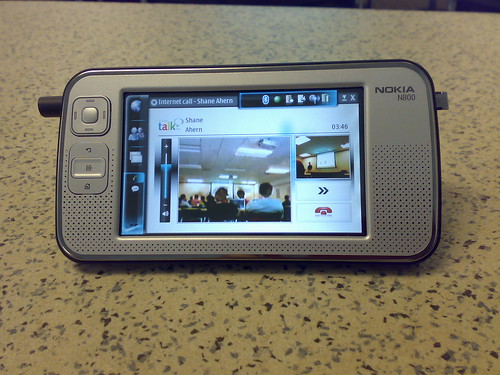
So, I spent an hour or two this afternoon following the iPhone 4 liveblog. It all looked fairly compelling (the screen!), right up until Steve's 'and one more thing': video calling.


HELLO I'M IN 2007, CAN YOU HEAR ME
(Photo of the Nokia N800, which shipped in January 2007, from rnair.)

The moral of the story? If you want to be four years ahead of the WWDC closing bombshell, email sales@collabora.co.uk. :)


PS: The 2010 'fuck it, we're going to fivefour blades' version; we also had a six-way video call going earlier today.

31 May 2010

Piotr Galiszewski: Short project update

Hello all.

Last week I was very busy, due to my university duties. On Tuesday I had my first exam in this semester (in Numerical Analysis), which took me more time than I had thought it would be.
From this reason my project is slightly behind schedule, but now I will do my best to catch the plan.

On the other hand, there are also some good news for me. Some time ago, Daniel Burrows migrated aptitude repository from mercurial to GIT. I am git user for nearly year, so I strongly support this move ;) .

Here are some basic thoughts which functionalities good package manager must have (and which approach (from aptitude-gtk, synaptic and adept) I like the most):
All of this will be elaborated in mockups. Am I forgetting something important?

The most important questions is: "What is the most common use case for package manager? Installing packages or upgrading packages?". I am not sure if this two actions require different views, or there should be only new category in install package view.

This is all now. More updates (and mockups) will be available today's midnight (or tomorrow morning). So please stay tuned :)

Piotr Galiszewski: Hello Word

Hello Planet Debian readers!

I've never thought that such a thing can ever happen, but I've started blogging ;) So now it is time to introduce myself.

My name is Piotr Galiszewski and I am second year student of computer science at AGH - University of Science and Technology in Krakow (Poland). I have been GNU/Linux user for about 5 years (mostly Debian based distributions).

Thanks for Debian and Google, this summer I will be working on creating Qt-based user interface for aptitude as my Google Summer of Code project. I hope that my mentors Sune Vuorela and Daniel Barrows will be patient with me ;) I am sure I will learn a lot from them. Please look at abstract of my project made by Debian GSoC administrator Obey Arthur Liu:
Qt GUI for aptitude. Currently, KDE users need to use Aptitude via the console interface, or install the newly developed GTK frontend, which does not fit well into KDE desktop. Making Qt frontend to Aptitude would solve this problem and bring an advanced and fully Debian-compliant graphical package manager to KDE.
As I wrote in my proposal I will split my work into three main parts:
  1. writing low level classes which will abstract aptitude signals and slots (which uses sigc++) into Qt slots and signals.
  2. creating and evaluating GUI mockups
  3. implementing GUI on top of classes from the first point
Point 1 and 2 will be made simultaneously and will take all May and half of June. Low level classes should implement all necessary functions for further use in GUI. This classes allow me to avoid direct usage of none Qt code in GUI classes and also give much more time to prepare completed and usability-wise mockups. Every mockups version will be presented and discussed on this blog. First version should be ready in next few days and updates will appear each week (or to weeks).
After finishing this two steps I will start coding GUI. With mockups and finished low level classes this should not be complicated (Yeah, I know that this is only my dream).

Full text of my proposal (including more precise time-line) can be found at Debian wiki.

Currently, project is slightly behind the schedule . It is caused by changes in my studies plan. The Juwanalia students' festival took place earlier, and yesterday it finished. But my first exam will take place one week later on 18 May, so I will have more time to catch up with time-line.

This project is my first direct contribution to Debian, but not first involvement in free software movement. I've been Kadu Instant Messenger developer for more then two year. In last two years I have been second most active developer with more than 700 commits in master branch. During GSoC period my Kadu activities will be limited. If time allows me to do this, I will be still contributing to Kadu. I still can be found at Kadu forum or #kadu channel on irc.freenode.net. I will also continue reviewing patches and fixing low time-consuming bugs.

My plans for the next few days:
If you have any thoughts about this project, please add comment to this post or contact me directly. I will be glad to read all yours opinions

Cheers

PS. As you can see English is not my mother tongue, so please forgive me my mistakes

27 May 2010

Vincent Sanders: Ex Phone

I went to the Linux Plumbers Conference (LPC) last year (which was very interesting and productive). While I was there Qualcomm were in attendance giving out penguin mints and running a competition. The lucky winners of this draw were to receive an ADP1 Android phone. So I dutifully filled in the entry form, handed it in and thought no more about it.

In the break after attending a particularly interesting workshop on the last day of the conference several other people congratulated me on winning the Qualcomm draw, this was the first I knew about it! I went in search of the nice people from Qualcomm and sure enough they handed over an ADP1 after getting a couple of photos.

Once I returned home I switched to using ADP1 as my phone and started experimenting with Android kernel stuff. Then one day the Wi-Fi stopped working which while odd could be overcome by repeatedly unloading and reloading the driver until it worked once more. Then one day the USB stopped working, no more ADB, no more console, no more debugging, no more hacking.

Then one day it turned itself off and never came back. I have been forced to return to using a hand me down, very kindly given to me by Daniel Silverstone. Alas it is not a smart phone of any kind and my finances do not allow for me to spend the money to replace it.

I have repeatedly tried to contact Qualcomm open source to see if there is any kind of warranty I might be able to use to get the phone repaired alas all the contact addresses I have are now simply returning SMTP errors.

So this is pretty much a tale without a happy ending, unless anyone out there knows the right people to contact? Perhaps someone at Google maybe? I only revisit the subject at all because of the recent announcement of an Android 2.1 based edition for these devices which reminded me I like to play with these things.

Next.

Previous.