I was gonna use this blog post to share about the migrant worker woes as there has been multiple stories doing the rounds. For e.g. a story which caught the idea of few people but most of us, i.e. middle-class people are so much into our own thing that we care a fig leaf about what happens to migrants. This should not be a story coming from a humane society but it seems India is no different than any other country of the world and in not a good way. Allow me to share
Or for those who don t like youtube, here s an alternative link
https://www.invidio.us/watch?v=JGEgZq_1jmc
Now the above two editorial shares two stories, one of Trump retaliatory threat to India in the Q&A of the journalist. In fact, Trump has upped the ante on visa sanctions as India buckled so easily under pressure.
There have been other stories doing the rounds how people who have illnesses who need HCQ in India are either dying or are close to death because of unavailability of HCQ in the medicine shop. There have been reports in Pune as well as South Mumbai (one of the poshest localities in Mumbai/Bombay) that medicine shops are running empty or emptier. There have been so many stories on that, with reporters going to shops and asking owners of the medicine shops and shop-owners being clueless.
I think the best article which vividly describes the Government of India (GOI) response to the pandemic is the free-to-read article shared by Arundhati Roy in Financial Times. It has reduced so much of my work or sharing that it s unbelievable. And she has shared it with pictures and all so I can share other aspects of how the pandemic has been affecting India and bringing the worst out in the Government in its our of need. In fact, not surprisingly though, apparently there was also a pro-Israel similar thing which happened in Africa too . As India has too few friends now globally, hence it decided to give a free pass to them.
Government of India, news agencies and paid News
One of the attempts the state tried to do, although very late IMHO is that it tried to reach out to the opposition i.e. Congress party and the others. Mrs. Sonia Gandhi, who is the Congress president asked that the Government should not run any of its ads on private television channels for a period of two years. There had been plenty of articles, both by medianama and others who have alleged that at least from the last 6 odd years, Government ads. comprise of almost 50-60% advertising budget of a channel advertising budget. This has been discussed also in medianama s roundtable on online content which happened few months back. While an edited version is out there on YT, this was full two day s event which happened across two different cities.
or the alternative to youtube
https://www.invidio.us/watch?v=c1PhWR1-Urs
It was as if the roundtable discussions were not enough, Mrs. Gandhi clarion call was answered by News Broadcaster s Association (NBA) and this is what they had to say
News Broadcasters Association reply to Mrs. Gandhi
To put it simply, NBA deplored the suggestion by Mrs. Gandhi and even called the economy in recession and all they had were the Government s own advertising budget to justify their existence. The statements in themselves are highly pregnant and reveal both the relationship that the media, print or mainstream news channels have with the Government of India. Now if you see that, doesn t it make sense that media always slants the story from the Government s perspective rather than remaining neutral. If my bread basket were on the onus of me siding with the Govt. that is what most sane persons would do, otherwise they would resign and leave which many reporters who had a conscience did.
Interestingly enough, the NBA statement didn t just end there but also used the word recession , this is the term that Government of India (GOI) hates and has in turn has been maintaining the word, terminology slowdown . While from a layman s perspective the two terms may seem to be similar, if India has indeed been in recession then the tools and the decisions that should have been taken by GOI should have been much different than what they took. Interestingly, enough GOI has refrained from saying anything on the matter which only reveals their own interests in the matter. Also if an association head is making the statement, it is more than likely that he consulted a lawyer or two and used application of mind while drafting the response. In other words, or put more simply, this was a very carefully drafted letter because they know that tomorrow the opposition party may come into power so they don t want to upset the power dynamics too much.
Privacy issues arising due to the Pandemic
On the same Financial Times, two stories which dealt with the possible privacy violations due to the Pandemic have been doing the rounds. The first one, by Yuval Noah Harari is more exploratory by nature and makes some very good points without going far too deep into specific instances of recent times but rather goes into history and past instances where Governments have used the pandemics to exert more control over their populace and drive their agenda. I especially liked the last few lines which he shared in his op-ed
Even if the current administration eventually changes tack and comes up with a global plan of action, few would follow a leader who never takes responsibility, who never admits mistakes, and who routinely takes all the credit for himself while leaving all the blame to others. Yuval Noah Harari . The whole statement could right fit onto the American President which he was talking about while at the same time, fits right into the current Indian Prime Minister, Boris Johnson of UK and perhaps Jair Bolsanaro of Brazil. All these three-four individuals have in common is that most of them belong to right-wing and hence cater only to the rich industrialist s agenda. While I don t know about Jair Bolsanaro much, at least three out of four had to turn to socialism and had to give some bailout packages to the public at large, even though continuing to undermine their own actions. More on this probably a bit down the line.
The second story shared by Nic Fildes and Javier Espinoza who broke the story of various surveillance attempts and the privacy concerns that people have. Even the Indian PMO has asked this data and because there was no protest by the civil society, a token protest was done by COAI (Cellular Operator Association of India) but beyond that nothing, I am guessing because the civil society didn t make much noise as everybody is busy with their own concerns of safety and things going on, it s possible that such data may have gone to the Government. There is not much new here that people who had been working on the privacy issues know, it s just how easy Governments are finding to do it. The part of informed consent is really a misnomer . Governments lie all the time, for e.g. in the UK, did the leave party and people take informed consent, no they pushed their own agenda. This is and will be similar in many countries of the world.
False Socialism by RW parties
In at least the three countries I have observing, simply due to available time, that lot of false promises are being made by our leaders and more often than not, the bailouts will be given to already rich industrialists. An op-ed by Vivek Kaul, who initially went by his handle which means somebody who is educated but unemployed. While Vivek has been one-man army in revealing most of the Government s mischiefs especially as fudging numbers are concerned among other things, there have been others too. As far as the US is concerned, an e-zine called free press (literally) has been sharing Trump s hollowness and proclamations for U.S. . Far more interestingly, I found New York times investigated and found a cache of e-mails starting from early January, which they are calling Red Dawn . The cache is undeniable proof that medical personnel in the U.S. were very much concerned since January 2020 but it was only after other countries started lock-down that U.S. had to follow suit. I am sure Indian medical professionals may have done similar mail exchanges but we will never know as the Indian media isn t independent enough.
Domestic violence and Patriarchy
There have been numerous reports of domestic violence against women going up, in fact two prominentpublications have shared pieces about how domestic violence has gone up in India since the lockdown but the mainstream press is busy with its own tropes, the reasons already stated above. In fact, interestingly enough, most women can t wear loose fitting clothes inside the house because of the near ones being there 24 7 . This was being shared as India is going through summer where heat waves are common and most families do not have access to A/C s and rely on either a fan or just ventilation to help them out. I can t write more about this as simply I m not a woman so I haven t had to face the pressures that they have to every day. Interestingly though, there was a piece shared by arre. Interestingly, also arre whose content I have shared a few times on my blog has gone from light, funny to be much darker and more serious tone. Whether this is due to the times we live in is something that a social scientist or a social anthropologist may look into in the times to come.
One of the good things though, there hasn t been any grid failures as no industrial activity is happening (at all). In fact SEB s (State Electricity Boards) has shown a de-growth in electricity uptake as no industrial activity has been taken. While they haven t reduced any prices (which they ideally should have) as everybody is suffering.
Loot and price rise
Again, don t think it is an Indian issue but perhaps may be the same globally. Because of broken supply chains, there are both real and artificial shortages happening which is leading to reasonable and unreasonable price hikes in the market. Fresh veggies which were normally between INR 10/- to INR 20/- for 250 gm have reached INR 40/- 50/- and even above. Many of the things that we have to become depend upon are not there anymore. The shortage of plastic bottles being case in point.
Aryan Plastic bottle
This and many others like these pictures have been shared on social media but it seems the Government is busy doing something else. The only thing we know for sure is that the lock-down period is only gonna increase, no word about PPE s (Personal Protection Equipment) or face masks or anything else. While India has ordered some, those orders are being diverted to US or EU. In fact, many doctors who have asked for the same have been arrested, sacked or suspended for asking such inconvenient questions, although whether in BJP ruled states or otherwise. In fact, the Centre has suspended MPLADS funds , members of parliament get funds which they can use to provide relief work or whatever they think the money is best to spend upon.
Conditions of Labor in the Pandemic
Another sort of depressing story has been how the Supreme Court CJI Justice SA Bobde has made statements and refrained from playing any role in directing the Center to provide relief to the daily wage laborers. In fact, Mr. Bobde made statements such as why they need salaries if they are getting food. This was shared by barandbench, a site curated by lawyers and reporters alike. Both livelaw as well as barandbench have worked to enhance people s awareness about the legal happenings in our High Courts and Supreme Court. And while sadly, they cannot cover all, they at least do attempt to cover a bit of what s hot atm.
The Chief Justice who draws a salary of INR 250,000 per month besides other perks is perhaps unaware or doesn t care about fate of millions of casual workers, 400 460 million workers who will face abject poverty and by extension even if there are 4 members of the family so probably 1.2 billion people will fall below the poverty line. Three, four major sectors are going to be severely impacted, namely Agriculture, Construction and then MSME (Micro, small and medium enterprises) which cover everything from autos, industrial components, FMCG, electronics, you name it, it s done by the MSME sector. We know that the Rabi crop, even though it was gonna be a bumper crop this year will rot away in the fields. Even the Kharif crop whose window for sowing is at the most 2-3 weeks will not be able to get it done in time. In fact, with the extended lockdown of another 21 days, people will probably return home after 2 months by which time they would have nothing to do there as well as here in the cities. Another good report was done by the wire, the mainstream media has already left the station.
Ministry of Public Health
There was an article penned by Dr. Edmond Fernandes which he published last year. The low salary along with the complexities that Indian doctors are and may face in the near future are just mind-boggling.
The Loss
Losses have already started pouring in. Just today Air Deccan has ceased all its operations. I had loved Mr. Gopinath s airline which was started in the early 2000 s. While I won t bore you with the history, most of it can be seen from simplify Deccan . This I believe is just the start and it s only after the few months after the lock-down has been lifted would we really know the true extent of losses everywhere. And the more lenghthier the lockdown, the more difficult it would be businesses to ramp back. People have already diagnosed at the very least 15-20 sectors of the economy which would be hit and another similar or more number of sectors which will have first and second-order of losses and ramp-downs. While some guesses are being made, many are wildly optimistic and many are wildly pessimistic, as shared we would only know the results when the lockdown is opened up.
Predictions for the future
While things are very much in the air, some predictions can be made or rationally deduced. For instance, investments made in automation and IT would remain and perhaps even accelerate a little. Logistics models would need to be re-worked and maybe, just maybe there would be talk and action in making local supply chains a bit more robust. Financing is going to be a huge issue for at least 6 months to a year. Infrastructure projects which require huge amount of cash upfront will either have to be re-worked or delayed, how they will affect projects like Pune Metro and other such projects only time will tell.
Raghuram Rajan
Raghuram Rajan was recently asked if he would come back and let bygones be bygones. Raghuram in his own roundabout way said no. He is right now with Chicago Booth doing the work that he always love. Why would he leave that and be right in the middle of the messes other people have made. He probably gets more money, more freedom and probably has a class full of potential future economists.
Immigration Control, Conferences and thought experiment
There are so many clueless people out there, who don t know why it takes so long for any visa to be processed. From what little I know, it is to verify who you say you are and you have valid reason to enter the country. The people from home ministry verify credentials, as well as probably check with lists of known criminals and their networks world-wide. They probably have programs for such scenarios and are part and parcel of their everyday work. The same applies to immigration control at Airports. there has been a huge gap at immigration counters and the numbers of passengers who were flying internationally to and fro from India. While in India, we call them as Ministry of Home Affairs, in U.S. it s Department of Homeland security, other countries using similar jargons.
Now even before this pandemic happened, the number of people who are supposed to do border control and check people was way less and there have been scenes of Air rage especially in Indian airports after people came after a long-distance flight.
Now there are couple of thought experiments, just day before yesterday scientists discovered six new coronaviruses in bats and scientists in Iceland found 40 odd mutations of the virus on people. Now are countries going to ban people from Iceland as in time the icelandic people probably would have anti-bodies on all the forty odd mutations. Now if and when they come in contact onto others who have not, what would happen ? And this is not specifically about one space or ethnicity or whatever, microbes and viruses have been longer on earth than we have. In our greed we have made viruses resistant to antibiotics. While Mr. Trump says as he discovered it today, this has been known to the medical fraternity since tht 1950 s. CDC s own chart shows it. We cannot live in fear of a virus, the only way we can beat it is by understanding it and using science. Jon Cohen shared some of the incredible ways science is looking to beat this thing
or as again an alternative to youtube
https://www.invidio.us/watch?v=MPVG_n3w_vM
One of the most troubling question is how the differently-abled communities which don t have media coverage at the best of times, haven t had any media coverage at all during the pandemic. What are their stories and what they are experiencing ? How are they coping ? Are there anyways we could help each other ? By not having those stories, we perhaps have left them more vulnerable than we intend. And what does that speak about us, as people or as a community or a society ?
Silver Linings
While there is not a lot to be positive about, one interesting project I came about is openbreath.tech . This is an idea, venture started by IISER (Indian Institute of Science Education and Research) , IUCAA (Inter-University Centre for Astronomy and Astrophysics). They are collaborating with octogeneraian Capt (Retd) Rustom Barucha from Barucha Instrumentation and Control, besides IndoGenius, New Delhi, and King s College, London. The first two institutes are from my home town, Pune. While I don t know much of the specifics of this idea other than that there is an existing Barucha ventilator which they hope to open-source and make it easier for people to produce their own. While I have more questions than answers at this point, this is something hopefully to watch out for in the coming days and weeks.
The other jolly bit of good news has come from Punjab where after several decades, people in Northern Punjab are finally able to see the Himalayas or the Himalayan mountain range.
Dhauladhar range Northern Punjab Copyright CNN.Com
There you have it, What I have covered is barely scratching the surface. As a large section of the media only focuses on one narrative, other stories and narratives are lost. Be safe, till later.
First of all, congratulations to all those who got us 2022 Debconf, so we will finally have a debconf in India. There is of course, lot of work to be done between now and then. For those who would be looking forward to visit India and especially Kochi I would suggest you to hear this enriching tale
I am sorry I used youtube link but it is too good a podcast not to be shared. Those who don t want youtube can use the invidio.us link for the same as shared below.
https://www.invidio.us/watch?v=BvjgKuKmnQ4
I am sure there are lot more details, questions, answers etc. but would direct them gently to Praveen, Shruti, Balasankar and the rest who are from Kochi to answer if you have any questions about that history.
National Science Day, GMRT 2020
First, as always, we are and were grateful to both NCRA as well as GMRT for taking such good care of us. Even though Akshat was not around, probably getting engaged, a few of us were there. About 6-7 from the Mozilla Nasik while the rest representing the foss community. Here is a small picture which commentrates the event
National Science Day, GMRT 2020
While there is and was a lot to share about the event. For e.g. Akshay had bought RPI- Zero as well as RPI-2 (Raspberry Pi s ) and showed some things. He had also bought up a Debian stable live drive with persistence although the glare from the sun was too much that we couldn t show it to clearly to students. This was also the case with RPI but still we shared what and how much we could. Maybe next year, we either ask them to have double screens or give us dark room so we can showcase things much better. We did try playing with contrast and all but it didn t have much of an effect . Of course in another stall few students had used RPI s as part of their projects so at times we did tell some of the newbies to go to those stalls and see and ask about those projects so they would have a much wider experience of things. The Mozilla people were pushing VR as well as Mozilla lite the browser for the mobile.
We also gossiped quite a bit. I shared about indicatelts , a third-party certificate extension although I dunno if I should file a wnpp about it or not. We didn t have a good experience of when I had put an RFP (Request for Package) which was accepted for an extension which had similar functionality which we later come to know was sharing the sites people were using the extension to call home and share both the URL and the IP Address they were using it from. Sadly, didn t leave a good taste in mouth
Delhi Riots
One thing I have been disappointed with is the lack of general awareness about things especially in the youth. We have people who didn t know that for e.g. in the Delhi riots which happened recently the law and order (Police) lies with Home Minister of India, Amit Shah. This is perhaps the only capital in the world which has its own Chief Minister but doesn t have any say on its law and order. And this has been the case for last 70 years i.e. since independance. The closest I know so far is the UK but they too changed their tune in 2012. India and especially Delhi seems to be in a time-capsule which while being dysfunctional somehow is made to work. In many ways, it s three body or a body split into three personalities which often makes governance a messy issue but that probably is a topic for another day. In fact, scroll had written a beautiful editorial that full statehood for Delhi was not only Arvind Kejriwal s call (AAP) but also something that both BJP as well as Congress had asked in the past. In fact, nothing about the policing is in AAP s power. All salaries, postings, transfers of police personnel everything is done by the Home Ministry, so if any blame has to be given it has to be given to the Home Ministry for the same.
American Capitalism and Ventilators
America had been having a history of high cost healthcare as can be seen in this edition of USA today from 2017 . The Affordable Care Act was signed as a law by President Obama in 2010 which Mr. Trump curtailed when he came into power couple of years back. An estimated 80,000 people died due to seasonal flu in 2018-19 . Similarly, anywhere between 24-63,000 have supposed to have died from Last October to February-March this year. Now if the richest country can t take care of their population which is 1/3rd of the population of this country while at the same time United States has thrice the area that India has. This I am sharing as seasonal flu also strikes the elderly as well as young children more than adults. So in one senses, the vulnerable groups overlap although from some of the recent stats, for Covid-19 even those who are 20+ are also vulnerable but that s another story altogether.
If you see the CDC graph of the seasonal flu it is clear that American health experts knew about it. One another common factor which joins both the seasonal flu and covid is both need ventilators for the most serious cases. So, in 2007 it was decided that the number of ventilators needed to be ramped up, they had approximately 62k ventilators at that point in time all over U.S. The U.S. in 2010, asked for bids and got bid from a small californian company called Newport Medic Instruments. The price of the ventilators was approximately INR 700000 at 2010 prices, while Newport said they would be able to mass-produce at INR 200000 at 2010 prices. The company got the order and they started designing the model which needed to be certified by FDA. By 2011, they got the product ready when a big company called Covidgen bought Newport Medic and shutdown the project. This was shared in a press release in 2012. The whole story was broken by New York Times again, just a few days ago which highlighted how America s capitalism rough shod over public health and put people s life unnecessarily in jeopardy. If those new-age ventilators would have been a reality then not just U.S. but India and many other countries would have bought the ventilators as every county has same/similar needs but are unable to pay the high cost which in many cases would be passed on to their citizens either as price of service, or by raising taxes or a mixture of both with public being none the wiser. Due to dearth of ventilators and specialized people to operate it and space, there is possibility that many countries including India may have to make tough choices like Italian doctors had to make as to who to give ventilator to and have the mental and emotional guilt which would be associated with the choices made.
Some science coverage about diseases in wire and other publications
Since Covid coverage broke out, the wire has been bringing variousreports of India s handling of various epidemics, mysteries, some solved, some still remaining unsolved due to lack of interest or funding or both. The Nipah virus has been amply discussed in the movie Virus (2019) which I shared in the last blog post and how easily it could have been similar to Italy in Kerala. Thankfully, only 24 people including a nurse succumbed to that outbreak as shared in the movie. I had shared about Kerala nurses professionalism when I was in hospital couple of years back. It s no wonder that their understanding of hygeine and nursing procedures are a cut above the rest hence they are sought after not just in India but world-over including US and UK and the middle-east. Another study on respitory illness was bought to my attention by my friend Pavithran.
Possibility of extended lockdown in India
There was talk in the media of extended lockdown or better put an environment is being created so that an extended lockdown can be done. This is probably in part due to a mathematical model and its derivatives shared by two Indian-origin Cambridge scholars who predict that a minimum 49 days lockdown may be necessary to flatten the covid curve about a week back.
Predictions of the outcome of the current 21-day lockdown (Source: Rajesh Singh, R. Adhikari, Cambridge University)
Alternative lockdown strategies suggested by the Cambridge model (Source: Rajesh Singh, R. Adhikari, Cambridge University)
India caving to US pressure on Hydroxychloroquine
While there has been lot of speculation in U.S. about Hydroxychloroquine as the wonder cure, last night Mr. Trump threatened India in a response to a reporter that Mr. Modi has to say no for Hydroxychloroquine and there may be retaliations.
As shared before if youtube is not your cup you can see the same on invidio.us
https://www.invidio.us/watch?v=YP-ewgoJPLw
Now while there have been several instances in the past of U.S. trying to bully India, going all the way back to 1954. In fact, in recent memory, there were sanctions on India by US under Atal Bihari Vajpayee Government (BJP) 1998 but he didn t buckle under the pressure and now we see our current PM taking down our own notification from a day ago and not just sharing Hydroxychloroquine but also Paracetemol to other countries so it would look as if India is sharing with other countries. Keep in mind, that India, Brazil haven t seen eye to eye on trade agreements of late and Paracetemol prices have risen in India. The price rise has been because the API (Active Pharmaceutical Ingredients) for the same come from China where the supply chain will take time to be fixed and we would also have to open up, although should we, should we not is another question altogether. I talk about supply chains as lean supply chains were the talk since late 90 s when the Japanese introduced Just-in-time manufacturing which lead to lean supply chains as well as lot of outsourcing as consequence. Of course, the companies saved money but at the cost of flexibility and how this model was perhaps flawed was shared by a series of articles in Economist as early as 2004 when there were lot of shocks to that model and would be exaberated since then. There have been frequent shocks to these fragile ecosystem more since 2008 after the financial meltdown and this would put more companies out of business than ever before.
The MSME sector in India had already been severely impacted first by demonetization and then by the horrendous implementation of GST whose cries can be heard from all sectors. Also the frequent changing of GST taxes has made markets jumpy and investors unsure. With judgements such as retrospective taxes, AGR (Adjusted Gross Revenue) etc. it made not only the international investors scared, but also domestic investors. The flight of the capital has been noticeable. This I had shared before when Indian Government shared about LRS report which it hasn t since then. In fact Outlook Business had an interesting article about it where incidentally it talked about localcircles, a community networking platform where you get to know of lot of things and whom I am also a member of.
At the very end I apologize for not sharing the blog post before but then I was feeling down but then I m not the only one.
I just had a weekend full of very successful serious geekery. On a whim I thought: Wouldn't it be nice if people could interact with my game Kaleidogen also via a telegram bot? This led me to learn about how I write a Telegram bot in Haskell and how I can deploy such a Haskell program to Amazon Lambda. In particular the latter bit might be interesting to some of my readers, so here is how went about it.
Kaleidogen
Kaleidogen is a little contemplative game (or toy game where, starting from just unicolored disks, you combine abstract circular patterns to breed more interesting patterns. See my FARM 2019 talk for more details, or check out the source repository. BTW, I am looking for help turning it into an Android app!
Amazon Lambda
Amazon Lambda is the Function as a service offering of Amazon Web Services. The idea is that you don t rent a server, where you have to deal with managing the whole system and that you are paying for constantly, but you just upload the code that responds to outside requests, and AWS takes care of the rest: Starting and stopping instances, providing a secure base system etc. When nobody is using the service, no cost occurs.
This sounds ideal for hosting a toy Telegram bot: Most of the time nobody will be using it, and I really don't want to have to baby sit yet another service on my server. On Amazon Lambda, I can probably just forget about it.
But Haskell is not one of the officially supported languages on Amazon Lambda. So to run Haskell on Lambda, one has to solve two problems:
how to invoke the Haskell code on the server, and
how to build Haskell so that it runs on the Amazon Linux distribution
A Haskell runtime for Lambda
For the first we need a custom runtime. While this sounds complicated, it is actually a pretty simple concept: A runtime is an executable called bootstrap that queries the Lambda Runtime Interface for the next request to handle. The Lambda documentation is phrased as if this runtime has to be a dispatcher that calls the separate function s handler. But it could just do all the things directly.
I found the Haskell package aws-lambda-haskell-runtime which provides precisely that: A function
that talks to the Lambda Runtime API and invokes its argument on each message. The package also provides Template Haskell magic to collect handlers of any JSON-able type and generates a dispatcher, like you might expect from other, more dynamic languages. But that was too much magic for me, so I ignored that and just wrote the handler manually:
main ::IO ()
main = runLambda run
where run ::LambdaOptions->IO (EitherStringLambdaResult)
run opts =do
result <- handler (decodeObj (eventObject opts)) (decodeObj (contextObject opts))
either (pure .Left. encodeObj) (pure .Right.LambdaResult. encodeObj) result
dataEvent=Event path ::T.Text
, body ::MaybeT.Textderiving (Generic, FromJSON)
dataResponse=Response statusCode ::Int
, headers ::Value
, body ::T.Text
, isBase64Encoded ::Boolderiving (Generic, ToJSON)
handler ::Event->Context->IO (EitherStringResponse)
handler Event body, path context =
I expose my Lambda function to the world via Amazon s API Gateway, configured to just proxy the HTTP requests. This means that my code receives a JSON data structure describing the HTTP request (here called Event, listing only the fields I care about), and it will respond with a Response, again as JSON.
The handler can then simply pattern-match on the path to decide what to do. For example this code handles URLs like /img/CAFFEEFACE.png, and responds with an image.
If this program would grow more, then one should probably use something more structured for routing here; maybe servant, or bridging towards wai apps (amost like wai-lamda, but that still assumes an existing runtime, instead of simply being the runtime). But for my purposes, no extra layers of indirection or abstraction are needed!
Deploying Haskell to Lambda
Building Haskell locally and deploying to different machiens is notoriously tricky; you often end up depending on a shared library that is not available on the other platform. The aws-lambda-haskell-runtime package, and similar projects like serverless-haskell, solve this using stack and Docker two technologies that are probably great, but I never warmed up to them.
So instead adding layers and complexities, can I solve this instead my making things simpler? If I compiler my bootstrap into a static Linux binary, it should run on any Linux, including Amazon Linux.
Unfortunately, building Haskell programs statically is also notoriously tricky. But it is made much simpler by the work of Niklas Hamb chen and others in the context of the Nix package manager, coordinated in the static-haskell-nix project. The promise here is that once you have set up building your project with Nix, then getting a static version is just one flag away. The support is not completely upstreamed into nixpkgs proper yet, but their repository has a nix file that contains a nixpkgs set with their patches:
let pkgs = (import (sources.nixpkgs-static + "/survey/default.nix") ).pkgs; in
$ nix-build -A kaleidogen
/nix/store/ppwyq4d964ahd6k56wsklh93vzw07ln0-kaleidogen-0.1.0.0
$ file result/bin/kaleidogen-amazon-lambda
result/bin/kaleidogen-amazon-lambda: ELF 64-bit LSB executable, x86-64, version 1 (SYSV), statically linked, stripped
$ ls -sh result/bin/kaleidogen-amazon-lambda
6,7M result/bin/kaleidogen-amazon-lambda
If we put this file, named bootstrap, into a zip file and upload it to Amazon Lambda, then it just works! Creating the zip file is easily scripted using nix:
Thanks to how Nix pins all dependencies, I am fairly confident that I can return to this project in 4 months and still be able to build it.
Of course, I want continuous integration and deployment. So I build the project with GitHub Actions, using a cachix nix cache to significantly speed up the build, and auto-deploy to Lambda using aws-lambda-deploy; see my workflow file for details.
The Telegram part
The above allows me to run basically any stateless service, and a Telegram bot is nothing else: When configured to act as a WebHook, Telegram will send a request with a message to our Lambda function, where we can react on it.
The telegram-api package provides bindigs for the Telegram Bot API (although I had to use the repository version, as the version on Hackage has some bitrot). Slightly simplified I can write a handler for an Update:
handleUpdate :: Update -> TelegramClient ()
handleUpdate Update  message = Just m   = do
  let c = ChatId (chat_id (chat m))
  liftIO $ printf "message from %s: %s\n" (maybe "?" user_first_name (from m)) (maybe "" T.unpack (text m))
  if "/start"  T.isPrefixOf  fromMaybe "" (text m)
  then do
    rm <- sendMessageM $ sendMessageRequest c "Hi! I am @KaleidogenBot.  "
    return ()
  else do
    m1 <- sendMessageM $ sendMessageRequest c "One moment "
    withPNGFile  $ \pngFN -> do
      m2 <- uploadPhotoM $ uploadPhotoRequest c
        (FileUpload (Just "image/png") (FileUploadFile pngFN))
      return ()
handleUpdate _ u =
  liftIO $ putStrLn $ "Unhandled message: " ++ show u
and call this from the handler that I wrote above:
      path == "/telegram" =
      case eitherDecode (LBS.fromStrict (T.encodeUtf8 (fromMaybe "" body))) of
        Left err ->
        Right update -> do
          runTelegramClient token manager $ handleUpdate Nothing update
          pure $ Right Response
              statusCode = 200
            , headers = object [ "Content-Type" .= ("text/plain" :: String) ]
            , isBase64Encoded = False
            , body = "Done"
Note that the Lambda code receives the request as JSON data structure with a body that contains the original HTTP request body. Which, in this case, is itself JSON, so we have to decode that.
All that is left to do is to tell Telegram where this code lives:
As a little add on, I also created a Telegram game for Kaleidogen. A Telegram game is nothing but a webpage that runs inside Telegram, so it wasn t much work to wrap the Web version of Kaleidogen that way, but the resulting Telegram game (which you can access via https://core.telegram.org/bots/games) still looks pretty neat.
No /dev/dri/renderD128
I am mostly happy with this setup: My game is now available to more people in more ways. I don t have to maintain any infrastructure. When nobody is using this bot no resources are wasted, and the costs of the service are neglectible -- this is unlikely to go beyond the free tier, and even if it would, the cost per generated image is roughly USD 0.000021.
There is one slight disappointment, though. What I find most intersting about Kaleidogen from a technical point of view is that when you play it in the browser, the images are not generated by my code. Instead, my code creates a WebGL shader program on the fly, and that program generates the image on your graphics card.
I even managed to make the GL rendering code work headlessly, i.e. from a command line program, using EGL and libgbm and a helper written in C. But it needs access to a graphics card via /dev/dri/renderD128. Amazon does not provide that to Lambda code, and neither do the other big Function-as-a-service providers. So I had to swallow my pride and reimplement the rendering in pure Haskell.
So if you think the bot is kinda slow, then that s why. Despite properly optimizing the pure implementation (the inner loop does not do allocations and deals only with unboxed Double# values), the GL shader version is still three times as fast. Maybe in a few years GPU access will be so ubiquitous that it s even on Amazon Lambda; then I can easily use that.
Tressie McMillan Cottom is an associate professor of sociology at Virginia
Commonwealth University. I first became aware of her via retweets and
recommendations from other people I follow on Twitter, and she is indeed
one of the best writers on that site. Thick: And Other Essays is
an essay collection focused primarily on how American culture treats black
women.
I will be honest here, in part because I think much of the regular
audience for my book reviews is similar to me (white, well-off from
working in tech, and leftist but privileged) and therefore may identify
with my experience. This is the sort of book that I always want to read
and then struggle to start because I find it intimidating. It received a
huge amount of praise on release, including being named as a finalist for
the National Book Award, and that praise focused on its incisiveness, its
truth-telling, and its depth and complexity. Complex and incisive books
about racism are often hard for me to read; they're painful, depressing,
and infuriating, and I have to fight my tendency to come away from them
feeling more cynical and despairing. (Despite loving his essays, I'm
still procrastinating reading Ta-Nehisi Coates's books.) I want to learn
and understand but am not good at doing anything with the information, so
this reading can feel like homework.
If that's also your reaction, read this book. I regret having waited as
long as I did.
Thick is still, at times, painful, depressing, and infuriating.
It's also brilliantly written in a way that makes the knowledge being
conveyed easier to absorb. Rather than a relentless onslaught of bearing
witness (for which, I should stress, there is an important place), it is a
scalpel. Each essay lays open the heart of a subject in a few deft
strokes, points out important features that the reader has previously
missed, and then steps aside, leaving you alone with your thoughts to come
to terms with what you've just learned. I needed this book to be an essay
collection, with each thought just long enough to have an impact and not
so long that I became numb. It's the type of collection that demands a
pause at the end of each essay, a moment of mental readjustment, and
perhaps a paging back through the essay again to remember the sharpest
points.
The essays often start with seeds of the personal, drawing directly on
McMillan Cottom's own life to wrap context around their point. In the
first essay, "Thick," she uses advice given her younger self against
writing too many first-person essays to talk about the writing form, its
critics, and how the backlash against it has become part of systematic
discrimination because black women are not allowed to write any other sort
of authoritative essay. She then draws a distinction between her own
writing and personal essays, not because she thinks less of that genre but
because that genre does not work for her as a writer. The essays in
Thick do this repeatedly. They appear to head in one direction,
then deepen and shift with the added context of precise sociological
analysis, defying predictability and reaching a more interesting
conclusion than the reader had expected. And, despite those shifts,
McMillan Cottom never lost me in a turn. This is a book that is not only
comfortable with complexity and nuance, but helps the reader become
comfortable with that complexity as well.
The second essay, "In the Name of Beauty," is perhaps my favorite of the
book. Its spark was backlash against an essay McMillan Cottom wrote about
Miley Cyrus, but the topic of the essay wasn't what sparked the backlash.
What many black women were angry about was how I located myself in
what I'd written. I said, blithely as a matter of observable fact,
that I am unattractive. Because I am unattractive, the argument went,
I have a particular kind of experience of beauty, race, racism, and
interacting with what we might call the white gaze. I thought nothing
of it at the time I was writing it, which is unusual. I can usually
pinpoint what I have said, written, or done that will piss people off
and which people will be pissed off. I missed this one entirely.
What follows is one of the best essays on the social construction of
beauty I've ever read. It barely pauses at the typical discussion of
unrealistic beauty standards as a feminist issue, instead diving directly
into beauty as whiteness, distinguishing between beauty standards that
change with generations and the more lasting rules that instead police the
bounds between white and not white. McMillan Cottom then goes on to
explain how beauty is a form of capital, a poor and problematic one but
nonetheless one of the few forms of capital women have access to, and
therefore why black women have fought to be included in beauty despite all
of the problems with judging people by beauty standards. And the essay
deepens from there into a trenchant critique of both capitalism and white
feminism that is both precise and illuminating.
When I say that I am unattractive or ugly, I am not internalizing the
dominant culture's assessment of me. I am naming what has been done
to me. And signaling who did it. I am glad that doing so unsettles
folks, including the many white women who wrote to me with impassioned
cases for how beautiful I am. They offered me neoliberal self-help
nonsense that borders on the religious. They need me to believe
beauty is both achievable and individual, because the alternative
makes them vulnerable.
I could go on. Every essay in this book deserves similar attention. I
want to quote from all of them. These essays are about racism, feminism,
capitalism, and economics, all at the same time. They're about power, and
how it functions in society, and what it does to people. There is an
essay about Obama that contains the most concise explanation for his
appeal to white voters that I've read. There is a fascinating essay about
the difference between ethnic black and black-black in U.S. culture.
There is so much more.
We do not share much in the U.S. culture of individualism except our
delusions about meritocracy. God help my people, but I can talk to
hundreds of black folks who have been systematically separated from
their money, citizenship, and personhood and hear at least eighty
stories about how no one is to blame but themselves. That is not
about black people being black but about people being American. That
is what we do. If my work is about anything it is about making plain
precisely how prestige, money, and power structure our so-called
democratic institutions so that most of us will always fail.
I, like many other people in my profession, was always more comfortable
with the technical and scientific classes in college. I liked math and
equations and rules, dreaded essay courses, and struggled to engage with
the mandatory humanities courses. Something that I'm still learning, two
decades later, is the extent to which this was because the humanities are
harder work than the sciences and I wasn't yet up to the challenge of
learning them properly. The problems are messier and more fluid. The
context required is broader. It's harder to be clear and precise. And
disciplines like sociology deal with our everyday lived experience, which
means that we all think we're entitled to an opinion.
Books like this, which can offer me a hand up and a grounding in the
intellectual rigor while simultaneously being engaging and easy to read,
are a treasure. They help me fill in the gaps in my education and help me
recognize and appreciate the depth of thought in disciplines that don't
come as naturally to me.
This book was homework, but the good kind, the kind that exposes gaps in
my understanding, introduces topics I hadn't considered, and makes the
time fly until I come up for air, awed and thinking hard. Highly
recommended.
Rating: 9 out of 10
With the (somewhat excessively long) subtitle of An Extraordinary
New Map of the Universe Ushering In a New Era of Discovery, this is a
history of the Sloan Digital Sky Survey. It's structured as a mostly
chronological history of the project with background profiles on key
project members, particularly James Gunn.
Those who follow my blog will know that I recently started a new job at
Vera C. Rubin Observatory (formerly the Large Synoptic Survey Telescope).
Our goal is to take a complete survey of the night sky several times a
week for ten years. That project is the direct successor of the Sloan
Digital Sky Survey, and its project team includes many people who
formerly worked on Sloan. This book (and another one, Giant
Telescopes) was recommended to me as a way to come up to speed on the
history of this branch of astronomy.
Before reading this book, I hadn't understood how deeply the ready
availability of the Sloan sky survey data had changed astronomy. Prior to
the availability of that survey data, astronomers would develop theories
and then try to book telescope time to make observations to test those
theories. That telescope time was precious and in high demand, so was not
readily available, and was vulnerable to poor weather conditions (like
overcast skies) once the allocated time finally arrived.
The Sloan project changed all of that. Its output was a comprehensive sky
survey available digitally whenever and wherever an astronomer needed it.
One could develop a theory and then search the Sloan Digital Sky Survey
for relevant data and, for at least some types of theories, test that
theory against the data without needing precious telescope time or new
observations. It was a transformational change in astronomy, made
possible by the radical decision, early in the project, to release all of
the data instead of keeping it private to a specific research project.
The shape of that change is one takeaway from this book. The other is how
many problems the project ran into trying to achieve that goal. About a
third of the way into this book, I started wondering if the project was
cursed. So many things went wrong, from institutional politics through
equipment failures to software bugs and manufacturing problems with the
telescope mirror. That makes it all the more impressive how much impact
the project eventually had. It's also remarkable just how many bad things
can happen to a telescope mirror without making the telescope unusable.
Finkbeiner provides the most relevant astronomical background as she tells
the story so that the unfamiliar reader can get an idea of what questions
the Sloan survey originally set out to answer (particularly about
quasars), but this is more of a project history than a popular astronomy
book. There's enough astronomy here for context, but not enough to
satisfy curiosity. If you're like me, expect to have your curiosity
piqued, possibly resulting in buying popular surveys of current astronomy
research. (At least one review is coming soon.)
Obviously this book is of special interest to me because of my new field
of work, my background at a research university, and because it features
some of my co-workers. I'm not sure how interesting it will be to someone
without that background and personal connection. But if you've ever been
adjacent to or curious about how large-scale science projects are done,
this is a fascinating story. Both the failures and problems and the way
they were eventually solved is different than how the more common stories
of successful or failed companies are told. (It helps, at least for me,
that the shared goal was to do science, rather than to make money for a
corporation whose fortunes are loosely connected to those of the people
doing the work.)
Recommended if this topic sounds at all interesting.
Rating: 7 out of 10
There have been lot of stories about Coronavirus and with it a lot of political blame-game has been happening. The first step that India took of a lockdown is and was a good step but without having a plan as to how especially the poor and the needy and especially the huge migrant population that India has (internal migration) be affected by it. A 2019 World Economic Forum shares the stats. as 139 million people. That is a huge amount of people and there are a variety of both push and pull factors which has displaced these huge number of people. While there have been attempts in the past and probably will continue in future they will be hampered unless we have trust-worthy data which is where there is lots that need to be done. In the recent few years, both the primary and secondary data has generated lot of controversies within India as well as abroad so no point in rehashing all of that. Even the definition of who is a migrant needs to be well-established just as who is a farmer . The simplest lucanae in the later is those who have land are known as farmers but the tenant farmers and their wives are not added as farmers hence the true numbers are never known. Is this an India-specific problem or similar definition issues are there in the rest of the world I don t know.
How our Policies fail to reach the poor and the vulnerable
The sad part is most policies in India are made in castles in the air . An interview by the wire shares the conundrum of those who are affected and the policies which are enacted for them (it s a youtube video, sorry)
If one with an open and fresh mind sees the interview it is clear that why there was a huge reverse migration from Indian cities to villages. The poor and marginalized has always seen the Indian state as an extortive force so it doesn t make sense for them to be in the cities. The Prime Minister s annoucement of food for 3 months was a clear indication for the migrant population that for 3 months they will have no work. Faced with such a scenario, the best option for them was to return to their native places. While videos of huge number of migrants were shown of Delhi, this was the scenario of most states and cities, including Pune, my own city . Another interesting point which was made is most of the policies will need the migrants to be back in the villages. Most of these are tied to the accounts which are opened in villages, so even if they want to have the benefits they will have to migrate to villages in order to use them. Of course, everybody in India knows how leaky the administration is. The late Shri Rajiv Gandhi had famously and infamously remarked once how leaky the Public Distribution system and such systems are. It s only 10 paise out of rupee which reaches the poor. And he said this about 30 years ago. There have been numerous reports of both IPS (Indian Police Services) reforms and IAS (Indian Administrative Services) reforms over the years, many of the committee reports have been in public domain and in fact was part of the election manifesto of the ruling party in 2014 but no movement has happened on that part. The only thing which has happened is people from the ruling party have been appointed on various posts which is same as earlier governments.
I was discussing with a friend who is a contractor and builder about the construction labour issues which were pointed in the report and if it is true that many a times the migrant labour is not counted. While he shared a number of cases where he knew, a more recent case in public memory was when some labourers died while building Amanora mall which is perhaps one of largest malls in India. There were few accidents while constructing the mall. Apparently, the insurance money which should have gone to the migrant laborer was taken by somebody close to the developers who were building the mall. I have a friend in who lives in Jharkhand who is a labour officer. She has shared with me so many stories of how the labourers are exploited. Keep in mind she has been a labor officer appointed by the state and her salary is paid by the state. So she always has to maintain a balance of ensuring worker s rights and the interests of the state, private entities etc. which are usually in cahoots with the state and it is possible that lot of times the State wins over the worker s rights. Again, as a labour officer, she doesn t have that much power and when she was new to the work, she was often frustrated but as she remarked few months back, she has started taking it easy (routinized) as anyways it wasn t helping her in any good way. Also there have been plenty of cases of labor officers being murdered so its easier to understand why one tries to retain some sanity while doing their job.
The Indian response and the World Response
The Indian response has been the lockdown and very limited testing. We seem to be following the pattern of UK and U.S. which had been slow to respond and slow to testing. In the past Kerala showed the way but this time even that is not enough. At the end of the day we need to test, test and test just as shared by the WHO chairman. India is trying to create its own cheap test kits with ICMR approval, for e.g. a firm from my own city Pune MyLab has been given approval. We will know how good or bad they are only after they have been field-tested. For ventilators we have asked Mahindra and Mahindra even though there are companies like Allied Medical and others who have exported to EU and others which the Govt. is still taking time to think through. This is similar to how in UK some companies who are with the Govt. but who have no experience in making ventilators are been given orders while those who have experience and were exporting to Germany and other countries are not been given orders. The playbook is errily similar. In India, we don t have the infrastructure for any new patients, period. Heck only a couple of states have done something proper for the anganwadi workers. In fact, last year there were massive strikes by anganwadi workers all over India but only NDTV showed a bit of it along with some of the news channels from South India. Most mainstream channels chose to ignore it.
On the world stage, some of the other countries and how they have responded perhaps need sharing. For e.g. I didn t know that Cuba had so many doctors and the politics between it and Brazil. Or the interesting stats. shared by Andreas Backhaus which seems to show how distributed the issue (age-wise) is rather than just a few groups as has been told in Indian media. What was surprising for me is the 20-29 age group which has not been shared so much in the Indian media which is the bulk of our population. The HBR article also makes a few key points which I hope both the general public and policymakers both in India as well as elsewhere take note of.
What is worrying though that people can be infected twice or more as seems to be from Singapore or China and elsewhere. I have read enough of Robin Cook and Michael Crichton books to be aware that viruses can do whatever. They will over time mutate, how things will happen then is anybody s guess. What I found interesting is the world economic forum article which hypothesis that it may be two viruses which got together as well as research paper from journal from poteome research which has recently been published. The biggest myth flying around is that summer will halt or kill the spread which even some of my friends have been victim of . While a part of me wants to believe them, a simple scientific fact has been viruses have probably been around us and evolved over time, just like we have. In fact, there have been cases of people dying due to common cold and other things. Viruses are so prevalent it s unbelivable. What is and was interesting to note is that bat-borne viruses as well as pangolin viruses had been theorized and shared by Chinese researchers going all the way back to 90 s . The problem is even if we killed all the bats in the world, some other virus will take its place for sure. One of the ideas I had, dunno if it s feasible or not that at least in places like Airports, we should have some sort of screenings and a labs working on virology. Of course, this will mean more expenses for flying passengers but for public health and safety maybe it would worth doing so. In any case, virologists should have a field day cataloging various viruses and would make it harder for viruses to spread as fast as this one has. The virus spread also showed a lack of leadership in most of our leaders who didn t react fast enough. While one hopes people do learn from this, I am afraid the whole thing is far from over. These are unprecedented times and hope that all are maintaining social distancing and going out only when needed.
Listening to experts argue can be one of the better ways to learn about a
new field. It does require some basic orientation and grounding or can be
confusing or, worse, wildly misleading, so some advance research or
Internet searches are warranted. But it provides some interesting
advantages over reading multiple popular introductions to a field.
First, experts arguing with each other are more precise about their points
of agreement and disagreement because they're trying to persuade someone
who is well-informed. The points of agreement are often more informative
than the points of disagreement, since they can provide a feel for what is
uncontroversial among experts in the field.
Second, internal arguments tend to be less starry-eyed. One of the
purposes of popularizations of a field is to get the reader excited about
it, and that can be fun to read. But to generate that excitement, the
author has a tendency to smooth over disagreements and play up exciting
but unproven ideas. Expert disagreements pull the cover off of the
uncertainty and highlight the boundaries of what we know and how we know
it.
Lost in Math (subtitled How Beauty Leads Physics Astray) is
not quite an argument between experts. That's hard to find in book form;
most of the arguments in the scientific world happen in academic papers,
and I rarely have the energy or attention span to read those. But it
comes close. Hossenfelder is questioning the foundations of modern
particle physics for the general public, but also for her fellow
scientists.
High-energy particle physics is facing a tricky challenge. We have a
solid theory (the standard model) which explains nearly everything that we
have currently observed. The remaining gaps are primarily at very large
scales (dark matter and dark energy) or near phenomena that are extremely
difficult to study (black holes). For everything else, the standard model
predicts our subatomic world to an exceptionally high degree of accuracy.
But physicists don't like the theory. The details of why are much
of the topic of this book, but the short version is that the theory does
not seem either elegant or beautiful. It relies on a large number of
measured constants that seem to have no underlying explanation, which is
contrary to a core aesthetic principle that physicists use to judge new
theories.
Accompanying this problem is another: New experiments in particle physics
that may be able to confirm or disprove alternate theories that go beyond
the standard model are exceptionally expensive. All of the easy
experiments have been done. Building equipment that can probe beyond the
standard model is incredibly expensive, and thus only a few of those
experiments have been done. This leads to two issues: Particle physics
has an overgrowth of theories (such as string theory) that are largely
untethered from experiments and are not being tested and validated or
disproved, and spending on new experiments is guided primarily by a sense
of scientific aesthetics that may simply be incorrect.
Enter Lost in Math. Hossenfelder's book picks up a thread of
skepticism about string theory (and, in Hossenfelder's case, supersymmetry
as well) that I previously read in Lee Smolin's The Trouble with Physics. But while Smolin's critique was
primarily within the standard aesthetic and epistemological framework of
particle physics, Hossenfelder is questioning that framework directly.
Why should nature be beautiful? Why should constants be small? What if
the universe does have a large number of free constants? And is the
dislike of an extremely reliable theory on aesthetic grounds a good basis
for guiding which experiments we fund?
Do you recall the temple of science, in which the foundations of
physics are the bottommost level, and we try to break through to
deeper understanding? As I've come to the end of my travels, I worry
that the cracks we're seeing in the floor aren't really cracks at all
but merely intricate patterns. We're digging in the wrong places.
Lost in Math will teach you a bit less about physics than Smolin's
book, although there is some of that here. Smolin's book was about
two-thirds physics and one-third sociology of science. Lost in
Math is about two-thirds sociology and one-third physics. But that
sociology is engrossing. It's obvious in retrospect, but I hadn't thought
before about the practical effects of running out of unexplained data on a
theoretical field, or about the transition from more data than we can
explain to having to spend billions of dollars to acquire new data. And
Hossenfelder takes direct aim at the human tendency to find aesthetically
appealing patterns and unified explanations, and scores some palpable
hits.
I went into physics because I don't understand human behavior. I went
into physics because math tells it how it is. I liked the
cleanliness, the unambiguous machinery, the command math has over
nature. Two decades later, what prevents me from understanding
physics is that I still don't understand human behavior.
"We cannot give exact mathematical rules that define if a theory is
attractive or not," says Gian Francesco Giudice. "However, it is
surprising how the beauty and elegance of a theory are universally
recognized by people from different cultures. When I tell you, 'Look,
I have a new paper and my theory is beautiful,' I don't have to tell
you the details of my theory; you will get why I'm excited. Right?"
I don't get it. That's why I am talking to him. Why should the laws
of nature care what I find beautiful? Such a connection between me
and the universe seems very mystical, very romantic, very not me.
But then Gian doesn't think that nature cares what I find
beautiful, but what he finds beautiful.
The structure of this book is half tour of how physics judges which
theories are worthy of investigation and half personal quest to decide
whether physics has lost contact with reality. Hossenfelder approaches
this second thread with multiple interviews of famous scientists in the
field. She probes at their bases for preferring one theory over another,
at how objective those preferences can or should be, and what it means for
physics if they're wrong (as increasingly appears to be the case for
supersymmetry). In so doing, she humanizes theory development in a way
that I found fascinating.
The drawback to reading about ongoing arguments is the lack of a
conclusion. Lost in Math, unsurprisingly, does not provide an
epiphany about the future direction of high-energy particle physics. Its
conclusion, to the extent that it has one, is a plea to find a way to put
particle physics back on firmer experimental footing and to avoid
cognitive biases in theory development. Given the cost of experiments and
the nature of humans, this is challenging. But I enjoyed reading this
questioning, contrarian take, and I think it's valuable for understanding
the limits, biases, and distortions at the edge of new theory development.
Rating: 7 out of 10
I wanted to have a working Two Factor Authentification (2FA) setup to login on salsa.debian.org, Debians s gitlab instance. You might already know Two Factor Authentification via a One Time Password (OTP) generating app on your smartphone, like FreeOTP or Google Authenticator. But it is possible to use a physical device, and a keypress on the device is enough to authenticate (speed up things !). Here I am using a Yubikey 4, a popular USB device for Two Factor Authentification which is officially supported by gitlab, and whose tooling is well packaged in Debian. Get to know the deviceInstall the needed packages to work with the yubikey
# apt install yubikey-manager libu2f-host0
List connected devices on your usb bus:
$ lsusb
Bus 002 Device 109: ID 1050:0407 Yubico.com Yubikey 4 OTP+U2F+CCID
Get info about the device capability
$ ykman info
Device type: YubiKey 4
Serial number: 1234567
Firmware version: 4.3.7
Enabled USB interfaces: OTP+FIDO+CCID
Applications
OTP         Enabled
FIDO U2F    Enabled
OpenPGP     Enabled
PIV         Enabled
OATH            Enabled
FIDO2       Not available
The capability which interests us here is FIDO U2F. The Yubikey 4 supports Two Factor Authentification via the U2F standard, and this standard is maintained by the FIDO Industry Association, hence the name. As I plan to only use the FIDO U2F capability of the key, I set FIDO to be the single mode of the key.
ykman mode FIDO
Testing web browser interaction with Yubico demo systemNow we need to have to have a browser with support for the U2F standard. Firefox has builtin support since Version 67. Debian 10 Buster has firefox-esr Version 68, so that will work. For testing yubikeys, the manufacturer has a demo website, where you can test U2F. Go to https://demo.yubico.com and follow the Explore the Yubikey link. Once there you will be asked to register an account on yubicom s demo systems, to which you will add the Yubikey as an Authenticating Device. After that you can add your security key. First step will be to register the device, which will require a light touch on the Yubikey button, and acceptance of this Firefox warning Window, as the demo website wants to know the model of the device.
Firefox message on the yubikey demo site. A normal site with U2F would not require the extended information, and have a simpler popup message.
As soon as the device is registered, you can login and logout and you will be prompted again to lightly touch the Yubikey button to authenticate, in addition to the classical login / password. Using U2F on gitlabWhen you want to register your yubikey for logging on salsa, you need first to register a One Time Password device in Settings -> Account -> Manage two-factor authentication, and Register Universal Two-Factor (U2F) Device. After the usual Firefox Popup, and the light touch on the key button, that'it you have a fast, and reliable Two Factor Authentification ! ConclusionEach time I have to look on anything close to cryptography / authentification, it is a terminology avalanche. Here we had already 2FA, OTP, U2F, FIDO. And now there is FIDO2 too. It is the next version of the U2F standard, but this time it was named after the standardizing organization, FIDO. The web browser part of FIDO2 is called Webauthn. Also sometimes the whole FIDO2 is called Webauthn too. Easy to get, isn t it ?
So I just gave a talk at SCaLE 18x about numpysane and gnuplotlib, two
libraries I wrote to make using numpy bearable. With these two, it's actually
quite nice!
Prior to the talk I overhauled the documentation for both these projects. The
gnuplotlib docs now have a tutorial/gallery page, which is interesting-enough
to write about. Check it out! Mostly it is a sequence of
Here's a bit of Python code
And here's the plot you get if you run that code
Clearly you want the plots in the documentation to correspond to the code, so
you want something to actually run each code snippet to produce each plot.
Automatically. I don't want to maintain these manually, and periodically
discover that the code doesn't make the plot I claim it does or worse: that the
code barfs. This is vaguely what Jupyter notebooks do, but they're ridiculous,
so I'm doing something better:
The documentation page is a plain-text org-mode file. org is a magical Emacs
mode; if you've never heard of it, stop everything and go check it out
This org file has a sequence of org-babel snippets. org-babel is a way to
include snippets from various languages into org documents. Here I'm using
Python, obviously
I have org evaluate each snippet to produce the resulting figure, as an .svg
I commit this .org file and the .svg plots, and push them to the git repo
That's it. The git repo is hosted by github, which has a rudimentary renderer
for .org documents. I'm committing the .svg files, so that's enough to get
rendered documentation that looks nice. Note that the usual workflow is to use
org to export to html, but here I'm outsourcing that job to github; I just make
the .svg files, and that's enough.
Look at the link again: gnuplotlib tutorial/gallery. This is just a .org file
committed to the git repo. github is doing its normal org->html thing to display
this file. This has drawbacks too: github is ignoring the :noexport: tag on
the init section at the end of the file, so it's actually showing all the
emacs lisp goop that makes this work (described below!). It's at the end, so I
guess this is good-enough.
Those of us that use org-mode would be completely unsurprised to hear that the
talk is also written as .org document. And the slides that show gnuplotlib
plots use the same org-babel system to render the plots.
It's all oh-so-nice. As with anything as flexible as org-babel, it's easy to get
into a situation where you're bending it to serve a not-quite-intended purpose.
But since this all lives in emacs, you can make it do whatever you want with a
bit of emacs lisp.
I ended up advising a few things (mailing list post here). And I stumbled on an
(arguable) bug in emacs that needed working around (mailing list post here).
I'll summarize both here.
Handling large Local Variables blocks
The advises I ended up with ended up longer than emacs expected, which made
emacs not evaluate them when loading the buffer. As I discovered (see the
mailing list post) the loading code looks for the string Local Variables in
the last 3000 bytes of the buffer only, and I exceeded that. Stefan Monnier
suggested a workaround in this post. Instead of the normal Local Variables
block at the end:
Local Variables:
eval: (progn ... ...
             ... ...
             LONG chunk of emacs-lisp
      )
End:
I do this:
(progn;;local-config
lisp lisp lisp
as long as I want
)
Local Variables:
eval: (progn (re-search-backward "^(progn ;;local-config") (eval (read (current-buffer))))
End:
So emacs sees a small chunk of code that searches backwards through the buffer
(as far back as needed) for the real lisp to evaluate. As an aside, this blog
is also an .org document, and the lisp snippets above are org-babel blocks
that I'm not evaluating. The exporter knows to respect the emacs-lisp syntax
highlighting, however.
Advises
OK, so what was all the stuff I needed to tell org-babel to do specially here?
First off, org needed to be able to communicate to the Python session the name
of the file to write the plot to. I do this by making the whole plist for this
org-babel snippet available to python:
;; THIS advice makes all the org-babel parameters available to python in the;; _org_babel_params dict. I care about _org_babel_params['_file'] specifically,;; but everything is available
(defundima-org-babel-python-var-to-python (var)
"Convert an elisp value to a python variable. Like the original, but supports (a . b) cells and symbols"
(if (listp var)
(if (listp (cdr var))
(concat "[" (mapconcat #'org-babel-python-var-to-python var ", ") "]")
(format "\"\"\"%s\"\"\"" var))
(if (symbolp var)
(format "\"\"\"%s\"\"\"" var)
(if (eq var 'hline)
org-babel-python-hline-to
(format
(if (and (stringp var) (string-match "[\n\r]" var)) "\"\"%S\"\"""%S")
(if (stringp var) (substring-no-properties var) var))))))
(defundima-alist-to-python-dict (alist)
"Generates a string defining a python dict from the given alist"
(let ((keyvalue-list
(mapcar (lambda (x)
(format "%s = %s, "
(replace-regexp-in-string
"[^a-zA-Z0-9_]""_"
(symbol-name (car x)))
(dima-org-babel-python-var-to-python (cdr x))))
alist)))
(concat
"dict( "
(apply 'concat keyvalue-list)
")")))
(defundima-org-babel-python-pass-all-params (f params)
(cons
(concat
"_org_babel_params = "
(dima-alist-to-python-dict params))
(funcall f params)))
(unless
(advice-member-p
#'dima-org-babel-python-pass-all-params
#'org-babel-variable-assignments:python)
(advice-add
#'org-babel-variable-assignments:python
:around #'dima-org-babel-python-pass-all-params))
So if there's a :file plist key, the python code can grab that, and write the
plot to that filename. But I don't really want to specify an output file for
every single org-babel snippet. All I really care about is that each plot gets a
unique filename. So I omit the :file key entirely, and use this advice to
generate one for me:
;; This sets a default :file tag, set to a unique filename. I want each demo to;; produce an image, but I don't care what it is called. I omit the :file tag;; completely, and this advice takes care of it
(defundima-org-babel-python-unique-plot-filename
(f &optional arg info params)
(funcall f arg info
(cons (cons ':file
(format "guide-%d.svg"
(condition-case nil
(setq dima-unique-plot-number (1+ dima-unique-plot-number))
(error (setq dima-unique-plot-number 0)))))
params)))
(unless
(advice-member-p
#'dima-org-babel-python-unique-plot-filename
#'org-babel-execute-src-block)
(advice-add
#'org-babel-execute-src-block
:around #'dima-org-babel-python-unique-plot-filename))
This uses the dima-unique-plot-number integer to keep track of each plot. I
increment this with each plot. Getting closer. It isn't strictly required, but
it'd be nice if each plot had the same output filename each time I generated it.
So I want to reset the plot number to 0 each time:
;; If I'm regenerating ALL the plots, I start counting the plots from 0
(defundima-reset-unique-plot-number
(&rest args)
(setq dima-unique-plot-number 0))
(unless
(advice-member-p
#'dima-reset-unique-plot-number
#'org-babel-execute-buffer)
(advice-add
#'org-babel-execute-buffer
:after #'dima-reset-unique-plot-number))
Finally, I want to lie to the user a little bit. The code I'm actually
executing writes each plot to an .svg. But the code I'd like the user to see
should use the default output: an interactive, graphical window. I do that by
tweaking the python session to tell the gnuplotlib object to write to .svg
files from org by default, instead of using the graphical terminal:
;; I'm using github to display guide.org, so I'm not using the "normal" org;; exporter. I want the demo text to not contain the hardcopy= tags, but clearly;; I need the hardcopy tag when generating the plots. I add some python to;; override gnuplotlib.plot() to add the hardcopy tag somewhere where the reader;; won't see it. But where to put this python override code? If I put it into an;; org-babel block, it will be rendered, and the :export tags will be ignored,;; since github doesn't respect those (probably). So I put the extra stuff into;; an advice. Whew.
(defundima-org-babel-python-set-demo-output (f body params)
(with-temp-buffer
(insert body)
(beginning-of-buffer)
(when (search-forward "import gnuplotlib as gp" nil t)
(end-of-line)
(insert
"\n""if not hasattr(gp.gnuplotlib, 'orig_init'):\n"" gp.gnuplotlib.orig_init = gp.gnuplotlib.__init__\n""gp.gnuplotlib.__init__ = lambda self, *args, **kwargs: gp.gnuplotlib.orig_init(self, *args, hardcopy=_org_babel_params['_file'] if 'file' in _org_babel_params['_result_params'] else None, **kwargs)\n"))
(setq body (buffer-substring-no-properties (point-min) (point-max))))
(funcall f body params))
(unless
(advice-member-p
#'dima-org-babel-python-set-demo-output
#'org-babel-execute:python)
(advice-add
#'org-babel-execute:python
:around #'dima-org-babel-python-set-demo-output))
)
And that's it. The advises in the talk are slightly different, in uninteresting
ways. Some of this should be upstreamed to org-babel somehow. Now entirely clear
which part, but I'll cross that bridge when I get to it.
Looking at the date I am posting this it will not come as a surprise
that the season was not a strong one.
For pre-opening I again booked a carving fresh-up workshop with
Pure Boarding in Pitztal (November
21 to November 24). Since the resort extends to more than 3400m of atitude
the weather can be harsh. This year we had strong southern winds and moved to
Riffelsee for Saturday, which turned out to be a really nice resort.
Natural snow turned out to be a rare commodity this year, but
nevertheless I only rode at Diedamskopf where they rely on tnatural snow
almost eclusively. They again managed to prepare quality slopes with
natural snow. First day on snow was 15 December followed by a long pause
until December 28. Having loads of unused vacation days I did three- or
four-day work weeks in January and start of February whenever work
(thanks, colleagues!) weather and conditions were nice. In hindsight
this saved the season.
Since resorts have closed yesterday or will close today due to
COVID-19 I am missing out on riding in Warth/Salober in spring.
While the number of a days is a low number, the quality of riding was still
high.
Health-wise jumper's knee has kept me from finally really improving on my
backside turn.
Well here is the balance-sheet, excluding pre-opening in Pitztal:
I have worked a bit on the fonts I use recently. From the main font I
use every day in my text editor and terminals to this very website, I
did a major and (hopefully) thoughtful overhaul of my typography, in
the hope of making things easier to use and, to be honest, just
prettier.
Editor and Terminal: Fira mono
This all started when I found out about the JetbrainsMono font. I found the idea of ligatures
fascinating: the result is truly beautiful. So I do what I often do
(sometimes to the despair of some fellow Debian members) and filed a
RFP to document my research.
As it turns out, Jetbrains Mono is not free enough to be packaged in
Debian, because it requires proprietary tools to build. I nevertheless
figured I could try another font so I looked at other monospace
alternatives. I found the following packages in debian:
Because Fira code had ligatures, i ended up giving it a shot. I really
like the originality of the font. See, for example, how the @ sign
looks when compared to my previous font, Liberation Mono:
Liberation Mono
Fira Mono
Interestingly, a colleague (thanks ahf!) pointed me to the Practical
Typography post "Ligatures in programming fonts: hell no", which
makes the very convincing argument that ligatures are downright
dangerous to programming environment. In my experiences with the
fonts, it was also not always giving the result I would expect. I also
remembered that the Emacs Haskell mode would have this tendency of
inserting crazy syntactic sugar like this in source code without being
asked, which I found extremely frustrating.
Besides, Emacs doesn't support ligatures, unless you count such
horrendous hacks which hack at the display time. That's because
Emacs' display layer is not based on a modern rendering library like
Pango but some scary legacy code that very few people
understand. On top of the complexity of the codebase, there is also
resistance in including a modern font.
So I ended up using Fira mono everywhere I use fixed-width fonts, even
though it's not packaged in Debian. That involves the following
configuration in my .Xresources (no, I haven't switched to Wayland):
! font settings
Emacs*font: Fira mono
rofi*font: Fira mono 12
! Symbola is to get emojis to display correctly, apt install fonts-symbola
!URxvt*font: xft:Monospace,xft:Symbola
URxvt*font: xft:Fira mono,xft:Symbola
I also dropped this script in ~/.local/share/fonts/download.sh, for
lack of a better way, to download all the fonts I'm interested in:
Update: I forgot to mention one motivation behind this was to work
around a change in the freetype interpreter, discussed in bug
866685 and my upgrades
documentation.
Website: Charter
That "hell no" article got me interested in the Practical
Typography web book, which I read over the weekend. It was an eye
opener and I realized I had already some of those concepts
implanted; in fact it's probably after reading the Typography in ten
minutes guide that I ended up trying Fira sans a few years
ago. I have removed that font since then,
however, after realising it was taking up an order of magnitude more
bandwidth space than the actual page content.
I really loved the book, so much that I actually bought it. I
liked the concept of it, the look, and the fact that it's a living
document. There's a lot of typography work I would need to do on this
site to catchup with the recommendations from Matthew
Butterick. Switching fonts is only one part of this, but it's
something I was excited to work on. So I sat down and reviewed the
free fonts Butterick recommends and tried out a few. I ended up
settling on Charter, a relatively old (in terms of computing)
font designed by Matthew Carter (of Verdana fame) in 1987.
Charter really looks great and is surprisingly small. While a single
version of Fira varies between 96KiB (Fira Sans Condensed) and 308KiB
(Fira Sans Medium Italic), Charter is only 28KiB! While it's still
about as large as most of my articles, I found it was a better
compromise and decided to make the jump. This site is now in Serif,
which is a huge change for me.
The change was done with the following CSS:
h1, h2, h3, h4, h5, body
    /*
     * Charter: Butterick's favorite, freely available, found on https://practicaltypography.com/free-fonts.html
     * Palatino: Mac OS
     * Palatino Linotype: Windows
     * Noto serif: Android, packaged in Debian
     * Liberation serif: Linux fallback
     * Serif: fallback
     */
    font-family: Charter, Palatino, "Palatino Linotype", "Noto serif", "Liberation serif", serif;
    /* Charter is available from https://practicaltypography.com/charter.html under the liberal Bitstream license */
I have also decided to outline headings by making them slanted, using
the beautiful italic version of Charter:
h1, h2, h3, h4, h5
    font-style: italic;
I also made the point size larger, if the display is large enough:
/* enlarge body point size for charter for larger displays */
@media (min-device-width: 750px)
    body
        font-size: 20px;
        line-height: 1.3; /* default in FF is ~1.48 */
Modern display (including fonts) have a much higher resolution and the
point size on my website was really getting too small to be
readable. This, in turn, required a change to the max-width:
#content
    /* about 2.5 alphabets with charter */
    max-width: 35em;
I have kept the footers and "UI" elements in sans-serif though, and
kept those aligned on operating system defaults or "system fonts":
/* some hacking at typefaces to get some fresh zest in here
 * fallbacks from:
 * https://en.wikipedia.org/wiki/List_of_typefaces_included_with_Microsoft_Windows
 * https://en.wikipedia.org/wiki/List_of_typefaces_included_with_macOS
 */
.navbar, .footer
    /*
     * Avenir: Mac, quite different but should still be pretty
     * Gill sans: Mac, Windows, somewhat similar to Avenir (indulge me)
     * Noto sans: Android, packaged in Debian
     * Open sans: Texlive extras AKA Linux, packaged in Debian
     * Fira sans: Mozilla's Firefox OS
     * Liberation sans: Linux fallback
     * Helvetica: general fallback
     * Sans-serif: fallback
     */
    font-family: Avenir, "Gill sans", "Noto sans", "Open sans", "Fira sans", "Liberation sans", Helvetica, sans-serif;
    /* Fira is available from https://github.com/mozilla/Fira/ under the SIL Open Font License */
    /* alternatively, just use system fonts for "controls" instead:
    font-family: -apple-system, BlinkMacSystemFont, "Segoe UI", "Roboto", "Oxygen", "Ubuntu", "Cantarell", "Fira Sans", "Droid Sans", "Helvetica Neue", sans-serif;
    gitlab uses: -apple-system, BlinkMacSystemFont, "Segoe UI", Roboto, "Noto Sans", Ubuntu, Cantarell, "Helvetica Neue", sans-serif, "Apple Color Emoji", "Segoe UI Emoji", "Segoe UI Symbol", "Noto Color Emoji"
    */
I've only done some preliminary testing of how this will look
like. Although I tested on a few devices (my phone, e-book tablet, an
iPad, and of course my laptop), I fully expect things to break on
your device. Do let me know if things look better or worse. For
future comparison, my site is well indexed in the Internet
Wayback Machine and can be used to look at the site before the
change. For example, compare the previous article here with its
earlier style.
The changes to the theme are of course available in my custom ikiwiki
bootstrap theme (see in particular commits 0bca0fb7 and
d1901fb8), as usual.
Enjoy, and let me know what you think!
PS: I considered just setting the Charter font in CSS and not adding
it as a @font-face. I'm still considering that option and might do
so if the performance cost is too big. The Fira mono font is
actually set like this for the preformatted sections of the site, but
because it's more common (and it's too big) I haven't added it as a
font-face. You might want to download the font locally to benefit from
the full experience as well.
PPS: As it turns out, an earlier version of this post featured exactly
that: a non-webfont version of Charter, which works fine if you have a
good Charter font available. But it looks absolutely terrible if, like
many Linux users, you have the nasty bitmap font shipped with
xfonts-100dpi and xfonts-75dpi. So I fixed the webfont and
it's unlikely this site will be able to load reasonably well in Linux
until those packages are removed or bitmap font rendering is disabled.
Everywhere I worked in the past, the only feedback that was asked of
employees was during a yearly evaluation meeting. These meetings always felt to me
like talking to Santa Claus and his Knecht Ruprecht. I was asked: Were you a good
employee last year? If yes, we might give you a raise. If no, admit all
your mistakes now, even if we already know everything, ho ho ho. And don't you talk about your feelings, or your
well-being, or say anything about the organization's (invisible)
hierarchies, otherwise we will put you on the "naughty list", and that's it with candy. The
yearly evaluation set aside, there was no other place to give feedback (except by escalating a matter by involving the Labour Court, if you happen to work in France, or going on strike, also mostly part of French culture).
Feedback allows to reflect on work processes, to situate oneself, and to get closure.
How surprised was I when, some years ago, I received an email from a
collaborator asking me: kindly for just few paragraphs (doesn t have to be
anything long) to hear from you about the process, your work, challenges
you had, or anything else you want to mention there.. Wow!
This simple email allowed me to reflect about:
What did I like about the project? What part of the work was fun, challenging, and creative?
What went well or was complicated? How did our meetings work out? Were they
productive? Was it easy for me to frame the work I have to do? Were expectations clearly defined? How were remarks
and proposals for improvement presented to me? Did people test my work
thoroughly and gave me useful feedback on mistakes or misunderstandings? Did I
have to do lots of unexpected work? Were file formats, texts or other input not
well formatted or unclear, or arrived late? Did I allocate enough time to the project? Was I late with delivering anything? Could I have done better?
What is my overall conclusion for this project? Between what
went well and what did not: were the issues, the workload, the
assignments manageable? Am I willing to work with this person again? If
yes, what needs to change? If no, why?
What am I grateful for? What can I thank my colleagues/collaborators for? Did they have great
communication skills, ideas, were they on time, did they voice issues early
enough? How did it feel to work with them?
How do we get to a feedback culture?
How do we get from German Christmas folklore, protestant work
ethics, and the deeply rooted principles of disciplining and punishing to a feedback culture on eye level? It sounds
a bit like going from the dark ages to a really cool science fiction utopia
with universal peace, telepathy, and magic between all sentient beings on all
inhabited planets in the cosmos at least that's how I imagined it as a child, just like some of my heroes did: the cosmonaut girl who saves Earth, the boy who talks to space flowers that give him the capacity to fly, and the little onion who fights for justice (the Italian author was so popular on our side of the iron curtain that a soviet astronomer named a minor planet after him. His wife meanwhile immortalized Karl Marx.) and some romantic part of me hangs on to these ideas.
Feedback is not always easy to hear and to give.
I-Statements
Giving and receiving feedback is hard in a culture where people learnt that
when they made a mistake they won't get candy. Or that they have to constantly please
other people because they are not worthy by themselves. This can lead to people
putting mistakes on one another. Every sentence that starts with You are
has the potential of creating a lot of hurt, and anger. Have you heard of I-Statements? They have very powerfully changed my
world view, as they shift from accusation to ownership of feelings. So
instead of telling someone Your writing style is impossible! You really need to change the way you write.,
with an I-Statement one could say I have a hard time understanding that
part of the text. I-Statements make cooperation possible.
Listening actively
Feedback is not about being right or wrong, it's first of all about being
able to see how another person has experienced a situation. Active listening is a tool that helps with understanding. It might seem easy, but needs quite
some practice and a safe space. One part of active listening is to restate what you hear the
other person say (by mirroring, or paraphrasing), to make sure you understood,
and make sure they know you understood what they were trying to say. You can
practise this: in a circle of three people, have one person tell how they
experienced a (possibly conflictual) situation, have one person do the active
listening, and the third person observing in order to give feedback to the
active listener about how they did. Then switch roles, for example
clockwise, until everyone has had every role.
Encouraging continuous feedback
A working feedback culture does not take place
only once a year. It needs to be a continuous process and therefore implemented
in meetings, teams, eventually on the level of a project. Making clear: Who can I talk to if
I experience an issue? is not different than telling developers and users where and how they can report a bug, or request a feature. A safe space to express feedback is key.
Encouraging multiple feedback channels
Some people might feel less empowered or more vulnerable over a channel than
others. Make sure to have different channels for receiving feedback such as
email, a point on each meeting agenda, a one-to-one meeting, or a poll.
Giving and receiving feedback on eye level
In a workplace that does not have a working feedback culture, feedback is
easily perceived as policing. If your feedback process consists of asking
people to upload a form to a cloud server every 3 months, and you notice that
some people don't do it, you could ask yourself if there is an issue with how
your colleagues perceive giving feedback in your organization. Do you meet
your colleagues on eye level when it comes to feedback? Do you take feedback
seriously and act on it? How do you deal with unpleasant feedback? How do
you react when colleagues don't meet your expectations? Can people participate
in the feedback process within their paid work time? Did everybody understand
what the feedback process is about?
Don't jump to conclusions
Humans are problem solving animals. When someone comes to us with a problem,
the first thing we want to do is to solve it, to help them. But sometimes this
is uncalled for, it can be disempowering, or prevent people from acquiring competences themselves, and it can even break people's boundaries. So
instead of asking What can I do for you?, try asking What do you
need right now? People will often reply something that you did not
expect at all.
Acting on feedback
Make sure you have a process to collect feedback (possibly anonymized) and
to regularly evaluate if the organization needs to implement changes to thrive.
Conclusion
I stumbled upon Hans-Christian Dany's critique of feedback again recently, therefore I need to make it clear: I'm not interested in improving capitalist work culture by using cybernetic principles of self-regulation through feedback. Instead, I am interested in improving cooperation between people who work either individually or in organizations on eye level. In this framework, I see feedback processes as profoundly anti-capitalist methods to improve cooperation while working towards common good.
Implementing these ideas should be doable: there are organizations who provide feedback training for example. This document, initially aiming at people in cooperatives, gives many insights on communication skills and
feedback, the agile and UX worlds do feedback "retrospectives". and otherwise I'll have to go and write science fiction stories for
children myself.
Following up on propelling disk images,
Propellor can now build custom ARM disk images for a variety of
different ARM boards. The disk image build can run on a powerful laptop or
server, so it's super fast and easy compared with manually installing
Debian on an ARM board.
Here's a simple propellor config for a Olimex LIME board, with ssh access
and a root password:
Propellor knows what kernel to install and how to make the image bootable
for a bunch of ARM boards,
including the Olimex LIME, the SheevaPlug, Banana Pi, and CubieTruck.
To build the disk image targeting ARM, propellor uses qemu. So it's helpful
that, after the first build, propellor incrementally updates disk images,
quite quickly and efficiently.
Once the board has the image installed, you can run propellor on it to
further maintain it, and if there's a hardware problem, you can quickly
replace it with an updated image.
computer tower that I will be
maintaining with propellor
It's fairly simple to teach propellor about other ARM boards, so it
should be quite easy to keep propellor knowing about all ARM boards
supported by Debian (and other distros). Here's how I taught it
about the Olimex LIME:
My home server is a CubieTruck which serves as a wireless access point,
solar panel data collector, and git-annex autobuilder. It's deployed from
a disk image built by propellor,
using this config.
I've been involved with building disk image for ARM boards for a long
time -- it was part of my job for five years -- and this is the first time
I've been entirely happy with the process.
I attended the MiniDebconf in Toulouse, which was hosted in the larger
Capitole du Libre, a free software event with talks, presentation of
associations, and a keysigning party. I didn't expect the event to be
that big, and I was very impressed by its organization. Cheers to all
the volunteers, it has been an amazing week-end!
Here's a sum-up of the talks I attended.
Du logiciel libre la monnaie libre
Speaker: lo s
The first talk I attended was, translated to English, "from free
software to free money".
lo s compared the 4 freedoms of free software with money, and what
properties money needs to exhibit in order to be considered free. He
then introduced 1, a project of free (as in free speech!) money,
started in the region around Toulouse. Contrary to some distributed
ledgers such as Bitcoin, 1 isn't based on an hash-based
proof-of-work, but rather around a web of trust of people certifying
each other, hence limiting the energy consumption required by the
network to function.
YunoHost
Speaker: Jimmy Monin
I then attended a presentation of YunoHost. Being an happy user
myself, it was very nice to discover the future expected features, and
also meet two of the developers. YunoHost is a Debian-based project,
aimed at providing all the tools necessary to self-host applications,
including email, website, calendar, development tools, and dozens of
other packages.
Premiers pas dans l'univers de Debian
Speaker: Nicolas Dandrimont
For the first talk of the MiniDebConf, Nicolas Dandrimont introduced
Debian, its philosophy, and how it works with regards to upstreams and
downstreams. He gave many details on the teams, the infrastructure,
and the internals of Debian.
Trusting your computer and system
Speaker: Jonas Smedegaard
Jonas introduced some security concepts, and how they are abused and
often meaningless (to quote his own words, "secure is bullshit"). He
described a few projects which lean towards a more secure and open
hardware, for both phones and laptops.
Automatiser la gestion de configuration de Debian avec Ansible
Speaker: J r my Lecour
J r my, from Evolix, introduced Ansible, and how they use it to manage
hundreds of Debian servers. Ansible is a very powerful tool, and a
huge ecosystem, in many ways similar to Puppet or Chef, except it is
agent-less, using only ssh connections to communicate with remote
machines. Very nice to compare their use of Ansible with mine, since
that's the software I use at work for deploying experiments.
Making Debian for everybody
Speaker: Samuel Thibault
Samuel gave a talk about accessibility, and the general availability
of the tools in today's operating systems, including Debian. The
lesson to take home is that we often don't do enough in this domain,
particularly when considering some issues people might have that we
don't always think about. Accessibility on computers (and elsewhere)
should be the default, and never require complex setups.
Retour d'exp rience : mise jour de milliers de terminaux Debian
Speaker: Cyril Brulebois
Cyril described a problem he was hired for, an update of thousands of
Debian servers from wheezy to jessie, which he discovered afterwards
was worse than initially thought, since the machines were running the
out-of-date squeeze. Since they were not always administered with the
best sysadmin practices, they were all exhibiting different
configurations and different packages lists, which raised many issues
and gave him interesting challenges. They were solved using Ansible,
which also had the effect of standardizing their system administration
practices.
Retour d'exp rience : utilisation de Debian chez Evolix
Speaker: Gr gory Colpart
Gr gory described Evolix, a company which manages servers for their
clients, and how they were inspired by Debian, for both their internal
tools and their practices. It is very interesting to see that some of
the Debian values can be easily exported for a more open and
collaborative business.
Lightning talks
To close the conference, two lightning talks were presented,
describing the switch from Windows XP to Debian in an ecologic
association near Toulouse; and how snapshot.debian.org can be used
with bisections to find the source of some regressions.
Conclusion
A big thank you to all the organizers and the associations who
contributed to make this event a success. Cheers!
I've been tempted to run own ElectrumX server for quite some. First attempt was to run this on Turris Omnia router, however that turned out to be impossible due to memory requirements both Bitcoind and ElectrumX have.
This time I've dedicated host for this and it runs fine:
The server runs Debian sid (probably it would be doable on stretch as well, but I didn't try much) and the setup was pretty simple.
First we need to install some things - Bitcoin daemon and ElectrumX dependencies:
# Bitcoin daemon, not available in stretch
apt install bitcoind
# We will checkout ElectrumX from git
apt install git
# ElectrumX deps
apt install python3-aiohttp
# Build environment for ElectrumX deps
apt install build-essentials python3-pip libleveldb-dev
# ElectrumX deps not packaged in Debian
pip3 install plyvel pylru
# Download ElectrumX sources
su - electrumx -c 'git clone https://github.com/kyuupichan/electrumx.git'
Create users which will run the services:
adduser bitcoind
adduser electrumx
Now it's time to prepare configuration for the services. For Bitcoin it's quite simple - we need to configure RPC interface and enable transaction index in /home/bitcoind/.bitcoin/bitcoin.conf:
I've decided to control both services using systemd, so it's matter of creating pretty simple units for that. Actually the Bitcoin one closely matches the one I've used on Turris Omnia and the ElectrumX the one they ship, but there are some minor changes.
Systemd unit for ElectrumX in /etc/systemd/system/electrumx.service:
Now everything should be configured and it's time to start up the services:
# Enable services so that they start on boot
systemctl enable electrumx.service bitcoind.service
# Start services
systemctl start electrumx.service bitcoind.service
Now you have few days time until Bitcoin fetches whole blockchain and ElectrumX indexes that. If you happen to have another Bitcoin node running (or was running in past), you can speedup the process by copying blocks from that system (located in ~/.bitcoin/blocks/). Only get blocks from sources you trust absolutely as it might change your view of history, see Bitcoin wiki for more information on the topic. There is also magnet link in the ElectrumX docs to download ElectrumX database to speed up this process. This should be safe to download from untrusted source.
The last think I'd like to mention is resources usage. You should have at least 4 GB of memory to run this, 8 GB is really preferred (both services consume around 4GB). On disk space, Bitcoin currently consumes 170 GB and ElectrumX 25 GB. Ideally all this should be running on the SSD disk.
You can however offload some of the files to slower storage as old blocks are rarely accessed and this can save some space on your storage. Following script will move around 50 GB of blockchain data to /mnt/btc/blocks (use only when Bitcoin daemon is not running):
 1
 2
 3
 4
 5
 6
 7
 8
 9
10
11
#!/bin/shset -e
DEST=/mnt/btc/blocks
cd ~/.bitcoin/blocks/
find . -type f \( -name 'blk00[0123]*.dat' -o -name 'rev00[0123]*dat'\) sed 's@^\./@@'whileread name ;do
mv $name$DEST/$name
ln -s $DEST/$name$namedone
Anyway if you would like to use this server, configure btc.cihar.com in your Electrum client.
If you find this howto useful, you can send some Satoshis to 3KPccmPtejpMczeog7dcFdqX4oTebYZ3tF.
Tom Mackee's family has fallen apart. The impetus was the death of his
uncle Joe in the London tube terrorist bombings, but that was only the
start. He destroyed his chances with the only woman he really loved. His
father's drinking got out of control, his mother left with his younger
sister to live in a different city, and he refused to go with them and
abandon his father. But then, six months later, his father abandoned him
anyway. As this novel opens, Tom collapses while performing a music set,
high on drugs and no sleep, and wakes up to discover his roommates have
been fired from their jobs for stealing, and in turn have thrown him out
of their apartment. He's at rock bottom.
The one place he can turn for a place to stay is his aunt Georgie, the
second (although less frequent) viewpoint character of this book. She was
the one who took the trip to the UK to try to find out what happened and
retrieve her brother's body, and the one who had to return to Australia
with nothing. Her life isn't in much better shape than Tom's. She's kept
her job, but she's pregnant by her ex-boyfriend but barely talking to him,
since he now has a son by another woman he met during their separation.
And she's not even remotely over her grief.
The whole Finch/Mackee family is, in short, a disaster. But they have a
few family relationships left that haven't broken, some underlying basic
decency, and some patient and determined friends.
I should warn up-front, despite having read this book without knowing
this, that this is a sequel to Saving Francesca, set five years
later and focusing on secondary characters from the original novel. I've
subsequently read that book as well, though, and I don't think reading it
first is necessary. This is one of the rare books where being a sequel
made it a better stand-alone novel. I never felt a gap of missing story,
just a rich and deep background of friendships and previous relationships
that felt realistic. People are embedded in networks of relationships
even when they feel the most alone, and I really enjoyed seeing that
surface in this book. All those patterns from Tom's past didn't feel like
information I was missing. They felt like glimpses of what you'd see if
you looked into any other person's life.
The plot summary above might make The Piper's Son sound like a
depressing drama fest, but Marchetta made an excellent writing decision:
the worst of this has already happened before the start of the book, and
the rest is in the first chapter. This is not at all a book about
horrible things happening to people. It's a book about healing. An
authentic, prickly, angry healing that doesn't forget and doesn't turn
into simple happily-ever-after stories, but does involve a lot of
recognition that one has been an ass, and that it's possible to be less of
an ass in the future, and maybe some things can be fixed.
A plot summary might fool you into thinking that this is a book about a
boy and his father, or about dealing with a drunk you still love. It's
not. The bright current under this whole story is not father-son bonding.
It's female friendships. Marchetta pulls off a beautiful double-story,
writing a book that's about Tom, and Georgie, and the layered guilt and
tragedy of the Finch/Mackee family, but whose emotional heart is their
friends. Francesca, Justine, absent Siobhan. Georgie's friend Lucia.
Ned, the cook, and his interactions with Tom's friends. And Tara Finke,
also mostly absent, but perfectly written into the story in letters and
phone calls.
Marchetta never calls unnecessary attention to this, keeping the camera on
Tom and Georgie, but the process of reading this book is a dawning
realization of just how much work friendship is doing under the surface,
how much back-channel conversation is happening off the page, and how much
careful and thoughtful and determined work went into providing Tom a
floor, a place to get his feet under him, and enough of a shove for him to
pull himself together. Pulling that off requires a deft and subtle
authorial touch, and I'm in awe at how well it worked.
This is a beautifully written novel. Marchetta never belabors an
emotional point, sticking with a clear and spare description of actions
and thoughts, with just the right sentences scattered here and there to
expose the character's emotions. Tom's family is awful at communication,
which is much of the reason why they start the book in the situation
they're in, but Marchetta somehow manages to write that in a way that
didn't just frustrate me or make me want to start banging their heads
together. She somehow conveys the extent to which they're trying,
even when they're failing, and adds just the right descriptions so that
the reader can follow the wordless messages they send each other even when
they can't manage to talk directly. I usually find it very hard to
connect with people who can only communicate by doing things rather than
saying them. It's a high compliment to the author that I felt I
understood Tom and his family as well as I did.
One bit of warning: while this is not a story of a grand reunion with an
alcoholic father where all is forgiven because family, thank heavens,
there is an occasional wiggle in that direction. There is also a steady
background assumption that one should always try to repair family
relationships, and a few tangential notes about the Finches and Mackees
that made me think there was a bit more abuse here than anyone involved
wants to admit. I don't think the book is trying to make apologies for
this, and instead is trying to walk the fine line of talking about
realistically messed up families, but I also don't have a strong personal
reaction to that type of story. If you have an aversion to "we should all
get along because faaaaamily" stories, you may want to skip this book, or
at least go in pre-warned.
That aside, the biggest challenge I had in reading this book was not
breaking into tears. The emotional arc is just about perfect. Tom and
Georgie never stay stuck in the same emotional cycle for too long,
Marchetta does a wonderful job showing irritating characters from a
slightly different angle and having them become much less irritating, and
the interactions between Tom, Tara, and Francesca are just perfect. I
don't remember reading another book that so beautifully captures that
sensation of knowing that you've been a total ass, knowing that you need
to stop, but realizing just how much work you're going to have to do, and
how hard that work will be, once you own up to how much you fucked up.
That point where you keep being an ass for a few moments longer, because
stopping is going to hurt so much, but end up stopping anyway because you
can't stand yourself any more. And stopping and making amends is hard and
hurts badly, and yet somehow isn't quite as bad as you thought it was
going to be.
This is really great stuff.
One final complaint, though: what is it with mainstream fiction and
the total lack of denouement? I don't read very much mainstream fiction,
but this is the second really good mainstream book I've read (after
The Death of Bees) that hits its climax
and then unceremoniously dumps the reader on the ground and disappears.
Come back here! I wasn't done with these people! I don't need a long
happily-ever-after story, but give me at least a handful of pages to be
happy with the characters after crying with them for hours! ARGH.
But, that aside, the reader does get that climax, and it's note-perfect to
the rest of the book. Everyone is still themselves, no one gets suddenly
transformed, and yet everything is... better. It's the kind of book you
can trust.
Highly, highly recommended.
Rating: 9 out of 10
I have recently released version 2.2 of Wad Compiler, a lazy
functional programming language and IDE for the construction of Doom maps.
The biggest change in this version is a reworking of the preferences system (to
use the Java Preferences API), the wadcli command-line interface respecting
preferences and a new preferences UI dialog (adapted from Quake
Injector).
There are two new example maps: A Labyrinth
demonstration contributed by
"Yoruk", and a Heretic map Bird
Cage by yours truly. These are
both now amongst the largest examples in the collection, although laby.wl was
generated by a higher-level program.
For more information see the release
notes and
the reference, or
check out the new gallery of examples
or skip straight to downloads.
I have no plans to work on WadC further (but never say never, I suppose.)
As a cat owner, being surprised by cat intelligence delights me. They re not exactly smart like a human, but they are smart in cattish ways. The more I watch them and try to sort out what they re thinking, the more it pleases me to discover they can solve problems and adapt in recognizably intelligent ways, sometimes unique to each individual cat. Each time that happens, it evokes in me affectionate wonder.
Today, I had one of those joyful moments.
First, you need to understand that some months ago, I thought I had my male cat all figured out with respect to mealtimes. I had been cleaning up after my oafish boy who made a watery mess on the floor from his mother s bowl each morning. I was slightly annoyed, but was mostly curious, and had a hunch. A quick search of the web confirmed it: my cat was left-handed. Not only that, but I learned this is typical for males, whereas females tend to be right-handed. Right away, I knew what I had to do: I adjusted the position of their water bowls relative to their food, swapping them from right to left; the messy morning feedings ceased. I congratulated myself for my cleverness.
You see, after the swap, as he hooked the kibbles with his left paw out of the right-hand bowl, they would land immediately on the floor where he could give them chase. The swap caused the messes to cease because before, his left-handed scoops would land the kibbles in the water to the right; he would then have to scoop the kibble out onto the floor, sprinkling water everywhere! Furthermore, the sodden kibble tended to not skitter so much, decreasing his fun. Or so I thought. Clearly, I reasoned, having sated himself on the entire contents of his own bowl, he turned to pilfering his mother s leftovers for some exciting kittenish play. I had evidence to back it up, too: he and his mother both seem to enjoy this game, a regular fixture of their mealtime routines. She, too, is adept at hooking out the kibbles, though mysteriously, without making a mess in her water, whichever way the bowls are oriented. I chalked this up to his general clumsiness of movement vs. her daintiness and precision, something I had observed many times before.
Come to think of it, lately, I ve been seeing more mess around his mother s bowl again. Hmm. I don t know why I didn t stop to consider why
And then my cat surprised me again.
This morning, with Shadow behind my back as I sat at my computer, finishing up his morning meal at his mother s bowl, I thought I heard something odd. Or rather, I didn t hear something. The familiar skitter-skitter sound of kibbles evading capture was missing. So I turned and looked. My dear, devious boy had squished his overgrown body behind his mother s bowls, nudging them ever so slightly askew to fit the small space. Now the bowl orientation was swapped back again. Stunned, I watched him carefully flip out a kibble with his left paw. Plop! Into the water on the right. Concentrating, he fished for it. A miss! He casually licked the water from his paw. Another try. Swoop! Plop, onto the floor. No chase now, just satisfied munching of his somewhat mushy kibble. And then it dawned on me that I had got it somewhat wrong. Yes, he enjoyed Chase the Kibble, like his mom, but I never recognized he had been indulging in a favourite pastime, peculiarly his own
I had judged his mealtime messes as accidents, a very human way of thinking about my problem. Little did I know, it was deliberate! His private game was Bobbing for Kibbles. I don t know if it s the altered texture, or dabbling in the bowl, but whatever the reason, due to my meddling, he had been deprived of this pleasure. No worries, a thwarted cat will find a way. And that is the joy of cat intelligence.
 I was gonna use this blog post to share about the migrant worker woes as there has been multiple stories doing the rounds. For e.g. a story which caught the idea of few people but most of us, i.e. middle-class people are so much into our own thing that we care a fig leaf about what happens to migrants. This should not be a story coming from a humane society but it seems India is no different than any other country of the world and in not a good way. Allow me to share
Or for those who don t like youtube, here s an alternative link
https://www.invidio.us/watch?v=JGEgZq_1jmc
Now the above two editorial shares two stories, one of Trump retaliatory threat to India in the Q&A of the journalist. In fact, Trump has upped the ante on visa sanctions as India buckled so easily under pressure.
There have been other stories doing the rounds how people who have illnesses who need HCQ in India are either dying or are close to death because of unavailability of HCQ in the medicine shop. There have been reports in Pune as well as South Mumbai (one of the poshest localities in Mumbai/Bombay) that medicine shops are running empty or emptier. There have been so many stories on that, with reporters going to shops and asking owners of the medicine shops and shop-owners being clueless.
I think the best article which vividly describes the Government of India (GOI) response to the pandemic is the free-to-read article shared by Arundhati Roy in Financial Times. It has reduced so much of my work or sharing that it s unbelievable. And she has shared it with pictures and all so I can share other aspects of how the pandemic has been affecting India and bringing the worst out in the Government in its our of need. In fact, not surprisingly though, apparently there was also a pro-Israel similar thing which happened in Africa too . As India has too few friends now globally, hence it decided to give a free pass to them.
 News Broadcasters Association reply to Mrs. Gandhi
 Aryan Plastic bottle
 Dhauladhar range Northern Punjab Copyright CNN.Com
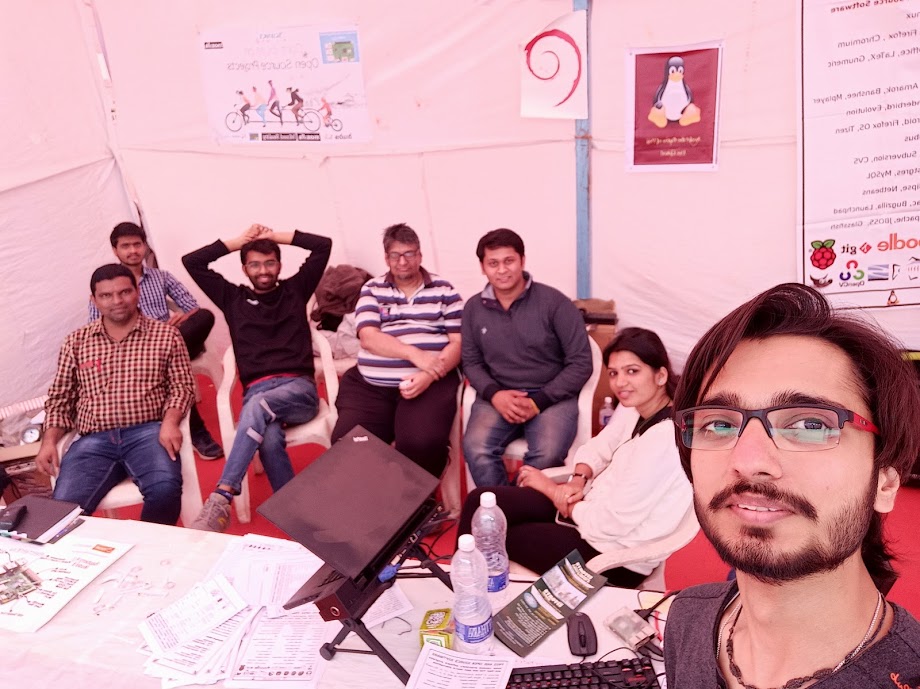
 . Of course in another stall few students had used RPI s as part of their projects so at times we did tell some of the newbies to go to those stalls and see and ask about those projects so they would have a much wider experience of things. The Mozilla people were pushing VR as well as Mozilla lite the browser for the mobile.
We also gossiped quite a bit. I shared about

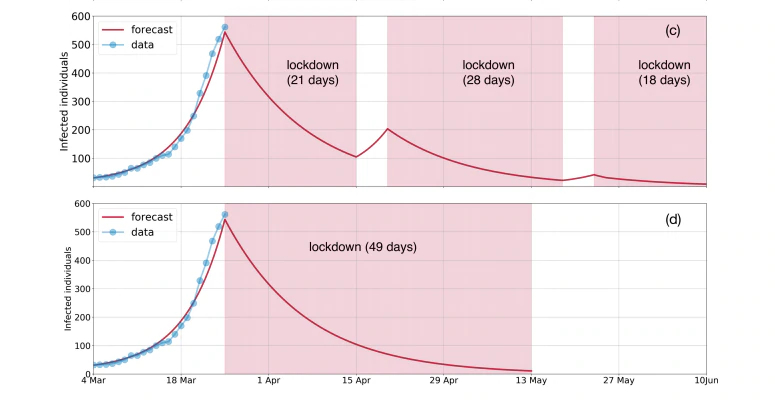
 I just had a weekend full of very successful serious geekery. On a whim I thought: Wouldn't it be nice if people could interact with my game

 I wanted to have a working Two Factor Authentification (2FA) setup to login on salsa.debian.org, Debians s gitlab instance.

 Liberation Mono
 Fira Mono
 Everywhere I worked in the past, the only feedback that was asked of
employees was during a yearly evaluation meeting. These meetings always felt to me
like talking to Santa Claus and his


 Following up on

 I've been tempted to run own
 The server runs Debian sid (probably it would be doable on stretch as well, but I didn't try much) and the setup was pretty simple.
First we need to install some things - Bitcoin daemon and ElectrumX dependencies:
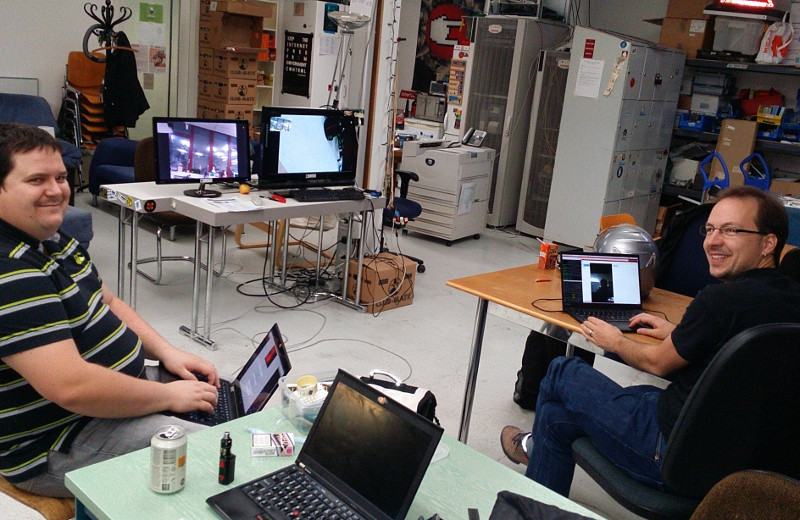 Francois is using Raspberry Pi and PiCam to develop a

 As a cat owner, being surprised by cat intelligence delights me. They re not exactly smart like a human, but they are smart in cattish ways. The more I watch them and try to sort out what they re thinking, the more it pleases me to discover they can solve problems and adapt in recognizably intelligent ways, sometimes unique to each individual cat. Each time that happens, it evokes in me affectionate wonder.
Today, I had one of those joyful moments.
First, you need to understand that some months ago, I thought I had my male cat all figured out with respect to mealtimes. I had been cleaning up after my oafish boy who made a watery mess on the floor from his mother s bowl each morning. I was slightly annoyed, but was mostly curious, and had a hunch. A quick search of the web confirmed it: my cat was left-handed. Not only that, but I learned this is typical for males, whereas females tend to be right-handed. Right away, I knew what I had to do: I adjusted the position of their water bowls relative to their food, swapping them from right to left; the messy morning feedings ceased. I congratulated myself for my cleverness.
You see, after the swap, as he hooked the kibbles with his left paw out of the right-hand bowl, they would land immediately on the floor where he could give them chase. The swap caused the messes to cease because before, his left-handed scoops would land the kibbles in the water to the right; he would then have to scoop the kibble out onto the floor, sprinkling water everywhere! Furthermore, the sodden kibble tended to not skitter so much, decreasing his fun. Or so I thought. Clearly, I reasoned, having sated himself on the entire contents of his own bowl, he turned to pilfering his mother s leftovers for some exciting kittenish play. I had evidence to back it up, too: he and his mother both seem to enjoy this game, a regular fixture of their mealtime routines. She, too, is adept at hooking out the kibbles, though mysteriously, without making a mess in her water, whichever way the bowls are oriented. I chalked this up to his general clumsiness of movement vs. her daintiness and precision, something I had observed many times before.
Come to think of it, lately, I ve been seeing more mess around his mother s bowl again. Hmm. I don t know why I didn t stop to consider why
And then my cat surprised me again.
This morning, with Shadow behind my back as I sat at my computer, finishing up his morning meal at his mother s bowl, I thought I heard something odd. Or rather, I didn t hear something. The familiar skitter-skitter sound of kibbles evading capture was missing. So I turned and looked. My dear, devious boy had squished his overgrown body behind his mother s bowls, nudging them ever so slightly askew to fit the small space. Now the bowl orientation was swapped back again. Stunned, I watched him carefully flip out a kibble with his left paw. Plop! Into the water on the right. Concentrating, he fished for it. A miss! He casually licked the water from his paw. Another try. Swoop! Plop, onto the floor. No chase now, just satisfied munching of his somewhat mushy kibble. And then it dawned on me that I had got it somewhat wrong. Yes, he enjoyed Chase the Kibble, like his mom, but I never recognized he had been indulging in a favourite pastime, peculiarly his own
I had judged his mealtime messes as accidents, a very human way of thinking about my problem. Little did I know, it was deliberate! His private game was Bobbing for Kibbles. I don t know if it s the altered texture, or dabbling in the bowl, but whatever the reason, due to my meddling, he had been deprived of this pleasure. No worries, a thwarted cat will find a way. And that is the joy of cat intelligence.