Search Results: "agi"

6 June 2022

Thorsten Alteholz: My Debian Activities in May 2022

FTP master This month I accepted 288 and rejected 45 packages. The overall number of packages that got accepted was 290. Debian LTS This was my ninety-fifth month that I did some work for the Debian LTS initiative, started by Raphael Hertzog at Freexian. This month my all in all workload has been 40h. During that time I did LTS and normal security uploads of: Further I continued working on libvirt and started to work on blender and ncurses. I also continued to work on security support for golang packages. Last but not least I did some days of frontdesk duties and took care of issues on security-master. Debian ELTS This month was the forty-seventh ELTS month. During my allocated time I uploaded: I also moved/refactored the current ELTS documentation to a new repository. Further I started to work on blender and ncurses in ELTS as well as in LTS. Last but not least I did some days of frontdesk duties. Debian Printing This month I uploaded new upstream versions or improved packaging of: The reason for the new upstream version of ipp-usb was a strange bug. Some HP printers claim to have fax support but fail to respond to corresponding IPP queries. I understand that nowadays sending a fax is no longer a main theme for quality assurance. But if one tries to advertise as much features as possible, all these features should basically work and not prevent the things a printer should normally do. The reason for the new upstream version of cups was a security issue. You now should have the latest version of cups installed (there have been updates in other Debian releases as well). Debian Astro This month I uploaded new upstream versions or improved packaging of: Other stuff This month I uploaded new packages:

31 May 2022

Paul Wise: FLOSS Activities May 2022

Focus This month I didn't have any particular focus. I just worked on issues in my info bubble.

Changes

Issues

Review
  • Spam: reported 1 Debian bug reports and 41 Debian mailing list posts
  • Patches: reviewed gt patches
  • Debian packages: sponsored psi-notify
  • Debian wiki: RecentChanges for the month
  • Debian BTS usertags: changes for the month
  • Debian screenshots:
    • approved cppcheck-gui eta flpsed fluxbox p7zip-full pampi pyqso xboard
    • rejected p7zip (help output), openshot (photo of a physical library), clamav-daemon (movie cartoon character), aptitude (screenshot of random launchpad project), laditools (screenshot of tracker.d.o for src:hello), weboob-qt/chromium-browser/supercollider-vim ((NSFW) selfies), node-split (screenshot of screenshots site), libc6 (Chinese characters alongside a photo of man and bottle)

Administration
  • Debian servers: investigate etckeeper cron mail
  • Debian wiki: investigate account existence, approve accounts

Communication
  • Respond to queries from Debian users and contributors on the mailing lists and IRC

Sponsors The gensim and libpst work was sponsored. All other work was done on a volunteer basis.

Russ Allbery: Review: Maskerade

Review: Maskerade, by Terry Pratchett
Series: Discworld #18
Publisher: Harper
Copyright: 1995
Printing: February 2014
ISBN: 0-06-227552-6
Format: Mass market
Pages: 360
Maskerade is the 18th book of the Discworld series, but you probably could start here. You'd miss the introduction of Granny Weatherwax and Nanny Ogg, which might be a bit confusing, but I suspect you could pick it up as you went if you wanted. This is a sequel of sorts to Lords and Ladies, but not in a very immediate sense. Granny is getting distracted and less interested in day-to-day witching in Lancre. This is not good; Granny is incredibly powerful, and bored and distracted witches can go to dark places. Nanny is concerned. Granny needs something to do, and their coven needs a third. It's not been the same since they lost their maiden member. Nanny's solution to this problem is two-pronged. First, they'd had their eye on a local girl named Agnes, who had magic but who wasn't interested in being a witch. Perhaps it was time to recruit her anyway, even though she'd left Lancre for Ankh-Morpork. And second, Granny needs something to light a fire under her, something that will get her outraged and ready to engage with the world. Something like a cookbook of aphrodisiac recipes attributed to the Witch of Lancre. Agnes, meanwhile, is auditioning for the opera. She's a sensible person, cursed her whole life by having a wonderful personality, but a part of her deep inside wants to be called Perdita X. Dream and have a dramatic life. Having a wonderful personality can be very frustrating, but no one in Lancre took either that desire or her name seriously. Perhaps the opera is somewhere where she can find the life she's looking for, along with another opportunity to try on the Perdita name. One thing she can do is sing; that's where all of her magic went. The Ankh-Morpork opera is indeed dramatic. It's also losing an astounding amount of money for its new owner, who foolishly thought owning an opera would be a good retirement project after running a cheese business. And it's haunted by a ghost, a very tangible ghost who has started killing people. I think this is my favorite Discworld novel to date (although with a caveat about the ending that I'll get to in a moment). It's certainly the one that had me laughing out loud the most. Agnes (including her Perdita personality aspect) shot to the top of my list of favorite Discworld characters, in part because I found her sensible personality so utterly relatable. She is fascinated by drama, she wants to be in the middle of it and let her inner Perdita goth character revel in it, and yet she cannot help being practical and unflappable even when surrounded by people who use far too many exclamation points. It's one thing to want drama in the abstract; it's quite another to be heedlessly dramatic in the moment, when there's an obviously reasonable thing to do instead. Pratchett writes this wonderfully. The other half of the story follows Granny and Nanny, who are unstoppable forces of nature and a wonderful team. They have the sort of long-standing, unshakable adult friendship between very unlike people that's full of banter and minor irritations layered on top of a deep mutual understanding and respect. Once they decide to start investigating this supposed opera ghost, they divvy up the investigative work with hardly a word exchanged. Planning isn't necessary; they both know each other's strengths. We've gotten a lot of Granny's skills in previous books. Maskerade gives Nanny a chance to show off her skills, and it's a delight. She effortlessly becomes the sort of friendly grandmother who blends in so well that no one questions why she's there, and thus manages to be in the middle of every important event. Granny watches and thinks and theorizes; Nanny simply gets into the middle of everything and talks to everyone until people tell her what she wants to know. There's no real doubt that the two of them are going to get to the bottom of anything they want to get to the bottom of, but watching how they get there is a delight. I love how Pratchett handles that sort of magical power from a world-building perspective. Ankh-Morpork is the Big City, the center of political power in most of the Discworld books, and Granny and Nanny are from the boondocks. By convention, that means they should either be awed or confused by the city, or gain power in the city by transforming it in some way to match their area of power. This isn't how Pratchett writes witches at all. Their magic is in understanding people, and the people in Ankh-Morpork are just as much people as the people in Lancre. The differences of the city may warrant an occasional grumpy aside, but the witches are fully as capable of navigating the city as they are their home town. Maskerade is, of course, a parody of opera and musicals, with Phantom of the Opera playing the central role in much the same way that Macbeth did in Wyrd Sisters. Agnes ends up doing the singing for a beautiful, thin actress named Christine, who can't sing at all despite being an opera star, uses a truly astonishing excess of exclamation points, and strategically faints at the first sign of danger. (And, despite all of this, is still likable in that way that it's impossible to be really upset at a puppy.) She is the special chosen focus of the ghost, whose murderous taunting is a direct parody of the Phantom. That was a sufficiently obvious reference that even I picked up on it, despite being familiar with Phantom of the Opera only via the soundtrack. Apart from that, though, the references were lost on me, since I'm neither a musical nor an opera fan. That didn't hurt my enjoyment of the book in the slightest; in fact, I suspect it's part of why it's in my top tier of Discworld books. One of my complaints about Discworld to date is that Pratchett often overdoes the parody to the extent that it gets in the way of his own (excellent) characters and story. Maybe it's better to read Discworld novels where one doesn't recognize the material being parodied and thus doesn't keep getting distracted by references. It's probably worth mentioning that Agnes is a large woman and there are several jokes about her weight in Maskerade. I think they're the good sort of jokes, about how absurd human bodies can be, not the mean sort? Pratchett never implies her weight is any sort of moral failing or something she should change; quite the contrary, Nanny considers it a sign of solid Lancre genes. But there is some fat discrimination in the opera itself, since one of the things Pratchett is commenting on is the switch from full-bodied female opera singers to thin actresses matching an idealized beauty standard. Christine is the latter, but she can't sing, and the solution is for Agnes to sing for her from behind, something that was also done in real opera. I'm not a good judge of how well this plot line was handled; be aware, going in, if this may bother you. What did bother me was the ending, and more generally the degree to which Granny and Nanny felt comfortable making decisions about Agnes's life without consulting her or appearing to care what she thought of their conclusions. Pratchett seemed to be on their side, emphasizing how well they know people. But Agnes left Lancre and avoided the witches for a reason, and that reason is not honored in much the same way that Lancre refused to honor her desire to go by Perdita. This doesn't seem to be malicious, and Agnes herself is a little uncertain about her choice of identity, but it still rubbed me the wrong way. I felt like Agnes got steamrolled by both the other characters and by Pratchett, and it's the one thing about this book that I didn't like. Hopefully future Discworld books about these characters revisit Agnes's agency. Overall, though, this was great, and a huge improvement over Interesting Times. I'm excited for the next witches book. Followed in publication order by Feet of Clay, and later by Carpe Jugulum in the thematic sense. Rating: 8 out of 10

30 May 2022

Russ Allbery: Review: Steles of the Sky

Review: Steles of the Sky, by Elizabeth Bear
Series: Eternal Sky #3
Publisher: Tor
Copyright: April 2014
ISBN: 0-7653-2756-2
Format: Hardcover
Pages: 429
Steles of the Sky is the third book of the Eternal Sky trilogy and a direct sequel to Shattered Pillars. You should not start here, and ideally you should read all three books close together. They form a single story, and Elizabeth Bear is somewhat notorious for not adding extra explanation to her novels. By the end of Shattered Pillars, Bear was (mostly) finished adding new factions to this story. Temur is returning home to fight for his people and his clan. His allies are mostly in place, as are his enemies. The hissable villain has remained hissable and boring, but several of his allies are more ambiguous and therefore more interesting (and get considerably more page time). All that remains is to see how Bear will end the story, and what last-minute twists will be thrown in. Well, that and getting the characters into the right positions, which occupies roughly the first half of the book and dragged a bit. There is an important and long-awaited reunion, Brother Hsiung gets his moment of focus, and the dowager empress gets some valuable character development, all of which did add to the story. But there's also a lot of plodding across the countryside. I also have no idea why the extended detour to Kyiv, began in Shattered Pillars and completed here, is even in this story. It tells us a few new scraps about Erem and its implications, but nothing vital. I felt like everything that happened there could have been done elsewhere or skipped entirely without much loss. The rest of the book is build-up to the epic conclusion, which is, somewhat unsurprisingly, a giant battle. It was okay, as giant battles go, but it also felt a bit like a fireworks display. Bear makes sure all the guns on the mantle go off by the end of the series, but a lot of them go off at the same time. It robs the plot construction of some of its power. There's nothing objectionable about this book. It's well-written, does what it sets out to do, brings the story to a relatively satisfying conclusion, provides some memorable set pieces, and is full of women making significant decisions that shape the plot. And yet, when I finished it, my reaction was "huh, okay" and then "oh, good, I can start another book now." Shattered Pillars won me over during the book. Steles of the Sky largely did not. I think my biggest complaint is one I've had about Bear's world-building before. She hints at some fascinating ideas: curious dragons, skies that vary with the political power currently in control, evil ancient magic, humanoid tigers with their own beliefs and magical system independent from humans, and a sky with a sun so hot that it would burn everything. Over the course of the series, she intrigued me with these ideas and left me eagerly awaiting an explanation. That explanation never comes. The history is never filled in, the tiger society is still only hints, Erem remains a vast mystery, the dragons appear only fleetingly to hint at connections with Erem... and then the book ends. I'm not sure whether Bear did explain some details and I wasn't paying close enough attention, or if she never intended detailed explanations. (Both are possible! Bear's books are often subtle.) But I wanted so much more. For me, half the fun of SFF world-building is the explanation. I love the hints and the mystery and the sense of lost knowledge and hidden depths... but then I want the characters to find the knowledge and plumb the depths, not just solve their immediate conflict. This is as good of a book as the first two books of the series on its own merits, but I enjoyed it less because I was hoping for more revelations before the story ended. The characters are all fine, but only a few of them stood out. Hrahima stole every scene she was in, and I would happily read a whole trilogy about her tiger people. Edene came into her own and had some great moments, but they didn't come with the revelations about Erem that I was hungry for. The rest of the large cast is varied and well-written and features a refreshing number of older women, and it wouldn't surprise me to hear that other readers had favorite characters who carried the series for them. But for me the characters weren't compelling enough to overcome my disappointment in the lack of world-building revelations. The series sadly didn't deliver the payoff that I was looking for, and I can't recommend it given the wealth of excellent fantasy being written today. But if you like Bear's understated writing style and don't need as much world-building payoff as I do, it may still be worth considering. Rating: 6 out of 10

26 May 2022

Sergio Talens-Oliag: New Blog Config

As promised, on this post I m going to explain how I ve configured this blog using hugo, asciidoctor and the papermod theme, how I publish it using nginx, how I ve integrated the remark42 comment system and how I ve automated its publication using gitea and json2file-go. It is a long post, but I hope that at least parts of it can be interesting for some, feel free to ignore it if that is not your case

Hugo Configuration

Theme settingsThe site is using the PaperMod theme and as I m using asciidoctor to publish my content I ve adjusted the settings to improve how things are shown with it. The current config.yml file is the one shown below (probably some of the settings are not required nor being used right now, but I m including the current file, so this post will have always the latest version of it):
config.yml
baseURL: https://blogops.mixinet.net/
title: Mixinet BlogOps
paginate: 5
theme: PaperMod
destination: public/
enableInlineShortcodes: true
enableRobotsTXT: true
buildDrafts: false
buildFuture: false
buildExpired: false
enableEmoji: true
pygmentsUseClasses: true
minify:
  disableXML: true
  minifyOutput: true
languages:
  en:
    languageName: "English"
    description: "Mixinet BlogOps - https://blogops.mixinet.net/"
    author: "Sergio Talens-Oliag"
    weight: 1
    title: Mixinet BlogOps
    homeInfoParams:
      Title: "Sergio Talens-Oliag Technical Blog"
      Content: >
        ![Mixinet BlogOps](/images/mixinet-blogops.png)
    taxonomies:
      category: categories
      tag: tags
      series: series
    menu:
      main:
        - name: Archive
          url: archives
          weight: 5
        - name: Categories
          url: categories/
          weight: 10
        - name: Tags
          url: tags/
          weight: 10
        - name: Search
          url: search/
          weight: 15
outputs:
  home:
    - HTML
    - RSS
    - JSON
params:
  env: production
  defaultTheme: light
  disableThemeToggle: false
  ShowShareButtons: true
  ShowReadingTime: true
  disableSpecial1stPost: true
  disableHLJS: true
  displayFullLangName: true
  ShowPostNavLinks: true
  ShowBreadCrumbs: true
  ShowCodeCopyButtons: true
  ShowRssButtonInSectionTermList: true
  ShowFullTextinRSS: true
  ShowToc: true
  TocOpen: false
  comments: true
  remark42SiteID: "blogops"
  remark42Url: "/remark42"
  profileMode:
    enabled: false
    title: Sergio Talens-Oliag Technical Blog
    imageUrl: "/images/mixinet-blogops.png"
    imageTitle: Mixinet BlogOps
    buttons:
      - name: Archives
        url: archives
      - name: Categories
        url: categories
      - name: Tags
        url: tags
  socialIcons:
    - name: CV
      url: "https://www.uv.es/~sto/cv/"
    - name: Debian
      url: "https://people.debian.org/~sto/"
    - name: GitHub
      url: "https://github.com/sto/"
    - name: GitLab
      url: "https://gitlab.com/stalens/"
    - name: Linkedin
      url: "https://www.linkedin.com/in/sergio-talens-oliag/"
    - name: RSS
      url: "index.xml"
  assets:
    disableHLJS: true
    favicon: "/favicon.ico"
    favicon16x16:  "/favicon-16x16.png"
    favicon32x32:  "/favicon-32x32.png"
    apple_touch_icon:  "/apple-touch-icon.png"
    safari_pinned_tab:  "/safari-pinned-tab.svg"
  fuseOpts:
    isCaseSensitive: false
    shouldSort: true
    location: 0
    distance: 1000
    threshold: 0.4
    minMatchCharLength: 0
    keys: ["title", "permalink", "summary", "content"]
markup:
  asciidocExt:
    attributes:  
    backend: html5s
    extensions: ['asciidoctor-html5s','asciidoctor-diagram']
    failureLevel: fatal
    noHeaderOrFooter: true
    preserveTOC: false
    safeMode: unsafe
    sectionNumbers: false
    trace: false
    verbose: false
    workingFolderCurrent: true
privacy:
  vimeo:
    disabled: false
    simple: true
  twitter:
    disabled: false
    enableDNT: true
    simple: true
  instagram:
    disabled: false
    simple: true
  youtube:
    disabled: false
    privacyEnhanced: true
services:
  instagram:
    disableInlineCSS: true
  twitter:
    disableInlineCSS: true
security:
  exec:
    allow:
      - '^asciidoctor$'
      - '^dart-sass-embedded$'
      - '^go$'
      - '^npx$'
      - '^postcss$'
Some notes about the settings:
  • disableHLJS and assets.disableHLJS are set to true; we plan to use rouge on adoc and the inclusion of the hljs assets adds styles that collide with the ones used by rouge.
  • ShowToc is set to true and the TocOpen setting is set to false to make the ToC appear collapsed initially. My plan was to use the asciidoctor ToC, but after trying I believe that the theme one looks nice and I don t need to adjust styles, although it has some issues with the html5s processor (the admonition titles use <h6> and they are shown on the ToC, which is weird), to fix it I ve copied the layouts/partial/toc.html to my site repository and replaced the range of headings to end at 5 instead of 6 (in fact 5 still seems a lot, but as I don t think I ll use that heading level on the posts it doesn t really matter).
  • params.profileMode values are adjusted, but for now I ve left it disabled setting params.profileMode.enabled to false and I ve set the homeInfoParams to show more or less the same content with the latest posts under it (I ve added some styles to my custom.css style sheet to center the text and image of the first post to match the look and feel of the profile).
  • On the asciidocExt section I ve adjusted the backend to use html5s, I ve added the asciidoctor-html5s and asciidoctor-diagram extensions to asciidoctor and adjusted the workingFolderCurrent to true to make asciidoctor-diagram work right (haven t tested it yet).

Theme customisationsTo write in asciidoctor using the html5s processor I ve added some files to the assets/css/extended directory:
  1. As said before, I ve added the file assets/css/extended/custom.css to make the homeInfoParams look like the profile page and I ve also changed a little bit some theme styles to make things look better with the html5s output:
    custom.css
    /* Fix first entry alignment to make it look like the profile */
    .first-entry   text-align: center;  
    .first-entry img   display: inline;  
    /**
     * Remove margin for .post-content code and reduce padding to make it look
     * better with the asciidoctor html5s output.
     **/
    .post-content code   margin: auto 0; padding: 4px;  
  2. I ve also added the file assets/css/extended/adoc.css with some styles taken from the asciidoctor-default.css, see this blog post about the original file; mine is the same after formatting it with css-beautify and editing it to use variables for the colors to support light and dark themes:
    adoc.css
    /* AsciiDoctor*/
    table  
        border-collapse: collapse;
        border-spacing: 0
     
    .admonitionblock>table  
        border-collapse: separate;
        border: 0;
        background: none;
        width: 100%
     
    .admonitionblock>table td.icon  
        text-align: center;
        width: 80px
     
    .admonitionblock>table td.icon img  
        max-width: none
     
    .admonitionblock>table td.icon .title  
        font-weight: bold;
        font-family: "Open Sans", "DejaVu Sans", sans-serif;
        text-transform: uppercase
     
    .admonitionblock>table td.content  
        padding-left: 1.125em;
        padding-right: 1.25em;
        border-left: 1px solid #ddddd8;
        color: var(--primary)
     
    .admonitionblock>table td.content>:last-child>:last-child  
        margin-bottom: 0
     
    .admonitionblock td.icon [class^="fa icon-"]  
        font-size: 2.5em;
        text-shadow: 1px 1px 2px var(--secondary);
        cursor: default
     
    .admonitionblock td.icon .icon-note::before  
        content: "\f05a";
        color: var(--icon-note-color)
     
    .admonitionblock td.icon .icon-tip::before  
        content: "\f0eb";
        color: var(--icon-tip-color)
     
    .admonitionblock td.icon .icon-warning::before  
        content: "\f071";
        color: var(--icon-warning-color)
     
    .admonitionblock td.icon .icon-caution::before  
        content: "\f06d";
        color: var(--icon-caution-color)
     
    .admonitionblock td.icon .icon-important::before  
        content: "\f06a";
        color: var(--icon-important-color)
     
    .conum[data-value]  
        display: inline-block;
        color: #fff !important;
        background-color: rgba(100, 100, 0, .8);
        -webkit-border-radius: 100px;
        border-radius: 100px;
        text-align: center;
        font-size: .75em;
        width: 1.67em;
        height: 1.67em;
        line-height: 1.67em;
        font-family: "Open Sans", "DejaVu Sans", sans-serif;
        font-style: normal;
        font-weight: bold
     
    .conum[data-value] *  
        color: #fff !important
     
    .conum[data-value]+b  
        display: none
     
    .conum[data-value]::after  
        content: attr(data-value)
     
    pre .conum[data-value]  
        position: relative;
        top: -.125em
     
    b.conum *  
        color: inherit !important
     
    .conum:not([data-value]):empty  
        display: none
     
  3. The previous file uses variables from a partial copy of the theme-vars.css file that changes the highlighted code background color and adds the color definitions used by the admonitions:
    theme-vars.css
    :root  
        /* Solarized base2 */
        /* --hljs-bg: rgb(238, 232, 213); */
        /* Solarized base3 */
        /* --hljs-bg: rgb(253, 246, 227); */
        /* Solarized base02 */
        --hljs-bg: rgb(7, 54, 66);
        /* Solarized base03 */
        /* --hljs-bg: rgb(0, 43, 54); */
        /* Default asciidoctor theme colors */
        --icon-note-color: #19407c;
        --icon-tip-color: var(--primary);
        --icon-warning-color: #bf6900;
        --icon-caution-color: #bf3400;
        --icon-important-color: #bf0000
     
    .dark  
        --hljs-bg: rgb(7, 54, 66);
        /* Asciidoctor theme colors with tint for dark background */
        --icon-note-color: #3e7bd7;
        --icon-tip-color: var(--primary);
        --icon-warning-color: #ff8d03;
        --icon-caution-color: #ff7847;
        --icon-important-color: #ff3030
     
  4. The previous styles use font-awesome, so I ve downloaded its resources for version 4.7.0 (the one used by asciidoctor) storing the font-awesome.css into on the assets/css/extended dir (that way it is merged with the rest of .css files) and copying the fonts to the static/assets/fonts/ dir (will be served directly):
    FA_BASE_URL="https://cdnjs.cloudflare.com/ajax/libs/font-awesome/4.7.0"
    curl "$FA_BASE_URL/css/font-awesome.css" \
      > assets/css/extended/font-awesome.css
    for f in FontAwesome.otf fontawesome-webfont.eot \
      fontawesome-webfont.svg fontawesome-webfont.ttf \
      fontawesome-webfont.woff fontawesome-webfont.woff2; do
        curl "$FA_BASE_URL/fonts/$f" > "static/assets/fonts/$f"
    done
  5. As already said the default highlighter is disabled (it provided a css compatible with rouge) so we need a css to do the highlight styling; as rouge provides a way to export them, I ve created the assets/css/extended/rouge.css file with the thankful_eyes theme:
    rougify style thankful_eyes > assets/css/extended/rouge.css
  6. To support the use of the html5s backend with admonitions I ve added a variation of the example found on this blog post to assets/js/adoc-admonitions.js:
    adoc-admonitions.js
    // replace the default admonitions block with a table that uses a format
    // similar to the standard asciidoctor ... as we are using fa-icons here there
    // is no need to add the icons: font entry on the document.
    window.addEventListener('load', function ()  
      const admonitions = document.getElementsByClassName('admonition-block')
      for (let i = admonitions.length - 1; i >= 0; i--)  
        const elm = admonitions[i]
        const type = elm.classList[1]
        const title = elm.getElementsByClassName('block-title')[0];
    	const label = title.getElementsByClassName('title-label')[0]
    		.innerHTML.slice(0, -1);
        elm.removeChild(elm.getElementsByClassName('block-title')[0]);
        const text = elm.innerHTML
        const parent = elm.parentNode
        const tempDiv = document.createElement('div')
        tempDiv.innerHTML =  <div class="admonitionblock $ type ">
        <table>
          <tbody>
            <tr>
              <td class="icon">
                <i class="fa icon-$ type " title="$ label "></i>
              </td>
              <td class="content">
                $ text 
              </td>
            </tr>
          </tbody>
        </table>
      </div> 
        const input = tempDiv.childNodes[0]
        parent.replaceChild(input, elm)
       
     )
    and enabled its minified use on the layouts/partials/extend_footer.html file adding the following lines to it:
     - $admonitions := slice (resources.Get "js/adoc-admonitions.js")
        resources.Concat "assets/js/adoc-admonitions.js"   minify   fingerprint  
    <script defer crossorigin="anonymous" src="  $admonitions.RelPermalink  "
      integrity="  $admonitions.Data.Integrity  "></script>

Remark42 configurationTo integrate Remark42 with the PaperMod theme I ve created the file layouts/partials/comments.html with the following content based on the remark42 documentation, including extra code to sync the dark/light setting with the one set on the site:
comments.html
<div id="remark42"></div>
<script>
  var remark_config =  
    host:   .Site.Params.remark42Url  ,
    site_id:   .Site.Params.remark42SiteID  ,
    url:   .Permalink  ,
    locale:   .Site.Language.Lang  
   ;
  (function(c)  
    /* Adjust the theme using the local-storage pref-theme if set */
    if (localStorage.getItem("pref-theme") === "dark")  
      remark_config.theme = "dark";
      else if (localStorage.getItem("pref-theme") === "light")  
      remark_config.theme = "light";
     
    /* Add remark42 widget */
    for(var i = 0; i < c.length; i++) 
      var d = document, s = d.createElement('script');
      s.src = remark_config.host + '/web/' + c[i] +'.js';
      s.defer = true;
      (d.head   d.body).appendChild(s);
     
   )(remark_config.components   ['embed']);
</script>
In development I use it with anonymous comments enabled, but to avoid SPAM the production site uses social logins (for now I ve only enabled Github & Google, if someone requests additional services I ll check them, but those were the easy ones for me initially). To support theme switching with remark42 I ve also added the following inside the layouts/partials/extend_footer.html file:
 - if (not site.Params.disableThemeToggle)  
<script>
/* Function to change theme when the toggle button is pressed */
document.getElementById("theme-toggle").addEventListener("click", () =>  
  if (typeof window.REMARK42 != "undefined")  
    if (document.body.className.includes('dark'))  
      window.REMARK42.changeTheme('light');
      else  
      window.REMARK42.changeTheme('dark');
     
   
 );
</script>
 - end  
With this code if the theme-toggle button is pressed we change the remark42 theme before the PaperMod one (that s needed here only, on page loads the remark42 theme is synced with the main one using the code from the layouts/partials/comments.html shown earlier).

Development setupTo preview the site on my laptop I m using docker-compose with the following configuration:
docker-compose.yaml
version: "2"
services:
  hugo:
    build:
      context: ./docker/hugo-adoc
      dockerfile: ./Dockerfile
    image: sto/hugo-adoc
    container_name: hugo-adoc-blogops
    restart: always
    volumes:
      - .:/documents
    command: server --bind 0.0.0.0 -D -F
    user: $ APP_UID :$ APP_GID 
  nginx:
    image: nginx:latest
    container_name: nginx-blogops
    restart: always
    volumes:
      - ./nginx/default.conf:/etc/nginx/conf.d/default.conf
    ports:
      -  1313:1313
  remark42:
    build:
      context: ./docker/remark42
      dockerfile: ./Dockerfile
    image: sto/remark42
    container_name: remark42-blogops
    restart: always
    env_file:
      - ./.env
      - ./remark42/env.dev
    volumes:
      - ./remark42/var.dev:/srv/var
To run it properly we have to create the .env file with the current user ID and GID on the variables APP_UID and APP_GID (if we don t do it the files can end up being owned by a user that is not the same as the one running the services):
$ echo "APP_UID=$(id -u)\nAPP_GID=$(id -g)" > .env
The Dockerfile used to generate the sto/hugo-adoc is:
Dockerfile
FROM asciidoctor/docker-asciidoctor:latest
RUN gem install --no-document asciidoctor-html5s &&\
 apk update && apk add --no-cache curl libc6-compat &&\
 repo_path="gohugoio/hugo" &&\
 api_url="https://api.github.com/repos/$repo_path/releases/latest" &&\
 download_url="$(\
  curl -sL "$api_url"  \
  sed -n "s/^.*download_url\": \"\\(.*.extended.*Linux-64bit.tar.gz\)\"/\1/p"\
 )" &&\
 curl -sL "$download_url" -o /tmp/hugo.tgz &&\
 tar xf /tmp/hugo.tgz hugo &&\
 install hugo /usr/bin/ &&\
 rm -f hugo /tmp/hugo.tgz &&\
 /usr/bin/hugo version &&\
 apk del curl && rm -rf /var/cache/apk/*
# Expose port for live server
EXPOSE 1313
ENTRYPOINT ["/usr/bin/hugo"]
CMD [""]
If you review it you will see that I m using the docker-asciidoctor image as the base; the idea is that this image has all I need to work with asciidoctor and to use hugo I only need to download the binary from their latest release at github (as we are using an image based on alpine we also need to install the libc6-compat package, but once that is done things are working fine for me so far). The image does not launch the server by default because I don t want it to; in fact I use the same docker-compose.yml file to publish the site in production simply calling the container without the arguments passed on the docker-compose.yml file (see later). When running the containers with docker-compose up (or docker compose up if you have the docker-compose-plugin package installed) we also launch a nginx container and the remark42 service so we can test everything together. The Dockerfile for the remark42 image is the original one with an updated version of the init.sh script:
Dockerfile
FROM umputun/remark42:latest
COPY init.sh /init.sh
The updated init.sh is similar to the original, but allows us to use an APP_GID variable and updates the /etc/group file of the container so the files get the right user and group (with the original script the group is always 1001):
init.sh
#!/sbin/dinit /bin/sh
uid="$(id -u)"
if [ "$ uid " -eq "0" ]; then
  echo "init container"
  # set container's time zone
  cp "/usr/share/zoneinfo/$ TIME_ZONE " /etc/localtime
  echo "$ TIME_ZONE " >/etc/timezone
  echo "set timezone $ TIME_ZONE  ($(date))"
  # set UID & GID for the app
  if [ "$ APP_UID " ]   [ "$ APP_GID " ]; then
    [ "$ APP_UID " ]   APP_UID="1001"
    [ "$ APP_GID " ]   APP_GID="$ APP_UID "
    echo "set custom APP_UID=$ APP_UID  & APP_GID=$ APP_GID "
    sed -i "s/^app:x:1001:1001:/app:x:$ APP_UID :$ APP_GID :/" /etc/passwd
    sed -i "s/^app:x:1001:/app:x:$ APP_GID :/" /etc/group
  else
    echo "custom APP_UID and/or APP_GID not defined, using 1001:1001"
  fi
  chown -R app:app /srv /home/app
fi
echo "prepare environment"
# replace  % REMARK_URL %  by content of REMARK_URL variable
find /srv -regex '.*\.\(html\ js\ mjs\)$' -print \
  -exec sed -i "s % REMARK_URL % $ REMARK_URL  g"   \;
if [ -n "$ SITE_ID " ]; then
  #replace "site_id: 'remark'" by SITE_ID
  sed -i "s 'remark' '$ SITE_ID ' g" /srv/web/*.html
fi
echo "execute \"$*\""
if [ "$ uid " -eq "0" ]; then
  exec su-exec app "$@"
else
  exec "$@"
fi
The environment file used with remark42 for development is quite minimal:
env.dev
TIME_ZONE=Europe/Madrid
REMARK_URL=http://localhost:1313/remark42
SITE=blogops
SECRET=123456
ADMIN_SHARED_ID=sto
AUTH_ANON=true
EMOJI=true
And the nginx/default.conf file used to publish the service locally is simple too:
default.conf
server   
 listen 1313;
 server_name localhost;
 location /  
    proxy_pass http://hugo:1313;
    proxy_set_header Host $http_host;
    proxy_set_header X-Real-IP $remote_addr;
    proxy_set_header X-Forwarded-For $proxy_add_x_forwarded_for;
    proxy_set_header X-Forwarded-Proto $scheme;
    proxy_set_header Upgrade $http_upgrade;
    proxy_set_header Connection "upgrade";
  
 location /remark42/  
    rewrite /remark42/(.*) /$1 break;
    proxy_pass http://remark42:8080/;
    proxy_set_header Host $http_host;
    proxy_set_header X-Real-IP $remote_addr;
    proxy_set_header X-Forwarded-For $proxy_add_x_forwarded_for;
    proxy_set_header X-Forwarded-Proto $scheme;


Production setupThe VM where I m publishing the blog runs Debian GNU/Linux and uses binaries from local packages and applications packaged inside containers. To run the containers I m using docker-ce (I could have used podman instead, but I already had it installed on the machine, so I stayed with it). The binaries used on this project are included on the following packages from the main Debian repository:
  • git to clone & pull the repository,
  • jq to parse json files from shell scripts,
  • json2file-go to save the webhook messages to files,
  • inotify-tools to detect when new files are stored by json2file-go and launch scripts to process them,
  • nginx to publish the site using HTTPS and work as proxy for json2file-go and remark42 (I run it using a container),
  • task-spool to queue the scripts that update the deployment.
And I m using docker and docker compose from the debian packages on the docker repository:
  • docker-ce to run the containers,
  • docker-compose-plugin to run docker compose (it is a plugin, so no - in the name).

Repository checkoutTo manage the git repository I ve created a deploy key, added it to gitea and cloned the project on the /srv/blogops PATH (that route is owned by a regular user that has permissions to run docker, as I said before).

Compiling the site with hugoTo compile the site we are using the docker-compose.yml file seen before, to be able to run it first we build the container images and once we have them we launch hugo using docker compose run:
$ cd /srv/blogops
$ git pull
$ docker compose build
$ if [ -d "./public" ]; then rm -rf ./public; fi
$ docker compose run hugo --
The compilation leaves the static HTML on /srv/blogops/public (we remove the directory first because hugo does not clean the destination folder as jekyll does). The deploy script re-generates the site as described and moves the public directory to its final place for publishing.

Running remark42 with dockerOn the /srv/blogops/remark42 folder I have the following docker-compose.yml:
docker-compose.yml
version: "2"
services:
  remark42:
    build:
      context: ../docker/remark42
      dockerfile: ./Dockerfile
    image: sto/remark42
    env_file:
      - ../.env
      - ./env.prod
    container_name: remark42
    restart: always
    volumes:
      - ./var.prod:/srv/var
    ports:
      - 127.0.0.1:8042:8080
The ../.env file is loaded to get the APP_UID and APP_GID variables that are used by my version of the init.sh script to adjust file permissions and the env.prod file contains the rest of the settings for remark42, including the social network tokens (see the remark42 documentation for the available parameters, I don t include my configuration here because some of them are secrets).

Nginx configurationThe nginx configuration for the blogops.mixinet.net site is as simple as:
server  
  listen 443 ssl http2;
  server_name blogops.mixinet.net;
  ssl_certificate /etc/letsencrypt/live/blogops.mixinet.net/fullchain.pem;
  ssl_certificate_key /etc/letsencrypt/live/blogops.mixinet.net/privkey.pem;
  include /etc/letsencrypt/options-ssl-nginx.conf;
  ssl_dhparam /etc/letsencrypt/ssl-dhparams.pem;
  access_log /var/log/nginx/blogops.mixinet.net-443.access.log;
  error_log  /var/log/nginx/blogops.mixinet.net-443.error.log;
  root /srv/blogops/nginx/public_html;
  location /  
    try_files $uri $uri/ =404;
   
  include /srv/blogops/nginx/remark42.conf;
 
server  
  listen 80 ;
  listen [::]:80 ;
  server_name blogops.mixinet.net;
  access_log /var/log/nginx/blogops.mixinet.net-80.access.log;
  error_log  /var/log/nginx/blogops.mixinet.net-80.error.log;
  if ($host = blogops.mixinet.net)  
    return 301 https://$host$request_uri;
   
  return 404;
 
On this configuration the certificates are managed by certbot and the server root directory is on /srv/blogops/nginx/public_html and not on /srv/blogops/public; the reason for that is that I want to be able to compile without affecting the running site, the deployment script generates the site on /srv/blogops/public and if all works well we rename folders to do the switch, making the change feel almost atomic.

json2file-go configurationAs I have a working WireGuard VPN between the machine running gitea at my home and the VM where the blog is served, I m going to configure the json2file-go to listen for connections on a high port using a self signed certificate and listening on IP addresses only reachable through the VPN. To do it we create a systemd socket to run json2file-go and adjust its configuration to listen on a private IP (we use the FreeBind option on its definition to be able to launch the service even when the IP is not available, that is, when the VPN is down). The following script can be used to set up the json2file-go configuration:
setup-json2file.sh
#!/bin/sh
set -e
# ---------
# VARIABLES
# ---------
BASE_DIR="/srv/blogops/webhook"
J2F_DIR="$BASE_DIR/json2file"
TLS_DIR="$BASE_DIR/tls"
J2F_SERVICE_NAME="json2file-go"
J2F_SERVICE_DIR="/etc/systemd/system/json2file-go.service.d"
J2F_SERVICE_OVERRIDE="$J2F_SERVICE_DIR/override.conf"
J2F_SOCKET_DIR="/etc/systemd/system/json2file-go.socket.d"
J2F_SOCKET_OVERRIDE="$J2F_SOCKET_DIR/override.conf"
J2F_BASEDIR_FILE="/etc/json2file-go/basedir"
J2F_DIRLIST_FILE="/etc/json2file-go/dirlist"
J2F_CRT_FILE="/etc/json2file-go/certfile"
J2F_KEY_FILE="/etc/json2file-go/keyfile"
J2F_CRT_PATH="$TLS_DIR/crt.pem"
J2F_KEY_PATH="$TLS_DIR/key.pem"
# ----
# MAIN
# ----
# Install packages used with json2file for the blogops site
sudo apt update
sudo apt install -y json2file-go uuid
if [ -z "$(type mkcert)" ]; then
  sudo apt install -y mkcert
fi
sudo apt clean
# Configuration file values
J2F_USER="$(id -u)"
J2F_GROUP="$(id -g)"
J2F_DIRLIST="blogops:$(uuid)"
J2F_LISTEN_STREAM="172.31.31.1:4443"
# Configure json2file
[ -d "$J2F_DIR" ]   mkdir "$J2F_DIR"
sudo sh -c "echo '$J2F_DIR' >'$J2F_BASEDIR_FILE'"
[ -d "$TLS_DIR" ]   mkdir "$TLS_DIR"
if [ ! -f "$J2F_CRT_PATH" ]   [ ! -f "$J2F_KEY_PATH" ]; then
  mkcert -cert-file "$J2F_CRT_PATH" -key-file "$J2F_KEY_PATH" "$(hostname -f)"
fi
sudo sh -c "echo '$J2F_CRT_PATH' >'$J2F_CRT_FILE'"
sudo sh -c "echo '$J2F_KEY_PATH' >'$J2F_KEY_FILE'"
sudo sh -c "cat >'$J2F_DIRLIST_FILE'" <<EOF
$(echo "$J2F_DIRLIST"   tr ';' '\n')
EOF
# Service override
[ -d "$J2F_SERVICE_DIR" ]   sudo mkdir "$J2F_SERVICE_DIR"
sudo sh -c "cat >'$J2F_SERVICE_OVERRIDE'" <<EOF
[Service]
User=$J2F_USER
Group=$J2F_GROUP
EOF
# Socket override
[ -d "$J2F_SOCKET_DIR" ]   sudo mkdir "$J2F_SOCKET_DIR"
sudo sh -c "cat >'$J2F_SOCKET_OVERRIDE'" <<EOF
[Socket]
# Set FreeBind to listen on missing addresses (the VPN can be down sometimes)
FreeBind=true
# Set ListenStream to nothing to clear its value and add the new value later
ListenStream=
ListenStream=$J2F_LISTEN_STREAM
EOF
# Restart and enable service
sudo systemctl daemon-reload
sudo systemctl stop "$J2F_SERVICE_NAME"
sudo systemctl start "$J2F_SERVICE_NAME"
sudo systemctl enable "$J2F_SERVICE_NAME"
# ----
# vim: ts=2:sw=2:et:ai:sts=2
Warning: The script uses mkcert to create the temporary certificates, to install the package on bullseye the backports repository must be available.

Gitea configurationTo make gitea use our json2file-go server we go to the project and enter into the hooks/gitea/new page, once there we create a new webhook of type gitea and set the target URL to https://172.31.31.1:4443/blogops and on the secret field we put the token generated with uuid by the setup script:
sed -n -e 's/blogops://p' /etc/json2file-go/dirlist
The rest of the settings can be left as they are:
  • Trigger on: Push events
  • Branch filter: *
Warning: We are using an internal IP and a self signed certificate, that means that we have to review that the webhook section of the app.ini of our gitea server allows us to call the IP and skips the TLS verification (you can see the available options on the gitea documentation). The [webhook] section of my server looks like this:
[webhook]
ALLOWED_HOST_LIST=private
SKIP_TLS_VERIFY=true
Once we have the webhook configured we can try it and if it works our json2file server will store the file on the /srv/blogops/webhook/json2file/blogops/ folder.

The json2file spooler scriptWith the previous configuration our system is ready to receive webhook calls from gitea and store the messages on files, but we have to do something to process those files once they are saved in our machine. An option could be to use a cronjob to look for new files, but we can do better on Linux using inotify we will use the inotifywait command from inotify-tools to watch the json2file output directory and execute a script each time a new file is moved inside it or closed after writing (IN_CLOSE_WRITE and IN_MOVED_TO events). To avoid concurrency problems we are going to use task-spooler to launch the scripts that process the webhooks using a queue of length 1, so they are executed one by one in a FIFO queue. The spooler script is this:
blogops-spooler.sh
#!/bin/sh
set -e
# ---------
# VARIABLES
# ---------
BASE_DIR="/srv/blogops/webhook"
BIN_DIR="$BASE_DIR/bin"
TSP_DIR="$BASE_DIR/tsp"
WEBHOOK_COMMAND="$BIN_DIR/blogops-webhook.sh"
# ---------
# FUNCTIONS
# ---------
queue_job()  
  echo "Queuing job to process file '$1'"
  TMPDIR="$TSP_DIR" TS_SLOTS="1" TS_MAXFINISHED="10" \
    tsp -n "$WEBHOOK_COMMAND" "$1"
 
# ----
# MAIN
# ----
INPUT_DIR="$1"
if [ ! -d "$INPUT_DIR" ]; then
  echo "Input directory '$INPUT_DIR' does not exist, aborting!"
  exit 1
fi
[ -d "$TSP_DIR" ]   mkdir "$TSP_DIR"
echo "Processing existing files under '$INPUT_DIR'"
find "$INPUT_DIR" -type f   sort   while read -r _filename; do
  queue_job "$_filename"
done
# Use inotifywatch to process new files
echo "Watching for new files under '$INPUT_DIR'"
inotifywait -q -m -e close_write,moved_to --format "%w%f" -r "$INPUT_DIR"  
  while read -r _filename; do
    queue_job "$_filename"
  done
# ----
# vim: ts=2:sw=2:et:ai:sts=2
To run it as a daemon we install it as a systemd service using the following script:
setup-spooler.sh
#!/bin/sh
set -e
# ---------
# VARIABLES
# ---------
BASE_DIR="/srv/blogops/webhook"
BIN_DIR="$BASE_DIR/bin"
J2F_DIR="$BASE_DIR/json2file"
SPOOLER_COMMAND="$BIN_DIR/blogops-spooler.sh '$J2F_DIR'"
SPOOLER_SERVICE_NAME="blogops-j2f-spooler"
SPOOLER_SERVICE_FILE="/etc/systemd/system/$SPOOLER_SERVICE_NAME.service"
# Configuration file values
J2F_USER="$(id -u)"
J2F_GROUP="$(id -g)"
# ----
# MAIN
# ----
# Install packages used with the webhook processor
sudo apt update
sudo apt install -y inotify-tools jq task-spooler
sudo apt clean
# Configure process service
sudo sh -c "cat > $SPOOLER_SERVICE_FILE" <<EOF
[Install]
WantedBy=multi-user.target
[Unit]
Description=json2file processor for $J2F_USER
After=docker.service
[Service]
Type=simple
User=$J2F_USER
Group=$J2F_GROUP
ExecStart=$SPOOLER_COMMAND
EOF
# Restart and enable service
sudo systemctl daemon-reload
sudo systemctl stop "$SPOOLER_SERVICE_NAME"   true
sudo systemctl start "$SPOOLER_SERVICE_NAME"
sudo systemctl enable "$SPOOLER_SERVICE_NAME"
# ----
# vim: ts=2:sw=2:et:ai:sts=2

The gitea webhook processorFinally, the script that processes the JSON files does the following:
  1. First, it checks if the repository and branch are right,
  2. Then, it fetches and checks out the commit referenced on the JSON file,
  3. Once the files are updated, compiles the site using hugo with docker compose,
  4. If the compilation succeeds the script renames directories to swap the old version of the site by the new one.
If there is a failure the script aborts but before doing it or if the swap succeeded the system sends an email to the configured address and/or the user that pushed updates to the repository with a log of what happened. The current script is this one:
blogops-webhook.sh
#!/bin/sh
set -e
# ---------
# VARIABLES
# ---------
# Values
REPO_REF="refs/heads/main"
REPO_CLONE_URL="https://gitea.mixinet.net/mixinet/blogops.git"
MAIL_PREFIX="[BLOGOPS-WEBHOOK] "
# Address that gets all messages, leave it empty if not wanted
MAIL_TO_ADDR="blogops@mixinet.net"
# If the following variable is set to 'true' the pusher gets mail on failures
MAIL_ERRFILE="false"
# If the following variable is set to 'true' the pusher gets mail on success
MAIL_LOGFILE="false"
# gitea's conf/app.ini value of NO_REPLY_ADDRESS, it is used for email domains
# when the KeepEmailPrivate option is enabled for a user
NO_REPLY_ADDRESS="noreply.example.org"
# Directories
BASE_DIR="/srv/blogops"
PUBLIC_DIR="$BASE_DIR/public"
NGINX_BASE_DIR="$BASE_DIR/nginx"
PUBLIC_HTML_DIR="$NGINX_BASE_DIR/public_html"
WEBHOOK_BASE_DIR="$BASE_DIR/webhook"
WEBHOOK_SPOOL_DIR="$WEBHOOK_BASE_DIR/spool"
WEBHOOK_ACCEPTED="$WEBHOOK_SPOOL_DIR/accepted"
WEBHOOK_DEPLOYED="$WEBHOOK_SPOOL_DIR/deployed"
WEBHOOK_REJECTED="$WEBHOOK_SPOOL_DIR/rejected"
WEBHOOK_TROUBLED="$WEBHOOK_SPOOL_DIR/troubled"
WEBHOOK_LOG_DIR="$WEBHOOK_SPOOL_DIR/log"
# Files
TODAY="$(date +%Y%m%d)"
OUTPUT_BASENAME="$(date +%Y%m%d-%H%M%S.%N)"
WEBHOOK_LOGFILE_PATH="$WEBHOOK_LOG_DIR/$OUTPUT_BASENAME.log"
WEBHOOK_ACCEPTED_JSON="$WEBHOOK_ACCEPTED/$OUTPUT_BASENAME.json"
WEBHOOK_ACCEPTED_LOGF="$WEBHOOK_ACCEPTED/$OUTPUT_BASENAME.log"
WEBHOOK_REJECTED_TODAY="$WEBHOOK_REJECTED/$TODAY"
WEBHOOK_REJECTED_JSON="$WEBHOOK_REJECTED_TODAY/$OUTPUT_BASENAME.json"
WEBHOOK_REJECTED_LOGF="$WEBHOOK_REJECTED_TODAY/$OUTPUT_BASENAME.log"
WEBHOOK_DEPLOYED_TODAY="$WEBHOOK_DEPLOYED/$TODAY"
WEBHOOK_DEPLOYED_JSON="$WEBHOOK_DEPLOYED_TODAY/$OUTPUT_BASENAME.json"
WEBHOOK_DEPLOYED_LOGF="$WEBHOOK_DEPLOYED_TODAY/$OUTPUT_BASENAME.log"
WEBHOOK_TROUBLED_TODAY="$WEBHOOK_TROUBLED/$TODAY"
WEBHOOK_TROUBLED_JSON="$WEBHOOK_TROUBLED_TODAY/$OUTPUT_BASENAME.json"
WEBHOOK_TROUBLED_LOGF="$WEBHOOK_TROUBLED_TODAY/$OUTPUT_BASENAME.log"
# Query to get variables from a gitea webhook json
ENV_VARS_QUERY="$(
  printf "%s" \
    '(.             @sh "gt_ref=\(.ref);"),' \
    '(.             @sh "gt_after=\(.after);"),' \
    '(.repository   @sh "gt_repo_clone_url=\(.clone_url);"),' \
    '(.repository   @sh "gt_repo_name=\(.name);"),' \
    '(.pusher       @sh "gt_pusher_full_name=\(.full_name);"),' \
    '(.pusher       @sh "gt_pusher_email=\(.email);")'
)"
# ---------
# Functions
# ---------
webhook_log()  
  echo "$(date -R) $*" >>"$WEBHOOK_LOGFILE_PATH"
 
webhook_check_directories()  
  for _d in "$WEBHOOK_SPOOL_DIR" "$WEBHOOK_ACCEPTED" "$WEBHOOK_DEPLOYED" \
    "$WEBHOOK_REJECTED" "$WEBHOOK_TROUBLED" "$WEBHOOK_LOG_DIR"; do
    [ -d "$_d" ]   mkdir "$_d"
  done
 
webhook_clean_directories()  
  # Try to remove empty dirs
  for _d in "$WEBHOOK_ACCEPTED" "$WEBHOOK_DEPLOYED" "$WEBHOOK_REJECTED" \
    "$WEBHOOK_TROUBLED" "$WEBHOOK_LOG_DIR" "$WEBHOOK_SPOOL_DIR"; do
    if [ -d "$_d" ]; then
      rmdir "$_d" 2>/dev/null   true
    fi
  done
 
webhook_accept()  
  webhook_log "Accepted: $*"
  mv "$WEBHOOK_JSON_INPUT_FILE" "$WEBHOOK_ACCEPTED_JSON"
  mv "$WEBHOOK_LOGFILE_PATH" "$WEBHOOK_ACCEPTED_LOGF"
  WEBHOOK_LOGFILE_PATH="$WEBHOOK_ACCEPTED_LOGF"
 
webhook_reject()  
  [ -d "$WEBHOOK_REJECTED_TODAY" ]   mkdir "$WEBHOOK_REJECTED_TODAY"
  webhook_log "Rejected: $*"
  if [ -f "$WEBHOOK_JSON_INPUT_FILE" ]; then
    mv "$WEBHOOK_JSON_INPUT_FILE" "$WEBHOOK_REJECTED_JSON"
  fi
  mv "$WEBHOOK_LOGFILE_PATH" "$WEBHOOK_REJECTED_LOGF"
  exit 0
 
webhook_deployed()  
  [ -d "$WEBHOOK_DEPLOYED_TODAY" ]   mkdir "$WEBHOOK_DEPLOYED_TODAY"
  webhook_log "Deployed: $*"
  mv "$WEBHOOK_ACCEPTED_JSON" "$WEBHOOK_DEPLOYED_JSON"
  mv "$WEBHOOK_ACCEPTED_LOGF" "$WEBHOOK_DEPLOYED_LOGF"
  WEBHOOK_LOGFILE_PATH="$WEBHOOK_DEPLOYED_LOGF"
 
webhook_troubled()  
  [ -d "$WEBHOOK_TROUBLED_TODAY" ]   mkdir "$WEBHOOK_TROUBLED_TODAY"
  webhook_log "Troubled: $*"
  mv "$WEBHOOK_ACCEPTED_JSON" "$WEBHOOK_TROUBLED_JSON"
  mv "$WEBHOOK_ACCEPTED_LOGF" "$WEBHOOK_TROUBLED_LOGF"
  WEBHOOK_LOGFILE_PATH="$WEBHOOK_TROUBLED_LOGF"
 
print_mailto()  
  _addr="$1"
  _user_email=""
  # Add the pusher email address unless it is from the domain NO_REPLY_ADDRESS,
  # which should match the value of that variable on the gitea 'app.ini' (it
  # is the domain used for emails when the user hides it).
  # shellcheck disable=SC2154
  if [ -n "$ gt_pusher_email##*@"$ NO_REPLY_ADDRESS " " ] &&
    [ -z "$ gt_pusher_email##*@* " ]; then
    _user_email="\"$gt_pusher_full_name <$gt_pusher_email>\""
  fi
  if [ "$_addr" ] && [ "$_user_email" ]; then
    echo "$_addr,$_user_email"
  elif [ "$_user_email" ]; then
    echo "$_user_email"
  elif [ "$_addr" ]; then
    echo "$_addr"
  fi
 
mail_success()  
  to_addr="$MAIL_TO_ADDR"
  if [ "$MAIL_LOGFILE" = "true" ]; then
    to_addr="$(print_mailto "$to_addr")"
  fi
  if [ "$to_addr" ]; then
    # shellcheck disable=SC2154
    subject="OK - $gt_repo_name updated to commit '$gt_after'"
    mail -s "$ MAIL_PREFIX $ subject " "$to_addr" \
      <"$WEBHOOK_LOGFILE_PATH"
  fi
 
mail_failure()  
  to_addr="$MAIL_TO_ADDR"
  if [ "$MAIL_ERRFILE" = true ]; then
    to_addr="$(print_mailto "$to_addr")"
  fi
  if [ "$to_addr" ]; then
    # shellcheck disable=SC2154
    subject="KO - $gt_repo_name update FAILED for commit '$gt_after'"
    mail -s "$ MAIL_PREFIX $ subject " "$to_addr" \
      <"$WEBHOOK_LOGFILE_PATH"
  fi
 
# ----
# MAIN
# ----
# Check directories
webhook_check_directories
# Go to the base directory
cd "$BASE_DIR"
# Check if the file exists
WEBHOOK_JSON_INPUT_FILE="$1"
if [ ! -f "$WEBHOOK_JSON_INPUT_FILE" ]; then
  webhook_reject "Input arg '$1' is not a file, aborting"
fi
# Parse the file
webhook_log "Processing file '$WEBHOOK_JSON_INPUT_FILE'"
eval "$(jq -r "$ENV_VARS_QUERY" "$WEBHOOK_JSON_INPUT_FILE")"
# Check that the repository clone url is right
# shellcheck disable=SC2154
if [ "$gt_repo_clone_url" != "$REPO_CLONE_URL" ]; then
  webhook_reject "Wrong repository: '$gt_clone_url'"
fi
# Check that the branch is the right one
# shellcheck disable=SC2154
if [ "$gt_ref" != "$REPO_REF" ]; then
  webhook_reject "Wrong repository ref: '$gt_ref'"
fi
# Accept the file
# shellcheck disable=SC2154
webhook_accept "Processing '$gt_repo_name'"
# Update the checkout
ret="0"
git fetch >>"$WEBHOOK_LOGFILE_PATH" 2>&1   ret="$?"
if [ "$ret" -ne "0" ]; then
  webhook_troubled "Repository fetch failed"
  mail_failure
fi
# shellcheck disable=SC2154
git checkout "$gt_after" >>"$WEBHOOK_LOGFILE_PATH" 2>&1   ret="$?"
if [ "$ret" -ne "0" ]; then
  webhook_troubled "Repository checkout failed"
  mail_failure
fi
# Remove the build dir if present
if [ -d "$PUBLIC_DIR" ]; then
  rm -rf "$PUBLIC_DIR"
fi
# Build site
docker compose run hugo -- >>"$WEBHOOK_LOGFILE_PATH" 2>&1   ret="$?"
# go back to the main branch
git switch main && git pull
# Fail if public dir was missing
if [ "$ret" -ne "0" ]   [ ! -d "$PUBLIC_DIR" ]; then
  webhook_troubled "Site build failed"
  mail_failure
fi
# Remove old public_html copies
webhook_log 'Removing old site versions, if present'
find $NGINX_BASE_DIR -mindepth 1 -maxdepth 1 -name 'public_html-*' -type d \
  -exec rm -rf   \; >>"$WEBHOOK_LOGFILE_PATH" 2>&1   ret="$?"
if [ "$ret" -ne "0" ]; then
  webhook_troubled "Removal of old site versions failed"
  mail_failure
fi
# Switch site directory
TS="$(date +%Y%m%d-%H%M%S)"
if [ -d "$PUBLIC_HTML_DIR" ]; then
  webhook_log "Moving '$PUBLIC_HTML_DIR' to '$PUBLIC_HTML_DIR-$TS'"
  mv "$PUBLIC_HTML_DIR" "$PUBLIC_HTML_DIR-$TS" >>"$WEBHOOK_LOGFILE_PATH" 2>&1  
    ret="$?"
fi
if [ "$ret" -eq "0" ]; then
  webhook_log "Moving '$PUBLIC_DIR' to '$PUBLIC_HTML_DIR'"
  mv "$PUBLIC_DIR" "$PUBLIC_HTML_DIR" >>"$WEBHOOK_LOGFILE_PATH" 2>&1  
    ret="$?"
fi
if [ "$ret" -ne "0" ]; then
  webhook_troubled "Site switch failed"
  mail_failure
else
  webhook_deployed "Site deployed successfully"
  mail_success
fi
# ----
# vim: ts=2:sw=2:et:ai:sts=2

24 May 2022

Bits from Debian: Debian welcomes the 2022 GSOC interns

GSoC logo We are very excited to announce that Debian has selected three interns to work under mentorship on a variety of projects with us during the Google Summer of Code. Here are the list of the projects, interns, and details of the tasks to be performed.
Project: Android SDK Tools in Debian The deliverables of this project will mostly be finished packages submitted to Debian sid, both for new packages and updated packages. Whenever possible, we should also try to get patches submitted and merged upstream in the Android sources.
Project: Project: Quality Assurance for Biological and Medical Applications inside Debian Deliverables of the project: Continuous integration tests for all Debian Med applications (life sciences, medical imaging, others), Quality Assurance review and bug fixing.
Congratulations and welcome to all the interns! The Google Summer of Code program is possible in Debian thanks to the efforts of Debian Developers and Debian Contributors that dedicate part of their free time to mentor interns and outreach tasks. Join us and help extend Debian! You can follow the interns' weekly reports on the debian-outreach mailing-list, chat with us on our IRC channel or reach out to the individual projects' team mailing lists.

22 May 2022

Sergio Talens-Oliag: New Blog

Welcome to my new Blog for Technical Stuff. For a long time I was planning to start publishing technical articles again but to do it I wanted to replace my old blog based on ikiwiki by something more modern. I ve used Jekyll with GitLab Pages to build the Intranet of the ITI and to generate internal documentation sites on Agile Content, but, as happened with ikiwiki, I felt that things were kind of slow and not as easy to maintain as I would like. So on Kyso (the Company I work for right now) I switched to Hugo as the Static Site Generator (I still use GitLab Pages to automate the deployment, though), but the contents are written using the Markdown format, while my personal preference is the Asciidoc format. One thing I liked about Jekyll was that it was possible to use Asciidoctor to generate the HTML simply by using the Jekyll Asciidoc plugin (I even configured my site to generate PDF documents from .adoc files using the Asciidoctor PDF converter) and, luckily for me, that is also possible with Hugo, so that is what I plan to use on this blog, in fact this post is written in .adoc. My plan is to start publishing articles about things I m working on to keep them documented for myself and maybe be useful to someone else. The general intention is to write about Container Orchestration (mainly Kubernetes), CI/CD tools (currently I m using GitLab CE for that), System Administration (with Debian GNU/Linux as my preferred OS) and that sort of things. My next post will be about how I build, publish and update the Blog, but probably I will not finish it until next week, once the site is fully operational and the publishing system is tested.
Spoiler Alert: This is a personal site, so I m using Gitea to host the code instead of GitLab. To handle the deployment I ve configured json2file-go to save the data sent by the hook calls and process it asynchronously using inotify-tools. When a new file is detected a script parses the JSON file using jq and builds and updates the site if appropriate.

Russ Allbery: Review: On a Sunbeam

Review: On a Sunbeam, by Tillie Walden
Publisher: Tillie Walden
Copyright: 2016-2017
Format: Online graphic novel
Pages: 544
On a Sunbeam is a web comic that was published in installments between Fall 2016 and Spring 2017, and then later published in dead tree form. I read the on-line version, which is still available for free from its web site. It was nominated for an Eisner Award and won a ton of other awards, including the Los Angeles Times Book Prize. Mia is a new high school graduate who has taken a job with a construction crew that repairs old buildings (that are floating in space, but I'll get to that in a moment). Alma, Elliot, and Charlotte have been together for a long time; Jules is closer to Mia's age and has been with them for a year. This is not the sort of job one commutes to: they live together on a spaceship that travels to the job sites, share meals together, and are more of an extended family than a group of coworkers. It's all a bit intimidating for Mia, but Jules provides a very enthusiastic welcome and some orientation. The story of Mia's new job is interleaved with Mia's school experience from five years earlier. As a new frosh at a boarding school, Mia is obsessed with Lux, a school sport that involves building and piloting ships through a maze to capture orbs. Sent to the principal's office on the first day of school for sneaking into the Lux tower when she's supposed to be at assembly, she meets Grace, a shy girl with sparkly shoes and an unheard-of single room. Mia (a bit like Jules in the present timeline) overcomes Grace's reticence by being persistently outgoing and determinedly friendly, while trying to get on the Lux team and dealing with the typical school problems of bullies and in-groups. On a Sunbeam is science fiction in the sense that it seems to take place in space and school kids build flying ships. It is not science fiction in the sense of caring about technological extrapolation or making any scientific sense whatsoever. The buildings that Mia and the crew repair appear to be hanging in empty space, but there's gravity. No one wears any protective clothing or air masks. The spaceships look (and move) like giant tropical fish. If you need realism in your science fiction graphical novels, it's probably best not to think of this as science fiction at all, or even science fantasy despite the later appearance of some apparently magical or divine elements. That may sound surrealistic or dream-like, but On a Sunbeam isn't that either. It's a story about human relationships, found family, and diversity of personalities, all of which are realistically portrayed. The characters find their world coherent, consistent, and predictable, even if it sometimes makes no sense to the reader. On a Sunbeam is simply set in its own universe, with internal logic but without explanation or revealed rules. I kind of liked this approach? It takes some getting used to, but it's an excuse for some dramatic and beautiful backgrounds, and it's oddly freeing to have unremarked train tracks in outer space. There's no way that an explanation would have worked; if one were offered, my brain would have tried to nitpick it to the detriment of the story. There's something delightful about a setting that follows imaginary physical laws this unapologetically and without showing the author's work. I was, sadly, not as much of a fan of the art, although I am certain this will be a matter of taste. Walden mixes simple story-telling panels with sweeping vistas, free-floating domes, and strange, wild asteroids, but she uses a very limited color palette. Most panels are only a few steps away from monochrome, and the colors are chosen more for mood or orientation in the story (Mia's school days are all blue, the Staircase is orange) than for any consistent realism. There is often a lot of detail in the panels, but I found it hard to appreciate because the coloring confused my eye. I'm old enough to have been a comics reader during the revolution in digital coloring and improved printing, and I loved the subsequent dramatic improvement in vivid colors and shading. I know the coloring style here is an intentional artistic choice, but to me it felt like a throwback to the days of muddy printing on cheap paper. I have a similar complaint about the lettering: On a Sunbeam is either hand-lettered or closely simulates hand lettering, and I often found the dialogue hard to read due to inconsistent intra- and interword spacing or ambiguous letters. Here too I'm sure this was an artistic choice, but as a reader I'd much prefer a readable comics font over hand lettering. The detail in the penciling is more to my liking. I had occasional trouble telling some of the characters apart, but they're clearly drawn and emotionally expressive. The scenery is wildly imaginative and often gorgeous, which increased my frustration with the coloring. I would love to see what some of these panels would have looked like after realistic coloring with a full palette. (It's worth noting again that I read the on-line version. It's possible that the art was touched up for the print version and would have been more to my liking.) But enough about the art. The draw of On a Sunbeam for me is the story. It's not very dramatic or event-filled at first, starting as two stories of burgeoning friendships with a fairly young main character. (They are closely linked, but it's not obvious how until well into the story.) But it's the sort of story that I started reading, thought was mildly interesting, and then kept reading just one more chapter until I had somehow read the whole thing. There are some interesting twists towards the end, but it's otherwise not a very dramatic or surprising story. What it is instead is open-hearted, quiet, charming, and deeper than it looks. The characters are wildly different and can be abrasive, but they invest time and effort into understanding each other and adjusting for each other's preferences. Personal loss drives a lot of the plot, but the characters are also allowed to mature and be happy without resolving every bad thing that happened to them. These characters felt like people I would like and would want to get to know (even if Jules would be overwhelming). I enjoyed watching their lives. This reminded me a bit of a Becky Chambers novel, although it's less invested in being science fiction and sticks strictly to humans. There's a similar feeling that the relationships are the point of the story, and that nearly everyone is trying hard to be good, with differing backgrounds and differing conceptions of good. All of the characters are female or non-binary, which is left as entirely unexplained as the rest of the setting. It's that sort of book. I wouldn't say this is one of the best things I've ever read, but I found it delightful and charming, and it certainly sucked me in and kept me reading until the end. One also cannot argue with the price, although if I hadn't already read it, I would be tempted to buy a paper copy to support the author. This will not be to everyone's taste, and stay far away if you are looking for realistic science fiction, but recommended if you are in the mood for an understated queer character story full of good-hearted people. Rating: 7 out of 10

19 May 2022

Agathe Porte: Status update, May 2022

Boing, time for another status update.
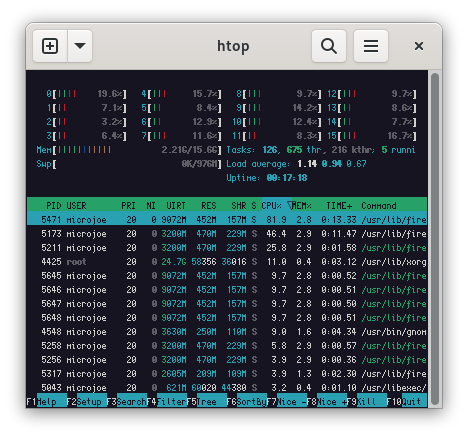
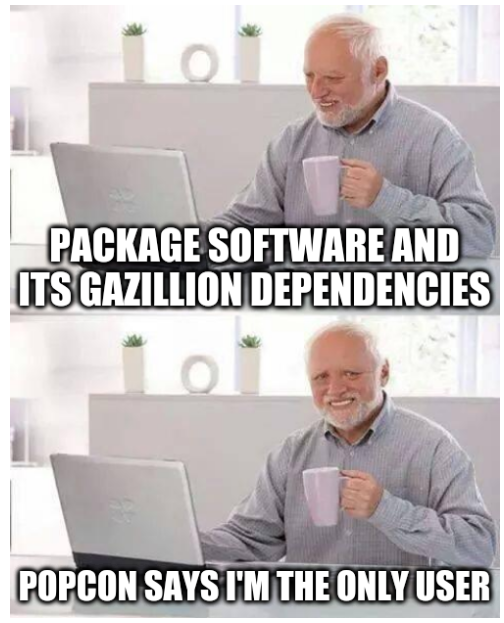
Debian work I have finally found how to make my fonts-creep2 package work on my Debian machines. The solution was to not use the TTF file that contains the Bitmap glyphs, but instead generate an OTB file, which is an OpenType format for Bitmap fonts. Creep2 font used in htop command This means that I can close the fonts-creep ITP bug altogether and rely on this fonts-creep2 package instead. Hopefully it will be reviewed and uploaded soon by a certified Debian Developer. This font is too small for daily usage, but imagine the quantity of data you could display on an auxiliary screen with poor resolution (and poor pixel density eventually). Here is a meme I created for the occasion: Hide the pain Harold meme. First: Package software and its gazillion dependencies. Second: Popcon says I'm the only user. Checks out.
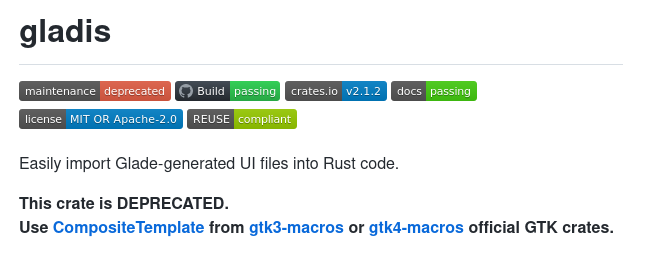
Rust work I have obsoleted my most popular Rust crate, gladis. Screenshot of the Gladis Github README Indeed, the GTK folks have managed to develop a similar solution named CompositeTemplate, that is available in both gtk3-macros and gtk4-macros crates. I did not investigate from how long this has been available before I created this crate. Hopefully it did not exist before I developed it. I have learnt a lot about Rust crates development with this crate, and managed to put in place a semi-automated release flow that I will surely use in other future crates. See ya.

Joerg Jaspert: Rust? Munin? munin-plugin

My first Rust crate: munin-plugin Sooo, some time ago I had to rewrite a munin plugin from Shell to Rust, due to the shell version going crazy after some runtime and using up a CPU all for its own. Sure, it only did that on Systems with Oracle Database installed, so that monster seems to be bad (who would have guessed?), but somehow I had to fixup this plugin and wasn t allowed to drop that wannabe-database. A while later I wrote a plugin to graph Fibre Channel Host data, and then Network interface statistics, all with a one-second resolution for the graphs, to allow one to zoom in and see every spike. Not have RRD round of the interesting parts. As one can imagine, that turns out to be a lot of very similar code - after all, most of the difference is in the graph config statements and actual data gathering, but the rest of code is just the same. As I already know there are more plugins (hello rsyslog statistics) I have to (sometimes re-)write in Rust, I took some time and wrote me a Rust library to make writing munin-plugins in Rust easier. Yay, my first crate on crates.io (and wrote lots of docs for it). By now I made my 1 second resolution CPU load plugin and the 1 second resolution Network interface plugin use this lib already. To test less complicated plugins with the lib, I took the munin default plugin load (Linux variant) and made a Rust version from it, but mostly to see that something as simple as that is also easy to implement: Munin load I got some idea on how to provide a useful default implementation of the fetch function, so one can write even less code, when using this library. It is my first library in Rust, so if you see something bad or missing in there, feel free to open issues or pull requests. Now, having done this, one thing missing: Someone to (re)write munin itself in something that is actually fast Not munin-node, but munin. Or maybe the RRD usage, but with a few hundred nodes in it, with loads of graphs, we had to adjust munin code and change some timeout or it would commit suicide regularly. And some other code change for not always checking for a rename, or something like it. And only run parts of the default cronjob once an hour, not on every update run. And switch to fetching data over ssh (and munin-async on the nodes). And rrdcached with loads of caching for the trillions of files (currently amounts to ~800G of data).. And it still needs way more CPU than it should. Soo, lots of possible optimizations hidden in there. Though I bet a non-scripting language rewrite might gain the most. (Except, of course, someone needs to do it :) )

18 May 2022

Gunnar Wolf: I do have a full face

I have been a bearded subject since I was 18, back in 1994. Yes, during 1999-2000, I shaved for my military service, and I briefly tried the goatee look in 2008 Few people nowadays can imagine my face without a forest of hair. But sometimes, life happens. And, unlike my good friend Bdale, I didn t get Linus to do the honors But, all in all, here I am: Turns out, I have been suffering from quite bad skin infections for a couple of years already. Last Friday, I checked in to the hospital, with an ugly, swollen face (I won t put you through that), and the hospital staff decided it was in my best interests to trim my beard. And then some more. And then shave me. I sat in the hospital for four days, getting soaked (medical term) with antibiotics and otherstuff, got my recipes for the next few days, and well, I really hope that s the end of the infections. We shall see! So, this is the result of the loving and caring work of three different nurses. Yes, not clean-shaven (I should not trim it further, as shaving blades are a risk of reinfection). Anyway I guess the bits of hair you see over the place will not take too long to become a beard again, even get somewhat respectable. But I thought some of you would like to see the real me PS- Thanks to all who have reached out with good wishes. All is fine!

Louis-Philippe V ronneau: Clojure Team 2022 Sprint Report

This is the report for the Debian Clojure Team remote sprint that took place on May 13-14th. Looking at my previous blog entries, this was my first Debian sprint since July 2020! Crazy how fast time flies... Many thanks to those who participated, namely: Sadly, Utkarsh Gupta although having planned on participating ended up not being able to and worked on DebConf Bursary paperwork instead. rlb Rob mostly worked on creating a dh-clojure tool to help make packaging Clojure libraries easier. At the moment, most of the packaging is done manually, by invoking build tools by hand. Having a tool to automate many of the steps required to build Clojure packages would go a long way in making them more uniform. His work (although still very much a WIP) can be found here: https://salsa.debian.org/rlb/dh-clojure/ ehashman Elana: lavamind It was J r me's first time working on Clojure packages, and things went great! During the sprint, he: allentiak Leandro joined us on Saturday, since he couldn't get off work on Friday. He mostly continued working on replacing our in-house scripts for /usr/bin/clojure by upstream's, a task he had already started during GSoC 2021. Sadly, none of us were familiar with Debian's mechanism for alternatives. If you (yes you, dear reader) are familiar with it, I'm sure he would warmly welcome feedback on his development branch. pollo As for me, I: Overall, it was quite a productive sprint! Thanks to Debian for sponsoring our food during the sprint. It was nice to be able to concentrate on fixing things instead of making food :) Here's a bonus picture of the nice sushi platter I ended up getting for dinner on Saturday night: Picture of a sushi platter

16 May 2022

Matthew Garrett: Can we fix bearer tokens?

Last month I wrote about how bearer tokens are just awful, and a week later Github announced that someone had managed to exfiltrate bearer tokens from Heroku that gave them access to, well, a lot of Github repositories. This has inevitably resulted in a whole bunch of discussion about a number of things, but people seem to be largely ignoring the fundamental issue that maybe we just shouldn't have magical blobs that grant you access to basically everything even if you've copied them from a legitimate holder to Honest John's Totally Legitimate API Consumer.

To make it clearer what the problem is here, let's use an analogy. You have a safety deposit box. To gain access to it, you simply need to be able to open it with a key you were given. Anyone who turns up with the key can open the box and do whatever they want with the contents. Unfortunately, the key is extremely easy to copy - anyone who is able to get hold of your keyring for a moment is in a position to duplicate it, and then they have access to the box. Wouldn't it be better if something could be done to ensure that whoever showed up with a working key was someone who was actually authorised to have that key?

To achieve that we need some way to verify the identity of the person holding the key. In the physical world we have a range of ways to achieve this, from simply checking whether someone has a piece of ID that associates them with the safety deposit box all the way up to invasive biometric measurements that supposedly verify that they're definitely the same person. But computers don't have passports or fingerprints, so we need another way to identify them.

When you open a browser and try to connect to your bank, the bank's website provides a TLS certificate that lets your browser know that you're talking to your bank instead of someone pretending to be your bank. The spec allows this to be a bi-directional transaction - you can also prove your identity to the remote website. This is referred to as "mutual TLS", or mTLS, and a successful mTLS transaction ends up with both ends knowing who they're talking to, as long as they have a reason to trust the certificate they were presented with.

That's actually a pretty big constraint! We have a reasonable model for the server - it's something that's issued by a trusted third party and it's tied to the DNS name for the server in question. Clients don't tend to have stable DNS identity, and that makes the entire thing sort of awkward. But, thankfully, maybe we don't need to? We don't need the client to be able to prove its identity to arbitrary third party sites here - we just need the client to be able to prove it's a legitimate holder of whichever bearer token it's presenting to that site. And that's a much easier problem.

Here's the simple solution - clients generate a TLS cert. This can be self-signed, because all we want to do here is be able to verify whether the machine talking to us is the same one that had a token issued to it. The client contacts a service that's going to give it a bearer token. The service requests mTLS auth without being picky about the certificate that's presented. The service embeds a hash of that certificate in the token before handing it back to the client. Whenever the client presents that token to any other service, the service ensures that the mTLS cert the client presented matches the hash in the bearer token. Copy the token without copying the mTLS certificate and the token gets rejected. Hurrah hurrah hats for everyone.

Well except for the obvious problem that if you're in a position to exfiltrate the bearer tokens you can probably just steal the client certificates and keys as well, and now you can pretend to be the original client and this is not adding much additional security. Fortunately pretty much everything we care about has the ability to store the private half of an asymmetric key in hardware (TPMs on Linux and Windows systems, the Secure Enclave on Macs and iPhones, either a piece of magical hardware or Trustzone on Android) in a way that avoids anyone being able to just steal the key.

How do we know that the key is actually in hardware? Here's the fun bit - it doesn't matter. If you're issuing a bearer token to a system then you're already asserting that the system is trusted. If the system is lying to you about whether or not the key it's presenting is hardware-backed then you've already lost. If it lied and the system is later compromised then sure all your apes get stolen, but maybe don't run systems that lie and avoid that situation as a result?

Anyway. This is covered in RFC 8705 so why aren't we all doing this already? From the client side, the largest generic issue is that TPMs are astonishingly slow in comparison to doing a TLS handshake on the CPU. RSA signing operations on TPMs can take around half a second, which doesn't sound too bad, except your browser is probably establishing multiple TLS connections to subdomains on the site it's connecting to and performance is going to tank. Fixing this involves doing whatever's necessary to convince the browser to pipe everything over a single TLS connection, and that's just not really where the web is right at the moment. Using EC keys instead helps a lot (~0.1 seconds per signature on modern TPMs), but it's still going to be a bottleneck.

The other problem, of course, is that ecosystem support for hardware-backed certificates is just awful. Windows lets you stick them into the standard platform certificate store, but the docs for this are hidden in a random PDF in a Github repo. Macs require you to do some weird bridging between the Secure Enclave API and the keychain API. Linux? Well, the standard answer is to do PKCS#11, and I have literally never met anybody who likes PKCS#11 and I have spent a bunch of time in standards meetings with the sort of people you might expect to like PKCS#11 and even they don't like it. It turns out that loading a bunch of random C bullshit that has strong feelings about function pointers into your security critical process is not necessarily something that is going to improve your quality of life, so instead you should use something like this and just have enough C to bridge to a language that isn't secretly plotting to kill your pets the moment you turn your back.

And, uh, obviously none of this matters at all unless people actually support it. Github has no support at all for validating the identity of whoever holds a bearer token. Most issuers of bearer tokens have no support for embedding holder identity into the token. This is not good! As of last week, all three of the big cloud providers support virtualised TPMs in their VMs - we should be running CI on systems that can do that, and tying any issued tokens to the VMs that are supposed to be making use of them.

So sure this isn't trivial. But it's also not impossible, and making this stuff work would improve the security of, well, everything. We literally have the technology to prevent attacks like Github suffered. What do we have to do to get people to actually start working on implementing that?

comment count unavailable comments

10 May 2022

Ben Hutchings: Debian LTS work, April 2022

In April I was assigned 16 hours of work by Freexian's Debian LTS initiative and carried over 8 hours from March. I worked 11 hours, and will carry over the remaining time to May. I spent most of my time triaging security issues for Linux, working out which of them were fixed upstream and which actually applied to the versions provided in Debian 9 "stretch". I also rebased the Linux 4.9 (linux) package on the latest stable update, but did not make an upload this month.

Russell Coker: Elon and Free Speech

Elon Musk has made the news for spending billions to buy a share of Twitter for the alleged purpose of providing free speech. The problem with this claim is that having any company controlling a large portion of the world s communication is inherently bad for free speech. The same applies for Facebook, but that s not a hot news item at the moment. If Elon wanted to provide free speech he would want to have decentralised messaging systems so that someone who breaks rules on one platform could find another with different rules. Among other things free speech ideally permits people to debate issues with residents of another country on issues related to different laws. If advocates for the Russian government get kicked off Twitter as part of the American sanctions against Russia then American citizens can t debate the issue with Russian citizens via Twitter. Mastodon is one example of a federated competitor to Twitter [1]. With a federated messaging system each host could make independent decisions about interpretation of sanctions. Someone who used a Mastodon instance based in the US could get a second account in another country if they wanted to communicate with people in countries that are sanctioned by the US. The problem with Mastodon at the moment is lack of use. It s got a good set of features and support for different platforms, there are apps for Android and iPhone as well as lots of other software using the API. But if the people you want to communicate with aren t on it then it s less useful. Elon could solve that problem by creating a Tesla Mastodon server and give a free account to everyone who buys a new Tesla, which is the sort of thing that a lot of Tesla buyers would like. It s quite likely that other companies selling prestige products would follow that example. Everyone has seen evidence of people sharing photos on social media with someone else s expensive car, a Mastodon account on ferrari.com or mercedes.com would be proof of buying the cars in question. The number of people who buy expensive cars new is a very small portion of the world population, but it s a group of people who are more influential than average and others would join Mastodon servers to follow them. The next thing that Elon could do to kill Twitter would be to have all his companies (which have something more than a dozen verified Twitter accounts) use Mastodon accounts for their primary PR releases and then send the same content to Twitter with a 48 hour delay. That would force journalists and people who want to discuss those companies on social media to follow the Mastodon accounts. Again this wouldn t be a significant number of people, but they would be influential people. Getting journalists to use a communications system increases it s importance. The question is whether Elon is lacking the vision necessary to plan a Mastodon deployment or whether he just wants to allow horrible people to run wild on Twitter. The Verge has an interesting article from 2019 about Gab using Mastodon [2]. The fact that over the last 2.5 years I didn t even hear of Gab using Mastodon suggests that the fears of some people significantly exceeded the problem. I m sure that some Gab users managed to harass some Mastodon users, but generally they were apparently banned quickly. As an aside the Mastodon server I use doesn t appear to ban Gab, a search for Gab on it gave me a user posting about being pureblood at the top of the list. Gab claims to have 4 million accounts and has an estimated 100,000 active users. If 5.5% of Tesla owners became active users on a hypothetical Tesla server that would be the largest Mastodon server. Elon could demonstrate his commitment to free speech by refusing to ban Gab in any way. The Wikipedia page about Gab [3] has a long list of horrible people and activities associated with it. Is that the free speech to associate with Tesla? Polestar makes some nice electric cars that appear quite luxurious [4] and doesn t get negative PR from the behaviour of it s owner, that s something Elon might want to consider. Is this really about bragging rights? Buying a controlling interest in a company that has a partial monopoly on Internet communication is something to boast about. Could users of commercial social media be considered serfs who serve their billionaire overlord?

9 May 2022

Robert McQueen: Evolving a strategy for 2022 and beyond

As a board, we have been working on several initiatives to make the Foundation a better asset for the GNOME Project. We re working on a number of threads in parallel, so I wanted to explain the big picture a bit more to try and connect together things like the new ED search and the bylaw changes. We re all here to see free and open source software succeed and thrive, so that people can be be truly empowered with agency over their technology, rather than being passive consumers. We want to bring GNOME to as many people as possible so that they have computing devices that they can inspect, trust, share and learn from. In previous years we ve tried to boost the relevance of GNOME (or technologies such as GTK) or solicit donations from businesses and individuals with existing engagement in FOSS ideology and technology. The problem with this approach is that we re mostly addressing people and organisations who are already supporting or contributing FOSS in some way. To truly scale our impact, we need to look to the outside world, build better awareness of GNOME outside of our current user base, and find opportunities to secure funding to invest back into the GNOME project. The Foundation supports the GNOME project with infrastructure, arranging conferences, sponsoring hackfests and travel, design work, legal support, managing sponsorships, advisory board, being the fiscal sponsor of GNOME, GTK, Flathub and we will keep doing all of these things. What we re talking about here are additional ways for the Foundation to support the GNOME project we want to go beyond these activities, and invest into GNOME to grow its adoption amongst people who need it. This has a cost, and that means in parallel with these initiatives, we need to find partners to fund this work. Neil has previously talked about themes such as education, advocacy, privacy, but we ve not previously translated these into clear specific initiatives that we would establish in addition to the Foundation s existing work. This is all a work in progress and we welcome any feedback from the community about refining these ideas, but here are the current strategic initiatives the board is working on. We ve been thinking about growing our community by encouraging and retaining diverse contributors, and addressing evolving computing needs which aren t currently well served on the desktop. Initiative 1. Welcoming newcomers. The community is already spending a lot of time welcoming newcomers and teaching them the best practices. Those activities are as time consuming as they are important, but currently a handful of individuals are running initiatives such as GSoC, Outreachy and outreach to Universities. These activities help bring diverse individuals and perspectives into the community, and helps them develop skills and experience of collaborating to create Open Source projects. We want to make those efforts more sustainable by finding sponsors for these activities. With funding, we can hire people to dedicate their time to operating these programs, including paid mentors and creating materials to support newcomers in future, such as developer documentation, examples and tutorials. This is the initiative that needs to be refined the most before we can turn it into something real. Initiative 2: Diverse and sustainable Linux app ecosystem. I spoke at the Linux App Summit about the work that GNOME and Endless has been supporting in Flathub, but this is an example of something which has a great overlap between commercial, technical and mission-based advantages. The key goal here is to improve the financial sustainability of participating in our community, which in turn has an impact on the diversity of who we can expect to afford to enter and remain in our community. We believe the existence of this is critically important for individual developers and contributors to unlock earning potential from our ecosystem, through donations or app sales. In turn, a healthy app ecosystem also improves the usefulness of the Linux desktop as a whole for potential users. We believe that we can build a case for commercial vendors in the space to join an advisory board alongside with GNOME, KDE, etc to input into the governance and contribute to the costs of growing Flathub. Initiative 3: Local-first applications for the GNOME desktop. This is what Thib has been starting to discuss on Discourse, in this thread. There are many different threats to free access to computing and information in today s world. The GNOME desktop and apps need to give users convenient and reliable access to technology which works similarly to the tools they already use everyday, but keeps them and their data safe from surveillance, censorship, filtering or just being completely cut off from the Internet. We believe that we can seek both philanthropic and grant funding for this work. It will make GNOME a more appealing and comprehensive offering for the many people who want to protect their privacy. The idea is that these initiatives all sit on the boundary between the GNOME community and the outside world. If the Foundation can grow and deliver these kinds of projects, we are reaching to new people, new contributors and new funding. These contributions and investments back into GNOME represent a true win-win for the newcomers and our existing community. (Originally posted to GNOME Discourse, please feel free to join the discussion there.)

Russ Allbery: C TAP Harness 4.8

C TAP Harness is my C implementation of the Perl "Test Anything Protocol" test suite framework. It includes test runner and libraries for both C and shell. This is mostly a cleanup release to resync with other utility libraries. It does fix an installation problem by managing symlinks correctly, and adds support for GCC 11's new deallocation warnings. The latter is a rather interesting new GCC feature. There is a Red Hat blog post about the implementation with more details, but the short version is that the __malloc__ attribute can now take an argument that specifies the function that should be used to deallocate the allocated object. GCC 11 and later can use that information to catch some deallocation bugs, such as deallocating things with the wrong function. You can get the latest version from the C TAP Harness distribution page.

8 May 2022

Thorsten Alteholz: My Debian Activities in April 2022

FTP master This month I accepted 186 and rejected 26 packages. The overall number of packages that got accepted was 188. Debian LTS This was my ninety-fourth month that I did some work for the Debian LTS initiative, started by Raphael Hertzog at Freexian. This month my all in all workload has been 40h. During that time I did LTS and normal security uploads of: Further I worked on libvirt, the dependency problems in unstable have been resolved and fixing in other releases can continue. I also continued to work on security support for golang packages. Last but not least I did some days of frontdesk duties. Debian ELTS This month was the forty-siyth ELTS month. During my allocated time I uploaded: Last but not least I did some days of frontdesk duties. Debian Printing This month I uploaded new upstream versions or improved packaging of: As I already became the maintainer of usb-modeswitch I also adopted usb-modeswitch-data Debian Astro Unfortunately I didn t do anything for this group, but in May I will upload a new version of openvlbi and several indi-3rdparty packages. Other stuff Last but not least I uploaded several new upstream version of golang packages but not before checking with ratt that all dependencies still work.

6 May 2022

Antoine Beaupr : Wallabako 1.4.0 released

I don't particularly like it when people announce their personal projects on their blog, but I'm making an exception for this one, because it's a little special for me. You see, I have just released Wallabako 1.4.0 (and a quick, mostly irrelevant 1.4.1 hotfix) today. It's the first release of that project in almost 3 years (the previous was 1.3.1, before the pandemic). The other reason I figured I would mention it is that I have almost never talked about Wallabako on this blog at all, so many of my readers probably don't even know I sometimes meddle with in Golang which surprises even me sometimes.

What's Wallabako Wallabako is a weird little program I designed to read articles on my E-book reader. I use it to spend less time on the computer: I save articles in a read-it-later app named Wallabag (hosted by a generous friend), and then Wallabako connects to that app, downloads an EPUB version of the book, and then I can read it on the device directly. When I'm done reading the book, Wallabako notices and sets the article as read in Wallabag. I also set it to delete the book locally, but you can actually configure to keep those books around forever if you feel like it. Wallabako supports syncing read status with the built-in Kobo interface (called "Nickel"), Koreader and Plato. I happen to use Koreader for everything nowadays, but it should work equally well on the others. Wallabako is actually setup to be started by udev when there's a connection change detected by the kernel, which is kind of a gross hack. It's clunky, but actually works and I thought for a while about switching to something else, but it's really the easiest way to go, and that requires the less interaction by the user.

Why I'm (still) using it I wrote Wallabako because I read a lot of articles on the internet. It's actually most of my readings. I read about 10 books a year (which I don't think is much), but I probably read more in terms of time and pages in Wallabag. I haven't actually made the math, but I estimate I spend at least double the time reading articles than I spend reading books. If I wouldn't have Wallabag, I would have hundreds of tabs open in my web browser all the time. So at least that problem is easily solved: throw everything in Wallabag, sort and read later. If I wouldn't have Wallabako however, I would be either spend that time reading on the computer -- which I prefer to spend working on free software or work -- or on my phone -- which is kind of better, but really cramped. I had stopped (and developing) Wallabako for a while, actually, Around 2019, I got tired of always read those technical articles (basically work stuff!) at home. I realized I was just not "reading" (as in books! fiction! fun stuff!) anymore, at least not as much as I wanted. So I tried to make this separation: the ebook reader is for cool book stuff. The rest is work. But because I had the Wallabag Android app on my phone and tablet, I could still read those articles there, which I thought was pretty neat. But that meant that I was constantly looking at my phone, which is something I'm generally trying to avoid, as it sets a bad example for the kids (small and big) around me. Then I realized there was one stray ebook reader lying around at home. I had recently bought a Kobo Aura HD to read books, and I like that device. And it's going to stay locked down to reading books. But there's still that old battered Kobo Glo HD reader lying around, and I figured I could just borrow it to read Wallabag articles.

What is this new release But oh boy that was a lot of work. Wallabako was kind of a mess: it was using the deprecated go dep tool, which lost the battle with go mod. Cross-compilation was broken for older devices, and I had to implement support for Koreader.

go mod So I had to learn go mod. I'm still not sure I got that part right: LSP is yelling at me because it can't find the imports, and I'm generally just "YOLO everythihng" every time I get anywhere close to it. That's not the way to do Go, in general, and not how I like to do it either. But I guess that, given time, I'll figure it out and make it work for me. It certainly works now. I think.

Cross compilation The hard part was different. You see, Nickel uses SQLite to store metadata about books, so Wallabako actually needs to tap into that SQLite database to propagate read status. Originally, I just linked against some sqlite3 library I found lying around. It's basically a wrapper around the C-based SQLite and generally works fine. But that means you actually link your Golang program against a C library. And that's when things get a little nutty. If you would just build Wallabag naively, it would fail when deployed on the Kobo Glo HD. That's because the device runs a really old kernel: the prehistoric Linux kobo 2.6.35.3-850-gbc67621+ #2049 PREEMPT Mon Jan 9 13:33:11 CST 2017 armv7l GNU/Linux. That was built in 2017, but the kernel was actually released in 2010, a whole 5 years before the Glo HD was released, in 2015 which is kind of outrageous. and yes, that is with the latest firmware release. My bet is they just don't upgrade the kernel on those things, as the Glo was probably bought around 2017... In any case, the problem is we are cross-compiling here. And Golang is pretty good about cross-compiling, but because we have C in there, we're actually cross-compiling with "CGO" which is really just Golang with a GCC backend. And that's much, much harder to figure out because you need to pass down flags into GCC and so on. It was a nightmare. That's until I found this outrageous "little" project called modernc.org/sqlite. What that thing does (with a hefty does of dependencies that would make any Debian developer recoil in horror) is to transpile the SQLite C source code to Golang. You read that right: it rewrites SQLite in Go. On the fly. It's nuts. But it works. And you end up with a "pure go" program, and that thing compiles much faster and runs fine on older kernel. I still wasn't sure I wanted to just stick with that forever, so I kept the old sqlite3 code around, behind a compile-time tag. At the top of the nickel_modernc.go file, there's this magic string:
//+build !sqlite3
And at the top of nickel_sqlite3.go file, there's this magic string:
//+build sqlite3
So now, by default, the modernc file gets included, but if I pass --tags sqlite3 to the Go compiler (to go install or whatever), it will actually switch to the other implementation. Pretty neat stuff.

Koreader port The last part was something I was hesitant in doing for a long time, but that turned out to be pretty easy. I have basically switch to using Koreader to read everything. Books, PDF, everything goes through it. I really like that it stores its metadata in sidecar files: I synchronize all my books with Syncthing which means I can carry my read status, annotations and all that stuff without having to think about it. (And yes, I installed Syncthing on my Kobo.) The koreader.go port was less than 80 lines, and I could even make a nice little test suite so that I don't have to redeploy that thing to the ebook reader at every code iteration. I had originally thought I should add some sort of graphical interface in Koreader for Wallabako as well, and had requested that feature upstream. Unfortunately (or fortunately?), they took my idea and just ran with it. Some courageous soul actually wrote a full Wallabag plugin for koreader, in Lua of course. Compared to the Wallabako implementation however, the koreader plugin is much slower, probably because it downloads articles serially instead of concurrently. It is, however, much more usable as the user is given a visible feedback of the various steps. I still had to enable full debugging to diagnose a problem (which was that I shouldn't have a trailing slash, and that some special characters don't work in passwords). It's also better to write the config file with a normal text editor, over SSH or with the Kobo mounted to your computer instead of typing those really long strings over the kobo. There's no sample config file which makes that harder but a workaround is to save the configuration with dummy values and fix them up after. Finally I also found the default setting ("Remotely delete finished articles") really dangerous as it can basically lead to data loss (Wallabag article being deleted!) for an unsuspecting user... So basically, I started working on Wallabag again because the koreader implementation of their Wallabag client was not up to spec for me. It might be good enough for you, but I guess if you like Wallabako, you should thank the koreader folks for their sloppy implementation, as I'm now working again on Wallabako.

Actual release notes Those are the actual release notes for 1.4.0.
Ship a lot of fixes that have accumulated in the 3 years since the last release. Features:
  • add timestamp and git version to build artifacts
  • cleanup and improve debugging output
  • switch to pure go sqlite implementation, which helps
  • update all module dependencies
  • port to wallabago v6
  • support Plato library changes from 0.8.5+
  • support reading koreader progress/read status
  • Allow containerized builds, use gomod and avoid GOPATH hell
  • overhaul Dockerfile
  • switch to go mod
Documentation changes:
  • remove instability warning: this works well enough
  • README: replace branch name master by main in links
  • tweak mention of libreoffice to clarify concern
  • replace "kobo" references by "nickel" where appropriate
  • make a section about related projects
  • mention NickelMenu
  • quick review of the koreader implementation
Bugfixes:
  • handle errors in http request creation
  • Use OutputDir configuration instead of hardcoded wallabako paths
  • do not noisily fail if there's no entry for book in plato
  • regression: properly detect read status again after koreader (or plato?) support was added

How do I use this?
This is amazing. I can't believe someone did something that awesome. I want to cover you with gold and Tesla cars and fresh water.
You're weird please stop. But if you want to use Wallabako, head over to the README file which has installation instructions. It basically uses a hack in Kobo e-readers that will happily overwrite their root filesystem as soon as you drop this file named KoboRoot.tgz in the .kobo directory of your e-reader. Note that there is no uninstall procedure and it messes with the reader's udev configuration (to trigger runs on wifi connect). You'll also need to create a JSON configuration file and configure a client in Wallabag. And if you're looking for Wallabag hosting, Wallabag.it offers a 14-day free trial. You can also, obviously, host it yourself. Which is not the case for Pocket, even years after Mozilla bought the company. All this wouldn't actually be necessary if Pocket was open-source because Nickel actually ships with a Pocket client. Shame on you, Mozilla. But you still make an awesome browser, so keep doing that.

5 May 2022

Reproducible Builds: Reproducible Builds in April 2022

Welcome to the April 2022 report from the Reproducible Builds project! In these reports, we try to summarise the most important things that we have been up to over the past month. If you are interested in contributing to the project, please take a few moments to visit our Contribute page on our website.

News Cory Doctorow published an interesting article this month about the possibility of Undetectable backdoors for machine learning models. Given that machine learning models can provide unpredictably incorrect results, Doctorow recounts that there exists another category of adversarial examples that comprise a gimmicked machine-learning input that, to the human eye, seems totally normal but which causes the ML system to misfire dramatically that permit the possibility of planting undetectable back doors into any machine learning system at training time .
Chris Lamb published two supporter spotlights on our blog: the first about Amateur Radio Digital Communications (ARDC) and the second about the Google Open Source Security Team (GOSST).
Piergiorgio Ladisa, Henrik Plate, Matias Martinez and Olivier Barais published a new academic paper titled A Taxonomy of Attacks on Open-Source Software Supply Chains (PDF):
This work proposes a general taxonomy for attacks on open-source supply chains, independent of specific programming languages or ecosystems, and covering all supply chain stages from code contributions to package distribution. Taking the form of an attack tree, it covers 107 unique vectors, linked to 94 real-world incidents, and mapped to 33 mitigating safeguards.

Elsewhere in academia, Ly Vu Duc published his PhD thesis. Titled Towards Understanding and Securing the OSS Supply Chain (PDF), Duc s abstract reads as follows:
This dissertation starts from the first link in the software supply chain, developers . Since many developers do not update their vulnerable software libraries, thus exposing the user of their code to security risks. To understand how they choose, manage and update the libraries, packages, and other Open-Source Software (OSS) that become the building blocks of companies completed products consumed by end-users, twenty-five semi-structured interviews were conducted with developers of both large and small-medium enterprises in nine countries. All interviews were transcribed, coded, and analyzed according to applied thematic analysis

Upstream news Filippo Valsorda published an informative blog post recently called How Go Mitigates Supply Chain Attacks outlining the high-level features of the Go ecosystem that helps prevent various supply-chain attacks.
There was new/further activity on a pull request filed against openssl by Sebastian Andrzej Siewior in order to prevent saved CFLAGS (which may contain the -fdebug-prefix-map=<PATH> flag that is used to strip an arbitrary the build path from the debug info if this information remains recorded then the binary is no longer reproducible if the build directory changes.

Events The Linux Foundation s SupplyChainSecurityCon, will take place June 21st 24th 2022, both virtually and in Austin, Texas. Long-time Reproducible Builds and openSUSE contributor Bernhard M. Wiedemann learned that he had his talk accepted, and will speak on Reproducible Builds: Unexpected Benefits and Problems on June 21st.
There will be an in-person Debian Reunion in Hamburg, Germany later this year, taking place from 23 30 May. Although this is a Debian event, there will be some folks from the broader Reproducible Builds community and, of course, everyone is welcome. Please see the event page on the Debian wiki for more information. 41 people have registered so far, and there s approx 10 on-site beds still left.
The minutes and logs from our April 2022 IRC meeting have been published. In case you missed this one, our next IRC meeting will take place on May 31st at 15:00 UTC on #reproducible-builds on the OFTC network.

Debian Roland Clobus wrote another in-depth status update about the status of live Debian images, summarising the current situation that all major desktops build reproducibly with bullseye, bookworm and sid, including the Cinnamon desktop on bookworm and sid, but at a small functionality cost: 14 words will be incorrectly abbreviated . This work incorporated:
  • Reporting an issue about unnecessarily modified timestamps in the daily Debian installer images. [ ]
  • Reporting a bug against the debian-installer: in order to use a suitable kernel version. (#1006800)
  • Reporting a bug in: texlive-binaries regarding the unreproducible content of .fmt files. (#1009196)
  • Adding hacks to make the Cinnamon desktop image reproducible in bookworm and sid. [ ]
  • Added a script to rebuild a live-build ISO image from a given timestamp. [
  • etc.
On our mailing list, Venkata Pyla started a thread on the Debian debconf cache is non-reproducible issue while creating system images and Vagrant Cascadian posted an excellent summary of the reproducibility status of core package sets in Debian and solicited for similar information from other distributions.
Lastly, 122 reviews of Debian packages were added, 44 were updated and 193 were removed this month adding to our extensive knowledge about identified issues. A number of issue types have been updated as well, including timestamps_generated_by_hevea, randomness_in_ocaml_preprocessed_files, build_path_captured_in_emacs_el_file, golang_compiler_captures_build_path_in_binary and build_path_captured_in_assembly_objects,

Other distributions Happy birthday to GNU Guix, which recently turned 10 years old! People have been sharing their stories, in which reproducible builds and bootstrappable builds are a recurring theme as a feature important to its users and developers. The experiences are available on the GNU Guix blog as well as a post on fossandcrafts.org
In openSUSE, Bernhard M. Wiedemann posted his usual monthly reproducible builds status report.

Upstream patches The Reproducible Builds project detects, dissects and attempts to fix as many currently-unreproducible packages as possible. We endeavour to send all of our patches upstream where appropriate. This month, we wrote a large number of such patches, including:

diffoscope diffoscope is our in-depth and content-aware diff utility. Not only can it locate and diagnose reproducibility issues, it can provide human-readable diffs from many kinds of binary formats. This month, Chris Lamb prepared and uploaded versions 210 and 211 to Debian unstable, as well as noticed that some Python .pyc files are reported as data, so we should support .pyc as a fallback filename extension [ ]. In addition, Mattia Rizzolo disabled the Gnumeric tests in Debian as the package is not currently available [ ] and dropped mplayer from Build-Depends too [ ]. In addition, Mattia fixed an issue to ensure that the PATH environment variable is properly modified for all actions, not just when running the comparator. [ ]

Testing framework The Reproducible Builds project runs a significant testing framework at tests.reproducible-builds.org, to check packages and other artifacts for reproducibility. This month, the following changes were made:
  • Daniel Golle:
    • Prefer a different solution to avoid building all OpenWrt packages; skip packages from optional community feeds. [ ]
  • Holger Levsen:
    • Detect Python deprecation warnings in the node health check. [ ]
    • Detect failure to build the Debian Installer. [ ]
  • Mattia Rizzolo:
    • Install disorderfs for building OpenWrt packages. [ ]
  • Paul Spooren (OpenWrt-related changes):
    • Don t build all packages whilst the core packages are not yet reproducible. [ ]
    • Add a missing RUN directive to node_cleanup. [ ]
    • Be less verbose during a toolchain build. [ ]
    • Use disorderfs for rebuilds and update the documentation to match. [ ][ ][ ]
  • Roland Clobus:
    • Publish the last reproducible Debian ISO image. [ ]
    • Use the rebuild.sh script from the live-build package. [ ]
Lastly, node maintenance was also performed by Holger Levsen [ ][ ].
If you are interested in contributing to the Reproducible Builds project, please visit our Contribute page on our website. However, you can get in touch with us via:

Next.

Previous.