Search Results: "will"

24 April 2011

Dirk Eddelbuettel: RcppArmadillo 0.2.19

Last Monday, Conrad Sanderson released version 1.2.10 of his most excellent Armadillo templated C++ library for linear algebra; I followed up the same day with version 0.2.19 of our RcppArmadillo wrapper for R based on our Rcpp library. However, the chief gatekeeper at CRAN took a well-deserved vacation last week, and with that it arrived only today on CRAN. The short NEWS file extract follows below containing just Conrad's entry for 1.2.0. No further changes from our side (and the benchmark comparison between R, compiled R and Rcpp for computing a VAR(1) dataset which I blogged about yesterday is only in SVN and will be in the next release.)
0.2.19	2011-04-18
    o	Upgraded to Armadillo version 1.2.0 "Unscrupulous Carbon Emitter"
	  * Added ability to use Blas & Lapack libraries with capitalised
	    function names 
	  * Reduction of pedantic compiler warnings
And courtesy of CRANberries, here are the diffs to the previous release.
 RcppArmadillo-0.2.18/RcppArmadillo/inst/doc/RcppArmadillo-unitTests.tex                     only
 RcppArmadillo-0.2.19/RcppArmadillo/ChangeLog                                                   10 
 RcppArmadillo-0.2.19/RcppArmadillo/DESCRIPTION                                                 10 
 RcppArmadillo-0.2.19/RcppArmadillo/R/fastLm.R                                                   2 
 RcppArmadillo-0.2.19/RcppArmadillo/inst/NEWS                                                   22 
 RcppArmadillo-0.2.19/RcppArmadillo/inst/doc/Makefile                                            5 
 RcppArmadillo-0.2.19/RcppArmadillo/inst/doc/RcppArmadillo-unitTests.pdf                     binary
 RcppArmadillo-0.2.19/RcppArmadillo/inst/doc/unitTests-results/RcppArmadillo-unitTests.html     16 
 RcppArmadillo-0.2.19/RcppArmadillo/inst/doc/unitTests-results/RcppArmadillo-unitTests.txt      40 -
 RcppArmadillo-0.2.19/RcppArmadillo/inst/include/armadillo_bits/arma_ostream_meat.hpp           14 
 RcppArmadillo-0.2.19/RcppArmadillo/inst/include/armadillo_bits/arma_ostream_proto.hpp           4 
 RcppArmadillo-0.2.19/RcppArmadillo/inst/include/armadillo_bits/arma_version.hpp                 6 
 RcppArmadillo-0.2.19/RcppArmadillo/inst/include/armadillo_bits/auxlib_meat.hpp                128 +--
 RcppArmadillo-0.2.19/RcppArmadillo/inst/include/armadillo_bits/blas_proto.hpp                  92 +-
 RcppArmadillo-0.2.19/RcppArmadillo/inst/include/armadillo_bits/compiler_setup.hpp              12 
 RcppArmadillo-0.2.19/RcppArmadillo/inst/include/armadillo_bits/config.hpp                       3 
 RcppArmadillo-0.2.19/RcppArmadillo/inst/include/armadillo_bits/constants.hpp                   20 
 RcppArmadillo-0.2.19/RcppArmadillo/inst/include/armadillo_bits/diskio_meat.hpp                  2 
 RcppArmadillo-0.2.19/RcppArmadillo/inst/include/armadillo_bits/lapack_proto.hpp               344 ++++++----
 19 files changed, 460 insertions(+), 270 deletions(-)
More information is on the RcppArmadillo page. Questions, comments etc should go to the rcpp-devel mailing list off the R-Forge page.

John Goerzen: Adventure: 1 dad, 2 boys, and lots of trains

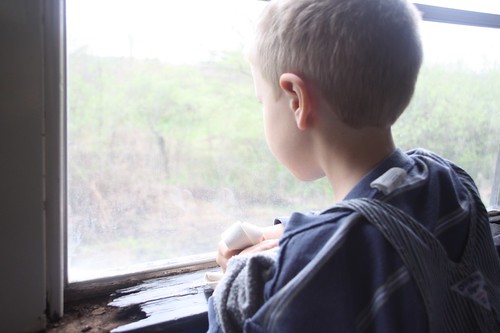
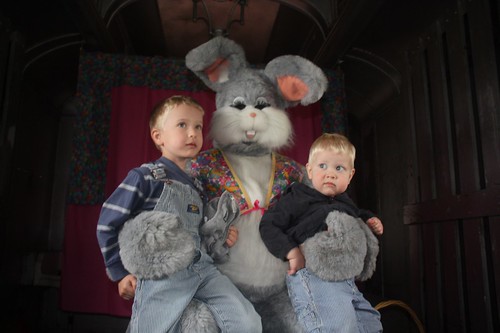
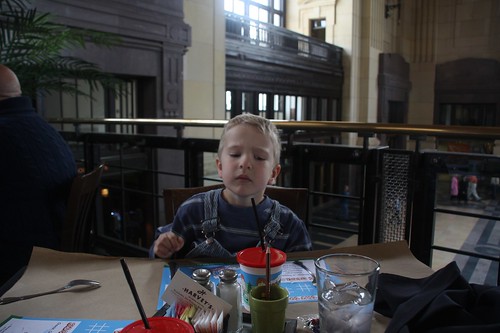
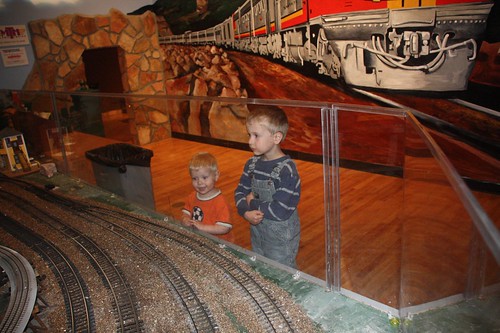
Terah and I recently decided that each of us could use a day off of not having to do work or supervise boys. Yesterday I had the day off work so that was mine. I took my Kindle, along with its Gutenberg copy of War and Peace, which yes, I m reading for fun. I slept in a bit, then got breakfast and sat down at Botanica, the Wichita Gardens with the Kindle for awhile. That was a nice way to spend the morning. Today was Terah s day off. Initially I thought of taking the boys to The Cosmosphere, one of the world s premier space museums, or to the Kansas Aviation Museum. But then I realized that the Midland Railway, a historic excursion line in Baldwin City, KS, was having their first train trip of the year. And it s the Easter special: you take the train a few miles out of town, get off, the kids do an Easter egg hunt, then also get to get their picture taken with the Easter bunny. Kid paradise, right? What could be better? So this is how my alarm came to be set for 5:15 on a Saturday morning. Oliver woke up early, but I had to get Jacob up. He was groggy, trying to cover his face and ears, and annoyed at me for trying to wake him up. Until I said, Jacob, it s time to get ready for the car trip to the train ride. Can you go get dressed for the day? Silence. Then about 5 seconds later, he jumped up, said, OK dad, I will do it, and he did. We drove our 2.5 hours. I had set out a non-dirty breakfast in the car for them the night before, so they munched while we drove. Then had to wait in a huge line for our tickets. An hour later we had them got the last 3 tickets for the first departure of the day, 10AM and ran to get on the train before it left. Jacob and Oliver both got very quiet. Sometimes Jacob especially does that when he s very excited about things. He doesn t always look it right then, but I knew I d be hearing about it later. He had his face almost pressed to the window the whole way. IMG_5685.JPG Oh, and yes, he dressed himself and I didn t check to make sure he had the correct shirt, or that it wasn t on inside-out, until it was too late. Oops. We rode in an ex-CP car built in 1936. One of the cars on the train was built in the 1890s quite some neat equipment. Anyhow, next came the hunt. There were two large lawns covered in eggs, separated by age group. Jacob and Oliver were in the younger group, but still only got a few eggs (there were lots of other parents, uhm, helping their kids by picking up eggs the kids were too slow to get and putting them in baskets ) But they were thrilled with the experience so that s what counts. They moved the locomotive to the other end of the train for the trip back using an adjacent track. Lots of the kids watched them couple it back on. Jacob and Oliver were particularly interested nothing could have distracted them from watching that train though they didn t particularly like the noise of the horn. IMG_5655.JPG On the way back, someone in an Easter bunny suit was on the train for pictures. I took the boys there. They usually refuse to sit on laps of Santa and such, so I didn t figure much success. They actually agreed to do it. And despite their expressions in this photo, Jacob later told me over and over how much fun it was to be with the Easter bunny. IMG_5671.JPG After we got back, we headed for the car. Jacob insisted on carrying his own Easter bag, and predictably wound up carrying it upside down for awhile. So his bag had some grass in it from picking the candy back up. Oliver discovered some rocks by a ditch and had fun throwing them in to make a splash, so we paused for that for awhile. By this point it was about noon. So at this point, what does a dad who has managed to keep two active boys in line for an hour, help them with an egg hunt and giant rabbit, and keep them from falling into the ditch they re throwing rocks into, do? Say that it s time to eat lunch and then head for home so we can be there in time for supper? Or go for MORE ADVENTURE? I said, Jacob, how would you like to eat lunch inside a big train station in Kansas City? Pause for a couple of seconds to think. YEAH! I have never had lunch in a train station before! Let s go! Shall we go NOW? So I gave them the leftover breakfast to eat during the hour drive on towards the beautiful Kansas City Union Station. It s one of the few grand American train stations that survives intact, and is just stunning. Jacob and Oliver both fell asleep on the way there. We parked, walked inside, and Jacob just froze. Dad WOW! That ceiling is SO HIGH! I can t even reach it! He then raised his hand as high as it would go and said, See dad, it is so high I can t touch it! (Most ceilings are, but this one is indeed much, much taller than most.) We ate lunch in the second level of a restaurant right in the Grand Hall, which Jacob really enjoyed. Here s Jacob, annoyed that I pulled out the camera again: IMG_5693.JPG Then we went exploring for an hour. Jacob talked about his adventure . We went up the elevators and checked out the balconies. Then we found the Model Railroad Experience. And oh my. The boys were visibly the most excited they had been all day. Oliver just froze at the spot he walked through the door, not caring to move and see the rest of the exhibit because he was so fascinated by what he already saw. There was a huge layout in the middle of the room, and smaller ones in adjacent rooms. We finally made our way there, and Oliver just ran round and round one of them, following a train, excitedly yelling There it is! There it is! There it is! Here s a photo from the big layout: IMG_5706.JPG Jacob cried when it was time to go, but I had promised them some dessert before we left, so after a bite of ice cream we were on our way. On the way home, every 15 minutes or so, Jacob would make a remark like this: Dad, the train ride was SO fun! or Dad, I really liked Kansas City Union Station! and so forth, naming every highlight of the day for him several times over: the Easter bunny, the egg hunt, train ride, and everything about Union Station. On the way home, we stopped at our favorite restaurant in Emporia: BobbyD s Merchant St. BBQ. This is always a hit for everyone in the family. A down-home place that has excellent food, is not far off our path, and never seems to have a wait. Yum.

Ben Hutchings: Upcoming changes in Debian Linux packages for i386

The major upcoming configuration change in Linux 2.6.39 is to get rid of the '686' flavour. This may be surprising, because it's the most widely used flavour of the 4 we have a present:
Name Minimum CPU features Maximum total CPU threads Physical address space
486 486-class 1 4 GiB
686 686-class; CMOV instruction 32 4 GiB
686-bigmem 686-class; PAE 32 64 GiB
amd64 x86-64 512 64 TiB
However, the physical address limitation means that an increasing proportion of new PCs and the majority of PC servers need the '686-bigmem' flavour. Even those that have less than 4 GiB RAM do support PAE and can run the '686-bigmem' flavour. There is a small cost (up to about 0.1% of RAM) in the use of larger hardware page tables. There is also an important benefit on recent processors: the larger page table entries include an NX bit (also known as XD) which provides protection against some buffer overflow attacks, both in the kernel and in user-space.. Q: What about 686 processors without PAE? There are only a few 686-class processors that support CMOV but not PAE: most Intel Pentium M models, the VIA C3 'Nehemiah' and the AMD Geode LX. These also all lack SMP support, which means the '486' flavour is suitable for them. Some benchmarking on two of those - a Pentium M model 745 and a C3 'Nehemiah' - indicated that they run the '486' flavour slightly faster than the '686' flavour. It appears that the performance gain from using plain uniprocessor code (rather than SMP-alternatives, which are patched with NOPs on uniprocessor systems) outweighs the performance loss from avoiding use of some newer instructions. Q: Why get rid of '686' but keep the 'amd64' flavour? We intend to get rid of 'amd64' too, but we need to ensure that upgrades from linux-image-2.6-amd64:i386 to linux-image-2.6-amd64:amd64 work properly. Q: If '686-bigmem' will be the default, isn't 'bigmem' redundant? Yes, it is. Therefore '686-bigmem' will be renamed to '686-pae'.

23 April 2011

Iustin Pop: Second system effect

A recent email from a user of one of my small software tools prompted me to write this entry If you read Wikipedia's page on Second system effect, it doesn't say much and it's hard to internalise what it means. Some other resources describe it better, but actually learning it first-hand is, shall we say, enlightening. Fortunately, I learned this in my spare time, and not at work. Back in 2002, I started working on a small tool (bakonf) to basically backup /etc and generate a tar archive out of it. It had some other features of course that made it a bit more useful than tar c /etc, but not many. It worked well and I was using it to make incremental dumps of server configuration ready to write to a CD on a few servers. A while later (around a year or so), I came to the conclusion that just having a tar archive is not enough, and rather one would want to be able to check differences between the filesystem and the archive, and ideally between multiple servers configurations (note, this was before DVCSs) online. I started working on cfvers in my free time and initially made reasonable progress. However, I didn't know to hold back from changing the scope and features, so actual progress in the form of a beta release was always postponed. Then came changes to the transport protocol, to the structure of the app, etc., all the fun. Note that this was in my free time, done in bursts of work in a month, then a few months with no work at all, so not too much work overall. Still, I slowly realised that this will go nowhere, so at the end of 2006 I finally gave up on developing it and marked the project as obsolete. However, bakonf is still doing its job, and I've done a few small commits to it in order to add compatibility with Python 3.x as recent as last year. I got an email about it from a user at the start of this year, so it definitely outlived its supposed replacement. Hah! Overall, it was a great lesson. Maybe it wasn't just second system effect, but also not enough effort invested by me, or bad planning, so on. But for me it drove the point home that writing the second version of something is filled with dangerous decisions

Ben Hutchings: Recent changes in Debian Linux packages

Linux 2.6.38 and 2.6.39 As you've probably seen, the testing suite finally got a new upstream kernel version (Linux 2.6.38) and is currently synchronised with unstable. I'm just about to upload a new version of linux-2.6 based on upstream stable update 2.6.38.4. Linux 2.6.39 is well on its way to release, so 2.6.39-rc4 should soon be in experimental. The Debian source package will add support for the new armhf (ARM with hardware floating-point) architecture. Splitting linux-2.6 The linux-base package, introduced to handle transitions and other support functions for 'image' packages, is now built from a separate source package. It won't be changed very often, so you will no longer need to upgrade linux-base every time you upgrade an 'image' package. (This doesn't apply within 'squeeze', but I may have a way to work around that.) The firmware-linux-free package, containing a few firmware and configuration blobs from Linux that are DFSG-compliant, is also now built from a separate source package. These blobs have not changed for a very long time, so again you will no longer be recommended to upgrade this package every time you upgrade an 'image' package. Secondly, this allows us to remove the entire 'firmware' directory from the upstream source rather than carefully removing and patching to leave just the DFSG-compliant bits. Wireless regulations The '2.4 GHz' and '5 GHz' ISM bands used for wifi are not defined identically around the world. The exact frequency ranges and maximum permitted power levels vary between countries. Radio equipment manufacturers have a legal responsibility to ensure their equipment operates within these regulations. Since it is expensive to implement such regulations in hardware (including many different variants for different regions), these restrictions are usually implemented in the driver using a country code retrieved from the hardware's EEPROM or flash. So this is now our responsibility. We need to be able to look up regulations by country codes, and we also need to support the case where a device sold in one country is used in another country with tighter regulations. For some time, the wifi configuration library (cfg80211) included regulatory information for a small number of countries and regions. However, the default since Linux 2.6.34 has been to build-in only the 'world' domain (intersection of all the restrictions) and to request information from user-space. In Debian, we didn't have anything to provide this information, so for example channels 12-13 became unavailable for users in Europe. The regulatory information should be provided by the Central Regulatory Domain Agent (CRDA) from a current database. These are now packaged as crda and wireless-regdb respectively. Drivers that do not use cfg80211 (mostly those from the 'staging' area) will not be affected, and may or may not implement correct regulations. When you travel to another country or use an imported wifi device with an incorrect country code (I hear 'CN' is common), you can use iw reg set to ensure that your wifi devices operate within the regulations of the country you are in. Set the REGDOMAIN variable in /etc/default/crda to make this persistent. These will be intersected with the regulations specified by the hardware.

Russell Coker: Links April 2011

Sebastian Thrun gave an interesting TED talk about the Google driverless car project and explains how his main aim is to avoid all the needless road deaths that are due to human error [1]. Finally a good use for the Google street-view type data! AnnMarie Thomas gave an interesting short TED talk about using play-dough to make circuits [2]. There are two recipies for play-dough, the one made with salt conducts well and the one made with sugar conducts poorly. That allows making wires with salty dough and insulators with the sugar dough. John Robb has published an interesting article about a Chinese fake revolutionary group that is triggering a backlash from Chinese security forces [3]. Even if this isn t accurate it seems like a good way to make people hate their local security forces and thus demand political change. Chris Rock made an interesting observation, we aren t making progress on racial issues, white people are getting less crazy [4]. Red Hill has an interesting article about 486 motherboards with fake cache chips that were sold in the 90 s [5]. One thing I disagree with is that they blame the customers for seeking low prices. When a white-box PC cost $2000 (which is $3000 in today s money) it made sense to try and get the cheapest option possible. Now that major department stores sell name-brand laptops for $400 it really makes sense to buy name-brand quality rather than white-box rubbish. IHollaBack.org is an interesting project to combat street harassment of women [6]. Psychology Today has an interesting article by Joe Navarro (former FBI counter-intelligence agent and author) about the serious implications of attempting to detect lies [7]. His main point is that most people over-estimate their ability to detect lies and because the legal system believes such claims from law enforcement officers many innocent people get found guilty and criminals get away free! Cory Doctorow wrote an informative article about the ways of persuading people to pay for content that can be obtained for free [8]. The main message seems to be that the big media companies are doing things the wrong way in everything that they do. The news satire site CBS Breaking News has an interesting about page explaining their mission [9]. They stopped their automated disaster generator after the Japanese Tsunami, while I can understand them wanting to keep some good taste and be sympathetic to the plight of the Japanese people it seems that they have forgotten that there is always a disaster somewhere. The typical bus plunge is just as bad as the Tsunami to the people on the bus and their relatives! Psychology Today has an interesting blog post by Satoshi Kanazawa explaining how criminals don t specialise, the psychological factors that make someone likely to commit one crime will make them likely to commit others, this makes it logical to collect DNA samples from all criminals [10]. Psychology Today has an interesting blog post by Dave Niose about a landmark US legal case in 1948 where Vashti McCollum had to escalate to the Supreme Court to allow her children to receive secular education [11]. We need something like this in Australia now as the religious extremists are going too far in indoctrinating children. Sam Richards gave a TED talk titled A Radical Experiment in Empathy which aims to teach Americans how to understand the way that people in the middle-east feel [12]. The comments suggest that his talk wasn t successful. Of course the fact that empathy doesn t have a clear definition in the English language doesn t help, and the fact that most people don t seem to interpret it in any way that corresponds to any dictionary and that most people seem unable to define what they mean by it makes things worse. At the moment I can t think of any examples of successfully teaching empathy to unwilling people. The people who want to learn will do so eventually, you can have some good success in helping them to learn faster. Kathryn Schulz gave an interesting TED talk about Being Wrong [13]. One interesting point that she makes concerns the way that people assume that people who disagree are ignorant, stupid, or evil instead of just having a different set of data or a different understanding of the same data. Of course it is possible for someone to be ignorant/stupid/evil AND have a different understanding. Marcin Jakubowski gave an inspiring TED talk about his project to develop free blueprints that allow anyone to create all machines needed to sustain civilisation with minimal cost [14]. His Open Source Ecology project has a blog and a wiki with blueprints and files for CAD/CAM [15]. Dave Meslin gave an insightful TED talk about apathy in the political process [16]. Among other things he compares council notices that supposedly request citizen input with adverts for running shoes which encourage people to buy them. One thing he didn t mention is the difference that technology can make, a short council advert with a QR code is probably a lot more useful than the current dense text-based adverts for today s audience.

22 April 2011

Steve McIntyre: Bias in the news

Apologies for yet more politics; normal-ish service will be resumed shortly, I hope. I've just put the following into the "BBC News website feedback" form, but I doubt it will have any impact. Quoting it here for the record... The BBC news website appears to be showing a systemic bias over the AV referendum. For the last few weeks, there has been regular coverage of the referendum and it seems that there has been the usual blind adherence to "balance" - every story about AV has included some of the (incorrect, unscientific, even hate-filled) propaganda from the "no to AV" campaign without critique or analysis. It's difficult to see any justification for this except deliberate editorial bias, but I don't imagine that there's much that can be done about that. However, right now on the BBC News front page at http://www.bbc.co.uk/news/ I can see that there is a link "Referendum views" that points to yet another opinion piece from a "No" campaigner (Frederick Forsyth). I only see a single view here, not the plural "views" suggested. I don't see any positive view for AV promoted from the front page at all, nor any link from this puff piece to the other articles that have been written in the recent past. Looking further, I can see that there *has*, in fact, been a positive piece on the News Front Page today (from Billy Bragg) but there are no visible links to it any more. Both articles were posted/updated at the same time this morning (22nd April, 08:34 BST) yet now only the negative one remains. Very shoddy, and not at all what I would expect from the BBC.

Michal Čihař: Photo of a week 15

As you can see in week number, I failed to take photo every week. Nevertheless I will try to continue, maybe I won't skip that much. To compensate it a little, I've decided to publish two photos taken in Prague Botanical Garden on annual butterfly event. Butterfly Butterfly

Filed under: English Photography 3 comments Flattr this!

21 April 2011

Evgeni Golov: Debian/Ubuntu Games Team Meeting #2

The readers of debian-devel-games@l.d.o and games@l.fd.o do already know, but the fact pkg-games has it s next (second) meeting on April 30th at 12:00 UTC in #debian-games needs the attention of the whole planet (pun intended)!For the agenda we have a whole bunch of leftovers from the first meeting, thus I did not plan any new items (besides of kicking Tolimar to be admin again instead of having the dream to drift away from his position ;)).
As most of us are lazy and wont klick the wiki link to read the agenda, it s served here too:
  1. games and cross-distro collaboration
  2. pending, removed, orphaned, wnpp & suggested games
  3. freedesktop.org/games group
  4. sponsoring policy
  5. cleaning old, adding new admins (and users)
Do you still remember where you will be on April 30th at 12:00 UTC? No? #debian-games on irc.debian.org. And don t you dare to be quiet! ;)

Christian Perrier: New language in Debian Installer: Uyghur

I just activated a new language in Debian Installer: Uyghur. Uyghur is the language of Xinjiang or Eastern Turkmenistan. This part of the People's Republic of China is the homeland of the Uyghur people and the language is spoken by nearly 9 million people. The translation effort is driven by the Uyghur Computer Science Association (Uyghur Kompyut r Ilimi Jem'iyiti. The next D-I daily builds will offer Uyghur as a choice of language to install Debian. Given the way D-I packages are built, it will however take some time before the entire installation process can be performed by only displaying Uyghur and no more English. Indeed, the new language will appear for each D-I component when the relevant udeb package is built from GIT, which happens most of the time when a D-I developers wants a new feature or bug fix to be available. During the upcoming days, I'll try to rebuild a few packages, though, so that Uyghur users can still have a preview of what will be available when the first alpha or beta release of D-I is out. Moreover, that will help testing the translation and the possible glitches with rendering, fonts or any other display issue.

Timo Jyrinki: Free Society Conference and Nordic Summit (FSCONS 2010)

Just a note that the slides are available (non-slideshare link) for my presentation Tuning an old but free phone (description) that I held in the tremendously great event FSCONS 2010. It could be described as a smaller scale FOSDEM, but that would be actually down-playing it since the free software effects on society are something that I've actually never seen elsewhere on such a scale. My talk was among the purely technical ones, though.

I was planning to hold on with this blog post until the recorded videos arrive, but since it seems it might not be during this year I will just post this now that slides are available.

I've shared a few photos as well at Flickr...


Keynote: Karin Kosina, The Inanna Project. A tech + art workshop for female artists in Damascus, Syria. An experiment in art, technology, and the transformative power of Free Hardware and Software.


Erik de Bruijn, The Future of RepRap, a self-replicating open source 3D printer that fabricates arbitrary objects including parts of itself.


Social event at the Berg 211.


Malin Nilsson on Gender, class and global flows. Using free software to fuel a revolution in home based industrial work.


Keynote: Glyn Moody, Ethics of Intellectual Monopolies.


Keynote: Glyn Moody, Ethics of Intellectual Monopolies (audience).

A few summaries available on a Qaiku seminar channel.

Alastair McKinstry: How much wind energy can we use?

So how much wind energy can we realistically use? A paper (Earth System Dynamics, DOI: 10.5194/esd-2-1-2011) by Miller,Gans and Kleidon (MGK10) has generated a lot of controversy courtesy of a New Scientist review (See Climate Progress for a good rebuttal). They argue that the effective limit we can safely extract without (bad) climatic consequences is around 18--68 TW (we currently use 0.2 TW of wind power). This paper is a follow-on to Kleidons work on the thermodynamics of the climate, where he points out that the free energy is the important measure of what energy can be generated by renewables. The free energy of the atmosphere is on the scale of hundreds of TW, he argues, much less than the heat energy of ~10^5 TW that comes from the sun. He argues that not enough attention is paid to the free energy budget, and argues that from MEP theory that free energy flows through different geophysical processes are more important than people currently think: such energy and momentum flows then lead to faster depletion of gradients than people currently use in their models. Frequently we use "diffusive-like" approximations to stuff we can't explicitly handle,such as convection and eddies below the resolution of our computer models. That the free energy budget, and small-scale processes need more detailed study (such as the transfer of momentum and energy from wind to water), I agree. But paradoxically, MGK10's estimates based on diffusive processes are what gets it into trouble. The critiques (e.g. Jacobsen and Archer) seem to concentrate on the estimates for diffusive and other energy losses (eg. wake fields) and climatic consequences are very loose, and out by factors of 50-100. They also ignore the fact that using wind as a substitute for more destructive energy sources produces a net gain, climate-wise. Based on these numbers, the real limits on wind power are more limited by where we can realistically place turbines, and the use and availability of rare earth metals in turbine magnets (MW sized turbines use over a ton of neodynium each in magnets!) One of the focuses of research at ICHEC and Met Eireann is wind for wind power: this becomes increasingly important for Ireland as we have more energy production by wind. I've been recently involved in a European project Weather Intelligence for Renewable Energies on investigating weather and climate forecasting needs of wind energy. In our weather models, we are getting to finer and finer resolutions (down to 2-5 km operationally, but working on 1 km in research), but as yet do not take account of wind energy changes. Modelling the wake turbulence, etc. and other effects of turbines is a 'fluid dynamics' problem done by the wind turbine manufacturers, mostly, in order to lay out turbines in a farm efficiently; this is done on the timescale of metres and seconds, while on the other end of the spectrum work is done in climate research on the changes in potential winds to see if wind energy will change in a few decades. But little is done on 'weather' scales of kilometres, minutes and hours: it turns out there are wind patterns that we don't predict in our models (vortices, etc.; especially for offshore turbines) that affect wind energy production, but would be very useful for wind farm and electrical grid operators to know about. So we should think about adapting our weather models for these. Either way, it looks like more detailed work on the interactions between atmospheric dynamics and wind farms would be a good thing. Incidentally, whatever about the alarmist nature of the article, kudos to New Scientist for their linking to papers: they quoted the names of the journals (Earth System Dynamics,Philosophical Transactions of the Royal Society), but where the article was not yet published (or behind a paywall), linked to the Arxiv.org version. More could do this. Tags , , , , ,

Raphaël Hertzog: People behind Debian: Meike Reichle, member of Debian Women

Meike Reichle is a Debian developer since 2008 but has been involved for longer than that, in particular in Debian Women. She s a great speaker and shared her experience in a Debconf talk. She s also part of the Debian publicity team and managed the live coverage of the last release on identi.ca. Enough introduction, learn more about her by reading the interview. My questions are in bold, the rest is by Meike. Who are you? My name is Meike Reichle, I am a studied information scientist and work as a project manager at Pengutronix, an embedded Linux company probably best known for their ARM kernel work. I live in Germany, more exactly in Lower Saxony, but I was originally born and raised in Swabia. Although I moved here ten years ago I still have a rather strong Swabian cultural identity. (Among other things I pride myself on having introduced a number of fellow DDs to the true promise that are real hand-made Sp tzle ;-) ) I am married to Alexander Reichle-Schmehl, we ll have our third wedding anniversary this summer. Apart from Debian most of my spare time is used for all kinds of crafts and DIY activities. Making things with my hands always gives me a great sense of accomplishment. My Free software history is summed up pretty quickly. Like most women of my age I wasn t introduced to computers until well into my teens. I didn t have a computer of my own until I started studying at the university in 2001. From there on things developed rather quickly: Working on the University s Unix terminals got me hooked on *nixes, so I got me one of those Linuxes everyone talked about. I tried a couple of different distributions, ended up with Debian around 2004, started contributing in 2005, and finally became a full DD what a nice coincidence! exactly this day (Apr 18th) three years ago. You re part of Debian Women. How is the project going? I have the feeling that the number of women involved in Debian has not significantly increased. The amount of women active within Debian is a tricky thing to judge. Here s a quick example why: When the DPL was elected in 2004 there were 911 Debian Developers eligible to vote, 4 of them were female. Shortly after, during DebConf4, debian-women was founded. When the current DPL was reelected last month, there were again 911 Debian Developers eligible to vote, but this time 13 of them were women. You can look at these numbers and say The number of female DDs has more than tripled, what a success! Or you can pull out your calculator and it will tell you that in terms of ratio this puts us from a measly 0.4% to an only slightly less measly 1.4% ratio of female DDs. This still is pardon my language a bloody shame, but sadly also pretty close to the average ratio of women in Free Software. So, while I do think that the debian-women project did already have a significant impact on the Debian project as a whole, I don t think it has achieved its goals yet. Not for a long time. There s still a lot to be done but unfortunately the debian-women project has somewhat run out of steam at the moment. The seven years of its existence divide quite equally into the first half, which was very active and saw great results, and the second half, which was very slow and much more passive. In my impression debian-women is currently undergoing a rather bumpy generational change. On the one hand a lot of the original members, including myself, have reduced their involvement. Speaking for myself this is caused by shift of interests as much as general weariness. On the other hand there are only very few women following up. This development is also reflected quite harshly in DD numbers: If I don t misjudge any first names (and I desperately hope I do!) for the last three years not a single woman has joined Debian as a developer! After the great start debian-women has had, this is a very painful thing to see! That said, things don t look all bad. There is a number of women maintaining packages without being DDs and there s also at least one woman currently in NM, so there s hope this standstill won t last very much longer. But still, the fact remains that debian-women is suffering from a rather serious recruitment problem and I hope that this interview might actually help to spur some new or not yet active members into action. The aim of debian-women is far from achieved and now that its initial members are receding its time for new members to step up and take initiative. What should Debian do to be more attractive to women ? I think the general atmosphere has improved, we re less tolerant with rude behaviour, the usual tone on mailing lists has improved. Yet it doesn t seem to be enough. If there was a female DD for every time I answered that question First of all, I agree, Debian as a community has improved tremendously! Our general tone is much more friendly and cooperative and there is now a much better awareness of the impression we give to outsiders and newcomers. Now on to the difficult part: The question what should be done to get more women into Free Software has been around almost as long as Free Software exists, and it has been answered very well by a lot of people: Twenty years ago Ellen Spertus wrote Why are There so Few Female Computer Scientists? and most of it still holds true. Almost ten years ago Val Henson (now Aurora) wrote HOWTO Encourage Women in Linux and that also is still pretty accurate. In 2006 Floss Pols undertook extensive research to find out why there were so few women in Open Source and Free Software and how that could be changed. They also came up with a very good set of recommendations. All of these texts highlight different aspects of that question and all of them have very good points. I personally have, over the years, arrived at a rather sociological, not to say holistic point of view. In fact I answered the exact same question a few days ago, and the answer I gave then was this: After ~10 years of women in tech advocacy I d say the ultimate and final measure to get more women into Free Software is by finally achieving a truly equal society and at the same time dramatically improving child care support in almost any country. I ve come to the conclusion that what really holds women back in practice is not so much a lack of skill or interest but a simple lack of opportunity. For most of us Free Software is what we do in our spare time and that s something that women, even today, have considerably less of than men. Even in couples where both partners work full-time it is still mostly the woman who does the majority of the housework and child care duties. In most cultures men have a perceived right to their leisure time that does not to the same degree exist for women. That is one major reason, the other is instilled modesty, which has kind of become my personal arch-enemy by now. I ve talked to so many girls and women at all sorts of events about why they won t take up Computer Science studies or join a Free Software project and the answer I hear most often is that they do not consider themselves good enough in one or another aspect. Sometimes they will doubt their technical skills, sometimes their language skills, sometimes their stamina. Needless to say these girls and women were not any less qualified than the people already active in Free Software. So, yes, in the short and medium term making Debian a more welcoming and friendly place is the way to go. As many others pointed out already this will not only benefit prospective contributors but the community as a whole: those new to it as well as those who ve been in it for a long time. In the long term however what we need is empowerment! Women who are just as confident about their skills as men and are not discouraged by uncooperative environments. This is of course something that is culturally deep-rooted and can only happen in a very large time frame. So, for the moment the way to go in my view is accessibility: a cooperative atmosphere, a code of conduct, comprehensive documentation not only of technical aspects but also of structures and processes. The other thing we need to do is to have as many already active women as possible attend as many Linux/Debian/Free Software/Whatever events as possible. In my experience it happens quite often that other women see these women, feel very inspired by them, get to talk to them and then a few days later show up on some mailing list or IRC channel. From what I ve seen personal contact still beats any other kind of recruiting measures. You re a Debian developer but you re also married with a Debian developer (Alexander Reichle-Schmehl). Did you meet because of Debian? If not, who introduced Debian to the other one? :-) We did in fact meet because of Debian. More specifically during our booth shift at the Debian booth at LinuxTag 2005, where I did a talk on the debian-women project and Alex organised the DebianDay. After that our relationship developed pretty much along our Debian activities: After our initial meeting we talked a lot on #debian.de, when Alex went to DebConf5 and I didn t we noticed that we kind of missed each other. The first gift he ever gave me was a Debconf5 shirt and a box Finnish chocolates (I still have one of them today. :) ) Our first secret kiss was at ApacheCon 2005, where we were both staffing the Debian booth (kudos to abe for pretending not to notice). We then became an official couple at Berlinux 2005 where we were both staffing the Debian booth and giving talks on packaging and user motivation. Our first real relationship stress test was when we both joined the DebConf6 orga team. It was a stressful time, but we passed it with flying colours! About a year later we announced our engagement via planet.debian.org. Our wedding was a veritable MiniDebConf, one of the best gifts we got was a Debian cookbook including the favourite recipes of DDs from around the world. By now we ve both finished university and work full-time jobs, so we don t do as many talks and attend as many Debian events as we used to. Instead we now mainly focus on press and publicity work, which is quite practical to work on as a pair. It s actually rather funny that way, Alex and I get confused with each other quite often, since we have almost the same name, often pick up on each other s E-Mail conversations and are most often quoted by our function rather than by name. Because of we have kind of merged into this virtual Debian Press Person in the perception of many of our contacts. You also have another hat : Debian Press Officer. What is this about? What would you suggest to people who would like get involved in that domain? Debian press work is mainly about providing an official and coordinated point of contact to anyone wanting information from or about Debian. The press team answers all sorts of inquiries (the most popular one is is of course always the next release date) and makes sure all important events and developments within Debian receive the attention and recognition they deserve. Debian is a diverse project where every sort of contributor is free to voice his or her opinion in any way. We don t have NDAs or prescribed terminology. That s one of the things I love about Debian but also something that makes us difficult to handle for conventional media. They want official statements, in generally understandable terms, at appointed times. That s what the press team takes care of. Almost all of the press work is done in the publicity team, which coordinates using IRC, Mail and SVN. The publicity team also publishes the Debian Project News, which are very popular among our users and developers. Press work is also an area of work that offers lots of possibilities for non-technical contribution. http://wiki.debian.org/Teams/Publicity lists a number of possibilities for contribution and, like most Debian Teams, we d be more than grateful to get some more helping hands and happy to introduce interested newcomers to our work. What s the biggest problem of Debian? In my view: Overwork. Debian has thousands of contributors but still a lot of the main work rests on very few shoulders. We need more contributors, especially, but not only in the key teams. In order to get more people we need to do some marketing which is very hard for us, since we are very proud of our independence and have a strong focus on purely technical aspects rather than aiming for popularity. However, with the current amount of Open Source and Free Software projects to join we find ourselves not only in a contest on technical excellence but also a sort of popularity contest that is about perception rather than hard facts. This popularity contest is difficult for Debian and currently costs us quite a bunch of very capable people. Do you have wishes for Debian Wheezy? My answer to that is a non-technical one: I think Debian is currently very under-appreciated, we do a lot of great work and maybe even more importantly we do a lot of important work for Software Freedom, sometimes even at the cost of our above-mentioned popularity. I hope people will appreciate that more again in the future. Is there someone in Debian that you admire for their contributions? Over the years I have made a lot of friends within the Debian community, some have even become family. That makes it somewhat hard to single out individual people. I think what I admire most is continuous commitment. I am very impressed by those among us who have kept up a high level of commitment over many years and at the same time managed to bring that in line with a fulfilled personal/family life. That s something that I hope I ll also be able to achieve in the years to come.
Thank you to Meike for the time spent answering my questions. I hope you enjoyed reading her answers as I did. Subscribe to my newsletter to get my monthly summary of the Debian/Ubuntu news and to not miss further interviews. You can also follow along on Identi.ca, Twitter and Facebook.

2 comments Liked this article? Click here. My blog is Flattr-enabled.

20 April 2011

Niels Thykier: Update on Lintian 2.5.0~rc3

While we are waiting for Lintian 2.5.0~rc3, here is a little update on what you can look forward to. About a week ago I had the pleasure of merging my branch into the Lintian master branch. While the IRC bot DOS ed the #debian-qa channel[SRY], cross-package checks became part of the official Lintian. Beyond the reduced amount of binary-without-manpage false-positives, circular-dependency checking and a partial broken symlink detector, the 2.5.0~rc3 release will also feature java and multiarch checks (kudos to Vincent Fourmond and Steve R. Langasek, respectively). The new java checks are based on the Java Policy and currently mostly covers checking for possibly build misconfigurations (jars without class files etc.), weird classpaths and missing Main-Class/depends on jarwrapper for executable jars. Note that #539315 has not been fixed, so executable jars will still trigger a warning. For people wanting to upgrade their libraries to multiarch, Lintian will have a check to see if you remember the Pre-Depends on multiarch-support. Personally I have not followed the progress of multiarch too closely, but last I checked multiarch-support was not in unstable. I guess we are ahead on this one. :) Other highlights include dont install stuff in /run , armhf support, less false positive on missing B-D on dh_python 2,3 and recognition of 3.9.2 as the latest version of the Policy Manual. I am also planning on starting a new branch and this time I intend to work on Vendor-based customization of Lintian. If you have any ideas/suggestions, by all means follow up on the thread on the Lintian list. [SRY] Sorry to anyone present in the channel!

Joey Hess: the popcon problem

I have noticed some problems with how Debian is using the popularity-contest data.

Bastian Venthur: Introducing python-ardrone

Flying AR.Drone The last weeks I spend quite a lot of time hacking on a Python library for the AR.Drone. The AR.Drone is a nice toy for nerds. You connect to it via WIFI and soon you ll realize that it has 4 ports open. Reading the specs you ll find, that on one port it listens for AT-Commands with which you can remote control the drone, on the other two ports it waits for an incoming package which will trigger the drone to send the navdata (speed, angles, battery status, etc) and the video stream. Heck, you can even telnet into the drone Unfortunately it comes without a proper software to control the drone, only an iPhone app (w/o iPhone of course). But given the documentation, it should be easy to write your own. While getting the beast to fly was relatively easy, decoding the almost -jpg-video-stream was not. Almost-jpg, since the images the drone sends are more or less jpg with a small difference which makes it impossible to decode them using standard multi-media libraries. Anyways, the format is documented and implementing a decoder was not that hard. The tricky part was to get the framerates from unacceptable 0.5 FPS to 12-22 FPS the whole decoder is written in Python. I m cheating a bit by using psyco, but the code in arvideo.py is heavily optimized to minimize calculations and to please psyco. In the code is also a small demo app which uses Pygame to display the video stream and allows to control the AR.Drone with the keyboard. It should be ready-to-use as soon as you are connected to the drone via WIFI. The git repository is here, the license is MIT. Suggestions and patches are welcome. Here is a video of the drone flying through the office.

Jeff Licquia: Triumphant Return

When you don t update a blog, it gets stale fast. Tim Bray Of course, I didn t intend to violate this basic rule of blogging. It just happened one thing leads to another, and pretty soon you notice just how little your front page has changed in the past two-and-a-half years. So, I shall begin again. Quite a bit has changed: All of these will get their own posts in the very near future. In the meantime, enjoy the new look. (Especially on mobile!)

19 April 2011

Craig Small: Passwords in PHP

Category:WikiProject Cryptography participants

Image via Wikipedia

Generally speaking it is a really bad idea to hold passwords in cleartext. I am actually amazed people still do this! The standard way of holding passwords that has been around for years is to encrypt or hash the password and store the result, called a ciphertext. There have been many ways of hashing the password, starting off with plain old crypt with no salt (a random pair of characters) then crypt with salt through to MD5 and SHA. The thing is, each one of these hashing techniques results in a ciphertext in a different length. Now with most languages, this doesn t matter because you know what hash you are using; its simply the name of the function or some flag you set. PHP is different, because all of these methods use the one function called crypt which is a little confusing because it is more than plain old crypt. Around the PHP version 5.3 the developers started putting in the more complex hash algorithms which is good, but the ciphertext has been growing. A lot of applications store this hashed password in a database and the decision needs to be made; how big should this field be? For a long while, 50 characters would be enough and this is what programs like jffnms use. Unfortunately the SHA-512 algorithm needs 98 characters so what you get is half a hash stored. When the user enters their password, the program compares the full hash from that password to the half hash in the database and it always fails. I ve adjusted JFFNMS to use 200 character long fields which is fine for now. The problem is who knows what the future will bring?

Ross Burton: AirPlay/UPnP Synergy

You know, it would be really good if someone could take ShairPort, glue that to gst-rtsp-server, and then implement the Rygel MediaServer specification, letting me play music from my iPhone on my Raumfeld UPnP speakers. I'd actually like this so much that I'm willing to put up some of my own hard cash to see it happen. Are there sites that will let people pledge money towards projects like this? NP: Central Reservation, Beth Orton

Christian Perrier: [life] [running] Boston marathon 2011

For marathon freaks, Boston marathon is a mythical one. Probably more than New York marathon, because this is the world's oldest annual marathon. Also because is is quite difficult to register for it (this year, the 20,000 seats reserved for qualifiers were distributed in....8 hours). In order to qualify, runners must have a previous mark that depends on their age and gender. For instance, in my age category (50-54), the required mark for men is 3h30, something I never achieved yet. This is what's required for the 2013 race. For 2012, it will be still 3h35, but a rolling process will be held to give best runners priority. So, in short, it will probably stay among my dream marathons forever..:-) The 2011 race happened yesterday and was a great event. Kenyan runners Geoffrey Mutai and Moses Mosop even broke Haile Gebresselassie's world record, set in Berlin, back in 2008. The ran in 2h03'02" while Gebresselassie's mark is 2h03'59". However, this record will not become official because Boston's race is one-way (thus with a possibility of consistent tailwind) and has a too big altitude difference between start and finish. However, many consider that hills on the race compensate this quite strongly, so this year's time is a really great time. And, really, from all reports I read and all images I saw, the level of support you get from the crowd is incredible there, with world famous moments like Wellesley College "scream tunnel", or Kenmore Square where, traditionnaly, the Red Sox have a game prior to marathon and the crowd then goes from Fenway Park to Kenmore Square to cheer the runners for their final mile (I have no idea how they can manage the unpredictable length of a base-ball game). And I can't even mention the final mile on Commonwealth Av., then Bolston St. Everybody who ran this once says this is something you have to do once in your life. So, well, I'm still crossing fingers..:-)...Maybe, one day a miracle happens, I can qualify *and* I get a seat and I fly to Boston...

Next.

Previous.