Search Results: "sto"

2 October 2009

Gustavo Noronha Silva: This is something I can agree with

It s no coincidence that most of those who are obsessed with population
growth are post-reproductive wealthy white men: it s about the only
environmental issue for which they can t be blamed. Quote from Stop blaming the poor. It s the wally yachters who are burning the planet in the Guardian. Shamelessly reproduced from Matt Zimmerman s post. Of course population growth causes some of the problem, but I am pretty sure the fact that more and more people are becoming developed causes way more. Of course telling people in developing nations to not become as big a problem is not really an option, which makes this a big challenge. I am, in fact, happy with the fact that my life has improved, as a consequence of Brazil becoming more developed, and my family being able to have more comfort (including more technological gadgets, transport means, and being able to eat out more often =P), but here s the challenge of the century: what do we do to fix this?

Barry Hawkins: Just When a Wizard Would Have Been Most Useful: Coaching versus Contracting

Then they stopped, and Thorin muttered something about supper, and where shall we get a dry patch to sleep on? Not until then did they notice Gandalf was missing. So far he had come all the way with them, never saying if he was in the adventure or merely keeping them company for a while. He had eaten most, talked most, and laughed most. But now he simply was not there at all! Just when a wizard would have been most useful, too, groaned Dori and Nori (who shared the hobbit s views about regular meals, plenty and often).

- J.R.R. Tokien, The Hobbit

I am very fond of the works of J.R.R. Tolkien; it would not surprise me to find that many of you recognize these words from the second chapter of The Hobbit titled Roast Mutton . It occurred to me recently that there are parallels between Gandalf s role in The Hobbit and that of an Agile coach. Now, before my fellow Tolkien enthusiasts leap on their keyboards, bear with me on this. Know that I am not saying an Agile coach is on par with a wizard (OK, with one of the Istari sent by the Valar, but let s table that so as not to scare off the normal folk, alright?); that should be enough to calm you down. In the excerpt from The Hobbit at the top of the page, Bilbo and the dwarves have run into their first predicament. Note that it s not a particularly difficult situation; they just need to find shelter and partake of some food. Fire would be nice, too, if it could be managed. (Mind you, it s the first day of their journey; they set off mere hours ago fully provisioned and riding on ponies.) It isn t very long before the fledgling group finds itself not only without shelter and food, but in the hands of three rather nasty trolls who are deciding how best to eat the entire group. Gandalf returns once things have gotten out of control, and with some subtle adjustments to the situation, the crisis is averted. Could Gandalf have come back sooner and spared them this entire experience? Perhaps, but in their struggle a few key things happened. First, the group had to work out how to assess tasks at hand and appropriately delegate. To their credit, that effort was partially successful. The most skilled firestarters were assigned to that task, one of the keen-eyed dwarves was assigned to be the lookout. Second, they gathered some field experience that led to the establishment of improved practices, i.e. don t leave the ponies laden with packs when you make camp, particularly if it s all your food. (They lost most of their food that night when the pony carrying it bolted and ran straight into a nearby river later that night.) Third, Bilbo Baggins was called upon to perform his first task as burglar, albeit a fool s errand that landed them in the troll predicament. While Bilbo was wildly under-equipped for his job, he managed to work through it. That experience began a developmental journey that would prepare him for the great things that would be expected of him later on. This was not Gandalf s first adventure, nor was it the first group of people he needed to equip and challenge in order to develop them to a point that they could accomplish their goal. At this point, he s been in Middle-Earth just shy of 2,000 years. He would have been more than capable of walking them through their entire journey, but to what end? Agile coaching is a discipline that aims to help teams develop their own use of methodologies like Scrum and cross-methodology practices like testing, user stories, etc. This means equipping teams with just enough information to strike out on their own for a bit, then letting them run with it rather than dazzle them with one s own mastery so as to appear like the indispensable demigod. Until people struggle with the terse maxims of Agile Software Development, they cannot internalize them. And when the wizard is always around, why bother struggling? One of my greatest frustrations as an Agile coach is how few companies are willing to take a coaching approach with their Agile adoption. They want you to come in and be the demigod as a full-time contractor. Sure, there are fiscal, political, and seemingly practical reasons that they will cite; I chalk most of them up to being excuses for a lack of willingness to embrace what it would take to face the hard task of nurturing what you have. It s seemingly easier to just throw more money at more bodies and hope that somehow things will all work out, and surely if you can stumble upon some superstar to wrangle the mess, you ll eventually be able to browbeat them into becoming a full-time employee. Don t get me wrong; in some ways, I benefit from this dysfunction. From a selfish business standpoint, having a single full-time client is certainly easier than juggling multiple concurrent clients and their schedules. As far as actually accomplishing the aim of my business, however, I think it hinders the mission. One of my aims in working with companies is to be a coach despite being brought in as a contractor. It s certainly possible, though it is more challenging. There s not that natural separation of the coach from the team that forces them to take up the mantle on their own. Few things in my work are more rewarding than having a developer come to me and say, I wasn t really sure this Agile stuff could work, but now, after going through all this, I wouldn t want to go back to the old way of doing things. Much later in the journey of the hobbit and his dwarf companions, Bilbo is again called upon for a challenging task. His response makes me think Gandalf s approach has worked:
Perhaps I have begun to trust my luck more than I used to in the old days he meant last spring before he left his own house, but it seemed centuries ago but anyway I think I will go and have a peep at once and get it over. Now who is coming with me?

- J.R.R. Tokien, The Hobbit

Here s hoping more people will be willing to embrace the challenging, messy, and altogether beneficial task of equipping teams and allowing them to struggle when necessary, even if it means the occasional scuffle with trolls.

1 October 2009

Daniel Kahn Gillmor: sexist behavior in the free software community

So not even 3 months out from RMS's sexist Gran Canaria virgins remarks, we have another powerful leader in the Free Software Community making sexist remarks in a talk to developers (this time, it's Mark Shuttleworth). It's a shame that these two people have said stupid things that hurt their causes and their communities by perpetuating an unfriendly environment for women. And it's a bigger shame that neither leader appears to care enough about their community to issue a sincere public apology for their screwup (if i'm wrong about this, please point me to the apology i've looked). These guys are in a situation which is nowhere near as hard as writing good software or managing complex technical projects: if you make a stupid mistake, own up to it, apologize, and try not to make similar mistakes in the future. Perhaps worst of all, are the remarkable number of unreasonably fucked-up comments on the blog posts discussing these unfortunate events. If you're in the habit of defending remarks like those made by RMS and Shuttleworth on the 'net, please take a minute and ask yourself a few questions: Please read the Geek Feminism wiki and blog. Even if you don't agree with everything on those sites (hey, it's a wiki! and a blog! you don't have to agree with everything!), people are at least trying to address the problem of sexism in our community there. Engage constructively and don't hide or ignore problems! UPDATE: I've asked the site admin to remove some trollish comments. If you want to use the comments on this blog to announce something like "i'd like for free software to be a boys-only club", that's fine, i'd like to know who you are so i can adjust my perception of you accordingly. Anything advocating or excusing rape and/or murder is way over the line and is not welcome here. i'm sure you can find some other place to troll. Tags: community, conduct, feminism, free software, sexism

Ingo Juergensmann: Debian Unstable - nomen est omen

Oh well... in the last days my machine crashed during the nightly backup. When I restarted it the next morning I realized two problems: the LVM is not recognized anymore and my X crashes on startup.
With the help of Tino Keitel (scorpi) I fixed the first issue by installing an older version of the lvm2 package (namely: lvm2_2.02.39-7_i386.deb) and libdevmapper1.02.1 (namely: libdevmapper1.02.1_1.02.37-1_i386.deb). Tino reported this in Bug #546817.

But there's still the Xorg problem left. Xorg.0.log reports:

CODE:
(II) RADEON(0): RADEONRestoreMemMapRegisters() :
(II) RADEON(0): MC_FB_LOCATION : 0xefffe800 0xefffe800
(II) RADEON(0): MC_AGP_LOCATION : 0xf87ff800
restore common
restore crtc1
restore pll1
finished PLL1
set RMX
set FP1
enable FP1
disable primary dac
disable TV
(II) RADEON(0): RandR 1.2 enabled, ignore the following RandR disabled message.

Backtrace:
0: X(xorg_backtrace+0x3b) [0x81314bb]
1: X(xf86SigHandler+0x51) [0x80c57d1]
2: [0xb7f32400]
3: X(xf86DiDGAInit+0x2f) [0x80f08cf]
4: X(xf86CrtcScreenInit+0x110) [0x80ed9e0]
5: /usr/lib/xorg/modules/drivers//radeon_drv.so [0xb7a2a114]
6: X(AddScreen+0x19d) [0x80712cd]
7: X(InitOutput+0x206) [0x80adfa6]
8: X(main+0x1db) [0x80719bb]
9: /lib/i686/cmov/libc.so.6(__libc_start_main+0xe5) [0xb7bb37a5]
10: X [0x8071051]

Fatal server error:
Caught signal 11. Server aborting


Maybe this is Bug #546586? I've already detached the second display, but it still crashes. Pointers and solutions appreciated!

UPDATE: thanks for the points! X is now working again!

John Goerzen: MoinMoin as a Personal Wiki, Zen To Done, And A Bit of Ikiwiki

Since I last evaluated and complained about wikis last year, I ve been using moinmoin for two sites: a public one and a personal one. The personal site has notes on various projects, and my task lists. I ve been starting out with the Zen To Done (ebook, PDF, paper) idea. It sounds great, by the way; a nice improvement on the better-known GTD. My To Do Page Anyhow, in MoinMoin, I have a ToDos page. At the top are links to pages with different tasks: personal, work, yard, etc. Below that, are the three big rocks (as ZTD calls them) for the day: three main goals for the day. I edit that section every day. The Calendar And below that, I use MoinMoin s excellent MonthCalendar macro. I have three calendars in a row: this month, next month, and last month. Each day on the calendar is a link to a wiki page; for instance, ToDos/Calendar/2009-10-01. The day has a red background if the wiki page exists, and white otherwise. So when I need to do something on or by a specific day, I click on the link, click my TaskTemplate, and create a simple wiki page. When I complete all the tasks for that day, I delete that day s wiki page (and can note what I did as the log message if I like). Very slick. The Task Lists My task pages are similar. They look like this:
= Personal =
<<NewPage(TaskTemplate,Create new task,@SELF)>> <<Navigation(children,1)>>
<<BR>>
So, my personal task page has a heading, then it has an input form with a text box and a button that says Create new task. Type something in and that becomes the name for a wiki page, and takes you do the editor to describe it. Below the button is a list of all the sub-pages under the Personal page, which represent the tasks. When a task is done, I delete the page and off the list it goes. I can move items from one list to another by renaming the page. It works very, very nicely. Collecting Part of both ZTD and GTD is that it must be very easy to get your thoughts down. The idea is that if you have to think, I ve got to remember this, then you ll be stressed and worried about the things you might be forgetting. I have a Collecting page, like the Personal or Work pages, that new items appear on when I m not editing my wiki. They get there by email. MoinMoin has a nice email system. I ve set up a secret email address. Mail sent there goes directly into MoinMoin. It does some checks on it, then looks at a combination of the From and Subject lines to decide what to do with it. If I name an existing page, it will append my message the the end. If it s a new page, it ll create it. I have it set up so that it takes the subject line as a page name to create/append to under ToDos/Collecting/$subject (by putting that as the name on the To line). So, on my computers, I have a newtodo script that invokes mail(1), asks for a subject, and optionally lets me supply a body. Quick and painless. Also, I ve added the address to my mobile phone s address book. That way I don t have to carry around pen and paper. Need to get down some thought ? No problem. Hit send email, pull the last address sent to, give it a subject and maybe a body. Very slick. Wiki Software As a way of updating my posts from last year: I ve been very happy with MoinMoin overall. It has some oddities, and the biggest one that concerns me is its attachment support. It doesn t let you specify a maximum upload size, and doesn t very well let you restrict attachment work to only certain people. But the biggest problem is that it doesn t track history on attachments. If a vandal deletes the attachment on a page, it s GONE. They expect to have that fixed in 2.0, coming out in approximately November, 2010. I also looked at Ikiwiki carefully over the past few days. Several things impressed me. First, everything can be in git. This makes for a very nice offline mode, better than Moin s offline sync. The comment module is nicer than anything in Moin, and the tagging system is as well. Ikiwiki truly could make a nice blog, and Moin just couldn t. It also puts backlinks at the bottom of each page automatically, a nice feature. And it s by Joey Hess, who writes very solid software. There are also some drawbacks. Chief on that list is that ikiwiki has no built-in history of a page feature. Click History and it expects to take you to gitweb or ViewVC or some such tool. That means that reverting a page requires either git access or cut and pasting. That s fine for me, but throwing newbies to gitweb suddenly might not be the most easy. Since ikiwiki is a (very smart) wiki compiler, its permission system is a lot less powerful than Moin s, and notably can t control read access to pages at all. If you need to do that, you d have to do it at the webserver level. It does have a calendar, but not one that works like Moin s does, though I could probably write one easily enough based on what s there. A few other minor nits: the email receiving feature is not as versatile as Moin s, you can t subscribe to get email notifications on certain pages (RSS feeds only, which would have to be manually tweaked later), and you can t easily modify the links at the top of each page or create personal bookmarks. Ikiwiki looks like an excellent tool, but just not quite the right fit for my needs right at the moment. I ve also started to look at DokuWiki a bit. I was initially scared off by all the plugins I d have to use, but it does look like a nice software. I also re-visited MediaWiki, and once again concluded that it is way too complicated for its own good. There are something like a dozen calendar plugins for it, some of which even are thought to work. The one that looked like the one I d use had a 7-step (2-page) installation process that involved manually running SQL commands and cutting and pasting some obscure HTML code with macros in it. No thanks.

30 September 2009

John Goerzen: Sen. Brownback s Visit

Since I asked for suggestions on the Brownback town hall, I figured I ought to report what happened. He was scheduled to spend about 30 minutes in it; he probably spent a total of 40 or 45. He arrived a few minutes early, went around the room shaking hands and asking each person their name (including me). It was polite on the one hand, and a little odd on the other, as he was occasionally reaching over chairs to reach people far away. Anyhow, he stood up front and had a little speech to start with. He spent the first 5-10 minutes talking about local sports teams. It might have been a nice icebreaker if it was 30-60 seconds, but it just felt weird by the time it was over. Everybody knew he was here to talk about other things and had very limited time. He then launched into the economy, talking about keeping taxes down and making sure they re low in Kansas for the recovery. He touched on energy, supporting wind energy (which led to his most memorable comment of the morning: This state blows, and it s got lots of wind, too. ) He also came out in favor of coal, oil, and gas. Basically he s pro-energy. Can t go wrong with that, eh? He rode our prototype all-electric ZTR mower, and praised it quite a bit. He touched on health care briefly, saying that he favors incremental changes to bring down costs. He thought health savings accounts and high-deductible health plans (such as one option at my employer with a $2500 deductible) were good innovations. He then opened it up for questions. There was a brief awkward moment when nobody raised their hand, so I did. I started by saying where I agreed with him. I told him I agreed that health care is way too expensive, that I agree that we need liability reform, and said that we pay almost as much each month in health care as we do in all federal taxes combined. I was going to continue, but he interrupted, and said, Are you serious? Yes. 80% as much in fact. Do you have an illness in your family? My wife has asthma, a thyroid disorder, and we had a baby this year. That s it. Wow. So I continued. I told him I was concerned about the 46 million uninsured Americans, that they weren t getting the care they needed. I pointed out that many of them wouldn t be able to afford that $2500 deductible in the HDHP, let alone regular doctor visits. And I said that it is our moral and even religious duty to take care of the least of these when it comes to health care. He answered by first saying that nobody goes without care that s the law because anybody can get care in any emergency room in the country. Then he spent several minutes describing how he thinks the government can t manage anything, and thus a single-payer system wasn t right for us. After a few minutes of this, he asked if that answered my question. I said that I don t care how the 46 million people get care, whether it s a public option or subsidies for private companies, just that they get it. I also acknowledged that ERs must provide necessary stabilizing care , but pointed out that 20,000 Americans die each year due to inadequate health care and reminded him that ERs are not required to provide diagnostic or preventative services, or long-term treatment of things like cancer. For the first, but not the last, time of the day, at that, he got really quiet, sort of hung his head, and said something like, Yeah, I agree. It is hard on the least of these. I wish we could do more. And moved on to the next question. At this point, it got weird. The next question was a guy that stood up, saying how we ve got to put God back into the constitution. He said he s lived long enough to see the moral decline in this country, and it s going to hell faster than we know. We need to be God-fearing again, he said. Brownback, in reply, again did the quiet hang-his-head thing and said, I agree. Then moved on. We then had a question about state s rights, nullification , and the 10th amendment. Though it was obvious some issue was underneath it, I couldn t figure out just what it was. Brownback, predictably, thinks that the federal government has grown way too powerful. (Ironic for someone that supported the Patriot Act, but hey.) Then one other question, and as he was going to wrap it up, a yelled question from the back: What s good about Kansas? Brownback was caught a bit off-guard, but launched into talking about aerospace, and how he hopes to lure wealthy retirees from California to settle here. All in all, an interesting experience. More respectful than I feared, more scary than I imagined, and about as genuine as I expected a politician at that level gets.

Daniel Stone: fd.o affected by portland state uni power failure

As ajax quite elegantly summed up, due to a series of catastrophic power failures at PSU, where fd.o is hosted, we were down for a good chunk of yesterday. Despite the machines having redundant power supplies, being connected to separate power rails in the rack, which were hooked up to independent, UPS-backed, power supplies, we still (like a good chunk of Portland, and certainly everyone in the PSU machine room) lost our power.

As far as we can tell, when annarchy.fd.o (websites, people.fd.o, cgit, anongit, et al) came back up, power was again interrupted while the ext3 journal was being replayed. When it came up the n'th time, fsck dumped almost the entire filesystem in lost+found, then started saying increasingly unhappy things about the state of the filesystem on its second pass. In the end, we just went with mkfs, and now we have a brand new and shiny filesystem.

It's worth pointing out that even if this was another filesystem, such as /srv, which hosts all project data, we would've been fine, as they're all backed up. But, unfortunately for some, we made a decision a while ago to not back /home up, and didn't advertise that as widely as we should have. So, if you had stuff in annarchy:/home, it's now gone, and I hope you have backups.

Sorry about that. On the upside, I got to see PSU's new and really very nice machine room this morning, thanks to XDC being about 250m away from the PSU machine room, and fd.o is otherwise running fine. We've been talking this week about replacing our ageing hardware, which would also allow for more redundancy as well as better performance from those machines. But we still have no plans to back up /home, so if you put stuff there, please, please keep your own backups (or make sure the Wayback Machine knows about it).

Jon Dowland: FAC-1

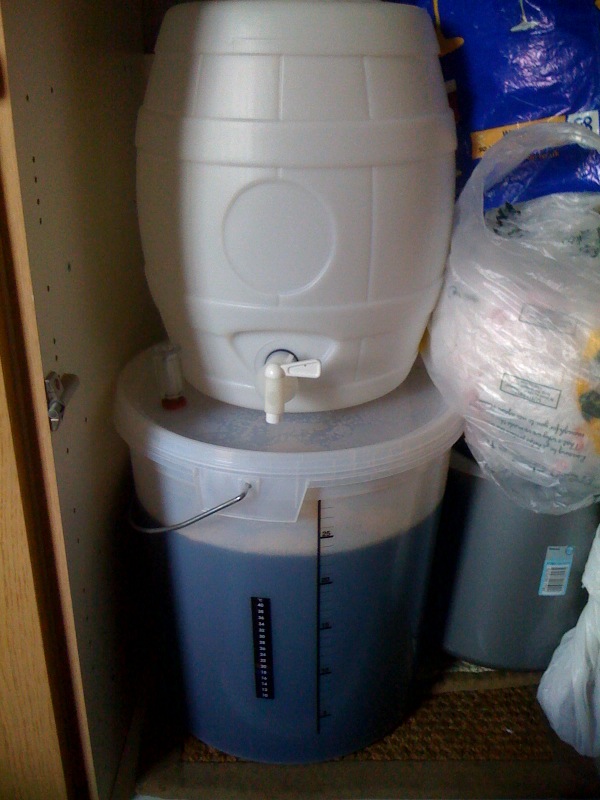
This is my first attempt at homebrew. It's from a stout kit, purchased from the Elderberry Home Brew Centre, which you can find at 28 Station Road, Whitley Bay. The fellow there is very helpful and gave me lots of advice on starting out. I'd recommend anyone interested in beer or wine making in the Newcastle or North Tyneside area to make the journey. In honour of a period in modern British music I am really fond of, I've decided to call it "FAC-1". Thus, when the first stage is complete and I siphon off a sampler, I can call that "FAC-2".

Zak B. Elep: Off We Go...

Arrived at Manila yesterday. At least in the parts we passed through (Pasay, Makati, and Malate,) everything seems back to normal, with almost no sign of the previous storm's havoc. And nary a raindrop in sight. I'm staying at my cousin Deng's place, as usual with my Manila trips. We found it in a bit of chaos, as ondoy's flooding reached here, recalling the water being almost knee-deep. The water's gone now though, but a lot of things that were not brought up to the apartment's second floor are still wet. Hopefully they will be dry before the next storm comes in... A little history: the last time I lived in Manila was in September 2006, when Orange & Bronze got me for a 3-month contract work on a project. At the time, I was fresh off my GSoC work, and I was raring to whet my skills as a software developer. That job gave me that opportunity, as well as opportunities to meet new friends, participate in a bit of commercial software development, and get used to Manila life again. Then awhile later I got into the Morph Labs bandwagon to become its first Systems Administrator, working from Daet via telecommuting. It was here that I began the long road to unrecovery^H^H^H^H^H learning the ropes of being a sysadmin, building some cool stuff in the process as well as maintaining it. Now, I'm back here in Manila, to work for Orange & Bronze again, but this time in a more permanent position, as Systems Administrator Lead. I look forward to reconnecting with my old pals as well as meet new ones, use the valuable experience I've had over the years in my new job, and get back to the long road of unrecovery^H^H^H^H^H building more cool stuff. And I start doing that tomorrow. Good times ahead.

Enrico Zini: Lessons learnt from Oracle

Lessons learnt from Oracle Lesson number 1: "how to handle temporary files".
$ rm tp*
$ proc code=cpp lines=yes dba_vm.pc 
Pro*C/C++: Release 10.2.0.1.0 - Production on Wed Sep 30 11:10:00 2009
Copyright (c) 1982, 2005, Oracle.  All rights reserved.
System default option values taken from: /usr/local/oracle/10.2.01/db_1/precomp/admin/pcscfg.cfg
$ echo $?
0
$ ls tp*
tpoHRjc8  tpqkU4Cp  tpY5Eo4G
$ 
Today we learn this: for every successful compilation of a single source file, it is a Good Thing to leave three temporary files around as a tribute to the Holy Trinity who bestowed upon us the grace of seeing our prayers fulfilled and our work rewarded. For those illiterate of us who do not want to learn from the Market Leaders, and do not want to put a rm -f tp* in their makefiles just to avoid in the future to see hours of work on tpl_support.cc disappear at the first invocation of make, here's the Yokel's Wrapper:
#!/bin/sh -ue
if [ $# -ne 2 ]
then
        echo "Usage: $0 infile outfile" >&2
        exit 1
fi
DIR= mktemp -d 
cleanup()  
        rm -rf "$DIR"
 
trap cleanup EXIT
cp "$1" "$DIR"
(
        cd $DIR
        proc code=cpp lines=yes "$1"
        mv  basename "$1" .pc .c "$2"
)
mv "$DIR/$2" .
exit 0

Chris Lamb: GeoDjango and the UK postcode database

This post describes how to play with the UK postcode database that recently turned up on WikiLeaks using GeoDjango. You will need the following pieces of free software:
  1. PostgreSQL (MySQL does not provide sufficient geospacial features) I will be using Postgres 8.4.1; please adjust your paths for your version and/or distributor.
  2. PostGIS spacial database extensions I will be using version 1.4.0.
  3. Django I will be using version 1.1. This version includes the GeoDjango framework.
  4. GEOS geometry engine I will be using version 3.0.0 from the libgeos-c1 package in Debian unstable.
You will also need a copy of the leaked postcode data. Usage of this data is almost certainly a copyright violation.
Getting started First, create a Django project and application for this example:
$ django-admin startproject ukpostcodes
$ cd ukpostcodes
$ ./manage.py startapp postcodes
Next, edit settings.py:
  • Configure DATABASE_*. You must use the postgresql_psycopg2 PostgreSQL database driver.
  • Add django.contrib.gis & ukpostcodes.postcodes to INSTALLED_APPS.
If you have not already done so, you must install PostGIS in your database:
$ sudo -u postgres createlang plpgsql -d <databasename>
$ sudo -u postgres psql <databasename> -f /usr/share/postgresql/8.4/contrib/postgis.sql
$ sudo -u postgres psql <databasename> -f /usr/share/postgresql/8.4/contrib/spatial_ref_sys.sql
Modelling a postcode Now define a simple model to store imported postcodes:
from django.contrib.gis.db import models
class Postcode(models.Model):
    name = models.CharField(max_length=8, db_index=True)
    location = models.PointField()
    objects = models.GeoManager()
  • We import models from django.contrib.gis.db instead of django.db.
  • We override the default objects manager with GeoDjango's GeoManager() so we can perform spacial queries.
Save this model in postcodes/models.py. We can now create this model in our database using:
$ ./manage syncdb
Importing postcode data We will use a management command to import the data. First, create the necessary modules with:
$ mkdir -p postcodes/management/commands
$ touch postcodes/management/commands/__init__.py
$ touch postcodes/management/__init__.py
Next, save the following code in postcodes/management/commands/import_postcodes.py:
import sys
import csv
from django.contrib.gis.geos import Point
from django.core.management.base import BaseCommand
from postcodes.models import Postcode
class Command(BaseCommand):
    def handle(self, \*args, \*\*options):
        Postcode.objects.all().delete()
        count = 0
        for row in csv.reader(sys.stdin):
            try:
                name = row[0].upper().strip().replace('  ', ' ')
                location = Point(map(float, row[13:15]))
            except ValueError:
                print "I: skipping %r" % row
                continue
            Postcode.objects.create(name=name, location=location)
            count += 1
            if count % 10000 == 0:
                print "Imported %d" % count
Finally, we can import the data using:
$ bunzip2 /path/to/uk-post-codes-2009.bz2   ./manage.py import_postcodes
This takes approximately one hour on my computer. If you plan to import the data multiple times, consult the Django documentation for faster methods of importing initial data.
Quering the postcode database We can now query our postcode database. First, let's find the postcode for Buckingham Palace:
>>> from postcodes.models import Postcode
>>> palace = Postcode.objects.get(name='SW1A 1AA')
>>> palace
<Postcode: SW1A 1AA>
Next, let's find all postcodes within 1 mile. For this, we will need to construct a tuple representing the area we want to search in.
>>> from django.contrib.gis.measure import Distance
>>> area = (palace.location, Distance(mi=1))
>>> Postcode.objects.filter(location__distance_lte=area)
[<Postcode: SE1 7BF>, <Postcode: SE1 7SG>, <Postcode: SE1 7JA>, <Postcode: SE1 7PB>,
 <Postcode: SE1 7PD>, <Postcode: SW1A 1DW>, <Postcode: SW1A 1EA>, <Postcode: SW1A 1EE>,
 <Postcode: SW1A 1EF>, <Postcode: SW1A 1EG>, '...(remaining elements truncated)...']
>>> Postcode.objects.filter(location__distance_lte=area)
7024
To find "neighbour" postcodes, we can pass a Point object to the .distance(..) method on our queryset this adds a field we can then sort on:
>>> Postcode.objects.distance(palace.location).order_by('distance')[:4]
[<Postcode: SW1A 1AA>, <Postcode: SW1E 6JP>, <Postcode: SW1E 6LA>, <Postcode: SW1E 6WG>]
Putting it all together Let's pretend we are making an app to find pizza from an arbitrary user-submitted postcode. (We will assume we have parsed the user's postcode and have found its Postcode object, but we will continue to use Buckingham Palace here.) First, define the following model in postcodes/models.py and re-run ./manage.py syncdb:
class PizzaJoint(models.Model):
    name = models.CharField(max_length=200)
    postcode = models.ForeignKey(Postcode)
    objects = models.GeoManager()
    def __unicode__(self):
         return self.name
Now, add some local pizza places:
>>> def add_pizza_joint(name, loc):
...     code = Postcode.objects.get(name=loc)
...     PizzaJoint.objects.create(name=name, postcode=code)
...
>>> add_pizza_joint('Pizza Hut', 'SW1E 6SQ')
>>> add_pizza_joint('Pizza Express', 'SW1E 5NA')
>>> add_pizza_joint('Pizza On The Park', 'SW1X 7LY')
If we were not using GeoDjango, we would have to be content with simply matching the postcode:
>>> PizzaJoint.objects.filter(postcode=palace)
[]
However, we can now find the cloest pizza places:
>>> PizzaJoint.objects.distance(palace.location,
            field_name='postcode__location').order_by('distance')
[<PizzaJoint: Pizza Hut>, <PizzaJoint: Pizza Express>, <PizzaJoint: Pizza On The Park>]
The .distance(..) method also sets a distance attribute on all the objects returned; this makes it easy to show the actual distance to the user:
>>> for x in PizzaJoint.objects.distance(palace.location,
                     field_name='postcode__location').order_by('distance'):
...    print "%s (%d metres away)" % (x, x.distance.m)
...
Pizza Hut (499 metres away)
Pizza Express (509 metres away)
Pizza On The Park (902 metres away)
For more details, see the GeoDjango documentation.

29 September 2009

Julian Andres Klode: upgrade failures


Today I wanted to upgrade my sid system again (like I do 1-3 times per day, especially when I have nothing else to do). First of all, I was hit by a bug in APT Could not perform immediate configuration (2) on perl . I worked around it by running the latest git commit of cupt, which then started to upgrade my system. At some stage however, after upgrading parts of perl it seems, the progress stopped and perl complained that it could not find English.pm anymore. I tried to manually install the perl packages using dpkg -i, but this did not work. Then I just thought I should just try to unpack it and run dpkg -x <package> / on the perl packages. Now dpkg -i was working again and I could run dpkg -i on the packages again and continue my upgrade using apt-get. Posted in Debian

28 September 2009

Matt Zimmerman: Quick quote: population growth


This is too long for identi.ca and Twitter, but too good to pass up:
It s no coincidence that most of those who are obsessed with population
growth are post-reproductive wealthy white men: it s about the only
environmental issue for which they can t be blamed.
Quote from Stop blaming the poor. It s the wally yachters who are burning the planet in the Guardian. (via Kevin Smith)

Zak B. Elep: Moving to Manila, Take 2

Ok, so I'm going ahead with my trip to Manila tomorrow, after my earlier delay. With a lot of relief efforts going on, I hope Manila's recovering now from Ondoy's onslaught. I'm both glad that the worst seems over, but sad for the loss of my fellow Filipinos, and worried about what seems to be more storms coming ahead. Thanks to everyone praying for Manila's recovery, and for me and my companions' safety. I'll be offline the whole day tomorrow as we make the 9-hour trip. I hope nothing bad happens.

27 September 2009

Joey Hess: additions and subtractions

Hauled this stove into the yurt today, across a creek that was flooded yesterday. Putting a stove in a space changes/refocuses it so much.

John Goerzen: How To Record High-Definition MythTV Files to DVD or Blu-Ray

I ve long had a problem. Back on January 20, I took the day off work to watch the inauguration of Barack Obama. I saved the HD video recordings MythTV made of the day (off the ATSC broadcast), intending to eventually save them somehow. I hadn t quite figured out how until recently, so there they sat: 9 hours of video taking up about 60GB of space on my disk. MythTV includes a program called mytharchive that will helpfully transcode your files and burn a DVD from them. But it helpfully will transcode the beautiful 1920 1080i down to DVD resolution of on a good day 720 480. I couldn t have that. Background My playback devices might be a PC, the MythTV, or the PlayStation 3. Of these, I figured the PS3 was going to be hardest to accommodate. ATSC (HD) broadcasts in the United States are an MPEG Transport Stream (TS). Things are a bit complicated, because there may be errors in the TS due to reception problems, the resolution and aspect ratio may change multiple times (for instance, down to SD for certain commercials). And, I learned that some ATSC broadcasts are actually 1920 1088 because the vertical resolution has to be a multiple of a certain number, and those bottom 8 pixels shouldn t be displayed. Adding to the complexity, one file was 7 hours of video and about 50GB itself. I was going to have to do quite some splitting to get it onto 4.7GB DVD+Rs. I also didn t want to re-encode any video, both for quality and for time reasons. Attempts So, I set out to try and figure out how to do this. My first approach was the sledgehammer one: split(1). split takes a large file and splits it on byte or line boundaries. It has no knowledge of MPEG files, so it may split them in the middle of frames. I figured that, worst case, I could always use cat to reassemble the file later. Surprisingly, both mplayer and xine could play back any of these files, but the PS3 would only play back the first part. I remembered this as an option if all else failed. Next, I tried avidemux. Quite the capable program and I thought I could use it to cut my file into DVD-sized bits. But I couldn t get it to let me copy the valid MPEG TS into another MPEG TS it kept complaining of incompatible formats, but wouldn t tell me in what way they were incompatible. I could get it to transcode to MPEG4, and produce a result that worked on the PS3, but that wasn t really what I was after. Then, I tried mpgsplit. Didn t recognize the MPEG TS as a valid file, and even when I used a different tool to convert to MPEG PS, acted all suspicious as if it bought the MPEG from a shady character on a grungy street corner. dvbcut I eventually wound up using dvbcut to split up the ATSC (DVB) recordings. It understood the files natively and did exactly what I wanted. Well, *almost* exactly what I wanted. It has no command-line interface and didn t have a way to split by filesize, but I calculated that about 35 minutes of the NBC broadcast and 56 minutes of the PBS broadcast could fit on a single DVD+R. It worked very, very nicely. The resulting files tested out well on both the PS3 and the Linux box. So after that, I wrote up an index.txt file to add to each disc and a little shell scripting later and I had a directory for each disc. I started burning them with growisofs. Discs 1 and 2 burned well, but then I got an error like this:
File disc06/VIDEO/0930-inaug-ksnw-06.mpg is larger than 4GiB-1.
-allow-limited-size was not specified. There is no way do represent this file size. Aborting.
Eeeeepp. So apparently the ISO 9660 filesystem can t represent files bigger than 4GB. My files on disc 1 had represented multiple different programs, and stayed under that limit; and disc 2 s file was surprisingly just a few KB short. But the rest of them weren t. I didn t want to have to go back and re-split the data to be under 4GB. I also didn t want to waste 700MB per disc, or to have to make someone change video files every 15 minutes. So I decided to investigate UDF, the filesystem behind Blu-Ray discs. mkisofs couldn t make a pure UDF, only a hybrid 9660/UDF disc that risked compatibility issues with big files. There is a mkudffs, but it doesn t take a directory of its own. So I wrote a script to do it. Note that this script may fail with dotfiles or files with spaces in them:
#!/bin/bash
set -e
if [ ! -d "$1" -o -e "$2" -o -z "$2" ]; then
   echo "Syntax: $0 srcdir destimage [volid]"
   echo "destimage must not exist"
   exit 5
fi
if [ " id -u " != "0" ]; then
   echo "This program must run as root."
fi
EXTRAARGS=""
if [ ! -z "$3" ]; then
   EXTRAARGS="--vid=$3"
fi
# Get capacities at http://en.wikipedia.org/wiki/DVD+R as of 9/27/2009
SECSIZE=2048
# I'm going to set it a few lower, than capacity 2295104 just in case.
# Must be at least one lower than the actual size for dd to do its thing.
# SECTORS=2295103
SECTORS=2295000
echo "Allocating image..."
dd if=/dev/zero "of=$2" bs=2048 "seek=$SECTORS" count=1
echo "Creating filesystem..."
mkudffs --blocksize=2048 $EXTRAARGS "$2"
mkdir "$2.mnt"
echo "Populating..."
mount -o rw,loop -t udf "$2" "$2.mnt"
cp -rvi "$1/"* "$2.mnt/"
echo "Unounting..."
umount "$2.mnt"
rmdir "$2.mnt"
echo "Done."
That was loosely based on a script I found on the Arch Linux site. But I didn t like the original script, because it tried to do too much, wasted tons of time writing out 4.7GB of NULLs when it could have created a sparse file in an instant, and was interactive. So there you have it. HD broadcast to playable on PS3, losslessly. Note that this info will also work equally well if you have a Bluray drive.

Carl Chenet: Python-keyring in Debian


I have been introducing the Python Keyring library in this previous post. At that time I was looking for a sponsor and thanks to Piotr O arowski, python-keyring is now available in Sid. What for ?
  • You can access the keyring you use on your system (Gnome-keyring, KWallet) to store your app s passwords.
  • It s a unified access to keyrings that the Python Keyring library provides, meaning you can easely write your own backend for your keyring software.
  • You can create your own keyring, crypted on a file, still with the same library.
  • Keyrings are cool and this library provides a great way to play with them, from your Python applications.
  • When mature, the Keyring library will be integrated in the official Python module getpass, which means you re not learning yet-another-soon-unmaintained library.
How ? The source package provides three binary packages :
  • python-keyring : the Keyring library without the support of both Gnome-keyring and KWallet.
  • python-keyring-gnome : the support for Gnome-keyring.
  • python-keyring-kwallet : the support for KWallet.
If you use passwords in your Python apps, it s worth to give python-keyring a try.

Zak B. Elep: Help Ondoy Victims

Hey $WORLD, Philippines needs your help! We just got hit by ondoy, and there seems to be a couple more storms coming in. You can help out via donations to the Red Cross/Red Crescent. If you have friends or family in Manila, you can check the RescueHub and Sahana lists for persons missing and in distress. And lastly, pray to your $DEITY for us (or do what works best for you.) UPDATE: Google is helping out too. The local Red Cross is also accepting donations. UPDATE 2: There's a new site up with additional info on the relief efforts.

Ross Burton: London Transport Stab Stab Die Die

Sometimes I really, really hate London. A trip to London on Saturday, in theory: Leave Ely 16:26, arrive Kings Cross 17:34, change to Piccadilly line and arrive Covent Garden at 17:54. Dinner then the 21:52 train back home, arriving 23:10. A trip to London on Saturday, in practise. Leave Ely 16:26, arrive Kings Cross 10 minutes late. Change to Piccadilly line and stand outside the closed barriers for 15 minutes because of overcrowding. Give up on the tube, catch a number 59 bus to Aldwych: 10 minutes to reach Euston (faster to walk) and gave up after sitting in gridlock on Russel Square for 15 minutes. Eventually get rather empty Piccadilly line from Russel Square to Covent Garden, arriving 18:50. Oh, and then the restaurant said it would be a two hour wait for a table for four. That said, the return journey wasn't exactly a barrel of laughs. The tube was behaving so that took the expected ten minutes, but then we just missed the train back home and the next train wasn't for over an hour. Jump into a taxi to Liverpool Street to catch the 22:26... to discover there are engineering works and we'd have to get a bus for two hours. Attempt to get the tube back to Kings Cross... more engineering works so that was out. Another taxi back to Kings Cross and we finally get on the last train home, arriving at 00:35. Just for extra fun I'm in London for the Moblin 2.0 Release Party on Monday and there are yet more engineering works, so if I miss the 22:15 I'll be on a bus for half the journey. Stab stab stab.

Zak B. Elep: (Not) Moving to Manila

So, I'm moving back to Manila tomorrow. I hope the flood's subsided by then. UPDATE: Delaying this, after hearing some more news. I hope it gets better and not worse, as I hear there are a couple more storms coming in.

Next.

Previous.