Search Results: "ina"

28 November 2010

Biella Coleman: The Existential Philsophy of Procrastination

out of cous The New Yorker has a very nice piece about the follies and foibles of procrastination. I really identified with it, especially the ruminations of multiple/divided selves (I do feel more like Biella s instead of Biella especially during moments of extreme procrastination). The heart of the piece has to do with the existential face of procrastination, which the author nails with this quote by Mark Kingwell:
Procrastination most often arises from a sense that there is too much to do, and hence no single aspect of the to-do worth doing. . . . Underneath this rather antic form of action-as-inaction is the much more unsettling question whether anything is worth doing at all
This reminds me of another one of my favorite (and kinda distributing but also kinda liberating) quotes by Henry Miller:
Life has to be given a meaning because of the obvious fact that it has no meaning
Finally, the most humorous bit in the article had to do with Victor Hugo, who apparently, to stave off distraction, would write in the nude and then make what sounds like his man servant hide his clothes so he could not go outside. Reminds me that prior to the Internet, there were certainly other ways to squander time. For now, I encourage some procrastination: read it and you might get some insight as to this habit, which seems to afflict so many.

Jaldhar Vyas: The YUI Package Needs Your Help

The Yahoo! User Interface toolkit Debian package is buggy due to being rather neglected by me of late. Luckily it seems most of the bugs can be solved by removing flash files for which no source is provided and rebuilding the rest. Today, I finally got around to doing that. The problem is it doesn't seem to be possible to build YUIs .swf files from the actionscript files upstream provides with the tools available in Debian. Actually, I don't know if its a problem with the tools or me not knowing what the hell you're supposed to do with actionscript files. If you do know about such things, please take a look at the work in progress (git://git.debian.org/git/pkg-javascript/yui.git) and get in touch with me.

27 November 2010

Robert Millan: About ZFS in Squeeze (2)

Sometimes it s nice being wrong. Contrary to what I predicted, ZFS will be supported in Debian Squeeze using the official installer. This means that Debian Squeeze will be one of the first GNU distributions to support ZFS. In fact, even though ZFS support didn t make it to Debian-Installer beta1 by the time it was released, it is now available in the netboot images (this happens because netboot images fetch newer installer components from the internet). As a consequence of this my unofficial installer can now be considered obsolete. So why did I say something that turned out to be grossly inaccurate? It s not due to anyone s fault really. At that time, the version of Parted that included ZFS detection hadn t migrated to Squeeze. The unblock policy didn t appear to allow this migration. However, the Release Team kindly decided to make an exception that allowed this, and after Parted had migrated the changes in Debian-Installer itself went in quite smoothly.

Axel Beckert: Useful but Unknown Unix Tools: units

Ever wondered how to easily convert e.g. 10 seamiles into kilometres? Use units:
$ units 
2411 units, 71 prefixes, 33 nonlinear units
You have: 10 seamiles
You want: km
        * 18.288
        / 0.054680665
You have: ^C
$
Of course this is interactive. There s also a non-interactive mode:
$ units '10 seamiles' 'km'
        * 18.288
        / 0.054680665
$ 
The line with the asterisk means that 10 seamiles are 18.288 kilometres or 1 kilometre is the 0.054680665th part of 10 seamiles. This quite non-intuitive output is caused by the fact that unit is designed to be used with units only:
$ units seamiles km
        * 1.8288
        / 0.54680665
$
Now this makes more sense: You have to multiply seamiles with 1.8288 to get kilometres and you have to multiply (not divide) kilometres with 0.54something to get seamiles. But this output is still a little bit cumbersome, and annoying if you want to use it in shell scripts. But for luck, units knows some nice options, especially -v ( verbose ) and -t ( terse ):
$ units -v '10 seamiles' km
        10 seamiles = 18.288 km
        10 seamiles = (1 / 0.054680665) km
$ units -t '10 seamiles' km
18.288
Now that s way easier to read and script! You can also script more complex things like
$ units -v '100 attoparsec/microfortnight' m/s
        100 attoparsec/microfortnight = 2.5509901 m/s
        100 attoparsec/microfortnight = (1 / 0.39200466) m/s
Unfortunately not all common units are unambiguous for units:
units -v '100 km/h' m/s
conformability error
        100 km/h = 1.5091905e+38 s / kg m
        m/s = 1 m / s
Well, h seems not to be units unit for hours , so lets tell it explicity that we want km per hour:
units -v '100 km/hour' m/s
        100 km/hour = 27.777778 m/s
        100 km/hour = (1 / 0.036) m/s
Looks more like what I expected. units behaves though a little bit strange when I try to convert litres per 100 kilometres into miles per gallon:
$ units -t '6L/100km' 'mpg'
conformability error
6e-08 m^2
425143.71 / m^2
$
Interestingly changing the verbosity helps already in this case:
$ units -v '6L/100km' 'mpg'
        reciprocal conversion
        1 / (6L/100km) = 39.202431 mpg
        1 / (6L/100km) = (1 / 0.025508622) mpg
Greetings from the Debian booth at LinuxDay.at and thanks to Y_Plentyn, rhalina and bzed for example ideas and the suggestion to write a blog posting about units. :-)

Russell Coker: Open Respect

On the 5th of November Jono Bacon wrote a blog post titled MAKING OUR WORLD MORE RESPECTFUL [1]. He then registered the domain OpenRespect.org for his manifesto [2].Aaron Siego supports the general concept of being more respectful while listing some of the practical problems that occur in a multi-cultural world [3]. If you read nothing else about this issue I recommend reading Aaron s post (which I summarised very poorly, I can t think of a good one-sentence explanation).Sam Varghese wrote an article suggesting that it was an attempt to deflect criticism from Ubuntu [4]. I think that Ubuntu receives a lot of unfair criticism, but don t think it s really relevant to the issue at hand. Sam criticises some of the Open Respect supporters for failing to show respect in the past.Jono wrote a follow-up blog post titled REFLECTIONS ON RESPECT [5], in that post he said Sometimes we were disrespectful, and frankly, sometimes we were also inadvertently assholes. We never set out to be assholes, but we did set out to be edgy in a satirical way, but we sometimes went too far and I apologize for that. But you know what, we all grow and mature in different parts of our lives about his past LugRadio work. Maybe instead of focusing on being respectful of others it would give more benefit to focus on how to apologise, back down, and move on after being disrespectful. It seems that the situations of epic disrespect tend not to be one-off incidents but are instead arguments of greatly expanded scope that arose from someone refusing to admit any error after doing something that is considered to be offensive. [Someone has registered OpenApology.org, just in case you were wondering.]Maybe advocating Rogerian Argument would be another way of reducing some of the problems in the community.Finally Kirrily wrote an insightful post about the ineffectiveness of discussing offensive things [6]. In terms of issues such as Feminism (which Kirrily uses as an example and which is also a matter of significant interest for her) discussions about offense apparently tend to end up being about the person who was offended rather than the person who might be described as acting in an offensive manner. She suggests using terms such as marginalised, belittled, stereotyped, frustrated, humiliated, threatened, patronised, silenced, intimidated, misrepresented, etc instead. It seems to me that there may be a similar issue with respect . Objective claims about people being dismissed, ignored, patronised, etc can be evaluated more easily than a claim about being disrespected.

26 November 2010

Dirk Eddelbuettel: RcppArmadillo 0.2.10

Conrad Sanderson released version 1.0.0 of Armadillo, his templated C++ library for linear algebra, earlier this week. So congratulations to Conrad on reaching 1.0.0! I folded his version 1.0.0 into a new release 0.2.10 of RcppArmadillo, our Rcpp-based integration into R. Other small changes comprises a small fix to the build process, and additional output in the summary() function for the fastLm function. The short NEWS file extract follows, also containing Conrad's entry for 1.0.0:
0.2.10  2010-11-25
    o   Upgraded to Armadillo 1.0.0 "Antipodean Antileech"
         * After 2 1/2 years of collaborative development, we are proud to
           release the 1.0 milestone version. 
         * Many thanks are extended to all contributors and bug reporters.
    o   R/RcppArmadillo.package.skeleton.R: Updated to no longer rely on GNU
        make for builds of packages using RcppArmadillo
 
    o   summary() for fastLm() objects now returns r.squared and adj.r.squared
And courtesy of CRANberries, here is the diff to the previous release 0.2.9:
 ChangeLog                                                   17 ++++++++
 DESCRIPTION                                                 25 +++++------
 R/RcppArmadillo.package.skeleton.R                           4 -
 R/fastLm.R                                                  21 +++++++++
 inst/NEWS                                                   13 ++++++
 inst/doc/RcppArmadillo-unitTests.pdf                     binary
 inst/doc/unitTests-results/RcppArmadillo-unitTests.html      6 +-
 inst/doc/unitTests-results/RcppArmadillo-unitTests.txt      34 ++++++++--------
 inst/include/armadillo_bits/arma_version.hpp                15 +++++--
 inst/skeleton/Makevars                                       2 
 src/Makevars                                                 2 
 src/Makevars.win                                             2 
 12 files changed, 97 insertions(+), 44 deletions(-)
More information is on the RcppArmadillo page. Questions, comments etc should go to the rcpp-devel mailing list off the R-Forge page.

Iustin Pop: No gaming: one week left

Today there's one week left on my self-imposed no-gaming exercise . I like to make this kind of exercise for various things (not eating $foo for this amount of time, not doing $bar, etc.), so by itself the exercise was not a special event. But computer gaming is one of my favourite activities, so it was rather interesting. There were to goals to this: gaming is addictive (can I stop playing for three entire months?) and gaming eats time (how much time do I gain?). Last time I tried such an exercise (for a month), it ended early by me accidentally playing, of all things, nethack: someone told me at work hey, you know we have a nethack server? and before I realised what I was doing I was already playing nethack for half an hour. In an xterm. With no graphics, no sound, but with coloured ASCII chars. In truth, I started the new attempt rather accidentally. I travelled a lot this summer, and so I was already a month without playing games. Realising this, I said to myself: I already didn't play for a month, and it goes fine, let's see if I can make it a three months official no-gaming exercise. So, my Windows partition went away, my save games were put aside, my few Android games were uninstalled, and I was ready. How did it go? Very interesting. After two weeks, I was having lots of free time. Long-delayed tasks were finally taken care of, unread books were getting attention, and in general I had time on my hands. A month into the exercise, somehow my free time was creeping away. I took on some new (periodic) tasks, I was reading more, and by one and a half months I was back to zero on free time advantage. Lesson 1: people expand their schedule until it eats all their free time. After about two months, I was still doing fine, but I had a few times the classical addiction dreams: you dream you visit someone, and they're playing a new game, and ask you Don't you want to play? , or someone tells you about a nethack server, and without realising, you ruined your exercise. I had this kind of dreams while giving up other things, so it was definitely a withdrawal symptom. Lesson 2: you might have given something up, but your brain didn't (yet). With three weeks left, I said: it's time for me to start building a new gaming machine, so that when I'm done with the exercise, I can start playing right away. And this is where the problems started. For until then, I was not thinking about games at all. But once you install your new Win7, the graphics drivers, you start to wonder what new games were launched, what new expansions were released, and suddenly you realise you skipped many games, and how can you not play them? A week later, my Steam and GOG wish lists have increased greatly, and another week later I was already with many newly-bought games. Lesson 3: giving up computer games for a just few months is only partially a time saver: while the backlog of non-played games doesn't contain all games that you skipped, it's still a significant backlog. Such an exercise is rather more useful to shift free time around, than an absolute time saver. At this point, I was talking with colleagues about all the new games, the expected launches during the holiday season, etc. like I didn't stop playing games. The funny part was that in the second half of November, Slashdot had not one but two articles about people not being so much interested in games anymore. Believe me, if you cannot play games for a period while your friends very much talk about how awesome hot new game X is after a while you won't have this lack of interest problem anymore (of course, I'm extrapolating from my experience, etc. etc.). On top of that, on Planet Debian was another blog post about what game to play . All these were like a general reminder about playing games :) This moment (two weeks left) was also the hardest moment, with the sweetest temptations: machine installed, games installed, all set, just need to press New game. Lesson 4: abstaining from a thing is much harder if said thing is readily available, or in your face . Quite obvious in hindsight So here I am, with just one week left. It was an interesting thing to do, and it was definitely worth the effort, if not for time gained but for learning about oneself. Only one question remains: next week, which game shall I play first? ;-)

Leo 'costela' Antunes: My kingdom for a VGA cable

So you have two geeks in a university room after a relatively late and (at least for one of them) unproductive learning session. It s just natural that they decide to kick back and watch some mind-numbingly stupid geek series, which in this case happened to be Stargate SG-1 (so absurdly shitty its actually very entertaining).
The first lazy geek instinct is to just watch it on the laptop that has the file, which with its 11 display and shitty speakers doesn t turn out to be a great idea. The next try involves the other laptop, but a 13 screen isn t that big of an improvement.
Since the room our intrepid heroes are in happens to have a pretty decent built-in projector and a couple of small but still a lot better than a laptop s Bose speakers, the obvious next step would be using it. The only problem is the lack of a VGA cable. Inspired by the brief sight of MacGyver on the 11 screen, one particularly enterprising geek comes up with the challenge of making a VGA cable out of the only material available at the time: one horribly yellow cat5 ethernet cable.
Being the helpful little extra-dimensional entity that it is, the internet happily provided all the needed information and after some slight problems trying to appropriately deprive the cat5 of its connectors (no scissors and no blades of any kind in sight) and some annoying and manual sticking-cable-to-socket action what did you mother tell you about sticking things in sockets? our reluctant hackers get it right: it's ALIIIIIVEEEE!!! The final solution looked like this: nothing like cable salad for dinner And if you re wondering where those white wires came from, one final touch of ber-hackerdom: notepads have never been more useful This might seem like overkill, but after a nice nice 4 hour movies and series marathon, we can safely say it was totally worth it (but no, we didn t stand 4 hours of Stargate; even geeks have their limits). Just in case the Instructables page gets hosed at some point, here s the invaluable connection diagram, originally scraped off of a since dead Geocities page.

Joachim Breitner: Screenshots as vector graphics

Recently, I was considering the following set of statements: Vector graphics are great, especially in print. Program documentation needs screenshots. Usual screenshots are not bitmaps. Some programs use gtk. Gtk uses Cairo to render most of its display. Cairo can generate PDF. PDF is a vector graphics format.
And while I was doing so, for some reason, I thought: Wouldn t it be great if I my gtk programs could generate vector PDF files of their screen content? And after some experimentation, I was able to extract this PDF file from the buttonbox example program (see here if you do not see anything below):
<iframe height="300" src="http://www.joachim-breitner.de/various/pdf_screenshot.pdf" width="80%">Use the link above</iframe>
This works without any modification to the original program. Instead, I am loading some code using LD_PRELOAD that overrides the cairo_xlib_surface_create function and creates a PDF surface instead. It also monitors calls to XCopyArea to observe where on the window gtk (gdk actually) paints the resulting image. Then I combine these PDF files (6 in this example, theoretically a lot more) using a latex document and I must say, the result is pretty good for a start: All lines are vector lines, the text really is text (and not just rendered pixels), so you can actually copy n paste from it. Of course this is but a proof of concept and has several problems: I don t think I ll fix that myself, as I had my fun. But maybe it can inspire a more useful tool exploiting this idea, and maybe there are cleaner approaches (for example special gtk theme engines, or by patching gtk).

Matt Zimmerman: Three ways for Ubuntu to help developers

Developers are a crucial part of any successful software platform. In the same way that an operating system is just a means for people to use applications, a platform is just a means for developers to create applications and make them available to people. There are three primary ways in which Ubuntu can help developers do their work. They are all related, but distinct, and so we should consider them individually: 1. Developing for Ubuntu Today, Ubuntu bundles thousands of free software applications, for both clients and servers, most of which are packaged by Debian. Ubuntu also carries certifications for a variety of third-party ISV software, both open source and proprietary, which are coordinated through Canonical s partner program. In both of these cases, many of these applications are actually developed on other platforms, and ported to Ubuntu, either by the free software community or by the creators of the software. 2. Developing on Ubuntu Ubuntu is already quite popular among developers, who mainly run Desktop Edition on their workstations. They might be developing: 3. Distributing through Ubuntu Like other modern operating systems, Ubuntu isn t just a platform where applications run, but also a system for finding and installing applications. Starting with APT, which originated in Debian, we ve added Software Center, the ISV partner repository, and various other capabilities in this area. They all help to connect developers with users, facilitating distribution of software to users, and feedback to developers. So, where should we focus? Some developers might be interested in all three of these, while others might only care about one or two. However, most of the developer improvements we could make in Ubuntu would only address one of these areas. For this reason, I think it s important that we consider the question of the relative importance of these three developer scenarios. Given that we want Ubuntu to flourish as a platform, how would we prioritize them? I have my own ideas, which I ll write about in subsequent posts, but here s your chance to tell me what you think. :-)

25 November 2010

Michal &#268;iha&#345;: Upgrading OpenWrt

While doing some bigger downloads, my wifi network used to have big problems, seeing tx errors, frame errors on the router. The router is old ASUS WL-500g Deluxe which was running OpenWrt Kamikaze up to now. I was anyway thinking going for something with 802.11a or 802.11n support, so I started to look for replacement. While looking for it and checking what newer boxes are supported by OpenWrt, I noticed, that I can finally try using 2.6 kernel and I should get working wireless as well with free (what was not possible for very long time). I gave it a try and upgraded to Backfire 10.03.1-rc4. And looks there is no need to upgrade hardware right now. No more tx errors, the wireless is much more stable and faster. Thanks to anybody who helped to create free drivers for Broadcom 4306 wireless chip. PS: Upgrading OpenWrt while keeping configuration lead to horrible mess in my case, so I rather did clean install reconfiguring everything and rediscovering all errors I've made in the past.

Filed under: Linux 3 comments Flattr this!

Russell Coker: Victorian State Election

Election TomorrowOn Saturday we will have a Victorian state election. As usual for state elections most people will vote on issues related to the federal government, the mainstream media has little coverage of state politics and people seem to vote on what they see on TV. Presumably that means we have a good chance of having a similar situation to the last Federal Election where the Labor and Liberal parties each won 72 seats in the lower house and Labor formed a coalition with the Greens MP and three independents.The independent MPs didn t give much explanation of the reasons for their choices. But it seems that a large motivating factor was the Greens success in the senate, as Labor was more willing to work with the Greens that meant that if a Liberal based coalition had won in the lower house there was a good chance of a Double Dissolution.The Liberal party can t make dealsIn a world where sanity prevailed the result of this would be the Liberal party firstly adjusting their policies to appeal to Greens voters and secondly trying to make some deals with the Greens at a high level to allow the possibility of a Liberal/Green coalition government. While there are substantial policy conflicts between the Liberal and Green parties it does seem possible to get a coalition working if both sides accept that they won t get everything that they want. Forming government and getting only some of your policy implemented seems like a better option than being in the opposition and getting almost none of your policy implemented. Also there is no reason why we couldn t have a Liberal/Labor coalition government in the next decade it seems unlikely that any election will deliver a result that doesn t have Liberal + Labor comprising more than 50% of the seats in both houses.But it seems that sanity doesn t prevail. The Liberal party have put the Greens below Labor on their preferences for the upper house and on their How To Vote cards for the lower house [1]. This greatly increases the probability of Labor scoring an outright win. It also seems likely to drive a wedge against the conservative voters who want to conserve the environment.The Sad State of the Liberal PartyKevin Andrews (Liberal MP and former minister) wrote a strange and amusing diatribe titled The ideological drive behind the Greens [2]. Here is what I regard as the best part:First, those who vote Green as their primary vote: This is the Don s Party group that used to be in the ALP in the 60s and 70s: young university students or graduates, frequently working or still studying in academia, no kids, often gay, arts and drama type degrees or architecture where they specialise is designing environmentally friendly suburbs, agnostic or atheist, often US or Canadian refugees from capitalism, but well paid in professional consulting or media jobs. According to the CIA World Factbook [3] the median age of Australians is 37.5, the majority of the population were born in 1972 or later. The film Don's_Party was released in 1976 and was about the 1969 election. While Kevin Andrews was old enough to remember the 1969 election clearly the majority of the Australian population weren t even born before that election and isn t old enough to have watched the movie when it was in the cinemas. Kevin is making it quite clear that he and his party represent a time that is past. The rest of that paragraph is filled with strangeness that is a good sample of the rest of his article.The sad thing is that he seems to think that this appeal to the minority of people who are old enough to remember the 1969 election, bigoted enough to appreciate the discrimination against homosexuals (which is a long standing Liberal policy), and politically clueless enough to support McCarthyist policies against alleged communists.We need a decent and sane conservative party to represent the decent and sane Australian citizens who are politically conservative. I am beginning to doubt that the Liberal party could ever be reformed enough to become such a party.

Cyril Brulebois: Debian XSF News

Since people seem to like it, I ll be trying to publish some news about ongoing work on the XSF side, on a (possibly) regular basis. Let s have a look at what happened since last time I blogged about X in Debian, mostly by checking what appeared in my =debian-x mailbox. Debian XSF News #1 What are the XSF plans?

Robert Millan: Re: The Freaky Wall

Heya Sergio Your blog doesn t allow comments :-( so I reply here. First off, thanks for being one of the first Debian developers in trying out my modified installer with ZFS support, you guys made my day! Some quick notes on the bugs you found: The missing //@ prefix bug is #600578, fixed in upstream, in sid and in squeeze. Thanks :-) The boot partition stays in /target/boot in final install bug is not in BTS. It was present in a preliminar version of partman-zfs which was never uploaded. The version currently in the archive correctly uses altroot option to fix this. The /lib/modules is needed for boot problem was reported as #600568, but I haven t been able to persuade the kFreeBSD maintainers that this is necessary. It s not critical anyway. Glad you finally got a working setup.

Rapha&#235;l Hertzog: People behind Debian: Colin Watson, the tireless man-db maintainer and a debian-installer developer

Colin Watson is not a high-profile Debian figure, you rarely see him on mailing lists but he cares a lot about Debian and you will see him on Debconf videos sharing many thoughtful comments. I have the pleasure to work with him on dpkg as he maintains the package in Ubuntu, but he does a lot of more interesting things. I also took the opportunity to ask some Ubuntu specific questions since he s worked for Canonical since the start. Read on. My questions are in bold, the rest is by Colin. Who are you? Hi. I m 32 years old, grew up in Belfast in Northern Ireland, but have been living in Cambridge, England, since I was 18. I m married with a stepson and a daughter. I became interested in Debian due to the critical mass of Debian work happening in Cambridge at the time (and perhaps more immediately because my roommate was running Debian: hey, what s that? ), started doing random bits of development in 2000, and joined as a developer in 2001 (a really exciting time, with lots of new people joining who became integral parts of the project). I d only really been intending to do QA work and various bits of packaging around the edges, and maybe some work on the BTS, but then Fabrizio Polacco died and I took over man-db from him, and it sort of snowballed from there. I graduated from university shortly before becoming a Debian developer. I worked for a web server company (Zeus), then a hardware cryptography company (nCipher), before moving to work for Canonical in 2004, since when I ve been working full-time on Ubuntu. By this point, I suspect that going back to work in an office every day would be pretty tough. What s your biggest achievement within Debian or Ubuntu? One thing I should say: I rarely start projects. Firstly I don t think I m very good at it, and secondly I much prefer coming on to an existing project and worrying away at all the broken bits, often after other people have got bored and wandered off to the next new and shiny thing. That s probably why I ended up in the GNU/Linux distribution world in the first place, rather than doing lots of upstream development from the start I like being able to polish things into a finished product that we can give to end users. So, I ve had my fingers in a lot of pies over the years, doing ongoing maintenance and fixing lots of bugs. I think the single project I m most proud of would have to be my work on the Debian installer. I joined that team in early 2004 (a few months before Canonical started up) partly because I was a release assistant at the time and it was an obvious hot-spot, and partly because I thought it d be a good idea to make sure it worked well on the shiny new G4 PowerBook I d just treated myself to. I ended up as one of the powerpc d-i port maintainers for a while (no longer, as that machine is dead), but I ve done a lot of core work as well: much of the work to put progress bars in front of absolutely everything that used to have piles of text output, rescue mode, the current kernel selection framework, a good deal of udev support, several significant debconf extensions, lots of os-prober work, and I think I can claim to be one of the few people who understands the partitioner almost top to bottom. :-) d-i is the very first thing many of our users see, and has a huge range of uses, from simple desktop installs to massive corporate deployments; it s unspeakably important that it works well, and it s a testament to its design that it s been able to trundle along without actually very much serious refactoring for the best part of five years now. I have a soft spot for man-db too. It was my first major project in Debian, starting out from an embarrassingly broken state, and is now nice and stable to the point where I recently had time to spawn a useful generic library out of it (libpipeline). What are your plans for Debian Wheezy? d-i has a lot of code to deal with disks and partitions. Of course a lot of it is in the partitioner, and for that we use libparted so we don t have to worry very much about the minutiae of device naming. But there are several other cases where we do need to care about naming, mainly before the partitioner when detecting disks, and after the partitioner when installing the boot loader. Back in etch, we introduced list-devices , which abstracted away the disk naming assumptions involved in hardware detection. In wheezy, I would like to take all the messy, duplicated, and error-prone code that handles disk naming in the boot loader installers, and design a simple interface to cover all of them. This has only got more important following the addition of the kFreeBSD and Hurd d-i ports in squeeze, but it bites us every time we notice that, say, CCISS arrays aren t handled consistently, and it s a pain to test all that duplicated code. I d also like to spread the use of libpipeline through C programs in the archive, which I think has potential to eliminate a class of security vulnerabilities in a much simpler way than was previously available. If you could spend all your time on Debian, what would you work on? I would love to systematically reduce the need for the current mass of boot loaders. There s a significant cost to having so much variation across architectures here: it s work that needs to be done in N different places, the wildly differing configuration means that d-i has to have huge piles of code to manage them all differently, and there are a bunch of strange arbitrary limitations on what you can do. The reason I m working on GRUB 2 is that, in my view, it s the project with the best chance of centralising all this duplicated work into a single place, and making it easier to bring up new hardware in future (in a way that doesn t compromise software freedom, as many proprietary boot loaders of the kind often found on phones do). Of course, with flexibility tends to come complexity, and some people have a natural objection to that and prefer something simpler. The things I don t quite have time to do here are to figure out a coherent way to address the specific over-complexity problems people have with the configuration framework while still keeping the flexibility we need, and to do enough QA and porting work to be able to roll out GRUB 2 at installation time to all the Debian architectures it theoretically supports. What s the biggest problem of Debian? Backbiting, and too much playing the man rather than the ball. With one or two honourable exceptions, I ve largely stopped reading most Debian mailing lists since it just never seems a productive way to spend time compared to writing code and fixing bugs; and yet I m conscious that they re one of the primary means of communication for the project and I m derelict in not taking part in them. I do find it a bit frustrating that people are seen primarily in terms of their affiliations. I suppose it s natural for people to see me as an Ubuntu guy , but I don t really see myself that way: I ve been working on Debian for nearly twice as long as I ve been working on Ubuntu, and, while I care a great deal about both projects, I ve put far more of my own personal time into Debian and I try to make sure that a decent number of the things I m involved with there aren t to do with work. Work/life separation is a good thing, not that I m very good at it. Generally speaking, when I m working on Debian, I m doing so as a Debian developer, because I want Debian to be better. When that s not the case, if it matters, I try to indicate it explicitly. You re working for Canonical since Ubuntu s inception. If you were Mark Shuttleworth, is there something that you would have done differently? We had many good intentions when we founded Ubuntu. We also had a huge amount of work to deliver, to the point where it wasn t at all clear whether it would be possible (the warty release was named based on the expectations of it, after all, and came out much more usable than we d dared to hope). In hindsight, it might have helped to be quieter about our good intentions, so that we could exceed expectations rather than in some cases failing to meet them. That might have set a very different tone early on. (Personally, I m happy I m not Mark. The decisions in my office are much easier to take.) It seems to me that the community part of Ubuntu is much more eager to cooperate with Debian than the corporate part. It s probably just that more and more Canonical employees are not former Debian contributors. Do you also have this feeling? Are there processes in place to ensure everybody at Canonical is trying to do the right thing towards Debian cooperation? Just to be clear, I m wearing my own hat here which, ironically, is a fedora rather than a company hat. It makes sense for Canonical to be taking on more non-Debian folks; after all, we can t simply hire from the Debian community forever, and a variety of backgrounds is healthy. As you say, it may well be natural that Ubuntu developers who don t work for Canonical are more likely to have a Debianish background, as it tends to take something significant to get people to switch to a very different family of GNU/Linux distributions, and changing jobs is one of the most obvious of those things. Certainly, there was a definite sense among the early developers that we were all part of the Debian family and cared about the success of Debian as well. As Ubuntu has developed its own identity, people involved in it now tend to care primarily about the success of Ubuntu. At the same time, pragmatically, it s still true that getting code changes into Debian is one of the most economical ways to land them; changes made in Debian or upstream land once and tend to stay in place, while changes made only in Ubuntu incur an ongoing merge overhead, which is not at all trivial. In many ways it s human nature to try to fulfil your immediate goals in the most direct way possible. If your goal is to deliver changes to Ubuntu users, then it s natural to concentrate on that rather than looking at the bigger picture (which takes experience). Debian developers often fail to send changes upstream for much the same reason, although there s more variation there because they re normally working on Debian of their own volition and thus tend to have wider goals; the economics are more or less parallel though. Thus, I think the best way to improve things is to make it the path of least resistance for Ubuntu developers to send changes to Debian. We re already seeing how this works with the Ubuntu MOTU group; if you send a patch for review, or work on merging a package from Debian, very often the response includes have you sent these changes to Debian? . We re working on both streamlining our code review through a regular patch pilot programme and requiring more code review for changes in general, so I think this will be a good opportunity to ask more people to work with Debian when they propose changes to Ubuntu. For myself, this may be obvious, but I notice that I m much better at getting changes into Debian when I already have commit access to the Debian package in question. All the work on improving collaborative maintenance in Debian can only help, for Ubuntu as well as for everyone else. It doesn t make so much difference for large changes that require extensive discussion, but there are lots of small changes too. Canonical is upstream of many software projects (unity, indicators infrastructure, etc.). Why aren t those software immediately packaged in Debian? Do you think we can get this to change? I m not sure what the right approach is here, particularly as I haven t been involved with much of that on the Ubuntu side. I suspect it would be helpful to look at this in a similar way to Ubuntu changes in general. It s understandable that those developers have getting changes into Ubuntu as their first goal. And yet, having code in Debian offers a wider, and often technically adept, audience, and most developers like having their code reach a wider audience even if it s not their first priority, particularly if that audience is likely to be able to help with finding problems and fixing bugs. It should be seen as something beneficial to both distributions. The hardest problems will be with things that aren t merely optional add-ons (which should generally be fairly non-controversial in Debian, given the breadth of the archive in general the existence of things like bzr and germinate as Debian packages was never a hard question), but which require changes in established packages. For example, gnome-power-manager in Ubuntu is built with application indicator support, and that s an important part of having a good indicator-based panel: a lot of the point of indicators is consistency. Since I do very little desktop work myself, I don t know exactly what would be involved in making it possible to choose this system based on a Debian desktop, but I think it s probably a bit more complicated than just making sure all the new packages exist in Debian too. Obviously you have to start somewhere. Is there someone in Debian that you admire for his contributions? Christian Perrier is absolutely tireless and has done superb things for the state of translations in Debian. And Russ Allbery, even aside from his fine ongoing work on policy, Lintian, and Kerberos, is a constant voice of sanity and calmness. Release management is incredibly hard work, as I know from my own experience, and anyone who can sustain involvement in it for a long period is somebody pretty special. Steve Langasek and I got involved at about the same time but he outlasted me by quite a few years. He deserves some kind of medal for everything he s done there.
Thank you to Colin for the time spent answering my questions. I hope you enjoyed reading his answers as I did. Subscribe to my newsletter to get my monthly summary of the Debian/Ubuntu news and to not miss further interviews. You can also follow along on Identi.ca, Twitter and Facebook.

11 comments Liked this article? Click here. My blog is Flattr-enabled.

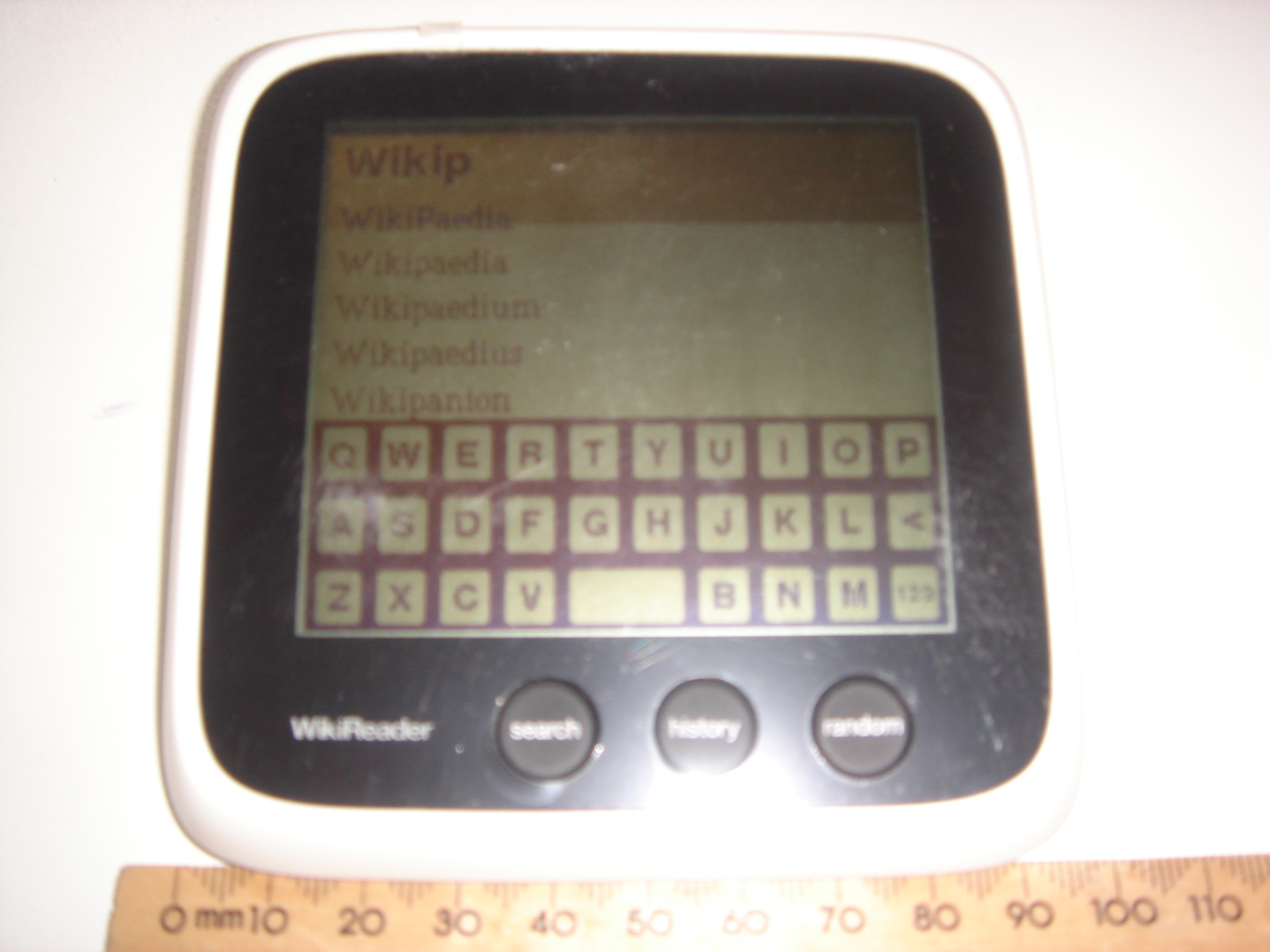
Russell Coker: The Wikireader

Just over a month ago I bought a Wikireader [1] from Officeworks (an Australian chain of stores that sell all manner of office supplies). It cost only $99, thanks to Brianna for informing me about this [2]. When I purchased my Wikireader an Officeworks employee had to get one from the back office and told me that I was the first person to buy one. I suggested to him that when a product isn t mentioned in their advertising and isn t put on the shelves it s unlikely to sell in quantity and that they shouldn t rely on bloggers to promote what is possibly one of the most desirable products that they stock.The Wikireader stores a copy of the text of the English language version of Wikipedia on a micro-SD card. They have a service whereby you can get two updates posted to you every year for $29, which would make it pretty close to free once postage and the cost of the micro-SD cards is taken into account. Also you can download new content. I have no immediate plans for updating my Wikireader as the content is more than good enough to answer idle questions while waiting for a bus but as it s lacking external links due to no net access and images it can t be used for serious Wiki reading IMHO.Brianna has documented the process of updating a Wikireader to add more content [3], she added the Chinese version and discovered that inter-wiki links are preserved! I have no immediate plans to add extra content (I don t know any other language well enough to read an encyclopaedia). Also an 8GB MicroSD card (which is the minimum requirement to use multiple languages) costs $35 and is a significant portion of the original purchase price.In terms of functionality the device is pretty good. The screen is not back-lit, but if it was then the two AA batteries wouldn t last anywhere near a year. The screen is not high resolution and the touch functionality isn t particularly accurate or sensitive but I guess that s a necessary trade-off to get the $99 price. The Wikipedia content seems quite complete, so far the only page which I found to be missing was the bio of an Australian architect, I m not sure if his page was removed from the Wikireader to save space or whether my device has a snapshot that predates the addition of the page.The Wikipedia page about downloading the database is interesting [4], it s 6GB of compressed data for the text of the English pages (not including history or talk pages) and for years they haven t even tried to provide a dump of the images. So I guess that a Wikireader that displays pictures is out of the question.The Wikireader has a parental filter, in my quick tests the only page that has been blocked is Sexual Intercourse , I could read all about safe-sex, infidelity, and lots of other related adult topics without being asked for a password. It also shows pages about goatse and other related things without asking for a password NB if you don t know what goatse is then you probably don t want to learn, trust me that it s something that most people won t want their children to learn about. The filter is so bad that I think they shouldn t include it, it will just give people false confidence. It s OK to sell a cheap device that is designed to give a detailed description of goatse etc on request to anyone, but IMHO it s not OK to sell such a device with a claim that it is kid safe and has parental controls . Note that holding down the History button will allow you to clear your history this is useful if you have just verified that goatse isn t blocked and you want to give the device to a young child.There is a button to give a random page, I believe that this would be more useful if it had some metric to make it more often return pages that might be interesting. It could weight the randomness by the length of the page (usually a longer page is more interesting to more people and has more links to other pages) or by some other metric that indicates the potential popularity. Random links often get me pages about obscure country towns and other things that probably aren t of interest to people who don t live near them.But overall this is a great product, $99 is not much to pay, and I recommend getting one!

24 November 2010

Sergio Talens-Oliag: The Freaky Wall (Part 2: Initial Installation)

For the Freaky Wall I have installed a Debian GNU/kFreeBSD system using the installer with ZFS support announced on: http://robertmh.wordpress.com/2010/09/06/debian-installer-with-zfs/ I used the mini.iso found on: http://people.debian.org/~rmh/zfs/kfreebsd-amd64/monolithic/mini.iso the 12th of October of 2010; as I had some problems and reported them to Robert is possible that the current image solves part of them. Installation plan I did a standard installation on a machine with two hard disks, but only used the first one from the installer. The plan was to use ZFS with RAID-1, but current versions of grub do not support booting from a ZFS + RAID file system, so I had to use the same technique used for Linux for a long time; three partitions: a swap partition, a small /boot partition and a big partition for /; / and /boot were formated to use ZFS. First reboot After the installation the system failed to boot because of a bug when building the /boot/grub/grub.cfg (some routes were missing a //@ prefix); to be able to boot Iwe edited the config on the grub prompt and later fixed the file:

    --- grub.cfg.orig       2010-10-13 16:40:39.000000000 +0200
    +++ grub.cfg    2010-10-13 18:38:47.535436766 +0200
    @@ -64,7 +64,7 @@
            set root='(hd0,1)'
            search --no-floppy --fs-uuid --set a371979bb836d1fe
            echo                    'Loading kernel of FreeBSD 8.1-1-amd64 ...'
    -       kfreebsd                /kfreebsd-8.1-1-amd64.gz
    +       kfreebsd                //@/kfreebsd-8.1-1-amd64.gz
            insmod part_msdos
            insmod zfs
            set root='(hd0,3)'
    @@ -75,7 +75,7 @@
            insmod zfs
            set root='(hd0,1)'
            search --no-floppy --fs-uuid --set a371979bb836d1fe
    -       kfreebsd_module         /zfs/zpool.cache type=/boot/zfs/zpool.cache
    +       kfreebsd_module         //@/zfs/zpool.cache type=/boot/zfs/zpool.cache
            set kFreeBSD.vfs.root.mountfrom=zfs:dkfbf1-ad4s3
            set kFreeBSD.vfs.root.mountfrom.options=rw
      
I haven't tested the installer since that day, but I believe that the current ZFS installer was fixed by Robert to deal with that problem. Once the system was booted I had to fix a couple of things: Adjusting ZFS to do RAID-1 On the second disk I created the same partitions as the ones on the first disk using parted; the final result was:
    # parted -l     
    Model: ST3250620NS/3BKS (ide)
    Disk /dev/ad6: 250GB
    Sector size (logical/physical): 512B/512B
    Partition Table: msdos
    Number  Start   End     Size    Type     File system  Flags
     1      1049kB  256MB   255MB   primary
     2      256MB   4256MB  4000MB  primary
     3      4256MB  250GB   246GB   primary
    Model: ST3250620NS/3BKS (ide)
    Disk /dev/ad4: 250GB
    Sector size (logical/physical): 512B/512B
    Partition Table: msdos
    Number  Start   End     Size    Type     File system     Flags
      1      1049kB  256MB   255MB   primary
      2      256MB   4256MB  4000MB  primary  linux-swap(v1)
      3      4256MB  250GB   246GB   primary
To use the second partition of both disks as swap I added the following to /etc/fstab:
    /dev/ad4s2      none            swap    sw              0       0
    /dev/ad6s2      none            swap    sw              0       0
To configure the mirroring for the root file system I did the following:
    zpool attach dkfbf1-ad4s3 ad4s3 ad6s3
As the /boot can't work as a replica I adjusted it to make two copies of every file:
    zfs   set copies=2     dkfbf1-ad4s1
Leaving the second disk copy alone, although my plan is to configure it to hold a copy of the /boot partition synchronized with rsync each night. After all those changes the system didn't boot, as the grub-pc generates a buggy /boot/grub/grub.cfg; the problem is on the /etc/grub.d/10_kfreebsd section:
    ### BEGIN /etc/grub.d/10_kfreebsd ###
    menuentry 'Debian GNU/kFreeBSD, with kFreeBSD 8.1-1-amd64' --class debian \
      --class gnu-kfreebsd --class gnu --class os  
          insmod part_msdos
          insmod zfs
          set root='(hd0,1)'
          search --no-floppy --fs-uuid --set a371979bb836d1fe
          echo 'Loading kernel of FreeBSD 8.1-1-amd64 ...'
          kfreebsd /kfreebsd-8.1-1-amd64.gz
          set kFreeBSD.vfs.root.mountfrom=unknown:/dev/ad4s3
          set kFreeBSD.vfs.root.mountfrom.options=rw
     
    ### END /etc/grub.d/10_kfreebsd ###
To fix it there has to be a copy of the modules for ZFS on the boot partition (in my case I moved the /lib/modules directory to /boot and created a link on the root partition to the new directory):
    cd /boot
    mkdir lib
    mv /lib/modules lib
    cd /lib
    ln -s ../boot/lib/modules
And instead of fixing the /etc/grub.d/10_kfreebsd code I wrote a new script (/etc/grub.d/09_zfs_kfreebsd) that creates the right config for my current configuration on the grub.cfg file:
    #!/bin/sh
    prefix=/usr
    exec_prefix=$ prefix 
    bindir=$ exec_prefix /bin
    libdir=$ exec_prefix /lib
    . $ libdir /grub/grub-mkconfig_lib
    prepare_boot_cache="$(prepare_grub_to_access_device $ GRUB_DEVICE_BOOT    sed -e "s/^/\t/")"
    kfreebsd_versions="$(ls /lib/modules/)"
    zfs_root_device="$(zfs list   awk '/\/$/   print $1  '   head -1)"
    for kversion in $kfreebsd_versions; do
      cat << EOF
    # Entry when using ZFS (we have issues with /etc/grub.d/10_kfreebsd)
    menuentry 'Debian GNU/kFreeBSD, with kFreeBSD $kversion and ZFS' --class debian --class gnu-kfreebsd --class gnu --class os  
    $ prepare_boot_cache 
          echo                    'Loading kernel of FreeBSD $kversion ...'
          kfreebsd                //@/kfreebsd-$kversion.gz
          kfreebsd_module_elf     //@/lib/modules/$kversion/opensolaris.ko
          kfreebsd_module_elf     //@/lib/modules/$kversion/zfs.ko
          kfreebsd_module         //@/zfs/zpool.cache type=/boot/zfs/zpool.cache
          set kFreeBSD.vfs.root.mountfrom=zfs:$zfs_root_device
          set kFreeBSD.vfs.root.mountfrom.options=rw
     
    EOF
    done
I solved the problem this way to have a working solution that does not break with squeeze upgrades, assuming that a future grub-pc package will deal well with my config and I'll be able to remove this script, but I guess I'll have to install it from backports. The entry generated by the script when called from update-grub will be similar to:
    ### BEGIN /etc/grub.d/09_zfs-kfreebsd ###
    # Entry when using ZFS (we have issues with /etc/grub.d/10_kfreebsd)
    menuentry 'Debian GNU/kFreeBSD, with kFreeBSD 8.1-1-amd64 @ ITI' --class debian --class gnu-kfreebsd --class gnu --class os  
          insmod part_msdos
          insmod zfs
          set root='(hd0,1)'
          search --no-floppy --fs-uuid --set a371979bb836d1fe
          echo                    'Loading kernel of FreeBSD 8.1-1-amd64 ...'
          kfreebsd                //@/kfreebsd-8.1-1-amd64.gz
          kfreebsd_module_elf     //@/lib/modules/8.1-1-amd64/opensolaris.ko
          kfreebsd_module_elf     //@/lib/modules/8.1-1-amd64/zfs.ko
          kfreebsd_module         //@/zfs/zpool.cache type=/boot/zfs/zpool.cache
          set kFreeBSD.vfs.root.mountfrom=zfs:dkfbf1-ad4s3
          set kFreeBSD.vfs.root.mountfrom.options=rw
     
    ### END /etc/grub.d/10_iti-kfreebsd ###
And after rebooting the machine with this new configuration the system boots OK. On my next post I'll continue explaining how to compile a kernel that supports the use of the OpenBSD Packet Filter and related technologies (CARP, pflog, etc.).

Jelmer Vernooij: On the way to Samba 4

After Samba XP 2008 Andrew and I started keeping a wiki page with our bi-weekly goals and achievements for Samba 4. Because planning in a Free Software project is hard (time availability and priorities change over time, and other volunteers are equally unpredictable) we called this our "Fantasy page"; it listed things we wanted to work on next ("fantasies"), but reality being what it is we would usually actually end up working on something entirely different. We discussed our progress and new plans in - what I would now call - a bi-weekly standup call. There were several reasons for doing this. It gave us some sense of direction as well as a sense of accomplishment; a way to look back at the end of the year and realize how much we had actually achieved. Because Samba 4 is such a long term project (it is 7 years old at this point) it is easy to become disillusioned, to look back at a year of commits and to not see the gradual improvement, just the fact that there is no release yet. We managed to keep this up for two years, much longer than I had anticipated, and eventually started to slip last year. More recently Kai and Tridge have started to blog weekly about their efforts to make Samba 4.0 a reality and I'm going to join them by trying to blog regularly - every two weeks - about my contributions, even if there were none. In the next two weeks I plan to work on finally getting alpha 14 of Samba 4 out and on fixing the daily builds of Samba 4 and OpenChange for Ubuntu on Launchpad after we did a massive reorganization of the private libraries in Samba 4. cp: Zero 7 - Somersault

Axel Beckert: Useful but Unknown Unix Tools: cut

Just recently someone asked on #debian.de how to extract the 3rd to 8th character out of some string. That reminded me that the GNU Coreutils tool cut is also quite unknown. The solution to his problem is:
$ echo Hurzlipuh   cut -c3-8
rzlipu
My favourite usage of cut is to restrict the output of programs which can t do that themselves to 80 columns (common terminal width):
$ dpkg -l   grep -i macro   cut -c-80
ii  docbook-to-man                                       1:2.0.0-28             
ii  latex-cjk-common                                     4.8.2+git20090105-5    
ii  m4                                                   1.4.14-3               
ii  mp4h                                                 1.3.1-5                
rc  swfdec-gnome                                         2.28.0-1               
cut can cut out columns based on characters (-c), bytes (-b), fields (-f) delimited by tab (or the delimiter given by -d). After many comments: Yes, dpkg -l is capable of restricting and even fitting its output to the number of available columns if $COLUMNS is passed as environment variable. (And $COLUMNS is set by default in the shell, but not exported as environment variable as it may change on terminal resize or WINCH signal.)

Matthew Garrett: Viewsonic and the GPL

Somebody linked me to this reddit story about the fact that Viewsonic appear to be engaging in the currently fashionable trend of shipping Android devices without providing any source. This one's more interesting though, in that Viewsonic appear to be entirely happy to publicly state that they have no intention of following their license obligations. I've pulled the kernel image for the device and confirmed that it contains code that's not present in the generic Android Tegra tree, so I don't think they have a leg to stand on here.

So of the companies I'm currently complaining about (Fusion Garage, Barnes and Noble, Viewsonic): One is in Singapore and two are based in the US. Chinese companies may be the current easy target when it comes to complaining about GPL violations, but the truth is that companies in countries with stronger IP enforcement are also either blissfully ignorant or feel that the risk of failing to follow their license obligations is low. This isn't a sustainable position. We've got three real choices here - do nothing, start lawsuits or start educating companies. The third is probably the most productive in the long run, though I wouldn't absolutely rule out the second if we don't get anywhere. I'm currently exploring the education possibilities. We'll see what happens next.

Next.

Previous.