I promised last week that I would be telling more on October 1st, about the mysterious Project X that I had been sporadically blogging about over the last few months. Better late than never, so here's the story:
Casablanca
I met Morocco-based French entrepreneur
Laurent Bervas via his blog in January 2006, while looking for countries nearby EU with a promising
ICT market, because of growing obstacles in getting work in my field, due to my not being an EU national.
By the time the situation had reached the ridiculous extreme that friends were continuously loosing juicy recruitment bonuses, simply because their employer's
HR department had issues with hiring non-EU nationals despite EU policies that clearly favor foreigners married to an EU national I figured that I ought to do something creative and see which of the countries bordering with EU might offer interesting opportunities.
Laurent was blogging about all the exciting opportunities he kept on seeing, since he relocated to Morocco to conquer the high-end Real Estate market. One day, he wrote about Morocco becoming a rising figure in the outsourcing business for the Francophone market, which prompted me to contact him. After a couple of weeks of discussion, he cautiously dropped his idea for a niche market he had spotted: a simple Linux-based set top box to surf the Internet. He then asked if I would be interested in developing it and in launching a startup with him to promote it. I gladly accepted.
Startup
That's when Laurent decided to introduce me to an old friend of his, Fr d ric Baille, who spent several years at Compaq, culminating with a role in the team that launched the iPaq. Fred's help was instrumental in defining the market positioning of our product.
Laurent and I discussed the product features at length over
IM and immediately agreed that the
OS would be based on Free Software. That left the hardware part unresolved... or so did Laurent think.
Years ago, I briefly worked in the management team of an Estonian data security startup. This gave me the opportunity to network with several movers and shakers of the Estonian ICT. Among them was a promising
ASIC and industrial design startup that produced really cool Thin Client hardware. The answer to our hardware needs, I figured, could easily be fulfilled by them.
My idea of contracting the hardware to Estonia was initially received with skepticism, so I made a simple proposal: why don't we hold the inception meeting in Tallinn and meet with the potential hardware supplier at the same time? Fred and Laurent accepted, so we spent part of April 2006 there, with me acting both as their friendly tourist guide and as the middleman for the introductions.
Fred and Laurent immediately fell in love with Tallinn's designer bars, omnipresent WiFi network and blond-a-plenty. Most of all, their visit at our potential hardware supplier gave them the answers they needed: Estonia is IT.
Overview
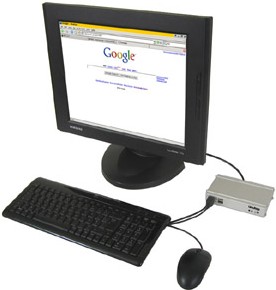
The hardware we selected is built around the AMD Geode LX, a nifty Pentium-compatible single-chip computer. It comes equipped with VGA output and four USB 2.0 ports, along with high-quality audio via 1/8" input and output jacks, plus a built-in encryption engine. We added 100baseT Ethernet connectivity (with provision for other networking options) to that, to complete the platform.
For the software part, we used ingredients from
Debian's Etch release, focusing on a configuration that would enable easy access to the most popular applications for home and small business use: Instant Messenger (Gaim), Multimedia player (Totem), PDF reader (Evince), Web browser (Firefox), word processor (AbiWord).
The result is this:
Press Coverage
The editorial team at IT-Neeger (an A-level Estonian ICT blog) immediately scooped
the story [in Estonian] and it produced such a strong response that the traditional Estonian media contacted the IT-Neeger team to write a feature article (stay tuned for details). The local Slashdot, Minut.EE, also
reported [in Estonian] on the IT-Neeger article.
Thus, myself and Laurent Bervas spent the better part of this week being blogged, interviewed and podcasted by a variety of Estonian and
French publications, which is how I only got around blogging this bit tonight.
Marketing
Contrary to our competitors, we fully intend on keeping this platform open, so our initial market will actually be Free Software developers with a penchant for innovation. As such, our first 50 units are exclusively intended for interested developers who want to improve upon our initial idea and participate in defining the final product.
Inquiries are welcome!


 I’m visiting my parents’ house in Vermont, where they finally got cable after the provider agreed to dig up the ground and run a mile or so of cable to their house in return for a two year subscription agreement. (I think after two years the cable company will almost have broken even on the cost of the installation).
Having been absent myself from the cable world for some time, I am impressed by the variety of interactive and “on demand” options. My parents’ low-end package includes dozens of free on-demand movies and music videos, as well as built-in easy-to-use tivo-like functionality. The on-demand music videos show one brief ad before the video — it seems the tradeoff is that if you are really going to watch the ad, they can get more money and show you fewer ads. (Or, maybe I’m wrong — if it’s one ad per video, I suppose that would be more ads, but it feels like fewer because of the “on demand” nature. I guess it’s a perceptual trick.)
Anyway, getting to the title of this entry. Anybody in the field of intellectual property these days has got to find
 Yesterday I was catching up with my magazine reading at Chapters (the Canadian equivalent of Border) when I came across an ad for a drug ad for bipolar disorder that struck me as slightly different less euphoric, more cautious to be exact compared with the ads that have been bandied loosely in all sorts of magazines in the last decade in the US.
The ad was for a drug called Abilify which must be some verbal riff on Ability (no?) and there was a very clear pronouncement on that ad that admitted they had no idea how the drug even worked. It went like this:
ABILIFY may work by adjusting dopmamine activity instead of completely blocking it and by adjusting serotonin activity. However, the exact way any medicine for bipolar disorder works is unknown.
I find this interesting because its tone seems to depart from other ads that seem somewhat more confident (or if they were less so, it was probably kept in the fine print). But when I went to the webpage, this caveat was a little harder to find, as it was a few clicks away within a page entitlted