Search Results: "cas"

20 March 2007

Gunnar Wolf: Flash disks' reliability

Uwe asks about fast, reliable, not noisy storage mechanisms - And yes, of course, he talks about Flash memory's well known limitation: The relatively low number of write cycles each area of the memory is known to be able to withstand. I recently told this same argument to a friend who was enthusiastically telling me about his dream project of setting up a computer based exclusively on solid-state storage. Of course, he didn't like the limitation.
But after reading a bit (sorry, I don't have the URLs at hand - but Google is a good friend), it seems that many (most? all?) controllers work around this limitation by rearranging the most used blocks around, so that the Flash gets as evenly used as possible. Quoting from Wikipedia's article on Flash memory:
Another limitation is that flash memory has a finite number of erase-write cycles (most commercially available flash products are guaranteed to withstand 1 million programming cycles). This effect is partially offset by some chip firmware or file system drivers by counting the writes and dynamically remapping the blocks in order to spread the write operations between the sectors. This technique is called wear levelling. Another mechanism is to perform write verification and remapping to spare sectors in case of write failure, which is named bad block management (BBM).
So, Uwe, just check the media you get supports wear levelling technology, and you should be safe.

19 March 2007

Lucas Nussbaum: Condorcet method and the french presidential election

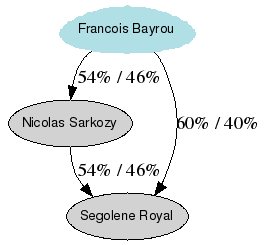
The french presidential election (in april/may 2007) will use plurality voting with two rounds (voters will choose 1 amongst 11 or 12 candidates during the first round. The two candidates with the most votes will be qualified for the second round). The latest polls clearly show how this election method fails to satisfy the Condorcet criterion. Using the second round results from this poll (only considering the 3 main candidates, since the other don’t have any chance to win the presidential election), we get this: 2007 elect results So Francois Bayrou is the Condorcet winner, and should win the election. However, the first round results, according to the same poll, could be:
  1. Sarkozy 31%
  2. Royal 24%
  3. Bayrou 22%
  4. Le Pen 12%
Since only the two first candidates are qualified to second round, Bayrou wouldn’t be elected. It will be interesting to see how those scores evolves until the first round (April 22nd).

18 March 2007

Sune Vuorela: a bug submitters fanclub

Anyone wants to join in the Luke Kenneth Casson Leighton fanclub? And these unfortunately aren’t candidates for DeFuBu

17 March 2007

Russell Coker: presentations and background color

In response to my last post about using laptops for presentations it has been suggested to me that using white (or a very bright color) as the background color can help some displays synchronise with the signal. I haven't had an opportunity to test this but it seems likely that as most computers are configured with a white background nowadays the display hardware is optimised for this case.

Another benefit of a light background is that it provides more ambient lighting to the room where the presentation is held. If all the lights are turned off (sometimes there is no dimmer switch) then the radiant light from the screen is the only form of illumination for the room.

Finally with the way the current generation of beamers work there is less heat trapped in the beamer if there is mostly white on the screen. This will hopefully decrease the incidence of hardware failures during lectures (which unfortunately are not uncommon in my observation).

Update:

Based on a comment on this blog entry I did a quick survey of the color scemes, black on white, yellow on blue, and white on green. Black on white got the most votes with some people saying that yellow on blue was most aesthetic while black on white was easiest to read ("clear and boring" was one comment).

One person pointed out that the light diverges slightly so black on white makes the letters look smaller while white on black makes them look bigger. My response to this is to use a slightly larger font.

Russell Coker: fluorescent lights and why it's worth saving resources

A common criticism of fluorescent lights is the inability to use dimmers, as mentioned in Julien Goodwin's blog.

However with some thought at the time the lights are installed this problem can be solved. The first thing to keep in mind is that an infinite number of levels of illumination (analogue scale) is not really required. In most cases two or three levels should do.

If you have two compact fluorescent lights that use 5W and 10W then you have the options of 5W, 10W, and 15W. If you have a large room to light (such as a lounge room) which needs 30W of fluorescent lighting for full illumination then you could have six 5W globes dispersed and have anything from one to six of them turned on to give different levels of illumination.

Of course if you don't plan electrical work then it's easiest to just use incandescent lights in those areas. As long as the areas that use the most light for the longest time have fluorescent lighting it shouldn't make too much difference.

In response to a post on Planete Beranger, saving energy DOES matter. Sure you saving a few KWh isn't going to make much difference on it's own, but when a million other people do the same it all adds up.

The lack of public transport in the US causes more problems for the country than just environmental damage. It hurts the economy by making it more difficult for people to get to work. It will hurt the defence forces in the (unlikely) event of an invasion (trains are the best way of moving large numbers of troops, heavy weapons, and military supplies. It also hurts the national interest in decreasing the ability to react to civil emergencies. For example the entire population of New Orleans could have been evacuated in time using a single platform of a European station. If every city had multiple stations that had a reasonable number of platforms and multiple redundant train lines then evacuating civilians and bringing in emergency equipment and workers would be very easy. In the Netherlands train lines often run on top of dikes, this means that the dikes are very strong (if they can sustain the weight of a freight train then they aren't going to be washed away by a wave) and that trains can still operate while flood waters are rising. If New Orleans is to be rebuilt to it's former glory then the Americans should consider a similar design.

Large cars are a temporary issue. As fuel prices rise people will choose smaller cars. Also hopefully people will start to realise that 4WD and SUV vehicles are actually less safe than cars and stop buying them for perceived safety.

The Chinese government doesn't worry about the same environmental issues, however they have more agressive targets for renewable energy use than most countries. It's not a matter of being nice (they aren't), but of looking out for their own self interest. It's a pity that the governments of the US, Australia, and EU countries have not yet done the same - but it will happen eventually.

As for supermarkets using open fridges, if the vent the heat outside the building then it will be just part of the building air-conditioning system. Every adult dissipates about 100W of heat when at rest, when shopping it would be more than 100W. Get 100 people in a supermarket (not the peak business time) and 10KW would have to be removed by the A/C system without counting heat from lights (fluorescent lights dissipate about half their energy as heat, they are much more efficient than incandescent lights but much less than LEDs),
and heat from other machinery.

Finally, if you want to see changes in government policy then join your local Green party!

Lars Wirzenius: Random thought: Energy meter

A few weeks ago I bought a device for measuring how much power other devices use. An energy meter, that is. You plug it in a power socket, and the device you want to measure into the socket in the meter, and it tells you how much power gets used at the moment, or over a period of time. So far, I've used it on two devices: my laptop, and the so called desktop machine I have, which acts as my music player, movie player, disk server, local Debian mirror, and so on. The results: the laptop used 2.25 kWh (kilowatthours) over 164.5 hours, for an average energy use of 13.7 Watts. That's measured over 24/7; since I put the laptop to sleep while I sleep, the laptop probably uses about 20 Watts while I'm actually using it. The desktop used 22.07 kWh over 232.0 hours, or about 95.1 Watts. Again, I shut it down while I sleep, so it's probably around 140 watts actual use while running. Quite a difference. That's for the case and contents only, the display is separate (but used only when I watch a video). Yearly energy use would be around 120 kWh for the laptop, or under 10 euros (at 8 c/kWh), and 830 kWh or 67 euros for the desktop. Both machines use cpufreq to slow down the CPU when load is low (which it is, almost all the time). I'll have to figure out other ways to optimize energy use in other ways.

Martin Michlmayr: X.org

In previous times, most Linux distributions and other free software projects relied on the XFree86 system. Over the years, the structures within the XFree86 project became were rigid and the project failed to innovate and keep up with the pace of the wider free software community. When XFree86 changed its license in February 2004, the active community and the majority of vendors quickly moved to X.org. X.org is a very active community and they decided to break up the monolithic code base and to adopt a more modern build system. As of X.org 7.0, the project moved to the modular system in which components are developed and released separately. Effectively, the project introduced a development mechanism which features two release mechanisms: individual components can be released as needed and there is an overall release of X.org in which all stable components are put together. These roll-up releases take place every six months.
VersionDateMonths
7.02005-12-21
7.12006-05-225
7.22007-02-159
Past problems Solutions Outstanding problems

16 March 2007

Romain Francoise: Playing with Yahoo Pipes

I've started using Yahoo Pipes today, and it's pretty cool. I wouldn't go so far as to call it a "milestone in the history of the Internet", but there are a few interesting use cases. Say for example if you're an avid reader of Planet Debian and you don't like the French Revolutionary Calendar, then you can use Pipes to filter out entries whose title matches a French Revolutionary month and enjoy a 100% revolution-free Planet. Or you could split matching entries into a separate feed, or just use regexp replacement to translate them into something else, etc. The possibilities are endless.

There's also a handy Babelfish module, so you can create a pipe that takes Planet Debian, translates it to French, then back to English. Hours of fun!

Sven Mueller: 40% nerdy?

Hmm, following up to a post by MJ Ray, I found out that I’m 40% nerdy:

You Are 40% Nerdy

You’re a little nerdy, but no one would ever call you a nerd. You sometimes get into nerdy things, but only after they’ve become a part of mainstream culture.
How Nerdy Are You?

Martin F. Krafft: Sony Ericsson customer support

I got myself a phone and wanted to give Sony Ericsson a chance to show that they are not like Nokia when it comes to customer feedback:
To: questions.ch@support.sonyericsson.com
From: sonyericsson.com@pobox.madduck.net
Product: W810i
Opinion: Hi, I am new owner of a W810i. I've encountered an issue
  with synchronising my address book, which contains many entries
  of companies. In those cases, first/last names are blank, only
  the company name field is filled. The W810i's phone book now
  displays these as "No name" at the top of the phonebook, which
  is not very useful at all.
  Is there any chance you could fix that in a firmware update?
  I suggest not making the name field mandatory, and to use other
  fields, like company, or primary phone number if the name is not
  specified.
  Thanks.
***
From: questions.ch@support.sonyericsson.com
To: sonyericsson.com@pobox.madduck.net
Subject: Case : 70876259
Dear Mr. Krafft,
Thank you for contacting Sony Ericsson on the World Wide Web.
If in your outlook the company names first and lanst name are
blank, the phone will register them as entry with no name. It is
not possible to get this changed with a software update.
"not possible", eh? I am really looking forward to open-source phones. This was most likely the last Sony Ericsson phone I ever bought. There's more:
To: questions.ch@support.sonyericsson.com
From: sonyericsson.com@pobox.madduck.net
Topic: Feedback on our sites
Opinion: I cannot submit this form without agreeing to subscribe
  to the eNewsletter and other marketing spam because of
  Javascript validation. Obviously, it's not hard to hack around
  this, but what is this??? Contact Sony Ericsson and get spammed,
  or don't contact Sony Ericsson at all???
***
From: questions.ch@support.sonyericsson.com
To: sonyericsson.com@pobox.madduck.net
Subject: Case : 70876261
Dear Mr.Krafft,
Thank you for contacting Sony Ericsson on the World Wide Web.
When you receive the Sony Ericsson confirmation e-mail, click on
"unsubscribe" and your personal data will be automatically
cancelled.
You can also unsubscribe by using the link contained in each
newsletter. Simply scroll down to the bottom of the newsletter,
there you will find information on how to unsubscribe. Please note
that you will need your login details to Fun & Downloads to be
able to unsubscribe.
So to recap: there is a check box on the contact form, next to the text:
I agree to receive copies of Sony Ericsson eNews or other offers, promotions or direct marketing from Sony Ericsson.
The Javascript, which is needed to submit the form, won't let you submit it without checking that box. Part of me wants to open the windows and scream "what the fuck were they thinking" and the other part really makes me now want to know. The easy workaround: get a Javascript console (e.g. via Firebug) and execute document.form.submit(). "Take back the Net" is really going to take a lot more effort than installing Free browers. NP: Dredg / Catch Without Arms Update: I replied to the second response, and promptly got an answer. Sony Ericsson really doesn't take long to get back to you, but then again it's hardly surprising if you look at the content:
To: questions.ch@support.sonyericsson.com
From: sonyericsson.com@pobox.madduck.net
Subject: Re: Case : 70876261
This seems like doing it the hard way. Why? Why not simply allow people
*not* to check the box if they do not want to receive newsletters?
***
From: questions.ch@support.sonyericsson.com
To: sonyericsson.com@pobox.madduck.net
Subject: Case : 70876261
Dear Mr. Kraft,
Thank you for contacting Sony Ericsson on the World Wide Web.
There is no reason why, it is as it is.
Thanks.

Lucas Nussbaum: Most broken spam protection ever

Just received that, in reply to a mail I sent:
This email is from X. My email address (X@Y.com) is protected against spam and viruses by MailInBlack. Please click on the following link in order to identify yourself to me and to allow your message to reach me.
http://192.168.0.252/v/?C8BEF10E72C&tmstp=20070316084314&tk=message_confirm&tkid=7951&lang=2 This needs to be done only once, for this email and all future email correspondence. Thank you for your understanding. X
MailInBlack seems to be a french company. No wonder why they guarantee that 100% of spams are stopped. (To be fair, I am not sure yet of who fucked up, it might be the admin)

John Goerzen: Farm Living Update

Well, we've been back in the country for about 2 months now. I figure it's about time to write about what's been going on lately around here.

The big controversy is about the county jail. Apparently the county is sharply divided about this. People are angry. Profanity has been uttered at county commission meetings. Some people want to build a new, larger county jail because the current jail has been overcrowded for years. Some don't see any problem with the current situation. Others want to close our county jail entirely and pay other counties to house our prisoners, saying that we usually have less than 6 prisoners total.

Yes, in all seriousness, the county is all abuzz about our jail where a population of 6 means overcrowding.

The weather has been getting warmer and that means an increase in traffic. Today I met two cars on the roads near our house -- one in the morning and one in the afternoon. That's a new single-day record. Usually I don't meet that many vehicles in a week.

And our local high school boys' basketball team made it to the state tournament for the first time since the late 80s. That was quite something. It's probably been years since our school had one of their games broadcast live on the radio. And probably about that long since any local business bothered to advertise on the radio. It even got mentioned in a sermon at church. (They took 4th in the state -- congrats!)

I also have prepared this helpful chart for you explaining a few differences about living out here.

ItemCityCountry
Check this before leaving homeTraffic report, so you can avoid the big 5-car pileup on the InterstateWeather report, so you can avoid the roads that are impassible if it rained last night You might comment on this when you get home in the eveningThree of the cars in the daily 5-car pileup were on fire and there was gas on the roadway and helicopters everywhere and you drove right past itSomeone drove down our road at night Always yield to...Trains, school busesEscaped cows and those trying to catch them Neighbors will be mad if...You are blaring loud music at 3AM Monday nightYou notice the gate to their pasture is open and you don't tell them Neighbors will not notice if...A car drives by at nightYou are blaring loud music, anytime Minor everyday dangersManiac drivers, drug dealers, Taco BellCow pies, electric fences, thistle infestations Seasonal events that prolong commute timeIndianapolis 500Harvest Bank tellers ask you...What your account number is, and could you give them a photo ID with thatHow your remodel has been coming Bank presidents...Never spek to youAsk about your brothers Distance from house to mailbox...50 feet or less1 mile or less Your car is sporty if...It can do 0-60 in a respectable timeIt can do 0-60, then slow back to a stop, before leaving your driveway Power flickers duringHurricanes and tornadosWind Water meters read byComputer or city employeesYourself; you write the reading on your payment stub each month, if you are lucky enough to qualify for a water service Free meals attainable by...Using a 2-for-1 couponAttending the annual business meeting for your electric company A good time for fundraising is...End of year so people can get a tax deduction on that year's taxesJust after harvest Fundraising benchmarks include...We have less than the price of a new house to raise!We have less than the price of a new combine to raise!

Russell Coker: things to do for the environment

I got the idea for this from Ben Hutchings.A. Copy the list below to your own journal and

Bold the actions you are already taking
Underline the actions you plan to start taking
Italicize the actions that don't apply to youB. Add one (or more) suggested action(s) of your ownC. Leave a comment here, so that she can track the meme to your journal, and copy your suggested action(s) back to my master list.
  1. Replace standard incandescent light bulbs with compact fluorescent light bulbs
  2. Choose energy efficient appliances - I'm documenting the power consumption of my computers
  3. Wash clothes in cold(er) water - Colder than what? I suspect this is based on American machines that are controlled by mixer valves rather than using a thermostat.
  4. Turn the thermostat of your hot water tank down to 50 C (125 F) - this is a good safety measure anyway
  5. Install a programmable thermostat (or turn the heat down over night and when you're out of the house)
  6. Register with the [Canadian Marketing Association's] Do Not Contact Service to reduce the amount of junk mail delivered to your house. - Substitute MPS.
  7. Eat less meat (particularly feedlot beef) - For practical purposes I'm vegetarian, with occasional exceptions.
  8. Walk, bike, carpool or take public transit as often as possible - I'm writing this on the tram
  9. Make sure you know what can be recycled in your area, and try to recycle as much household waste as possible
  10. Compost using an outdoor compost bin or an indoor vermicomposter
  11. Clean or replace filters on your furnace and air conditioner
  12. Buy local, organic or fair trade food where possible
  13. Reduce air travel - pity that long-distance trains suck in Australia
  14. Wrap your water heater in an insulation blanket
  15. Use a clothesline instead of a dryer whenever possible - don't own a clothes dryer, hanging up clothes inside near a heater works on cold days
  16. Plant a tree - pity my trees are dying because of the drought / climate change
  17. Buy fresh foods instead of frozen
  18. Keep your car tuned up and your tires inflated to their optimal pressure - also minimise driving. I drive about 5000Km per year.
  19. Use biodegradable dishwashing liquid, laundry soap powder, etc.
  20. Drink tap water (filtered if necessary) rather than buying bottled water - remember the Benzene incident...
  21. Turn the tap off while brushing your teeth
  22. Unplug seldom-used appliances and chargers for phones, cameras, etc., when you're not using them - the power use is small so I only do this for rarely used chargers.
  23. Plug air leeks and drafts around doors and windows with weatherstripping
  24. Switch from disposable to reusable products: food and beverage containers, cups, plates, writing pens, razors, diapers, towels, shopping bags, etc - I've done this for most things, could improve though.
  25. Consider garage sales, Freecycle, eBay, or borrowing from friends/family before buying a new tool or appliance - second-hand and refurbished computers are so powerful and so cheap that you don't need to care about the environment to do this.
  26. Reuse bathwater, maybe to flush the loo, water the garden, etc.
  27. Make sure your roof is well-insulated. - I think it is, but as tenants it's not really our choice.
  28. Always wear a jumper/sweater and socks indoors unless it's warm enough outdoors to go without both.
  29. Run your vehicle on biofuel/sustainable fuels
  30. Set up a grey water barrel to use when clean water isn't necessary - grey water should never be stored. It contains chemicals that are used as food for bacteria.
  31. Put grey water on your garden immediately without storing it.
  32. Install tanks to collect rain-water from your roof for watering the garden, washing your car, etc.

15 March 2007

Martin F. Krafft: I want Jabra!

My Nokia 6230 and I decided to split ways, or rather someone decided it was time for us to break up. Given that I have all my contacts on the computer anyway, and the 6230 was nearing its end of life anyway, I skipped the part about being annoyed and hopped into the store yesterday to pick up a new subsidised phone in exchange for a contract extension that was due anyway. Remembering the chat with Scott James Remnant at last year's Debian Barbeque, I went for the Sony Ericsson W810i. I initially wanted to stick with Nokia because I own many power adapters already, but Nokia recently switched the plugs, so that was no longer a motivation. I did have a brief look at the brand new E65 (the first Nokia phone to look decent, says Hanspeter), but I seriously doubt that Nokia actually fixed the problems with the E60, considering that the from the 6230 via the 6230i to the 6233, Nokia did not fix any single one of the problems I've had with the 6230. So now I have this shiny W810i (with a white case) and I am struggling to use it, having grown accustomed to Nokia over the past years. The worst is that it won't play nice with my Jabra BT250 headset, which has treated me very well and which I'd much rather keep than replace. However, while I can speak over it, I cannot use any of the buttons on the headset, meaning I cannot receive calls without touching the phone. The phone thus thinks that I would much rather talk through the phone than the headset and I have to transfer the sound manually. So I am wondering: does anyone of you have a newer Jabra BT headset, such as the BT250v or the BT500v and can confirm that it works with Sony Ericsson phones? If so, please let me know! NP: Rage Against The Machine / Rage Against The Machine

Erich Schubert: Energy saving meme

Via Russel Coker. A. Copy the list below to your own journal and Bold the actions you are already taking
Underline the actions you plan to start taking
Italicize the actions that don't apply to you B. Add one (or more) suggested action(s) of your own C. Leave a comment here, so that she can track the meme to your journal, and copy your suggested action(s) back to my master list.
  1. Replace standard incandescent light bulbs with compact fluorescent light bulbs - my room has a 12 W bulb. How much watts do you need for lighting?
  2. Choose energy efficient appliances
  3. Wash clothes in cold(er) water
  4. Turn the thermostat of your hot water tank down to 50 C (125 F)
  5. Install a programmable thermostat (or turn the heat down over night and when you're out of the house) - it is often sufficient to have the heater go on at like 7 at night and 5 in the morning for an hour each
  6. Register with the [Canadian Marketing Association's] Do Not Contact Service to reduce the amount of junk mail delivered to your house. - Substitute MPS.
  7. Eat less meat (particularly feedlot beef) - it's a lot healthier anyway. I enjoy the occasional steak, but you actually enjoy any taste more if you have more variance
  8. Walk, bike, carpool or take public transit as often as possible - I don't have a car. If I need to transport something big, I borrow one. I do my regular shopping via bicycle or public transit, which saves me looking for a parking space etc. anyway. Also note that when using public transit, you can work a bit, read a book, enjoy some music, ... and you arrive less stressed out than when driving a car.
  9. Make sure you know what can be recycled in your area, and try to recycle as much household waste as possible
  10. Compost using an outdoor compost bin or an indoor vermicomposter - at my parents
  11. Clean or replace filters on your furnace and air conditioner
  12. Buy local, organic or fair trade food where possible - tastes much better anyway
  13. Reduce air travel - pity that long-distance trains suck in Australia
  14. Wrap your water heater in an insulation blanket
  15. Use a clothesline instead of a dryer whenever possible - don't own a clothes dryer, hanging up clothes inside near a heater works on cold days - you often can do without ironing, too, by hanging them on a clothes hanger for drying they'll often be reasonably straight. My washing mashine has a program helping at that, too. It uses 40 C and takes just about .8 kWh and is called "easy iron".
  16. Plant a tree - pity my trees are dying because of the drought / climate change
  17. Buy fresh foods instead of frozen - especially with meat I do really notice a better taste
  18. Keep your car tuned up and your tires inflated to their optimal pressure - I don't have or need a car
  19. Use biodegradable dishwashing liquid, laundry soap powder, etc. - causes less allergies
  20. Drink tap water (filtered if necessary) rather than buying bottled water - our tap water here in Munich is better than bottled water anyway, and it saves you from carrying it, too.
  21. Turn the tap off while brushing your teeth
  22. Unplug seldom-used appliances and chargers for phones, cameras, etc., when you're not using them - consider to use a master switch for them
  23. Plug air leeks and drafts around doors and windows with weatherstripping
  24. Switch from disposable to reusable products: food and beverage containers, cups, plates, writing pens, razors, diapers, towels, shopping bags, etc. - especially shopping bags and beverage containers is easy
  25. Consider garage sales, Freecycle, eBay, or borrowing from friends/family before buying a new tool or appliance - saves energy and money
  26. Reuse bathwater, maybe to flush the loo, water the garden, etc.
  27. Make sure your roof is well-insulated.
  28. Always wear a jumper/sweater and socks indoors unless it's warm enough outdoors to go without both. - and turn down the heater a bit, it saves a lot of energy and money. Sweater and socks are quite comfortable...
  29. Run your vehicle on biofuel/sustainable fuels
  30. Set up a grey water barrel to use when clean water isn't necessary
  31. Put grey water on your garden immediately without storing it.
  32. Install tanks to collect rain-water from your roof for watering the garden, washing your car, etc. (at my parents; we also installed an overflow valve which will automatically redirect overflow water to plants that can always use more water)
  33. Don't keep windows open when your heater is on - especially don't keep them half-open. If you want better air, turn off the heater and open the windows for a few minutes completely. This will quickly refersh the air in the room. Then close the window and turn the heater on again.
  34. Turn off light that you don't need
  35. Stop your engine when waiting more than 10 seconds - for example at train crossings; maybe doesn't apply to Diesel as much because it relies on a operating temperatrue, but I doubt it cools down that quickly
  36. Install a solar panel on your roof for water heating - especially in summer or in sunny regions, this will allow you to completely turn off the heater during summer or even most of the year. A solar water heater will easily heat your water to 60 C (on hot days we reach 70 or 80 C), while even keeping your house a bit cooler). It can be installed yourself. At the same time, maybe add insulation to your pipes. If you minimize temperature loss over night, you'll even have warm water left in the morning.
  37. Use air circulation for cooling - much cooling can be achieved by having a good air flow, wearing appropriate clothing and avoiding heavy work during the hot hours. Consider doing a siesta and work in the morning and evening
  38. Ask your bank for an online-only account - some banks even offer lower fees if you don't use paper-based banking
  39. Try to make more use of daylight - that's like free light, you know.
  40. Walk and run more - it's healthy, saves you fitness club costs and it saves some energy if you are not using the lift. Walk to the supermarket or fitness club!
  41. Use your local recreational facilities - there are probably nice parks nearby where you can go running, maybe some place to go climbing nearby, some pool, ...; this can be an interesting alternative to watching a movie, too
  42. Use the refridgerator smartly - don't leave it open when not necessary, and keep the temperature only as low as you need it. Bring all your shopping into the house, sort it, and then open the refridgerator and put it all in in one go, for example.
  43. Learn how to cook energy efficient - for example, if you plan ahead you can put frozen foods into the refridgerator to defrost at virtually no power cost. It's also better for the food. Use lids when boiling water; you can also use it often for cooking if you turn down the heat. For rice, I usually put on the lid, and when the water is boiling I can turn the heat off again. With the lid on, the rice will end up cooked just fine. Also pick an appropriate applicance. A real water cooker will be more power efficient for making your tea than putting a small pot on a large flame.

Ingo Juergensmann: Debian

I've been using Debian for about 10 years now. Debian was my first Linux distribution. For about 7 years I've been running a Debian m68k buildd now. For some time now I've been worrying about Debian and its future.
IMHO, there are several reasons to worry about its future.
a) Release cycles.
Funny enough Martin Michlmayr wrote today about Gnome release cycles. Apparently Gnome suffered from similar problems in Gnome 1.x times as Debian still does today. The big difference between Gnome and Debian is: Gnome has actually learned from its mistakes and changed its release model to something better. Really. I don't use "better" very often in conjunction with "Gnome", but in this regard, the Gnome project did really something good.
Debian, on the other hand, suffers more and more from its "release everything for all when it's ready" syndrome. Releases are always delayed, it's a big chunk of work for everyone involved, Debian is losing users because of the delays and so on...
b) Debian as a base for other distributions.
Lately, several distributions announced, that they will use Ubuntu as a base for their own distribution and not Debian any longer.
c) Internal problems.
Debian has many internal problems. Many of them have to do with communication problems. Others with "you can't force anyone to do anything in Debian" ideology. Some with unresponsive persons in key positions. Some problems are a mixture of all the above. Altogether, these problems are causing that many developers are losing their fun in the long run.
d) Flame wars.
Well, actually this could be listed in b) Internel problems as well, but it's a massive problem of itself, so I think it deserves its own section. Flame wars are really time consuming and destructive. I know what I say. Been there, done that.
e) Getting new people in.
It is often said, that there are >1000 Debian Developers. The truth is that many of them are inactive or MIA. There was a proposal lately to find those inactive DDs and handle them accordingly. Given this fact of many, many inactive DDs means, that there is more work for those left. To solve this problem of overworked DDs (it's another truth, that some DDs are very active and have far too many jobs within Debian), Debian needs to attract more people and encourage people to contribute. Currently, it's not that easy for people to contribute, because of bureaucratic formalisms like sponsored uploads and such. Additionally, not everyone willing to help wants to do packaging or other tasks. There is a lot of other work to do like making graphics, organizing booths or other events, etc. Currently those tasks are mostly done by DDs that could better spent their time on developing Debian itself (packaging, porting, ...).

Ok, enough for now. But how can those problems be solved?
ad a)
Martin mentioned in his post about the Gnome Release management, that they changed from "release when it's ready" to time based releases and gained credibility because of this.
I think, Debian would benefit as well from this type of release management. Additionally, every Developer can react to this new method and make his packages fit for the release because he knows "Hey! Just 4 weeks until the release! Let's get my packages ready for it!"
Another problem, IMHO, is the "release all packages for all archs at one time" problem. This lead to the drop of m68k for etch (via some obscure circumstances like a very broken gcc 4.0 version and some strange release criteria, sometimes referenced as Vancouver Massacre).
Someone of the contestants for the new DPL job mentioned in his world domination plan to have a stable release of some basic components every year and having sub-releases for desktop environments (KDE, Gnome, XFCE...) every 6 months. Basically I believe that this is the way to go. You can discuss the time frames, of course. Release a stable base every year or every 2 years? But really, I think this would be the best way to deal with many problems Debian has.
If every 1-2 years a new stable base would be released, everyone could be happy: the admins with long release cycles for their servers, the users with faster releases for their desktops and (maybe) the porters who can (maybe) omit a subrelease of the desktop apps and concentrate on porting the base system if needed. Really. 15000 packages for (let's say) 15 archs is way too much work for everyone.

ad b)
With the above mentioned changes, Debian could re-gain some more market share and users from other distributions like Ubuntu - and be a base for distributions again. The reputation of Debian would rise again, because the releases wouldn't be delayed again.
I think it would be ok for smaller ports (like m68k) to release differently than the main archs (i386, amd64, ppc, arm): if every year a new stable base release would be done, it could be ok for them to skip a release, if necessary. Of course, details must be elaborated more in detail.

ad c)
There are many internal problems. The most urgent one is "bad communication". Needless to say that it's very important to communicate with your work mates to get your work done. If someone fails basic communication skills (answering questions about the stuff s/he is responsible for) in a reasonable time frame, s/he's simply the wrong person in that position and should be replaced. Of course this interfere with the current understanding of "not being able to be forced to do things" in Debian. People should change their mind about that.
Basically, it's similar to NMUs: if a package maintainer fails to fulfill his responsibilities (fixing bugs), he can either be enforced to fix the problem in that package by a bugreport or he can somewhat be replaced by doing a NMU when he's not fulfilling his duties. If he fails often to get his package into a good shape, he can be replaced permanently by hijacking the package.
Or to give a real world example: If you are holding a honorary post, let's say, you're doing the financial paper work for your soccer club, you can't say "Oh no... I don't have the time to do the tax declaration now or the next month...". That just doesn't work. Either you do your duties on time or you need to step down from that post. Otherwise you would do damage to your club. This is valid for other volunteer organisations as well, like Debian. Do your duties on time or step down from your post.

ad d)
Well, I'm not innocent when speaking about flame wars. Anyway, people can learn and change their mind. Flame wars are really bad in Debian, but it seems to be something like a sport to me sometimes. And usually it needs two parties for a flame war. That's the reason why I believe that expelling a fellow DD because they were involved in some major flame wars in the past is simply wrong. Either expel all parties or none.
A party is not only involved when answering to mails on mailing lists, but also when doing stuff that forces the other party to react - for example by starting a flame war on a mailing list. There's always action and always reaction. Therefore you can't disjoin both and just judge upon one party.
When a mediation is tempted, both parties are required to obey the mediators decision. Of course there should be a fair decision that honors both sides. Both sides have to give in for a successful mediation attempt. If that's not the case, the mediator failed. Not obeying to the mediators decision, because "no-one can be forced to do anything in Debian" (see above), is plainly wrong.
Anyway, most people should know of what I'm speaking here. I think it's plainly wrong to expel developers that have done really great work in the past due to some flame wars. Debian as a community has failed when it chooses this ultima ratio. Debian just proves that it is unable to establish a community where people can work together, when developers are going to get expelled because they thing that a mischief was done to him.
How would you feel and react when someone would play bad games on you? Wouldn't you yell loudly as well?
So, how can something like this be avoided? Maybe a Code of Conduct could help, maybe that CoC wouldn't be necessary when everyone would be nice to anyone and remember that there's a human being each mail with feelings and emotions?
Anyway, Debian needs to abandon flame wars in general.

ad e)
Well, I've already written a little bit about this problem above. There are many tasks in Debian that doesn't need technical excellence of packaging details - instead it needs excellence in social skills. Something that many technically focussed people are missing. Debian needs to become more attractive to those kind of people that are good at this non-technical issues and encourage them to join the project - and not to frighten them away by a very technical and bureaucratic procedure like the current NM process. Those kind of people won't wait some years to be actually being able to do work. They will just go on and find a place where their skills are better welcomed.


Ok, that's for now, I think... it's been a long post and therefore I've used folding for it.

Conclusion:
Well, not a nice one. Debian needs big changes in its structure and the candidates for the upcoming DPL elections identified some of them and put them on their agenda for their DPL period (if they win, of course). But the history showed that none of the past DPLs had really the power or the will to push big changes and made hard decisions. So, after all everything will stay as it is now. Nothing will change for the better, I fear. Users will leave Debian because of its stale release cycles, more and more Debian-based distributions will change their base to Ubuntu and Debian will become more and more irrelevant over time instead of being a strong participant in the free software world.
Evan Prodromou: 24 Vent se CCXV

South-by-Southwest is well and truly over now. I had a really good time. I don't have quite as much fun at general-Web conferences as at wiki-specific conferences, but I think it's also healthy for me to look outside my own narrow niche every once in a while and see what other people are doing. I think overall the conference was pretty great, although I don't feel like the passion of 2006 was here in 2007. I will say that I find it disconcerting that there are so few wiki people at SxSW. I think there should be considerably more, and I'm going to urge some intelligent and thoughtful people to come to Austin next year and get on panels. Practically every aspect of blogging gets covered at SxSW, but mine was the only wiki-specific panel this year. We're taking a week on the coast near Galveston to recharge batteries and get our work lives back on track. Then it's off to Las Vegas for the IA Summit. Maj will be in the conference area -- I'll be baby-sitting at New York New York or something. tags:

Dear LazyWeb Two questions:
  • N800 movies. What ffmpeg or mencoder or transcode parameters should I use to convert video to run on the media player on my Nokia N800?
  • Zip code of Canada. In the US, when you try to charge a tank of gas using pay-at-the-pump, frequently you're asked for the ZIP code of the billing address of your credit card. But if your residential address is in Canada (or anywhere outside the US), you don't have a ZIP code attached to the card. I usually go inside to the cashier and pay there, but I wonder: is there a special code you could use (like "00000") that means "I don't have a US ZIP code"? If not, why not?
Thanks for any answers (see Contact for how to get them to me). tags:

Twittering again It seems like Twitter is waking up from its own SXSW07 hangover and sending out the thousands of backlogged twits that weren't delivered at the right time. I don't think in the age of EC2 any public Web site should go AWOL due to too much traffic. Twitter suffered just the kind of surge that EC2 (and S3) are there to solve. tags:

14 March 2007

Phil Hands: Debian Tartan

The design is now agreed with the weavers, but unfortunately I misunderstood the price-list, so the prices I've been quoting for hand-sewn 8-yard kilts, and machined lady's 4-yard kilt-skirts were too low -- the correct prices for those and a couple of other things being:
Hand-sewn, 8 yard kilt: £420.00
Machined, 4-yard, skirt-kilt (lady's): £237.50
Machined, 6-yard kilt: £270.00
Waistcoat: £113.00
I'm sorry about quoting prices without making absolutely sure they were correct, the reason was that I was quoting the prices for standard weaves from stock, and it turns out that the custom weaves are more expensive. That said, note that the machined kilts are £80.00 cheaper than the previously quoted price (for hand-sewn), and that these are perhaps more appropriate to the use to which many of us will be putting the kilts anyway (hand-sewn are really an evening dress item, after all) Even so, I'll probably still fork out for the full 8-yards, on the basis that my dinner jacket is falling to bits after 20 years wear, so I need something new anyway. In case you're wondering what on earth I'm talking about, this has been discussed elsewhere. Just to make sure there are no other nasty surprises, if you are of a more rotund nature, you may find that it will take some extra material to encompass your circumference -- as an example, a 7 yard machined gents kilt will cost an extra fiver to stitch, and an extra £25.00 for the yard of cloth, so will come in at £300.00 rather than the usual £270.00 Confused? Well, so was I --- The designer's sending me a fuller price list, which I will ensure than anyone on the list of currently interested people is fully conversant with before we put the order in, so don't panic that I'll spend your money without giving you a final chance to come to your senses ;-) I hope that doesn't result in everyone changing their minds, but I'll understand completely if it does. Alternatively, you could decide that this is an opportunity to save yourself £80.00 by opting for a machined kilt (which AIUI are still made to measure, but just have proportionately less work and material in them) Anyway I'll post any further developments here so as not to continue spamming the lists. So, if you're interested in getting hold of any of the above despite the new prices, and have not yet told me you need to mail me now! -- the order will probably go in at the end of the week.

Eddy Petrișor: ext2online is not always online

If you are running a system with ext3/ext2 on top of a LVM partition, or just when you made the partition bigger, you obviously want the file system to grow, too.

Easy, ext2online is the answer:

ext2online /dev/mapper/hdapool-homefilesystem

Unless you run into an error like:
ext2online v1.1.19 - 2001/03/18 for EXT2FS 0.5b
ext2online: group 0, block 2 not reserved

ext2online: unable to resize /dev/mapper/hdapool-homefilesystem

That's when you start googling and find that ext2online is not that online and needs the file system to be unmounted you need to run first:

ext2prepare
/dev/mapper/hdapool-homefilesystem 23G

Note that the size there is the desired new target for the filesystem.
So you log off, go to a console, umount the file system (unlucky you if is the root file system, in that case you'll need the rescue mode - does D-I have ext2prepare?), run the command.

Now fsck.ext3 the device, mount it and try again ext2online. Now it should work.

Francesco P. Lovergine: To package or not to package...

... this is the problem

I just casually saw Norbert post about the ion3 querelle. This a very unfortunate example of collapsing interactions among upstreams and maintainers. My general advice (but for suggesting to use wmii or dwm instead of ion3 :-)) is avoiding packaging of development branches, but this is a decision which sometimes is difficult to take: some programs seems in development for years and stable releases could result largerly unusable or limited. Surely our - and generally speaking any distribution - release cycle and maintainance are not adequate for many on-the-edge software out there.

When upstreams releases [a]periodical milestones, those could be packaged, but upstream will not support them: we have already our problems in supporting regular releases for security independently by upstream for mainstream programs, without adding pieces of casual crap around.

Packaging a casual snapshots is out of question IMHO, but for using it in sid/experimental, so I can understand the upstream opinion, because many users report problem to upstream instead of maintainers. I see definitively no silver bullet anyway, but for maintainers' capability of understanding what should be packaged or not and opening an unbreakable communication channel with upstreams to be up-to-date in respect with upstream roadmap.

Next.

Previous.