Search Results: "mak"

14 September 2010

Kees Cook: my part in the ecosystem

I was asked to write about what I do at Canonical and what I do in the Free Software community at large. There is obviously a great deal of overlap, but I ll start with the things I m involved with when I m wearing my Ubuntu hat. My primary job at Canonical is keeping Ubuntu secure. This means that I, along with the rest of the Ubuntu Security Team, coordinate with other Free Software distributions and upstream projects to publish fixes together so that everyone in the community has the smallest possible window of vulnerability, no matter if they re running Ubuntu, Debian, RedHat/Fedora, SUSE/openSUSE, Gentoo, etc. Between vendor-sec, oss-security, and the steady stream of new CVEs, there is plenty going on. In addition to updates, the Security Team works on pro-active security protections. I work on userspace security hardening via patches to gcc and the kernel, and via build-wrapper script packages. Much of this work has been related trying to coordinate these changes with Debian, and to clean up unfinished pieces that were left unsolved by RedHat, who had originally developed many of the hardening features. Things like proper /proc/$pid/maps permissions, real AT_RANDOM implementation, upstreaming executable stack fixing patches, upstreaming kernel NX-emu, etc. Most of the kernel work I ve done has gotten upstream, but lately some of the more aggressive protections have been hitting frustrating upstream roadblocks. Besides the hardening work, I also improve and support the AppArmor Mandatory Access Control system, as well as write and improve confinement profiles for processes on Ubuntu. This work ends up improving everyone s experience with AppArmor, especially now that it has gotten accepted upstream in the Linux kernel. I audit code from time to time, both on the clock with Canonical and in my free time. I m no Tavis Ormandy, but I try. ;) I ve found various security issues in Xorg, Koffice, smb4k, libgd2, Inkscape, curl+GnuTLS, hplip, wpa_supplicant, Flickr Drupal module, poppler/xpdf, LimeSurvey, tunapie, and the Linux kernel. With my Canonical hat off, I do all kinds of random things around the Free Software ecosystem. I m a sysadmin for kernel.org. In Debian, I maintain a few packages, continue to try to push for security hardening, and contribute to the CVE triage efforts of the Debian Security Team. I ve written or maintain several weird projects, including MythTVFS for browsing MythTV recordings, GOPchop for doing non-encoding editing of MPEG2-PS streams, Perl s Device::SerialPort module, and the TAP paging server Sendpage. For a selection of things I ve contributed to other project, I ve implemented TPM RNG access in rng-tools, made contributions to Inkscape s build and print systems, implemented CryptProtect for Wine, wrote a PayPal IPN agent in PHP that actually checks SSL certificates unlike every other implementation I could find, added additional protocol-specific STARTTLS negotiations to OpenSSL, implemented the initial DVD navigation support in MPlayer, updated serial port logic in Scantool for communicating with vehicle CAN interfaces, tried to add support for new types of timeouts in Snort and Ettercap, fixed bugs in mutt, and added HPUX audio support to the Apple ][ emulator XGS. As you can see, I like making weird/ancient protocols, unfriendly file formats, and security features more accessible to people using Free Software. I ve done this through patches, convincing people to take those patches, auditing code, testing fixes and features, and doing packaging work. When I go to conferences, I attend UDS, DefCon, OSCon, and LinuxCon. I ve presented in the past at OSCon on various topics including security, testing, and video formats, and presented at the Linux Security Summit (miniconf before LinuxCon this year) on the need to upstream various out-of-tree security features available to the Linux kernel. I love our ecosystem, and I love being part of it. :)

Dominique Dumont: Creating a DEP-5 parser with Config::Model

Hello Following a discussion on #debian-perl IRC channel, I ve proposed to provide a script to parse DEP-5 files. The goal is to be able to parse *and* validate DEP-5 files. DEP-5 is a
proposal to make debian/copyright machine-interpretable. This proposal is driven by Lars Wirzenius. With Config::Model, any evolution of DEP-5 specification will
be easy to include in the DEP-5 model read by Config::Model. What DEP-5 model ? To keep a long story short, let s say that DEP-5 model is a description of DEP-5 syntax and semantic that can be used by Config::Model to perform validation. For more detail on how to create a model, please read this doc. In other word, DEP-5 model is DEP-5 document translated into a special format. First step was to directly edit the doc and munge it into a YAML document describing the structure of DEP-5. Here s a small extract of this YAML file (slightly edited to remove most long descriptions) :
 
---
class:
  Debian::Dep5:
    class_description: >
       Machine-readable debian/copyright
    accept:
      name_match: X-.*
      type: leaf
      value_type: string
    element:
      Format-Specification:
        mandatory: 1
        type: leaf
        value_type: uniline
        description: >-
          URI of the format specification, such as ...
      Name:
        type: leaf
        value_type: uniline
      Files:
        type: hash
        index_type: string
        ordered: 1
        cargo:
          type: node
          config_class_name: Debian::Dep5::Content

During this YAML file creation step, the problem raised by the License keyword became obvious because of License properties: Long story short, I had to add to Config::Model the possibility to specify a Parse::RecDescent grammar to validate a value. More on this later. Of course, the first draft of a model in YAML was far from being perfect. So the second step was to load it with config-edit-model. I had to fix a number of YAML errors and then some errors in the model description. Then, I had to write a parser to load the DEP-5 data into Config::Model tree. I first used Rapha l Hertzog s Dpkg::Control::Hash module. But this one is not able to cope with repeated fields without clobbering them. So I had to provide my own parser. The parser is divided in 2 parts:
- the parse function to load DEP-5 data in a simple data structure
- the read function to load the simple data structure into Config::Model s configuration tree You can view the code on Config::Model repository. Then the model is divided in 3 configuration classes: And the full model of Dep-5 can be also read on Config::Model repository: (The models are biggish because they include help text taken from DEP-5 documentation) Now some explanation is required on how is performed the License validation. The trick is that each License used must be listed in Dep5 s license parameter which is specified this way (in YAML syntax):
 
License:
  type: hash
  index_type: string
  allow_keys_matching: '^(?i:Apache Artistic BSD etc... other)[\d\.\-]*\+?$'
  cargo:
     type: leaf
     value_type: string
So this License element contains the list of licenses with their full text and only Licenses whose name matches the regular expression are accepted. Now, let s explain how the files are tied to the declaredlicenses. The Debian::Dep5::Content class had a License element that represent the relation between the files and the License(s). This bond is represented by Debian::Dep5::License configuration class. The abbrev and full_license elements are fairly obvious. The abbrev element is another matter. Here s its declaration (minus the description and help):
 abbrev:
 type: leaf
 value_type: uniline
 default: other
So far, so good. Now the meaty part: the validation requirement based on Parse::RecDescent
grammar: "license (oper license)(s?)
          oper: 'and'   'or'
          license: /[\\w\\-\\.\\+]+/i\n
               # PRD action to check if the license text is provided
               $return = $arg[0]->grab('! License')->defined($item[0]);
               "
This grammar specifies: This way, an abbreviation cannot be used without a proper License statement. This code is the first stab. Some more work is to be done soon: Anyway, I ll soon release Config::Model with this first version of DEP-5 parser. As always feedback are more than welcome. All the best update: added missing Parse::RecDescent link

13 September 2010

Lucas Nussbaum: Debian Bugs Search using UDD

After a few hours of hacking, I came up with Debian Bugs Search. This Ultimate Debian Database tool enables to query different kinds of Debian bugs (especially RC bugs using a multi-criteria search. It is aimed at being a replacement for the unofficial RC Bugs tracker, which has some bugs and fails to display the correct status for some bugs (Debian Bugs Search sees 450 RC bugs affecting squeeze, vs 278 for the unofficial RC bugs tracker). While Debian Bugs Search still lacks some features that the unofficial RC bugs tracker has, it also brings some new features. The main advantage is that it makes it easy to find some classes of interesting bugs, for example: RC bugs affecting squeeze and sid, tagged patch, sorted by time of last change. Why weren t they fixed using the patch? RC bugs affecting squeeze and sid, tagged pending, sorted by time of last change. Why weren t they fixed by an upload if they were tagged pending a long time ago? Bugs affecting squeeze but not sid, and marked as done. Why didn t the fixed packages migrate to testing? I m open to suggestions of improvements, bug reports, or better, patches. Since it is UDD-based, it is quite easy to add more information. My own TODO list is:
- add popcon information (also enable sorting by popcon)
- add a way to display/hide additional columns (popcon, package s versions)

Alexander Wirt: Etch Backports removed from backports.debian.org

Today the Backports for Debian Etch got removed from the backports.debian.org archive. Should you really still need them, the backports are still available from http://archive.debian.org/debian-backports [1] but we recommend everybody to upgrade from Etch with backports to Lenny (with backports) now, as there is no security support anymore for Etch.Over its lifetime etch-backports accumulated a total of 508 different backports, resulting in more than 2250 binary packages for all Debian architectures offered to the users. All together the available backports and their source occupied 13Gb of mirrorspace and the backports team would like to thank every contributor and mirror admin for their work and help to make this possible.[1] deb http://archive.debian.org/debian-backports etch-backports main

Iustin Pop: 3ware raid resize via pivot_root

How pivot_root won against a stupid RAID controller This post is brought to you by a very stupid 3ware 9650SE RAID controller, which doesn't understand the concept of growing a RAID array after all disks have been replaced by bigger ones. Or, well, it can, but the procedure, involving sending array dumps to the technical support, then receiving a program to run under DOS (!), doesn't inspire me with confidence. Furthermore, this stupid RAID card doesn't allow easy reordering (if it's possible, and I just missed it, please let me know) of the RAID arrays at runtime, only from the BIOS screen, and I didn't have access to that (only poor man's serial console under Linux). So, after buying new harddrives, and replacing the original ones in the RAID1 array with double the capacity, I realised I have to do a manual conversion. Basically, go into single-user mode, remount all read-only, split the RAID1 array into its (identical) components, change root directory to the second disk, re-partition the first disk, copy the data from the 2nd to the 1st disk, then re-add the 2nd disk to the 1st one (repartitioned) to re-establish the RAID1. All this, on a headless (no keyboard, no VGA) machine, just with a serial console. Of course, if this is just your local machine, you can easily reboot from an external media, and do all this easily from a full user-space. In any case, I'm writing this down, as there seem to be no easily findable guides on how to do the resize on a 3ware with its restrictions. Procedure Disclaimer: you might lose data via this, there are no guarantees. Have up-to-date backups. First, make sure you have power control (you can power-cycle the box if needed) and the serial console works. Also, make absolutely sure that the RAID array is fully consistent, and that you don't have any bad sectors on the drives, as you will lose redundancy during the operation. If /usr is not on your root file-system, then you need to copy /usr/sbin/chroot to somewhere on it. Also, if you have tools for the array that are not on your root file-system, you should copy them there now. In my case, that was tw_cli. First reboot Reboot into init=/bin/sh. Note: I've tried to simply go into single-user mode, or to reboot with emergency, but this doesn't work, because in both modes, beside the init process with PID 1 and your shell, there's another init process (the parent of the shell), and I didn't know how to tell it to re-execute itself. To the main init process it's easy, you just run telinit u, but that child keeps the old root directory mounted. If it's possible to re-exec that child too, then this step can be skipped please let me know how! Changing the root mount Make sure everything is mounted read-only (should be), then split the raid array into its component drives, using whatever tool the card needs. For me, it was:
# tw_cli /c0/u0 migrate type=single
The second drive now should be visible e.g. as /dev/sdc, so mount it somewhere, and pivot_root to it:
# mount -o ro /dev/sdcX /mnt
# cd /mnt/
# pivot_root . mnt/
# exec chroot .
At this point, the new root (on some partition on /dev/sdc) is mount at the root, and the exec call replaced the current shell with another one that has the right root directory. So nothing should keep the old root directory (at /dev/sdaX) in use, and umount /mnt (or umount /dev/sdaX) should succeed now. Recreate the first raid array Now, since it's no longer in use, you can delete and recreate the first raid array. Once it's available, you have two choices: I did the latter, since I wanted to use the new alignment standards (the initial installation was still using sector 63 for the boot partition, etc.) as a future preparation for either SSD or 4K-sector drives. So I used: In any case, either copy the entire disk, or each partition in turn, or possibly pvmove from the old to the new disk, etc. Switch back the root mount At this point, /dev/sdc is no longer used, and you can again change the root directory. This is similar to the first pivot_root, but now using /dev/sda as a target. All the instructions are the same. Convert back to RAID1 Now, since (in our example) /dev/sdc is no longer in-use, you can delete that drive and rejoin it to the first drive, recreating the RAID1 array. In my case:
# tw_cli
/> /c0/u2 delete
blah blah [y/n] y
/> /c0/u0 migrate type=raid1 disk=X
At this point, the machine is again redundant (or will be once the resync finishes), but it still needs one more step or it won't boot correctly. Reinstall the boot-loader Now, for reinstall the boot loader, you'll probably need to mount /boot (and mount it read-write), and do whatever you need. In my case, I re-ran lilo, but grub-install /dev/sda should also work. Final reboot And now, you only need to reboot into the normal, resized system. Since you can't easily use shutdown when booted with /bin/sh as init, just use /proc/sysrq-trigger to sync/unmount/reboot. Thoughts While I use a hardware RAID controller for the battery backup it offers, I have never thought it cannot do such a simple operation (compare with mdadm --grow /dev/mdX --size=max). Second, I knew about pivot_root but have not used it before. It's a very very nice thing, and the only downside is that you can't really use it with more than a few processes, since it's hard/impossible to change a random process' root directory. But anyway, it works, and it's damn handy for doing things to the root file-system or in general to the root drive (e.g. just repartitioning it) when you can't boot from another media (e.g. remote machine).

Amaya Rodrigo: Of inner peace and struggle

[Nothing related to Debian here, move on if you don't care about my recurring obsession with the end of the world, Cassandra pains, or Big Phat Living Room Revolution yearnings].

Although I am still looking for a community of anarcho-primitivists that want to accept me joining their frugal living, and simply slip off the social construct, the system, the fucking face of earth, call it what you will, I could find some comfort in my favourite feminist blogger's take on the subject of my midlife crisis regarding ecology, capitalism, patriarchy, child bearing, overpopulation, meat consumption and all the rumination of consuming thoughts that (still) make my life miserable and have kept me running away from human contact for a year.

[Emphasis mine]

At what point does human culture depart from the Natural? With the invention of computers? TV? Cars? The cotton gin? Electricity? Taco stands? Gunpowder? The printing press? Written language? Shoes? Crop cultivation? Yurts? The wheel? Did humans become unnatural when the good old days of picturesque, endless agrarian toil, feudal oppression, unchecked disease, ignorance, and death from dysentery at 35 turned into the bad new days of urban post-industrial capitalism where a pound of fair-trade organic coffee costs $12.99 and your email inbox is full of spam?

ah. Everything humans do, or have ever done, is natural. We can t do anything else. The idea that modern culture is un-natural is nostalgic and inaccurate. Living off the grid in a yurt is good in some absolute sense, whereas driving an SUV from a suburban bungalow to the stripmall is bad ? Come on. This a romantic, but misguided view. The cosmic reaction to a 20 Ford Expedition is the same as to a sanctimonious Prius: bupkis. The universe doesn t give a fuck about you or your lifestyle choices. It doesn t give a fuck about the economy, oil spills, or civil unrest in Blargistan. It doesn t give a fuck about katydids. Eventually our whole planet will be erased from space, and the galaxy won t bat an eye. The inevitable extinction of our species (imminent, according to research here at Spinster Laboratories) via the exhaustion of available resources is as natural as a fresh-picked peach. As Andre 3000 and other dude philosophers have observed, nothing is forever.

Yes, yes, when people use the word natural what they really mean is free of chemical additives and maybe some of the assorted hippie concepts that go with that narrative. Barter economies, home furnishings made from bamboo, vegan cookbooks, living in the country. While I would argue that it is just as natural for people to put chemical additives in things as it is to not put chemical additives in things, I admit that it is appealing to fantasize that the source of human misery is an unnatural isolation from Nature, and that doing yoga on an organic rubber mat and drinking organic spinach smoothies will put me back in sync with the cosmos.

But alas, I m already in sync with the cosmos, and so are you. In other words, this is it. This is what we ve become, and this is what we get. Which is not to say that a person can t fantasize about a verdant paradise full of songbirds and polar bears and Bengal tigers, untouched by human influence. Only, that world isn t a world we could actually live in. The minute you add contented children, lazy from a carefree day at the swimming hole, eating ripe plums on the porch at sunset to that scenario, natural history changes, and it s right back to our scorched-earth dystopia. Our giant brains use up resources, it s as simple as that.

As long as we re still here, though, we might as well try to make the best of it.

http://blog.iblamethepatriarchy.com/2010/06/19/heads-up-art-week-starts-on-monday/


Though the comfort is somewhat ephemeral, because deep inside, I know she's wrong, I know another way is feasible, but I have given up already, I have very well come to terms with extiction, I get an enormous pleasure from the thought of the very well deserved human mass suicide-by-cop^Wnature, and in fact, I trust and hope it will save me personally from facing the hard times ahead, as I am a damn coward, paralized by fear, hopeless about the flock ever getting it (is it so hard, really?), while doing as much as I can but completely overwhelmed by the need of changing a world everyone seems to like just as it is. I can certainly empathize with much more disturbed ways of airing similar anguish, among many other examples, such as The Unabomber, or The Weather Underground. I don't even want to go there as I know violence all too well and it is not fun to be on the receiving end. But I see the screaming desperation behind the motives of acts I am not at the liberty to discuss here. I wonder if consumption of resources in the form of books will numb the disorder or make it worse and what sort of medical arrangement the stablishment has for it. As you click away the previous links will mean nothing to you because a)it is Wikipedia after all, and b)you probably don't even understand what the problem of eating animal corpses is, humans are omnivores after all, and what is all this nonsense about dropping language altogether.

WTF, there was no comfort after all, and I am still a nutjob.

Dirk Eddelbuettel: RcppArmadillo 0.2.6

Now that Rcpp got updated to 0.8.6, we have an updated RcppArmadillo release containing mostly updates to Conrad's Armadillo version 0.9.70 as well as some more templated sugar magic. RcppArmadillo makes it easy to write highly efficient and highly readable C++ code for linear algebra (based on Armadillo) in R extensions (using Rcpp for the interface). The short NEWS file extract follows:
0.2.6   2010-09-12
    o   Upgraded to Armadillo 0.9.70 "Subtropical Winter Safari"
    
    o   arma::Mat, arma::Row and arma::Col get constructor that take vector
        or matrix sugar expressions. See the unit test "test.armadillo.sugar.ctor" 
        and "test.armadillo.sugar.matrix.ctor" for examples.
More information is on the RcppArmadillo page. Questions, comments etc should go to the rcpp-devel mailing list off the R-Forge page.

Robert Collins: What do I do @ work?

I recently moved withing Canonical from being a paid developer of Bazaar to take on a larger challenge Technical Architect for Launchpad. Its been two months now, and its time to put my head up out of the coal face, have a look around and regroup. When I worked on Bazaar, every day when I started work got up I was working on a tool anyone can use, designed for collaboration upon sourcecode, for people writing software. This is a toolchain component right at the heart of the free software world. Bazaar and tools like it get used everyday to manage, distribute and collaborate on the sourcecode that makes up the components of Ubuntu, Debian, Fedora and so forth. Every time someone new starts using Bazaar for a new free or open source project, well I felt happy happy that in my small part I m helping with this revolution we re carrying out. Launchpad is pretty similar to Bazaar in some ways. Obviously they are both free software, both are written in Python, and both are sponsored by Canonical, my employer. And they both are designed to assist in collaboration and communication between free software developers albeit in rather different ways. Bazaar is a tool anyone can install locally, run as a command line, GUI, or local webserver, and share code either centrally (e.g. by pushing to Launchpad), or in a peer to peer fashion, acting as their own server. Launchpad, by contrast is a website which (usually) folk will use as a service in their browser, from the comand line FTP (for package building), ssh (for Bazaar branch pushing or pulling), or even local GUI programs using the Launchpad API service. This makes it more approachable for first time collaborators, but its less able to be used offline, and it has all the usual caveats of web sites : it needs a username and password, it s availability depends on the operators on the team I m part of. So there s a lot less room for error: if we do something wrong, the system is unavailable, and users can t just apt-get install an older release. With Launchpad our goal is to to get all the infrastructure that open source need out of the way, so that they can focus on their code, collaboration within their team and almost uniquely collaboration with other teams. As well as being open source, Launchpad is free for all open source projects to use Ubuntu is our single biggest user they use it for all bugtracking, translation and package building, and have a hugefraction of the total storage overhead in the database. Launchpad is a pretty nice system, so people use it, and as a result (on a technical basis) it is suffering from its own success: small corner cases in the code turn up every day or two, code written years ago to deal with a relatively small data set now has to deal with data sets a thousand or more times larger (one table, for instance, has over 600,000,000 rows in it. For the last two months then, I ve been working on Launchpad. As Technical Architect, I need to ensure that the things that we (users, stakeholders and developers of Launchpad) want to do are supported by the structure of the system : the platform(s) we re building on, the way we approach problems, coding standards and diagnostic tools. That sounds pretty dry and hands off, but I m finding its actually very balanced. I wrote a presentation when I started the job, which encapsulated the challenges I saw in front of the team on this purely technical front, and what I thought I needed to do. I think I was about right in my expectations: On a typical day, I ll be hands on in a problem helping get it diagnosed, talking long term structural changes with someone around how to make things more efficient / flexible / maintainable, and writing a small patch here or there to help move things along. In the two months since I took on this challenge, we ve made significant headway on the problem of performance for Launchpad : many inefficient code paths have been identified and removed, some new infrastructure has been created as is being rolled out to make individual pages faster, and we ve massively increased the diagnostic data we get when things go wrong. We ve introduced facilities for responding more rapidly to issues in the software (but they have to be rolled out across the system) and I hope, over the next 4 months we ll reach the first of my performance goals: for any webpage in Launchpad, it will complete rendering in 99% of the time. (Note that we already meet this goal if you measure the whole system, but this is biased by some pages being very frequently hit and also being very small).

Eddy Petrișor: Fixing a bookmark corruption in Iceweasel/Firefox

At some point in the past my bookmarks broke in such a way that I wasn't able anymore to alter in any way the bookmarks, deletions, additions, reorganisation, nothing worked.


Way before this event I set up a git repo in my .mozilla directory and committed everything in the directory (except obvious cache files and such) in the repo. I didn't make a cronjob with this since I didn't thought of a proper way to make sure the browser wasn't started (the data might have been inconsistent at commit time), and, since most of the time I have the browser started, it seemed rather useless to try to automate for a very, very small window of time when the browser data would be in a consistent state. As a consequence, I did occasional manual commits in the git repo.

When the bookmarks issue appeared I realised that my last git commit was so old that it didn't made any sense to try to restore since I would have had lost bookmarks, passwords and plugins. So I made a checkpoint commit os the broken profile and resorted to all sorts of manual attempts at fixing the issue, but all my efforts of playing with the bookmarks.* files proved to be useless.

I concluded that icewesel/firefox 3.5.x was using some other mechanism and decided to dig into the issue at some latter time when time allowed me to analyse and fix it. Today was that day.

I began by creating a backup for the bookmarks via the Bookmarks Manager export function. After a hickup, it managed to save a proper bookmarks.html file. I tried to import that file, but the breakage remained.

Then I decided I should prepare for the worst, installed an addon which allowed me to save all stored passwords and created a new account (started firefox from the command line with 'firefox -ProfileManager') with the intention to transplant files from the old files into the new one. Short after that I realised that it would be smarter to commit the new profile, too, import the bookmarks from the backup file and replace the touched files back into the old profile.

After the import and closing the browser, git informed me that the modified files were:
XPC.mfasl
XUL.mfasl
cookies.sqlite
localstore.rdf
places.sqlite
pluginreg.dat
urlclassifier3.sqlite


At this point the modification of the binary .mfasl files looked very ugly to me, but I had a hunch that the only relevant file to my problem was the places.sqlite file and I went on to check the contents of the file with sqlitebrowser. After inspecting also the urlclassifier3.sqlite file (whose contents were unreadable), I decided to give it a try at simply placing the places.sqlite file in the old profile and see if the problem would be fixed that way. After all, I had the whole profile's state in git so any breakage could have been undone easily.

I started firefox using the old profile and the problem was fixed. Yay!

Now I have my bookmarks back and a suggestion for the mozilla people: please don't keep useless files like bookmarks.html in the profile once they become outdated, they are misleading.

P.S.: I still have to think of a way to make automated sane commits. Maybe I'll try to make an iceweasel/firefox addon. This could be a nice idea since I could learn something new, too.

12 September 2010

Theodore Ts'o: Moderate Muslims need a better PR Agency

There has been much made of recent reports that roughly half of Americans have an unfavorable view of Islam. And as usual, there are those who will try to claim that Muslims really aren t all that bad, and that Sharia is just set of nice, abstract principles which are all about the protection of life, family, education, religion, property, and human dignity. And on the other side, we have people pointing out that using Sharias as justification, there are countries which are stoning women and chopping off poor people s hands and then forbidding Muslims from arguing about whether such things are just. Worst yet, some of the more public moderate Muslims , such as Iman Rauf, refuse to criticize organizations such as Hamas, on the ground that he is a bridge builder , and it wouldn t help to criticize Hamas s terrorist activities as being anti-Isalmic. OK, so let s grant for the sake of argument the claims that Shariah really is far more than just criminal sanctions, but mainly about exhorting people to live a moral life, and that of the 1,081 pages of the two-volume Arabic text which Sherman A. Jackson (the Arthur F. Thurnau Prfessor of Arabic and Isalamic Studies at the University of Michigan) used to study Shariah, only 60 pages were devoted to criminal sanctions (i.e., the stoning and the cutting off of hands), and only 19 were devoted to Jihad. Let s even further grant the claims made by Humaira Awais Shahid that most Muslims reject Political Islam and are not even arabs. OK. But that case, wouldn t there be more Imans publically disavowing the people who advocate terrorism and suicide bombs as not being Islamic? Not all of them are bridge-builders, are they? And if so, some of them might be better deployed towards saying what Islam is not, and saying that perhaps people who espouse those beliefs are being profoundly unIslamic and saying this loudly outside of their Mosques. Oh, I understand that many Muslims feel that they shouldn t be asked to repudiate the sins of a few crazy terrorists ; just as all Christians shouldn t be held accountable for disturbed crazy rants of a small-time pastor from Gainsville, Florida. But at the same time, it seems to me that Islamic leaders should be eager to say, loudly, that what is being done in the name of their religion in Iran and Nigeria is wrong, and to denounce it. Maybe, some would say, that they are doing that and the media isn t paying attention to them. Well, the Media is surely paying attention to people like Iman Rauf, and he refuses to denounce Hamas! I would gently suggest to those Islamic leaders who feel that they and their faith haven t been given a fair shake, to hire a better PR agency; and make sure that active denunciations of that which they claim does not represent true Islam is shouted from the rooftops; published in press releases; made in press conferences. And actively denounce your fellow Muslims that you feel are shaming your religion, instead of complaining about American Islamophobia. Trying to pretend that there is absolutely no truth in why Americans might be afraid of terrorists who have been hiding under the mantle of your religion is not going to help your cause. There may be truth in the fact that many Americans don t know as much as they should about Islam and Shariah. And there may be truth that American unswerving support of Israel, despite the fact that they acted in profound and unjust ways against the Palestinians, is not only morally and ethically wrong, but has hurt American interests. I certainly believe that to be to true; I am no friend to fundamentalists of any stripe, whether they are Christian, Jewish, or Islamic; and I think the Jewish fundamentalists have almost completely taken over the Israeli political discourse. But all of that is irrelevant if the goal is reduce people e negative views towards Islam. And in any case, if you really believe that attacking innocents, and coercing religion by threatening Muslims who have fallen away from their faith with the death penalty is wrong, then it s wrong regardless of whether those innocents happened to vote for politicians who have been influenced by way too much money from AIPAC. So instead of trying to lecture Americans about their uncritical support of Israel, why not just stand witness to the fact that killing innocents is wrong, and that people who do that are not Islamic, no matter what they claim or how impressive their turban might happen to be? And maybe it might be a good idea to speak out against those who would lend support, whether moral, or financial or logistical, to people who do these unIslamic things in the name of Islam? And it may not be enough to say it once; it needs to be said again and again. Which is why it s important to hire a good PR agency. No related posts.

Dirk Eddelbuettel: Chicago Half Marathon 2010

Second Sunday in September -- time for the annual Chicago Half Marathon now in its fourteenth edition (and I have been running it in 2003, 2004, 2005, 2006, 2007, 2008 and 2009 making this and the JPM Chase Corporate Challenge the races I've run most often). And the course was altered this year, alongside with an earlier start as the Bears have their season home opener today. So we started north towards 57th, then running down to 67th, turning east towards the lake at around three miles --- and having the remaining ten miles along the lakefront running up to 31st (the usual turn) and back down to 63rd. I like this course better; let's hope it sticks. Race conditions were fantastic. We had a rainy and gray day yesterday but today is pure bliss. Temperatures around 60 degrees at the 7:00am start, no wind, sunshine and not a cloud in the sky. The race itself went well. I had a pretty brutal running year suffering most of the time from some archilles tendon inflammation. It has gotten better in the last few weeks possibly thanks to some heel cups I now put in the shoes. But I had exactly one run longer than ten miles since the Boston Marathon. So I lost a lot of speed, as well as endurance and was a little nervous as to how I'd do. And considering all this, it went pretty well. I fininished in 1;41:50 or a 7:47 pace. While is easily the slowest half in a number of years, at least I got to run it evenly, pain free and with a negative split (== faster second half) and some gas left for a fast last half mile or so. So maybe I don't have to retire from running just yet. We'll see if I get some speed back in 2011.

Lucas Nussbaum: Ruby packaging in Debian and Ubuntu: Mythbusting and FAQ

A lot is being said on how Ruby is packaged in Debian and Ubuntu. In this post, I m trying to go through the most common myths and give my position as a Debian Ruby maintainer. Note that those are my views, not necessarily those of the other Debian Ruby maintainers. Myth: Ruby is completely outdated in Debian and Ubuntu There s a culture in the Ruby community of always using the latest bleeding-edge version. There s also a culture (though this one has recessed a bit, I think) that it s perfectly fine to change APIs in incompatible ways if it makes the software slightly better. In Debian (and Ubuntu) stable releases, we try to provide a rock-solid version of Ruby that won t be allowed to change API during the support lifetime of a release. Bugfixes for important bugs can be applied, but that s basically all. So it s not surprising that Ruby in released versions of Debian and Ubuntu is behind the latest upstream version. In development branches, we are following the latest upstream versions quite closely. Debian 6.0 squeeze , to be released by the end of the year, includes Ruby 1.8.7-p302, and will include 1.9.2-p0 (the currently of Ruby 1.9.2 in squeeze is currenty a SVN snapshot from beginning of august). There are people interested in installing a packaged Ruby that just works, and other people interested in installing their own version of Ruby (through RVM and such). People in the Ruby community tend to forget about the first category, and consider that, because they install Ruby from source or with RVM, that should be the solution for everybody. We need the Ruby community to respect that different people have different ways of using Ruby, and to stop recommending that everyone using Debian and Ubuntu should install Ruby from source. We also need to leverage the backports services for both Debian and Ubuntu to provide a way to install the latest upstream version on stable releases. The only reason why we are not doing it yet is lack of time. Myth: Ruby is split into a myriad of packages in Debian In the past (pre-2005), a decision was made to split some libraries from the standard library into separate packages. This was motivated by: Most of the split was undone a very long time ago, and the readline and openssl splits were undone this year. The current package in Debian squeeze has: It is always possible to merge more packages, but merging any of the other packages would significantly increase the size of what you get by default, and might discourage people to use it in some contexts (disk space is not always cheap. Think embedded systems and smartphones). Myth: Rubygems is crippled in Debian There are two differences in the rubygems Debian packages. First, gems are installed in /var/lib/gems, not /usr/local/lib/gems. That is because rubygems are seen as state for the Rubygems package, not independant software installed separately. A change for this is currently being discussed, and should be done after the squeeze release. (I don t think that it s reasonable to push that change now). A consequence of installing to /var/lib/gems is that gems binary are outside of $PATH. After the change, gems binary would also be installed in /usr/local/bin. Second, gem update --sytem is disabled in the Debian package, because that would replace code from the Rubygems Debian package with code downloaded from the Internet, and can break your system in subtle ways. We have changed this (in SVN, not in any package in the archive yet) to allow gem update --system if a specific environment variable is set, which gives us the opportunity to display a warning message. Myth: Ruby is slow on Debian Ruby is built with the pthread threading code, because not using it breaks many native Ruby libraries (Ruby-gnome2, for example). And other Linux distributions are doing the same. There are some very old benchmark results floating around in some blogs that show that the pthread code has a performance impact of about 20%. There are been patches for that for a long time (applied in Ruby Enterprise Edition), but they were never properly sent back. Actually, all the discussions about this issue were rumors and blog posts, and there wasn t even a bug report about it! After the bug was reported properly, it was fixed in a timely manner. The fix is not yet included in the Ruby 1.8.7, but is being applied as a patch to the Debian package since 1.8.7.299-2. (So the Debian package is actually newer and faster than upstream Ruby in that regard). What makes Ruby so difficult to maintain in Debian? The main problems we have with Ruby are portability issues. The only officially supported platform for Ruby is IA32 (i386 in Debian), and everything else is best effort. It means that it is not even supported officially on x86_64/amd64! Debian supports a dozen of architectures, and the Ruby package has to work on each of them. Ruby 1.8 is mostly OK nowadays thanks to the help of Debian porters, but we still have serious problems with 1.9.2, since the test suite fails on sparc, hppa, ia64 and Debian GNU/kFreeBSD. Why doesn t Ruby use the alternatives system on Debian? The alternatives system provides a way to switch between different software providing the same functionality. Currently, if you want to use Ruby 1.9.2, you need to use the ruby1.9.1 executable (1.9.1 = ruby compatibility version here). The alternatives system would allow to switch ruby to ruby1.9.1 on a system-wide basis. However, the situation of applications and libraries working only with Ruby 1.8 should be clarified: those should use /usr/bin/ruby1.8 instead of /usr/bin/ruby. Another problem is that the way to specify packages dependencies still need to be determined. There s nothing impossible to do about that, it just needs someone to do the work. Where do we go from here? The Ruby developers (or expert users) community is generally very hostile towards Debian. Many harsh words and insults are used in discussions mentioning Debian in the ruby-core@ mailing list, and there are frequent recommendations to avoid the Debian packages and install from sources, which is quite demotivating (Actually, what prompted that blog post is someone calling Debian-specific changes unforgivable). This atmosphere makes it hard to recruit people, and the Debian Ruby teams are completely understaffed, which is clearly the major blocker to improving the situation further. We are 3 co-maintainers for the interpreter packages, and I m the only Debian Developer that is really active on a regular basis in the pkg-ruby-extras team (that does libraries and applications packaging). We desperately need help, but at the same time I have no time to improve our documentation and make it easier to join the team. While I haven t reached a final decision yet, I am also likely to stop doing Ruby work in Debian after squeeze is released, as I am getting increasingly tired and demotivated.

Steve Kemp: So people spend a fortune on office chairs?

I've heard, over the years, of people spending insane amounts of money on office chairs. On the one hand I accept that you spend a lot of time sitting in chairs when you're working upon a computer. On the left I find the idea of spending 750+ on a chair a little insane. For the past few years I've had a kneeling chair over time this has gotten pretty "squished" and "flat". (Specifically the part where my knees go.) So I decided to get a new chair. What did I buy? a large rubber ball! It's a little weird to walk into the room and see this green ball in front of the keyboard, but it's actually pretty great to sit on. I'm gonna ignore all claims of "excercise" and "healthyness". Sure I find myself shifting around slightly to retain balance, but I'm not at all convinced that such small movements, even over the course of many days, will make any appreciable different to my muscles. Anyway .. That is all I have to say today. ObQuote: "Don't tell anyone we went to war over a woman. " - Mongol (2007)

Alastair McKinstry: Exoclimes: the diversity of planetary scientists

I'm just back from ExoClimes 2010: Exploring the Diversity of Planetary Atmospheres. An excellent conference: the PDFs of the talks and posters are now online, and they are putting the videos of the talks up soon. But in particular the organizers deserves thanks for bringing exoplanetary scientists and observers together with climate modelers doing Earth (and Mars, Titan, Venus, ...) models.
Model complexity graph Peter Cox on model complexity
The last talk on Friday was by Peter Cox on Climate change and exoplanet sciences that was far better than expected for the "graveyard shift". One theme of the conference was the need for a 'heirarchy' of models, from simple energy-balance models to full circulation (GCM) models: using progressively more complex models to understand more bits of whats going on. Exoplanet workers mostly use simpler models, progressing now to GCMs, while Earth modellers are moving beyond GCMs to "Earth system" models including biology, etc. Peter pointed out the two styles of work: the exoplanet modelers are short of data, and risk being too speculative. We know little of what the planets are like, and concentrate on implementing physics in the models to see what they might be like. Earth modelers on the other hand are if anything swamped with data: the tendency here is to make the model fit the data, by adjusting parameters until it does so. The danger of this approach is that the model will then not work away from current present-Earth conditions. Tim Lenton pointed out some work that was done with the Met Office model, where they took the radiative transfer part of the model and tested it for other planets, and paleo-Earth conditions. The model blew up : it wasn't capable of x2 or x4 current CO2 levels. (This has since been corrected). Over dinner there were interesting discussions on the different styles within the communities. While the underlying GCMs used come from the Earth sciences, its quite common within the exoplanetary community for a researcher to work on all parts of the model: dynamics one day, radiative transfer the next. In Earth climate work people have become more specialized and someone is a 'radiative transfer' person, and won't touch other parts of the code (even if they can follow them in the huge codes we have today!). On the other hand, there is a greater tradition of model inter-comparison in Earth sciences, where we compare the model outputs to each other for some known test cases ( Held & Suarez, the CMIP5 project, etc.) Apart from some initial work by Emily Rauscher, little has been done on this in exoplanetary models; it was agreed more of this would be a good idea. Radiative transfer (the interaction of 'sunlight' with the atmosphere, where it gets absorbed, scattered and re-radiated) in particular seems to be an area that could benefit from this. In this middle ground Francois Forget showed the work on the LMDZ model and applying GCMs to terrestrial planets. They've successfully applied this model to Mars, Titan, and partially to Venus (a much tougher problem, due to its heavy clouds giving a long radiative timescale). There are problems with correctly explaining super-rotation though. This is where the atmosphere rotates faster than the planet: on Venus for example the planet rotates every 243 days, while the clouds rotate around the planet every 4 days. Sebastian Lebonnois described the possible mechanisms for Venus and Titan; Johnathan Mitchell so did some interesting work on this recently. Different regimes are involved for different rotation rates of the planet. Ralph Lorenz pointed out the lack of "real paleo-Earth" climate work at the moment. While geology has inspired a lot of work on the atmospheric composition, what with the different gas mixtures (meaning earth-model radiative transfer codes don't work) and the faster dynamics meaning super-rotation could apply (Earth's day was about 8 hours long in the Archean era), we don't have a model of the climate yet. It looks like we should treat Earth as an exoplanet. Tags , , ,

Francois Marier: Setting up your own DNSSEC-aware resolver using Unbound

Now that the root DNS servers are signed, I thought it was time I started using DNSSEC on my own PC. However, not wanting to wait for my ISP to enable it, I decided to setup a private recursive DNS resolver for myself using Unbound.

Installing UnboundBeing already packaged in Debian and Ubuntu, unbound is only an apt-get away:
apt-get install unbound
though if you are running lenny, I suggest you grab the latest backport.

Once unbound is installed, follow these instructions to enable DNSSEC.

Optional settingsIn my /etc/unbound/unbound.conf, I enabled the following security options:
harden-referral-path: yes
use-caps-for-id: yes
and turned on prefetching to hopefully keep in cache the sites I visit regularly:
prefetch: yes
prefetch-key: yes
Finally, I also enabled statistics:
extended-statistics: yes
control-enable: yes
control-interface: 127.0.0.1
and ran sudo unbound-control-setup to generate the necessary keys.

Once unbound is restarted (sudo /etc/init.d/unbound restart) stats can be queried to make sure that the DNS resolver is working:
unbound-control stats

Overriding DHCP settingsIn order to use my own unbound server for DNS lookups and not the one received via DHCP, I added this line to /etc/dhcp/dhclient.conf:
supersede domain-name-servers 127.0.0.1;
and restarted dhclient:
sudo killall dhclient
sudo /etc/init.d/network-manager restart
If you're not using DHCP, then you simply need to put this in your /etc/resolv.conf:
nameserver 127.0.0.1

Testing DNSSEC resolutionOnce everything is configured properly, the best way I found to test that this setup was actually working is to use a web browser to visit these sites:
and using dig:
$ dig +dnssec A www.dnssec.cz   grep ad
;; flags: qr rd ra ad; QUERY: 1, ANSWER: 2, AUTHORITY: 3, ADDITIONAL: 1

Are there any other ways of making sure that DNSSEC is fully functional?

11 September 2010

Iustin Pop: New harddrive: WD6000HLHX

While SSDs are all the rage nowadays (and for good reason), I don't trust them yet for my important storage, as I'm not familiar with their failure behaviour. So when one of my hard-drives recently started misbehaving, I bought the new WD Raptor model. Since some people might be interested in how it performs in some synthetic tests under Linux, here are some fio results. Now, I admit that 10K RPM for desktop is a want versus need discussion, but nevertheless, these hard-drives are (for their capacity) quite affordable, compared to SSDs, and faster than a regular 7200 RPM drive. So:
# smartctl -i /dev/ 
 
Device Model:     WDC WD6000HLHX-01JJPV0
Serial Number:    WD-WXA1C20U0627
Firmware Version: 04.05G04
User Capacity:    600,127,266,816 bytes
The older hard-drive I'm comparing to is also a WD Raptor, the WD3000GLFS model (yes, I'm a sucker for shiny hardware). A few of the SMART capabilities seems to have changed (e.g. a new Phy Event Counter has been added, CRC errors within host-to-device FIS, and the SCT Status Version is now 3 instead of 2, the Temperature History Size is now 478 instead of 128), but nothing significantly different that I can see. First, the IOPS test: nothing changed here. To be honest, even the WD3000 model had pretty good performance. The fio job definition is:
[global]
filename=$ DRIVE 
iodepth=$ IODEPTH 
bs=$ BS 
ramp_time=10
runtime=120
[rate-iops]
rw=randread
ioscheduler=noop
ioengine=libaio
direct=1
I did tests for block sizes of 512 and 4096 bytes (but the results were so close that I only used the 512 bytes ones), and at queue depths of 1, 2, 4, 8, 16 and 24 (not 32 as AFAIK the SATA protocol only allows a max queue depth of 31, and I wanted to test only the drive's queue). So: IOPS graph As I said, nothing really changed, but starting at 130 IOPS and reaching more than 200 IOPS at queue depth 8 (which again, is not so much used at home) is nice. Next, the bandwidth tests. This uses the standard disk-zone-profile job shipped with fio:
[global]
bs=64k
direct=1
rw=read
ioengine=libaio
iodepth=2
zonesize=256m
zoneskip=2g
write_bw_log
[disk_zoning]
filename=$ DRIVE 
Here the changes are significant. Whereas the previous generation topped at around 110MB/s, the new model tops at over 140MB/s: Bandwidth graph I'm not sure what makes the old model vary so much at the start of the test (I repeated the measurement twice, and it looks the same), but in any case, there a few conclusions to be drawn: So, I can say I'm pretty happy. The 300GB model was a tiny bit too small for me, but the new size is great, and it seems the sequential read/write speed is also good. Let's see how long they will last though, HDD failures are (unwanted) friends of mine

10 September 2010

Bernd Zeimetz: refactoring the guruplug server plus

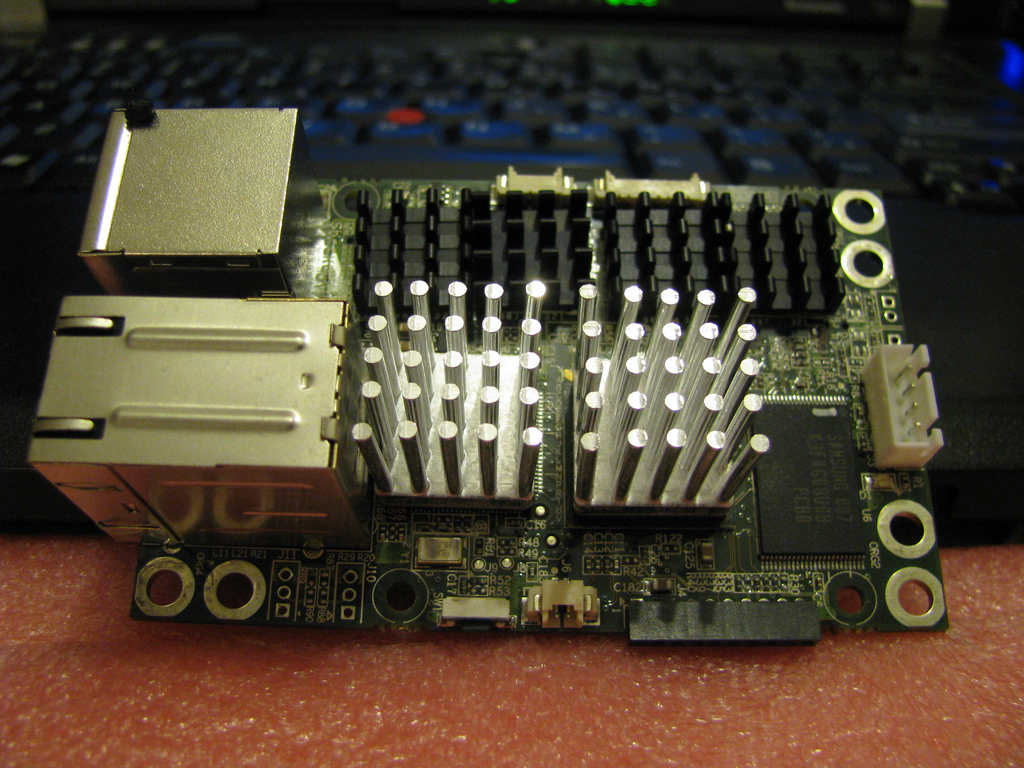
As mentioned in my last blog post the GuruPlug Server Plus needs some major refactoring before it can be used. Not doing so will make you end up with a fried brick. There are various stories in the forums about cooling it properly, so you might want to have a look first instead of following mine blindly. And of course - whatever you do - it is your fault when you end up with a brick, not mine!.

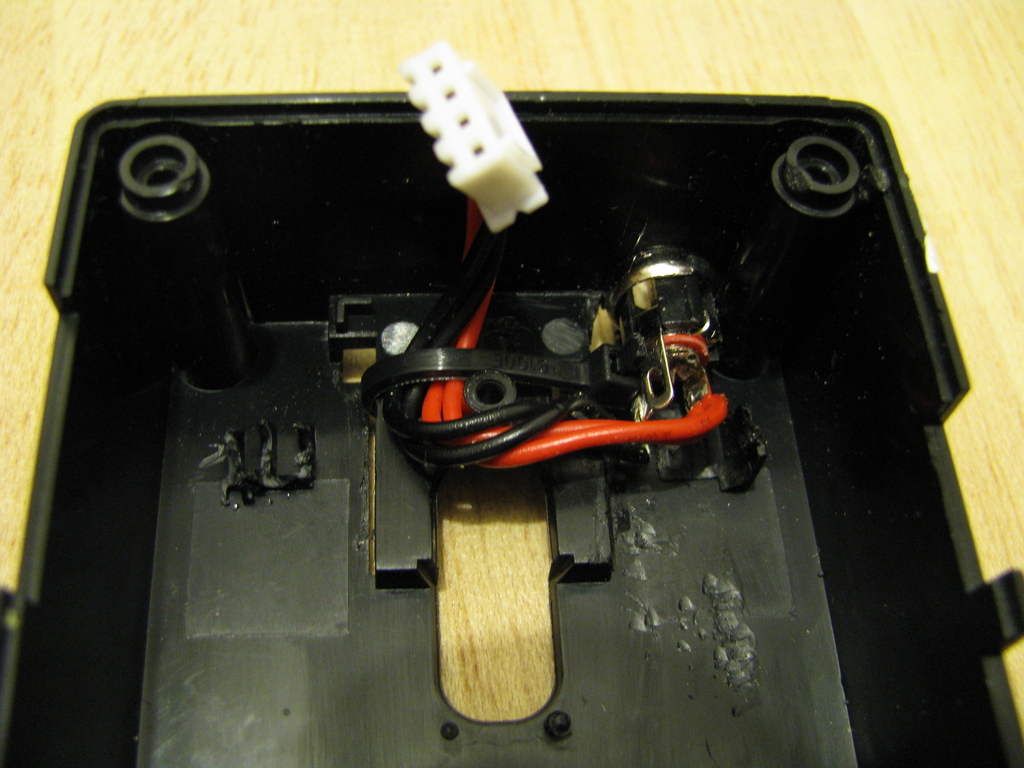
Replacing the power supply As I would never ever trust the PSU (see my last blog post for the gory details) and some additional free space in the case is necessary, it is time to rip it out. As replacement I've ordered an external 5V/20W PSU. To connect it to the plug I've drilled a hole into the case and added a proper connector after soldering the original cable from the old PSU to it. Make sure to add some retainer to stop the cable from touching the CPU/memory heat sinks later. GuruPlug Server Plus PSU replacement GuruPlug Server Plus PSU cabling

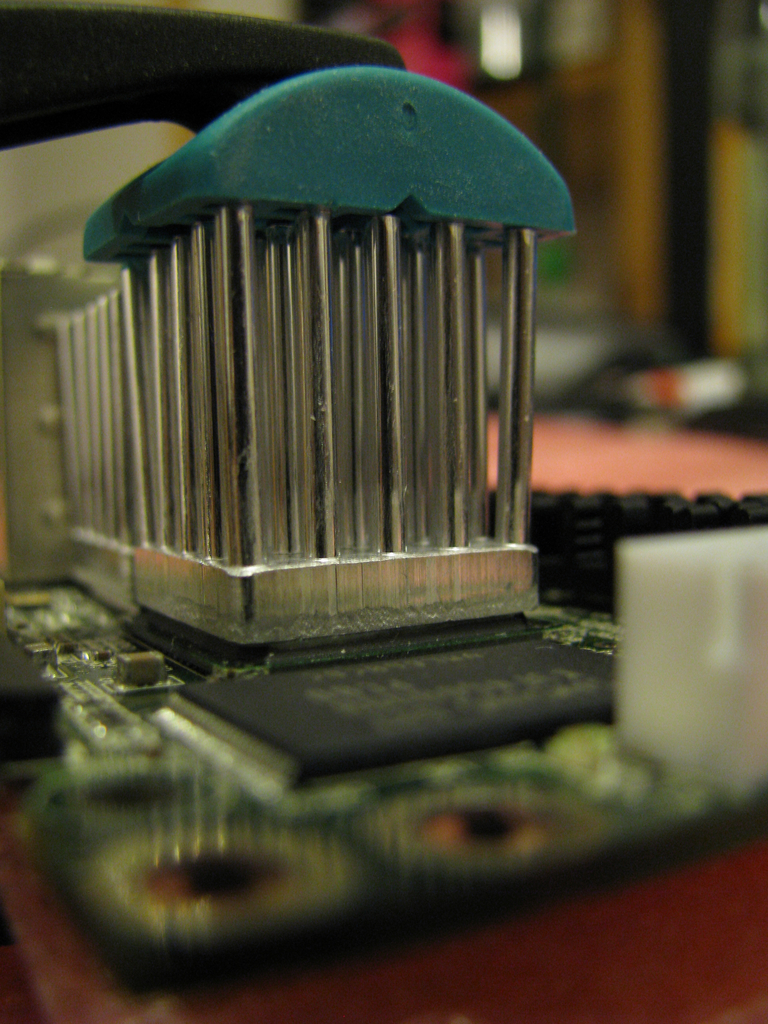
Proper heatsinks One of the biggest problems in the original GuruPlug design is the heat spreading and collecting piece of alloy, which probably makes things even worse than better. After some discussion in #debian-devel the idea came up, that the board should be able to run fine without a heatsink - at least when idling. That is the case, indeed. So let's get rid of that piece of alloy, together with the holders and springs. Unfortunately heat things are necessary to handle some work load. To mount them make sure you get some good thermal glue as you don't want to insulate the chips from their heat sinks. I've used Arctic Silver II thermal glue - not cheap, but working well. Make sure to clean the heat sinks and chips properly with alcohol (2-Propanol is my favourite for that), so there is no fat and dust left. When you use the glue be careful to read the documentation properly and make sure you apply only as much as necessary - a thin coating is enough. After applying the glue and mounting the heat sink you need a clamp to put some pressure on it while the glue dries.

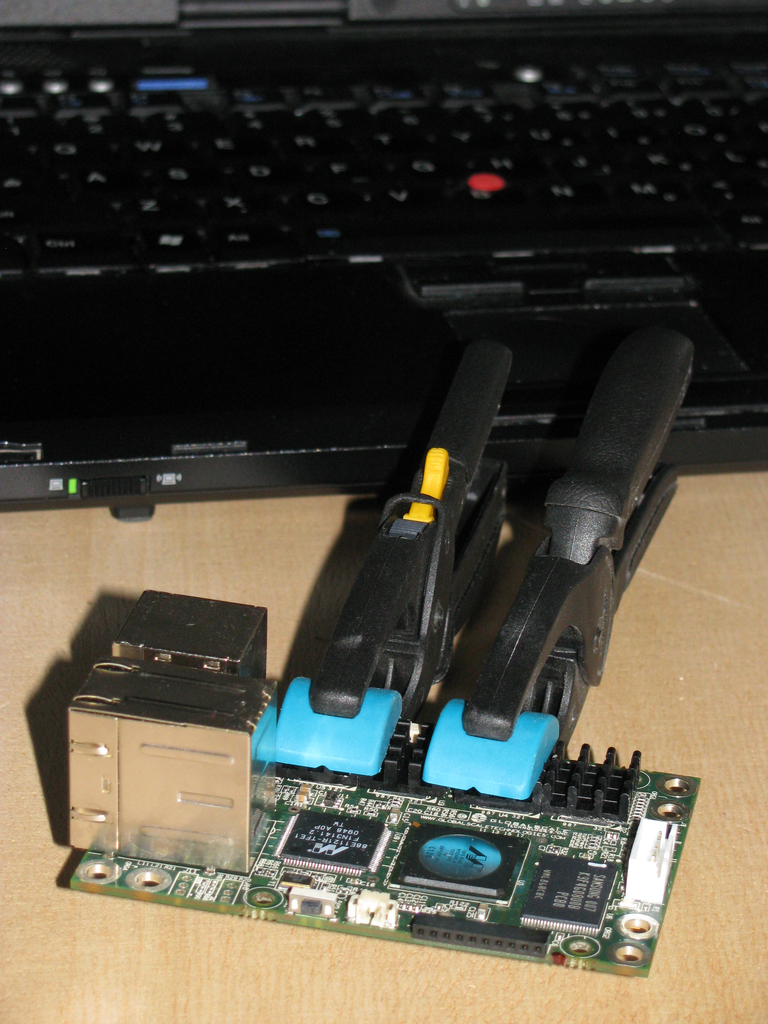
Heat sinks for the memory As there is a lot of space around the memory chips, I've got some 14x14x6mm heat sinks. Luckily there are only small parts on the other side of the board, so it was not hard to attach clamps to ensure the glue is able to dry properly. In case largish amounts of glue are squeezing out between heat sink and chip you probably want to start from scratch and clean everything (quickly!) with alcohol again. GuruPlug Server Plus memory heat sink clamping

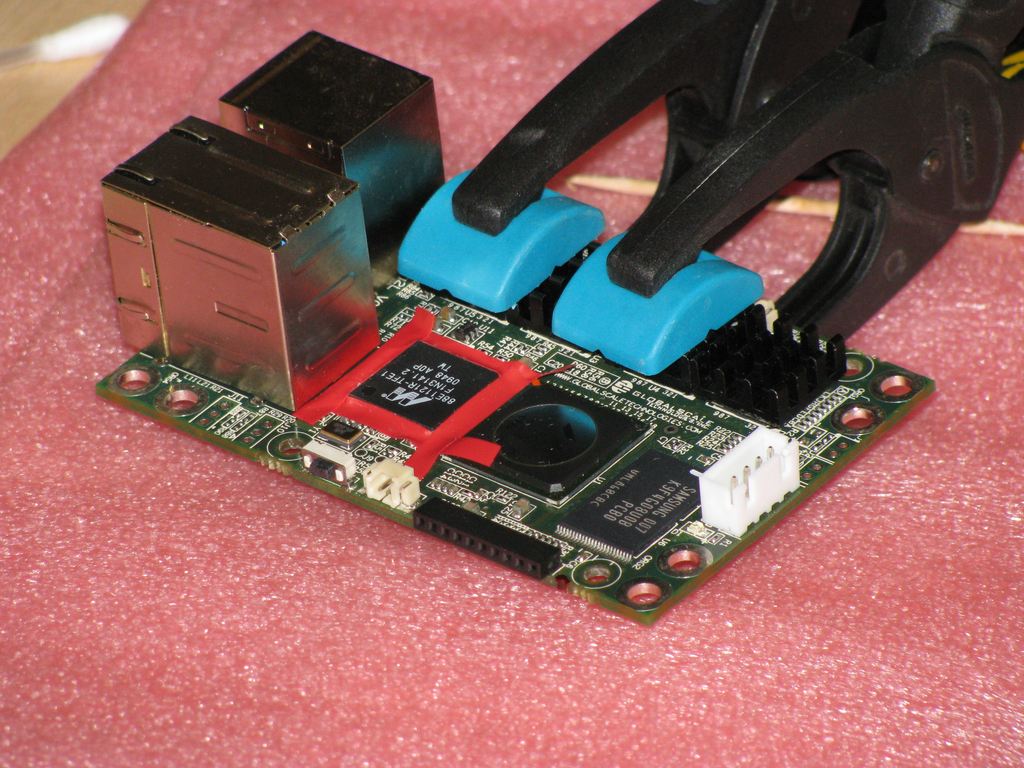
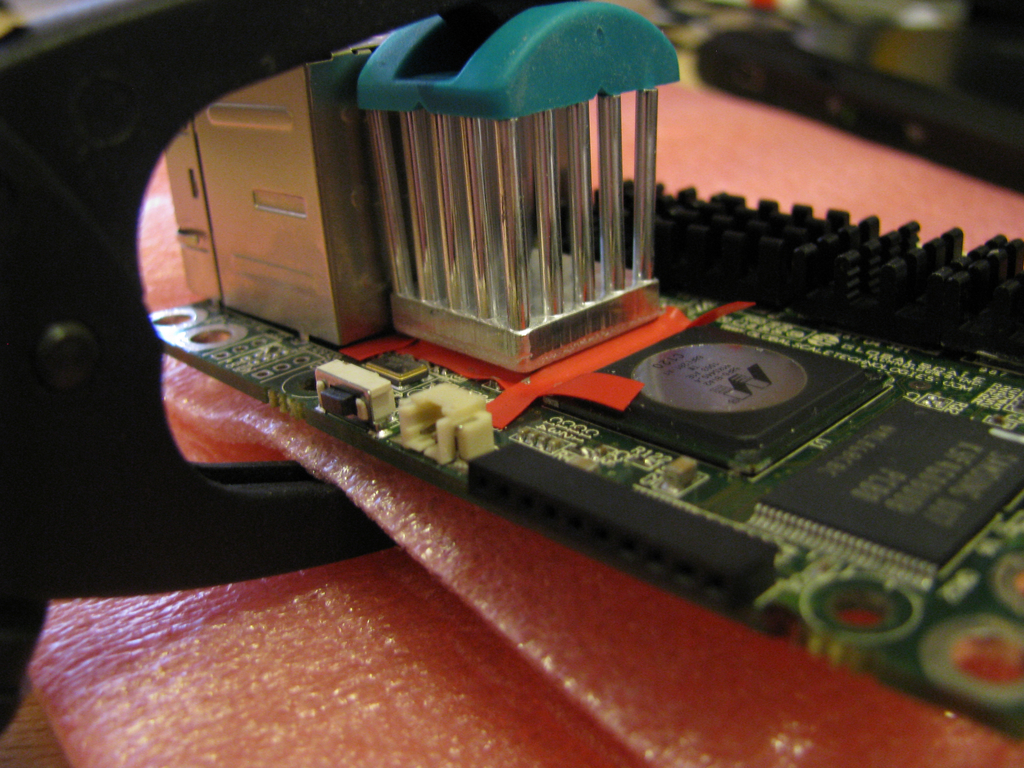
Gigabit Ethernet PHY and CPU heatsinks PHY and CPU need proper heatsinks as they're becoming pretty hot under load. Due to space limitations I had to stick with a 17x17x20mm heat sink for the PHY. I've tried to get a largish heat sink with BGA mount for the CPU, but I was not able to find one in short time and without ordering 1000 of them. So I've got another one of the 17x17x20mm model for the CPU. Later I found two other heat sinks which might fit on the GuruPlug's CPU: Malico 19x19x25mm or a Advanced Thermal Solutions Maxigrip. But for now the smaller one will have to do the job, also I'm scared to removed it without destroying the CPU. To mount the heat sink on the PHY a bit of preparation is necessary to ensure that the glue doesn't result in short cuts on the IC's pins. The arctic silver documentation recommends to use silicone on the pins to stop the glue. As I neither had the proper silicone nor did I want to make such a mess, I've decided to get a sticky insulating tape and some tooth picks to mount it properly on the IC pins. Make sure to do a proper job here! With good clamps you can work on the PHY while the memory heat sink glue is still drying. GuruPlug Server Plus - preparing the PHY The other problem on this side of the board is that some higher parts are mounted on the lower side of the board, so make sure to get some foam to protect them from your clamps. Except of the size of the heat sinks there is no real difference to the small ones: add glue, mount the heat sink and fix it with a clamp. GuruPlug Server Plus - mounting the PHY heatsink Before the glue dries completely make sure you remove the duct tape strips again. Be careful not to wipe any excess glue onto the IC pins. If you manage to do so you might want to remove and clean everything properly. So just be careful and everything should be fine. GuruPlug Server Plus - mounting the PHY heatsink 3 Mounting the heat sink on the CPU is easier as the CPU is a nice BGA package. No need to protect pins an there are none. GuruPlug Server Plus - mounting the CPU heatsink

Finished As you're able to see on the photo I did not the very perfect job, but fine enough to work properly. GuruPlug Server Plus - heatsinks

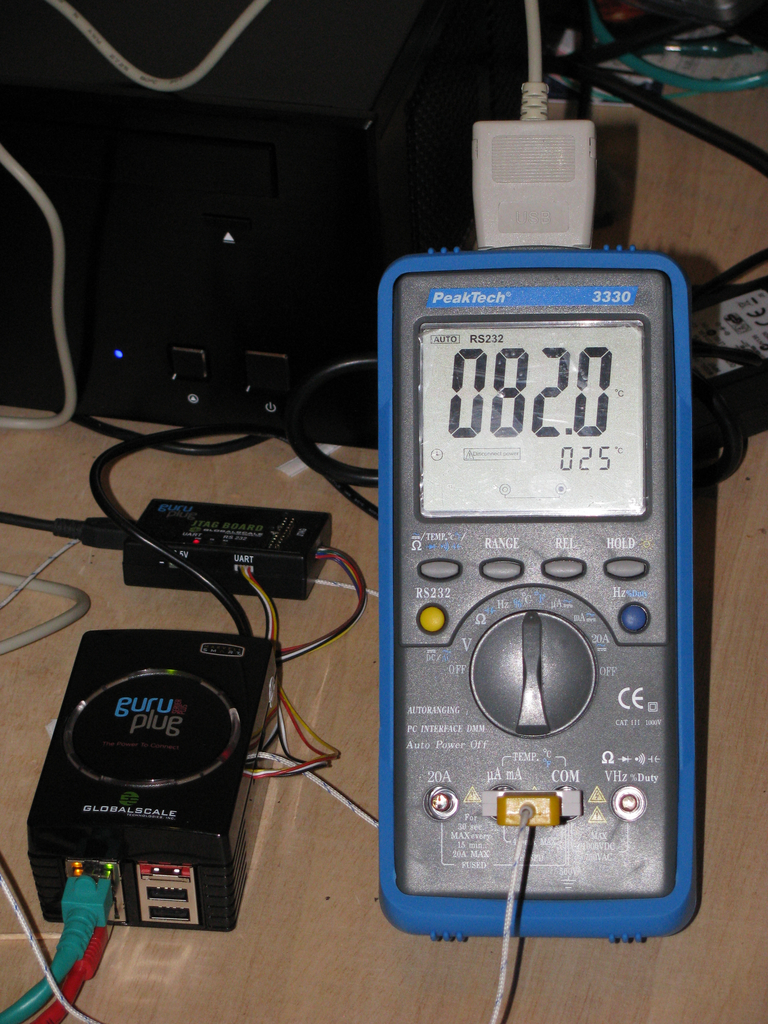
First tests with the new heatsinks Some tests with stress and some heavy network traffic showed quickly that the heat sinks are working well! But not well enough to be able to mount them into the original closed case (how the hell was this supposed to work before!?). Without any air to breath the temperature on the CPU heat sink went up to 85 deg C quickly. So on the CPU's die are > 100 deg C, which is at least close to the max allowed temperature. GuruPlug Server Plus - still too hot

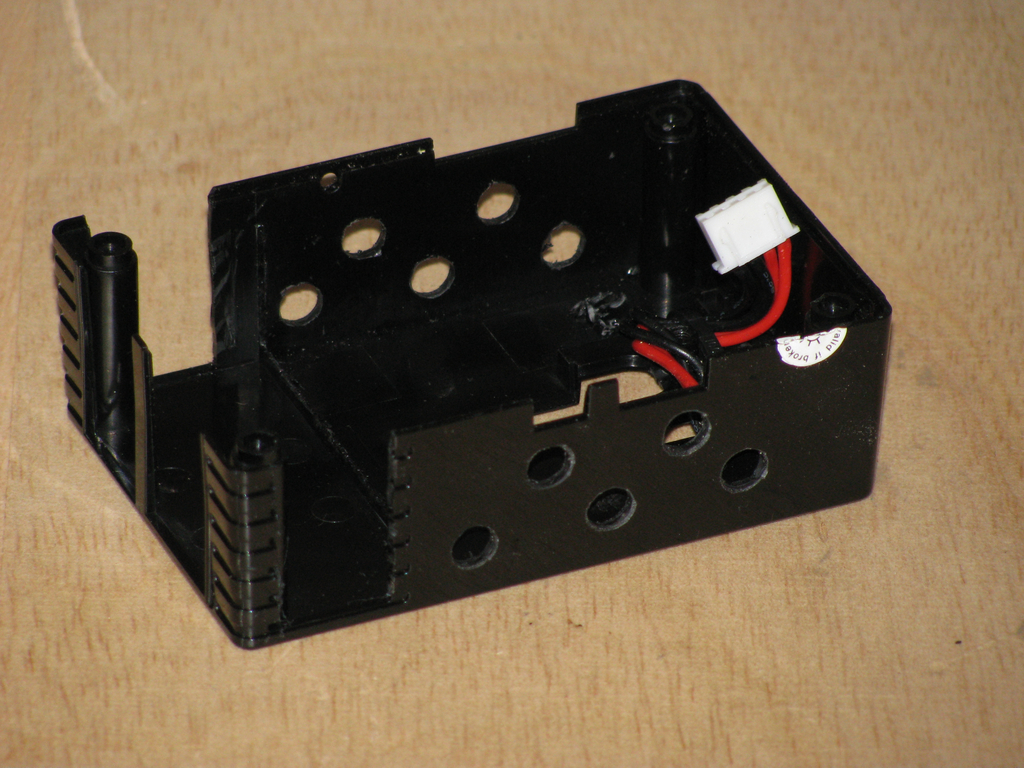
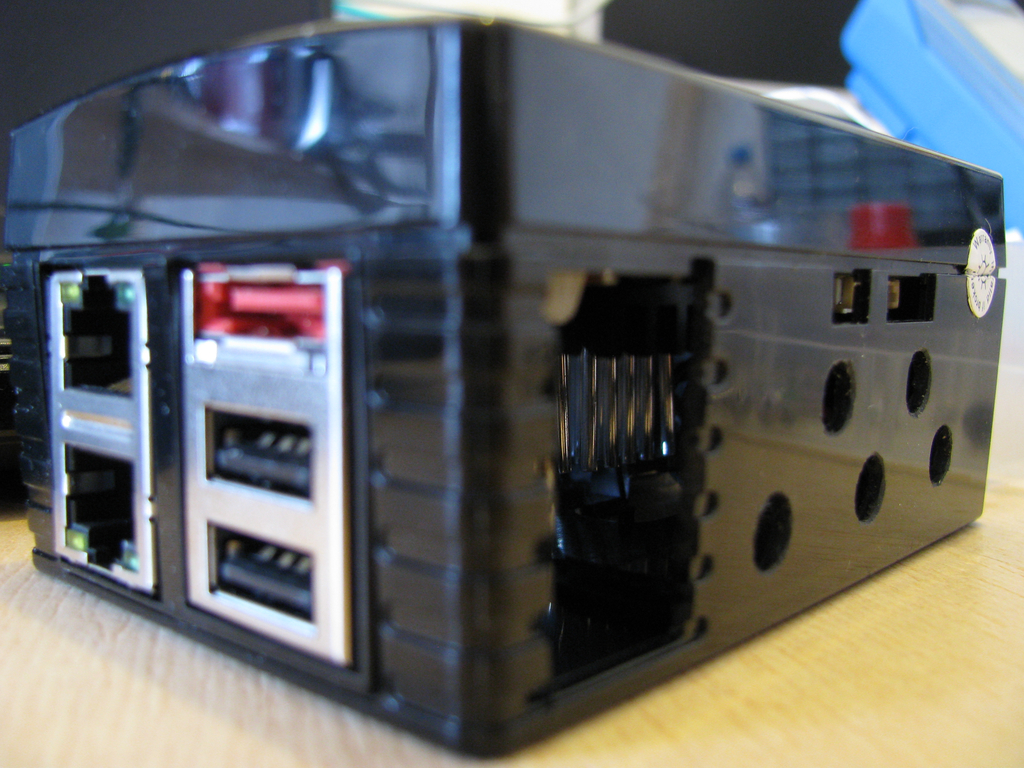
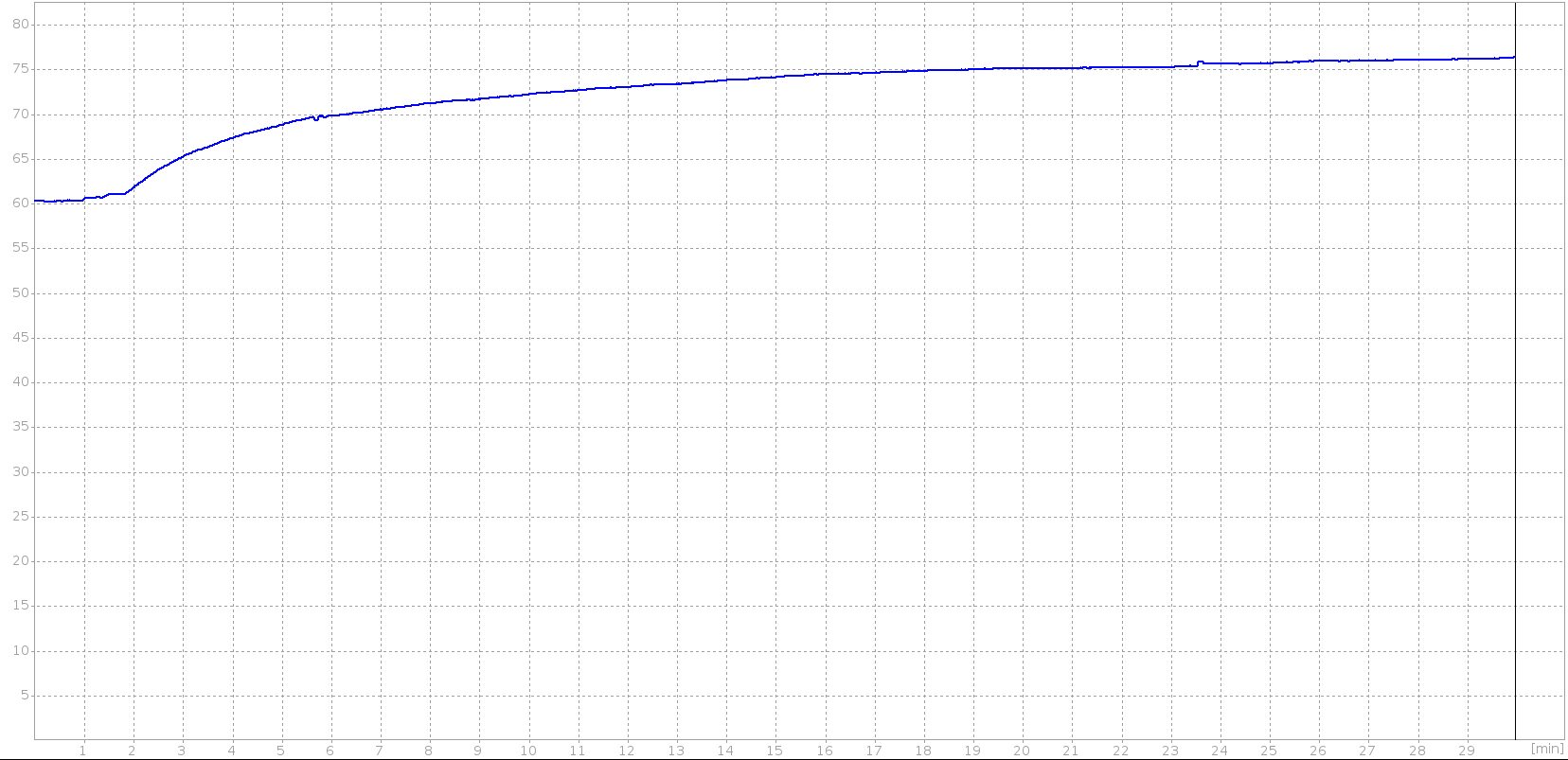
Adding air holes Obviously some additional air holes are necessary. After meeting my drill and cutter, the original case looks a bit like a piece of cheese now. GuruPlug Server Plus - case with air holes 1 GuruPlug Server Plus - case with air holes 2 Some more tests show that the temperature sticks around 76 deg C under heavy load now. That is still pretty hot, especially when the temperature in the room becomes hotter in summer. As I'm not going to run a lot of traffic trough it (my cable connection is limited to 20 MBit/s anyway), I guess it will work. Below is a graph I've recorded with my multimeter and qtdmm. It shows that the temperature rises to ~76 deg C and stays there. GuruPlug Server Plus - temperature curve Not sure if I could introuce some more load, the CPU had a load of 6 running stress. Network traffic was around 2x100MBit/s again. I could imagine with 2xGBit the CPU and PHY would become much hotter (no idea if it would be able to handle it at all, though). The PHY was usually a bit cooler than the CPU, so I didn't spend time to measure the temperature properly.

Conclusion My opinion is still the the original design of the plug is an insane QA and design failure. There is no way that it could ever work as shipped originally. If I'd have to design a new case for it, it should have a single insulated compartment for a PSU to ensure that no contact with high voltage is possible. The case around all other parts should be made of alloy with a lot of air holes. So the case could be used as heat sink (properly done, not with these insulating duct tape strips) and at the same time allow air circulation and a nice view on the LEDs on the board. Of course the case would be much more expensive than, but I'm sure it would work properly and would be worth the money. And if done peoperly, it would look much better than this blinking plastic thing. I could imagine it would sell well! So at the end I'm wondering what GlobalScale Technologies will do. I doubt it will be possible to create the 'professional upgrade kit' as they had announced before. Replacing all units is the only proper way. We'll see what happens. At least my GuruPlug is working well now and it will be used as replacement for my OpenWRT router soon. WiFi is not working, but that will be handled by my media center anyway. GuruPlug Server Plus - running plug

Joey Hess: sunny day

I'm back in town. After approximatly 4 full days of use, the first battery bank dropped to 9 volts, my cutoff point for safe use. Which turned out to be below the safe use point of my laptop power adapter, which burnt out while I was busy listening to music and adding power-saving caching stuff to my mpd setup. Irony not appreciated, world. I decided to come back while the other bank is still relatively full.
my modest PV array
Hurrying downtown to grab lunch in between work on Branchable, I noticed it was a beautiful sunny day, and I realized that this makes such days even better, because besides enjoying them, I know I'll be enjoying the yield on chilly nights sometime later. Well, in theory. Actually, the very antique charge controller in the house was dead and bypassed, so I removed it. I called its manufacturer wondering if it could be refurbished, but they suggested it belonged in a museum. So I've ordered a new controller, a Xantrex C-35. Until that comes, pretty days like today will charge, or possibly over-charge the batteries, which will then drain back out at night.

Dirk Eddelbuettel: Rcpp 0.8.6

After a somewhat longer than usual break, we now have a new release of Rcpp on CRAN and in Debian. This release adds quite few things. The main one may be the addition of density, distribution, quantile and random number functions for a rather large number of statistical distribution. Usage is pretty much as it would be in R, yet it is vectorised at the C++ level. A fair number of unit tests were added too, but some work is left to do there too.
Support for complex number was enhanced both in the expressive 'sugar' context and via a few binary operators that had been missing. We also started a new vignette to provide a 'quick reference'; unfortunately this is not quite complete yet. The NEWS entry follows below:
0.8.6   2010-09-09
    o	new macro RCPP_VERSION and Rcpp_Version to allow conditional compiling
        based on the version of Rcpp
    
           #if defined(RCPP_VERSION) && RCPP_VERSION >= Rcpp_Version(0,8,6)
           ...
           #endif
    o   new sugar functions for statistical distributions (d-p-q-r functions)
	with distributions : unif, norm, gamma, chisq, lnorm, weibull, logis,
	f, pois, binom, t, beta.
    o   new ctor for Vector taking size and function pointer so that for example
    	   NumericVector( 10, norm_rand )
	generates a N(0,1) vector of size 10
    o   added binary operators for complex numbers, as well as sugar support 
    o   more sugar math functions: sqrt, log, log10, exp, sin, cos, ...
    o	started new vignette Rcpp-quickref : quick reference guide of Rcpp API
        (still work in progress)
    o	various patches to comply with solaris/suncc stricter standards
    o	minor enhancements to ConvolutionBenchmark example
    o	simplified src/Makefile to no longer require GNU make; packages using
        Rcpp still do for the compile-time test of library locations
    
As always, even fuller details are in Rcpp Changelog page and the Rcpp page which also leads to the downloads, the browseable doxygen docs and zip files of doxygen output for the standard formats. A local directory has source and documentation too. Questions, comments etc should go to the rcpp-devel mailing list off the R-Forge page

Lior Kaplan: Hebrew translation and Bidi issues in Openoffice 3.3 (beta)

In the last few years the Israeli government founded some work on openoffice.org by Tk Open Systems Ltd. During the years, the work has resulted with an Israeli version , released after the official release and includes a lot of patches to improve support for Bidi and Hebrew specifically. Although most patches were submitted to the hamburg , a lot of them weren t used and are still waiting for inclusion. The funding the that projects stopped a year ago (9/2009), and the last release of the Israeli version is 3.1.1. Since then we had a quiet period in which 3.2 and 3.2.1 were released. While still enjoying the fruits of the projects in these version, it seems that it s time for the community to take over, as we lost hopes for yet another funds from the government. In may Netanel and I started talking about taking over the Hebrew translation, and in June we got Hebrew added to the openoffice.org pootle server. We started with about 80%, and got to 86% in time to get to the list of languages getting a language pack built for. This was a first achievement as Hebrew didn t have a language pack since early on the 2.x versions. I believe that working as part of the openoffice.org l10n group and with openoffice.org release schedule will only benefit for the Hebrew translation process. We used the language pack to test the translation and improve it. We also were able to get to 89% with the help of more volunteers.I believe it s now much more consistent than before. In the process with manually checked Writer thoroughly, while Calc and Impress got less attention due to the time frame. But we fixed some major translation issues in all of the three components. While testing the translation we also started to report Bidi issues we saw in 3.3 beta, hoping they will be fixed for the final release. For example, the main openoffice.org screen on windows has is getting repainted wrongly when moving the mouse over the options (text, spreadsheet..). This looks very badly as this is the main screen! See issue #97556 for details
Openoffice.org main screen in RTL UI

In RTL UI the main screen doesn't get repaited properly.

In addition to report new issues, we also started to keep track of the already opened issues regarding Bidi and Hebrew. I m following the issue system for a few years now, but seeing the list of issues organized in the wiki gave me a better orientation in the problems we have. E.g. finding some related or similar issues and mention each other in the comments, when someone goes to first one, he could also fixed the other as the problem is similar and probably comes from the same code. Organizing also the already closed bugs in 3.x, gave me a some kind of a changelog for the Bidi and Hebrew related issues. In that manner, version 3.1 was a very good for Bidi, thanks for a lot of efforts and work with the Bidi meta issue #79434. The wiki page is in Hebrew, but looks quite OK with Google translate (see here). Hoping to have 3.4 a major release (Bidi wise), I ve opened issue #114236 as another meta issue for Bidi related issues. I ve kept Hebrew specific issues out, as to get it more general and also relevant for Bidi users in other languages. Any help of those issues will be more than welcome (starting with votes and ending with patches).
Filed under: i18n & l10n, Israeli Community, Openoffice.org

Next.

Previous.