A new package! A couple of weeks ago folks at Google released CCTZ: a C++ library for translating between absolute and civil times using the rules of a time zone. It requires only a proper C++11 compiler and the standard IANA time zone data base which standard Unix, Linux, OS X, ... computers tend to have in /usr/share/zoneinfo.
And as the world needs nothing more than additional date, time, or timezones libraries, I started to quickly create a basic R wrapper package. This stalled as the original version of CCTZ used an __int128 for extended precision. That is not only not portable, but also prohibits compilation on baby computers still running a 32 OS (such as my trusted X1 laptop merrily plugging along with 4 gb of ram under Linux). Hence I filed an issue ticket which, lo and behold, got resolved two days ago.
And so now we have a shiny new RcppCCTZ package on CRAN in a very basic version 0.0.1. It happily runs all the original examples from CCTZ as e.g. this one:
// from examples/hello.cc//// [[Rcpp::export]]int helloMoon()
cctz::TimeZone syd;
if (!cctz::LoadTimeZone("Australia/Sydney", &syd)) return-1;
// Neil Armstrong first walks on the moonconstauto tp1 = cctz::MakeTime(1969, 7, 21, 12, 56, 0, syd);
const std::string s = cctz::Format("%F %T %z", tp1, syd);
Rcpp::Rcout << s << "\n";
cctz::TimeZone nyc;
cctz::LoadTimeZone("America/New_York", &nyc);
constauto tp2 = cctz::MakeTime(1969, 7, 20, 22, 56, 0, nyc);
return tp2 == tp1 ? 0 : 1;
indicating that the two civil times in fact correspond to the same absolute times when Armstrong walked on the moon.
If you want to learn more about CCTZ, there was a corresponding talk CppCon (Youtube, Slides).
I hope this provides a starting point for some new interesting computation on time from R. Collaboration welcome via the RcppCCTZ GitHub repo.
FTP assistant
This month I marked 352 packages for accept and rejected 61 of them. I had to send only 15 emails to maintainers.
I also started to work on #796095 and #796784, but my first patch was rejected. So expect more to come here
Squeeze LTS
This was my seventeenth month that I did some work for the Squeeze LTS initiative, started by Raphael Hertzog at Freexian.
Due to Toshiba becoming the first platinum sponsor, I got a workload of 21.25h. This is a new and delightful record! Altogether I uploaded those DLAs:
[DLA 341-1] php5 security update
[DLA 343-1] libpng security update
[DLA 355-1] libxml2 security update
[DLA 356-1] libsndfile security update
I also started to work on two bugs that were filed against the pseudo-package ftp.debian.org, which are somehow related to the security team: #796095 and #796784 (see above). Moreover I started to work on the next php5 upload, which will happen at the end of December.
As more and more people work at the LTS frontdesk now, this month I could chill out a bit and let the others do the work.
Other stuff
As the Advent season started again I would also like to draw some attention to the Debian Med Advent Calendar. It was announced here and like the past years, the Debian Med team starts a bug squashing event from the December 1st to 24th. Every bug that is closed will be registered in the calendar. So instead of taking something from the calendar, this special one will be filled and at Christmas hopefully every Debian Med related bug is closed. Don t hestitate, start to squash .
This was my seventh month as a Freexian sponsored LTS contributor. I was assigned 8 hours for the month of November.
As I did last month, I worked on review and testing of the proposed MySQL 5.5 packages for squeeze-lts and did a bit more work on Quassel. It has been suggested that maybe we ought to just EOL Quassel since backporting the necessary fixes is so complicated. I think they may be right, but I haven t quite given up yet.
I reviewed CVE-2015-6360 for SRTP and my assessment was that squeeze-lts was not affected (same for the other Debian releases while I was at it).
I published one security update, it was for libphp-snoopy. This resolves the outstanding security issues by updating to the newest version as was done for all other Debian releases.
Finally, in the interest of getting better support in tools for Debian LTS, I came up with a patch for the pull-debian-source[1] script in ubuntu-dev-tools so that it will download Debian LTS packages correctly. Although it took a bit of investigating, the patch turned out to be very simple. I filed bug #806749. I also started looking at the distro-info package (thinking I d need it updated to fix pull-debian-source, which turned out not to be the case), but didn t finish it yet. I plan to work on that this month.
[1] Even though this is in ubuntu-dev-tools and not devscripts, there s really nothing Ubuntu specific about it.
I think it s important that organizations as Software Freedom Conservancy exist.
They provide a non-profit home, infrastructure, and advice for FLOSS projects. They take care that the will of the project members, choosing free software licenses, is respected by third parties. They care about all the rest so free software contributors can focus in improving the software itself. They have an agreement with the Debian community to protect the freedoms that Debian Developers provide to the Debian end users (and derivative distributions).
So I decided to join as supporter. I m happy that this week there is a matching fund so my donation will count double.
I hope that many others join too, so the organization s voice and action continues loyal to their goals and representative of all the projects (wether big or small) under their umbrella. This way (small donations from many individuals as funding model), no single or few actors can use their big money as pressure to deviate or block Conservancy s action.
We free software/free knowledge contributors know very well the power that many micro actions can provide, when coordinated towards the common good, isn t it? Filed under: My experiences and opinion Tagged: Communities, Contributing to libre software, Debian, Economic Aspects, English, Free Software, licenses, Project Management
When Akonadi silently fails to sync your calendar...
Bug severity: seriously ruining my life.
Try to use korganizer to create a calendar entry when the server is not
reachable (say, you are offline, or you typed the wrong password), and you may
find that you end up with no error messages, an entry that shows up perfectly
fine, but that will never be synced to the server, ever again.
I use korganizer, radicale and caldav for important things. The practical
ramifications of me inserting entries in korganizer, seeing that everything
looks ok, and then not finding them on my phone while on the go, are scary.
Think of things like importing .ics files with flight schedules, entering tax
deadlines, time and places for customer meetings, time and places of arrival of
loved ones I'm supposed to pick up.
I spent time setting up my own infrastructure for this
exactly because I care that all of this works reliably.
And now I urgently took a morning off work to find a way
to detect those entries that Akonadi is refusing to update,
The whole thing is cumbersome to run, but if you are using kdepim-based tools
to manage your calendars and sync them across devices, you may want to give it
a go every once in a while.
You can find the script and the notes I took so far on the issue at https://github.com/spanezz/akonadi-workarounds.
I recently presented a talk at the Debian miniconf in Cambridge. This was a new talk explaining what goes on in a web browser to get a web page on screen.
The presentation was filmed and my slides are also available. I think it went over pretty well despite the venues lighting adding a strobe ambiance to part of proceedings.
I thought the conference was a great success overall and enjoyed participating. I should like to thank Cosworth for allowing me time to attend and for providing some sponsorship.
My monthly report covers a large part of what I have been doing in the free software world. I write it for my donators (thanks to them!) but also for the wider Debian community because it can give ideas to newcomers and it s one of the best ways to find volunteers to work with me on projects that matter to me.
Debian LTS
This month I have been paid to work 21.25 hours on Debian LTS. During this time I worked on the following things:
From November 2nd to November 8th, I was handling the LTS frontdesk, triaging new CVE, filing bugs, and ensuring timely answers on the mailing list. I pushed 26 commits to the security tracker. While investigating CVE-2015-7183 I discovered more embedded copies of nspr (which resulted in #804058). I also commented on the upstream fix for CVE-2015-5602 which looked like insufficient.
Prepared and released DLA-339-1 on libhtml-scrubber-perl fixing one CVE.
Prepared and released DLA-350-1 on eglibc with a non-trivial backport fixing one CVE.
Prepared and released DLA-353-1 on imagemagick fixing two security issues without CVE yet (and marking one as not-affecting squeeze).
Added a third patch after review by the upstream author on my still pending bouncycastle update. The upstream author asked me to further defer the update as they have some related fixes coming up.
I did preparatory work for DLA-352-1 by identifying the upstream commits that fixed the security issue.
I spent some time checking issues that have been assigned for a long time without any visible progress being made in the hope to unblock them (libvncserver, pound, quassel).
The Debian Administrator s Handbook
Now that the English version has been finalized for Debian 8 Jessie (I uploaded the package to Debian Unstable), I concentrated my efforts on the French version. The book has been fully translated and we re now finalizing the print version that Eyrolles will again edit.
Paris Open Source Summit
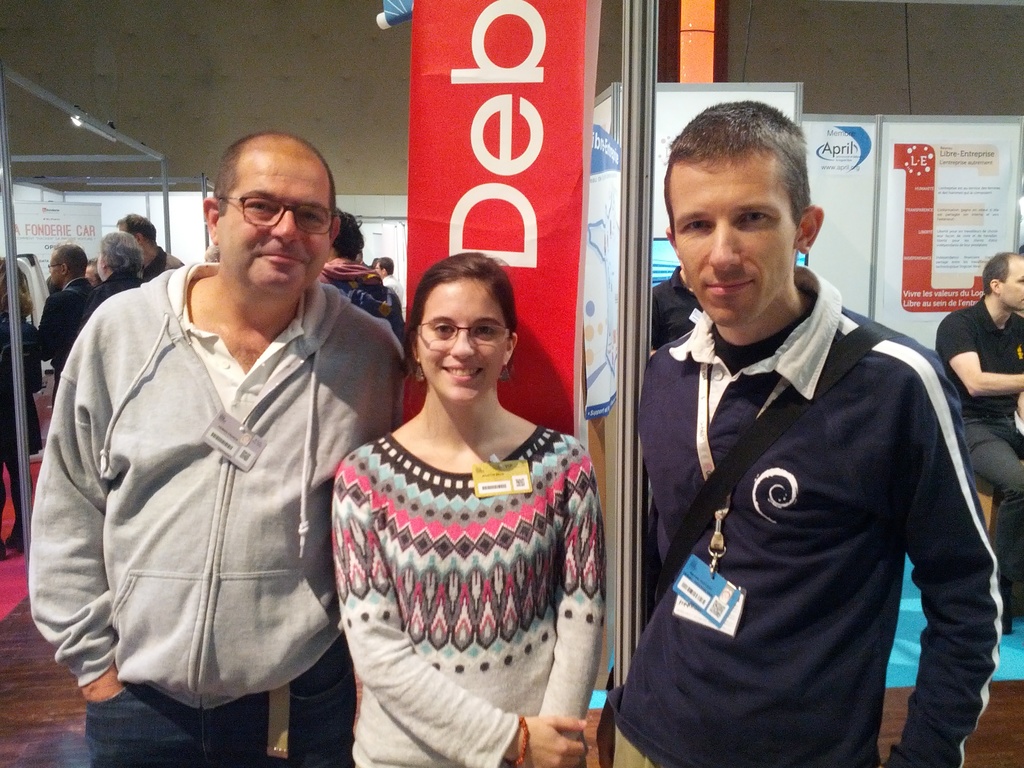
On November 18th and 19th, I was in Paris for the Paris Open Source Summit. I helped to hold a booth for Debian France during two days (with the help of Fran ois-R gis and several others).
Fran ois-R gis Vuillemin, Juliette Belin and Rapha l Hertzog
On the booth, we had the visit of Juliette Belin who created the theme and the artwork of Debian 8 Jessie. We lacked goodies but we organized a lottery to win 12copies of my French book.
Debian packaging work
Django. After two weeks of preparation for revers dependencies, I uploaded Django 1.8 to unstable and raised the severity of remaining bugs. Later I uploaded a new upstream point release (1.8.6). I also handled a release critical bug first by opening a ticket upstream and then by writing a patch and submitting it upstream. I uploaded 1.8.7-2 to Debian with my patch.
I also submittted another small fix which has been rejected because the manual page is generated via Sphinx and I thus had to file a bug against Sphinx (which I did). A work-around has been found in the mean time.
apt-xapian-index NMU. A long time ago, I filed a release critical bug against that package (#793681) but the maintainer did not handle it. Fortunately Sven Joachim prepared an NMU and I just uploaded his work. This resulted in another problem due bash-completion changes that Sven promptly fixed and I uploaded a second NMU a few days later.
Gnome-shell-timer. I forwarded #805347 to gnome-shell-timer issue #29 but gnome-shell-timer is abandoned upstream. On a suggestion of Paul Wise, I tried to get this nice extension integrated into gnome-shell-extensions but the request has been turned down. Is there anyone with javascript skills who would like to adopt this project as an upstream developer? It s a low maintenance project with a decent and loyal user base.
Misc. I fixed bug #804763 in zim which was the result of a bad Debian-specific patch.
I sponsored pylint-plugin-utils_0.2.3-2.dsc for Joseph Herlant to fix a release critical bug. I filed 806237 against lintian. I filed more tickets upstream, related to my Kali packaging work: one against sddm, one against john
Other Debian-related work
Distro-Tracker. I finally merged the work of Orestis Ioannou on bug #756766 which added the possibility to browse old news of each package.
Debian Installer. I implemented two small features that we wanted in Kali: I fixed #647405 to have a way to disable deb-src lines in generated sources.list files. I also filed #805291 to see how to allow kernel command line preseeding to override initrd preseeding the fix is trivial and it works in Kali. I just have to commit it in Debian, I was hoping to get an ack from someone in charge before doing it.
Thanks
See you next month for a new summary of my activities.
It has been seven years since I've joined SUSE (for second time, but that's different story). As everything has to come to the end, I've decided to make a change in my life and leave safety net of being employed and go for new experience with freelancer life.
This will give me more time to spend on free software projects where I'm involved. Of course I need to earn some money to live, so many decisions about where to spend my time will be backed by money...
First of all I will work on phpMyAdmin, where I was chosen as a contractor (of two for this year). This will be half time job for me and you will see weekly reports in my blog, similar to what Madhura is doing.
Second priority will be Weblate, especially the hosting solution. I believe that this is something what can work quite well in the long term, but the tool needs some development to make it as great as I would like to have it. If you want me to extend hosting for free software projects, you can do it by money :-).
And nobody knows what projects come next. There is some work to be done on Gammu and Wammu, but given that I don't have any recent device to use it, it's sometimes hard to fix the bugs there. Of course this can change if I get some money to work on that.
PS: It's not that SUSE would be bad place to work. It's actually pretty great if you're looking for work with free software. You work there on free software, with great people and you get quite some freedom. As bonus once or twice in a year, there is Hackweek which you can spend on anything. And of course they have lot of open positions :-).
In case you are going to
32C3, you may be
interested to join us at the Debian
Assembly there.
As in the last years, this is going to be fairly informal, so if you are
loosely affiliated with Debian or want to become a member by the time 34C3
rolls around, you are more than welcome to show up and sit there.
mcd is the oldest one and the simplest. The others are just useful git management shortcuts. I can use gum to bring a feature branch back to master and gsb to show me which branches need to be rebased on master, typically after a pull. The list of excluded branches includes branches which should not be rebased against master (I could do some processing of git branch -r to not have those hardcoded) but the odd one is stale. Sometimes, I get an idea for a feature which is too intrusive, too messy or just too incomplete to be rebased against master. Rather than losing the idea or wasting time rebasing, I m getting into the habit of renaming the branch foo as stale-foo and gsb then leaves it alone. Equally, there are frequently times when I need to have a feature branch based on another feature branch, sometimes several feature branches deep. Identifying these branches and avoiding rebasing on the wrong branch is important to not waste time.
gsb takes a bit of getting used to, but basically the shorter and cleaner the output, the less work needs to be done. As shown, gsb is git show-branch under the hood. What I m looking for is multiple commits listed between a branch and master. Then I know which branches to use with gum.
Finally, gleaf shows which feature branches can be dropped with git branch -d.
Moved my TP-Link TR-ML3020 router to OpenWRT and started to configure it using Ansible, without requiring Python to be installed on the target device. (code)
s vezes voc s quer um pouco mais de velocidade nos downloads do APT e n o tem muito como modificar muito a instala o do cliente. Duas dicas simples podem ganhar minutos preciosos:
Coloque em algum dos /etc/apt.conf.d (sugiro criar o /etc/apt.conf.d/71parallel) a seguinte linha:
Acquire::Queue-Mode "host";
Isso faz com que o modo de queue do APT seja orientado ao host e n o ao tipo de URL. Dependendo dos seus sources, isso acelera mais do que o modo access padr o.
A segunda dica um hack que encontrei h algum tempo em um blog que faz o download pr vio das URLs que ser o utilizadas na opera o do APT para o /var/cache/apt/archives usando xargs:
#!/bin/bash
NBATCH=3

NPARALLEL=5
(apt-get -y --print-uris $@ egrep -o -e "http://[^\']+" xargs -r -l$ NBATCH -P$ NPARALLEL wget -nv -P "/var/cache/apt/archives/") && apt-get $@
Ajuste os par metros NBATCH e NPARALLEL e boa sorte.
After 1.5 years of work we released APT 1.1 this week! I m very excited about this milestone.
The new 1.1 has some nice new features but it also improves a lot of stuff under the hood. With APT 1.0 we did add a lot of UI improvements, this time the focus is on the reliability of the acquire system and the library.
Some of the UI highlights include:
apt install local-file.deb works
apt build-dep foo.dsc works
apt supports most of the common apt-get/apt-cache commands so you save some typing :)
apt update progress reporting much more accurate
apt-cache showsrc --only-source srcpkgname does the right thing
The --force-yes option is split into the more fine grained --allow- downgrades, remove-essential, change-held options
Documentation and help output improvements
apt-mark supports more states
Support for deb822 style sources.list.d files
Under the hood:
No more guessing when fetching files (we did this to support old repository formats) only download stuff that is listed in the ,In release file).
support for by-hash index downloads (once the servers support that no more hashsum-mismatch errors because of proxies or transparent proxies)
we support downloading additional files that are opaque for apt itself (like apt-file or appstream data)
the acquire system is more atomic and more robust, no more issues with captive portals
protection about a class of endless-data attacks from hostile MITM
disallow signed repositories from ever becoming unsigned
privilege dropping in the acquire methods
if ,In Release did not change, do not bother checking the other indexes (lot less HITs on the mirrors on not-modified resources)
The Software Freedom Conservancy are desperately looking for financial support after one of their corporate supporters have stopped their sponsorship. This week, there s an anonymous pledge to match donations from new supporters.
Becoming an SFC supporter will help them fight for our software freedom. I have signed up for a monthly donation, and I suggest you do so too here.
Matthew Garrett s recent very good response to Eric Raymond s recent post opposing inclusiveness efforts in free software reminded me of something I ve been noticing more and more often: a very substantial proportion of the female developers I encounter working on the kernel are from non-European cultures where I (and I expect most people from western cultures) lack familiarity with the gender associations of all but the most common and familiar names. This could be happening for a lot of reasons it could be better entry paths to kernel development in those cultures (though my experience visiting companies in the relevant countries makes me question that), it could be that the sample sizes are so regrettably small that this really is just anecdote but I worry that some of what s going on is that the cultural differences are happening to mask and address some of the unconscious barriers that get thrown up.
A blog post from my fellow Debian developer Paul Wise titled
"The
GPL is not magic pixie dust" explain the importance of making sure
the GPL is enforced.
I quote the blog post from Paul in full here with his permission:
The GPL is not magic pixie dust. It does not work by itself.
The first step is to choose a
copyleft license for your
code.
The next step is, when someone fails to follow that copyleft license,
it must be enforced
and its a simple fact of our modern society that such type of
work
is incredibly expensive to do and incredibly difficult to do.
-- Bradley Kuhn, in
FaiFepisode
0x57
As the Debian Website
usedto
imply, public domain and permissively licensed software can lead to
the production of more proprietary software as people discover useful
software, extend it and or incorporate it into their hardware or
software products. Copyleft licenses such as the GNU GPL were created
to close off this avenue to the production of proprietary software but
such licenses are not enough. With the ongoing adoption of Free
Software by individuals and groups, inevitably the community's
expectations of license compliance are violated, usually out of
ignorance of the way Free Software works, but not always. As Karen
and Bradley explained in FaiFepisode 0x57,
copyleft is nothing if no-one is willing and able to stand up in court
to protect it. The reality of today's world is that legal
representation is expensive, difficult and time consuming. With
gpl-violations.org in hiatus
until
some time in 2016, the Software
Freedom Conservancy (a tax-exempt charity) is the major defender
of the Linux project, Debian and other groups against GPL violations.
In March the SFC supported a
lawsuit
by Christoph Hellwig against VMware for refusing to
comply
with the GPL in relation to their use of parts of the Linux
kernel. Since then two of their sponsors pulled corporate funding and
conferences
blocked
or cancelled their talks. As a result they have decided to rely
less on corporate funding and more on the broad community of
individuals who support Free Software and copyleft. So the SFC has
launched
a campaign to create
a community of folks who stand up for copyleft and the GPL by
supporting their work on promoting and supporting copyleft and Free
Software.
If you support Free Software,
like
what the SFC do, agree with their
compliance
principles, are happy about their
successes in 2015,
work on a project that is an SFC
member and or
just want to stand up for copyleft, please join
Christopher
Allan Webber,
Carol
Smith,
Jono
Bacon, myself and
others in
becoming a
supporter. For the
next week your donation will be
matched
by an anonymous donor. Please also consider asking your employer to
match your donation or become a sponsor of SFC. Don't forget to
spread the word about your support for SFC via email, your blog and or
social media accounts.
I agree with Paul on this topic and just signed up as a Supporter
of Software Freedom Conservancy myself. Perhaps you should be a
supporter too?
The following is a short summary of my open source work in November. My hope is
that keeping better track of what I m doing will help me reflect on how I spend
my time, and help me to focus my efforts better.
Debian
Completed the NM process and became a Debian Developer in the end of October.
Released
Mopidy-Spotify 2.2.0:
Fixes related to duplicate Starred playlists and albums from year 0.
Moved Mopidy s Travis CI testing from Ubuntu 12.04 to Ubuntu 14.04, to
prepare for GStreamer 1.x, and eventually testing with Python 3.4.
PR #1341
Worked on porting Mopidy from GStreamer 0.10 to PyGI and GStreamer 1.x.
PR #1339
Briefly looked at what remains to get Mopidy running on both Python 2.7 and
3.4+ when we ve landed the port to GStreamer 1.x. Doesn t look too bad,
except that ConfigParser doesn t want to work with bytes in Python 3, so
there s no easy way to read a config file referring to a path on a non-UTF-8
file system.
Comics
Fixed two old crawlers. Added two new crawlers.
Needs to upgrade to Django 1.8 before the Django 1.7 security support ends
this December.
 A new package! A couple of weeks ago folks at Google released CCTZ: a C++ library for translating between absolute and civil times using the rules of a time zone. It requires only a proper C++11 compiler and the standard IANA time zone data base which standard Unix, Linux, OS X, ... computers tend to have in
 .
 I think it s important that organizations as


 My monthly report covers a large part of what I have been doing in the free software world. I write it for
 It has been seven years since I've joined
 Already December. 2015 is going to close.
 In case you are going to
 What happened in the
 Just in case someone else finds these useful, some bash functions I ve got into the habit of having in
 Here is my monthly update covering a large part of what I have been doing in the free software world (
 s vezes voc s quer um pouco mais de velocidade nos downloads do APT e n o tem muito como modificar muito a instala o do cliente. Duas dicas simples podem ganhar minutos preciosos:
Coloque em algum dos /etc/apt.conf.d (sugiro criar o /etc/apt.conf.d/71parallel) a seguinte linha: